


Journal Menu
► ▼ Journal Menu-
- Microorganisms Home
- Aims & Scope
- Editorial Board
- Reviewer Board
- Topical Advisory Panel
- Early Career Editorial Board
- Instructions for Authors
- Special Issues
- Topics
- Sections & Collections
- Article Processing Charge
- Indexing & Archiving
- Editor’s Choice Articles
- Most Cited & Viewed
- Journal Statistics
- Journal History
- Journal Awards
- Society Collaborations
- Conferences
- Editorial Office
Journal Browser
► ▼ Journal BrowserNeed Help?
Announcements
3 July 2026
Microorganisms | Hot Papers in the “Microbiomes” Section
The “Microbiomes” Section publishes reviews and original papers on microbial community composition, diversity, and dynamics across different environments. It focuses on the functional roles of microbiome members, their metabolic and immunological interactions with hosts (human and animal), and their impact on health and disease. The Section integrates basic ecology with translational applications to advance microbiome-driven solutions for host and ecosystem health.
1. “Oral Microbiome: A Review of Its Impact on Oral and Systemic Health”
by John J. Rajasekaran, Hari Krishnan Krishnamurthy, Jophi Bosco, Vasanth Jayaraman, Karthik Krishna, Tianhao Wang and Kang Bei
Microorganisms 2024, 12(9), 1797; https://doi.org/10.3390/microorganisms12091797
Available online: https://www.mdpi.com/2076-2607/12/9/1797
2. “Metagenome-Assembled Genomes (MAGs): Advances, Challenges, and Ecological Insights”
by Salvador Mirete, Mercedes Sánchez-Costa, Jorge Díaz-Rullo, Carolina González de Figueras, Pablo Martínez-Rodríguez and José Eduardo González-Pastor
Microorganisms 2025, 13(5), 985; https://doi.org/10.3390/microorganisms13050985
Available online: https://www.mdpi.com/2076-2607/13/5/985
3. “Unveiling the Probiotic Potential of Streptococcus thermophilus MCC0200: Insights from In Vitro Studies Corroborated with Genome Analysis”
by Neelam Kapse, Vaidehi Pisu, Tanisha Dhakephalkar, Prajakta Margale, Deepa Shetty, Shilpa Wagh, Sumit Dagar and Prashant K. Dhakephalkar
Microorganisms 2024, 12(2), 347; https://doi.org/10.3390/microorganisms12020347
Available online: https://www.mdpi.com/2076-2607/12/2/347
4. “The Potential Harmful Effects of Genetically Engineered Microorganisms (GEMs) on the Intestinal Microbiome and Public Health”
by Aaron Lerner, Carina Benzvi and Aristo Vojdani
Microorganisms 2024, 12(2), 238; https://doi.org/10.3390/microorganisms12020238
Available online: https://www.mdpi.com/2076-2607/12/2/238
5. “Characteristics of Vaginal Microbiota of Women of Reproductive Age with Infections”
by Wanting Dong, Siyi Wang, Xi Wang, Guojin Xu, Qiuying Liu, Zheng Li, Na Lv, Yuanlong Pan, Qian Xiong, Donglai Liu and Baoli Zhu
Microorganisms 2024, 12(5), 1030; https://doi.org/10.3390/microorganisms12051030
Available online: https://www.mdpi.com/2076-2607/12/5/1030
6. “Effects of Polycyclic Aromatic Hydrocarbons on the Composition of the Soil Bacterial Communities in the Tidal Flat Wetlands of the Yellow River Delta of China”
by Yue Qi, Yuxuan Wu, Qiuying Zhi, Zhe Zhang, Yilei Zhao and Gang Fu
Microorganisms 2024, 12(1), 141; https://doi.org/10.3390/microorganisms12010141
Available online: https://www.mdpi.com/2076-2607/12/1/141
7. “Broiler Chicken Cecal Microbiome and Poultry Farming Productivity: A Meta-Analysis”
by Dmitry Deryabin, Christina Lazebnik, Ludmila Vlasenko, Ilshat Karimov, Dianna Kosyan, Alexander Zatevalov and Galimzhan Duskaev
Microorganisms 2024, 12(4), 747; https://doi.org/10.3390/microorganisms12040747
Available online: https://www.mdpi.com/2076-2607/12/4/747
8. “Human Microbiome as an Immunoregulatory Axis: Mechanisms, Dysbiosis, and Therapeutic Modulation”
by Matías Cortés, Paula Olate, Rodrigo Rodriguez, Rommy Diaz, Ailín Martínez, Genisley Hernández, Nestor Sepulveda, Erwin A. Paz and John Quiñones
Microorganisms 2025, 13(9), 2147; https://doi.org/10.3390/microorganisms13092147
Available online: https://www.mdpi.com/2076-2607/13/9/2147
9. “Unlocking the Uterine Code: Microbiota, Immune Cells, and Therapy for Recurrent Reproductive Failure”
by Svetla Blazheva, Svetlana Pachkova, Tatyana Bodurska, Petar Ivanov, Alexander Blazhev, Tzvetan Lukanov and Emiliana Konova
Microorganisms 2024, 12(3), 547; https://doi.org/10.3390/microorganisms12030547
Available online: https://www.mdpi.com/2076-2607/12/3/547
10. “Deciphering Differences in Microbial Community Diversity between Clubroot-Diseased and Healthy Soils”
by Huajun Kang, Ali Chai, Zihan Lin, Yanxia Shi, Xuewen Xie, Lei Li, Tengfei Fan, Sheng Xiang, Jianming Xie and Baoju Li
Microorganisms 2024, 12(2), 251; https://doi.org/10.3390/microorganisms12020251
Available online: https://www.mdpi.com/2076-2607/12/2/251
We would like to take this opportunity to thank all the research groups that have submitted to Microorganisms (ISSN 2076-2607). We would appreciate it if you could circulate this document among your colleagues and network.
Submitting a manuscript:
This Section is currently open for submissions. Papers may be submitted via the following link:
https://www.mdpi.com/user/manuscripts/upload/?journal=microorganisms.
Joining the Volunteer Reviewer Board:
If you are an active researcher in the field of microbiology research and are interested in joining the Volunteer Reviewer Board of Microorganisms, please do not hesitate to submit your application via the following link: https://susy.mdpi.com/volunteer/profile/edit.
Microorganisms Editorial Office
2 July 2026
MDPI INSIGHTS: The CEO’s Letter #36 – Basel Anniversary Summit, 2025 Impact Factors & CiteScores, CSAL Partnership & ncRNA2026

Welcome to the MDPI Insights: The CEO's Letter.
In these monthly letters, I will showcase two key aspects of our work at MDPI: our commitment to empowering researchers and our determination to facilitating open scientific exchange.
Opening Thoughts

Reflections from the MDPI 30th Anniversary Summit in Basel
On 4 June, we welcomed 30 Editors-in-Chief (EiCs) from across Europe, North America, and Asia-Pacific to A 66, MDPI’s former headquarters in Basel, for our 30th Anniversary Summit.
In the middle of the year that we celebrate 30 years since MDPI’s founding in 1996, the Summit provided an opportunity to reflect on our journey and recognize the academic community that has helped shape MDPI over the past three decades.
Designed as a small invitation-only event, the Summit brought together long-standing editorial leaders whose experience and perspectives continue to shape our journals. Throughout the day, one message emerged consistently: strong journals are built together, through partnership between publishers, editors, reviewers, and researchers.
MDPI at 30
During my opening presentation, I reflected on MDPI’s evolution from a single journal (Molecules) to a global Open Access (OA) publisher supporting more than 500 peer-reviewed journals, thousands of editors, and millions of researchers worldwide.
While our growth has been significant, our purpose remains unchanged: to help researchers communicate their work openly, efficiently, and responsibly.

I also took the opportunity to recognize that MDPI’s success has never been achieved alone. It has been built alongside our EiCs, Editorial Board Members, reviewers, authors, institutional partners, and colleagues around the world.
Agenda
The agenda combined moments for reflection, discussion, and direct engagement with our guests. The event was moderated by Damaris Critchlow (Editorial Engagement Manager, MDPI) and the program focused on dialogue rather than presentations alone, combining expert talks, panel discussions, and open forums covering:
- MDPI at 30: reflections and the road ahead
- Research integrity and editorial responsibility
- Partnerships and collaboration in publishing
- Editorial leadership and journal development
- Artificial intelligence and the future of scholarly publishing
|
|
|
|


|
|
|
|
|
|


Research Integrity and Editorial Responsibility
A key theme throughout the summit was the continued importance of research integrity and editorial independence. Tim Tait-Jamieson provided an overview of MDPI’s approach to publication ethics, emerging industry challenges, and ongoing investments in prevention, detection, and post-publication oversight. This was a key topic, as it created discussions on the evolving role of publishers, editors, and institutions in safeguarding the scientific record while maintaining transparency and trust.

Editors Panel: Building Journals and Communities
The EiC panel focused on the role of editorial leadership in developing journals and academic communities. Discussions highlighted the importance of active editorial boards, constructive peer review, community engagement, and maintaining quality as scholarly publishing continues to evolve. Thank you to our panelists: Dr. Ester Ballana (Viruses), Dr. Dilantha Fernando (Plants), and Dr. Ting Chi (Journal of Theoretical and Applied Electronic Commerce Research).

MDPI Panel: The Future of Scholarly Publishing
We also had a roundtable discussion on the future of scholarly publishing. Topics included:
- Artificial intelligence and its role in publishing workflows
- Technology and innovation in scholarly communication
- Research integrity and quality assurance
- The future of peer review
- Open Access and Open Science
- The evolving expectations of researchers, institutions, and funders
|
|
|
|


Recognizing Editorial Leadership
A highlight of the Summit was recognizing EiCs whose long-term leadership has helped strengthen both their journals and their research communities.
Through the Decade of Editorial Leadership Award and the Outstanding Editorial Impact Award, we celebrated individuals whose dedication has made a lasting contribution to scientific publishing.
|
|
|
|


As we look ahead to MDPI’s next chapter, partnerships with our editors and the wider academic community will remain central to everything we do.
Thank You
My sincere thanks to everyone who participated, and to the many colleagues whose planning and commitment made the Summit such a memorable event.
|
|
|
|
|


Impactful Research

2025 Impact Factors Released
June marked another important milestone, with the release of the 2025 Journal Citation Reports (JCR).
Learn more: https://www.mdpi.com/about/announcements/17055
This year:
- 330 MDPI journals received a Journal Impact Factor
- 254 journals increased their Impact Factor
- 29 journals received their first Journal Impact Factor
- 71% of ranked journals are now positioned in Q1 or Q2
- MDPI publications have now accumulated 25 million citations
While journal metrics should never be viewed as the sole measure of research quality, they remain an important indicator of journal visibility, community engagement, and scientific influence.
These achievements reflect the collective work of our Editors-in-Chief, Editorial Board Members, reviewers, authors, Publishing teams, and everyone involved in developing our journals.
Congratulations to every journal team that contributed to these results.
Inside MDPI

MDPI Journals Receive 2025 CiteScores
In June, Scopus published the 2025 CiteScores, providing another positive indication of the continued development of MDPI journals.
You can find more details about the 2025 CiteScore release here: Open Access, Broadly Recognized: 363 MDPI Journals Receive CiteScores for 2025
This year’s highlights include:
- 363 journals received a CiteScore
- 41 journals received a CiteScore for the first time
- 314 journals (86%) rank in Q1 or Q2
- 42 journals are now within the top 10% of their subject categories
Although no single metric defines journal quality, these results demonstrate the continued recognition and visibility of our journals across many research disciplines.
Particularly encouraging is the growing number of journals receiving their first CiteScore, reflecting years of sustained editorial development, successful indexing, and close collaboration between our Publishing teams, Indexing team, editors, and academic communities.
Thank you to everyone across MDPI whose daily work contributes to these achievements.
Coming Together for Science

Supporting Open Access in Switzerland: MDPI Renews Agreement with CSAL
I am pleased to share that MDPI has renewed its Open Access (OA) publishing agreement with the Consortium of Swiss Academic Libraries (CSAL), extending support for researchers across 24 Swiss institutions through our Institutional Open Access Program (IOAP).
As a Swiss-founded publisher, we are particularly proud to continue supporting Switzerland’s research community through long-term institutional partnerships that improve accessibility to Open Access publishing.
The renewal also coincides with the release of our 2025 Switzerland Country Report, highlighting continued national leadership in Open Science. Between 2021 and 2025, Switzerland maintained an OA publication rate of approximately 65–70%, while more than 14,000 Switzerland-affiliated papers have been published with MDPI since 2021.
“We are particularly proud to continue supporting Switzerland’s research community”
The announcement also received coverage across several leading international publishing and research news platforms, including STM, Research Information, EurekAlert!, Bytes Europe, and EdTech Innovation Hub, helping increase visibility for both the partnership and the broader discussion around OA.
My thanks to our IOAP, External Affairs, Communications, and Publishing teams, whose work continues to strengthen relationships with institutions around the world.
Closing Thoughts

Highlights from MDPI Conference ncRNA2026 in Leuven, Belgium (24–26 June)
From 24–26 June, MDPI hosted the ncRNA2026: From Molecular Mechanisms to Clinical Impact Conference in Leuven, Belgium.
The conference welcomed 125 participants from 22 countries and territories, providing an international forum for exchange across molecular biology, medicine, biotechnology, artificial intelligence, and translational research.

Bringing the Global Research Community Together
Over three days, participants exchanged ideas through:
- 4 Chair Talks
- 8 Invited Lectures
- 29 Selected Oral Presentations
- 51 Poster Presentations
Sessions covered topics including molecular biology, clinical applications, artificial intelligence, and emerging non-coding RNA research, creating a dynamic forum for scientific exchange.
|
|
|


Beyond the scientific program, the conference created opportunities for researchers, journal teams, sponsors, and academic partners to exchange ideas, build existing relationships, and create new collaborations across the global research community.
|
|
|


Our thanks to Conference Chairs Professors George Calin, Manuela Ferracin, Eleonora Leucci, and Isidore Rigoutsos, together with the invited speakers, for delivering an outstanding scientific program.
|
|
|


“By creating opportunities for researchers to exchange ideas, we continue to support the advancement of research worldwide”
Recognizing the Team
The conference also took place during an exceptional heatwave in Belgium, with temperatures reaching 38°C. Thanks to the excellent planning by the Conference team and collaboration with the venue, additional cooling measures and attendee support ensured that the event ran safely and successfully despite challenging conditions.
|
|
|
|


It is often these behind-the-scenes efforts that make the greatest difference to the participant experience. Thank you to everyone involved for your professionalism, flexibility, and commitment throughout the event.
Thank You
My sincere thanks to the Conference Chairs, invited speakers, sponsors, Editorial Office, Conference team, Marketing colleagues, volunteers, and everyone who contributed to making ncRNA2026 such a success.

As MDPI celebrates its 30th anniversary, events such as ncRNA2026 remind us that our contribution extends well beyond publishing journals. By creating opportunities for researchers to exchange ideas, establish collaborations, and build scientific communities, we continue to support the advancement of research worldwide.
Thank you for your continued dedication throughout another busy month, and I wish you all an enjoyable July!
Chief Executive Officer
MDPI AG
26 June 2026
Microorganisms | Interview with Dr. Nico Jehmlich, the Event Chair of ECM2027

1. Could you please briefly introduce yourself?
My name is Nico Jehmlich, and I work at the Helmholtz Centre for Environmental Research - UFZ in Leipzig, Germany. My scientific background is in environmental microbiology. I am particularly interested in how microorganisms function in complex environments, where many different factors interact at the same time.
In my own research, I use molecular approaches to better understand microbial communities and their role in environmental processes. As Chair of ECM2027, I am very happy to help bring together colleagues from different areas of microbiology and from many different countries. For me, this exchange is one of the most valuable parts of a conference.
2. What were the important turning points or challenges in your academic career, and how did you overcome them?
I would not point to only one single turning point. It was more a series of moments where I had to learn that research rarely follows a straight line. At the beginning of an academic career, you often hope that experiments will give clear answers. Later, you understand that unexpected results, failed experiments, and changes in direction are also part of the process.
One important step for me was learning to work across disciplines. This can be very rewarding, but it is also demanding. You have to explain your own work clearly, and at the same time, you have to be open to the language and way of thinking about other fields.
I overcame these challenges by staying curious, asking questions, and not being afraid to rethink an idea. Good colleagues, mentors, and collaborators were also very important. In science, you rarely move forward completely alone. Often, a good discussion at the right moment helps more than you expected.
3. In your opinion, what are the most important qualities of an outstanding researcher?
For me, an outstanding researcher needs curiosity, honesty, patience, and flexibility. Curiosity is important because you really have to want to understand something. Honesty is essential because we must be careful with our data, with our interpretation, and with the way we communicate results.
4. In an environment with an impetuous academic atmosphere and heavy pressure on research output, how do you maintain your original aspiration and focus on research?
The pressure is there, and I do not think we should pretend otherwise. There is pressure to publish, to get funding, to be visible, and to move quickly. What helps me is to come back to the scientific question itself. Why is this question interesting? What do we really want to understand? Does the work add something meaningful?
Publications are important, of course, but they should not be the only motivation. I try to focus on solid work, careful experimental design, and honest interpretation. Good science needs time, discussion, and sometimes also the courage to slow down and think again. Working with students and young researchers also helps me keep this focus. Their questions and enthusiasm are a good reminder of why research is exciting in the first place.
5. What was the primary goal or inspiration for establishing this year’s conference theme?
The main inspiration behind the conference theme is to show how broad and important microbiology is today. Microorganisms are everywhere. They are important for the environment, for health, for biotechnology, for agriculture, for climate-related processes, and for many other areas.
6. Beyond the presentations, what are the key opportunities for professional development and community building?
For me, one of the most important parts of a conference happens outside the lecture hall. Talks are important, of course, but many ideas start during poster sessions, coffee breaks, lunches, or informal discussions.
ECM2027 should offer many opportunities to meet people (online), to ask questions, and to start collaborations. This is especially important for young researchers. Presenting your work, receiving feedback, and talking to more experienced scientists can be very valuable.
7. What exclusive gains can people get nowhere else but in this event, and why should young researchers and first-time attendees join in?
I am always a bit careful with the word “exclusive” because science is built on exchange and openness. But what ECM2027 can offer in a very special way is the combination of scientific breadth, international community, and direct discussion with people from many different areas of microbiology.
For young researchers and first-time attendees, this can be especially important. They get the chance to present their work, to become visible, and to meet people (online) whom they may only know from publications. It is also a good place to see the diversity of microbiology and to think about where their own research could go in the future. I would really encourage young scientists to join. ECM2027 will be a place to learn, to connect, and to be inspired. And perhaps most importantly, it is a place where they can become part of an international microbiology community.
Introduction of ECM 2027
Conference date: 7–9 April 2027
Deadline for abstract submission: 29 June 2026
Deadline for registration: 2 April 2027
Conference chair: Dr. Nico Jehmlich (Helmholtz-Centre for Environmental Research-UFZ, Department of Molecular Systems Biology, Leipzig, Germany)
For more details, please visit the following link: https://sciforum.net/event/ECM2027.
For any enquiries regarding the event, please get in touch with ecm2027@mdpi.com.
25 June 2026
Microorganisms Receives an Updated Impact Factor of 4.7

We are pleased to share that Microorganisms (ISSN 2076-2607) was awarded an increased Impact Factor of 4.7 in the 2025 Journal Citation Reports™ released by Clarivate™ in June 2026. Microorganisms ranks in Q2 (50 among 167 titles) in the “Microbiology” category.
The 2025 Journal Impact Factor is calculated by dividing the number of citations received in 2025 to all publications in the journal from 2023 and 2024 by the total number of citable publications from those same years.
To learn more, visit our journal statistics website for detailed metrics.
The support and dedication of all the editors, reviewers, authors, and readers are an integral part of the journal’s performance. We would like to take this opportunity to thank all of you who have contributed to the journal.
23 June 2026
Meet Us Virtually at the 4th International Electronic Conference on Microbiology, 7–9 April 2027
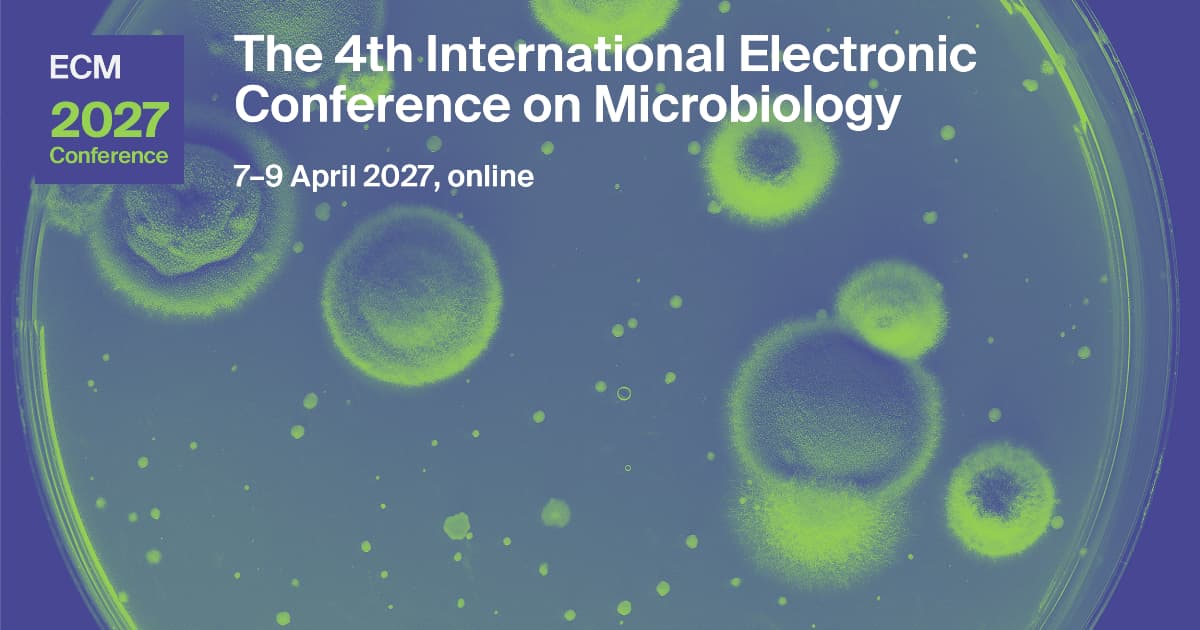
We cordially invite you to attend this event organized by the MDPI journal Microorganisms (ISSN: 2076-2607, Impact Factor 4.7). It will take place online from 7 to 9 April 2027, and is free of charge for all participants.
Conference Chair:
Dr. Nico Jehmlich, Department of Molecular Toxicology, UFZ-Helmholtz Centre for Environmental Research, Leipzig, Germany
Topics of interest:
S1. Gut Microbiota and Health and Disease;
S2. Foodborne Pathogens and Food Safety
S3. Antimicrobial Resistance: Mechanisms and Control Strategies;
S4. Emerging Infectious Diseases and Pathogen Dynamics;
S5. Soil Microbiomes and Microbial Ecology;
S6. Microbe–Plant Interactions:
S7. Biodegradation and Environmental Microbiomes:
S8. Microbial Physiology, Metabolism and Evolution.
Important dates:
Deadline for abstract submission: 7 December 2026;
Notification of acceptance: 7 January 2027;
Deadline for registration: 2 April 2027.
Guide for authors:
To submit your abstract, please click on the following link:
https://sciforum.net/user/submission/create/1774.
To register for the event, please click on the following link:
https://sciforum.net/event/ECM2027?subscribe§ion=#registration.
Note: We only accept abstracts for this conference. To publish a conference proceedings paper for free and submit a full manuscript to the organizing journal Microorganisms (ISSN 2076-2607, Impact Factor 4.7), please refer to the “Publication Opportunities” section.
Best Presentation Award and Best Poster Award:
There will be six winners selected for these awards. The winners will receive a certificate and CHF 200 each.
For any enquiries regarding this event, please contact ecm2027@mdpi.com.
We look forward to seeing you at the 4th International Electronic Conference on Microbiology!
17 June 2026
2025 Impact Factors Released
Impact Factors measure how often articles in scientific journals are cited—specifically, the average number of citations received in a given year by articles published in that journal over the previous two years, as tracked in the Web of Science. For researchers, the number answers a practical question: how often is work published in this journal being picked up and built upon?
The metric is assigned to the journal as a whole, not to individual articles. A high Impact Factor tells you something useful about a journal's place in its field; it tells you less about any single paper within it.
For a complementary, article-level view, MDPI lists an Altmetric score on each article page. Where the Impact Factor tracks academic citations, the Altmetric score captures broader online attention: how an article is being shared, discussed, and referenced beyond the journal literature. Together, they offer two different ways of asking the same question: is this research reaching people?
With 2025 CiteScores from Scopus published a few weeks ago, Clarivate has now released this year's Journal Impact Factors in the Journal Citation Reports (JCR).
254 MDPI Journals Saw a Rise in Impact Factor
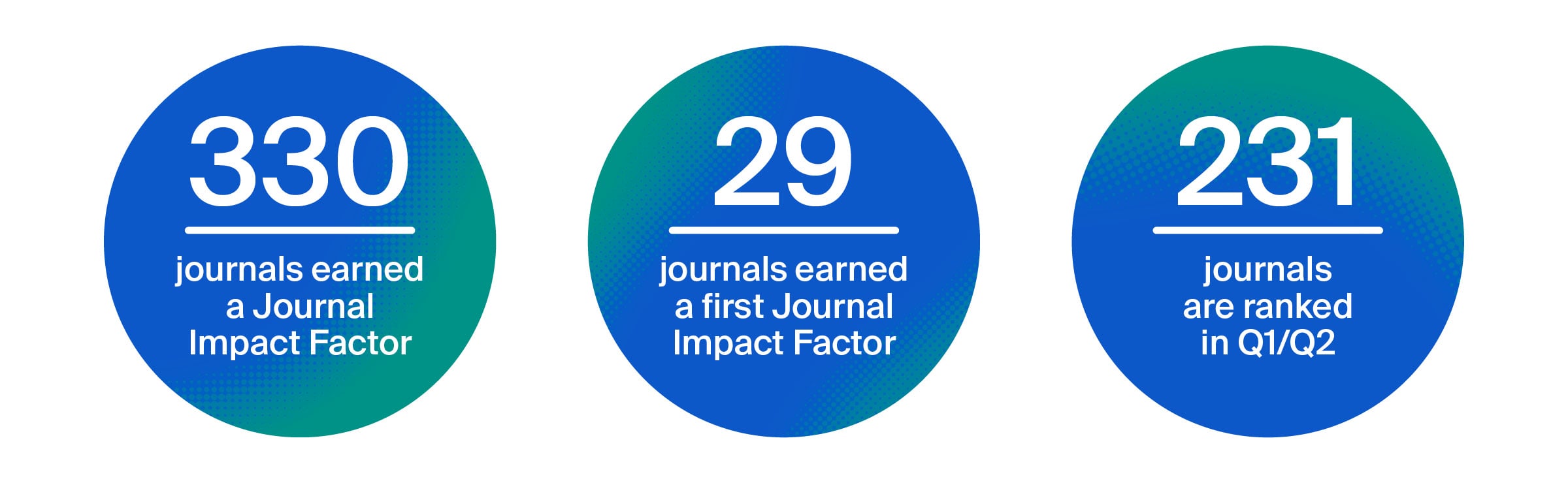
This year's JCR include 330 MDPI journals across a wide range of disciplines. Of these, 231 journals are placed in the top 50% (Q1 or Q2) of their respective subject categories, a result that spans fields as different as materials science, public health, environmental studies, and mathematics. 78 journals hold a top-quartile position (Q1), and 33 journals have a JIF of 5.0 or above.
- 330 journals earned a Journal Impact Factor (JIF)
- 29 journals earned a first JIF
- 254 journals had an increase in JIF
- 71% of ranked journals are in Q1 or Q2
For the full metrics on any MDPI journal, visit our Web of Science journals overview page or a journal's individual statistics page.
29 MDPI Journals Received Their First Journal Impact Factor
A first Impact Factor is a confirmation for an emerging journal. It marks the point at which a journal has been publishing long enough, and cited broadly enough, to enter the formal record of scientific influence. For the research communities those journals serve, it signals that the work being published is being read and built upon.
This year, 29 MDPI journals received a Journal Impact Factor for the first time, across a range of emerging and established research areas. Each represents years of editorial development and peer review—recognized in 2026 for the first time in the JCR.
This is also part of a longer shift in how science gets indexed. When the Emerging Sources Citation Index (ESCI) launched in 2016, 24 MDPI journals were included. By 2024 that number had grown to over 200, reflecting a broader change in the visibility of open access publishing within major citation tracking systems, not just at MDPI but across the sector.
Open Access with Impact
MDPI journals have received a total of 25.2 million citations in Web of Science. That figure matters less as a measure of MDPI's reach and more as a measure of what happens when research is freely available: it gets found, read, and used. Open access is only meaningful if the work actually travels and citations are one indicator that it does.
More than 4.6 million authors have published with MDPI. That breadth, across disciplines, institutions, and geographies, is what makes open access at this scale worth doing.
Thank You to the MDPI Scholarly Community
These results belong to the people who do the actual work: the Editors-in-Chief who set the standards, the Editorial Board Members and reviewers who hold them, and the authors who choose open access for their research. The numbers in the Journal Citation Reports are the downstream effect of decisions made at the desk, in the review, and at submission. Thank you for making them.
Data: 2025 Journal Impact Factors, Journal Citation Reports™ (Clarivate, 2026)
8 June 2026
Interview with Dr. Riccardo Scotti—Winner of the Microorganisms Outstanding Reviewer Award

1. Could you introduce yourself to our readers? What is your current research area?
My name is Riccardo Scotti, and I am a researcher at Council for Agricultural Research and Economics, Research Centre for Vegetable and Ornamental Crops. I mainly focus my activity on the area of soil microbiology and microbial ecology. My main research interests are plant–microbe interactions, soil microbial communities, and the role of beneficial microorganisms in sustainable agriculture. In particular, I am interested in how microbial communities in soil and plant roots respond to different agronomic practices and microbial treatments. I also work with sequencing-based approaches to better understand the structure and function of the plant and soil microbiome. My general goal is to support more sustainable and resilient agricultural systems through a better understanding of microbial processes.
2. How was your experience reviewing for Microorganisms, and what motivated you to participate actively in the peer review process?
My experience reviewing Microorganisms has been very positive. I had the opportunity to evaluate manuscripts from different areas of microbiology, and this was both interesting and professionally rewarding. What motivates me most is the idea that peer review is an important service to the scientific community. Good reviews can really help improve a manuscript, not only in terms of scientific quality, but also in terms of clarity and impact. I also believe that reviewing helps me as a researcher, because it keeps me updated and pushes me to think critically about experimental design, interpretation of results, and scientific writing.
3. In your opinion, what key qualities should an excellent manuscript have? From what perspectives will you help authors improve the quality of their papers?
In my opinion, an excellent manuscript should first have a clear research question and a solid experimental design. The methods should be appropriate and described clearly, the results should be presented in a logical way, and the conclusions should be fully supported by the data.
As a reviewer, I usually try to help authors from different perspectives: scientific soundness, clarity of presentation, interpretation of results, and overall structure of the paper. I pay attention to whether the conclusions are balanced, whether the discussion is well connected to the data, and whether the manuscript can be made clearer and more useful for readers.
4. How do you balance the comprehensiveness and efficiency of review? Can you share some specific methods or principles for reviewing?
I try to be thorough, but also practical. Usually, I first read the manuscript to understand the general objective, the main findings, and the overall quality of the work. Then I go back more carefully to evaluate the study design, methods, results, and interpretation. I normally focus first on the major points that affect the scientific value of the paper, and then on minor points such as clarity, wording, or formatting.
5. How do you view the role of a reviewer in shaping the quality and integrity of newly submitted research?
I think reviewers have an important role in protecting the quality and integrity of scientific publishing. A good reviewer helps make sure that the research is sound, that the interpretation is fair, and that the conclusions are not overstated. Reviewers also help improve transparency, clarity, and reproducibility. At the same time, I believe the reviewer’s role should be constructive, not punitive. The aim should not be only to judge a manuscript, but also to help improve it when possible.
6. What advice would you give to early career researchers who want to become strong peer reviewers, or do you have any suggestions for the current peer-review process? Would you like to recommend that more scholars join us as reviewers to promote the scientific quality of peer review?
My advice to early career researchers is to approach peer review seriously, but also with confidence. Reviewing is a skill that improves with experience. It is important to read the manuscript carefully, stay objective, and focus on science. I would also suggest that early career researchers read good papers critically and compare their own opinions with published peer-reviewed work. This is a good way to build judgement over time.
Microorganisms Editorial Office
8 June 2026
Microorganisms Outstanding Reviewer Award 2026

On behalf of the Editor-in-Chief, Dr. Nico Jehmlich, we wish to acknowledge the reviewers who generously offer their time to Microorganisms by presenting an award to those who have most demonstrated their dedication, professionalism, and timeliness in reviewing manuscripts for Microorganisms (ISSN: 2076-2607).
Eligibility and requirements:
- All of the reviewers for Microorganisms in 2026 will be automatically considered;
- Number of review reports;
- The quality and timeliness of review reports.
The prize:
- CHF 500;
- A free voucher for article processing fees valid for one year;
- A certificate.
Number of winners: 3.
Winner announcement: 31 March 2027.
How can I make myself eligible?
If you have not yet reviewed papers for Microorganisms but would like to do so, you can register as a reviewer at the following link: https://susy.mdpi.com/volunteer_reviewer_info/update.
8 June 2026
Microorganisms Receives an Increased CiteScore of 8.2

We are pleased to share that Microorganisms (ISSN: 2076-2607) has received an increased CiteScore of 8.2 in June 2026.
Microorganisms’ CiteScore maintains its Q1 ranking across multiple disciplines:
- Q1 (14 out of 86) in the “Virology” category;
- Q1 (25 out of 147) in the “Microbiology (medical)” category;
- Q1 (41 out of 194) in the “Microbiology” category.
You can find more statistics on our website.
The current CiteScores measure the average number of citations within a journal over a four-year window (2022–2025). The Scopus database provides a comprehensive suite of metrics that support informed publishing strategies, research evaluation and enable benchmarking of journal performance.
This encouraging progress would not have been possible without the sincere recognition and ongoing support from all authors, reviewers and scholars. Together we will continue to track the progress of Microorganisms and its growing impact in microbiology research.
Microorganisms Editorial Office
4 June 2026
Open Access, Broadly Recognized: 363 MDPI Journals Receive CiteScores for 2025
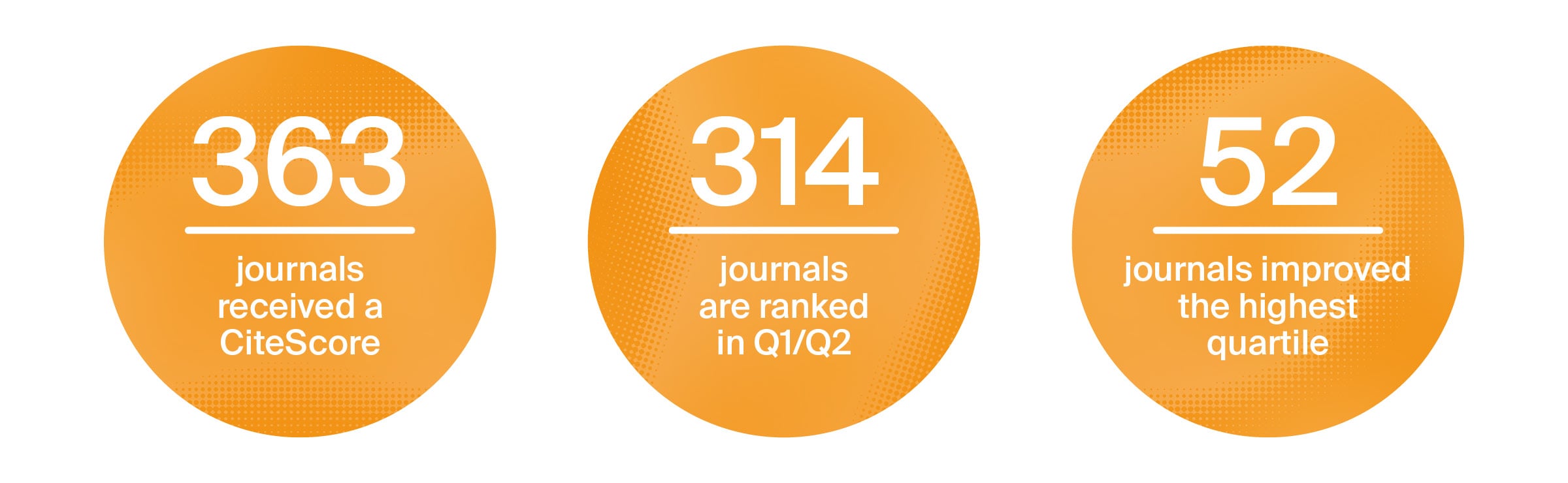
The 2025 CiteScore metrics have been officially released by Scopus, and the results confirm what has become a consistent pattern for MDPI's journal portfolio: broad recognition across disciplines, steady improvement across the majority of ranked titles, and a growing presence at the top of subject category rankings.
CiteScore, published annually by Elsevier's Scopus database, measures the average citations received by articles published in a journal over a four-year window. As a complement to the Journal Impact Factor, which uses a two-year window based on the Web of Science database, CiteScore provides an alternative, long-term perspective on citation performance.
The 365 MDPI journals in Scopus (as of May 2026) are indexed across a wide range of subject categories, ensuring that open access research remains highly discoverable to a global readership through one of the most widely used platforms in academic publishing.
Data Summary (2025 CiteScores)
- New Additions: 41 MDPI journals received a CiteScore for the first time.
- Trending Upward: 234 of 322 previously ranked journals (73%) saw an increase in their CiteScore compared to last year.
- High Visibility: 314 journals (86%) rank in Q1 or Q2 in at least one subject category.
- Elite Performance: 42 journals rank in the top 10% of their subject categories.
Portfolio Performance
Among the 322 journals that held a CiteScore in 2024, 234 saw an increase this year. Quartile improvements outnumbered declines across the portfolio, with 52 journals moving to a higher quartile and only 20 seeing a decline. Furthermore, no previously ranked journals were removed. The 42 journals now ranked in the top 10% of their subject categories are drawn from a strong foundation of 178 journals holding a Q1 position.
With the large majority of our indexed portfolio ranked in the top half of research fields, researchers can confidently choose MDPI to meet funder mandates for high-quality, fully compliant Open Access publishing.
Exceptional Achievements for Foods and Life
Notably, both Foods and Life achieved a 99th percentile ranking in their respective subject categories for the 2025 CiteScores. This outstanding placement positions them as leading journals in their fields and highlights the high visibility and global impact of the open access research they publish.
Journal Metrics and Beyond
Journal-level metrics describe outlets, not individual articles. An increasing number of funders and institutions—including signatories of DORA and the Coalition for Advancing Research Assessment—now explicitly encourage evaluation at the article level rather than by the journal in which research appears. MDPI supports this direction: we report CiteScore alongside the Journal Impact Factor, Journal Citation Indicator, and article-level usage data because no single number captures the full reach and contribution of published research.
Thank You
These results reflect the sustained effort of thousands of editors-in-chief, editorial board members, reviewers, and authors across every field MDPI serves. The metrics are the outcome; the work is yours.
