
Skip Content
You are currently on the new version of our website. Access the old version .

Microorganisms

Microorganisms is a scientific, peer-reviewed, open access journal of microbiology, published monthly online by MDPI. 
The Hellenic Society Mikrobiokosmos (MBK), the Spanish Society for Nitrogen Fixation (SEFIN) and the Society for Microbial Ecology and Disease (SOMED) are affiliated with Microorganisms, and their members receive a discount on the article processing charges.
Indexed in PubMed | Quartile Ranking JCR - Q2 (Microbiology)

All Articles (17,125)

Intramuscular fat (IMF) is a crucial determinant of pork quality, influencing tenderness, flavor, and consumer preferences, yet selective breeding has reduced its levels in modern pigs. This review explores the molecular and cellular mechanisms of IMF deposition, including progenitor cell differentiation via pathways like Wnt/β-catenin and PPARγ, and advances in non-invasive detection methods such as hyperspectral imaging and Raman spectroscopy. It highlights correlations and causal links between the gut microbiota composition and IMF, established through omics analyses, fecal microbiota transplantation, and germ-free models. Key microbial metabolites, including short-chain fatty acids (SCFAs) and bile acids, modulate lipid metabolism bidirectionally via signaling receptors like GPR43, FXR, and TGR5. Future research should integrate multi-omics and develop probiotics to enhance IMF efficiency for sustainable pork production.

29 January 2026
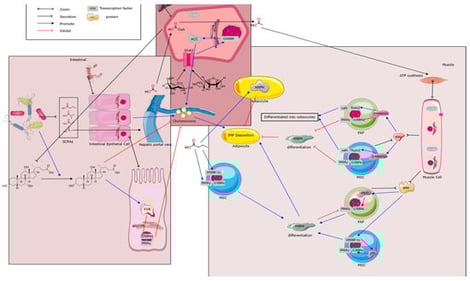
A schematic overview of the metabolic crosstalk between the intestine, liver, and skeletal muscle in regulating intramuscular fat (IMF) deposition. Dietary nutrients are absorbed by intestinal epithelial cells, assembled into chylomicrons, and transported via the hepatic portal vein to the liver, where lipid and glucose metabolism are regulated through FXR, AMPK, and SREBP-1c signaling. Short-chain fatty acids (SCFAs) derived from gut fermentation further modulate hepatic energy homeostasis. In muscle, mesenchymal stem cells (MSCs) differentiate into adipocytes under the control of PPARγ, C/EBPα, Wnt/β-catenin, and BMP pathways, promoting IMF accumulation. This integrative network highlights the intestine–liver–muscle axis regulation of lipid synthesis, transport, and storage. ATP: Adenosine Triphosphate. ACC: Acetyl-CoA Carboxylase. IMF: Intramuscular Fat. Wnt: Wingless-Type (signaling pathway). ChREBP: Carbohydrate Response Element Binding Protein. FAP: Fibro/Adipogenic Progenitor. Lef1: Lymphoid Enhancer-Binding Factor 1. Runx2: Runt-Related Transcription Factor 2. PPARγ: Peroxisome Proliferator-Activated Receptor Gamma. C/EBPα: CCAAT/Enhancer-Binding Protein Alpha. SMAD: Mothers Against Decapentaplegic Homolog. MSC: Mesenchymal Stem Cell. BMP: Bone Morphogenetic Protein. FABP4: Fatty Acid-Binding Protein 4. SREBP-1c: Sterol Regulatory Element-Binding Protein 1c. ZFP: Zinc Finger Protein. SCFAs: Short-Chain Fatty Acids. Glut2: Glucose Transporter 2. CoA: Coenzyme A. FXR: Farnesoid X Receptor. AMPK: AMP-Activated Protein Kinase.
  • Communication
  • Open Access

Tuberculosis (TB) remains a leading cause of infectious-disease-related morbidity and mortality worldwide, including in low-incidence, high-income countries, where cases increasingly cluster among vulnerable populations. In these settings, persistent diagnostic and treatment delays, rather than a lack of therapeutic options, drive preventable morbidity, ongoing transmission, and inappropriate antimicrobial use. We argue that TB antimicrobial stewardship must extend beyond treatment adherence and resistance containment to encompass the entire diagnostic continuum. Emerging evidence demonstrating a substantial burden of subclinical and asymptomatic TB challenges symptom-based diagnostic paradigms and reveals an underrecognized “asymptomatic delay”, during which radiologic or microbiologic disease is present but undetected. Failure to identify TB during this interval represents a critical stewardship failure, perpetuating empirical broad-spectrum antibiotic exposure while allowing disease progression and transmission. We review diagnostic challenges across the early clinical spectrum of pulmonary and extrapulmonary TB in low-incidence settings, with particular emphasis on migrants and other high-risk populations disproportionately affected by structural and healthcare system barriers. We propose a stewardship-oriented framework integrating targeted screening, enhanced clinical vigilance, front-loaded and parallel diagnostic pathways, and early referral to specialized TB centers. Explicit incorporation of asymptomatic delay into TB diagnostic frameworks can strengthen system accountability, reduce inappropriate antibiotic use, improve patient outcomes, and accelerate progress toward TB elimination in high-income, low-incidence countries.

29 January 2026

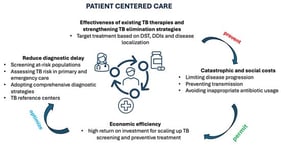
Proposed solutions to decrease delays in TB care. Legend: DDIs = drug–drug interactions; DST = drug susceptibility test; TB = tuberculosis.

Monkeypox (Mpox), a zoonotic viral disease caused by the Monkeypox Virus (MPXV), has gained significant attention in recent years due to its increasing incidence and the grave threat it poses to global health. MPXV has spread at a rapid pace during the COVID-19 pandemic, causing 10,000+ confirmed cases and ~300 fatalities in 122 countries. This virus comprises two major clades, Clade I (Central African), which is evidently more virulent, and Clade II (West African), which has caused the recent outbreaks across the world and caused fewer deaths. Clinically, Mpox presents as a milder form with fever, lymphadenopathy, and vesiculopustular rash similar to smallpox. Diagnostic measures such as polymerase chain reaction (PCR) are the main diagnostic confirmatory tools. Advanced diagnostics involve electronic microscopy, serology, and immunohistochemistry. Alternative drugs like tecovirimat and brincidofovir have demonstrated potential for treating smallpox, but there is scanty evidence on their efficacy against MPXV. Most recent advancements in the study of vaccines have resulted in the creation and introduction of MVA-BN (JYNNEOS/Imvanex/Imvamune) and ACAM2000 vaccines, which conferred cross-protection against MPXV. MVA-BN is suggested to perform better than other types due to its enhanced safety and immunogenicity. Researchers are also developing DNA and protein subunit vaccines against Mpox to induce specific immune responses by presenting viral proteins. The discovery of novel vaccine candidates and antiviral treatments will be needed to prevent future outbreaks and reduce the global health burden of Mpox. This review focuses on the characterization of MPXV, summarizing current knowledge on its genomic structure, pathogenesis, replication, potential targets of anti-MPXV drugs, clinical features, and epidemiological patterns, along with recent advances in vaccine development.

29 January 2026

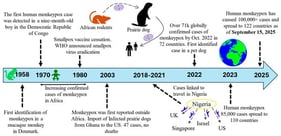
Timeline of MPXV from 1st identification until current outbreak.

Heat-killed Enterococcus faecalis EF-2001 (EF-2001) is a postbiotic preparation reported to modulate host immunity. However, its specific impact on host immune responses and virological outcomes during the early phase of influenza infection remains insufficiently characterized. Female BALB/c mice received oral EF-2001 (16 mg/kg/day) for either 4 days or 14 days prior to intranasal inoculation with influenza A/H3N2 (A/Aichi/2/68). On day 2 post-infection, splenic T-cell subsets (CD3+, CD4+, CD8+) were quantified by flow cytometry. Cytokines released from PMA/ionomycin-stimulated splenocytes were measured using a cytometric bead array assay to assess functional polarization. Lung viral titers (TCID50) and interferon-α (IFN-α) concentrations were assessed to evaluate local antiviral efficacy. EF-2001 administration significantly increased the proportions of splenic CD3+ T cells, including both CD4+ and CD8+ subsets, compared to controls. The 14-day pretreatment regimen significantly enhanced IFN-γ production while reducing IL-10, IL-4, and IL-2 secretion, consistent with a distinct systemic Th1-skewed immune activation. In contrast to these systemic effects, EF-2001 did not significantly reduce lung viral titers (difference < 0.2 log10 TCID50) and did not increase lung IFN-α concentrations at day 2 post-infection. Oral EF-2001 pretreatment promoted systemic immune activation characterized by T-cell expansion and a Th1-biased cytokine profile. However, this systemic priming showed no detectable antiviral effect on lung viral burden at the early evaluation time point. EF-2001 may be better positioned as an adjunctive immunomodulatory approach rather than a direct antiviral agent, warranting further studies that include clinical outcomes and multi-time-point antiviral and mucosal immune assessments.

29 January 2026

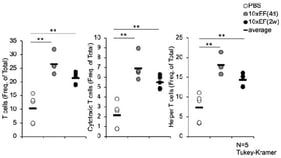
Proportions of splenic T-cell populations (CD3+, CD4+, CD8+) on day 2 after influenza infection. Oral EF-2001 pretreatment (14 days) significantly increased the frequency of these subsets compared to PBS controls, indicating enhanced systemic lymphocyte availability. (** p &lt; 0.01 vs. Control).

News & Conferences

Issues

Open for Submission

Editor's Choice

Get Alerted

Add your email address to receive forthcoming issues of this journal.

XFacebookLinkedIn
Microorganisms - ISSN 2076-2607