
Plant Hormone Regulation of Competitive Growth: Implications for Agriculture and Inclusive Fitness


Abstract
1. Introduction
2. Plant Competitive Traits Identified by Kin Selection Studies
2.1. Empirical Evidence for Kin Selection in Plants
2.2. Kin-Dependent Growth Strategies Above- and Belowground
2.3. Resource Availability Shapes Altruism: Competition Trade-Offs
2.4. Kin Selection Effects Across Growth, Reproduction and Defense
2.5. Summary
- Plants exhibit kin-modulated behaviors consistent with Hamilton’s inclusive fitness theory, demonstrating that altruistic traits in plants can evolve through natural selection when benefits accrue to genetically related individuals.
- Kin-dependent modulation spans multiple trait classes, including growth, defense, and reproductive investment.
- The magnitude and direction of these responses are context dependent, varying with environmental conditions, population genetic structure, and resource availability.
3. Hormonal Modulation of Competitive Behavior
3.1. Hormonal Modularity as an Evolutionary Framework for Growth Trade-Offs
3.2. Conceptual Features Linking Hormones to Competition and Cooperation
3.2.1. Hormonal Mediation of Growth: Reproduction Trade-Offs
3.2.2. Resource Depletability and Growth Architecture
3.2.3. Signal Mobility and Evolutionary Constraint
3.2.4. Conclusions
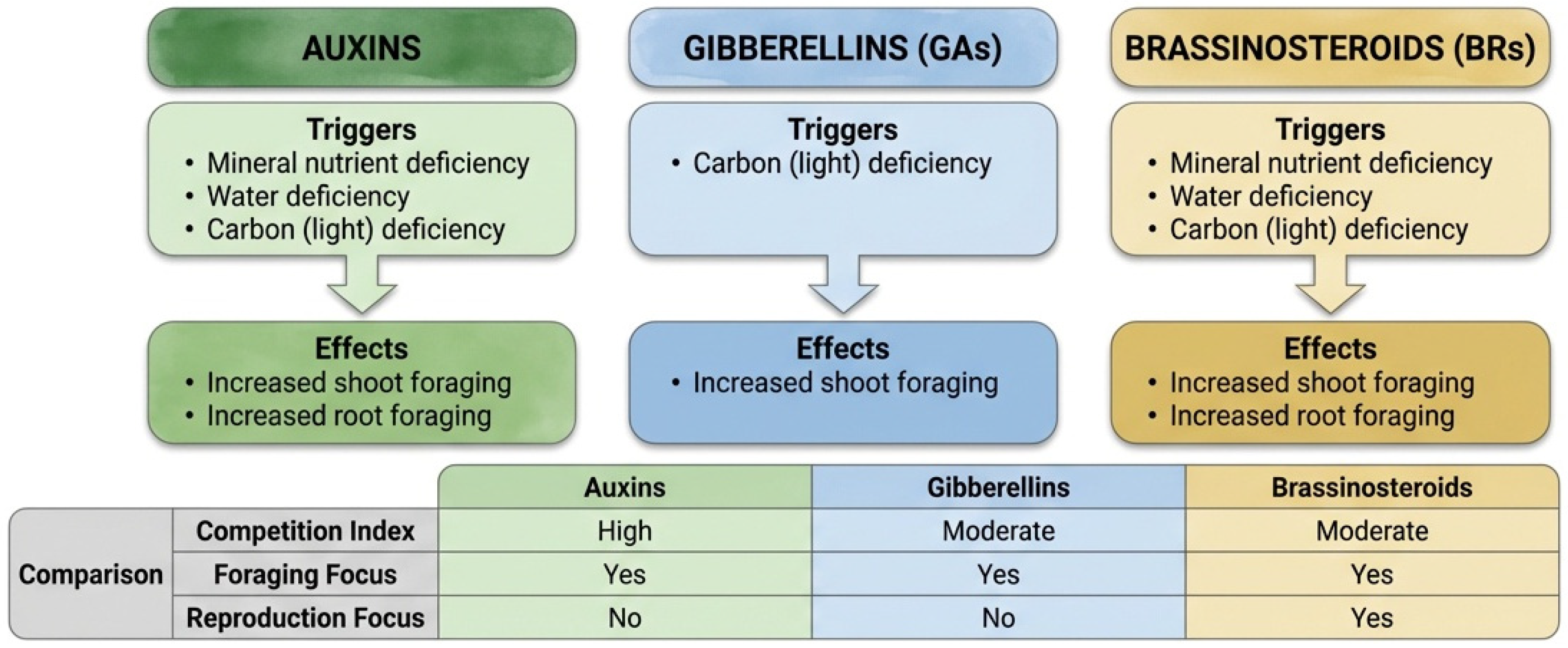
3.3. Hormones That Promote Increased Foraging: Pathways of Competitive Growth
3.3.1. Auxins: The Primary Foraging Hormone
3.3.2. GAs and Carbon Acquisition Focus
3.3.3. BRs: Competitive Reproduction Maximization
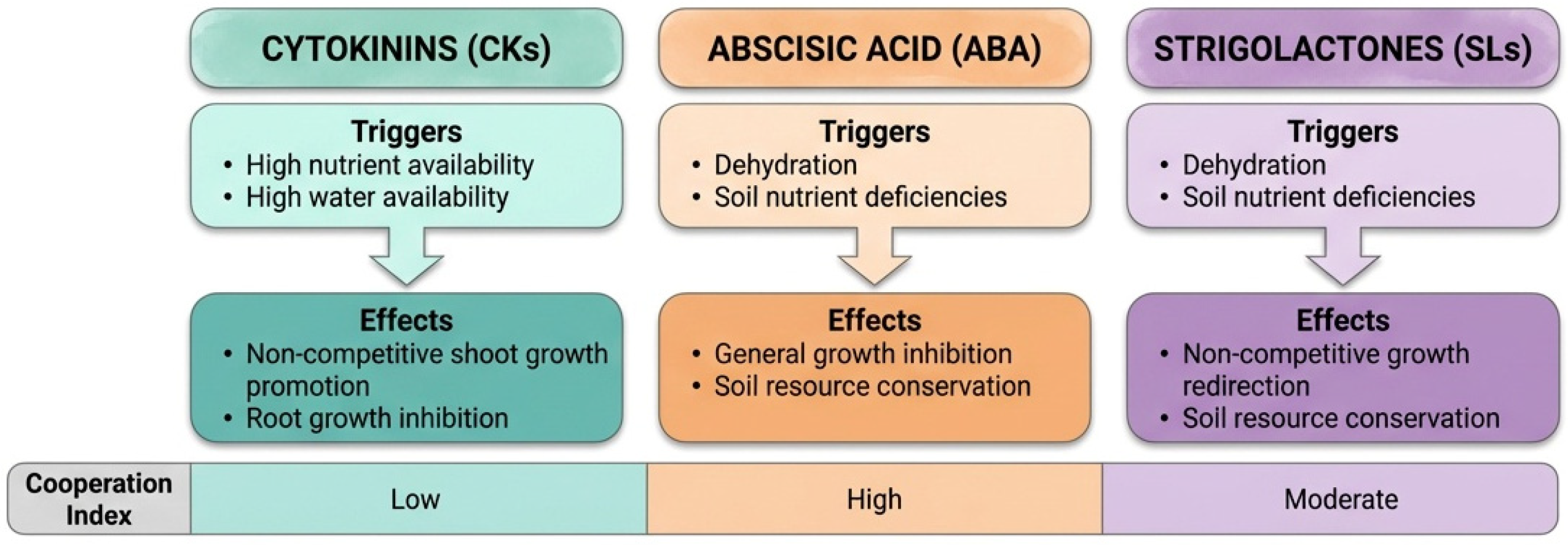
3.4. Hormones That Limit Foraging: Growth Restraint and Cooperative Allocation
3.4.1. CKs: Reproduction Maximization Under Favorable Conditions
3.4.2. ABA: Growth Restraint Under Severe Stress
3.4.3. SLs: Allocation Control Under Moderate Stress
3.4.4. Comparative Roles of CKs, ABA, and SLs in Growth Restraint
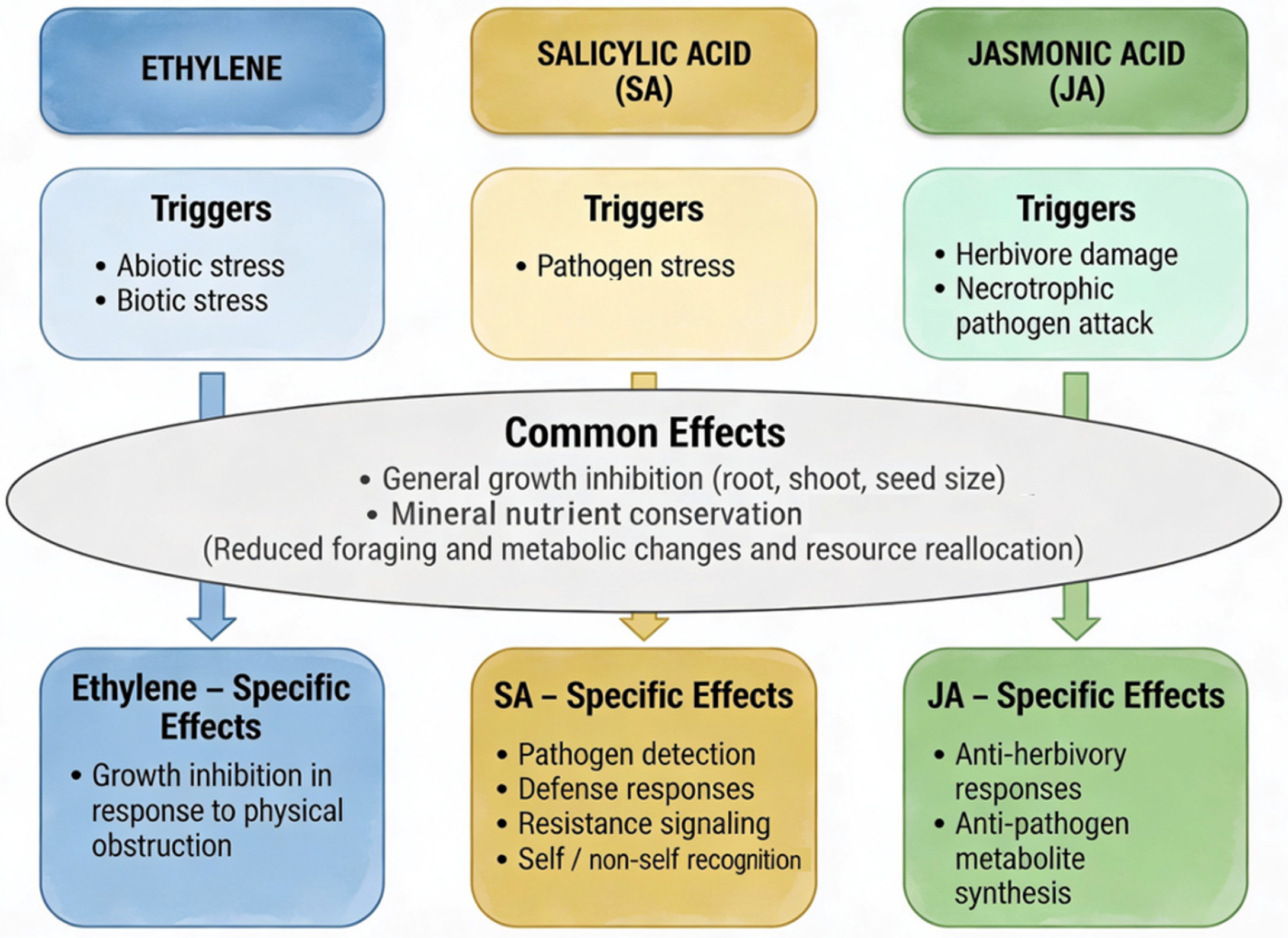
3.5. Volatile Hormones: Growth Restraint, Communication, and Collective Defense
3.5.1. Ethylene: Growth Restraint Under Stress
3.5.2. SA: Growth Restraint in Defense
3.5.3. JA: Defense-Centered Growth Modulation
3.6. Hormonal Strategies Revealed by Conflict and Manipulation: Lessons from Allelopathy and Microbial Interactions
3.6.1. Negative Allelopathy: Forcing Neighbors into Restraint
3.6.2. Plant–Microbial Interactions: Hijacking Competitive Modules
3.7. Synthesis: Hormone Modules Along the Competition–Cooperation Spectrum
4. Monocot Evolution: A Hormonal Shift Toward Communal Efficiency
4.1. Evolutionary Origins of Reduced Competition in Monocots
4.2. Density, Compatibility, and Group-Level Fitness
4.3. Auxin and Monocot Restraint
4.4. A Shift from Nitrogen Foraging to Carbon Efficiency
4.5. Synthesis: Competitive Differences Between Dicots and Monocots
5. Agricultural Implications
5.1. Domestication and the Erosion of Kin-Based Altruism
5.2. Hormone-Guided Crop Design: Matching Growth Strategy to Yield Type
5.3. PGPMs: Benefits, Constraints, and Implications for Competitive Dynamics
5.4. General Recommendations
- Avoid strong Auxin/GA/BR stimulation in dense grain stands
- Consider foraging-promoting hormones for vegetative crops grown at low density
- Favor CK-based strategies for grain and fruit crops
- Differentiate between reproductive and vegetative crops when using PGPMs
- Use PGPMs cautiously at high density
6. Concluding Remarks
Author Contributions
Funding
Data Availability Statement
Acknowledgments
Conflicts of Interest
Abbreviations
| Abbreviation | Full term |
| ABA | Abscisic Acid |
| AMF | Arbuscular Mycorrhizal Fungi |
| BRs | Brassinosteroids |
| C4 | C4 Photosynthesis |
| CKs | Cytokinins |
| CO2 | Carbon Dioxide |
| GA/GAs | Gibberellic Acid/Gibberellins |
| JA/JAs | Jasmonic Acid/Jasmonates |
| MeSA | Methyl Salicylate |
| MeJA | Methyl Jasmonate |
| N | Nitrogen |
| P | Phosphorus |
| N:P | Nitrogen-to-Phosphorus Ratio |
| PGPMs | Plant Growth-Promoting Microbes |
| R/FR | Red:Far-Red Light Ratio |
| SA | Salicylic Acid |
| SLs | Strigolactones |
| UV-B | Ultraviolet-B Radiation |
References
- Okasha, S. Biological altruism. In The Stanford Encyclopedia of Philosophy; Zalta, E.N., Ed.; Metaphysics Research Lab, Stanford University: Stanford, CA, USA, 2020; Available online: https://plato.stanford.edu/archives/sum2020/entries/altruism-biological/ (accessed on 14 January 2026).
- Hamilton, W.D. The genetical evolution of social behaviour I & II. J. Theor. Biol. 1964, 7, 1–32. [Google Scholar] [CrossRef] [PubMed]
- Queller, D.C. A general model for kin selection. Evolution 1992, 46, 376–380. [Google Scholar] [CrossRef] [PubMed]
- Hardin, G. The tragedy of the commons. Science 1968, 162, 1243–1248. [Google Scholar] [CrossRef] [PubMed]
- West, S.A.; Pen, I.; Griffin, A.S. Cooperation and competition between relatives. Science 2002, 296, 72–75. [Google Scholar] [CrossRef]
- Tilman, D. Resource Competition and Community Structure; Princeton University Press: Princeton, NJ, USA, 1982. [Google Scholar]
- Grime, J.P. Evidence for the existence of three primary strategies in plants and its relevance to ecological and evolutionary theory. Am. Nat. 1977, 111, 1169–1194. [Google Scholar] [CrossRef]
- West, S.A.; Griffin, A.S.; Gardner, A. Social semantics: Altruism, cooperation, mutualism, strong reciprocity and group selection. J. Evol. Biol. 2007, 20, 415–432. [Google Scholar] [CrossRef]
- Crespi, B.J. The evolution of social behavior in microorganisms. Trends Ecol. Evol. 2001, 16, 178–183. [Google Scholar] [CrossRef]
- Frank, S.A. Mutual policing and repression of competition in the evolution of cooperative groups. Nature 1995, 377, 520–522. [Google Scholar] [CrossRef]
- Cremer, S.; Armitage, S.A.O.; Schmid-Hempel, P. Social immunity. Curr. Biol. 2007, 17, R693–R702. [Google Scholar] [CrossRef]
- Smith, P.; Schuster, M. Public goods and cheating in microbes. Curr. Biol. 2019, 29, R442–R447. [Google Scholar] [CrossRef]
- Karasov, T.L.; Almario, J.; Friedemann, C.; Ding, W.; Giolai, M.; Heavens, D.; Kersten, S.; Lundberg, D.S.; Neumann, M.; Regalado, J.; et al. Arabidopsis thaliana and Pseudomonas pathogens exhibit stable associations over evolutionary timescales. Cell Host Microbe 2018, 24, 168–179.e4. [Google Scholar] [CrossRef] [PubMed]
- Agrawal, A.A. Macroevolution of plant defense strategies. Trends Ecol. Evol. 2007, 22, 103–109. [Google Scholar] [CrossRef] [PubMed]
- Crepy, M.A.; Casal, J.J. Photoreceptor-mediated kin recognition in plants. New Phytol. 2015, 205, 329–338. [Google Scholar] [CrossRef] [PubMed]
- Yang, X.F.; Li, L.L.; Xu, Y.; Kong, C.H. Kin recognition in rice (Oryza sativa) lines. New Phytol. 2018, 220, 567–578. [Google Scholar] [CrossRef]
- Murphy, G.P.; Dudley, S.A. Kin recognition and cooperation in Impatiens (Balsaminaceae). Am. J. Bot. 2009, 96, 1990–1996. [Google Scholar] [CrossRef]
- Dudley, S.A.; File, A.L. Kin recognition in an annual plant. Biol. Lett. 2007, 3, 435–438. [Google Scholar] [CrossRef]
- Gruntman, M.; Novoplansky, A. Physiologically mediated self/non-self discrimination in roots. Proc. Natl. Acad. Sci. USA 2004, 101, 3863–3867. [Google Scholar] [CrossRef]
- Semchenko, M.; Hutchings, M.J.; John, E.A. Challenging the tragedy of the commons in root competition: Confounding effects of neighbour presence and substrate volume. J. Ecol. 2007, 95, 252–260. [Google Scholar] [CrossRef]
- Gersani, M.; Brown, J.S.; O’Brien, E.E.; Maina, G.M.; Abramsky, Z. Tragedy of the commons as a result of root competition. J. Ecol. 2001, 89, 660–669. [Google Scholar] [CrossRef]
- Craine, J.M. Competition for nutrients and optimal root allocation. Plant Soil 2006, 285, 171–185. [Google Scholar] [CrossRef]
- O’Brien, E.E.; Gersani, M.; Brown, J.S. Root proliferation and seed yield in response to spatial heterogeneity of below-ground competition. New Phytol. 2005, 168, 401–412. [Google Scholar] [CrossRef] [PubMed]
- Fehr, E.; Fischbacher, U. The nature of human altruism. Nature 2003, 425, 785–791. [Google Scholar] [CrossRef]
- Cahill, J.F., Jr.; McNickle, G.G.; Haag, J.J.; Lamb, E.G.; Nyanumba, S.M.; St Clair, C.C. Plants integrate information about nutrients and neighbors. Science 2010, 328, 1657–1660. [Google Scholar] [CrossRef] [PubMed]
- Hess, L.; de Kroon, H. Effects of rooting volume and nutrient availability. J. Ecol. 2007, 95, 241–251. [Google Scholar] [CrossRef]
- Thomas, R.Q.; Brookshire, E.N.; Gerber, S. Nitrogen limitation on land: How can it occur in Earth system models? Glob. Change Biol. 2015, 21, 1777–1793. [Google Scholar] [CrossRef]
- Elser, J.J.; Bracken, M.E.; Cleland, E.E.; Gruner, D.S.; Harpole, W.S.; Hillebrand, H.; Ngai, J.T.; Seabloom, E.W.; Shurin, J.B.; Smith, J.E. Global analysis of nitrogen and phosphorus limitation. Ecol. Lett. 2007, 10, 1135–1142. [Google Scholar] [CrossRef]
- Xia, X.-X.; Yan, S.; Wang, P.; Kong, C.-H. A Meta-analysis of response strategies and interfering factors of kin recognition in plants. Plants 2025, 14, 683. [Google Scholar] [CrossRef]
- Torices, R.; Gómez, J.M.; Pujol, M.; González-Megías, A. Effects of the relatedness of neighbours on floral colour and nectar production in Moricandia moricandioides. Front. Ecol. Evol. 2021, 9, 589781. [Google Scholar] [CrossRef]
- Torices, R.; Gómez, J.M.; Pannell, J.R. Kin discrimination allows plants to modify investment towards pollinator attraction. Nat. Commun. 2018, 9, 2018. [Google Scholar] [CrossRef]
- Sun, B.; Britton, N.F.; Johnston, A.J.; Rowe, C. Kin selection and floral display: A mathematical model. J. Theor. Biol. 2021, 519, 110619. [Google Scholar] [CrossRef]
- Biernaskie, J.M. Evidence for competition and cooperation among climbing plants. Proc. R. Soc. B Biol. Sci. 2011, 278, 1989–1996. [Google Scholar] [CrossRef] [PubMed]
- Abd El-Gawad, A.M.; Zotti, M.; Sarker, T.C.; Mazzoleni, S.; Bonanomi, G. Does a plant detect its neighbor if it is kin or stranger? Evidence from a common garden experiment. Community Ecol. 2017, 18, 305–310. [Google Scholar] [CrossRef]
- Hikosaka, K.; Hirose, T. Leaf angle as a strategy for light competition: Optimal and evolutionarily stable light-extinction coefficient within a leaf canopy. Écoscience 1997, 4, 501–507. [Google Scholar] [CrossRef]
- Biedrzycki, M.L.; Bais, H.P. Kin recognition in plants: A mysterious phenomenon uncovered. J. Exp. Bot. 2010, 61, 4123–4128. [Google Scholar] [CrossRef]
- Li, L.; Tilman, D.; Lambers, H.; Zhang, F.-S. Plant diversity and overyielding: Insights from belowground facilitation of interspecific interactions. New Phytol. 2014, 203, 63–69. [Google Scholar] [CrossRef]
- Dudley, S.A.; Murphy, G.P.; File, A.L. Kin recognition and competition in plants. Funct. Ecol. 2013, 27, 898–906. [Google Scholar] [CrossRef]
- Orrock, J.L.; Christopher, C.C. Density of intraspecific competitors determines the occurrence and benefits of accelerated germination. Am. J. Bot. 2010, 97, 694–699. [Google Scholar] [CrossRef]
- Heil, M.; Karban, R. Explaining evolution of plant communication by airborne signals. Trends Ecol. Evol. 2010, 25, 137–144. [Google Scholar] [CrossRef]
- Trewavas, A. Plant intelligence: Mindless Mastery. Nature 2002, 415, 841. [Google Scholar] [CrossRef]
- Kurepa, J.; Smalle, J.A. Plant hormone modularity and the survival–reproduction trade-off. Biology 2023, 12, 1143. [Google Scholar] [CrossRef]
- Kurepa, J.; Smalle, J. The evolution of plant hormones: From metabolic byproducts to regulatory hubs. Int. J. Mol. Sci. 2025, 26, 7190. [Google Scholar] [CrossRef]
- Bloom, A.J.; Chapin, F.S.; Mooney, H.A. Resource limitation in plants—An economic analogy. Annu. Rev. Ecol. Syst. 1985, 16, 363–392. [Google Scholar] [CrossRef]
- Obeso, J.R. The costs of reproduction in plants. New Phytol. 2002, 155, 321–348. [Google Scholar] [CrossRef] [PubMed]
- Weiner, J. Allocation, plasticity and allometry in plants. Perspect. Plant Ecol. Evol. Syst. 2004, 6, 207–215. [Google Scholar] [CrossRef]
- Hodge, A. The plastic plant: Root responses to heterogeneous supplies of nutrients. New Phytol. 2004, 162, 9–24. [Google Scholar] [CrossRef]
- Kurepa, J.; Smalle, J.A. Auxin/cytokinin antagonistic control of the shoot/root growth ratio and its relevance for adaptation to drought and nutrient deficiency stresses. Int. J. Mol. Sci. 2022, 23, 1933. [Google Scholar] [CrossRef]
- West, S.A.; Griffin, A.S.; Gardner, A. Evolutionary explanations for cooperation. Curr. Biol. 2007, 17, R661–R672. [Google Scholar] [CrossRef]
- Nowak, M.A. Five rules for the evolution of cooperation. Science 2006, 314, 1560–1563. [Google Scholar] [CrossRef]
- Ballaré, C.L. Light regulation of plant defense. Annu. Rev. Plant Biol. 2014, 65, 335–363. [Google Scholar] [CrossRef]
- Broekgaarden, C.; Vos, I.A.; Pieterse, C.M.J.; Van Wees, S.C.M.; Caarls, L. Ethylene: Traffic controller on hormonal crossroads to defense. Plant Physiol. 2015, 169, 2371–2379. [Google Scholar] [CrossRef]
- Jiang, S.; Wu, L.; Huang, L.; Li, Y. Genetic and molecular mechanisms of phytohormone-mediated seed size control in crops. J. Genet. Genom. 2025, 52, 1460–1474. [Google Scholar] [CrossRef]
- McSteen, P. Auxin and monocot development. Cold Spring Harb. Perspect. Biol. 2010, 2, a001479. [Google Scholar] [CrossRef]
- de Wit, M.; Lorrain, S.; Fankhauser, C. Auxin-mediated plant architectural changes in response to shade and high temperature. Plant Physiol. 2014, 151, 13–24. [Google Scholar] [CrossRef]
- Yamaguchi, S. Gibberellin metabolism and its regulation. Annu. Rev. Plant Biol. 2008, 59, 225–251. [Google Scholar] [CrossRef] [PubMed]
- Fu, J.; Li, L.; Wang, S.; Yu, N.; Shan, H.; Shi, Z.; Li, F.; Zhong, X. Effect of gibberellic acid on photosynthesis and oxidative stress response in maize under weak light conditions. Front. Plant Sci. 2023, 14, 1128780. [Google Scholar] [CrossRef] [PubMed]
- Tripathi, J.M.; Khan, B.R.; Gaur, R.; Yadav, D.; Verma, K.K.; Gupta, R. Gibberellic acid improves photosynthetic electron transport and stomatal function in crops that are adversely affected by salinity exposure. Plants 2025, 14, 3388. [Google Scholar] [CrossRef] [PubMed]
- Wen, Y.; Su, S.-C.; Ma, L.-Y.; Wang, X.-N. Effects of gibberellic acid on photosynthesis and endogenous hormones of Camellia oleifera Abel in first and sixth leaves. J. For. Res. 2018, 23, 309–317. [Google Scholar] [CrossRef]
- Davière, J.-M.; Achard, P. Gibberellin signaling in plants. Development 2013, 140, 1147–1151. [Google Scholar] [CrossRef]
- Ali, A.; Zhao, T.-T.; Feng, C.-L.; Zhao, X.-T.; Li, L.; Wu, R.-J.; Liu, H.-B.; Huang, Q.-X.; Lin, J.-S.; Wang, J.-G. Decoding the hormonal, genetic, and environmental signals regulating leaf angle in plants. Plant Stress 2025, 17, 100918. [Google Scholar] [CrossRef]
- Wille, W.; Pipper, C.B.; Rosenqvist, E.; Andersen, S.B.; Weiner, J. Reducing shade avoidance responses in a cereal crop. AoB Plants 2017, 9, plx039. [Google Scholar] [CrossRef]
- Vriet, C.; Russinova, E.; Reuzeau, C. From squalene to brassinolide: The steroid metabolic and signaling pathways across the plant kingdom. Mol. Plant 2013, 6, 1738–1757. [Google Scholar] [CrossRef] [PubMed]
- Nolan, T.M.; Chen, J.; Yin, Y. Brassinosteroids: Multi-functional regulators of plant growth, development, and stress responses. Plant Cell 2020, 32, 295–318. [Google Scholar] [CrossRef] [PubMed]
- Li, X.; Wu, P.; Lu, Y.; Guo, S.; Zhong, Z.; Shen, R.; Xie, Q. Synergistic interaction of phytohormones in determining leaf angle in crops. Int. J. Mol. Sci. 2020, 21, 142. [Google Scholar] [CrossRef] [PubMed]
- Yang, C.; Li, L. Hormonal regulation in shade avoidance. Front. Plant Sci. 2017, 8, 1527. [Google Scholar] [CrossRef]
- Huang, P.; Zhao, J.; Hong, J.; Zhu, B.; Xia, S.; Zhu, E.; Han, P.; Zhang, K. Cytokinins regulate rice lamina joint development and leaf angle. Plant Physiol. 2023, 191, 56–69. [Google Scholar] [CrossRef]
- Sah, S.K.; Reddy, K.R.; Li, J. Abscisic acid and abiotic stress tolerance in crop plants. Front. Plant Sci. 2016, 7, 571. [Google Scholar] [CrossRef]
- Cutler, S.R.; Rodriguez, P.L.; Finkelstein, R.R.; Abrams, S.R. Abscisic acid: Emergence of a core signaling network. Annu. Rev. Plant Biol. 2010, 61, 651–679. [Google Scholar] [CrossRef]
- Li, Q.F.; Lu, J.; Zhou, Y.; Wu, F.; Tong, H.N.; Wang, J.D.; Yu, J.W.; Zhang, C.Q.; Fan, X.L.; Liu, Q.Q. Abscisic acid represses rice lamina joint inclination by antagonizing brassinosteroid biosynthesis and signaling. Int. J. Mol. Sci. 2019, 20, 4908. [Google Scholar] [CrossRef]
- Wen, B.; Zhao, X.; Gong, X.; Zhao, W.; Sun, M.; Chen, X.; Li, D.; Li, L.; Xiao, W. The NAC transcription factor MdNAC4 positively regulates nitrogen deficiency-induced leaf senescence by enhancing ABA biosynthesis in apple. Mol. Hortic. 2023, 3, 5. [Google Scholar] [CrossRef]
- Asad, M.A.U.; Guan, X.; Zhang, Y.; Zhou, L.; Bartas, M.; Ullah, N.; Zhou, W.; Cheng, F. Nitrogen deficiency accelerates rice leaf senescence through ABA signaling and sugar metabolic shifts. Physiol. Plant. 2025, 177, e70124. [Google Scholar] [CrossRef]
- Donald, C.M. The breeding of crop ideotypes. Euphytica 1968, 17, 385–403. [Google Scholar] [CrossRef]
- Waters, M.T.; Gutjahr, C.; Bennett, T.; Nelson, D.C. Strigolactone signaling and evolution. Annu. Rev. Plant Biol. 2017, 68, 291–322. [Google Scholar] [CrossRef] [PubMed]
- Yamada, Y.; Umehara, M. Possible roles of strigolactones during leaf senescence. Plants 2015, 4, 664–677. [Google Scholar] [CrossRef] [PubMed]
- Sang, D.; Chen, D.; Liu, G.; Liang, Y.; Huang, L.; Meng, X.; Chu, J.; Sun, X.; Dong, G.; Yuan, Y.; et al. Strigolactones regulate rice tiller angle by attenuating shoot gravitropism through inhibiting auxin biosynthesis. Proc. Natl. Acad. Sci. USA 2014, 111, 11199–11204. [Google Scholar] [CrossRef]
- Kelly, J.H.; Gilmore, A.J.; Situmorang, A.; Porker, K.D.; Marzec, M.; Tucker, M.R.; Brewer, P.B. Strigolactones coordinate barley tillering and grain size. J. Exp. Bot. 2025, 76, 4538–4554. [Google Scholar] [CrossRef]
- Omoarelojie, L.O.; Kulkarni, M.G.; Finnie, J.F.; Van Staden, J. Strigolactones and their crosstalk with other phytohormones. Ann. Bot. 2019, 124, 749–767. [Google Scholar] [CrossRef]
- Sun, H.; Guo, X.; Zhu, X.; Gu, P.; Zhang, W.; Tao, W.; Wang, D.; Wu, Y.; Zhao, Q.; Xu, G.; et al. Strigolactone and gibberellin signaling coordinately regulate metabolic adaptations to changes in nitrogen availability in rice. Mol. Plant 2023, 16, 588–598. [Google Scholar] [CrossRef]
- Van Butselaar, T.; Van den Ackerveken, G. Salicylic acid steers the growth–immunity tradeoff. Trends Plant Sci. 2020, 25, 566–576. [Google Scholar] [CrossRef]
- Erb, M.; Reymond, P. Molecular interactions between plants and insect herbivores. Annu. Rev. Plant Biol. 2019, 70, 527–557. [Google Scholar] [CrossRef]
- Karban, R. Plant behaviour and communication. Ecol. Lett. 2008, 11, 727–739. [Google Scholar] [CrossRef]
- Campos, M.L.; Yoshida, Y.; Major, I.T.; de Oliveira Ferreira, D.; Weraduwage, S.M.; Froehlich, J.E.; Johnson, B.F.; Kramer, D.M.; Jander, G.; Sharkey, T.D.; et al. Rewiring of jasmonate and phytochrome B signalling uncouples plant growth-defense tradeoffs. Nat. Commun. 2016, 7, 12570. [Google Scholar] [CrossRef] [PubMed]
- Spoel, S.H.; Dong, X. Making sense of hormone crosstalk during plant immune responses. Cell Host Microbe 2008, 3, 348–351. [Google Scholar] [CrossRef] [PubMed]
- Iqbal, N.; Trivellini, A.; Masood, A.; Ferrante, A.; Khan, N.A. Current understanding on ethylene signaling in plants: The influence of nutrient deficiency. Front. Plant Sci. 2017, 8, 2227. [Google Scholar] [CrossRef]
- Lewis, D.R.; Negi, S.; Sukumar, P.; Muday, G.K. Ethylene inhibits lateral root development, increases IAA transport and expression of PIN3 and PIN7 auxin efflux carriers. Development 2011, 138, 3485–3495. [Google Scholar] [CrossRef]
- Cahill, J.F.; Lamb, E.G. Interactions between root and shoot competition and plant traits. HortScience 2007, 42, 1110–1112. [Google Scholar] [CrossRef]
- Ando, A.; Kirkbride, R.C.; Qiao, H.; Chen, Z.J. Endosperm- and maternal-specific expression of EIN2 in the endosperm affects endosperm cellularization and seed size in Arabidopsis. Genetics 2023, 223, iyac161. [Google Scholar] [CrossRef]
- Ma, B.; Ma, T.; Xian, W.; Hu, B.; Chu, C. Interplay between ethylene and nitrogen nutrition: How ethylene orchestrates nitrogen responses in plants. J. Integr. Plant Biol. 2023, 65, 399–407. [Google Scholar] [CrossRef]
- Liang, W.; Huang, S.; Chen, X.; Jiang, K.; Gong, X.; Guo, H.; Li, L. The small-molecule pifithrin-α deactivates ETR1 to repress shade avoidance in Arabidopsis. Sci. Adv. 2025, 11, eadw9241. [Google Scholar] [CrossRef]
- Spoel, S.H.; Dong, X. Salicylic acid in plant immunity and beyond. Plant Cell 2024, 36, 1451–1464. [Google Scholar] [CrossRef]
- Elsisi, M.; Elshiekh, M.; Sabry, N.; Aziz, M.; Attia, K.; Islam, F.; Chen, J.; Abdelrahman, M. The genetic orchestra of salicylic acid in plant resilience to climate change induced abiotic stress: Critical review. Stress Biol. 2024, 4, 31. [Google Scholar] [CrossRef]
- Lewis, K. Pathogen resistance as the origin of kin altruism. J. Theor. Biol. 1998, 193, 359–363. [Google Scholar] [CrossRef]
- Hayat, S.; Ahmad, A.; Alyemeni, M.N.; Wani, A.S.; Pichtel, J.; Ahmad, H. Salicylic acid enhances the efficiency of nitrogen fixation and assimilation in Cicer arietinum plants grown under cadmium stress. J. Plant Interact. 2012, 9, 35–42. [Google Scholar] [CrossRef]
- Iqbal, N.; Fatma, M.; Gautam, H.; Sehar, Z.; Rasheed, F.; Khan, M.I.R.; Sofo, A.; Khan, N.A. Salicylic acid increases photosynthesis of drought-grown mustard plants effectively with sufficient-N via regulation of ethylene, abscisic acid, and nitrogen-use efficiency. J. Plant Growth Regul. 2022, 41, 1966–1977. [Google Scholar] [CrossRef]
- Wasternack, C.; Strnad, M. Jasmonates are signals in the biosynthesis of secondary metabolites—Pathways, transcription factors and applied aspects. AIMS Plant Sci. 2019, 7, 205–232. [Google Scholar] [CrossRef] [PubMed]
- Zhang, J.; Yao, J.; He, K.; Yu, C.; Du, J.; Fu, Q.; Yao, R.; Howe, G.A.; Han, X.; Hu, Y. Jasmonate signaling coordinates with the SOD7-KLU pathway to regulate seed size in Arabidopsis thaliana. Plant Cell 2025, 37, koaf178. [Google Scholar] [CrossRef] [PubMed]
- Pan, J.; Hu, Y.; Wang, H.; Guo, Q.; Chen, Y.; Howe, G.A.; Yu, D. Molecular mechanism underlying the synergetic effect of jasmonate on abscisic acid signaling during seed germination in Arabidopsis. Plant Cell 2020, 32, 3846–3865. [Google Scholar] [CrossRef]
- Schommer, C.; Palatnik, J.F.; Aggarwal, P.; Chetelat, A.; Cubas, P.; Farmer, E.E.; Nath, U.; Weigel, D. Control of jasmonate biosynthesis and senescence by miR319 targets. PLoS Biol. 2008, 6, E230. [Google Scholar] [CrossRef]
- Naseem, M.; Kaltdorf, M.; Dandekar, T. The nexus between growth and defence signalling: Auxin and cytokinin modulate plant immune response pathways. J. Exp. Bot. 2015, 66, 4885–4896. [Google Scholar] [CrossRef]
- Hickman, D.T.; Rasmussen, A.; Ritz, K.; Birkett, M.A.; Neve, P. Review: Allelochemicals as multi-kingdom plant defence compounds: Towards an integrated approach. Pest Manag. Sci. 2021, 77, 1121–1131. [Google Scholar] [CrossRef]
- Kong, C.-H.; Li, Z.; Li, F.-L.; Xia, X.-X.; Wang, P. Chemically mediated plant–plant interactions: Allelopathy and allelobiosis. Plants 2024, 13, 626. [Google Scholar] [CrossRef]
- Scavo, A.; Abbate, C.; Mauromicale, G. Plant allelochemicals: Agronomic, nutritional and ecological relevance in the soil system. Plant Soil 2019, 442, 23–48. [Google Scholar] [CrossRef]
- Inderjit; Wardle, D.A.; Karban, R.; Callaway, R.M. The ecosystem and evolutionary contexts of allelopathy. Trends Ecol. Evol. 2011, 26, 655–662. [Google Scholar] [CrossRef] [PubMed]
- Kong, J.; Yin, K.; Zhang, C.; Liu, X.; Yang, N. PLDδ, auxin, and H2O2 mediate the allelopathic effect of cycloastragenol on root growth in Arabidopsis. J. Plant Physiol. 2023, 282, 153929. [Google Scholar] [CrossRef] [PubMed]
- Xiao, X.; Ma, Z.; Zhou, K.; Niu, Q.; Luo, Q.; Yang, X.; Chu, X.; Shan, G. Elucidating the underlying allelopathy effects of Euphorbia jolkinii on Arundinella hookeri using metabolomics profiling. Plants 2025, 14, 123. [Google Scholar] [CrossRef] [PubMed]
- Fang, C.; Li, Y.; Li, C.; Li, B.; Ren, Y.; Zheng, H.; Zeng, X.; Shen, L.; Lin, W. Identification and comparative analysis of microRNAs in barnyardgrass (Echinochloa crus-galli) in response to rice allelopathy. Plant Cell Environ. 2015, 38, 1368–1381. [Google Scholar] [CrossRef]
- Wang, C.Y.; Li, L.L.; Meiners, S.J.; Kong, C.H. Root placement patterns in allelopathic plant–plant interactions. New Phytol. 2023, 237, 563–575. [Google Scholar] [CrossRef]
- Steenackers, W.; Cesarino, I.; Klíma, P.; Quareshy, M.; Vanholme, R.; Corneillie, S.; Kumpf, R.P.; Van de Wouwer, D.; Ljung, K.; Goeminne, G.; et al. The allelochemical MDCA inhibits lignification and affects auxin homeostasis. Plant Physiol. 2016, 172, 874–888. [Google Scholar] [CrossRef]
- Zhang, W.; Lu, L.Y.; Hu, L.Y.; Cao, W.; Sun, K.; Sun, Q.B.; Siddikee, A.; Shi, R.H.; Dai, C.C. Evidence for the involvement of auxin, ethylene and ROS signaling during primary root inhibition of Arabidopsis by benzoic acid. Plant Cell Physiol. 2018, 59, 1889–1904. [Google Scholar] [CrossRef]
- Araniti, F.; Bruno, L.; Sunseri, F.; Pacenza, M.; Forgione, I.; Bitonti, M.B.; Abenavoli, M.R. The allelochemical farnesene affects Arabidopsis thaliana root meristem altering auxin distribution. Plant Physiol. Biochem. 2017, 121, 14–20. [Google Scholar] [CrossRef]
- Li, P.; Ding, L.; Zhang, L.; He, J.; Huan, Z. Weisiensin B inhibits primary and lateral root development by interfering with polar auxin transport in Arabidopsis thaliana. Plant Physiol. Biochem. 2019, 139, 738–745. [Google Scholar] [CrossRef]
- Ma, L.; Yin, K.; Zhu, W.; Wang, Y.; Zhang, L.; Yang, N. Allelopathic inhibitory effect of thymol on Arabidopsis thaliana primary root growth is mediated by ABA signaling pathway. Plant Sci. 2025, 355, 112453. [Google Scholar] [CrossRef]
- Chen, B.X.; Peng, Y.X.; Gao, J.D.; Zhang, Q.; Liu, Q.J.; Fu, H.; Liu, J. Coumarin-induced delay of rice seed germination is mediated by suppression of abscisic acid catabolism and reactive oxygen species production. Front. Plant Sci. 2019, 10, 828. [Google Scholar] [CrossRef] [PubMed]
- Kurepa, J.; Shull, T.E.; Smalle, J.A. Friends in arms: Flavonoids and the auxin/cytokinin balance in terrestrialization. Plants 2023, 12, 517. [Google Scholar] [CrossRef] [PubMed]
- Etesami, H. The dual nature of plant growth-promoting bacteria: Benefits, risks, and pathways to sustainable deployment. Curr. Res. Microb. Sci. 2025, 9, 100421. [Google Scholar] [CrossRef] [PubMed]
- Patkar, R.N.; Naqvi, N.I. Fungal manipulation of hormone pathways in plants. PLoS Pathog. 2017, 13, e1006334. [Google Scholar] [CrossRef]
- Timofeeva, A.M.; Galyamova, M.R.; Sedykh, S.E. How do plant growth-promoting bacteria use plant hormones to regulate stress reactions? Plants 2024, 13, 2371. [Google Scholar] [CrossRef]
- Khoso, M.A.; Wagan, S.; Alam, I.; Hussain, A.; Ali, Q.; Saha, S.; Poudel, T.R.; Manghwar, H.; Liu, F. Impact of plant growth-promoting rhizobacteria (PGPR) on plant nutrition and root characteristics: Current perspective. Plant Stress 2024, 11, 100341. [Google Scholar] [CrossRef]
- Cerdá-Olmedo, E.; Fernández-Martín, R.; Avalos, J. Genetics and gibberellin production in Gibberella fujikuroi. Antonie Leeuwenhoek 1994, 65, 217–225. [Google Scholar] [CrossRef]
- Pieterse, C.M.J.; Van der Does, D.; Zamioudis, C.; Leon-Reyes, A.; Van Wees, S.C.M. Hormonal modulation of plant immunity. Annu. Rev. Phytopathol. 2015, 53, 411–435. [Google Scholar] [CrossRef]
- de Torres-Zabala, M.; Bennett, M.H.; Truman, W.H.; Grant, M.R. Antagonism between salicylic and abscisic acid reflects early host-pathogen conflict and shapes plant defense responses. Plant J. 2009, 59, 375–386. [Google Scholar] [CrossRef]
- Lievens, L.; Pollier, J.; Goossens, A.; Beyaert, R.; Staal, J. Abscisic Acid as a pathogen effector and immune regulator. Front. Plant Sci. 2017, 8, 587. [Google Scholar] [CrossRef] [PubMed]
- Roussin-Léveillée, C.; Lajeunesse, G.; St-Amand, M.; Veerapen, V.P.; Silva-Martins, G.; Nomura, K.; Brassard, S.; Bolaji, A.; He, S.Y.; Moffett, P. Evolutionarily conserved bacterial effectors hijack abscisic acid signaling to induce an aqueous environment in the apoplast and suppress host defenses. Cell Host Microbe 2022, 30, 489–501.e4. [Google Scholar] [CrossRef]
- Chaw, S.M.; Chang, C.C.; Chen, H.L.; Li, W.H. Dating the monocot–dicot divergence and the origin of core eudicots using whole chloroplast genomes. J. Mol. Evol. 2004, 58, 424–441. [Google Scholar] [CrossRef] [PubMed]
- Scarpella, E.; Meijer, A.H. Pattern formation in the vascular system of monocot and dicot plant species. New Phytol. 2004, 164, 209–242. [Google Scholar] [CrossRef] [PubMed]
- Yun, C.; Ma, W.; Feng, J.; Li, L. Branching angles in the modulation of plant architecture: Molecular mechanisms, dynamic regulation, and evolution. Plant Commun. 2025, 6, 101292. [Google Scholar] [CrossRef]
- Pagès, L. Branching patterns of root systems: Comparison of monocotyledonous and dicotyledonous species. Ann. Bot. 2016, 118, 1337–1346. [Google Scholar] [CrossRef]
- Glémin, S.; Bataillon, T. A comparative view of the evolution of grasses under domestication. New Phytol. 2009, 183, 273–290. [Google Scholar] [CrossRef]
- Weiner, J.; Andersen, S.B.; Wille, W.K.; Griepentrog, H.W.; Olsen, J.M. Evolutionary agroecology: The potential for cooperative, high density, weed-suppressing cereals. Evol. Appl. 2010, 3, 473–479. [Google Scholar] [CrossRef]
- Stevens, C.J. Recent advances in understanding grasslands. F1000Research 2018, 7, F1000 Faculty Rev-1363. [Google Scholar] [CrossRef]
- Linder, H.P.; Lehmann, C.E.R.; Archibald, S.; Osborne, C.P.; Richardson, D.M. Global grass (Poaceae) success underpinned by traits facilitating colonization, persistence and habitat transformation. Biol. Rev. 2018, 93, 1125–1144. [Google Scholar] [CrossRef]
- Grossmann, K. Auxin herbicides: Current status of mechanism and mode of action. Pest Manag. Sci. 2010, 66, 113–120. [Google Scholar] [CrossRef] [PubMed]
- Kudoyarova, G.; Arkhipova, T.; Korshunova, T.; Bakaeva, M.; Loginov, O.; Dodd, I.C. Phytohormone mediation of interactions between plants and non-symbiotic growth-promoting bacteria under edaphic stresses. Front. Plant Sci. 2019, 10, 1368. [Google Scholar] [CrossRef] [PubMed]
- Xian, F.; Liu, S.; Xie, B.; Huang, J.; Zhang, Q.; Xu, Y.; Zhang, X.; Lv, C.; Zhu, L.; Hu, J. The auxin response factor OsARF12 modulates rice leaf angle via affecting shoot gravitropism. J. Genet. Genom. 2025, 53, 234–245. [Google Scholar] [CrossRef] [PubMed]
- Jing, H.; Strader, L.C. Interplay of auxin and cytokinin in lateral root development. Int. J. Mol. Sci. 2019, 20, 486. [Google Scholar] [CrossRef]
- Olatunji, D.; Geelen, D.; Verstraeten, I. Control of endogenous auxin levels in plant root development. Int. J. Mol. Sci. 2017, 18, 2587. [Google Scholar] [CrossRef]
- Turner, F.A.; Jordan, K.S.; Van Acker, R.C. The recruitment biology and ecology of large and small crabgrass in turfgrass. Can. J. Plant Sci. 2012, 92, 829–845. [Google Scholar] [CrossRef]
- Abdallah, I.; Fischer, A.J.; Elmore, C.L.; Saltveit, M.E.; Zaki, M. Mechanism of resistance to quinclorac in smooth crabgrass (Digitaria ischaemum). Pestic. Biochem. Physiol. 2006, 84, 38–48. [Google Scholar] [CrossRef]
- Song, D.; Jiang, X.; Wang, D.; Fang, S.; Zhou, H.; Kong, F. From the effective herbicide to the environmental contaminant: A review of recent studies on quinclorac. Environ. Exp. Bot. 2022, 193, 104706. [Google Scholar] [CrossRef]
- Liu, M.; Zhou, T.; Fu, Q. Leaf nitrogen and phosphorus are more sensitive to environmental factors in dicots than in monocots, globally. Plant Divers. 2024, 46, 804–811. [Google Scholar] [CrossRef]
- Güsewell, S. N:P ratios in terrestrial plants: Variation and functional significance. New Phytol. 2004, 164, 243–266. [Google Scholar] [CrossRef]
- Li, C.; Li, Q.-G.; Dunwell, J.M.; Zhang, Y.-M. Divergent evolutionary pattern of starch biosynthetic pathway genes in grasses and dicots. Mol. Biol. Evol. 2012, 29, 3227–3236. [Google Scholar] [CrossRef]
- Sage, R.F. The evolution of C4 photosynthesis. New Phytol. 2004, 161, 341–370. [Google Scholar] [CrossRef] [PubMed]
- Delaux, P.M.; Radhakrishnan, G.; Oldroyd, G. Tracing the evolutionary path to nitrogen-fixing crops. Curr. Opin. Plant Biol. 2015, 26, 95–99. [Google Scholar] [CrossRef] [PubMed]
- York, L.M.; Galindo-Castañeda, T.; Schussler, J.R.; Lynch, J.P. Evolution of US maize (Zea mays L.) root architectural and anatomical phenes over the past 100 years corresponds to increased tolerance of nitrogen stress. J. Exp. Bot. 2015, 66, 2347–2358. [Google Scholar] [CrossRef] [PubMed]
- Wang, F.; Yoshida, H.; Matsuoka, M. Making the “Green Revolution” truly green: Improving crop nitrogen use efficiency. Plant Cell Physiol. 2021, 62, 942–947. [Google Scholar] [CrossRef]
- Carriedo, L.G.; Maloof, J.N.; Brady, S.M. Molecular control of crop shade avoidance. Curr. Opin. Plant Biol. 2016, 30, 151–158. [Google Scholar] [CrossRef]
- Biernaskie, J.M. Kin selection theory and the design of cooperative crops. Evol. Appl. 2022, 15, 1555–1564. [Google Scholar] [CrossRef]
- Murphy, G.P.; Swanton, C.J.; Van Acker, R.C.; Dudley, S.A. Kin recognition, multilevel selection and altruism in crop sustainability. J. Ecol. 2017, 105, 930–934. [Google Scholar] [CrossRef]
- Guo, K.; Yang, J.; Yu, N.; Luo, L.; Wang, E. Biological nitrogen fixation in cereal crops: Progress, strategies, and perspectives. Plant Commun. 2023, 4, 100499. [Google Scholar] [CrossRef]
- Pandey, P.; Gupta, R.; Tiwari, S.; Gupta, A.; Mondal, S.; Sinha, R.P.; Singh, S.P. Carbon concentrating mechanism in cyanobacteria: Necessity and evolution. In Cyanobacteria; Mishra, A.K., Singh, S.S., Eds.; Academic Press: Cambridge, MA, USA, 2024; pp. 57–67. [Google Scholar] [CrossRef]
- Glick, B.R. Bacteria with ACC deaminase can promote plant growth and help to feed the world. Microbiol. Res. 2014, 169, 30–39. [Google Scholar] [CrossRef]
- Sher, J.; Zheng, Y.-L.; Burns, J.H.; Jan, G.; Zhang, J.-L. Kin recognition in plants—An ecological perspective: An overview of plant kin recognition under different resources, consequences and future challenges. J. Plant Interact. 2025, 20, 2548579. [Google Scholar] [CrossRef]



| Trait | Description of Competitive Expression |
|---|---|
| Shoot elongation | Increased shoot apical dominance leading to vertical elongation for light competition [33]. |
| Shoot branching angle | Increased branching angle (prostrate/lateral growth) to occupy horizontal space [15,17,34]. |
| Leaf angle | Increased leaf angle to maximize light interception and shading of neighbors [35]. |
| Root system size | Increased total root biomass to enhance access to soil resources [21]. |
| Lateral root growth | Increased initiation and expansion of lateral roots to outcompete neighbors for soil resources [18,36,37]. |
| Seed size | Increased seed size, conferring an early growth advantage over competitors [29,38]. |
| Seed germination | Accelerated germination (reduced dormancy) to preempt resource acquisition by neighboring seedlings [39]. |
| Trait Domain | Typical Pattern (Dicots vs. Monocots) | Key References and Evidence Strength |
|---|---|---|
| Leaf angle and canopy architecture | Dicots often display broader leaf-angle diversity and prostrate growth forms associated with horizontal space occupation; erectophile architecture is more common in grasses and many other monocots. | [35,61]—Moderate |
| Shoot branching plasticity | Dicots frequently exhibit greater lateral branching plasticity; many monocots (especially grasses) show more developmentally constrained branching linked to vascular organization. | [126,127]—Moderate |
| Root system type | Dicots commonly form dominant taproots with extensive lateral branching and strong plastic proliferation; monocots typically develop fibrous root systems with limited expansion capacity. | [47,126,128]—Strong |
| Nitrogen-responsive root proliferation | Many dicots show pronounced lateral root expansion under N limitation; monocots often exhibit more conservative morphological responses. | [141]—Moderate |
| Tissue N:P stoichiometry | Dicots tend to exhibit greater N:P plasticity across environments; monocots often show more stable internal N:P ratios. | [141,142]—Moderate |
| Seed biochemical allocation (C:N balance) | Many dicots (e.g., legumes) produce relatively protein-rich seeds; cereal monocots commonly produce starch-rich seeds with lower relative protein content. | [143]—Strong (crop systems) |
| Nitrogen fixation capacity | Nodulation-based symbiotic N fixation occurs in several dicot lineages but is absent in monocots. | [145]—Strong |
| C4 photosynthesis frequency | C4 photosynthesis evolved earlier and more frequently in monocots (especially grasses). | [132,144]—Strong |
| PGPM responsiveness (auxin/ethylene modulation) | Many PGPMs enhance auxin signaling and suppress ethylene, often increasing root proliferation; effects appear stronger and more plastic in dicot model systems, though comparative evidence remains limited. | [134]—Speculative/Indirect |
Disclaimer/Publisher’s Note: The statements, opinions and data contained in all publications are solely those of the individual author(s) and contributor(s) and not of MDPI and/or the editor(s). MDPI and/or the editor(s) disclaim responsibility for any injury to people or property resulting from any ideas, methods, instructions or products referred to in the content. |
© 2026 by the authors. Licensee MDPI, Basel, Switzerland. This article is an open access article distributed under the terms and conditions of the Creative Commons Attribution (CC BY) license.
Share and Cite
Kurepa, J.; Smalle, J.A. Plant Hormone Regulation of Competitive Growth: Implications for Agriculture and Inclusive Fitness. Appl. Biosci. 2026, 5, 24. https://doi.org/10.3390/applbiosci5020024
Kurepa J, Smalle JA. Plant Hormone Regulation of Competitive Growth: Implications for Agriculture and Inclusive Fitness. Applied Biosciences. 2026; 5(2):24. https://doi.org/10.3390/applbiosci5020024
Chicago/Turabian StyleKurepa, Jasmina, and Jan A. Smalle. 2026. "Plant Hormone Regulation of Competitive Growth: Implications for Agriculture and Inclusive Fitness" Applied Biosciences 5, no. 2: 24. https://doi.org/10.3390/applbiosci5020024
APA StyleKurepa, J., & Smalle, J. A. (2026). Plant Hormone Regulation of Competitive Growth: Implications for Agriculture and Inclusive Fitness. Applied Biosciences, 5(2), 24. https://doi.org/10.3390/applbiosci5020024