
Genetically Modified Crops as a Strategy for Reducing Pesticide Dependence in Sub-Saharan Africa: Exploring Benefits, Adoption Constraints and Policies †



Abstract
1. Introduction
2. Methodology
2.1. Study Design and Literature Search Strategy
2.2. Inclusion and Exclusion Criteria
2.3. Focus Countries and Justification
2.4. Data Extraction and Synthesis
2.5. Ethical Considerations
3. Evidence Analysis and Discussion
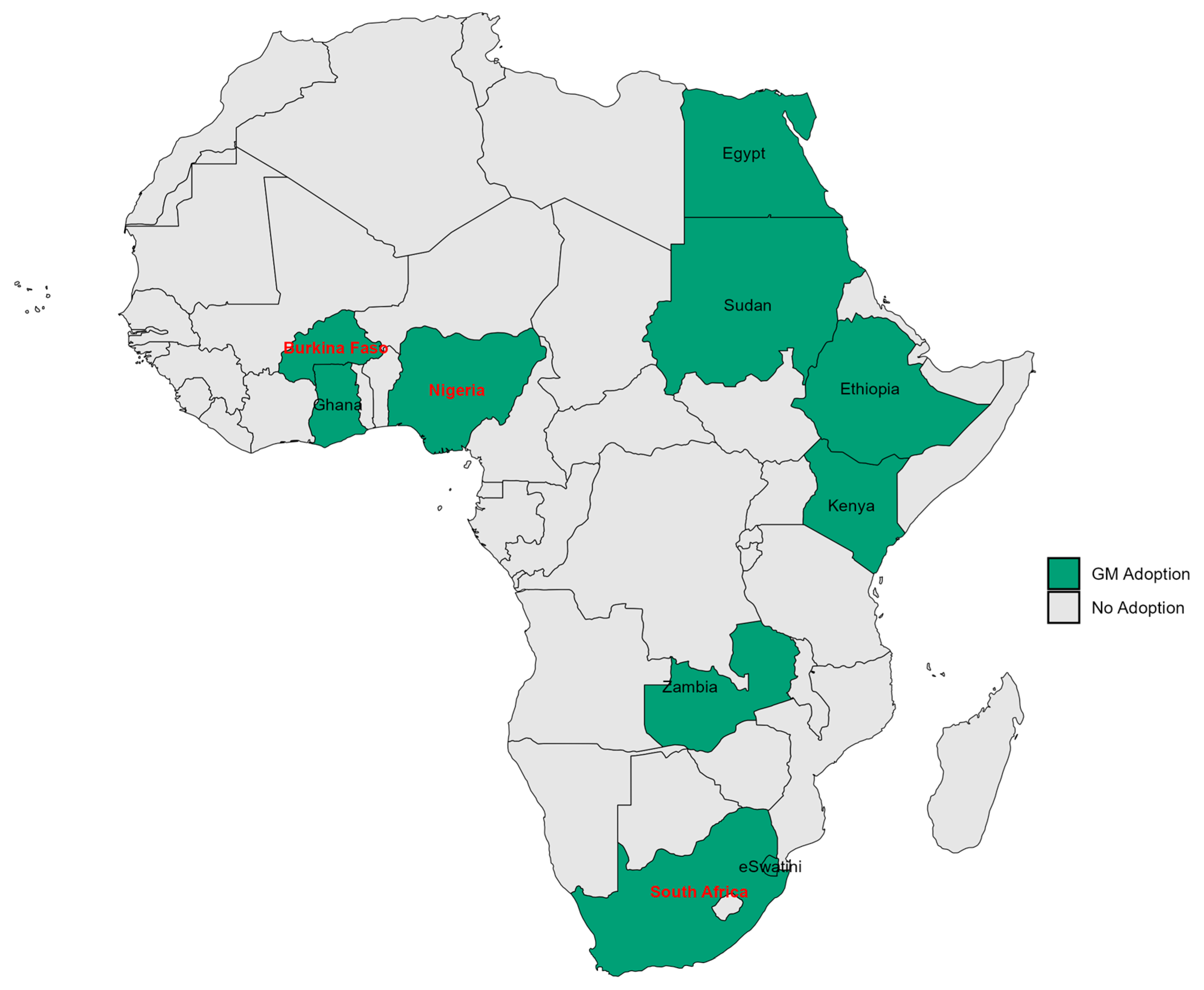
3.1. Overview of GM Crop Adoption Patterns in Sub-Saharan Africa
3.2. Approved GM Crop Events and Trait Diversity in the Focus Countries
3.3. Impact of GM Crops on Pesticide Use Reduction and Socio-Economic Outcomes
3.4. Key Adoption Constraints and Pathways for Improving GM Crop Uptake in Africa
3.4.1. Cultural, Religious, and Community Perception Barriers
3.4.2. Socioeconomic and Environmental Concerns
3.4.3. Regulatory and Institutional Constraints
4. Conclusions and Future Directions
Author Contributions
Funding
Institutional Review Board Statement
Informed Consent Statement
Data Availability Statement
Conflicts of Interest
References
- Fuhrimann, S.; Wan, C.; Blouzard, E.; Veludo, A.; Holtman, Z.; Chetty-Mhlanga, S.; Dalvie, M.A.; Atuhaire, A.; Kromhout, H.; Röösli, M.; et al. Pesticide Research on Environmental and Human Exposure and Risks in Sub-Saharan Africa: A Systematic Literature Review. Int. J. Environ. Res. Public Health 2021, 19, 259. [Google Scholar] [CrossRef] [PubMed]
- Zhou, W.; Li, M.; Achal, V. A comprehensive review on environmental and human health impacts of chemical pesticide usage. Emerg. Contam. 2025, 11, 100410. [Google Scholar] [CrossRef]
- El-Nahhal, I.; El-Nahhal, Y. Pesticide residues in drinking water, their potential risk to human health and removal options. J. Environ. Manag. 2021, 299, 113611. [Google Scholar] [CrossRef] [PubMed]
- Mamane, A.; Baldi, I.; Tessier, J.-F.; Raherison, C.; Bouvier, G. Occupational exposure to pesticides and respiratory health. Eur. Respir. Rev. 2015, 24, 306–319. [Google Scholar] [CrossRef] [PubMed]
- Mmbando, G.S. The Adoption of Genetically Modified Crops in Africa: The Public’s Current Perception, the Regulatory Obstacles, and Ethical Challenges. GM Crop. Food 2024, 15, 185–199. [Google Scholar] [CrossRef]
- Ala-Kokko, K.; Nalley, L.L.; Shew, A.M.; Tack, J.B.; Chaminuka, P.; Matlock, M.D.; D’HAese, M. Economic and ecosystem impacts of GM maize in South Africa. Glob. Food Secur. 2021, 29, 100544. [Google Scholar] [CrossRef]
- Phillip, D.; Nin-Pratt, A.; Zambrano, P.; Wood-Sichra, U.; Kato, E.; Komen, J.; Hanson, H.; Falck-Zepeda, J.B.; Chambers, J.A. Insect-Resistant Cowpea in Nigeria: An Ex Ante Economic Assessment of a Crop Improvement Initiative; IFPRI Discussion Paper 1896; International Food Policy Research Institute: Washington, DC, USA, 2019. [Google Scholar] [CrossRef]
- Gbashi, S.; Adebo, O.; Adebiyi, J.A.; Targuma, S.; Tebele, S.; Areo, O.M.; Olopade, B.; Odukoya, J.O.; Njobeh, P. Food safety, food security and genetically modified organisms in Africa: A current perspective. Biotechnol. Genet. Eng. Rev. 2021, 37, 30–63. [Google Scholar] [CrossRef] [PubMed]
- GM Approval Database, Countries with GM Crop Approval. 2025. Available online: https://www.isaaa.org/gmapprovaldatabase/cropslist/default.asp (accessed on 18 October 2025).
- Kedisso, E.G.; Maredia, K.; Guenthner, J.; Koch, M. Commercialization of genetically modified crops in Africa: Opportunities and challenges. Afr. J. Biotechnol. 2022, 21, 188–197. [Google Scholar] [CrossRef]
- Boluwade, E.; Uche, N. Agricultural Biotechnology Annual; Report number: NI2020-0005; United States Department of Agriculture-Foreign Agricultural Service: Washington, DC, USA, 2021.
- Muzhinji, N.; Ntuli, V. Genetically modified organisms and food security in Southern Africa: Conundrum and discourse. GM Crops Food 2021, 12, 25–35. [Google Scholar] [CrossRef]
- Nboyine, J.A.; Adazebra, G.A.; Owusu, E.Y.; Agrengsore, P.; Seidu, A.; Lamini, S.; Zakaria, M.; Kwabena, J.Y.; Ali, H.K.; Akaogu, I.; et al. Field Performance of a Genetically Modified Cowpea (Vigna unguiculata) Expressing the Cry1Ab Insecticidal Protein Against the Legume Pod Borer Maruca vitrata. Agronomy 2024, 14, 3055. [Google Scholar] [CrossRef]
- Addae, P.C.; Ishiyaku, M.F.; Tignegre, J.-B.; Ba, M.N.; Bationo, J.B.; Atokple, I.D.K.; Abudulai, M.; Dabiré-Binso, C.L.; Traore, F.; Saba, M.; et al. Efficacy of a cry1Ab Gene for Control of Maruca vitrata (Lepidoptera: Crambidae) in Cowpea (Fabales: Fabaceae). J. Econ. Èntomol. 2020, 113, 974–979. [Google Scholar] [CrossRef] [PubMed]
- Komen, J.; Wafula, D.K. Authorizing GM Crop Varieties: Policy Implications for Seed Systems in Sub-Saharan Africa. Agronomy 2021, 11, 1855. [Google Scholar] [CrossRef]
- Hlatshwayo, S.; Modi, A.; Hlahla, S.; Ngidi, M.; Mabhaudhi, T. Usefulness of seed systems for reviving smallholder agriculture: A South African perspective. Afr. J. Food, Agric. Nutr. Dev. 2021, 21, 17581–17603. [Google Scholar] [CrossRef] [PubMed]
- Oyewunmi, A.O. Nigerian Law of Intellectual Property; University of Lagos Press and Bookshop Limited: Lagos, Nigeria, 2015. [Google Scholar]
- Bekele-Alemu, A.; Dessalegn-Hora, O.; Safawo-Jarso, T.; Ligaba-Osena, A. Rethinking progress: Harmonizing the discourse on genetically modified crops. Front. Plant Sci. 2025, 16, 1547928. [Google Scholar] [CrossRef]
- Byron, I.P. The protection of traditional knowledge under the sui generis regime in Nigeria. Int. Rev. Law Comput. Technol. 2021, 36, 17–27. [Google Scholar] [CrossRef]
- Then, C.; Miyazaki, J.; Bauer-Panskus, A. Deficiencies in the Risk Assessment of Genetically Engineered Bt Cowpea Approved for Cultivation in Nigeria: A Critical Review. Plants 2022, 11, 380. [Google Scholar] [CrossRef] [PubMed]
- Ogunwola, A.A. Genetically Modified Foods and the Ethics of Ọmọlúàbí: An African Perspective on Biotechnology Policy in Nigeria. Afr. J. Relig. Theol. Stud. 2025, 5, 76–90. [Google Scholar] [CrossRef]
- Gbadegesin, L.A.; Ayeni, E.A.; Tettey, C.K.; Uyanga, V.A.; Aluko, O.O.; Ahiakpa, J.K.; Okoye, C.O.; Mbadianya, J.I.; Adekoya, M.A.; Aminu, R.O.; et al. GMOs in Africa: Status, adoption and public acceptance. Food Control 2022, 141, 109193. [Google Scholar] [CrossRef]
- Akinbo, O.; Obukosia, S.; Ouedraogo, J.; Sinebo, W.; Savadogo, M.; Timpo, S.; Mbabazi, R.; Maredia, K.; Makinde, D.; Ambali, A. Commercial Release of Genetically Modified Crops in Africa: Interface Between Biosafety Regulatory Systems and Varietal Release Systems. Front. Plant Sci. 2021, 12, 605937. [Google Scholar] [CrossRef] [PubMed]


| Country | Crop (Scientific Name) | Events Approved | GM Traits |
|---|---|---|---|
| Nigeria | Cotton (Gossypium hirsutum L.) | 1 | Insect resistance; Antibiotic resistance |
| Cowpea (Vigna unguiculata) | 1 | Insect resistance | |
| Maize (Zea mays L.) | 19 | Insect resistance; Herbicide tolerance | |
| Soybean (Glycine max L.) | 11 | Herbicide tolerance | |
| Wheat (Triticum aestivum) | 1 | Drought stress tolerance | |
| South Africa | Argentine Canola (Brassica napus) | 5 | Herbicide tolerance; Fertility restoration |
| Cotton (Gossypium hirsutum L.) | 11 | Insect resistance; Herbicide tolerance | |
| Soybean (Glycine max L.) | 16 | Herbicide tolerance; Nematode resistance | |
| Rice (Oryza sativa L.) | 1 | Herbicide tolerance | |
| Maize (Zea mays L.) | 49 | Insect resistance; Herbicide tolerance, mannose metabolism | |
| Burkina Faso | Cotton (Gossypium hirsutum L.) | 1 | Insect resistance |
| Dimension | Nigeria | South Africa | Burkina Faso |
|---|---|---|---|
| Regulatory framework maturity | Emerging but strengthening biosafety system through the recently operationalized National Biosafety Management Agency-led framework [15] | Long-established, well-funded, and mature biosafety regulatory system [5] | Previously functional but weakened after Bt cotton suspension [5]. |
| Policy consistency and institutional coordination | Ongoing harmonization among regulatory agencies; improving but still fragmented coordination [15] | Strong inter-agency coordination and regulatory clarity [10] | Institutional disagreements between government and private partners undermined continuity [5]. |
| Seed system readiness and stewardship | Developing seed certification, stewardship, and distribution systems; challenges for nationwide scale-up [15] | Highly developed commercial seed sector with strong stewardship systems [10] | Weak seed system integration for GM crops; dependency on external partners [5]. |
| Farmer structure and capacity | Dominated by smallholder farmers; adoption driven by clear pest-control benefits (e.g., Bt cowpea) [5,7] | Dominance of large-scale commercial farming; smallholders face cost and access barriers [10,16] | Predominantly smallholder cotton farmers with limited bargaining power [5]. |
| Socioeconomic concerns | Fear of seed dependency, loss of traditional seed systems, and corporate control; cost sensitivity among smallholders [10,17] | Concerns mainly among smallholders; commercial farmers better positioned to absorb GM seed costs [10,16] | Strong concerns over farmer autonomy, seed pricing, and market dependence [5]. |
| Cultural, religious, and public perception | Religious and cultural objections present; narratives of “playing God” and biopiracy influence public debate [18,19] | Relatively higher public acceptance, though civil society opposition remains active [10,16] | Initial acceptance eroded primarily by economic dissatisfaction rather than cultural resistance [5]. |
| Environmental and biosafety concerns | Gene flow risks in mixed cropping systems; concerns over long-term ecological effects of Bt proteins [8,20] | Robust environmental risk assessment and monitoring systems [12] | Environmental concerns secondary to fibre quality and market issues [5]. |
| Observed benefits from GM adoption | Significant reduction in insecticide use; yield gains in Bt cowpea and maize [7,13] | Sustained yield gains, reduced pesticide use, and economic benefits in maize and cotton [5,12] | Initial pesticide reduction and yield gains from Bt cotton [5]. |
| Key factors limiting sustained adoption | Public perception, regulatory learning curve, seed access for smallholder farmers [5,21] | Cost barriers for smallholders; social equity concerns [10,16] | Fibre quality issues, institutional conflict, and loss of farmer trust [5]. |
| Pathways for improving uptake | Strengthen public engagement, involve religious and community leaders, improve seed affordability, expand extension services | Support inclusive policies for smallholders, targeted subsidies, continued stewardship | Restore institutional trust, invest in locally adapted GM traits, strengthen farmer participation |
| Overall adoption trajectory | Gradual expansion with strong potential | Stable and consolidated adoption | Reversal and stagnation |
Disclaimer/Publisher’s Note: The statements, opinions and data contained in all publications are solely those of the individual author(s) and contributor(s) and not of MDPI and/or the editor(s). MDPI and/or the editor(s) disclaim responsibility for any injury to people or property resulting from any ideas, methods, instructions or products referred to in the content. |
© 2026 by the authors. Licensee MDPI, Basel, Switzerland. This article is an open access article distributed under the terms and conditions of the Creative Commons Attribution (CC BY) license (https://creativecommons.org/licenses/by/4.0/).
Share and Cite
Uhegwu, C.C.; Anumudu, C.K. Genetically Modified Crops as a Strategy for Reducing Pesticide Dependence in Sub-Saharan Africa: Exploring Benefits, Adoption Constraints and Policies. Biol. Life Sci. Forum 2025, 54, 32. https://doi.org/10.3390/blsf2025054032
Uhegwu CC, Anumudu CK. Genetically Modified Crops as a Strategy for Reducing Pesticide Dependence in Sub-Saharan Africa: Exploring Benefits, Adoption Constraints and Policies. Biology and Life Sciences Forum. 2025; 54(1):32. https://doi.org/10.3390/blsf2025054032
Chicago/Turabian StyleUhegwu, Chijioke Christopher, and Christian Kosisochukwu Anumudu. 2025. "Genetically Modified Crops as a Strategy for Reducing Pesticide Dependence in Sub-Saharan Africa: Exploring Benefits, Adoption Constraints and Policies" Biology and Life Sciences Forum 54, no. 1: 32. https://doi.org/10.3390/blsf2025054032
APA StyleUhegwu, C. C., & Anumudu, C. K. (2025). Genetically Modified Crops as a Strategy for Reducing Pesticide Dependence in Sub-Saharan Africa: Exploring Benefits, Adoption Constraints and Policies. Biology and Life Sciences Forum, 54(1), 32. https://doi.org/10.3390/blsf2025054032