


Need Help?
Announcements
9 October 2025
Meet Us at the 3rd International Conference on AI Sensors and Transducers, 2–7 August 2026, Jeju, South Korea
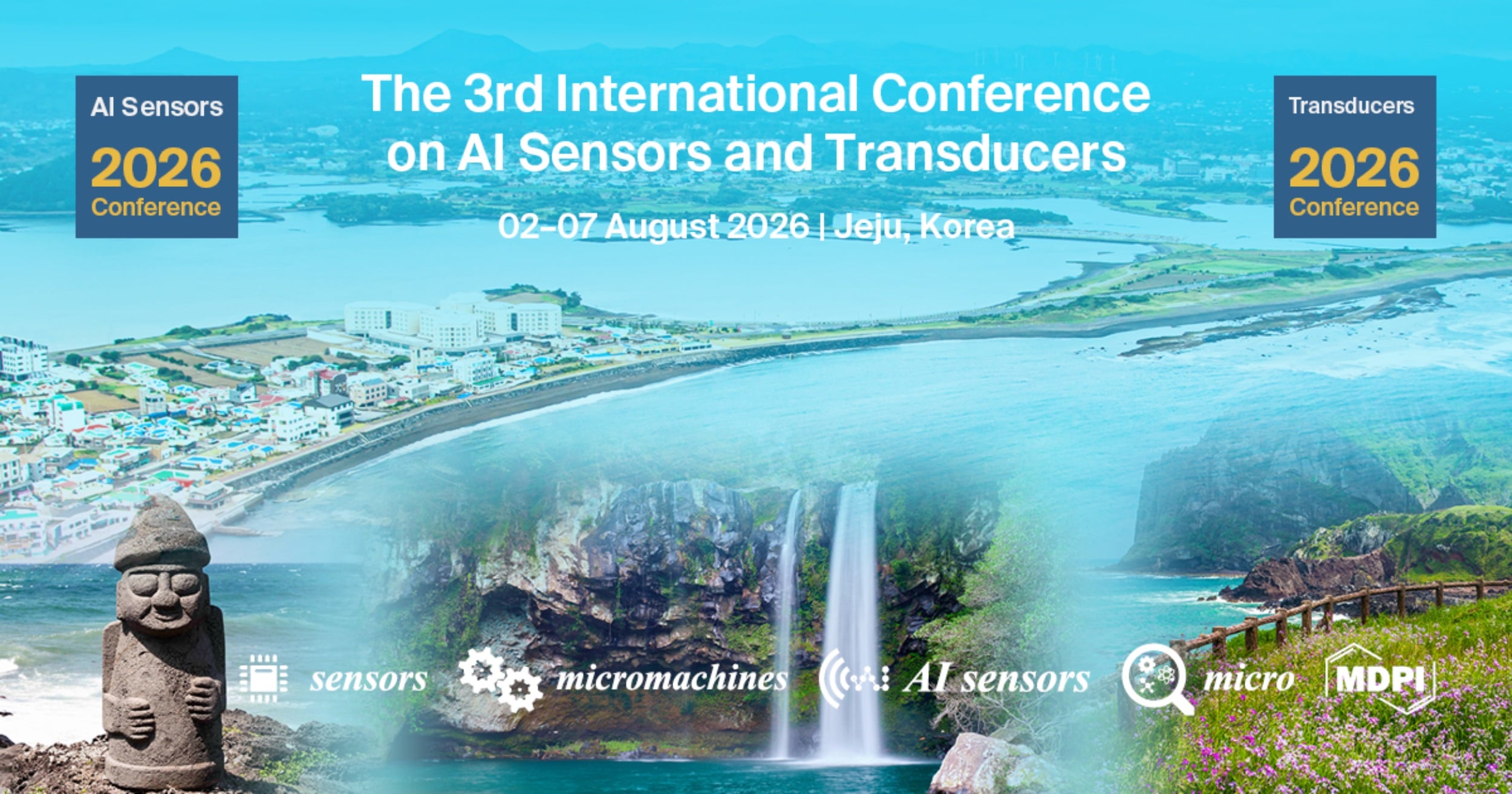
Following from our two previous successful editions, we invite you to submit your abstracts and participate in the 3rd International Conference on AI Sensors and Transducers, taking place from 2 to 7 August 2026 in Jeju, South Korea.
Organized by MDPI and the open access journals Sensors, Micromachines, AI Sensors, Micro and Remote Sensing, this in-person conference will once again bring together experts and participating researchers who will share insights and innovations in sensors, sensing technology, transducers and artificial intelligence.
Start preparing your abstracts:
Don’t miss this opportunity to showcase your work to peers and leading experts in AI-enhanced sensing systems and transducers. We will be announcing the session topics at AIS 2026 soon.
Find out more about the instructions for authors: https://sciforum.net/event/AIS2026?section=#instructions.
Find out more about the publication opportunities available for authors: https://sciforum.net/event/AIS2026?section=#Publicationopportunities.
Please feel free to share the information about this conference to your colleagues and students.
We look forward to welcoming you in Jeju!
The organizing committee of the 3rd International Conference on AI Sensors and Transducers (AIS 2026).
5 August 2026
MDPI INSIGHTS: The CEO’s Letter #37 – Canada Summit, Sciforum Relaunch, 30 Years of Impactful Research & ISPRS 2026

Welcome to the MDPI Insights: The CEO's Letter.
In these monthly letters, I will showcase two key aspects of our work at MDPI: our commitment to empowering researchers and our determination to facilitating open scientific exchange.
Opening Thoughts

Reflections from the MDPI Canada Summit 2026 in Toronto (9–10 July)
As part of this year’s MDPI Summit events, we were delighted to host Editors-in-Chief (EiCs) and Editorial Board Members (EBMs) in Toronto for the MDPI Canada Summit 2026 this July.
Across the two days, we presented on topics including research integrity, editorial leadership, artificial intelligence, peer review, and the evolving role of the EiC. More importantly, the Summit created space for feedback and conversations with the academic community: these engagements continue play and important role in shaping how MDPI develops its journals and services.
Why Canada?
Canada has become one of the world’s leading Open Access (OA) nations. In 2025, 68% of Canadian research publications were published OA, with more than 73,000 OA articles produced during the year. Over the past five years alone, Canadian researchers have published more than 526,000 scholarly articles, showing both the scale and quality of Canadian research.
MDPI Toronto Office

“Canada has become one of the world’s leading Open Access nations”
Since opening in 2019, our Toronto office has grown to more than 85 colleagues supporting editorial operations, research integrity, marketing, societies, conferences, indexing, author services, and many other functions across North America. It was great to spend time with the team, see first-hand the energy and enthusiasm they bring to their work, and recognize the significant role they play in building relationships with the Canadian research community and delivering events such as this Summit.
MDPI and Canada
Today, Canada is an important part of the MDPI community:
- More than 53,800 articles from Canadian institutions published with MDPI since 1996
- More than 5,800 MDPI publications from Canadian researchers in 2025
- Nearly 1,900 Canadian Editorial Board Members, including 24 Editors-in-Chief; 49 Section Editors-in-Chief
- More than 30 Institutional Open Access Partnerships (IOAP) with universities across Canada

“The academic community is at the center of everything we do”
These numbers reflect the long-term partnerships with researchers, reviewers, editors, and institutions who continue to place their trust in MDPI.
Summit Program
Throughout the Summit, we presented and discussed topics against the following agenda:
- MDPI at 30: Introduction, Reflections and the Road Ahead – Stefan Tochev (CEO)
- Engagement with Academic Community and Society Partnerships – Karen Irwin (Associate Editorial Engagement Manager) and Carla Aloè (Head of Societies and Acquisition)
- Latest Developments in the Editorial Process – Summer Huggard (Operations Manager)
- Research Integrity and Publication Ethics – Renato Merki (Research Integrity Specialist)
- AI and Technology in Publishing – Dr. Barnaby Crook (Regional Engagement Editor)
- Panel Discussion – Bob Vrooman (Head of Business Development / Operations Manager, USA), Summer Huggard, Renato Merki, and myself

These presentations reinforce something we often say at MDPI: The academic community is at the center of everything we do. Each session concluded with a Q&A, allowing for discussions throughout the Summit to engage directly with our EiCs and EBMs.
Further Reading
I also had the opportunity to be interviewed by University Affairs about the evolving landscape of scholarly publishing, Open Access, and the importance of engaging with the research community. If you’re interested, you can read the interview in:
- English: University Affairs – MDPI Toronto Summit 2026: Bringing Together Leaders to Shape the Future of Scholarly Publishing
- Français: Affaires universitaires – Sommet MDPI de Toronto 2026
Thank You
As OA continues to grow around the world, events such as the MDPI Canada Summit remind us of the importance of meeting with our academic community in person. Listening to feedback, exchanging ideas, and building relationships are essential to ensuring that MDPI continues to evolve alongside the researchers, editors, reviewers, and institutions we serve.

Impactful Research

Five Journals, Five Different Stories of Success
Each year, the release of the Journal Citation Reports (JCR) provides an opportunity to look at the progress of our journal portfolio and, more importantly, the achievements of the research communities behind it.
A recent MDPI Blog article from Tommy Lax (Content Specialist, MDPI) highlights five journals whose 2025 Journal Impact Factor results show that success can take many forms – from achieving a first Impact Factor, to steady long-term growth, to leadership within highly competitive disciplines.
The featured journals include:
- Machine Learning & Knowledge Extraction (MAKE) – Among the 330 MDPI journals which received an Impact Factor in 2025, MAKE (ISSN 2504-4990) holds the accolade of having the highest rating of 8.4. The journal, which provides an advanced forum for the study of machine learning and its applications, is placed in Q1 for three subject categories: Computer science, artificial intelligence; Computer science, interdisciplinary applications; and Engineering, electrical & electronic.
- Antioxidants – Continuing its strong position across multiple scientific disciplines, Antioxidants (ISSN 2076-3921) was awarded an exceptional Impact Factor of 8.2. In addition, the journal was placed in Q1 in three subject categories: Biochemistry & molecular biology; Chemistry, medicinal; and Food science & technology.
- Biomass – This year, Biomass (ISSN 2673-8783) was recognized in the JCR for the first time, with a strong debut Impact Factor of 6.7. What makes this achievement even more impressive is the journal’s placement in Q1 of the category Engineering, chemical.
- Analytica – Remaining with the theme of growth, Analytica (ISSN 2673-4532), which provides an advanced forum for all aspects of fundamental and applied analytical chemistry, recorded one of the largest year-on-year increases in Journal Impact Factor, with a 7.4 – an astounding 3.8-point increase from its 2024 rating of 3.6.
- Batteries – Indexed in SCIE, Batteries (ISSN 2313-0105) received an updated Impact Factor of 6.3 this year, representing an increase of 1.5 versus last year, demonstrating consistent growth and increasing visibility over several years.
While citation metrics provide one perspective on journal performance, they tell only part of the story. Every milestone reflects the dedication of Editors-in-Chief, Editorial Board Members, reviewers, authors, and colleagues across MDPI who work together to uphold rigorous editorial standards and support high-quality research.
As a signatory of the Declaration on Research Assessment (DORA), MDPI supports a balanced approach to research evaluation. Journal-level metrics should be viewed alongside article-level indicators and the broader scientific and societal impact of published research.
Thank you to everyone whose commitment continues to strengthen our journals and advance Open Access across the global research community.
Inside MDPI

Building Better Tools for the Research Community: The Relaunch of Sciforum
Innovation at MDPI extends beyond journals. Over the past decade, we have continued to invest in products that support researchers, conference organizers, editors, reviewers, and institutions throughout the research lifecycle. As part of this ongoing investment, our Product and Engineering teams have been modernizing several of MDPI’s digital platforms. One important milestone in that journey is the relaunch of Sciforum, our conference management platform.
Read More: Sciforum Relaunch: Empowering Science through Seamless Event Management
Rather than simply updating an existing system, our product and engineering teams have rebuilt Sciforum, using a modern architecture designed to improve the user experience, support future growth, and continue to strengthen our position in the conference management market.
“Scalable technology is essential to delivering a high-quality experience”
Why We Rebuilt Sciforum
Technology must continue evolving alongside the needs of our users. The previous platform had served MDPI well for many years but had become difficult to extend and maintain. The new platform introduces a modular architecture that enables faster development, more flexibility, and a scalable foundation for future work.
Major improvements include:
- Simplified submission workflows
- Role-based dashboards
- A modern website builder
- Flexible pricing options
- Permanent data hosting
- A scalable architecture for future development

Supporting Our Conference Community
Sciforum is more than a software platform: it supports researchers, conference organizers, reviewers, speakers, and attendees by helping them organize, participate in, and share scientific meetings more efficiently. As MDPI continues to expand its conference activities worldwide, investing in modern, scalable technology is essential to delivering a high-quality experience for both our external partners and our internal teams.
Looking Ahead
The relaunch represents the beginning Sciforum’s next chapter. Planned improvements include: the Program Builder, Communication Hub, expanded payment options, Zoom integration, and a mobile application. These will continue to enhance the platform over the coming months.
Coming Together for Science

Highlights from ISPRS Congress 2026 – Toronto, Canada
In early July, I had the pleasure of attending the XXV ISPRS Congress in Toronto, one of the world’s leading gatherings for the geospatial and remote sensing research community. It was a great opportunity to meet researchers, editors, society leaders, and collaborators, while gaining insights into some of the latest developments in geospatial science and technology.
Over several days, I had the privilege of presenting the Jack Dangermond Award; speaking about MDPI’s approach to AI in publishing and our 30-year journey in Open Access publishing; participating in Editorial Board meetings; and engaging with members of the ISPRS community.
Below is a summary of these activities:
Celebrating excellence in research
One of the highlights of the week was presenting the Jack Dangermond Award for the best paper published in the ISPRS International Journal of Geo-Information (IJGI). Sponsored by MDPI and ESRI, the award recognizes an outstanding paper published over a four-year period and includes an ISPRS certificate together with a USD 10,000 prize.

Awards such as these remind us that journals are much more than publication platforms: they celebrate research that advances knowledge, inspires future work, and delivers meaningful impact for both science and society.
Presentations at ISPRS
I also had the pleasure to give two presentations during the congress:

1. The AI Revolution in Publishing: Challenges, Innovations, and MDPI’s Vision
The development of AI continues to transform scholarly publishing. During this session, I shared how MDPI is integrating AI responsibly, not to replace editorial judgement or peer review, but to support our staff by improving efficiency while maintaining scientific quality and research integrity.
2. MDPI: 30 Years of Open Access Publishing
I also had the opportunity to share MDP’s 30-year journey from a small publishing initiative to becoming a global Open Access publisher serving millions of researchers worldwide. As part of this session, my colleague Carla Aloè (Head of Societies and Acquisitions) introduced the ISPRS International Journal of Geo-Information (IJGI), sharing its development and contribution to the geospatial research community.

Meeting with Our Editorial Boards
Another rewarding aspect of the congress was meeting with the Editorial Boards of two of our journals:
- Remote Sensing
- ISPRS International Journal of Geo-Information
These discussions went beyond journal metrics. We heard ideas about editorial quality and emerging research areas, and we discussed reviewer engagement, diversity within editorial boards, and how journals can continue serving their communities for the future. These conversations are a great way to connect directly to the scientists who help shape our journals.


“One of our core missions has always been to make high-quality research openly accessible”
Partnerships matter
Scientific publishing is built on collaboration. Throughout the congress, our team welcomed researchers to the MDPI booth, met with authors and editors, and discussed opportunities for collaboration across our journals and society partnerships.
Special thanks to our MDPI colleagues who were present throughout the ISPRS congress supporting our Editorial Board meetings and the MDPI booth: Andy Tran, Carla Aloè, Carlo Cunanan, Diana Ribeiro Tosato, and Elena Duan.

Thank you to ISPRS for organizing this congress, to the researchers who shared their work, to our Editorial Board members, and to MDPI colleagues whose dedication continues to shape the journals and communities we support.
Closing Thoughts

Insights Into 30 Years of Impactful MDPI Research
As we celebrate 30 years of MDPI, it’s worth reflecting on the impact that the research we publish has on society. One of our core missions has always been to make high-quality research openly accessible so that it can inform new discoveries, public policy, education and innovation around the world.
A recent article on the MDPI Blog highlights several examples of MDPI publications that have gone beyond academic citations to help inform governments, international organizations and public policy discussions.
Research Creating Real-World Impact
The MDPI blog article features research that has contributed to topics including:
- protecting the Amazon rainforest through satellite mapping
- understanding climate change and urban heat inequality
- encouraging more young women to pursue STEM careers
- tackling obesity through healthier food environments
- shaping sustainable urban planning through the “15-minute city” concept
These examples remind us that publishing research is not only about producing articles: it is about helping knowledge reach the people who can use it to improve lives and address global challenges.
Thirty Years of Open Access
MDPI’s 30th Anniversary is also an opportunity to recognize the collective contribution of everyone across MDPI. Every manuscript processed, every review coordinated, every system developed, every conference organized, every partnership established and every article published contributes to a much larger purpose: helping scientific knowledge move further and faster.
You can explore the full article here: 30 Years of Impactful MDPI Research
You can also visit our 30th Anniversary page to learn more about MDPI’s journey over the past three decades.
Chief Executive Officer
MDPI AG
9 July 2026
MDPI’s Journal Cluster of Instruments and Instrumentation Webinar | Micro–Nano Fabrication: Biosensors, Triboelectric Devices and Biomedical Microrobots, 14 July 2026

Join us for the MDPI Journal Cluster of Instruments and Instrumentation Webinar entitled “Micro–Nano Fabrication: Biosensors, Triboelectric Devices and Biomedical Microrobots”.
This webinar will explore recent advances in micro- and nanofabrication technologies and their applications in biosensing, triboelectric devices and biomedical microrobotics.
The program features three distinguished speakers who will present their latest research and insights on topics including the fabrication and control of biomedical micro- and nanorobots, high-performance nanoplasmonic biosensor chips and triboelectric devices for energy harvesting and sensing.
The webinar provides an opportunity for researchers, engineers and academics to learn about emerging developments in the field, engage with leading experts and participate in discussions on the future of micro–nano fabrication and its biomedical and engineering applications.
Keywords: micro- and nanofabrication; microrobotics; nanorobotics; micromanipulation; targeted drug delivery; microbiorobotics; microbiomanipulation and sensing; microfluidics; triboelectric nanodevices
Date: 14 July 2026
Time: 12:00 p.m. CEST | 6:00 p.m. CST (Asia)
Webinar ID: 833 4641 6213
Webinar Secretariat: journal.webinar@mdpi.com
Website: https://sciforum.net/event/Cluster-14?subscribe
Register now for free!

| Speaker | Presentation | Time (CEST) | Time (CST Asia) |
| Webinar Opening | 12:00–12:10 | 18:00–18:10 | |
| Dr. U Kei Cheang | Fabrication and Control of Biomedical Micro- and Nanorobots | 12:10–12:35 | 18:10–18:35 |
| Q&A Session | 12:35–12:40 | 18:35–18:40 | |
| Dr. Francesco Arcadio | Ultra-High Performance Nanoplasmonic Biosensor Chips Based on Optimized L-Shaped Gold Nanogratings | 12:40–13:05 | 18:40–19:05 |
| Q&A Session | 13:05–13:10 | 19:05–19:10 | |
| Dr. Christos Tsamis | Triboelectric Devices: Influence of Fabrication Technologies on Device Performance | 13:10–13:35 | 19:10–19:35 |
| Q&A Session | 13:35–13:40 | 19:35–19:40 | |
| Ms. Maria Sikorska | Journal Introduction and Special Issue Presentation | 13:40–13:50 | 19:40–19:50 |
| Closing Remarks | 13:50–14:00 | 19:50–20:00 |
After registering, you will receive a confirmation email on how to join the webinar. Registrations with academic institutional email addresses will be prioritized.
Unable to attend? Register anyway, and we will let you know when the recording is available to view.
Webinar Keynote Speakers:
- Dr. U Kei Cheang, Southern University of Science and Technology, China;
- Dr. Francesco Arcadio, University of Campania Luigi Vanvitelli, Italy;
- Dr. Christos Tsamis, National Center for Scientific Research “Demokritos”, Greece.
8 July 2026
MDPI’s Newly Launched Journals in June 2026
Our portfolio of journals available for publishing up-to-date research in immediate open access format has been further expanded. In June 2026, eleven new journals released their inaugural issues and two transferred journals released their first issue as part of MDPI, covering the subjects of environmental & earth sciences, chemistry & materials science, public health & healthcare, engineering, medicine & pharmacology, and biology & life sciences.
We extend our gratitude to the Editors-in-Chief, Associate Editors, and Editorial Board Members who will shape the future course of these new journals. Each journal is dedicated to upholding strong editorial standards through a thorough peer review process, enabling impactful open access scholarship.
Please feel free to browse and discover more about the new journals below.
|
New Journals |
Founding Editor(s)-in-Chief |
Journal Topics (Selected) |
|
|
Prof. Dr. Xiaochuan Pan, Peking University, China |
public health research, practice, policy, and education; eco-health equity | |
|
|
Prof. Dr. Xin-Gao Gong Fudan University, China; Prof. Dr. Zhimei Sun Beihang University, China |
AI-enhanced theory & simulation; generative design & discovery; autonomous experimentation; AI for characterization; large language models and agents | |
|
|
Prof. Dr. Yong Liu, Wuhan University, China |
hydropower technology; renewable energy; water resources; optimization; rock and soil mechanics; power system stability | |
|
|
Prof. Dr. Giovanni Rezza, University Vita-Salute San Raffaele, Italy |
pandemic preparedness; public health; global outbreak dynamics and epidemiology; outbreak prediction and risk forecasting; one health approach; zoonotic and pre-pandemic vaccines | |
|
|
Prof. Dr. Brian Horton, University of Texas at Austin, USA |
stratigraphy; sedimentology; earth surface processes; basin evolution and tectonics; climate and paleoclimate | |
|
|
Prof. Dr. Yike Guo, Hong Kong University of Science and Technology, China |
artificial intelligence (AI); application of AI to engineering; Explainable AI (XAI); AI-driven design and optimization; AI for manufacturing and automation | view journal scope | submit an article |
|
|
Prof. Dr. Hei Wong, City University of Hong Kong, China |
novel semiconductor materials; advanced heterogeneous integration technologies; advanced characterization and testing techniques; heterogeneously integrated systems and applications; modeling and design automation| |
|
|
Prof. Dr. Michail Panagiotidis, Mississippi State University, USA |
plant-based medicines; natural products-based drug discovery; plant-based bioactive compounds; pharmacognosy; phytochemicals; pharmacokinetics | |
|
|
Prof. Dr. Khalid Meksem, Southern Illinois University, USA |
genome biotechnology; applied genomics; genetic engineering; agricultural biotechnology; medical biotechnology; data science and AI| |
|
|
Dr. Chenxi Wu, Chinese Academy of Sciences, China |
environmental cleanup; ecological restoration; environmental management and governance; environmental modeling and monitoring | |
|
|
Prof. Dr. Janusz Kozinski, Lakehead University, Canada |
renewable energy; sustainable agriculture; green innovation; climate change; artificial intelligence and environmental sustainability | |


|
Transferred Journals |
Editor(s)-in-Chief |
Journal Topics (Selected) |
|
|
Prof. Dr. Thomas Frese, Martin-Universität Halle-Wittenberg, Germany |
health services in primary care; integrated care models; quality and safety of care; coordination across primary and secondary care services; patient management; primary care clinical practice and interventions; clinical interventions delivered in primary care settings; |
|
|
Prof. Dr. Paul Gerson Unschuld, Geneva University Hospitals (HUG), Switzerland |
neurology, psychiatry, psychotherapy, and the neurosciences | |


We would like to thank everyone who has supported the development of open access publishing. If you would like to create a new journal, you are welcome to send an application here or contact the New Journal Committee (newjournal-committee@mdpi.com).
8 July 2026
Honoring the Top 1000 Reviewers for 2025
Peer review is the invisible foundation of academic progress. The 2025 MDPI Top Reviewers are some of the key experts who helped build it.
We are honored to recognize 1000 individuals from our global community of 210,000 reviewers across 67 countries and territories—chosen for their commitment to rigorous, constructive peer review and the consistency of their contributions throughout 2025.
The Top Reviewers provided constructive and impartial feedback that makes research stronger and more impactful, and we are grateful for it.
The names of these reviewers are listed below in alphabetical order by first name:
|
A. N. M. Mamun-Or-Rashid |
Han Wu |
Nijia Qian |
|
Abdallah Galal |
Hani Nasser Abdelhamid |
Nikola Petrović |
|
Abdeljabbar Ghanmi |
Hanstter Rezende |
Nina Mendez-Dominguez |
|
Abdelmalek Bellal |
Han-Tsung Wang |
Nora Ahmed |
|
Abdelnasser Abidli |
Hao Tang |
Nurcan Kilinc-Ata |
|
Abderrahim Ayad |
Haodong Chen |
Oğuzhan Çetindemir |
|
Abdulkadir Atalan |
Haoxuan Dong |
Oksana Kovtun |
|
Abid Ullah |
Hassan Barakat |
Oluwagbemiga Paul Agboola |
|
Adeney De Freitas Bueno |
Hassan Harb |
Omar Alsetoohy |
|
Agnieszka Synowiec |
Hebat-Allah Sarhan Tohamy |
Ömer Kaya |
|
Agnishwar Girigoswami |
Héctor Mora-Montes |
Omneya Attallah |
|
Agustín Ariño |
Hengkai Li |
Orestis M. Ioannidis |
|
Ahmadjan Muhammadhaji |
Hengrui Liu |
Oscar Arias-Carrion |
|
Ahmadreza Mohebbi |
Hiroshi Matsuyama |
Osmar Antonio Jaramillo Morales |
|
Ahmed Gad |
Ho Namgung |
Palash Mandal |
|
Ahmed Ghezal |
HoangNam Tran |
Panayiotis Iliakis |
|
Ahmed Mohamed Nabil Helaly |
Hongfen Zhu |
Pargam Vashishtha |
|
Ahmed Saad Rashed |
Hongzhi Shen |
Parisa Kaviani |
|
Ahmet İhsan Turan |
Hossein Lotfi |
Patrycja Kleczkowska |
|
Aidin Bordbar-Khiabani |
Huajin Li |
Paula Pinto |
|
Alain Manuel Chaple Gil |
Huayue Chen |
Paulius Skačkauskas |
|
Alan Gasiński |
Hui Lu |
Paulo Cezar Bastianello Campagnol |
|
Albena Doicheva |
Huseyin Cetin |
Pavel Kic |
|
Alberto Gallegos |
Hyeong-Geun Kim |
Pavlo Maruschak |
|
Alejandro Cano-Villagrasa |
Hyoungchul Shin |
Paweł Ciężkowski |
|
Aleksandr Bobrovskikh |
Ibrahim Mohamed |
Paweł Rydzewski |
|
Aleksandra Figurek |
Ibrahim Mosly |
Pedro Valdivia-Moral |
|
Aleksandra Jovanović |
Ibtissam Bakkouri |
Peng Chen |
|
Aleksandra Rybak |
Igor Schepetkin |
Pengle Cheng |
|
Alessandro Poggi |
Ilias Lazos |
Philippe Colomban |
|
Alessio Castagnoli |
Imen Barraj |
Pier Nicola Sergi |
|
Alexandre Pimenta |
Imran Ali |
Ping Zhu |
|
Alexey Andreychev |
Imtiaz Ahmad |
Piotr Legutko |
|
Alexey Beskopylny |
Ioannis A. Giantsis |
Piotr Lichota |
|
Alexis Murillo Carrasco |
Ioannis Vardiambasis |
Poya Sohrabi |
|
Alfredo Teixeira |
Irina Georgescu |
Pradeep Kumar Yadav |
|
Ali Abd El-Aty |
Isaac Adejumo |
Prashant Singh |
|
Ali Alshebami |
Isabel Legaz |
Prithviraj Nandigrami |
|
Ali Ercetin |
Isabel Maldonado |
Przemysław Podulka |
|
Ali Kandil |
Isabel Marques |
Qiang Peng |
|
Alireza Shoari |
Itamar Luís Gonçalves |
Qiang Yao |
|
Alok Tiwari |
Ivan Laktionov |
Qiaochu Li |
|
Aman Muhammad |
Ivan Šoša |
Qichang An |
|
Amgad Fahmy |
Ivan V. Semenyuta |
Qingqing Sun |
|
Amira Mohamed Idrees |
Izabela Zakrocka |
Rabii El Maani |
|
Amr Mohamed |
Jae Hwan Lee |
Radosław Balwierz |
|
Amroune Salah |
Jakub Ciazela |
Rafat Ghanamah |
|
Anastasia Ivanova |
Jale Minibas-Poussard |
Rajaram Rajamohan |
|
Anastasios Koulaouzidis |
Jamal Ayour |
Rajendra Rohokale |
|
Anatoli Popov |
James A. Bunce |
Raluca Isac |
|
András Molnár |
Janvier Habumugisha |
Raluca Mureşan |
|
André Luiz Missio |
Jarogniew Łuszczki |
Ramalingam Manikandan |
|
André Pinto |
Jasna Čanadanović Brunet |
Rashad EL-Sagheer |
|
André Rolim Baby |
Jean-Louis Pinault |
Rashid Dallaev |
|
Andres Camargo-Sanchez |
Jelena Petrović |
Ravish Patel |
|
Andrew Perry |
Jesús Bernardo Páez-Lerma |
Rehan Jamil |
|
Andrey Kuskov |
Jesus Jaquez-Muñoz |
Renzo Pepe-Victoriano |
|
Andrey Zamyatnin |
Jia Wang |
Ricardo Hernández-Martínez |
|
Andrii Velychkovych |
Jia Wen Li |
Ricardo Luiz Fernandes Bella |
|
Angeliki Papalou |
Jia-Bin Wu |
Ricardo Raimundo |
|
Anita Sejben |
Jianfeng Chen |
Rina Zviel-Girshin |
|
Anja Terzić |
Jiangmin Ding |
Ritthideach Yorsaeng |
|
Anna Kamenskikh |
Jiangxiong Zhu |
Robinson J. Herrera-Feijoo |
|
Anna Maria Kot |
Jiangyu Zhu |
Rocco Ditommaso |
|
Antanas Laurincikas |
Jianhua Ren |
Rocco Vitis |
|
Anton Tkachenko |
Jianjian Zheng |
Rodrigo Valenzuela |
|
António Miguel Monteiro |
Jianzhao Qi |
Roman Dmytryshyn |
|
António Portelada |
Jiazhen Zhang |
Roman Parovik |
|
Antonios Christou |
Jifu Li |
Ronit Sionov |
|
Antreas Kantaros |
Jingcai Zhang |
Ruben Rodríguez Elizalde |
|
Arash Kardani |
Joanna Kosałka-Węgiel |
Ružica R. Nikolić |
|
Arash Shams Taleghani |
João Carlos Caetano Simões |
Sadegh Ghaderi |
|
Armand Faganel |
Jonathan Soldera |
Salih Özer |
|
Artem Perepelitsyn |
Jongbeom Lim |
Saliha Karadayi-Usta |
|
Ashraf Ali |
Joon Hyuk Choi |
Salvatore Falanga Bolognesi |
|
Asif Ali Haider |
Jorge L. Mejía-Méndez |
Salvatore Simone |
|
Atila Kumbasaroglu |
José Ascención Martínez Álvarez |
Sandeep Kumar Chamoli |
|
Aurel Burciu |
José Antonio Suarez-Navarro |
Sandra Pascual-García |
|
Aynur Aliyeva |
José Carlos Vázquez-Parra |
Sanjin Kovacevic |
|
Ayushman Ramola |
Jose Lavres Junior |
Santiago Juan-Navarro |
|
Azizollah Khormali |
José Leija-Martínez |
Santosh Reddy Addula |
|
Baishu Guo |
José Luis Aguirre-Noyola |
Saravanan Ramasamy |
|
Baoqiang Liu |
José Ramiro Fernandes |
Sasa Radoslav Bubanj |
|
Bartłomiej Zieniuk |
José Rodrigues |
Saurabh Agarwal |
|
Bartosz Kruszewski |
Josef Yayan |
Sayed Saber |
|
Beata Dedicova |
Juan Gabriel Avina-Cervantes |
Sebastian Schnaubelt |
|
Behnam Mobaraki |
Juan Sebastián Fernández-Prados |
Sergei G. Gaidin |
|
Ben Ingram |
Juan Vielma-Perez |
Sergii Sagin |
|
Bernardo Tutikian |
Jui-Hsiang Lee |
Serife Balikci |
|
Bhupinder Kumar |
Junhe Yu |
Seweryn Lipiński |
|
Biao Luo |
Jun-Sheng Zhang |
Shadfar Davoodi |
|
Bin Wang |
Justin Nnaemeka Onyeukaziri |
Shamsaldeen Ibrahim Saeed |
|
Bin Yan |
K. S. Anandh |
Shanmugam Vignesh |
|
Binfeng Yin |
Kaibing Zhou |
Shaohua Lei |
|
Bing He |
Kakarla Ramakrishna |
Sheng Chang |
|
Bingnan Guo |
Kamil Henryk Nelke |
Shengqun Deng |
|
Bingzhe Zhang |
Kamran Shah |
Shigeru Kanemitsu |
|
Bishal Baniya |
Karina Teixeira Magalhães-Guedes |
Shijun Pan |
|
Bojan Stojanovic |
Karol Chilmon |
Shiquan Wang |
|
Bojana S. Stojanovic |
Karthik Kannan |
Shiva Shankar Reddy |
|
Bojana Vidovic |
Kasireddy Sudarshan |
Shuai Yuan |
|
Bozena Gajdzik |
Katarzyna Mądra-Gackowska |
Shun Yao |
|
Byoungwook Ahn |
Kavipriya Thangavel |
Shuo Liu |
|
Caio Santos Bonilha |
Keith Watts |
Siham Bakkouri |
|
Carlos Cerdán Santacruz |
Kelcie Slaton |
Silviu Beciu |
|
Carlos Marcuello Anglés |
Kesavan Nair |
Simone Galano |
|
Carolin Hannusch |
Ketan M. Ranch |
Simone Treccarichi |
|
Catalin Bulai |
Khrystyna Lipianina-Honcharenko |
Sina Sarfarazi |
|
Cátia Sousa |
Khursheed Ahmad |
Sinan Chen |
|
Changning Liu |
Kinga Korniejenko |
Sing-Chung Li |
|
Chanin Khomlaem |
Kiwon Lee |
Sivakumar Jeyarajan |
|
Chao Fu |
Konrad Szychowski |
Slađana Popović |
|
Chao Zheng |
Konstantin Alexandrovich Rybakov |
Slavica Miladinovic |
|
Chen Kim Lim |
Konstantinos Arsenopoulos |
Slobodanka Galovic |
|
Cheng Fang |
Koulla Parpa |
Sofoklis Stavros |
|
Cheng Li |
Kun Yang |
Somya Agrawal |
|
Chengling Lu |
Kuo-Chien Liao |
Song Yu |
|
Chenkang Liu |
Lambert Zixin Li |
Sotomi Ishihara |
|
Chigozie Andy Ngwaba |
László Orlóci |
Stanisław Pietrzyk |
|
Chih-Wei Zeng |
Laura Diaconu Maxim |
Stefanos Kourtis |
|
Chin-Feng Lin |
Laxman Subedi |
Stepan Dzhimak |
|
Ching-Ta Lu |
Leilei Wei |
Sudarshan Singh |
|
Chunxiao Li |
Leonidas Trakolis |
Suhan Zhang |
|
Corina Aurelia Zugravu |
Liang Zheng |
Süleyman Çınar Çağan |
|
Costel Plescan |
Lijana Maskeliūnaitė |
Swati Dahariya |
|
Cristian Ciobanescu |
Liliya Demidova |
Syed Asad Ali Zaidi |
|
Cristina Dumitru |
Lorena Del Carmen Espina Romero |
Szymon Suwała |
|
Dajun Liu |
Lorentz Jäntschi |
Tae Young Ko |
|
Dan Valeriu Voinea |
Luca Giacomelli |
Tao Ni |
|
Daniel Badulescu |
Luciana Rotaru |
Tarek Berghout |
|
Daniel Miron Brie |
Luis Miguel Pires |
Tatiana Fedotcheva |
|
Daniel Piotr Potaczek |
Luis O. Viteri Jumbo |
Tatiana V. Vygodina |
|
Daniel Sanin-Villa |
Lvyang Ye |
Tetsuya Tanioka |
|
Danijela Smiljanic |
Maconi Teixeira |
Theoharis Babanatsas |
|
David Michel De Oliveira |
Madina Isametova |
Thomas Roule |
|
Daxin Dong |
Magdalena Pietrzak |
Tiago Lima De Albuquerque |
|
Dejan Ćirin |
Mahendra Kumar Samal |
Tiziana Maria Sirangelo |
|
Dejan Vasovic |
Mahmoud Owais |
Tomáš Toporcer |
|
Deju Zhang |
Maja Hitl |
Tomasz Koczorowski |
|
Denis Stanescu |
Maksim Iavich |
Tomyslav Sledevič |
|
Derya Arslan |
Małgorzata Rataj |
Tudor Sorin Pop |
|
Di Tian |
Manal Fawzy |
Tuğba Kuru Çolak |
|
Dignesh Khunt |
Mansoor-Ali Vaali-Mohammed |
Tuo Zeng |
|
Dikshat Gupta |
Manuel De La Sen |
Tzu-Hurng Cheng |
|
Dimitrios Doukas |
Manuel Saba |
Vahdettin Demir |
|
Dimitrios Fanourakis |
Manuele Cesare |
Valdivino Domingos de Oliveira Júnior |
|
Dina Khoudaer |
Marcelo Kaminski Lenzi |
Vanessa Bergamin Boralli |
|
Dmitriy Tverdyi |
Marcia Bastos Convento |
Vasile Razvan Filimon |
|
Dmitry Erokhin |
Márcio Vargas-Ramella |
Vasileios Greveniotis |
|
Domenico Rosa |
Marco Cavaco |
Vasily Lubashevskiy |
|
Dominika Gajdosikova |
Marco Eigenfeld |
Vasudeva Reddy Netala |
|
Dominika Guzek |
Marco Fogante |
Vesselin Gueorguiev |
|
Dong Wook Shin |
Marco Vincenzo Valente |
Vicente Borja Jaimes |
|
Dong Zhao |
Marcos Antonio Japiassu Resende Montes |
Vicente González-Prida |
|
Donghyun Lee |
Marcus Goncalves |
Victor Abiola Adepoju |
|
Dongwang Wu |
Marek Wozniak |
Vidyasrilekha Sanapalli |
|
Dongzhao Jin |
María Guadalupe Frías-De-León |
Vikas Mehta |
|
Douglas Watts |
Maria Pia Di Palo |
Vilmar Steffen |
|
Dragana Filipovic |
Marian Palcut |
Vincenzo Mirco La Fazia |
|
Duc Hung Pham |
Marianna Olivadese |
Vincezo Cuteri |
|
Dulani Meedeniya |
Marielena Saivish |
Virginia-Maria Rădulescu |
|
Dumitru Toader |
Marija R. Popović-Nikolić |
Vlad Stoian |
|
Dursun Zafer Seker |
Marina Konuhova |
Walaa Salah |
|
Eber Quintana-Obregón |
Marino Paroli |
Walter R. Schumm |
|
Eduarda Vieira |
Marios Christodoulou |
Wang Chun Kwok |
|
Eduardo Alvarez-Duarte |
Mariusz Bialecki |
Weber Da Silva Robazza |
|
Eduardo Fernandes |
Marko Bašković |
Wei Ling |
|
Edwin M. Pino-Vargas |
Marko Slavković |
Wei-Biao Liao |
|
Efraín Villamor Herrero |
Massimo Pacella |
Weichen Zhan |
|
Ehab Ali |
Matteo Angelo Fabris |
Weiwei Han |
|
Ehab AlShamaileh |
Matteo Conti |
Welson Bassi |
|
Ehsan Hosseini |
Matteo Pellegrini |
Wen Chen |
|
Ekaterina Lesovaya |
Maurizio Sabbatini |
Wiktor Stopyra |
|
Elcio Ferreira Dos Santos |
Maxim Polyakov |
Wilhelm Londono |
|
Elena Tchetina |
Mazen Al-Kheetan |
Wilhelm Mistiaen |
|
Elina Margarida Ribeiro Marinho |
Mehmet Das |
William Aperador |
|
Elnaz Amirahmadi |
Mehmet Palanci |
Wojciech Niemczyk |
|
Eloy Conde |
Melissa Anne Beryl Vogt |
Xiang Lei |
|
Elvira Rozhina |
Menaouar Berrehil El Kattel |
Xiang Zhang |
|
Emad A. Az-Zo'bi |
Meng Zhang |
Xiangchen Meng |
|
Emmanouil Georgios C. Tzanakakis |
Michael Halim |
Xiao Jian Tan |
|
En Lu |
Michal Stosiak |
Xiaohai Zheng |
|
Enrique Cervantes Pérez |
Michał Zarobkiewicz |
Xiaokang Ma |
|
Eqram Rahman |
Michele Paolantonio |
Xiaoxi Hu |
|
Erand Llanaj |
Mika Merviö |
Xin Li |
|
Eungi Kim |
Mikhail Akimov |
Xin Yang |
|
Evangelos Tsiaras |
Mikhail Arbatsky |
Xin Zhang (Henan Institute of Science and Technology) |
|
Fabio Massimo Oddi |
Mikhail Statkus |
Xin Zhang (Tianjin Normal University) |
|
Fahad Al Basir |
Milan Lal |
Xinfa Tang |
|
Faïçal Brini |
Milica Dimitrijevic Stojanovic |
Xinxin Zhao |
|
Fanglei Zhong |
Miłosz Huber |
Xinyan Peng |
|
Faseeulla Mohammad |
Ming Wu |
Xu Li |
|
Fayyaz Qureshi |
Minh Tam Schlosky |
Yang Shen |
|
Fazlurrahman Khan |
Mira Chitt |
Yanlin Shi |
|
Federico Minelli |
Mirela Jimborean |
Yanlong Ji |
|
Fei Han |
Mirela Lučan Čolić |
Yasir Rasool |
|
Fei Yu |
Miriam González-Afonso |
Yaxsier De Armas |
|
Fekete Mónika |
Mirjana Ocokoljić |
Yew Hoong Wong |
|
Fengwei Wang |
Miroslava Rakocevic |
Yile Chen |
|
Fernando França Cunha |
Mohamed A. Hassan |
Yinbo Gan |
|
Fernando Marson |
Mohamed Ibrahem Elhawy |
Yinghao Shan |
|
Fernando Monroy |
Mohamed-Amine Babay |
Yixin He |
|
Filipe Pereira |
Mohammad Aldossary |
Yong Zhang |
|
Flaviu Mihai Frigură-Iliasa |
Mohammad Ali Arjomand |
Yonggang Kim |
|
Florian Pape |
Mohammad Mofatteh |
Yoshiro Horai |
|
Florin Oancea |
Mohammad Nurul Matin |
Younho Han |
|
Francesco Cali |
Mohammad Younis Hajeer |
Youqiang Zhang |
|
Francesco Gagliardi |
Mohammed Abdulrasak |
Yuan Chen |
|
Francisco Delgado |
Mohammed Alnaim |
Yuanjie Deng |
|
Francisco E. M. Silveira |
Mohammed M. Gomaa |
Yuchen Wang |
|
Francisco Guillen-Grima |
Mohd Ismail Ibrahim |
Yue Cheng |
|
Francisco Rafael Trejo-Macotela |
Mohd Usman Mohd Junaidi |
Yue Ma |
|
Fredrick N. Eze |
Moisés Tolentino Bento Da Silva |
Yue Tan |
|
Fredy Hoyos Velasco |
Monika Michalska |
Yufei Gao |
|
Fuhaid Alshammari |
Mostafa Shooshtari |
Yunchao Tang |
|
Gabriel Marín Díaz |
Mothana Mustafa Gasaymeh |
Yuniel Méndez-Martínez |
|
Gabriel Sperandio Milan |
Mubarak A. Alanazi |
Yuri Tokarev |
|
Gabriela Ignat |
Mudasir Younis |
Yurii Syromyatnikov |
|
Gamal Ebrahim |
Muhammad A. Butt |
Yury V. Ilyushin |
|
Gang Hui |
Muhammad Jamil |
Yuyan Pan |
|
Gaydaa Al-Zohbi |
Muhammad Munir |
Zbigniew Raszewski |
|
George Karabatsos |
Muhammad Waseem |
Zbigniew Waśkiewicz |
|
Gerardo Fuentes-Vilugrón |
Muntean Calin |
Zeashan Khan |
|
Gerasimos Pagiatakis |
Murat Demiral |
Zeesham Abbas |
|
Giovani Telli |
Mussa Makran |
Zhao Li |
|
Gleb Zaitsev |
Mustafa Bora |
Zhen Zhang |
|
Golap Kalita |
Mustafa Zeybek |
Zheng Lu |
|
Gonzalo Emiliano Aranda-Abreu |
Muzaffar Iqbal |
Zheng Yuan |
|
Goran Marinkovic |
Nafiu Olanrewaju Ogunsola |
Zhengchang Wu |
|
Guangliang Xing |
Nagendra Verma |
Zhenhua Zhang |
|
Guanjun Yang |
Nam Deuk Kim |
Zhenyu Liu |
|
Guanzhou Ji |
Narayanaswamy Venketasubramanian |
Zhiguo Meng |
|
Guilherme Welter Wendt |
Natalia Kurhaluk |
Zhouli Liu |
|
Guillermo Berumen-Varela |
Natalija Čutović |
Zhuofu Liu |
|
Guna Sekhar Sajja |
Natesan Thirumalaivasan |
Zied Ben Hazem |
|
Guojie Xie |
Nebojša Jurišević |
Zihan Qu |
|
Hajer Ben Ammar |
Nevien Elhawat |
Zongwu Chen |
|
Hamid Ghazi Sulimany |
Nguyen Thi Thanh Binh |
Zorica Mojović |
|
Hamid Osman |
Nicolás Amigo |
(Note: we respected all privacy preferences, with part of nominees opting for limited attribution.)
6 July 2026
Meet Us at the 52nd International Conference on Micro and Nano Engineering (MNE 2026), 21–24 September 2026, Interlaken, Switzerland

Conference: The 52nd International Conference on Micro and Nano Engineering
Date: 21–24 September 2026
Location: Xi’an, China
Booth No.: 41
MDPI will be attending the 52nd International Conference on Micro and Nano Engineering (MNE 2026) as an exhibitor. The conference will be held from 21 to 24 September 2026. We welcome researchers from different backgrounds to visit and share their latest ideas with us.
MNE is a major annual international conference, devoted to micro and nano engineering, held in a European country every September. The conference brings together engineers and scientists from across the world to discuss recent progress and future trends in the fabrication, manufacturing, operation and application of micro and nano-structures and devices. Applications in electronics, magnetics, photonics, electromechanics, environment and life sciences are also discussed. MNE 2026 will be the 52nd conference in a series that was started in Cambridge in 1975 and which was held most recently in Turin (2021), Leuven (2022), Berlin (2023), Montpellier (2024) and Southampton (2025). In September 2026, MNE will take place in Interlaken, Switzerland – an idyllic lakeside town nestled between the lakes of Thun and Brienz and framed by the majestic snow-capped peaks of the infamous Bernese Alps. It is estimated that the conference will attract 600-700 participants.
The following open access journals will be represented:
- Micromachines;
- Sensors;
- Micro;
- Nanomanufacturing;
- Nanoenergy Advances;
- Biomimetics;
- Metrology;
- Applied Nano;
- JETA;
- JMMP;
- Hardware;
- Nanomaterials;
- Actuators;
- Electronics;
- Microelectronics.
If you are planning to attend this conference, please do not hesitate to start an online conversation with us. Our delegates look forward to meeting you in person and answering any questions that you may have. For more information about the conference, please visit the following website: https://mne2026.imnes.org/.
2 July 2026
MDPI INSIGHTS: The CEO’s Letter #36 – Basel Anniversary Summit, 2025 Impact Factors & CiteScores, CSAL Partnership & ncRNA2026
Welcome to the MDPI Insights: The CEO's Letter.
In these monthly letters, I will showcase two key aspects of our work at MDPI: our commitment to empowering researchers and our determination to facilitating open scientific exchange.
Opening Thoughts

Reflections from the MDPI 30th Anniversary Summit in Basel
On 4 June, we welcomed 30 Editors-in-Chief (EiCs) from across Europe, North America, and Asia-Pacific to A 66, MDPI’s former headquarters in Basel, for our 30th Anniversary Summit.
In the middle of the year that we celebrate 30 years since MDPI’s founding in 1996, the Summit provided an opportunity to reflect on our journey and recognize the academic community that has helped shape MDPI over the past three decades.
Designed as a small invitation-only event, the Summit brought together long-standing editorial leaders whose experience and perspectives continue to shape our journals. Throughout the day, one message emerged consistently: strong journals are built together, through partnership between publishers, editors, reviewers, and researchers.
MDPI at 30
During my opening presentation, I reflected on MDPI’s evolution from a single journal (Molecules) to a global Open Access (OA) publisher supporting more than 500 peer-reviewed journals, thousands of editors, and millions of researchers worldwide.
While our growth has been significant, our purpose remains unchanged: to help researchers communicate their work openly, efficiently, and responsibly.

I also took the opportunity to recognize that MDPI’s success has never been achieved alone. It has been built alongside our EiCs, Editorial Board Members, reviewers, authors, institutional partners, and colleagues around the world.
Agenda
The agenda combined moments for reflection, discussion, and direct engagement with our guests. The event was moderated by Damaris Critchlow (Editorial Engagement Manager, MDPI) and the program focused on dialogue rather than presentations alone, combining expert talks, panel discussions, and open forums covering:
- MDPI at 30: reflections and the road ahead
- Research integrity and editorial responsibility
- Partnerships and collaboration in publishing
- Editorial leadership and journal development
- Artificial intelligence and the future of scholarly publishing
|
|
|
|


|
|
|
|
|
|


Research Integrity and Editorial Responsibility
A key theme throughout the summit was the continued importance of research integrity and editorial independence. Tim Tait-Jamieson provided an overview of MDPI’s approach to publication ethics, emerging industry challenges, and ongoing investments in prevention, detection, and post-publication oversight. This was a key topic, as it created discussions on the evolving role of publishers, editors, and institutions in safeguarding the scientific record while maintaining transparency and trust.

Editors Panel: Building Journals and Communities
The EiC panel focused on the role of editorial leadership in developing journals and academic communities. Discussions highlighted the importance of active editorial boards, constructive peer review, community engagement, and maintaining quality as scholarly publishing continues to evolve. Thank you to our panelists: Dr. Ester Ballana (Viruses), Dr. Dilantha Fernando (Plants), and Dr. Ting Chi (Journal of Theoretical and Applied Electronic Commerce Research).

MDPI Panel: The Future of Scholarly Publishing
We also had a roundtable discussion on the future of scholarly publishing. Topics included:
- Artificial intelligence and its role in publishing workflows
- Technology and innovation in scholarly communication
- Research integrity and quality assurance
- The future of peer review
- Open Access and Open Science
- The evolving expectations of researchers, institutions, and funders
|
|
|
|


Recognizing Editorial Leadership
A highlight of the Summit was recognizing EiCs whose long-term leadership has helped strengthen both their journals and their research communities.
Through the Decade of Editorial Leadership Award and the Outstanding Editorial Impact Award, we celebrated individuals whose dedication has made a lasting contribution to scientific publishing.
|
|
|
|


As we look ahead to MDPI’s next chapter, partnerships with our editors and the wider academic community will remain central to everything we do.
Thank You
My sincere thanks to everyone who participated, and to the many colleagues whose planning and commitment made the Summit such a memorable event.
|
|
|
|
|


Impactful Research

2025 Impact Factors Released
June marked another important milestone, with the release of the 2025 Journal Citation Reports (JCR).
Learn more: https://www.mdpi.com/about/announcements/17055
This year:
- 330 MDPI journals received a Journal Impact Factor
- 254 journals increased their Impact Factor
- 29 journals received their first Journal Impact Factor
- 71% of ranked journals are now positioned in Q1 or Q2
- MDPI publications have now accumulated 25 million citations
While journal metrics should never be viewed as the sole measure of research quality, they remain an important indicator of journal visibility, community engagement, and scientific influence.
These achievements reflect the collective work of our Editors-in-Chief, Editorial Board Members, reviewers, authors, Publishing teams, and everyone involved in developing our journals.
Congratulations to every journal team that contributed to these results.
Inside MDPI

MDPI Journals Receive 2025 CiteScores
In June, Scopus published the 2025 CiteScores, providing another positive indication of the continued development of MDPI journals.
You can find more details about the 2025 CiteScore release here: Open Access, Broadly Recognized: 363 MDPI Journals Receive CiteScores for 2025
This year’s highlights include:
- 363 journals received a CiteScore
- 41 journals received a CiteScore for the first time
- 314 journals (86%) rank in Q1 or Q2
- 42 journals are now within the top 10% of their subject categories
Although no single metric defines journal quality, these results demonstrate the continued recognition and visibility of our journals across many research disciplines.
Particularly encouraging is the growing number of journals receiving their first CiteScore, reflecting years of sustained editorial development, successful indexing, and close collaboration between our Publishing teams, Indexing team, editors, and academic communities.
Thank you to everyone across MDPI whose daily work contributes to these achievements.
Coming Together for Science

Supporting Open Access in Switzerland: MDPI Renews Agreement with CSAL
I am pleased to share that MDPI has renewed its Open Access (OA) publishing agreement with the Consortium of Swiss Academic Libraries (CSAL), extending support for researchers across 24 Swiss institutions through our Institutional Open Access Program (IOAP).
As a Swiss-founded publisher, we are particularly proud to continue supporting Switzerland’s research community through long-term institutional partnerships that improve accessibility to Open Access publishing.
The renewal also coincides with the release of our 2025 Switzerland Country Report, highlighting continued national leadership in Open Science. Between 2021 and 2025, Switzerland maintained an OA publication rate of approximately 65–70%, while more than 14,000 Switzerland-affiliated papers have been published with MDPI since 2021.
“We are particularly proud to continue supporting Switzerland’s research community”
The announcement also received coverage across several leading international publishing and research news platforms, including STM, Research Information, EurekAlert!, Bytes Europe, and EdTech Innovation Hub, helping increase visibility for both the partnership and the broader discussion around OA.
My thanks to our IOAP, External Affairs, Communications, and Publishing teams, whose work continues to strengthen relationships with institutions around the world.
Closing Thoughts

Highlights from MDPI Conference ncRNA2026 in Leuven, Belgium (24–26 June)
From 24–26 June, MDPI hosted the ncRNA2026: From Molecular Mechanisms to Clinical Impact Conference in Leuven, Belgium.
The conference welcomed 125 participants from 22 countries and territories, providing an international forum for exchange across molecular biology, medicine, biotechnology, artificial intelligence, and translational research.

Bringing the Global Research Community Together
Over three days, participants exchanged ideas through:
- 4 Chair Talks
- 8 Invited Lectures
- 29 Selected Oral Presentations
- 51 Poster Presentations
Sessions covered topics including molecular biology, clinical applications, artificial intelligence, and emerging non-coding RNA research, creating a dynamic forum for scientific exchange.
|
|
|


Beyond the scientific program, the conference created opportunities for researchers, journal teams, sponsors, and academic partners to exchange ideas, build existing relationships, and create new collaborations across the global research community.
|
|
|


Our thanks to Conference Chairs Professors George Calin, Manuela Ferracin, Eleonora Leucci, and Isidore Rigoutsos, together with the invited speakers, for delivering an outstanding scientific program.
|
|
|


“By creating opportunities for researchers to exchange ideas, we continue to support the advancement of research worldwide”
Recognizing the Team
The conference also took place during an exceptional heatwave in Belgium, with temperatures reaching 38°C. Thanks to the excellent planning by the Conference team and collaboration with the venue, additional cooling measures and attendee support ensured that the event ran safely and successfully despite challenging conditions.
|
|
|
|


It is often these behind-the-scenes efforts that make the greatest difference to the participant experience. Thank you to everyone involved for your professionalism, flexibility, and commitment throughout the event.
Thank You
My sincere thanks to the Conference Chairs, invited speakers, sponsors, Editorial Office, Conference team, Marketing colleagues, volunteers, and everyone who contributed to making ncRNA2026 such a success.

As MDPI celebrates its 30th anniversary, events such as ncRNA2026 remind us that our contribution extends well beyond publishing journals. By creating opportunities for researchers to exchange ideas, establish collaborations, and build scientific communities, we continue to support the advancement of research worldwide.
Thank you for your continued dedication throughout another busy month, and I wish you all an enjoyable July!
Chief Executive Officer
MDPI AG
23 June 2026
MDPI Webinar | International Women in Engineering Day, 23 June 2026

International Women in Engineering Day (INWED), observed annually on 23 June, is a global initiative that celebrates the outstanding achievements of women in engineering while inspiring more young women to pursue engineering careers. Aligned with the 2026 theme, "Engineering Intelligence", and Goal 5 (Gender Equality) of the United Nations Sustainable Development Goals (SDGs), MDPI highlights the innovative contributions of women engineers who are shaping the future through creativity, collaboration, and technological advancement. Together, we can foster a more inclusive engineering landscape and empower the next generation of women in STEM.
Join us in celebrating International Women in Engineering Day and supporting initiatives that empower women in STEM. This webinar will showcase not only the technical contributions of women engineers, but also the personal journeys, challenges, and achievements that have shaped their careers and inspired others to pursue paths in engineering and innovation.
Session 1:
Keywords: women in engineering; female engineers; innovation; STEM
Date: 12:00 p.m. CEST | 6:00 p.m. CST Asia
Webinar ID: 856 2639 9832
Webinar page: https://sciforum.net/event/INWED2026-1?subscribe
Register now for free!

| Speaker | Presentation | Time in CEST | Time in CST Asia |
| Introduction and Opening Remarks | 12:00–12:10 p.m. | 6:00–6:10 p.m. | |
| Dr. Maria Konstantaki | From Lab to Life: Application-Driven Optical Fiber Sensors | 12:10–12:30 p.m. | 6:10–6:30 p.m. |
| Prof. Gabriella Gaias | Multi-Satellite Missions for a Sustainable Use of Space | 12:30–12:50 p.m. | 6:30–6:50 p.m. |
| Prof. Sara Casaccia | Measuring Wellbeing: My Journey Through Engineering Research and Innovation in Measurement Applications | 12:50–1:10 p.m. | 6:50–7:10 p.m. |
| Assoc. Prof. Marilena De Simone | A Woman’s Perspective on the Human Factor in Energy Engineering | 1:10–1:30 p.m. | 7:10–7:30 p.m. |
| Q&A Session | 1:30–1:55 p.m. | 7:30–7:55 p.m. |
After registering, you will receive a confirmation email on how to join the webinar.
Registrations with academic institutional email addresses will be prioritized.
Unable to attend? Register anyway and we will let you know when the recording is available to view.
Webinar Keynote Speakers:
- Dr. Maria Konstantaki, Foundation for Research and Technology-Hellas (FORTH), Greece;
- Dr. Gabriella Gaias, Politecnico di Milano, Italy;
- Dr. Sara Casaccia, Università Politecnica delle Marche, Italy;
- Dr. Marilena De Simone, University of Calabria, Italy.
Session 2:
Keywords: women in engineering; female engineers; innovation; STEM
Date: 4:00 p.m. CEST | 10:00 a.m. EDT| 10:00 p.m. CST Asia
Webinar ID: 833 7384 9123
Webinar page: https://sciforum.net/event/INWED2026-2
Register now for free!
| Speaker | Presentation | Time in CEST | Time in EDT |
| MDPI Introduction | 4:00–4:10 p.m. | 10:00–10:10 a.m. | |
| Dr. Najmeh Bazmohammadi | Next-Generation Power Systems Resilience | 4:10–4:30 p.m. | 10:10–10:30 a.m. |
| Prof. Dr. Kristen Fichthorn | What Enhanced Free-Energy Sampling Techniques and Machine Learning Can Tell Us about Effective Catalysts | 4:30–4:50 p.m. | 10:30–10:50 a.m. |
| Dr. Encarna Micó-Amigo | Wearable Sensors for Real-World Health Monitoring: Algorithms and Applications | 4:50–5:10 p.m. | 10:50–11:10 a.m. |
| Prof. Dr. Yuliya Semenova | Optical Fiber Sensing Solutions From Macro- to Nanoscale | 5:10–5:30 p.m. | 11:10–11:30 a.m. |
| Prof. Dr. Sabina Merlo | TBC | 5:30–5:50 p.m. | 11:30–11:50 a.m. |
| Q&A Session | 5:50–6:15 p.m. | 11:50 a.m.–12:15 p.m. | |
| Closing Remarks | 6:15–6:20 p.m. | 12:15–12:20 p.m. |
After registering, you will receive a confirmation email on how to join the webinar. Registrations with academic institutional email addresses will be prioritized.
Unable to attend? Register anyway and we will let you know when the recording is available to view.
Webinar Keynote Speakers:
- Dr. Najmeh Bazmohammadi, Aalborg University, Denmark;
- Prof. Dr. Kristen Fichthorn, Pennsylvania State University, USA;
- Dr. Encarna Micó-Amigo, Heriot-Watt University, UK;
- Prof. Dr. Yuliya Semenova, Technological University Dublin, Ireland;
- Prof. Dr. Sabina Merlo, University of Pavia, Italy.
23 June 2026
International Women in Engineering Day—“Engineering Intelligence”, 23 June 2026

International Women in Engineering Day (INWED), led by the Women’s Engineering Society (WES) and observed annually on 23 June, is a global initiative that celebrates the outstanding achievements of women in engineering while inspiring more young women to pursue engineering careers. Under the 2026 theme “Engineering Intelligence”, INWED celebrates its 13th anniversary, highlighting the expertise, creativity, and leadership that women bring to the engineering profession.
Echoing this mission, MDPI’s established engineering journals serve as platforms for scientific communication. Through webinars, award, Special Issues, and research articles, MDPI aims to celebrate the achievements of women engineers, inspire future generations, and help shape a more inclusive future for engineering worldwide.

|
Engineering ● Actuators;● Aerospace; ● AgriEngineering; ● Applied Sciences; ● Automation; ● Bioengineering; ● Buildings; ● Drones; ● Electronics; ● Eng; |
● Inventions; ● Journal of Nuclear Engineering; ● Lubricants; ● Machines; ● Micromachines; ● Modelling; ● Powders; ● Processes; ● Sensors; ● Smart Cities; ● Telecom; |
● Vehicles; Chemistry & Materials Science ● Alloys; |


|
Date: 23 June 2026, 12:00 pm (CEST) Webinar ID: 856 2639 9832 Free to register for this webinar here! |
Date: 23 June 2026, 04:00 pm (CEST) Webinar ID: 833 7384 9123 Free to register for this webinar here! |


We are pleased to announce that the 2nd edition of the Young Women in Engineering Award is now open for nominations. This award was established to recognize the achievements of young women researchers in the field of engineering and to inspire more young women to pursue research and careers in engineering.
Nomination deadline: 30 November 2026.
Prize:
- CHF 1000;
- An electronic certificate;
- A voucher to waive the article processing charges (APCs) for one submission to a journal within the field of engineering (subject to peer review)—valid for one year.
Number of winners: 4.
For more details about the award, please visit here. Please feel free to send the nomination letter to ywe-award@mdpi.com.

We are honored to interview several outstanding female scholars in engineering field to share their research journey and your insight into being a female engineer.
 |
Name: Dr. Miriam Filippi Affiliation: Soft Robotics Laboratory, ETH Zurich, Zurich, Switzerland Winner of the inaugural Young Women in Engineering Award “The most transformative research often comes from integrating perspectives across fields and pushing beyond conventional boundaries.” Please read the full interview here. |
 |
Name: Prof. Dr. Yang Gao Affiliation: Department of Mechanical and Aerospace Engineering, Hong Kong University of Science and Technology, Hong Kong, China “I tell my students: use AI and automation aggressively but never outsource your reasoning or your conscience.” Please read the full interview here. |
 |
Name: Dr. Maria Graça Rasteiro Affiliation: CERES, Department of Chemical Engineering, University of Coimbra, Coimbra, Portugal “It is important to always analyse the potential negative consequences of relying on AI for engineering decisions.” Please read the full interview here. |

“Design and Analysis of a Compact Self-Tuning High-Voltage Controller for MFC”
by Qiong Zhu, Qiang Zhang, Hongli Ji and Jinhao Qiu
Actuators 2026, 15(3), 169; https://doi.org/10.3390/act15030169
“Nervous System-on-Chip: Innovative Microfluidic Platform to Compartmentalize hiPSC-Derived Neural Networks”
by Rahman Sabahi-Kaviani, Antigoni Gogolou, Celine Souilhol, Mark van der Kroeg, Steven A. Kushner, Femke M. S. de Vrij, Anestis Tsakiridis and Regina Luttge
Micromachines 2026, 17(2), 199; https://doi.org/10.3390/mi17020199
“Maximizing Efficiency in a Retrofitted Battery-Powered Material Handler by Novel Control Strategies”
by Marco Ferrari, Daniele Beltrami, Vinay Partap Singh, Tatiana Minav and Stefano Uberti
Actuators 2025, 14(11), 553; https://doi.org/10.3390/act14110553
“An Internet of Things Approach to Vision-Based Livestock Monitoring: PTZ Cameras for Dairy Cow Identification”
by Niken Prasasti Martono, Ryota Tsukamoto and Hayato Ohwada
Telecom 2025, 6(4), 82; https://doi.org/10.3390/telecom6040082
“Mechanisms and Control Strategies for Morphing Structures in Quadrotors: A Review and Future Prospects”
by Osman Acar, Eija Honkavaara, Ruxandra Mihaela Botez and Deniz Çınar Bayburt
Drones 2025, 9(9), 663; https://doi.org/10.3390/drones9090663
“Optimizing Local Explainability in Robotic Grasp Failure Prediction”
by Cagla Acun, Ali Ashary, Dan O. Popa and Olfa Nasraoui
Electronics 2025, 14(12), 2363; https://doi.org/10.3390/electronics14122363
“AI-Enabled IoT for Food Computing: Challenges, Opportunities, and Future Directions”
by Zohra Dakhia, Mariateresa Russo and Massimo Merenda
Sensors 2025, 25(7), 2147; https://doi.org/10.3390/s25072147
“A Review of Time-Series Forecasting Algorithms for Industrial Manufacturing Systems”
by Syeda Sitara Wishal Fatima and Afshin Rahimi
Machines 2024, 12(6), 380; https://doi.org/10.3390/machines12060380
Special Issues:
|
Guest Editor: Dr. Ines Domingues Deadline for manuscript submissions: 30 September 2026 |
“AI-Driven Intelligent Maintenance and Health Management for Complex Industrial Systems” Guest Editors: Prof. Dr. Dandan Peng, Dr. Xiaoxi Hu, Dr. Jipu Li and Prof. Dr. Chuanjiang Li Deadline for manuscript submissions: 31 October 2026 |
|
|
|
|
“Vehicle Systems and Road Infrastructure Integration for Smarter Transportation Systems” Guest Editors: Prof. Dr. Anna Granà, Prof. Dr. Elżbieta Macioszek and Dr. Maria Luisa Tumminello Deadline for manuscript submissions: 30 November 2026 |
“Intelligent Automation: Bridging Artificial Intelligence and Automation” Guest Editors: Prof. Dr. João Miguel da Costa Sousa and Dr. Susana Vieira Deadline for manuscript submissions: 30 November 2026 |
|
|
|
|
Guest Editors: Dr. Xi Kuai, Prof. Dr. Biao He, Dr. Minmin Li and Dr. Haojia Lin Deadline for manuscript submissions: 31 January 2027 |
“Actuators and Robotic Devices for Rehabilitation and Assistance—2nd Edition” Guest Editors: Dr. Monica Tiboni, Dr. Monica Malvezzi and Dr. Maria Cristina Valigi Deadline for manuscript submissions: 31 March 2027 |
 |
 |




“A Machine Learning Framework for Crop Productivity Classification and Risk Assessment”
by João Pedro de Moraes Xavier, Kelyn Schenatto, Glauco Vieira Miranda, Claudio Leones Bazzi, Ricardo Sobjak and Marlon Rodrigues
AgriEngineering 2026, 8(6), 203; https://doi.org/10.3390/agriengineering8060203
“Mechanical Modeling of Grape Destemming in a Horizontal Centrifugal Destemmer”
by Piernicola Masella, Agnese Spadi, Ferdinando Corti, Alessandro Parenti and Giulia Angeloni
AgriEngineering 2026, 8(3), 94; https://doi.org/10.3390/agriengineering8030094
“An Automated Modular Platform for Vascular Graft Assessment via Coronary-like Flow-Induced Stimulation”
by Elia Pederzani, Lucrezia Moro, Alessia Sofia Bolandrina, Sara Rega, Gianluca Lorenzo Perrucci, Gianfranco Beniamino Fiore and Monica Soncini
Bioengineering 2026, 13(2), 221; https://doi.org/10.3390/bioengineering13020221
“Biomechanical Monitoring of Exercise Fatigue Using Wearable Devices: A Review”
by Yang Chen, Siqi Li, Jian Kuang, Xu Zhang, Zhijie Zhou, En-Jing Li, Xiaoli Chen and Xianmei Meng
Bioengineering 2026, 13(1), 13; https://doi.org/10.3390/bioengineering13010013
“Applying Machine Learning Algorithms to Classify Digitized Special Nuclear Material Obtained from Scintillation Detectors”
by Sai Kiran Kokkiligadda, Cathleen Barker, Emily Gunger, Jalen Johnson, Brice Turner and Andreas Enqvist
J. Nucl. Eng. 2025, 6(3), 31; https://doi.org/10.3390/jne6030031
“Reliability Analysis of Interface Oxidation for Thermal Barrier Coating Based on Proxy Model”
by Juan Ma, Anyi Wang, Philipp Junker, Anas W. Alshawawreh, Qingya Li, Haoqi Xu and Runzhuo Xue
Modelling 2025, 6(3), 61; https://doi.org/10.3390/modelling6030061
“Classification of Metallic Powder Morphology Using Traditional and Automated Static Image Analysis: A Comparative Study”
by Cindy Charbonneau, Fabrice Bernier, Étienne Perrault, Roger Pelletier and Louis-Philippe Lefebvre
Powders 2025, 4(2), 15; https://doi.org/10.3390/powders4020015
“Advancing Brain Tumor Analysis: Current Trends, Key Challenges, and Perspectives in Deep Learning-Based Brain MRI Tumor Diagnosis”
By Namya Musthafa, Qurban A. Memon and Mohammad M. Masud
Eng 2025, 6(5), 82; https://doi.org/10.3390/eng6050082
Special Issues:
|
“AI and Data Analysis in Neurological Disease Management” Guest Editors: Dr. Bess Lam and Dr. Ka-Chun Wong Deadline for manuscript submissions: 31 August 2026 |
“Machine Learning and Artificial Intelligence in Modelling” Guest Editors: Dr. Margarita Terziyska and Dr. Miroslava Ivanova Deadline for manuscript submissions: 30 September 2026 |
|
|
|
|
“Advanced Simulation and Digital Technologies in Women’s Health and Medical Training” Guest Editor: Dr. Aida Petca Deadline for manuscript submissions: 20 October 2026 |
Guest Editors: Dr. Juan Ren and Dr. Xuan Ma Deadline for manuscript submissions: 31 October 2026 |
|
|
|
|
“Machine Learning Applications in Healthcare and Disease Prediction” Guest Editor: Dr. Chiara Iacovelli Deadline for manuscript submissions: 30 November 2026 |
“Smart Technologies for Agricultural Product Processing and Quality Detection” Guest Editors: Dr. Huertas María Díaz-Mula, Dr. Salvador Castillo-Gironés and Dr. María Nicolás-Almansa |
|
|
|






 |
 |
 |
 |
17 June 2026
2025 Impact Factors Released

Impact Factors measure how often articles in scientific journals are cited—specifically, the average number of citations received in a given year by articles published in that journal over the previous two years, as tracked in the Web of Science. For researchers, the number answers a practical question: how often is work published in this journal being picked up and built upon?
The metric is assigned to the journal as a whole, not to individual articles. A high Impact Factor tells you something useful about a journal's place in its field; it tells you less about any single paper within it.
For a complementary, article-level view, MDPI lists an Altmetric score on each article page. Where the Impact Factor tracks academic citations, the Altmetric score captures broader online attention: how an article is being shared, discussed, and referenced beyond the journal literature. Together, they offer two different ways of asking the same question: is this research reaching people?
With 2025 CiteScores from Scopus published a few weeks ago, Clarivate has now released this year's Journal Impact Factors in the Journal Citation Reports (JCR).
254 MDPI Journals Saw a Rise in Impact Factor
This year's JCR include 330 MDPI journals across a wide range of disciplines. Of these, 231 journals are placed in the top 50% (Q1 or Q2) of their respective subject categories, a result that spans fields as different as materials science, public health, environmental studies, and mathematics. 78 journals hold a top-quartile position (Q1), and 33 journals have a JIF of 5.0 or above.
- 330 journals earned a Journal Impact Factor (JIF)
- 29 journals earned a first JIF
- 254 journals had an increase in JIF
- 71% of ranked journals are in Q1 or Q2
For the full metrics on any MDPI journal, visit our Web of Science journals overview page or a journal's individual statistics page.
29 MDPI Journals Received Their First Journal Impact Factor
A first Impact Factor is a confirmation for an emerging journal. It marks the point at which a journal has been publishing long enough, and cited broadly enough, to enter the formal record of scientific influence. For the research communities those journals serve, it signals that the work being published is being read and built upon.
This year, 29 MDPI journals received a Journal Impact Factor for the first time, across a range of emerging and established research areas. Each represents years of editorial development and peer review—recognized in 2026 for the first time in the JCR.
This is also part of a longer shift in how science gets indexed. When the Emerging Sources Citation Index (ESCI) launched in 2016, 24 MDPI journals were included. By 2024 that number had grown to over 200, reflecting a broader change in the visibility of open access publishing within major citation tracking systems, not just at MDPI but across the sector.
Open Access with Impact
MDPI journals have received a total of 25.2 million citations in Web of Science. That figure matters less as a measure of MDPI's reach and more as a measure of what happens when research is freely available: it gets found, read, and used. Open access is only meaningful if the work actually travels and citations are one indicator that it does.
More than 4.6 million authors have published with MDPI. That breadth, across disciplines, institutions, and geographies, is what makes open access at this scale worth doing.
Thank You to the MDPI Scholarly Community
These results belong to the people who do the actual work: the Editors-in-Chief who set the standards, the Editorial Board Members and reviewers who hold them, and the authors who choose open access for their research. The numbers in the Journal Citation Reports are the downstream effect of decisions made at the desk, in the review, and at submission. Thank you for making them.
Data: 2025 Journal Impact Factors, Journal Citation Reports™ (Clarivate, 2026)
