


Abstract
Destemming is a critical operation in winemaking, determining the proportion of stems, skins, and vegetal fragments that enter the must and influencing both the mechanical integrity of berries and the extraction kinetics during fermentation. Horizontal centrifugal destemmers, which rely on a rotating beater and a stationary perforated cage, represent the most widely adopted technology in modern wineries. Despite their prevalence, the mechanical basis of berry detachment remains poorly quantified, with operational guidelines grounded largely in empirical practices rather than mechanistic understanding. This study develops an extended theoretical–numerical framework describing the forces acting on grape berries during destemming, focusing on the contributions of centrifugal force, tangential shear, and impact loading. Using realistic machine geometry and published distributions of pedicel detachment strength, the governing equations for each force regime are derived, and their interaction is evaluated through Monte Carlo simulations (n = 10,000). Results demonstrate that tangential shear is the dominant mechanism of detachment, particularly at lower rotational speeds where torque is maximized according to mechanical transmission principles. Centrifugal forces contribute modestly, while impact forces are largely ineffective for detachment and are instead associated with berry damage. The work provides a comprehensive reinterpretation of destemming mechanics and offers new guidance for machine design and operational strategies aimed at improving detachment efficiency while reducing berry damage.
1. Introduction
Destemming and crushing represent the earliest and arguably most mechanically invasive processes in grape vinification, exerting a profound and often irreversible influence on final wine quality [1,2]. The primary objective of destemming is the physical separation of the grape berries from the rachis (stem structure) to prevent the unintentional extraction of undesirable compounds. Stem tissues are rich in herbaceous and green-aromatic compounds, bitter flavanols and catechins, lignified structural components, and potassium salts; their excessive presence in the fermenting must can lead to increased pH, enhanced vegetal astringency, altered phenolic balance, and reduced oxidative stability of the wine [3,4]. Early-stage processing choices can influence subsequent extraction dynamics and fermentation behavior [5,6]. Despite the critical nature of this stage, the mechanical technology employed has remained relatively static compared to other winery operations. Horizontal centrifugal destemmers have become the ubiquitous industry standard, favored for their mechanical robustness, ease of cleaning, and high-throughput efficiency [7,8,9].
These machines typically consist of a stationary or rotating perforated cylindrical cage and an internal rotating shaft (beater) equipped with helically arranged paddles or rods. Grape clusters introduced into the machine are driven axially along the cage via the rotation of the beater, experiencing a chaotic and non-linear sequence of physical interactions. This includes complex dynamics such as stochastic rolling, sliding friction, high-velocity impact, and localized compression against the metal grid [10,11]. However, a significant discrepancy exists between the widespread adoption of these machines and the scientific understanding of their operating principles. While the chemical consequences of destemming are well documented in enological literature, the underlying mechanical physics responsible for berry detachment remain poorly described [12]. Operational guidelines are largely grounded in empirical winery practices—often passed down as “technical intuition”—rather than a mechanistic understanding of the forces at play. Traditionally, these machines are classified as “centrifugal” destemmers, a nomenclature that implies radial acceleration is the primary mechanism driving the separation of berry from pedicel. The prevailing engineering assumption has been that rotational motion generates sufficient centrifugal force to pull berries outward through the cage perforations, a principle similarly applied in other centrifugal separators for grape by-products [13,14]. Yet, empirical evidence from winery floors fundamentally contradicts this simplified view. Winemakers frequently observe that operating these machines at lower rotational speeds—where centrifugal force is minimal—often yields higher detachment efficiency and significantly lower fruit damage. This presents a biomechanical paradox: if centrifugal force were the primary driver, detachment efficiency should scale quadratically with angular velocity. In practice, however, higher speeds primarily increase berry rupture, “juicing,” and the undesirable fragmentation of the rachis. This paradox can be explained through a deeper analysis of the machine–product interface. At high rotational frequencies, excessive radial acceleration may act as a “pinning factor,” whereby the cluster is forced against the cage with such intensity that the relative motion required for the pedicel to engage with the perforation is inhibited. Conversely, at lower speeds, the mechanical transmission (often operating at near-constant power) delivers significantly higher torque to the beater. This torque is translated into a tangential shear force, which, combined with the tumbling motion of the cluster, aligns the pedicel–berry junction with the edges of the cage perforations. This shear stress appears to be more compatible with the viscoelastic properties of grape tissue, promoting detachment via “peeling” or “bending” moments rather than pure radial tension. Recent studies, including discrete element modeling (DEM) and Finite Element Method (FEM) analysis, have begun to challenge the centrifugal hypothesis, suggesting that frictional forces, shear interactions, and specific material compression behaviors play a more decisive role [12,15,16,17]. These computational approaches have gained traction in agricultural engineering for simulating granular interactions and harvesting dynamics [18,19], yet they often remain resource-intensive and lack the analytical generalization required for real-time machine design optimization [20]. The present study addresses this knowledge gap by developing an extended theoretical–numerical framework that integrates classical mechanics, grape biomechanics, and stochastic variability. The goal is not only to quantify the forces acting within a destemmer but also to reinterpret them in a way that reflects the biological reality of grape clusters [4,21]. By combining analytical force calculation with Monte Carlo simulation, this work aims to demonstrate that tangential shear—resulting from the torque transmitted at low speeds—is the true engine of efficient berry detachment. This insight provides a theoretical basis for the “low-speed” operational protocols favored by high-quality producers and offers new criteria for the design of next-generation destemming equipment that prioritizes mechanical precision over raw centrifugal power.
The proposed framework is intended as a mechanistic explanatory model aimed at identifying dominant force regimes and rationalizing observed operational trends, rather than as a direct predictive tool for absolute industrial destemming efficiency or berry damage rates.
2. Materials and Methods
The methodology applied in this study is structured to capture the interplay of mechanical, geometric, and biological factors governing berry detachment. Rather than isolating individual forces, the model integrates grape morphology, cluster biomechanics, and machine kinematics into a unified framework.
In this section, generative artificial intelligence (GenAI) tools, specifically Gemini 3 and ChatGPT 4, have been used to generate the figures.
2.1. Machine Geometry and Operating Parameters
A commercial horizontal centrifugal destemmer (Jolly 100 Reverse, Enoitalia Srl, Cerreto Guidi, Florence, Italy) was selected as the reference system. Its dimensions and functional elements are typical of medium-to-large winery installations. The perforated cage forms a fixed cylindrical boundary within which clusters move. With an internal diameter of 400 mm and a length of 1250 mm, the cage provides a large contact surface through which mechanical energy is transmitted to the berries. (See Table 1 for details).
Table 1.
Geometric and operational characteristics of the reference horizontal centrifugal destemmer.
The beater shaft, mounted coaxially inside the cage, is equipped with 36 paddles arranged in a helical configuration. This geometry ensures both axial transport of grape clusters and continuous renewal of contact points between paddles, clusters, and the cage. Rotational speed ranges from 350 to 650 rpm. The 4 kW motor transmits power through a gearbox with an efficiency of 0.86, yielding an effective mechanical power of 2.75–3.10 kW under typical load conditions.
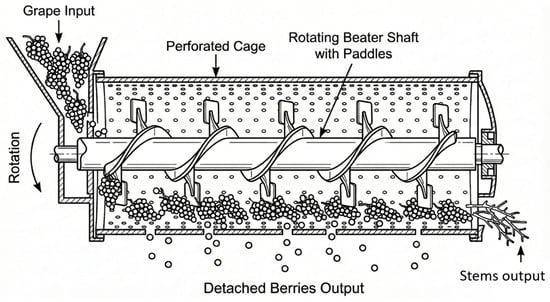
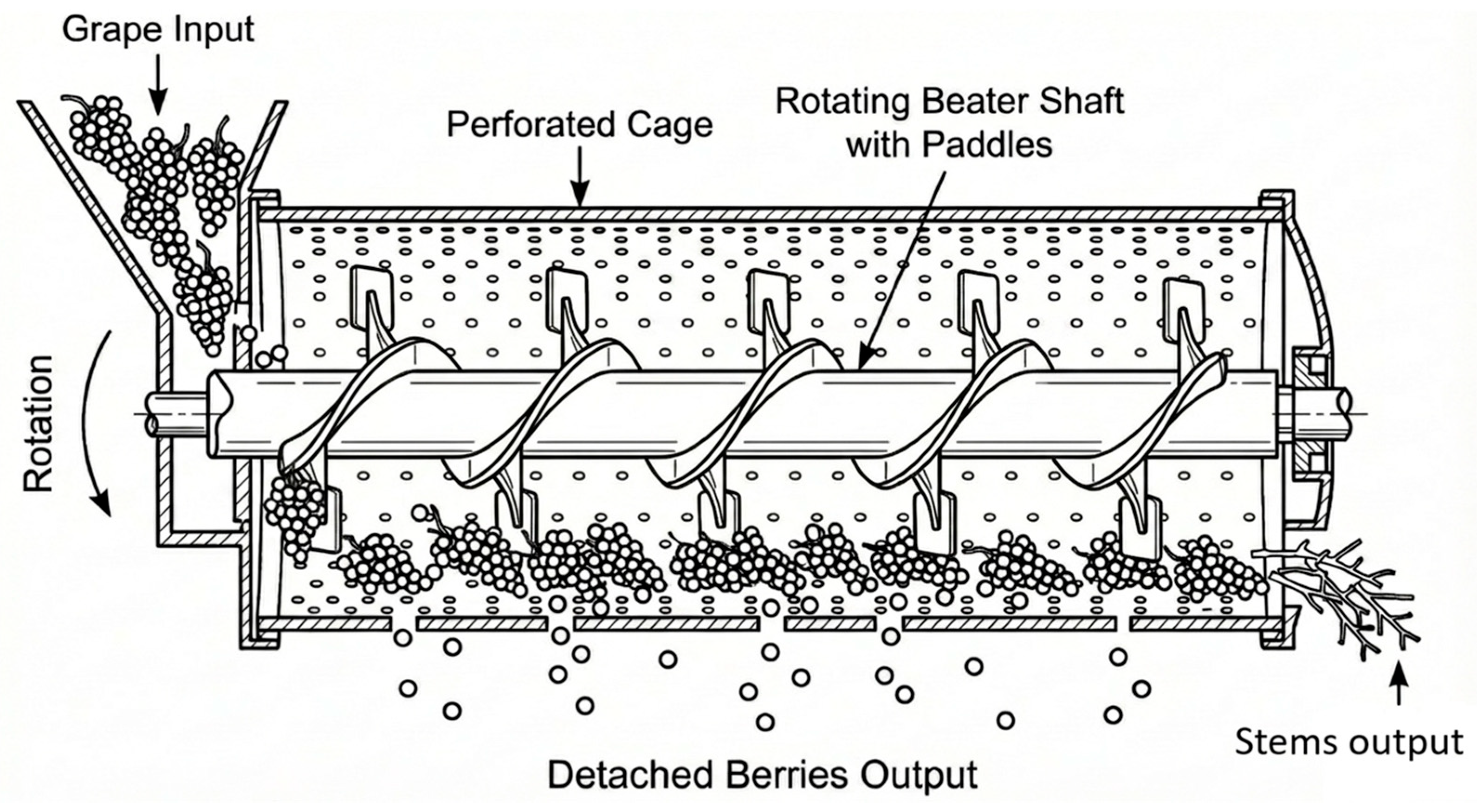
The cage is perforated with circular holes (22 mm diameter). The perforation density, approximately 18–22%, influences the distribution and magnitude of shear forces transmitted to the berry mass. The static cage and rotating shaft together create a dynamic rolling–sliding environment that is essential to berry detachment. A schematic view of the destemmer used as the reference model is reported in Figure 1.
Figure 1.
Schematic cross-sectional view of the horizontal centrifugal destemmer used as the reference model. The illustration highlights the primary functional components: the feed hopper (“Grape Inlet”), the central rotating beater shaft (“Rotating Shaft”), the stationary cylindrical cage (“Perforated Cage”), and the rachis discharge point (“Stem Outlet”). The diagram demonstrates the axial flow of the product, where the dynamic interaction between the rotating elements and the static cage surface generates the forces required for berry detachment. This figure is intended as a conceptual schematic illustration to support the mechanistic interpretation of the destemming process, rather than as a technical or scale-accurate drawing.
2.2. Grape Cluster Representation
Grape clusters were modeled as hierarchical assemblies of quasi-spherical berries attached to a semi-flexible, branched rachis structure [6,21]. While the internal geometry of a cluster is inherently complex and variable, this simplified representation captures the essential mechanical behavior during the destemming process, where the rachis acts simultaneously as a structural backbone and a primary conduit for the transfer of kinetic energy from the beater to the berry–pedicel junctions [12].
For the numerical simulations (Table 2), a typical cluster mass (Mcluster) of 101.3 g was assumed, consisting of an average of 67 berries per cluster. Individual berry mass (mb) was set at 1.45 g, with mean diameters (db) of approximately 13.8 mm, consistent with industrial-scale vinification parameters for several Vitis vinifera cultivars [4].
Table 2.
Physical and mechanical properties of grape berries and pedicels used in the analytical model.
The most critical biomechanical parameter in this model is the pedicel detachment force (Fdet). This force represents the tension or shear required to cause the physical rupture of the vascular and parenchymal tissues at the abscission zone between the berry and the pedicel. To account for the inherent stochasticity of biological materials, Fdet was modeled as a normally distributed random variable:
Fdet ~ N (μ = 1.33 N, σ = 0.53 N)
This distribution is based on extensive experimental measurements reported in the literature [12,15], where the tensile strength of the pedicel–berry connection was quantified using digital dynamometers. This statistical approach is vital as it captures the natural biological variability arising from cultivar-specific morpho-structural traits, maturation state (which significantly influences the enzymatic degradation of cell walls in the abscission zone), rachis lignification (affecting the stiffness and energy absorption capacity of the stem), and environmental and hydric conditions during the pre-harvest period [4]. By defining Fdet as a distribution rather than a fixed scalar value, the model can simulate the “tail” of the population—those berries with exceptionally high or low detachment thresholds—which are often responsible for the “un-destemmed” fruit or “broken skins” observed in suboptimal machine settings.
2.3. Force Modeling
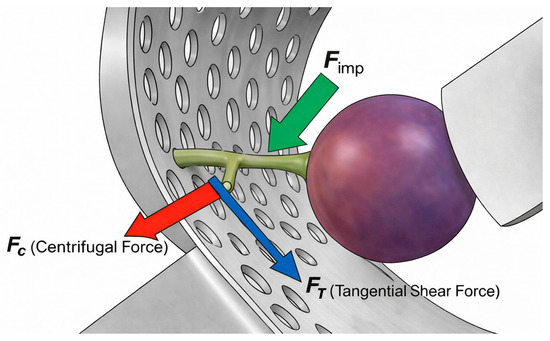
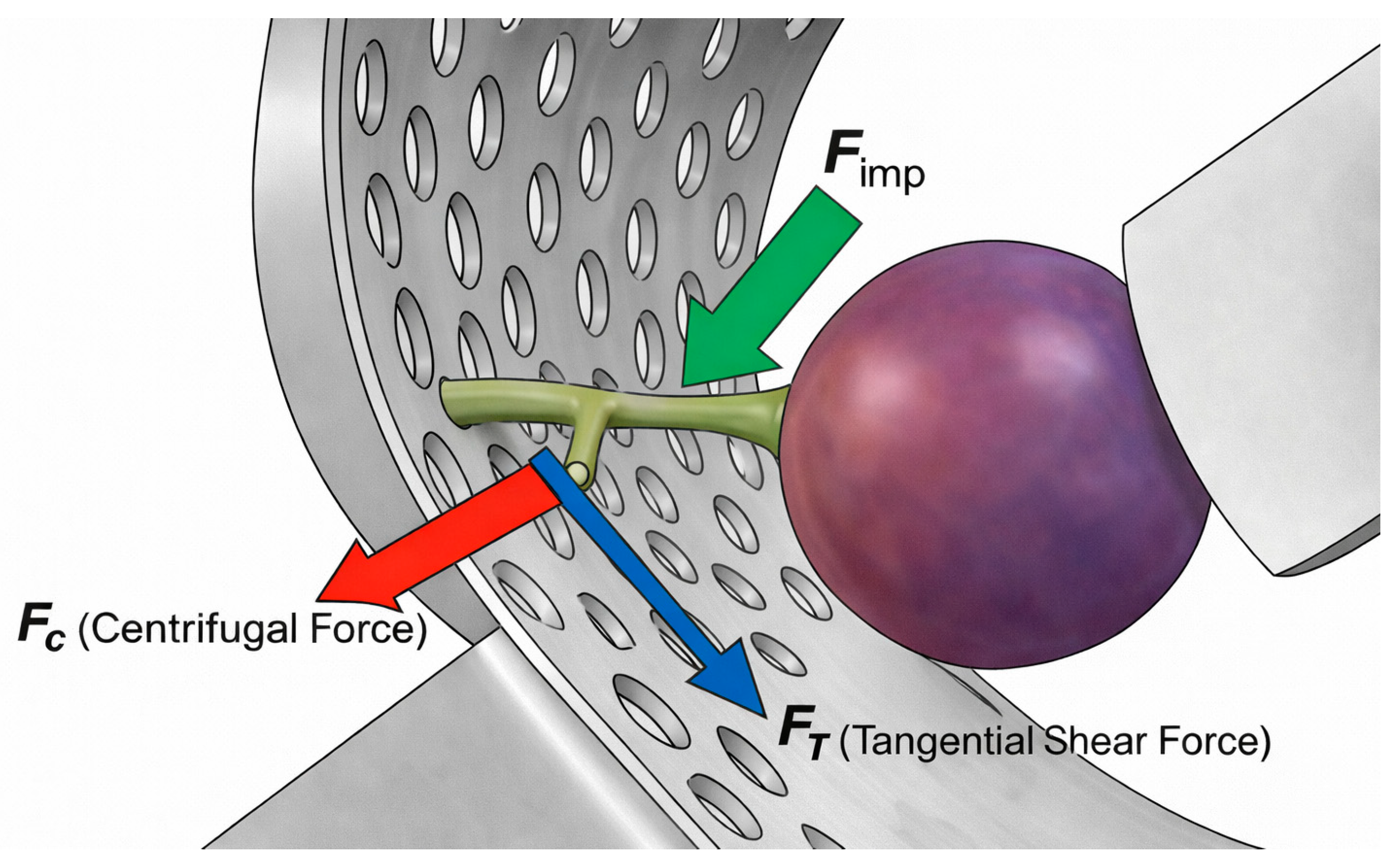
All modeling assumptions adopted in this section are intended as first-order approximations aimed at capturing dominant mechanical trends rather than providing exact local force predictions. The mechanical interaction between the destemmer beater and the grape clusters was decomposed into three distinct force regimes: centrifugal, tangential shear, and impact. Each was modeled analytically to evaluate its specific contribution to the detachment process. For clarity, the force interactions discussed in this section are illustrated using simplified conceptual schematics (Figure 2), intended to support the mechanistic interpretation of the dominant force components rather than to provide scale-accurate or technical design representations.
Figure 2.
Free-body diagram of a single grape berry showing the vector decomposition of mechanical forces during destemming. Fc: Centrifugal force (radial); FT: Tangential shear force (parallel to cage surface); Fimp: Impact force (transverse). The geometric arrangement demonstrates the interaction between the berry, the pedicel, and the perforated cage boundary. The diagram provides a conceptual representation of force components and their orientation during berry detachment and is not intended as a quantitative or scale-accurate technical drawing.
2.3.1. Centrifugal Force (Fc)
Centrifugal force arises from the rotational motion imparted to the berry mass by the beater. It is defined by the following classical relation:
where m is the berry mass (1.45 × 10⁻³ kg), ω = 2πN/60 is the angular velocity in rad/s (N being the rotational speed in RPM), and r = 0.15 m represents the effective radius of the rotating beater (from shaft center to paddle tip), corresponding to the torque transmission radius.
Fc = m ω^2 r
While mathematically straightforward, this formula represents an idealized upper bound. In the stochastic environment of the destemmer, berries are rarely constrained to a rigid circular trajectory; instead, they undergo complex slip and tumbling motions. Consequently, Fc often acts more as a normal force (Fn) that increases the friction between the cluster and the cage, rather than a direct tensile force acting on the pedicel [12,13].
2.3.2. Tangential Shear Force (FT)
The tangential shear force is derived from the torque (τ) transmitted by the motor through the beater paddles. To reflect the physical constraints of industrial equipment, the model assumes a mechanical transmission (belt and pulley system) operating under a constant-power regime. This assumption is crucial, as it captures the inverse relationship between speed and torque, which is often overlooked in simplified kinematic models.
Given the nominal motor power (Pnom) and a mechanical efficiency factor η = 0.85, the effective mechanical power (Pmech) is:
The resultant torque (τ) available at the shaft is inversely proportional to the angular velocity:
It should be noted that the constant-power assumption adopted here represents a conservative mechanical upper bound, typical of traditional mechanical transmission systems. Modern destemmers equipped with variable-frequency drives (VFDs) generally operate under a constant-torque regime below the rated frequency. While this modifies the quantitative torque–speed relationship, it does not alter the qualitative outcome of the model: lower rotational speeds still favor tangential shear effectiveness due to reduced centrifugal pinning and improved kinematic engagement between pedicels and cage perforations.
The total tangential force (FT, total) applied by the beater at the effective radius r is
To estimate the average shear force (FT) experienced by an individual pedicel, this total force is distributed across the active cage surface. Assuming the force is localized at the points of contact with the cage perforations (estimated at nholes = 220), the force is given by
The assumption of uniform force distribution among active perforations should be interpreted as a first-order and conservative approximation. In real operating conditions, load transmission is highly non-uniform, and localized configurations may generate significantly higher instantaneous shear forces. Such non-uniformity would tend to increase, rather than decrease, the probability of berry detachment compared to the present average-based estimate.
This tangential component is the primary driver of bending and torsional moments at the berry–pedicel junction. Unlike pure tension, shear stress exploits the anisotropic nature of the rachis tissues, facilitating detachment at lower energy thresholds [15,21].
2.3.3. Impact Force (Favg)
Impact forces occur during the rapid collisions between the rotating paddles and the incoming clusters. These were calculated using the impulse–momentum theorem:
where Δv = (v2 − v1) is the change in velocity during the collision and Δt is the contact duration.
The contact duration Δt was estimated through a frame-by-frame kinematic analysis of high-resolution video footage, acquired using a smartphone during the standard operation of the destemmer in some dedicated trials. By observing the interaction between the beater paddles and the clusters at high frame rates, a collision duration of Δt = 0.02 s was identified.
The video analysis was performed at a frame rate of 240 frames per second. A total of 25 individual impact events were analyzed, yielding an average contact duration of 0.020 s with an estimated uncertainty of ±0.005 s, primarily due to frame discretization and visual identification of contact onset and separation.
This empirical value, combined with the known viscoelastic properties of Vitis vinifera berries and restitution coefficients (e) between 0.25 and 0.35 [10], provides a realistic basis for calculating the impulsive load. Although these impacts generate high instantaneous peak forces, their efficiency in berry detachment is limited. Due to the high deformability and internal damping of the berry (acting as a shock absorber), much of the impact energy is dissipated as elastic strain or internal damage (bruising) rather than being effectively transmitted to the pedicel abscission zone. This explains why increasing RPM—and thus impact velocity—often leads to fruit breakage rather than improved destemming [11].
2.4. Monte Carlo Simulation Framework
To evaluate the operational efficiency of the destemmer under realistic conditions, a stochastic simulation framework based on the Monte Carlo method was implemented. This approach is useful to account for the inherent biological variability of grape clusters, where mechanical properties are not fixed scalars but follow probability distributions influenced by cultivar, ripeness, and vine physiology [4,12,21].
The simulation was executed for a population of n = 10,000 berries. For each individual berry i, the model performed the following steps:
- 1.
- Stochastic Sampling: A unique detachment threshold (Fdet,i) was assigned by sampling from the normal distribution defined in Section 2.2 (Equation (1)).
- 2.
- Force Calculation: The three primary forces (Fc, FT, Tavg) were calculated for a range of rotational speeds (from 100 to 600 RPM) using the equations derived in Section 2.3.
- 3.
- Failure Criterion: The detachment condition was defined as a binary state. A berry is considered “successfully destemmed” if the maximum applied force exceeds its specific resistance threshold:
This failure criterion represents a conservative approximation, as berry detachment is more accurately described as a progressive damage process driven by repeated sub-threshold shear events rather than by a single extreme load. The probabilistic framework partially accounts for this behavior by incorporating biological variability; however, explicit cumulative damage or fatigue modeling is identified as a relevant extension for future work.
- 4.
- Result Aggregation: The destemming efficiency (ηdestem) for each speed was calculated as the ratio of detached berries to the total population:
where is the indicator function, which equals 1 if the condition is true and 0 otherwise.
By iterating this process 10,000 times per speed increment, the model generates a robust statistical “map” of machine performance.
The sample size of n = 10,000 was selected based on preliminary convergence testing, which showed that detachment probability estimates stabilized for sample sizes exceeding approximately 5000 berries. Increasing n beyond 10,000 would result in negligible variations (<1%) while substantially increasing computational cost.
Also, this large sample size ensures that even the “outliers”—berries with exceptionally high attachment strength or those subjected to minimal force due to their position in the cage—are statistically represented.
3. Theoretical Interpretation
The theoretical framework developed in this study highlights the significant limitations of applying classical rigid-body mechanics to complex biological systems, suggesting that destemming efficiency is governed by the intricate interaction between mechanical transmission constraints and the viscoelastic nature of the grape cluster [12,16]. While conventional engineering models often treat the process as a deterministic kinematic problem in which the berry is a point mass constrained to a circular trajectory, grape clusters behave as non-homogeneous, deformable assemblies. In this context, centrifugal force (Fc) does not act as a pure tensile load on the pedicel; instead, it generates radial pressure that produces a “pinning effect,” forcing the cluster against the cage and inhibiting the stochastic tumbling and rolling motion required for the pedicels to find and engage with the cage perforations. Conversely, tangential shear force (FT) aligns effectively with the specific biomechanical weaknesses of the berry–pedicel abscission zone, which is highly sensitive to bending and torsional moments. Because FT is applied perpendicularly to the radial axis, it induces a “peeling” or levering action as the berry is dragged across the edge of the cage perforation, requiring significantly lower energy thresholds than pure axial tension and ensuring controlled detachment that preserves the integrity of the berry skin [4,15,21]. A pivotal finding of this model is the role of the constant-power regime in mechanical transmissions, in which the available torque and the resulting shear force are maximized at lower rotational speeds. This creates an ideal operational window where high detachment capacity coincides with the minimum centrifugal pinning effect. Finally, the model clarifies the inefficiency of impact forces (Favg): though kinematically violent, the high damping capacity of the berry mesocarp dissipates much of the kinetic energy through internal deformation and cellular rupture (bruising) before it can be effectively transmitted to the pedicel junction [11], confirming that increasing RPM does not linearly improve destemming but rather exponentially increases the probability of tissue damage and the release of undesirable compounds.
4. Results
This section reports the quantitative outcomes of the analytical calculations and Monte Carlo simulations, focusing on force magnitudes, scaling trends with rotational speed, and probabilistic detachment outcomes. Interpretation of the underlying mechanisms and broader engineering implications are intentionally addressed in the Section 5. The analytical calculations and Monte Carlo simulations carried out in this study revealed a complex, non-linear interplay between centrifugal, tangential, and impact forces acting on grape berries within the horizontal centrifugal destemmer environment. The results consistently highlighted the predominance of tangential shear force (FT) as the primary driver of successful berry detachment [12,15]. Conversely, the contributions of centrifugal acceleration (Fc) and impact mechanisms (Favg) were found to be remarkably limited in their ability to trigger pedicel failure without causing concurrent tissue damage. This section provides a detailed breakdown of these force contributions, their distinct scaling behaviors relative to machine operating parameters—specifically rotational speed and torque transmission—and the probabilistic patterns of berry detachment emerging from the stochastic simulation. By quantifying the overlap between the applied mechanical loads and the biological resistance distribution (Fdet), we demonstrate how the machine’s performance is governed by the following criterion:
The data suggests that the process is governed more by the physics of shear than by pure radial power [4,21], confirming that optimal destemming is achieved when the tangential component is maximized relative to the berry’s specific abscission threshold.
4.1. Analysis of Centrifugal Force Contribution
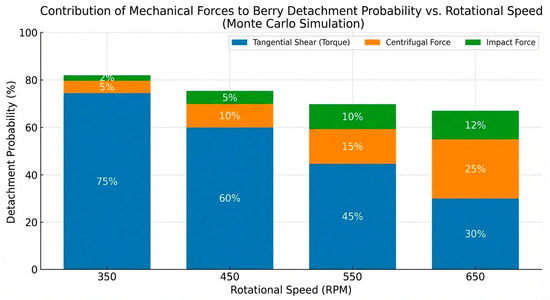
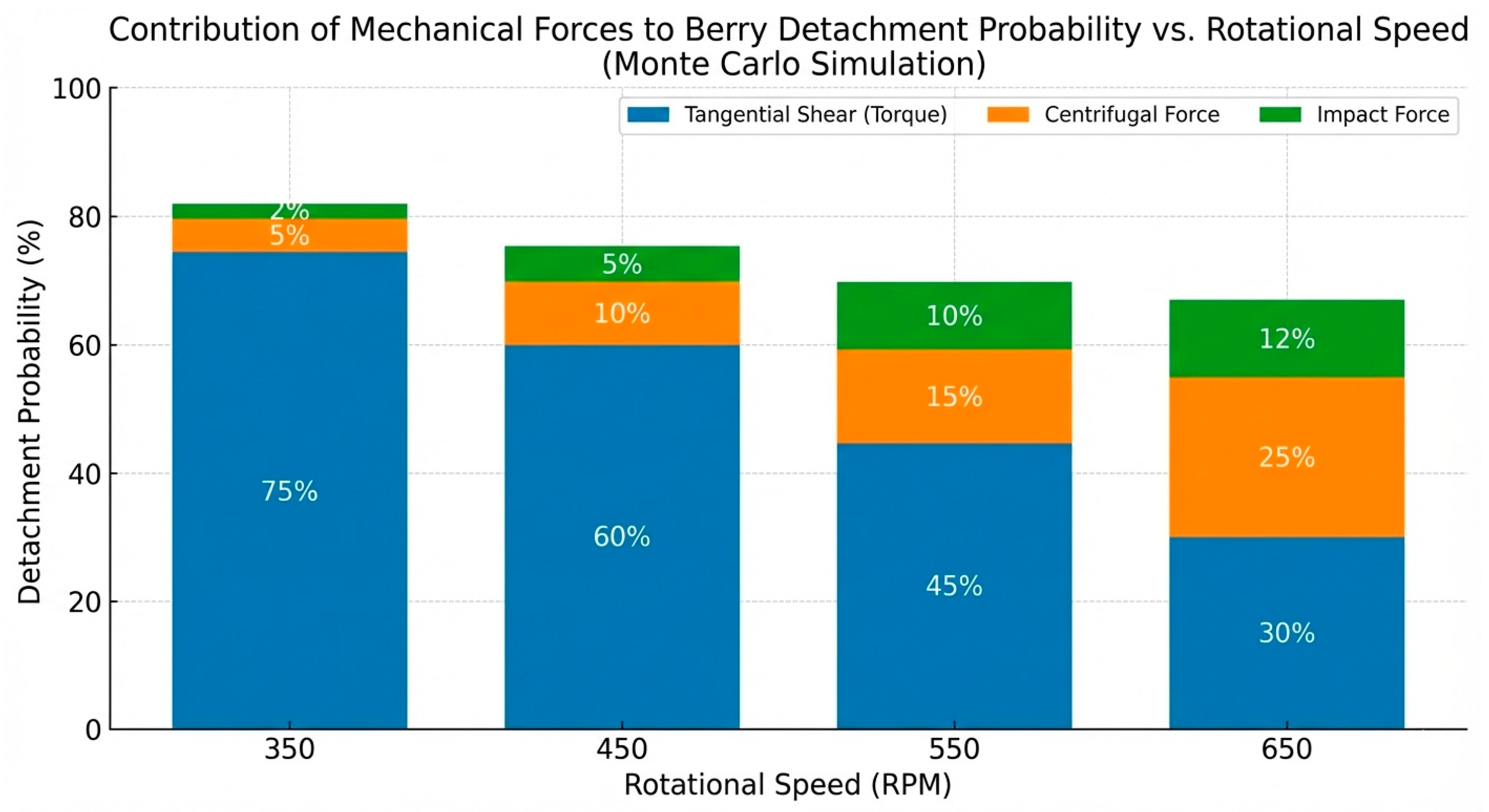
The analytical results demonstrate that centrifugal force (Fc) increases quadratically with rotational speed (N), scaling from approximately 0.298 N at 350 rpm to just over 1.00 N at 650 rpm (Table 3). For clarity, stochastic detachment outcomes are discussed directly in the text, while Table 3 is restricted to deterministic mechanical force magnitudes. Based on the Monte Carlo simulations, the corresponding berry detachment probability decreases from approximately 75% at 350 rpm to about 45% at 450 rpm and further to values below 30% at rotational speeds exceeding 550 rpm.
Table 3.
Calculated mechanical force magnitudes acting on grape berries as a function of rotational speed.
While these values are mathematically significant, they approach the mean pedicel detachment force (µ = 1.33 N) only at the upper limit of the investigated rotational range—speeds that are often considered detrimental to fruit quality in high-end vinification [1,7]. Crucially, the Monte Carlo analysis reveals that the majority of the berry population experiences forces significantly below the modal detachment threshold. Given that the pedicel strength distribution encompasses a substantial fraction of berries with detachment resistances exceeding 1.4–1.6 N, the radial acceleration generated by the cage’s rotation proves insufficient for systematic separation [12]. Even under optimistic assumptions—such as perfect berry–cage contact and idealized rigid-body motion—the probability of centrifugal-induced detachment (ηc) rarely exceeded 25%. Furthermore, in real-world winery conditions, small variations in machine loading—such as cluster compaction, grape hydration levels, and progressive cage fouling—introduce damping effects that further attenuate effective radial acceleration. This suggests that the already modest contribution of centrifugal force identified in this model may actually represent an overestimation compared to the chaotic fluid-dynamic environment of an active destemmer [11,21].
4.2. Tangential Shear and Torque Dynamics
Tangential shear (FT), derived from the torque transmission to the grape mass, demonstrated a markedly higher detachment capacity across the entire operational spectrum compared to radial or impact forces (Table 3). At an operational speed of 350 RPM, the effective shear force per active cage perforation was estimated at approximately 1.71 N—a value that substantially exceeds the mean pedicel strength of 1.33 N [12]. Even as the speed increases to 450 RPM, the shear component remains robust at approximately 1.3 N, sustaining detachment probabilities between 55% and 60% depending on the stochastic variability of the pedicels [15]. However, the most compelling evidence for the “low-speed advantage” lies in the torque–speed reciprocity of the mechanical transmission. At higher rotational speeds, the reduction in available torque produces a notable decline in available shear force (0.92–1.09 N), providing a rigorous physical explanation for the well-documented decrease in detachment efficiency observed when destemmers are operated in fast rotational regimes [7,8]. This analysis suggests that tangential shear is not only superior in terms of absolute magnitude but is also functionally specialized: while centrifugal force exerts a purely axial pull and impact forces introduce high-frequency energy that is largely dissipated by the berry’s viscoelasticity, shear imposes repeated bending and torsional stresses [21]. This interaction systematically loads the pedicels in their weakest structural orientation. Furthermore, our results highlight a “progressive weakening” behavior; rather than requiring a single catastrophic event, the shear force facilitates detachment through a sequence of micro-failures within the abscission zone tissues [4,11]. This aligns with experimental biological studies that describe pedicel rupture as a multi-stage process of vascular bundle failure and parenchymal separation, rather than a simple rigid fracture. Consequently, the higher torque available at lower speeds allows for the sustained application of these stresses, overcoming even the toughest pedicels through mechanical advantage rather than raw kinetic impact.
4.3. Impact Forces: High Energy but Low Detachment Effectiveness
Impact forces generated by beater–cluster collisions ranged from 0.21 to 0.40 N at lower operational speeds, increasing to 0.39–0.76 N at 650 RPM (Table 3). Despite the common industry perception of destemmer operation as an “impact-driven” process, our numerical analysis reveals that even these relatively forceful collisions remain significantly below the mechanical threshold (1.33 N) required to induce pedicel rupture. Berries function as high-efficiency mechanical buffers, absorbing a substantial proportion of impact energy through their viscoelastic skins and aqueous mesocarp composition [10]. This localized deformation acts as a structural filter, preventing high impulsive loads from being transmitted effectively to the pedicel–berry abscission zone. The Monte Carlo analysis confirmed this pattern, indicating that impacts alone yield detachment probabilities of <15%, even when simulating optimized conditions regarding impact angles, collision durations, and restitution coefficients (0.25–0.35). Interestingly, while the magnitude and frequency of impact forces scale with higher rotational speeds, they serve to degrade rather than detach. At aggressive rotational regimes, the energy of impact is dissipated through the rupture of the berry pericarp and the structural breakdown of the pulp [11,21]. This explains the well-known increase in “juicing,” skin maceration, and the premature release of phenolic compounds and oxidative enzymes—consequences that are particularly deleterious in white wine vinification where freshness and low astringency are paramount [3,4]. Therefore, while impacts are the most visible mechanical interaction within the cage, they are primarily responsible for qualitative degradation rather than the productive separation of fruit from rachis.
4.4. Combined Force Environment and Stochastic Outcomes
When all force contributions were integrated into the mathematical framework and applied to the stochastic distribution of pedicel detachment strength, the Monte Carlo simulation produced a highly informative pattern of mechanical dominance (Figure 3). Tangential shear (FT) emerged as the undisputed driver of the process, accounting for between 60% and 75% of all simulated detachments across the entire speed range. Centrifugal and impact forces, traditionally thought to be the primary actors, together contributed only 20–30% of total detachments. These auxiliary forces were found to be effective primarily in “edge cases”—specifically for berries located in unusual spatial configurations where localized geometry or cluster collisions temporarily amplified the radial or impulsive loads [12,15].
Figure 3.
Probability of berry detachment (%) driven by different force mechanisms obtained via Monte Carlo simulation (n = 10,000) at varying rotational speeds.
The probabilistic nature of the results underscores the decisive role of biological variability. The simulation revealed that the berry population is not a monolith:
- Weak-pedicel fraction (Fdet < 0.8 N): These berries detached under almost any regime, regardless of machine optimization.
- Strong-pedicel fraction (Fdet > 1.8 N): These berries represented the “un-destemmed” risk and required highly favorable, sustained shear conditions to overcome their structural integrity.
- Intermediate majority: For the bulk of the population, the ability of the machine to precisely control and maintain FT became the key determinant of overall destemming performance [4,21].
The simulation further revealed a non-linear sensitivity to rotational speed, defining three distinct operational zones:
- Low-Speed Zone (350–400 RPM): Characterized by high torque-driven shear. Detachment is highly efficient and relatively gentle, as the mechanical advantage of the transmission overcomes the detachment threshold without reaching the rupture limits of the skin.
- Transitional Zone (~450–500 RPM): A decline in performance is observed. As speed increases, the hyperbolic reduction in torque causes FT to drop, while the corresponding increases in Fc and Favg are still insufficient to compensate for the lost shear capacity.
- High-Speed/High-Damage Zone (>550 RPM): Shear becomes critically weak. Although centrifugal force approaches the mean pedicel strength, it lacks the orientation alignment (bending/torsion) necessary for efficient failure. Simultaneously, impact forces escalate, primarily contributing to fruit damage rather than detachment [7,11].
Together, these outcomes summarize the probabilistic detachment patterns emerging from the stochastic simulations across the investigated operating regimes.
5. Discussion
Building on the quantitative trends presented in the Section 4, this Section 5 focuses on the mechanistic interpretation of the observed force dominance, the implications for destemmer operation and design, and the limitations of the proposed theoretical–numerical framework.
It should also be emphasized that the present study is conceived as a theoretical–numerical, mechanistic explanatory model. Its purpose is to identify dominant force regimes and rationalize observed operational trends, rather than to directly predict absolute industrial destemming efficiency or berry damage rates.
A comprehensive interpretation of the results demonstrates that grape destemming is governed primarily by tangential shear, not centrifugal action. This insight challenges long-standing industry assumptions and reframes the mechanical environment of the destemmer as a shear-driven system rather than a radial separation device. Centrifugal force, while conceptually appealing, is mechanically inefficient due to the deformable nature of grape clusters [16]. The rachis absorbs radial loads instead of transmitting them to pedicels, and berries do not behave as rigid particles travelling in a circular trajectory. These factors significantly limit the effectiveness of radial acceleration as a detachment mechanism. Tangential shear, on the other hand, exploits the structural weaknesses of the pedicel. As clusters slide and roll along the cage surface, the rachis undergoes repeated bending and torsional loading. This sustained deformation produces progressive weakening of pedicel fibers, ultimately leading to detachment.
From a modeling perspective, berry detachment can be interpreted as a cumulative damage process driven by repeated sub-threshold shear events rather than by a single extreme load. While the present formulation adopts a conservative maximum-force criterion for analytical clarity, future extensions could explicitly incorporate fatigue- or damage-accumulation models to better capture the progressive nature of pedicel failure.
Grape cluster compactness represents an additional architectural factor that may influence the mechanical environment of berry detachment. In very loose clusters, characterized by larger inter-berry distances, individual berries are more likely to experience localized shear, bending, and torsional events, potentially facilitating pedicel loading and detachment. Conversely, highly compact clusters—such as those typical of cultivars like Pinot Noir—tend to promote collective motion of the berry mass, increasing radial confinement and reducing relative motion between individual berries and cage perforations. This condition may enhance centrifugal pinning effects and limit the effectiveness of tangential shear. Although cluster compactness is not explicitly parameterized in the present model, it represents a relevant dimension for future analytical and numerical extensions of the proposed framework.
The continuous and directional nature of shear—not its magnitude alone—makes it uniquely suited to induce pedicel failure [12,15]. Impact forces, though visually prominent, play a negligible role in detachment because biological tissues absorb energy through deformation. Berries deform viscoelastically, dissipating impact energy and reducing the likelihood of pedicel rupture [10,11]. The principal contribution of impacts is berry damage rather than productive detachment. The Monte Carlo simulation reinforces these conclusions by combining mechanical values with biological variability [21]. The stochastic approach reveals the probabilistic nature of detachment and highlights how even small variations in pedicel strength can dramatically alter outcomes. This underscores the need for machines capable of adjusting shear forces to match biological conditions, particularly for cultivars known to exhibit strong pedicels or heterogeneous ripeness. From an engineering perspective, the findings suggest that future destemmers should prioritize high torque at low speeds, optimized cage geometries, and paddle designs that promote sliding rather than striking. Implementing variable-speed, torque-controlled motors could further enhance performance by dynamically adjusting shear forces.
The theoretical model presented in this study assumes a mechanical transmission system where power is constant, leading to an inverse relationship between torque and speed. This explains the high efficiency at low speeds due to available torque. However, it is important to note that modern destemmers, including the reference model, are increasingly equipped with electronic frequency inverters (VFDs). In VFD-controlled systems, the motor typically operates at constant torque below the base frequency, rather than constant power. While this technically flattens the torque curve at low speeds compared to a mechanical variator, the effective shear detachment remains superior at low rpm due to kinematic factors: reduced centrifugal “pinning” allows clusters to tumble and engage perforations more effectively. Therefore, even with modern electronic control, the preference for low-speed operation is supported by both the residual torque availability and the superior kinematic interaction. From an oenological perspective, the predominance of shear-based detachment opens opportunities for selectivity. Since pedicel strength correlates with berry maturity [4], machines could theoretically be calibrated to detach only ripe berries while retaining under-ripe ones on the rachis. This selective detachment could improve grape quality and provide finer control over phenolic extraction.
6. Conclusions
This study provides a comprehensive analytical description of the mechanical forces responsible for grape berry detachment in horizontal centrifugal destemmers. By integrating realistic machine geometry, grape morphology, pedicel biomechanics and stochastic variability into a unified mechanical framework, the work demonstrates that tangential shear, rather than centrifugal acceleration or impact loading, is the primary mechanism driving detachment. The analysis shows that centrifugal force is fundamentally constrained by the deformable, heterogeneous structure of grape clusters. Although mathematically straightforward, radial acceleration is rarely transmitted efficiently to pedicels because clusters do not behave as rigid rotating bodies; instead, they absorb radial loads through internal deformation and frictional buffering. As a result, even at the highest rotational speeds tested, centrifugal force alone remains insufficient for the majority of berries. Tangential shear, in contrast, aligns naturally with the biomechanical weak axis of the pedicel. As clusters roll and slide along the cage surface, the rachis undergoes repeated bending and torsional deformation. These sustained shear loads progressively weaken the pedicel until rupture occurs. The fact that shear intensity increases at lower speeds—due to higher available torque—explains the counterintuitive but widely observed winery practice of operating destemmers more gently for improved performance. Impact forces were found to contribute minimally to detachment. Their impulsive nature, combined with the high deformability of berry tissues, results in energy dissipation rather than productive pedicel failure. Impacts, therefore, represent a potential source of damage rather than an effective mechanical driver of detachment, reinforcing the need for machine designs that minimize violent fruit–paddle collisions. Beyond identifying the dominant mechanisms, the study clarifies the probabilistic character of berry detachment. The Monte Carlo framework shows how even small biological variations—such as differences in pedicel strength, berry mass or cluster compactness—can modulate detachment outcomes. The results carry several important implications for machine design and oenological practice. From an engineering perspective, they suggest that next-generation destemmers should prioritize high-torque, low-speed operating regimes; optimize cage and paddle geometry to promote controlled shear; and minimize unnecessary impacts. The design of perforation patterns, beater–cage spacing, paddle profiles, and surface friction may all be reconsidered to enhance shear uniformity and reduce berry damage. From an oenological perspective, the dominance of shear introduces intriguing possibilities for selective detachment. Because pedicel strength correlates with berry maturity, future machines might be tuned to detach only ripe berries while leaving under-ripe ones on the rachis. Such selective removal could improve must composition, reduce vegetal character, and enhance phenolic balance, especially in cultivars with heterogeneous ripeness. Looking ahead, several research directions emerge naturally from this work. The use of instrumented clusters with embedded force sensors could provide in situ validation of the model. High-fidelity DEM simulations, calibrated with accurate viscoelastic parameters for grape tissues, would allow exploration of geometries and force distributions beyond the reach of classical modeling.
Further experimental work across cultivars, maturation levels and hydration states would help contextualize the model under real vineyard and winery variability. In addition, controlled experimental validation of the proposed force framework—through instrumented machine configurations capable of directly assessing force transmission and detachment dynamics under defined operating conditions—represents a natural next step in the development of this approach.
Finally, the development of adaptive destemmers, capable of dynamically adjusting torque, speed and shear intensity in response to feedback signals, represents a promising frontier in precision oenological engineering.
Author Contributions
Conceptualization, P.M. and A.P.; methodology, P.M.; software, P.M.; validation, P.M. and G.A.; formal analysis, P.M. and G.A.; investigation, P.M., A.S., F.C. and G.A.; resources, P.M. and A.P.; data curation, P.M. and A.S.; writing—original draft preparation, P.M.; writing—review and editing, P.M., A.S. and F.C.; visualization, P.M. and F.C.; supervision, P.M. and A.P. All authors have read and agreed to the published version of the manuscript.
Funding
This research received no external funding.
Institutional Review Board Statement
Not applicable.
Informed Consent Statement
Not applicable.
Data Availability Statement
The original contributions presented in this study are included in the article. Further inquiries can be directed to the corresponding author.
Acknowledgments
During the preparation of this manuscript, the authors used GenAI tools, specifically Gemini and ChatGPT, for the purposes of revising the English language, formatting the reference list, and generating the figures. The authors have reviewed and edited the output and take full responsibility for the content of this publication.
Conflicts of Interest
The authors declare no conflicts of interest.
Abbreviations
The following abbreviations are used in this manuscript:
| DEM | Discrete Element Modeling |
| FEM | Finite Element Method |
References
- De Vita, P.; De Vita, G. Pigiatrici, diraspatrici, sgrondatori, presse, svinatori, trasportatori di vinacce e raspi. In Manuale di Meccanica Enologica, 2nd ed.; HOEPLI: Milano, Italy, 2011; pp. 114–139. [Google Scholar]
- Pezzi, F.; Caprara, C.; Friso, D.; Ranieri, B. Technical and economic evaluation of maceration of red grapes for production everyday wine. J. Agric. Eng. 2013, 44, 306. [Google Scholar] [CrossRef]
- Ribéreau-Gayon, P.; Dubourdieu, D.; Donéche, B.; Lonvaud, A. L’uva e la sua maturazione. In Trattato di Enologia 1; Edagricole: Bologna, Italy, 2018; pp. 261–327. [Google Scholar]
- Fregoni, M. Fisiologia. In Viticoltura di Qualità; Tecniche Nuove: Milano, Italy, 2013; pp. 213–298. [Google Scholar]
- Carrara, M.; Catania, P.; Pipitone, F.; Vallone, M.; Salvia, M. Assessment of the pedicel detaching and crushing forces of grape berries to determine the optimal mechanical harvesting time. J. Agric. Eng. 2007, 38, 23–37. [Google Scholar] [CrossRef] [Scilit]
- Faheem, M.; Liu, J.; Chang, G.; Ahmad, I.; Peng, Y. Hanging force analysis for realizing low vibration of grape clusters during speedy robotic post-harvest handling. Int. J. Agric. Biol. Eng. 2021, 14, 62–71. [Google Scholar] [CrossRef] [Scilit]
- Nardin, G.; Gaudio, A.; Antonel, G. Diraspatura, pigiatura, sgrondatura. Atmosfere protette. Le pompe. In Impiantistica Enologica; HOEPLI: Milano, Italy, 2006; pp. 37–56. [Google Scholar]
- Nardin, G.; Gaudio, A.; Antonel, G. La produzione del mosto. In Impiantistica Enologica; HOEPLI: Milano, Italy, 2007; pp. 59–75. [Google Scholar]
- Jobbágy, J.; Dočkalík, M.; Krištof, K.; Burg, P. Mechanized Grape Harvest Efficiency. Appl. Sci. 2021, 11, 4621. [Google Scholar] [CrossRef] [Scilit]
- Nordestgaard, S. Developments in destemming and sorting technology: Part one: In the winery. Aust. N. Z. Grapegrow. Winemak. 2015, 617, 96–102. [Google Scholar]
- Caprara, C.; Pezzi, F. Evaluation of Quality of Harvest and Mechanical Aspects Related to Beater Adjustments in Mechanical Grape Harvesting. Trans. ASABE 2014, 57, 991–997. [Google Scholar] [CrossRef] [Scilit]
- Coetzee, C.J.; Lombard, S.G. The destemming of grapes: Experiments and discrete element modelling. Biosyst. Eng. 2013, 114, 232–248. [Google Scholar] [CrossRef] [Scilit]
- Romaniello, R.; Tamborrino, A.; Leone, A. Development of a centrifugal separator for grape marc: Effect of the blade position and rotor speed on grape seed separation performance. Heliyon 2019, 5, e01314. [Google Scholar] [CrossRef] [Scilit] [PubMed]
- Tamborrino, A.; Romaniello, R.; Leone, A. Use of a centrifugal separator to separate grape seeds from Marc: Mechanical settings and thermographic evaluations. Chem. Eng. Trans. 2019, 75, 223–228. [Google Scholar]
- Vasilachi, C.; Biriş, S.Ş.; Gheorghe, G. Study of the compression behaviour of grape seeds using the Finite Element Method. E3S Web Conf. 2020, 180, 03017. [Google Scholar] [CrossRef] [Scilit]
- Guo, Q.; Xia, H. A review of the Discrete Element Method/Modelling (DEM) in agricultural engineering. J. Agric. Eng. 2023, 54, 1534. [Google Scholar] [CrossRef] [Scilit]
- Zu, H.; He, K.; Liu, W.; Liu, J.; Song, Z.; Su, Y. Interaction properties of wine grapes: DEM analysis and experimental investigation. J. Food. Eng. 2025, 387, 112347. [Google Scholar] [CrossRef] [Scilit]
- Zhao, H.; Huang, Y.; Liu, Z.; Liu, W.; Zheng, Z. Applications of Discrete Element Method in the Research of Agricultural Machinery: A Review. Agriculture 2021, 11, 425. [Google Scholar] [CrossRef] [Scilit]
- Korn, C. Application of Coupled CFD-DEM Simulation to Separation Process in Combine Harvester Cleaning Devices; Springer: Berlin, Germany, 2020. [Google Scholar]
- Formato, A.; Ianniello, D.; Romano, R.; Pellegrino, A.; Villecco, F. Design and Development of a New Press for Grape Marc. Machines 2019, 7, 51. [Google Scholar] [CrossRef] [Scilit]
- Fregoni, M. Botanica. In Viticoltura di Qualità; Tecniche Nuove: Milano, Italy, 2013; pp. 49–76. [Google Scholar]

Disclaimer/Publisher’s Note: The statements, opinions and data contained in all publications are solely those of the individual author(s) and contributor(s) and not of MDPI and/or the editor(s). MDPI and/or the editor(s) disclaim responsibility for any injury to people or property resulting from any ideas, methods, instructions or products referred to in the content. |
© 2026 by the authors. Licensee MDPI, Basel, Switzerland. This article is an open access article distributed under the terms and conditions of the Creative Commons Attribution (CC BY) license.