



Remote Sens., Volume 17, Issue 21 (November-1 2025) – 153 articles
Cover Story (view full-size image):
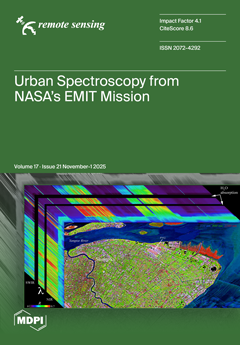
With the launch of NASA’s EMIT imaging spectrometer in 2022, comparative spectroscopic characterization of built environments using atmospherically corrected imagery became feasible. Imaging visible through shortwave infrared (VSWIR ~380 to 2500 nm) radiance at ~50 m spatial resolution allows EMIT to resolve narrow-band absorption features, not possible with broadband multispectral sensors. Spectroscopic characterization quantifies the spectral dimensionality and topology of the spectral feature space, revealing spectral endmembers and mixing continua within it. Combining linear and nonlinear dimensionality reduction facilitates visualization of low-dimensional projections of the higher-dimensional mixing space. This informs the development of both continuous physical and discrete thematic models of natural and anthropogenic land cover. View this paper
- Issues are regarded as officially published after their release is announced to the table of contents alert mailing list.
- You may sign up for e-mail alerts to receive table of contents of newly released issues.
- PDF is the official format for papers published in both, html and pdf forms. To view the papers in pdf format, click on the "PDF Full-text" link, and use the free Adobe Reader to open them.
Previous Issue
Next Issue