Noise Reduction for the Future ODYSEA Mission: A UNet Approach to Enhance Ocean Current Measurements

 , , , and
Highlights
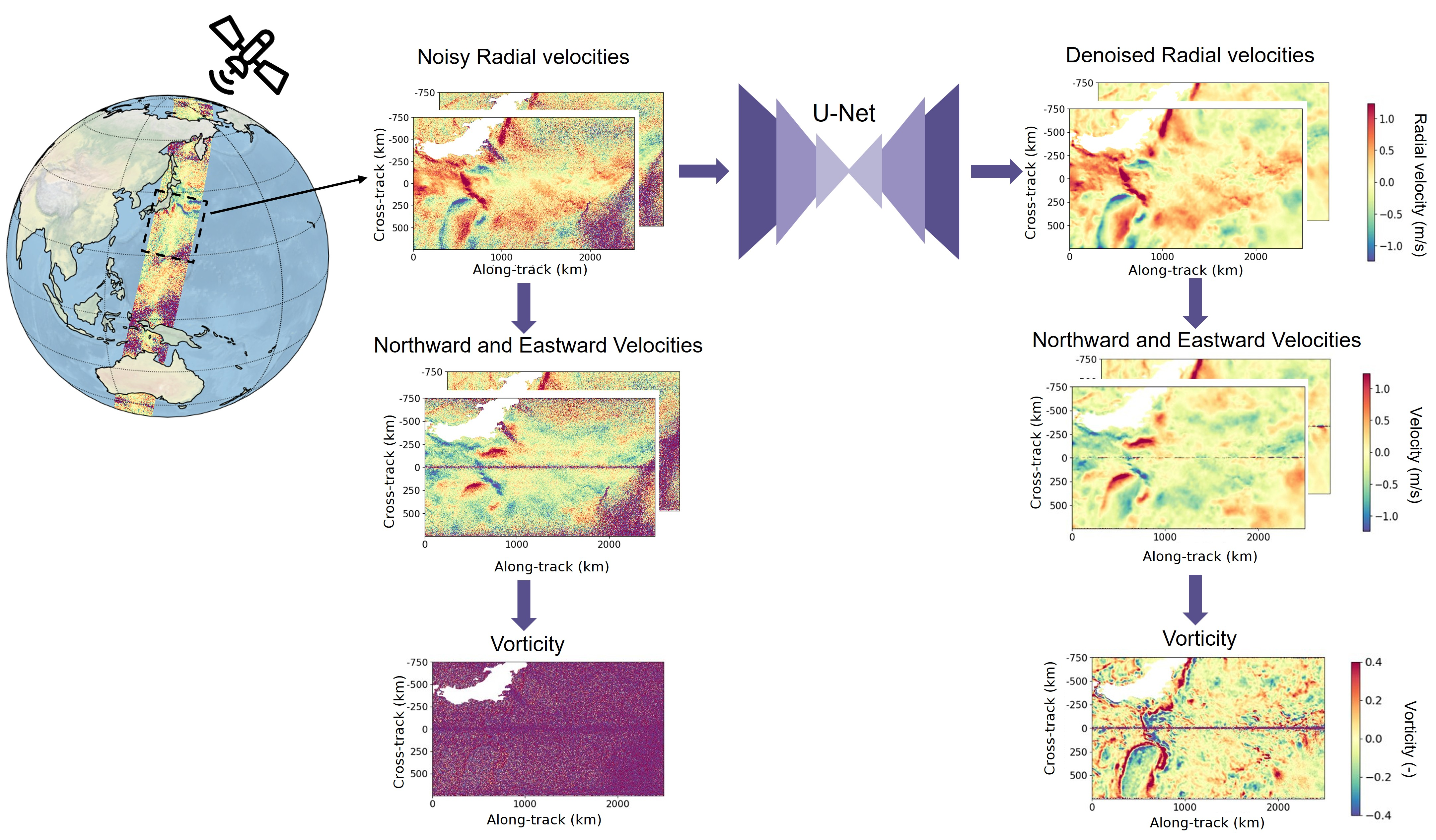
- Denoising is needed to enhance the performance and the coverage of the future ODYSEA mission.
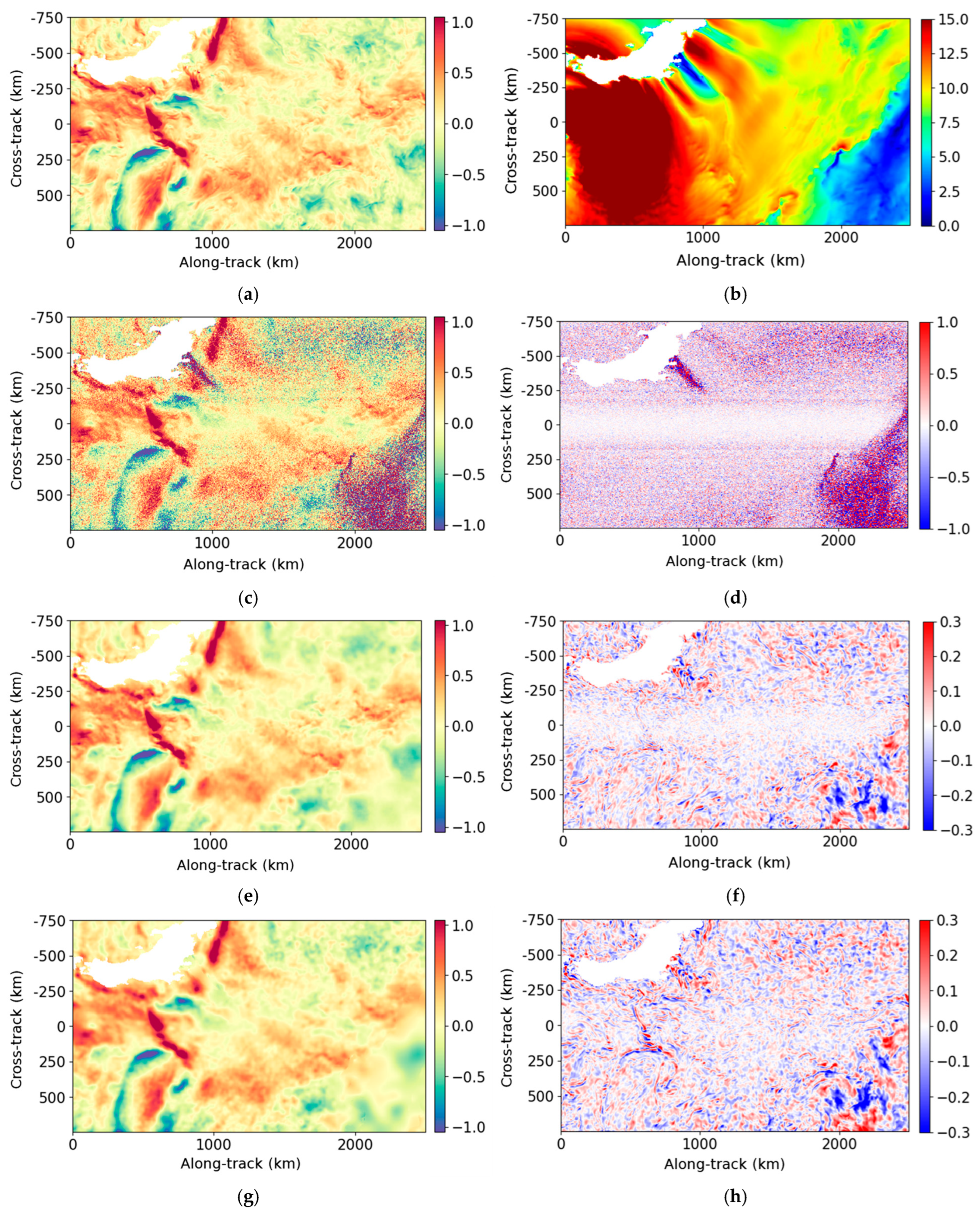
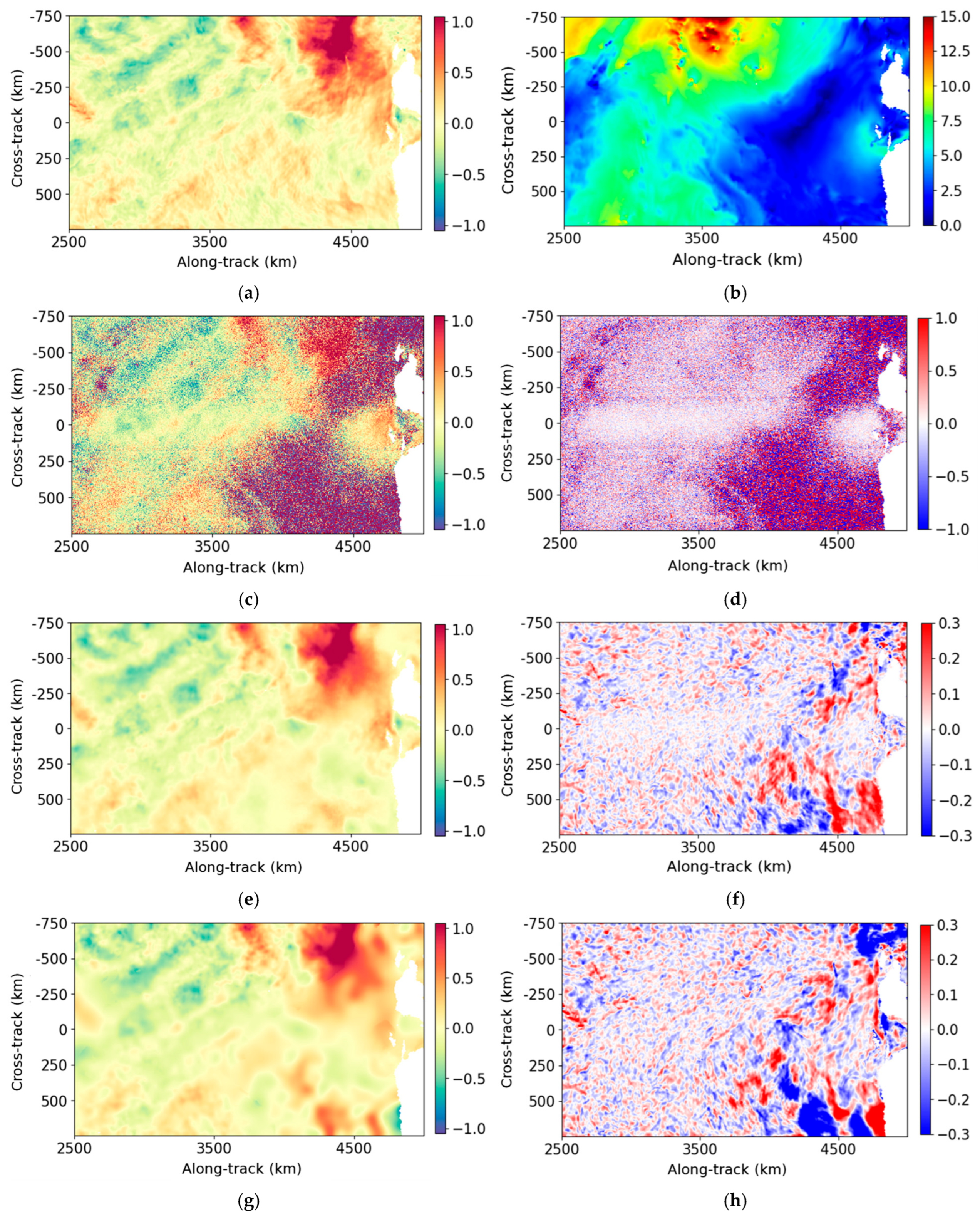
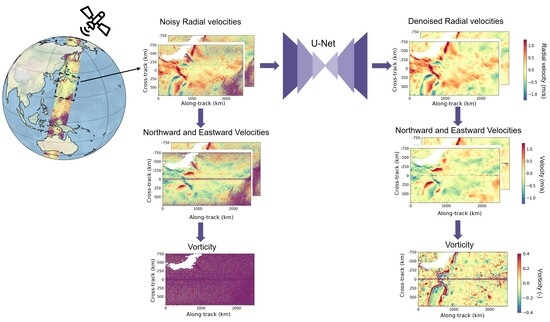
- Neural network denoising (with a UNet) achieves better performance than classical smoothing on radial velocities.
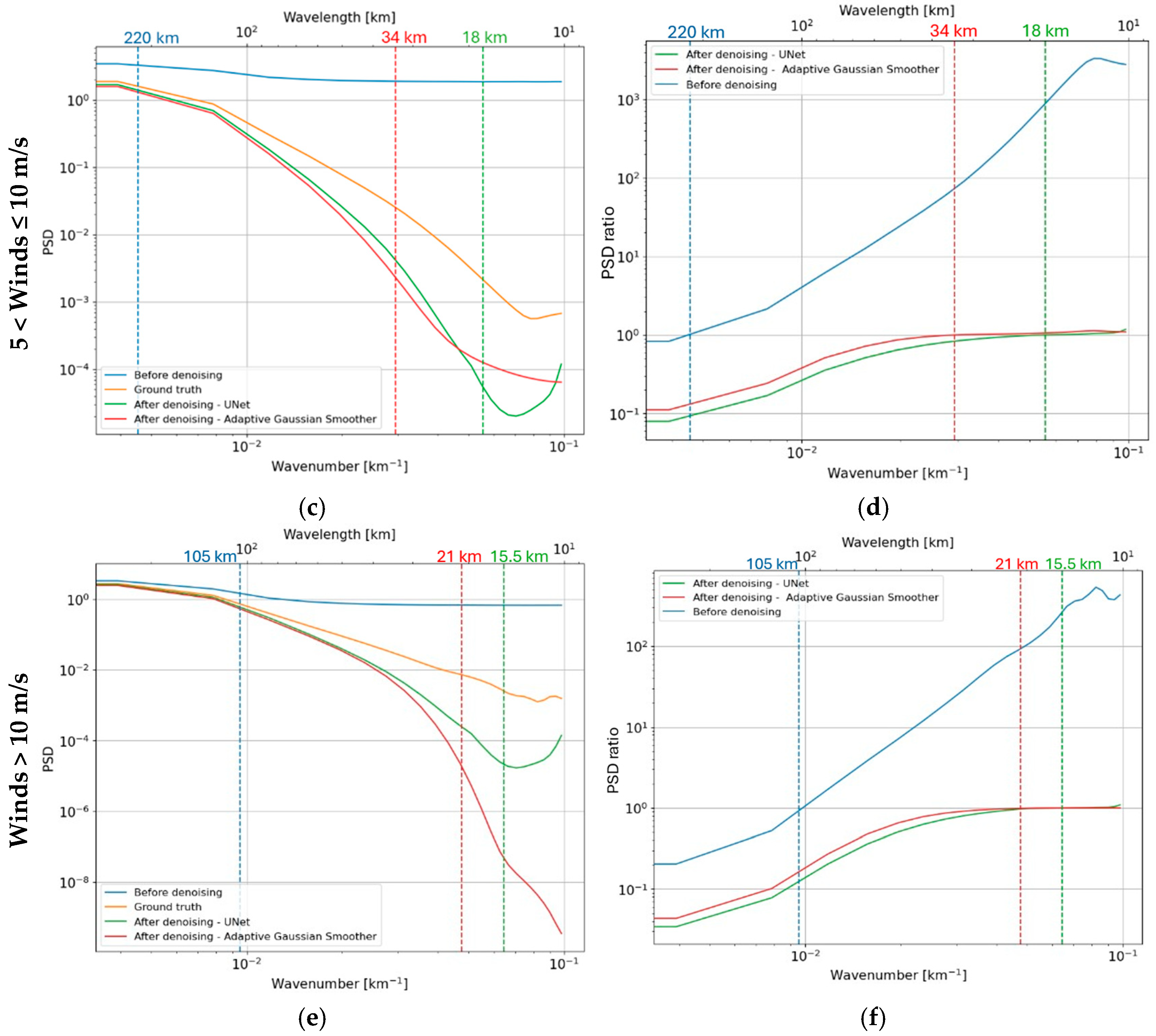
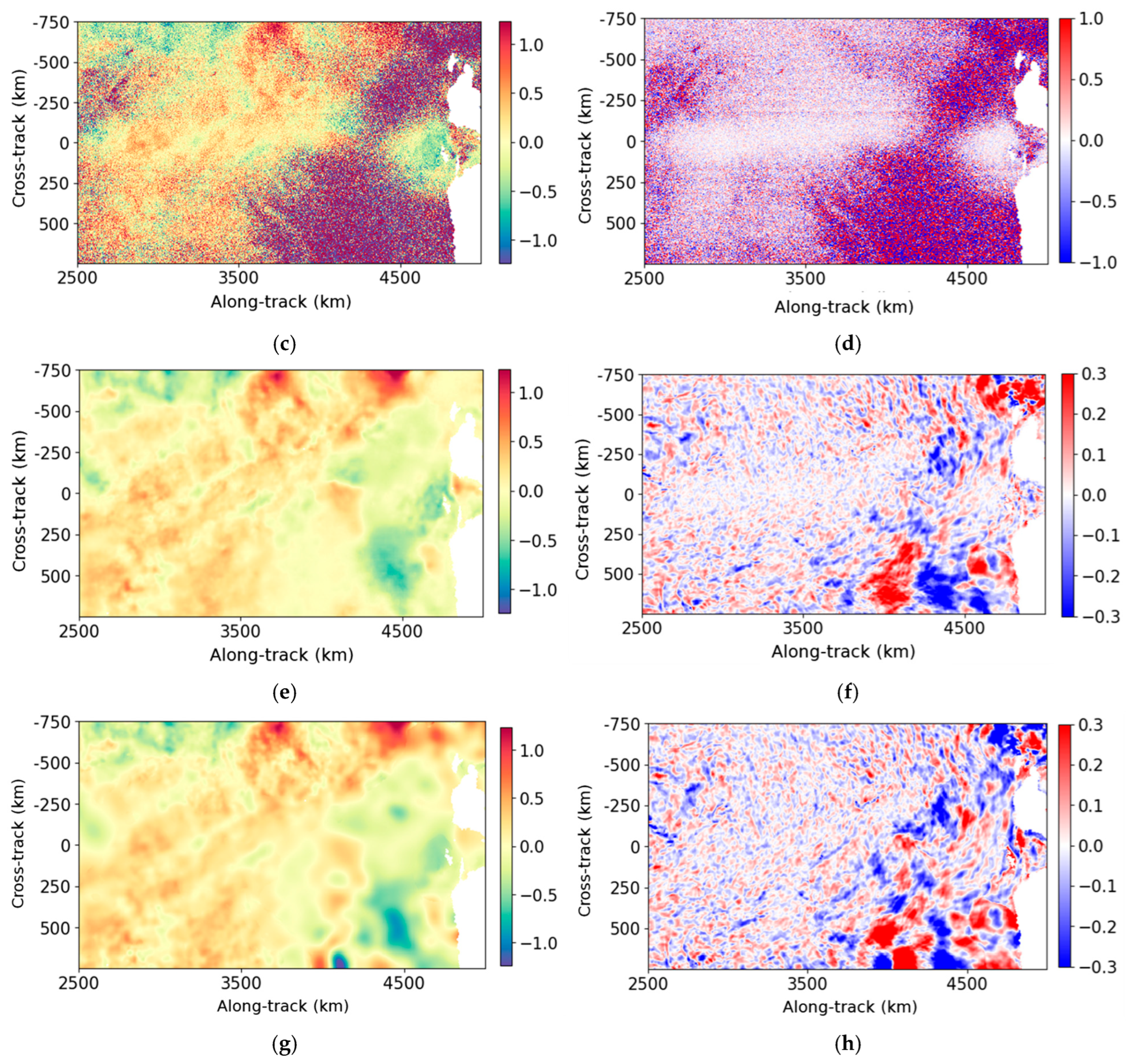
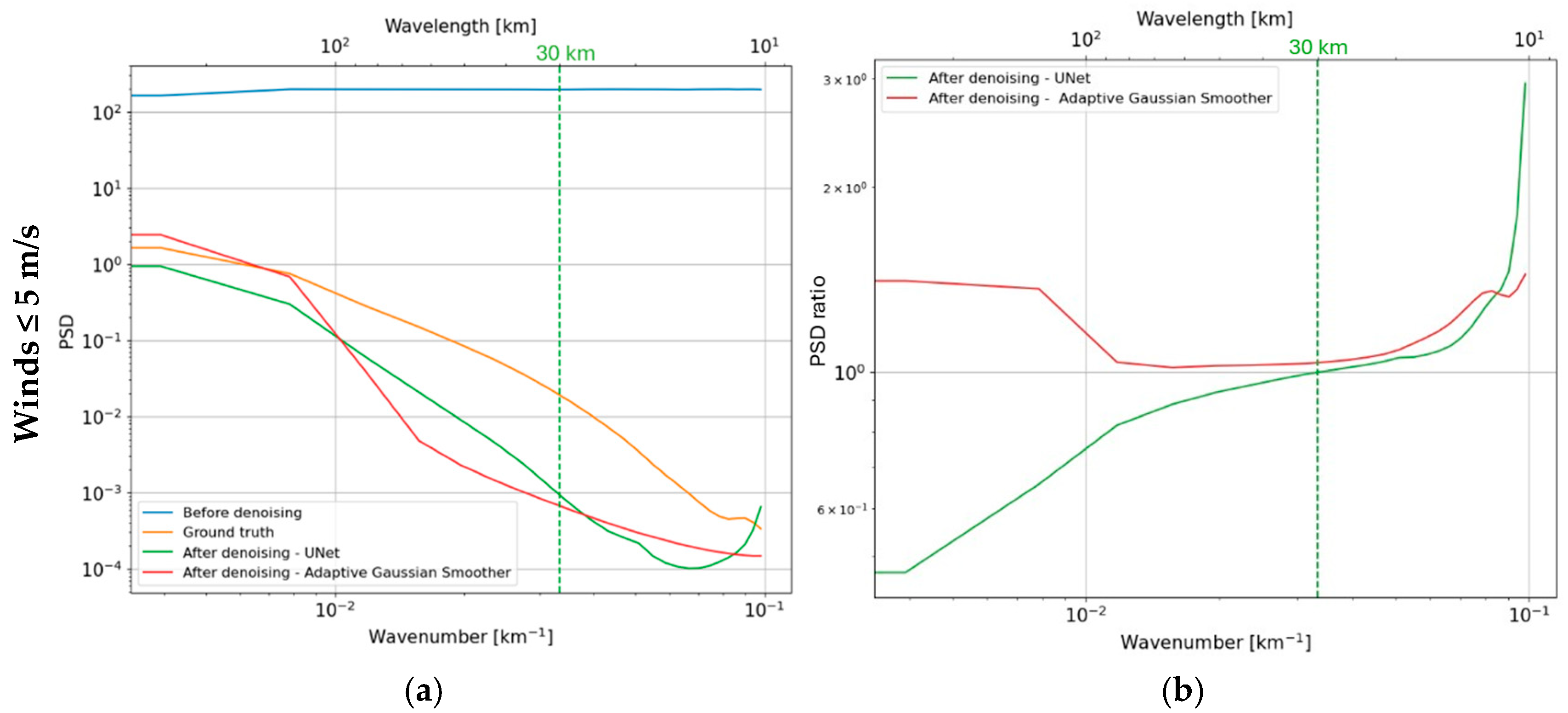
- Smaller scales (up to 30 km in strong wind conditions) can be observed after UNet denoising.
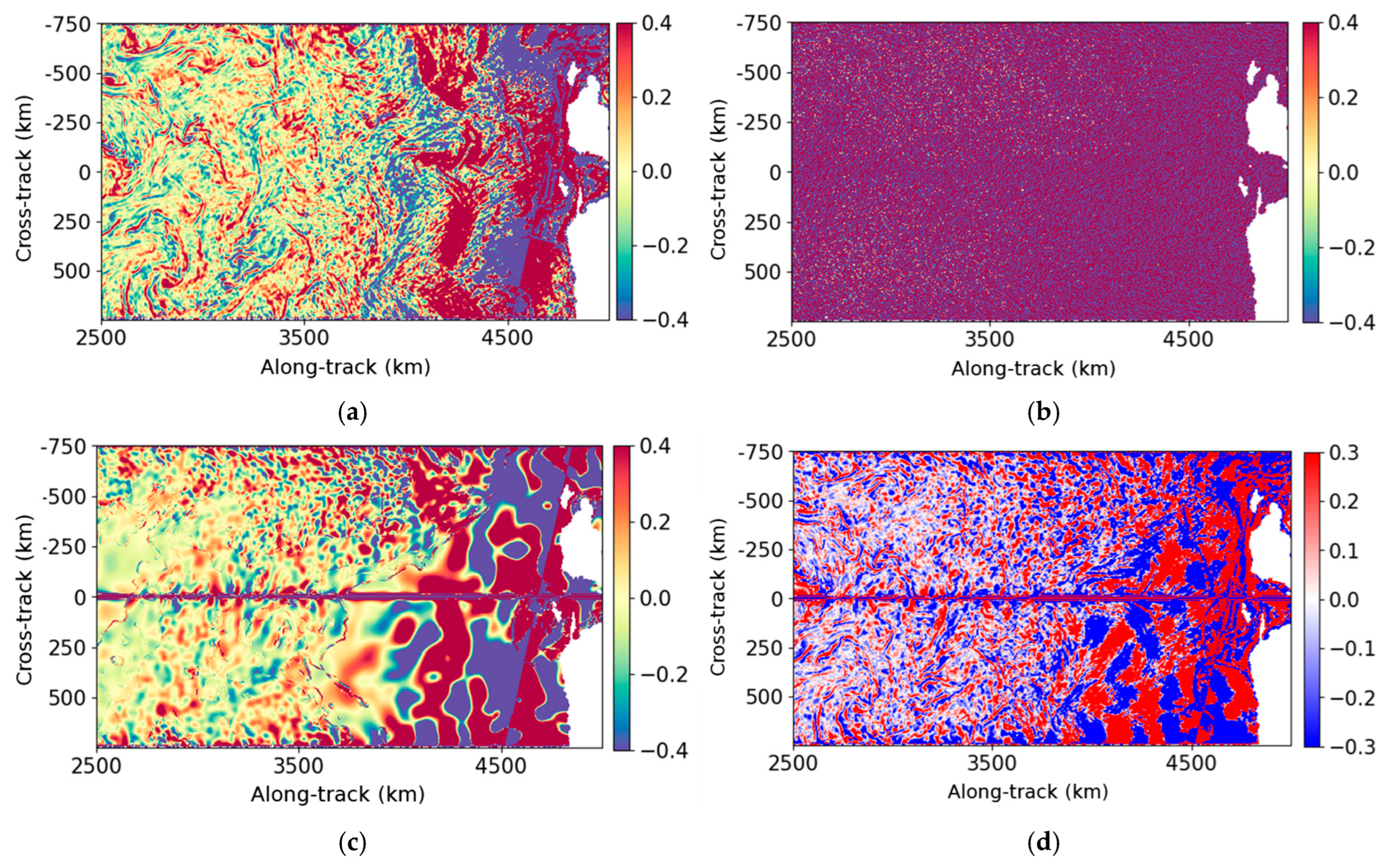
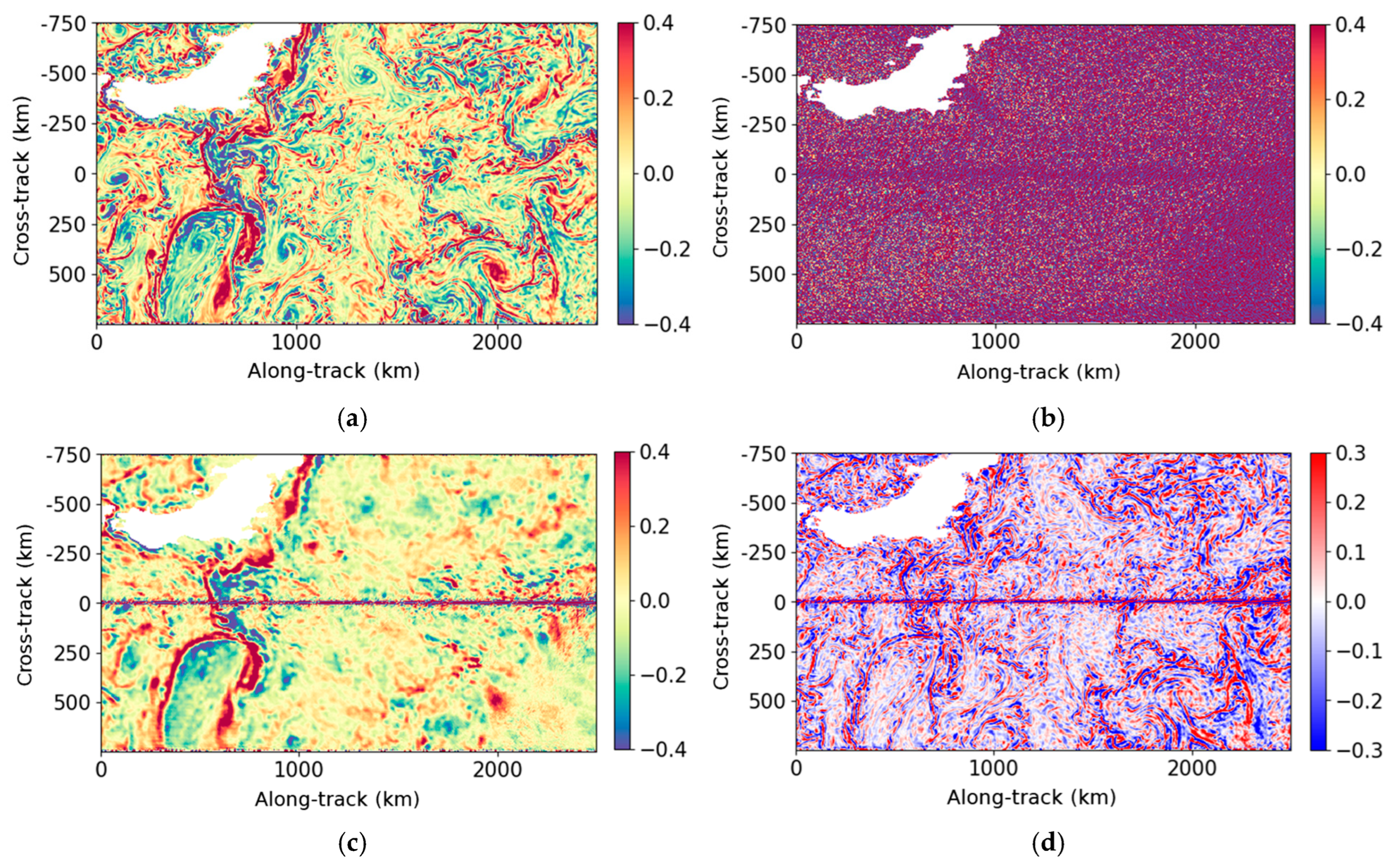
- The UNet enables the reconstruction of the main eddies and fronts in the relative vorticity field.
Abstract
1. Introduction
- Gain new insights into ocean–atmosphere climate forecasting and projections and improve climate projections.
- Understand how current wind coupling affects the main ocean currents, local and remote winds, and storm tracks.
- Understand how surface currents exchange and transport energy.
- Develop a deeper understanding of climate.
2. Input Data
- Parameters of the satellite observations such as the along-track and cross-track distance and different observation angles.
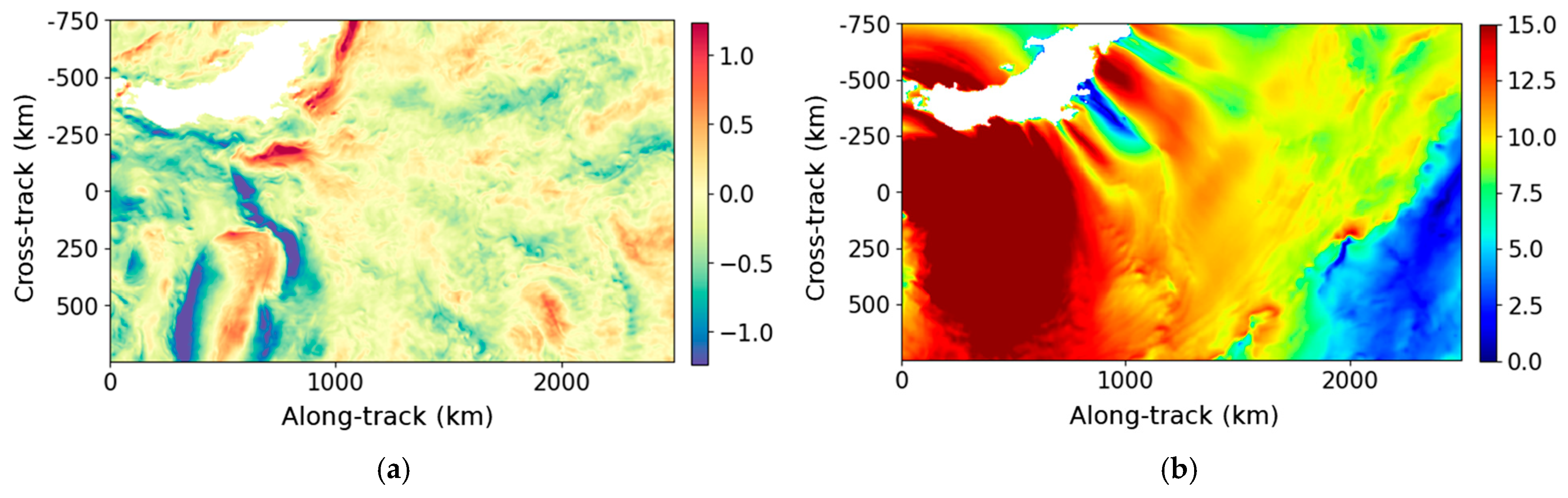
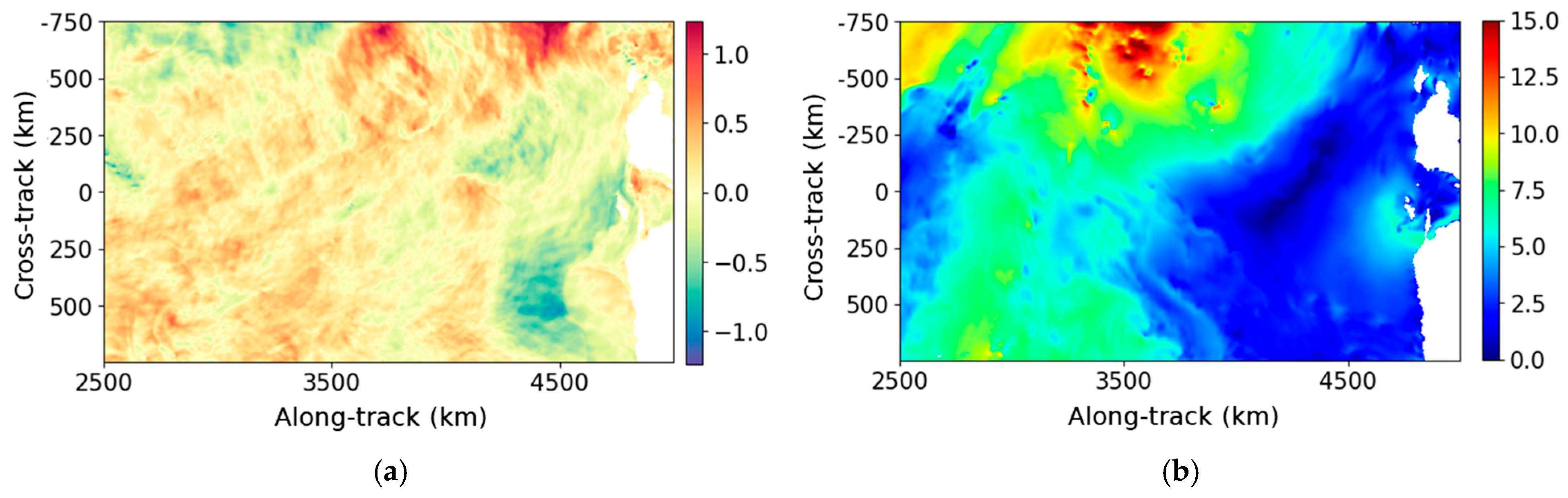
- Physical variables interpolated from the MITgcm (wind speed and direction, eastward/northward velocities and radial velocities).
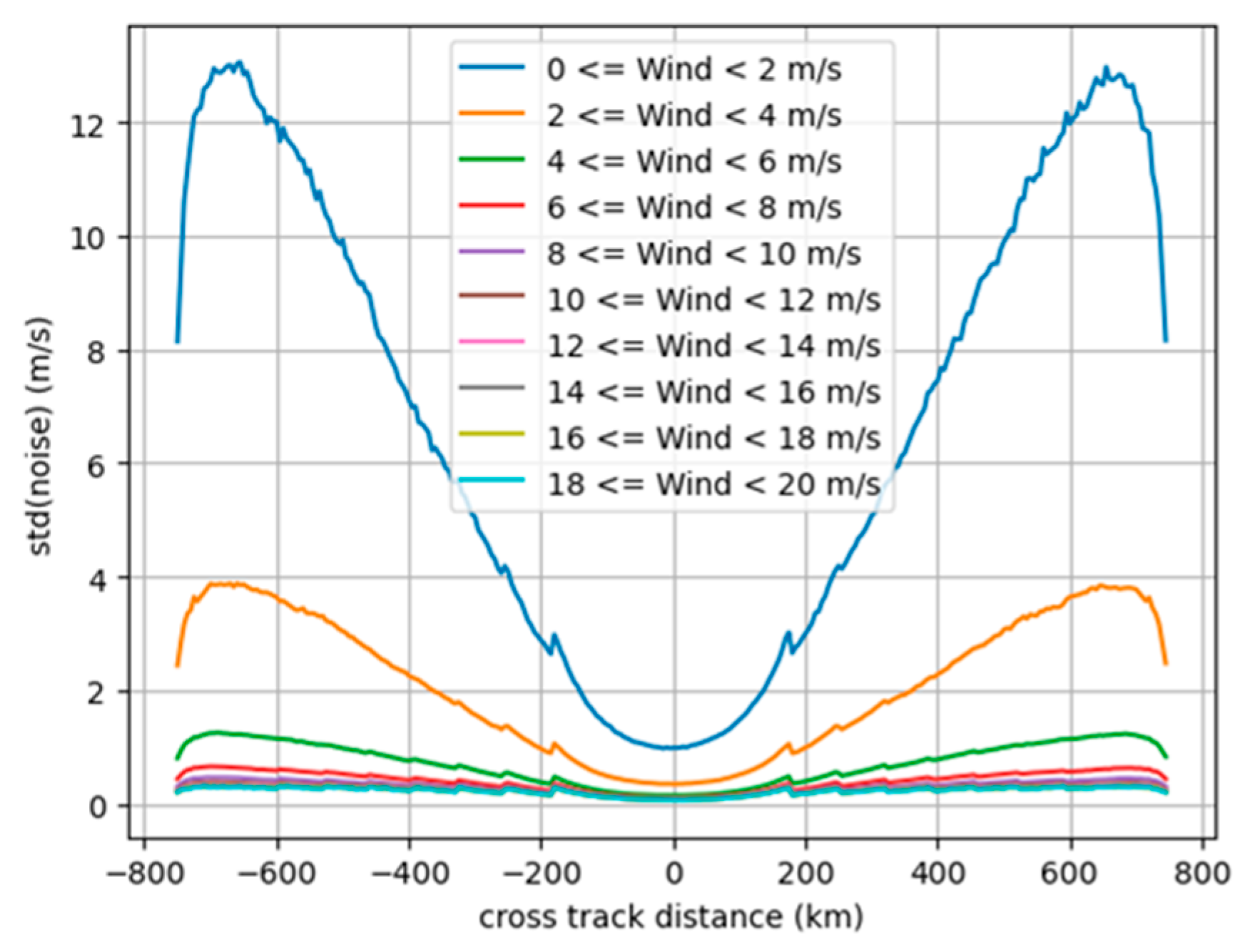
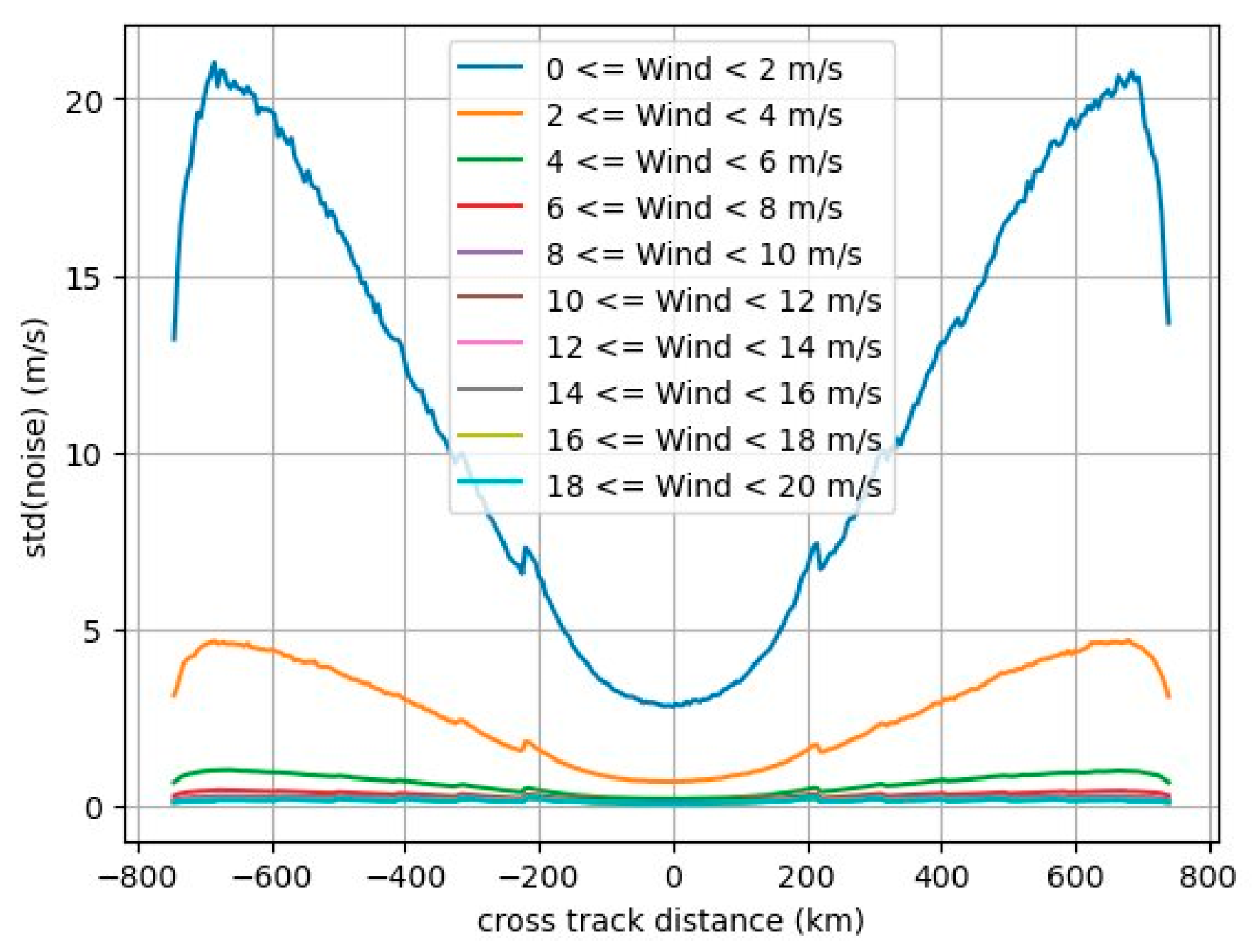
- Random errors that impact the radial velocities. The wind-dependent and the azimuth-dependent noise model is derived from Rodríguez et al. [2].
3. Noise-Reduction Algorithms
3.1. Neural Network Method: UNet
3.2. Adaptive Gaussian Smoother
3.3. Computation Efficiency
4. Metrics for Evaluation
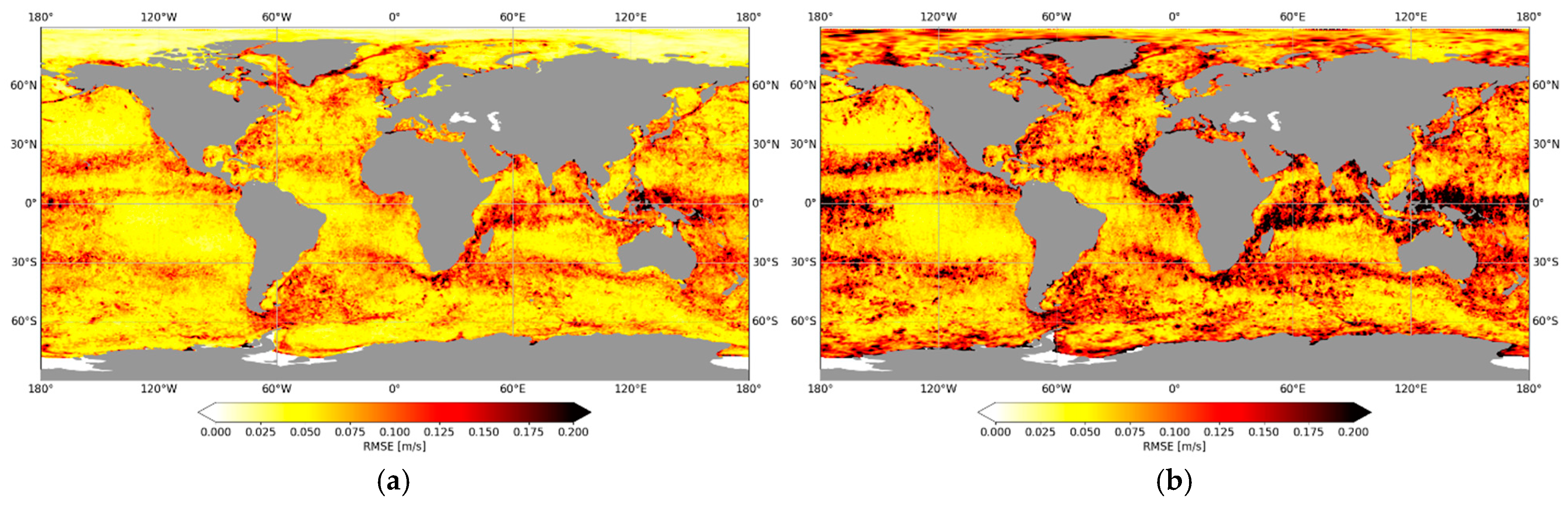
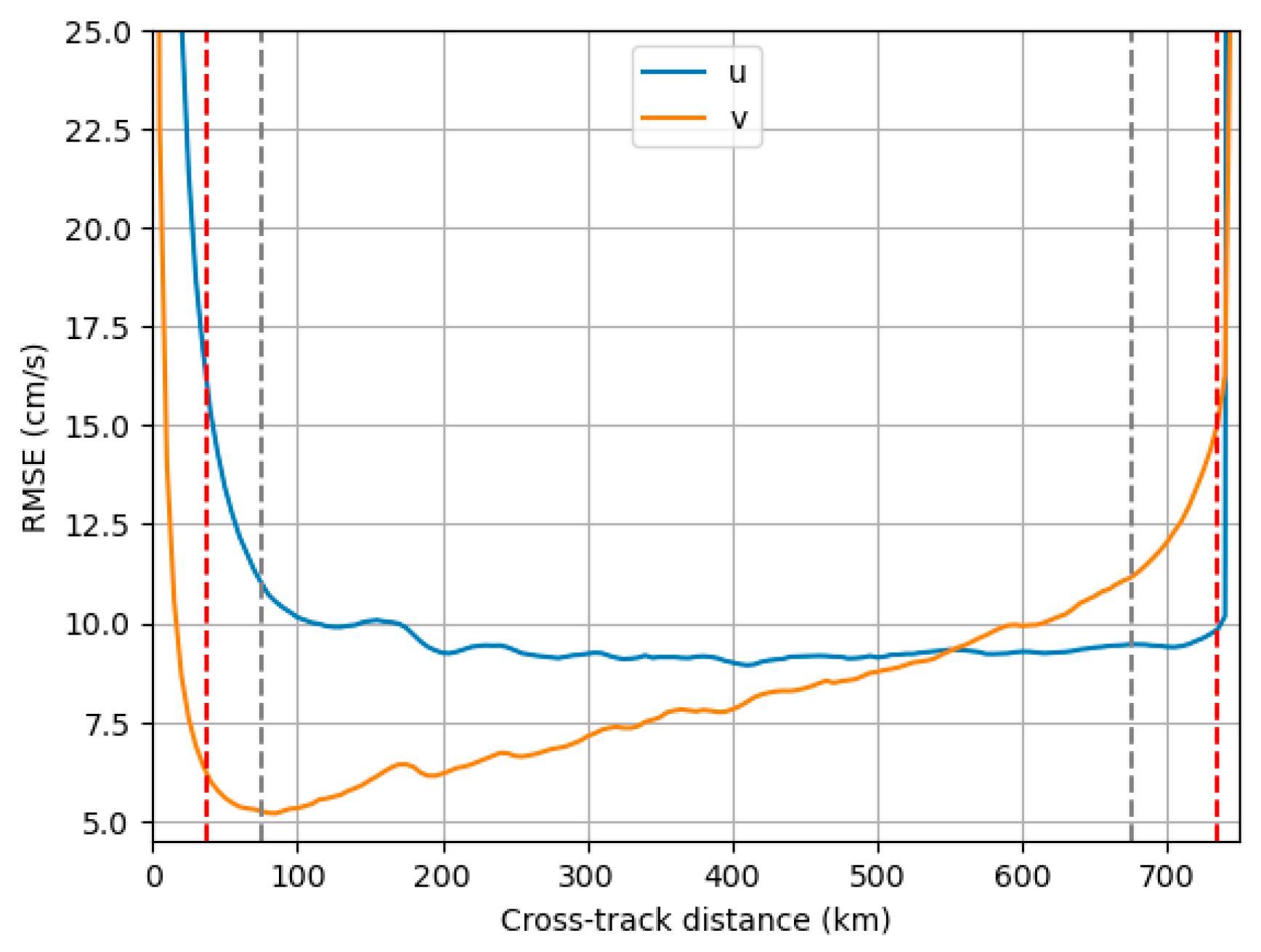
- Root Mean Square Error (RMSE) between denoised data and ground truth to quantify performance.
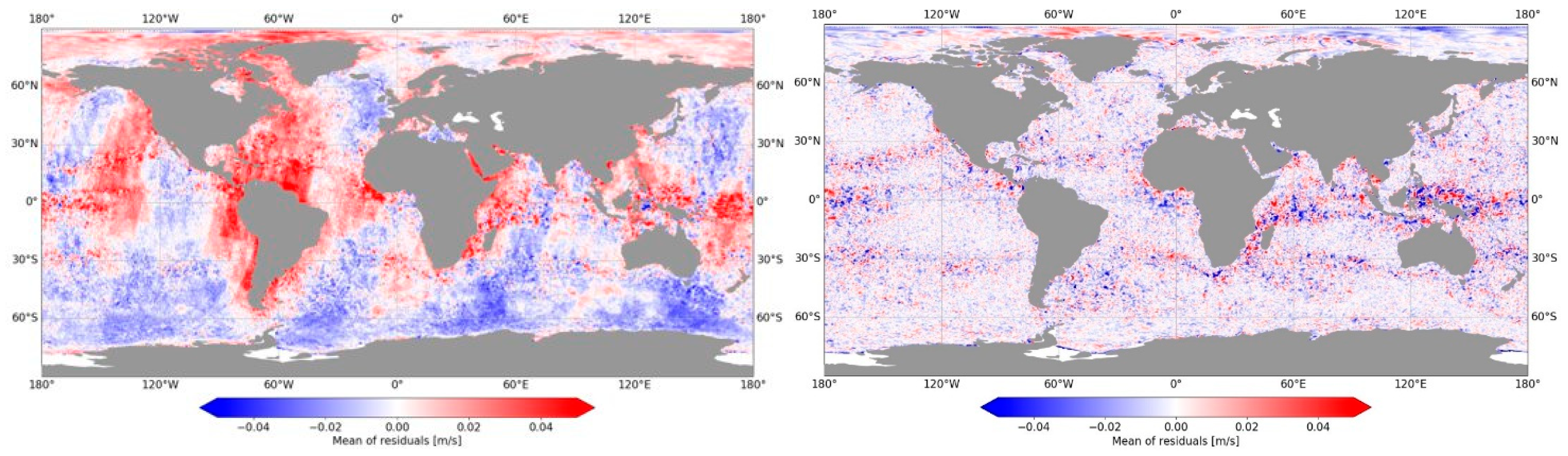
- Mean of residuals (i.e., error made by the denoising compared to ground truth) to gauge the bias introduced by the denoiser.
- Resolved scale corresponding to a Signal-to-Noise-Ratio (SNR) greater than or equal to 1 to provide information on the wavelength at which the noise dominates the radial velocities [18].
- Noise reduction:
5. Results
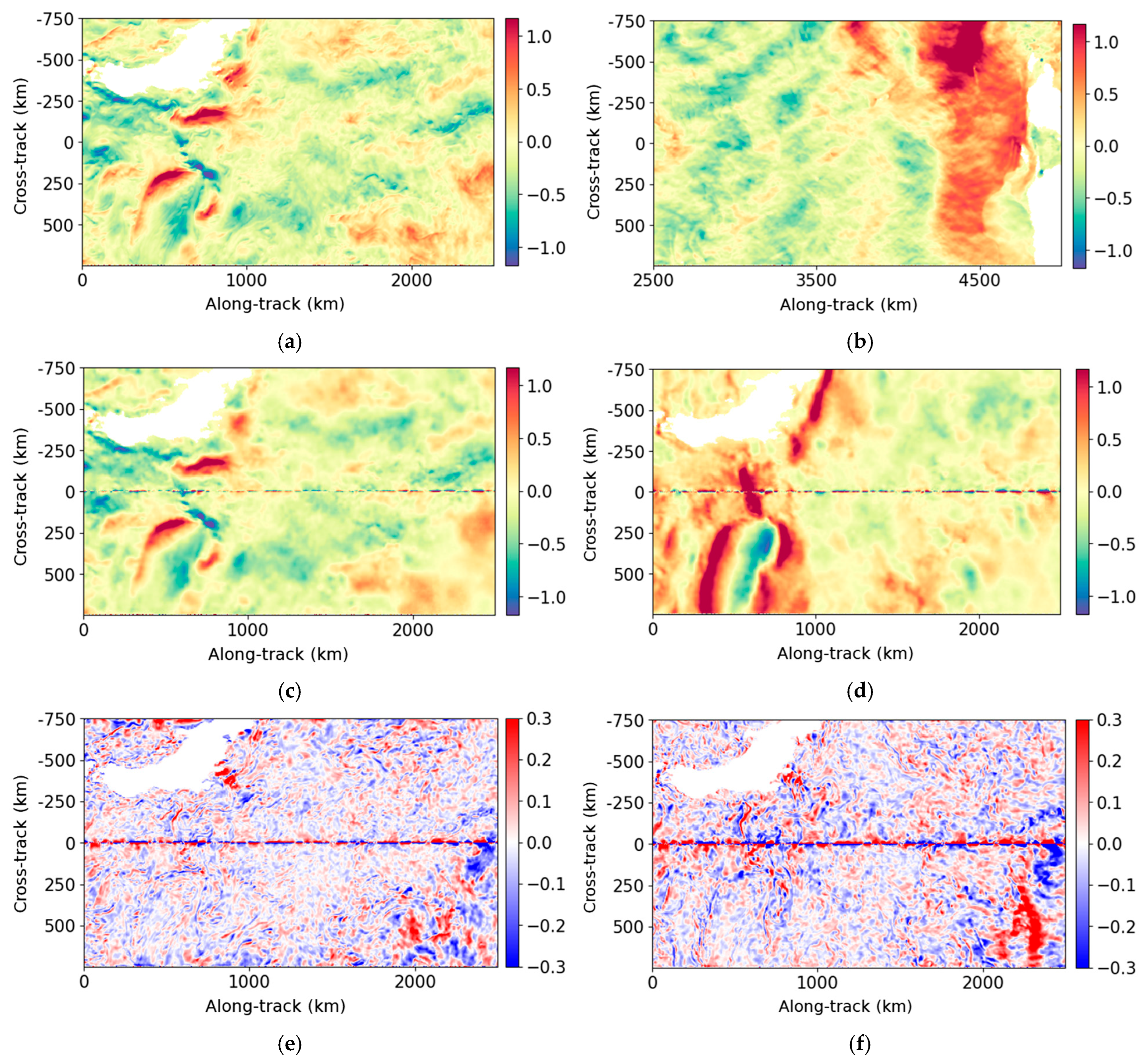
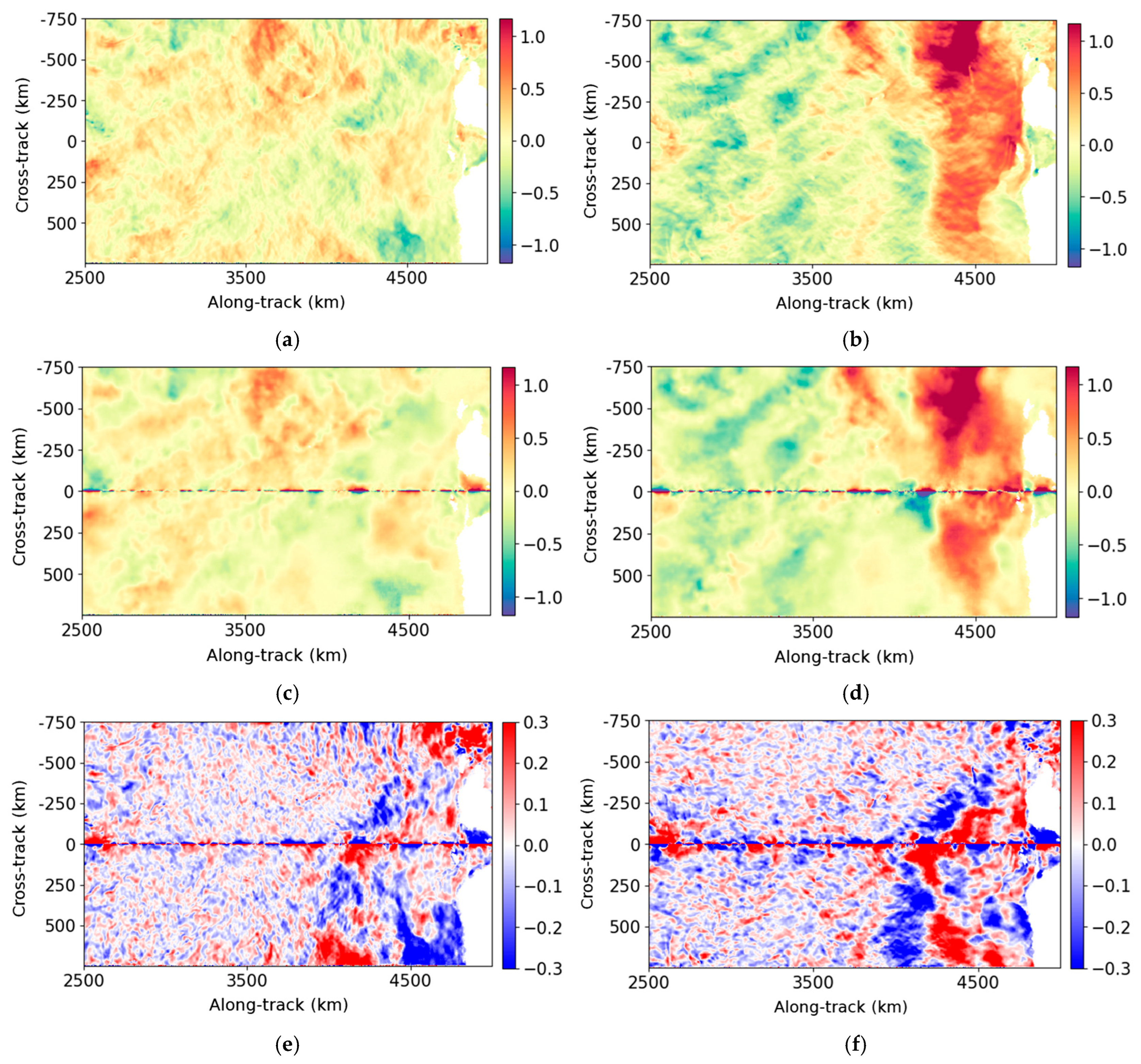
5.1. Qualitative Analysis
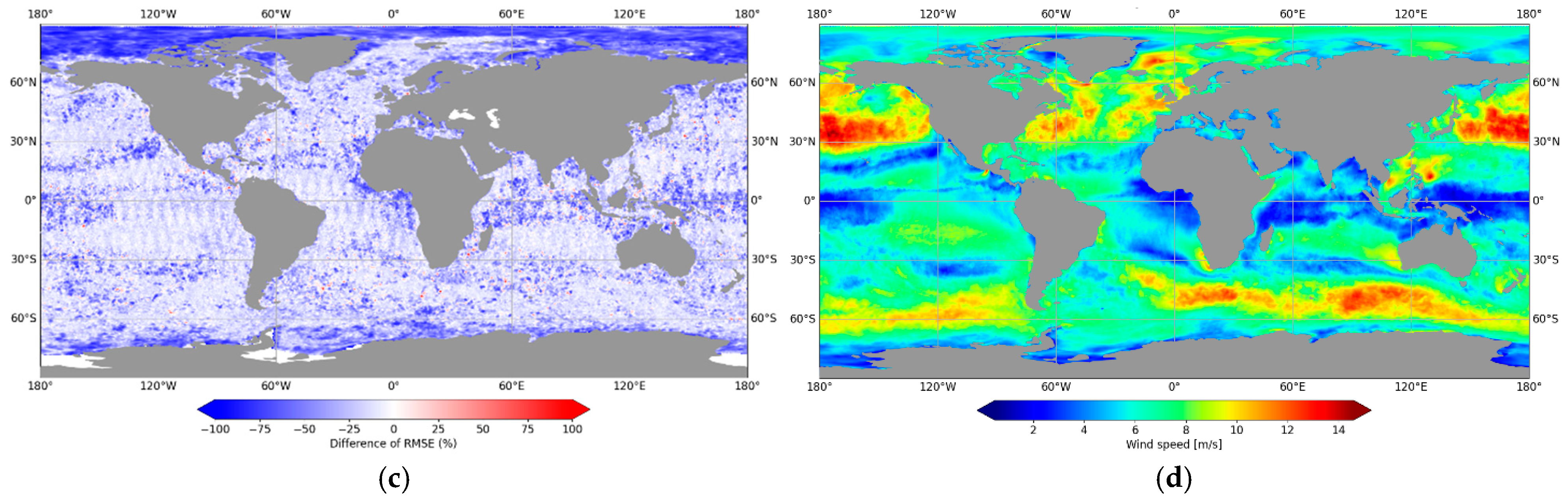
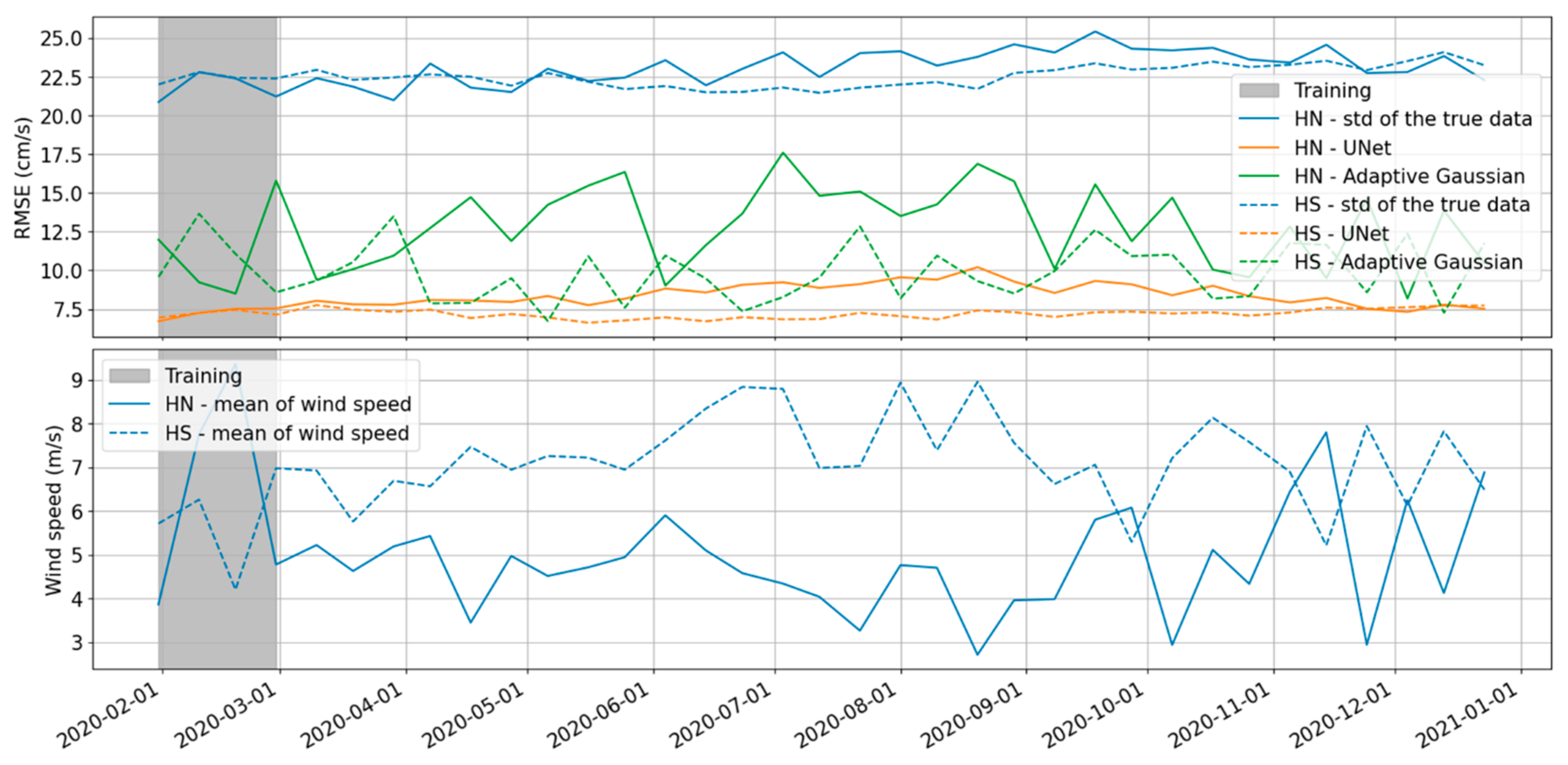
5.2. Statistics: Geographical and Temporal Variations
5.3. Spectral Analysis
5.4. Impact of Denoising on Velocities and Relative Vorticity
6. Robustness of the Model
6.1. Method Applied to Test the Robustness of the UNet
- Change one characteristic of the dataset compared with the training dataset. This can be either a different noise or a different ocean model. Simulated data is not an exact representation of reality. The noise level impacting the real ODYSEA data may be stronger or weaker, the noise may be correlated or uncorrelated, impacted by residuals from previous processing, etc. This is exactly the case with SWOT, where the real noise is correlated and weaker than in the simulations [10]. Moreover, the ocean model is only an imperfect representation of the real ocean.
- Application of the UNet on radial velocities on this new dataset in inference without re-training. As a reminder, the UNet was trained and tested on the high-SNR configuration and on the MITgcm. Applying it without re-training will allow us to see how the UNet behaves when faced with new data, and also to determine whether or not it is overfitted.
- Performance evaluation in the same way as in the previous section. The results presented previously will be used as a baseline.
6.2. Scenario: Change of the Noise Configuration
6.3. Scenario: Change of the Ocean Model
7. Conclusions and Perspectives
Author Contributions
Funding
Data Availability Statement
Acknowledgments
Conflicts of Interest
Appendix A. Impact of the Input Dataset in the UNet Training
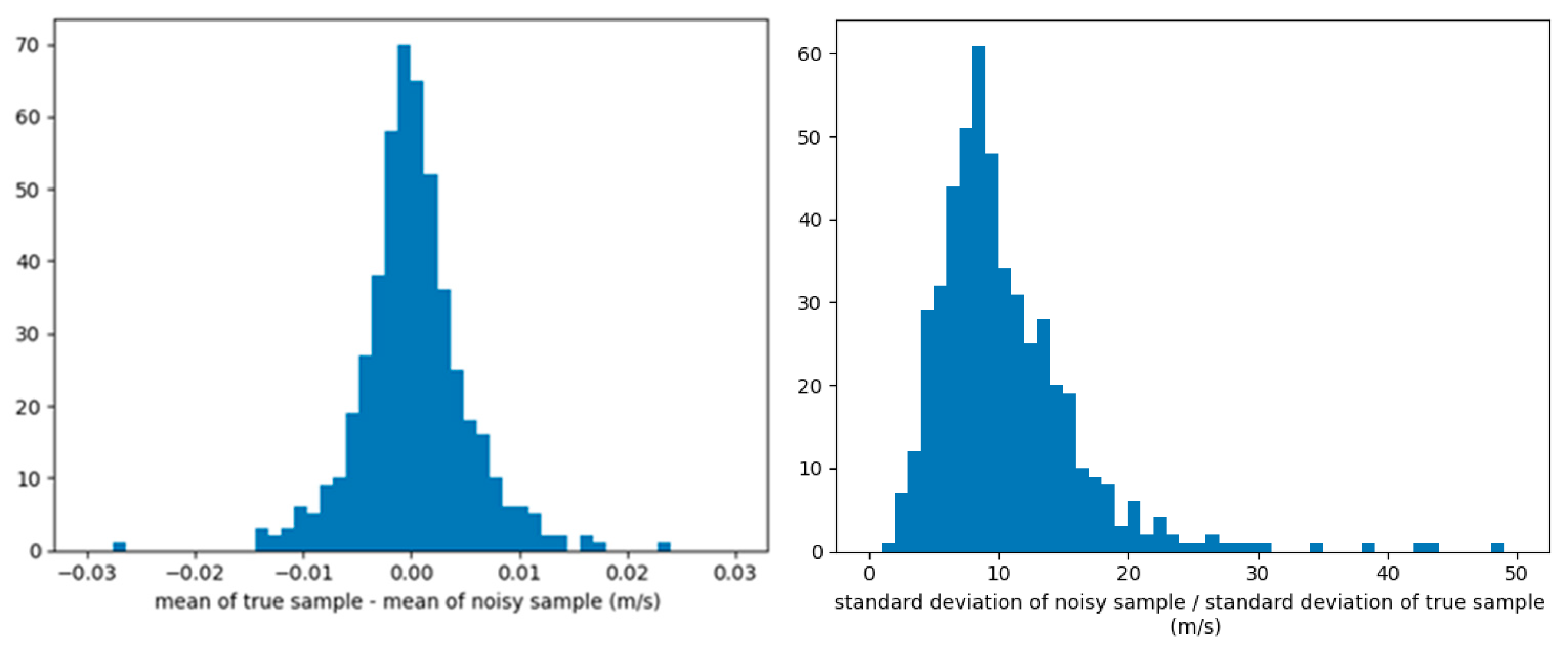
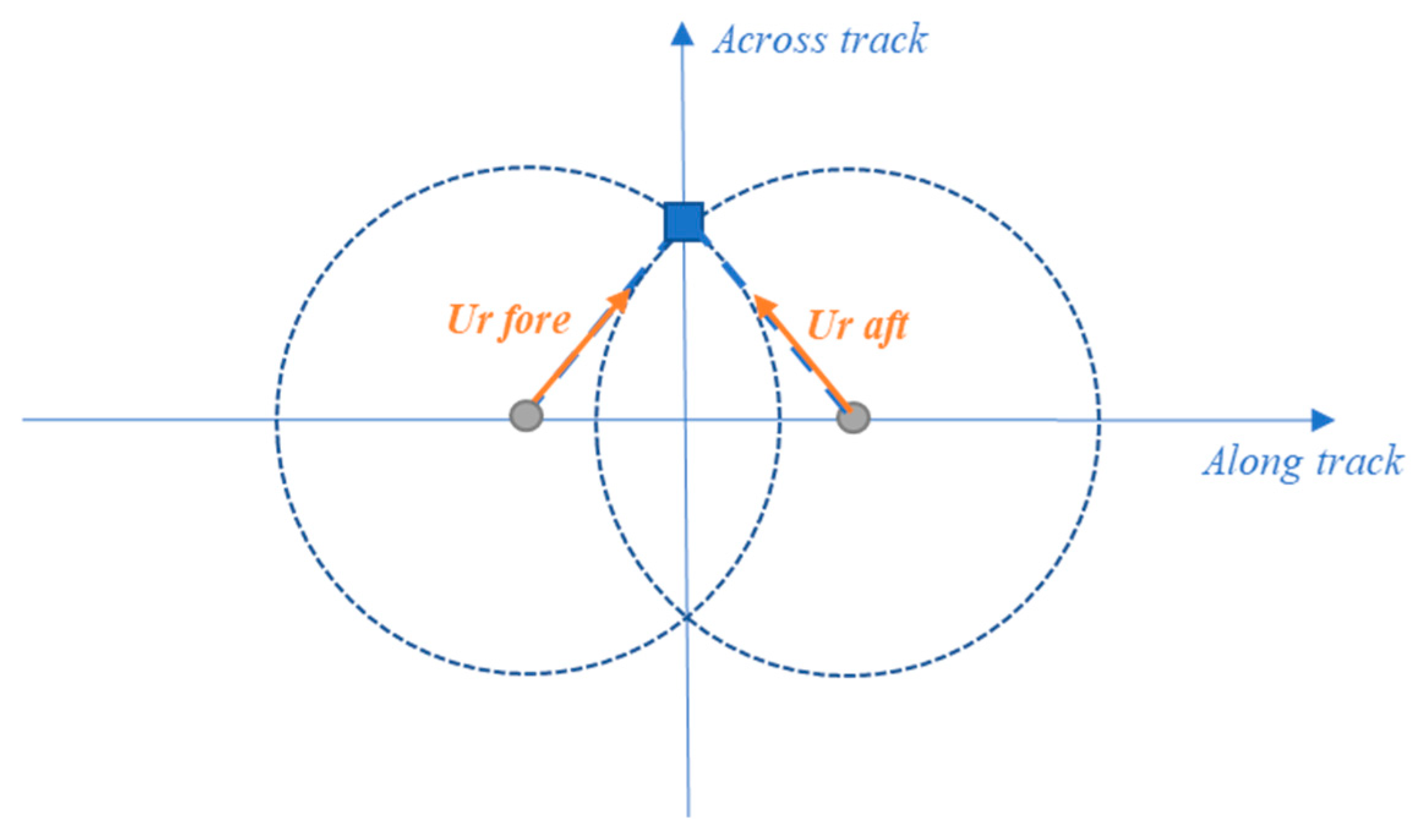
- ur aft and ur fore separately (hereafter called conf 1);
- ur aft and ur fore jointly (conf 2);
- ur aft and ur fore jointly and the true wind speed (conf 3).

| Global | Winds ≤ 5 m/s | 5 < Winds ≤ 10 m/s | Winds > 10 m/s | |
|---|---|---|---|---|
| Before denoising | >200 | >350 | 47 | 27 |
| Conf 1 | 7.8 | 10.8 | 6.2 | 5.3 |
| Conf 2 | 7.6 | 10.6 | 6.0 | 5.2 |
| Conf 3 | 7.6 | 10.6 | 6.0 | 5.2 |
Appendix B. Impact of the Derivation Method
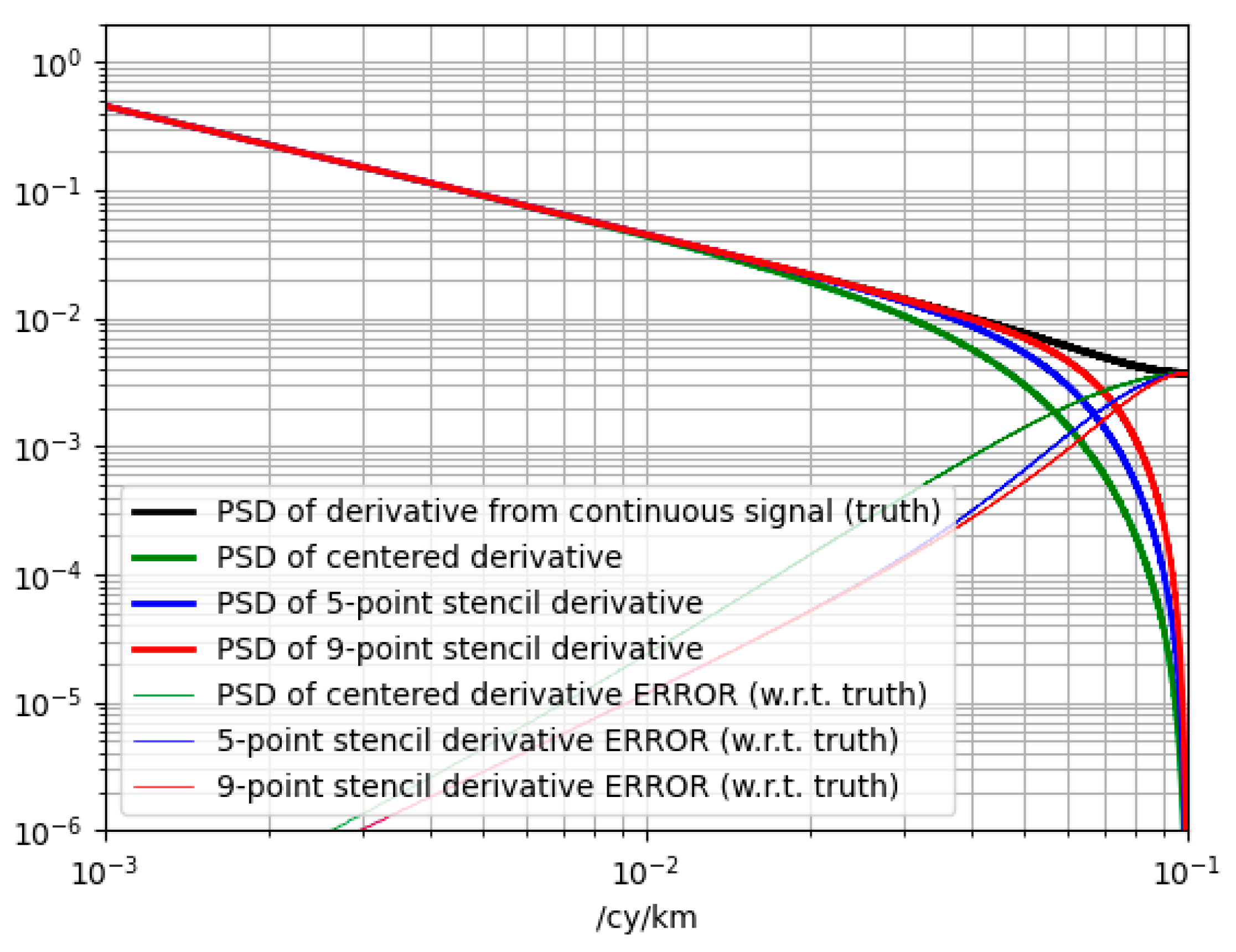
2) + 0.03809524 × f(N + 3) − 0.00357143 × f(N)

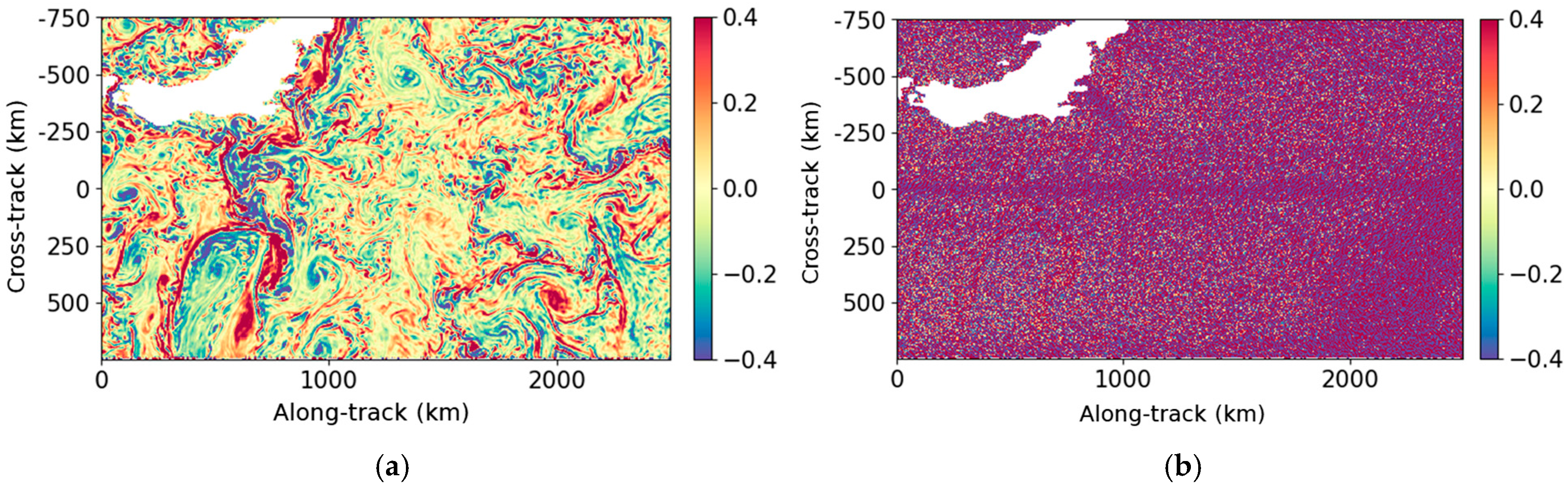
Appendix C. Denoising of Ur Aft


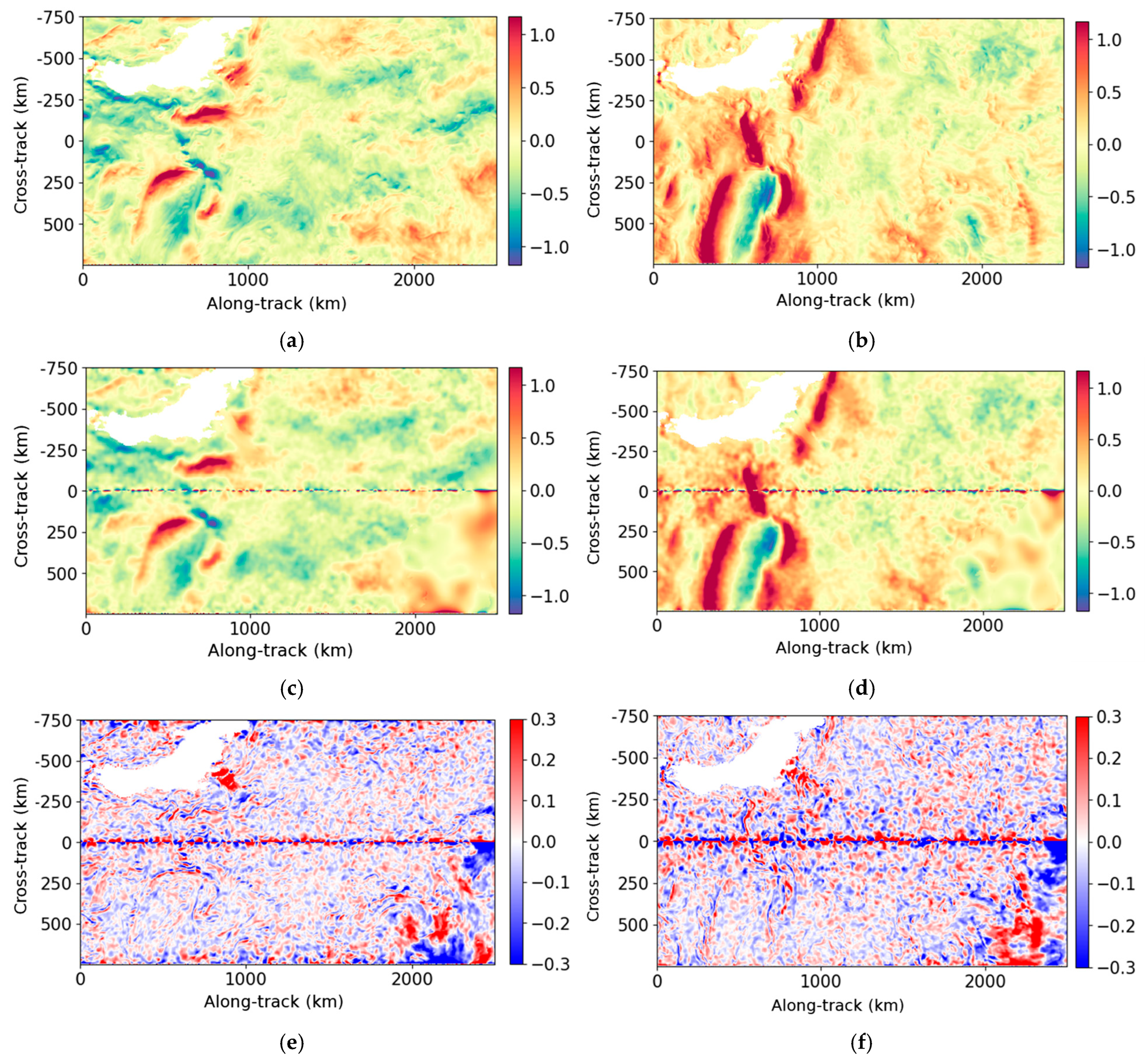
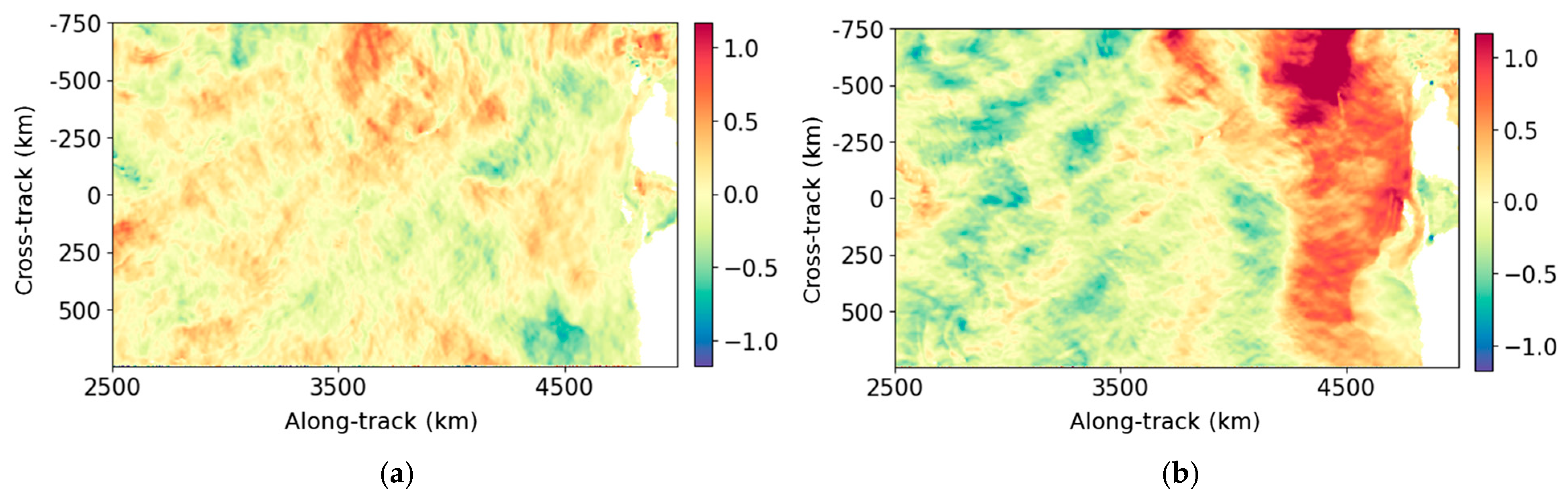
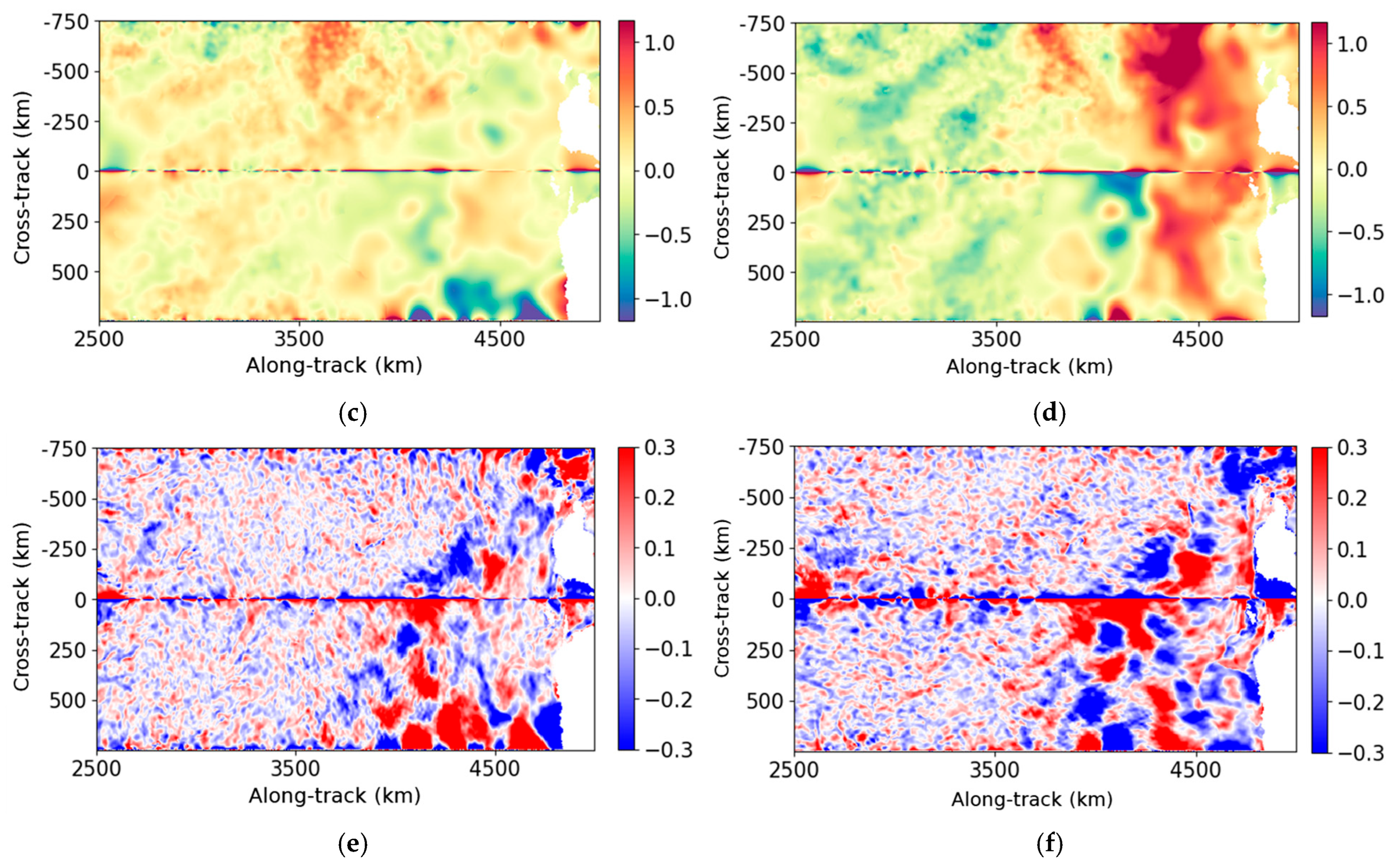
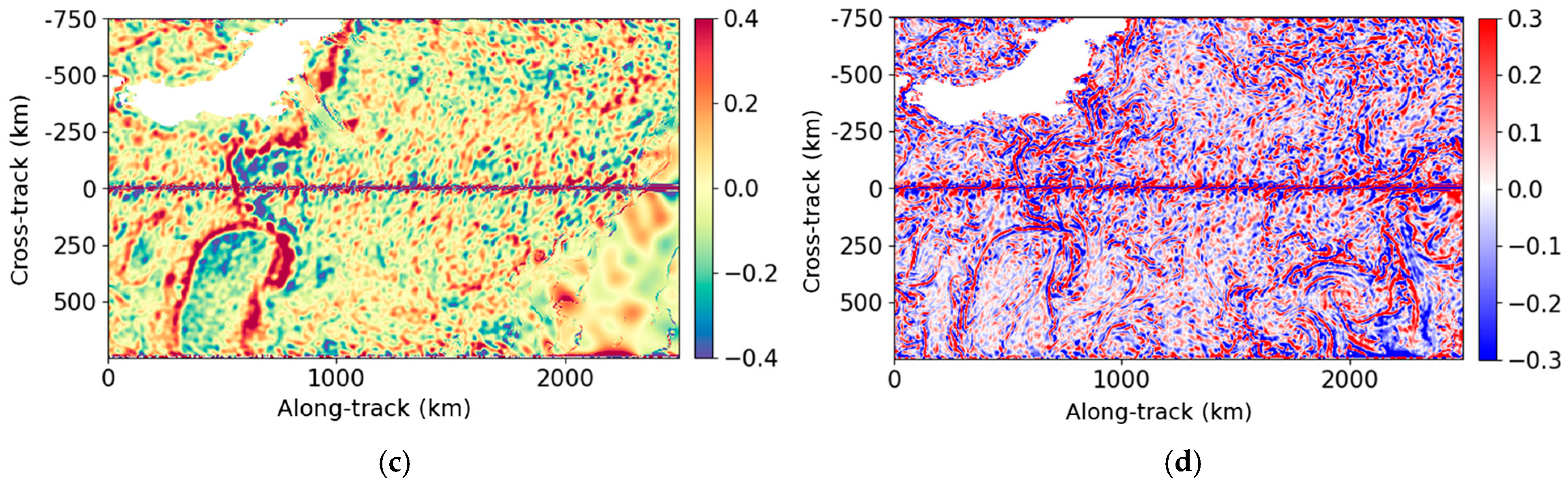
Appendix D. Velocities and Relative Vorticities Deduced from the Adaptive Gaussian Smoother

References
- Ferrari, R.; Wunsch, C. Ocean Circulation Kinetic Energy: Reservoirs, Sources, and Sinks. Annu. Rev. Fluid Mech. 2009, 41, 253–282. [Google Scholar] [CrossRef] [Scilit]
- Rodríguez, E.; Wineteer, A.; Perkovic-Martin, D.; Gál, T.; Stiles, B.W.; Niamsuwan, N.; Rodriguez Monje, R. Estimating Ocean Vector Winds and Currents Using a Ka-Band Pencil-Beam Doppler Scatterometer. Remote Sens. 2018, 10, 576. [Google Scholar] [CrossRef] [Scilit]
- Rodríguez, E.; Bourassa, M.; Chelton, D.; Farrar, J.T.; Long, D.; Perkovic-Martin, D.; Samelson, R. The Winds and Currents Mission Concept. Front. Mar. Sci. 2019, 6, 438. [Google Scholar] [CrossRef] [Scilit]
- Frasier, S.J.; Camps, A.J. Dual-beam interferometry for ocean surface current vector mapping. IEEE Trans. Geosci. Remote Sens. 2001, 39, 401–414. [Google Scholar] [CrossRef] [Scilit]
- Gaultier, L. Technical Note: ODYSEA L2 Simulated Datasets. 2024. Available online: https://www.aviso.altimetry.fr/fileadmin/documents/data/tools/hdbk_Odysea_simulator_v1.pdf (accessed on 26 October 2025).
- Wineteer, A.; Torres, H.S.; Rodriguez, E. On the Surface Current Measurement Capabilities of Spaceborne Doppler Scatterometry. Geophys. Res. Lett. 2020, 47, e2020GL090116. [Google Scholar] [CrossRef] [Scilit]
- Gómez-Navarro, L.; Cosme, E.; Sommer, J.; Papadakis, N.; Pascual, A. Development of an Image De-Noising Method in Preparation for the Surface Water and Ocean Topography Satellite Mission. Remote Sens. 2020, 12, 734. [Google Scholar] [CrossRef] [Scilit]
- Tréboutte, A.; Carli, E.; Ballarotta, M.; Carpentier, B.; Faugère, Y.; Dibarboure, G. KaRIn Noise Reduction Using a Convolutional Neural Network for the SWOT Ocean Products. Remote Sens. 2023, 15, 2183. [Google Scholar] [CrossRef] [Scilit]
- Fu, L.-L.; Pavelsky, T.; Cretaux, J.-F.; Morrow, R.; Farrar, J.T.; Vaze, P.; Sengenes, P.; Vinogradova-Shiffer, N.; Sylvestre-Baron, A.; Picot, N.; et al. The Surface Water and Ocean Topography Mission: A Breakthrough in Radar Remote Sensing of the Ocean and Land Surface Water. Geophys. Res. Lett. 2024, 51, e2023GL107652. [Google Scholar] [CrossRef] [Scilit]
- Dibarboure, G.; Anadon, C.; Briol, F.; Cadier, E.; Chevrier, R.; Delepoulle, A.; Faugère, Y.; Laloue, A.; Morrow, R.; Picot, N.; et al. Blending 2D topography images from SWOT into the altimeter constellation with the Level-3 multi-mission DUACS system. EGUsphere 2024, 2024, 1–64. [Google Scholar] [CrossRef] [Scilit]
- OceanDataLab. Level-2 ODYSEA Simulated Dataset. 2024. Available online: https://www.aviso.altimetry.fr/en/data/products/value-added-products/simulated-level-2-odysea-dataset.html (accessed on 26 October 2025).
- Komatsu, R.; Gonsalves, T. Comparing U-Net Based Models for Denoising Color Images. AI 2020, 1, 465–486. [Google Scholar] [CrossRef] [Scilit]
- Kovacs, A.; Bukki, T.; Legradi, G.; Meszaros, N.J.; Kovacs, G.Z.; Prajczer, P.; Tamaga, I.; Seress, Z.; Kiszler, G.; Forgacs, A.; et al. Robustness analysis of denoising neural networks for bone scintigraphy. Nucl. Instrum. Methods Phys. Res. Sect. Accel. Spectrometers Detect. Assoc. Equip. 2022, 1039, 167003. [Google Scholar] [CrossRef] [Scilit]
- Ronneberger, O.; Fischer, P.; Brox, T. U-Net: Convolutional Networks for Biomedical Image Segmentation. arXiv 2015, arXiv:1505.04597. [Google Scholar] [CrossRef] [Scilit]
- Agrawal, S.; Barrington, L.; Bromberg, C.; Burge, J.; Gazen, C.; Hickey, J. Machine Learning for Precipitation Nowcasting from Radar Images. arXiv 2019, arXiv:1912.12132. [Google Scholar] [CrossRef] [Scilit]
- Mirouze, I.; Rémy, E.; Lellouche, J.-M.; Martin, M.J.; Donlon, C.J. Impact of assimilating satellite surface velocity observations in the Mercator Ocean International analysis and forecasting global 1/4° system. Front. Mar. Sci. 2024, 11, 1376999. [Google Scholar] [CrossRef] [Scilit]
- Ubelmann, C.; Dibarboure, G.; Gaultier, L.; Ponte, A.; Ardhuin, F.; Ballarotta, M.; Faugère, Y. Reconstructing Ocean Surface Current Combining Altimetry and Future Spaceborne Doppler Data. J. Geophys. Res. Oceans 2021, 126, e2020JC016560. [Google Scholar] [CrossRef] [Scilit]
- Wang, J.; Fu, L.-L.; Torres, H.S.; Chen, S.; Qiu, B.; Menemenlis, D. On the Spatial Scales to be Resolved by the Surface Water and Ocean Topography Ka-Band Radar Interferometer. J. Atmospheric Ocean. Technol. 2019, 36, 87–99. [Google Scholar] [CrossRef] [Scilit]
- Arbic, B.K.; Scott, R.B.; Chelton, D.B.; Richman, J.G.; Shriver, J.F. Effects of stencil width on surface ocean geostrophic velocity and vorticity estimation from gridded satellite altimeter data. J. Geophys. Res. Oceans 2012, 117. [Google Scholar] [CrossRef] [Scilit]
- Seo, H.; Miller, A.J.; Norris, J.R. Eddy–Wind Interaction in the California Current System: Dynamics and Impacts. J. Phys. Oceanogr. 2016, 46, 439–459. [Google Scholar] [CrossRef] [Scilit]
- Torres, H.S.; Rodriguez, E.; Wineteer, A.; Klein, P.; Thompson, A.F.; Callies, J.; D’Asaro, E.; Perkovic-Martin, D.; Farrar, J.T.; Polverari, F.; et al. Airborne observations of fast-evolving ocean submesoscale turbulence. Commun. Earth Environ. 2024, 5, 771. [Google Scholar] [CrossRef] [Scilit]
- Carli, E.; Morrow, R.; Vergara, O.; Chevrier, R.; Renault, L. Ocean 2D eddy energy fluxes from small mesoscale processes with SWOT. Ocean Sci. 2023, 19, 1413–1435. [Google Scholar] [CrossRef] [Scilit]
- Debreu, L.; Marchesiello, P.; Penven, P.; Cambon, G. Two-way nesting in split-explicit ocean models: Algorithms, implementation and validation. Ocean Model. 2012, 49–50, 1–21. [Google Scholar] [CrossRef] [Scilit]
- Shchepetkin, A.F.; McWilliams, J.C. Quasi-Monotone Advection Schemes Based on Explicit Locally Adaptive Dissipation. Mon. Wea. Rev. 1998, 126, 1541–1580. [Google Scholar] [CrossRef] [Scilit]
- Lellouche, J.-M.; Greiner, E.; Le Galloudec, O.; Garric, G.; Regnier, C.; Drevillon, M.; Benkiran, M.; Testut, C.-E.; Bourdalle-Badie, R.; Gasparin, F.; et al. Recent updates to the Copernicus Marine Service global ocean monitoring and forecasting real-time 1∕12° high-resolution system. Ocean Sci. 2018, 14, 1093–1126. [Google Scholar] [CrossRef] [Scilit]
- Egbert, G.D.; Erofeeva, S.Y. Efficient Inverse Modeling of Barotropic Ocean Tides. J. Atmos. Oceanic Technol. 2002, 19, 183–204. [Google Scholar] [CrossRef] [Scilit]
- Contreras, M.; Renault, L.; Marchesiello, P. Understanding Energy Pathways in the Gulf Stream. J. Phys. Oceanogr. 2023, 53, 719–736. [Google Scholar] [CrossRef] [Scilit]
- Contreras, M.; Renault, L.; Marchesiello, P. Tidal Modulation of Energy Dissipation Routes in the Gulf Stream. Geophys. Res. Lett. 2023, 50, e2023GL104946. [Google Scholar] [CrossRef] [Scilit]
- Lu, Y.; Ying, Y.; Lin, C.; Wang, Y.; Jin, J.; Jiang, X.; Shuai, J.; Li, X.; Zhong, J. UNet-Att: A self-supervised denoising and recovery model for two-photon microscopic image. Complex Intell. Syst. 2024, 11, 55. [Google Scholar] [CrossRef] [Scilit]
- Zhang, K.; Li, Y.; Liang, J.; Cao, J.; Zhang, Y.; Tang, H.; Fan, D.-P.; Timofte, R.; Gool, L.V. Practical Blind Image Denoising via Swin-Conv-UNet and Data Synthesis. Mach. Intell. Res. 2023, 20, 822–836. [Google Scholar] [CrossRef] [Scilit]
- Jang, H.; Park, J.; Jung, D.; Lew, J.; Bae, H.; Yoon, S. PUCA: Patch-Unshuffle and Channel Attention for Enhanced Self-Supervised Image Denoising. arXiv 2023, arXiv:2310.10088. [Google Scholar] [CrossRef] [Scilit]






| Orbit | Height | Swath Width | Look Angle | Configuration |
|---|---|---|---|---|
| Orbit 800 km | 800 km | 1497 km | 41° | E2-high SNR |
| Orbit 590 km | 590 km | 1486 | 49° | F-low SNR |
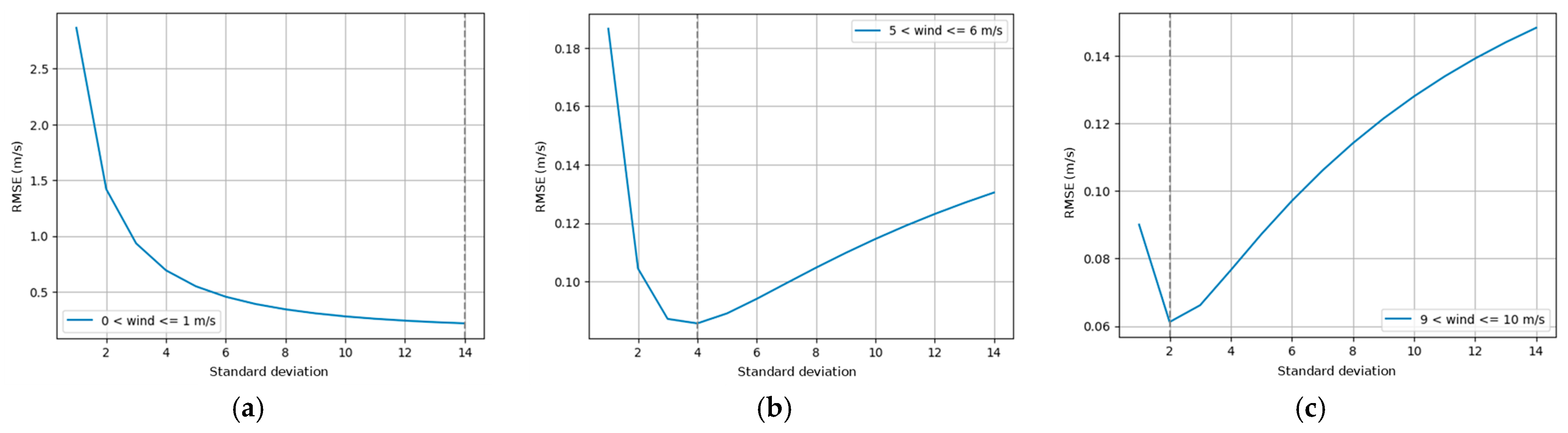
| Winds ≤ 4 m/s | 4 < Winds ≤ 5 m/s | 5 < Winds ≤ 6 m/s | 6 < Winds ≤ 8 m/s | 8 m/s < Winds | |
|---|---|---|---|---|---|
| σ (pixels) | 8 | 5 | 4 | 3 | 2 |
| σ (km) | 40 | 25 | 20 | 15 | 10 |
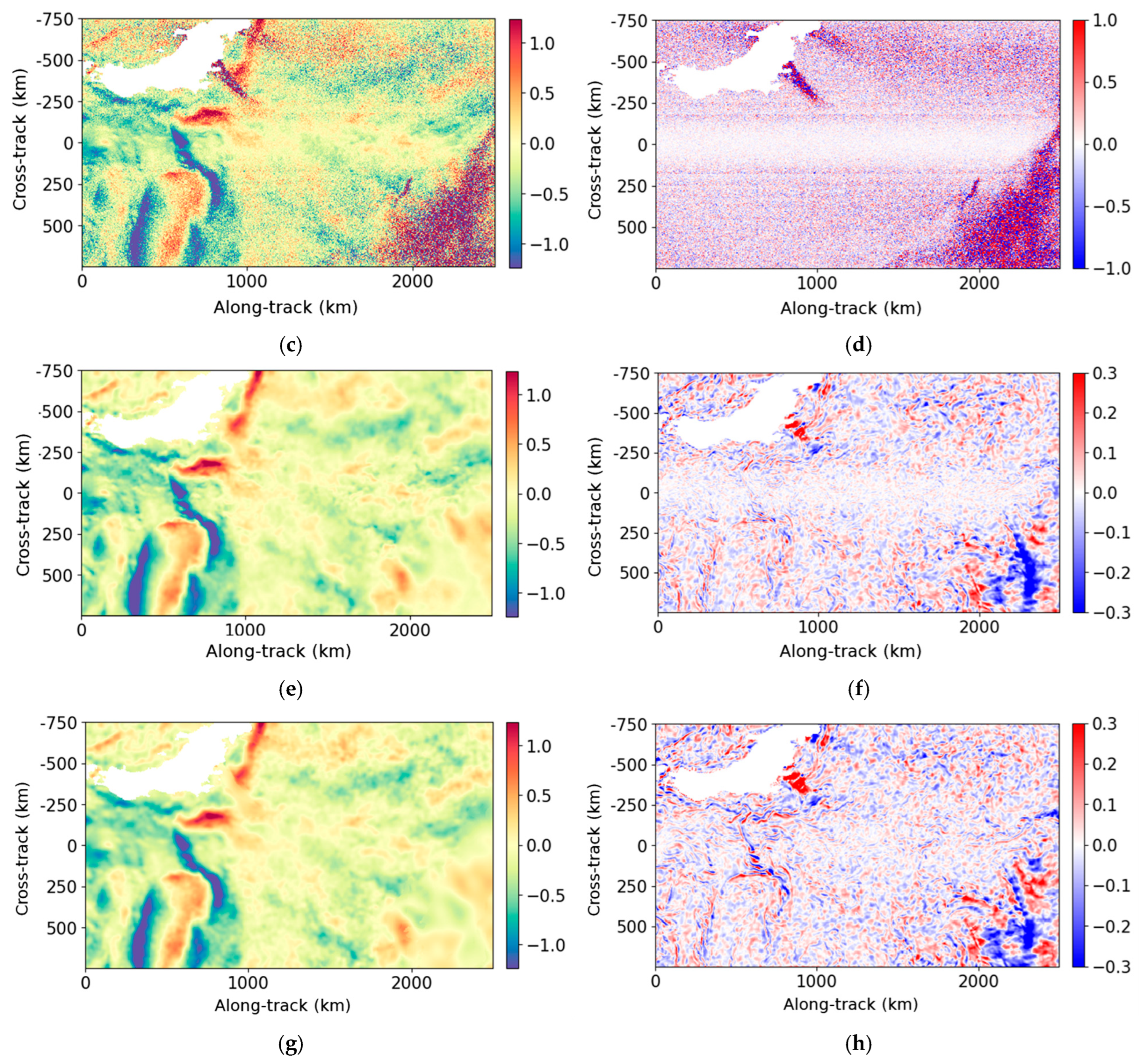
| Global | Winds ≤ 5 m/s | 5 < Winds ≤ 10 m/s | Winds > 10 m/s | ||
|---|---|---|---|---|---|
| Before denoising | RMSE | >200 | >350 | 47 | 27 |
| Adaptive Gaussian Smoother | RMSE | 11.0 | 17.0 | 7.3 | 5.8 |
| Noise reduction | 18 | 20 | 6 | 4 | |
| UNet | RMSE | 7.6 | 10.6 | 6.0 | 5.2 |
| Noise reduction | 26 | 33 | 7 | 5 |
| Global | Winds ≤ 5 m/s | 5 < Winds ≤ 10 m/s | Winds > 10 m/s | ||
|---|---|---|---|---|---|
| Before denoising | RMSE | 19.66 | 35.42 | 4.74 | 1.55 |
| UNet | RMSE | 0.20 | 0.28 | 0.16 | 0.11 |
| Noise reduction | 98 | 126 | 26 | 14 |
| Global | Winds ≤ 5 m/s | 5 < Winds ≤ 10 m/s | Winds > 10 m/s | |||
|---|---|---|---|---|---|---|
| Noise: low-SNR configuration | No filter | RMSE | >290 | >500 | 34 | 18 |
| UNet | RMSE | 7.5 | 11.2 | 5.4 | 4.5 | |
| Noise reduction | 38 | 44 | 6 | 4 | ||
| Ocean model: CROCO | No filter | RMSE | >150 | >350 | 44 | 26 |
| UNet | RMSE | 8.5 | 12.9 | 7.7 | 6.6 | |
| Noise reduction | 17 | 27 | 5 | 4 |
Disclaimer/Publisher’s Note: The statements, opinions and data contained in all publications are solely those of the individual author(s) and contributor(s) and not of MDPI and/or the editor(s). MDPI and/or the editor(s) disclaim responsibility for any injury to people or property resulting from any ideas, methods, instructions or products referred to in the content. |
© 2025 by the authors. Licensee MDPI, Basel, Switzerland. This article is an open access article distributed under the terms and conditions of the Creative Commons Attribution (CC BY) license (https://creativecommons.org/licenses/by/4.0/).
Share and Cite
Tréboutte, A.; Anadon, C.; Pujol, M.-I.; Binet, R.; Dibarboure, G.; Ubelmann, C.; Gaultier, L. Noise Reduction for the Future ODYSEA Mission: A UNet Approach to Enhance Ocean Current Measurements. Remote Sens. 2025, 17, 3612. https://doi.org/10.3390/rs17213612
Tréboutte A, Anadon C, Pujol M-I, Binet R, Dibarboure G, Ubelmann C, Gaultier L. Noise Reduction for the Future ODYSEA Mission: A UNet Approach to Enhance Ocean Current Measurements. Remote Sensing. 2025; 17(21):3612. https://doi.org/10.3390/rs17213612
Chicago/Turabian StyleTréboutte, Anaëlle, Cécile Anadon, Marie-Isabelle Pujol, Renaud Binet, Gérald Dibarboure, Clément Ubelmann, and Lucile Gaultier. 2025. "Noise Reduction for the Future ODYSEA Mission: A UNet Approach to Enhance Ocean Current Measurements" Remote Sensing 17, no. 21: 3612. https://doi.org/10.3390/rs17213612
APA StyleTréboutte, A., Anadon, C., Pujol, M.-I., Binet, R., Dibarboure, G., Ubelmann, C., & Gaultier, L. (2025). Noise Reduction for the Future ODYSEA Mission: A UNet Approach to Enhance Ocean Current Measurements. Remote Sensing, 17(21), 3612. https://doi.org/10.3390/rs17213612