



Catalysts, Volume 15, Issue 12 (December 2025) – 83 articles
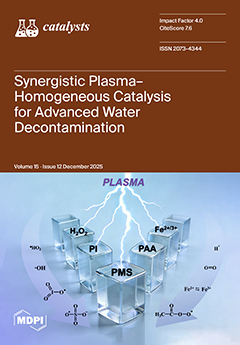
Cover Story (view full-size image):
This comprehensive review systematically examines plasma-activated homogeneous catalysis for water decontamination. Focusing on key catalysts (PMS, PAA, PI, H2O2, and Fe2+/Fe3+), we analyze their synergistic mechanisms with plasma, including electron-driven, photolytic, and radical-mediated activation pathways. The review highlights how these hybrid systems enhance pollutant degradation rates, improve mineralization efficiency, broaden pH adaptability, and optimize energy utilization. We critically assess current research trends, performance metrics, and influencing factors, while addressing challenges in practical implementation. This work provides a valuable reference for advancing sustainable water purification technologies and guiding future developments in plasma–catalytic synergy research. View this paper
- Issues are regarded as officially published after their release is announced to the table of contents alert mailing list.
- You may sign up for e-mail alerts to receive table of contents of newly released issues.
- PDF is the official format for papers published in both, html and pdf forms. To view the papers in pdf format, click on the "PDF Full-text" link, and use the free Adobe Reader to open them.
Previous Issue
Next Issue
