Article

Improving the Reproducibility of Oxygen Reduction Reaction Activity Assessment for Pt-Based Electrocatalysts on a Rotating Disk Electrode via Catalytic Layer Optimization


by
Andrey A. Kokhanov
1,
Elizaveta A. Moguchikh
1,
Angelina S. Pavlets
1,
Ilya V. Pankov
2,
Danil V. Alekseenko
3 and
Anastasia A. Alekseenko
1,*
1
Faculty of Chemistry, Southern Federal University, 7 Zorge St., Rostov-on-Don 344090, Russia
2
Research Institute of Physical Organic Chemistry, Southern Federal University, 194/2 Stachki St., Rostov-on-Don 344090, Russia
3
Prometheus R&D LLC, 4G Zhmaylova St., Rostov-on-Don 344090, Russia
*
Author to whom correspondence should be addressed.
Catalysts 2025, 15(12), 1140; https://doi.org/10.3390/catal15121140
Submission received: 19 October 2025 / Revised: 10 November 2025 / Accepted: 13 November 2025 / Published: 4 December 2025
(This article belongs to the Special Issue Catalytic Materials in Electrochemical and Fuel Cells)

Abstract

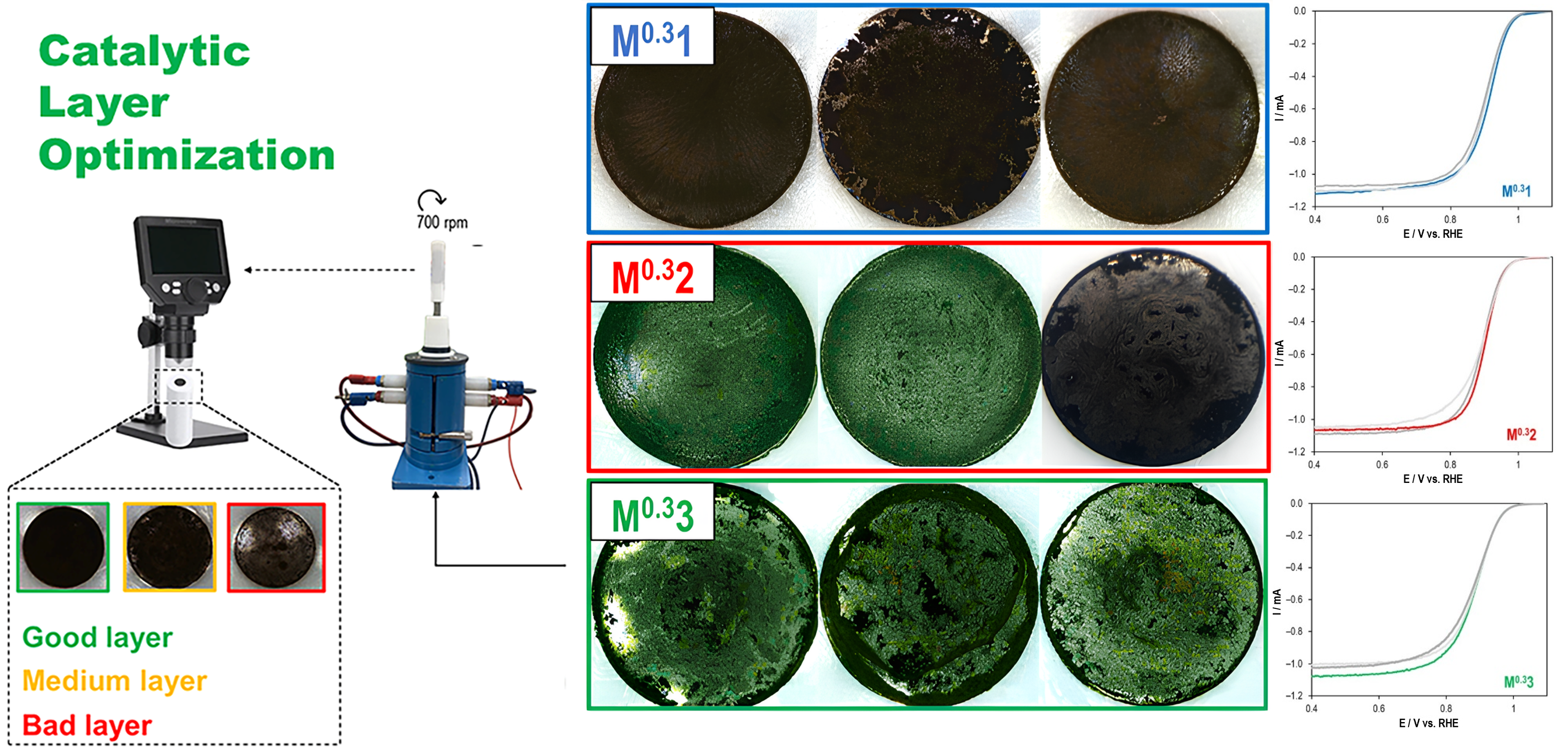
The reproducibility of oxygen reduction reaction (ORR) activity assessment for platinum-based electrocatalysts using the rotating disk electrode (RDE) method is critically dependent on the quality of the fabricated catalytic layer. This work presents a comprehensive study on optimizing catalytic ink formulation—specifically the water-to-isopropanol (H2O:IPA) solvent ratio and the ionomer-to-carbon (I/C) ratio—to achieve a homogeneous catalytic layer and ensure high data reproducibility for monometallic Pt/C and bimetallic PtCu/C catalysts. A key aspect of this research is the implementation of a simple and effective visual inspection method using a benchtop digital microscope to rapidly assess catalytic layer quality, which was shown to correlate directly with electrochemical performance. The optimal ink composition was found to be catalyst-specific. For Pt/C, the highest mass activity of 353 A/g~Pt~ was achieved with a solvent ratio of 1:3 (H2O:IPA) and an I/C ratio of 0.3. For PtCu/C, the best performance was obtained with the same solvent ratio (1:3) but a higher I/C ratio of 0.4, yielding a mass activity of 491 A/g~Pt~. It was demonstrated that ink compositions leading to layer inhomogeneities, such as aggregates and “coffee-ring” effects, significantly impair mass transport and lead to underestimated ORR activity. The study underscores the absence of a universal ink recipe and establishes that the optimization of ink parameters for each specific catalyst is essential for obtaining reliable and reproducible electrochemical data.

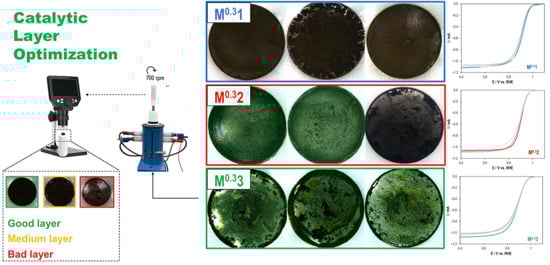
Graphical Abstract

1. Introduction

Proton exchange membrane fuel cells (PEMFCs) represent a promising technology for efficient energy conversion. Their performance critically depends on platinum-based electrocatalysts [1], which facilitate the core electrode reactions: hydrogen oxidation at the anode and the oxygen reduction reaction (ORR) at the cathode. The ORR suffers from slow kinetics, making the development of highly active and stable cathode catalysts a critically important challenge [2,3,4].
A prominent strategy to enhance the catalytic activity of Pt is the alloying of its nanoparticles (NPs) with d-metals (e.g., Co, Ni, Fe, Cu) [5,6,7,8,9]. This strategy not only reduces the cost of the catalysts but also improves their functional characteristics. The activity and stability of Pt/C and PtM/C systems are strongly influenced by NP’ morphology, their distribution on the carbon support, and the strength of their adhesion.
The rapid investigation of the catalyst electrochemical behavior is typically conducted under laboratory conditions in a three-electrode cell using a rotating disk electrode (RDE). However, obtaining reproducible and reliable ORR activity data on the RDE is notoriously difficult, as highlighted in key methodological studies [10,11]. Alongside the catalyst’s composition and structure (primary factors), the quality of the catalytic layer (a secondary factor) plays a significant role in the electrode’s properties [10,11,12]. The parameters for forming a high-quality catalytic layer (CL) include the solvent composition to obtain a stable catalytic suspension (ink) [13,14,15,16,17,18,19,20], the ionomer-to-carbon ratio (I/C) [16,17,20,21,22,23,24], as well as the methods and conditions of deposition (temperature, humidity, atmosphere, electrode rotation rate during the drying of the CL) [25,26,27].
In practice, significant data scatter in metrics like mass activity and half-wave potential often stems from these secondary factors. Issues such as the inhomogeneity of the CL (aggregates, “coffee rings” effect, uneven ionomer distribution) lead to distorted oxygen diffusion fluxes, uncontrolled changes in the triple-phase boundary, and, as a result, underestimation or overestimation of the measured catalyst activity in the ORR. Furthermore, the optimal composition of the catalytic ink (ratio of water/organic solvent, amount of ionomer) depends on the nature of the catalyst (composition of the metal phase, type of carbon support), which precludes the existence of universal recipes [15].
Therefore, methodical optimization of ink formulation and layer deposition is essential for reliable catalyst evaluation. This work presents a comprehensive study on the effect of ink composition for monometallic (Pt/C) and bimetallic (PtCu/C) catalysts provided by PROMETHEUS R&D LLC. Optimal parameters for the water/organic solvent and I/C ratios have been established, ensuring the formation of a homogeneous catalytic layer free of “coffee rings” and aggregates, and yielding high reproducibility in voltametric data. As a result, high mass activities of 276 A/gPt for Pt/C and 491 A/gPt for PtCu/C were achieved. The obtained results are of practical importance for standardizing catalyst testing methodologies on the RDE as a rapid method for assessing electrochemical characteristics, and for developing advanced materials for PEMFCs.

2. Results and Discussion

2.1. Microstructure of the Catalysts

The Pt/C and PtCu/C catalysts consist of spherical metal NPs (2–4.5 nm) supported on Vulcan XC-72 carbon black, which has a particle size of 20–50 nm (Figure 1). Analysis of the micrographs reveals that the bimetallic PtCu/C catalyst exhibits a less uniform nanoparticle distribution compared to the monometallic Pt/C, along with the presence of large, isolated particles (Figure 1).

2.2. Effect of Ink Solvent Composition on the Electrochemical Performance of Pt/C Catalyst

At the first stage, the influence of the water-to-isopropanol ratio (H2O:IPA) in the catalytic ink on the quality of the CL and the electrochemical performance of the electrode was investigated. For this purpose, a series of catalytic inks with H2O:IPA ratios of 1:3, 1:1, and 3:1 were prepared, while maintaining a constant ionomer-to-carbon ratio (I/C) of 0.3 (Table 1).
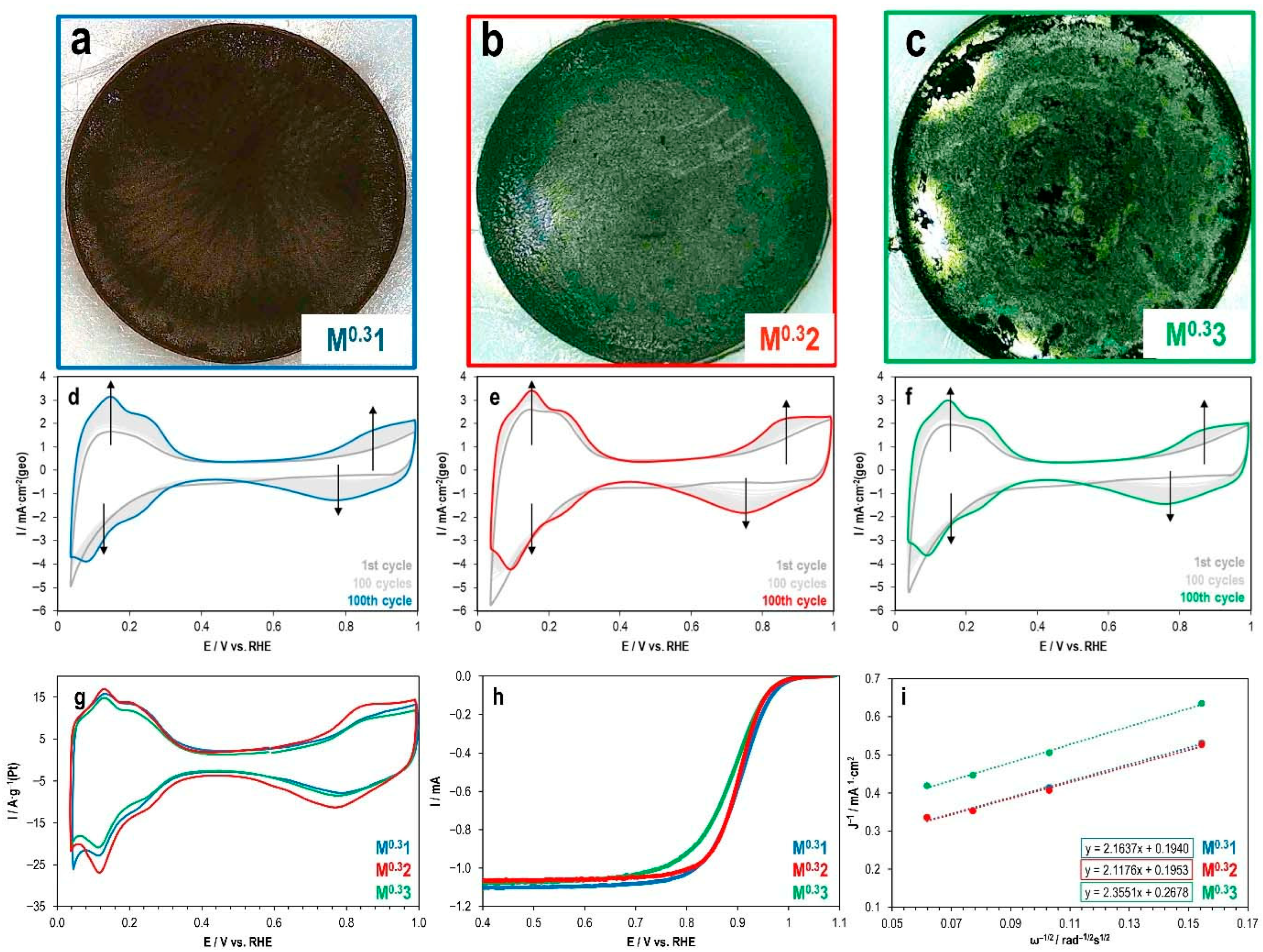
The CL on the RDE was visually inspected using a “G1000” digital microscope. Analysis of the photographs (Figure 2) for the Pt/C catalyst revealed that the most uniform CL was formed using methods M0.31 and M0.32, which employ H2O:IPA ratios of 1:3 and 1:1, respectively (Figure 2b). A significant decrease in CL uniformity was observed when the water content in the ink was increased (M0.33). Large, isolated aggregates were found at the perimeter of the glassy carbon end face, along with a pronounced “coffee-ring” effect [28] (Figure 2c). The coffee-ring effect is likely caused by centrifugal forces generated during layer formation at 700 rpm [28]. Another contributing factor is the Marangoni effect, driven by a surface tension gradient arising from the different evaporation rates of water and isopropanol at the center and edge of the ink droplet [29,30,31]. This surface tension gradient induces a prolonged capillary flow, transporting catalyst particles toward the droplet’s periphery.
Following the visual inspection of the CL (Figure 2a–c), the electrochemical characteristics of each electrode were investigated (Figure 2d–i). Prior to evaluating the main electrochemical parameters of the catalyst (ECSA and ORR activity), a crucial step is surface activation (Section 2.3). In the literature, this step is also referred to as standardization or conditioning. This process serves to clean the surface from potential contaminants and stabilize the metal nanoparticle surface, thereby ensuring reproducible measurement characteristics [25,32].
Figure 4d–f presents the CVs of the activation stage for Pt/C catalysts prepared from different catalytic inks. In all CVs, an initial increase followed by stabilization of the current is observed in both the hydrogen (0.04–0.35 V) and oxygen (0.6–1.0 V) regions (Figure 2d–f). This behavior is attributed to an increase in the nanoparticle surface area, likely caused by platinum dissolution/redeposition [33]. The catalyst surface prepared using method M0.32 stabilizes the most rapidly (Figure 2e).
Following activation, the CVs exhibit the characteristic profile of a platinum electrode with well-defined hydrogen and oxygen regions. The ECSA value is directly related to the current in the hydrogen region of the CV (Figure 2g). The hydrogen region currents increase in the order: M0.31 > M0.32 ≈ M0.33. The measurements were performed in triplicate for each method, and the average value was calculated from the obtained data. The average ECSA values for each ink composition ranged from 60 to 68 m2/g(Pt), which is within the margin of error for the method q.v.Electrochemical Measurements (Table 1).
The LSV curves obtained for all investigated electrodes exhibit the characteristic S-shaped profile (Figure 2h). The polarization curve for M0.33 shows a significantly steeper slope in the mixed kinetic-diffusion control region (0.80–0.95 V) compared to M0.31 and M0.32 (Figure 2h). These differences are attributed to the quality of the CL formation. Layer inhomogeneity impedes oxygen diffusion through the CL, which consequently affects the shape of the polarization curves and the catalytic activity for the ORR.
The half-wave potential (E1/2), a key indicator of catalyst activity [4,25,34,35] shifts to more positive values for ink compositions M0.31 and M0.32 compared to M0.33 (Table 1). The number of electrons transferred and the ORR kinetic parameters were determined using the Koutecký–Levich equation. The kinetic current, specific and mass activity were additionally calculated from a single polarization curve measured at a rotation rate of 1600 rpm (Table 1). The highest ORR activity was demonstrated by the M0.31 electrode, fabricated with a water-to-isopropanol ratio of 1:3.
Figure S2 presents the results of triplicate experiments for the three catalytic ink preparation methods. It is shown that method M0.31 ensures the formation of the most uniform CL during repeated applications (Figure S1a). In contrast, a pronounced coffee-ring effect and catalyst aggregation are observed in all replicates for method M0.33. All obtained linear sweep voltammetry (LSV) curves demonstrate the characteristic S-shape (Figure S1). However, for the layers formed using method M0.33, a decrease in current in the diffusion region was recorded, which is explained by the hindered transport of oxygen molecules to the active sites due to the non-uniform morphology of the CL (Figure S2d). A comparative analysis of the mass activity in the ORR, presented in the histograms (Figure S1e), confirms that the highest and reproducible values are achieved using method M0.31.
Analysis of the Tafel slopes for the Pt/C catalyst (Figure S4a) shows that two characteristic linear regions are observed for all layer preparation methods. In the high-potential region (>0.90 V), the slope is approximately 60 mV/dec. This behavior is fully consistent with the classical kinetics of the ORR on Pt NPs in an acidic medium [36]. Method M0.31 demonstrates a slightly higher activity, which is reflected by a shift in the curve towards more positive potentials in the kinetic region (Figure S1b).
This study demonstrated that the ink composition significantly affects the uniformity of the fabricated CL. The presence of various defects in the catalytic layer such as catalyst aggregates, microcracks, and characteristic “coffee-ring” effects observed by microscopy leads to poor reproducibility of ORR activity. The optimal CL morphology and maximum ORR activity were achieved with a solvent ratio of 1:3 (method M0.31).
The optimal ionomer content in the CL on RDE depends on the type of carbon support. For instance, the authors of [37] demonstrate the need to vary the ionomer/carbon ratio depending on the nature of the support. Investigating the influence of the support on the layer structure and activity in the ORR is a separate task. Targeted optimization of the ink composition for different supports is considered a promising direction of research.

2.3. Effect of Ink Solvent Composition on the Electrochemical Performance of PtCu/C Catalyst

The introduction of a doping element into the platinum nanoparticle structure can alter the catalyst’s physicochemical properties, consequently necessitating adjustments to the ink composition. In the third stage (Table 2), we investigated the effect of the solvent ratio (water-to-isopropanol) on the quality of the CL and the electrochemical characteristics of the PtCu/C catalyst.
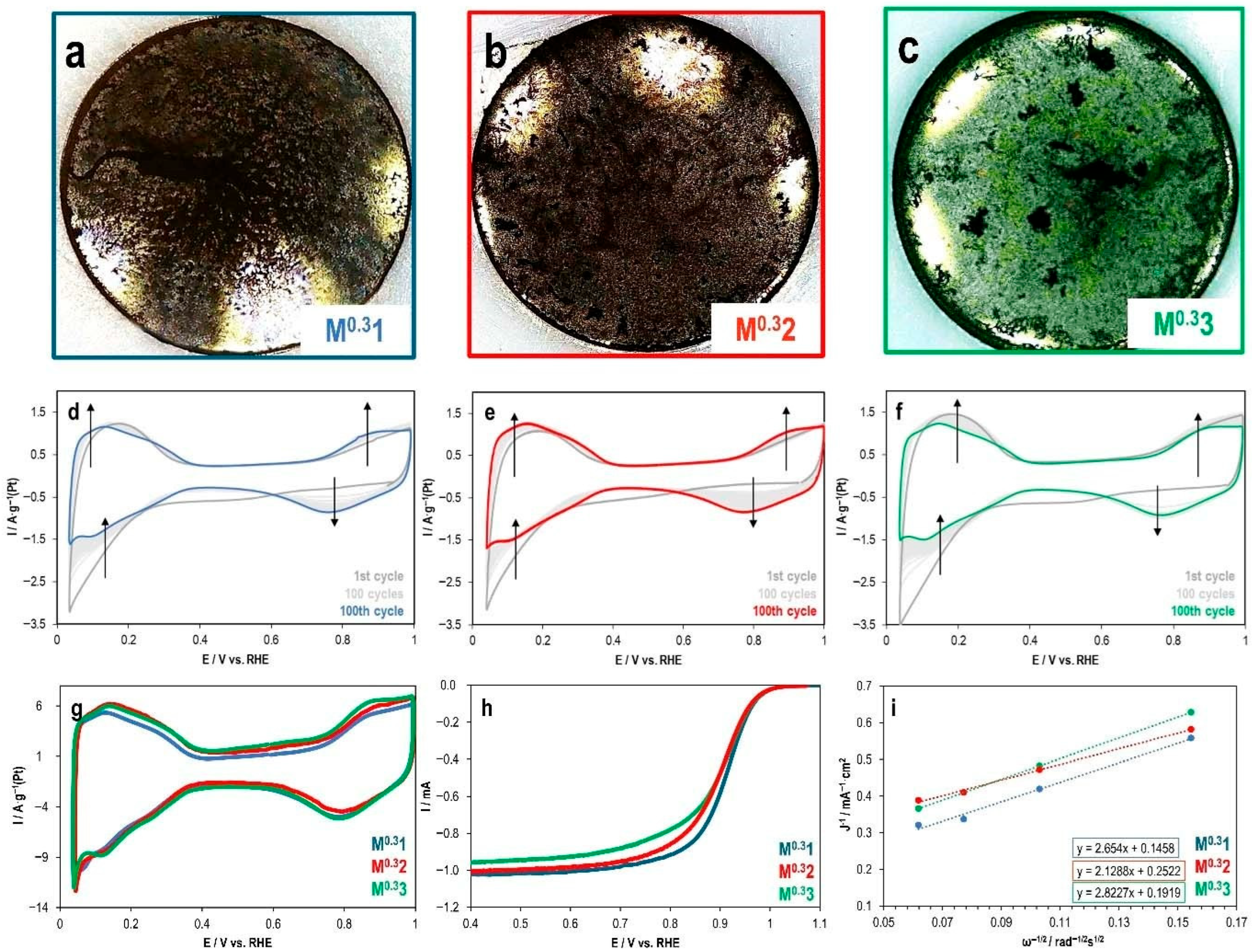
Visual inspection of the CLs prepared with different solvent ratios at a constant Nafion content for the PtCu/C catalyst revealed that increasing the water content in the ink reduces layer uniformity. Photographs demonstrate that as the water content increases from method M0.31 to M0.33, the size of aggregates at the RDE periphery increases (Figure 3a–c). Consequently, the most uniform CL was achieved using method M0.31 with a water-to-isopropanol ratio of 1:3.
Figure 3d–f presents the CVs of the surface activation stage for the PtCu/C catalyst with different H2O:IPA ratios. During activation, the CVs develop the characteristic profile of a platinum electrode, indicating surface enrichment of the bimetallic nanoparticles with platinum and the formation of a secondary core–shell structure [33,38,39]. A decrease in current is observed in the hydrogen and double-layer (0.35–0.60 V) regions, while an increase occurs in the oxygen region. Similar to the Pt/C material, the ink composition and CL quality for PtCu/C did not significantly affect the ECSA values (Figure 3g).
Improved CL uniformity on the RDE correlates with enhanced ORR activity. Visual inspection of the RDE surface confirmed that the CL prepared using method M0.31 exhibits the highest uniformity, with the corresponding catalyst demonstrating the highest mass activity of 340 A/g(Pt) and the smallest data scatter (Table 3, Figure S2a,b). As the water content in the ink increases, the half-wave potential of the LSV shifts, reaching 0.91 V for composition M0.31 (Figure 3h).
Since the electron transfer numbers for M0.32 and M0.33 were below 3.8, the kinetic current, specific and mass activity were additionally calculated from a single polarization curve measured at a rotation rate of 1600 rpm (Table 2). Further analysis revealed that method M0.31 enables the highest ORR activity for the PtCu/C catalyst.

2.4. Influence of Ionomer-to-Carbon Ratio in Catalytic Inks on the Electrochemical Properties of PtCu/C Catalyst

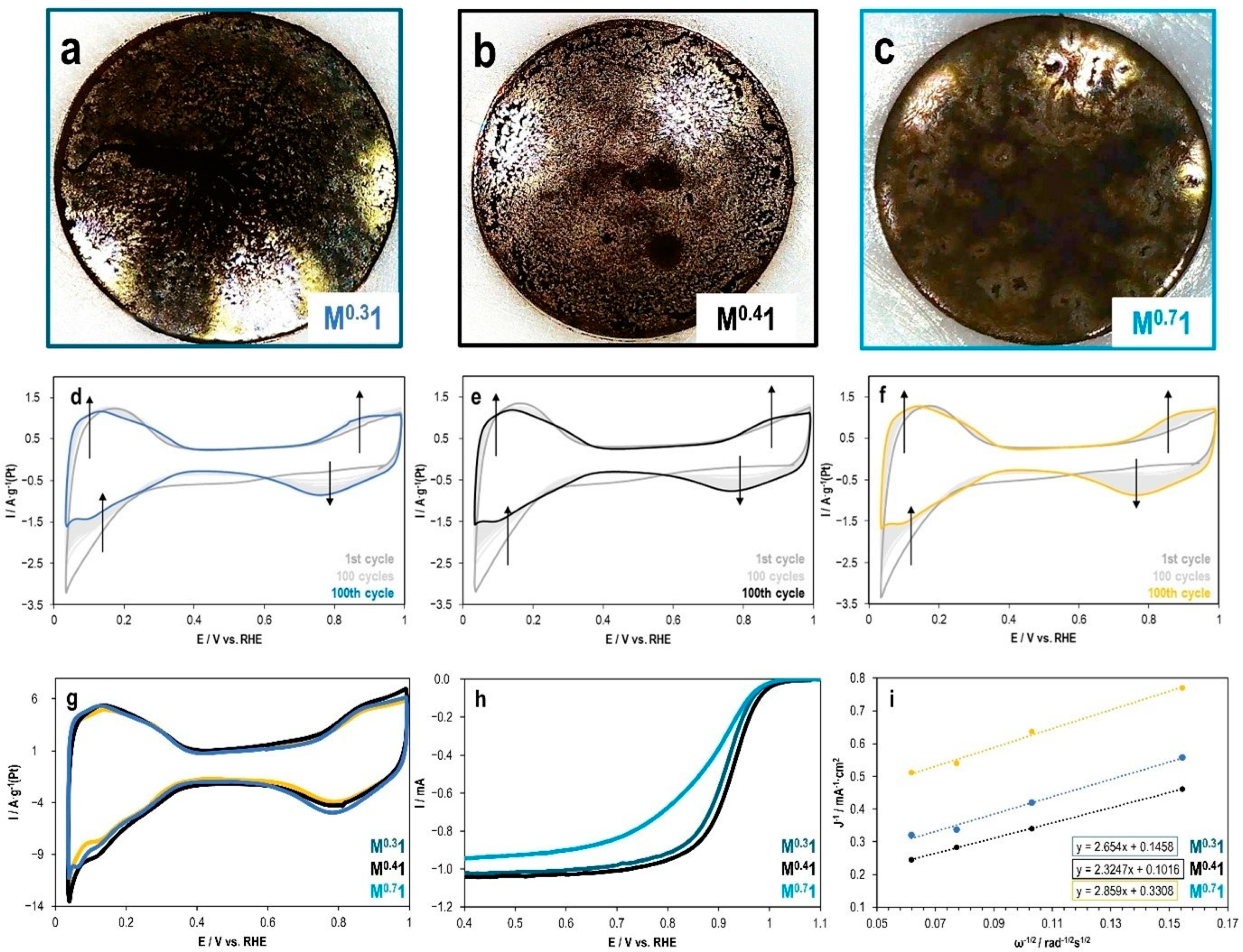
The previous section demonstrated that the most uniform CL forms using method M1. Nevertheless, some inhomogeneity and isolated catalyst aggregates remain present in the layer. Therefore, this solvent composition was selected for further investigation of the ionomer content effect in Stage 3 (Table 3). Analysis of the RDE surface with the deposited CL revealed that the most uniform layer forms at an I/C ratio of 0.4 (M0.41) (Figure 4a–c).
Increasing the ionomer content in the catalytic ink intensifies the coffee-ring effect. With a further increase in the I/C ratio to 0.7, the formation of a Nafion film is observed, appearing as blue inclusions on the RDE surface (white arrows in Figure S3a). This film negatively impacts oxygen diffusion, consequently reducing the material’s ORR activity. We believe this effect is associated with a specific interaction between IPA and Nafion.
Figure 4d–f shows that the evolution of the CV profiles during the activation of the PtCu/C catalyst is similar for different I/C ratios. Current stabilization in all regions is achieved within a comparable number of cycles for all ink formulations (M0.31—80 cycles, M0.41—81 cycles, M0.71—81 cycles). Analysis of the CVs further demonstrated that the ECSA value is independent of the catalytic layer quality (Figure 4g, Table 2).
The study of ORR activity identified an optimal CL composition that enables the highest performance for the PtCu/C material. When the I/C ratio is decreased from 0.7 to 0.4, the voltammogram develops a more pronounced S-shape, and an increase in current is observed in the diffusion-limited region, indicating improved reactant mass transport (Figure S3c). Further decreasing the I/C ratio from 0.4 to 0.3 does not alter the diffusion-limited current; however, a 10 mV negative shift in the half-wave potential is observed. The CL fabricated using method M0.41 yielded the highest half-wave potential (0.92 V) and ORR mass activity (491 A/g(Pt)) for the PtCu/C catalyst (Table 2).
Analysis of the Tafel slope for the PtCu/C catalyst shows that the results obtained with all CL methods (Figure S4b) are characterized by a slope of about 60 mV in the potential region above 0.85 V. It is worth noting that the dependencies in the E-ln(Ik) coordinates show that method M0.31 yields the highest catalyst activity in the potential region below 0.90 V. An increase in the amount of Nafion in the catalytic suspension leads to an increase in catalyst activity in the potential region above 0.90 V (Figure S4c). The highest activity was shown by the PtCu/C catalyst layer prepared using method M0.41.The study demonstrated that the ionomer content in the catalytic ink affects the ORR activity of PtCu/C but does not influence its ECSA. Increasing the I/C ratio from 0.3 to 0.4 enhanced the mass activity by a factor of 1.4 while maintaining high measurement reproducibility. Notably, the optimal ink composition differed between Pt/C and PtCu/C catalysts. This indicates that the composition of platinum-based nanoparticles is a critical factor influencing the formation of the catalytic layer on the RDE.

3. Materials and Methods

The investigation focused on Pt/C and PtCu/C electrocatalysts supplied by PROMETHEUS R&D LLC (Rostov-on-Don, Russia), which were synthesized via patented methods [40]. Both catalysts utilized Vulcan XC-72 (Cabot Corporation, Boston, MA, USA) carbon black as a support. The platinum mass loading was 40 wt.% for Pt/C and 41 wt.% for PtCu/C.

3.1. Preparation of Catalytic Inks

The catalytic ink is an aqueous-organic suspension. Deionized water and isopropanol (IPA) in various ratios were used as solvents (Table 3).
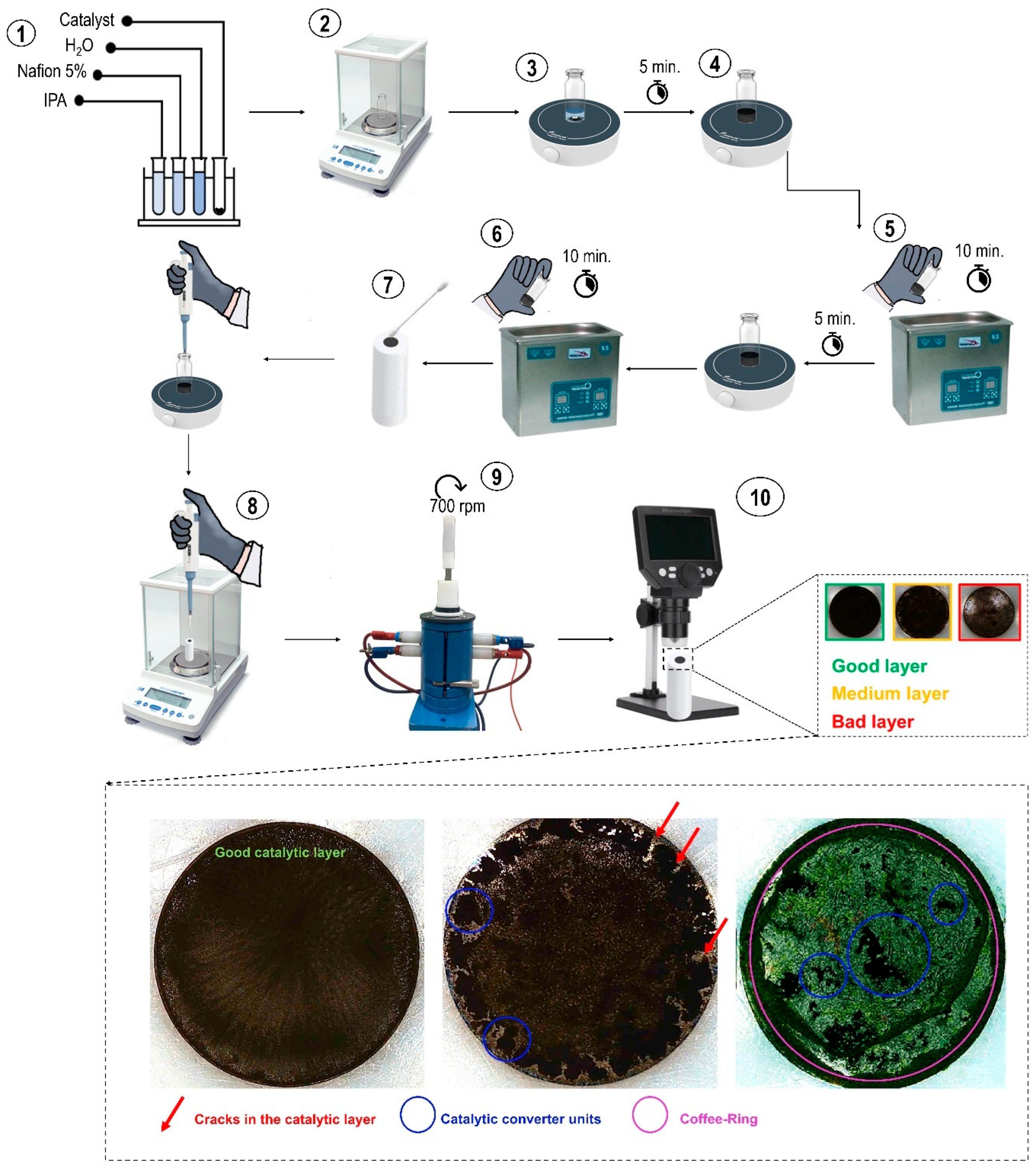
The catalyst ink was prepared by adding a specified amount of IPA, deionized water, and a 5% aqueous-alcoholic Nafion® D520 (The Chemours Company, Wilmington, NC, USA) emulsion to 4.0 mg of the catalyst sample (Table 3, Figure 5, Steps 1–3). The resulting suspension was then mixed on a magnetic stirrer for 5 min (Figure 5, Step 4). This was followed by a dispersion sequence consisting of ultrasonication in a water bath for 10 min and magnetic stirring for 5 min (Figure 5, Step 5). This two-step sequence was repeated once, resulting in a total preparation time of 30 min for a homogeneous ink (Figure 5, Step 6). The temperature of the water in the ultrasonic bath was maintained below 20 °C. Only freshly prepared inks were used for the investigation.
Catalytic inks were prepared according to different methodologies (Table 3). The mass-based ionomer-to-carbon ratio (I/C) was kept constant at 0.3 for all formulations.

3.2. Fabrication of the Catalytic Layer on the Rotating Disk Electrode (RDE)

Prior to the catalytic ink deposition, the glassy carbon end face of the RDE was polished using an alumina slurry (“Allied” aluminum oxide suspension) in accordance with the Pine Instruments manufacturer’s recommendations [41,42]. To remove any residual polishing particles, the electrode was subsequently ultrasonicated in deionized water and rinsed with IPA (a degreasing step).
The prepared catalytic inks were used to deposit a thin catalytic layer onto the glassy carbon electrode. Immediately before applying the ink aliquot, the RDE surface was wiped with deionized water (Figure 5, Step 7).
A 2 µL aliquot of the catalytic ink was pipetted while the ink was continuously stirred. A droplet of this specified volume was deposited onto the polished and cleaned glassy carbon electrode (5 mm diameter, 0.196 cm2 geometric area). After the ink application, the electrode was dried by rotating it at 700 rpm in ambient air for 10–15 min until the droplet was completely dry (Figure 5, Steps 8 and 9), as recommended in [26]. Ambient humidity was maintained above 30% using a humidification system (Kitfort KT-2808 (Saint Petersburg, Russia)), and the temperature was kept between 21 and 24 °C. A schematic of the setup for catalytic layer fabrication is presented in Figure S5 (see Supplementary Materials).
After the first ink droplet had dried, a second droplet of the required volume was applied. The volume was calculated to achieve a total platinum loading on the RDE between 19.0 and 21.0 µg(Pt)/cm2.
The quality of the deposited catalytic layer was visually inspected using a benchtop digital microscope with LED illumination (“G1000”, China) (Figure 5, Step 10).

3.3. Electrochemical Measurements

3.3.1. Determination of Electrochemical Active Surface Area (ECSA)

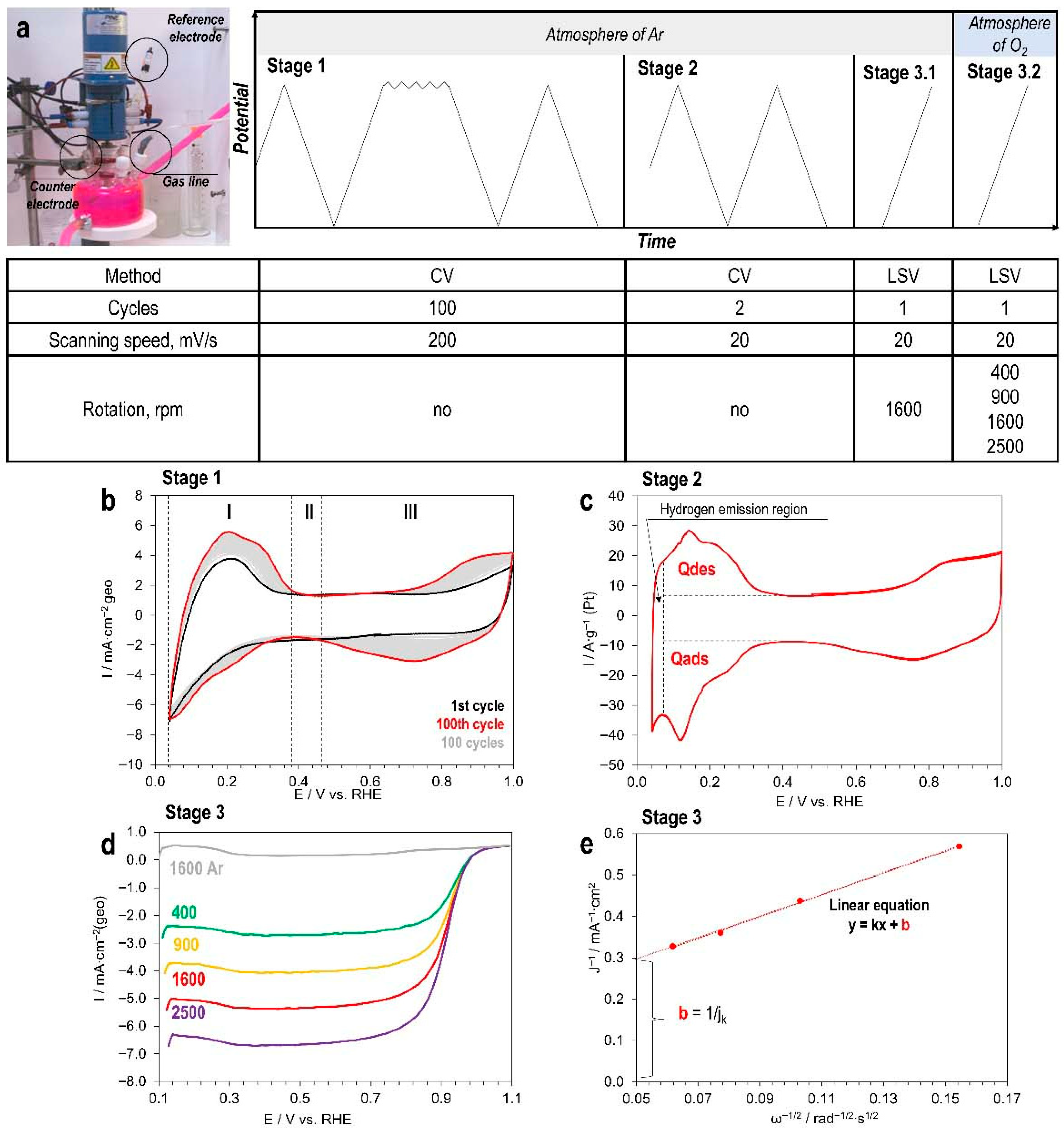
Prior to the electrochemical measurements, the electrolyte (0.1 M HClO4) was saturated with argon for 40 min. The catalyst surface was then activated by potential cycling between 0.04 and 1.00 V for 100 cycles at a scan rate of 200 mV/s. All potentials in this work are reported versus the reversible hydrogen electrode (RHE) (Figure 6b).
Following the surface activation, two cycles of voltammograms (CVs) were recorded in the potential range of 0.04 to 1.00 V at a scan rate of 20 mV/s under an argon atmosphere. The ECSA was determined from the second CV cycle by calculating the electric charge associated with hydrogen desorption (Qdes) and adsorption (Qads), as shown in Figure 6c [43].
The ECSA was calculated using Equation (1):
ECSA   =   0.5 ( Q a d s + Q d e s ) 210 m P t
where:
  • ECSA is the electrochemical active surface area of platinum, m2/g;
  • Qads is the electric charge associated with hydrogen adsorption (after double-layer correction), μC;
  • Qdes—is the electric charge associated with hydrogen desorption (after double-layer correction), μC;
  • 210 μC/cm2 is the charge required for the adsorption of a hydrogen monolayer on a smooth polycrystalline Pt surface.
CV measurements for ECSA determination were repeated at least three times.
The error of the method is no more than 10%.

3.3.2. Determination of Activity in the ORR

Following the ECSA measurement, a background voltammogram was recorded using linear sweep voltammetry (LSV) in the potential range of 0.1 to 1.1 V. The measurement was performed under an argon atmosphere at an RDE rotation rate of 1600 rpm and a scan rate of 20 mV/s. LSV measurements should be performed by scanning from low to high potentials, as recommended by the authors of [44], since the Pt surface remains in a reduced state for a longer period, enabling more accurate measurement of ORR activity before the onset of irreversible oxide formation.
Subsequently, the electrolyte was replaced with a freshly prepared solution and saturated with oxygen for 40 min while rotating the RDE at 700 rpm. Following saturation, ORR polarization curves were recorded under identical LSV conditions at various rotation rates: 400, 900, 1600, and 2500 rpm (Figure 6d).
The ORR activity measurements were repeated at least three times to ensure reproducibility.
To account for the ohmic drop (iR compensation), the measured potential was corrected using Equation (2) [34,35]:
𝐸(RHE) = 𝐸set + 𝐸ref + 𝐸pH − iR
where:
  • Eset is the potential set value, V;
  • Eref is the reference electrode potential, V;
  • EpH is the adjustment for pH of the solution; and
  • iR is the ohmic potential drop equal to the product of the current strength by the resistance of the cell. This resistance was no greater than 25 Ω.
The contribution of processes occurring in the deaerated electrolyte (Ar atmosphere) was accounted for by subtracting a background curve from the voltammograms recorded at each rotation rate. This background curve was measured on the same electrode in an Ar atmosphere at a rotation rate of 1600 rpm.
To plot the ORR polarization curves, the current was recalculated using Equation (3):
I = I(O2) − I(Ar)
where:
  • I(O2) is the current for the ORR at a given potential, obtained from the measurement in an oxygen-saturated electrolyte.
  • I(Ar) is the background (capacitive) current at a given potential, obtained from the measurement in an argon-saturated electrolyte.
The activity of an electrode towards the ORR is characterized by its kinetic current. The kinetic current represents the current flow in the absence of mass-transfer limitations. The measured current at the disk electrode (i) is the total current, encompassing all processes occurring at the electrode. The kinetic current, which excludes the diffusional contribution, can be determined using the Koutecký–Levich Equations (4)–(6) [4,28,45]:
1 i = 1 i k + 1 i d
i d = 0.62 n F C D 2 / 3 ω 1 / 2 v 1 / 6
1 i = 1 i k + 1 0.62 n F C D 2 3 ω 1 2 v 1 6 = 1 i k + 1 B ω 1 / 2
where:
  • i is the measured current at the disk electrode,
  • ik is the kinetic current,
  • id is the diffusion-limited current,
  • ω is the electrode rotation rate (rad/s),
  • n is the number of electrons transferred in the electrochemical reaction,
  • F is the Faraday constant (C/mol),
  • D is the diffusion coefficient of oxygen (cm2/s),
  • υ is the kinematic viscosity of the electrolyte (cm2/s),
  • C is the bulk concentration of oxygen in the solution (mol/cm3).
To account for mass-transport limitations, the investigation must be conducted on a RDE at various rotation rates. To determine the kinetic current density (1/jk), measurements are performed at several RDE rotation rates (400, 900, 1600, and 2500 rpm). The data are then plotted in Koutecký–Levich coordinates (1/J vs. ω−1/2), where J is the current density normalized to the geometric area of the RDE.
The analysis proceeds as follows: on the voltammograms measured at each rotation rate, the current (I) is determined at a fixed potential of E = 0.9 V. This current is then divided by the geometric area of the RDE to obtain the current density (J). A plot is constructed with the four data points (current density for each rotation rate). By extrapolating the resulting linear fit to the y-axis (where ω = ∞, ω−1/2 = 0, indicating the absence of diffusion limitations), the intercept (b) is obtained. This intercept corresponds to the inverse kinetic current density (1/Jk) under conditions free from mass-transport limitations (Figure 6e).
The kinetic parameters were calculated using Equations (7) and (8):
jk = 1/b
ik = jk × A
where:
  • jk is the kinetic current density (A/cm2),
  • b is the y-intercept of the linear fit in the Koutecký–Levich plot (A−1 cm2),
  • ik is the kinetic current (A),
  • A is the geometric area of the RDE (0.19625 cm2 for a 5 mm diameter disk).
To avoid potential inaccuracies from limited oxygen diffusion due to catalytic layer inhomogeneity, which can cause the Koutecký–Levich equation to yield underestimated values, the electrochemical activity was further evaluated by normalizing the current at a selected potential to the diffusion current at a rotation rate of 1600 rpm [44,46].
The kinetic current is then calculated using Equation (9):
i k   =   i 0.9 i d i f | i d i f i 0.9 |
where:
  • i0.9 is the current measured at a potential of 0.9 V vs. RHE;
  • idif is the diffusion-limited current.
Furthermore, it is necessary to determine the half-wave potential (E1/2). The ORR activity is typically quantified at a potential of 0.90 V vs. RHE.
It should be noted that since approximately 2005, this calculation protocol has been widely adopted by international research groups for determining the kinetic current [47,48,49].
Since around 2015, following key publications [25,43,50], standard practice has evolved to include:
  • Current correction for ohmic drop (iR compensation) and background subtraction using measurements in an argon or nitrogen (Ar/N2) atmosphere.
  • The preparation of thin, uniform catalytic layers with low platinum group metal loading to minimize mass-transport limitations within the layer itself.

4. Conclusions

Visual inspection of the catalytic layers and analysis of the voltammograms for Pt/C and PtCu/C catalysts demonstrated that the composition of the catalytic ink significantly influences the formation of the catalytic layer and the ORR activity. The following conclusions were drawn from this study:
  • A method for the visual assessment of catalytic layer quality was proposed, enabling the rapid and cost-effective determination of optimal catalytic ink preparation parameters without the need for expensive equipment (e.g., SEM or AFM). This approach is based on analyzing the macroscopic homogeneity of the layer and the absence of defects (aggregates, coffee rings), which correlates with electrochemical activity. Visualization using a digital benchtop microscope proved highly effective for the preliminary screening of catalytic layer quality prior to electrochemical measurements, thereby reducing sample preparation time and minimizing non-representative experiments.
  • The highest quality catalytic layer for the Pt/C catalyst was formed using an ink preparation method with a solvent ratio of H2O:IPA = 1:3 and an I/C ratio of 0.3. This method ensures the most uniform distribution of the catalytic material on the RDE surface, leading to the highest mass activity of 353 A/g(Pt).
  • The best results for the PtCu/C catalyst were achieved using ink preparation method M0.41 with a solvent ratio of H2O:IPA = 1:3 and an I/C ratio of 0.4. This ink composition facilitates the formation of a uniform catalytic layer. The mass activity of PtCu/C under these conditions is 491 A/g(Pt), which is 25–30% higher than the values obtained with other investigated ink formulations.
The conducted research demonstrates the absence of a universal approach to catalytic ink preparation applicable to all types of catalysts. The optimal composition must be individually tailored for each specific catalytic material (Pt/C, PtCu/C, etc.) based on experimental data.
If low electrochemical performance is observed for a catalyst, we recommend not discarding it. Carefully examine its microstructure. If this parameter is inconsistent with the electrochemical characteristics, it is advisable to optimize the catalytic ink composition and the catalytic layer formation conditions. Adjusting the solvent composition, ionomer concentration, or deposition regime can significantly improve layer uniformity and material activity.
Future studies will benefit from the implementation of quantitative image analysis techniques, as recommended in the literature, to provide an objective metric for catalytic layer homogeneity and further minimize subjective assessment.

Supplementary Materials

The following supporting information can be downloaded at https://www.mdpi.com/article/10.3390/catal15121140/s1: Figure S1: (a) Representative optical micrographs of the catalytic layer on RDE for the Pt/C catalyst with different H2O:IPA ratios, demonstrating reproducibility. (b–d) Reproducibility of ORR LSVs at a disk rotation rate of 1600 rpm. (e) Mass activity values for the Pt/C catalyst with different H2O:IPA ratios and their corresponding average values; Figure S2: (a) Representative optical micrographs of the catalytic layer on RDE for the PtCu/C catalyst with different H2O:IPA ratios, demonstrating reproducibility. (b-d) Reproducibility of ORR LSVs at a disk rotation rate of 1600 rpm. (e) Mass activity values for the PtCu/C catalyst with different H2O:IPA ratios and their corresponding average values. Figure S3: (a) Representative optical micrographs of the catalytic layer on RDE for the PtCu/C catalyst with different I/C ratios, demonstrating reproducibility. (b–d) Reproducibility of ORR LSVs at a disk rotation rate of 1600 rpm. (e) Mass activity values for the PtCu/C catalyst with different I/C ratios and their corresponding average values. Figure S4: Tafel plots: (a) for Pt/C catalyst with different H2O:IPA ratios; (b) for PtCu/C catalyst with different H2O:IPA ratios (c) for PtCu/C catalyst with different I/C ratios. Figure S5: Setup for the deposition of a catalytic layer on the RDE tip, with control over rotation speed, temperature, and humidity. Figure S6: View of the formed catalyst layer on the rotating disk electrode surface after wiping with: (a) IPA; (b) deionized water. Table S1: Comparative electrochemical performance data of the commercial HISPEC4000 catalyst from literature and the Pt/C material in this study. Refs. [51,52,53,54,55,56,57,58,59,60,61,62,63,64,65,66,67,68,69] are cited in Supplementary Materials.

Author Contributions

A.A.K.: Research, writing-Preparation. E.A.M.: Conceptualization, writing-Preparation of the original project, methodology. A.S.P.: Writing is the preparation of an original project, validation. D.V.A.: Research. I.V.P.: Software. A.A.A.: Writing—Reviewing and editing, author supervision. All authors have read and agreed to the published version of the manuscript.

Funding

This research was financially supported by the Ministry of Science and Higher Education of the Russian Federation (State Assignment in the Field of Scientific Activity No. FENW-2023-0016).

Data Availability Statement

All data generated or analyzed during this study are included in this published article (and its Supplementary Information Files).

Acknowledgments

The authors are grateful to the Shared Use Center “High-Resolution Transmission Electron Microscopy” (SFedU, Rostov-on-Don) for conducting the TEM studies.

Conflicts of Interest

Author D.V. Alekseenko was employed by the company Prometheus R&D LLC. The remaining authors declare that the research was conducted in the absence of any commercial or financial relationships that could be construed as a potential conflict of interest.

References

  1. Zhang, X.; Li, H.; Yang, J.; Lei, Y.; Wang, C.; Wang, J.; Tang, Y.; Mao, Z. Recent advances in Pt-based electrocatalysts for PEMFCs. RSC Adv. 2021, 11, 13316–13328. [Google Scholar] [CrossRef]
  2. Zhang, J.; Yuan, Y.; Gao, L.; Zeng, G.; Li, M.; Huang, H. Stabilizing Pt-Based Electrocatalysts for Oxygen Reduction Reaction: Fundamental Understanding and Design Strategies. Adv. Mater. 2021, 33, 2006494. [Google Scholar] [CrossRef] [PubMed]
  3. Su, L.; Jia, W.; Li, C.; Lei, Y. Mechanisms for Enhanced Performance of Platinum-Based Electrocatalysts in Proton Exchange Membrane Fuel Cells. ChemSusChem 2014, 7, 361–378. [Google Scholar] [CrossRef] [PubMed]
  4. Bhuvanendran, N.; Ravichandran, S.; Xu, Q.; Maiyalagan, T.; Su, H. A quick guide to the assessment of key electrochemical performance indicators for the oxygen reduction reaction: A comprehensive review. Int. J. Hydrogen Energy 2022, 47, 7113–7138. [Google Scholar] [CrossRef]
  5. Wang, Y.-J.; Zhao, N.; Fang, B.; Li, H.; Bi, X.T.; Wang, H. Carbon-Supported Pt-Based Alloy Electrocatalysts for the Oxygen Reduction Reaction in Polymer Electrolyte Membrane Fuel Cells: Particle Size, Shape, and Composition Manipulation and Their Impact to Activity. Chem. Rev. 2015, 115, 3433–3467. [Google Scholar] [CrossRef]
  6. Stamenkovic, V.; Mun, B.S.; Mayrhofer, K.J.J.; Ross, P.N.; Markovic, N.M.; Rossmeisl, J.; Greeley, J.; Nørskov, J.K. Changing the Activity of Electrocatalysts for Oxygen Reduction by Tuning the Surface Electronic Structure. Angew. Chem. Int. Ed. 2006, 45, 2897–2901. [Google Scholar] [CrossRef]
  7. Crawley, J.W.M.; Gow, I.E.; Lawes, N.; Kowalec, I.; Kabalan, L.; Catlow, C.R.A.; Logsdail, A.J.; Taylor, S.H.; Dummer, N.F.; Hutchings, G.J. Heterogeneous Trimetallic Nanoparticles as Catalysts. Chem. Rev. 2022, 122, 6795–6849. [Google Scholar] [CrossRef]
  8. Cui, J.; Zhang, D.; Liu, Z.; Li, C.; Zhang, T.; Yin, S.; Song, Y.; Li, H.; Li, H.; Li, C. Carbon-anchoring synthesis of Pt1Ni1@Pt/C core-shell catalysts for stable oxygen reduction reaction. Nat. Commun. 2024, 15, 9458. [Google Scholar] [CrossRef] [PubMed]
  9. Ren, Y.; Li, B.; Lv, C.; Zang, Z.; Li, L.; Lu, Z.; Yang, X.; Zhang, X.; Yu, X. Stabilizing platinum-based electrocatalysts for oxygen reduction reaction in acid media: A mini review. Int. J. Hydrogen Energy 2024, 51, 1–15. [Google Scholar] [CrossRef]
  10. Garsany, Y.; Baturina, O.A.; Swider-Lyons, K.E.; Kocha, S.S. Experimental Methods for Quantifying the Activity of Platinum Electrocatalysts for the Oxygen Reduction Reaction. Anal. Chem. 2010, 82, 6321–6328. [Google Scholar] [CrossRef]
  11. Garsany, Y.; Singer, I.L.; Swider-Lyons, K.E. Impact of film drying procedures on RDE characterization of Pt/VC electrocatalysts. J. Electroanal. Chem. 2011, 662, 396–406. [Google Scholar] [CrossRef]
  12. Wu, X.; Zhang, L.; Kong, D.; He, P.; Zhang, T.; Sun, C. A Smart Workflow for Performing the Electrochemical Evaluation of Fuel Cell Catalysts in a Precise Way with Ultra-High Reproducibility. ACS Electrochem. 2025, 1, 2190–2197. [Google Scholar] [CrossRef]
  13. Ren, H.; Meng, X.; Lin, Y.; Shao, Z. Microstructure formation mechanism of catalyst layer and its effect on fuel cell performance: Effect of dispersion medium composition. J. Energy Chem. 2022, 73, 588–598. [Google Scholar] [CrossRef]
  14. Zheng, Z.; Zhu, F.; Tang, M.; Chen, S. Effects of Ink Water/Isopropanol Ratio on Structural and Oxygen Transport Properties of Pt/Ionomer Interface: Insights from Molecular Dynamics Simulations. Renewables 2024, 2, 233–241. [Google Scholar] [CrossRef]
  15. Takahashi, I.; Kocha, S.S. Examination of the activity and durability of PEMFC catalysts in liquid electrolytes. J. Power Sources 2010, 195, 6312–6322. [Google Scholar] [CrossRef]
  16. Guo, Y.; Yang, D.; Li, B.; Yang, D.; Ming, P.; Zhang, C. Effect of Dispersion Solvents and Ionomers on the Rheology of Catalyst Inks and Catalyst Layer Structure for Proton Exchange Membrane Fuel Cells. ACS Appl. Mater. Interfaces 2021, 13, 27119–27128. [Google Scholar] [CrossRef]
  17. Wu, D.; Kayo, N.; Jayawickrama, S.M.; Phua, Y.K.; Tanaka, N.; Fujigaya, T. Effect of alcohol content on the ionomer adsorption of polymer electrolyte membrane fuel cell catalysts. Int. J. Hydrogen Energy 2023, 48, 5915–5928. [Google Scholar] [CrossRef]
  18. Uchida, M.; Aoyama, Y.; Eda, N.; Ohta, A. New Preparation Method for Polymer-Electrolyte Fuel Cells. J. Electrochem. Soc. 1995, 142, 463–468. [Google Scholar] [CrossRef]
  19. Tarokh, A.; Karan, K.; Ponnurangam, S. Atomistic MD Study of Nafion Dispersions: Role of Solvent and Counterion in the Aggregate Structure, Ionic Clustering, and Acid Dissociation. Macromolecules 2020, 53, 288–301. [Google Scholar] [CrossRef]
  20. Mauger, S.A.; Khandavalli, S.; Iyer, R.; Park, J.; Osmieri, L.; Cetinbas, F.; Myers, D.J.; Ulsh, M.; Neyerlin, K.C. The Effect of Dispersion-Medium Composition and Ionomer Concentration on the Microstructure and Rheology of Fe-N-C Platinum Group Metal-Free Catalyst Inks for Polymer Electrolyte Membrane Fuel Cells. Meet. Abstr. 2020, MA2020-02, 2217. [Google Scholar] [CrossRef]
  21. Pan, L.; Lu, J.; Dunseath, O.; Ronovský, M.; Guo, A.; Klingenhof, M.; Wang, X.; Hornberger, E.; Bonastre, A.M.; Burdett, H.; et al. Unveiling the origins of the activity gap between rotating disk electrodes and membrane electrode assemblies: Pt seed-mediated iridium-doped octahedral platinum nickel catalysts for proton exchange membrane fuel cells. EES Catal. 2025, 3, 128–139. [Google Scholar] [CrossRef]
  22. Suzuki, T.; Tsushima, S.; Hirai, S. Effects of Nafion® ionomer and carbon particles on structure formation in a proton-exchange membrane fuel cell catalyst layer fabricated by the decal-transfer method. Int. J. Hydrogen Energy 2011, 36, 12361–12369. [Google Scholar] [CrossRef]
  23. Jung, J.; Jung, D.-W.; Kim, J. Optimum Ratio between Nafion and 20, 40 wt% Pt/C Catalysts for MEAs. J. Korean Electrochem. Soc. 2011, 14, 50–55. [Google Scholar] [CrossRef]
  24. Liu, H.; Ney, L.; Zamel, N.; Li, X. Effect of Catalyst Ink and Formation Process on the Multiscale Structure of Catalyst Layers in PEM Fuel Cells. Appl. Sci. 2022, 12, 3776. [Google Scholar] [CrossRef]
  25. Shinozaki, K.; Zack, J.W.; Pylypenko, S.; Pivovar, B.S.; Kocha, S.S. Oxygen Reduction Reaction Measurements on Platinum Electrocatalysts Utilizing Rotating Disk Electrode Technique: II. Influence of Ink Formulation, Catalyst Layer Uniformity and Thickness. J. Electrochem. Soc. 2015, 162, F1384–F1396. [Google Scholar] [CrossRef]
  26. Garsany, Y.; Ge, J.; St-Pierre, J.; Rocheleau, R.; Swider-Lyons, K.E. Analytical Procedure for Accurate Comparison of Rotating Disk Electrode Results for the Oxygen Reduction Activity of Pt/C. J. Electrochem. Soc. 2014, 161, F628–F640. [Google Scholar] [CrossRef]
  27. Inaba, M.; Quinson, J.; Bucher, J.R.; Arenz, M. On the Preparation and Testing of Fuel Cell Catalysts Using the Thin Film Rotating Disk Electrode Method. JoVE 2018, 133, 57105. [Google Scholar] [CrossRef]
  28. Ke, K.; Hiroshima, K.; Kamitaka, Y.; Hatanaka, T.; Morimoto, Y. An accurate evaluation for the activity of nano-sized electrocatalysts by a thin-film rotating disk electrode: Oxygen reduction on Pt/C. Electrochim. Acta 2012, 72, 120–128. [Google Scholar] [CrossRef]
  29. Hu, H.; Larson, R.G. Marangoni Effect Reverses Coffee-Ring Depositions. J. Phys. Chem. B 2006, 110, 7090–7094. [Google Scholar] [CrossRef]
  30. Rey, M.; Walter, J.; Harrer, J.; Perez, C.M.; Chiera, S.; Nair, S.; Ickler, M.; Fuchs, A.; Michaud, M.; Uttinger, M.J.; et al. Versatile strategy for homogeneous drying patterns of dispersed particles. Nat. Commun. 2022, 13, 2840. [Google Scholar] [CrossRef]
  31. Howard, N.S.; Archer, A.J.; Sibley, D.N.; Southee, D.J.; Wijayantha, K.G.U. Surfactant Control of Coffee Ring Formation in Carbon Nanotube Suspensions. Langmuir 2023, 39, 929–941. [Google Scholar] [CrossRef]
  32. Shinozaki, K.; Zack, J.W.; Richards, R.M.; Pivovar, B.S.; Kocha, S.S. Oxygen Reduction Reaction Measurements on Platinum Electrocatalysts Utilizing Rotating Disk Electrode Technique: I. Impact of Impurities, Measurement Protocols and Applied Corrections. J. Electrochem. Soc. 2015, 162, F1144–F1158. [Google Scholar] [CrossRef]
  33. Ali-Löytty, H.; Hannula, M.; Valden, M.; Eilert, A.; Ogasawara, H.; Nilsson, A. Chemical Dissolution of Pt(111) during Potential Cycling under Negative pH Conditions Studied by Operando X-ray Photoelectron Spectroscopy. J. Phys. Chem. C 2019, 123, 25128–25134. [Google Scholar] [CrossRef]
  34. Du, C.; Sun, Y.; Shen, T.; Yin, G.; Zhang, J. 7-Applications of RDE and RRDE Methods in Oxygen Reduction Reaction. In Rotating Electrode Methods and Oxygen Reduction Electrocatalysts; Xing, W., Yin, G., Zhang, J., Eds.; Elsevier: Amsterdam, The Netherlands, 2014; pp. 231–277. [Google Scholar] [CrossRef]
  35. Jia, Z.; Yin, G.; Zhang, J. Rotating Ring-Disk Electrode Method. Rotating Electrode Methods and Oxygen Reduction Electrocatalysts; Elsevier: Amsterdam, The Netherlands, 2014; pp. 199–229. [Google Scholar] [CrossRef]
  36. Sun, J.; Wang, L.; Yang, C.; Song, L. An Ancient BCR-like Signaling Promotes ICP Production and Hemocyte Phagocytosis in Oyster. iScience 2020, 23, 100834. [Google Scholar] [CrossRef] [PubMed]
  37. Alekseenko, A.; Belenov, S.; Mauer, D.; Moguchikh, E.; Falina, I.; Bayan, J.; Pankov, I.; Alekseenko, D.; Guterman, V. Activity of Platinum-Based Cathode Electrocatalysts in Oxygen Redaction for Proton-Exchange Membrane Fuel Cells: Influence of the Ionomer Content. Inorganics 2024, 12, 23. [Google Scholar] [CrossRef]
  38. Alekseenko, A.A.; Guterman, V.E.; Belenov, S.V.; Menshikov, V.S.; Tabachkova NYu Safronenko, O.I.; Moguchikh, E.A. Pt/C electrocatalysts based on the nanoparticles with the gradient structure. Int. J. Hydrogen Energy 2018, 43, 3676–3687. [Google Scholar] [CrossRef]
  39. Pavlets, A.; Alekseenko, A.; Menshchikov, V.; Belenov, S.; Volochaev, V.; Pankov, I.; Safronenko, O.; Guterman, V. Influence of Electrochemical Pretreatment Conditions of PtCu/C Alloy Electrocatalyst on Its Activity. Nanomaterials 2021, 11, 1499. [Google Scholar] [CrossRef]
  40. Catalysts | PROMETHEUS R&D LLC Research and Production Enterprise. PROMETHEUS R&D LLC n.d. Available online: https://www.prometheusrd.com (accessed on 16 October 2025).
  41. E3 Series Rotating Disk Electrode, 1018 Carbon Steel, PEEK Shroud | Pine Research Instrumentation n.d. Available online: https://pineresearch.com/products/e3-rde-1018-peek/ (accessed on 16 October 2025).
  42. How to Polish Your Electrode. 2020. Available online: https://www.youtube.com/watch?v=B1vndNRUnV4 (accessed on 14 September 2025).
  43. Mayrhofer, K.J.J.; Strmcnik, D.; Blizanac, B.B.; Stamenkovic, V.; Arenz, M.; Markovic, N.M. Measurement of oxygen reduction activities via the rotating disc electrode method: From Pt model surfaces to carbon-supported high surface area catalysts. Electrochim. Acta 2008, 53, 3181–3188. [Google Scholar] [CrossRef]
  44. Gasteiger, H.A.; Kocha, S.S.; Sompalli, B.; Wagner, F.T. Activity benchmarks and requirements for Pt, Pt-alloy, and non-Pt oxygen reduction catalysts for PEMFCs. Appl. Catal. B Environ. 2005, 56, 9–35. [Google Scholar] [CrossRef]
  45. Bard, A.J.; Faulkner, L.R. Electrochemical Methods: Fundamentals and Applications, 2nd ed.; Wiley: New York, NY, USA, 2001; p. 335. [Google Scholar]
  46. van der Vliet, D.; Strmcnik, D.S.; Wang, C.; Stamenkovic, V.R.; Markovic, N.M.; Koper, M.T.M. On the importance of correcting for the uncompensated Ohmic resistance in model experiments of the Oxygen Reduction Reaction. J. Electroanal. Chem. 2010, 647, 29–34. [Google Scholar] [CrossRef]
  47. Higuchi, E.; Uchida, H.; Watanabe, M. Effect of loading level in platinum-dispersed carbon black electrocatalysts on oxygen reduction activity evaluated by rotating disk electrode. J. Electroanal. Chem. 2005, 583, 69–76. [Google Scholar] [CrossRef]
  48. Zhang, L.; Li, H.; Zhang, J. Kinetics of oxygen reduction reaction on three different Pt surfaces of Pt/C catalyst analyzed by rotating ring-disk electrode in acidic solution. J. Power Sources 2014, 255, 242–250. [Google Scholar] [CrossRef]
  49. Treimer, S.; Tang, A.; Johnson, D.C. A Consideration of the Application of Koutecký-Levich Plots in the Diagnoses of Charge-Transfer Mechanisms at Rotated Disk Electrodes. Electroanalysis 2002, 14, 165. [Google Scholar] [CrossRef]
  50. Shinozaki, K.; Zack, J.W.; Pylypenko, S.; Richards, R.M.; Pivovar, B.S.; Kocha, S.S. Benchmarking the oxygen reduction reaction activity of Pt-based catalysts using standardized rotating disk electrode methods. Int. J. Hydrogen Energy 2015, 40, 16820–16830. [Google Scholar] [CrossRef]
  51. Lv, Y.; Liu, H.; Li, J.; Chen, J.; Song, Y. A convenient protocol for the evaluation of commercial Pt/C electrocatalysts toward oxygen reduction reaction. J. Electroanal. Chem. 2020, 870, 114172. [Google Scholar] [CrossRef]
  52. Moguchikh, E.; Paperzh, K.; Pankov, I.; Belenov, S.; Alekseenko, A. Durability of Commercial Catalysts within Relevant Stress Testing Protocols. Catalysts 2023, 13, 923. [Google Scholar] [CrossRef]
  53. Danilenko, M.; Guterman, V.; Paperzh, K.; Alekseenko, A.; Nikulin, A. Kinetics of Nanoparticles Nucleation/Growth and Control of the Pt/C Catalysts Microstructure and Activity. IOP Conf. Ser. Earth Environ. Sci. 2022, 987, 012022. [Google Scholar] [CrossRef]
  54. Saleh, F.S.; Easton, E.B. Assessment of the ethanol oxidation activity and durability of Pt catalysts with or without a carbon support using Electrochemical Impedance Spectroscopy. J. Power Sources 2014, 246, 392–401. [Google Scholar] [CrossRef]
  55. Angel, G.M.A.; Mansor, N.; Jervis, R.; Rana, Z.; Gibbs, C.; Seel, A.; Kilpatrick, A.F.R.; Shearing, P.R.; Howard, C.A.; Brett, D.J.L.; et al. Realising the electrochemical stability of graphene: Scalable synthesis of an ultra-durable platinum catalyst for the oxygen reduction reaction. Nanoscale 2020, 12, 16113–16122. [Google Scholar] [CrossRef]
  56. Wang, X.X.; Tan, Z.H.; Zeng, M.; Wang, J.N. Carbon nanocages: A new support material for Pt catalyst with remarkably high durability. Sci. Rep. 2014, 4, 4437. [Google Scholar] [CrossRef]
  57. Zhao, Q.; Wang, C.; Wang, H.; Wang, J.; Tang, Y.; Mao, Z.; Sasaki, K. H2-induced thermal treatment significantly influences the development of a high performance low-platinum core-shell PtNi/C alloyed oxygen reduction catalyst. Int. J. Energy Res. 2020, 44, 4773–4783. [Google Scholar] [CrossRef]
  58. Belenov, S.; Nevelskaya, A.; Nikulin, A.; Tolstunov, M. The Effect of Pretreatment on a PtCu1/C Catalyst’s Structure and Functional Characteristics. Int. J. Mol. Sci. 2023, 24, 2177. [Google Scholar] [CrossRef]
  59. Fu, T.; Huang, J.; Lai, S.; Zhang, S.; Fang, J.; Zhao, J. Pt skin coated hollow Ag-Pt bimetallic nanoparticles with high catalytic activity for oxygen reduction reaction. J. Power Sources 2017, 365, 17–25. [Google Scholar] [CrossRef]
  60. Yang, D.; Yan, Z.; Li, B.; Higgins, D.C.; Wang, J.; Lv, H.; Chen, Z.; Zhang, C. Highly active and durable Pt–Co nanowire networks catalyst for the oxygen reduction reaction in PEMFCs. Int. J. Hydrogen Energy 2016, 41, 18592–18601. [Google Scholar] [CrossRef]
  61. Wang, Y.; Yin, K.; Zhang, J.; Si, C.; Chen, X.; Lv, L.; Ma, W.; Gao, H.; Zhang, Z. A nanoporous PtCuTi alloy with a low Pt content and greatly enhanced electrocatalytic performance towards methanol oxidation and oxygen reduction. J. Mater. Chem. A 2016, 4, 14657–14668. [Google Scholar] [CrossRef]
  62. Fu, T.; Zhang, S.; Huang, J.; Cai, D.; Li, J.; Zhao, J. Direct One-pot Synthesis of Carbon Supported Ag-Pt Alloy Nanoparticles as High Performance Electrocatalyst for Fuel Cell Application. Fuel Cells 2019, 19, 169–176. [Google Scholar] [CrossRef]
  63. Zhao, Z.L.; Wang, Q.; Du, H.; Liang, T.; An, H.M.; Li, C.M. Sub-15 nm Pd@PtCu concave octahedron with enriched atomic steps as enhanced oxygen reduction electrocatalyst. J. Power Sources 2019, 434, 226742. [Google Scholar] [CrossRef]
  64. Li, S.; Li, H.; Zhang, Y.; Garcia, R.M.; Li, J.; Xie, Y.; Yin, J.; Li, M.; Wang, J.; Shelnutt, J.A.; et al. One-step synthesis of carbon-supported foam-like platinum with enhanced activity and durability. J. Mater. Chem. A 2015, 3, 21562–21568. [Google Scholar] [CrossRef]
  65. Mensharapov, R.M.; Ivanova, N.A.; Spasov, D.D.; Kukueva, E.V.; Zasypkina, A.A.; Seregina, E.A.; Grigoriev, S.A.; Fateev, V.N. Carbon-Supported Pt-SnO2 Catalysts for Oxygen Reduction Reaction over a Wide Temperature Range: Rotating Disk Electrode Study. Catalysts 2021, 11, 1469. [Google Scholar] [CrossRef]
  66. Shi, W.; Park, A.-H.; Kwon, Y.-U. Scalable synthesis of (Pd,Cu)@Pt core-shell catalyst with high ORR activity and durability. J. Electroanal. Chem. 2022, 918, 116451. [Google Scholar] [CrossRef]
  67. Park, H.-U.; Park, A.-H.; Shi, W.; Park, G.-G.; Kwon, Y.-U. Ternary core-shell PdM@Pt (M = Mn and Fe) nanoparticle electrocatalysts with enhanced ORR catalytic properties. Ultrason. Sonochemistry 2019, 58, 104673. [Google Scholar] [CrossRef] [PubMed]
  68. Paperzh, K.; Bayan, Y.; Gerasimov, E.; Pankov, I.; Konstantinov, A.; Menshchikov, V.; Mauer, D.; Beskopylny, Y.; Alekseenko, A. High-performance electrocatalyst for PEMFC cathode: Combination of ultra-small platinum nanoparticles and N-doped carbon support. Carbon. Trends 2024, 16, 100383. [Google Scholar] [CrossRef]
  69. Hu, K.; Zhang, Y.; Zhu, J.; Mai, J.; Liu, G.; Sugumar, M.K.; Liu, X.; Zhan, F.; Tan, R. Nano-engineered catalysts for high-performance oxygen reduction reaction. Chin. Chem. Lett. 2024, 35, 109423. [Google Scholar] [CrossRef]
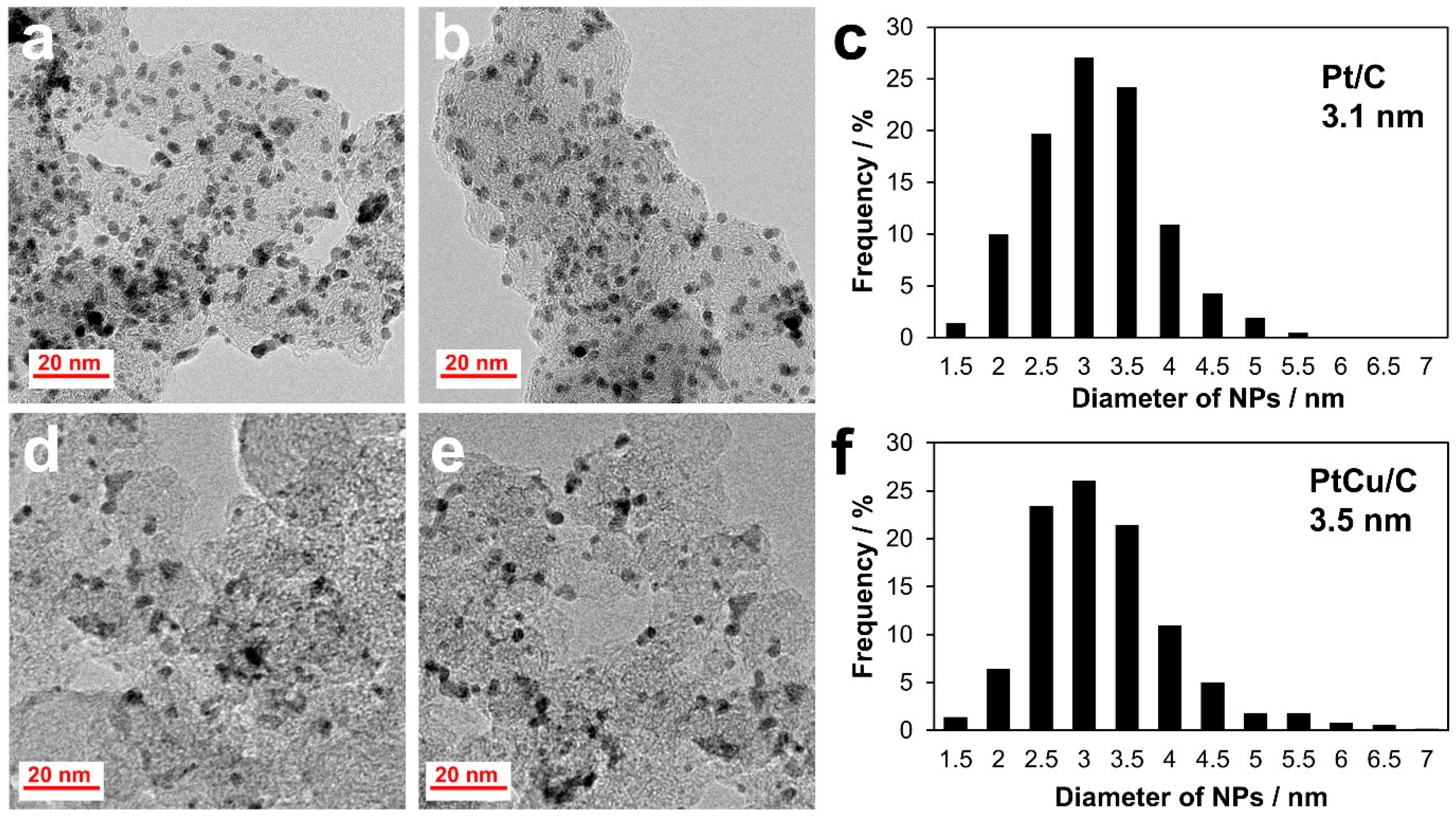
Figure 1. TEM images Pt/C (a,b) and PtCu/C (d,e) materials. Histograms of the NPs distribution in Pt/C and PtCu/C materials, respectively (c,f).
Catalysts 15 01140 g001
Figure 2. (ac) Optical micrographs of the catalytic layer on the RDE for Pt/C catalyst prepared with different H2O:IPA ratios: (a) M0.31, (b) M0.32, (c) M0.33. (df) CVs of Pt/C catalyst during the activation procedure (100 cycles) with different H2O:IPA ratios: (d) M0.31, (e) M0.32, (f) M0.33. Measurement conditions: scan rate 200 mV/s, Ar-saturated 0.1 M HClO4. (g) CVs after activation of Pt/C catalysts with different H2O:IPA ratios. Conditions: 0.1 M HClO4, Ar atmosphere, scan rate 20 mV/s. (h) LSVs of Pt/C catalyst with different H2O:IPA ratios. Conditions: rotation rate 1600 rpm, 0.1 M HClO4, O2-saturated, scan rate 20 mV/s. (i) Koutecký–Levich plots for Pt/C catalyst with different H2O:IPA ratios.
Catalysts 15 01140 g002
Figure 3. (ac) Optical micrographs of the catalytic layer on the RDE for PtCu/C catalyst prepared with different H2O:IPA ratios: (a) M0.31, (b) M0.32, (c) M0.33. (df) CVs of PtCu/C catalyst during the activation procedure (100 cycles) with different H2O:IPA ratios: (d) M0.31, (e) M0.32, (f) M0.33. Measurement conditions: scan rate 200 mV/s, Ar-saturated 0.1 M HClO4. (g) CVs after activation of PtCu/C catalysts with different H2O:IPA ratios. Conditions: 0.1 M HClO4, Ar atmosphere, scan rate 20 mV/s. (h) LSVs of PtCu/C catalyst with different H2O:IPA ratios. Conditions: rotation rate 1600 rpm, 0.1 M HClO4, O2-saturated, scan rate 20 mV/s. (i) Koutecký–Levich plots for PtCu/C catalyst with different H2O:IPA ratios.
Catalysts 15 01140 g003
Figure 4. (ac) Optical micrographs of the catalytic layer on the RDE for PtCu/C catalyst prepared with different H2O:IPA ratios: (a) M0.31, (b) M0.41, (c) M0.71. (df) CVs of PtCu/C catalyst during the activation procedure (100 cycles) with different I/C ratios: (d) M0.31, (e) M0.41, (f) M0.71. Measurement conditions: scan rate 200 mV/s, Ar-saturated 0.1 M HClO4. (g) CVs after activation of PtCu/C catalysts with different I/C ratios. Conditions: 0.1 M HClO4, Ar atmosphere, scan rate 20 mV/s. (h) LSVs of PtCu/C catalyst with different I/C ratios. Conditions: rotation rate 1600 rpm, 0.1 M HClO4, O2-saturated, scan rate 20 mV/s. (i) Koutecký–Levich plots for PtCu/C catalyst with different I/C ratios.
Catalysts 15 01140 g004
Figure 5. Schematic of the catalytic layer preparation process: (1) preparation of solvents and catalyst, (2) weighing the catalyst sample, (3) addition of solvents and ionomer, (4) suspension stirring, (5, 6) ultrasonication and stirring, (7) RDE surface wetting with water, (8) ink aliquot deposition under continuous stirring and mass control, (9) catalytic layer drying under rotation, (10) quality assessment of the catalytic layer using a digital microscope (Good layer—the film is flat and free of agglomeration, cracks, and coffee rings. Medium layer—the interior of the film is smooth, but there are annular deposits near the edges. Bad layer—the film is defected).
Catalysts 15 01140 g005
Figure 6. (a) Schematic of the three-electrode cell and the electrochemical experimental setup. (b) Representative CV of the catalyst activation stage, showing the characteristic hydrogen (I), double-layer (II), and oxygen (III) regions. (c) Example of the ECSA calculation for a Pt/C catalyst based on hydrogen adsorption/desorption charge. (d) Representative LSV recorded at different RDE rotation rates. (e) Koutecký–Levich plot for determining kinetic parameters from four RDE rotation rates.
Catalysts 15 01140 g006
Table 1. Electrochemical performance of the Pt/C electrocatalyst prepared using different ink formulations.
MethodologyReplicateECSA, m2/g(Pt)E1/2, BNumber of ēKoutecký–Levich EquationPolarization Curve at 1600 rpm
Ik, mAImass, A/g(Pt)Isp, A/m2 (Pt)Ik, mAImass, A/g(Pt)Isp, A/m2 (Pt)
Absolute ValueAverage ValueAbsolute ValueAverage ValueAbsolute ValueAverage Value
Stage 1
M0.3116670 ± 40.904.21.02774.21.1314353 ± 504.85.0 ± 0.8
2700.914.21.53745.31.64035.8
3740.913.51.43514.71.43434.6
M0.3216667 ± 10.893.61.02413.70.9229256 ± 533.53.8 ± 0.8
2670.894.31.02674.01.23094.6
5670.884.70.71892.80.92303.4
M0.3316868 ± 40.883.70.71852.70.7188192 ± 42.82.8 ± 0.3
3640.893.80.71842.90.81963.1
5710.884.10.71792.50.81932.7
Table 2. Electrochemical performance of the PtCu/C electrocatalyst prepared using different ink formulations.
MethodologyReplicateECSA, m2/g(Pt)E1/2, BNumber of ēKoutecký–Levich EquationPolarization Curve at 1600 rpm
Ik, mAImass, A/g(Pt)Isp, A/m2 (Pt)Ik, mAImass, A/g(Pt)Isp, A/m2 (Pt)
Absolute ValueAverage ValueAbsolute ValueAverage ValueAbsolute ValueAverage Value
Stage 2
M0.3113129 ± 20.923.91.93409.12.1337324 ± 4610.911.0 ± 1.3
2290.914.41.23049.11.435712.3
3280.94.51.23069.11.12789.9
M0.3213029 ± 20.94.30.81895.10.9222193 ± 297.46.7 ± 0.9
2270.884.00.61715.10.71856.9
3300.883.40.81835.10.71735.8
M0.3312829 ± 30.93.71.02538.11.0245226 ± 228.87.7 ± 1.1
2320.93.70.92135.10.92287.1
3280.893.30.92066.10.92047.3
Stage 3
M0.3113129 ± 20.923.91.93409.12.1337324 ± 4610.911.0 ± 1.3
2290.914.41.23049.11.435712.3
3280.94.51.23069.11.12789.9
M0.4112829 ± 20.923.91.949116.12.0523462 ± 6118.716.0 ± 2.7
2280.924.21.331810.11.843815.6
3310.924.11.537711.11.742413.7
M0.7113029 ± 10.873.20.61554.10.6153131 ± 225.14.5 ± 0.6
2280.842.60.61373.10.51124.0
3290.872.50.61564.10.51294.4
Table 3. Composition of catalytic inks.
Methodology DesignationH2O:IPAI/CVH2O, μLVIPA, μLVNafion 5%, μL
Pt/C
Stage 1
M0.311:30.3492.5 1492.515
M0.321:1992.5992.515
M0.333:11492.5492.515
PtCu/C
Stage 2
M0.311:30.3492.5 1492.515
M0.321:1992.5992.515
M0.333:11492.5492.515
Stage 3
M0.311:30.3492.5 1492.515
M0.410.4490.01490.020
M0.710.7483.01483.034
Disclaimer/Publisher’s Note: The statements, opinions and data contained in all publications are solely those of the individual author(s) and contributor(s) and not of MDPI and/or the editor(s). MDPI and/or the editor(s) disclaim responsibility for any injury to people or property resulting from any ideas, methods, instructions or products referred to in the content.