Article

Enhancement of Cellulase Production by Penicillium oxalicum Using Traditional Chinese Medicine Residue and Its Application in Flavonoid Extraction

Hunan Provincial Key Laboratory for Biomedical Nanomaterials and Devices, College of Biological Science and Medical Engineering, Hunan University of Technology, Zhuzhou 412007, China
*
Author to whom correspondence should be addressed.
Catalysts 2025, 15(12), 1150; https://doi.org/10.3390/catal15121150 (registering DOI)
Submission received: 14 September 2025 / Revised: 19 November 2025 / Accepted: 1 December 2025 / Published: 5 December 2025

Abstract

Cellulase is an inducible enzyme. By using traditional Chinese medicine residues (TCMRs) as inducer for microbial cellulase, the enzyme’s production yield can be improved. Additionally, this approach enables the resource utilization and harmless treatment of TCMRs. In this study, a fungus that can use TCMRs as a substrate was screened and identified as Penicillium oxalicum. The fungus grew well in the culture medium containing TCMRs, and the highest filter paper activity (FPA) reached 2.06 IU/mL in forsythia leaves residue (FR). After fermentation, the FR exhibited the highest weight loss rate, reaching 22.67%. Enzyme production conditions were optimized using the Plackett–Burman (PB) and Central –Composite Design (CCD) methods. The FPA could reach 2.75 IU/mL under the optimal conditions of FR concentration of 24.84 g/L, (NH4)2SO4 concentration of 2 g/L, temperature of 34.44 °C, pH 6.20, rotational speed of 200 rpm, and inoculum size of 6%, which was 33.50% higher than that before optimization. The crude cellulase was used to extract total flavonoids from TCMRs, and the extraction rate of total flavonoids increased by 24.2–55.1%. The results demonstrated that TCMRs are effective for inducing substrates for cellulase production by Penicillium oxalicum Ti-11. Furthermore, the crude cellulase produced significantly promoted total flavonoids extraction from TCMRs.

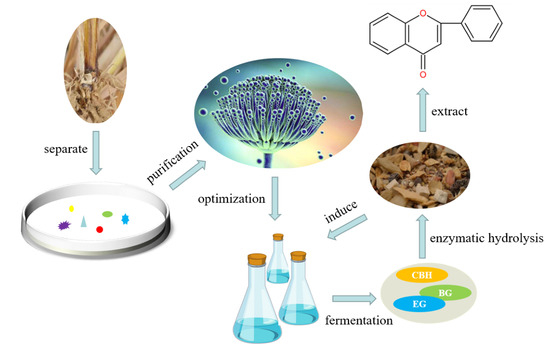
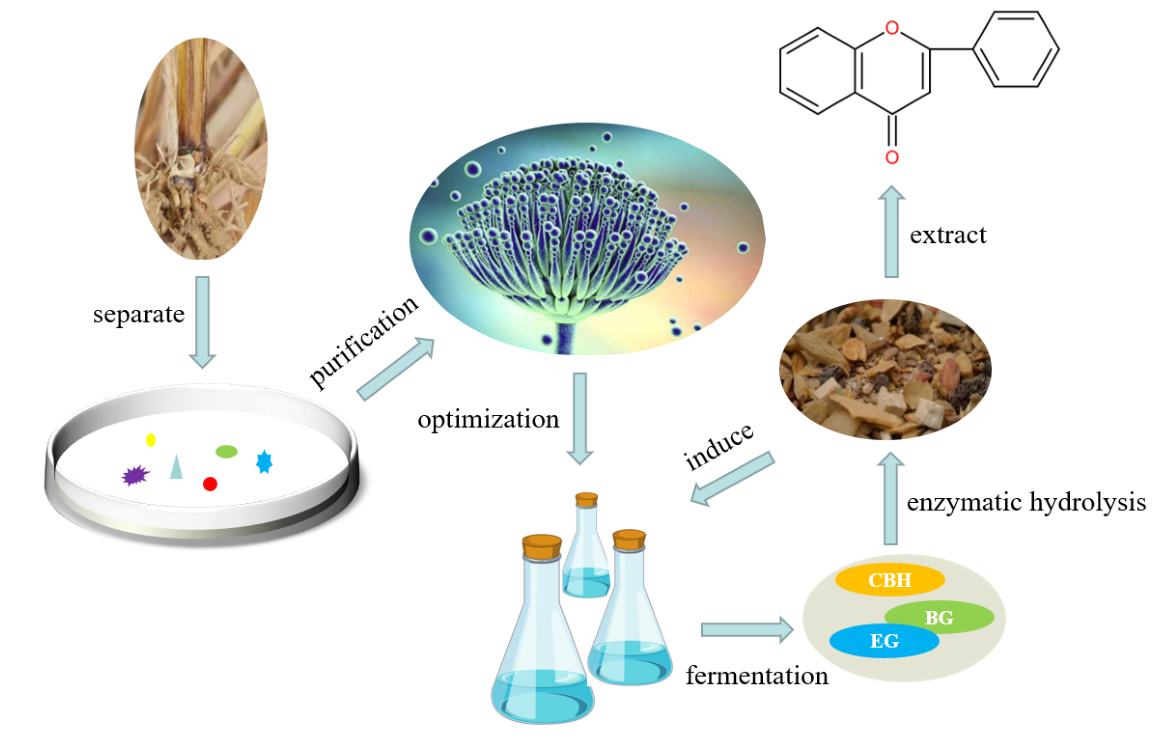
Graphical Abstract

1. Introduction

Cellulase is a group of enzymes that catalyze the hydrolysis of cellulose to glucose, comprising not a single enzyme but a multi-enzyme complex comprising main enzyme systems including endoglucanases, exoglucanases (including cellodextrinase and cellobiohydrolase), and β-glucosidase [1,2]. It contains multiple catalytic domains capable of cooperatively breaking the β-1,4-glycosidic bonds between glucose residues in cellulose, ultimately releasing glucose monomers [3]. It is widely used in the textile industry, pulp and paper industry, biofuel production, brewing, and food industry [4,5,6]. Demand for cellulases is continuously increasing, making them the world’s third-largest industrial enzyme preparation [7]. In the textile industry, processes like pre-treatment and dyeing extensively employ toxic chemicals including heavy metals, bleaching agents, and dyes, accounting for an estimated 20% of global water pollution as well as high energy and water consumption; substituting these chemicals with non-toxic, biodegradable enzymatic preparations can significantly reduce environmental pollution and resource depletion [8,9]. Because endoglucanases can function under alkaline and high-temperature conditions, using cellulase hydrolysis instead of mechanical pulping in paper and pulp processing leads to pulp with reduced bulk and hardness [10,11]. However, the high production cost and low yield of cellulase are essential limiting factors in its development [12]. Cost-effectively lowering the production and utilization costs of cellulase to consequently enhance its commercial viability remains a significant challenge that requires collaborative efforts between academia and industry [13].
Cellulase is an inducible enzyme that typically needs an inducer to produce cellulase [14]. Studies have reported that polysaccharides can be used as inducers for fungal cellulase production [15], and sophorose is the most effective inducer known at present [16,17]. Zhang et al. [18] found that using a glucose—sophorose mixture (MGS) as an inducer can efficiently induce Trichoderma reesei to produce cellulase. Through experimentation, it yielded cellulase activities (with filter paper activity significantly increased) 1.64-fold and 5.26-fold higher than those induced by lactose and cellobiose, respectively. However, the large-scale industrialization of sophorose faces triple barriers: low sophorose conversion rate, the corrosiveness of the acid hydrolysis step, and glucose byproduct-induced carbon catabolite repression. This contradiction has promoted the exploration of alternative fiber-based substrates. Recent studies have confirmed that cellulose-rich agricultural waste containing natural inducing factors—such as soybean hulls [19], bamboo shoot shells [20], apple pomace [21], grass powder [22], and sugarcane bagasse [23]—can enhance enzyme production through a dual-action mechanism. Li et al. [24] compared the differences in cellulase components and yields between a glucose—disaccharide mixture (MGD) and alkali-pretreated corn stover (APCS) as soluble inducer pairs. They found that the MGD-induced crude cellulase contained higher levels of major cellulases, but still suffered from insufficient β-glucosidase activity. In contrast, the APCS-induced enzyme mixture contained more accessory proteins and demonstrated higher hydrolysis efficiency on corn stover. Similarly to agricultural waste, traditional Chinese medicine residues (TCMRs), as a cellulosic substrate, holds unique advantages: containing varying ratios of cellulose and hemicellulose components, possessing inducing/synergistic effects from residual active ingredients such as saponins/flavonoids, and enabling value-added conversion of waste feedstock into cost-effective raw material [25].
TCMRs are the solid residues left behind after boiling medicinal plants, which have not been fully utilized so far. TCMRs are primarily generated by large pharmaceutical companies in a centralized manner or generated by pharmacies and households in smaller amounts. According to statistics, in China, the annual emissions of TCMRs reaches 35 million tons [26]. The large-scale production of TCMRs increases the difficulty of its treatment. After the initial extraction of traditional Chinese medicine, about 30% of the active components are not fully utilized in the TCMRs [27]. Incineration and landfilling are the primary disposal methods for TCMRs [28,29]. These methods result in groundwater pollution [30], greenhouse gas emissions [31,32], and resource wastage [33]. They represent the simplest and fastest ways to handle TCMRs, but their environmental impact is unpredictable and highly harmful, while also causing significant resource loss. Therefore, developing an environmentally friendly treatment method specifically for TCMRs is of great significance for addressing environmental pollution and achieving the efficient utilization of resources.
Currently, TCMRs are routinely used in basic applications like edible fungus cultivation, animal feed, and organic fertilizer production [34]. While these mitigate waste accumulation, they underutilize TCMRs’ bioactive potential. Crucially, TCMRs offer advantages as fungal cellulase inducers; their rich cellulose/lignin content provides ideal substrates [35], and their pre-boiled structure facilitates microbial breakdown. Unlike other biomass (e.g., agricultural waste), TCMRs retain abundant active compounds (flavonoids, alkaloids, and polysaccharides) [36], making structural disruption via cellulase treatment key to efficient re-extraction [37]. Concurrent cellulase production benefits microorganisms by enabling sugar utilization [38].
Compared to costly chemical methods, enzymatic treatment offers mild, efficient processing [39]. However, widespread adoption is limited by enzyme costs, particularly for cellulase. Penicillium oxalicum, recognized alongside Trichoderma and Aspergillus as a premier cellulase producer [40,41], displays exceptional β-glucosidase activity—offering potential cost advantages over dominant strains like T. reesei [42]
It will be an important and difficult point to explore the harmless and resource treatment of solid—waste TCMRs in the waste treatment industry. The purpose of this study is to explore the ability of Penicillium oxalicum to ferment. TCMRs to produce cellulase and extract total flavonoids from medicine residue. The output and cost of cellulase are crucial factors limiting its application. Under this background, a strain of Penicillium oxalicum was screened and identified to explore its ability to produce cellulase using TCMRs as the substrate. Optimal conditions for cellulase production were determined. In addition, crude cellulase improves the extraction rate of total flavonoids from TCMRs. This study demonstrated that TCMRs can be used as substrates for cellulase production by Penicillium oxalicum, and provides a new idea for the resource treatment of it.

2. Results

2.1. Results of Isolation and Identification of Cellulase-Producing Fungi

Among the 28 strains screened, strain Ti-11 was selected as the candidate strain for further identification because it had the highest proportion of a transparent zone. Strain Ti-11 was inoculated on a PDA medium and cultured at 37 °C for 3 days. The morphological characteristics of Penicillium oxalicum are shown in Figure 1A. The colony was flat; the texture was velvety; the surrounding hyphae were white; the central hyphae were dark green; and the conidia were numerous and easy to fall off. The conidium structure under the microscope is shown in Figure 1B. The conidia are present in the matrix with broom-like branches, which are usually whorled, occasionally forming three rings. The conidia are oval. Clustering analysis of the 18S rDNA sequences of the target and model fungi was performed with the MEGA 7.0 software, and the strain was identified as Penicillium oxalicum, as shown in Figure S1. This strain is deposited in the China Center for Type Culture Collection, deposit number: M 2022302. The nucleotide sequence data reported in this study have been deposited in GenBank under accession number OL687558.1.

2.2. Fungi Growth and Enzyme Production Under Three Kinds of Residues

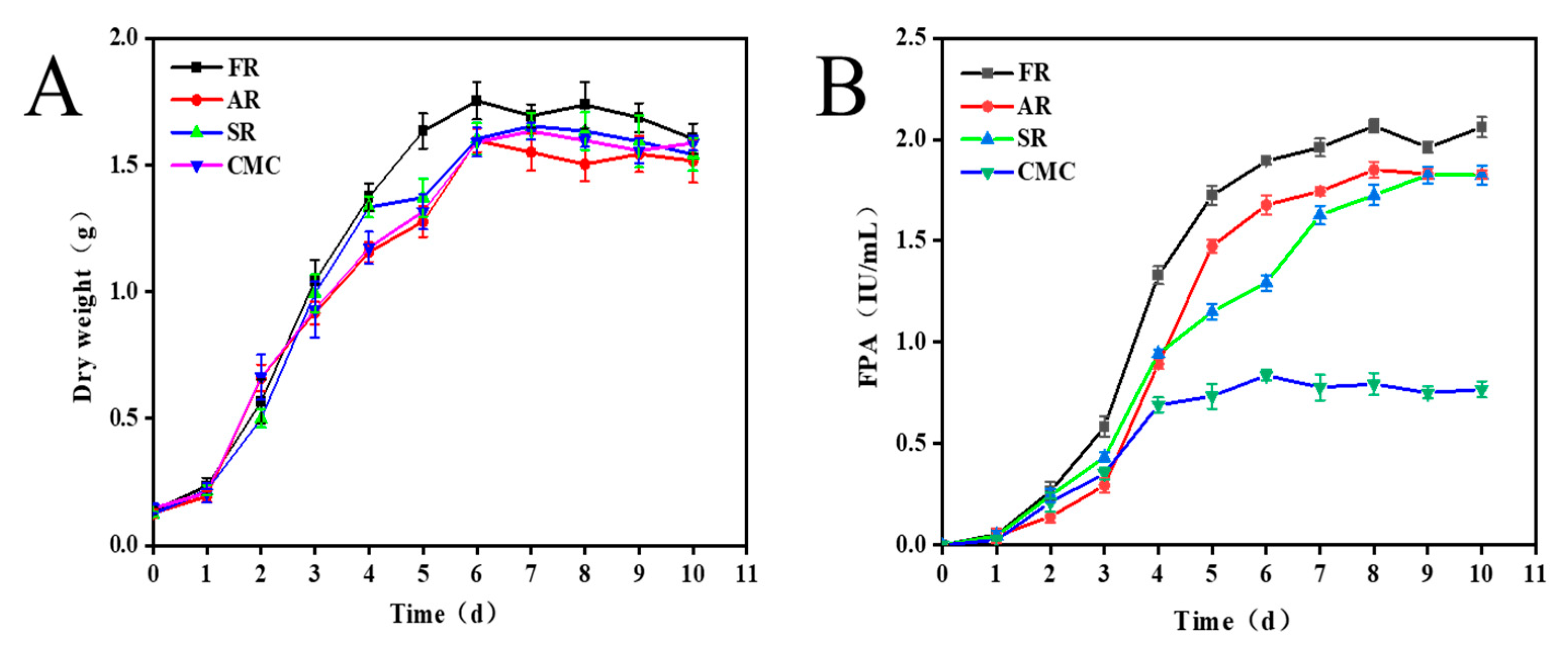
As shown in Figure 2A, the strain reached the logarithmic growth phase 1–6 days after inoculation, then reached the growth plateau and lasted for about 4 days. In the culture medium of three different types of TCMRs (Sophora residue (SR), Aster residue (AR), and Forsythia residue (FR)), the growth cycle of the strain is almost the same. When FR was used as the substrate, cellulase activity was up to 2.06 IU/mL (Figure 2B), and the other two residues also showed strong induction. After fermentation by Penicillium oxalicum, the three kinds of TCMRs showed significant weight-reduction effects. FR exhibited the highest weight loss rate of 22.67%, followed by AR (14.38%) and SR (9.55%) (Table 1). The superior mass loss observed in FR may be attributed to its lower lignocellulose content, which presumably weakens the protective barrier effect against enzymatic degradation.

2.3. Structural Characterization of TCMRs Before and After Enzymatic Hydrolysis

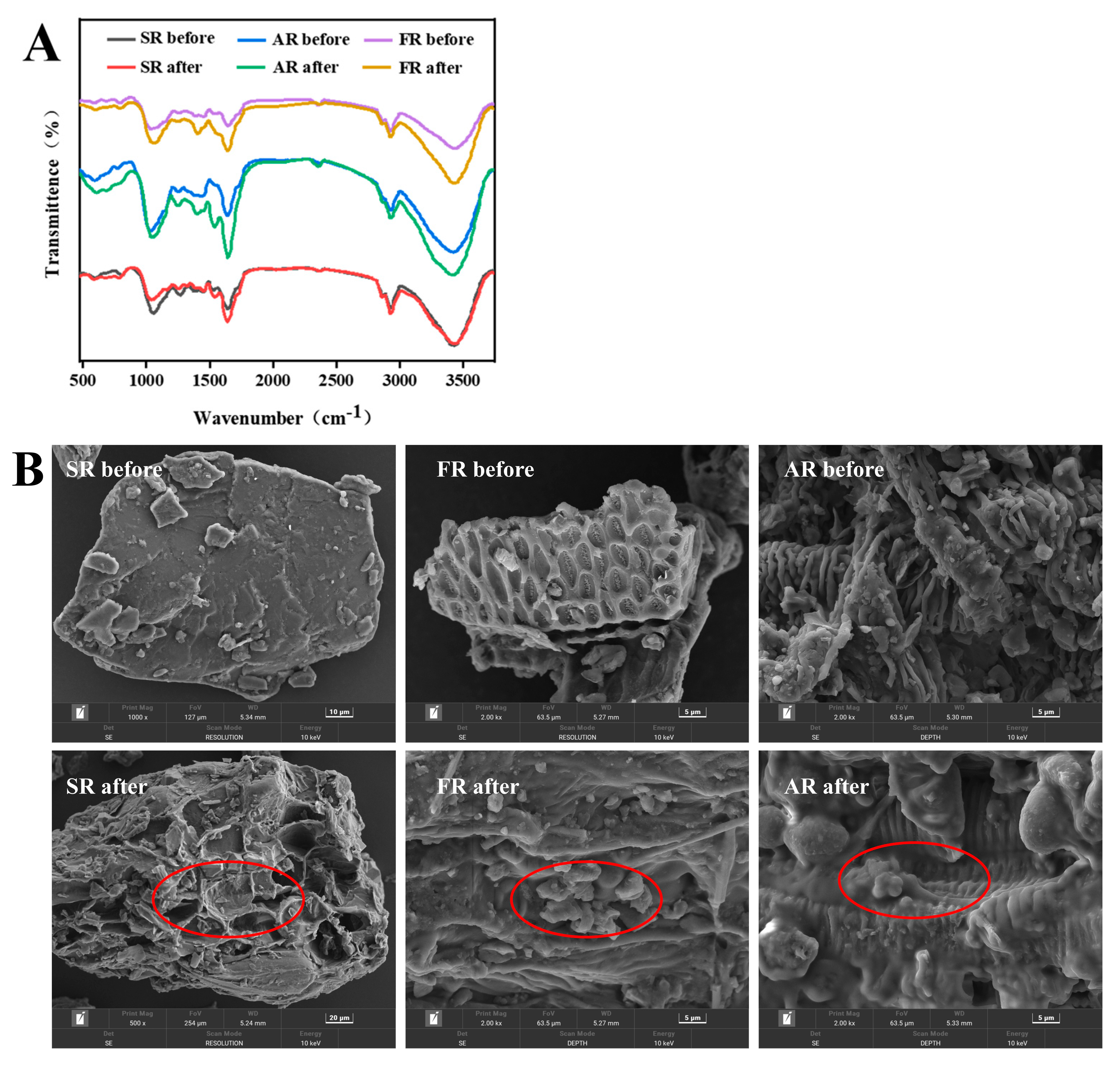
The FTIR spectra showed identical functional groups before and after enzymatic hydrolysis. However, changes in absorption intensity were observed at specific characteristic peaks, with some peaks even disappearing completely (Figure 3A). After enzymatic hydrolysis of FR and SR, the intensity of the stretching vibration peak around 1280 cm−1 (C-O-C) weakened. Similarly, enzymatic hydrolysis of AR and SR reduced the intensity of the vibration peak near 1050 cm−1 (C-O-H). Moreover, enzymatic hydrolysis of FR, AR, and SR altered peak intensity around 1620 cm−1 (C=O). These changes might be attributed to variations in the content of lignin and hemicellulose [43,44]. The decreased band intensity of residual components indicates enzymatic facilitation of structural degradation. These chemical modifications correlate with the observed morphological changes. SEM results revealed distinct surface alterations following enzymatic treatment. Untreated TCMRs exhibited a dense and smooth surface, whereas enzymatically hydrolyzed samples displayed fragmented morphology with increased porosity and irregular cavities. Notably, the surface of fermented FR showed the most pronounced structural disintegration, with coarse textures and fracture traces visible on larger fibrous structures (Figure 3B). These morphological transformations collectively demonstrate the breakdown of the lignocellulosic matrix induced by enzymatic hydrolysis.

2.4. Results of Screening and Optimization

First, we performed univariate conditional optimization. The results showed that the optimal pH was 6, the optimal temperature was 35 °C, and the optimal FR concentration was 25 g/L. The effects of FR concentration (X1), (NH4)2SO4 concentration (X2), temperature (X3), inoculum size (X4), pH (X5), and rotation speed (X6) on cellulase activity were studied by PB experiments. The first-order linear model was obtained by Minitab18 software as follows:
Y = 3.519 + 0.02237X1 + 0.0107X2 − 0.02549X3 − 0.0308X4 − 0.2201X5 + 0.00105X6
The statistical analysis of the PB experiment showed that X3, X4, and X5 had a negative effect on cellulase production, whereas X1, X2, and X6 showed a positive effect on cellulase production. Among these factors, X5 (pH), X3 (temperature), and X1 (FR concentration) were significant factors affecting cellulase production by Penicillium Ti-11.
The quadratic polynomial regression model relating the filter paper activity (Y) to FR concentration (A), temperature (B), and pH (C) was developed via quadratic multiple regression fitting of the Central Composite Design (CCD) experimental data presented in Table 2, utilizing Design Expert 13 software:
Y = 2.47 + 0.2246A + 0.0359S − 0.0499C − 0.0551AB + 0.0970AC + 0.0629BC − 0.4068A2 − 0.3271B2 − 0.1957C2
In Table 3, the F-value is 7.70, with a corresponding probability (p-value) of 0.0018, indicating that the model is significant. At the significance level of 0.05, the statistical analysis indicated that A, A2, B2, and C2 were significant model terms for cellulase production. In the lack-of-fit test, the F-value is 1.51, with a corresponding p-value of 33.01% (0.3301), which is greater than 0.05, suggesting that the lack of fit is not significant and the model adequately fits the data. The predicted results of the model showed that the maximum cellulase production could be achieved when pH, temperature, and FR concentration were 6.20, 34.44 °C, and 24.84 g/L, respectively. After optimization, cellulase productionincreased by 33.50% compared to the non-optimized medium. To confirm the optimization results, a set of experiments in triplicate were carried out with suggested medium components and fermentation conditions. The predicted result (2.82 U/mL) and actual result (2.75 IU/mL) showed no significant difference (p > 0.05). Furthermore, the contour plot and response surface plot have been provided as Supplementary Figure S2.

2.5. Extraction of Total Flavonoids from TCMRs by Crude Cellulase

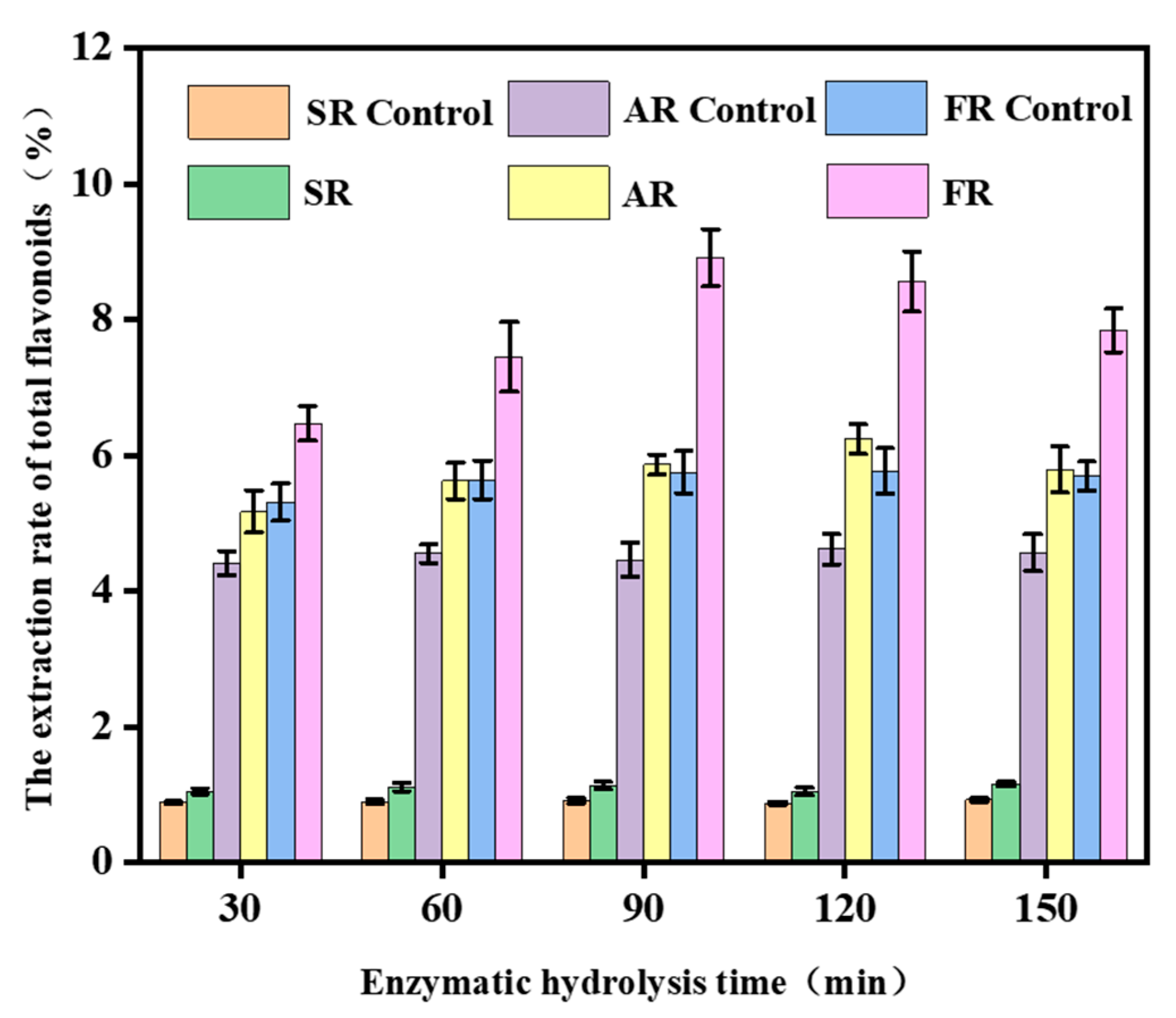
After enzymatic hydrolysis, the extraction rate of total flavonoids from TCMRs was significantly increased. As shown in Figure 4, after 90 min of enzymatic hydrolysis, the extraction rate of total flavonoids of SR reached the maximum (1.13%), which was 24.2% higher than that of the control group without enzyme solution. Similarly, after enzymatic hydrolysis for 90 min, the extraction rate of total flavonoids of FR reached the maximum (8.91%), which was 55.1% higher than that of the control. However, only after enzymatic hydrolysis for 120 min did the extraction rate of AR reach the maximum (6.24%), which was 35.5% higher than that of the control.

3. Discussion

Cellulase is widely used because of its effectiveness in cellulose conversion. In particular, it has a bright prospect of destroying plant cell walls to promote the release of effective components. However, the low enzyme activity and high production cost limit the application of cellulase. Screening microorganisms with high cellulase activity is one of the most fundamental methods to solve the problem of low enzyme activity. Microorganisms are usually screened from animal feces, intestines, soil, and water [45]. The cellulose contents of rice straw are approaching 40% [46]; according to the characteristics, it can be speculated that the cellulase-producing fungi from rice straw may have higher enzyme activity. Bacteria, fungi, and actinomycetes can produce cellulase, but fungi are recognized as the microorganisms with the highest cellulase activity [47]. Penicillium is a representative one. Therefore, in this study, the Congo red staining method was used to screen cellulase-producing fungi (Figure 1C). Combined with the results of 18S rDNA and microscopic observations, the strain was identified to belong to Penicillium oxalicum.
As an induced enzyme, the yield of cellulase depends not only on different strains but also on the substrate. As a kind of cellulose-rich and nutrient-rich waste, TCMRs are expected to become excellent substrates for cellulase production. This study first confirmed the feasibility of utilizing TCMRs as a substrate, demonstrating robust strain growth particularly on the FR medium. Notably, the strain exhibited superior growth on the FR substrate compared to the traditional CMC medium. This enhanced performance may be attributed to the lignocellulosic nature of TCMRs; their concurrent cellulose and hemicellulose content potentiates more efficient cellulase production than pure cellulose substrates [35]. Specifically, Forsythiae residue (FR), derived from leaves, possesses a higher nutrient density and lower lignin content than seed- or root-type residues (Qiu et al. [48]), thus optimizing enzymatic output. When cultured on FR medium, Penicillium oxalicum T-11 achieved peak cellulase activity of 2.06 IU/mL. This observation suggests the strain’s tolerance towards TCMRs and highlights the potential for its utilization as a substrate. It is reported that CMC is an active inducer of cellulase production [49]. Compared to the traditional culture medium, the strain was induced significantly, and the enzyme activity increased in the TCMR medium. After fermentation, the weight loss rate of TCMRs reached 9.55–22.67%. On the one hand, the high cellulose content ensures the enzyme production ability of the strain, and on the other hand, the strain reduced the weight of TCMRs by consuming organic matter. The SEM showed that the structure of the TCMRs was destroyed to different degrees after fermentation and the FTIR spectra showed that the band intensity of the residue decreased after fermentation, indicating microbial degradation of lignocellulose. Microorganisms can utilize the nutritious components of TCMRs for their growth and enzyme production. They produce cellulases that further degrade the structure of the TCMRs, effectively breaking them down. These results explain the decreased weight of TCMRs after fermentation. To further improve the activity of cellulase, the fermentation conditions of Penicillium oxalicum were optimized. In this study, the PB design method was used to investigate the effects of FR concentration (X1), (NH4)2SO4 concentration (X2), temperature (X3), inoculum size (X4), pH (X5), and rotational speed (X6) on the production of cellulase by Penicillium oxalicum Ti-11. It was found that temperature, pH, and FR concentration had significant effects on the cellulase activity of the strain. It has been reported that cellulase exhibits sensitivity to pH and temperature [50], and similar results were observed in our study. Temperatures that are either too high or too low could inhibit the growth of the strain and product formation [51]. In particular, a higher temperature eventually leads to the denaturation of cellulase, resulting in reduced enzyme activity [52]. Fungi can grow within a relatively wide pH range but cellulases are sensitive to ambient pH [53]. Substrate concentration had a significant effect on cellulase production by fungi [54,55]. Excessive addition of FR can create a limited growth space for fungi, leading to the accumulation of phenolic compounds, flavonoids, and other antimicrobial substances, which have a negative effect on the growth of microorganisms. Response surface analysis was used to optimize the medium for cellulase production. Temperature, pH, and FR concentration were selected as independent variables to increase cellulase production. The maximum output (2.75 IU/mL) under the optimized condition is 33.50% higher than that before optimization. The predicted enzyme activity is very close to the actual enzyme activity, which proves the effectiveness of the model. Comparatively, while Malik et al. [56] reported a post-optimization yield of 0.698 IU/mL using sugarcane bagasse to cultivate Bacillus subtilis CD001 for cellulase production, the FR medium demonstrated significantly superior enhancement of cellulase synthesis.
Flavonoids, the active components of TCMRs, play a significant role in anti-free radical, anti-oxidation, anti-cancer, and anti-tumor activities, protecting the liver and protecting digestive tract, and improving animal immune function [57]. Our study found that the extraction rate of total flavonoids increased significantly after adding cellulase compared to the blank control. The extraction rate of total flavonoids from FR reached 8.91%, which was 55.1% higher than that of the control. This absolute yield demonstrates competitive efficacy when compared to established cellulase-assisted methods; Huang et al. [58] reported 14.76% from Illicium verum residues (without specifying processing time), while Yin et al. [59] achieved 4.88 mg/g (~0.49%) from horsetail. Our 8.91% yield exceeds results from herbaceous sources (e.g., 18-fold higher than Yin et al. [59]) and reaches >60% of the maximum yield reported for fruit residues in Huang et al. [58], despite differences in biomass composition. The enhanced extraction is attributed to cellulase-mediated degradation of cellulose in the residue. This process increases surface area, improving component release during solvent hydrolysis while aligning with established mechanisms [60]. The research indicates that there is little difference in the extraction rate of total flavonoids from TCMRs between the utilization of commercial cellulase and the crude cellulase employed in this experiment. Therefore, it is feasible to use microbial cellulase to extract the active components of TCMRs. This idea provides a theoretical basis and ideas for solving the resource waste of lignocellulosic materials such as TCMRs.
Microorganisms provide an eco-friendly solution for the treatment and management of industrial waste to combat environmental threats, which is a key requirement of sustainable development. In this study, it is shown that isolated cellulase-producing strains may be an important part for the future development of an efficient cellulase production system and for the extraction of effective components from TCMRs. Subsequent research could explore utilizing traditional. Chinese medicinal residues (TCMRs) processed through microbial fermentation as feed additives. Quantitative analysis of reducing sugars will serve as a key monitoring metric in the pilot phase to evaluate conversion efficiency. The active compounds present in TCMRs can exert anti-microbial, anti-oxidant, liver protection, growth-promoting, and immune-enhancing effects in animals. Fully harnessing the resource of TCMRs, would mitigate resource wastage and environmental pollution, thus promoting a green circularity in the traditional Chinese medicine industry.

4. Materials and Methods

4.1. Isolation and Identification of Cellulase-Producing Fungi

The strain was isolated from rotten straw in the suburban farmland of Zhuzhou City using the dilution coating method and streak plate method. The isolation medium contained 10 g/L CMC-Na, 5 g/L peptone, 1 g/L Congo red, 1 g/L NaCl, 1 g/L MgSO4, 1 g/L K2HPO4, 1 g/L KH2PO4, 20 g/L agar, and was at pH 7. The plates were incubated at 37 °C for 2–3 d, and then underwent elution with 1 M NaCl solution. The ratio of the transparent zone’s diameter to colony’s diameter indicated the hydrolysis capacity [28]. The strain with a high ratio was selected and preserved at −80 °C for subsequent experiments. The potential cellulase-producing fungi were identified based on morphological observation. Further confirmation was performed by 18S rDNA sequencing using universal primers ITS1 (5′-TCCGTAGGTGAACCTGCGG-3′) and ITS4 (5′-TCCTCCGCTTA TTGATATGC-3′). After sequencing the PCR products, the resulting DNA sequences were compared with the NCBI GenBank database using online BLAST tool (https://blast.ncbi.nlm.nih.gov, accessed on 13 November 2025) to determine the taxonomic status of the strain through sequence homology analysis. The growth curves of the strains were determined using the dry weight method. The strains were cultured in liquid medium, and the mycelia were filtered through filter paper at different times, dried at 80 °C, and then weighed the dry weight.

4.2. Acquisition and Preparation of TCMRs

TCMRs were obtained from Renmin Pharmacy in Tianyuan District, Zhuzhou City, comprising Ziziphi Spinosae Semen residue (SR) [61], Forsythia leaves residue (FR) [62], and Astragalus residue (AR) [63]. These residues are rich in cellulose, hemicellulose, and other components conducive to microbial growth. The obtained TCMRs were oven-dried at 65 °C to a constant weight to remove moisture. Subsequently, the samples were powdered using a mill mixer and the powder was collected by passing it through an 80-mesh sieve.

4.3. Determination of Cellulase Activity

Filter paper activity (FPA) was measured according to the standard method described by Ghose [64]. One unit of activity (IU/mL) is defined as the amount of enzyme required to release 1 μmol of glucose equivalents per minute under assay conditions. A 2 mL suspension of Pseudomonas oxalaticus spores (1.8 × 10⁶ spores/mL) was inoculated into the culture medium. After incubation, 0.5 mL of the resulting supernatant was reacted with 1.5 mL of 0.05 M citrate buffer (pH 4.8) and 50 mg of Whatman No. 1 filter paper at 50 °C for 60 min. The quantity of released reducing sugars was quantified using the 3,5-dinitrosalicylic acid (DNS) method, with one unit of enzyme activity defined as the amount of enzyme required to release 1 μmol of reducing sugars per minute under the specified assay conditions. The composition of the CMC medium is as follows: CMC-Na 10 g, peptone 5 g, Yeast extract 3 g, NaCl 1 g, K2HPO4 1 g, MgSO4 1 g, H2O 1000 mL, and pH natural. The composition of the fermentation medium is as follows: TCMRs 20 g, NaCl 5 g, (NH4)2SO4 3 g, MgSO4 3 g, H2O 1000 mL, and pH natural.

4.4. Screening and Optimization

Screening of significant variables was conducted by the Plackett–Burman (PB) method. The PB method is a reliable technique used to select factors that significantly influence cellulase production with minimal trials [65]. The variables chosen for the present study were FR concentration (X1), (NH4)2SO4 concentration (X2), temperature (X3), inoculum size (X4), pH (X5), and rotation speed (X6). All the tests were carried out in triplicate, and the average values were taken as the response.
Process optimization was performed by CCD. FR concentration (A), temperature (B), and pH (C) were chosen as independent variables for response surface analysis experiments. Analysis of variance (ANOVA) was carried out, and the data were processed using statistical software Design-Expert 13.

4.5. Structural Characterization of TCMRs

The sample was ultrasonically dispersed using ethanol as solvent. A volume of 0.1 mL was taken and dried on aluminum foil, followed by a thin coating of gold. The morphology of TCMRs before and after enzymatic hydrolysis was examined under a scanning electron microscope (SEM) (TESCAN MIRA4 SEM operated at 10 keV, Brno, Czech Republic).
Fourier transform infrared spectroscopy (FTIR) analysis was conducted to identify the structural changes in the sample. Infrared (IR) absorption spectra were obtained with a Nicolet is 10 (Thermo Fisher Scientific, Waltham, MA, USA) in a dry atmosphere. FTIR spectra were collected between 400 and 4000 wave numbers (cm−1)

4.6. Extraction of Total Flavonoids from TCMRs

The strains were inoculated in an enzyme-producing culture medium and cultured for 8 days. The fermentation broth was centrifuged at 5000 rpm for 10 min, and the supernatant was collected as the crude enzyme. The content of total flavonoids was determined by TU-1810 UV-Vis spectrophotometer (Beijing Purkinje General Instrument Co., Ltd., Beijing, China) [66]. TCMRs were enzymatically hydrolyzed using crude cellulase at 55 °C for 90 min, though these reaction parameters (temperature and duration) may be adjusted depending on the specific enzymatic substrate requirements. Subsequently, 20 mL of extraction solution (60% ethanol, pH 5) was added, and ultrasound was performed for 30 min. Colorimetric analysis was performed using the NaNO2-Al(NO3)3-NaOH color system. All the samples were prepared in triplicate, and the mean values of total flavonoids contents were calculated by the standard calibration curve and set blank to eliminate the effect of high sugar background on the results.

4.7. Statistical Analysis

The statistical analyses were performed using Origin 9.0 and IBM SPSS Statistics 25 software. All experiments were carried out in triplicates, and the data were presented as means ± standard deviations (SD). The mean value and standard deviation are calculated based on the data obtained from three independent experiments. Statistical differences at p < 0.05 were considered significant.

5. Conclusions

A TCMRs—tolerant Penicillium oxalicum Ti-11—was screened from rotten straw. The strain produces a cellulase yield that reaches a maximum of 2.06 IU/mL with FR as the induction substrate, having the highest weight loss rate of 22.67%. The FPA reached 2.75 IU/mL under the optimal conditions of FR concentration 24.84 g/L, (NH4)2SO4 concentration 2 g/L, temperature 34.44 °C, pH 6.20, rotational speed 200 rpm, and inoculum size 6%, which was 33.50% higher than that before optimization. The extraction rate of total flavonoids increased by 24.2–55.1% after the addition of crude cellulase. This study provides an idea for the low-cost production of fungal cellulase and the resource utilization of traditional Chinese medicine residues (TCMRs).

Supplementary Materials

The following supporting information can be downloaded at: https://www.mdpi.com/article/10.3390/catal15121150/s1, Figure S1: The phylogenetic tree of Penicillium oxalicum Ti-11; Figure S2. Contour plot and response surface plot

Author Contributions

Conceptualization: X.Z. and L.M.; Methodology: Y.Z., X.Z., L.M., S.R., C.Z. and X.L.; Validation: Y.Z., S.R., C.Z. and X.L.; Formal Analysis: Y.Z., S.R., C.Z. and X.L.; Investigation: W.G., Z.H., Y.Z., S.R., C.Z. and X.L.; Resources: X.Z. and L.M.; Data Curation: Y.Z., S.R., C.Z. and X.L.; Writing—Original Draft: Y.Z., S.R., C.Z. and X.L.; Writing—Review and Editing: L.M., X.Z. and X.L.; Supervision: X.Z. and L.M.; Project Administration: X.Z. and L.M. All authors have read and agreed to the published version of the manuscript.

Funding

This work was supported by the Natural Science Foundation of Hunan Province of China (2023JJ50168), the Key Project of Hunan Provincial Department of Education (22A0402), National College Students Innovation and Entrepreneurship Training Program (202211535009), High Technology Industry S & T Innovation Leading Project of Hunan Province (2020NK2001), Program for Science &Technology Innovation Platform/Talents of Hunan Province (2019TP1029), and Hunan Provincial Education Department (21A0161 and 20C0622).

Data Availability Statement

Data are available in a publicly accessible repository. This strain is deposited in the China Center for Type Culture Collection, deposit number: M 2022302. The original data presented in the study are openly available in GenBank at accession number: OL687558.1.

Acknowledgments

The authors gratefully acknowledge Xiaoxi Zeng for her overall guidance and supervision of this research project. We also thank Liang Ma for his valuable comments and suggestions on the initial draft of the manuscript.

Conflicts of Interest

The authors declare no conflicts of interest.

References

  1. Kaur, G.; Taggar, M.S.; Kalia, A. Cellulase-immobilized chitosan-coated magnetic nanoparticles for saccharification of lignocellulosic biomass. Environ. Sci. Pollut. Res. 2023, 30, 111627–111647. [Google Scholar] [CrossRef]
  2. Gutiérrez-Rojas, I.; Moreno-Sarmiento, N.; Montoya, D. Mechanisms and regulation of the enzymatic hydrolysis of cellulose in filamentous fungi: Classic cases and new models. Iberoam. J. Mycol. 2015, 32, 1–12. [Google Scholar] [CrossRef]
  3. Ren, F.; Wu, F.; Wu, X.; Bao, T.; Jie, Y.; Gao, L. Fungal systems for lignocellulose deconstruction: From enzymatic mechanisms to hydrolysis optimization. Gcb Bioenergy 2024, 16, e13130. [Google Scholar] [CrossRef]
  4. Aro, E.M. From first generation biofuels to advanced solar biofuels. Ambio 2016, 45, 24–31. [Google Scholar] [CrossRef] [PubMed]
  5. Chakraborty, S.; Gupta, R.; Jain, K.K.; Gautam, S.; Kuhad, R.C. Cellulases: Application in wine and brewery industry. In New and Future Developments in Microbial Biotechnology and Bioengineering; Elsevier: Amsterdam, The Netherlands, 2016; pp. 193–200. [Google Scholar] [CrossRef]
  6. Anoop Kumar, V.; Suresh Chandra Kurup, R.; Snishamol, C.; Nagendra Prabhu, G. Role of cellulases in food, feed, and beverage industries. In Green Bio-Processes: Enzymes in Industrial Food Processing; Springer: Singapore, 2018; pp. 323–343. [Google Scholar] [CrossRef]
  7. Patel, K.; Amaresan, N. Mass Multiplication, Production Cost Analysis, and Marketing of Cellulase. In Industrial Microbiology Based Entrepreneurship: Making Money from Microbes; Springer Nature: Singapore, 2022; pp. 37–50. [Google Scholar] [CrossRef]
  8. Rebello, S.; Aneesh, E.M.; Sindhu, R.; Binod, P.; Pandey, A.; Gnansounou, E. Enzyme catalysis: A workforce to productivity of textile industry. High Value Ferment. Prod. Hum. Welf. 2019, 2, 49–65. [Google Scholar] [CrossRef]
  9. Ahmed, I.; Iqbal, H.; Dhama, K. Enzyme-based biodegradation of hazardous pollutants-an overview. J. Exp. Biol. Agric. Sci. 2017, 5, 402–411. [Google Scholar] [CrossRef]
  10. Sangrila Sadhu, S.S.; Maiti, T.K. Cellulase production by bacteria: A review. Microbiol. Res. J. Int. 2013, 3, 235–258. [Google Scholar] [CrossRef]
  11. Kuhad, R.C.; Gupta, R.; Singh, A. Microbial cellulases and their industrial applications. Enzym. Res. 2011, 2011, 280696. [Google Scholar] [CrossRef]
  12. Srivastava, N.; Srivastava, M.; Mishra, P.K.; Gupta, V.K.; Molina, G.; Rodriguez-Couto, S.; Manikanta, A.; Ramteke, P.W. Applications of fungal cellulases in biofuel production: Advances and limitations. Renew. Sustain. Energy Rev. 2018, 82, 2379–2386. [Google Scholar] [CrossRef]
  13. Rodrigues, V.J.; Odaneth, A.A. Industrial application of cellulases. In Current Status and Future Scope of Microbial Cellulases; Elsevier: Amsterdam, The Netherlands, 2021; pp. 189–209. [Google Scholar] [CrossRef]
  14. Behera, B.C.; Sethi, B.K.; Mishra, R.R.; Dutta, S.K.; Thatoi, H.N. Microbial cellulases–Diversity & biotechnology with reference to mangrove environment: A review. J. Genet. Eng. Biotechnol. 2017, 15, 197–210. [Google Scholar] [CrossRef]
  15. Luo, Y.; Valkonen, M.; Jackson, R.E.; Palmer, J.M.; Bhalla, A.; Nikolaev, I.; Saloheimo, M. Modification of transcriptional factor ACE3 enhances protein production in Trichoderma reesei in the absence of cellulase gene inducer. Biotechnol. Biofuels 2020, 13, 137. [Google Scholar] [CrossRef]
  16. Xia, Y.; Yang, L.R.; Xia, L.M. High-level production of a fungal β-glucosidase with application potentials in the cost-effective production of Trichoderma reesei cellulase. Process Biochem. 2018, 70, 55–60. [Google Scholar] [CrossRef]
  17. Huang, T.T.; Wages, J.M. New-to-nature sophorose analog: A potent inducer for gene expression in Trichoderma reesei. Enzym. Microb. Technol. 2016, 85, 44–50. [Google Scholar] [CrossRef]
  18. Zhang, P.; Li, Q.; Chen, Y.; Peng, N.; Liu, W.; Wang, X.; Li, Y. Induction of cellulase production in Trichoderma reesei by a glucose–sophorose mixture as an inducer prepared using stevioside. RSC Adv. 2022, 12, 17392–17400. [Google Scholar] [CrossRef]
  19. Astolfi, V.; Astolfi, A.L.; Mazutti, M.A.; Rigo, E.; Di Luccio, M.; Camargo, A.F.; Dalastra, C.; Kubeneck, S.; Fongaro, G.; Treichel, H. Cellulolytic enzyme production from agricultural residues for biofuel purpose on circular economy approach. Bioprocess Biosyst. Eng. 2019, 42, 677–685. [Google Scholar] [CrossRef] [PubMed]
  20. Zhang, J.G.; Li, Q.M.; Thakur, K.; Faisal, S.; Wei, Z.J. A possible water-soluble inducer for synthesis of cellulase in Aspergillus niger. Bioresour. Technol. 2017, 226, 262–266. [Google Scholar] [CrossRef] [PubMed]
  21. Dhillon, G.S.; Brar, S.K.; Kaur, S.; Metahni, S.; M’hamdi, N. Lactoserum as a moistening medium and crude inducer for fungal cellulase and hemicellulase induction through solid-state fermentation of apple pomace. Biomass Bioenergy 2012, 41, 165–174. [Google Scholar] [CrossRef]
  22. Saratale, G.D.; Kshirsagar, S.D.; Sampange, V.T.; Saratale, R.G.; Oh, S.E.; Govindwar, S.P.; Oh, M.K. Cellulolytic enzymes production by utilizing agricultural wastes under solid state fermentation and its application for biohydrogen production. Appl. Biochem. Biotechnol. 2014, 174, 2801–2817. [Google Scholar] [CrossRef]
  23. Pramanik, S.K.; Mahmud, S.; Paul, G.K.; Jabin, T.; Naher, K.; Uddin, M.S.; Zaman, S.; Saleh, M.A. Fermentation optimization of cellulase production from sugarcane bagasse by Bacillus pseudomycoides and molecular modeling study of cellulase. Curr. Res. Microb. Sci. 2021, 2, 100013. [Google Scholar] [CrossRef]
  24. Li, Y.H.; Zhang, X.Y.; Zhang, F.; Peng, L.-C.; Zhang, D.-B.; Kondo, A.; Bai, F.-W. Optimization of cellulolytic enzyme components through engineering Trichoderma reesei and on-site fermentation using the soluble inducer for cellulosic ethanol production from corn stover. Biotechnol. Biofuels 2018, 11, 49. [Google Scholar] [CrossRef]
  25. Chang, S.; Yun, C.; Yang, B.; Duan, J.; Chen, T.; Liu, L.; Li, B.; Guo, S.; Zhang, S. Comprehensive reutilization of Glycyrrhiza uralensis residue by extrusion-biological pretreatment for coproduction of flavonoids, cellulase, and ethanol. Bioresour. Technol. 2024, 406, 131002. [Google Scholar] [CrossRef]
  26. Shreya, N.B.; Sharma, A.K. Cost—effective cellulase production, improvement strategies, and future challenges. J. Food Process Eng. 2021, 44, 13623. [Google Scholar] [CrossRef]
  27. Huang, C.; Li, Z.X.; Wu, Y.; Huang, Z.-Y.; Hu, Y.; Gao, J. Treatment and bioresources utilization of traditional Chinese medicinal herb residues: Recent technological advances and industrial prospect. J. Environ. Manag. 2021, 299, 113607. [Google Scholar] [CrossRef]
  28. Wang, M.H.; Liu, Y.; Wang, S.Q.; Wang, K.; Zhang, Y. Development of a compound microbial agent beneficial to the composting of Chinese medicinal herbal residues. Bioresour. Technol. 2021, 330, 124948. [Google Scholar] [CrossRef]
  29. Zhan, H.; Yin, X.-L.; Huang, Y.-Q.; Zhang, X.-H.; Yuan, H.-Y.; Xie, J.-J.; Wu, C.-Z. Characteristics of NOx precursors and their formation mechanism during pyrolysis of herb residues. J. Fuel Chem. Technol. 2017, 45, 279–288. [Google Scholar] [CrossRef]
  30. Mandpe, A.; Bhattacharya, A.; Paliya, S.; Pratap, V.; Hussain, A.; Kumar, S. Life-cycle assessment approach for municipal solid waste management system of Delhi city. Environ. Res. 2022, 212, 113424. [Google Scholar] [CrossRef]
  31. Luo, J.; Yang, R.; Ma, F.; Jiang, W.; Han, C. Recycling utilization of Chinese medicine herbal residues resources: Systematic evaluation on industrializable treatment modes. Environ. Sci. Pollut. Res. 2023, 30, 32153–32167. [Google Scholar] [CrossRef]
  32. Chavan, D.; Manjunatha, G.S.; Singh, D.; Periyaswami, L.; Kumar, S.; Kumar, R. Estimation of spontaneous waste ignition time for prevention and control of landfill fire. Waste Manag. 2022, 139, 258–268. [Google Scholar] [CrossRef] [PubMed]
  33. Marcelino, S.; Gaspar, P.D.; Paco, A. Sustainable waste management in the production of medicinal and aromatic plants—A systematic review. Sustainability 2023, 15, 13333. [Google Scholar] [CrossRef]
  34. Shao, Y.; Zhu, C.; Fu, Z.; Lin, K.; Wang, Y.; Chang, Y.; Han, L.; Yu, H.; Tian, F. Green synthesis of multifunctional fluorescent carbon dots from mulberry leaves (Morus alba L.) residues for simultaneous intracellular imaging and drug delivery. J. Nanoparticle Res. 2020, 22, 229. [Google Scholar] [CrossRef]
  35. Ahmad, T.; Sharma, A.; Gupta, G.; Mansoor, S.; Jan, S.; Kaur, B.; Paray, B.A.; Ahmad, A. Response surface optimization of cellulase production from Aneurinibacillus aneurinilyticus BKT-9: An isolate of urban Himalayan freshwater. Saudi J. Biol. Sci. 2020, 27, 2333–2343. [Google Scholar] [CrossRef]
  36. Lu, Q.; Li, C.L. Comprehensive utilization of Chinese medicine residues for industry and environment protection: Turning waste into treasure. J. Clean. Prod. 2021, 279, 123856. [Google Scholar] [CrossRef]
  37. Lu, Y.; Jiang, J.G. Application of enzymatic method in the extraction and transformation of natural botanical active ingredients. Appl. Biochem. Biotechnol. 2013, 169, 923–940. [Google Scholar] [CrossRef]
  38. Bhardwaj, N.; Kumar, B.; Agrawal, K.; Verma, P. Current perspective on production and applications of microbial cellulases: A review. Bioresour. Bioprocess. 2021, 8, 95. [Google Scholar] [CrossRef]
  39. Puri, M.; Sharma, D.; Barrow, C.J. Enzyme-assisted extraction of bioactives from plants. Trends Biotechnol. 2011, 30, 37–44. [Google Scholar] [CrossRef]
  40. de França Passos, D.; Pereira, N., Jr.; de Castro, A.M. A comparative review of recent advances in cellulases production by Aspergillus, Penicillium and Trichoderma strains and their use for lignocellulose deconstruction. Curr. Opin. Green Sustain. Chem. 2018, 14, 60–66. [Google Scholar] [CrossRef]
  41. Wang, Y.; Li, P.; Zhang, B.; Wang, Y.-P.; Meng, J.; Gao, Y.-F.; He, X.-M.; Hu, X.-M. Identification of phosphate-solubilizing microorganisms and determination of their phosphate-solubilizing activity and growth-promoting capability. BioResources 2020, 15, 2560–2578. [Google Scholar] [CrossRef]
  42. Vaishnav, N.; Singh, A.; Adsul, M.; Pooja, D.; Kaur, S.S.; Anshu, M.; Kumar, P.S.; Rani, S.R. Penicillium: The next emerging champion for cellulase production. Bioresour. Technol. Rep. 2018, 2, 131–140. [Google Scholar] [CrossRef]
  43. Ahamed, J.I.; Presley, S.D.; Rajabathar, J.R.; Sangeetha, V.; Babu, V.; Rajkumar, M.; Kamath, M.S. Analyze and assess the spectral, DFT, and medicinal characteristics through targeted pharmacological investigation of 2-(3-(5-(4-chlorophenyl) furan-2-yl) acryloyl)-3,4-dihydro-2H-naphthalen-1-one (CHFADN). J. Mol. Struct. 2025, 1321, 139659. [Google Scholar] [CrossRef]
  44. Park, J.H.; Choi, S.; Moon, H.C.; Seo, H.; Kim, J.Y.; Hong, S.-P.; Lee, B.S.; Kang, E.; Lee, J.; Ryu, D.H.; et al. Antimicrobial spray nanocoating of supramolecular Fe(III)-tannic acid metal-organic coordination complex: Applications to shoe insoles and fruits. Sci. Rep. 2017, 7, 6980. [Google Scholar] [CrossRef] [PubMed]
  45. Leo, V.V.; Zothanpuia; Lalthafala; Ramesh, N.; Singh, B.P. Microorganisms as an efficient tool for cellulase production: Availability, diversity, and efficiency. In New and Future Developments in Microbial Biotechnology and Bioengineering; Elsevier: Amsterdam, The Netherlands, 2019; Volume 45, p. 61. [Google Scholar] [CrossRef]
  46. Jiang, F.; Han, S.Y.; Hsieh, Y.L. Controlled defibrillation of rice straw cellulose and self-assembly of cellulose nanofibrils into highly crystalline fibrous materials. RSC Adv. 2013, 3, 12366–12375. [Google Scholar] [CrossRef]
  47. Jayasekara, S.; Ratnayake, R. Microbial cellulases: An overview and applications. In Cellulose; IntechOpen: London, UK, 2019; Volume 22, p. 84531. [Google Scholar] [CrossRef]
  48. Qiu, S. Screening of Enzyme Producing Resistance Strain from Chinese Medicine Residues Such as Salviae Militorrhizae and Its Resource Utilization. Master’s Thesis, Nanjing University of Chinese Medicine, Nanjing, China, 2020. [Google Scholar] [CrossRef]
  49. Singh, S.; Moholkar, V.S.; Goyal, A. Optimization of carboxymethyl cellulase production from Bacillus amyloliquefaciens SS35. 3 Biotech 2013, 4, 411–424. [Google Scholar] [CrossRef]
  50. Ahmed, A.; Bibi, A. Fungal cellulase; production and applications: Minireview. Int. J. Health Life Sci. 2018, 4, 19–36. [Google Scholar] [CrossRef]
  51. Steensels, J.; Snoek, T.; Meersman, E.; Nicolino, M.P.; Voordeckers, K.; Verstrepen, K.J. Improving industrial yeast strains: Exploiting natural and artificial diversity. FEMS Microbiol. Rev. 2014, 38, 947–995. [Google Scholar] [CrossRef] [PubMed]
  52. Saini, A.; Aggarwal, N.K.; Yadav, A. Cost-effective cellulase production using Parthenium hysterophorus biomass as an unconventional lignocellulosic substrate. 3 Biotech 2017, 7, 12. [Google Scholar] [CrossRef] [PubMed]
  53. He, R.; Ma, L.; Li, C.; Jia, W.; Li, D.; Zhang, D.; Chen, S. Trpac1, a pH response transcription regulator, is involved in cellulase gene expression in Trichoderma reesei. Enzym. Microb. Technol. 2014, 67, 17–26. [Google Scholar] [CrossRef] [PubMed]
  54. Irfan, M.; Mushtaq, Q.; Tabssum, F.; Shakir, H.A.; Qazi, J.I. Carboxymethyl cellulase production optimization from newly isolated thermophilic Bacillus subtilis K-18 for saccharification using response surface methodology. AMB Express 2017, 7, 29. [Google Scholar] [CrossRef]
  55. Varotkar, P.; Tumane, P.M.; Wasnik, D.D. Bioconversion of waste paper into bio-ethanol by co-culture of fungi isolated from lignocellulosic waste. Int. J. Pure Appl. Biosci. 2016, 4, 264–274. [Google Scholar] [CrossRef]
  56. Malik, W.A.; Khan, H.M.; Javed, S. Bioprocess Optimization for Enhanced Production of Bacterial Cellulase and Hydrolysis of Sugarcane Bagasse. Bioenergy Res. 2022, 15, 1116–1129. [Google Scholar] [CrossRef]
  57. Chávez-González, M.L.; Sepúlveda, L.; Verma, D.K.; Luna-García, H.A.; Rodríguez-Durán, L.V.; Ilina, A.; Aguilar, C.N. Conventional and emerging extraction processes of flavonoids. Processes 2020, 8, 434. [Google Scholar] [CrossRef]
  58. Huang, D.; Zhou, X.; Si, J.; Gong, X.; Wang, S. Studies on cellulase-ultrasonic assisted extraction technology for flavonoids from Illicium verum residues. Chem. Cent. J. 2016, 10, 56. [Google Scholar] [CrossRef]
  59. Yin, H.; Zhang, Y.; Hu, T.; Li, W.; Deng, Y.; Wang, X.; Tang, H.; Zhao, L.; Yan, G. Optimization of Cellulase-Assisted Extraction of Total Flavonoids from Equisetum via Response Surface Methodology Based on Antioxidant Activity. Processes 2023, 11, 1978. [Google Scholar] [CrossRef]
  60. Zhang, S.; Chang, S.; Xiao, P.; Qiu, S.; Ye, Y.; Li, L.; Yan, H.; Guo, S.; Duan, J. Enzymatic in situ saccharification of herbal extraction residue by a medicinal herbal-tolerant cellulase. Bioresour. Technol. 2019, 287, 121417. [Google Scholar] [CrossRef]
  61. Chen, W.; Qin, F.X.; Jiang, Y.Y.; Jia, Y.S. Study on technology of extracting total flavonoids from seed of wild jujube by cellulase method. Foods Oils 2018, 31, 87–91. [Google Scholar] [CrossRef]
  62. Li, Y.; Xu, T.; Lin, C.; Xiong, H.; Bai, Z.; Wu, H.; Cao, F.; Wei, P. Determination of Lignocellulosic Components in Traditional Chinese Herb Residues and Its Sugar-Producing Application. Waste Biomass Valor. 2023, 14, 1891–1903. [Google Scholar] [CrossRef]
  63. Li, K.; Li, S.; Wang, D.; Li, X.; Wu, X.; Liu, X.; Du, G.; Li, X.; Qin, X.; Du, Y. Extraction, characterization, antitumor and immunological activities of hemicellulose polysaccharide from Astragalus radix herb residue. Molecules 2019, 24, 3644. [Google Scholar] [CrossRef]
  64. Ghose, T.K. Measurement of cellulase activities. Pure Appl. Chem. 1987, 59, 257–268. [Google Scholar] [CrossRef]
  65. Vanaja, K.; Shobha Rani, R.H. Design of experiments: Concept and applications of Plackett Burman design. Clin. Res. Regul. Aff. 2007, 24, 1–23. [Google Scholar] [CrossRef]
  66. Zarina, Z.; Tan, S.Y. Determination of flavonoids in Citrus grandis (Pomelo) peels and their inhibition activity on lipid peroxidation in fish tissue. Int. Food Res. J. 2013, 20, 313. Available online: https://www.researchgate.net/publication/285866489 (accessed on 13 November 2025).
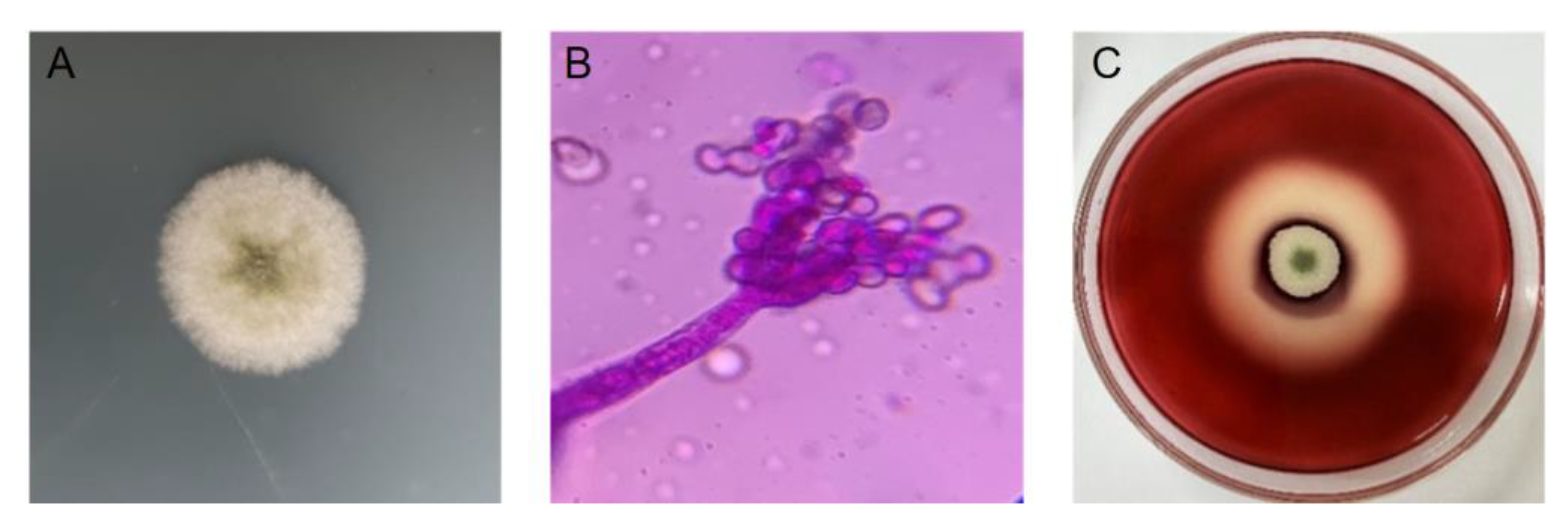
Figure 1. The results of strain identification: (A) morphological identification; (B) microscope observation; (C) the transparent zone of Congo red staining.
Catalysts 15 01150 g001
Figure 2. Growth and metabolism of Penicillium oxalicum Ti-11 in different TCMRs substrates: (A) the growth curves; (B) the enzyme production curves (mean ± SD, n = 3).
Catalysts 15 01150 g002
Figure 3. Structural characterization of TCMRs before and after enzymatic hydrolysis: (A) the FTIR spectra of TCMRs; (B) the SEM analysis before and after fermentation of TCMRs. The red circles highlight the samples of sorghum dregs, dregs of sour jujube, and Astragalus showing morphological transformations of lignocellulosic structure following enzymatic hydrolysis and fermentation.
Catalysts 15 01150 g003
Figure 4. Extraction of total flavonoids from TCMRs by cellulase cocktail (mean ± SD, n = 3).
Catalysts 15 01150 g004
Table 1. Weight loss rate after fermentation of TCMRs (mean ± SD, n = 3).
TypesWeight Loss Rate (%)
SR9.55 ± 2.59
AR14.38 ± 1.76
FR 22.67 ± 4.33
Table 2. CentralComposite Design and results (mean ± SD, n = 3).
stdA: FR Concentration (g/L)B: Temperature (°C)C: pHY: Filter Paper Activity (IU/mL)
122.8432.445.81.46846
226.8432.445.81.72069
322.8436.445.81.47085
426.8436.445.81.68722
522.8432.446.61.12537
626.8432.446.61.95021
722.8436.446.61.56409
826.8436.446.61.98368
921.790734.446.21.01181
1027.889334.446.21.75177
1124.8431.39076.21.5629
1224.8437.48936.21.57126
1324.8434.445.590142.17017
1424.8434.446.809861.57485
1524.8434.446.22.11518
1624.8434.446.22.41643
1724.8434.446.22.61845
1824.8434.446.22.75593
1924.8434.446.22.55868
2024.8434.446.22.53836
Table 3. The ANOVA analysis for the RSM model.
SourceSum of SquaresdfMean SquareF-Valuep-Value
Model4.1890.46397.700.0018significant
A-FR concentration0.638210.638210.600.0086
B-temperature0.016310.01630.27050.6143
C-pH0.031510.03150.52360.4859
AB0.024310.02430.40390.5393
AC0.075210.07521.250.2898
BC0.031710.03170.52580.4850
A21.7911.7929.700.0003
B21.1611.1619.200.0014
C20.413810.41386.870.0255
Residual0.6021100.0602
Lack of Fit0.362650.07251.510.3301not significant
Pure Error0.239550.0479
Cor Total4.7819
Note: R2 = 0.8740, Radj2 = 0.7605.
Disclaimer/Publisher’s Note: The statements, opinions and data contained in all publications are solely those of the individual author(s) and contributor(s) and not of MDPI and/or the editor(s). MDPI and/or the editor(s) disclaim responsibility for any injury to people or property resulting from any ideas, methods, instructions or products referred to in the content.