You are currently viewing a new version of our website. To view the old version click .
Catalysts
  • Feature Paper
  • Article
  • Open Access

3 December 2025

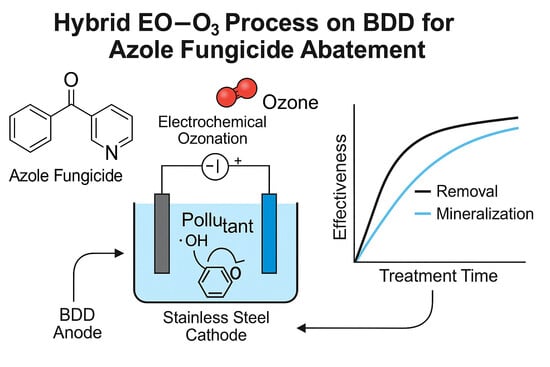
Greener Catalytic Oxidation of Azole Fungicides: Coupling EO–O3 on BDD with Kinetics and Mineralization Targets


,
and
1
Chemical Engineering Department, Universidad de Extremadura, Av. Elvas s/n, 06006 Badajoz, Spain
2
Instituto Universitario de Investigación del Agua, Cambio Climático y Sostenibilidad (IACYS), Avda. de la Investigación s/n, 06006 Badajoz, Spain
*
Author to whom correspondence should be addressed.
This article belongs to the Special Issue Heterogeneous Catalysis for a Greener Environment

Abstract

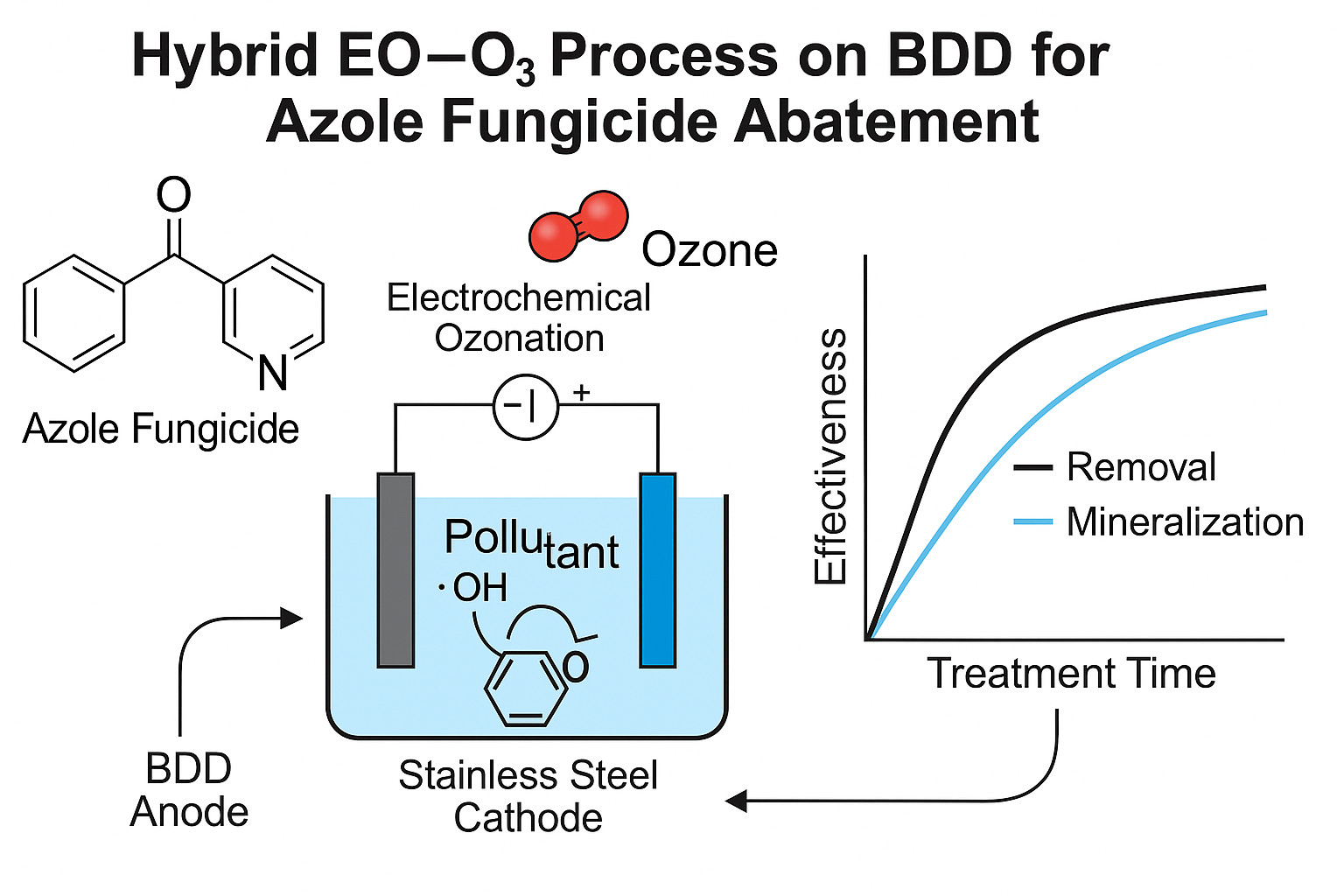
This study evaluates the abatement of four common azole fungicides—prochloraz, tebuconazole, tetraconazole, and penconazole—using ozonation (O3), electro-oxidation (EO on boron-doped diamond anode), and their coupling (EO–O3). A central composite design (CCD) with three coded factors—current (A), electrolyte (B), and ozone concentration in the gas phase (C)—was employed to model three responses: pollutant abatement (%), apparent pseudo-first-order rate constant k (min−1), and TOC removal (%). Quadratic models showed good in-samples (R2 ≈ 0.84–0.86). Ozone and current dominate abatement and kinetics (with curvature in current), while the electrolyte penalizes mineralization and narrows the window for TOC removal. Under optimal conditions, 116 mA (current), 0.992 mM (electrolyte), and 7.09 ppm (ozone concentration), the EO–O3 configuration results in a TOC removal of 33.78%. At a reaction time of 10 min (total abatement of the pollutants), the hybrid EO–O3 configuration exhibits a specific energy consumption (SEC) of 1.825 kWh·m−3. We compare trends with the last decade of literature on ozone-based EAOPs, electro-peroxone variants, and BDD anodic oxidation, and outline practical guidance for its application and scale-up, and model refinement in predictive settings.

1. Introduction

Azole fungicides are pervasive agrochemicals in modern agriculture and horticulture. Their triazole or imidazole rings and halogenated phenyl moieties confer persistence and biological activity at low concentrations, complicating removal by conventional biological treatment. Field and monitoring campaigns have reported azoles in surface waters, wastewater effluents, and occasionally in drinking-water sources at ng·L−1 to µg·L−1 levels [1], with seasonal pulses reflecting application cycles and storm-driven runoff. Beyond persistence, certain azole transformation products (TPs) [2] can retain endocrine activity or antimicrobial properties, motivating advanced treatment that goes beyond primary disappearance to achieve carbon removal [3].
Advanced oxidation processes (AOPs) offer versatile routes to oxidize recalcitrant organics via reactive oxygen species (ROS). In ozonation (O3) [4], direct electrophilic reactions occur at activated sites, while indirect radical pathways emerge as ozone decomposes to hydroxyl radicals (•OH) [5,6,7]. The balance between direct and radical routes depends on pH, alkalinity, matrix species, and promoters (e.g., H2O2 in peroxone schemes) [8,9,10]. Other ozone-based AOPs (coupled with solar radiation, UV, active carbon, or chlorine) have also shown great potential [11,12,13,14].
Electro-oxidation (EO) with boron-doped diamond (BDD) anodes [15,16,17,18] is a robust electrochemical advanced oxidation process (EAOP) that generates surface-bound •OH with a high standard potential and minimal adsorption, enabling non-selective oxidation under mild conditions [19,20]. Integrating O3 with EO exploits complementary transport and reaction pathways: ozone delivery through the gas–liquid interface and radical generation near the anode, as well as peroxone-like chains when H2O2 is electro-generated at the cathode [21,22].
While mechanistic models exist for individual AOPs [4,15], engineering design and optimization of coupled AOPs [23,24,25] require empirical maps of factor influence and curvature across realistic operating windows. In this connection, the response-surface methodology (RSM) [26,27] is a pragmatic framework to achieve this: by using structured designs such as central composite designs (CCDs), one can quantify main effects, two-factor synergies, and curvature (quadratic terms) with relatively few experiments [28,29,30].
Recent reviews have emphasized the rapid progress of ozone-based electrochemical AOPs [31,32], including electro-peroxone (E-peroxone) [21,22] and electrolysis-catalyzed ozonation, highlighting electrode stability, reactor configurations, and energy considerations. Likewise, state-of-the-art reports on EAOPs underline the durability and broad reactivity of BDD anodes [15], but also the sensitivity of selectivity and mineralization to electrolyte identity and current density. For azoles in particular, single-stage ozonation typically yields fast primary decay consistent with pseudo-first-order kinetics in dilute solutions. In contrast, TOC removal lags as aromatic acids and ring-opened products accumulate. Therefore, EO extends oxidation [32] but may divert the pathway in chloride-rich media towards active chlorine and chlorine-radical chemistry, increasing apparent abatement without guaranteeing deeper mineralization.
Coupling O3 with EO is therefore attractive but non-trivial: mass transfer of ozone, hydrodynamics of bubble dispersion, local radical fluxes at the anode, and electrolyte-dependent side chemistry all interplay. Micro- and nanobubble ozonation [10] can enhance gas–liquid interfacial area and ozone utilization, offering another dimension for process intensification. Yet, aggressive conditions may trigger diminishing returns due to mass-transfer ceilings, scavenging, or parasitic reactions. From a statistical vantage, such behavior manifests as interior optima (negative quadratic terms) and, at times, significant lack-of-fit of quadratic polynomial signals that the surface bends more sharply than the model can capture or that an unmodelled factor exerts leverage.
Although numerous studies have examined electro-peroxone and other ozone-assisted electrochemical advanced oxidation processes (EAOPs) [21,22,31,32,33,34,35,36,37,38,39,40], most have focused on individual pollutants, providing mechanistic insights without quantitative optimization. Recent reviews [15,17,31,32] highlight the lack of integrative studies that couple kinetics, mineralization, and energy efficiency under realistic, multi-contaminant conditions. The present work addresses this gap by coupling electro-oxidation on boron-doped diamond (BDD) with gas-phase ozonation (EO–O3) and implementing a central composite design (CCD) to develop response-surface models that simultaneously describe pollutant abatement, apparent rate constant (k), and TOC removal for a mixture of four representative azole fungicides. In contrast to previous works that have assessed EO or O3 separately, or hybrid systems without statistical optimization, this study provides, for the first time, an integrated quantitative framework that identifies the main interaction and curvature effects of current, electrolyte, and ozone dosage. It also elucidates the inhibitory effect of sulfate ions on radical reactivity and defines an operational window that achieves balanced kinetics, mineralization, and energy efficiency (SEC ≈ 1.8 kWh·m−3).
Here, we analyze experimental data for the EO–O3 treatment of a four-azole mixture (prochloraz, tebuconazole, tetraconazole, and penconazole) under a CCD, reconstructing quadratic models and visualizing their response surfaces [27]. In this study, we reconstructed quadratic models for three responses that capture complementary objectives: pollutant abatement (removal percentage, %), the apparent pseudo-first-order kinetic constant k (min−1), and mineralization (TOC removal, %). Three coded factors—the galvanostatic current (A), the supporting electrolyte Na2SO4 concentration (B), and the ozone concentration (C) in the feed gas—are the levers most commonly available to practitioners when implementing the EO–O3 coupled process. We assess model adequacy using ANOVA and R2 metrics (both adjusted and predicted). We then interpret the statistics mechanistically, compare with recent literature on ozone-assisted EAOPs, and derive operating guidance. Finally, we discuss implications for predictive use and energy metrics (e.g., electrical energy per order, EE/O) to inform scale-up.

2. Results and Discussion

The design of experiments (DOEs) followed the matrix reported in Table 1. The coded center point corresponded to 101 mA (current), 13 mM (electrolyte concentration), and 5.5 ppm (gas-phase ozone concentration). The factor step sizes were 60 mA, 7.14 mM, and 2.7 ppm, respectively.
Table 1. Coded values for the design of experiments.
The responses were described by a second-order response-surface model defined in terms of the coded factors A (current), B (electrolyte concentration), and C (gas-phase ozone concentration). The polynomial comprised linear (A, B, C), two-factor interaction (AB, AC, BC), and quadratic (A2, B2, C2) terms and were estimated by ordinary least squares using data from a randomized central composite design (CCD). Model adequacy was established through analysis of variance—reporting the model F-statistic and associated p-value—together with coefficients of determination (R2 and adjusted R2) and standard residual diagnostics (assessment of normality, homoscedasticity, and leverage/influence). The fitted surface was subsequently exploited to render response surfaces and contour plots, elucidate main and interaction effects, and locate operating optima within the experimental domain (stationary points and/or targets derived from a multi-response desirability function).

2.1. Pollutants Abatement

2.1.1. ANOVA Test Interpretation

In this case, the target variable was the removal (%) of the sum of concentrations of the four pollutants. As shown in Table 2, the quadratic model adequacy was measured by R2 = 0.855 (adjusted R2 = 0.725) and a global ANOVA F = 6.570 (p = 0.0035). The small R2–R2(adj) gap confirms that the quadratic model captures curvature effects effectively, with no evidence of overfitting.
Table 2. Model ANOVA (model vs. error) for compound abatement.
In ANOVA regression, the SS (sum of squares) quantifies the variability attributed to each source (model, term, error); dfs (degrees of freedom) indicate how much information underlies each SS; MS (mean square) is the variance estimated for that source (MS = SS/df); the F-statistic compares explained to residual variance (F = MS_source/MS_error) to test whether the effect exceeds random noise; and the p-value is the probability of observing an F at least as extreme under the null hypothesis (coefficients = 0), such that a small p suggests the model or term is statistically significant.

2.1.2. Influence of Operating Variables and Optimization

The combined statistical–mechanistic analysis clarifies the operating levers that matter for treating azole fungicides with the EO–O3 process. Ozone concentration (C), firstly, and galvanostatic current (A), secondly, are consistently the most influential factors for pollutant abatement (the sum of the four azole concentrations). Their positive effects persist up to curvature-imposed plateaus, beyond which additional input yields diminishing returns. These plateaus reflect either mass-transfer ceilings, radical recombination, or the onset of side pathways—fingerprinted by negative A2 and C2 terms in the fitted models (see Table 3).
Table 3. Regression coefficients and significance for compound abatement (10 min reaction time).
In regression outputs, SE denotes the coefficient’s standard error (its estimation uncertainty); t is the ratio of the estimate to its SE, quantifying departure from zero; and p is the probability, under the null (actual coefficient = 0), of observing an equal or larger |t|. Consequently, larger |t| (smaller p) indicates a statistically significant term.
The reaction mechanism involves both surface-bound oxidants generated at the BDD anode and solution-phase radical pathways sustained by ozone decomposition. At the anode, water undergoes one-electron oxidation to produce adsorbed hydroxyl radicals (•OH ads), as shown in Equation (1):
H2O → •OH ads + H+ + e (BDD water oxidation)
The high oxygen-evolution overpotential of BDD favors the accumulation of •OH ads, which can oxidize organic pollutants directly or initiate further reactions in solution.
Ozone (added in the gas phase) or produced electrochemically at the anode dissolves into the bulk, where its reactivity depends strongly on pH. Under alkaline conditions, ozone enters a radical chain pathway initiated by its reaction with hydroxide ions:
O3 + OH → O2 + HO2 (ozone chemical decomposition)
The formation of HO2 is the initiation step that governs the pH dependence of ozone transformations. The hydroperoxide anion then reacts with ozone, generating both superoxide and hydroxyl radicals in the propagation stage:
O3 + HO2 → O2 + O2 + •OH (propagation chain reaction)
In parallel, ozone may undergo cathodic reduction according to Equation (4):
O3 + H2O + 2e → O2 + 2OH (ozone cathodic reduction)
This pathway increases the concentration of OH and contributes to the formation of reactive oxygen species that participate in the oxidation sequence.
When electro-oxidation and ozonation coincide, the interaction between anode-generated •OH and dissolved O3 intensifies the radical environment. The coupled effect is schematically represented by Equation (5):
O3 + BDD(H2O) → 2 •OH + O2 (coupled EO–O3)
The radicals produced at the electrode accelerate ozone decomposition, while the intermediates derived from O3 extend the oxidative lifetime of reactive species in the bulk solution. This mutual reinforcement explains the high efficiency of the combined EO–O3 system for the degradation of recalcitrant organic contaminants.
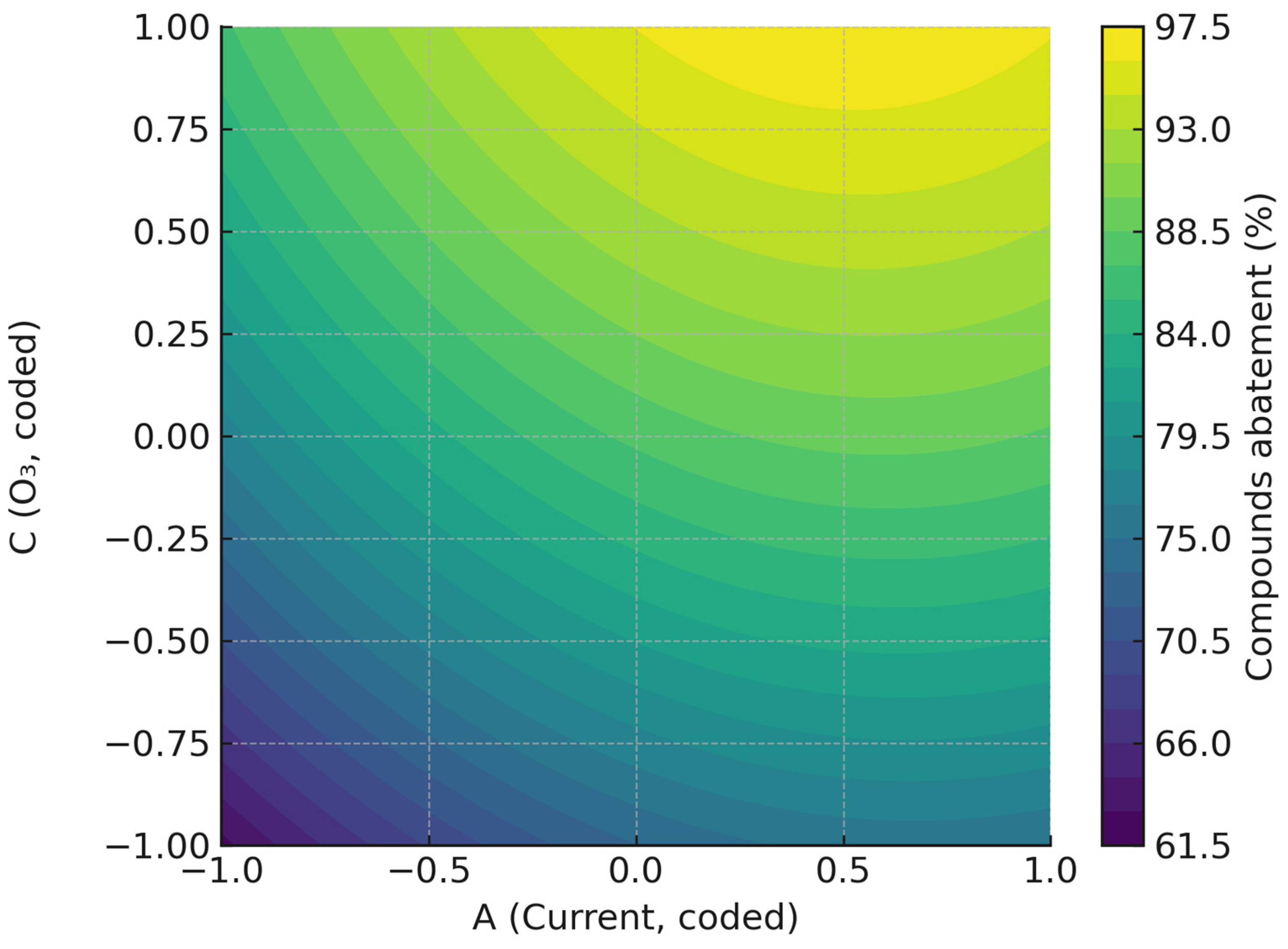
As shown in Figure 1, ozone (coded as C) exerts the most significant positive effect, followed by current (A). The negative A2 and C2 terms imply interior optima in A and C; raising current or ozone concentration improves abatement up to a curvature-limited plateau. Electrolyte (B) shows a negligible (no significant) positive effect on this response. This pattern aligns with ozone-assisted EAOP reports, where synergistic O3/•OH mechanisms and mass-transfer-limited plateaus are widely documented [33,34,35]. Elevated current densities or high ozone concentrations can negatively impact oxidation efficiency due to radical recombination and deactivation. Excessive ozone may lead to the accumulation of reactive oxygen species, such as hydroxyl radicals (•OH), which at high local concentrations rapidly recombine following reactions like the following (see Equations (6) and (7)):
2 •OH → H2O2 (radical recombination)           
OH + H2O2 → H2O+ ·HO2 (less powerful oxidant)     
Figure 1. Two-dimensional contour map for compound abatement (%) (A vs. C; B = 0).
This recombination reduces the availability of free radicals needed for pollutant degradation. Similarly, high currents can accelerate radical generation beyond optimal levels, favoring termination reactions and dissipating oxidative power. Moreover, excess ozone can act as a radical scavenger, reacting with •OH to form less reactive species, thus decreasing overall oxidation capacity (Equation (8)).
O3 + •OH·HO2 + O2

2.2. Kinetics as Target Variable

2.2.1. ANOVA Test Interpretation

In this case, the target variable was the pseudo-first-order kinetic rate constant, k (min−1). The ANOVA test, R2 = 0.842 (adjusted R2 = 0.700), and global ANOVA F = 5.91 (p = 0.0052) demonstrate the adequate simulation capacity of the model. The quadratic form captures k satisfactorily in the studied domain, supporting its use for rapid screening and prioritization. The small R2–R2(adj) gap confirms that the quadratic model captures curvature effects effectively, with no evidence of overfitting.

2.2.2. Influence of Operating Variables and Optimization

The combined statistical analysis (see Table 4) clarifies that ozone concentration (C) (first) and galvanostatic current (A) (second) are the most influential factors for kinetics removal. Their positive effects persist up to curvature-imposed plateaus, beyond which additional input yields diminishing returns. These plateaus reflect either mass-transfer ceilings, radical recombination, or the onset of side pathways (see Equations (6) and (7) of the previous section).
Table 4. Regression coefficients and significance for k (10 min reaction time).
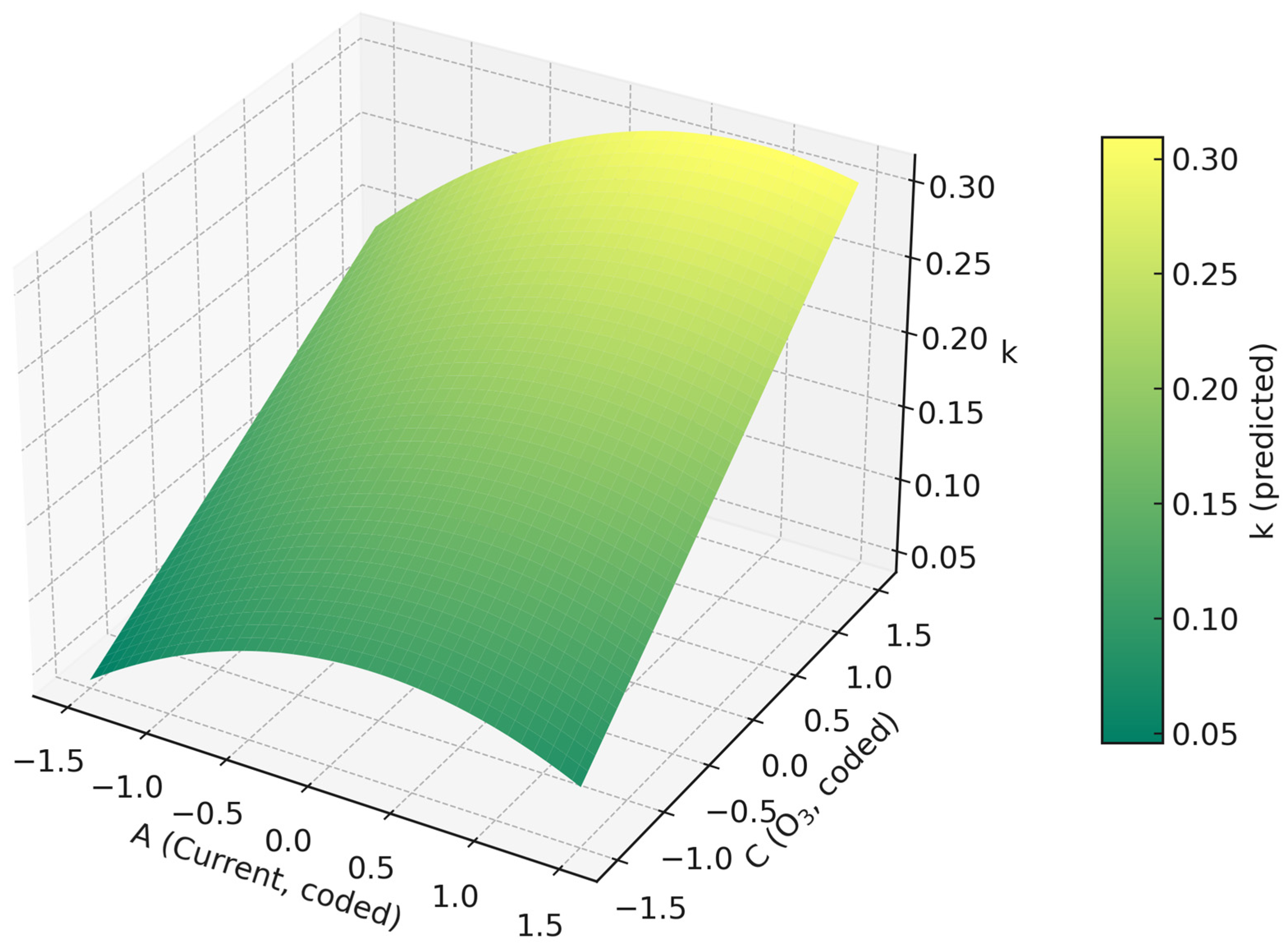
As shown in Figure 2, both C and A increase k; the curvature in A signals diminishing returns at high current. The A–C synergy is evident as sloped ridges in the response surface, consistent with reports where peroxone-like chains and enhanced radical availability drive kinetic gains in E-peroxone configurations (see Equation (8)).
Figure 2. Three-dimensional response surface for k (min−1) as a function of A and C (B = 0).
Related works [38,39,40] describe the same phenomena: an increase in kinetics with current and ozone, their synergy, diminishing returns at high currents (due to radical recombination and the onset of side pathways), and the crucial role of peroxone-like radical chains in driving the reaction kinetics.

2.3. Mineralization as Target Variable

The TOC removal data were obtained at 60 min, since at 10 min the removal levels were too low to be significant for assessing the influence of the operating variables.

2.3.1. ANOVA Test

For this case, the authors considered mineralization (TOC removal, %) as the target variable. The model adequacy R2 = 0.836 (adjusted R2 = 0.690) and global ANOVA F = 5.65 (p = 0.0061) confirm the less-predictive ability of the model (compared with previous target variables), in agreement with the common observation that carbon removal involves slower, multi-step pathways not easily approximated by a single quadratic surface.

2.3.2. Influence of Operating Variables and Optimization

Mineralization (TOC removal) is governed by a different balance: electrolyte (B) exerts a statistically significant and negative main effect. As shown in Table 5, electrolyte (B) penalizes TOC removal. The deactivation of hydroxyl radicals (•OH) by sulfate anions (SO42−) occurs through reactions that reduce the availability of •OH for oxidation processes (see Equation (9)). The primary reactions involve sulfate radicals (SO4), which are formed via the reaction of sulfate ions with •OH under specific conditions. This process generates sulfate radicals (SO4·), which, although reactive, are less reactive than •OH radicals.
·OH + SO42−·SO4 + OH
Table 5. Regression coefficients and significance for TOC removal (60 min of reaction time).
Sulphate radicals can oxidize organic compounds, but typically at lower rate constants compared to •OH. Carbonates and bicarbonates (CO32−/HCO3) also act as hydroxyl-radical scavengers, forming carbonate radicals (CO3) that are less reactive and more selective, thereby reducing overall oxidation efficiency. The overall effect is a reduction in the availability of highly reactive •OH radicals, leading to a “quenching” or deactivation of ·OH oxidative capacity in sulfate-rich environments. This reaction pathway is especially significant in systems where sulfate ions are present as electrolyte support (this case). This explains the empirical observation that treatments delivering nearly complete parent removal may still fall short in TOC, pathways dominated by active •OH radicals.
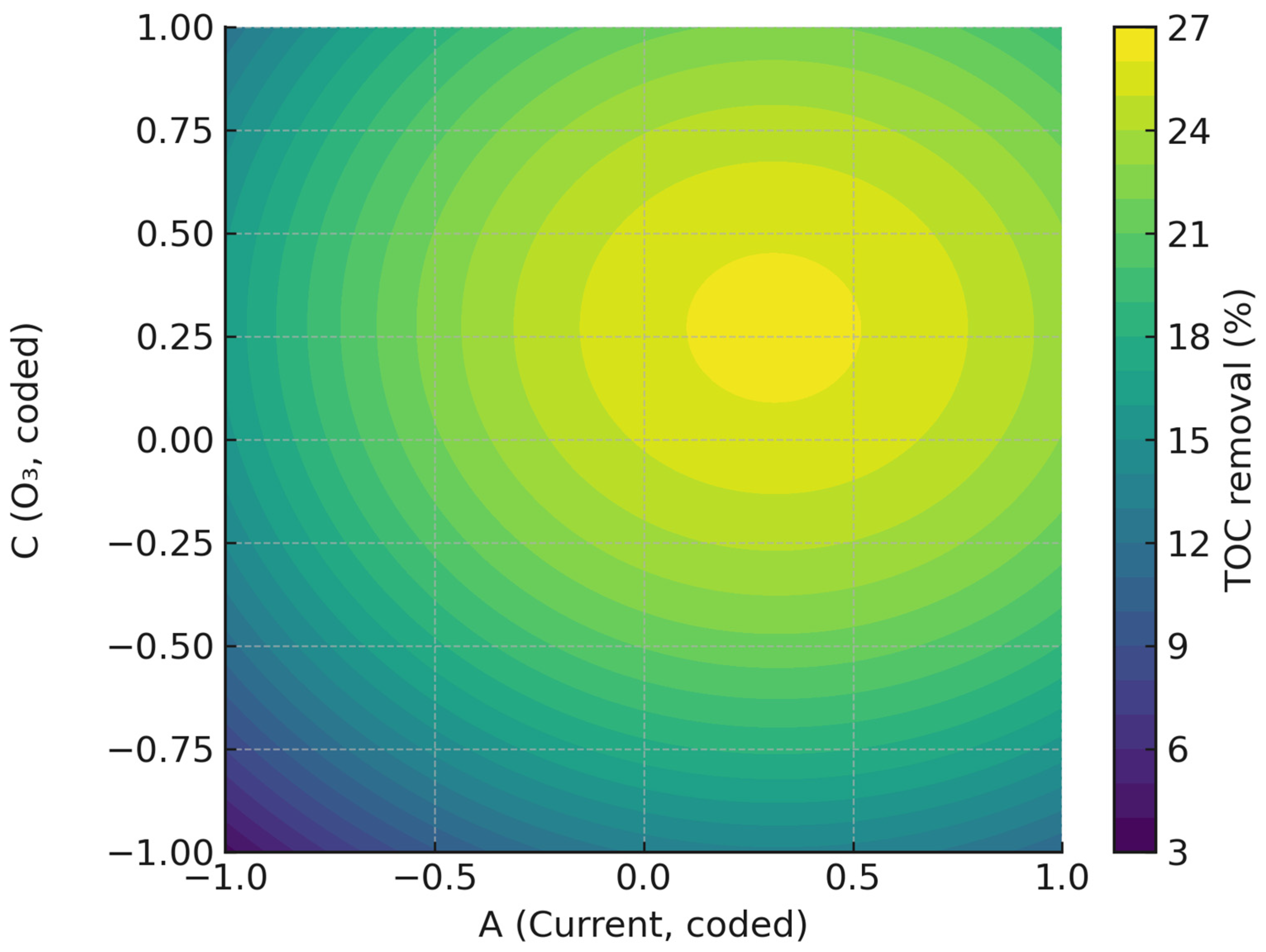
Regarding the curvature in the A and C shapes, a narrow window for mineralization (see Figure 3) was observed. Practically, mineralization benefits from sulfate-based electrolytes at the lowest concentration compatible with conductivity, and from operating A and C near interior optima rather than at extremes. These effects (A and C) were just explained for pollutant abatement and kinetics in previous sections (see Equations (1)–(8)). High ozone or current doses decreased mineralization rates and generated inefficient energy use. Controlling current and ozone concentration is therefore critical to maintain a balance that maximizes radical production while minimizing recombination or deactivation, ensuring efficient pollutant removal and favorable operating costs.
Figure 3. Two-dimensional contour map for TOC removal (%) (A vs. C; B = 0).
Within the CCD design domain (A, B, C ∈ [−1.6818, 1.6818]), the constrained optimum for TOC removal was located at A = +0.2523, B = −1.6818 (boundary), and C = +0.5886 in coded units, corresponding to actual settings of 116.14 mA (current), 0.992 mM (electrolyte), and 7.089 ppm (gas-phase O3). Under these conditions, the model predicts a TOC removal of ≈33.78%. The placement of B at its lower bound indicates that minimizing electrolyte concentration is beneficial within the explored domain.
In general, the EO–O3 process remains among the most robust anode technologies, but electrolyte management is pivotal for steering selectivity toward mineralization. Micro-nanobubble ozonation [9,10] emerges as a complementary lever to increase interfacial area and enhance ozone mass transfer, although energy metrics (EE/O) and bubble management must be balanced to avoid parasitic losses.

2.4. Energy Considerations

At reaction times of 10 min (considered in this research for total abatement of the pollutants), the hybrid EO–O3 configuration exhibits a specific energy consumption (SEC) of 1.825 kWh·m−3, apportioned as 1.200 kWh·m−3 (≈66%) from electro-oxidation and 0.625 kWh·m−3 (≈34%) from ozonation (see Table 6). For the constrained optimum conditions used here (TOC removal 33.78%), the energy per %TOC removed was 0.324 kWh·m−3·(%TOC)−1 (considering a reaction time of 60 min).
Table 6. Energy metrics for the EO–O3 process (10 min of reaction time).
Collectively, these metrics indicate that improving gas–liquid mass transfer of ozone (higher kLa, finer bubbles, optimized contact time, and off-gas management) is a more effective lever for reducing overall energy intensity than merely increasing current density. In practice, operating at a moderate current (to limit parasitic losses and resistive heating), achieving adequate but efficiently dissolved ozone and maintaining minimal electrolytes at the effective conductivity threshold, provides a favorable trade-off between kinetics and power demand, supporting a pragmatic pathway to scale-up with manageable OPEX.
The TOC removal values reported in this work correspond to 60 min of treatment, which represents the plateau region of mineralization. Extending the reaction time beyond this point would provide only marginal additional TOC reduction while significantly increasing specific energy consumption (estimated EE/O > 15 kWh·m−3·order−1). Therefore, the EO–O3 process is more suitable as a pre-oxidation or polishing step to enhance biodegradability with moderate energy demand, rather than as a stand-alone total mineralization technology.

2.5. Practical Implications and Scale-Up

The experimental results indicate that gas-phase ozone dosage (C) is the primary driver of both the apparent rate constant (k) and percent of azole removal, whereas the current (A) exhibits curvature (negative A2), implying diminishing returns beyond a moderate range. Operationally, settings that elevate C while maintaining A at an intermediate level sustain reactivity without unduly increasing electrical demand. Electrolyte concentration (B) does not enhance kinetics or overall removal and displays a negative effect on TOC removal; consequently, B should be minimized to the conductivity threshold required to avoid polarization and excessive ohmic drops, thereby also limiting dissolved-solid loading in the effluent.
The recommended operating window, within the CCD domain and based on the constrained optimum, is as follows: current ≈ 115–135 mA, electrolyte ≈ 1–3 mM, gas-phase O3 ≈ 7–8 ppm. This region balances kinetic performance and energy cost. For TOC, the constrained optimum occurs at A = +0.252, B = −1.682, C = +0.589 (coded).
Scale-up should preserve key invariants: current density (A·m−2), A/V, kLa, and hydraulic/gas residence times comparable to the pilot conditions. Modularization of electrochemical cells and ozone contactors facilitates linear scale-out. Robust anode materials (e.g., BDD) mitigate fouling and sustain oxidative performance. Closed-loop control using DO3/ORP/UV254 and set-points within the recommended window enables adaptation to influent variability.

3. Materials and Methods

3.1. Chemicals

Reference azole fungicides—prochloraz (PCZ), tebuconazole (TBZ), tetraconazole (TCZ), and penconazole (PNZ)—were employed in a mixture (5 ppm for each) as target compounds (≥98% purity; Sigma-Aldrich, Madrid, Spain). Stock solutions were prepared in Type I ultrapure water (Milli-Q) and stored refrigerated; working solutions were freshly diluted on the day of use. The supporting electrolyte (Na2SO4 ≥ 99% purity; Panreac Química, Barcelona, Spain) was dissolved in ultrapure water.

3.2. Oxidation Systems

3.2.1. Ozonation (O3)

Ozonation experiments were carried out in a jacketed glass batch reactor (working volume 0.40 L), thermostated at 20.0 ± 0.5 °C, and operated at a natural pH (6.1). Ozone was generated from oxygen using a Sander GmbH 300.1 (Labor-Ozonisator, Garbsen, Germany) and introduced into the liquid through a porous diffuser to promote homogeneous gas–liquid contact. The inlet gas stream contained a nominal O3 concentration of approximately 1–10 mg·L−1 (adjustable) at a flow rate of 20 L·h−1.
The off-gas was directed through a 2% KI trap to ensure complete ozone quenching before release, preventing atmospheric emissions. Moreover, based on inlet–outlet concentration measurements, the estimated ozone utilization efficiency was approximately 90–95% under optimized EO–O3 conditions.

3.2.2. Electro-Oxidation (EO)

The electrochemical system comprised two flat-plate electrodes (5 cm × 8 cm) separated by a 25 mm gap: a boron-doped diamond (BDD) anode (CSEM, Neuchâtel, Switzerland) and a stainless-steel cathode (AISI 304). Smaller electrodes at the same current increase current density and radical flux, which can enhance oxidation kinetics but also promote side reactions (e.g., O2 evolution, radical recombination). This trade-off is well established in electrochemical advanced oxidation processes and was controlled in our setup by maintaining a constant electrode area of 40 cm2. Galvanostatic operation was imposed with a Tektronix PWS2326 (Tektronix, Inc., Beaverton, OR, USA) power supply; reference tests were conducted at I = 0.30 A (V ≈ 24 V). The electrolyte was Na2SO4 prepared in Type I water.

3.3. Operating Conditions

All experiments used the same liquid volume (0.40 L) and temperature (20.0 ± 0.5 °C). A reaction time of 10 min was selected to ensure direct comparability among O3, EO, and EO–O3 systems under identical energy and hydraulic conditions. Under optimal conditions, practically complete pollutant abatement was achieved (see Supplementary Materials Figures S1 and S2). This duration captures the initial kinetic phase, where pseudo-first-order behavior dominates, and the influence of operational factors is most discernible, while limiting confounding effects associated with ozone depletion and secondary oxidation pathways at longer residence times. However, the TOC removal data were obtained at 60 min, since at 10 min the removal levels were too low to be significant for assessing the influence of the operating variables.

3.4. Analytical Note

Azoles in water were quantified by HPLC-DAD (Agilent 1260 Infinity II, Agilent Technologies, Inc., Santa Clara, CA, USA) using a C18 column (Kinetex, Phenomenex Inc., Torrance, CA, USA, 5 µm, 150 × 4.6 mm). The mobile phase consisted of acetonitrile and an aqueous phase containing phosphoric acid (25 mM) at 1.0 mL·min−1. Detection wavelengths were selected at each compound’s absorption maximum.

4. Conclusions

The combined statistical–mechanistic analysis clarifies the operating levers that matter for treating azole fungicides with the EO–O3 process. Ozone concentration (C) and galvanostatic current (A) are consistently the most influential factors for pollutant abatement and kinetic acceleration. Their positive effects persist up to curvature-imposed plateaus, beyond which additional input yields diminishing returns. These plateaus reflect either mass-transfer ceilings, radical recombination, or the onset of side pathways—fingerprinted by negative A2 terms in the fitted models.
Mineralization (TOC removal) is governed by a different balance: electrolyte (B) exerts a statistically significant and negative main effect, and strong curvature in A and C compresses the feasible window for carbon removal. The deactivation of hydroxyl radicals by sulfate anions occurs through reactions that reduce the availability of •OH for oxidation processes.
From an optimization perspective, the response surfaces recommend increasing ozone and operating at a moderate-to-high current (below curvature-limited optima) while minimizing electrolyte concentration and favoring sulfate over chloride. The recommended operating window, within the CCD domain and based on the constrained optimum, is as follows: current ≈ 115–135 mA, electrolyte ≈ 1–3 mM, gas-phase O3 ≈ 7–8 ppm. This region balances kinetic performance and energy cost.

Supplementary Materials

The following supporting information can be downloaded at: https://www.mdpi.com/article/10.3390/catal15121136/s1, Figure S1: Initial Chromatogram (t = 0) for azoles mixture. EO-O3 treatment; Figure S2: Chromatogram obtained at 10 min of reaction time (EO-O3).

Author Contributions

J.R.D.: supervision, conceptualization, writing—original draft preparation, and writing—review and editing; T.G.: supervision, conceptualization, writing—original draft preparation, methodology, writing—review and editing; D.S.-G.: laboratory investigation and validation. All authors have read and agreed to the published version of the manuscript.

Funding

The authors thank the Ministerio de Ciencia e Innovación of Spain for funding this research under project PID2020-113389RB-I00 (Agencia Estatal de Investigación) MCIN/AEI/10.13039/501100011033. They also thank the Junta de Extremadura and the EU’s FEDER for funding project GR24080.

Data Availability Statement

The data that support the findings of this study are available from the corresponding author upon reasonable request.

Conflicts of Interest

The authors declare that they have no known competing financial interests or personal relationships that could have appeared to influence the work reported in this paper.

References

  1. Liu, J.; Xia, W.; Wan, Y.; Xu, S. Azole and strobilurin fungicides in source, treated, and tap water from wuhan, Central China: Assessment of human exposure potential. Sci. Total Environ. 2021, 801, 149733. [Google Scholar] [CrossRef] [PubMed]
  2. Kang, D.; Lee, H.; Bae, H.; Jeon, J. Comparative insight of pesticide transformations between river and wetland systems. Sci. Total Environ. 2023, 879, 163172. [Google Scholar] [CrossRef] [PubMed]
  3. Saha, P.; Wang, J.; Zhou, Y.; Carlucci, L.; Jeremiasse, A.W.; Rijnaarts, H.H.; Bruning, H. Effect of electrolyte composition on electrochemical oxidation: Active sulfate formation, benzotriazole degradation, and chlorinated by-products distribution. Environ. Res. 2022, 211, 113057. [Google Scholar] [CrossRef]
  4. Hoigné, J.; Bader, H. Rate constants of reactions of ozone with organic and inorganic compounds in water—I: Non-dissociating organic compounds. Water Res. 1983, 17, 173–183. [Google Scholar] [CrossRef]
  5. Gerrity, D.; Wert, E.C. The Role of Ozonation as an Advanced Oxidation Process for Attenuation of 1, 4-Dioxane in Potable Reuse Applications. Ozone Sci. Eng. 2024, 46, 282–293. [Google Scholar] [CrossRef]
  6. Zheng, T.H.; Zhang, Z.Z.; Liu, Y.; Zou, L.H. Recent Progress in Catalytically Driven Advanced Oxidation Processes for Wastewater Treatment. Catalysts 2025, 15, 761. [Google Scholar] [CrossRef]
  7. Martínez, C.M.; Garrido, I.; Flores, P.; Hellín, P.; Contreras, F.; Fenoll, J. Ozonation for remediation of pesticide-contaminated soils at field scale. Chem. Eng. J. 2022, 446, 137182. [Google Scholar] [CrossRef]
  8. Caponio, G.; Vendemia, M.; Mallardi, D.; Marsico, A.D.; Alba, V.; Gentilesco, G.; Forte, G.; Velasco, R.; Coletta, A. Pesticide Residues and Microbiome after Ozonated-Water Washing of Table Grapes. Foods 2023, 12, 3144. [Google Scholar] [CrossRef] [PubMed]
  9. Pal, P.; Kiola, A. Micro and nanobubbles enhanced ozonation technology: A synergistic approach for pesticides removal. Compr. Rev. Food Sci. Food Saf. 2025, 24, 70133. [Google Scholar] [CrossRef]
  10. Xiao, Y.; Liu, H.; Sun, C.; Wang, D.; Li, L.; Shao, L.; Hu, J. Research Progress of Micro-Nano Bubbles in Environmental Remediation: Mechanisms, preparation methods, and applications. J. Environ. Manag. 2025, 375, 124387. [Google Scholar] [CrossRef]
  11. Völker, J.; Stapf, M.; Miehe, U.; Wagner, M. Systematic review of toxicity removal by advanced wastewater treatment technologies via ozonation and activated carbon. Environ. Sci. Technol. 2019, 53, 7215–7233. [Google Scholar] [CrossRef]
  12. Liu, Z.; Jin, R.; Qiao, Y.; Liu, J.; He, Z.; Jia, M.; Jiang, Y. Influencing Factors, Kinetics, and Pathways of Pesticide Degradation by Chlorine Dioxide and Ozone: A Comparative Review. Appl. Sci. 2025, 15, 5154. [Google Scholar] [CrossRef]
  13. Martínez-Escudero, C.M.; Garrido, I.; Ros, C.; Flores, P.; Hellín, P.; Contreras, F.; Fenoll, J. Remediation of pesticides in commercial farm soils by solarization and ozonation techniques. J. Environ. Manag. 2023, 329, 117062. [Google Scholar] [CrossRef] [PubMed]
  14. Gerrity, D.; Gamage, S.; Holady, J.C.; Mawhinney, D.B.; Quiñones, O.; Trenholm, R.A.; Snyder, S.A. Pilot-scale evaluation of ozone and biological activated carbon for trace organic contaminant mitigation and disinfection. Water Res. 2011, 45, 2155–2165. [Google Scholar] [CrossRef]
  15. Brillas, E. Recent development of electrochemical advanced oxidation of herbicides. A review on its application to wastewater treatment and soil remediation. J. Clean. Prod. 2021, 290, 125841. [Google Scholar] [CrossRef]
  16. Brosler, P.; Girão, A.V.; Silva, R.F.; Tedim, J.; Oliveira, F.J. Electrochemical Advanced Oxidation Using BDD—A Review. Environments 2023, 10, 15. [Google Scholar] [CrossRef]
  17. Li, W.; Song, G.; Sun, J.; Zhou, M. Electrochemical Advanced oxidation processes towards carbon neutral wastewater treatment: A Review. Chem. Eng. J. 2024, 480, 148044. [Google Scholar] [CrossRef]
  18. Das, A.K.; Chen, L. A review on electrochemical advanced oxidation treatment of dairy wastewater. Environments 2024, 11, 124. [Google Scholar] [CrossRef]
  19. Radjenovic, J.; Sedlak, D.L. Challenges and opportunities for electrochemical processes as next-generation technologies for the treatment of contaminated water. Environ. Sci. Technol. 2015, 49, 11292–11302. [Google Scholar] [CrossRef] [PubMed]
  20. Martínez-Huitle, C.A.; Brillas, E. Decontamination of wastewaters containing synthetic organic dyes by electrochemical methods: A general review. Appl. Catal. B 2009, 87, 105–145. [Google Scholar] [CrossRef]
  21. Chen, L.; Wei, L.; Ru, Y.; Weng, M.; Wang, L.; Dai, Q. A mini-review of the electro-peroxone technology for wastewaters: Characteristics, mechanism and prospect. Chin. Chem. Lett. 2023, 34, 108162. [Google Scholar] [CrossRef]
  22. Wang, Y.; Yu, G.; Deng, S.; Huang, J.; Wang, B. The electro-peroxone process for the abatement of emerging contaminants: Mechanisms, recent advances, and prospects. Chemosphere 2018, 208, 640–654. [Google Scholar] [CrossRef] [PubMed]
  23. Han, J.; Li, W.; Yang, Y.; Zhang, X.; Bao, S.; Zhang, X.; Zhang, T.; Leung, K.M.Y. UV-Based Advanced Oxidation Processes for Antibiotic Resistance Control: Efficiency, Influencing Factors, and Energy Consumption. Engineering 2024, 37, 27–39. [Google Scholar] [CrossRef]
  24. Oturan, M.A.; Aaron, J.J. Advanced oxidation processes in water/wastewater treatment: Principles and applications. A review. Crit. Rev. Environ. Sci. Technol. 2014, 44, 2577–2641. [Google Scholar] [CrossRef]
  25. Hübner, U.; Spahr, S.; Lutze, H.; Wieland, A.; Rüting, S.; Gernjak, W.; Wenk, J. Advanced oxidation processes for water and wastewater treatment–Guidance for systematic future research. Heliyon 2024, 10, e30402. [Google Scholar] [CrossRef]
  26. Montgomery, D.C. Design and Analysis of Experiments, 9th ed.; Wiley: Hoboken, NJ, USA, 2017. [Google Scholar]
  27. Myers, R.H.; Montgomery, D.C.; Anderson-Cook, C.M. Response Surface Methodology: Process and Product Optimization Using Designed Experiments, 4th ed.; Wiley: Hoboken, NJ, USA, 2016. [Google Scholar]
  28. Box, G.E.P.; Draper, N.R. Response Surfaces, Mixtures, and Ridge Analyses, 2nd ed.; Wiley: Hoboken, NJ, USA, 2007. [Google Scholar]
  29. Montgomery, D.C. Experimental Design for Product and Process Design; Wiley: Hoboken, NJ, USA, 2012. [Google Scholar]
  30. Mehrkhah, R.; Hadavifar, M.; Mehrkhah, M.; Baghayeri, M.; Lee, B.H. Recent advances in titanium-based boron-doped diamond electrodes for enhanced electrochemical oxidation in industrial wastewater treatment: A review. Sep. Purif. Technol. 2025, 358, 130218. [Google Scholar] [CrossRef]
  31. Hu, Z.Y.; Xiang, F.Y.; Mao, J.Q.; Ding, Y.L.; Tong, S.P. Oxidative efficiency of ozonation coupled with electrolysis for treatment of acid wastewater. J. Electrochem. 2022, 28, 2104191. [Google Scholar] [CrossRef]
  32. Qiu, C.; Yuan, S.; Li, X.; Wang, H.; Bakheet, B.; Komarneni, S.; Wang, Y. Investigation of the synergistic effects for p-nitrophenol mineralization by a combined process of ozonation and electrolysis using a boron-doped diamond anode. J. Hazard. Mater. 2014, 280, 644–653. [Google Scholar] [CrossRef]
  33. Amado-Piña, D.; Roa-Morales, G.; Barrera-Díaz, C.; Balderas-Hernandez, P.; Romero, R.; Martín del Campo, E.; Natividad, R. Synergic Effect of Ozonation and Electrochemical Methods on Oxidation and Toxicity Reduction: Phenol Degradation. Fuel 2017, 198, 82–90. [Google Scholar] [CrossRef]
  34. Domínguez, J.R.; González, T.; Montero-Fernández, I. Degradation of Azole Pesticides in WWTP Effluent by Hybrid Advanced Oxidation Processes: UV, O3, US, EO, US/UV, O3/EO, O3/US, UV/O3, UV/EO, UV/O3/US, and UV/O3/EO. J. Environ. Chem. Eng. 2025, 13, 116676. [Google Scholar] [CrossRef]
  35. Zhang, H.; Li, S.; Zhang, C.; Ren, X.; Zhou, M. A Critical Review of Ozone-Based Electrochemical Advanced Oxidation Processes for Water Treatment: Fundamentals, Stability Evaluation, and Application. Chemosphere 2024, 365, 143330. [Google Scholar] [CrossRef]
  36. Liao, X.; Chen, Z.; Du, L.; Chen, J.; Chen, S.; Crittenden, J.C.; Wang, X. Development of an electrochemical oxidation processes model: Revelation of process mechanisms and impact of operational parameters on process performance. Chem. Eng. J. 2025, 503, 158574. [Google Scholar] [CrossRef]
  37. Rodríguez-Peña, M.; Barrios Pérez, J.A.; Llanos, J.; Sáez, C.; Rodrigo, M.A.; Barrera-Díaz, C.E. New insights about the electrochemical production of ozone. Curr. Opin. Electrochem. 2021, 27, 100697. [Google Scholar] [CrossRef]
  38. Von Sonntag, C.; Von Gunten, U. Reaction of Ozone with Hydrogen Peroxide (Peroxone Process): A Revision of Current Mechanistic Concepts Based on Thermokinetic and Quantum-Chemical Considerations. Environ. Sci. Technol. 2010, 44, 3505–3507. [Google Scholar] [CrossRef] [PubMed]
  39. Souza, I.M.G.; Fernández Mena, I.; Moratalla Tolosa, A.; Sáez Jiménez, C.; Pinheiro de Souza, L.; Teixeira, A.C.S.C.; Rodrigo, M.A. Intensification of peroxone production through the paired generation of hydrogen peroxide and ozone in a continuous flow electrochemical reactor. Electrochim. Acta 2025, 524, 146049. [Google Scholar] [CrossRef]
  40. Qin, X.; Zhang, C.; Wang, B.; Dagnew, M.; Yu, J.; Zhang, X.; Zhao, C. Synergistic mechanisms of 3D electrochemical processes and multi-oxidant integration for enhanced water purification. J. Water Process Eng. 2025, 75, 107882. [Google Scholar] [CrossRef]
Disclaimer/Publisher’s Note: The statements, opinions and data contained in all publications are solely those of the individual author(s) and contributor(s) and not of MDPI and/or the editor(s). MDPI and/or the editor(s) disclaim responsibility for any injury to people or property resulting from any ideas, methods, instructions or products referred to in the content.

Article Metrics

Citations

Article Access Statistics

Article metric data becomes available approximately 24 hours after publication online.