
Construction of Modified Silica Gel Catalysts and Their Enhancement of Fructose Dehydration for 5-HMF Production

Abstract
1. Introduction
2. Results
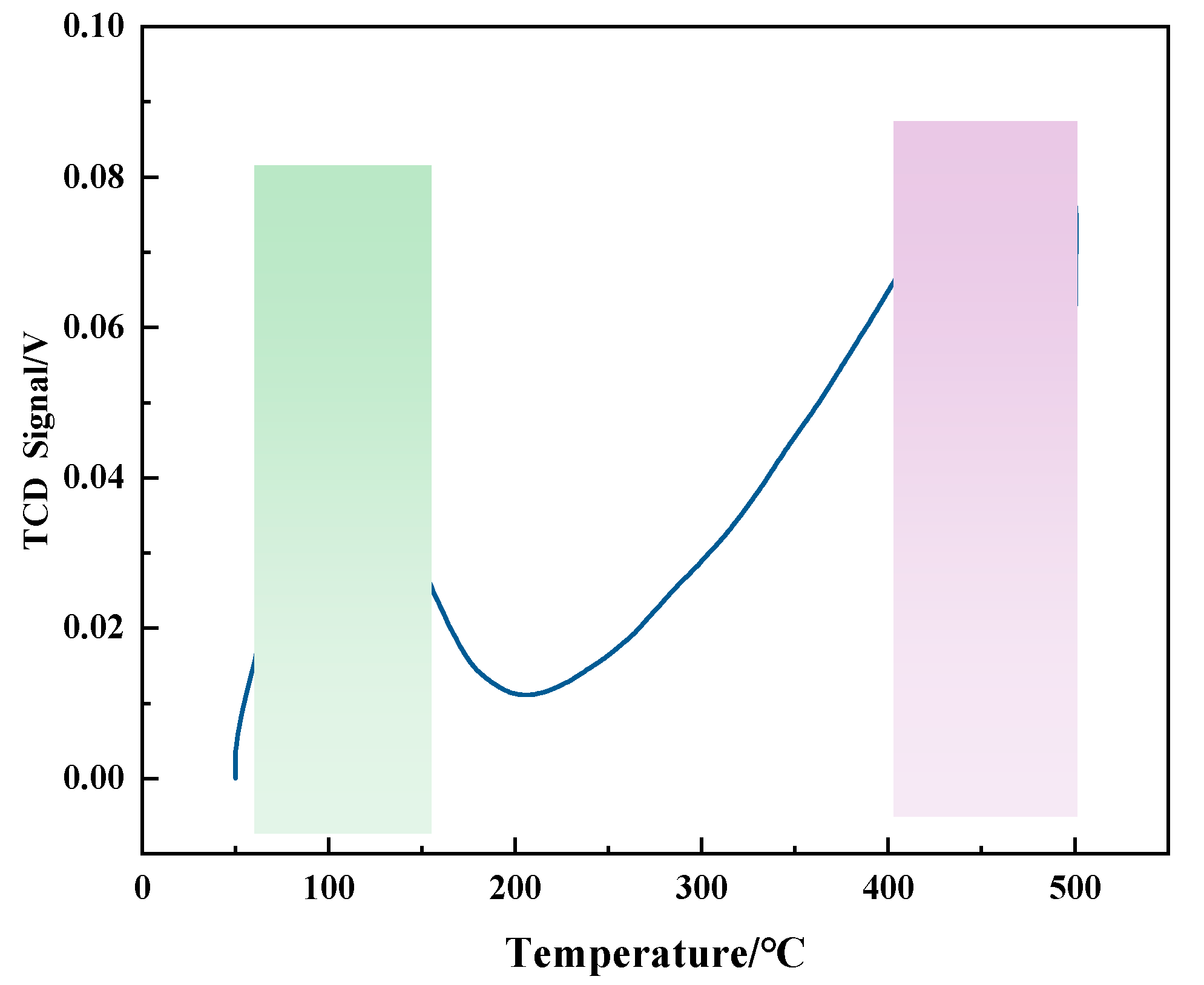
2.1. BET and TPD Analysis
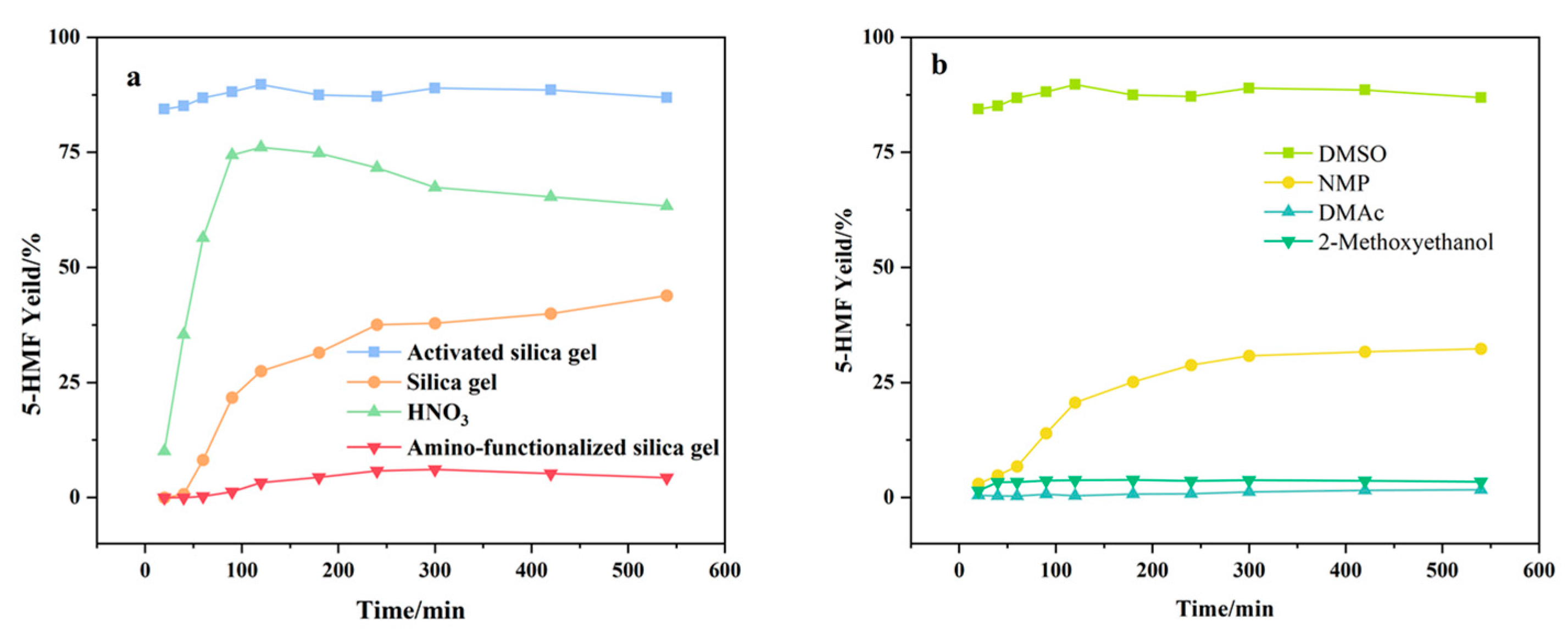
2.2. Effect of Catalyst Type on 5-HMF Yield
2.3. Effect of Solvent on 5-HMF Yield
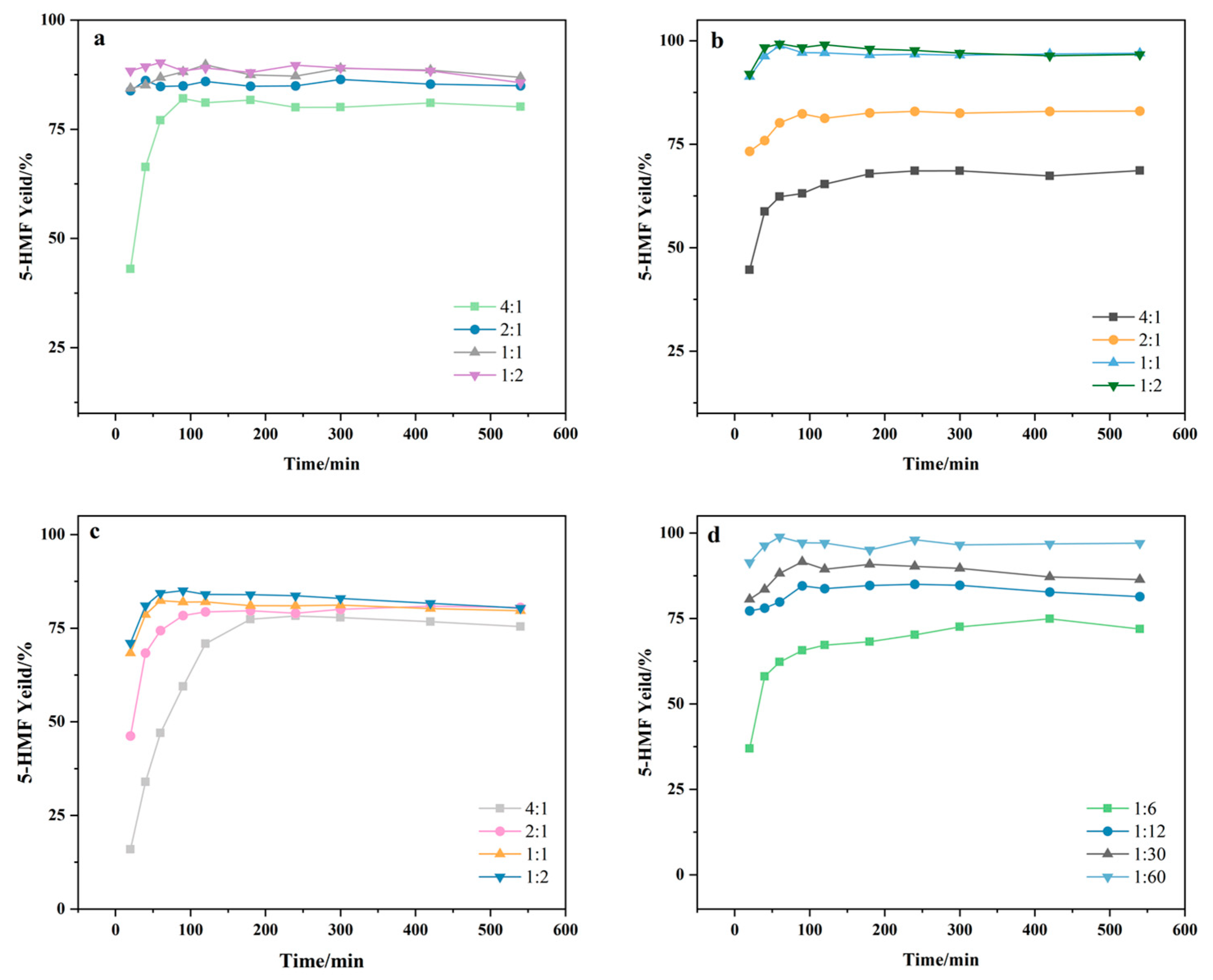
2.4. Synergistic Effect of Temperature and Catalyst Dosage on 5-HMF Yield
2.5. Effect of Substrate Concentration on 5-HMF Yield
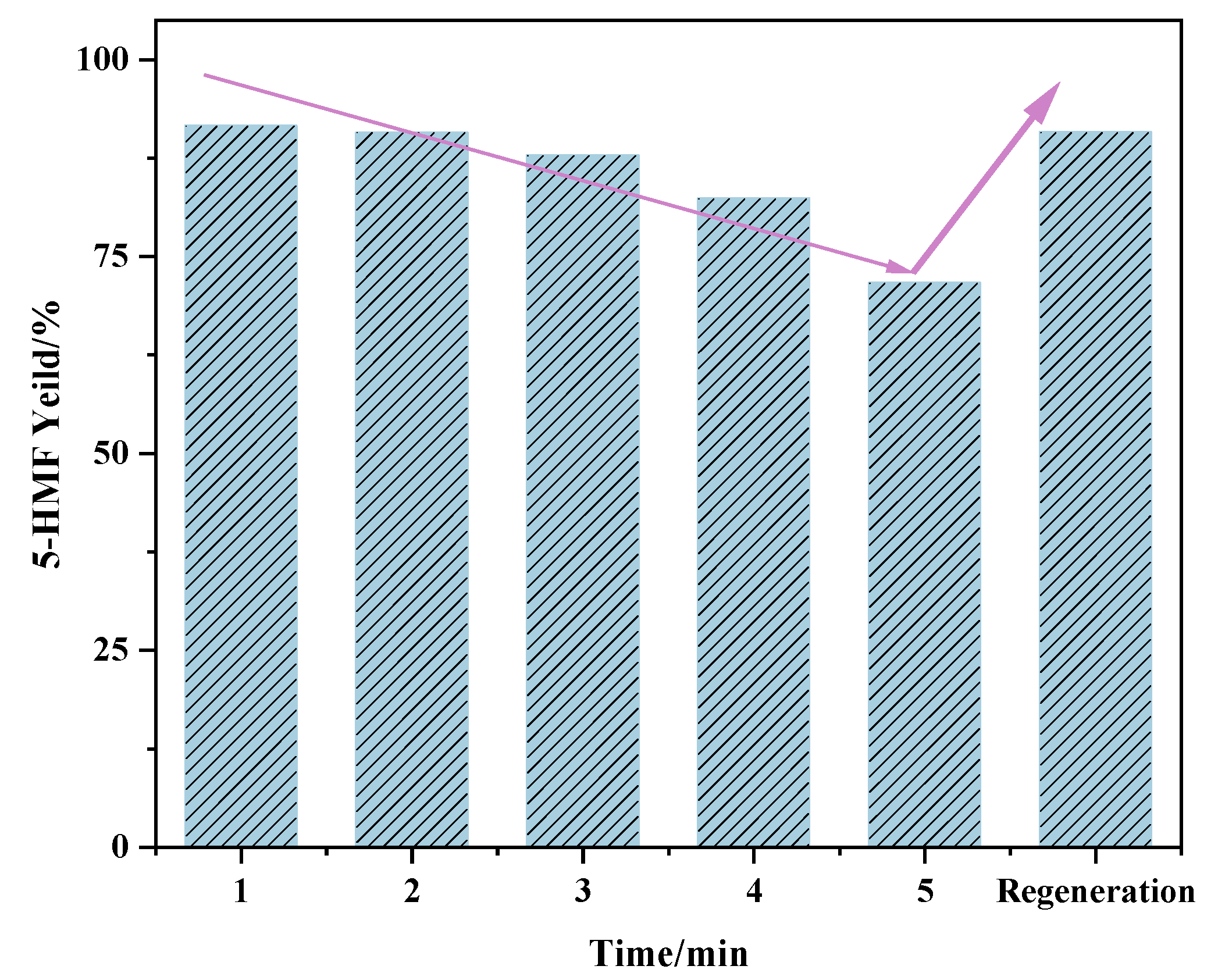
2.6. Recyclability of Catalysts
2.7. Regeneration of Catalyst Activity
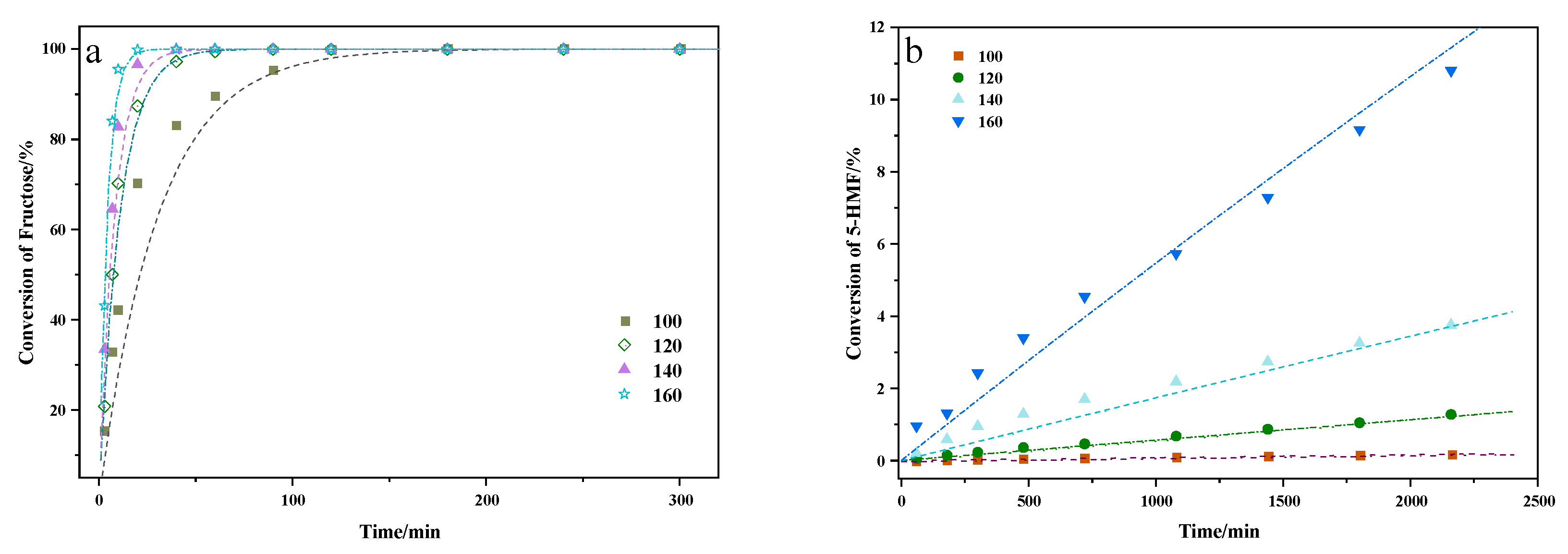
2.8. Reaction Kinetics for the Preparation of 5-HMF from Fructose on Silica Gel Catalyst

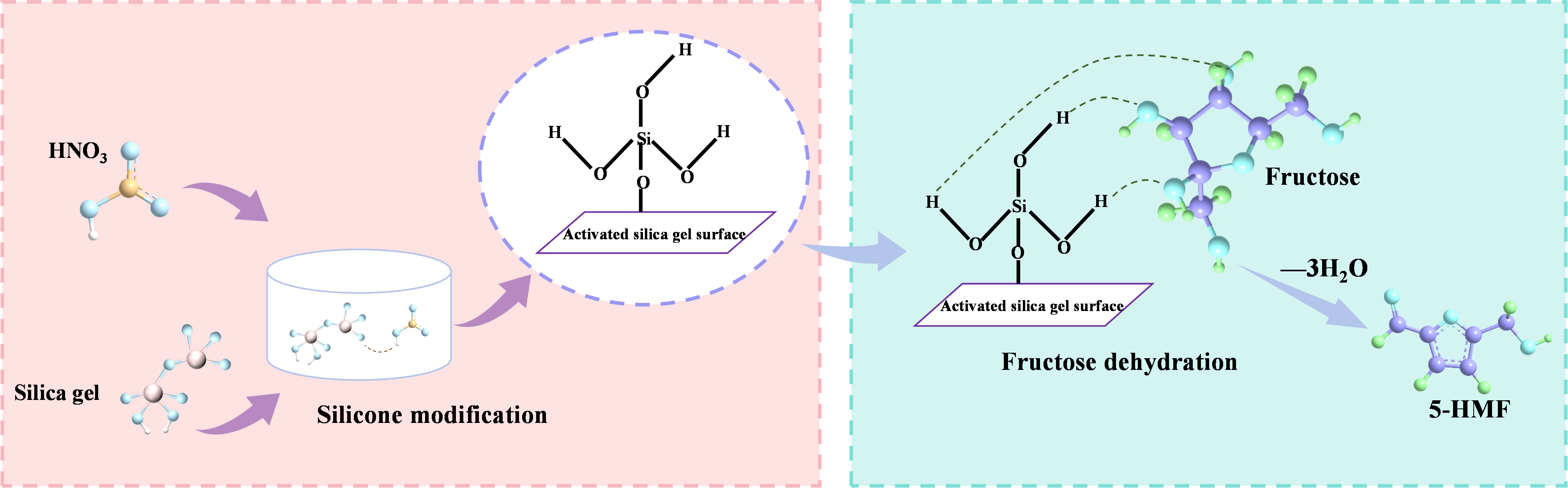
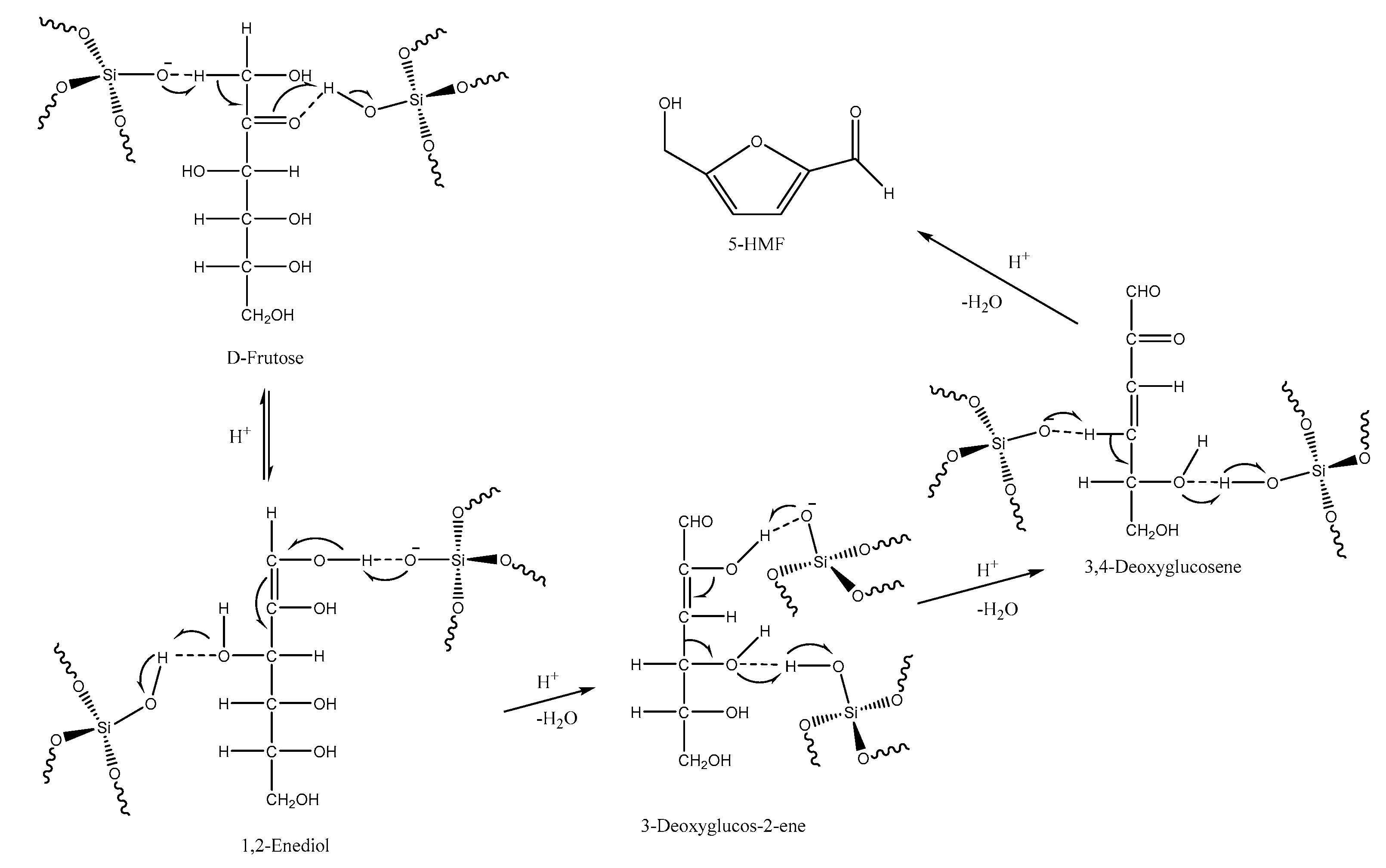
2.9. Catalytic Mechanism of Activated Silicas
3. Materials and Methods
3.1. Experimental Materials
3.2. Preparation of Activated Silica Gel
3.3. Preparation of Aminated Silica Gel
3.4. Catalyst Characterization
3.5. Preparation of Dehydrated Fructose from Fruit and Quantitative Analysis of 5-HMF
4. Conclusions
Author Contributions
Funding
Data Availability Statement
Conflicts of Interest
References
- Zamanbekova, A.T.; Zharmagambetova, A.K.; Auyezkhanova, A.S.; Talgatov, E.T.; Jumekeyeva, A.I.; Akhmetova, S.N.; Kenzheyeva, A.M. Perspectives on the catalytic processes for the deep valorization of carbohydrates into fuels and chemicals. Molecules 2025, 30, 3498. [Google Scholar] [CrossRef]
- He, L.; Chen, L.; Zheng, B.; Zhou, H.; Wang, H.; Li, H.; Zhang, H.; Xu, C.C.; Yang, S. Deep eutectic solvents for catalytic biodiesel production from liquid biomass and upgrading of solid biomass into 5-hydroxymethylfurfural. Green Chem. 2023, 25, 7410–7440. [Google Scholar] [CrossRef]
- Zhao, W.; Ge, Q.; Li, H.; Jiang, N.; Yang, S.; Cong, H. Catalyst-free valorization of biomass resources to value-added products. Green Chem. 2024, 26, 8550–8563. [Google Scholar] [CrossRef]
- Lecona-Vargas, C.S.; Dumont, M.-J. Advances in continuous flow production of 5-(hydroxymethyl)-furfural, 2,5-furandicarboxylic acid, 2,5-diformylfuran, and 2,5-dimethylfuran. Ind. Eng. Chem. Res. 2024, 63, 16222–16246. [Google Scholar] [CrossRef]
- Hu, L.; Lin, L.; Wu, Z.; Zhou, S.; Liu, S. Recent advances in catalytic transformation of biomass-derived 5-hydroxymethylfurfural into the innovative fuels and chemicals. Renew. Sustain. Energy Rev. 2017, 74, 230–257. [Google Scholar] [CrossRef]
- Jiang, Z.; Zeng, Y.; Hu, D.; Guo, R.; Yan, K.; Luque, R. Chemical transformations of 5-hydroxymethylfurfural into highly added value products: Present and future. Green Chem. 2023, 25, 871–892. [Google Scholar] [CrossRef]
- Barbosa, S.L.; de Freitas, M.S.; dos Santos, W.T.P.; Nelson, D.L.; Klein, S.I.; Clososki, G.C.; Caires, F.J.; Baroni, A.C.M.; Wentz, A.P. Dehydration of d-fructose to 5-hydroxymethyl-2-furfural in DMSO using a hydrophilic sulfonated silica catalyst in a process promoted by microwave irradiation. Sci. Rep. 2021, 11, 1919. [Google Scholar] [CrossRef] [PubMed]
- Pawar, H.S. Purification of 5-hydroxymethyl furfural from side products of fructose dehydration reaction in a green solvent. ChemistrySelect 2020, 5, 6851–6855. [Google Scholar] [CrossRef]
- Masteri-Farahani, M.; Ghahremani, M.; Niakan, M. Sulfonic acid functionalized support materials as efficient solid acid catalysts for 5-hydroxymethylfurfural production from sugars. Energy Fuels 2025, 39, 15225–15241. [Google Scholar] [CrossRef]
- Sun, A.; Ying, Y.; Wang, M.; Zhu, L.; Wang, Y.; Zhang, Q.; Li, L.; Cao, C.; Xu, H.; Cheng, D. Efficient conversion of fructose to 5-hydroxymethylfurfural by hydrophobic modified SAPO-34 molecular sieve. J. Catal. 2025, 446, 116059. [Google Scholar] [CrossRef]
- Karimi, S.; Shekaari, H.; Halimehjani, A.Z.; Niakan, M. Solvent-free production of 5-hydroxymethylfurfural from deep eutectic substrate reaction mixtures over a magnetically recoverable solid acid catalyst. ACS Sustain. Chem. Eng. 2021, 9, 326–336. [Google Scholar] [CrossRef]
- Han, X.; Zhu, G.; Ding, Y.; Miao, Y.; Wang, K.; Zhang, H.; Wang, Y.; Liu, S.-B. Selective catalytic synthesis of glycerol monolaurate over silica gel-based sulfonic acid functionalized ionic liquid catalysts. Chem. Eng. J. 2019, 359, 733–745. [Google Scholar] [CrossRef]
- Dong, X.; Xi, J.; Song, B.; Zhang, M.; Jin, B. One-pot fabrication of waste granular silica gel (WGSG) supported nickel catalysts for dry reforming of methane. J. Environ. Chem. Eng. 2022, 10, 108428. [Google Scholar] [CrossRef]
- Urbanas, D.; Baltrėnaitė-Gedienė, E. Selective catalytic reduction of NO by NH3 over Mn–Cu oxide catalysts supported by highly porous silica gel powder: Comparative investigation of six different preparation methods. Catalysts 2021, 11, 702. [Google Scholar] [CrossRef]
- Chen, W.; You, K.; Wei, Y.; Zhao, F.; Chen, Z.; Wu, J.; Ai, Q.; Luo, H.A. Highly dispersed low-polymeric VOx/silica gel catalyst for efficient catalytic dehydrogenation of propane to propylene. Ind. Eng. Chem. Res. 2021, 60, 18327–18336. [Google Scholar] [CrossRef]
- Polshettiwar, V.; Len, C.; Fihri, A. Silica-supported palladium: Sustainable catalysts for cross-coupling reactions. Coord. Chem. Rev. 2009, 253, 2599–2626. [Google Scholar] [CrossRef]
- Jin, R.; Zheng, D.; Liu, R.; Liu, G. Silica-supported molecular catalysts for tandem reactions. ChemCatChem 2018, 10, 1739–1752. [Google Scholar] [CrossRef]
- Lee, D.-H.; Jung, J.-Y.; Jin, M.-J. Highly active and recyclable silica gel-supported palladium catalyst for mild cross-coupling reactions of unactivated heteroaryl chlorides. Green Chem. 2010, 12, 2024–2029. [Google Scholar] [CrossRef]
- Li, Y.; Zhu, H.; Kong, Z.; Zhang, Y.; Ai, X.; Wang, G.; Wang, Q.; Liu, Z.; Lu, S.; Xie, L.; et al. The effect of doping on the digital etching of silicon-selective silicon-germanium using Nitric acids. Nanomaterials 2021, 11, 1209. [Google Scholar] [CrossRef]
- Murata, K.; Yotpanya, N.; Sawada, M.; Kondo, N.; Koike, M.; Arai, S.; Manabe, R.; Hosokawa, S.; Yumura, T.; Kondo, J.N.; et al. Coordinatively unsaturated Lewis acidic aluminum sites in zeolites for direct partial oxidation of methane. Catal. Sci. Technol. 2025, 15, 5025–5037. [Google Scholar] [CrossRef]
- Pei, Z.; Feng, Z.; Yao, Z.; Luo, Y.; Lu, J. Emerging molecular sieve regulation strategy for the adsorption and catalysis: Silicon hydroxyl engineering. Mol. Catal. 2025, 570, 114667. [Google Scholar] [CrossRef]
- Faranak, G.; Mohammad, R.S.S.; Molood, H.Z. Effect of pH and storage temperature on 5-(Hydroxymethyl) furfural (5-HMF) formation in USP syrup preparation. Pharm. Sci. 2015, 21, 1–5. [Google Scholar] [CrossRef]
- Wang, S.; Zhang, M.; Guo, D.; Feng, J.; Pan, H. Construction of Lewis-Brønsted bifunctional carbonaceous acidic catalyst for efficient transformation of glucose into 5-HMF. Fuel 2024, 363, 130991. [Google Scholar] [CrossRef]
- van Putten, R.-J.; Soetedjo, J.N.M.; Pidko, E.A.; van der Waal, J.C.; Hensen, E.J.M.; de Jong, E.; Heeres, H.J. Dehydration of different ketoses and aldoses to 5-hydroxymethylfurfural. ChemSusChem 2013, 6, 1681–1687. [Google Scholar] [CrossRef]
- Amarasekara, A.S.; Williams, L.D.; Ebede, C.C. Mechanism of the dehydration of d-fructose to 5-hydroxymethylfurfural in dimethyl sulfoxide at 150 °C: An NMR study. Carbohydr. Res. 2008, 343, 3021–3024. [Google Scholar] [CrossRef] [PubMed]
- Nikolakis, V.; Mushrif, S.H.; Herbert, B.; Booksh, K.S.; Vlachos, D.G. Fructose–Water–Dimethylsulfoxide Interactions by Vibrational Spectroscopy and Molecular Dynamics Simulations. J. Phys. Chem. B 2012, 116, 11274–11283. [Google Scholar] [CrossRef]
- Wu, Z.; Yu, Y.; Wu, H. Hydrothermal reactions of biomass-derived platform molecules: Mechanistic insights into 5-hydroxymethylfurfural (5-HMF) formation during glucose and fructose decomposition. Energy Fuels 2023, 37, 2115–2126. [Google Scholar] [CrossRef]
- Shen, T.; Hou, L.; Gosset, J.; Wang, H.; Leng, S.; Boumghar, Y.; Barghi, S.; Xu, C. Recent advances in processes and technologies for production of 5-hydroxymethylfurfural and 2,5-furandicarboxylic acid from carbohydrates. Chem. Eng. J. 2024, 500, 156470. [Google Scholar] [CrossRef]
- Lopes da Costa, N.; Guedes Pereira, L.; Mendes Resende, J.V.; Diaz Mendoza, C.A.; Kaiser Ferreira, K.; Detoni, C.; Souza, M.M.V.M.; Gomes, F.N.D.C. Phosphotungstic acid on activated carbon: A remarkable catalyst for 5-hydroxymethylfurfural production. Mol. Catal. 2021, 500, 111334. [Google Scholar] [CrossRef]
- Hou, Q.; Li, W.; Ju, M.; Liu, L.; Chen, Y.; Yang, Q. One-pot synthesis of sulfonated graphene oxide for efficient conversion of fructose into HMF. RSC Adv. 2016, 6, 104016–104024. [Google Scholar] [CrossRef]
- Huang, T.; Zhang, H.-X.; Zhang, X.-H.; Peng, D.-Y.; Nie, X.-L.; Chen, J.; Xiong, W.-M. Preparation of functionalized diallylimidazole ionic liquid and its application in conversion of D-fructose into HMF. J. Mol. Liq. 2022, 345, 118233. [Google Scholar] [CrossRef]
- Farrell, B.L.; Igenegbai, V.O.; Linic, S. A viewpoint on direct methane conversion to ethane and ethylene using oxidative coupling on solid catalysts. ACS Catal. 2016, 6, 4340–4346. [Google Scholar] [CrossRef]
- Guo, H.; Qi, X. Deep eutectic solvents for synthesis of 5-hydroxymethylfurfural. Curr. Opin. Green Sustain. Chem. 2024, 47, 100924. [Google Scholar] [CrossRef]
- Di Menno Di Bucchianico, D.; Cipolla, A.; Buvat, J.-C.; Mignot, M.; Casson Moreno, V.; Leveneur, S. Kinetic study and model assessment for n-Butyl levulinate production from alcoholysis of 5-(hydroxymethyl) furfural over Amberlite IR-120. Ind. Eng. Chem. Res. 2022, 61, 10818–10836. [Google Scholar] [CrossRef]
- Arabie, M.; Toghraie, D.; Samani, M.R.; Haratian, M.; Aghadavoudi, F. Thermal performance of octadecane as phase change materials in circular tube applying molecular dynamics simulation: The effect of initial temperature. Eur. Phys. J. Plus 2025, 140, 328. [Google Scholar] [CrossRef]



| Types of Catalysts | Macroporous Silica Gel | Activated Silica Gel | Aminated Silica Gel |
|---|---|---|---|
| Specific surface area (m2∙g−1) | 372 | 376 | 338 |
| Average pore size (nm) | 12.3 | 12.1 | 12.5 |
| Total acidity (mmol∙g−1) | 0.009 | 0.037 | 0 |
| Temperature (°C) | k0 (min−1) | k1 (min−1) | k2 (min−1) | k3 (min−1) |
|---|---|---|---|---|
| 100 | 0.03265 | 0.02953 | 0.00312 | 8.079 × 10⁻⁷ |
| 120 | 0.08326 | 0.07339324 | 0.00987 | 5.680 × 10⁻⁶ |
| 140 | 0.1453 | 0.126216 | 0.01911 | 1.652 × 10⁻⁵ |
| 160 | 0.2796 | 0.238565529 | 0.04102 | 4.924 × 10⁻⁵ |
| Activation Energy, Ea (kJ∙mol−1) | Pre-Exponential Factor, A (min−1) | ||||
|---|---|---|---|---|---|
| Ea1 | Ea2 | Ea3 | A1 | A2 | A3 |
| 45.88 | 56.55 | 90.47 | 8.24 × 10⁴ | 2.79 × 10⁵ | 4.48 × 10⁶ |
Disclaimer/Publisher’s Note: The statements, opinions and data contained in all publications are solely those of the individual author(s) and contributor(s) and not of MDPI and/or the editor(s). MDPI and/or the editor(s) disclaim responsibility for any injury to people or property resulting from any ideas, methods, instructions or products referred to in the content. |
© 2025 by the authors. Licensee MDPI, Basel, Switzerland. This article is an open access article distributed under the terms and conditions of the Creative Commons Attribution (CC BY) license (https://creativecommons.org/licenses/by/4.0/).
Share and Cite
Zheng, L.; Qu, Y.; Li, Y.; Cao, Y.; Wei, Q.; Fang, M. Construction of Modified Silica Gel Catalysts and Their Enhancement of Fructose Dehydration for 5-HMF Production. Catalysts 2025, 15, 1160. https://doi.org/10.3390/catal15121160
Zheng L, Qu Y, Li Y, Cao Y, Wei Q, Fang M. Construction of Modified Silica Gel Catalysts and Their Enhancement of Fructose Dehydration for 5-HMF Production. Catalysts. 2025; 15(12):1160. https://doi.org/10.3390/catal15121160
Chicago/Turabian StyleZheng, Liya, Yongshui Qu, Yibing Li, Yuanxin Cao, Quanyuan Wei, and Ming Fang. 2025. "Construction of Modified Silica Gel Catalysts and Their Enhancement of Fructose Dehydration for 5-HMF Production" Catalysts 15, no. 12: 1160. https://doi.org/10.3390/catal15121160
APA StyleZheng, L., Qu, Y., Li, Y., Cao, Y., Wei, Q., & Fang, M. (2025). Construction of Modified Silica Gel Catalysts and Their Enhancement of Fructose Dehydration for 5-HMF Production. Catalysts, 15(12), 1160. https://doi.org/10.3390/catal15121160