Article

Enhanced Hydrogen Desorption Performance of AlH3 via MXene Catalysis

1
Guangxi Novel Battery Materials Research Center of Engineering Technology, School of Physical Science and Technology, Guangxi University, Nanning 530004, China
2
College of Mathematics and Physics, Guangxi Minzu University, Nanning 530006, China
3
Guangxi Key Laboratory of Electrochemical Energy Materials, Nanning 530004, China
4
State Key Laboratory of Silicon and Advanced Semiconductor Materials, School of Materials Science & Engineering, Zhejiang University, Hangzhou 310027, China
5
Key Laboratory of Advanced Energy Materials Chemistry (Ministry of Education), Nankai University, Tianjin 300071, China
*
Author to whom correspondence should be addressed.
These authors contributed equally to this work.
Catalysts 2025, 15(12), 1143; https://doi.org/10.3390/catal15121143
Submission received: 25 September 2025 / Revised: 14 November 2025 / Accepted: 27 November 2025 / Published: 4 December 2025
(This article belongs to the Special Issue Advanced Catalysts for Energy Conversion and Environmental Protection)

Abstract

Aluminum hydride (AlH3) features a theoretical hydrogen content of 10.1 wt%, with initial hydrogen desorption temperatures generally ranging from 150 to 200 °C. However, its metastability makes it complicated to achieve low hydrogen desorption temperatures alongside high desorption capacities, which has limited its practical application. This study aims to improve the hydrogen desorption performance of AlH3 by incorporating different MXenes (V2C, Nb2C, Ti3C2, Ti3CN) accompanied by ball milling condition and catalyst content optimizations. It was shown that AlH3 catalyzed with 1 wt% Nb2C, ball milled at 300 rpm for 180 min under an argon atmosphere, exhibits the best performance, achieving an initial hydrogen desorption temperature of 95 °C and a final hydrogen desorption content of 9.3 wt%. It was further demonstrated that Nb2C MXene mainly acts as an efficient catalyst for the hydrogen desorption process of AlH3 and can extend the Al–H bonds of AlH3 in local interphase regions observed by means of theoretical calculation, thus enhancing the hydrogen desorption performance of AlH3. This work proposes a method to achieve high-capacity and low-temperature hydrogen desorption from metastable AlH3 through proper ball milling and the introduction of MXenes.

Graphical Abstract

1. Introduction

The extensive use of traditional fossil fuels poses two problems: environmental pollution and energy depletion. Hydrogen, as a clean secondary energy source, boasts excellent combustion properties, abundant elemental reserves, and diverse utilization forms, making it a highly promising new energy source [1,2,3,4]. The development and utilization of hydrogen energy involve hydrogen production, storage, and application, with the safe and high-density storage of hydrogen gas being a critical aspect [5,6,7,8,9,10,11]. Currently, solid-state hydrogen storage technologies using solid hydrogen storage materials as the hydrogen carriers have become a research hotspot due to their large volumetric hydrogen storage density, low operational pressures, high safety, and high purity of the provided hydrogen. The development of high-performance hydrogen storage materials is crucial for the practical applications of solid-state hydrogen storage [12,13,14,15,16,17,18,19].
Currently, several categories of high-performance hydrogen storage materials are under investigation, including rare-earth-based hydrogen storage alloys (such as LaNi5) [12,20,21], titanium-based hydrogen storage alloys (such as TiMn2, TiFe) [22,23,24,25,26,27,28,29], binary light metal hydrides (such as MgH2, AlH3) [14,30,31,32,33,34,35,36,37,38,39,40,41,42,43,44,45,46,47,48,49,50], complex metal hydrides (such as NaAlH4, LiBH4) [51,52,53,54,55,56,57,58,59,60,61], carbon nanomaterials [62,63,64,65,66], and metal–organic frameworks (MOFs) [15,19,67,68,69]. Among these, AlH3 is a solid-state hydrogen storage material with outstanding performance, possessing high weight and volumetric hydrogen storage densities of 10.1 wt% and 148 kg H2 m−3, respectively, which is double that of liquid hydrogen [50,70,71]. Additionally, AlH3 has a low reaction enthalpy and high hydrogen desorption rates. These advantages render AlH3 highly potential for applications in portable fuel cells, hydrogen fuel cell vehicles, and solid rocket propellants [45,46,47].
However, the practical application of AlH3 still faces several unresolved challenges: first, the reversible hydrogen absorption of AlH3 is difficult, requiring very high hydrogen pressures; second, the hydrogen desorption temperature of AlH3 remains high (150–200 °C). To address the high desorption temperature of AlH3, current methods include radiation-assisted decomposition [72,73], particle size reduction [74,75,76], and additive catalysis [46,47,48,49,77,78,79]. For example, Herley et al. [80,81,82] revealed that compared to untreated samples, AlH3 powder decomposes by 10–30% under irradiation with a 1000 W high-pressure mercury ultraviolet lamp at room temperature. Gabis et al. [72] found that UV-irradiated AlH3 exhibits shorter induction periods and higher hydrogen release rates. Sandrock et al. [75] demonstrated that ball milling AlH3 for one hour reduces its hydrogen release temperature range from 175–200 °C to 125–175 °C. Graetz et al. [76] reported that nanoscale AlH3 synthesized via organometallic methods can decompose below 100 °C without catalysts or mechanical milling. The addition of Ti during AlH3 synthesis lowers its decomposition activation energy, significantly enhancing H2 release rates between 60 and 192 °C [83]. However, such Ti-catalyzed AlH3 composites exhibit extreme instability, undergoing partial decomposition at room temperature and consequently reducing effective hydrogen release capacity. Commonly, enhancing the hydrogen desorption performance of AlH3 involves ball milling in an inert atmosphere to reduce particle sizes while adding metallic compound catalysts; this method is relatively simple to implement and allows better control over the catalyst dosage. Sandrock et al. [75,79] demonstrated that introducing LiH via ball milling reduces the initial hydrogen release temperature of AlH3 by 20–50 °C. He et al. [49] found that ball milling TiB2 with AlH3 lowers the initial hydrogen release temperature by 60 °C compared to pristine AlH3. Although many methods have been developed to enhance the hydrogen desorption performance of AlH3, its metastable nature often leads to premature decomposition when milled with catalysts, resulting in a low effective hydrogen content during use. Generally, the higher the catalyst activity and the greater the ball milling energy, the lower the hydrogen desorption temperature of AlH3, but the lesser the effective hydrogen content. Thus, it is challenging for AlH3 to simultaneously possess low hydrogen desorption temperatures and high desorption capacities, which is a key issue in its application.
MXene, a layered transition metal carbide, has shown great potential in energy conversion and catalysis [33,34,84,85,86,87,88,89,90]. In recent years, MXenes have also been used as catalysts in hydrogen storage materials to enhance their hydrogen absorption and desorption performance [33,34,35,39,41,42,46,52,56,59,60,85,88,90,91,92,93,94]. For instance, Lu et al. [95] milled MgH2 with Ti3C2 and V2C MXenes, producing a MgH2–V2C–Ti3C2 composite that begins desorbing hydrogen at 180 °C and absorbs hydrogen at room temperature with good cycling performance. To reduce the hydrogen desorption temperature of AlH3 while maximizing its desorption capacity, He et al. [48] introduced Ti3C2 MXene as a catalyst into AlH3 by means of ball milling under air atmosphere (250 rpm, 120 min), reducing AlH3’s initial hydrogen desorption temperature to 61 °C with a desorption capacity of 8.1 wt%. Under the same milling conditions, AlH3 milled under argon atmosphere exhibits an initial desorption temperature of 121 °C. Therefore, the addition of MXene materials as catalysts significantly improves the hydrogen storage properties of both MgH2 and AlH3. The high specific surface area of MXenes and the active transition metals contained play a key role in the catalyzed dehydrogenation of these hydrogen storage materials. The large surface area of MXenes will provide more active sites for the catalyzed dehydrogenation of materials. For example, in our previous work, the multilayered V2C MXene has a surface area of 10 m3/g [44]. Inspired by this, this work systematically investigates the catalytic effects of various MXenes (V2C, Nb2C, Ti3C2, Ti3CN) on AlH3 under optimized ball milling conditions, with the aim of achieving low-temperature decomposition without compromising hydrogen capacity. The novelty lies in the identification of Nb2C MXene as a highly effective catalyst, which significantly enhances the desorption kinetics, weakens the Al–H bonds and facilitates the hydrogen release of AlH3.

2. Results and Discussion

2.1. Hydrogen Desorption Properties of AlH3 Catalyzed by MXenes

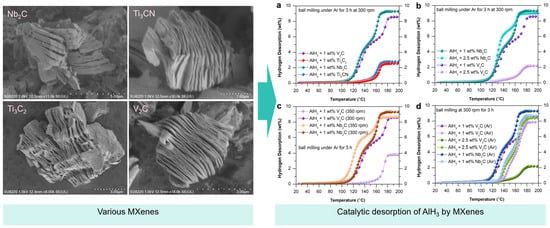
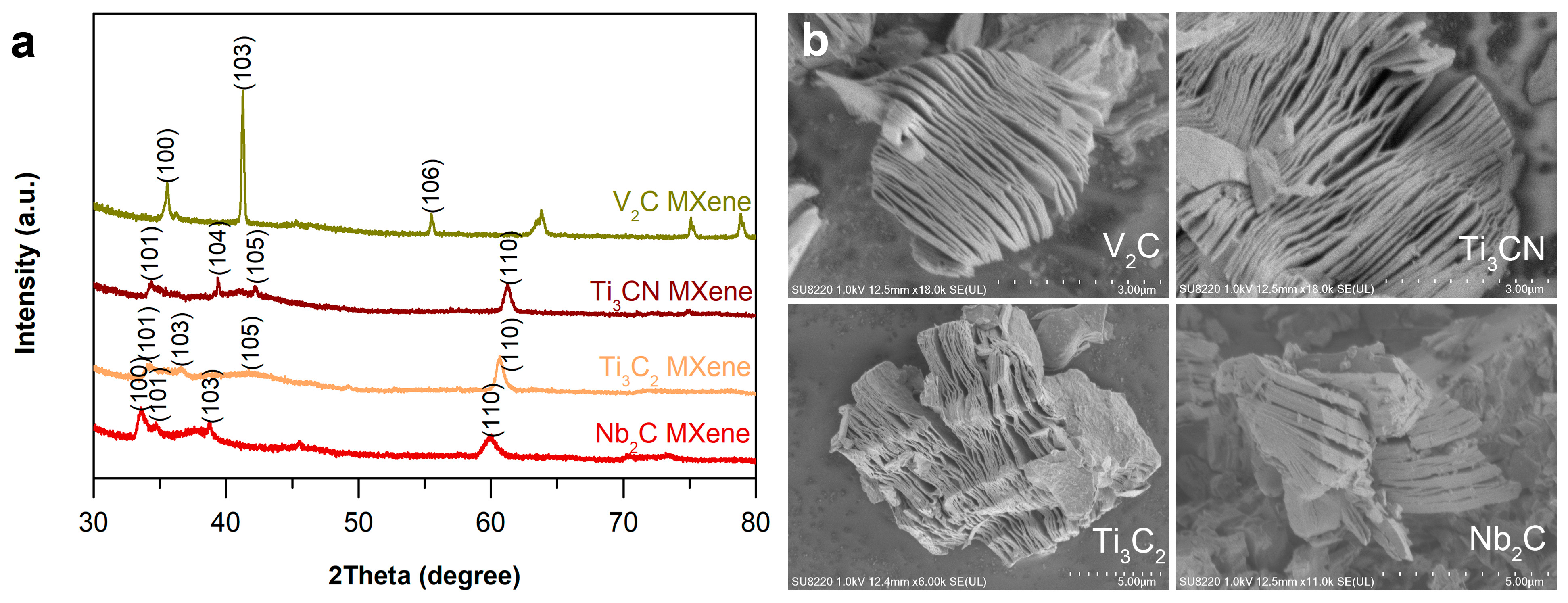
Figure 1a shows the X-ray diffraction (XRD) pattern of the purchased α-AlH3 and the corresponding scanning electron microscope (SEM) image. The XRD pattern matches the standard card (JCPDS: 71-2421) of α-AlH3, and the remaining impurity peaks are ε-AlH3. Figure 1b shows the non-isothermal decomposition curves of as-received AlH3 and as-milled AlH3 (at 300 rpm for 3 h), respectively, at a heating rate of 2 °C min−1. The initial decomposition temperature of as-received AlH3 was 138 °C, and the total hydrogen releasing capacity is 9.8 wt%. The initial decomposition temperature of AlH3 is reduced by 18 °C after ball milling at 300 rpm for 120 min, but the capacity is also decreased slightly. Figure 2a shows the XRD patterns of as-synthesized V2C, Ti3CN, Ti3C2 and Nb2C MXenes, while Figure 2b is the corresponding SEM images, which show that all MXenes are layered structures.
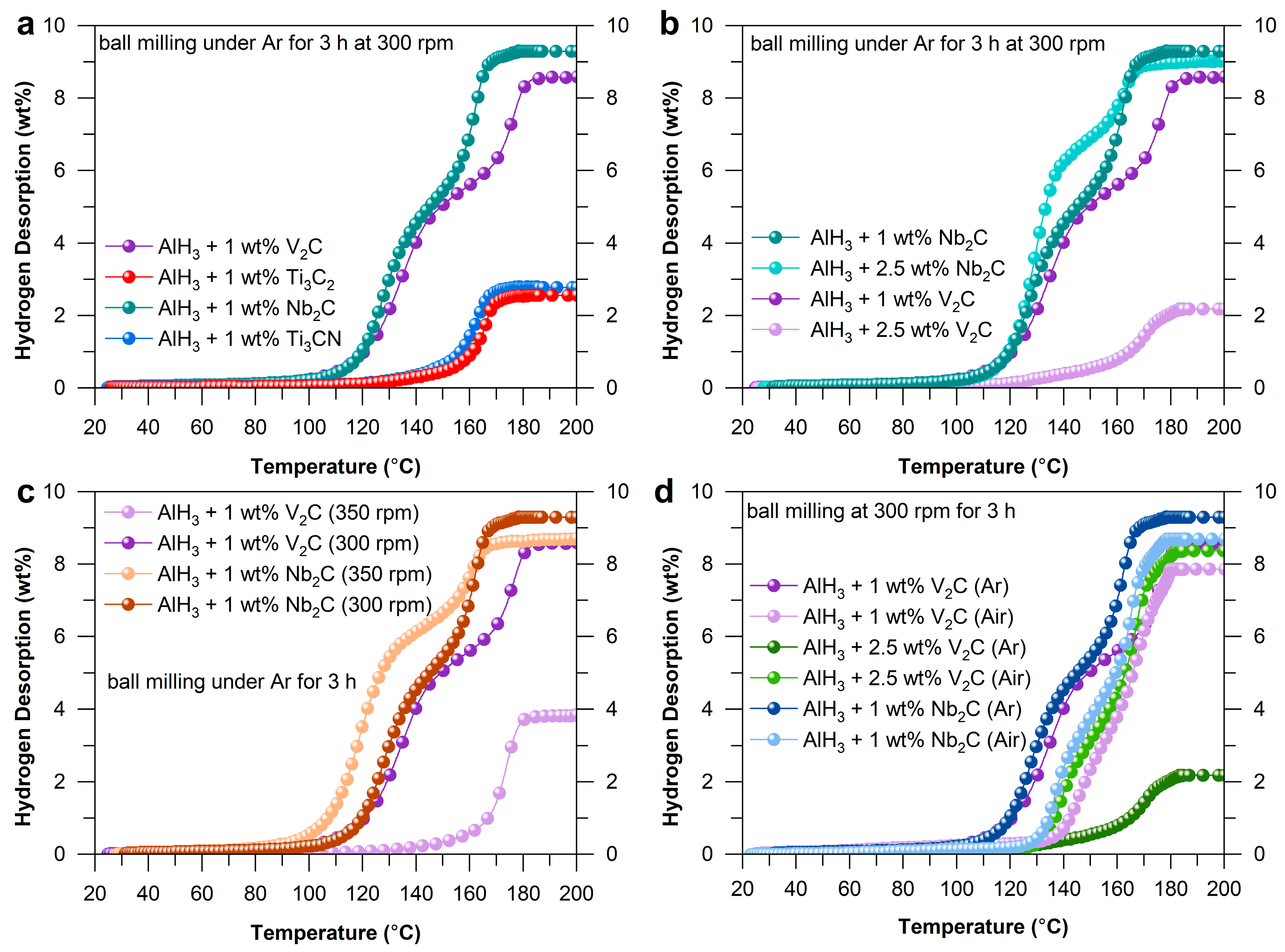
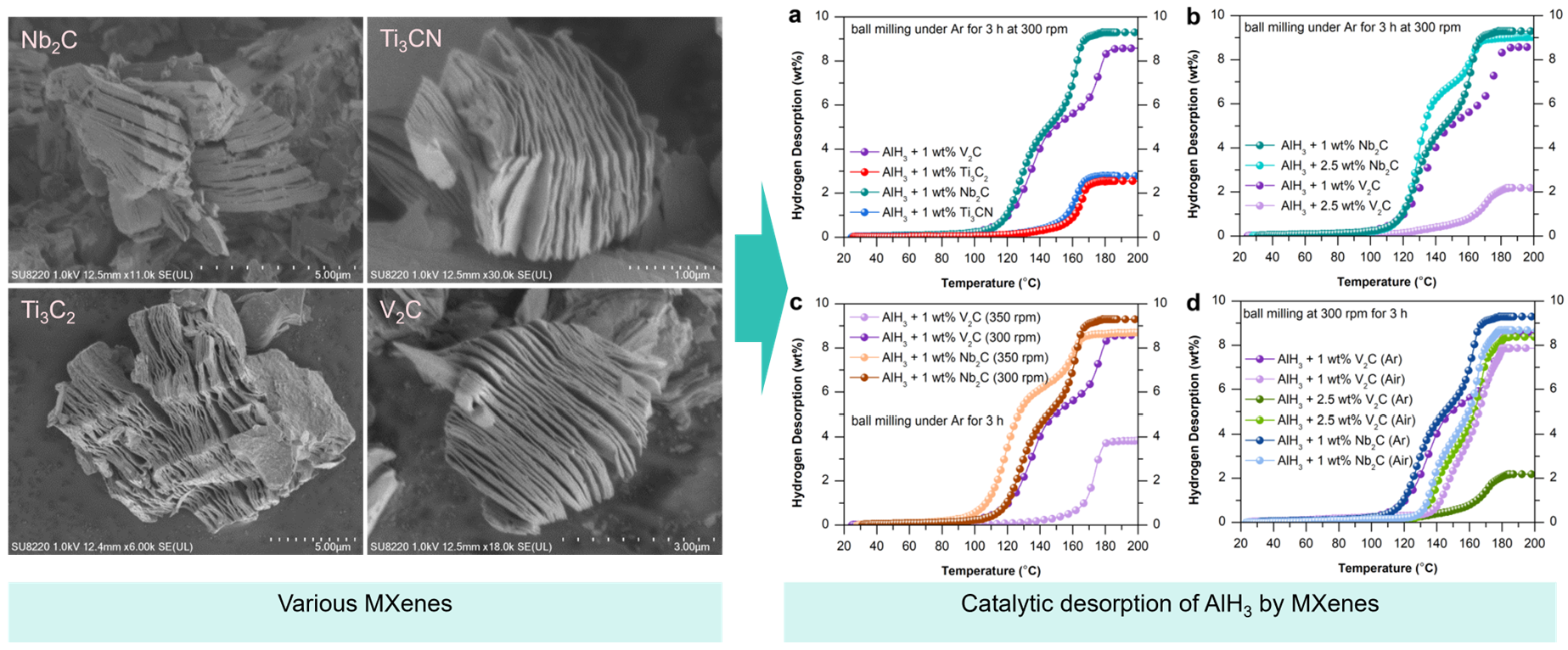
Figure 3 displays the non-isothermal hydrogen desorption curves for different samples heated at a rate of 2 °C min−1. From Figure 3b, it is observed that the initial hydrogen desorption temperature for AlH3 + 2.5 wt% V2C is 122 °C, with a final hydrogen content of only 2.2 wt%. As AlH3 is a metastable compound, it is speculated that the catalytic effect of V2C is too significant, leading to the decomposition of most of the hydrogen during the ball milling process with AlH3, thus reducing the subsequent effective hydrogen content. Therefore, we reduced the V2C content, and from Figure 3b, it is evident that AlH3 + 1 wt% V2C has an initial hydrogen desorption temperature of 93 °C and a final hydrogen content of 8.6 wt%. Under the same milling conditions, the appropriate catalyst content not only improves the hydrogen content of AlH3 but also lowers its initial desorption temperature, significantly enhancing its dehydrogenation performance. Based on this catalyst introduction, we explored the impact of different MXene catalysts on the dehydrogenation performance of AlH3. Table 1 summarizes the hydrogen storage performance of all samples in Figure 3a,b. Figure 3a shows that, under identical milling conditions, the AlH3 + 1 wt% Nb2C composite performs the best, with an initial hydrogen desorption temperature of 95 °C and a final hydrogen content of 9.3 wt%. The AlH3 + 1 wt% Ti3C2 and AlH3 + 1 wt% Ti3CN composites have significantly lower final hydrogen contents, both not exceeding 3.0 wt%. Subsequently, we selected V2C and Nb2C, two catalysts with better catalytic effects, to investigate whether ball milling under air atmosphere could continue to reduce the initial hydrogen desorption temperature of AlH3.
Table 2 summarizes the initial hydrogen desorption temperatures and final hydrogen contents of AlH3 composites obtained under different milling atmospheres shown in Figure 3d. For AlH3 milled with 1 wt% V2C and Nb2C under air atmosphere, performance does not improve significantly. For AlH3 + 1 wt% V2C, although the initial hydrogen desorption temperature is 80 °C, the hydrogen desorption rate is slow within the temperature range up to 140 °C, and the final dehydrogenation content is lower than that obtained under argon atmosphere. This might be due to the rapid chemical reaction of the Al surface with oxygen in the air during the milling process, forming a dense Al2O3 film with stable physical properties, which may have prevented the decomposition of AlH3 during the milling process. Thus, most of the hydrogen in AlH3 is released upon heating, but the initial hydrogen desorption temperature of the AlH3 + 2.5 wt% V2C composite does not decrease significantly. From the discussion above, ball milling under air atmosphere is not very effective in reducing the initial hydrogen desorption temperatures of the AlH3 + 2.5 wt% V2C, AlH3 + 1 wt% V2C, and AlH3 + 1 wt% Nb2C composites. However, when the catalyst content in AlH3 was higher, ball milling under air atmosphere can significantly increase the final hydrogen content of AlH3.
Next, we explored the impact of ball milling speeds (300 rpm and 350 rpm) on the hydrogen desorption of AlH3 + 1 wt% V2C and AlH3 + 1 wt% Nb2C composites. The hydrogen desorption curves are shown in Figure 3c, with the initial decomposition temperatures and final hydrogen desorption capacities listed in Table 3. It is evident that the AlH3 + 1 wt% Nb2C composite milled at 300 rpm exhibits the best hydrogen desorption performance. Therefore, selecting the appropriate milling speed can significantly enhance the hydrogen desorption performance of AlH3.
Based on the above tested initial hydrogen desorption temperatures and the final hydrogen contents of AlH3 + 2.5 wt% V2C, AlH3 + 2.5 wt% Nb2C, AlH3 + 1 wt% V2C, AlH3 + 1 wt% Nb2C, AlH3 + 1 wt% Ti3C2, and AlH3 + 1 wt% Ti3CN samples, we selected the best-performing AlH3 + 1 wt% Nb2C composite for further characterizations.

2.2. Hydrogen Desorption Kinetics and Activation Energy of AlH3 + 1 wt% Nb2C

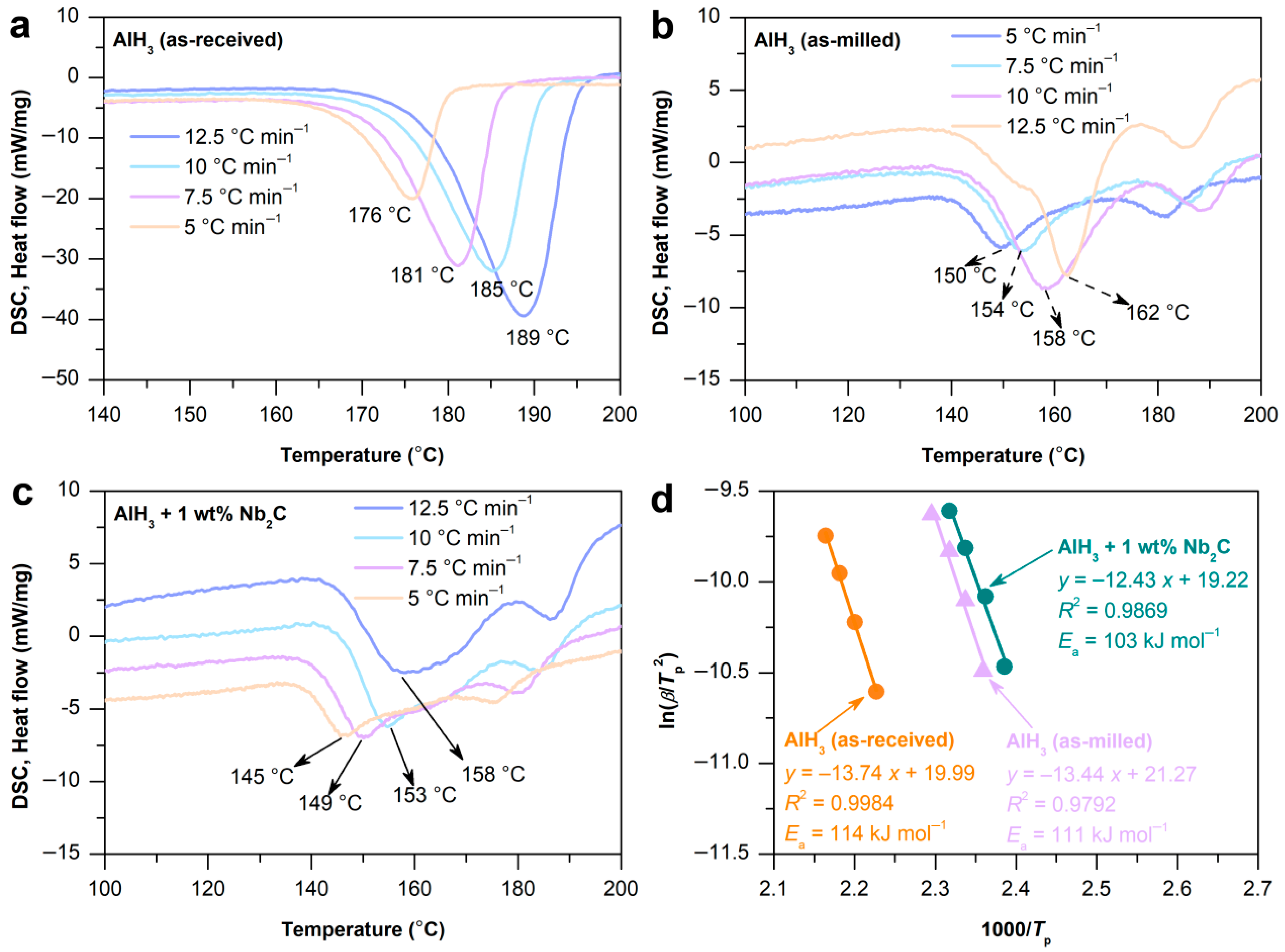
To further understand the decomposition kinetics of the AlH3 + 1 wt% Nb2C composite, Kissinger’s equation was used to estimate the decomposition activation energy of AlH3. The expression for Kissinger’s equation is: ln(β/Tp2) = −Ea/RTp + A, where β represents the heating rate used during DSC testing, T P is the peak temperature of the heat flow curve in the DSC results, E a is the activation energy, R is the gas constant, and A is a constant. In this DSC testing, the heating rates were 5, 7.5, 10, and 12.5 °C min−1. Figure 4a–c respectively show the DSC curves of as-received AlH3, as-milled AlH3, and as-milled AlH3 + 1 wt% Nb2C composite, with the peak temperatures of the heat flow also directly indicated in the figures. It can be seen that the peak temperature for AlH3 + 1 wt% Nb2C is significantly lower than that of both the as-received AlH3 and the as-milled AlH3. By fitting the peak temperatures from the DSC curves at different heating rates to 1000 / T P and ln ( β / T P 2 ) , the fitted curve graph is shown in Figure 4d. Using Kissinger’s equation, the decomposition activation energy E a of the sample can be calculated. Finally, the decomposition activation energies for the as-received AlH3, as-milled AlH3, and as-milled AlH3 + 1 wt% Nb2C composite were found to be 114 kJ mol−1, 111 kJ mol−1, and 103 kJ mol−1, respectively. This indicates that introducing Nb2C can indeed effectively reduce the activation energy of the AlH3 decomposition reaction, thereby enhancing the decomposition kinetics of AlH3 to some extent.

2.3. Microstructural Study on the Catalysis Mechanism in AlH3 + 1 wt% Nb2C

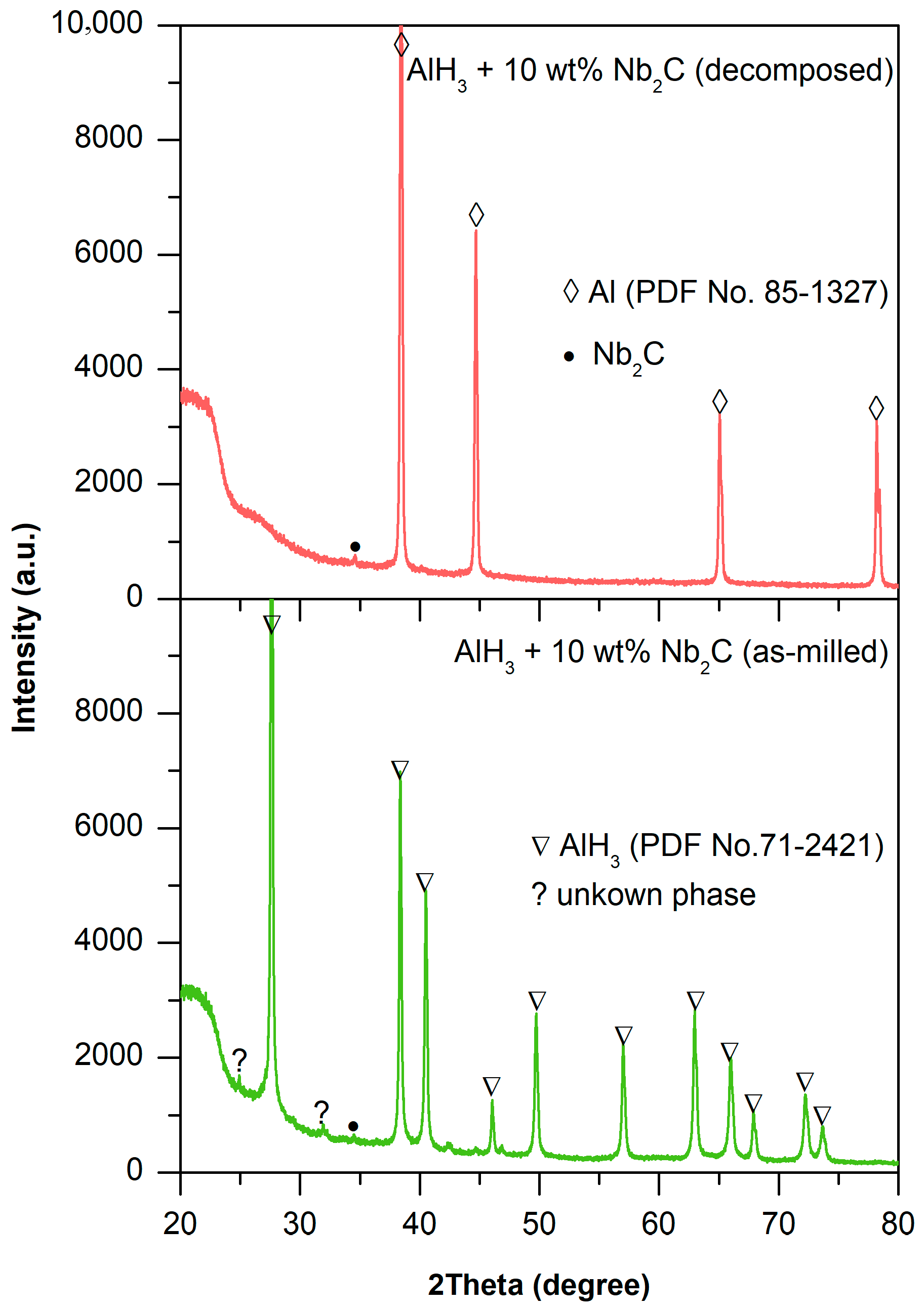
To further investigate the mechanism by which Nb2C enhances the hydrogen desorption performance of the AlH3, XRD analysis was conducted with an increased amount of Nb2C (10 wt%). As shown in Figure 5, it is evident that the characteristic diffraction peaks of AlH3 are apparent in the as-milled AlH3 + 10 wt% Nb2C sample, with no significant Al diffraction peaks observed, indicating that most of the AlH3 does not decompose during the milling process. In other words, hydrogen does not prematurely release. After the hydrogen desorption, only the main Al diffraction peaks remain, indicating that the hydrogen in AlH3 has completely decomposed into hydrogen gas, forming Al. Additionally, some unknown diffraction peaks located at 24.9° and 31.8° are observed, indicating that the catalysts may have reacted with AlH3/Al to form some new phases.
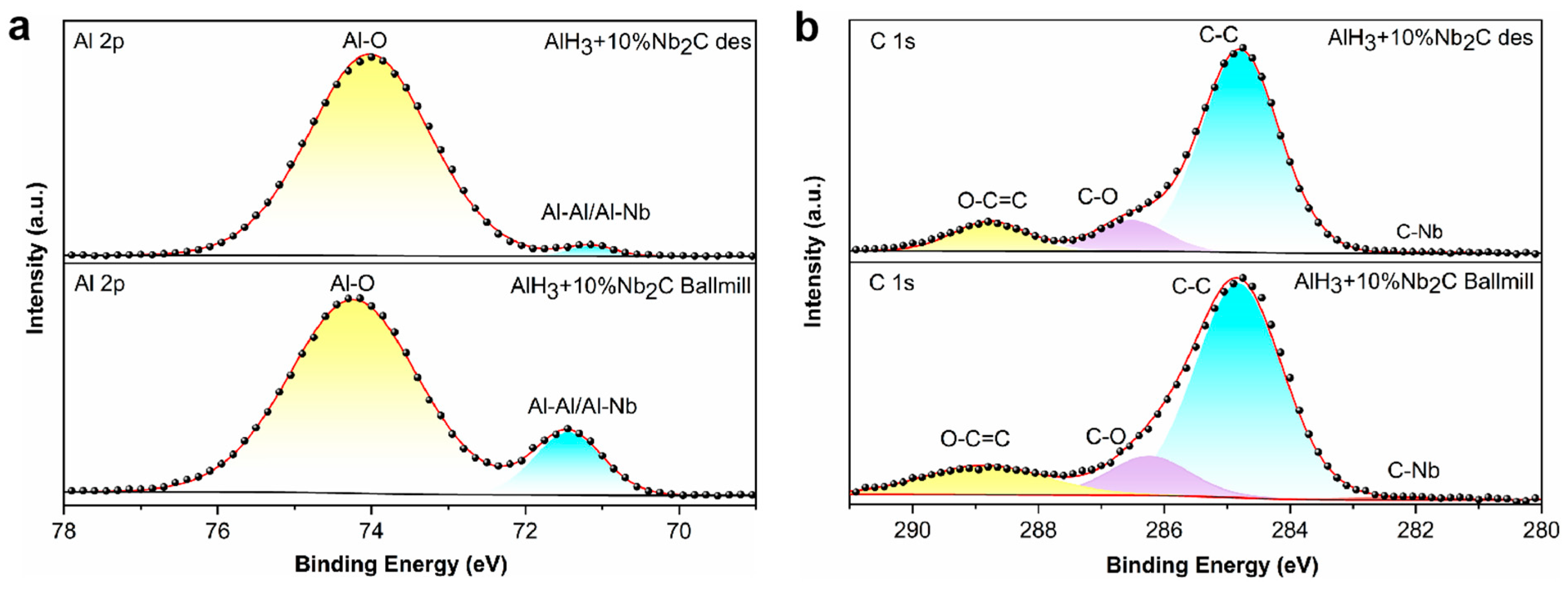
To more accurately analyze the changes of the valence states before and after hydrogen desorption, XPS analysis was performed on the AlH3 + 5 wt% Nb2C composite. Figure 6a presents the XPS spectra of Al 2p for the composite material after ball milling and hydrogen desorption, respectively. In Figure 6a, the peak at 74.3 eV corresponds to Al2O3. After ball milling, a new peak at 71.45 eV appears, which is attributed to Al–Al/Al–Nb bonds. This suggests that the catalyst Nb2C may have reacted with AlH3/Al in the local areas. After hydrogen desorption, the peak weakens. Figure 6b illustrates the XPS spectra of C 1s for the composite material after ball milling and hydrogen desorption, respectively. The peak positions show minimal changes before and after hydrogen desorption, with a weakened C–Nb bond, consistent with the XRD results.
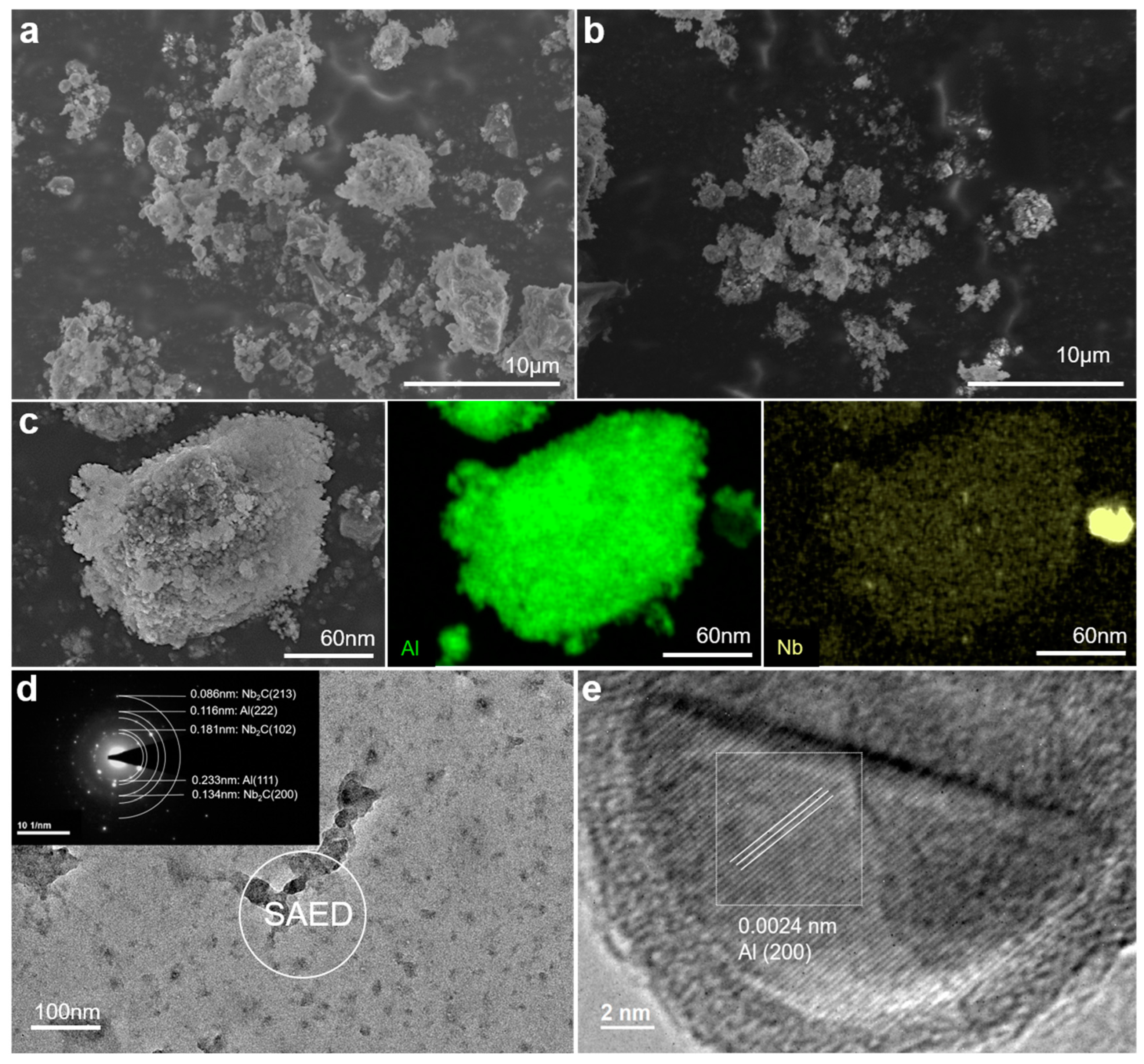
Subsequently, the microstructure of the composite was further studied using SEM and TEM. Figure 7a,b shows the SEM images of the AlH3 + 1 wt% Nb2C sample after milling and after hydrogen desorption, respectively. It can be observed that the particle size of the decomposed sample is noticeably smaller than the as-milled sample. The particles of both samples are composed of many smaller sub-particles. Figure 7c shows the electron image and elemental distribution mappings of the sample after hydrogen desorption. It can be seen that C, Al, and Nb elements are distributed uniformly in the material, which is beneficial for the contact and interaction between Al and Nb. Some Nb-based species are aggregating in the local areas, as shown in the Nb mapping. Figure 7d shows the TEM and SAED images of the sample after hydrogen desorption, with electron diffraction spots for the Al (111), (222) planes and Nb2C (102), (200), (213) planes, which is consistent with the phase analysis from Figure 2a and Figure 5. Figure 7e shows the HRTEM image of the sample after hydrogen desorption, where lattice fringes with a spacing of 0.204 nm can be observed, corresponding to the Al (200) plane. Based on the analysis of the hydrogen desorption process and the microstructural and phase changes before and after the reaction for AlH3 + 1 wt% Nb2C, introducing a small amount of Nb2C into AlH3 can reduce the initial hydrogen desorption temperature to a certain extent, and, in conjunction with appropriate ball milling parameters, can also ensure that most of the hydrogen does not decompose prematurely during milling, ultimately increasing the effective hydrogen content.

2.4. Computational Study on the Catalysis Mechanism in AlH3 + 1 wt% Nb2C

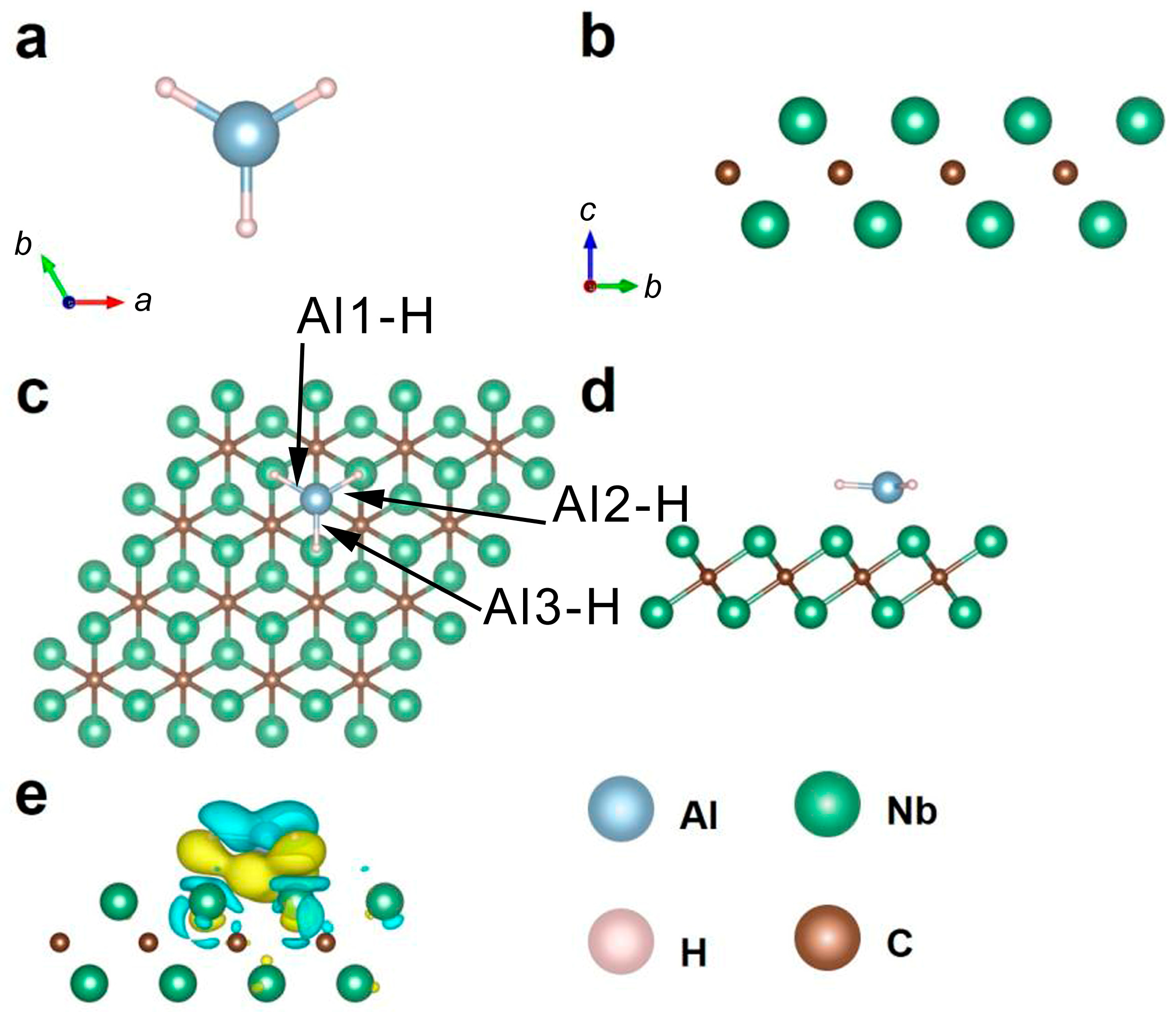
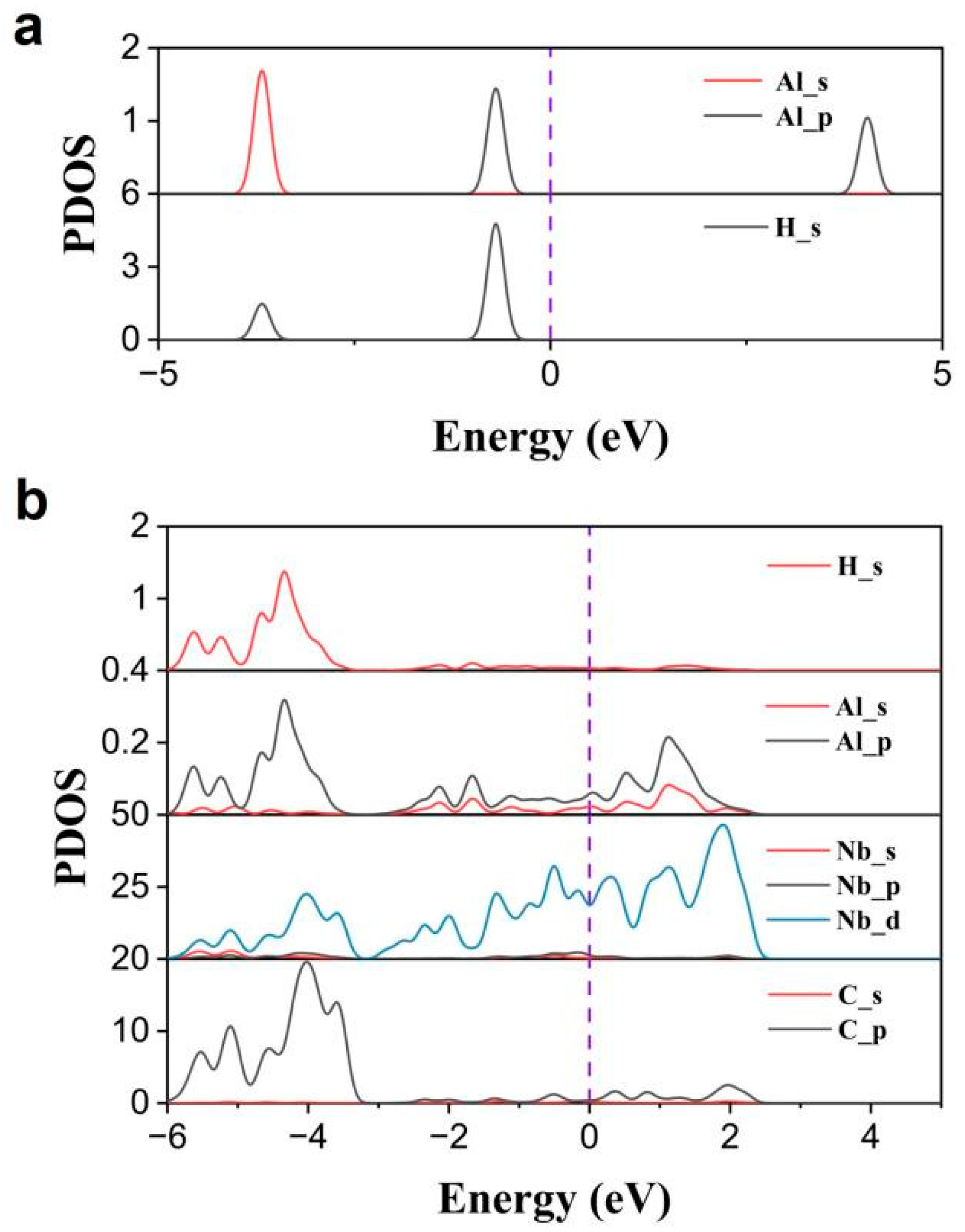
To investigate how Nb2C affects α-AlH3, DFT calculations were performed, focusing on changes in charge density and Al–H bonds from a thermodynamic perspective. Based on results obtained from XRD patterns, the (100) crystal plane of Nb2C was selected for the adsorption simulation of α-AlH3 (Figure 8a–d). Compared with Al–H bonds in pure α-AlH3, the bond lengths significantly increased (Table 4). As shown in Figure 8e, blue, pink, green, and brown spheres represent Al, H, Nb, and C atoms, respectively. The yellow and blue regions indicate charge accumulation and depletion, respectively. This demonstrates that electrons are transferred from Nb to Al, which weakens the ability of Al to draw electrons from H (leading to an increase in the Al–H bond length). This indicates that the interaction of the Al–H bond weakens after adsorption. Figure 9 presents the partial density of states (PDOS) for α-AlH3 with and without Nb2C addition, with the Fermi level set at zero energy. Compared to the sample without Nb2C catalyst (Figure 8a), the sample with Nb2C exhibits significant hybridization between the H s and Nb d orbitals, as well as between the Al p and Nb d orbitals, within the energy range of −6.0 eV to −3.0 eV. These results indicate that Nb2C can facilitate the breaking of the Al–H bonds in AlH3, thereby improving its dehydrogenation performance.

3. Materials and Methods

3.1. Sample Preparation

α-AlH3 (purity of ≥98%) was purchased from Henan Nayu New Material Co., Ltd. (Xinxiang, China) The MXenes (Ti3C2, Nb2C, V2C, Ti3CN) were prepared as follows: Ti3C2 MXene was synthesized by adding 3 g of Ti3AlC2 powder (Fosan Xinxi Technology Co., Ltd., Foshan, China) into 60 mL of 40% HF solution (Aladdin, Shanghai, China) and magnetically stirred at 30 °C for 36 h. After centrifugation at 4000 rpm three times, the precipitate was washed with deionized water until the pH was above 6. The product was then freeze-dried for 24 h to obtain Ti3C2 MXene. The preparation methods for other MXenes are similar.
AlH3 was ball milled with MXenes to prepare the AlH3–MXene composites. The ball milling was carried out on a planetary ball mill (Pulverisette 7, Fritsch, Idar-Oberstein, Germany). Throughout the milling processes, the raw materials were sealed in stainless steel jars under argon atmosphere with a ball-to-powder ratio of 60:1. The ball milling process was conducted in an intermittent mode with cycles of 6 min of milling followed by 6 min of pause, while alternating rotation directions to prevent heat accumulation and subsequent decomposition of AlH3. Initially, AlH3 mixed with 2.5 wt% V2C was ball milled under an argon atmosphere for 180 min at 300 rpm. Dehydrogenation testing of this composite revealed a final hydrogen content of only 2.2 wt%, indicating that an excessive amount of catalyst was added during the milling process, causing most of the hydrogen in AlH3 to decompose prematurely. Therefore, we reduced the catalyst content and prepared AlH3 with 1 wt% V2C under the same milling conditions. Dehydrogenation testing of this composite showed a significant increase in final hydrogen content, reaching 8.6 wt%. Considering the high activity of MXene catalysts in catalyzing the decomposition of AlH3, we then introduced Ti3C2, Nb2C, and Ti3CN at a mass ratio of 1 wt% under the same milling conditions, producing composites of AlH3 with 1 wt% Ti3C2, AlH3 with 1 wt% Nb2C, and AlH3 with 1 wt% Ti3CN. Dehydrogenation testing of these three samples found that the AlH3 composite with 1 wt% Nb2C exhibited the highest hydrogen content. Subsequently, we prepared AlH3 with x wt% V2C (x = 1, 2.5) and AlH3 with 1 wt% Nb2C composites under air atmosphere by ball milling for 180 min at 300 rpm to explore the impact of milling atmosphere on the decomposition of the composites. We then chose AlH3 with 1 wt% V2C and AlH3 with 1 wt% Nb2C composites for further exploration under an argon atmosphere by ball milling for 180 min at 350 rpm to study the effect of milling speed on the decomposition of AlH3.

3.2. Sample Characterization

The phase structure of the materials was studied using an X-ray diffractometer (Rigaku, Miniflex 600) from Tokyo, Japan. The radiation source was Cu Kα, with working current and voltage set at 15 mA and 40 kV, respectively. Scanning steps and rates were 0.02° and 2° min−1, with scanning angles ranging from 5 to 90°. Before testing, the materials were sealed in polyimide film in a glove box to prevent degradation due to contact with oxygen and water. The sample powder was then spread evenly on carbon-based conductive double-sided tape in the glove box, excess powder was blown off, and the sample was placed in a flange pan ball milling jar and tightened. After removal, it was quickly placed on the device platform and vacuumed to minimize the impact of water and oxygen in the air on the sample. The X-ray photoelectron spectrometer used was a Thermo Fisher Scientific’s Thermofisher 250XI (East Grinstead, UK), with a radiation source of Al Kα. The morphology and microstructure of the samples were characterized using a field emission transmission electron microscope (FEI TECNAI G2/F30, FEI from Hillsboro, OR, USA), operated at 300 kV. Elemental distribution was studied using an attached energy-dispersive X-ray detector (EDX) (EDAX, FEI from Hillsboro, OR, USA). The DSC curves of the samples were tested using a Setaram Labsys Evo simultaneous thermal analyzer from Lyon, France, weighing approximately 5 mg of sample. To prevent oxidation, the sample was placed in a covered aluminum crucible (Shanghai Limo Biotech Co., Ltd., Shanghai, China) inside a glove box. The temperature was raised at rates of 5 °C min−1, 7.5 °C min−1, 10 °C min−1, and 12.5 °C min−1, with 20 mL min−1 of argon continuously flowing into the apparatus during testing.

3.3. Hydrogen Desorption Performance Testing

Hydrogen desorption tests were conducted in the laboratory using a Sievert-type apparatus. Approximately 0.1 g of sample was loaded into the reactor inside a glove box. In non-isothermal hydrogen desorption experiments, the sample was heated from room temperature to 200 °C at a rate of 2 °C min−1. In isothermal desorption experiments, the sample was heated to the required target temperature in the shortest possible time and maintained at that temperature throughout the experiment. The hydrogen storage capacity was expressed as a weight percentage of the entire composite material.

3.4. Computational Details

All spin-polarized density functional theory (DFT) calculations were performed using the Vienna Ab initio Simulation Package (VASP 5.4). The projector augmented wave (PAW) method was employed to describe the electron-ion interactions. The exchange-correlation functional was treated within the generalized gradient approximation (GGA) using the Perdew–Burke–Ernzerhof (PBE) functional. A plane-wave energy cutoff of 450 eV was used for the basis set expansion. The convergence criteria for geometry optimization were set to 0.02 eV/Å for the forces on atoms. To account for van der Waals interactions, the Grimme’s DFT-D3 dispersion correction method was applied. The Brillouin zone was sampled using a Γ-centered k-point mesh of 2 × 2 × 1. The energy convergence threshold for self-consistent field (SCF) calculations was set to 10−5 eV. All models were constructed with periodic boundary conditions. Spin polarization was not considered in these calculations. Structural visualization and charge density analysis were conducted using the VESTA 3.5.8 software.

4. Conclusions

We prepared and tested the decomposition performance of composites of AlH3 with V2C, Nb2C, Ti3C2, and Ti3CN MXene materials introduced through ball milling. It was determined that the AlH3 composite with 1 wt% Nb2C has the best decomposition performance. Under an argon atmosphere, with a milling speed of 300 rpm and milling time of 180 min, the initial hydrogen desorption temperature of the AlH3 + 1 wt% Nb2C composite is reduced to 95 °C, with a final hydrogen content of 9.3 wt% and a decomposition activation energy of 103 kJ mol−1. The high specific surface area of the Nb2C MXene may provide more reaction sites for the decomposition reaction of AlH3. Moreover, combining appropriate ball milling time and speed could largely preserve the hydrogen in AlH3. In summary, ball milling to introduce layered Nb2C provides an effective method for achieving controlled high-capacity and low-temperature hydrogen desorption from metastable AlH3.

Author Contributions

Conceptualization, Z.H., L.Z. and H.L. (Haizhen Liu); methodology, Z.H., L.Z. and H.N.; software: J.G.; validation, Z.Y. and J.M.; formal analysis, Z.H., H.N. and C.H.; investigation, Z.H., L.Z., Z.Y., J.M., H.L. (Hui Luo) and Q.W.; resources, X.W. and H.L. (Haizhen Liu); data curation: L.Z.; writing—original draft preparation, Z.H. and L.Z.; writing—review and editing, Z.L., W.Z., X.W., G.L. and H.L. (Haizhen Liu); visualization, L.Z. and H.L. (Haizhen Liu); supervision, J.G. and H.L. (Haizhen Liu); project administration: H.L. (Haizhen Liu); funding acquisition: H.L. (Haizhen Liu). All authors have read and agreed to the published version of the manuscript.

Funding

This research was funded by the Science and Technology Department of Guangxi Zhuang Autonomous Region, grant number 2025GXNSFFA069003, the National Natural Science Foundation of China, grant number 22379030, and the Bagui Young Scholars Program of Guangxi Zhuang Autonomous Region.

Data Availability Statement

The data that support the findings of this study are available from the corresponding author upon reasonable request.

Acknowledgments

This work was supported by the high-performance computing platform of Guangxi University.

Conflicts of Interest

The authors declare no conflicts of interest.

References

  1. Zhao, A.P.; Li, S.; Xie, D.; Wang, Y.; Li, Z.; Hu, P.J.-H.; Zhang, Q. Hydrogen as the nexus of future sustainable transport and energy systems. Nat. Rev. Electr. Eng. 2025, 2, 447–466. [Google Scholar] [CrossRef]
  2. Wu, Y.; Zhong, L. Decarbonizing urban residential communities with green hydrogen systems. Nat. Cities 2025, 2, 81–92. [Google Scholar] [CrossRef]
  3. Johnson, N.; Liebreich, M.; Kammen, D.M.; Ekins, P.; McKenna, R.; Staffell, I. Realistic roles for hydrogen in the future energy transition. Nat. Rev. Clean Tech. 2025, 1, 351–371. [Google Scholar] [CrossRef]
  4. Yang, Z.-X.; Li, X.-G.; Yao, Q.-L.; Lu, Z.-H.; Zhang, N.; Xia, J.; Yang, K.; Wang, Y.-Q.; Zhang, K.; Liu, H.-Z.; et al. 2022 roadmap on hydrogen energy from production to utilizations. Rare Met. 2022, 41, 3251–3267. [Google Scholar] [CrossRef]
  5. Tasleem, S.; Bongu, C.S.; Krishnan, M.R.; Alsharaeh, E.H. Navigating the hydrogen prospect: A comprehensive review of sustainable source-based production technologies, transport solutions, advanced storage mechanisms, and CCUS integration. J. Energy Chem. 2024, 97, 166–215. [Google Scholar] [CrossRef]
  6. Panigrahi, P.K.; Chandu, B.; Motapothula, M.R.; Puvvada, N. Potential Benefits, Challenges and Perspectives of Various Methods and Materials Used for Hydrogen Storage. Energy Fuels 2024, 38, 2630–2653. [Google Scholar] [CrossRef]
  7. Mehr, A.S.; Phillips, A.D.; Brandon, M.P.; Pryce, M.T.; Carton, J.G. Recent challenges and development of technical and technoeconomic aspects for hydrogen storage, insights at different scales; A state of art review. Int. J. Hydrogen Energy 2024, 70, 786–815. [Google Scholar] [CrossRef]
  8. Long, J.-J.; Wu, H.-C.; Liu, Y.-T.; Ding, Y.-Y.; Yao, Q.-L.; Metin, O.; Lu, Z.-H. Hydrogen production from chemical hydrogen storage materials over copper-based catalysts. cMat 2024, 1, e10. [Google Scholar] [CrossRef]
  9. Li, Y.; Li, Q.; Peng, W.; Hua, Z.; Zheng, J. A comparative analysis of the regulations, codes and standards for on-board high-pressure hydrogen storage cylinders. Int. J. Hydrogen Energy 2024, 54, 894–907. [Google Scholar] [CrossRef]
  10. Le, T.T.; Sharma, P.; Bora, B.J.; Tran, V.D.; Truong, T.H.; Le, H.C.; Nguyen, P.Q.P. Fueling the future: A comprehensive review of hydrogen energy systems and their challenges. Int. J. Hydrogen Energy 2024, 54, 791–816. [Google Scholar] [CrossRef]
  11. Kumar, N.; Lee, S.Y.; Park, S.J. Advancements in hydrogen storage technologies: A comprehensive review of materials, methods, and economic policy. Nano Today 2024, 56, 102302. [Google Scholar] [CrossRef]
  12. Zhou, D.; Zheng, C.; Zhang, Y.; Sun, H.; Sheng, P.; Zhang, X.; Li, J.; Guo, S.; Zhao, D. An overview of RE-Mg-based alloys for hydrogen storage: Structure, properties, progresses and perspectives. J. Magnes. Alloys 2025, 13, 41–70. [Google Scholar] [CrossRef]
  13. Shen, S.; Li, Y.; Ouyang, L.; Zhang, L.; Zhu, M.; Liu, Z. V–Ti-Based Solid Solution Alloys for Solid-State Hydrogen Storage. Nano-Micro Lett. 2025, 17, 175. [Google Scholar] [CrossRef]
  14. Xu, Y.; Zhou, Y.; Li, Y.; Ding, Z. Carbon-based materials for Mg-based solid-state hydrogen storage strategies. Int. J. Hydrogen Energy 2024, 69, 645–659. [Google Scholar] [CrossRef]
  15. Li, Y.; Guo, Q.; Ding, Z.; Jiang, H.; Yang, H.; Du, W.; Zheng, Y.; Huo, K.; Shaw, L.L. MOFs-Based Materials for Solid-State Hydrogen Storage: Strategies and Perspectives. Chem. Eng. J. 2024, 485, 149665. [Google Scholar] [CrossRef]
  16. Abdechafik, E.H.; Ait Ousaleh, H.; Mehmood, S.; Filali Baba, Y.; Bürger, I.; Linder, M.; Faik, A. An analytical review of recent advancements on solid-state hydrogen storage. Int. J. Hydrogen Energy 2024, 52, 1182–1193. [Google Scholar] [CrossRef]
  17. Yang, H.; Ding, Z.; Li, Y.T.; Li, S.Y.; Wu, P.K.; Hou, Q.H.; Zheng, Y.; Gao, B.; Huo, K.F.; Du, W.J.; et al. Recent advances in kinetic and thermodynamic regulation of magnesium hydride for hydrogen storage. Rare Met. 2023, 42, 2906–2927. [Google Scholar] [CrossRef]
  18. Huang, L.J.; Lin, H.J.; Wang, H.; Ouyang, L.Z.; Zhu, M. Amorphous alloys for hydrogen storage. J. Alloys Compd. 2023, 941, 168945. [Google Scholar] [CrossRef]
  19. Simanullang, M.; Prost, L. Nanomaterials for on-board solid-state hydrogen storage applications. Int. J. Hydrogen Energy 2022, 47, 29808–29846. [Google Scholar] [CrossRef]
  20. Shen, H.; Jiang, L.-J.; Li, P.; Yuan, H.-P.; Li, Z.-N.; Zhang, J.-X. Heat treatment effect on structural evolution and hydrogen sorption properties of Y0.5La0.2Mg0.3−xNi2 compound. Rare Met. 2023, 42, 1813–1820. [Google Scholar] [CrossRef]
  21. Joubert, J.-M.; Paul-Boncour, V.; Cuevas, F.; Zhang, J.; Latroche, M. LaNi5 related AB5 compounds: Structure, properties and applications. J. Alloys Compd. 2021, 862, 158163. [Google Scholar] [CrossRef]
  22. Liu, H.; Xu, L.; Guo, X.; Wu, Y.; Li, Z.; Wang, S. Hydrogen storage properties of Ti-Mn-based AB2-type Laves phase alloys. Chin. J. Rare Met. 2019, 43, 928–934. [Google Scholar] [CrossRef]
  23. Liu, Y.; Pan, H.; Gao, M.; Wang, Q. Advanced hydrogen storage alloys for Ni/MH rechargeable batteries. J. Mater. Chem. 2011, 21, 4743–4755. [Google Scholar] [CrossRef]
  24. Bian, L.; Shao, L.; Wang, B.; Zhang, J.; Li, Y.; Hu, Z.; Zou, J.; Zhang, K.; Lin, X. Enhancing hydrogen sorption kinetics of Ti-based hydrogen storage alloy tanks through an optimized bulk-powder combination strategy. Chem. Eng. J. 2025, 507, 160799. [Google Scholar] [CrossRef]
  25. Zhou, P.; Cao, Z.; Xiao, X.; Jiang, Z.; Zhan, L.; Li, Z.; Jiang, L.; Chen, L. Study on low-vanadium Ti–Zr–Mn–Cr–V based alloys for high-density hydrogen storage. Int. J. Hydrogen Energy 2022, 47, 1710–1722. [Google Scholar] [CrossRef]
  26. Zhou, P.; Cao, Z.; Xiao, X.; Zhan, L.; Li, S.; Li, Z.; Jiang, L.; Chen, L. Development of Ti-Zr-Mn-Cr-V based alloys for high-density hydrogen storage. J. Alloys Compd. 2021, 875, 160035. [Google Scholar] [CrossRef]
  27. Lu, Z.; Liu, H.; Luo, H.; Wu, Z.; Ning, H.; Fan, Y.; Wang, X.; Huang, X.; Huang, C.; Lan, Z.; et al. Effect of Ti0.9Zr0.1Mn1.5V0.3 alloy catalyst on hydrogen storage kinetics and cycling stability of magnesium hydride. Chem. Eng. J. 2024, 479, 147893. [Google Scholar] [CrossRef]
  28. Ko, W.-S.; Park, K.B.; Park, H.-K. Density functional theory study on the role of ternary alloying elements in TiFe-based hydrogen storage alloys. J. Mater. Sci. Tech. 2021, 92, 148–158. [Google Scholar] [CrossRef]
  29. Shang, H.; Zhang, Y.; Li, Y.; Qi, Y.; Guo, S.; Zhao, D. Effects of adding over-stoichiometrical Ti and substituting Fe with Mn partly on structure and hydrogen storage performances of TiFe alloy. Renew. Energy 2019, 135, 1481–1498. [Google Scholar] [CrossRef]
  30. Zhang, J.; Liu, M.; Qi, J.; Lei, N.; Guo, S.; Li, J.; Xiao, X.; Ouyang, L. Advanced Mg-based materials for energy storage: Fundamental, progresses, challenges and perspectives. Prog. Mater. Sci. 2025, 148, 101381. [Google Scholar] [CrossRef]
  31. Yang, Z.; Wang, Y.; Lin, X.; Zou, Y.; Xiang, C.; Xu, F.; Sun, L.; Chua, Y.S. Vanadium induces Ni-Co MOF formation from a NiCo LDH to catalytically enhance the MgH2 hydrogen storage performance. J. Magnes. Alloys 2025, 13, 4020–4031. [Google Scholar] [CrossRef]
  32. Lang, C.; Yao, X. Enhancing hydrogen storage performance of magnesium-based materials: A review on nanostructuring and catalytic modification. J. Magnes. Alloys 2025, 13, 510–538. [Google Scholar] [CrossRef]
  33. Zhou, D.; Zhao, D.; Sun, H.; Sheng, P.; Zhang, X.; Li, J.; Guo, S.; Zhang, Y. Two-dimensional material MXene and its derivatives enhance the hydrogen storage properties of MgH2: A review and summary. Int. J. Hydrogen Energy 2024, 71, 279–297. [Google Scholar] [CrossRef]
  34. Zhao, Y.; Wang, B.; Ren, L.; Li, Y.; Lin, X.; Zhang, Q.; Hu, Z.; Zou, J. Nanostructured MXene-based materials for boosting hydrogen sorption properties of Mg/MgH2. Mater. Rep. Energy 2024, 4, 100255. [Google Scholar] [CrossRef]
  35. Yuan, Z.; Zhang, X.; Wu, Y.; Guan, S.; Zhao, S.; Ji, L.; Peng, Q.; Han, S.; Fan, Y.; Liu, B. Effectively enhanced catalytic effect of sulfur doped Ti3C2 on the kinetics and cyclic stability of hydrogen storage in MgH2. J. Magnes. Alloys 2024, 13, 1843–1853. [Google Scholar] [CrossRef]
  36. Wu, J.; Liu, Z.; Zhang, H.; Zou, Y.; Li, B.; Xiang, C.; Sun, L.; Xu, F.; Yu, T. Hydrogen storage performance of MgH2 under catalysis by highly dispersed nickel-nanoparticle–doped hollow spherical vanadium nitride. J. Magnes. Alloys 2024, 12, 5132–5143. [Google Scholar] [CrossRef]
  37. Wang, L.; Zhang, L.; Wu, F.; Jiang, Y.; Yao, Z.; Chen, L. Promoting catalysis in magnesium hydride for solid-state hydrogen storage through manipulating the elements of high entropy oxides. J. Magnes. Alloys 2024, 12, 5038–5050. [Google Scholar] [CrossRef]
  38. Qin, Y.; Hu, J.; Yang, Z.; Han, C.; Long, S.; Zhang, D.; Chen, Y.A.; Pan, F. Constructing VO/V2O3 interface to enhance hydrogen storage performance of MgH2. J. Magnes. Alloys 2024, 12, 4877–4886. [Google Scholar] [CrossRef]
  39. Lu, H.; Li, J.; Zhou, X.; Lu, Y.; Chen, Y.A.; Li, Q.; Pan, F. N/S co-doped Nb2CTx MXene as the effective catalyst for improving the hydrogen storage performance of MgH2. J. Mater. Sci. Tech. 2024, 190, 135–144. [Google Scholar] [CrossRef]
  40. Tang, H.; Sun, Y.; Ning, H.; Luo, H.; Wei, Q.; Huang, C.; Lan, Z.; Guo, J.; Wang, X.; Liu, H. Layered MoS2-supported and metallic Ni-doped MgH2 towards enhanced hydrogen storage kinetics and cycling stability. J. Magnes. Alloys 2025, 13, 4517–4529. [Google Scholar] [CrossRef]
  41. Xiao, P.; Liu, J.; Guo, D.; Yang, L.; Sun, L.; Li, S.; Xu, L.; Liu, H. High catalytic activity derived from TiNbAlC MAX towards improving the hydrogen storage properties of MgH2. J. Alloys Compd. 2023, 955, 170297. [Google Scholar] [CrossRef]
  42. Liu, H.; Duan, X.; Wu, Z.; Luo, H.; Wang, X.; Huang, C.; Lan, Z.; Zhou, W.; Guo, J.; Ismail, M. Exfoliation of compact layered Ti2VAlC2 MAX to open layered Ti2VC2 MXene towards enhancing the hydrogen storage properties of MgH2. Chem. Eng. J. 2023, 468, 143688. [Google Scholar] [CrossRef]
  43. Huang, X.; Lu, C.; Li, Y.; Tang, H.; Duan, X.; Wang, K.; Liu, H. Hydrogen release and uptake of MgH2 modified by Ti3CN MXene. Inorganics 2023, 11, 243. [Google Scholar] [CrossRef]
  44. Lu, C.; Liu, H.; Xu, L.; Luo, H.; He, S.; Duan, X.; Huang, X.; Wang, X.; Lan, Z.; Guo, J. Two-dimensional vanadium carbide for simultaneously tailoring the hydrogen sorption thermodynamics and kinetics of magnesium hydride. J. Magnes. Alloys 2022, 10, 1051–1065. [Google Scholar] [CrossRef]
  45. Zhang, L.; He, Z.-L.; Ning, H.; Luo, H.; Wei, Q.-Q.; Qing, P.-L.; Huang, X.-T.; Wang, X.-H.; Li, G.-X.; Huang, C.-K.; et al. Reversible hydrogen storage in AlH3−LiNH2 system. Rare Met. 2025, 44, 5022–5033. [Google Scholar] [CrossRef]
  46. Lin, Z.; Yuan, Z.; Zhang, H.; Guan, S.; Wang, X.; Zhao, S.; Fan, G.; Fan, Y.; Liu, B. Excellent catalytic effect of V2C MXene on dehydrogenation performance of α-AlH3. Int. J. Hydrogen Energy 2024, 56, 998–1006. [Google Scholar] [CrossRef]
  47. Liang, L.; Zhao, S.; Wang, C.; Yin, D.; Wang, S.; Wang, Q.; Liang, F.; Li, S.; Wang, L.; Cheng, Y. Heterojunction synergistic catalysis of MXene-supported PrF3 nanosheets for the efficient hydrogen storage of AlH3. Nano Res. 2023, 16, 9546–9552. [Google Scholar] [CrossRef]
  48. Liu, H.; He, S.; Li, G.; Wang, Y.; Xu, L.; Sheng, P.; Wang, X.; Jiang, T.; Huang, C.; Lan, Z.; et al. Directed stabilization by air-milling and catalyzed decomposition by layered titanium carbide toward low-temperature and high-capacity hydrogen storage of aluminum hydride. ACS Appl. Mater. Interfaces 2022, 14, 42102–42112. [Google Scholar] [CrossRef] [PubMed]
  49. He, S.; Li, G.; Wang, Y.; Liu, L.; Lu, Z.; Xu, L.; Sheng, P.; Wang, X.; Chen, H.; Huang, C.; et al. Achieving both high hydrogen capacity and low decomposition temperature of the metastable AlH3 by proper ball milling with TiB2. Int. J. Hydrogen Energy 2022, 48, 3541–3551. [Google Scholar] [CrossRef]
  50. Liu, H.; Zhang, L.; Ma, H.; Lu, C.; Luo, H.; Wang, X.; Huang, X.; Lan, Z.; Guo, J. Aluminum hydride for solid-state hydrogen storage: Structure, synthesis, thermodynamics, kinetics, and regeneration. J. Energy Chem. 2021, 52, 428–440. [Google Scholar] [CrossRef]
  51. Mustafa, N.S.; Noor, N.A.M.; Omar, N.A.M.Y.; Omar, Z.; Ismail, M. Influence of CeCl3 incorporation on the dehydrogenation characteristics of NaAlH4 for solid-state hydrogen storage. Int. J. Hydrogen Energy 2025, 105, 278–285. [Google Scholar] [CrossRef]
  52. Hang, Z.; Jiang, R.; Shi, L.; Feng, Y.; Dong, H.; Yang, L.; Piao, M.; Xiao, X. Sodium alanate in-situ doped with Ti2C MXene with enhanced hydrogen storage properties. Int. J. Hydrogen Energy 2024, 71, 250–258. [Google Scholar] [CrossRef]
  53. Zheng, H.-Y.; Ding, Z.-Q.; Xie, Y.-J.; Li, J.-F.; Huang, C.-K.; Cai, W.-T.; Liu, H.-Z.; Guo, J. Cerium hydride generated during ball milling and enhanced by graphene for tailoring hydrogen sorption properties of sodium alanate. Int. J. Hydrogen Energy 2021, 46, 4168–4180. [Google Scholar] [CrossRef]
  54. Zhao, L.; Xu, F.; Zhang, C.; Wang, Z.; Ju, H.; Gao, X.; Zhang, X.; Sun, L.; Liu, Z. Enhanced hydrogen storage of alanates: Recent progress and future perspectives. Prog. Nat. Sci. Mater. Int. 2021, 31, 165–179. [Google Scholar] [CrossRef]
  55. Qu, S.; Yang, Y.; Gao, M.; Li, Z.; Sun, W.; Liang, C.; Zhang, X.; Zhang, X.; Zhang, L.; Wang, R.; et al. Superior reversible hydrogen storage in eutectic LiBH4–KBH4 system via Ni–based catalysts synergized with graphene. Mater. Today Catal. 2025, 9, 100105. [Google Scholar] [CrossRef]
  56. Zhang, Q.; Zheng, J.; Xia, A.; Lv, M.; Ma, Z.; Liu, M. Enhanced reversible hydrogen storage in LiBH4-Mg(BH4)2 composite with V2C-Mxene. Chem. Eng. J. 2024, 487, 150629. [Google Scholar] [CrossRef]
  57. Wang, S.; Wu, M.H.; Zhu, Y.Y.; Li, Z.L.; Yang, Y.X.; Li, Y.Z.; Liu, H.F.; Gao, M.X. Reactive destabilization and bidirectional catalyzation for reversible hydrogen storage of LiBH4 by novel waxberry-like nano-additive assembled from ultrafine Fe3O4 particles. J. Mater. Sci. Tech. 2024, 173, 63–71. [Google Scholar] [CrossRef]
  58. Lv, Y.; Zhang, B.; Huang, H.; Yu, X.; Xu, T.; Chen, J.; Liu, B.; Yuan, J.; Xia, G.; Wu, Y. Excellent low-temperature dehydrogenation performance and reversibility of 0.55LiBH4-0.45Mg(BH4)2 composite catalyzed by few-layer Ti2C. J. Alloys Compd. 2024, 972, 172896. [Google Scholar] [CrossRef]
  59. Liu, H.; Lu, L.; Luo, H.; Deng, J.; Li, G.; Ning, H.; Fan, Y.; Huang, C.; Lan, Z.; Zhou, W.; et al. Hybrid of bulk NbC and layered Nb4C3 MXene for tailoring the hydrogen storage kinetics and reversibility of Li–Mg–B–H composite: An experimental and theoretical study. J. Mater. Sci. Tech. 2024, 194, 225–235. [Google Scholar] [CrossRef]
  60. Luo, H.; Yang, Y.; Lu, L.; Li, G.; Wang, X.; Huang, X.; Tao, X.; Huang, C.; Lan, Z.; Zhou, W.; et al. Highly-dispersed nano-TiB2 derived from the two-dimensional Ti3CN MXene for tailoring the kinetics and reversibility of the Li-Mg-B-H hydrogen storage material. Appl. Surf. Sci. 2023, 610, 155581. [Google Scholar] [CrossRef]
  61. Lu, L.-W.; Luo, H.; Li, G.-X.; Li, Y.; Wang, X.-H.; Huang, C.-K.; Lan, Z.-Q.; Zhou, W.-Z.; Guo, J.; Ismail, M.; et al. Layered niobium carbide enabling excellent kinetics and cycling stability of Li–Mg–B–H hydrogen storage material. Rare Met. 2023, 43, 1153–1166. [Google Scholar] [CrossRef]
  62. Cao, S.; Li, Y.; Tang, Y.; Sun, Y.; Li, W.; Guo, X.; Yang, F.; Zhang, G.; Zhou, H.; Liu, Z.; et al. Space-Confined Metal Ion Strategy for Carbon Materials Derived from Cobalt Benzimidazole Frameworks with High Desalination Performance in Simulated Seawater. Adv. Mater. 2023, 35, 2301011. [Google Scholar] [CrossRef]
  63. Gangu, K.K.; Maddila, S.; Mukkamala, S.B.; Jonnalagadda, S.B. Characteristics of MOF, MWCNT and Graphene Containing Materials for Hydrogen Storage: A Review. J. Energy Chem. 2019, 30, 132–144. [Google Scholar] [CrossRef]
  64. Baughman, R.H.; Zakhidov, A.A.; de Heer, W.A. Carbon nanotubes—The route toward applications. Science 2002, 297, 787–792. [Google Scholar] [CrossRef]
  65. Liu, C.; Fan, Y.Y.; Liu, M.; Cong, H.T.; Cheng, H.M.; Dresselhaus, M.S. Hydrogen storage in single-walled carbon nanotubes at room temperature. Science 1999, 286, 1127–1129. [Google Scholar] [CrossRef]
  66. Dillon, A.C.; Jones, K.M.; Bekkedahl, T.A.; Kiang, C.H.; Bethune, D.S.; Heben, M.J. Storage of hydrogen in single-walled carbon nanotubes. Nature 1997, 386, 377–379. [Google Scholar] [CrossRef]
  67. Chen, Z.J.; Kirlikovali, K.O.; Idrees, K.B.; Wasson, M.C.; Farha, O.K. Porous materials for hydrogen storage. Chem 2022, 8, 693–716. [Google Scholar] [CrossRef]
  68. Ren, J.W.; Langmi, H.W.; North, B.C.; Mathe, M. Review on processing of metal-organic framework (MOF) materials towards system integration for hydrogen storage. Int. J. Energy Res. 2015, 39, 607–620. [Google Scholar] [CrossRef]
  69. Rosi, N.L.; Eckert, J.; Eddaoudi, M.; Vodak, D.T.; Kim, J.; O’Keeffe, M.; Yaghi, O.M. Hydrogen storage in microporous metal-organic frameworks. Science 2003, 300, 1127–1129. [Google Scholar] [CrossRef] [PubMed]
  70. Yu, M.; Zhu, Z.; Li, H.-P.; Yan, Q.-L. Advanced preparation and processing techniques for high energy fuel AlH3. Chem. Eng. J. 2021, 421, 129753. [Google Scholar] [CrossRef]
  71. Jiang, W.; Wang, H.; Zhu, M. AlH3 as a hydrogen storage material: Recent advances, prospects and challenges. Rare Met. 2021, 40, 3337–3356. [Google Scholar] [CrossRef]
  72. Gabis, I.E.; Voyt, A.P.; Chernov, I.A.; Kuznetsov, V.G.; Baraban, A.P.; Elets, D.I.; Dobrotvorsky, M.A. Ultraviolet activation of thermal decomposition of α-alane. Int. J. Hydrogen Energy 2012, 37, 14405–14412. [Google Scholar] [CrossRef]
  73. Gabis, I.E.; Elets, D.I.; Kuznetsov, V.G.; Baraban, A.P.; Dobrotvorskii, M.A.; Dobrotvorskii, A.M. Thermal- and photoactivation of aluminum hydride decomposition. Russ. J. Phys. Chem. A 2012, 86, 1736–1741. [Google Scholar] [CrossRef]
  74. Orimo, S.; Nakamori, Y.; Kato, T.; Brown, C.; Jensen, C.M. Intrinsic and Mechanically Modified Thermal Stabilities of α-, β- and γ-Aluminum Trihydrides AlH3. Appl. Phys. A 2006, 83, 5–8. [Google Scholar] [CrossRef]
  75. Sandrock, G.; Reilly, J.; Graetz, J.; Zhou, W.-M.; Johnson, J.; Wegrzyn, J. Accelerated thermal decomposition of AlH3 for hydrogen-fueled vehicles. Appl. Phys. A 2005, 80, 687–690. [Google Scholar] [CrossRef]
  76. Graetz, J.; Reilly, J.J. Decomposition kinetics of the AlH3 polymorphs. J. Phys. Chem. B 2005, 109, 22181–22185. [Google Scholar] [CrossRef]
  77. Liu, X.-S.; Liu, H.-Z.; Qiu, N.; Zhang, Y.-B.; Zhao, G.-Y.; Xu, L.; Lan, Z.-Q.; Guo, J. Cycling hydrogen desorption properties and microstructures of MgH2–AlH3–NbF5 hydrogen storage materials. Rare Met. 2021, 40, 1003–1007. [Google Scholar] [CrossRef]
  78. Yang, J.; Liang, F.; Cheng, Y.; Yin, D.; Wang, L. Improvement of dehydrogenation performance by adding CeO2 to alpha-AlH3. Int. J. Hydrogen Energy 2020, 45, 2119–2126. [Google Scholar] [CrossRef]
  79. Sandrock, G.; Reilly, J.; Graetz, J.; Zhou, W.-M.; Johnson, J.; Wegrzyn, J. Alkali Metal Hydride Doping of α-AlH3 for Enhanced H2 Desorption Kinetics. J. Alloys Compd. 2006, 421, 185–189. [Google Scholar] [CrossRef]
  80. Herley, P.J.; Christofferson, O.; Irwin, R. Decomposition of Alpha-Aluminum Hydride Powder. 1. Thermal Decomposition. J. Phys. Chem. 1981, 85, 1874–1881. [Google Scholar] [CrossRef]
  81. Herley, P.J.; Christofferson, O. Decomposition of Alpha-Aluminum Hydride Powder. 3. Simultaneous Photolytic-Thermal Decomposition. J. Phys. Chem. 1981, 85, 1887–1892. [Google Scholar] [CrossRef]
  82. Herley, P.J.; Christofferson, O. Decomposition of Alpha-Aluminum Hydride Powder. 2. Photolytic Decomposition. J. Phys. Chem. 1981, 85, 1882–1886. [Google Scholar] [CrossRef]
  83. Graetz, J.; Reilly, J.J.; Yartys, V.A.; Maehlen, J.P.; Bulychev, B.M.; Antonov, V.E.; Tarasov, B.P.; Gabis, I.E. Aluminum Hydride as a Hydrogen and Energy Storage Material: Past, Present and Future. J. Alloys Compd. 2011, 509, S517–S528. [Google Scholar] [CrossRef]
  84. Wei, Q.; Luo, H.; Huang, C.; Lan, Z.; Guo, J.; Wang, X.; Liu, H. MXene as a hydrogen storage material. Appl. Phys. Rev. 2025, 12, 031326. [Google Scholar] [CrossRef]
  85. Xia, A.; Zheng, J.-G.; Zhang, Q.-B.; Shu, Y.-G.; Yan, C.-G.; Zhang, L.-T.; Tao, Z.-L.; Chen, L.-X. Facile construction of MXene-supported niobium hydride nanoparticles toward reversible hydrogen storage in magnesium borohydride. Rare Met. 2024, 43, 4387–4400. [Google Scholar] [CrossRef]
  86. Wang, X.Y.; Yang, Q.H.; Meng, X.Y.; Zhen, M.M.; Hu, Z.Z.; Shen, B.X. Research status and perspectives of MXene-based materials for aqueous zinc-ion batteries. Rare Met. 2024, 43, 1867–1885. [Google Scholar] [CrossRef]
  87. Thomas, T.; Bontha, S.; Bishnoi, A.; Sharma, P. MXene as a hydrogen storage material? A review from fundamentals to practical applications. J. Energy Storage 2024, 88, 111493. [Google Scholar] [CrossRef]
  88. Rehman, A.U.; Khan, S.A.; Mansha, M.; Iqbal, S.; Khan, M.; Abbas, S.M.; Ali, S. MXenes and MXene-based Metal Hydrides for Solid-State Hydrogen Storage: A Review. Chem. Asian J. 2024, 19, e202400308. [Google Scholar] [CrossRef] [PubMed]
  89. Hamzehlouy, A.; Soroush, M. MXene-based catalysts: A review. Mater. Today Catal. 2024, 5, 100054. [Google Scholar] [CrossRef]
  90. Deng, J.; Li, Y.; Ning, H.; Qing, P.; Huang, X.; Luo, H.; Zhang, L.; Li, G.; Huang, C.; Lan, Z.; et al. MXenes as catalysts for lightweight hydrogen storage materials: A review. Mater. Today Catal. 2024, 7, 100073. [Google Scholar] [CrossRef]
  91. Lan, Z.; Yang, J.; Wen, X.; Liu, R.; Liu, Z.; Ding, S.; Ning, H.; Liu, H.; Jain, I.P.; Guo, J. An experimental and theoretical investigation of the enhanced effect of Ni atom-functionalized MXene composite on the mechanism for hydrogen storage performance in MgH2. J. Magnes. Alloys, 2024; in press. [Google Scholar] [CrossRef]
  92. Yan, Y.; Sall, D.; Loupias, L.; Célérier, S.; Aouine, M.; Bargiela, P.; Prévot, M.; Morfin, F.; Piccolo, L. MXene-supported single-atom and nano catalysts for effective gas-phase hydrogenation reactions. Mater. Today Catal. 2023, 2, 100010. [Google Scholar] [CrossRef]
  93. Shi, W.; Hong, F.; Li, R.; Zhao, R.; Ding, S.; Liu, Z.; Qing, P.; Fan, Y.; Liu, H.; Guo, J.; et al. Improved hydrogen storage properties of MgH2 by Mxene (Ti3C2) supported MnO2. J. Energy Storage 2023, 72, 108738. [Google Scholar] [CrossRef]
  94. Duan, X.-Q.; Li, G.-X.; Zhang, W.-H.; Luo, H.; Tang, H.-M.; Xu, L.; Sheng, P.; Wang, X.-H.; Huang, X.-T.; Huang, C.-K.; et al. Ti3AlCN MAX for tailoring MgH2 hydrogen storage material: From performance to mechanism. Rare Met. 2023, 42, 1923–1934. [Google Scholar] [CrossRef]
  95. Liu, H.; Lu, C.; Wang, X.; Xu, L.; Huang, X.; Wang, X.; Ning, H.; Lan, Z.; Guo, J. Combinations of V2C and Ti3C2 MXenes for boosting the hydrogen storage performances of MgH2. ACS Appl. Mater. Interfaces 2021, 13, 13235–13247. [Google Scholar] [CrossRef] [PubMed]
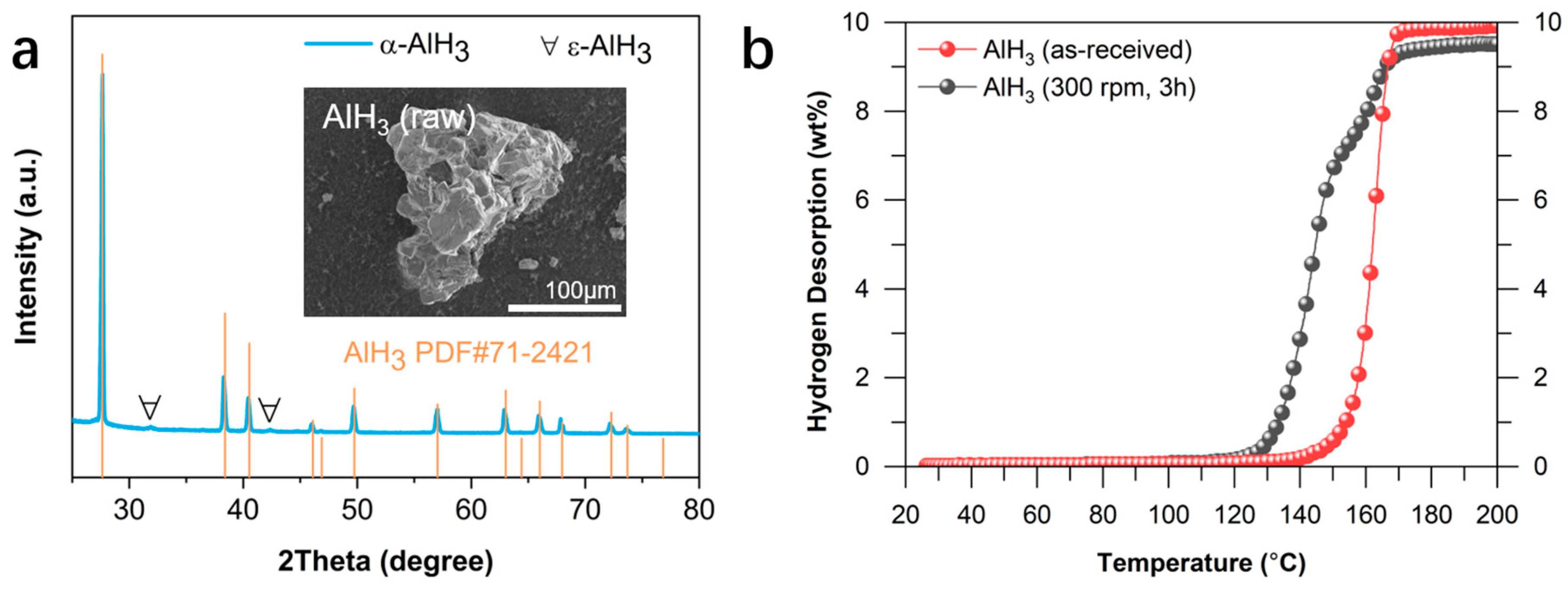
Figure 1. (a) XRD patterns and SEM image of as-received raw AlH3. (b) Non-isothermal decomposition curves of as-received AlH3 and as-milled AlH3.
Catalysts 15 01143 g001
Figure 2. XRD patterns (a) and SEM image (b) of as-synthesized V2C, Ti3CN, Ti3C2 and Nb2C MXenes.
Catalysts 15 01143 g002
Figure 3. (a) Hydrogen desorption curves of AlH3 with different catalysts. (b) Hydrogen desorption curves of AlH3 with different catalysts and varying proportions. (c) Hydrogen desorption curves of AlH3 with different catalysts and under different ball milling speeds. (d) Hydrogen desorption curves of AlH3 with different catalysts and under different ball milling atmospheres.
Catalysts 15 01143 g003
Figure 4. DSC curves of as-received AlH3 (a), as-milled AlH3 (b), and as-milled AlH3 + 1 wt% Nb2C composite (c). (d) Kissinger’s plots and activation energy calculation for the three samples.
Catalysts 15 01143 g004
Figure 5. XRD patterns of AlH3 + 10 wt% Nb2C in as-milled and decomposed states, respectively.
Catalysts 15 01143 g005
Figure 6. XPS spectra of Al 2p (a) and C 1s (b) of the AlH3 + 5 wt% Nb2C composite after ball milling and after decomposition, respectively.
Catalysts 15 01143 g006
Figure 7. SEM images of the (a) as-milled and (b) decomposed AlH3 + 1 wt% Nb2C composite. (c) elemental mappings, (d) TEM image and SAED pattern, and (e) HRTEM image of the decomposed AlH3 + 1 wt% Nb2C composite.
Catalysts 15 01143 g007
Figure 8. Structure of (a) α-AlH3; (b) Nb2C (100), Top (c) and front (d) views of the structural model of α-AlH3 adsorbed on the Nb2C (100) surface and (e) charge density of the α-AlH3 and the Nb2C models.
Catalysts 15 01143 g008
Figure 9. The partial density of states (PDOS) of (a) α-AlH3 and (b) α-AlH3 + Nb2C.
Catalysts 15 01143 g009
Table 1. Initial decomposition temperatures and final hydrogen desorption capacities of AlH3 with different catalysts.
SampleInitial Temperature (°C)Capacity (wt%)
AlH3 + 2.5 wt% V2C1222.2
AlH3 + 2.5 wt% Nb2C959.0
AlH3 + 1 wt% V2C938.6
AlH3 + 1 wt% Ti3C21302.6
AlH3 + 1 wt% Nb2C959.3
AlH3 + 1 wt% Ti3CN1252.8
Table 2. Initial decomposition temperatures and final hydrogen desorption capacites of AlH3 + 2.5 wt% V2C, AlH3 + 1 wt% V2C and AlH3 + 1 wt% Nb2C composites at different atmosphere.
SampleInitial Temperature (°C)Capacity (wt%)
ArAirArAir
AlH3 + 2.5 wt%V2C1221252.28.4
AlH3 + 1 wt% V2C93808.67.9
AlH3 + 1 wt% Nb2C951209.38.7
Table 3. Initial decomposition temperatures and final hydrogen desorption capacities of AlH3 + 1 wt% V2C and AlH3 + 1 wt% Nb2C composites at different rotation speeds.
SampleInitial Temperature (°C)Capacity (wt%)
300 rpm350 rpm300 rpm350 rpm
AlH3 + 1 wt% V2C931378.63.8
AlH3 + 1 wt% Nb2C95909.38.7
Table 4. Bond distance of Al–H bonds in pure α-AlH3 and α-AlH3 + Nb2C.
Al–H BondsBond Length (Å)
(Before)
Bond Length (Å)
(After)
Al-H11.593791.71862
Al-H21.592331.71890
Al-H31.593791.71725
Disclaimer/Publisher’s Note: The statements, opinions and data contained in all publications are solely those of the individual author(s) and contributor(s) and not of MDPI and/or the editor(s). MDPI and/or the editor(s) disclaim responsibility for any injury to people or property resulting from any ideas, methods, instructions or products referred to in the content.