Article

Hollow ZnO Nanofibers for Efficient Photocatalytic Degradation of Methylene Blue

1
National Engineering Laboratory for Modern Silk, College of Textile and Engineering, Soochow University, Suzhou 215123, China
2
Jiangsu Engineering Research Center of Textile Dyeing and Printing for Energy Conservation, Discharge Reduction and Cleaner Production (ERC), Soochow University, Suzhou 215123, China
*
Author to whom correspondence should be addressed.
Catalysts 2025, 15(12), 1137; https://doi.org/10.3390/catal15121137
Submission received: 30 July 2025 / Revised: 7 November 2025 / Accepted: 19 November 2025 / Published: 3 December 2025

Abstract

In this work, hollow-structured nanofibers with densely and uniformly distributed ZnO nanorods were successfully prepared by a combination of coaxial electrospinning, heat treatment, and hydrothermal synthesis, exhibiting excellent photocatalytic degradation performance. The morphological and structural characteristics of hollow ZnO nanofibers obtained at different heat treatment temperatures were systematically investigated, and their photocatalytic degradation performances were compared through degrading methylene blue (MB) under ultraviolet (UV) irradiation. It was found that the hollow ZnO nanofibers obtained by heat treatment at 280 °C exhibited the best photocatalytic degradation performance due to their optimal morphology and structure. Their photocatalytic degradation efficiencies for MB under 3 h of UV light and natural sunlight were 94.70% and 92.95%, respectively. Furthermore, cyclic stability tests were conducted on the optimal sample, revealing that its degradation efficiency remained at 89.96% after three cycles, demonstrating its excellent reusability.

1. Introduction

With the continuous development of global industrialization and the ever-expanding scale of industrial production, the increasingly severe ecological environment pressures have become a critical bottleneck restricting sustainable development [1,2]. In particular, organic dyes such as methylene blue (MB), Congo red, and methyl orange are widely used in textile, printing, and paper industries, leading to the direct discharge of large amounts of industrial wastewater with high chromaticity and toxicity, posing serious threats to aquatic ecosystems [3,4]. However, the complexity and toxicity of organic pollutants limit the effectiveness of conventional wastewater treatment methods [5,6], necessitating the development of more efficient and environmentally friendly technologies for MB removal from wastewater. Therefore, the photocatalytic degradation technology has attracted widespread attention as a highly promising method, which utilizes light energy to excite the catalyst to generate electron–hole pairs, directly oxidizing and reducing pollutants adsorbed on the catalyst surface [7,8]. As the core of photocatalytic degradation technology, photocatalysts have become a research hotspot in the field of organic pollutant degradation over the past decade due to their low cost, excellent stability, environmental friendliness, and non-toxicity. Although the photocatalytic performances of various photocatalysts have been extensively investigated [9], their practical applications still face significant technical challenges [10,11].
ZnO, as a wide-bandgap semiconductor (~3.37 eV) [12], stands out as a highly promising photocatalyst owing to its eco-friendliness, cost-effectiveness, and low toxicity [13,14,15]. Studies have demonstrated that ZnO exhibits visible-light-responsive characteristics and can effectively degrade organic pollutants in water [16,17]. However, its inherent drawbacks, such as rapid electron–hole recombination and low visible-light utilization efficiency, limit its practical application. Accordingly, by regulating the structure of ZnO, particularly by developing its nanostructures (including nanoparticles, nanowires, nanosheets, nanorods, nanotubes, etc.), its light absorption and exposure of active sites can be enhanced [18,19]. Although these ZnO nanostructures exhibit excellent photocatalytic performance, their easy aggregation and difficult recovery as powders severely hinder their practical application [20,21]. Combining ZnO with nanofiber carriers is considered an effective method to solve this critical challenge [22,23,24]. Among them, ZnO nanofibers with a hollow structure have a high specific surface area and provide more active sites for photocatalytic reactions, significantly improving light-harvesting capability and mass transfer efficiency [25,26,27]. Due to its simple and easy operation, electrospinning technology is one of the commonly used methods for constructing continuous ZnO nanofibers [28,29,30,31]. Compared with traditional single-needle electrospinning, through core–shell structure design and subsequent heat treatment, coaxial electrospinning can precisely control the core–shell or hollow structure of ZnO nanofibers, thus obtaining efficient and recyclable photocatalysts [32,33,34]. Among them, polymer materials with excellent thermal decomposition property can be selected as the core layer, which can be completely decomposed during the heat treatment process to obtain hollow-structured nanofibers. This one-step formation of a hollow structure eliminates the need for complex etching or removal steps required by conventional template methods.
However, the hollow ZnO nanofibers (H-ZnO) obtained solely through coaxial electrospinning and subsequent heat treatment have relatively low ZnO content, and their photocatalytic performance still needs further improvement. Therefore, in order to obtain ultrahigh-performance ZnO photocatalysts, this work combined coaxial electrospinning, heat treatment, and hydrothermal synthesis to construct hollow ZnO nanofibers with densely and uniformly distributed ZnO nanorods (ZnO@HNF) and determined the optimal process parameters through morphology, structure, and performance characterization. Moreover, the photocatalytic performance of ZnO@HNF was systematically evaluated by degrading MB under ultraviolet (UV) and natural sunlight irradiation. It was found that the optimal sample exhibited excellent photocatalytic activity under both UV light and sunlight, demonstrating its practical application potential in environmental remediation.

2. Results and Discussion

2.1. Morphology and Structure Characterization

Figure 1(a-1) shows that the coaxial electrospun nanofibers had a uniform morphology and smooth surface, with a fiber diameter of approximately 565 ± 24 nm and a zinc content of 17.917% by weight (Figure 1(a-2)). Figure 1b shows that due to the softening and partial decomposition of PMMA at 220 °C, both the surface and interior of the fibers became rough. When the temperature reached 230 °C (Figure 1c), the decomposition of PMMA was accelerated, releasing gaseous by-products including methyl methacrylate monomers and CO2, resulting in the formation of micropores within the fibers and moderate surface roughness. As shown in Figure 1d, PMMA was almost completely decomposed at 260 °C, forming an internal hollow structure. Figure 1e,f demonstrates that within the range of 280–300 °C, the thorough decomposition of PMMA produced well-defined hollow structures. Moreover, it can be found from Figure 1b–f that as the temperature increased, the surface roughness of fibers significantly increased due to the continuous decomposition of Zn(OAc)2, and more pronounced particulate features gradually appeared, leading to an increase in the coverage of ZnO nanoparticles. This well-defined hollow structure and high coverage of ZnO nanoparticles would synergistically increase the specific surface area and active sites of fibers, facilitating the growth of ZnO crystals during hydrothermal processes. This conclusion could be confirmed by XRD and FTIR analysis.
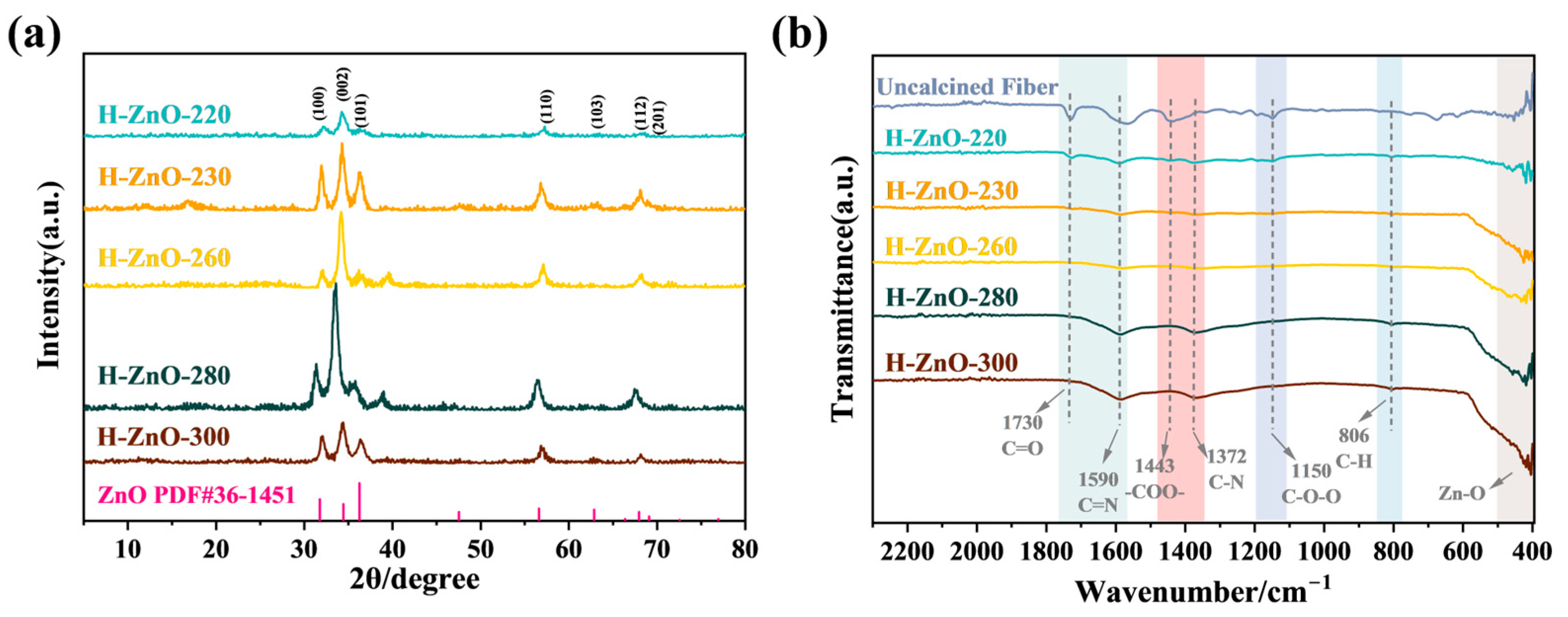
The XRD spectra of H-ZnO revealed that ZnO in all samples exhibited a hexagonal wurtzite structure (PDF#36-1451), with diffraction peaks well matching the standard pattern (Figure 2a). The strong reflection peak located at 34.4° corresponded to the (002) diffraction peak of ZnO, indicating a fine orientation along the c-axis of wurtzite ZnO. No impurity phases were detected in all samples, and the sharp diffraction peaks confirmed the high crystallinity and phase purity of the materials. As shown in Figure 2b, the FTIR spectra of all samples revealed a clear upward trend in the thermal decomposition of components and the formation of ZnO with increasing heat treatment temperature. Among them, the FTIR spectra of uncalcined nanofibers and H-ZnO-220 all exhibited characteristic peaks at 1150 cm−1, 1730 cm−1 and 1443 cm−1, which were attributed to the C-O-C stretching vibration of the ester group and the C=O stretching vibration in PMMA, as well as the symmetric stretching vibration of the carboxylate group (-COO-) in Zn(OAc)2, respectively. When the temperature was 230 °C, the peak intensities at 1730 cm−1 and 1443 cm−1 weakened, while the peak at 1150 cm−1 disappeared completely, indicating PMMA and Zn(OAc)2 began to undergo thermal decomposition. When the temperature was further raised to 260 °C or above, all three characteristic peaks vanished, confirming the complete decomposition of PMMA and Zn(OAc)2 as well as the eventual formation of a hollow structure. The broad and weak absorption band in the range of 400–500 cm−1, associated with Zn-O stretching vibrations [35], gradually intensified above 260 °C, indicating the initiation and progressive crystallization of the ZnO lattice. Moreover, all samples exhibited characteristic peaks at 806 cm−1, 1372 cm−1, and 1590 cm−1. Among them, the absorption peak at 806 cm−1 arose from the out-of-plane bending vibration of =C-H in aromatic ring structures, which was likely caused by the cyclization reaction of PAN at high temperatures to form a conjugated ladder structure. The peak intensity increased with the rising heat treatment temperature, indicating the enhanced stability of the aromatic structure. The peaks at 1372 cm−1 and 1590 cm−1 corresponded to the C-N and -C=N- stretching vibrations of PAN, respectively. As the temperature increased, the relative peak intensity of the -C=N- group gradually strengthened, confirming the progressive cyclization reaction of cyano groups with increasing temperature [36].
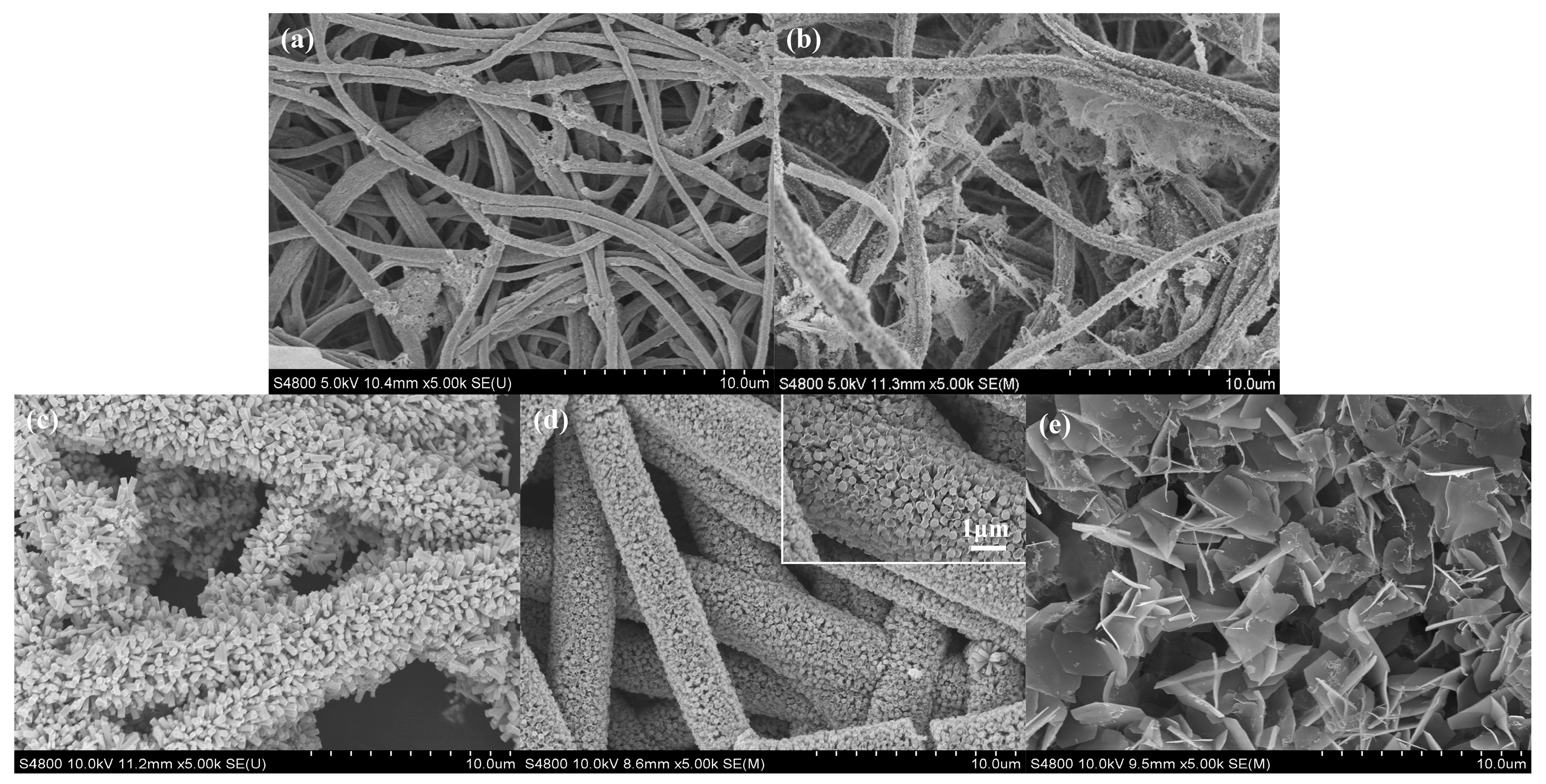
The morphological evolution of ZnO@HNF during hydrothermal growth exhibited a significant correlation with the heat treatment temperature (Figure 3). It could be revealed that at 220–230 °C (Figure 3a,b), the ZnO shell layer was in the initial crystallization stage, and partial amorphous regions began to crystallize. At this stage, the small grain size and high surface energy led to the formation of particulate ZnO during hydrothermal growth. When the heat treatment temperature increased to 260–280 °C, the crystallinity of ZnO was significantly improved after heat treatment (Figure 2a), with a notably intensified (002) diffraction peak, suggesting the preferential growth of ZnO crystals along the c-axis [37]. This crystallographic feature promoted the vertical growth of ZnO nanorod arrays on the fiber surface in the subsequent hydrothermal process, forming well-aligned hexagonal wurtzite structures, as confirmed by Figure 3c,d. Especially, the average size of ZnO nanorods in ZnO@HNF-280 (about 460 nm) was smaller and denser compared to ZnO@HNF-260 (about 638 nm), leading to a larger specific surface area and more active sites. When the temperature further increased to 300 °C, the hydrothermal growth mechanism underwent a distinct transition, resulting in the formation of nanosheets (Figure 3e) [38]. In summary, 280 °C was the optimal heat treatment temperature, at which a photocatalyst (ZnO@HNF-280) with the optimal hollow structure as well as the most densely and uniformly distributed ZnO nanorods could be synergistically constructed. Therefore, ZnO@HNF-280 had a high specific surface area and abundant active sites, which could endow it with optimal photocatalytic degradation performance.
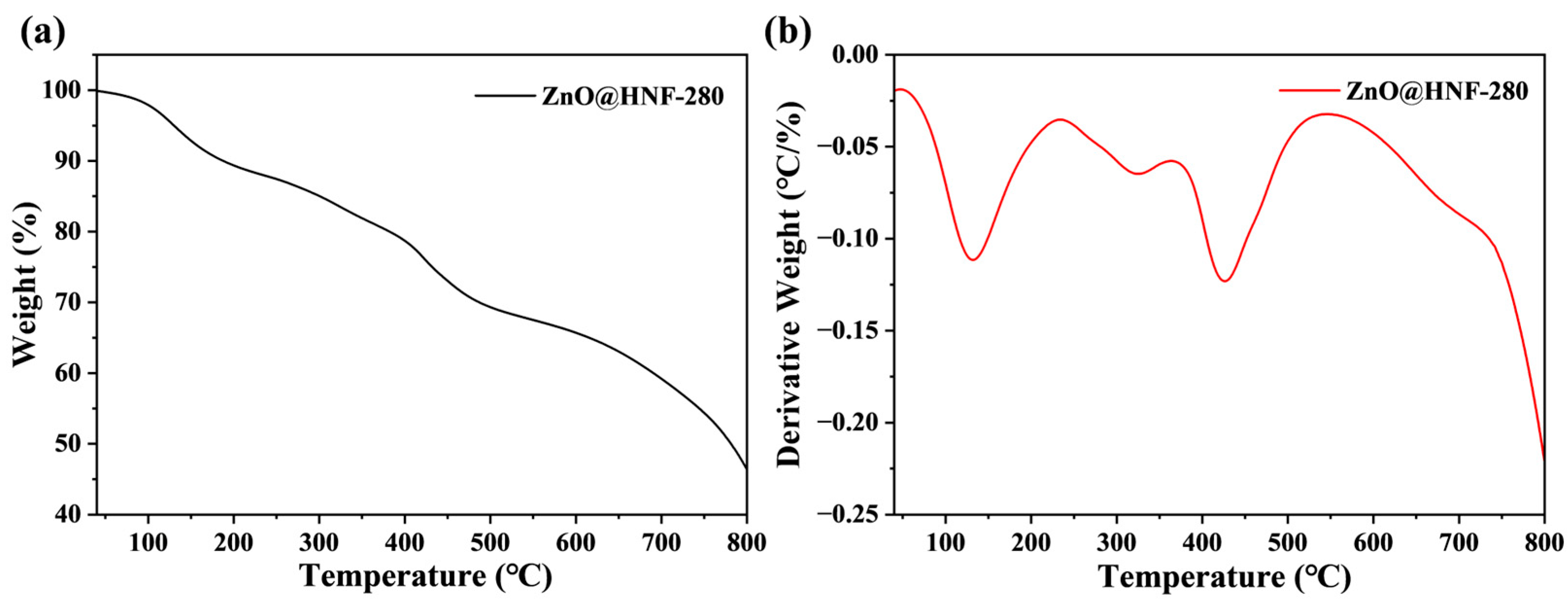
The TGA curve of ZnO@HNF-280 (Figure 4a) showed that it retained more than 85% of its original weight up to 300 °C, demonstrating its excellent thermal stability within the heat treatment temperature range of 220–280 °C. Moreover, its derivative of thermal gravity (DTG) curve (Figure 4b) showed no significant decomposition peaks above 150 °C. This provided strong evidence that volatile components and organic precursors were effectively removed after heat treatment, and no significant residual organics remained.

2.2. Analysis of Optical Characteristics

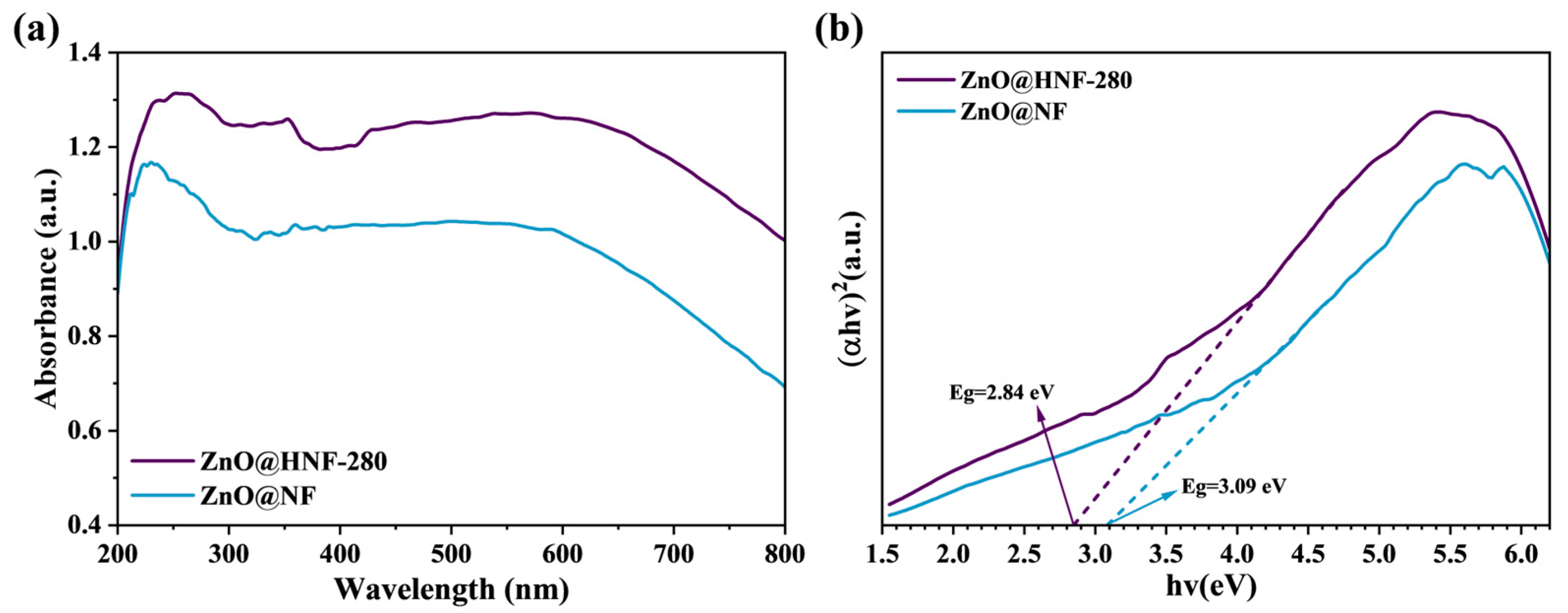
To evaluate the optical characteristics of ZnO@HNF-280, UV-Vis diffuse reflectance spectroscopy (DRS) was conducted. As illustrated in Figure 5a, both ZnO@HNF-280 and ZnO@NF displayed strong absorption in the UV region (<400 nm), but ZnO@HNF-280 had a stronger intensity, indicating its superior optical properties. Moreover, the UV-Vis DRS results indicated a distinct red shift in the absorption edge of ZnO@HNF-280, with higher absorbance in the visible light region (400–780 nm), suggesting a reduction in its bandgap energy (Eg). This implied that the hollow structure might contribute to improving the light absorption capacity, which was more favorable for the photocatalytic degradation processes.
According to their UV-Vis spectra, Eg of samples was determined using the Tauc plot method based on the following equation [39]:
( α h v ) 1 / n = A ( h v E g )
where α, h, and ν and A represent the absorption coefficient, Planck constant, frequency, and constant, respectively. The exponent n is related to the type of optical transition: for direct bandgap semiconductors, n equals 1/2, whereas for indirect bandgap semiconductors, n equals 2.
Since ZnO is a direct bandgap semiconductor [40], n was taken as 1/2, and (αhν)2 was plotted against photon energy (). Eg was estimated by extrapolating the linear region of the curve to the horizontal axis. As shown in Figure 5b, the calculated Eg values of ZnO@HNF-280 and ZnO@NF were 2.84 eV and 3.09 eV, respectively. Both values were notably reduced compared to the intrinsic Eg of pure ZnO (~3.2 eV), which was consistent with the red shift observed in the absorption edges of UV-Vis DRS. The narrower Eg of ZnO@HNF-280 further confirmed its enhanced light absorption capability, which was likely attributable to oxygen vacancy defects introduced by the hollow structure [41,42], thereby changing the electronic structure and extending the photoresponse to the visible light region. These features made ZnO@HNF-280 a promising material for applications in visible-light-driven photocatalysis.
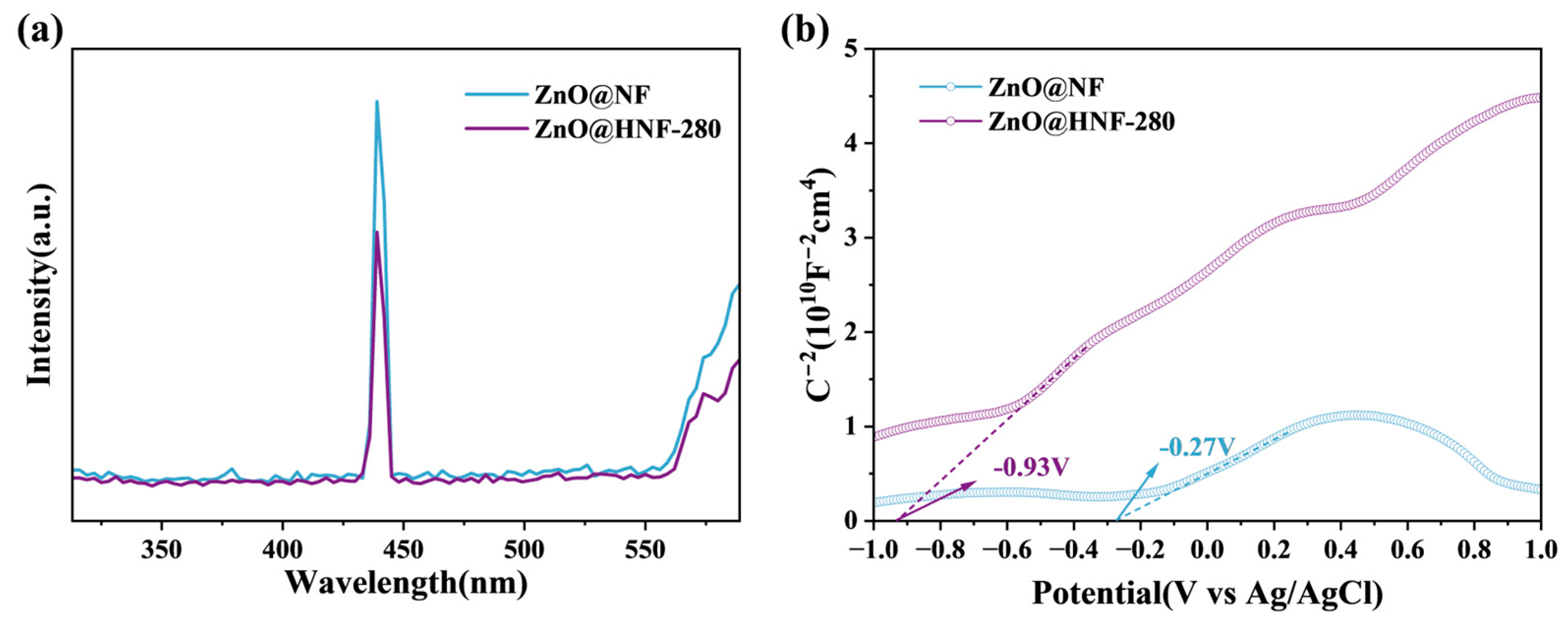
Figure 6a displays the PL spectra of ZnO@HNF-280 and ZnO@NF under 298 nm excitation, which reflected the recombination behavior of photogenerated electron–hole pairs. The PL results further confirmed the conclusions drawn from UV-Vis analysis. It was observed that the hollow-structured ZnO@HNF-280 exhibited significantly lower fluorescence intensity compared to the solid ZnO@NF, indicating a higher concentration of crystal defects. These defects suppressed near-band-edge emission, enhanced defect-related visible emission, and reduced the apparent optical bandgap. This suggested that the hollow structure provided more active sites, facilitated reactant adsorption and photogenerated charge separation, effectively suppressed electron–hole recombination, and consequently enhanced the photocatalytic activity of ZnO@HNF-280, demonstrating its great potential in visible-light-driven photocatalytic applications.
The reduction ability of semiconductors is a key indicator for evaluating their photocatalytic activity, primarily determined by the position of the minimum conduction band potential (ECB). The semiconductor type and flat band potential (EFB) of ZnO@HNF-280 were analyzed using Mott-Schottky measurement. As shown in Figure 6b, the positive slope of the Mott-Schottky curve indicated that ZnO@HNF-280 was a typical n-type semiconductor. By extrapolating the linear region to the horizontal axis, EFB was estimated to be approximately −0.93 V (vs. Ag/AgCl). In comparison, ZnO@NF exhibited a EFB of about −0.27 V. Based on their EFB values and the formula ECB = EFB + 0.197 V, the ECB values of ZnO@HNF-280 and ZnO@NF were calculated to be about −0.73 V and −0.07 V (vs. SHE), respectively, implying that ZnO@HNF-280 had a stronger ability to reduce photogenerated electrons. This result was consistent with the enhanced defect states and improved charge separation efficiency observed in the PL spectra, suggesting that the defects introduced by the hollow structure might increase charge carrier concentration and optimize interfacial charge transfer behavior, thereby further suppressing electron–hole recombination and enhancing photocatalytic activity.

2.3. Photocatalytic Degradation Performance

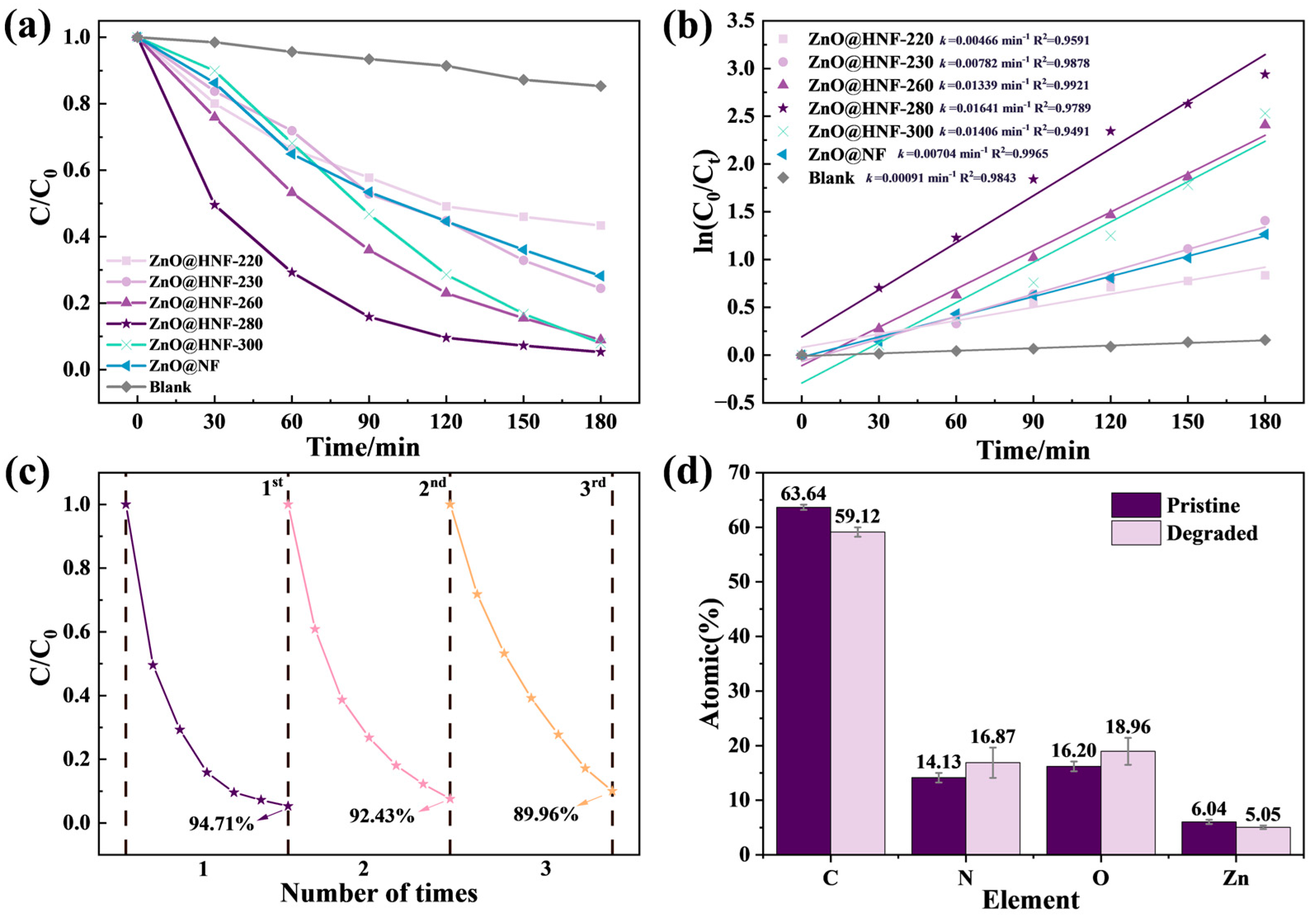
As shown in Table 1 and Figure 7a, the photocatalytic degradation performance for MB of ZnO@HNF under UV irradiation for 3 h was systematically evaluated, indicating that the photocatalytic activity increased first and then decreased with the increase in heat treatment temperature.
Among them, ZnO@HNF-280 had the highest photocatalytic degradation efficiency, reaching 94.70%, due to its optimal multilevel structure. Moreover, the degradation efficiency of ZnO@HNF-260 and ZnO@HNF-300 both exceed 90%, indicating their high photocatalytic activity. In comparison, ZnO@NF showed a degradation efficiency of 71.78%, whereas the blank control (without any photocatalyst) exhibited only a negligible degradation rate of 14.67%, further confirming the superior photocatalytic performance of hollow-structured fibers. Therefore, the findings confirmed that the heat treatment temperature played a crucial role in determining the photocatalytic performance of ZnO@HNF materials, with consistently yielding high-efficiency photocatalysts in the range of 260–300 °C. According to the equation ln(C0/Ct) = kt (k is the apparent rate constant), a pseudo-first-order model was applied to fit the experimental data for determining the degradation kinetics, as presented in Figure 7b. It was found that all samples exhibited pseudo-first-order kinetics for the photocatalytic degradation of MB, with R2 values of 0.9591, 0.9878, 0.9921, 0.9789, 0.9491, and 0.9965, respectively. Furthermore, the k value of ZnO@HNF-280 was the maximum (0.01641 min−1), indicating that ZnO@HNF-280 could degrade MB the fastest.
To illustrate the recyclability of ZnO@HNF-280, three cycles of degradation experiments were conducted, and the results are shown in Figure 7c. After three cycles of degradation, ZnO@HNF-280 still maintained stable photocatalytic activity and showed no significant decrease in the degradation efficiency for MB solution. Figure 7d displays the content of different elemental substances in ZnO@HNF-280 before and after cyclic degradation. It was found that the atomic percentages of Zn and other major components (C, N, O) did not show significant changes after three photocatalytic cycles, indicating that the overall chemical composition of ZnO@HNF-280 had good stability during the reaction process. Meanwhile, it was confirmed that ZnO was firmly anchored in the hollow nanofiber matrix without significant leaching. In addition, the photocatalytic performance for MB of ZnO@HNF-280 under natural sunlight was investigated to evaluate its practical applicability. As demonstrated in Table 1, ZnO@HNF-280 exhibited an outstanding degradation efficiency of 92.95% under sunlight for 3 h, confirming its potential in real-world applications where solar energy served as the primary excitation source. Table 2 presents the performance comparison between ZnO@HNF-280 and other reported ZnO-based photocatalysts for MB degradation, further indicating the potential application of ZnO@HNF-280 in wastewater treatment.

2.4. Photocatalytic Degradation Mechanism

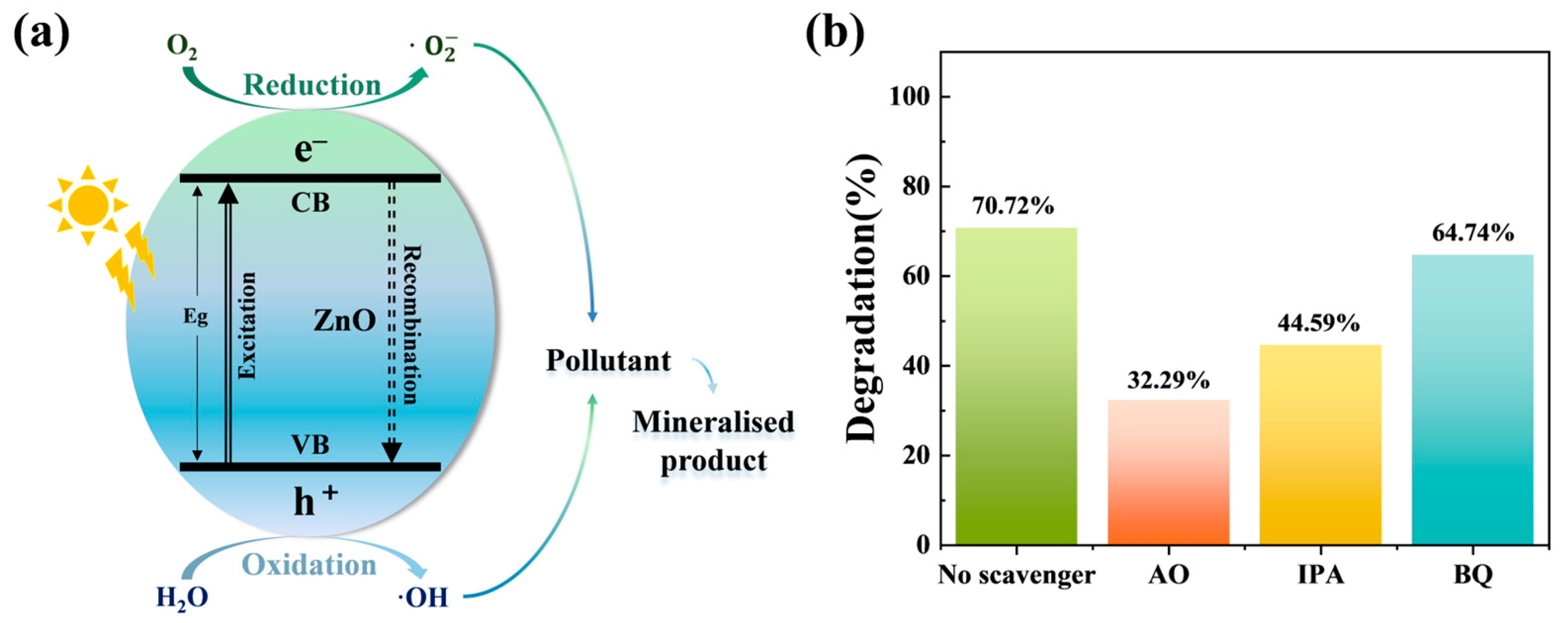
The photocatalytic degradation mechanism of ZnO@HNF-280 is illustrated in Figure 8a. When the incident light energy exceeded the bandgap of ZnO, electrons in the valence band (VB) were excited and transitioned to the conduction band (CB), generating holes (h+) in the VB and forming electron–hole pairs. The photogenerated electrons (e) migrated from the CB of ZnO to the surface, where they were captured by adsorbed O2 molecules, forming superoxide radicals (·O2−). Meanwhile, h+ in the VB directly oxidized surface hydroxyl groups (OH) or water molecules, producing hydroxyl radicals (·OH). The band structure of ZnO also allowed some holes to directly oxidize organic pollutants. These reactive oxygen species (·O2−, ·OH, etc.) worked synergistically to progressively oxidize and degrade organic pollutants, ultimately converting them into CO2 and H2O [47]. Furthermore, the hollow structure facilitated reactant mass transfer and shortened the carrier migration path, thereby suppressing electron–hole recombination and significantly enhancing photocatalytic degradation efficiency.
The free radical capture experiments of ZnO@HNF-280 under UV light for 1 h (Figure 8b) revealed that its photocatalytic degradation for MB primarily followed the h+-dominated oxidation mechanism. The addition of AO (h+ scavenger) caused the most significant reduction in degradation efficiency (from 70.72% to 32.29%), demonstrating that photogenerated h+ played a predominant role in the photocatalytic degradation process. The system showed a weaker dependence on ·OH, as evidenced by the modest inhibition effect observed with IPA (degradation efficiency decreased to 44.59%). In comparison, the introduction of BQ (·O2− scavenger) le d to a degradation efficiency of 64.74%, demonstrating a limited role of ·O2− in the reaction.
These results indicated that the exceptional photocatalytic degradation performance of ZnO@HNF-280 originated mainly from the direct oxidation of MB by photogenerated h+. The limited involvement of ·OH and ·O2− suggested that the indirect oxidation pathway played a secondary role in the photocatalytic degradation process. Meanwhile, the one-dimensional nanofiber morphology promoted efficient charge separation, which could prolong the lifetime of photogenerated holes. Furthermore, the unique hollow structure and the densest ZnO nanorods provided a high specific surface area and abundant active sites, thereby enhancing light absorption through multiple scattering.

3. Materials and Methods

3.1. Materials

Polyacrylonitrile (PAN, Mw = 150,000 g/mol) powders were obtained from Hefei Sipin Technology Co., Ltd., Hefei, China. N,N-dimethylformamide (DMF, Mw = 73.09 g/mol) was obtained from Shanghai Chemical Reagent Co., Ltd., Shanghai, China. Anhydrous zinc acetate (Zn(OAc)2, Mw = 183.48 g/mol) and polymethyl methacrylate (PMMA, Mw = 99.100 kDa) were purchased from Shanghai Aladdin Biochemical Co., Ltd., Shanghai, China. Ammonia (NH3·H2O, Mw = 17.03 g/mol), hexamethylenetetramine (HMTA, Mw = 140.19 g/mol) and zinc chloride (ZnCl2, Mw = 136.30 g/mol) were acquired from China Pharmaceutical Group Chemical Reagents Co., Ltd., Shanghai, China. Methylene blue (MB, Mw = 373.90 g/mol) was supplied by Shanghai Debai Biotechnology Co., Ltd., Shanghai, China. Acetone (ACE, Mw = 58.08 g/mol) and Isopropyl alcohol (IPA, Mw = 60.01 g/mol) were provided by Jiangsu Qiangsheng Functional Chemicals Co., Ltd., Jiangsu, China. P-benzoquinone (BQ, Mw = 108.1 g/mol) was obtained from Suzhou Grete Pharmaceutical Technol Co., Ltd., Jiangsu, China. Ammonium oxalate (AO, Mw = 142.11 g/mol) was provided from Jiangsu Argon Krypton Xenon Material Technol Co., Ltd., Jiangsu, China.

3.2. Preparation of ZnO@HNF

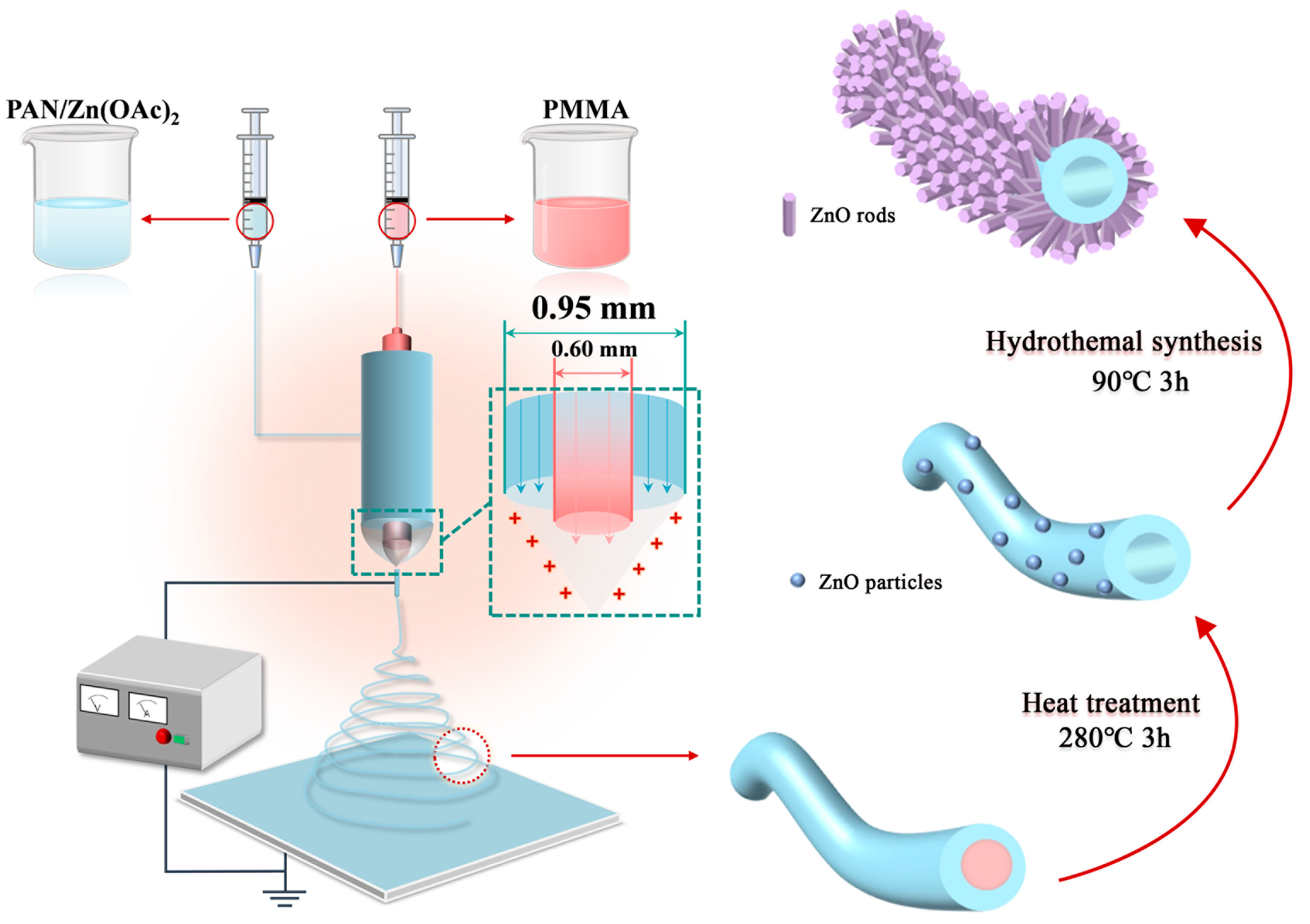
The fabrication process of ZnO@HNF is exhibited in Figure 9. Firstly, core–shell-structured nanofibers were prepared by coaxial electrospinning, and then ZnO@HNF was obtained through heat treatment and subsequent hydrothermal growth.
Using 20 g DMF as the solvent as well as 5 g Zn(OAc)2 and 2.72 g PAN as the solutes, a well stirred shell spinning solution with 18 wt% Zn(OAc)2 and 10 wt% PAN was obtained. A core spinning solution containing 6 wt% PMMA was prepared by dissolving 1.76 g PMMA in a mixed solvent of 10 g DMF and 15 g ACE (the mass ratio of DMF to ACE was 4:6) with stirring until complete dissolution. In the coaxial electrospinning process, a high voltage of 18 kV was applied to the spinneret, with a collector distance of 15 cm. The flow rates of the core and shell solutions were 0.9 mL/h and 1.2 mL/h, respectively.
The coaxial electrospun nanofibers were heat-treated in Muffle furnace under air atmosphere to obtain ZnO@HNF by core removal. The temperature was raised from room temperature to the target temperature (220 °C, 230 °C, 260 °C, 280 °C, 300 °C) at a heating rate of 2 °C/min, hold for 3 h, and then cooled to below 100 °C before removal. During this process, the core material, PMMA, underwent complete thermal decomposition above 200 °C, generating gaseous products (CO2, H2O) that diffused out through the shell layer to form the hollow structure [48]. The temperature was maintained below 300 °C to prevent excessive sintering of ZnO. The samples obtained after heat treatment at different temperatures were named H-ZnO-x, where x represented the heat treatment temperature (x = 220, 230, 260, 280, 300).
H-ZnO-x were vacuum-dried at 60 °C for hydrothermal synthesis. The growth solution was prepared from ZnCl2, NH3·H2O, HMTA and deionized water, and poured into the reaction vessel to 20% of its capacity, fully submerging H-ZnO-x. The molar mass ratio of ZnCl2 to HMTA was 1:1, and NH3·H2O was added dropwise until the solution achieved optical clarity. The hydrothermal reaction was carried out in a temperature-controlled convection oven at 90 °C for 3 h using sealed Teflon-lined autoclaves. Similarly, the final products obtained after hydrothermal synthesis were named ZnO@HNF-x (x = 220, 230, 260, 280, 300). Additionally, based on the traditional single-needle electrospinning and the use of shell solution, solid ZnO nanofibers (ZnO@NF) were prepared by subsequent hydrothermal synthesis as a control.

3.3. Measurement and Characterization

The morphology and elemental distribution of samples were studied by a scanning electron microscopy (SEM, Regulus s-4800, Tokyo, Japan) equipped with an energy dispersive spectroscopy (EDS). Fourier transform infrared (FTIR) patterns of samples were tested by a FTIR spectrometer (Nicolet 5700, Thermo Nicolet Company, Madison, WI, USA). The crystal structure of samples was characterized by X-ray diffraction (XRD) analysis (D8 Advance, Berlin, Germany). The thermostability of samples was measured by thermogravimetric analysis (TGA) from room temperature to 800 °C at a heating rate of 20 °C/min in N2 atmosphere (TG/DTA5700, PerkinElmer, Waltham, MA, USA). The light absorption ability of samples was tested by using an ultraviolet-visible (UV-Vis) spectrometer (UV3600, Shimadzu, Kyoto, Japan). The photoluminescence (PL) spectra of samples were tested by a fluorescence spectrometer (FLS920, Edinburgh Instruments, Edinburgh, UK). Mott-Schottky testing was performed by an electrochemical workstation (CHI660E, Chenhua, Shanghai, China).

3.4. Photocatalytic Degradation Tests

MB was selected as the model pollutant, and a 10 mg/L MB solution was used as the reaction solution. 30 mg of catalyst samples were dispersed into 30 mL of MB solution in a 50 mL beaker, and the reaction system was kept in the dark for 1 h to establish adsorption–desorption equilibrium. Subsequently, photocatalytic degradation was carried out for 3 h under the irradiation of a 250 W UV lamp (λ = 365 nm) placed 20 cm vertically above the beaker. After 3 h of UV irradiation, the solution temperature was 50 °C. The photocatalytic experiments under natural sunlight were conducted from 12:00 to 16:00 local time on 22 July 2025 in Suzhou, China. The weather was sunny throughout the testing period. At 30 min intervals, the supernatant samples were collected and centrifuged to remove suspended catalysts. The residual MB concentration was determined by measuring the absorbance at 664 nm using a UV-Vis spectrophotometer. The photocatalytic degradation efficiency (η) was calculated using the following equation [49]:
η = 1 C t C 0 × 100 % = 1 A t A 0 × 100 %
where C0 and Ct represented the concentration of MB solution (mg/L) after initial adsorption equilibrium and a certain reaction time, respectively, while A0 and At denoted the corresponding absorbance values at the characteristic absorption peak. All experiments were conducted at room temperature, and blank control tests were performed to exclude the influence of direct photolysis.
The free radical capture experiments were used to explore the major active components in the photocatalytic degradation of MB. To capture h+, ·O2− and ·OH, 0.05 M of AO, BQ, and IPA were added into the MB solution, separately.

4. Conclusions

This work successfully fabricated hollow-structured nanofibers with densely and uniformly distributed ZnO nanorods through coaxial electrospinning combined with heat treatment and subsequent hydrothermal synthesis. By precisely controlling the heat treatment temperature, the effective regulation of fiber morphology and structure was achieved. The results demonstrated that when the heat treatment temperature was set at 280 °C, the obtained sample (ZnO@HNF-280) maintained a well-defined hollow fiber structure, while forming the most densely and uniformly distributed ZnO nanorod arrays on the fiber surface. This unique hierarchical structure significantly enhanced the photocatalytic activity of the material. ZnO@HNF-280 demonstrated excellent photocatalytic degradation efficiency for MB under UV irradiation, reaching up to 94.70%, significantly outperforming samples prepared at other heat treatment temperatures. Under natural sunlight, ZnO@HNF-280 still maintained an outstanding photocatalytic degradation efficiency of 92.95%. Furthermore, after three cycles of use under UV light, the degradation efficiency of ZnO@HNF-280 was still retained at 89.96%, demonstrating excellent structural stability and reusability. In summary, through structural design and preparation process optimization of photocatalysts, this work successfully developed hollow ZnO nanofibers with highly efficient and stable photocatalytic degradation performance, offering a promising green solution for addressing the challenges of organic pollutant degradation in the environment.

Author Contributions

Conceptualization, Y.C. and L.X.; methodology, Y.C. and L.X.; validation, Y.C.; formal analysis, Y.C.; investigation, Y.C.; resources, L.X.; data curation, Y.C.; writing—original draft preparation, Y.C.; writing—review and editing, L.X.; supervision, L.X.; project administration, L.X.; funding acquisition, L.X. All authors have read and agreed to the published version of the manuscript.

Funding

This research was funded by National Natural Science Foundation of China (grant number 11672198), Jiangsu Engineering Research Center of Textile Dyeing and Printing for Energy Conservation (grant number 2024-ERC(PRC)-9011580324).

Data Availability Statement

The original contributions presented in this study are included in the article. Further inquiries can be directed to the corresponding author.

Conflicts of Interest

The authors declare no conflicts of interest.

References

  1. Raza, A.; Altaf, S.; Ali, S.; Ikram, M.; Li, G. Recent advances in carbonaceous sustainable nanomaterials for wastewater treatments. Sustain. Mater. Technol. 2022, 32, e00406. [Google Scholar] [CrossRef]
  2. Lubchenco, J. Entering the century of the environment: A New Social Contract for Science. Science 1998, 279, 491–497. [Google Scholar] [CrossRef]
  3. Prakruthi, K.; Ujwal, M.P.; Yashas, S.R.; Mahesh, B.; Kumara Swamy, N.; Shivaraju, H.P. Recent advances in photocatalytic remediation of emerging organic pollutants using semiconducting metal oxides: An overview. Environ. Sci. Pollut. Res. 2022, 29, 4930–4957. [Google Scholar] [CrossRef]
  4. Moztahida, M.; Lee, D.S. Photocatalytic degradation of methylene blue with P25/Graphene/Polyacrylamide hydrogels: Optimization using response surface methodology. J. Hazard. Mater. 2020, 400, 123314. [Google Scholar] [CrossRef]
  5. Dong, S.; Gong, Y.; Zeng, Z.; Chen, S.; Ye, J.; Wang, Z.; Dionysiou, D.D. Dissolved organic matter promotes photocatalytic degradation of refractory organic pollutants in water by forming hydrogen bonding with photocatalyst. Water Res. 2023, 242, 120297. [Google Scholar] [CrossRef]
  6. Pantò, F.; Dahrouch, Z.; Saha, A.; Patanè, S.; Santangelo, S.; Triolo, C. Photocatalytic degradation of methylene blue dye by porous zinc oxide nanofibers prepared via electrospinning: When defects become merits. Appl. Surf. Sci. 2021, 557, 149830. [Google Scholar] [CrossRef]
  7. Dong, H.; Zeng, G.; Tang, L.; Fan, C.; Zhang, C.; He, X.; He, Y. An overview on limitations of Tio2-based particles for photocatalytic degradation of organic pollutants and the corresponding countermeasures. Water Res. 2015, 79, 128–146. [Google Scholar] [CrossRef]
  8. Ahmad, A.; Noor, A.E.; Anwar, A.; Majeed, S.; Khan, S.; Ul Nisa, Z.; Ali, S.; Gnanasekaran, L.; Rajendran, S.; Li, H. Support based metal incorporated layered nanomaterials for photocatalytic degradation of organic pollutants. Environ. Res. 2024, 260, 119481. [Google Scholar] [CrossRef]
  9. Gusain, R.; Gupta, K.; Joshi, P.; Khatri, O.P. Adsorptive removal and photocatalytic degradation of organic pollutants using metal oxides and their composites: A comprehensive review. Adv. Colloid Interface Sci. 2019, 272, 102009. [Google Scholar] [CrossRef]
  10. Ikram, M.; Rashid, M.; Haider, A.; Naz, S.; Haider, J.; Raza, A.; Ansar, M.T.; Uddin, M.K.; Ali, N.M.; Ahmed, S.S.; et al. A review of photocatalytic characterization, and environmental cleaning, of metal oxide nanostructured materials. Sustain. Mater. Technol. 2021, 30, e00343. [Google Scholar] [CrossRef]
  11. Cheng, C.; Liang, Q.; Yan, M.; Liu, Z.; He, Q.; Wu, T.; Luo, S.; Pan, Y.; Zhao, C.; Liu, Y. Advances in preparation, mechanism and applications of graphene quantum dots/semiconductor composite photocatalysts: A review. J. Hazard. Mater. 2022, 424, 127721. [Google Scholar] [CrossRef]
  12. Kegel, J.; Povey, I.M.; Pemble, M.E. Zinc oxide for solar water splitting: A brief review of the material’s challenges and associated opportunities. Nano Energy 2018, 54, 409–428. [Google Scholar] [CrossRef]
  13. Tasso Guaraldo, T.; Wenk, J.; Mattia, D. Photocatalytic ZnO foams for micropollutant degradation. Adv. Sustain. Syst. 2021, 5, 2000208. [Google Scholar] [CrossRef]
  14. Li, B.; Lv, M.; Zhang, Y.; Gong, X.; Lou, Z.; Wang, Z.; Liu, Y.; Wang, P.; Cheng, H.; Dai, Y.; et al. Single-particle imaging photoinduced charge transfer of ferroelectric polarized heterostructures for photocatalysis. ACS Nano 2024, 18, 25522–25534. [Google Scholar] [CrossRef]
  15. Negash, A.; Mohammed, S.; Weldekirstos, H.D.; Ambaye, A.D.; Gashu, M. Enhanced photocatalytic degradation of methylene blue dye using eco-friendly synthesized rGO@ZnO nanocomposites. Sci. Rep. 2023, 13, 22234. [Google Scholar] [CrossRef]
  16. Garcia-Segura, S.; Ocon, J.D.; Chong, M.N. Electrochemical oxidation remediation of real wastewater effluents—A review. Process Saf. Environ. Prot. 2018, 113, 48–67. [Google Scholar] [CrossRef]
  17. Kumar, S.; Kaushik, R.D.; Purohit, L.P. ZnO-CdO nanocomposites incorporated with graphene oxide nanosheets for efficient photocatalytic degradation of bisphenol a, thymol blue and ciprofloxacin. J. Hazard. Mater. 2022, 424, 127332. [Google Scholar] [CrossRef]
  18. Chang, J.S.; Strunk, J.; Chong, M.N.; Poh, P.E.; Ocon, J.D. Multi-dimensional zinc oxide (ZnO) nanoarchitectures as efficient photocatalysts: What is the fundamental factor that determines photoactivity in ZnO? J. Hazard. Mater. 2020, 381, 120958. [Google Scholar] [CrossRef]
  19. Ren, X.; Hou, H.; Liu, Z.; Gao, F.; Zheng, J.; Wang, L.; Li, W.; Ying, P.; Yang, W.; Wu, T. Shape-enhanced photocatalytic activities of thoroughly mesoporous ZnO nanofibers. Small 2016, 12, 4007–4017. [Google Scholar] [CrossRef]
  20. Verma, H.K.; Vij, M.; Maurya, K.K. Synthesis, characterization and sun light-driven photocatalytic activity of zinc oxide nanostructures. J. Nanosci. Nanotechnol. 2020, 20, 3683–3692. [Google Scholar] [CrossRef]
  21. Mohamed, W.A.A.; Handal, H.T.; Ibrahem, I.A.; Galal, H.R.; Mousa, H.A.; Labib, A.A. Recycling for solar photocatalytic activity of dianix blue dye and real industrial wastewater treatment process by zinc oxide quantum dots synthesized by solvothermal method. J. Hazard. Mater. 2021, 404, 123962. [Google Scholar] [CrossRef] [PubMed]
  22. Chen, C.; Mei, W.; Wang, C.; Yang, Z.; Chen, X.; Chen, X.; Liu, T. Synthesis of a flower-like SnO/ZnO nanostructure with high catalytic activity and stability under natural sunlight. J. Alloys Compd. 2020, 826, 154122. [Google Scholar] [CrossRef]
  23. Zang, C.; Chen, H.; Han, X.; Zhang, W.; Wu, J.; Liang, F.; Dai, J.; Liu, H.; Zhang, G.; Zhang, K.-Q.; et al. Rational construction of ZnO/CuS heterostructures-modified pvdf nanofiber photocatalysts with enhanced photocatalytic activity. RSC Adv. 2022, 12, 34107–34116. [Google Scholar] [CrossRef]
  24. Chen, W.; Kang, T.; Du, F.; Han, P.; Gao, M.; Hu, P.; Teng, F.; Fan, H. A new S-scheme heterojunction of 1D ZnGa2O4/ZnO nanofiber for efficient photocatalytic degradation of TC-HCl. Environ. Res. 2023, 232, 116388. [Google Scholar] [CrossRef]
  25. Zhang, Z.; Li, X.; Wang, C.; Wei, L.; Liu, Y.; Shao, C. ZnO hollow nanofibers: Fabrication from facile single capillary electrospinning and applications in gas sensors. J. Phys. Chem. C 2009, 113, 19397–19403. [Google Scholar] [CrossRef]
  26. Kayaci, F.; Vempati, S.; Ozgit-Akgun, C.; Donmez, I.; Biyikli, N.; Uyar, T. Transformation of polymer-ZnO core–shell nanofibers into ZnO hollow nanofibers: Intrinsic defect reorganization in ZnO and its influence on the photocatalysis. Appl. Catal. B 2015, 176–177, 646–653. [Google Scholar] [CrossRef]
  27. Sousa, T.S.E.; de Paulo Ferreira, E.; Vieira, P.A.; Reis, M.H.M. Decoration of alumina hollow fibers with zinc oxide: Improvement of the photocatalytic system for methylene blue degradation. Environ. Sci Pollut. Res. 2022, 29, 66741–66756. [Google Scholar] [CrossRef]
  28. Serrano-Garcia, W.; Ramakrishna, S.; Thomas, S.W. Electrospinning technique for fabrication of coaxial nanofibers of semiconductive polymers. Polymers 2022, 14, 5073. [Google Scholar] [CrossRef]
  29. Du, H.; Yang, W.; Yi, W.; Sun, Y.; Yu, N.; Wang, J. Oxygen-plasma-assisted enhanced acetone-sensing properties of ZnO nanofibers by electrospinning. ACS Appl. Mater. Interfaces 2020, 12, 23084–23093. [Google Scholar] [CrossRef]
  30. Naseri, A.; Samadi, M.; Pourjavadi, A.; Ramakrishna, S.; Moshfegh, A.Z. Enhanced photocatalytic activity of ZnO/g-C3N4 nanofibers constituting carbonaceous species under simulated sunlight for organic dye removal. Ceram. Int. 2021, 47, 26185–26196. [Google Scholar] [CrossRef]
  31. Song, G.; Li, Z.; Li, K.; Zhang, L.; Meng, A. SiO2/ZnO composite hollow sub-micron fibers: Fabrication from facile single capillary electrospinning and their photoluminescence properties. Nanomaterials 2017, 7, 53. [Google Scholar] [CrossRef] [PubMed]
  32. Chen, Z.; Chen, W.; Han, P.; Yang, J.; Wan, Z.; Hu, P.; Teng, F.; Fan, H. Enhanced photocatalytic degradation of tetracycline hydrochloride by hollow nanofiber ag@ZnGa2O4/ZnO with synergistic effects of LSPR and S-Scheme interface engineering. J. Mater. Chem. C 2024, 12, 17448–17457. [Google Scholar] [CrossRef]
  33. Li, C.; Zhang, X.; Dong, W.; Liu, Y. High photocatalytic activity material based on high-porosity ZnO/CeO2 nanofibers. Mater. Lett. 2012, 80, 145–147. [Google Scholar] [CrossRef]
  34. Li, J.; Zhao, F.; Zhang, L.; Zhang, M.; Jiang, H.; Li, S.; Li, J. Electrospun hollow ZnO/NiO heterostructures with enhanced photocatalytic activity. RSC Adv. 2015, 5, 67610–67616. [Google Scholar] [CrossRef]
  35. Nandi, P.; Das, D. Photocatalytic degradation of rhodamine-B dye by stable ZnO nanostructures with different calcination temperature induced defects. Appl. Surf. Sci. 2019, 465, 546–556. [Google Scholar] [CrossRef]
  36. Wang, B.; Li, C.; Cao, W. Effect of polyacrylonitrile precursor orientation on the structures and properties of thermally stabilized carbon fiber. Materials 2021, 14, 3237. [Google Scholar] [CrossRef]
  37. Abdullayeva, N.; Tuc Altaf, C.; Kumtepe, A.; Yilmaz, N.; Coskun, O.; Sankir, M.; Kurt, H.; Celebi, C.; Yanilmaz, A.; Demirci Sankir, N. Zinc oxide and metal halide perovskite nanostructures having tunable morphologies grown by nanosecond laser ablation for light-emitting devices. ACS Appl. Nano Mater. 2020, 3, 5881–5897. [Google Scholar] [CrossRef]
  38. Ejsmont, A.; Goscianska, J. Hydrothermal synthesis of ZnO superstructures with controlled morphology via temperature and pH optimization. Materials 2023, 16, 1641. [Google Scholar] [CrossRef]
  39. Tauc, J.; Grigorovici, R.; Vancu, A. Optical properties and electronic structure of amorphous germanium. Phys. Status Solidi 1966, 15, 627–637. [Google Scholar] [CrossRef]
  40. Coulter, J.B.; Birnie, D.P., III. Assessing tauc plot slope quantification: ZnO thin films as a model system. Phys. Status Solidi 2018, 255, 1700393. [Google Scholar] [CrossRef]
  41. Gurylev, V.; Perng, T.P. Defect engineering of ZnO: Review on oxygen and zinc vacancies. J. Eur. Ceram. Soc. 2021, 41, 4977–4996. [Google Scholar] [CrossRef]
  42. Yu, F.; Liu, Z.; Li, Y.; Nan, D.; Wang, B.; He, L.; Zhang, J.; Tang, X.; Duan, H.; Liu, Y. Effect of oxygen vacancy defect regeneration on photocatalytic properties of Zno nanorods. Appl. Phys. A 2020, 126, 931. [Google Scholar] [CrossRef]
  43. Liu, S.; Wu, D.; Hu, J.; Zhao, L.; Zhao, L.; Yang, M.; Feng, Q. Electrospun flexible core-sheath PAN/PU/β-CD@ag nanofiber membrane decorated with ZnO: Enhance the practical ability of semiconductor photocatalyst. Environ. Sci. Pollut. Res. 2022, 29, 39638–39648. [Google Scholar] [CrossRef]
  44. Mousa, H.M.; Sayed, M.M.; Mohamed, I.M.A.; El-sadek, M.S.A.; Nasr, E.A.; Mohamed, M.A.; Taha, M. Engineering of multifunc-tional nanocomposite membranes for wastewater treatment: Oil/water separation and dye degradation. Membranes 2023, 13, 810. [Google Scholar] [CrossRef] [PubMed]
  45. Ranjith, K.S.; Yildiz, Z.I.; Khalily, M.A.; Huh, Y.S.; Han, Y.-K.; Uyar, T. Membrane-based electrospun poly-cyclodextrin nano-fibers coated with ZnO nanograins by ALD: Ultrafiltration blended photocatalysis for degradation of organic micropollutants. J. Membr. Sci. 2023, 686, 122002. [Google Scholar] [CrossRef]
  46. Jian, S.; Tian, Z.; Zhang, K.; Duan, G.; Yang, W.; Jiang, S. Hydrothermal synthesis of Ce-doped ZnO heterojunction sup-ported on carbon nanofibers with high visible light photocatalytic activity. Chem. Res. Chin. Univ. 2021, 37, 565–570. [Google Scholar] [CrossRef]
  47. Xu, H.; Xu, L.; Ahmed, A. Carbon quantum dots-decorated Zno heterostructure nanoflowers grown on nanofiber membranes as high-efficiency photocatalysts. Diam. Relat. Mater. 2023, 136, 109972. [Google Scholar] [CrossRef]
  48. Zussman, E.; Yarin, A.L.; Bazilevsky, A.V.; Avrahami, R.; Feldman, M. Electrospun polyaniline/poly(methyl methacrylate)-derived turbostratic carbon micro-/nanotubes. Adv. Mater. 2006, 18, 348–353. [Google Scholar] [CrossRef]
  49. Alias, N.H.; Jaafar, J.; Samitsu, S.; Ismail, A.F.; Mohamed, M.A.; Othman, M.H.D.; Rahman, M.A.; Othman, N.H.; Nor, N.A.M.; Yusof, N.; et al. Mechanistic insight of the formation of visible-light responsive nanosheet graphitic carbon nitride embedded polyacrylonitrile nanofibres for wastewater treatment. J. Water Process Eng. 2020, 33, 101015. [Google Scholar] [CrossRef]
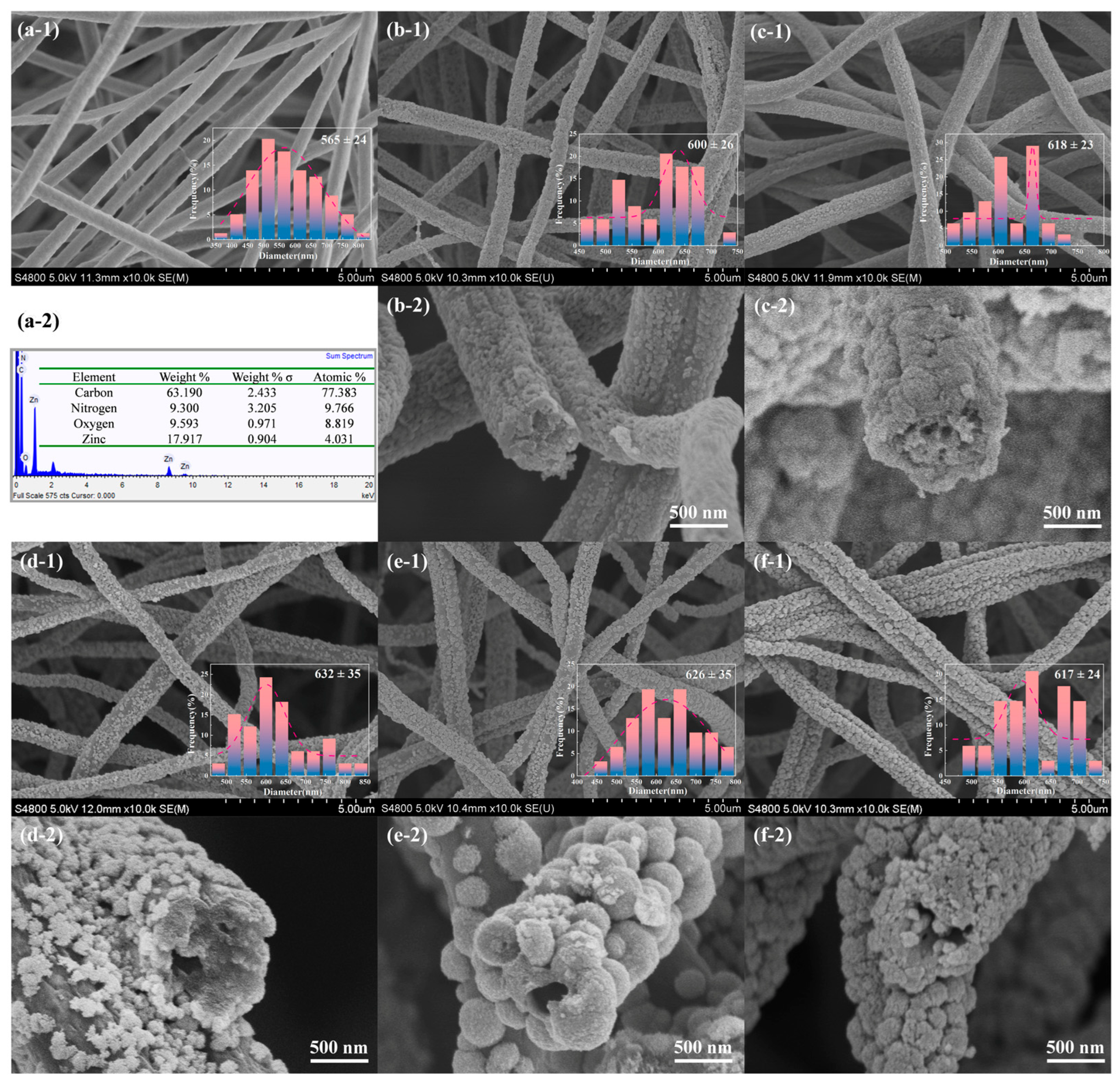
Figure 1. (a) SEM picture and EDS elemental analysis of coaxial electrospun nanofiber; SEM pictures of (b) H-ZnO-220, (c) H-ZnO-230, (d) H-ZnO-260, (e) H-ZnO-280, and (f) H-ZnO-300.
Catalysts 15 01137 g001
Figure 2. (a) XRD and (b) FTIR spectra of samples.
Catalysts 15 01137 g002
Figure 3. SEM images of (a) ZnO@HNF-220, (b) ZnO@HNF-230, (c) ZnO@HNF-260, (d) ZnO@HNF-280, and (e) ZnO@HNF-300.
Catalysts 15 01137 g003
Figure 4. TGA (a) and DTG (b) curves of ZnO@HNF-280.
Catalysts 15 01137 g004
Figure 5. (a) UV-Vis spectra and (b) Tauc plot spectra of ZnO@HNF-280 and ZnO@NF.
Catalysts 15 01137 g005
Figure 6. (a) PL spectra and (b) Mott-Schottky curves of ZnO@HNF-280 and ZnO@NF.
Catalysts 15 01137 g006
Figure 7. (a) Degradation curves and (b) corresponding pseudo-first-order kinetics for MB of ZnO@HNF-x and ZnO@NF under UV light. (c) Cyclic degradation curves of ZnO@HNF-280. (d) EDS elemental comparison of the pristine and degraded ZnO@HNF-280.
Catalysts 15 01137 g007
Figure 8. (a) Photocatalytic degradation mechanism and (b) results of free radical capture experiments for ZnO@HNF-280.
Catalysts 15 01137 g008
Figure 9. Schematic illustration of fabrication process for ZnO@HNF.
Catalysts 15 01137 g009
Table 1. Photocatalytic degradation efficiency (η) for MB of ZnO@HNF-x.
Time (min)0306090120150180
η under UV (%)ZnO@HNF-220019.9233.6342.2250.8553.9856.64
ZnO@HNF-230016.2228.1047.1255.1967.1175.51
ZnO@HNF-260024.0446.7463.9776.9684.5091.01
ZnO@HNF-280050.4470.7284.1290.4092.7794.70
ZnO@HNF-300010.0831.8453.2171.3683.1892.03
ZnO@NF013.6835.0846.5455.3563.8971.78
Blank01.504.346.558.5712.7814.67
η under sunlight (%)ZnO@HNF-280056.8175.6885.9889.6291.4992.95
Table 2. A comparison of performance parameters of ZnO photocatalysts.
CatalystsCatalyst Dosage (mg)MB Solution
(mL, mg/L)
Time
(min)
Degradation Efficiency (%)k (min−1)Ref.
ZnO NPs20100, 1512096.5, 81 after 10 cycles0.00497[15]
rGO@ZnO-NCs99, 84 after 10 cycles0.00503
PVDF/ZnO/CuS/50, 2042093.3, >90 after 4 cycles0.00901[23]
ZnO/carbon/g-C3N41010, 3.212091.8, no cycle0.0206[30]
PPCD@3Ag/ZnO5050, 1012071.5, 64.2 after 5 cycles0.0115[43]
CA/ZnO@TiO21015, 1012080, no cycle0.00175[44]
ZnO@poly-CD/10, 1512094.3, 93.6 after 10 cycles/[45]
Ce/ZnO/CNFs6050, 1042096, decreased slightly after 3 cycles0.00540[46]
ZnO@HNF-2803030, 1018094.70, 89.96 after 5 cycles0.01641This work
Disclaimer/Publisher’s Note: The statements, opinions and data contained in all publications are solely those of the individual author(s) and contributor(s) and not of MDPI and/or the editor(s). MDPI and/or the editor(s) disclaim responsibility for any injury to people or property resulting from any ideas, methods, instructions or products referred to in the content.