Abstract
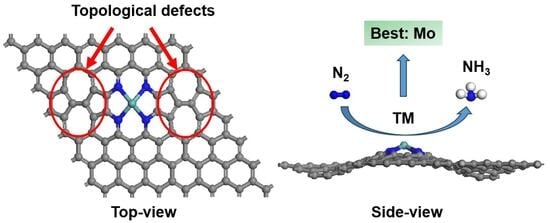
Defect engineering can effectively regulate the catalytic activity of single-atom catalysts anchored on the graphene substrate. Based on graphene with topological defects consisting of 5,7-membered carbon rings, we designed and investigated twenty transition metal single-atom catalysts TM-N4-C57 (TM = Sc~Cu, Zr~Mo, Ru, Rh, Hf~Ir) for electrocatalytic nitrogen reduction reaction (NRR) using density functional theory (DFT) calculations. Employing a screening strategy that considers binding energy, N2 adsorption, catalytic activity, selectivity, and thermal stability, we ultimately screened out two electrocatalysts (Mo-N4-C57 and W-N4-C57) with excellent catalytic activity and selectivity. The NRR pathways on these two catalysts proceed through distal and consecutive pathways, with limiting potentials of −0.19 and −0.53 V for Mo-N4-C57 and W-N4-C57, respectively. The activity origin was elucidated through the analysis of partial density of states (PDOS) and crystal orbital Hamilton populations (COHP), suggesting that the interaction between Mo and NH2 in the *NH2 intermediate is relatively weak. An excellent linear relationship between UL and ICOHP has been identified, suggesting it as a descriptor. This work provides a theoretical basis for designing efficient NRR catalysts with modified second coordination spheres.
1. Introduction
Ammonia (NH3), as a crucial chemical raw material and green energy carrier, plays a significant role in modern industry, agriculture and manufacturing [1,2]. Currently, industrial NH3 synthesis is still dominated by the Haber–Bosch process, which is energy-intensive and CO2-emissive [3,4]. To promote sustainable development and reduce dependence on fossil fuels, researchers are actively seeking green, efficient, and sustainable NH3 preparation methods to replace the Haber–Bosch process. Among these, the electrochemical nitrogen reduction reaction (NRR) for NH3 has garnered significant attention due to its advantages of low energy consumption, mild conditions, and environmental friendliness [5,6,7,8,9]. However, electrochemical NRR also faces challenges, including slow reaction kinetics, a high limiting potential, and the competing hydrogen evolution reaction (HER) in aqueous conditions [10,11,12,13,14]. Therefore, designing and synthesizing electrocatalysts with high-efficiency performance is essential.
Single-atom catalysts (SACs) have attracted widespread attention owing to their high atomic utilization and unique coordination environments [15]. To date, numerous two-dimensional material-supported SACs have been reported, with particular emphasis on graphene-supported transition-metal single-atom catalysts [16,17]. To enhance catalytic performance, researchers have employed strategies such as modifying the active center atoms, adjusting the coordinating atoms of the transition metal (TM), and introducing defects [18,19,20,21,22,23,24,25,26,27,28,29,30,31,32]. Modification efforts primarily focus on the first coordination sphere of the active atoms [18,19,20,21,22,23,24,25,26,27,28]. For example, Zhao et al. [24] investigated the electrocatalytic NRR properties of 3d and 4d TM atoms loaded on boron nitride (BN) containing B defects and found that Mo@BN exhibited the highest catalytic activity, with an overpotential of −0.19 V. The Xia groups [25] reported that, compared with pristine BN, Ti atom-doped Stone-Wales defect-type and N defect-type BN 2D materials effectively enhanced NRR efficiency, reducing the overpotential from −1.20 V (pristine BN) to −0.96 V. The SACs TM@BN (TM = Sc~Zn) with B-N double vacancy have been systematically investigated, and V@BN and Fe@BN catalysts were identified as candidate catalysts with overpotentials of −0.66 and −0.68 V, respectively [26]. Zafari et al. [27] designed 26 SACs on BX sheets (X = As, P, Sb) by anchoring transition metals on vacant sites of P, Sb, and As elements for NRR. The W-BSb and Mo-BSb catalysts demonstrated high performance, with limiting potentials of 0.00 and −0.19 V, respectively. Chen et al. [28] explored the catalytic activity of a single Mo atom anchored on BC2N monolayers with different defects and proposed that Mo supported on a defective BC2N monolayer with double B-C vacancies served as a promising catalyst, exhibiting an overpotential of −0.441 V. Beyond the first coordination sphere designs, research on the second coordination sphere modulation remains relatively limited due to the synthetic challenges associated with functionalizing these extended coordination environments [29,30,31,32]. Huang et al. [29] designed defective hybrid h-BN/graphene (BCN) heterostructures to anchor a single Mo atom as an SAC for NRR. Calculations revealed that the hybrid catalyst with a graphene structure surrounding Mo-N3 exhibited efficient NRR performance, achieving a low overpotential of −0.42 V. Xiao and co-workers [30] constructed and screened various BN-doped graphene materials with transition metals anchored at B vacancies for NRR. They demonstrated that the catalytic activity and selectivity of NRR could be enhanced by adjusting the BN coverage, effectively replacing the second and distant coordination spheres. The Xu group [31] proposed that asymmetric hydrogenation occurring in the second coordination sphere and beyond serves as a powerful strategy to simultaneously enhance the catalytic activity and selectivity of vanadium-anchored N3-doped graphene catalysts for NRR. Additionally, Qiao et al. [32] demonstrated that the selectivity of Co-SACs for the oxygen reduction reaction (ORR) could be improved by modifying their first coordination sphere (N and/or O coordination) and second coordination sphere (C-O-C groups). These studies indicate that the molecular-level local structure, encompassing both the first and second coordination spheres, synergistically promotes electrocatalytic performance. Collectively, these findings suggest that modifying the second coordination sphere enhances catalytic activity and selectivity. The concept of tuning the second coordination sphere provides new insights for designing highly efficient single-atom catalysts for NRR.
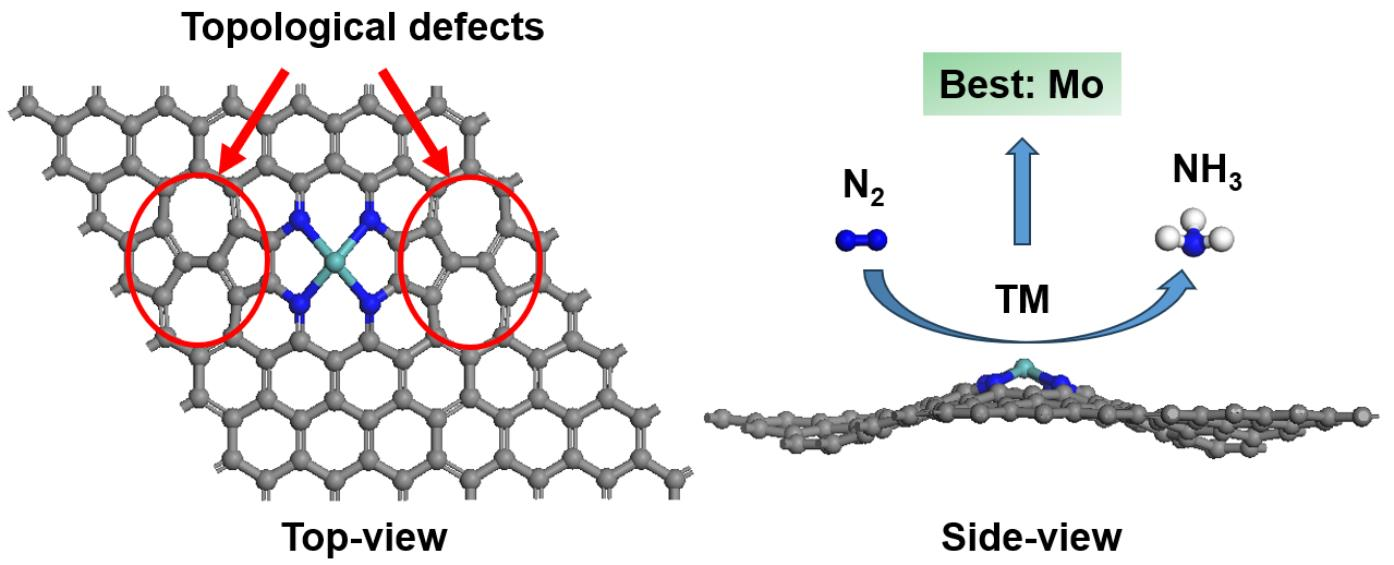
In graphene, topological defects, including the absence, addition, or substitution of carbon atoms, lead to structural irregularities. These defects induce charge redistribution, thereby modifying the electronic structure of active sites and ultimately influencing catalytic activity [33,34,35,36,37]. The Zeng groups [38] designed a N-doped defective graphene support to anchor one or two Mo atoms (Mox-N6-gra (x = 1–2)) as catalysts for NRR. The Mo-N6-gra catalyst exhibited high catalytic activity toward NRR via the distal mechanism, with a limiting potential of −0.23 V. By positioning the active center at the edge or basal plane of N-doped defective graphene, four Mo-based SACs were constructed and evaluated for NRR. Among them, Mo-ZZG (where Mo is located between graphene zigzag edges) demonstrated remarkable catalytic activity and selectivity, with a limiting potential of −0.26 V [39]. Recently, Han et al. successfully synthesized a porous carbon-based material with single-atom Ru embedded and containing 5,7-membered carbon rings (denoted Ru-N4-C57) [40]. As an electrocatalyst, Ru-N4-C57 exhibits exceptional performance for NRR. Calculational results reveal that N2 adsorption on a single-atom Ru site surrounded by topological defects elongates the N≡N bond, reducing its bond and enhancing NRR susceptibility. This work provides crucial guidance for designing novel M-N-C electrocatalysts by introducing topological defects in the second coordination sphere of active metal sites.
Notably, the literature reveals that the optimized structure of Ru-N4-C57 exhibits a distinct curvature, in contrast to the planar configurations observed in either defect-free [40] or other defective graphene-based SACs [38,39]. Inspired by this unique structural feature and the exceptional NRR catalytic performance of Ru-N4-C57, we aim to systematically investigate the influence of topological defects in the second coordination sphere on NRR performance by introducing 5,7-membered carbon rings. To achieve this, we designed and constructed a series of TM-N4-C57 electrocatalysts (TM = Sc~Cu, Zr~Mo, Ru, Rh, Hf~Ir) for NRR. Using density functional theory (DFT) calculations, we comprehensively evaluated their stability and catalytic activity. Ultimately, two TM-N4-C57 catalysts (TM = Mo, W) were identified as promising candidates, demonstrating excellent NRR catalytic activity and selectivity. We anticipate that this study will provide valuable insights for enhancing NRR performance through second coordination sphere modulation strategies.
2. Results and Discussion
2.1. Structures and Binding
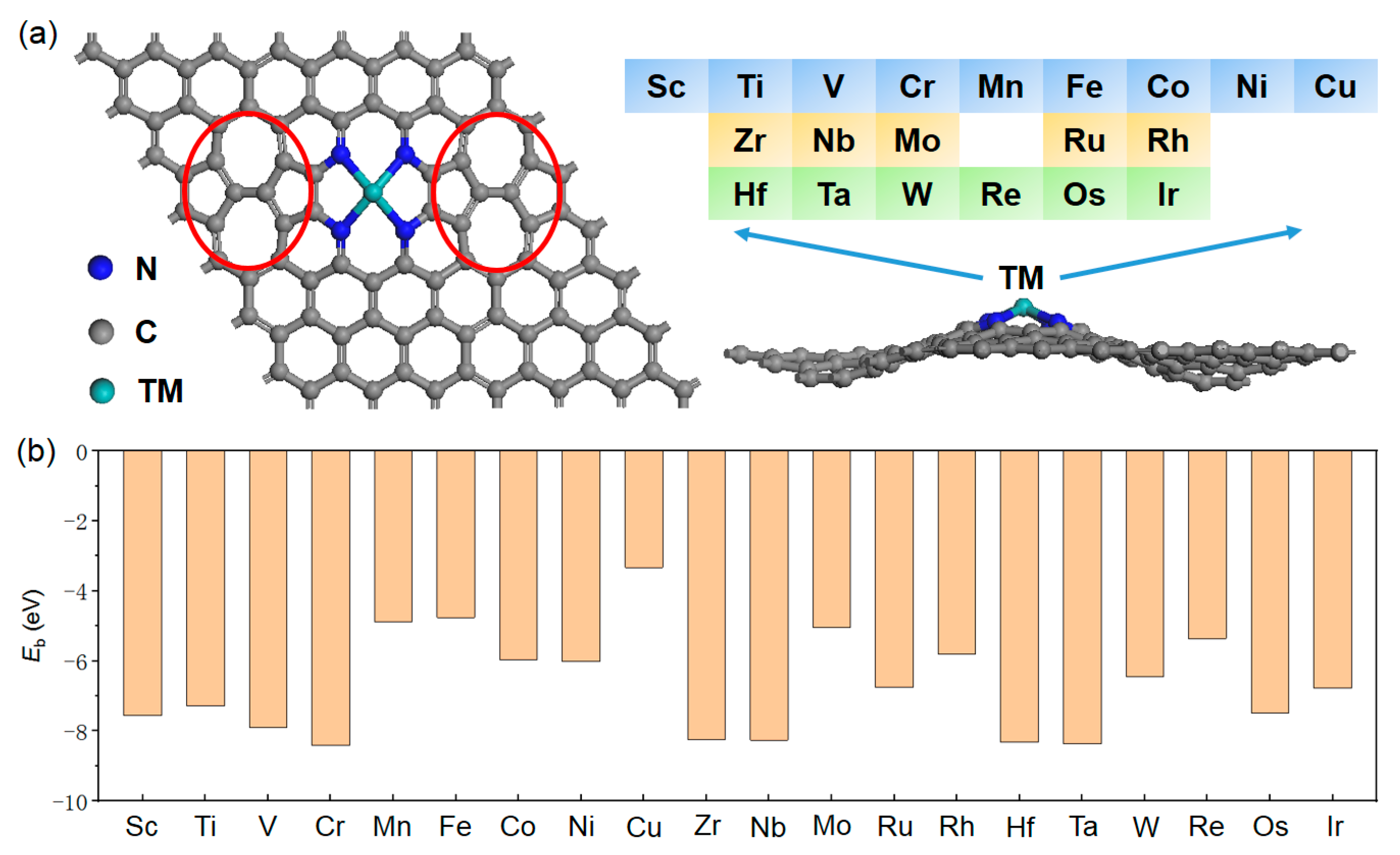
The optimized structures of the TM-N4-C57 catalysts (TM = Sc~Cu, Zr~Mo, Ru, Rh, Hf~Ir) containing 5,7-membered carbon rings are presented in Figure 1a. These structures display significant curvature, consistent with the curved configuration of Ru-N4-C57 reported in the literature [40].
Figure 1.
(a) Schematic diagram of the optimized TM-N4-C57 catalyst structures. The red circles indicate the location of the topological defects. (b) The corresponding binding energies (Eb) of transition metal atoms anchored on topological defective graphene substrate N4-C57.
Good stability is an important criterion for evaluating catalytic performance. To assess the stability of the TM-N4-C57 catalysts (TM = Sc-Cu, Zr-Mo, Ru, Rh, Hf-Ir), we calculated the binding energy (Eb) using the following formula:
where Ecat, Esub and ETM represent the total energy of the TM-N4-C57 catalyst, the topological defective substrate N4-C57 and the isolated TM atom, respectively. As shown in Figure 1b, the binding energy (Eb) of the TM atom on the substrate N4-C57 ranges from −3.33 to −8.41 eV, indicating that all the TM atoms form strong bonds with the topological defective substrate N4-C57.
Eb = Ecat − Esub − ETM
2.2. Catalyst Screening
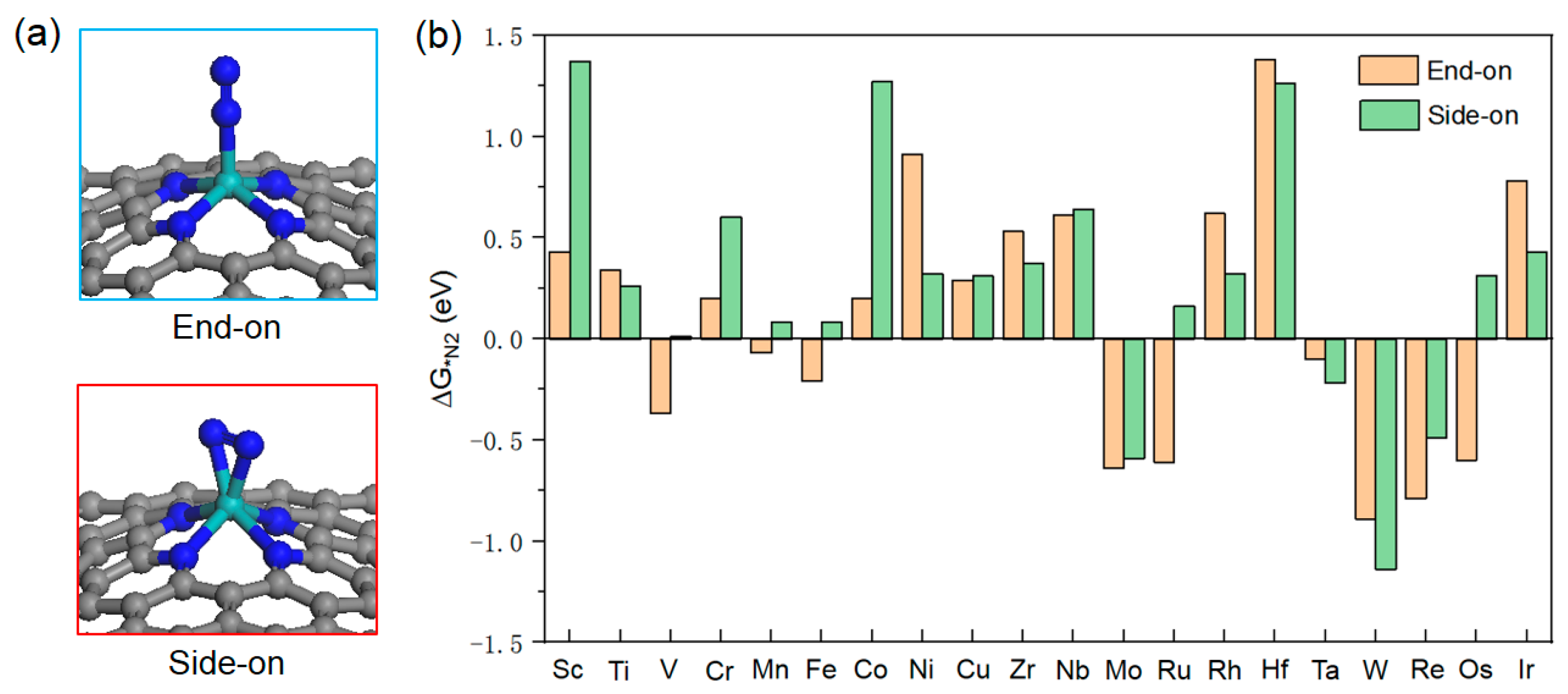
The adsorption of N2 molecules on catalysts represents the first critical step for NRR. The two adsorption configurations of N2 molecules on TM-N4-C57 are shown in Figure 2a, namely end-on adsorption and side-on adsorption. By comparing the adsorption free energy (∆G*N2) of the two configurations, the dominant configuration of N2 molecules on different catalysts is determined. The calculated adsorption free energies are summarized in Figure 2b, where a more negative value corresponds to a stronger N2 adsorption affinity. Based on the negative adsorption energies, nine TM-N4-C57 (TM = V, Mn, Fe, Mo, Ru, Ta, W, Re and Os) were identified. N2 molecules predominantly adsorb in a side-on configuration, except in the cases of Ta and W, where the end-on mode prevails. The N-N bond length after N2 adsorption can reflect the activation of N2 to a certain extent. Compared with the bond length in free N2 molecule (dN-N = 1.114 Å), the adsorbed N-N bonds are significantly elongated, ranging from 1.124 Å to 1.337 Å (Table S1). These results indicate that the interaction between the TM and N2 effectively activates the N2 molecule.
Figure 2.
(a) Schematic diagram of end-on and side-on adsorption configurations of N2. In the depicted molecular structure, nitrogen atoms are denoted by blue spheres, carbon atoms by gray spheres, and the metal atom by a light blue sphere. (b) Adsorption free energy of N2 on TM-N4-C57 (TM = Sc~Cu, Zr~Mo, Ru, Rh, Hf~Ir).
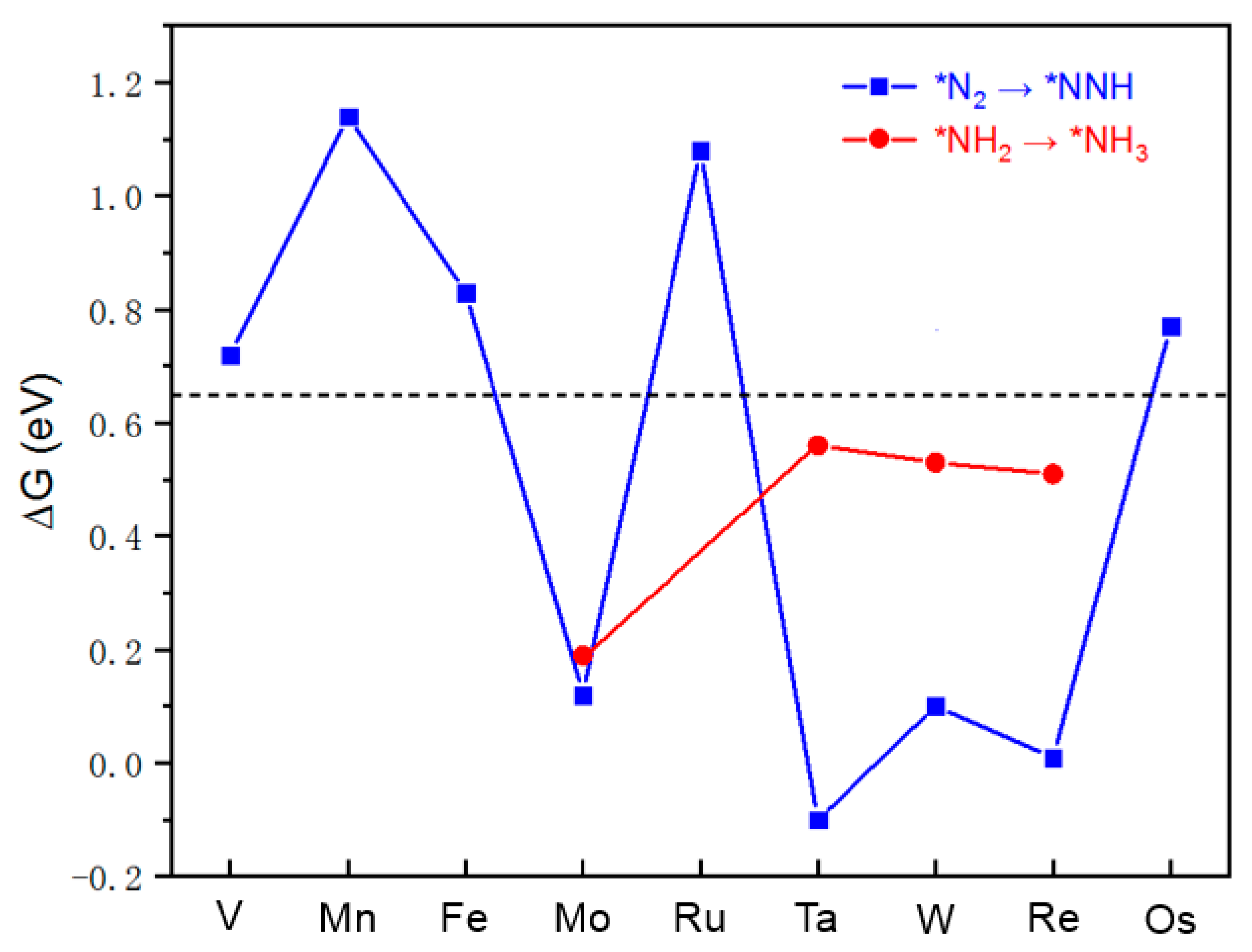
During the six-electron reduction reaction of N2 to NH3, the first protonation step (*N2 + H+ + e− → *NNH) or the last protonation step (*NH2 + H+ + e− → *NH3) is usually regarded as the potential-determining step (PDS), which is the most thermodynamically uphill step in the reaction pathway [26,28,39,41,42,43,44]. To efficiently screen high-activity catalysts from the nine TM-N4-C57 candidates (TM = V, Mn, Fe, Mo, Ru, Ta, W, Re and Os), we used the free energy change in these two steps (∆G*N2-*NNH and ∆G*NH2-*NH3) as activity descriptors. The screening criteria for these two descriptors were set to 0.65 eV to identify higher-activity catalysts, which is more stringent than the commonly used threshold of 0.98 eV (based on the benchmark Ru(0001) bulk metal catalyst) [26,28,39,41,42,43,44]. As shown in Figure 3, four TM-N4-C57 (TM = Mo, Ta, W, and Re) met the criteria: their ∆G*N2-*NNH values were below 0.65 eV, and their ∆G*NH2-*NH3 values also satisfied the threshold. Thus, TM-N4-C57 (TM = Mo, Ta, W, and Re) are promising candidates for catalysts.
Figure 3.
Free energy changes in the first and last hydrogenation steps. The “*” symbol represents an adsorbed species and the black dashed line indicates the screening criterion (∆G = 0.65 eV).
2.3. NRR Mechanism
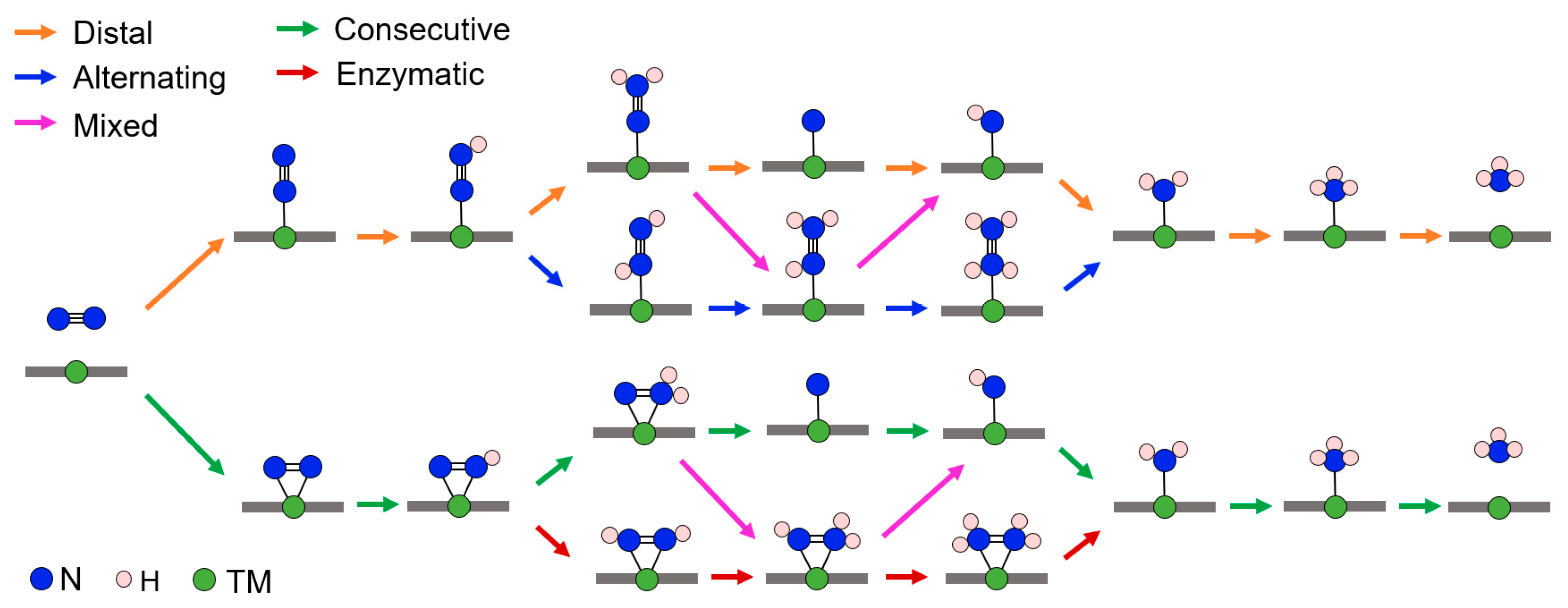
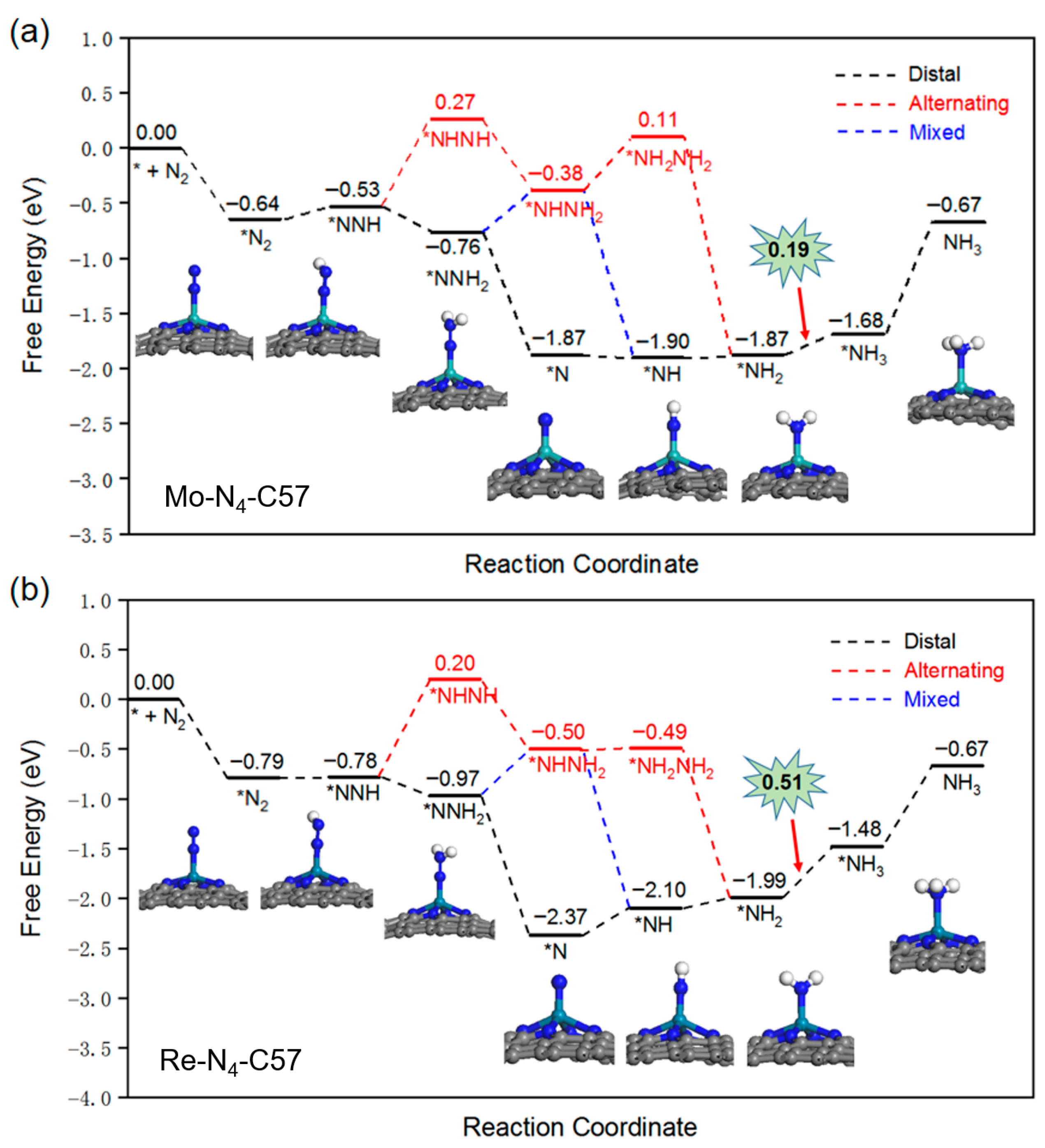
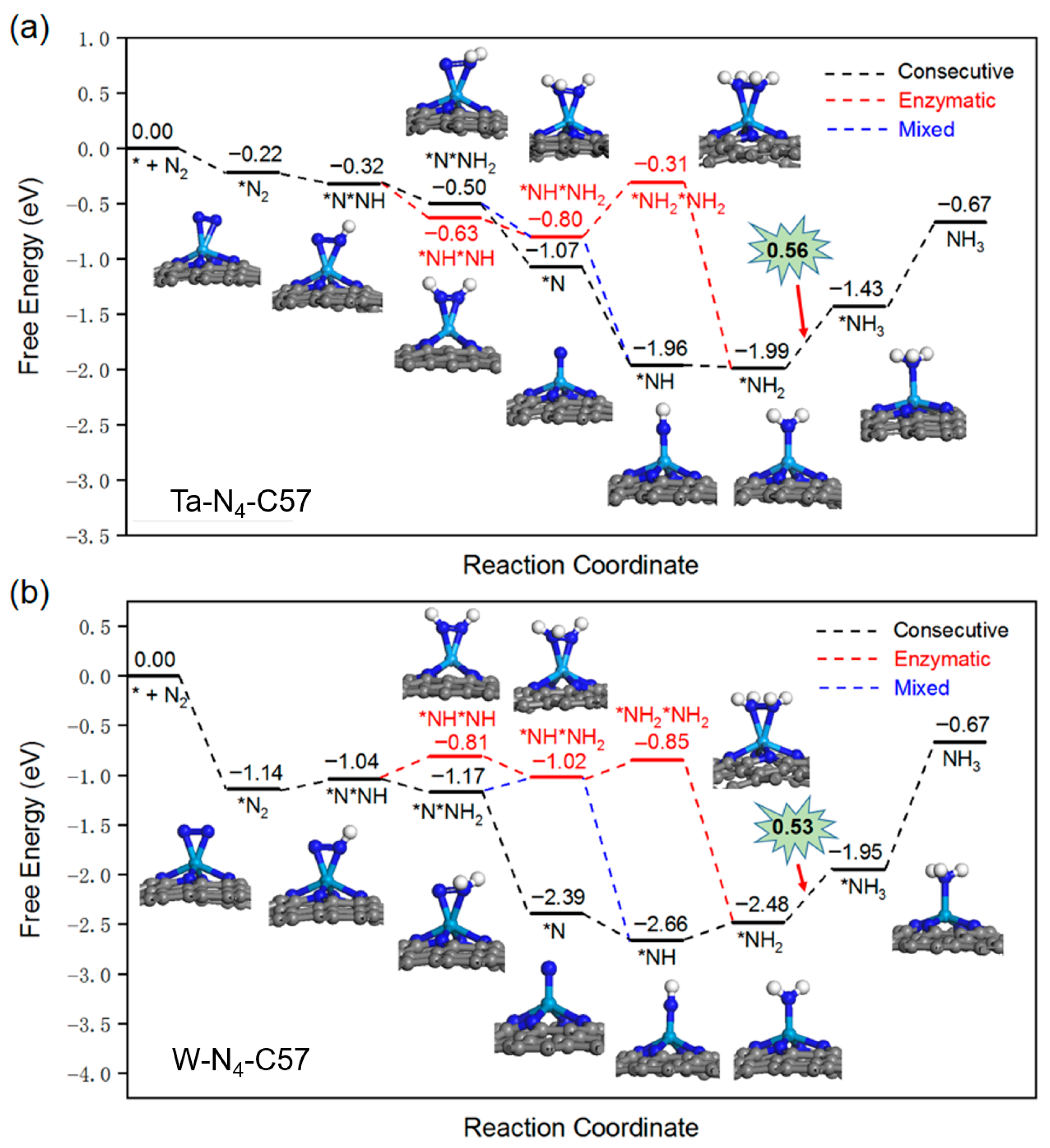
The adsorption configurations of N2 molecules on TM-N4-C57 (TM = Mo, Ta, W, and Re) are end-on for Mo-N4-C57 and Re-N4-C57, but side-on for Ta-N4-C57 and W-N4-C57. To evaluate the catalytic performance of NRR, five possible NRR pathways were analyzed (Figure 4): distal, alternating, consecutive, enzymatic, and mixed mechanisms. For Mo-N4-C57 and Re-N4-C57 (end-on adsorption), NRR proceeds via distal, alternating, or mixed pathways, while Ta-N4-C57 and W-N4-C57 (side-on adsorption) favor consecutive, enzymatic, or mixed pathways. Figure 5 and Figure 6 present the corresponding Gibbs free energy diagrams and intermediate structures for these two types of catalysts.
Figure 4.
Schematic diagram of possible reaction pathways for NRR on the TM-N4-C57 catalyst.
Figure 5.
Gibbs free energy diagrams for NRR on (a) Mo-N4-C57 and (b) Re-N4-C57 via end-on adsorption configuration. The “*” symbol represents an adsorbed species.
Figure 6.
Gibbs free energy diagrams for NRR on (a) Ta-N4-C57 and (b) W-N4-C57 via side-on adsorption configuration. The “*” symbol represents an adsorbed species.
On Mo-N4-C57, N2 adsorbs in an end-on configuration with an adsorption free energy of −0.64 eV (Figure 5a). The first hydrogenation step forms *NNH, shifting the free energy diagram slightly by 0.11 eV. Subsequently, the proton–electron pair preferentially adds to the distal N atom of *NNH to form *NNH2 (ΔG = −0.23 eV) rather than attacking the proximal N to form *NHNH (ΔG = 0.80 eV), indicating that the *NNH2 pathway is thermodynamically favored. To elucidate the stability difference between *NNH2 and *NHNH, we calculated the ICOHP of Mo-N and N-N bonds. The more negative ICOHP indicates a higher bonding degree. The Mo-N bond in *NNH2 (−4.28 eV) is significantly stronger than in *NHNH (−2.37 eV), while the N-N bond in *NNH2 (−6.71 eV) is slightly weaker than in *NHNH (−7.19 eV). This suggests that the enhanced Mo-N interaction in *NNH2 primarily stabilizes this intermediate. Subsequently, the hydrogenation of *NNH2 to *NHNH2 requires an energy of 0.38 eV, whereas the conversion of *NNH2 to *N is exothermic (−1.11 eV). The preference for *N over *NHNH2 can be explained by ICOHP analysis: the Mo-N and N-N bonds in *NHNH2 (−2.82 and −5.65 eV, respectively) are weaker than those in *NNH2 (−4.28 and −6.71 eV), while the Mo-N bond in *N (−5.64 eV) is stronger than in *NNH2, stabilizing the *N intermediate. Then, *N undergoes three sequential hydrogenation steps to form *NH, *NH2, and *NH3, corresponding to the ΔG values of −0.03, 0.03, and 0.19 eV. The results confirm that NRR proceeds via a distal mechanism, with the last hydrogenation step (*NH2 + H+ + e− → *NH3) serving as the PDS. The limiting potential (UL) is −0.19 V, comparable to high-performance catalysts like Mo@BN [24], W-BSb [27], Mo-BSb [27], Mo-N6-gra [38], and Mo-ZZG [39]. The Gibbs free energy changes along the reaction pathway of NRR on Re-N4-C57 are shown in Figure 5b. The reaction pathways on Re-N4-C57 are similar to those on Mo-N4-C57, following a distal mechanism, with the same PDS but a higher UL of −0.51 V.
The Gibbs free energy changes along the reaction pathway of NRR on Ta-N4-C57 and W-N4-C57 are shown in Figure 6. The molecule N2 adsorbs on Ta-N4-C57 in a side-on configuration with an adsorption free energy of −0.22 eV. As illustrated in Figure 6a, the hydrogenation steps from*N2 to *N*NH, *N*NH2, *N, *NH, and *NH2, all proceed downhill under the consecutive mechanism. Simultaneously, the formation of *NH*NH and *NH*NH2 via the enzymatic pathway is also exothermic, with ΔG values of −0.31 and −0.17 eV, respectively. These results suggest that the two pathways are competitive and both are plausible. The final hydrogenation step (*NH2 + H+ + e− → *NH3) has a ΔG value of 0.56 eV, and thus is identified as the potential-determining step (PDS) for NRR on Ta-N4-C57, resulting in a UL of −0.56 V.
The reaction pathways on W-N4-C57 (Figure 6b) are similar to those on Ta-N4-C57, with N2 adsorbing in a side-on configuration. The adsorption of N2 is slightly endothermic by 0.10 eV. Subsequently, the hydrogenation steps via the consecutive mechanism are exothermic, forming *N*NH2, *N, and *NH. The subsequent two hydrogenation steps are endothermic, with ΔG values of 0.22 and 0.53 eV for *NH2 and *NH3, respectively. In brief, on W-N4-C57, the NRR proceeds through a consecutive mechanism, with the last hydrogenation step (*NH2 + H+ + e− → *NH3) serving as the PDS, and the corresponding UL is −0.53 V. Collectively, the free energy profiles confirm that the final step (*NH2 + H+ + e− → *NH3) is consistently the PDS for TM-N4-C57 (TM = Mo, Ta, W, and Re), with UL values of −0.19, −0.51, −0.56 and −0.53 V, respectively.
2.4. Origin of the NRR Activity
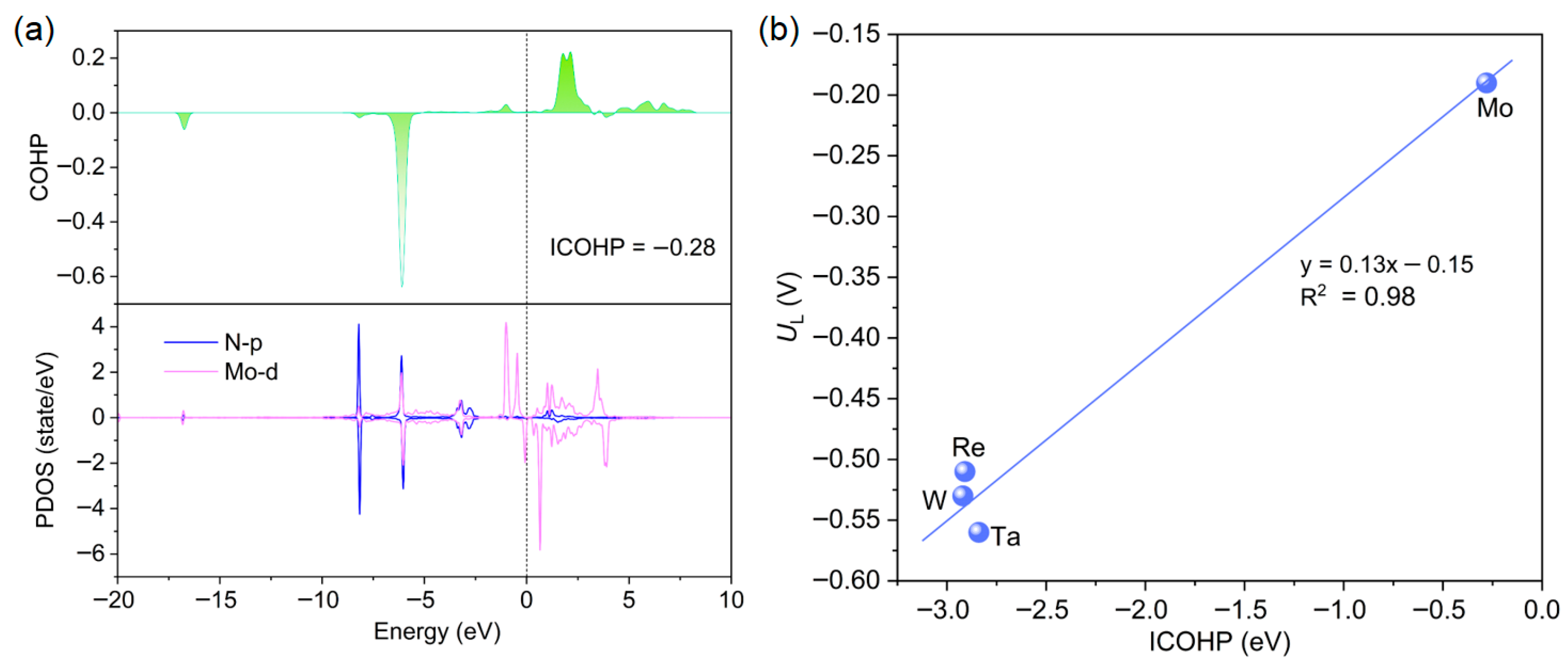
To elucidate the superior activity of Mo-N4-C57 among the four TM-N4-C57 catalysts (TM = Mo, Ta, W, and Re), we conducted the partial density of states (PDOS) and crystal orbital Hamilton populations (COHP) analyses, integrating the band states up to the highest occupied energy level (Figure 7a). Since the last hydrogenation step (*NH2 + H+ + e− → *NH3) is the PDS, *NH2 intermediates were adopted in these calculations. A more negative ICOHP value indicates stronger interactions between TM and N in *NH2. The computed ICOHP for Mo-N4-C57 is −0.28, which is less negative than those of Re-N4-C57 (−2.91), Ta-N4-C57 (−2.84), and W-N4-C57 (−2.92) (Figure S1), suggesting relatively weaker Mo-NH2 interaction among the four catalysts. More interestingly, we plotted the ICOHP versus UL and found an excellent linear correlation with R2 of 0.98 (Figure 7b), indicating that the weaker the interaction between TM and NH2, the closer the limiting potential to zero. Therefore, the ICOHP of TM-N bond in *NH2 can serve as a descriptor for NRR catalyst activity. Multiple descriptors, such as the d-band center of the metal, metal charge variance, and adsorption free energy of *NNH et al., have been evaluated using machine learning to identify the optimal ones for predicating catalytic performance [45,46,47]. Our results reveal that the ICOHP of the TM-N bond in *NH2 serves as a descriptor reflecting the interaction between TM and NH2, which directly correlates with the stability of *NH2. Specifically, the instability of *NH2 leads to a lower UL for the NRR process, where the last protonation step (*NH2 + H+ + e− → *NH3) constitutes the PDS. This is consistent with the suggestion that stabilizing *NNH and destabilizing *NH2 can effectively reduce the overpotential [24,48].
Figure 7.
(a) The partial density of states (PDOS) and crystal orbital Hamilton populations (COHP) of NH2 on Mo-N4-C57. (b) Linear relationship between UL and ICOHP.
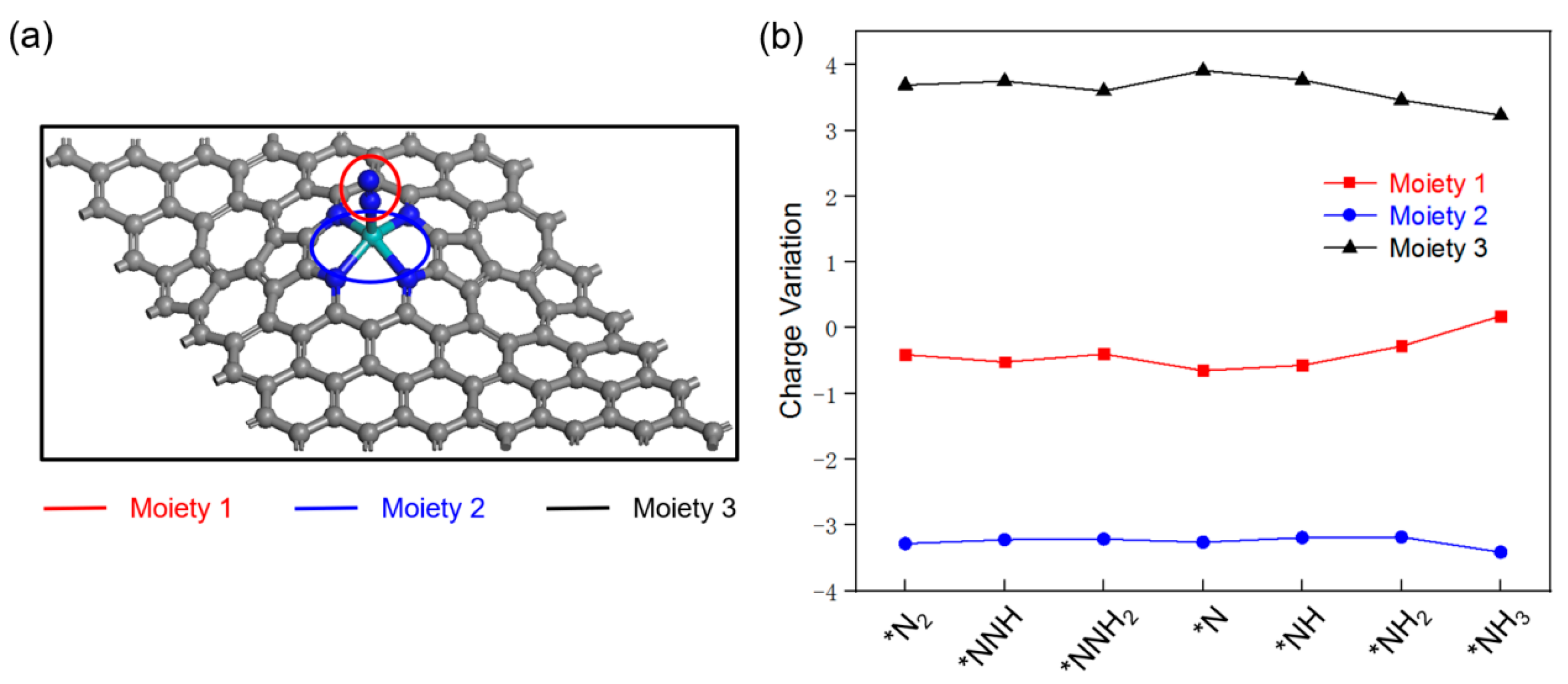
The adsorption strength of adsorbed species can be evaluated by analyzing the charge variation after being adsorbed on the catalyst. As illustrated in Figure 8a, each intermediate can be divided into three parts: the adsorbed species (moiety 1), the active center MoN4 (moiety 2), and the substrate without MoN4 (moiety 3). As shown in Figure 8b for the highly active Mo-N4-C57 catalyst, the charge variation trend of the substrate (moiety 3) is opposite to that of the adsorbed species (moiety 1), with similar magnitude, suggesting that the substrate serves as an electron donor, while the MoN4 center functions as a bridge facilitating charge transfer between the substrate and adsorbed species (except NH3). In summary, the topological defective graphene substrate acts as an effective electron donor, which plays a significant role in N2 activation and subsequent protonation steps.
Figure 8.
(a) Definition of the three parts for Mo-N4-C57. The three parts represent moiety 1 (the adsorbed species), moiety 2 (MoN4), and moiety 3 (substrate without MoN4), respectively. (b) Charge variation in Mo-N4-C57 catalyst with the species adsorption. The “*” symbol represents an adsorbed species.
2.5. Selectivity and Stability
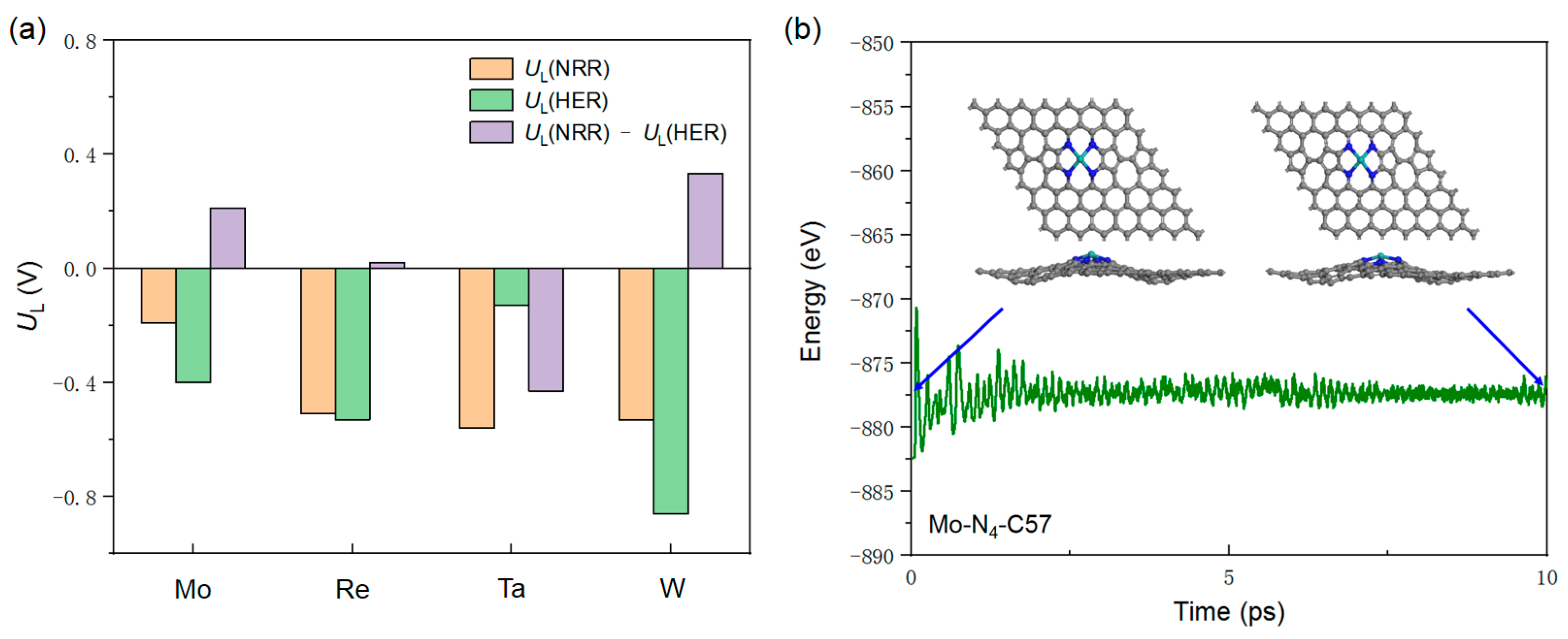
To evaluate the competition between NRR and HER, the limiting potentials UL(NRR) and UL(HER) are presented in Figure 9a. NRR selectivity is superior to HER when the value of UL(NRR)-UL(HER) is positive. As shown in Figure 9a, the UL(NRR)-UL(HER) values are positive for Mo-N4-C57, W-N4-C57, and Re-N4-C57, with values of 0.21 and 0.36 V for the two former catalysts, indicating that Mo-N4-C57 and W-N4-C57 process high NRR selectivity. Furthermore, an inverted volcano-shaped relationship is observed between the HER limiting potential UL(HER) and the binding energies (Eb) of TM in TM-N4-C57 (TM = Mo, Ta, W, and Re) (Figure S2), in which the optimal selectivity performance occurs at moderate Eb values, as exemplified by W-N4-C57.
Figure 9.
(a) Limiting potentials UL(NRR) and UL(HER) for NRR and HER, as well as the difference UL(NRR)-UL(HER) between them on TM-N4-C57 (TM = Mo, Ta, W, and Re) catalysts. (b) Energy curve versus timesteps and local structures before and after AIMD for Mo-N4-C57.
The catalyst stability under operating conditions determines whether it can be practically applied. To investigate the thermal stability of Mo-N4-C57 and W-N4-C57 catalysts, we performed ab initio molecular dynamics (AIMD) simulations at 400 K for 10 ps. Figure 9b displays the energy variation over time for Mo-N4-C57 (for W-N4-C57 in Figure S3), along with the initial and final (0 ps and 10 ps) structures. The results reveal no significant structural disruption or diffusion of metal atoms during the simulation, confirming that both Mo-N4-C57 and W-N4-C57 exhibit excellent thermal stability and are suitable for use as NRR electrocatalysts under electrochemical conditions.
3. Computational Methods
All calculations based on the spin-polarized density functional theory (DFT) method were performed using the Vienna Ab initio Simulation Package (VASP 5.4.4) [49,50]. The projector-augmented-wave (PAW) method and Perdew–Burke–Ernzerhof (PBE) functional within the generalized gradient approximation (GGA) were adopted [51,52]. The cutoff energy for the electron plane-wave expansion was chosen as 450 eV. The k-point grid settings were 3 × 3 × 1 and 9 × 9 × 1 for structure relaxation and density of states calculations, respectively. Convergence thresholds of 10−5 eV for energy and 0.02 eV/Å for force were adopted. We used a (5 × 5) single-layer graphene supercell as the substrate for catalyst and introduced a 20 Å vacuum layer along the c direction to eliminate interactions between periodic images. DFT-D3 empirical dispersion correction was applied to describe the long-range van der Waal’s interactions [53]. The implicit solvation model introduced in VASPsol was used to consider solvation effects [54]. The crystal orbital Hamilton population (COHP) was implemented using LOBSTER 5.0.0 (Local Orbital Basis Suite Towards Electronic-Structure Reconstruction) [55]. Ab initio molecular dynamics (AIMD) simulations at 400 K were conducted to assess the thermal stability of the catalyst, with a time step of 2 fs over a total simulation time of 10 ps [56].
The Gibbs free-energy change (ΔG) of each elementary step was calculated referring to the computational hydrogen electrode (CHE) model [57] as follows:
where ΔEDFT, ΔEZPE, and ΔS are changes in the DFT energy, zero-point energy, and entropy, respectively. T is set to room temperature (298.15 K). Additionally, data postprocessing was assisted by Qvasp 2.24 [58] and VASPKIT 1.4.0 packages [59]. The limiting potential was defined as UL = −ΔGPDS/e, where ΔGPDS is the maximum free energy change along the reaction pathway.
ΔG = ΔEDFT + ΔEZPE – TΔS
4. Conclusions
In this work, we designed twenty TM-N4-C57 catalysts (TM = Sc~Cu, Zr~Mo, Ru, Rh, Hf~Ir) by supporting TM-N4 on graphene with topological defects of 5,7-membered carbon rings for the NRR electrocatalysts. Using DFT calculations, these twenty catalysts were screened based on their structural stability, N2 adsorption energy, and the free energy changes in the first and last hydrogenation steps. The results indicate that among the twenty catalysts, four TM-N4-C57 catalysts (TM = Mo, Ta, W, and Re) were ultimately screened out. Among them, Mo-N4-C57 exhibits the highest catalytic performance, achieving a limiting potential of −0.19 V through a distal pathway. The NRR pathways on Re-N4-C57, Ta-N4-C57, and W-N4-C57 exhibit limiting potentials of −0.51, −0.56, and −0.53 V, respectively. The interaction between Mo and NH2 in Mo-N4-C57 was found to be relatively weaker than in the other three catalysts, as reflected by the less negative ICOHP values. Furthermore, an excellent linear correlation was observed between UL and ICOHP, suggesting ICOHP as a descriptor for the NRR activity of TM-N4-C57 catalysts. Moreover, by comparing the limiting potentials of NRR and HER, it was determined that Mo-N4-C57 and W-N4-C57 effectively suppress HER, thus providing high NRR selectivity. AIMD simulations further confirmed the excellent thermal stability of these catalysts under operational conditions. We hope these findings offer theoretical insights for the design of more efficient NRR electrocatalysts.
Supplementary Materials
The following supporting information can be downloaded at: https://www.mdpi.com/article/10.3390/catal15121135/s1, Table S1: The N−N bond length dN−N (Å) in *N2 intermediates. Figure S1: The partial density of states (PDOS) and crystal orbital Hamilton populations (COHP) of NH2 on (a) Re-N4-C57, (b) Ta-N4-C57 and (c) W-N4-C57. Figure S2: Relationship between the HER limiting potential UL(HER) and the binding energies (Eb) of TM in TM-N4-C57. Figure S3: Energy curve versus timesteps and local structures before and after AIMD for W-N4-C57.
Author Contributions
Investigation, writing—original draft, S.K.; investigation, H.D. and X.D.; writing—review and editing, M.W.; supervision, J.L. All authors have read and agreed to the published version of the manuscript.
Funding
This research was funded by the National Key Research and Development Program of China, grant number 2021YFA1500403, and the National Natural Science Foundation of China, grant number 22573040.
Data Availability Statement
The original contributions presented in this study are included in the article/Supplementary Materials. Further inquiries can be directed to the corresponding author(s).
Conflicts of Interest
The authors declare no conflicts of interest.
References
- Coric, I.; Mercado, B.Q.; Bill, E.; Vinyard, D.J.; Holland, P.L. Binding of dinitrogen to an iron–sulfur–carbon site. Nature 2015, 526, 96–99. [Google Scholar] [CrossRef]
- Spatzal, T.; Perez, K.A.; Einsle, O.; Howard, J.B.; Rees, D.C. Ligand binding to the FeMo-cofactor: Structures of CO–bound and reactivated nitrogenase. Science 2014, 345, 1620–1623. [Google Scholar] [CrossRef]
- MacFarlane, D.R.; Cherepanov, P.V.; Choi, J.; Suryanto, B.H.R.; Hodgetts, R.Y.; Bakker, J.M.; Vallana, F.M.F.; Simonov, A.N. A roadmap to the ammonia economy. Joule 2020, 4, 1186–1205. [Google Scholar] [CrossRef]
- Kitano, M.; Kanbara, S.; Inoue, Y.; Kuganathan, N.; Sushko, P.V.; Yokoyama, T.; Hara, M.; Hosono, H. Electride support boosts nitrogen dissociation over ruthenium catalyst and shifts the bottleneck in ammonia synthesis. Nat. Commun. 2015, 6, 6731. [Google Scholar] [CrossRef]
- Fu, Y.; Liao, Y.; Li, P.; Li, H.; Jiang, S.; Huang, H.; Sun, W.; Li, T.; Yu, H.; Li, K.; et al. Layer structured materials for ambient nitrogen fixation. Coord. Chem. Rev. 2022, 460, 214468. [Google Scholar] [CrossRef]
- Yang, Y.; Zhang, W.; Tan, X.; Jiang, K.; Zhai, S.; Li, Z. Atomic-level reactive sites for electrocatalytic nitrogen reduction to ammonia under ambient conditions. Coord. Chem. Rev. 2023, 489, 215196. [Google Scholar] [CrossRef]
- Cui, X.Y.; Tang, C.; Zhang, Q. A review of electrocatalytic reduction of dinitrogen to ammonia under ambient conditions. Adv. Energy Mater. 2018, 8, 1800369. [Google Scholar] [CrossRef]
- Liu, D.; Chen, M.; Du, X.; Ai, H.; Lo, H.K.; Wang, S.; Chen, S.; Xing, G.; Wang, X.; Pan, H. Development of Electrocatalysts for Efficient Nitrogen Reduction Reaction under Ambient Condition. Adv. Funct. Mater. 2021, 31, 2008983. [Google Scholar] [CrossRef]
- Herrán, L.; Sancy, M.; Río, R.D.; Dalchiele, E.; Silva, D.; Veliz-Silva, D.F.; Isaacs, M. Review of Graphene Materials as Electrocatalysts for the Production of Green Ammonia from Nitrogen-Containing Compounds. Chem. Rec. 2025, 25, e202500072. [Google Scholar] [CrossRef] [PubMed]
- Singh, A.R.; Rohr, B.A.; Schwalbe, J.A.; Cargnello, M.; Chan, K.; Jaramillo, T.F.; Chorkendorff, I.; Nørskov, J.K. Electrochemical Ammonia Synthesis—The Selectivity Challenge. ACS Catal. 2017, 7, 706–709. [Google Scholar] [CrossRef]
- Minteer, S.D.; Christopher, P.; Linic, S. Recent Developments in Nitrogen Reduction Catalysts: A Virtual Issue. ACS Energy Lett. 2019, 4, 163–166. [Google Scholar] [CrossRef]
- Chen, G.; Ren, S.; Zhang, L.; Cheng, H.; Luo, Y.; Zhu, K.; Ding, L.; Wang, H. Advances in Electrocatalytic N2 Reduction—Strategies to Tackle the Selectivity Challenge. Small Methods 2019, 3, 1800337–1800356. [Google Scholar] [CrossRef]
- Suryanto, B.H.R.; Du, H.; Wang, D.; Chen, J.; Simonov, A.N.; MacFarlane, D.R. Challenges and Prospects in the Catalysis of Electroreduction of Nitrogen to Ammonia. Nat. Catal. 2019, 2, 290–296. [Google Scholar] [CrossRef]
- Singh, A.R.; Rohr, B.A.; Statt, M.J.; Schwalbe, J.A.; Cargnello, M.; Nørskov, J.K. Strategies toward Selective Electrochemical Ammonia Synthesis. ACS Catal. 2019, 9, 8316–8324. [Google Scholar] [CrossRef]
- Qiao, B.; Wang, A.; Yang, X.; Allard, L.F.; Jiang, Z.; Cui, Y.; Liu, J.; Li, J.; Zhang, T. Single-atom catalysis of CO oxidation using Pt1/FeOx. Nat. Chem. 2011, 3, 634–641. [Google Scholar] [CrossRef]
- Fei, H.L.; Dong, J.C.; Chen, D.L.; Hu, T.D.; Duan, X.D.; Shakir, I.; Huang, Y.; Duan, X.F. Single Atom Electrocatalysts Supported on Graphene or Graphene-Like Carbons. Chem. Soc. Rev. 2019, 48, 5207–5241. [Google Scholar] [CrossRef]
- Zhang, Q.; Guan, J. Single-Atom Catalysts for Electrocatalytic Applications. Adv. Funct. Mater. 2020, 30, 2000768. [Google Scholar] [CrossRef]
- Liu, P.X.; Zheng, N.F. Coordination Chemistry of Atomically Dispersed Catalysts. Natl. Sci. Rev. 2018, 5, 636–638. [Google Scholar] [CrossRef]
- Shi, K.; Cui, L.; Zhang, M.; Jiang, Y.; Gao, R.; Hao, H. DFT study the influence of active site structure on the electrocatalytic nitrogen reduction reaction. Fuel 2025, 380, 133174. [Google Scholar] [CrossRef]
- Song, W.; Xiao, C.; Ding, J.; Huang, Z.; Yang, X.; Zhang, T.; Mitlin, D.; Hu, W. Review of Carbon Support Coordination Environments for Single Metal Atom Electrocatalysts (SACS). Adv. Mater. 2024, 36, 2301477. [Google Scholar] [CrossRef]
- Yang, L.; Chen, F.X.; Wu, M.; Song, E.H.; Xiao, B.B.; Jiang, Q. Mo decoration on graphene edge for nitrogen fixation: A computational investigation. Appl. Surf. Sci. 2021, 568, 150867. [Google Scholar] [CrossRef]
- Chen, S.; Bu, M.; Zhou, Z.; Liang, Y.; Dai, Z.; Shi, J. Boosting nitrogen reduction to ammonia on Fe-N3S sites by introduction S into defect graphene. Mater. Today Energy 2022, 25, 100954. [Google Scholar]
- Wu, J.; Yang, L.; Liu, X.; Zhang, Z.; Liu, S.; Xiao, B. ZrN6-Doped Graphene for Ammonia Synthesis: A Density Functional Theory Study. ChemPhysChem 2023, 24, e202200864. [Google Scholar] [CrossRef]
- Zhao, J.; Chen, Z. Single Mo Atom Supported on Defective Boron Nitride Monolayer as an Efficient Electrocatalyst for Nitrogen Fixation: A Computational Study. J. Am. Chem. Soc. 2017, 139, 12480–12487. [Google Scholar] [CrossRef]
- Wang, Y.; Du, Y.; Meng, Y.; Xie, B.; Ni, Z.; Xia, S. Monatomic Ti doped on defective monolayer boron nitride as an electrocatalyst for the synthesis of ammonia: A DFT study. Appl. Surf. Sci. 2021, 563, 150277. [Google Scholar] [CrossRef]
- Ma, P.; Guo, J.; Zhao, J.; Yang, Z.; Wang, J.; Song, W. DFT calculations for transition metal atoms supported on BN as single-atom electrocatalysts for NH3 synthesis. Theor. Chem. Acc. 2025, 144, 48. [Google Scholar] [CrossRef]
- Zafari, M.; Umer, M.; Nissimagoudar, A.S.; Anand, R.; Ha, M.; Umer, S.; Lee, G.; Kim, K.S. Unveiling the Role of Charge Transfer in Enhanced Electrochemical Nitrogen Fixation at Single-Atom Catalysts on BX Sheets (X = As, P, Sb). J. Phys. Chem. Lett. 2022, 13, 4530–4537. [Google Scholar] [CrossRef]
- Chen, L.; Wang, Q.; Gong, H.; Xue, M. Single Mo atom supported on defective BC2N monolayers as promising electrochemical catalysts for nitrogen reduction reaction. Appl. Surf. Sci. 2021, 546, 149131. [Google Scholar] [CrossRef]
- Huang, Y.; Yang, T.; Yang, L.; Liu, R.; Zhang, G.; Jiang, J.; Luo, Y.; Lian, P.; Tang, S. Graphene–boron nitride hybrid-supported single Mo atom electrocatalysts for efficient nitrogen reduction reaction. J. Mater. Chem. A 2019, 7, 15173. [Google Scholar] [CrossRef]
- Xiao, Y.-H.; Ma, Z.-W.; Wu, X.-W.; Chen, L.-K.; Sajid, Z.; Devasenathipathy, R.; Lin, J.-D.; Wu, D.-Y.; Tian, Z.-Q. Theoretical Insight into the Transition-Metal-Embedded Boron Nitride-Doped Graphene Single-Atom Catalysts for Electrochemical Nitrogen Reduction Reaction. J. Phys. Chem. C 2025, 129, 1930–1940. [Google Scholar] [CrossRef]
- Lu, W.; Guo, K.; Ye, D.; Gong, X.; Liu, W.; Xu, J. Asymmetric hydrogenation-driven enhancement of activity and selectivity in V-anchored N3-doped graphene catalysts for nitrogen reduction. Int. J. Hydrog. Energy 2025, 162, 150787. [Google Scholar] [CrossRef]
- Tang, C.; Chen, L.; Li, H.; Li, L.; Jiao, Y.; Zheng, Y.; Xu, H.; Davey, K.; Qiao, S.-Z. Tailoring Acidic Oxygen Reduction Selectivity on Single-Atom Catalysts via Modification of First and Second Coordination Spheres. J. Am. Chem. Soc. 2021, 143, 7819–7827. [Google Scholar] [CrossRef]
- Wang, Y.; Yang, N.; Xin, X.; Yu, Y.; Wei, Y.; Zha, B.; Liu, W. Structure-activity relationship of defective electrocatalysts for nitrogen fixation. Chin. Chem. Lett. 2023, 34, 107841. [Google Scholar] [CrossRef]
- Wang, Q.; Lei, Y.; Wang, D.; Li, Y. Defect engineering in earth-abundant electrocatalysts for CO2 and N2 reduction. Energy Environ. Sci. 2019, 12, 1730. [Google Scholar] [CrossRef]
- Liu, P.; Fu, C.; Li, Y.; Wei, H. Theoretical screening of single atoms anchored on defective graphene for electrocatalytic N2 reduction reactions: A DFT study. Phys. Chem. Chem. Phys. 2020, 22, 9322–9329. [Google Scholar] [CrossRef]
- Zhang, Y.; Liu, J.; Xu, Y.; Xie, C.; Wang, S.; Yao, X. Design and regulation of defective electrocatalysts. Chem. Soc. Rev. 2024, 53, 10620–10659. [Google Scholar] [CrossRef]
- Li, W.; Chen, Z.; Jiang, X.; Jiang, J.; Zhang, Y. Recent advances in the design of single-atom electrocatalysts by defect engineering. Front. Chem. 2022, 10, 1011597. [Google Scholar] [CrossRef] [PubMed]
- Zhang, W.; Di, Y.; Liang, X.; Zeng, X.C. Atomically Dispersed Mo for Efficient Electrocatalytic Nitrogen Reduction: Nitrogen-Doped Defective Graphene Support. J. Phys. Chem. Lett. 2025, 16, 11632–11640. [Google Scholar] [CrossRef] [PubMed]
- Wang, S.; Zhu, B.; Yan, L. Regulating the coordination environment of single-atom catalysts anchored on nitrogen-doped graphene for efficient nitrogen reduction. Inorg. Chem. Front. 2025, 12, 2833. [Google Scholar] [CrossRef]
- Han, Z.; Huang, S.; Zhang, J.; Wang, F.; Han, S.; Wu, P.; He, M.; Zhuang, X. Single Ru–N4 Site-Embedded Porous Carbons for Electrocatalytic Nitrogen Reduction. ACS Appl. Mater. Interfaces 2023, 15, 13025–13032. [Google Scholar] [CrossRef]
- Ma, Z.; Cui, Z.; Xiao, C.; Dai, W.; Lv, Y.; Li, Q.; Sa, R. Theoretical screening of efficient single-atom catalysts for nitrogen fixation based on a defective BN monolayer. Nanoscale 2020, 12, 1541. [Google Scholar] [CrossRef]
- Wang, S.; Li, L.; Hui, K.S.; Bin, F.; Zhou, W.; Fan, X.; Zalnezhad, E.; Li, J.; Hui, K.N. Computational Screening of Single Atoms Anchored on Defective Mo2CO2 MXene Nanosheet as Efficient Electrocatalysts for the Synthesis of Ammonia. Adv. Eng. Mater. 2021, 23, 2100405. [Google Scholar] [CrossRef]
- Guo, X.; Gu, J.; Lin, S.; Zhang, S.; Chen, Z.; Huang, S. Tackling the Activity and Selectivity Challenges of Electrocatalysts toward the Nitrogen Reduction Reaction via Atomically Dispersed Biatom Catalysts. J. Am. Chem. Soc. 2020, 142, 5709–5721. [Google Scholar] [CrossRef]
- Skúlason, E.; Bligaard, T.; Gudmundsdóttir, S.; Studt, F.; Rossmeisl, J.; Abild-Pedersen, F.; Vegge, T.; Jónsson, H.; Norskov, J.K. A theoretical evaluation of possible transition metal electro-catalysts for N2 reduction. Phys. Chem. Chem. Phys. 2012, 14, 1235–1245. [Google Scholar] [CrossRef] [PubMed]
- Wang, S.; Qian, C.; Zhou, S. Machine Learning Design of Single-Atom Catalysts for Nitrogen Fixation. ACS Appl. Mater. Interfaces 2023, 15, 40656–40664. [Google Scholar] [CrossRef]
- Wu, L.; Li, T. Machine learning enabled rational design of atomic catalysts for electrochemical reactions. Mater. Chem. Front. 2023, 7, 4445. [Google Scholar] [CrossRef]
- Chen, J.; Gu, Y.; Zhu, Q.; Gu, Y.; Liang, X.; Ma, J. Automated Machine Learning of Interfacial Interaction Descriptors and Energies in Metal-Catalyzed N2 and CO2 Reduction Reactions. Langmuir 2025, 41, 3490–3502. [Google Scholar] [CrossRef]
- Montoya, J.H.; Tsai, C.; Vojvodic, A.; Nørskov, J.K. The Challenge of Electrochemical Ammonia Synthesis: A New Perspective on the Role of Nitrogen Scaling Relations. ChemSusChem 2015, 8, 2180–2186. [Google Scholar] [CrossRef]
- Kresse, G.; Hafner, J. Ab Initio Molecular-Dynamics Simulation of the Liquid-Metal-Amorphous-Semiconductor Transition in Germanium. Phys. Rev. B 1994, 49, 14251–14269. [Google Scholar] [CrossRef] [PubMed]
- Kresse, G.; Furthmuller, J. Efficient Iterative Schemes for Ab Initio Total-Energy Calculations Using a Plane-Wave Basis Set. Phys. Rev. B 1996, 54, 11169–11185. [Google Scholar] [CrossRef] [PubMed]
- Kresse, G.; Joubert, D. From Ultrasoft Pseudopotentials to the Projector Augmented-Wave Method. Phys. Rev. B 1999, 59, 1758–1775. [Google Scholar] [CrossRef]
- Perdew, J.; Burke, K.; Ernzerhof, M. Generalized Gradient Approximation Made Simple. Phys. Rev. Lett. 1996, 77, 3865–3868. [Google Scholar] [CrossRef]
- Grimme, S.; Antony, J.; Ehrlich, S.; Krieg, H. A Consistent and Accurate Ab Initio Parametrization of Density Functional Dispersion Correction (DFT-D) for the 94 Elements H-Pu. J. Chem. Phys. 2010, 132, 154104. [Google Scholar] [CrossRef] [PubMed]
- Mathew, K.; Sundararaman, R.; Letchworth-Weaver, K.; Arias, T.A.; Hennig, R.G. Implicit solvation model for density-functional study of nanocrystal surfaces and reaction pathways. J. Chem. Phys. 2014, 140, 084106. [Google Scholar] [CrossRef] [PubMed]
- Maintz, S.; Deringer, V.L.; Tchougréeff, A.L.; Dronskowski, R. LOBSTER: A Tool to Extract Chemical Bonding from Plane-Wave Based DFT. Comput. Chem. 2016, 37, 1030–1035. [Google Scholar] [CrossRef]
- Tuckerman, M.; Laasonen, K.; Sprik, M.; Parrinello, M. Ab initio molecular dynamics simulation of the solvation and transport of hydronium and hydroxyl ions in water. J. Chem. Phys. 1995, 103, 150–161. [Google Scholar] [CrossRef]
- Nørskov, J.K.; Rossmeisl, J.; Logadottir, A.; Lindqvist, L.; Kitchin, J.R.; Bligaard, T.; Jónsson, H. Origin of the Overpotential for Oxygen Reduction at a Fuel-Cell Cathode. J. Phys. Chem. B 2004, 108, 17886–17892. [Google Scholar] [CrossRef]
- Yi, W.; Tang, G.; Chen, X.; Yang, B.; Liu, X. Qvasp: A Flexible Toolkit for VASP Users in Materials Simulations. Comput. Phys. Commun. 2020, 257, 107535. [Google Scholar] [CrossRef]
- Wang, V.; Xu, N.; Liu, J.-C.; Tang, G.; Geng, W.-T. VASPKIT: A User-Friendly Interface Facilitating High-Throughput Computing and Analysis Using VASP Code. Comput. Phys. Commun. 2021, 267, 108033. [Google Scholar] [CrossRef]
Disclaimer/Publisher’s Note: The statements, opinions and data contained in all publications are solely those of the individual author(s) and contributor(s) and not of MDPI and/or the editor(s). MDPI and/or the editor(s) disclaim responsibility for any injury to people or property resulting from any ideas, methods, instructions or products referred to in the content. |
© 2025 by the authors. Licensee MDPI, Basel, Switzerland. This article is an open access article distributed under the terms and conditions of the Creative Commons Attribution (CC BY) license (https://creativecommons.org/licenses/by/4.0/).