Article

A Comparative Electrochemical Study of Pt and Ni–Oxide Cathodes: Performance and Economic Viability for Scale-Up Microbial Fuel Cells

1
Yangtze Delta Region Institute (Huzhou), University of Electronic Science and Technology of China, Huzhou 313001, China
2
School of Materials and Energy, University of Electronic Science and Technology of China, Chengdu 611731, China
3
Department of Chemistry, College of Science, University of Tehran, Tehran 1417614411, Iran
4
Department of Chemical Engineering, University of Qom, Qom 3716146611, Iran
5
Centre for Excellence in Solid State Physics, University of Punjab, Lahore 54590, Pakistan
6
Chemical Engineering Section, Faculty of Engineering, Sohar University, Sohar 311, Oman
*
Author to whom correspondence should be addressed.
Catalysts 2025, 15(12), 1153; https://doi.org/10.3390/catal15121153 (registering DOI)
Submission received: 11 October 2025 / Revised: 30 November 2025 / Accepted: 3 December 2025 / Published: 5 December 2025

Abstract

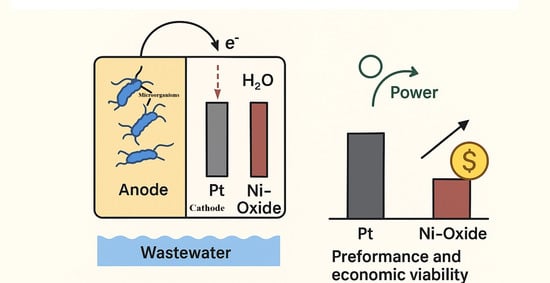
The expensive nature and limited availability of platinum (Pt) cathodes pose a significant challenge for the widespread adoption of microbial fuel cell (MFC) technology. Although many alternatives have been studied, very few reports provide a systematic head-to-head comparison of different Ni–oxide cathodes under the same operational conditions. This research investigates cost-effective nickel-based metal oxide composites (Ni–TiO2, Ni–Cr2O3, Ni–Al2O3) as catalysts for the oxygen reduction reaction (ORR), using Pt as a reference point. The performance of the MFC was thoroughly evaluated in terms of power output, chemical oxygen demand (COD) removal, and Coulombic efficiency (CE). The Pt cathode exhibited the highest performance (275 mW m−2, 87% COD removal, 35% CE), confirming its catalytic advantages. Among the alternative materials, the Ni–TiO2 composite yielded the best outcomes (224 mW m−2, 79% COD removal, 17.7% CE), markedly surpassing the performances of Ni–Cr2O3 (162 mW m−2, 72%, 24% CE) and Ni–Al2O3 (134 mW m−2, 64%, 11.6% CE). Koutecký–Levich analysis clarified the mechanisms at play: Pt facilitated a direct 4-electron ORR process, while the composites operated through a 2-electron mechanism. Notably, the semiconductor properties of Ni–TiO2 resulted in a higher electron transfer number (n = 2.8) compared to the other composites (n ≈ 2.3), which accounts for its increased efficiency. With its low production cost, Ni–TiO2 presents an exceptional cost-to-performance ratio. By linking catalytic performance directly to the electronic nature of the oxide supports, this study offers clear design guidelines for selecting non-precious cathodes. The dual evaluation of electrochemical efficiency and cost-to-performance distinguishes this study from prior reports and underscores its practical significance and originality. This study highlights Ni–TiO2 as a highly sustainable and economically viable catalyst, making it a strong candidate to replace Pt for practical MFC applications that focus on simultaneous power generation and wastewater treatment.

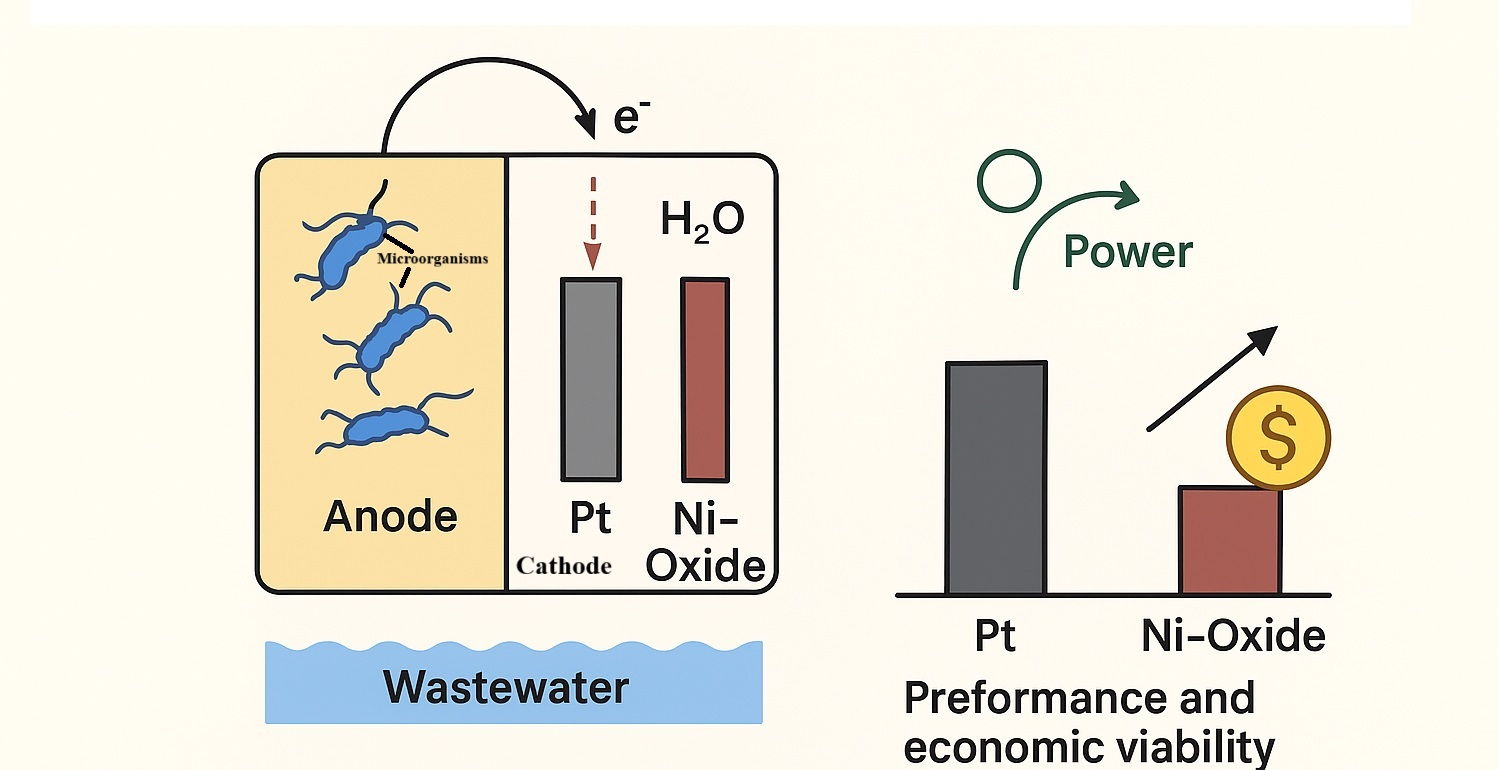
Graphical Abstract

1. Introduction

The need for clean energy and reliable wastewater treatment has brought microbial fuel cells (MFCs) into focus [1,2]. These devices can turn organic matter into electricity while also reducing pollutants in water [3,4]. In a typical setup, microbes on the anode break down organic compounds and release electrons and protons. The electrons move through a circuit to the cathode and drive the oxygen reduction reaction (ORR), while protons pass through the electrolyte [5]. Because of this dual role, energy generation plus water treatment MFCs are considered an interesting option for sustainable technologies. However, their practical use is limited by low power output, slow ORR at the cathode, and high internal resistance [1,6].
Despite their potential for simultaneous wastewater treatment and energy recovery, the overall performance of microbial fuel cells (MFCs) is still largely limited by the sluggish oxygen reduction reaction (ORR) at the cathode [7]. Platinum-based catalysts are commonly employed as benchmark ORR electrocatalysts due to their high activity; however, their high cost, scarcity, and vulnerability to poisoning and degradation under realistic wastewater conditions severely restrict their use in large-scale and long-term MFC applications [8,9,10]. To overcome these limitations, considerable effort has been devoted to developing non-precious metal catalysts, among which nickel-based materials are particularly attractive due to their low cost, natural abundance, and reasonable stability under neutral and alkaline conditions. In addition, combining Ni with oxide supports provides an effective strategy to tune the electronic structure, active-site distribution, and durability of the cathode [11]. Nevertheless, the role of different oxide supports in governing the ORR activity of Ni-based cathodes in MFC systems remains insufficiently understood, especially in terms of how the electronic properties and surface chemistry of the oxides influence ORR kinetics and charge-transfer resistance [12,13]. Therefore, this work systematically investigates Ni-based cathodes supported on TiO2, Cr2O3, and Al2O3 for the ORR in single-chamber MFCs. By combining linear sweep voltammetry, Koutecký–Levich (K–L) analysis, electrochemical impedance spectroscopy (EIS), and chronoamperometry, we correlate the electrochemical performance with the electronic characteristics of the oxide supports. The specific aims are to (i) identify which oxide support yields the highest ORR activity and MFC power output for Ni-based cathodes, and (ii) elucidate, at a qualitative level, how support–metal interactions and oxide electronic structure control ORR kinetics in MFC cathodes.
In the following sections, we first describe the preparation of the Ni–oxide cathodes and the MFC configuration, then present the electrochemical characterization (LSV, K–L, EIS, and CA), and finally discuss how the oxide supports govern the overall MFC performance. Several Ni systems have been tested. Ni–TiO2 uses strong metal–support interactions to improve electron transfer and stability [14]. Ni–Al2O3 and Ni–Cr2O3 have shown good corrosion resistance and long-term durability [15]. Some hybrid materials, such as Co–Ni on Al2O3–GO, have even outperformed Pt/C in similar tests [3]. Mixing Ni with Cu oxides is another useful strategy, combining the catalytic activity of Cu with the robustness of Ni [16]. Together, these results suggest that well-designed Ni composites can compete with Pt while being much more affordable.
Even so, side-by-side comparisons of different Ni–oxide catalysts under the same MFC setup are rare. This lack of direct benchmarking has left a major gap in understanding how the intrinsic electronic properties of oxide supports translate into catalytic activity inside MFCs. Our study addresses this by providing a systematic head-to-head comparison of Ni–TiO2, Ni–Cr2O3, and Ni–Al2O3 under identical conditions with Pt as the benchmark. Most studies focus on a single material, which makes it hard to judge how composition or structure really affect performance. Without direct comparisons, choosing the best material for either higher energy recovery or stronger pollutant removal remains uncertain [17]. This study addresses that gap by directly comparing Ni–Cr2O3, Ni–TiO2, and Ni–Al2O3 catalysts, with Pt used as a benchmark. All are tested under the same conditions, and their performance is measured through polarization curves, maximum power density, Coulombic efficiency (CE), and COD removal.
In neutral media, the oxygen reduction reaction (ORR) is generally hindered by sluggish kinetics compared to acidic or alkaline environments. The reaction may proceed via a two-electron pathway, generating hydrogen peroxide intermediates, or through a more efficient four-electron pathway directly producing water. The selectivity between these routes strongly depends on the electrocatalyst surface, conductivity of the support, and dispersion of active sites. While Pt is well known to promote the four-electron pathway with high stability, Ni-based catalysts often face limitations due to their lower intrinsic activity. However, coupling Ni with semiconducting or conductive oxides can significantly enhance electron transfer, minimize peroxide accumulation, and shift the ORR pathway toward a more efficient mechanism. Therefore, exploring Ni–oxide composites is particularly relevant for MFCs that operate under near-neutral pH conditions.
Recent advances have demonstrated that hybrid Ni–oxide catalysts supported on carbon nanostructures or doped with heteroatoms can even surpass Pt/C in certain configurations. For example, Ni–CuO/graphene composites reported power densities exceeding 1400 mW m−2, while Co–Ni supported on Al2O3–GO achieved stable long-term operation in pilot-scale MFCs. In another study, nitrogen-doped NiO composites showed significant improvements in both ORR selectivity and COD removal.
To address the limitations of high cost and scarcity associated with platinum, extensive research has focused on developing non-precious metal catalysts (NPMCs), which include transition metal oxides (such as Ni-based materials), nitrogen-doped carbons, and various metal alloys. For example, recent work has successfully implemented methanol-tolerant Pd–Co alloy nanoparticles supported on reduced graphene oxide as efficient cathode catalysts for the oxygen reduction reaction in fuel cells [18].
The goal is to provide a clearer ranking and practical guidance for designing cost-effective and durable cathodes. This research not only compares Ni–oxide cathodes with Pt but also shows that the electronic characteristics of oxide supports (whether they are semiconducting, conductive, or insulating) determine the primary pathway for the ORR and the overall efficiency of MFC, offering valuable design guidelines for upcoming cathode innovations. What sets this study apart is its dual emphasis: a detailed mechanistic explanation of how oxide characteristics dictate ORR pathways, and a cost-to-performance evaluation that highlights scalability. This combination of electrochemical insight and techno-economic analysis makes the novelty of our work stand out for future practical deployment. In conclusion, optimized Ni–oxide catalysts can help MFCs move closer to real applications. They offer the chance for affordable energy recovery while cleaning wastewater. The findings here are expected to support further development of sustainable bioelectrochemical technologies.
Although numerous studies have investigated Ni-based catalysts, previous comparisons have typically evaluated each material under different reactor designs, loadings, or electrochemical protocols. As a result, there is no unified benchmark that directly compares Ni–TiO2, Ni–Cr2O3, and Ni–Al2O3 under identical MFC conditions while integrating both mechanistic electrochemical analysis and a performance-normalized cost assessment. The present study fills this specific gap by providing a controlled, systematic evaluation of these three oxide-supported Ni cathodes alongside Pt.

2. Results and Discussion

2.1. Microorganism Attachment

Figure 1 illustrates the process by which microorganisms adhere to the electrode surface and grow there, using organic compounds in the wastewater as their food source to produce electrons and protons that are transferred to the electrode and converted into electricity while also lowering the wastewater’s chemical oxygen demand (COD). To further illustrate this capability, a cyclic voltammetry (CV) test was conducted, as shown in Figure 1b. The CV results clearly showed two distinct redox peaks after the inoculation of microorganisms, indicating that the microorganisms actively participate in both oxidation and reduction reactions, proving their role in energy generation and pollutant removal [19].

2.2. Power Density and COD Removal

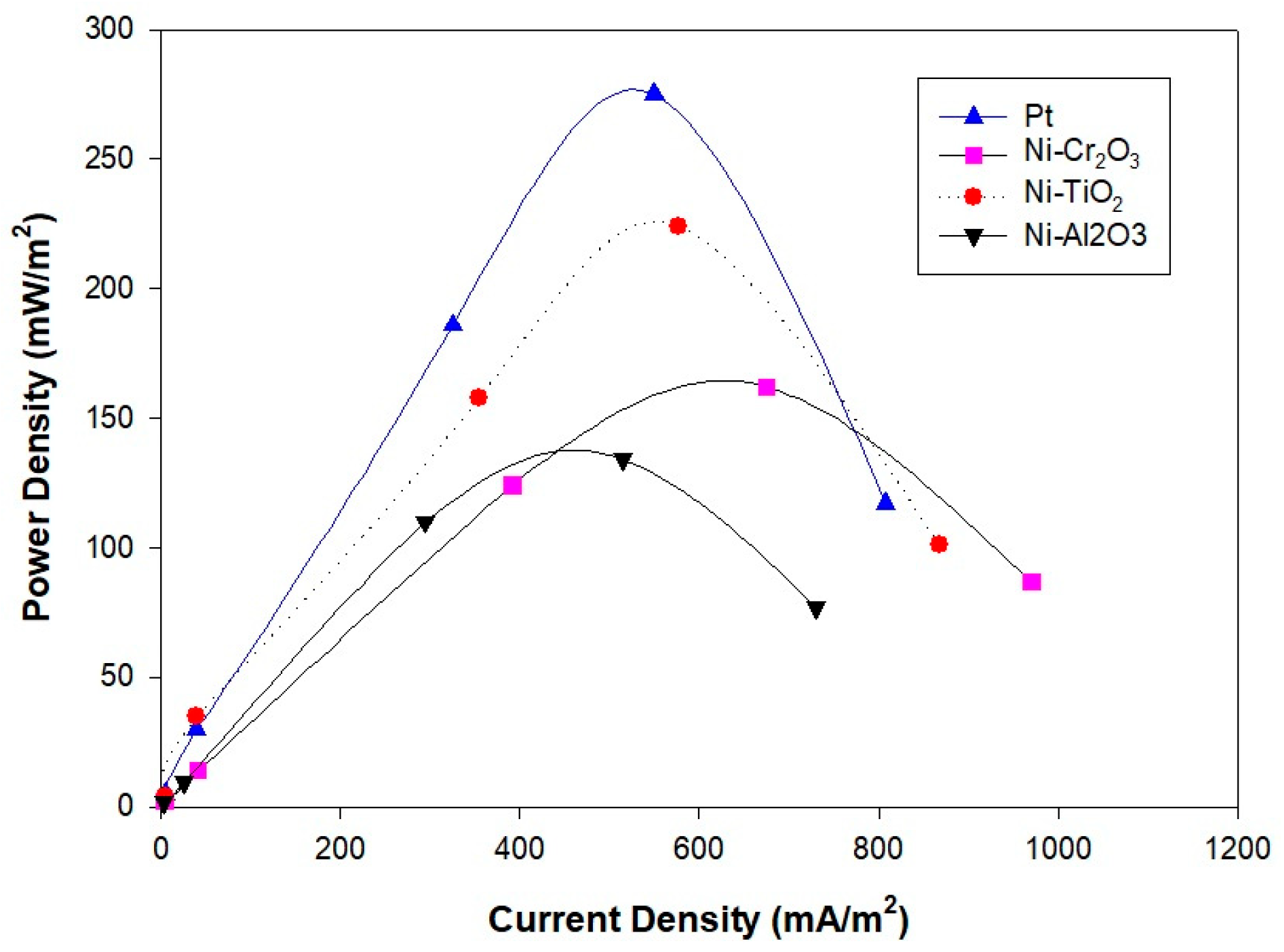
Figure 2 shows the power density graph of the different MFC systems. As the graph shows, the MFC with Pt as the cathode catalyst produced the highest power density of 275 mW/m2 followed by Ni-TiO2 by 224 mW/m2 and Cr2O3 by 162 mW/m2.
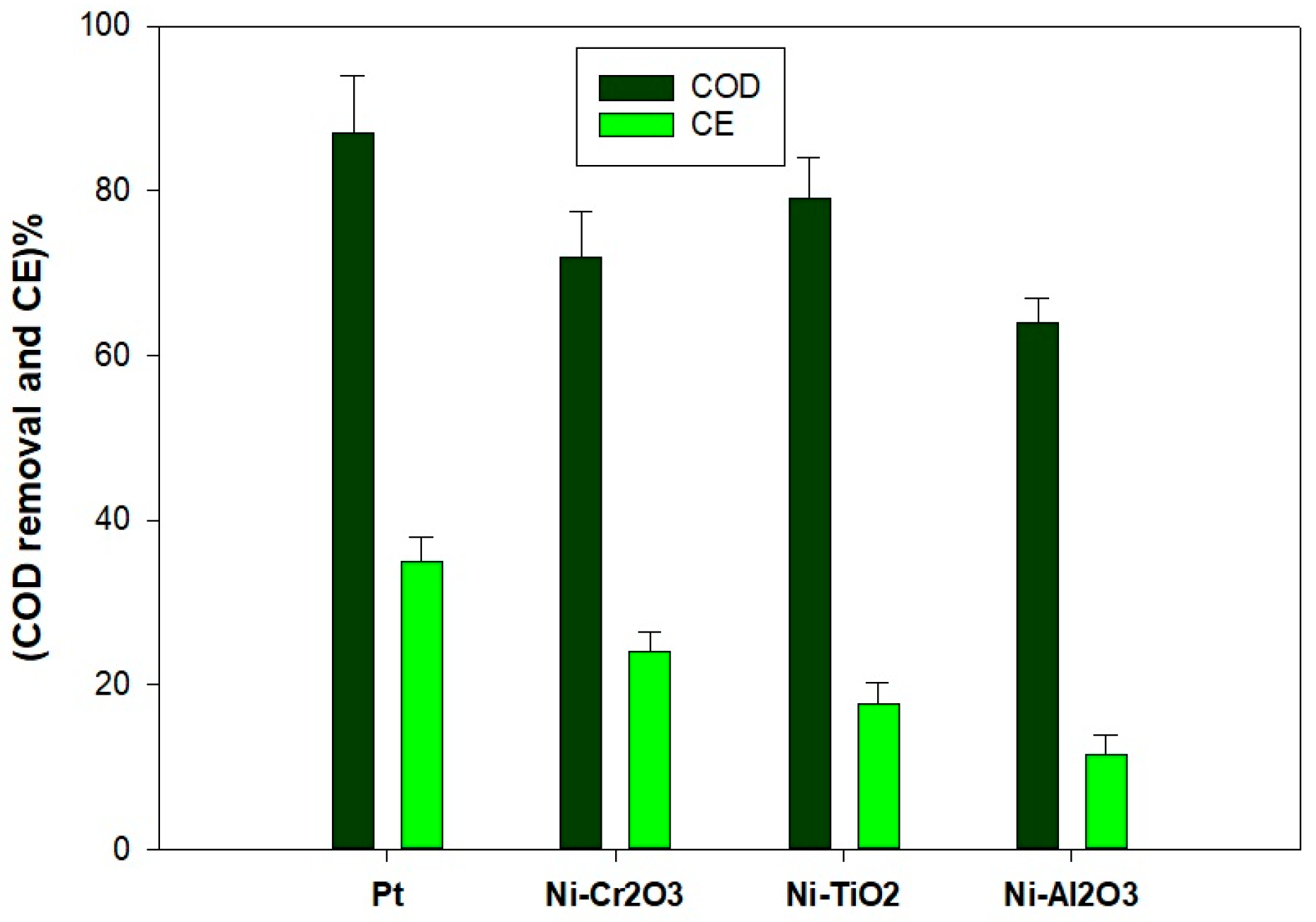
As shown in Figure 2, the maximum power densities follow the order Pt (275 mW/m2) > Ni–TiO2 (224 mW/m2) > Ni–Cr2O3 (162 mW/m2) > Ni–Al2O3 (134 mW/m2). This same trend is also reflected in the COD removal and Coulombic efficiency results presented in Figure 3.
The MFC utilizing Pt shows the highest COD elimination rate at 87% along with a CE of 35%, which can be attributed to its excellent electrocatalytic properties for the ORR, thereby improving electron transfer efficiency [20]. In second place, MFCs that incorporate Ni–TiO2 achieve a COD reduction of 79% and a CE of 17.7%, as the semiconductor characteristics of TiO2 facilitate modest electron transfer but are not as effective in catalyzing ORR [21]. The Ni–Cr2O3 system comes next with approximately 72% COD removal and a CE of 24%, attributed to a synergistic effect whereby Cr2O3 enhances conductivity and creates more active sites for oxygen adsorption. This indicates that Ni–Cr2O3 can balance moderate catalytic activity with improved electron transport, making it a more favorable option among non-precious catalysts compared to insulating supports.
Although Ni–TiO2 demonstrated superior ORR kinetics, as evidenced by its higher electron transfer number (n) and power density; the observed discrepancy in Coulombic efficiency (CE), where Ni–Cr2O3 exhibited a higher CE of 24% compared to Ni–TiO2’s 17.7%, requires complementary discussion regarding long-term system stability and parasitic losses [22]. The CE in MFCs is not solely governed by the intrinsic catalytic activity of the cathode but is highly sensitive to non-catalytic current losses, such as the crossover of substrate from the anode chamber and direct chemical oxidation on the electrode surface [23]. Cr2O3 is known for its exceptional chemical stability and low solubility in aqueous electrolytes, particularly compared to certain transition metal oxides. This robust chemical profile suggests that the Ni–Cr2O3 composite likely exhibits enhanced long-term structural stability under continuous operating conditions, minimizing catalyst leaching or degradation that could increase internal resistance over time and, thus, reducing the overall current recovered [22,24,25]. Furthermore, the nature of the support material significantly impacts the selectivity and longevity of the oxygen reduction process. It is hypothesized that the highly stable and less chemically reactive surface of Cr2O3 may better mitigate non-productive electrochemical side reactions (e.g., reduction of minor redox mediators or leakage products from the anolyte) compared to TiO2 which, as discussed previously, promotes diverse surface defect chemistries that could potentially react with non-O2 species in the complex MFC environment. These factors enhanced chemical stability and reduced non-productive losses, providing a materials science explanation for the superior Coulombic efficiency observed for Ni–Cr2O3, despite its lower intrinsic ORR activity.
The Ni-Al2O3 configuration results in around 64% COD removal, exhibiting a Coulombic efficiency of 11.6%, which is constrained by the insulating properties of Al2O3 that restrict electron flow and raise resistance [26]. The limited performance of Ni–Al2O3 is consistent with previous reports, where insulating oxides suppressed electron mobility, leading to severe kinetic barriers in ORR pathways. The notable performance of Pt may also be connected to its capability to maintain stable reaction conditions under varying load scenarios. Conversely, the lower efficiency observed in Ni-Al2O3 may be further worsened by inadequate ionic conductivity at the cathode interface [27]. Overall, the comparative COD removal and CE values highlight that the intrinsic conductivity of the oxide support directly governs the extent of electron recovery, underscoring the need for conductive or semiconductive frameworks in future MFC cathode designs. These observations imply that the selection of metal oxide support plays a crucial role in impacting MFC performance through its effects on both catalytic and conductive attributes [28].

2.3. LSV and EIS Analysis

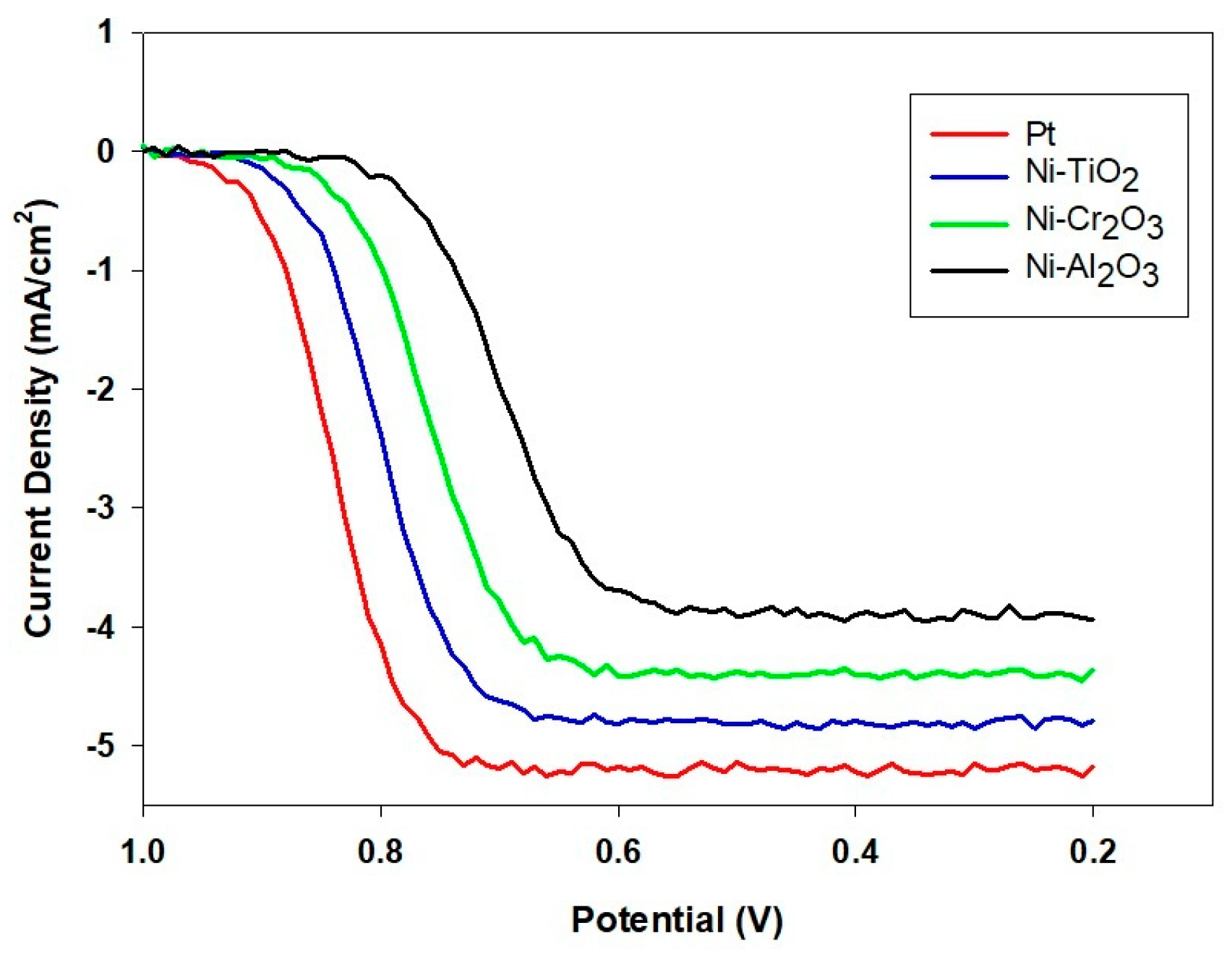
Figure 4 presents the linear sweep voltammetry (LSV) curves of the different cathode catalysts in MFCs. LSV is a common electrochemical technique used to evaluate the oxygen reduction reaction (ORR) activity by recording the current response as a function of applied potential. This analysis allows for the direct comparison of onset potential and current density, thereby providing insights into the relative electrocatalytic activity of Pt and Ni–oxide catalysts.
LSV profiles highlight clear patterns in the catalytic performance of the ORR occurring at the cathodes of MFCs. Platinum (Pt) shows the highest onset potential and current density, indicating its outstanding electrocatalytic capabilities [29]. Nickel-titanium dioxide (Ni–TiO2) exhibits the next level of activity, which is linked to its semiconductor-facilitated electron transfer that improves power density and chemical oxygen demand (COD) removal compared to other nickel-based oxides [30]. Nickel-chromium oxide (Ni–Cr2O3) demonstrates a moderate level of catalytic efficiency, presenting a lower current density than Ni–TiO2 but better performance than nickel-aluminum oxide (Ni–Al2O3), thanks to its enhanced conductivity and increased availability of active sites. Ni–Al2O3 shows the least favorable LSV results, which aligns with its lowest power density (134 mW/m2) and COD removal efficiency (64%). The pattern observed in LSV activity (Pt > Ni–TiO2 > Ni–Cr2O3 > Ni–Al2O3) closely aligns with performance measures of MFCs, affirming that electrochemical activity evaluated through LSV is a reliable indicator of both power output and wastewater treatment effectiveness [31]. These results highlight the essential function of oxide support materials in refining cathode design to improve sustainability in MFC applications.
The variations in performance can be linked to the electronic characteristics and surface chemistry of the oxide supports. In the case of Ni–TiO2, the improved ORR performance can be partially attributed to support–metal interactions that have been reported in previous studies. Several works have shown that TiO2 can enhance charge transfer at the metal/oxide interface and may suppress electron–hole recombination, thereby facilitating faster electron transport during ORR [32]. Although our study did not directly measure band alignment, recombination dynamics, or interfacial charge transfer, the observed decrease in Rct and higher electron transfer number are consistent with trends previously reported for Ni/TiO2 systems.
For Ni–Cr2O3, prior literature identifies Cr2O3 as a defect-rich oxide capable of promoting surface oxygen adsorption, which aligns with the moderate ORR activity observed here. In contrast, the insulating nature of Al2O3 limits charge mobility and is known to hinder catalytic kinetics, which is consistent with our EIS and K–L results. These mechanistic interpretations remain qualitative and are supported by electrochemical evidence; however, full confirmation would require advanced characterization techniques such as XPS, UPS, EPR, or DFT modeling, which were beyond the scope of this study. These observations underline the importance of the oxide electronic structure in determining MFC cathode efficiency.
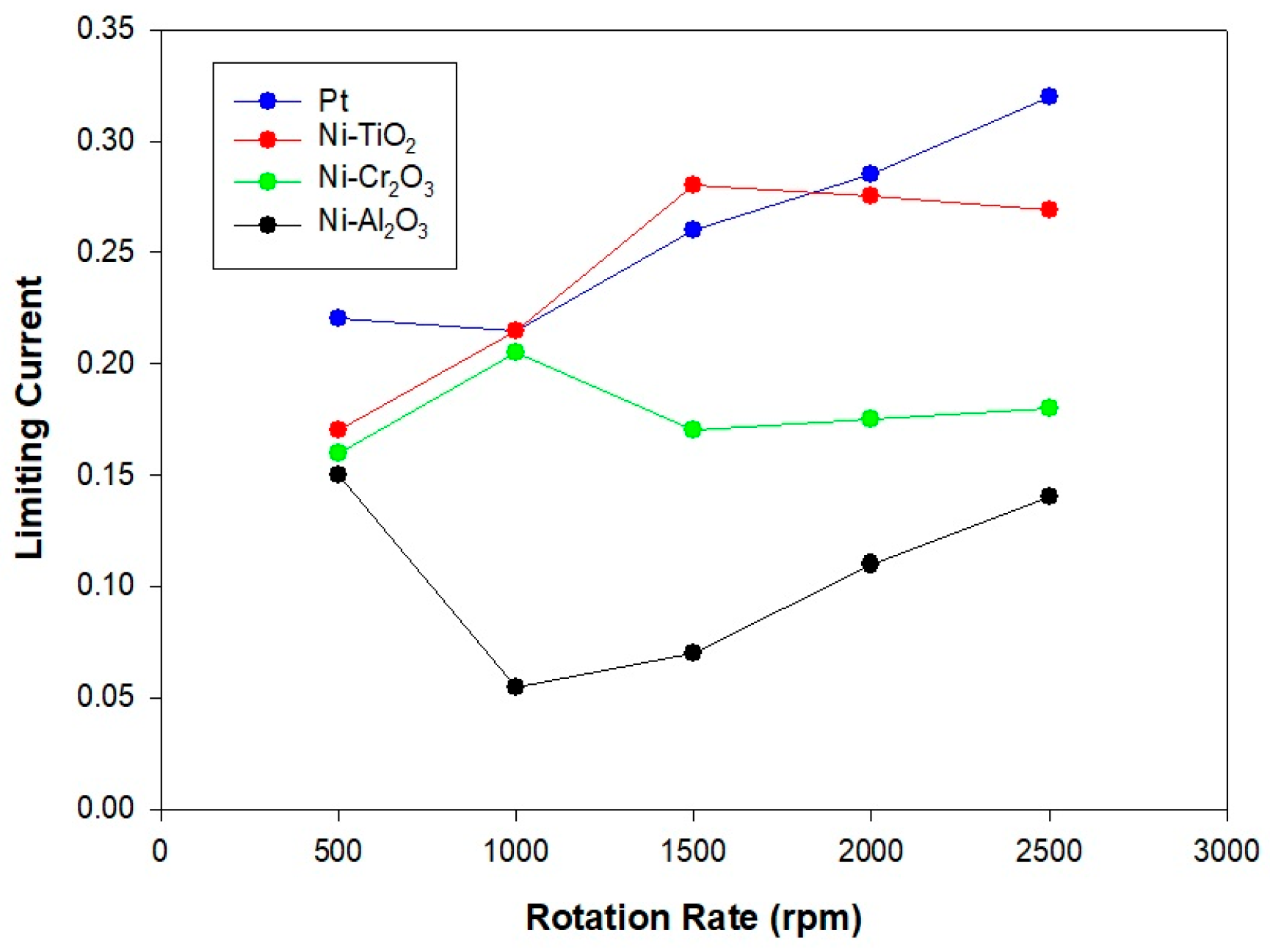
To clarify the mass transport properties and catalytic performance for the oxygen reduction reaction, the limiting current was examined as a function of rotation speed utilizing a rotating disk electrode (RDE). The limiting current, as depicted in Figure 5, rose with the rotation rate for each catalyst, validating diffusion-controlled [33] kinetics within the examined potential range. The Pt catalyst showed an entirely linear and smooth response, representing the theoretical standard for a highly uniform and stable catalyst with consistent active sites. In comparison, the graph for the Ni–TiO2 composite displays minor variations around the trendline. This is a typical feature of composite materials and can be linked to the intrinsic heterogeneity of the electrodeposited Ni–TiO2 surface, where uneven distributions of TiO2 nanoparticles lead to slight variations in conductivity and catalytic performance [28,34,35]. The limiting current densities obtained from RDE follow the same trend as LSV and MFC performance (Pt > Ni–TiO2 > Ni–Cr2O3 > Ni–Al2O3), confirming that mass-transport controlled ORR remains consistent with device-level behavior.
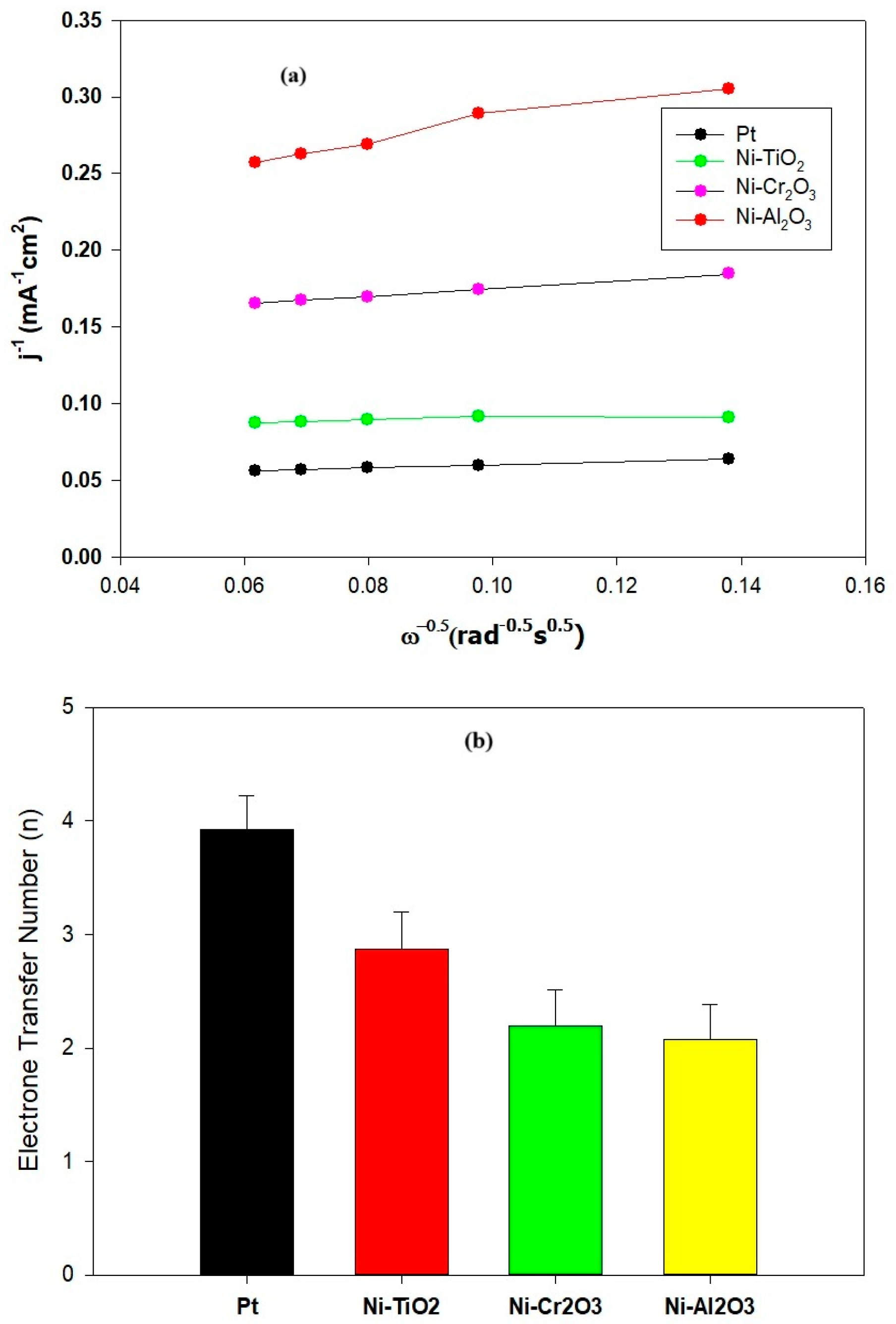
The RDE data was subjected to a Koutecký–Levich analysis in order to quantitatively identify the oxygen reduction reaction (ORR) pathway and compute the number of electrons transported (n) per oxygen molecule, a crucial measure for catalytic efficiency. Based on the results in Figure 5, the K–L plots for each catalyst at −0.5 V vs. Ag/AgCl are shown in Figure 6a. Each plot’s strong linearity (R2 > 0.99) validates the analysis that follows by confirming that the ORR was subject to diffusion control at this voltage.
The electron transfer number (n) was determined from the slope of the corresponding plots using the Levich equation (refer to Materials and Methods). The results, illustrated in the bar chart of Figure 6b, indicate a significant difference in the reaction mechanism. The platinum catalyst enabled the optimal 4-electron pathway (n = 3.9), which reduces oxygen directly to water (O2 + 4H+ + 4e → 2H2O). In clear contrast, the nickel-based composites mainly adhered to the less efficient 2-electron pathway (O2 + 2H+ + 2e → H2O2), resulting in the formation of hydrogen peroxide as an intermediate product. K–L analysis indicates that all Ni–oxide cathodes predominantly follow a 2-electron ORR pathway, with Ni–TiO2 showing a partial contribution from a 4-electron route, as reflected by its higher electron transfer number n ≈ 2.87 compared to Ni–Cr2O3 (n ≈ 2.20) and Ni–Al2O3 (n ≈ 2.08).
In order to rationalize the higher n value observed for the Ni–TiO2 cathode, we attribute this behavior to the specific semiconductor and defect chemistry of the TiO2 support. It is well established that TiO2 can accommodate oxygen vacancies and Ti3+ centers, which create mid-gap states, enhance charge separation, and facilitate interfacial redox reactions [36,37]. Such defect states can participate in direct charge transfer between the defect levels in TiO2 and adsorbed oxygen species, thereby promoting more efficient O–O bond cleavage and enabling a partial 4-electron reduction pathway in addition to the dominant 2-electron route [36,38]. Oxygen-vacancy-rich TiO2 has been reported to exhibit competitive oxygen reduction activity, with the reaction proceeding via defect-centered mechanisms on selectively exposed reactive facets [38]. Furthermore, in various modified TiO2 systems, dopant-induced defect bands and oxygen vacancies have been shown to broaden light absorption, accelerate charge transfer, and provide additional active sites for multielectron surface reactions, such as photocatalytic hydrogen evolution and CO2 reduction [36,39,40]. By analogy, the Ni–TiO2 interface in our cathodes likely hosts oxygen vacancies that anchor Ni species and create electronically favorable sites for more complete O2 reduction, which is consistent with the higher n value of Ni–TiO2 compared with Ni–Cr2O3 and Ni–Al2O3. Although we did not directly quantify oxygen vacancies or band alignment in this study, the observed K–L behavior supports a mixed 2e/4e ORR pathway on Ni–TiO2, whereas Ni–Cr2O3 and Ni–Al2O3 appear to remain closer to a predominantly 2-electron route.
This discovery offers a fundamental electrochemical rationale for the observed performance differences in the MFC tests. The enhanced power density and COD removal efficiency of Pt can be directly linked to its ability to achieve a complete 4-electron reduction [41]. Among the other materials, the semiconductor characteristics of Ni-TiO2 seem to enable somewhat improved ORR kinetics compared to the insulating oxides (Cr2O3, Al2O3), which significantly hinder charge transfer and promote incomplete reduction reactions [42]. This relationship between the electronic structure of the support, the number of electrons transferred, and the overall MFC performance highlights the critical role of material selection in cathode design. Since higher n values correlate with higher power density and Coulombic efficiency due to more effective electron usage and decreased peroxide production, this observed electron transfer number directly explains the device-level performance trends.
Due to the 2-electron ORR pathway of Ni–TiO2 and Ni–Cr2O3, the produced H2O2 could break down into reactive oxygen species, potentially damaging fuel-cell parts and diminishing long-term stability, which is a significant disadvantage in contrast to Pt’s 4-electron pathway.
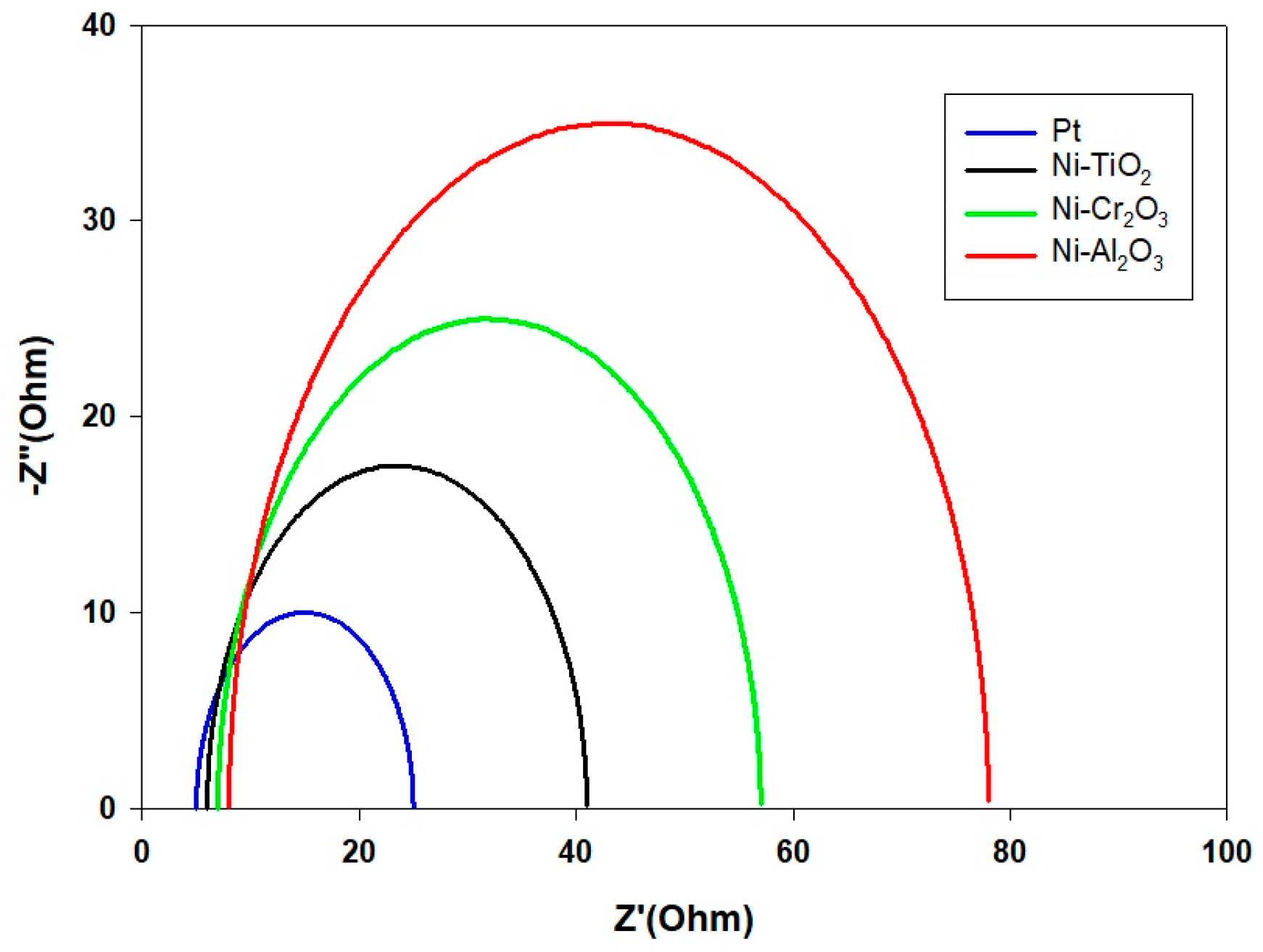
The EIS data shown in Figure 7 were analyzed using the equivalent circuit and frequency range specified in the Materials and Methods Section 3.6.1. Figure 7 displays the Nyquist plots obtained for different cathode catalysts. EIS helps distinguish the solution resistance (Rs), charge-transfer resistance (Rct), and diffusion-related limitations [43]. By analyzing the semicircle diameter and the slope of the low-frequency region, the technique provides valuable information on electron transfer kinetics and oxygen diffusion behavior at the cathode interface. Among the catalysts tested, the one made with Pt worked the best. It had a solution resistance of about 5 ohms and a charge-transfer resistance of around 20 ohms. These values show that Pt is very good at conducting electricity and speeding up the ORR, making it the standard material for this process. The nickel-based catalysts had higher resistances, but their performance varied depending on the type of oxide they were supported on. The Ni–TiO2 cathode had a solution resistance of about 6 ohms and a charge-transfer resistance of around 35 ohms, which are lower than those of Ni–Cr2O3 (7 ohms and 50 ohms) and Ni–Al2O3 (8 ohms and 70 ohms).
The smaller semicircle for Ni–TiO2 means electrons move more quickly and the ORR happens more efficiently [44]. TiO2 helps by improving electrical conductivity, creating better connections with Ni, and spreading out active sites more evenly, which lowers resistance. In contrast, Cr2O3 and Al2O3 are less conductive and create more resistance at the interface, which slows down electron movement and makes the catalyst work worse. At lower frequencies, the way oxygen moves through the system also shows differences between the catalysts.
Pt and Ni–TiO2 had shorter diffusion tails, which means oxygen moves more easily and there are fewer limits to how much oxygen can be used. On the other hand, Ni–Cr2O3 and Ni–Al2O3 had longer diffusion arcs, showing that there is less oxygen available and more resistance during the ORR [34].
The Nyquist plots reveal clear differences in the electrochemical processes occurring at the cathode–electrolyte interface. The charge-transfer resistance (Rct) is a critical parameter that directly correlates with the kinetics of the oxygen reduction reaction. Pt, as expected, exhibits the lowest Rct, confirming its superior ability to facilitate electron transfer. Among Ni-based catalysts, Ni–TiO2 shows significantly reduced Rct compared to Ni–Cr2O3 and Ni–Al2O3, which is attributed to the favorable semiconductor–metal interactions that accelerate charge transfer. In contrast, the higher Rct values of Ni–Cr2O3 and Ni–Al2O3 indicate sluggish kinetics and greater energy loss. The solution resistance (Rs) remained relatively similar across all systems, suggesting that variations in performance are predominantly governed by charge-transfer processes rather than bulk electrolyte conductivity. This reinforces the conclusion that the electronic properties of the oxide support play a decisive role in controlling electrochemical efficiency.
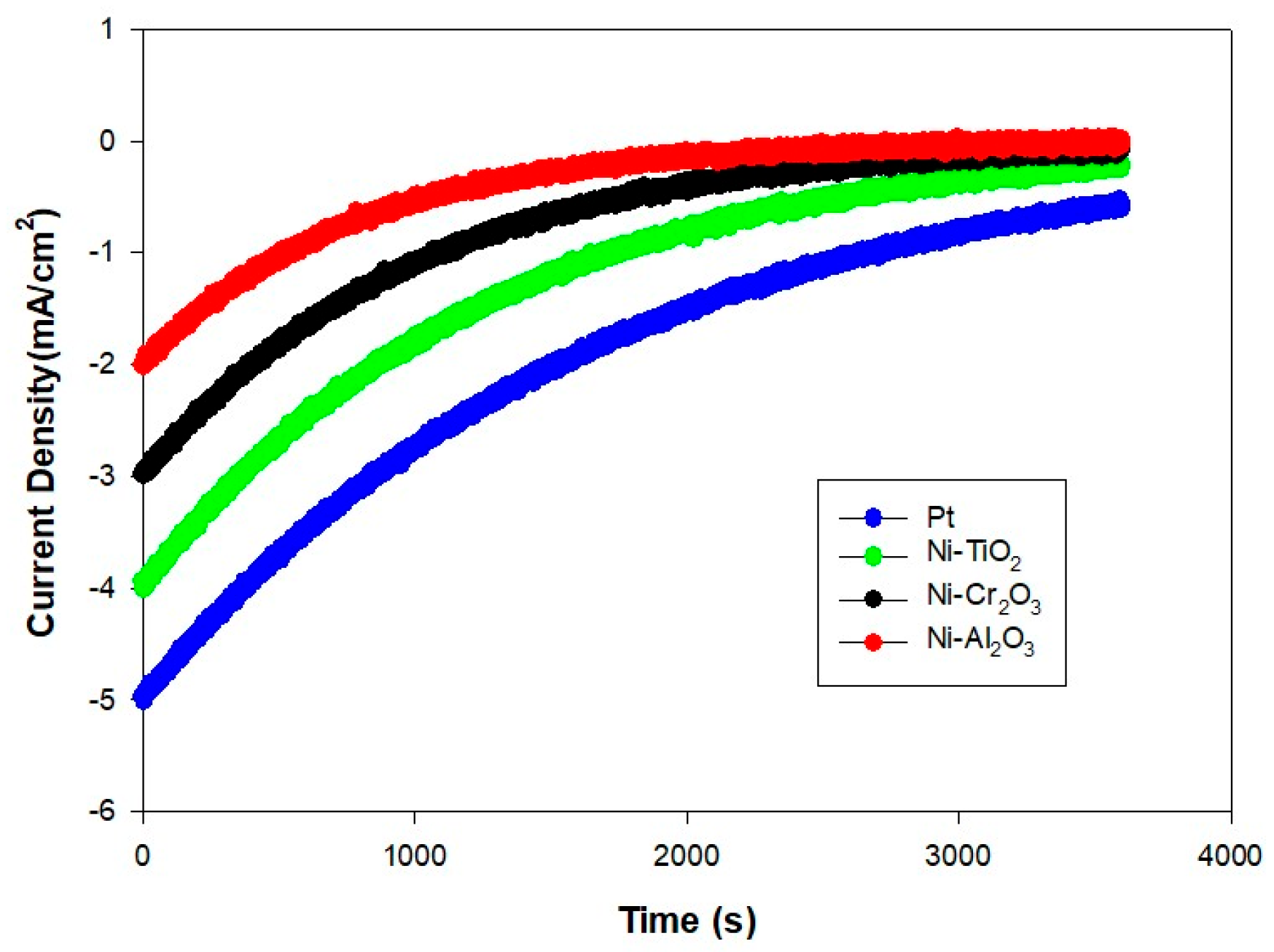
In addition to charge-transfer kinetics, the low-frequency region of the Nyquist plots provides valuable insights into oxygen diffusion limitations. Pt and Ni–TiO2 display relatively short Warburg tails, indicating efficient oxygen transport and minimal mass-transfer resistance. Conversely, Ni–Cr2O3 and Ni–Al2O3 exhibit longer diffusion arcs, reflecting hindered oxygen accessibility at the electrode surface. Such mass-transfer constraints reduce the number of active sites available for ORR and ultimately lower the achievable power density. The distinction between TiO2 and the other oxides can be attributed to its higher electronic conductivity and better compatibility with Ni, which promote uniform active site distribution. These findings imply that, in addition to intrinsic catalytic activity, ensuring effective oxygen transport is a crucial design criterion for scaling MFC cathodes. Combining Ni-based catalysts with porous conductive supports may further reduce these diffusion-related barriers. CA was utilized to assess the long-term electrocatalytic durability of four cathode catalysts (Pt, Ni–TiO2, Ni–Cr2O3, and Ni–Al2O3) while maintaining a constant applied potential in an oxygen-saturated neutral electrolyte. It is shown in Figure 8.
As anticipated, all electrodes displayed negative current densities throughout the experiment, confirming that the primary process was the cathodic ORR. Right after the potential step, the current density quickly reached a peak value indicative of each material’s intrinsic catalytic activity. Pt exhibited the highest initial current, followed by Ni–TiO2, Ni–Cr2O3, and Ni–Al2O3, aligning with their relative activities noted in linear sweep voltammetry. A gradual decrease in current was noted for all catalysts during the hour-long test, which can be attributed to double-layer charging, stabilization of mass transport, and potential fouling of the catalyst surface [45,46]. Nonetheless, the rate of decline varied significantly among the materials. Pt not only achieved the highest initial current but also maintained a considerable fraction of its activity, demonstrating remarkable durability. Ni–TiO2 showed the most encouraging performance among nonprecious catalysts, displaying a relatively high initial current and moderate decline, which underscores TiO2’s beneficial role in improving conductivity and enhancing the availability of active sites. Conversely, Ni–Cr2O3 and Ni–Al2O3 experienced lower initial currents and quicker current decay, likely due to their inferior electronic conductivity and less advantageous ORR kinetics. In summary, the results highlight that Ni–TiO2 serves as the most effective alternative to Pt in terms of achieving a balance between activity and stability, while Ni–Al2O3 has shown limited potential as a cathode catalyst. These results reinforce the idea that the choice of support plays a crucial role in determining both catalytic efficiency and long-term electrochemical stability in MFC cathodes.

2.4. Techno-Economic Evaluation: A Performance-Normalized Cost Analysis

A simplistic economic comparison based on the cost per gram of catalyst material is insufficient for evaluating practical viability, as it ignores the actual performance delivered at a specific electrode loading. To provide a more rigorous and meaningful assessment, we introduce a “cost per watt” (USD/W) metric. This figure of merit normalizes the material and loading costs by the maximum power density achieved, offering a direct measure of the economic efficiency of each catalyst in an operating Microbial Fuel Cell (MFC). The cost per watt was calculated using the following formula:
Cost   per   Watt   ( USD / W ) = Catalyst   Material   Cost   ( USD / g )   × Catalyst   Loading   ( g / m ^ 2 ) Maximum   Power   Density   ( W / m ^ 2 )
For this analysis, we used a consistent catalyst loading of 0.5 mg/cm2 (equivalent to 5 g/m2) for all electrodes, which is a standard loading in MFC research and ensures a fair comparison [47]. Catalyst costs were based on Q3 2025 market averages for bulk industrial-grade materials to reflect potential for scale-up [48,49]. The results of this analysis are summarized in Table 1.
The data in Table 1 reveal a stark economic disparity. While Pt is the top electrochemical performer, its cost per watt is approximately USD 636/W, which is over 200 times higher than the Ni-based alternatives. This prohibitive cost remains the single greatest barrier to its widespread commercial application in MFCs [50,51]. Among the non-precious metal catalysts, Ni-Al2O3 presents the lowest cost per watt at USD 2.99/W. However, as established by its poor power generation and unfavorable 2-electron ORR pathway, its low cost cannot compensate for its functional inefficiency. In contrast, Ni-TiO2, at USD 3.35/W, offers the most compelling balance between high electrochemical performance and low cost. It achieves 81% of Pt’s power density for only 0.5% of its performance-normalized cost.
It is important to acknowledge the limitations of this analysis. The costs are based on current spot prices, and a full feasibility study would require a sensitivity analysis to account for market fluctuations in metal prices [52]. Furthermore, this evaluation does not include lifetime-adjusted costs, which would depend on long-term durability data not gathered in this study. Nonetheless, this performance-normalized assessment clearly demonstrates that from a practical standpoint, Ni-TiO2 is a far more scalable and economically rational choice than Pt for MFC applications, providing a strong foundation for future development and optimization.

3. Materials and Methods

In this study, Ni-based cathodes supported on TiO2, Cr2O3, and Al2O3 were evaluated in order to understand how the oxide support influences ORR activity and MFC performance. The electrochemical results consistently show that the Ni–TiO2 cathode exhibits the highest ORR activity, followed by Ni–Cr2O3, whereas Ni–Al2O3 displays the lowest activity. In the following section, we discuss these trends by integrating the LSV and K–L analysis with the EIS and chronoamperometry data, and by relating them to the electronic characteristics and surface chemistry of the oxide supports

3.1. Nickel Nanocomposite Preparation

The samples were cut from a high-purity nickel plate (purity > 99.9%) into different dimensions. After cutting, the surfaces were polished sequentially using SiC abrasive papers from #240 up to #800, followed by cleaning with distilled water, ethanol, and acetone. The nickel samples exhibited a coarse grain size of approximately 70 µm, as described in our previous study [53,54,55,56]. For electrodeposition, a nickel sulfate electrolyte was prepared, containing 150 g/L NiSO4·6H2O, 35 g/L H3BO3, 120 g/L C6H5Na3O7·2H2O, and 12 g/L NaCl, and then it was maintained at 60 °C for 3 h. This bath was subsequently used for the fabrication of Ni–Cr2O3, Ni–TiO2, and Ni–Al2O3 nanocomposites. The Cr2O3, Al2O3, and TiO2 nanoparticles employed in this study, with average particle sizes of 60 nm, 28 nm, and 30 nm, respectively, were procured from Shanghai Macklin. The particles were used for electrodeposition at a concentration of 10 g/L to fabricate the nanocomposite coatings. The resulting electrodeposited coatings had an average thickness of approximately 20 μm. Further experimental details can be found in our recent publication. Electrodeposition was carried out at a current density of approximately 1.5 A/dm2, with the pH maintained in the range of 5–6, enabling the uniform dispersion of nanoparticles in the Ni matrix. During electrodeposition, the electrolyte was continuously magnetically stirred to keep nanoparticles uniformly suspended, ensuring homogeneous incorporation into the Ni matrix. The Ni-based composites were electrodeposited and their geometric surface areas were identical; the true active surface area was estimated using the double-layer capacitance (C_dl) obtained from non-faradaic CV in 0.1 M PBS (N2-saturated) at scan rates of 10–100 mV/s. The C_dl was calculated from the slope of the current vs. scan-rate plot. The resulting nanocrystalline Ni-based composite films were successfully fabricated and later employed for comparative evaluation against Pt as cathode catalyst in MFC for oxidation and reduction reaction [57,58].
It should be noted that the particle-size values reported for TiO2, Cr2O3 and Al2O3 correspond to supplier specifications and qualitative SEM inspection; no independent BET, DLS or TEM analysis was performed. Therefore, the particle sizes reported here (30–60 nm range) should be considered approximate. Similarly, the coating thickness (~20 μm) represents an SEM-based estimate derived from cross-sectional imaging, as profilometry/ellipsometry measurements were not available.

3.2. MFC Configuration

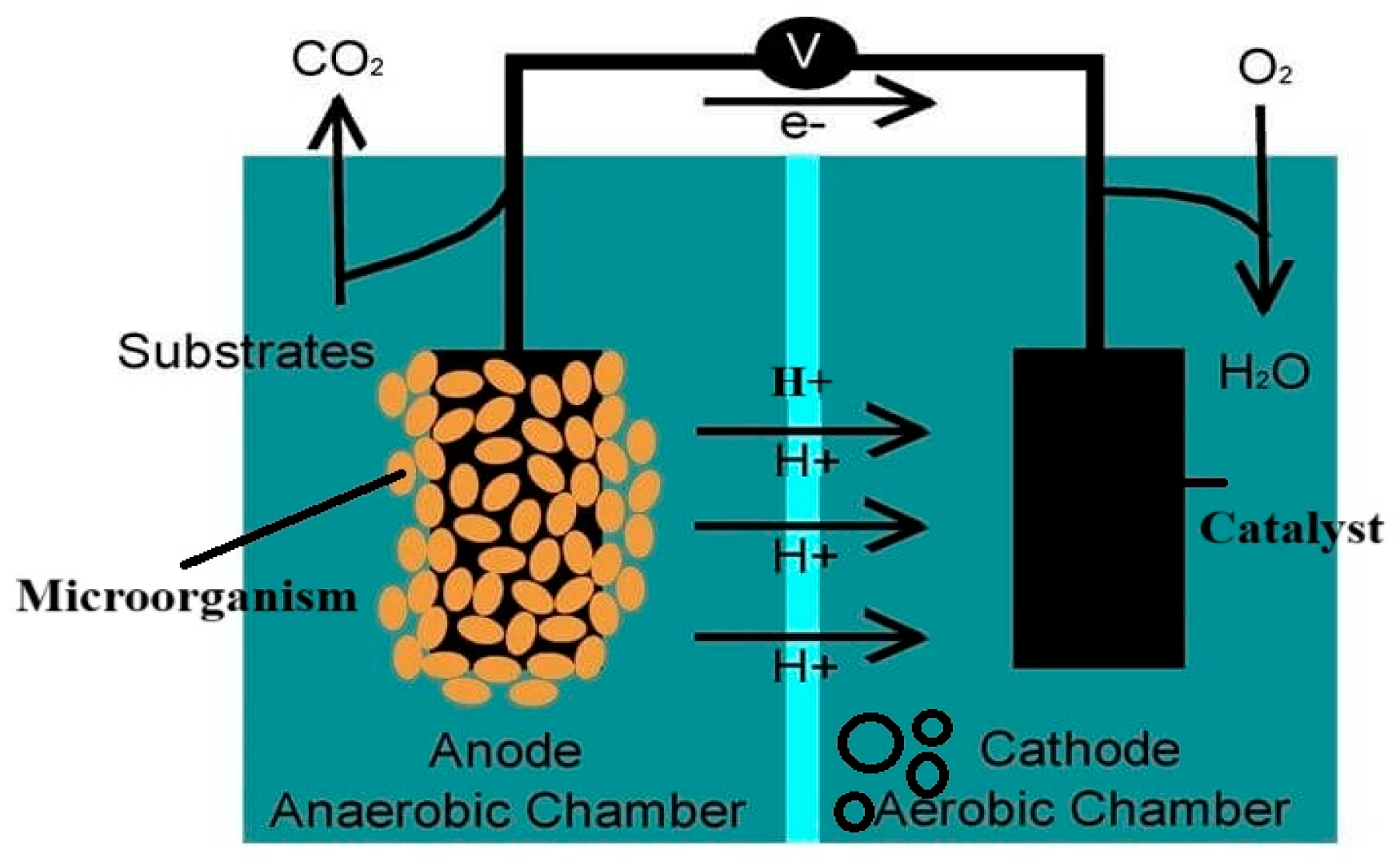
The microbial cell (MFC) built-in had separate anode and cathode chambers, separated by Nafion® 117 membranes that acted as a proton exchange membrane (PEM). The process starts in the anode chamber, where the micro-organisms digest the organic substrate, releasing electrons and protons. These components then proceed in different ways: electrons are shunted through the outer circuit to produce electricity, while protons are shunted through the PEM to the cathode chamber [59]. The overall structure of the MFC is shown in Figure 9.

3.3. Media

The anode chamber’s growth medium was modified based on our earlier research and included glucose and carbon sources. Both ingredients were purchased from Sigma-Aldrich: 2 g/L of yeast extract for the nitrogen source and 5 g/L of glucose for the carbon source. To ensure optimal microbial performance, 1 mL/L of the mineral solution was incorporated. All used materials were of analytical grade and procured from Sigma-Aldrich unless stated otherwise. All media is taken from Sigma Aldrich (St. Louis, MO, USA).

3.4. Surface Microstructure with EDS Results

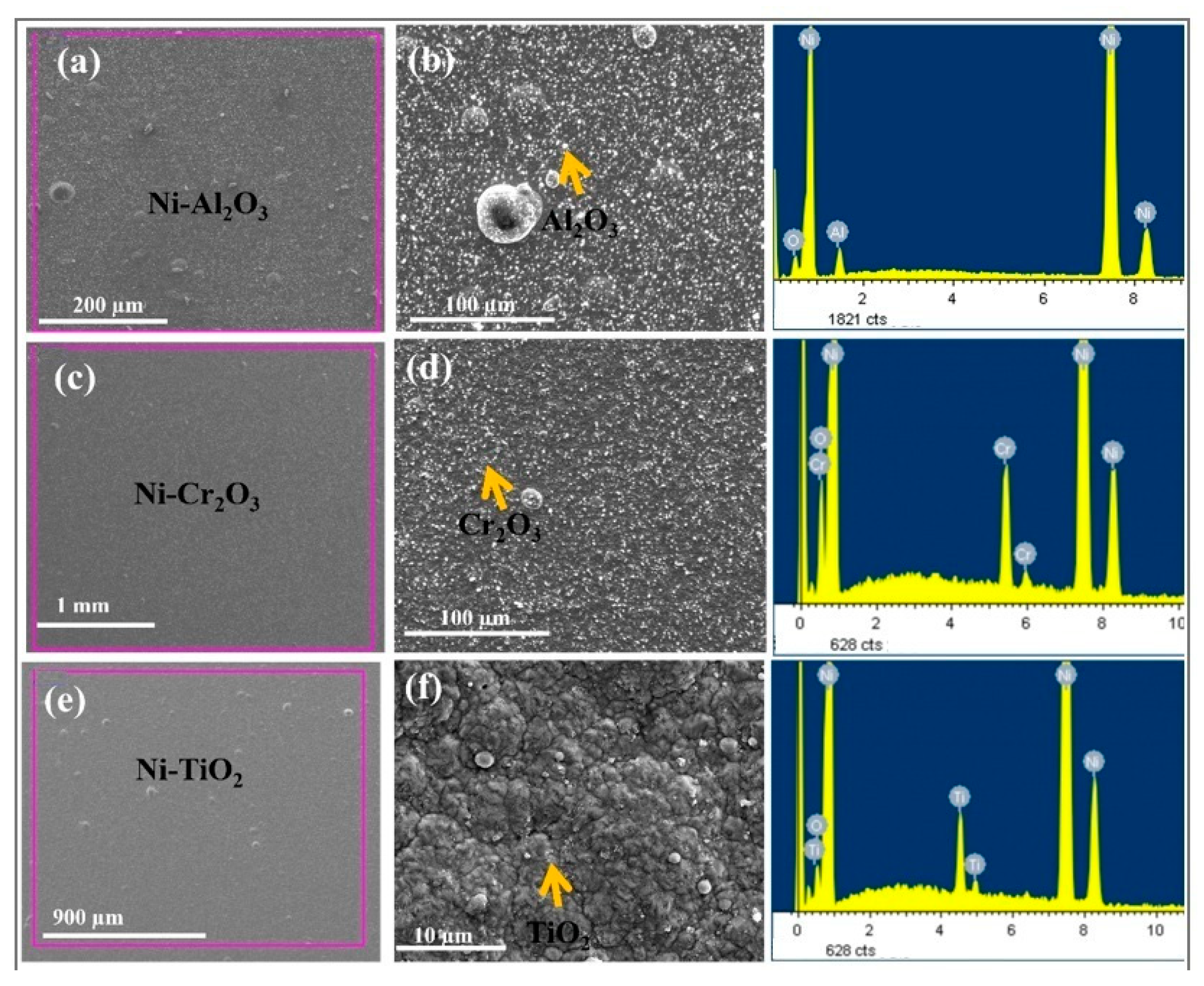
The surface morphology and compositional analysis of the Ni-Al2O3, Ni-Cr2O3, and Ni-TiO2 nanocomposites were successfully prepared by electroplating are illustrated in Figure 10. For the Ni-Al2O3 system Figure 10a,b, the nickel matrix appears with Al2O3 nanoparticles embedded and evenly distributed, as indicated by the bright contrast regions in the SEM image. The corresponding EDS spectrum confirms the coexistence of Ni, Al, and O, verifying the incorporation of Al2O3 into the composite coating. In the case of the Ni-Cr2O3 composite Figure 10c,d, the surface exhibits a uniform dispersion of Ni-Cr2O3 particles across the nickel layer. The SEM/EDS profile shows distinct signals for Ni, Cr, and O, supporting the successful electrodeposition of the Cr2O3 nanoparticles on pure Ni substrate. For Ni-TiO2 Figure 10e,f, the microstructure is comparatively finer and denser, with TiO2 nanoparticles dispersed throughout the nickel matrix. The SEM/EDS analysis highlights the presence of Ni, Ti, and O, confirming the composition of nanocomposites. Collectively, the SEM images demonstrate a homogeneous distribution of oxide nanoparticles in all three systems, while the EDS spectra validate the elemental composition, indicating the effective fabrication of these Ni-based nanocomposites through electroplating [54,55,56,60].

3.5. Analysis and Calculations

To continuously monitor the output voltage, the MFC system was connected to a digital voltmeter. All data were logged on a computer that was connected to the equipment. The current (I) and power (P) were computed using the corresponding equations based on the measured voltage (V) and the predetermined external resistance (R):
I = V R ,
P = V × I ,
In these formulas, I shows the current (A), V indicates the voltage (V), and R stands for the external resistance (Ω) utilized in the circuit [61]. The sample was diluted ten times with deionized water in order to measure COD. Two milliliters of the diluted sample was then put into a COD digestion vial and thoroughly mixed to ensure homogeneity. The vials were then put in a COD reactor and heated in accordance with the manufacturer’s instructions (typically for two hours at 150 °C). Once the vials had cooled, the COD values were measured using UV-Vis spectrophotometry. The coulombic efficiency (CE) was determined to assess the efficiency of electron recovery by applying the equation below:
CE = M 0 t I   d t F   b   V an   Δ COD
The molar mass of oxygen in this equation is represented by M (32 g/mol), F (96,485 C/mol) refers to Faraday’s constant, b (4) signifies the number of electrons exchanged per mole of O2, Vₐₙ stands for the volume of the anode chamber (L), and ∆COD reflects the change in chemical oxygen demand (mg/L) that occurs during operation, 0 t I   dt indicates the overall charge that has been moved during the time period t [62].

3.6. Electrochemical Characterization

Electrochemical analyses were performed using a Gamry Reference 3000 potentiostat/galvanostat (Warminster, PA, USA) which also served as the amperometric workstation.

3.6.1. Electrochemical Impedance Spectroscopy (EIS)

EIS measurements were carried out in a frequency range of 100 kHz to 0.1 Hz with an AC perturbation amplitude of 10 mV. The resulting Nyquist plots were used to determine the solution resistance (Rs), charge-transfer resistance (Rct), and oxygen diffusion behavior of the cathode catalysts.

3.6.2. Linear Sweep Voltammetry (LSV) and Rotating Disk Electrode (RDE)

The oxygen reduction reaction (ORR) kinetics and mass transport properties were investigated using a rotating disk electrode (RDE) configuration in a standard three-electrode cell. A 5 mm diameter glassy carbon electrode (GCE) was used as the substrate. Catalyst inks were prepared by dispersing 5 mg of catalyst powder in 975 µL isopropanol and 25 µL of 5% Nafion solution, followed by sonication for 60 min to obtain a uniform suspension. Ten microliters of the ink were drop-cast onto the polished GCE and dried at room temperature. A Pt wire and a saturated Ag/AgCl (3 M KCl) electrode served as the counter and reference electrodes, respectively. LSV was then performed in O2-saturated 0.1 M phosphate buffer solution (PBS, pH 7.0) at a constant scan rate of 10 mV s−1, with rotation speeds ranging from 500 to 2500 rpm to evaluate the diffusion-limited current [19].
The oxide powders (TiO2, Cr2O3, Al2O3) used for catalyst ink preparation did not include certified particle-size specifications from the supplier. Therefore, approximate primary particle sizes were estimated from high-magnification SEM images (Section 2.4), yielding values in the range of ~30–50 nm for TiO2, ~40–70 nm for Cr2O3, and ~30–60 nm for Al2O3. These values represent qualitative morphology-based estimates rather than absolute measurements. To prepare the catalyst inks, each oxide was first dispersed at ~5 mg/mL in isopropanol/Nafion solution and ultrasonicated for 30 min to ensure homogeneous distribution. For comparison, a standard Pt/C benchmark electrode (20 wt% Pt/C) was prepared by dispersing 5 mg Pt/C in 1 mL of a 1:1 (v/v) mixture of deionized water and isopropanol containing 25 µL of 5% Nafion. The suspension was ultrasonicated for 30 min, and 10 µL of the ink was drop-cast onto a 5 mm GCE (geometric area 0.196 cm2) and dried at room temperature, resulting in an approximate Pt loading of ~0.20 mg·cm−2. This procedure is consistent with widely used Pt/C benchmark protocols.
For Koutecký–Levich (K–L) analysis, all current density values were extracted at a fixed potential of −0.50 V vs. Ag/AgCl. RDE–LSV measurements were performed at evenly spaced rotation speeds of 500, 1000, 1500, 2000, and 2500 rpm to maintain a consistent hydrodynamic range. The reciprocal current density (j−1) was plotted against the inverse square root of the angular rotation speed (ω−1/2), and linear regression was applied to each dataset instead of point-to-point connections. The electron transfer number (n) for each catalyst was calculated directly from the slope (1/B) of the regression line using the Levich equation. All measurements were repeated three times, and the resulting n values represent averaged results with <5% variation.

3.6.3. Electrochemical Active Surface Area (ECSA)

The electrochemically active surface area (ECSA) of the Ni-based coatings was evaluated using double-layer capacitance (C_dl) obtained from non-faradaic CV in 0.1 M PBS (N2-saturated). CV was recorded at 10–100 mV/s, and C_dl was determined from the slope of the current vs. scan-rate plot. ECSA was then calculated, where the specific capacitance of smooth Ni is 0.040 mF·cm−2. The ECSA followed the trend Pt > Ni–TiO2 > Ni–Cr2O3 > Ni–Al2O3, consistent with the microstructural features of each coating.

3.6.4. Chronoamperometry (CA)

Long-term catalytic stability was examined via CA in a three-electrode setup with the catalyst-coated cathode as the working electrode, a Pt wire counter electrode, and an Ag/AgCl (3 M KCl) reference electrode. Measurements were conducted in oxygen-saturated PBS (pH 7.0) at −0.2 V vs. Ag/AgCl for 3600 s at room temperature. The kinetics of the oxygen reduction reaction (ORR) were quantitatively evaluated through Koutecký–Levich (K–L) analysis derived from rotating disc electrode (RDE) measurements. For each catalyst, the reciprocal of the current density (j−1) was graphed against the reciprocal square root of the rotation speed (ω−1/2) at a constant potential of −0.5 V vs. Ag/AgCl. The electron transfer number (n) per oxygen molecule was determined from the slope of the Koutecký–Levich plots utilizing the Levich equation:
1 j = 1 j k + 1 B ω 2 = 1 j k + 1 0.62   n   F   C O 2   DO 2   ν 1 / 6 ω 1 / 2
where j is the measured current density (A cm−2), jk is the kinetic current density (A cm−2), ω is the electrode rotation speed (rad s−1), F is the Faraday constant (96,485 C mol−1), n is the number of electrons transferred per O2 molecule, CO2 is the bulk concentration of O2 in 0.1 M PBS (1.26 × 10⁻⁶), DO2 diffusion coefficient of O2 in 0.1 M PBS (1.93 × 10⁻⁵ s−1), ν is the kinematic viscosity of the electrolyte (0.01 cm2 s−1). The standard literature provided the constant values for CO2 and DO2 for air-saturated 0.1 M phosphate buffer solutions at neutral pH and 25 °C. Linear regression analysis was conducted on the K–L plots to determine the slope (1/B) for each catalyst, which allowed for the direct calculation of n [63]. All electrochemical measurements were repeated at least three times, and the reported values represent average results with less than ±5% variation.

4. Conclusions

In this research, we systematically evaluated three types of Ni-oxide catalysts (Ni-Cr2O3, Ni-TiO2, and Ni-Al2O3) against Pt, which serves as a reference material for microbial fuel cell (MFC) applications. We thoroughly examined their electrochemical performance, power output, COD removal efficiency, and Coulombic efficiency. The findings indicate that:
(a)
Pt demonstrated the overall best performance, achieving the highest power density (275 mW/m2) and COD removal rate (87%), underscoring its exceptional catalytic activity for the oxygen reduction reaction (ORR). Among the nickel-based materials, Ni-TiO2 exhibited the most notable performance (224 mW/m2, 79% COD removal), benefiting from its capacity to facilitate electron transfer through its semiconductor properties. Ni-Cr2O3 presented moderate performance (162 mW/m2, 72% COD removal), attributed to its enhanced conductivity and presence of oxygen adsorption sites, whereas Ni-Al2O3 showed the least effectiveness (134 mW/m2, 64% COD removal, CE 11.6%) due to its insulating characteristics, which hindered electron flow and catalytic activity.
(b)
From an economic perspective, the performance-normalized cost analysis (Table 1) highlights the substantial financial advantage of Ni-based catalysts relative to Pt. Although Pt achieves the highest electrochemical activity, its extremely high material cost leads to a performance-normalized cost of approximately USD 636/W, compared with USD 3.35/W for Ni–TiO2, USD 3.70/W for Ni–Cr2O3, and USD 2.99/W for Ni–Al2O3. This means that Ni–TiO2 delivers comparable power density at less than 1% of the cost of Pt, making it the most cost-effective option among the tested materials. These findings demonstrate that, when cost considerations are incorporated, Ni-oxide catalysts, particularly Ni–TiO2, offer a far more practical route for future MFC development than Pt-based cathodes.
(c)
Koutecký–Levich analysis illustrated the fundamental reasons behind this performance ranking. Pt enabled the ideal 4-electron transfer route (O2 + 4H+ + 4e → 2H2O), while the Ni-based composites predominantly utilized a less effective 2-electron pathway (O2 + 2H+ + 2e → H2O2). Significantly, Ni-TiO2’s slightly higher electron transfer number (n ≈ 2.8) compared to Ni-Cr2O3 and Ni-Al2O3 (n ≈ 2.3) indicates that its semiconductor characteristics foster more favorable ORR kinetics than the insulating oxide counterparts.
(d)
From an economic perspective, Ni-based catalysts are significantly more affordable than Pt, suggesting potential advantages for future large-scale studies. Although Ni-Al2O3 has the lowest cost per gram, its subpar performance and inefficient 2-electron pathway render it impractical. Ni-TiO2 offers the most advantageous balance between cost and electrochemical efficacy.
(e)
Consequently, considering both technical performance and the associated reaction kinetics, Ni-TiO2 shows promising performance among the Ni-oxide cathodes. However, it should be noted that it’s CE is still in the medium level. And it is an essential obstacle which should be addressed in the future developments. Its ability to partially facilitate a more efficient 4-electron pathway, along with its balanced performance and cost-effectiveness, suggests that Ni-TiO2 could become a practical alternative to Pt after further durability optimisation. It is important to note that the present durability testing was limited to 3600 s and long-term stability in real wastewater has not yet been demonstrated; therefore, the scalability claim remains preliminary.
(f)
The novelty of this work lies in offering a unified electrochemical and economic comparison of three Ni–oxide supports under identical MFC conditions, enabling clearer structure–performance correlations than previously reported studies. These insights may inform future cathode optimization efforts, although further research is required to establish comprehensive design guidelines.
(g)
Future research should concentrate on methods to enhance the electron transfer number of Ni-based catalysts, such as through doping, the incorporation of heteroatoms, or the creation of heterojunctions with more conductive supports, to improve their performance towards achieving the desired 4-electron limit.

Author Contributions

Conceptualization, A.K. and M.G.; methodology, K.R. and M.S.; software, S.K. and M.G.; validation, M.S. and S.K.; formal analysis, M.S.; investigation, A.K.; resources, M.S.; data curation, K.R.; writing—original draft preparation, M.G.; writing—review and editing, S.K.; visualization, M.S.; supervision, M.G.; project administration, M.G.; funding acquisition, M.G. All authors have read and agreed to the published version of the manuscript.

Funding

This research was supported by the International Young Scientist National Natural Science Foundation of China (RFIS-NSFC) under Grant No. 52150410429, and by the Yangtze Delta Region Institute (Huzhou), University of Electronic Science and Technology of China.

Data Availability Statement

Data are available upon reasonable request.

Acknowledgments

The authors gratefully acknowledge the Yangtze Delta Region Institute (Huzhou) for providing laboratory facilities and experimental support. The authors also thank all colleagues who contributed technical assistance during the project.

Conflicts of Interest

The authors declare that they have no known competing financial interests or personal relationships that could have appeared to influence the work reported in this study.

Abbreviations

The following abbreviations are used in this manuscript:
MFCMicrobial Fuel Cell
ORROxygen Reduction Reaction
PtPlatinum
NiNickel
Ni–TiO2Nickel–Titanium Dioxide
Ni–Cr2O3Nickel–Chromium(III) Oxide
Ni–Al2O3Nickel–Aluminum Oxide
CODChemical Oxygen Demand
CECoulombic Efficiency
LSVLinear Sweep Voltammetry
CVCyclic Voltammetry
EISElectrochemical Impedance Spectroscopy
RsSolution Resistance
RctCharge-Transfer Resistance
PEMProton Exchange Membrane
SEMScanning Electron Microscopy
EDSEnergy-Dispersive X-ray Spectroscopy
UV-VisUltraviolet–Visible Spectroscopy
CAChronoamperometry

References

  1. Khan, M.J.; Das, S.; Vinayak, V.; Pant, D.; Ghangrekar, M. Live diatoms as potential biocatalyst in a microbial fuel cell for harvesting continuous diafuel, carotenoids and bioelectricity. Chemosphere 2022, 291, 132841. [Google Scholar] [CrossRef]
  2. Khandelwal, A.; Swaminathan, J.; Mangal, A.; Ghoroi, C.; Lens, P.N. Comparing efficacy of anodic and cathodic chambers in a low-cost algae-assisted microbial fuel cell for textile wastewater remediation. Process Saf. Environ. Prot. 2024, 187, 1259–1268. [Google Scholar] [CrossRef]
  3. Kumar, V.K.; Manangath, S.P.; Gajalakshmi, S. Innovative pilot-scale constructed wetland-microbial fuel cell system for enhanced wastewater treatment and bioelectricity production. Chem. Eng. J. 2023, 460, 141686. [Google Scholar] [CrossRef]
  4. Mahmoud, R.H.; Gomaa, O.M.; Hassan, R.Y. Bio-electrochemical frameworks governing microbial fuel cell performance: Technical bottlenecks and proposed solutions. RSC Adv. 2022, 12, 5749–5764. [Google Scholar] [CrossRef] [PubMed]
  5. Moqsud, M.A.; Akamatsu, F. Integrating plant microbial fuel cells into green infrastructure: Tackling heat islands and powering sensors. Bioresour. Technol. Rep. 2025, 32, 102316. [Google Scholar] [CrossRef]
  6. Priyadarshini, M.; Ahmad, A.; Das, S.; Ghangrekar, M. Metal organic frameworks as emergent oxygen-reducing cathode catalysts for microbial fuel cells: A review. Int. J. Environ. Sci. Technol. 2022, 19, 11539–11560. [Google Scholar] [CrossRef]
  7. Li, G.; Lu, M.; Wang, F.; Hou, Y. Improving power output in microbial fuel cells with free-standing CoCx/Co@CC composite anodes. Electrochim. Acta 2023, 469, 143290. [Google Scholar] [CrossRef]
  8. Douma, M.N.K.; Ondel, O.; Tsafack, P.; Mieyeville, F.; Kengnou, N.A. Microbial fuel cell: Investigation of the electrical power production of cow dung and human faeces using 3D-printed reactors. Bioresour. Technol. Rep. 2025, 29, 102036. [Google Scholar] [CrossRef]
  9. Singh, A.; Ieropoulos, I.A. Enhancing microbial fuel cell performance using ceramic additive as biomedia. Renew. Energy 2025, 244, 122738. [Google Scholar] [CrossRef]
  10. Tan, S.; Zhao, Z.; Zhang, K.; Zhang, B.; Yin, Q.; Zhang, Y.; Wang, R. Digestate derived porous biochar through thermochemical nitrogen self-doping as an efficient cathode catalyst for microbial fuel cells. Renew. Energy 2025, 247, 123033. [Google Scholar] [CrossRef]
  11. Guerrero-Sodric, O.; Baeza, J.A.; Guisasola, A. Enhancing bioelectrochemical hydrogen production from industrial wastewater using Ni-foam cathodes in a microbial electrolysis cell pilot plant. Water Res. 2024, 256, 121616. [Google Scholar] [CrossRef]
  12. Kharti, H.; Hitar, M.E.H.; Touach, N.; Lotfi, E.M.; El Mahi, M.; Mouhir, L.; Fekhaoui, M.; Benzaouak, A. Generating sustainable bioenergy from wastewater with Ni2V2O7 as a potential cathode catalyst in single-chamber microbial fuel cells. Chem. Afr. 2024, 7, 209–218. [Google Scholar] [CrossRef]
  13. Han, Z.; Li, X.; Wang, X.; Gao, Y.; Yang, S.; Song, L.; Dong, J.; Pan, X. Insight into the promoting effect of support pretreatment with sulfate acid on selective catalytic reduction performance of CeO2/ZrO2 catalysts. J. Colloid Interface Sci. 2022, 608, 2718–2729. [Google Scholar] [CrossRef]
  14. Ji, T.; Chen, D.; He, Z.; Ma, H.-H.; Wang, L.-Q. Experimental study on detonation propagation characteristics of hydrogen-nitrous oxide at stoichiometric and fuel-lean conditions. Int. J. Hydrogen Energy 2022, 47, 25795–25807. [Google Scholar] [CrossRef]
  15. Bhowmick, G.D.; Chakraborty, I.; Ghangrekar, M.M.; Mitra, A. TiO2/Activated carbon photo cathode catalyst exposed to ultraviolet radiation to enhance the efficacy of integrated microbial fuel cell-membrane bioreactor. Bioresour. Technol. Rep. 2019, 7, 100303. [Google Scholar] [CrossRef]
  16. Mishra, A.; Chhabra, M. Performance of photo-microbial fuel cell with Dunaliella salina at the saline cathode. Bioresour. Technol. Rep. 2022, 19, 101199. [Google Scholar] [CrossRef]
  17. Yang, X.; Huang, S.; Chen, D.; Dong, S.; Li, N.; Xu, Q.; Li, H.; Lu, J. Hollow Zn/multi-heteroatom carbon polyhedra derived from ZIF-8 as efficient cathode catalysts for microbial fuel cells. Chem. Eng. Sci. 2025, 320, 122495. [Google Scholar] [CrossRef]
  18. Yellatur, C.S.; Vinothkumar, V.; Kuppam, P.K.R.; Oh, J.; Kim, T.H. Methanol-Tolerant Pd-Co Alloy Nanoparticles on Reduced Graphene Oxide as Cathode Catalyst for Oxygen Reduction in Fuel Cells. Catalysts 2025, 15, 128. [Google Scholar] [CrossRef]
  19. Raj, R.; Gundepuri, I.S.; Ghangrekar, M.M. High specific surface area graphene-like biochar for green microbial electrosynthesis of hydrogen peroxide and Bisphenol A oxidation at neutral pH. Environ. Res. 2025, 275, 121374. [Google Scholar] [CrossRef] [PubMed]
  20. Saadat, N.; Dhakal, H.N.; Tjong, J.; Jaffer, S.; Yang, W.; Sain, M. Recent advances and future perspectives of carbon materials for fuel cell. Renew. Sustain. Energy Rev. 2021, 138, 110535. [Google Scholar] [CrossRef]
  21. Qu, Y.; Zhao, L.; Jin, Z.; Yang, H.; Tu, C.; Che, F.; Russel, M.; Song, X.; Huang, W. Study on the management efficiency of lanthanum/iron co-modified attapulgite on sediment phosphorus load. Chemosphere 2023, 313, 137315. [Google Scholar] [CrossRef] [PubMed]
  22. Sun, Y.; Li, H.; Guo, S.; Li, C. Metal-based cathode catalysts for electrocatalytic ORR in microbial fuel cells: A review. Chin. Chem. Lett. 2024, 35, 109418. [Google Scholar] [CrossRef]
  23. Kodali, M.; Santoro, C.; Serov, A.; Kabir, S.; Artyushkova, K.; Matanovic, I.; Atanassov, P. Air breathing cathodes for microbial fuel cell using Mn-, Fe-, Co-and Ni-containing platinum group metal-free catalysts. Electrochim. Acta 2017, 231, 115–124. [Google Scholar] [CrossRef]
  24. Khater, D.Z.; Amin, R.; Zhran, M.; Abd El-Aziz, Z.K.; Mahmoud, M.; Hassan, H.M.; El-Khatib, K. The enhancement of microbial fuel cell performance by anodic bacterial community adaptation and cathodic mixed nickel–copper oxides on a graphene electrocatalyst. J. Genet. Eng. Biotechnol. 2022, 20, 12. [Google Scholar] [CrossRef]
  25. Jiang, L.; Chen, J.; Han, D.; Chang, S.; Yang, R.; An, Y.; Liu, Y.; Chen, F. Potential of core-shell NiFe layered double hydroxide@ Co3O4 nanostructures as cathode catalysts for oxygen reduction reaction in microbial fuel cells. J. Power Sources 2020, 453, 227877. [Google Scholar] [CrossRef]
  26. Pan, X.; Chen, Y.; Wen, Q.; Lin, C.; Gao, H.; Qiu, Z.; Yang, L. Synergistic effect of bimetallic bioelectrocatalysis and endogenous soluble electron mediators for functional regulation of electroactive biofilms. J. Clean. Prod. 2025, 491, 144789. [Google Scholar] [CrossRef]
  27. Sharma, V.; Vijay, A. Unlocking the potential of microbial fuel cells: A comprehensive review of substrates, emerging applications, and challenges. Bioresour. Technol. Rep. 2025, 31, 102241. [Google Scholar] [CrossRef]
  28. Liu, Z.; Guo, J.; Liu, L.-y.; Wang, F.; Kong, Z.; Wang, Y. Defect spinel oxides for electrocatalytic reduction reactions. Nano Res. 2024, 17, 3547–3570. [Google Scholar] [CrossRef]
  29. Ansari, A.; Siddiqui, V.U.; Rehman, W.U.; Akram, M.K.; Siddiqi, W.A.; Alosaimi, A.M.; Hussein, M.A.; Rafatullah, M. Green synthesis of TiO2 nanoparticles using Acorus calamus leaf extract and evaluating its photocatalytic and in vitro antimicrobial activity. Catalysts 2022, 12, 181. [Google Scholar] [CrossRef]
  30. Fakharan, Z.; Naji, L.; Madanipour, K.; Dabirian, A. Complex electrochemical study of reduced graphene oxide/Pt produced by Nd:YAG pulsed laser reduction as photo-anode in polymer solar cells. J. Electroanal. Chem. 2021, 880, 114927. [Google Scholar] [CrossRef]
  31. Bashir, Y.; Raj, R.; Ghangrekar, M.; Nema, A.K.; Das, S. Critical assessment of advanced oxidation processes and bio-electrochemical integrated systems for removing emerging contaminants from wastewater. RSC Sustain. 2023, 1, 1912–1931. [Google Scholar] [CrossRef]
  32. Fernandes, P.B.; Gonçalves, L.F.; Claudio, F.L.; Souza, J.A.; Júnior, G.C.; Alves, E.M.; Paim, T.D.P. Sustainable Production of Maize with Grass and Pigeon Pea Intercropping. Agriculture 2023, 13, 1246, Correction in Agriculture 2024, 14, 348. [Google Scholar] [CrossRef]
  33. Kim, C.A.; Shayesteh Zadeh, A.; Peters, B. Ethylene Polymerization Activity vs. Grafting Affinity Trade-off Revealed by Importance Learning Analysis of In Silico Phillips Catalyst. J. Phys. Chem. C 2024, 128, 19166–19181. [Google Scholar] [CrossRef]
  34. Smiljanić, M.; Srejić, I.; Georgijević, J.P.; Maksić, A.; Bele, M.; Hodnik, N. Recent progress in the development of advanced support materials for electrocatalysis. Front. Chem. 2023, 11, 1304063. [Google Scholar] [CrossRef]
  35. Wang, M.; Wang, M.; Guo, L.; Li, Y.; Chen, S.; Wei, Z. Coating layer-free synthesis of sub-4 nm ordered intermetallic L10-PtCo catalyst for the oxygen reduction reaction. Int. J. Hydrogen Energy 2022, 47, 27116–27123. [Google Scholar] [CrossRef]
  36. Liu, J.; Tao, Z.; Xie, H.; Zhang, X.; Wang, H.; Xiao, H.; Wang, L. Facial construction of defected NiO/TiO2 with Z-scheme charge transfer for enhanced photocatalytic performance. Catal. Today 2019, 335, 269–277. [Google Scholar] [CrossRef]
  37. Fernández-Climent, R.; Giménez, S.; García-Tecedor, M. The role of oxygen vacancies in water splitting photoanodes. Sustain. Energy Fuels 2020, 4, 5916–5926. [Google Scholar] [CrossRef]
  38. Pei, D.-N.; Gong, L.; Zhang, A.-Y.; Zhang, X.; Chen, J.-J.; Mu, Y.; Yu, H.-Q. Defective titanium dioxide single crystals exposed by high-energy {001} facets for efficient oxygen reduction. Nat. Commun. 2015, 6, 8696. [Google Scholar] [CrossRef]
  39. Tang, J.-Y.; Liu, X.-J.; Guo, R.-T.; Wang, J.; Wang, Q.-S.; Pan, W.-G. Constructing Cu defect band within TiO2 and supporting NiOx nanoparticles for efficient CO2 photoreduction. Dalton Trans. 2024, 53, 4088–4097. [Google Scholar] [CrossRef]
  40. Wu, Q.; Li, Z.; Zhang, X.; Xu, C.; Ni, M.; Cen, K.; Zhang, Y. Oxygen-vacancy-anchoring NixOy loading towards efficient hydrogen evolution via photo-thermal coupling reaction. J. Energy Chem. 2021, 61, 77–87. [Google Scholar] [CrossRef]
  41. Guadarrama-Pérez, O.; Guadarrama-Pérez, V.H.; Bustos-Terrones, V.; Guillén-Garcés, R.A.; Treviño-Quintanilla, L.G.; Estrada-Arriaga, E.B.; Moeller-Chávez, G.E. Bioelectrochemical performance on constructed wetland-microbial fuel cells operated under diffuse and direct solar radiation using root exudates as endogenous substrate to feed an electroactive biofilm. Electrochim. Acta 2024, 507, 145116. [Google Scholar] [CrossRef]
  42. Zhang, J.; Li, S. Theoretical investigation on the Ni atom-pair supported by N-doped graphene for the oxygen reduction reaction. Comput. Theor. Chem. 2022, 1209, 113598. [Google Scholar] [CrossRef]
  43. Wang, H.; Long, X.; Sun, Y.; Wang, D.; Wang, Z.; Meng, H.; Jiang, C.; Dong, W.; Lu, N. Electrochemical impedance spectroscopy applied to microbial fuel cells: A review. Front. Microbiol. 2022, 13, 973501. [Google Scholar] [CrossRef]
  44. Mohamed, I.M.; Shehata, A.G.; Al-Anazi, A.; Khairy, M.; Newair, E.F. A template-assisted method for synthesizing TiO2 nanoparticles and Ni/TiO2 nanocomposites for urea electrooxidation. Mater. Chem. Phys. 2024, 316, 129112. [Google Scholar] [CrossRef]
  45. Mishra, S.; Dhanda, A.; Dubey, B.K.; Ghangrekar, M.M. Enhancing electrokinetics and desalination efficiency through catalysts and electrode modifications in microbial desalination cells. J. Environ. Manag. 2024, 366, 121719. [Google Scholar] [CrossRef]
  46. Gao, Q.; Jin, X.; Zhang, X.; Li, J.; Liu, P.; Li, P.; Luo, X.; Gong, W.; Xu, D.; Dewil, R. Catalytic membrane with dual-layer structure for ultrafast degradation of emerging contaminants in surface water treatment. J. Hazard. Mater. 2024, 480, 136333. [Google Scholar] [CrossRef]
  47. Barakat, N.A.; Almasri, R.A.; Irfan, O.M. Cost-effective sewage-powered microbial fuel cells with nitrogen-doped cobalt carbon nanofiber cathodes and biomass-derived graphitized anodes. Bioprocess Biosyst. Eng. 2025, 48, 647–663. [Google Scholar] [CrossRef] [PubMed]
  48. Yang, L.; Wen, Q.; Chen, Y.; Lin, C.; Gao, H.; Qiu, Z.; Pan, X. Capacitive bio–electrocatalyst Mxene@ CoMo–ZIF sulfide heterostructure for boosted biofilm electroactivity to enhance renewable energy conversion. Renew. Energy 2025, 243, 122545. [Google Scholar] [CrossRef]
  49. Ashmath, S.; Kwon, H.-J.; Peera, S.G.; Lee, T.G. Solid-state synthesis of cobalt/NCS electrocatalyst for oxygen reduction reaction in dual chamber microbial fuel cells. Nanomaterials 2022, 12, 4369. [Google Scholar] [CrossRef] [PubMed]
  50. Lian, Y. Progress on Platinum-Free Catalysts for Fuel Cells. In Proceedings of the MATEC Web of Conferences, Pretoria, South Africa, 27–30 October 2025; p. 01022. [Google Scholar]
  51. Nisa, K.U.; da Silva Freitas, W.; D’Epifanio, A.; Mecheri, B. Design and optimization of critical-raw-material-free electrodes towards the performance enhancement of microbial fuel cells. Catalysts 2024, 14, 385. [Google Scholar] [CrossRef]
  52. Huya-Kouadio, J.; James, B. Fuel cell cost and performance analysis. In Proceedings of the Presentation at in 2023 Annual Merit Review and Peer Evaluation Meeting, Washington, DC, USA, 5–8 June 2023. [Google Scholar]
  53. Khan, A.; Ullah, A.; Ullah, I.; Zhang, S.; Song, G. Thermally grown oxide formation on Ni2Al3 aluminide coating: The effect of nanocrystalline nickel film on oxide scale adhesion. Vacuum 2022, 197, 110843. [Google Scholar] [CrossRef]
  54. Khan, A.; Ullah, I.; Shah, S.; Aziz, T.; Zhang, S.; Song, G. Effect of Cr nanoparticle dispersions with various contents on the oxidation and phase transformation of alumina scale formation on Ni2Al3 coating. Surf. Coat. Technol. 2022, 438, 128397. [Google Scholar] [CrossRef]
  55. Khan, A.; Dong, Z.; Peng, X. Accelerated phase transformation of thermally grown alumina on Ni2Al3: Effect of dispersion of hcp-oxides with various content and particle size and chemistry. Surf. Coat. Technol. 2020, 394, 125861. [Google Scholar] [CrossRef]
  56. Khan, A.; Huang, Y.-C.; Dong, Z.-H.; Peng, X. Effect of Cr2O3 nanoparticle dispersions on oxidation kinetics and phase transformation of thermally grown alumina on a nickel aluminide coating. Corros. Sci. 2019, 150, 91–99. [Google Scholar] [CrossRef]
  57. Khan, A.; Ullah, I.; Ullah, A.; Shah, S.; Zhang, S.; Song, G. The effect of grain refinement on the oxidation and phase transformation of alumina scale on Ni2Al3 coating. Intermetallics 2022, 146, 107571. [Google Scholar] [CrossRef]
  58. Khan, A.; Rauf, A.; Ullah, S.; Jan, H.U.; Aziz, T.; Zhang, S.; Song, G. ZrO2-nanoparticle assisted phase transformation and oxidation kinetics of thermally grown alumina on nickel aluminide coatings. Surf. Coat. Technol. 2023, 470, 129852. [Google Scholar] [CrossRef]
  59. Kuznowicz, M.; Jędrzak, A.; Rębiś, T.; Jesionowski, T. Biomimetic magnetite/polydopamine/β-cyclodextrins nanocomposite for long-term glucose measurements. Biochem. Eng. J. 2021, 174, 108127. [Google Scholar] [CrossRef]
  60. Huang, Y.; Peng, X.; Chen, X.-Q. TiO2 nanoparticles-assisted α-Al2O3 direct thermal growth on nickel aluminide intermetallics: Template effect of the oxide with the hexagonal oxygen sublattice. Corros. Sci. 2019, 153, 109–117. [Google Scholar] [CrossRef]
  61. Rezk, H.; Ghasemi, M. Experimental validation of optimized performance of microbial fuel cell-based horned lizard algorithm and artificial intelligence. Neural Comput. Appl. 2025, 37, 21519–21544. [Google Scholar] [CrossRef]
  62. Qazani, M.R.C.; Ghasemi, M.; Asadi, H. Optimising the power regeneration and chemical oxygen demand removal in microbial fuel cell systems using integrated soft computing methods and multiple-objective optimisation. Renew. Energy 2025, 256, 124188. [Google Scholar] [CrossRef]
  63. Duignan, T.T.; Kathmann, S.M.; Schenter, G.K.; Mundy, C.J. Toward a first-principles framework for predicting collective properties of electrolytes. Acc. Chem. Res. 2021, 54, 2833–2843. [Google Scholar] [CrossRef] [PubMed]
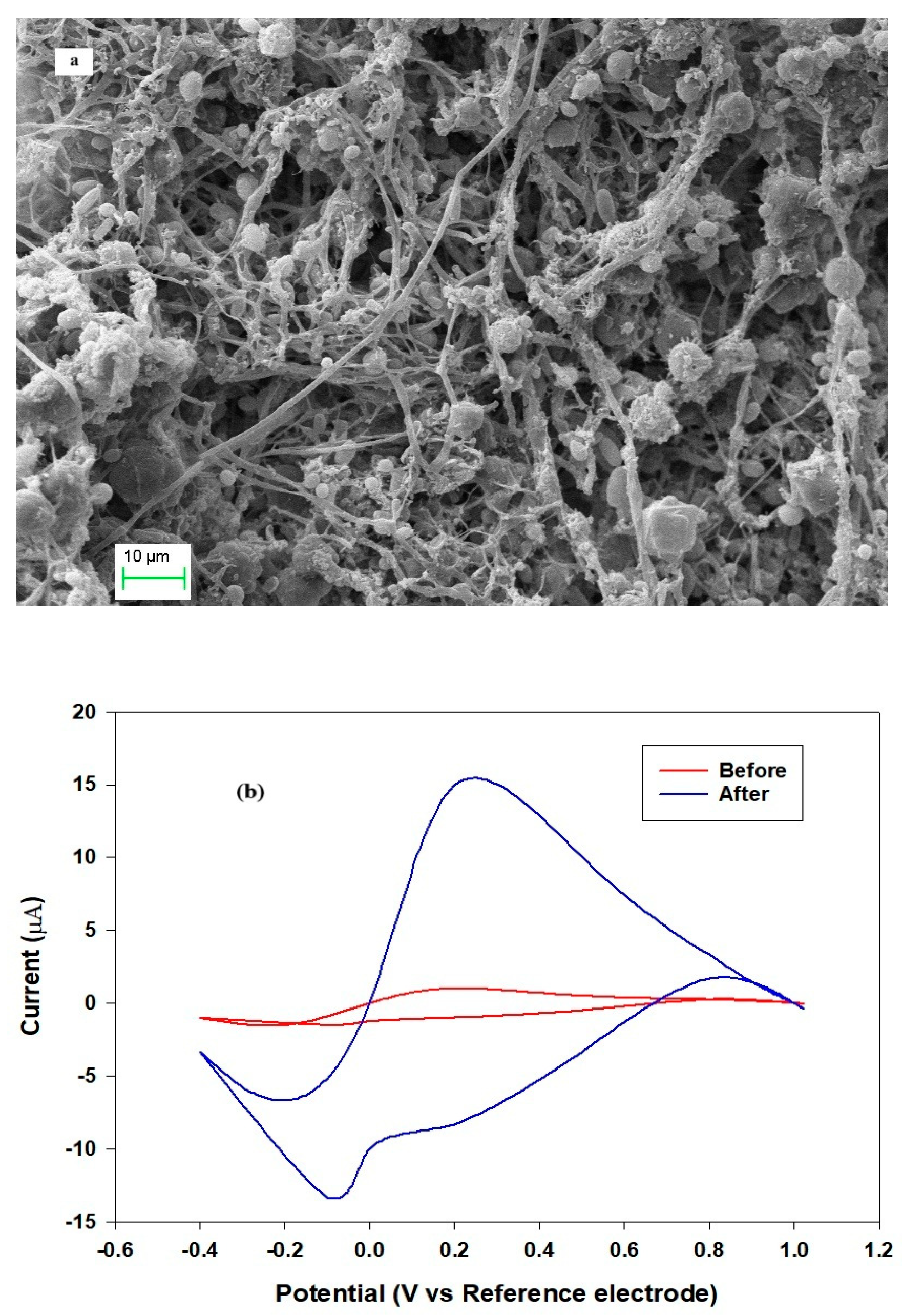
Figure 1. (a) Attachment of microorganism on the anode electrode; (b) CV results of the anode electrode before and after inoculation.
Catalysts 15 01153 g001
Figure 2. The power density curve of the MFCs.
Catalysts 15 01153 g002
Figure 3. COD removal and CE of the systems.
Catalysts 15 01153 g003
Figure 4. LSV of the systems.
Catalysts 15 01153 g004
Figure 5. RDE analysis of the MFCs.
Catalysts 15 01153 g005
Figure 6. Identification of the pathway for the oxygen reduction reaction. (a) Koutecký–Levich graphs (b) electron ORR pathway.
Catalysts 15 01153 g006
Figure 7. EIS analysis.
Catalysts 15 01153 g007
Figure 8. CA analysis of different cathodes at a fixed potential.
Catalysts 15 01153 g008
Figure 9. Schematic of an MFC.
Catalysts 15 01153 g009
Figure 10. (af) Surface microstructure of as-prepared Ni-Al2O3, Ni-Cr2O3, and Ni-TiO2 nanocomposites, respectively, with SEM/EDS results.
Catalysts 15 01153 g010
Table 1. Techno-economic comparison of cathode catalysts based on performance-normalized cost.
Catalyst MaterialRaw Material Cost (USD/g)[Source]Catalyst Loading (g/m2)Max. Power Density (W/m2)Calculated Cost Per Watt (USD/W)
Pt (on Carbon)USD 35.00[48]5.00.275USD 636.36
Ni-TiO2USD 0.15[49]5.00.224USD 3.35
Ni-Cr2O3USD 0.12[49]5.00.162USD 3.70
Ni-Al2O3USD 0.08[49]5.00.134USD 2.99
Disclaimer/Publisher’s Note: The statements, opinions and data contained in all publications are solely those of the individual author(s) and contributor(s) and not of MDPI and/or the editor(s). MDPI and/or the editor(s) disclaim responsibility for any injury to people or property resulting from any ideas, methods, instructions or products referred to in the content.