
Micron Aluminum Concurrently Encapsulated with Metallic Copper, Cobalt, and Iron Nanoparticles and Its Catalysis on Thermolysis and Combustion of Ammonium Perchlorate and Hexogen


Abstract
1. Introduction
2. Results and Discussion
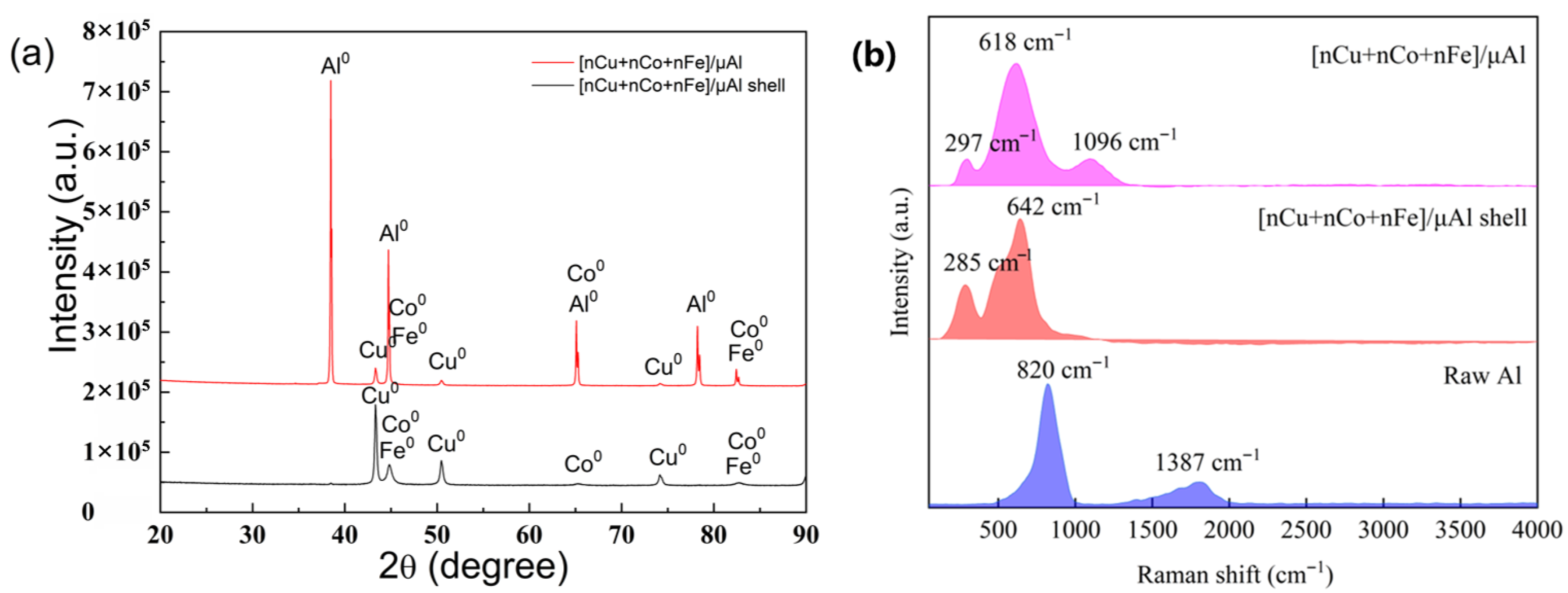
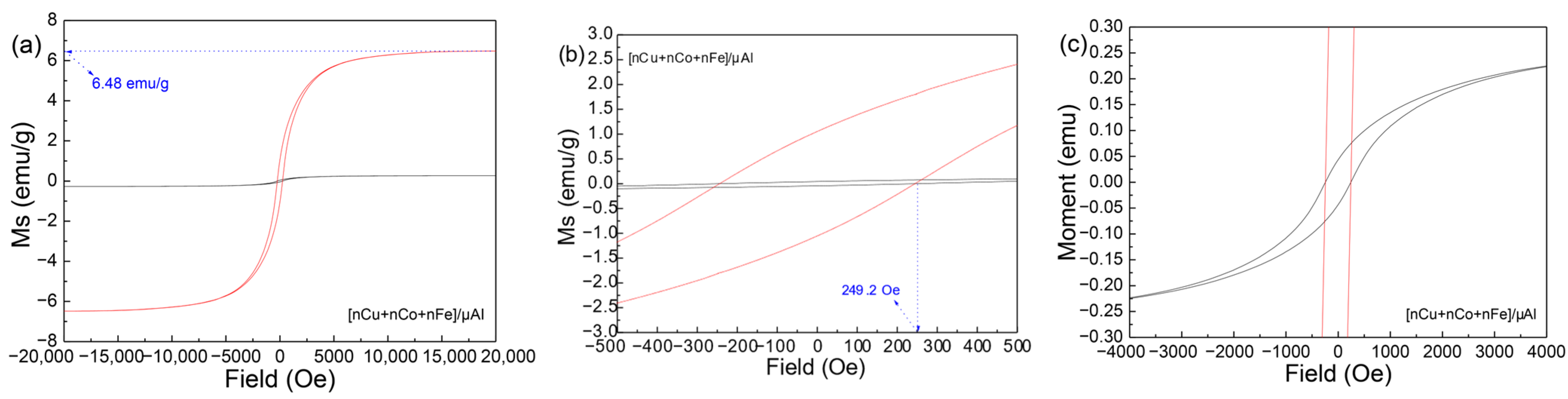
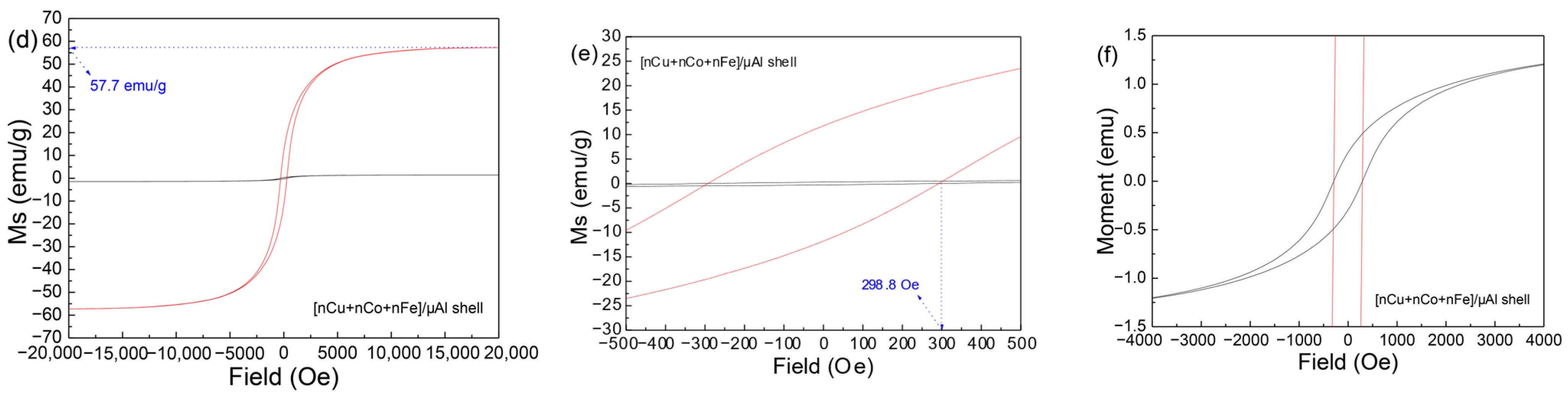
2.1. Characterization of [nCu+nCo+nFe]/μAl
2.2. Thermal Analyses
2.3. Combustion Performance
2.3.1. Combustion in a Closed Bomb
2.3.2. Combustion in the Air
3. Experimental Sections
3.1. Materials
3.2. Preparation of [nCu+nCo+nFe]/μAl
3.3. Fabrication of Nanocomposite+AP/RDX
3.4. Characterization and Tests
3.5. Combustion Performance Test
4. Conclusions
Author Contributions
Funding
Institutional Review Board Statement
Data Availability Statement
Acknowledgments
Conflicts of Interest
References
- Wang, Y.; Ren, H.; Song, X.; An, C.; Yang, K.; Li, F. Encapsulation of micron-scale aluminum with pluralistic magnetic metallic nanoparticles and its combustion performance. FirePhysChem, 2025; in press. [Google Scholar] [CrossRef]
- Xu, R.; Xue, Z.; Yang, D.; Li, X.; Nie, H.; Guo, Y.; Guo, H.; Yan, Q.; Gu, J. Highly Energy Release of Aluminum@Ammonium Perchlorate Composites Incorporated with Graphene Oxide-based Energetic Coordination Polymer. Adv. Funct. Mater. 2025, 35, 2423205. [Google Scholar] [CrossRef]
- Liu, Q.; Wu, Z.; Li, M.; Xu, Y.; Xin, X.; Xu, J.; Song, X. Integrated preparation of Al-based energetic micro-unit fuel toward combustion performance. Hang Kong Cai Liao Xue Bao 2023, 43, 102–110. [Google Scholar]
- Zhu, L.; Liang, B.; Liu, J.; Zhang, W. Effect of Aluminum Morphology on Burning Rate Characteristics of HTPB Propellant. Chin. J. Energetic Mater. 2017, 25, 799–803. [Google Scholar]
- Du, K. Combustion performance of ultrafine aluminum powder in AP/HTPB propellants. Chem. Eng. Equip. 2024, 10, 21–23. [Google Scholar]
- Chen, K.; Xue, X.; Yu, Y. A model for the combustion behavior of AP/HTPB propellant containing ultrafine aluminum. Propellants Explos. Pyrotech. 2024, 49, e202400049. [Google Scholar] [CrossRef]
- Xin, H.; Wang, K.; Ren, H.; Jiao, Q. Comparative study on combustion behavior of aluminum-based alloy fuels and aluminum powder in solid propellants. Metals 2023, 13, 1492. [Google Scholar] [CrossRef]
- Trunov, M.A.; Schoenitz, M.; Zhu, X.; Dreizin, E.L. Effect of polymorphic phase transformations in Al2O3 film on oxidation kinetics of aluminum powders. Combust. Flame 2005, 140, 310–318. [Google Scholar] [CrossRef]
- Jeurgens, L.; Sloof, W.; Tichelaar, F.; Mittemeijer, E. Composition and chemical state of the ions of aluminium-oxide films formed by thermal oxidation of aluminium. Surf. Sci. 2002, 506, 313–332. [Google Scholar] [CrossRef]
- Sánchez-López, J.; Fernández, A.; Conde, C.; Conde, A.; Morant, C.; Sanz, J. The melting behavior of passivated nanocrystalline aluminum. Nanostruct. Mater. 1996, 7, 813–822. [Google Scholar] [CrossRef]
- Wang, S.-X.; Liang, K.-M.; Zhang, X.-H.; Wang, G.-L. Influence of heating-rate on DTA curve of the aluminothermic reaction. J. Mater. Sci. Lett. 2003, 22, 855–856. [Google Scholar] [CrossRef]
- Zeng, C.; Wang, J.; He, G.; Huang, C.; Yang, Z.; Liu, S.; Gong, F. Enhanced water resistance and energy performance of core–shell aluminum nanoparticles via in situ grafting of energetic glycidyl azide polymer. J. Mater. Sci. 2018, 53, 12091–12102. [Google Scholar] [CrossRef]
- Guo, L.; Song, W.; Xie, C.; Zhang, X.; Hu, M. Characterization and thermal properties of carbon-coated aluminum nanopowders prepared by laser-induction complex heating in methane. Mater. Lett. 2007, 61, 3211–3214. [Google Scholar] [CrossRef]
- Lyu, J.-Y.; Chen, S.; He, W.; Zhang, X.-X.; Tang, D.-Y.; Liu, P.-J.; Yan, Q.-L. Fabrication of high-performance graphene oxide doped PVDF/CuO/Al nanocomposites via electrospinning. Chem. Eng. J. 2019, 368, 129–137. [Google Scholar] [CrossRef]
- Cheng, Z.; Chu, X.; Yin, J.; Dai, B.; Zhao, W.; Jiang, Y.; Xu, J.; Zhong, H.; Zhao, P.; Zhang, L. Formation of composite fuels by coating aluminum powder with a cobalt nanocatalyst: Enhanced heat release and catalytic performance. Chem. Eng. J. 2020, 385, 123859. [Google Scholar] [CrossRef]
- Kou, Y.; Wang, Y.; Zhang, J.; Guo, K.-G.; Song, X.-L. Iron/aluminum nanocomposites prepared by one-step reduction method and their effects on thermal decomposition of AP and AN. Def. Technol. 2023, 22, 74–87. [Google Scholar] [CrossRef]
- Cheng, Z.; Chu, X.; Zhao, W.; Yin, J.; Dai, B.; Zhong, H.; Xu, J.; Jiang, Y. Controllable synthesis of Cu/Al energetic nanocomposites with excellent heat release and combustion performance. Appl. Surf. Sci. 2020, 513, 145704. [Google Scholar] [CrossRef]
- Li, D.Y.; Zeng, D.W.; Li, H.T. Autocatalytic performance of AP/Co-MOF core-shell nanocomposite on thermal decomposition of AP. Chem. Bioeng. 2016, 33, 15–18. [Google Scholar]
- Wu, Y.Y.; Shi, X.F.; Zhang, Z.J.; Zhang, W.H.; Wang, F.; Wang, J.Y. Preparation and properties of ADN/NC/RDX composite micro-propulsion system. Initiat. Pyrotech. 2025, 2, 24–30. [Google Scholar]
- Liu, T.; Wang, J.; Chen, J.; Nie, C.; Mao, Y.; Nie, F.; Zhong, R.; Cao, W.; Wang, J. The combustion reactivity of core-shell Al/Fluoropolymers and application in RDX-based explosives. Def. Technol. 2025, 51, 30–39. [Google Scholar] [CrossRef]
- Kou, Y.; Lu, Q.; Fu, X.; Yang, R.; Yu, J.; Yang, H.; Zhang, C.; Di, J.; Liu, G.; Gao, H.; et al. Construction of Fe Nanoparticles Interfacial Layer on Micron Al Surface: Boosting the Efficient Energy Release of High-Energy DAP-4 as a Gradient Catalyst. Small 2024, 20, 2404623. [Google Scholar] [CrossRef]
- Lee, J.H.; Lee, E.G.; Joo, O.S.; Jung, K.D. Stabilization of Ni/Al2O3 catalyst by Cu addition for CO2 reforming of methane. Appl. Catal. A Gen. 2004, 269, 1–6. [Google Scholar] [CrossRef]
- Liu, Y.; Cheng, B.; Wang, K.-K.; Ling, G.-P.; Cai, J.; Song, C.-L.; Han, G.-R. Study of Raman spectra for γ-Al2O3 models by using first-principles method. Solid State Commun. 2014, 178, 16–22. [Google Scholar] [CrossRef]
- Assih, T.; Ayral, A.; Abenoza, M.; Phalippou, J. Raman study of alumina gels. J. Mater. Sci. 1988, 23, 3326–3331. [Google Scholar] [CrossRef]
- Hu, C.L.; Chen, S.Y.; Chen, J.; Zhang, W.; Chen, X. Application progress of Raman spectroscopy in polymer study. Polym. Bull. 2022, 27, 30–45. [Google Scholar]
- Tao, W.J.; Liu, X.D.; Zheng, X.G.; Meng, D.D.; Guo, Q.X. Mid-infrared and Raman spectral analysis of geometrically frustrated natural atacamite. Spectrosc. Spectr. Anal. 2011, 31, 2431–2436. [Google Scholar]
- Li, B.; Wang, H.; Ding, F.C.; Li, C.Q.; Song, Y.J.; Ke, M.; Ren, C.T. Effects of Preparation Methods on the Catalytic Performance of Selective Catalytic Reduction of NO with CH4 over Co-MOR Catalysts. Acta Phys.-Chim. Sin. 2013, 29, 1289–1296. [Google Scholar]
- Cao, P.G.; Yao, J.L.; Gu, R.A.; Tian, Z.Q. Raman spectroscopic study of corrosion inhibition of copper and iron by benzotriazole. J. Light Scatt. 1999, 3–8. [Google Scholar]
- Ren, H. Preparation of Fe3O4-Based Nanoparticle Draw Solution and Its Forward Osmosis Performance; Southwest Jiaotong University: Chengdu, China, 2022. [Google Scholar]
- Li, J.W.; Li, J.F.; Zhang, D.X.; Xue, Z.H.; Li, Z.Q.; Lei, J.S.; Wang, J.Y.; Wu, B.D. Preparation of Micron-scale DAP-4-based Energetic Composite Microspheres by Microfluidic Technology and its Characterization. Chin. J. Energetic Mater. 2024, 32, 249–255. [Google Scholar]
- Zhang, X. Preparation of Porous Oxide Supported Noble Metal Catalysts and Their Catalytic Performance for Typical Halogenated Hydrocarbons; Beijing University of Technology: Beijing, China, 2021. [Google Scholar]
- Kissinger, H.E. Reaction kinetics in differential thermal analysis. Anal. Chem. 1957, 29, 1702–1706. [Google Scholar] [CrossRef]
- Xie, M.Z.; Heng, S.Y.; Liu, Z.R.; Wang, H.; Wang, X.H.; Zhao, F.Q. Catalytic thermal decomposition of RDX-CMDB propellant by TG-DSC-IR-MS. J. Solid Rocket Technol. 2009, 32, 539–542+553. [Google Scholar]
- Wang, Y.; Song, X.; Song, D. Synthesis, thermolysis, and sensitivities of HMX/NC energetic nanocomposites. J. Hazard. Mater. 2016, 312, 73–83. [Google Scholar] [CrossRef] [PubMed]
- Wang, X.F.; Xu, Y.G.; Lu, M. Research progress of energetic oxidizers for solid propellants. J. Solid Rocket Technol. 2025, 48, 9–26. [Google Scholar]
- Yang, S.-L.; Meng, K.-J.; Xie, W.-X.; Nie, H.-Q.; Yan, Q.-L. Tuning the reactivity of Al-Ni by fine coating of halogen-containing energetic composites. Def. Technol. 2022, 18, 1810–1821. [Google Scholar] [CrossRef]
- Tan, L.; Xu, J.; Zhang, X.; Hang, Z.; Jia, Y.; Wang, S. Synthesis of g-C3N4/CeO2 nanocomposites with improved catalytic activity on the thermal decomposition of ammonium perchlorate. Appl. Surf. Sci. 2015, 356, 447–453. [Google Scholar] [CrossRef]
- Xu, Y.; Sun, W.; Chen, X.; Wang, Y.; Ji, W.; Chen, D. Reaction mechanism and kinetic modelling of RDX/AP via a chemical reaction neural network. Chem. Eng. Sci. 2025, 310, 121535. [Google Scholar] [CrossRef]
- GJB 772A-1997; Test Methods for Explosives. Military Standards Press of COSTIND: Beijing, China, 1997.


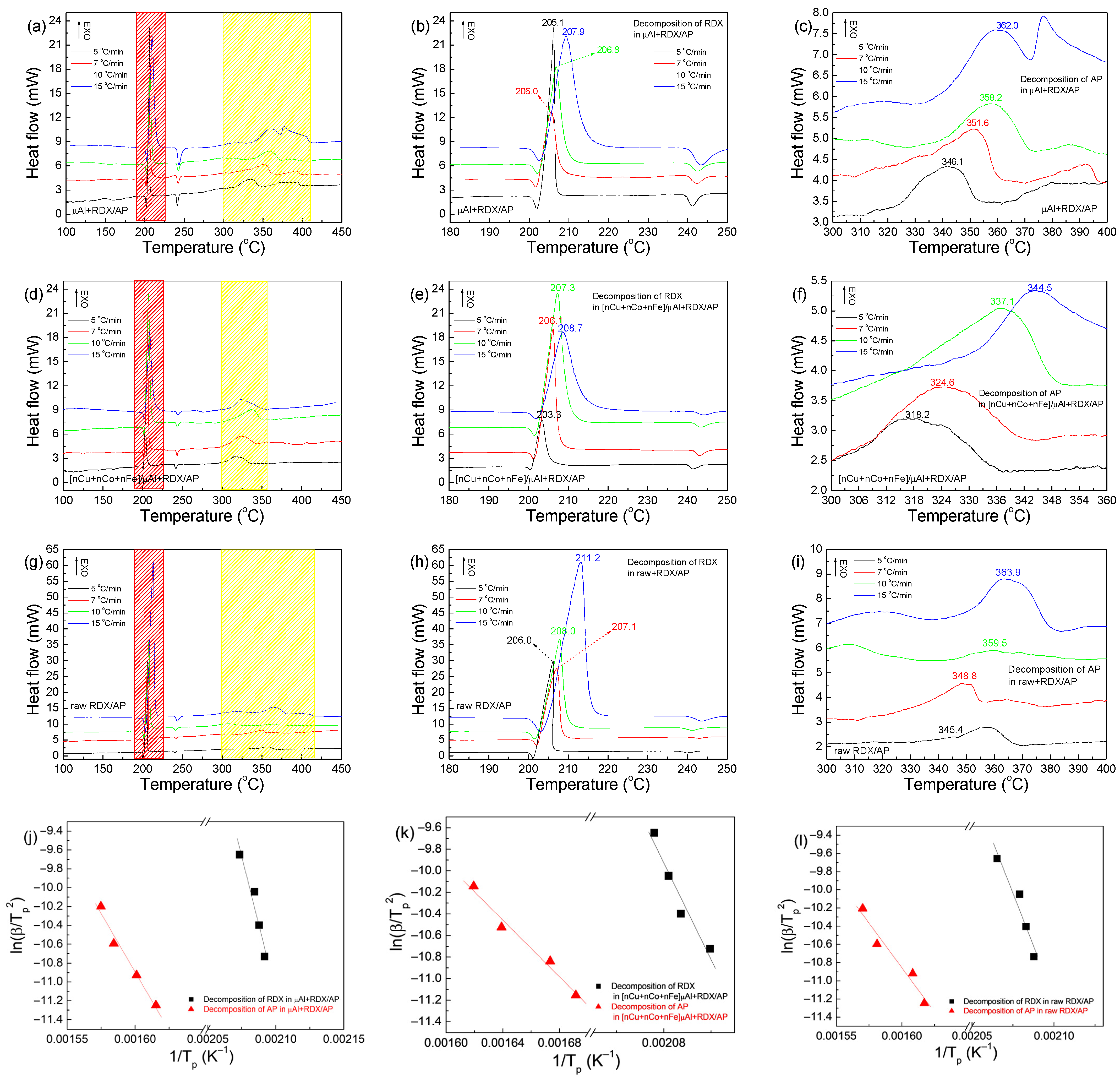





| Samples | TP (°C) (10 °C/min) | Thermodynamic | Kinetics | ||||
|---|---|---|---|---|---|---|---|
| ΔH≠ (kJ/mol) | ΔG≠ (kJ/mol) | ΔS≠ (J/mol·K) | EK (kJ/mol) | lnAK | k (s−1) | ||
| [nCu+nCo+nFe]/μAl+AP/RDX | 337.1 | 158.0 | 103.1 | −0.090 | 108.2 | 20.35 | 0.376 |
| μAl+AP/RDX | 358.2 | 161.1 | 196.3 | 0.056 | 201.5 | 37.92 | 0.614 |
| AP/RDX | 359.5 | 162.0 | 157.4 | −0.007 | 162.6 | 30.32 | 0.547 |
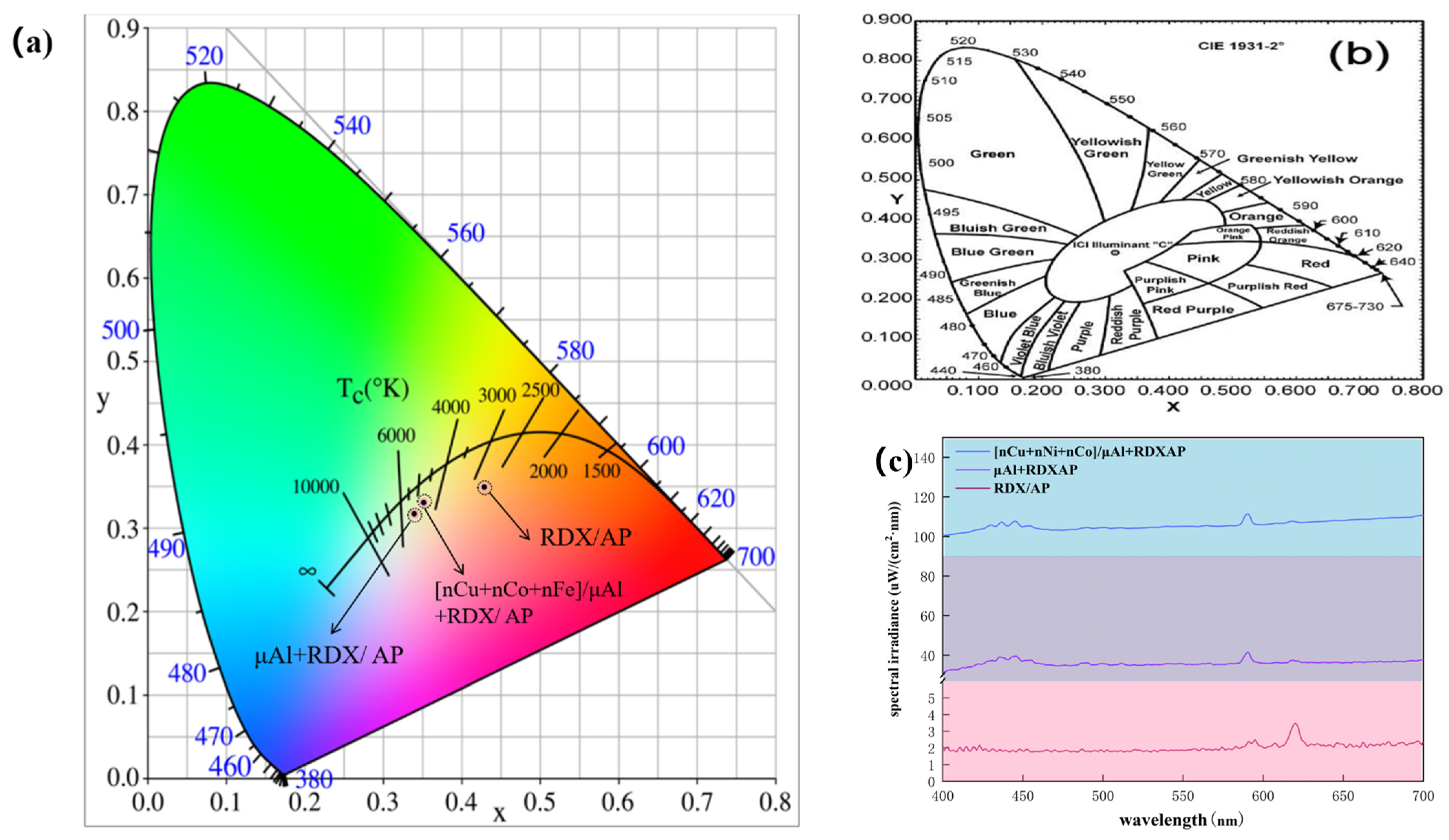
| Samples | Chromatic Coordinates | BT /s | DW /nm | SP /% | LI /cd | LE /cd·s·g−1 | Color Category | |
|---|---|---|---|---|---|---|---|---|
| x | y | |||||||
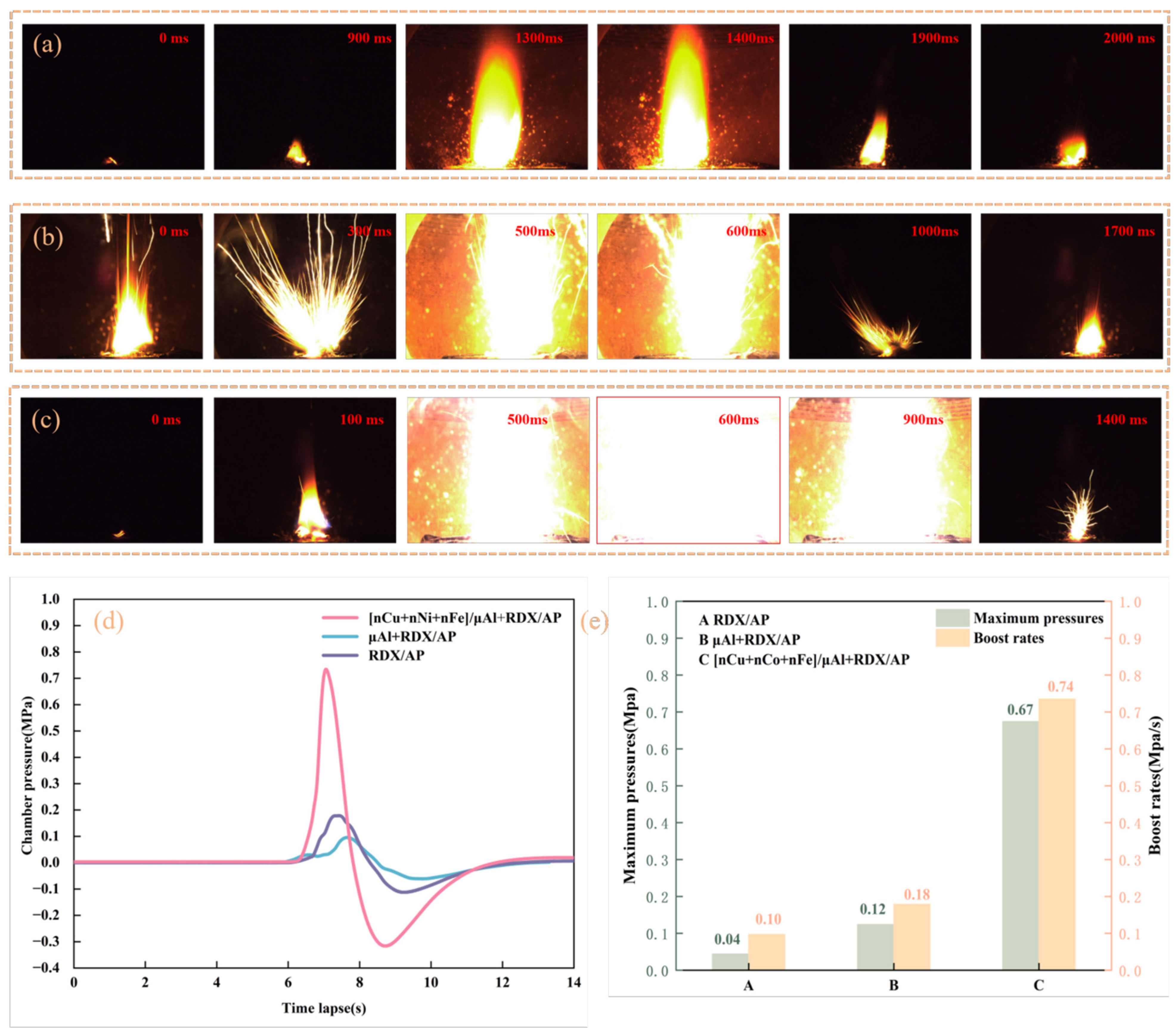
| [nCu+nCo+nFe/μAl+AP/RDX | 0.3517 | 0.3303 | 1.07 | 675 | 4.6 | 1069.086 | 3813.07 | white |
| μAl+AP/RDX | 0.3405 | 0.3171 | 1.64 | 525 | 3.3 | 816.917 | 4465.81 | yellow-green |
| AP/RDX | 0.4298 | 0.3498 | 1.58 | 598 | 33.9 | 58.755 | 451.643 | orange-red |
| Samples | TTOP,exp (°C) | Tad,cal (°C) | HR,cal (kJ/kg) | HP,cal (kJ/kg) | ΔHC,cal (kJ/kg) |
|---|---|---|---|---|---|
| [nCu+nCo+nFe]/μAl+AP/RDX | 2205.6 | 3096.6 | −1166.7 | −7523.2 | −6356.5 |
| μAl+AP/RDX | 1900.2 | 2716.7 | −1325.8 | −8111.1 | −6785.3 |
| AP/RDX | 1712.8 | 2648.7 | −1395.6 | −6712.4 | −5316.8 |
Disclaimer/Publisher’s Note: The statements, opinions and data contained in all publications are solely those of the individual author(s) and contributor(s) and not of MDPI and/or the editor(s). MDPI and/or the editor(s) disclaim responsibility for any injury to people or property resulting from any ideas, methods, instructions or products referred to in the content. |
© 2025 by the authors. Licensee MDPI, Basel, Switzerland. This article is an open access article distributed under the terms and conditions of the Creative Commons Attribution (CC BY) license (https://creativecommons.org/licenses/by/4.0/).
Share and Cite
Song, X.; Liu, H.; Yan, W.; Wang, Y. Micron Aluminum Concurrently Encapsulated with Metallic Copper, Cobalt, and Iron Nanoparticles and Its Catalysis on Thermolysis and Combustion of Ammonium Perchlorate and Hexogen. Catalysts 2025, 15, 1166. https://doi.org/10.3390/catal15121166
Song X, Liu H, Yan W, Wang Y. Micron Aluminum Concurrently Encapsulated with Metallic Copper, Cobalt, and Iron Nanoparticles and Its Catalysis on Thermolysis and Combustion of Ammonium Perchlorate and Hexogen. Catalysts. 2025; 15(12):1166. https://doi.org/10.3390/catal15121166
Chicago/Turabian StyleSong, Xiaolan, Hangchen Liu, Wenhu Yan, and Yi Wang. 2025. "Micron Aluminum Concurrently Encapsulated with Metallic Copper, Cobalt, and Iron Nanoparticles and Its Catalysis on Thermolysis and Combustion of Ammonium Perchlorate and Hexogen" Catalysts 15, no. 12: 1166. https://doi.org/10.3390/catal15121166
APA StyleSong, X., Liu, H., Yan, W., & Wang, Y. (2025). Micron Aluminum Concurrently Encapsulated with Metallic Copper, Cobalt, and Iron Nanoparticles and Its Catalysis on Thermolysis and Combustion of Ammonium Perchlorate and Hexogen. Catalysts, 15(12), 1166. https://doi.org/10.3390/catal15121166