Article

Effect of Promoters on Co/Al2O3 Catalysts for Partial Oxidation of Methane: Structure–Activity Correlations

by
Khaled M. Banabdwin
1,
Abdulaziz A. M. Abahussain
1,*,
Amal BaQais
2,
Ahmed A. Bhran
3,
Alaaddin M. M. Saeed
4,
Nawaf N. Alotaibi
5,
Mohammed Abdullh Al Sudairi
1,
Ahmed A. Ibrahim
1,
Sunit Kumar Singh
6 and
Ahmed S Al-Fatesh
1,*
1
Chemical Engineering Department, College of Engineering, King Saud University, P.O. Box 800, Riyadh 11421, Saudi Arabia
2
Department of Chemistry, College of Science, Princess Nourah bint Abdulrahman University, P.O. Box 84428, Riyadh 11671, Saudi Arabia
3
Chemical Engineering Department, Imam Mohammad Ibn Saud Islamic University (IMSIU), Riyadh 11432, Saudi Arabia
4
UNILAB, State Key Laboratory of Chemical Engineering, East China University of Science and Technology, Shanghai 200237, China
5
Institute of Refining and Petrochemicals Technologies, King Abdulaziz City for Science and Technology (KACST), P.O. Box 6086, Riyadh 11442, Saudi Arabia
6
NTPC-Energy Technology Research Alliance, NTPC Ltd., Greater Noida 201306, India
*
Authors to whom correspondence should be addressed.
Catalysts 2025, 15(12), 1176; https://doi.org/10.3390/catal15121176
Submission received: 28 October 2025 / Revised: 27 November 2025 / Accepted: 11 December 2025 / Published: 18 December 2025

Abstract

The development of cost-effective non-noble metal catalysts for the partial oxidation of methane (POM) remains a key strategy for producing hydrogen-rich syngas while mitigating greenhouse gas emissions. In this study, cobalt-supported alumina (Co/Al2O3) catalysts were prepared using 5 wt.% of Co and calcined at 600, 700, and 800 °C. Subsequently, Co/Al2O3 catalysts were promoted with 10 wt.% Mg, Si, Ti, and Zr at the optimized calcination temperature. The catalysts were systematically characterized by FT-IR, XRD, N2 physisorption, H2-TPR, and XPS analyses. Catalytic activity tests for POM of CH4 were conducted at 600 °C (CH4/O2 = 2 and GHSV = 14,400 mL g−1 h−1). Catalysts calcined at 700 °C (5Co/Al_700) exhibited the highest activity among unpromoted samples, with CH4 conversion of 43.9% and H2 yield of 41.8%. The superior performance was attributed to its high surface area and the abundance of reducible Co3+ species, generating a greater number of Co0 active sites. XPS results confirmed the structural stability of γ-Al2O3 and preserved Co–Al interactions across calcination temperatures, while promoters mainly modulated Co dispersion and redox accessibility. Among the promoted catalysts, the activity order followed: 5Co/10ZrAl > 5Co/10MgAl> unpromoted-5Co/Al_700 > 5Co/10SiAl > 5Co/10TiAl. Si and Ti promoted catalysts acquired less concentration of active sites and less activity as well. The concentration of reducible species as well as initial activity towards POM are comparable over Zr and Mg-promoted catalysts. However, earlier one has a higher edge of reducibility and sustained constant activity over time in a stream study. The Zr-promoted catalyst exhibited superior reducibility and remarkable stability, achieving 47.3% CH4 conversion and 44.4% H2 yield sustained over 300 min time-on-stream. TEM analysis of spent 5Co/10ZrAl indicated that Zr promotion suppressed graphitic carbon formation.

1. Introduction

Synthesis gas, a mixture of hydrogen (H2) and carbon monoxide (CO), is an important feedstock for various industrial applications, including methanol production, Fischer–Tropsch (FT) synthesis, and ammonia manufacturing [1]. H2 has gained significant attention as a clean energy carrier with the potential to shift toward sustainable energy systems by cutting carbon emissions. Thus, growing research and investment are currently directed towards developing efficient methods for the production of H2 and syngas [2]. Partial oxidation of methane (POM) is considered an efficient and thermodynamically favorable reaction where methane (CH4) reacts with a limited amount of oxygen (O2) to produce H2 and CO [3]. POM proceeds nearly stoichiometrically at high temperatures (Equation (1)) to produce syngas with an ideal H2/CO ratio of nearly 2.
2 C H 4 + O 2 2 C O + 4 H 2 H ° 298 = 35.7   k J m o l 1
POM can proceed via a direct route (Equation (1)) or through a combustion–reforming sequence, where full combustion (Equation (2)) produces CO2 and H2O that subsequently undergo dry reforming of methane (DRM) (Equation (3)) and steam reforming of methane (SRM) (Equation (4)), respectively, to generate syngas.
C H 4 + 2 O 2 C O 2 + 2 H 2 O g H ° 298 = 802.3   k J m o l 1
C H 4 + C O 2 2 C O + 2 H 2 H ° 298 = + 247.3   k J m o l 1
C H 4 + H 2 O g C O + 3 H 2 H ° 298 = + 206.1   k J m o l 1
Besides these main routes, secondary reactions such as the water–gas shift (WGS) (Equation (5)) and Boudouard reaction (Equation (6)) may also occur, which can alter the H2/CO ratio from the theoretical value of 2. These exothermic side reactions dominate at lower temperatures, while their reverse counterparts become favorable at higher temperatures.
C O + H 2 O g C O 2 + H 2 H ° 298 = 41.2   k J m o l 1
2 C O + C ( s , g r a p h i t e ) C O 2 H ° 298 = 172.5   k J m o l 1
Catalyst design plays an important role in POM, as it directly controls activation of CH4, selectivity towards syngas, and resistance to catalyst deactivation [4]. Among the transition metals, Co and Ni are generally used as active metals in POM catalysts due to their good activity, stability, and relatively low cost compared with the noble metals [5,6].
Interestingly, although Ni-based catalysts are traditionally considered the benchmark for DRM reactions, studies have shown that Co can exhibit superior performance under POM conditions. Zagaynov et al. (2016) reported that Co-based mesoporous catalysts were more active in POM than Ni-only catalysts, displaying higher CH4 conversion, CO selectivity, and H2/CO ratio, whereas Ni performed better in DRM [7]. In Ni-based catalysts, NiO tends to persist together with metallic Ni under POM conditions. While metallic Ni is active for POM, NiO is considered the main active site for the total oxidation of methane. As the proportion of NiO increases, the available metallic Ni sites decrease, leading to a decline in POM efficiency [8]. In contrast, Co-based catalysts maintain a more favorable balance of reducible oxide species and metallic Co, offering superior activity and stability for POM.
Alumina (Al2O3) is commonly employed as a support due to its high surface area, thermal stability, and its capacity to participate in metal-support interactions [9]. Co/Al2O3 offers high dispersion and superior resistance to sintering and carbon deposition, enabling stable performance under POM conditions [3,5]. Zhang et al. found that Co/Al2O3 catalysts calcined at 800–1000 °C showed CH4 conversion of up to 80–90% with high CO selectivity initially; however, catalyst deactivation was observed later due to the formation of Co-aluminate spinel (CoAl2O4) and coke deposition [10]. It indicated that Co/Al2O3 catalysts face significant challenges, such as the formation of inactive CoAl2O4 spinel phases at high calcination temperatures (>800 °C), which limits their applicability for POM [11,12]. Thus, identifying an optimal calcination temperature is critical to suppress inactive spinel CoAl2O4 formation, which is inactive for POM, while maximizing the concentration of reducible Co3O4 species that provide the active redox sites for POM [12].
The choice of promoter significantly influences textural properties and catalytic activity [13], and various promoters from noble metals, alkali/alkaline earths, transition metals, and non-metals have been widely investigated. Noble metals (Pt, Ru) and Group IB metals (Cu, Ag, Au) were used as promoters in the Co/Al2O3 system for FT and found to enhance reduction and increase active Co sites [14]. However, such promoters have not yet been employed in Co/Al2O3 catalysts for POM due to high cost and limited availability.
Alkali and alkaline earth promoters, including Ca and Mg were explored for Co/Al2O3 catalysts. Ca promotion enhanced Co3O4 reducibility and suppressed CoAl2O4 spinel formation, also offering coke resistance and high activity (88% CH4 conversion and 94% CO selectivity) toward POM. However, excess Co-loading reduced the surface area and blocked pores [15]. Mg promotion stabilized Co/Al2O3, modified the reducibility, acid–base properties, metal, and catalyst surface area. Choya et al. reported 12 wt.% Co/Al2O3 catalyst exhibited a stable CH4 conversion (30–35%) for 150 h of continuous operation, with only slight deactivation from minor surface area loss and a small shift in reduction temperature [16].
Zr is recognized as an effective promoter for Co/Al2O3, primarily by stabilizing the support structure and enhancing oxygen ion transfer, which collectively improve catalyst stability and resistance to coking. Zr promotion in Co/Al2O3 catalysts, when studied for FT, was found to improve surface area, enhance dispersion, and moderate surface acidity [17].
Amongst the non-metals, Si has been used earlier both in Ni/Al2O3 and Co/Al2O3 catalyst systems and found to exhibit distinct effects [18,19]. An optimum composition was identified at 10 wt.% of Si, where Ni–support interactions were tuned to balance dispersion and reducibility. The 5Ni/10Si–90Al catalyst exhibited the best performance at 600 °C, achieving ~54% H2 yield. Si loading >10 wt.% promoted Ni–Ni-silicate formation, leading to a loss of active sites and lower CH4 conversion [18]. Whereas, in Co/Al2O3, Si is found to enhance reducibility by suppressing CoAl2O4 formation at a comparatively low loading of 5 wt.%. The modified catalysts showed higher FT activity and selectivity [19].
Certain promoters were found to negatively impact the performance of Co/Al2O3 catalysts in POM. Mo and W formed hard-to-reduce spinel phases or block active sites, thus lowering CH4 conversion and CO selectivity. Fe accelerated carbon deposition, while Mn induced slow activation and deactivation through re-oxidation of active sites and formation of Mn–Co mixed oxides [20,21].
In the earlier studies, Ibrahim et al. investigated 10 wt.% Ni/Al2O3 catalysts promoted with Mo, Mg, Ti, and Y (calcined 650 °C) and studied for POM at 550 and 650 °C. The results showed that Mg exhibited the best performance with nearly 92% CH4 conversion and 60% H2 yield at 650 °C, and Mo showed good performance, particularly at lower temperatures and best coke resistance. Ti gave stable activity (~60% at 550 °C and ~90% at 650 °C), whereas Y was the least effective [22]. Enger et al. examined Co/Al2O3 catalysts modified with a wide range of promoters, including Ni, Fe, Cr, Re, Mn, W, Mo, V, and Ta. Among the promoters, Ni was most effective, improving stability and maintaining high CH4 conversion by providing extra active sites and stabilizing metallic Co against re-oxidation. In contrast, other promoters such as Fe and Mn either promoted carbon deposition or induced slow deactivation through re-oxidation, while W, Mo, V, and Ta formed stable mixed oxides with Co, significantly reducing the available metallic Co0 sites and thereby suppressing activity [20]. Despite these advances, most studies have focused on a few promoters or narrow operating conditions. Systematic comparisons of promoter effects on Co/Al2O3, particularly under optimized calcination, remain unexplored.
The present work aims to bridge this gap by systematically examining the influence of selected promoters on reducibility, spinel formation, and long-term catalytic stability. Co/Al2O3 catalysts containing 5 wt.% Co was synthesized by wet impregnation, and to determine the optimum calcination temperature, the impregnated catalysts were calcined at 600, 700, and 800 °C. At the optimized conditions, Mg, Si, Ti, and Zr were introduced as promoters via wet impregnation followed by calcination at 700 °C for 3 h. The catalysts were comprehensively characterized using FT-IR, XRD, BET surface area analysis, H2-TPR, and XPS to establish a correlation between textural and chemical properties and catalytic performance in POM.

2. Results

2.1. Physicochemical Characterization of Catalysts

2.1.1. FT-IR Analysis

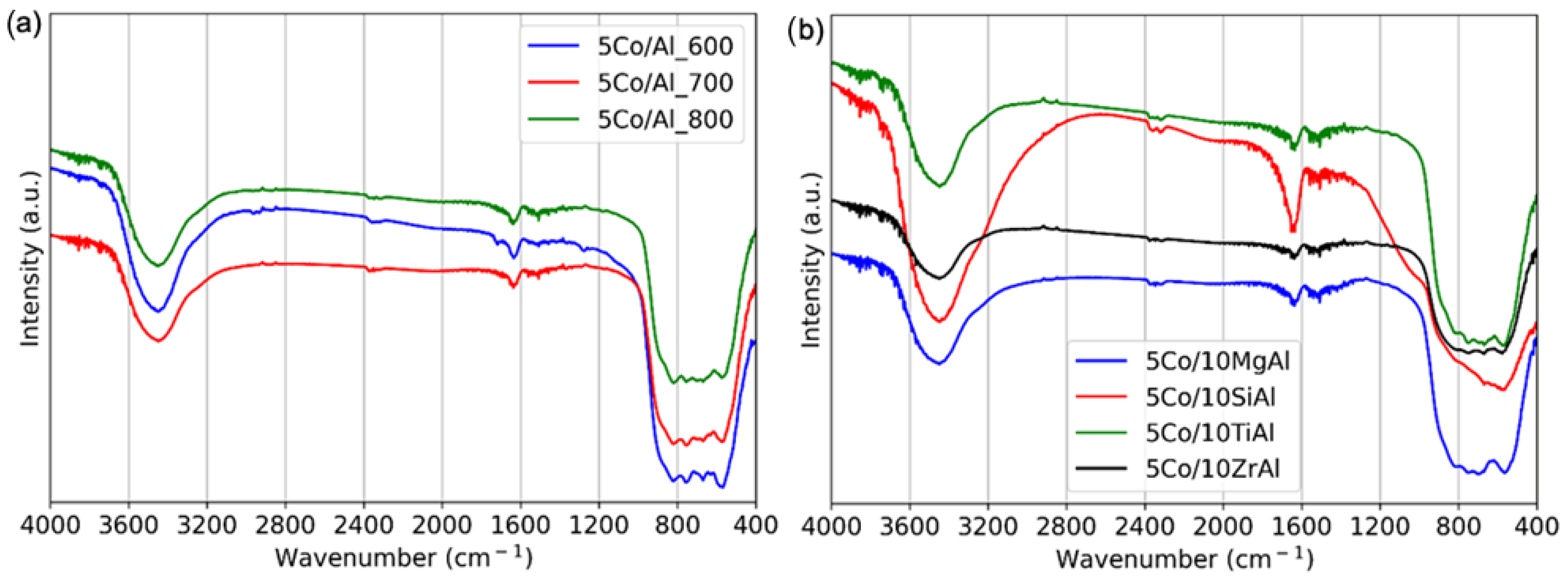
The FT-IR spectra of the unpromoted catalysts calcined at 600, 700, and 800 °C are presented in Figure 1a, and promoted (Zr, Mg, Si, and Ti) Co/Al catalysts are presented in Figure 1b. All samples display a broad OH stretching band in the 3600–3100 cm−1 region and a bending band about 1630 cm−1, attributed to surface hydroxyl groups. Interestingly, in the case of the 5Co/10SiAl catalyst, the peak intensity for surface hydroxyl is increased markedly [23]. The silicon is higher valent than alumina, and the covalency between silica and alumina always leaves an excess oxygen/hydroxyl at each silica. Overall, the surface hydroxyl concentration is maximum over 5Co/10SiAl. While FT-IR provides insights into surface functional groups and metal–oxygen linkages, it cannot convincingly identify crystalline phases. Therefore, XRD analysis was employed to determine the phase composition and crystallinity of the catalysts.

2.1.2. XRD Analysis of Catalysts

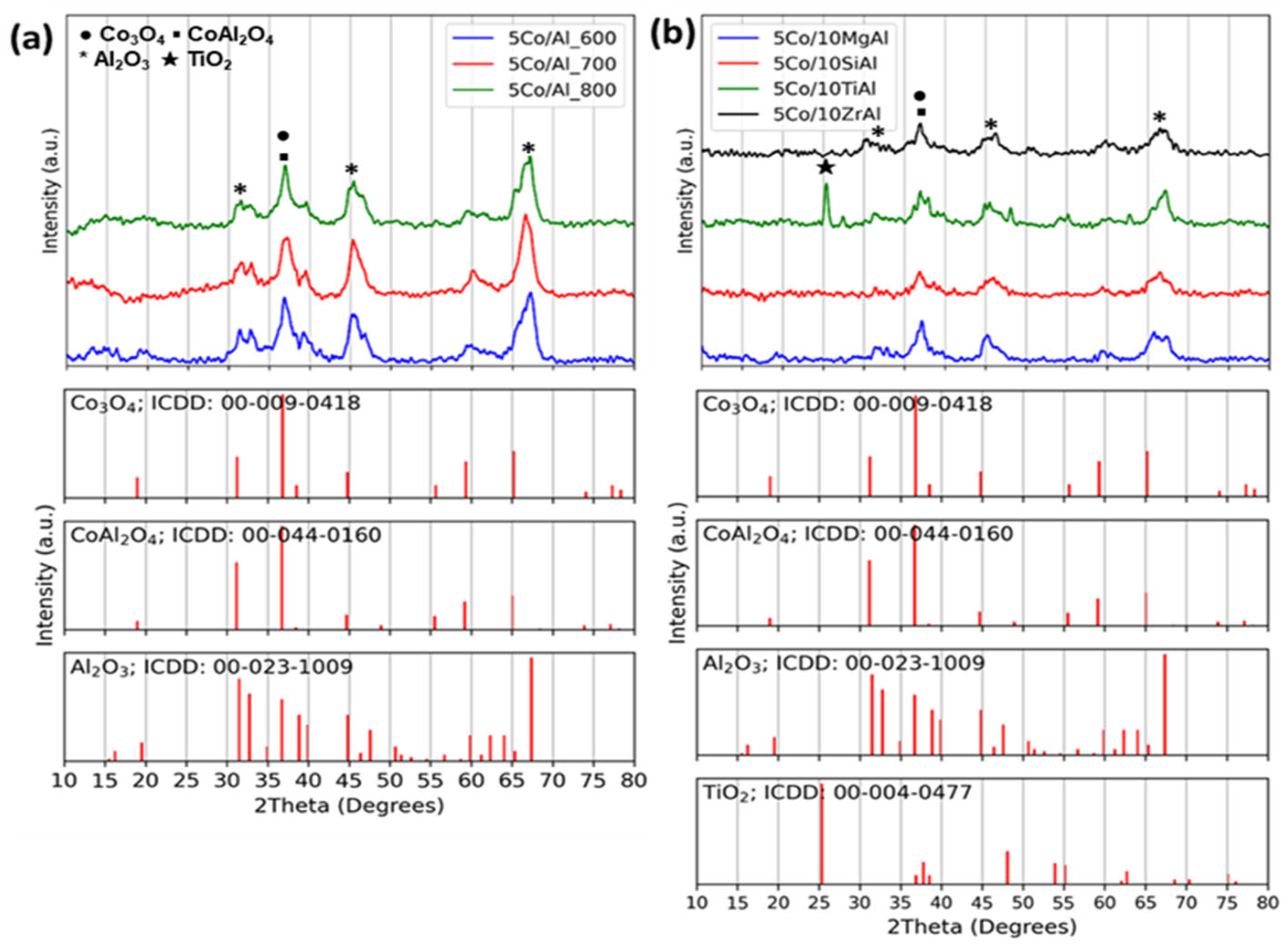
The XRD patterns of the synthesized 5Co/Al catalysts were examined to determine their crystal structure and phase composition. Figure 2a presents the XRD patterns of the unpromoted catalysts. The alumina support is primarily represented by the γ-Al2O3 phase, which belongs to the monoclinic crystal group (C2/m; ICDD no. 00-023-1009). Upon cobalt impregnation, two additional spinel phases were identified: Co3O4 (cubic, Fd-3m; ICDD no. 00-009-0418) and CoAl2O4 (cubic, Fd-3m; ICDD no. 00-044-0160). In all three samples (5Co/Al_600, 5Co/Al_700, and 5Co/Al_800), a broad diffraction feature observed between 2θ = 30–40° which includes overlapping reflections from multiple phases: Co3O4 at 36.8° (311), 38.6° (222), CoAl2O4 at 36.7° (311), 38.5° (222), θ-Al2O3 at 36.7° (111), 38.8° (401), and 39.9° (202). Similarly, the broad diffraction regions between 60 and 70° also consist of overlapping peaks from these three phases. The corresponding ICDD reference peak intensities for each phase are provided below the XRD patterns in Figure 2a for comparison.
Figure 2b presents the XRD patterns of promoted catalysts (5Co/10MgAl, 5Co/10SiAl, 5Co/10TiAl, 5Co/10ZrAl). Similar broad diffraction regions as observed in Figure 2a are also observed here. For 5Co/10MgAl and 5Co/10ZrAl, no distinct MgO or ZrO2 reflections were detected, which is possibly due to high dispersion or crystallite sizes below XRD detection limits. Consequently, the 5Co/10MgAl and 5Co/10ZrAl samples did not display characteristic peaks of separate MgO or ZrO2 phases. In addition, Mg could be incorporated as MgAl2O4 spinel, and Zr might exist as highly dispersed ZrO2 or Zr–O–Al mixed-oxide species, below XRD detection [24,25].
In contrast, the Ti-promoted catalyst (5Co/10TiAl) exhibited distinct reflections corresponding to the anatase TiO2 phase (tetragonal, I41/amd) at 2θ = 25.3° (101), 37.7° (004), 48.1° (200), 53.9° (105), 55.1° (211), and 62.7° (204) (ICDD: 00-004-0477). The Si-promoted sample (5Co/10SiAl) did not reveal any crystalline silica or aluminosilicate phase, suggesting the presence of an amorphous silica phase dispersed on the alumina surface.

2.1.3. N2 Adsorption–Desorption Studies of Catalysts

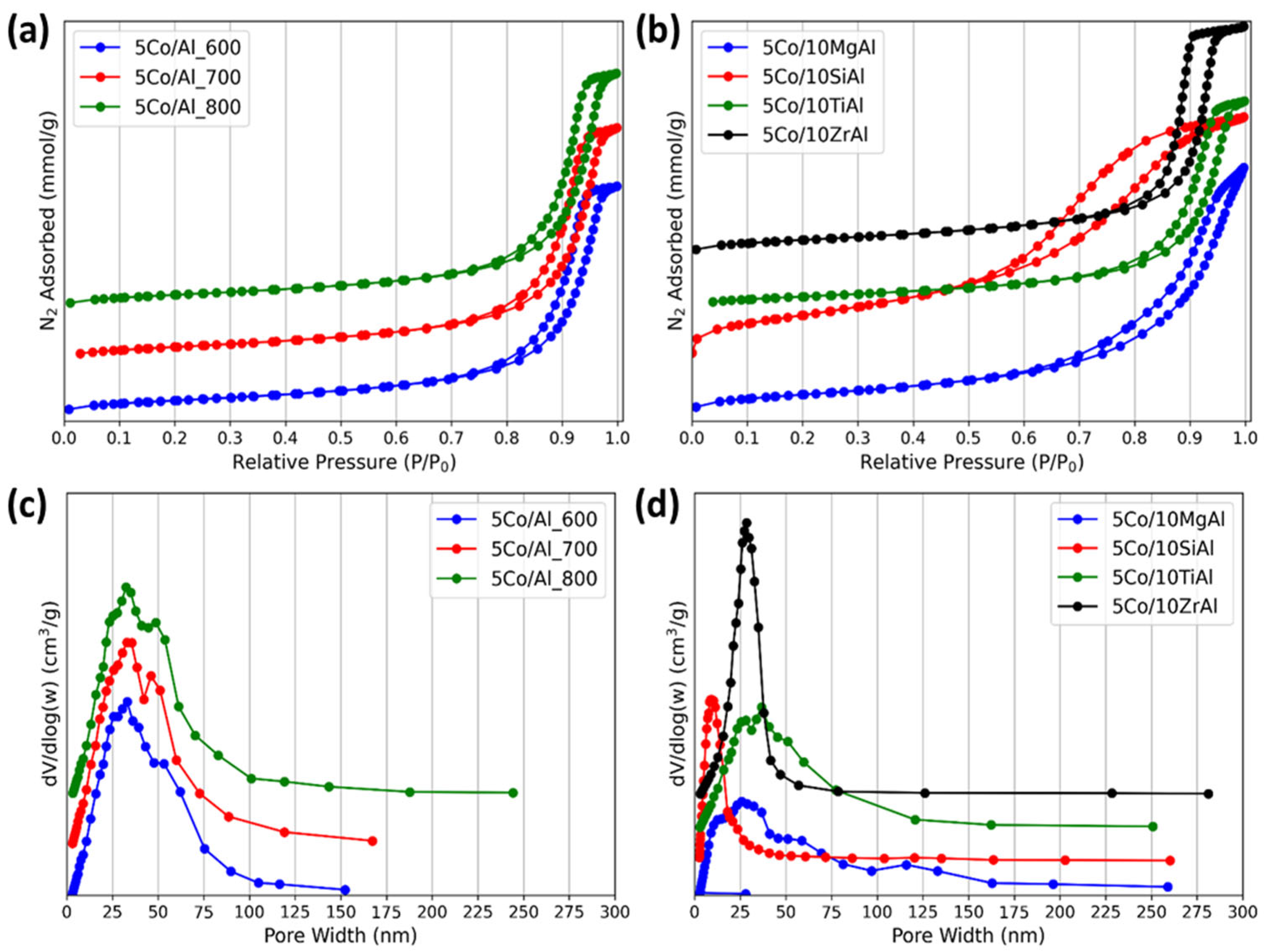
The N2 adsorption–desorption isotherms of the unpromoted (5Co/Al_600, 5Co/Al_700, and 5Co/Al_800) catalysts are presented in Figure 3a. All samples exhibited Type IV isotherms with H1 hysteresis loops in the relative pressure range of 0.8–1.0 (P/P0). This behavior is characteristic of mesoporous materials with uniform cylindrical pores or ordered mesoporous networks with a narrow pore size distribution (Figure 3c). Among the unpromoted catalysts, the 5Co/Al_700 exhibited the highest BET surface area (126 m2 g−1). The average pore diameters for all samples were narrowly distributed in the range of 19.8–21.2 nm (Table 1). 5Co/10ZrAl, 5Co/10MgAl, and 5Co/10TiAl catalysts (Figure 3b) also exhibited similar isotherm profiles to the unpromoted catalyst, confirming their mesoporous nature with H1-type hysteresis loops. In contrast, the Si-promoted 5Co/10SiAl catalyst displayed a markedly different adsorption behavior, with the hysteresis loop extending over a wider relative pressure range (0.6–1.0 P/P0) (Figure 3b). This transformation, accompanied by a sharp surface area increase (322.1 m2 g−1) and narrower pore diameter (7.9 nm), indicates that Si introduced by co-impregnation expands the catalyst surface. A similar observation was reported by Mardkhe et al. for Si-doped Al. They observed the formation of an interfacial Si–Al phase between primary crystallites within the agglomerates, with the ordering affecting the stability of the γ-Al2O3 crystal agglomerates [26].

2.1.4. H2 Temperature Programmed Reduction (H2-TPR) Analysis of Catalysts

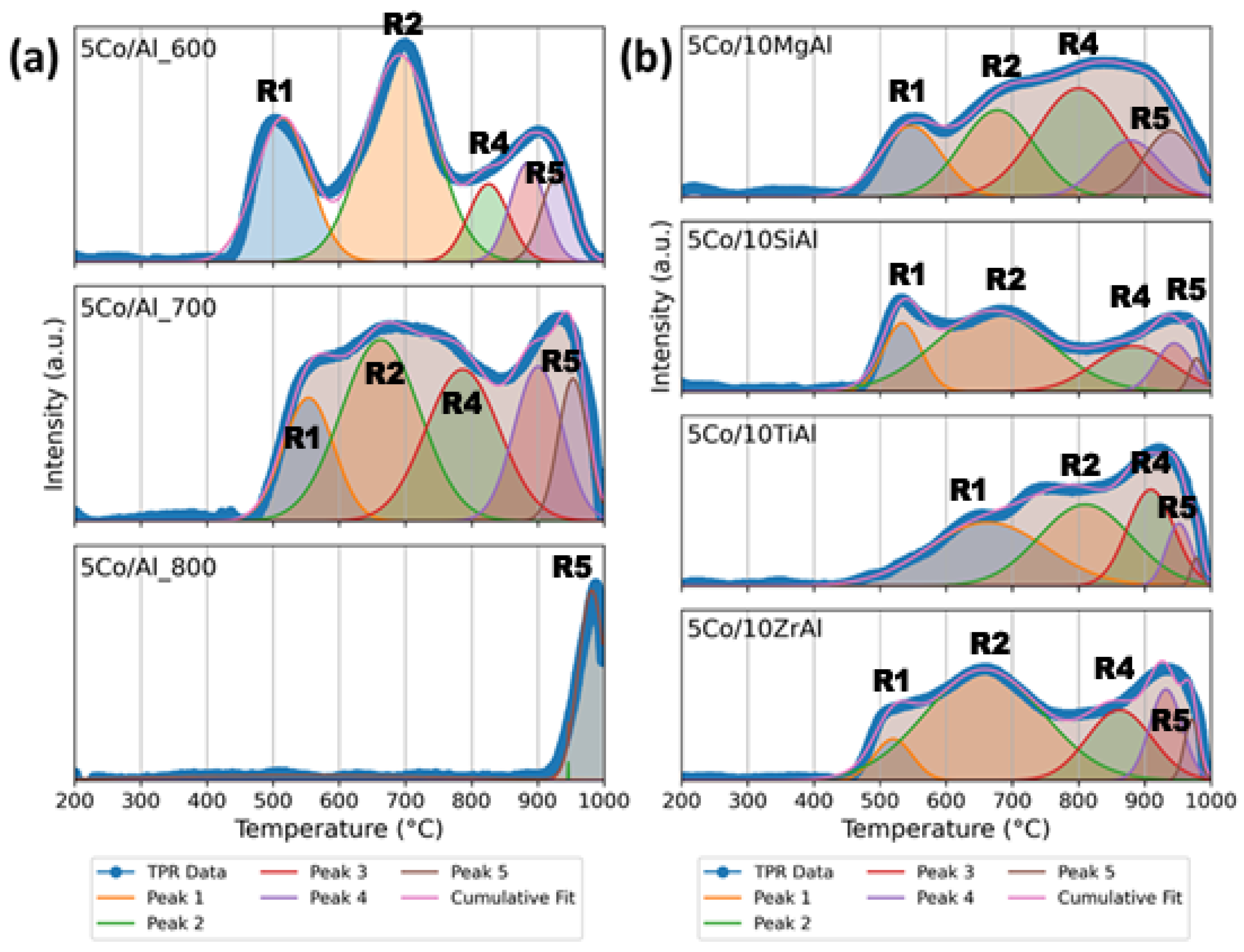
Figure 4a shows the H2-TPR profiles of unpromoted catalysts (5Co/Al_600, 5Co/Al_700, 5Co/Al_800). The H2-TPR profiles exhibit a combination of asymmetric peaks, indicating that cobalt undergoes a multistep reduction process [27,28].
C o 3 O 4 + H 2 C o 3 O 2 ( H O ) 2   R 1
C o 3 O 2 ( O H ) 2 + H 2 C o + 2 C o O + 2 H 2 O   R 2
C o O + A l 2 O 3 C o A l 2 O 4   R 3
C o O + H 2 C o + 2 H 2 O   R 4
C o A l 2 O 4 + H 2 C o + A l 2 O 3 + H 2 O   R 5
Deconvolution of the H2-TPR profiles was carried out using Gaussian peak fitting. The reduction temperatures reported for bare cobalt oxides Co3O4 and CoO to Co0 are typically in the range of 200–300 °C and 300–400 °C, respectively [28,29]. However, none of the catalysts in this study exhibited reduction peaks in this low-temperature region. The higher reduction temperatures observed indicate strong metal–support interaction between Co oxides and the Al support [28]. As can be seen in Figure 4a, for the sample 5Co/Al_600, the peaks at 514.9 °C and 691.8 °C can be attributed to sequential reduction of Co3O4 → Co3O2(OH)2 → CoO (shown by R1 and R2), respectively. Peak at 825.7 °C and 884.7 °C can be assigned to CoO and CoAl2O4 reduction (R4, R5).
Similar assignments are observed for 5Co/Al_700, though peaks are slightly shifted (553.7 and 662.8 °C-R1, 786.5 °C-R4, 900.8 and 953.3 °C-R5) reflecting progressive Co–Al interaction. In contrast, 5Co/Al_800 shows only one peak at 981.8 °C assigned to R5. This suggested that when the sample was calcined at 800 °C, the entire Co-oxide reacted with Al2O3 to form a CoAl2O4 spinel phase that is hard to reduce and requires a temperature beyond 900 °C [27,28]. The H2 consumed for this catalyst sample is the minimum among all samples, which proves the partial reducibility of the CoAl2O4 phase in the temperature range TPR studied.
The effect of promoters is presented in Figure 4b and summarized in Table 2. For the 5Co/MgAl catalyst, high-temperature reduction peaks are more prominent than low-temperature reduction peaks. That means over 5Co/MgAl catalyst, CoO, and CoAl2O4 reducible species are more prominent, and most of the active sites are generated by the reduction in these species. In contrast, Zr and Si-promoted catalysts showed a larger peak contribution from R2, which suggested that a considerable portion of Co was already present as Co3O2(OH)2 after calcination at 700 °C. The H2 consumption (in H2-TPR) over the Zr-promoted catalyst is maximum (892 µmol g−1). This trend is consistent with reports that Zr promotion improves Co reducibility by suppressing strong Co–Al2O3 interactions and limiting CoAl2O4 formation [17]. Ti promotion, however, shifted the R1 and R2 peaks to higher temperatures, reflecting stronger metal–support interactions and a consequent decrease in reducibility of the Co species. The differences are also reflected in total H2 consumption: the 700 °C calcined sample exhibited the highest uptake (944 µmol g−1), whereas the Ti-promoted catalysts showed lower values (556 µmol g−1), consistent with the stabilization of less reducible Co species.

2.1.5. XPS Profiles of Co–Al–O System Under Calcination and Promoter Effects of Catalysts

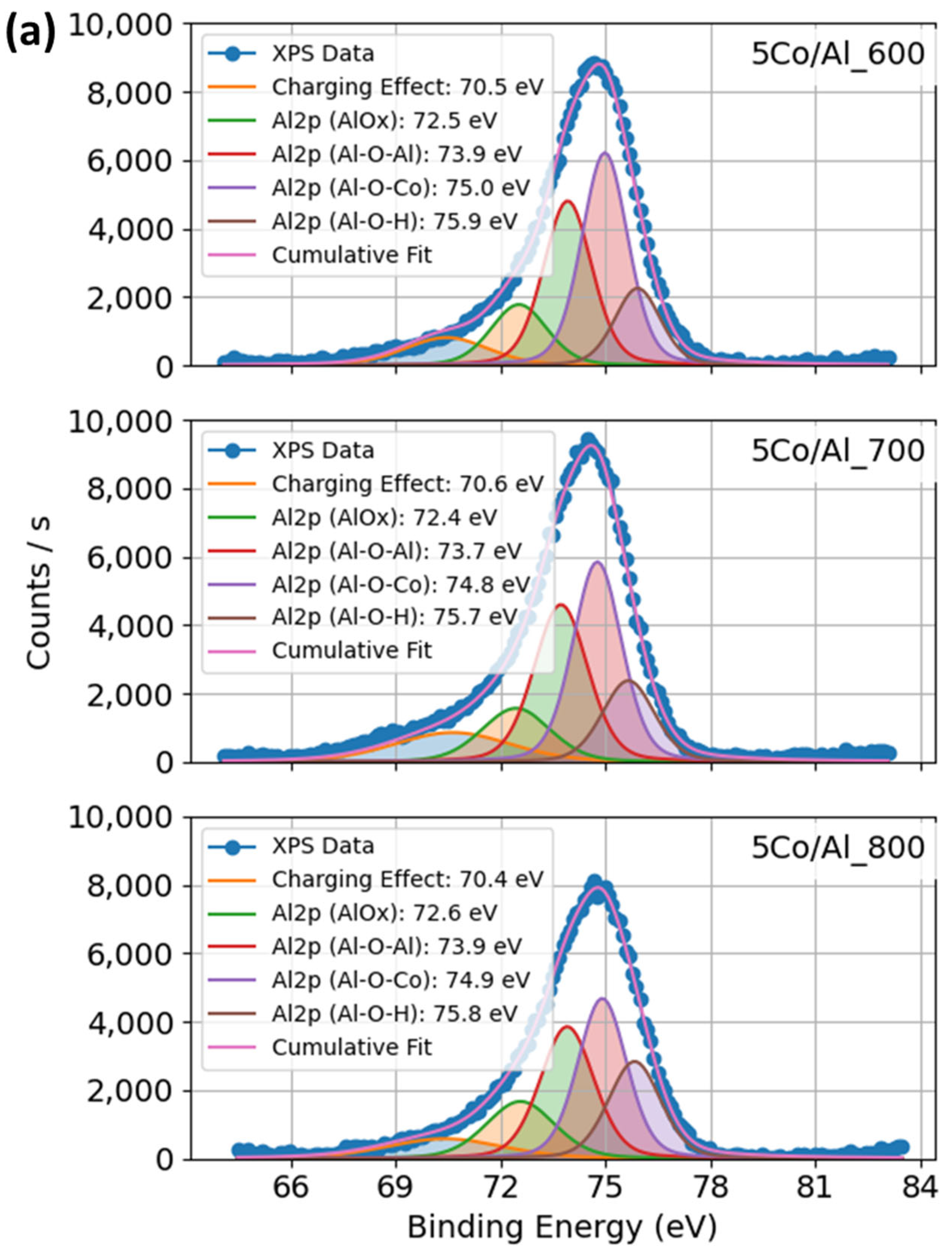
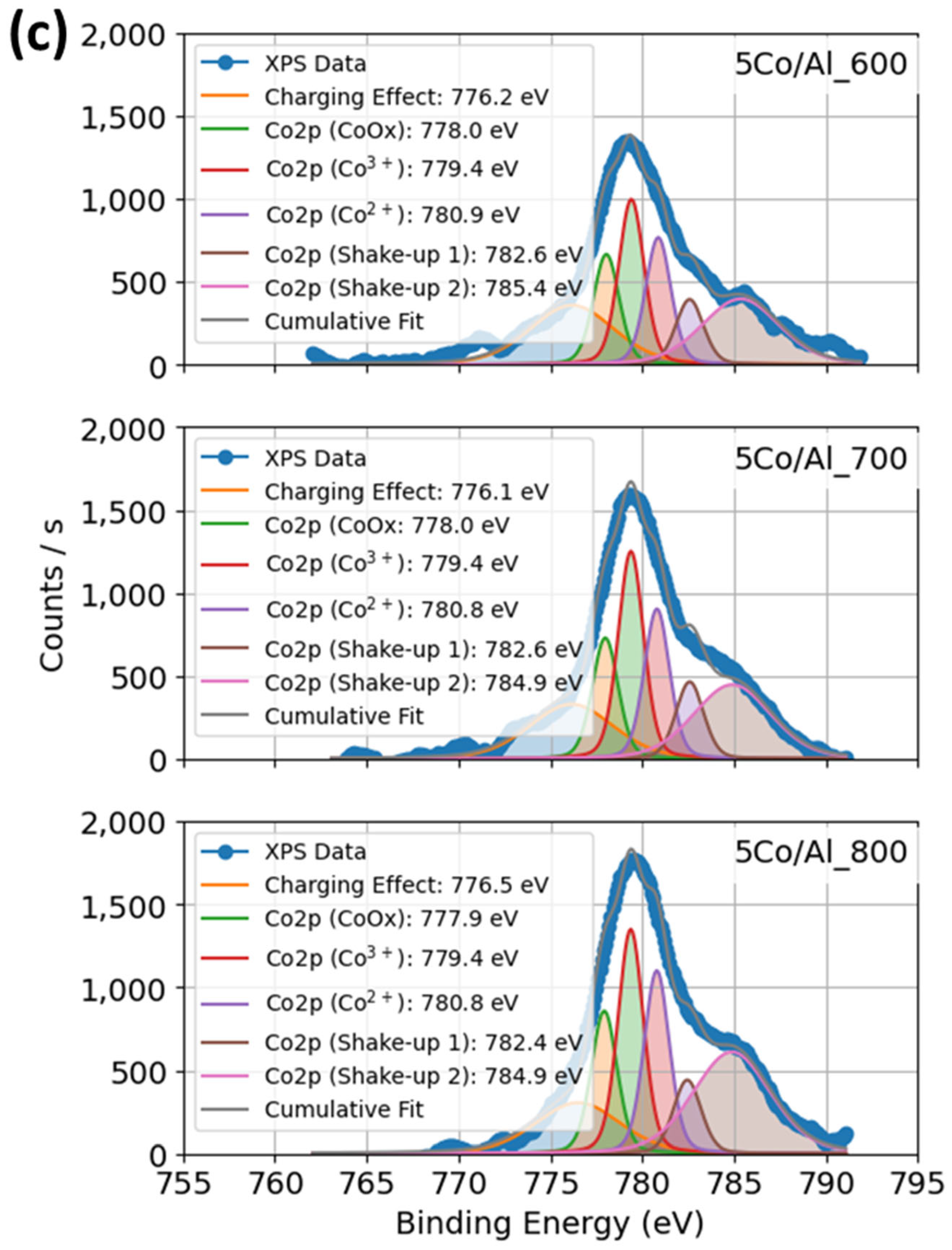
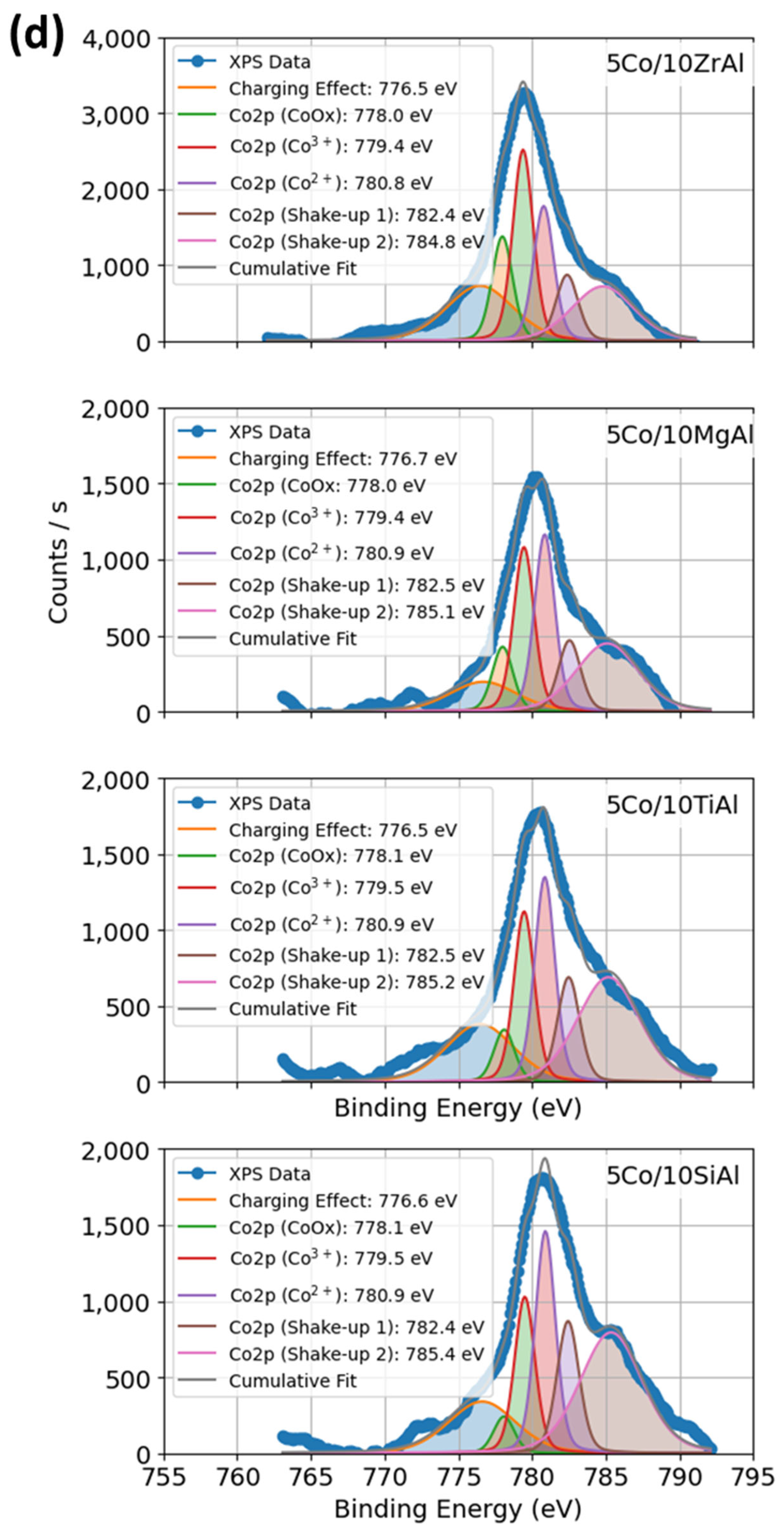
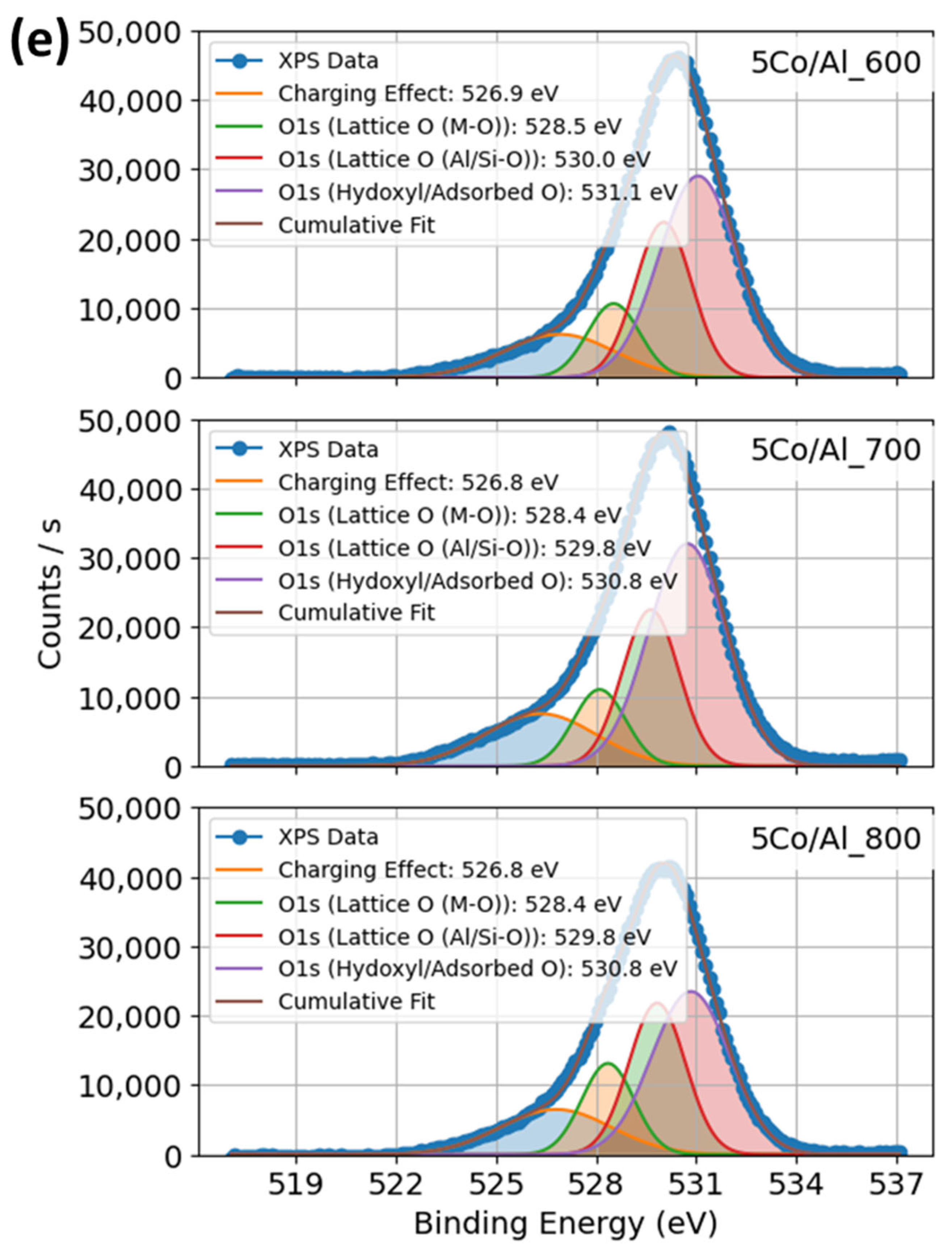
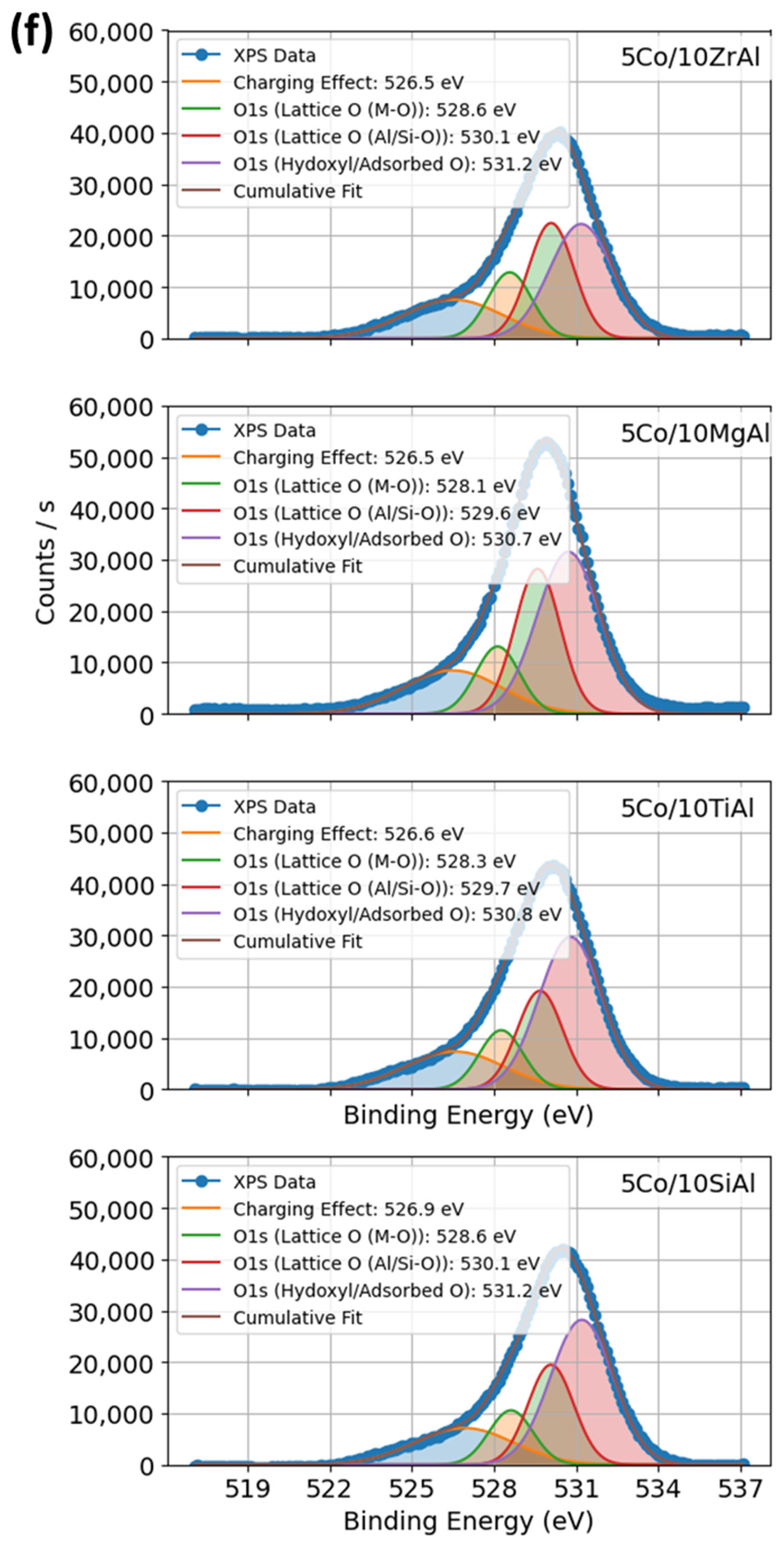
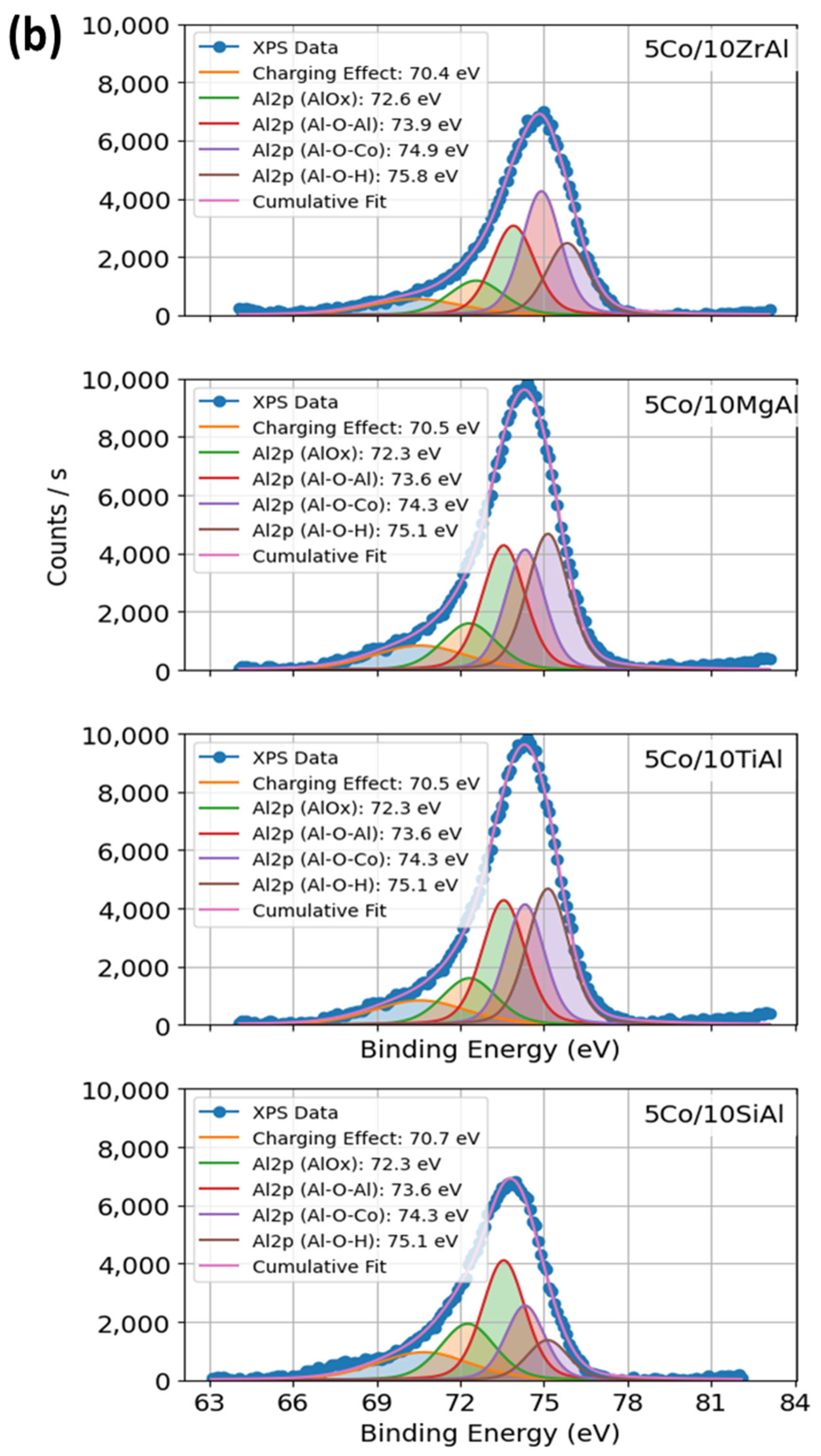
The XPS analysis was performed to evaluate the chemical states and surface interactions among Co, Al, and O species in the Co/Al2O3 catalysts subjected to different calcination temperatures and promoter incorporation (Figure 5). The Al 2p, Co 2p3/2, and O 1s spectra collectively indicated the structural stability of the γ-Al2O3 support and the robustness of the Co–Al–O framework. The Al 2p spectra of catalysts calcined at 600–800 °C (Figure 5a) exhibited consistent features with no notable changes in binding energy or relative peak area.
Peaks attributed to Al–O–Al (lattice alumina), Al–O–Co (interfacial species), and Al–OH (surface hydroxyls) remained nearly identical across all samples, indicating that the alumina lattice and Co–Al interactions were largely unaffected by calcination. These findings indicate that γ-Al2O3 retains its structural integrity and that the Co–Al interaction persists even at elevated temperatures, consistent with its thermally robust nature [30,31].
For the promoter-modified catalysts (5Co/xAl; x = Mg, Si, Ti, Zr) calcined at 700 °C (Figure 5b), the Al 2p spectra displayed deconvolution profiles similar to those of the unpromoted sample. The absence of significant peak shifts indicated that the promoters did not alter the Al3+ environment or Al–O coordination, suggesting that their effects are mainly expressed through modifications in surface texture and redox behavior rather than electronic changes within the alumina lattice [29,30]. Further details of peak assignments (≈70.6 eV for charging, 72.4 eV AlOx, 73.7 eV Al–O–Al, 74.6 eV Al–O–Co, 75.5 eV Al–OH) and relative area distributions are listed in Table S1 (Supporting Information).
The Co 2p3/2 spectra of catalysts calcined at 600–800 °C (Figure 5c) were dominated by Co3+ and Co2+ signals accompanied by characteristic shake-up satellites, consistent with the multiple splitting typical of cobalt oxides [32].
The binding energies and relative intensities remained almost unchanged with calcination temperature, confirming that the oxidation-state distribution of cobalt was preserved and that the Co–support interaction is largely insensitive to calcination in this range. Similarly, the promoter-containing catalysts (Figure 5d) exhibited nearly identical Co 2p3/2 profiles, implying that Mg, Si, Ti, and Zr had negligible influence on the Co electronic structure. Their effects are instead associated with improved Co dispersion and redox accessibility rather than modification of the intrinsic Co-Al bonding environment [33]. Detailed deconvolution parameters are presented in Table S2 (Supporting Information).
The O 1s spectra also exhibited strong chemical stability across all samples. For catalysts calcined at 600–800 °C (Figure 5e), three principal oxygen species were observed: lattice oxygen bound to metal cations, lattice oxygen in Al–O environments, and surface hydroxyl or adsorbed oxygen. The relative intensities of these peaks remained nearly constant with calcination and promoter addition, confirming that the oxide lattice and surface oxygen species were not significantly perturbed [34].
In the promoter series (Figure 5f), the Zr-promoted catalyst exhibited a slightly stronger lattice-oxygen signal (~528.4 eV), indicating enhanced oxygen mobility and lattice participation consistent with its superior reducibility observed in H2-TPR [34,35]. Complete peak positions are tabulated in Table S3 (Supporting Information).
Overall, the XPS results suggest that calcination and promoter incorporation do not alter the oxidation states of Co or Al, demonstrating the structural stability of the Co–Al–O framework. Promoters mainly influence surface dispersion and redox behavior, with Zr notably enhancing lattice oxygen availability and catalyst stability during POM.

2.2. Catalyst Performance

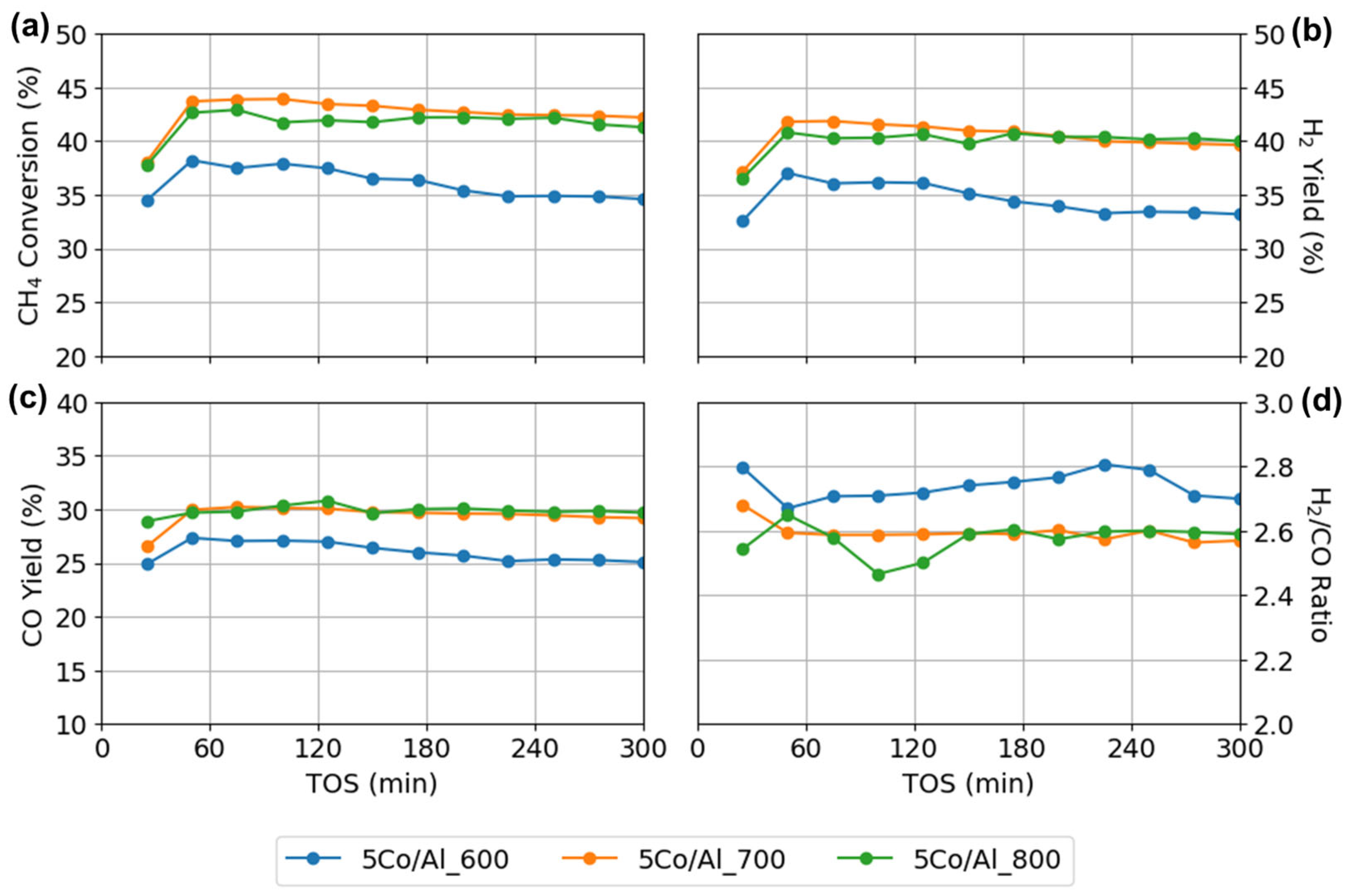
The 5Co/Al catalysts synthesized initially at calcination temperatures 600, 700, and 800 °C were screened for POM at 600 °C with CH4/O2 = 2 and GHSV = 14, 400 mL g−1 h−1. Figure 6 presents the activity of these catalysts. All 5Co/Al catalysts showed stable activity up to 300 min of TOS. The 5Co/Al_700 exhibited the highest CH4 conversion (44%) and H2 yield (41%), while calcination at 800 °C offered no further improvement in activity (CH4 conversion 42%, H2 yield 41%). The CH4/O2 ratio in the feed was kept at 2. This is the exact ratio as per the POM reaction (Equation (1)). Under these conditions, the theoretical H2/CO ratio is 2. As shown in Figure 6d, the H2/CO ratio (>2) exceeds the POM stoichiometric value of 2. This indicated the involvement of indirect pathways such as combustion followed by SRM and/or WGS alongside the POM [36,37]. The necessary H2O for the WGS reaction originates in situ from the initial combustion step. The close numerical values of H2 yield and CH4 conversion on % basis indicate that, under steady-state conditions, the reaction predominantly proceeds through syngas-producing pathways (POM, SRM, and WGS), while the extent of complete combustion is relatively minor. With the above results in view, 700 °C was used as the optimum calcination temperature for catalysts promoted with 10 wt.% loading of Mg, Si, Ti, and Zr.
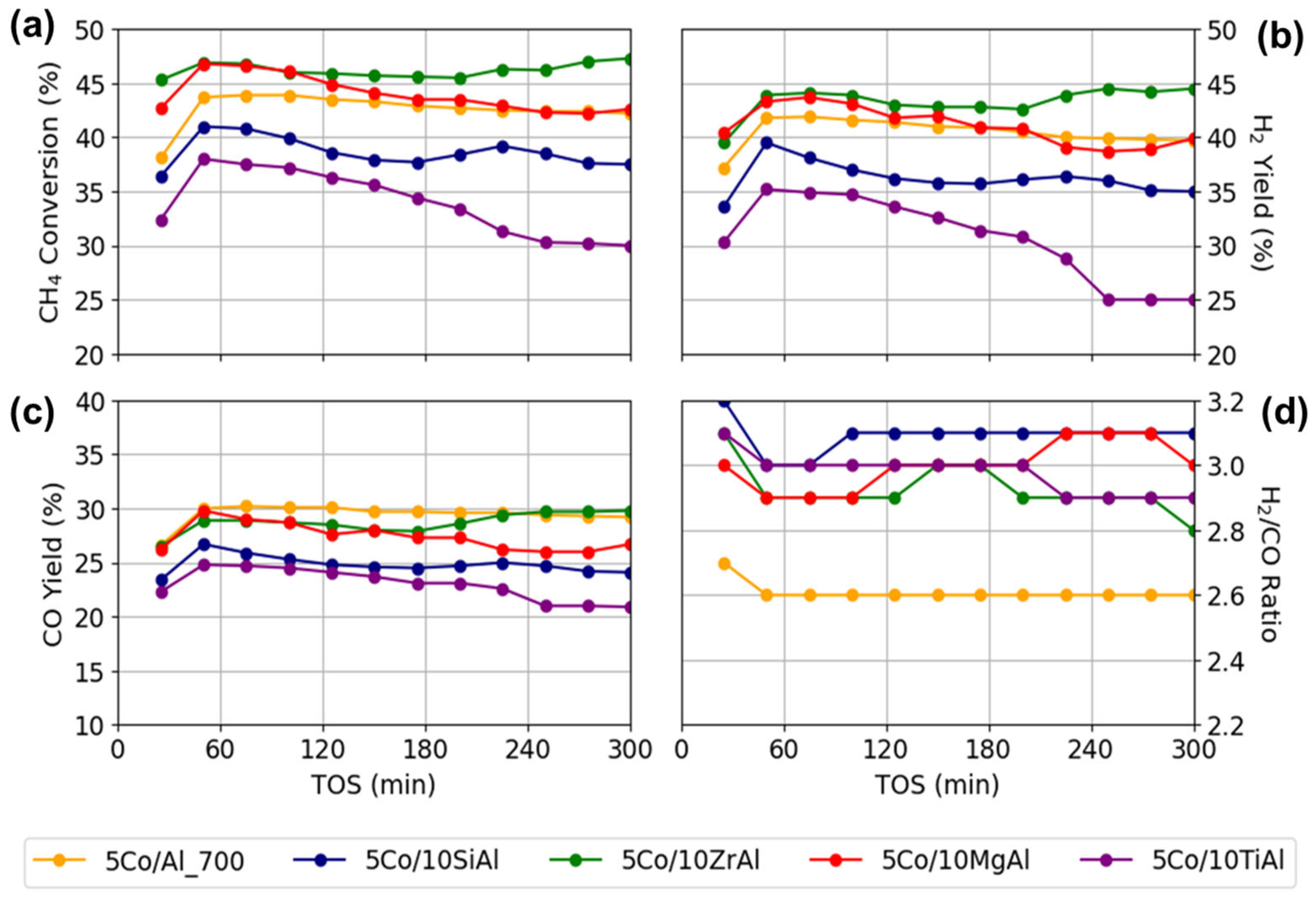
These catalysts were further studied for their activities under POM conditions, and the results are shown in Figure 7. The Zr-promoted catalyst (5Co/10ZrAl) exhibited the highest CH4 conversion (47.3%) and H2 yield (44.4%) with excellent stability that was maintained throughout the 300 min TOS. The Mg-promoted catalyst (5Co/10MgAl) exhibited relatively high initial activity (CH4 conversion 46.8%, H2 yield 43.7%), but both gradually declined to 42.1% and 39.9%, respectively, by the end of TOS. The Si-promoted (5Co/10SiAl) and Ti-promoted (5Co/10TiAl) catalysts did not perform well, with CH4 conversion stabilizing at 37.5% and 30% and H2 yield at 35% and 25%, respectively. The unpromoted 5Co/Al_700 catalyst maintained intermediate performance, with CH4 conversion of 43.9% and H2 yield of 41.8%.
The H2 yields obtained for all catalysts were comparable to the CH4 converted under TOS, confirming that syngas formation via POM is the predominant pathway. A close H2–CH4 balance is a well-recognized marker of POM selectivity. However, the observed H2/CO ratio > 2 for promoted catalysts exceeds the theoretical value for POM. This likely reflects contributions from secondary reactions such as combustion followed by SRM or WGS, and may also be consistent with partial carbon deposition [38,39].
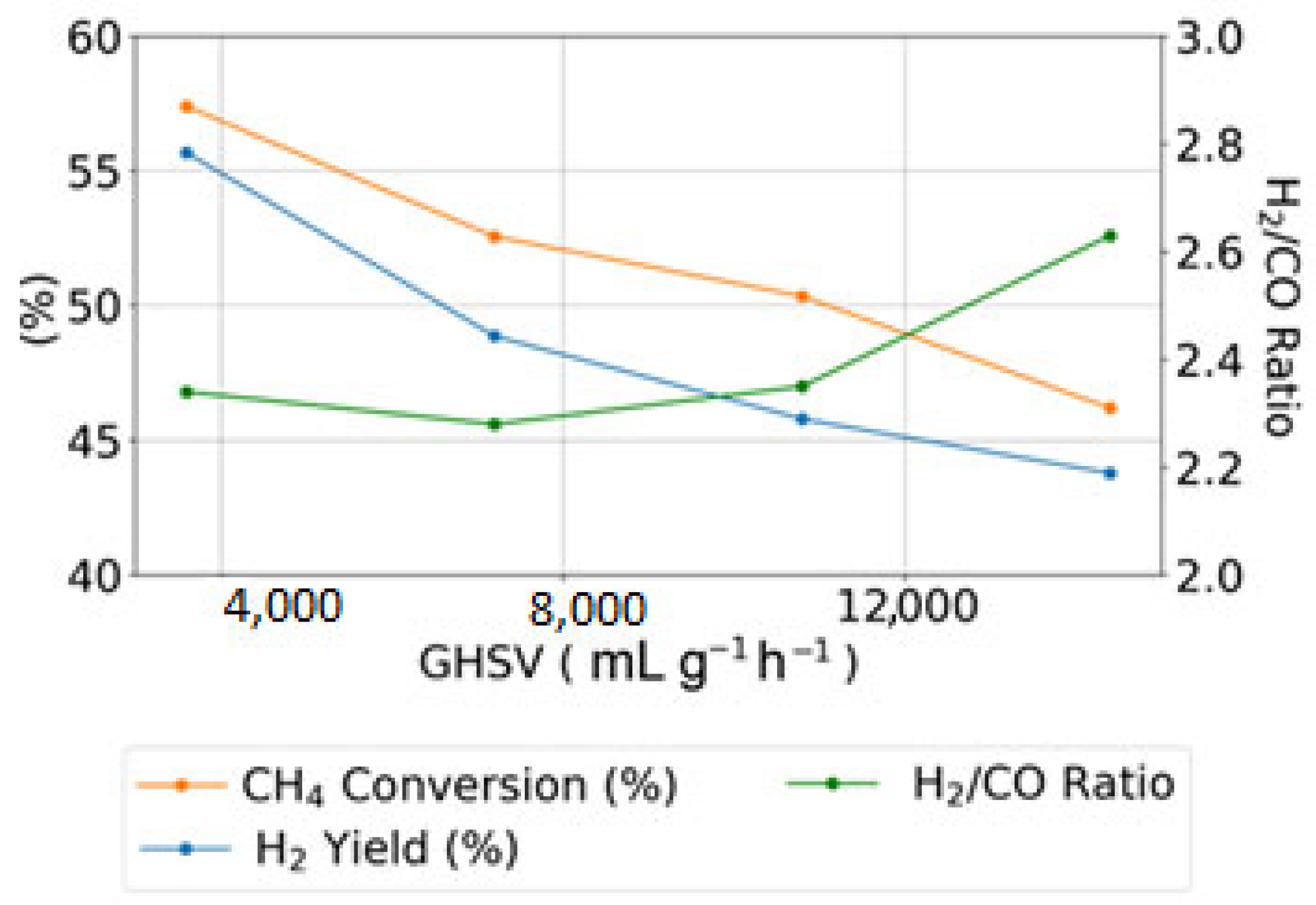
The effect of GHSV was studied for Zr-promoted catalysts, as shown in Figure 8. GHSV was varied from 3600 to 14,440 mL g−1 h−1. With the increasing GHSV, CH4 conversion and H2 yield declined from 57.4% to 46.2% and 55.7% to 43.8%, respectively. This reduction can be attributed to the limited residence time at higher flow rates, where the reaction rate cannot fully match the rapid gas throughput. Notably, there was an increase in the H2/CO ratio with an increase in GHSV, which may result from a lower extent of CO-consuming reactions together with a greater relative contribution of steam reforming and WGS [38,39].
A comparison of CH4 conversions for Co and Ni-based catalysts supported on Al2O3 for POM are presented in Table S4 (Supporting Information).

2.3. Stability Test of Catalyst

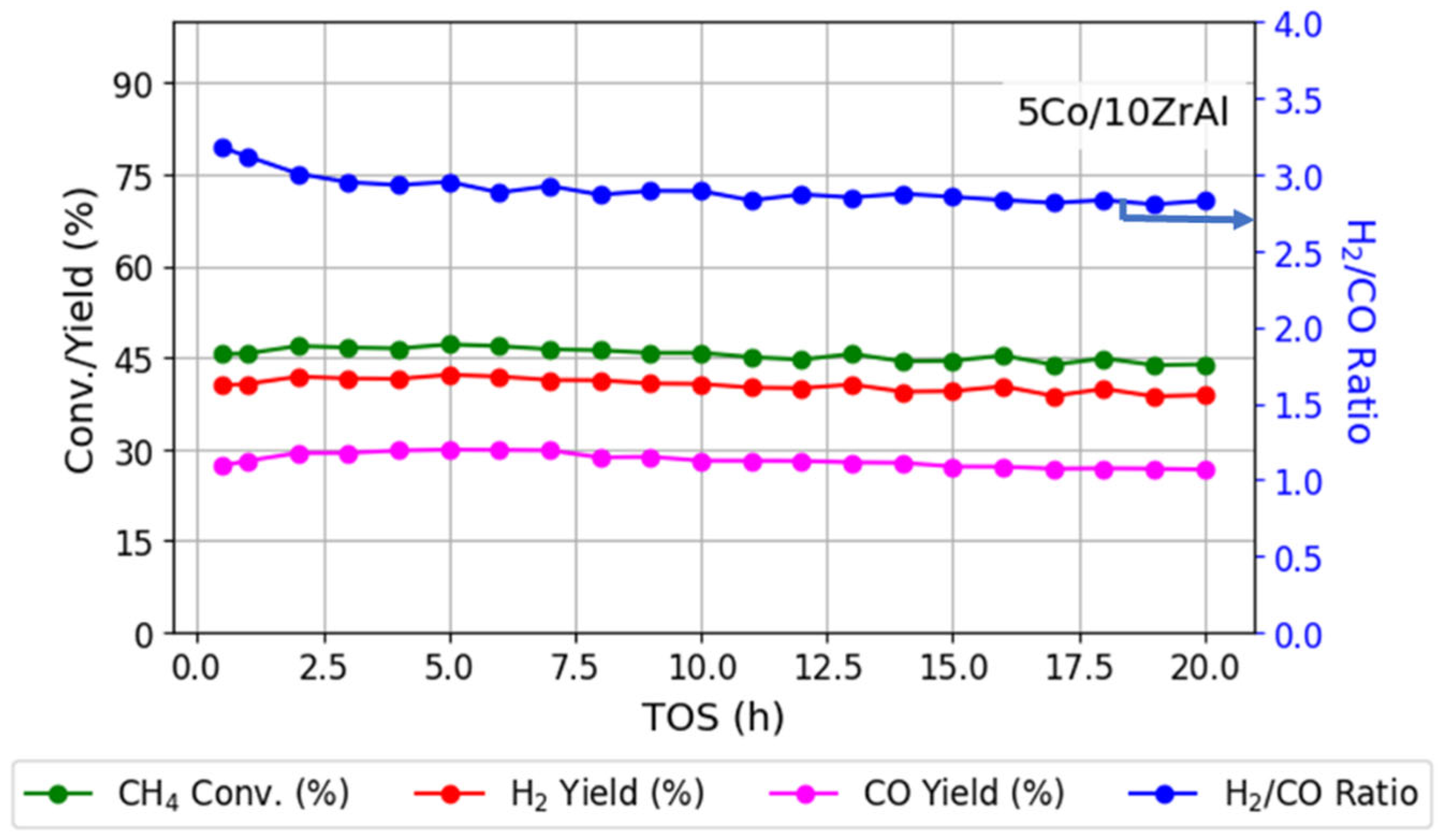
The best-performing catalyst, 5Co/10ZrAl, was further evaluated for extended stability under reaction conditions for TOS of up to 20 h. The long-term performance results are presented in Figure 9.
The catalyst exhibited stable activity throughout the duration of the test, with an average CH4 conversion of 45.5%, H2 yield of 40.5%, CO yield of 28.2%, and an H2/CO ratio of 2.9. These results confirm the robustness and sustained performance of the 5Co/10ZrAl catalyst under prolonged operation.

2.4. Analysis of Spent Catalysts

2.4.1. N2 Sorption Analysis of Spent Catalysts

To further understand the structural features responsible for the observed catalytic performance, the spent catalysts were characterized using N2 sorption and the results are presented in the Supplementary Information (Figure S1). Among all spent catalysts, the 5Co/10ZrAl sample exhibited the highest post-reaction N2 adsorption, indicating a larger fraction of its original surface area and pore volume remained accessible after reaction with minimal pore blockage. The preservation of mesoporosity suggested that Zr incorporation enhanced the structural stability of the alumina network and promoted more effective CO2 activation, thereby restricting carbon accumulation within the pore channels. Consequently, the Zr-modified catalyst showed superior textural stability which was consistent with its improved long-term activity [40].

2.4.2. TEM Analysis of Spent Catalysts

TEM images of the freshly reduced (unspent) catalysts are provided in the Figure S2, (Supplementary Information), confirming well-dispersed metallic Co nanoparticles prior to reaction.
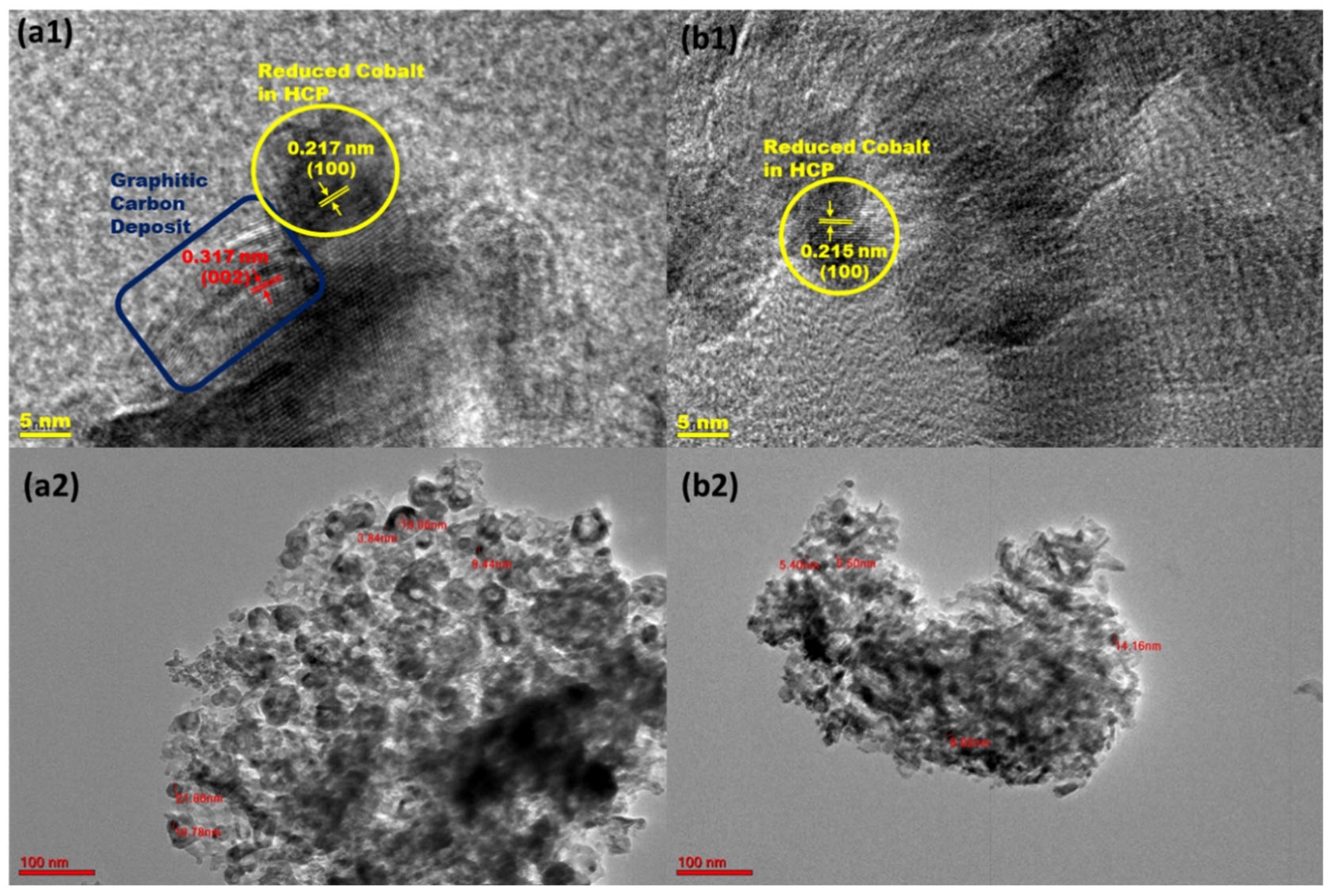
The TEM analysis of the spent catalysts revealed distinct morphological and structural differences between the 5Co/Al_700 and 5Co/10ZrAl systems after the POM (Figure 10). In both catalysts, reduced Co nanoparticles were observed with a hexagonal close-packed (HCP) structure, as confirmed by the presence of the <100> lattice plane with a d-spacing of approximately 0.21 nm. However, a significant contrast was observed in the extent of carbon deposition. The 5Co/Al_700 catalyst exhibited graphitic carbon layers surrounding the Co nanoparticles, characterized by the <002> plane of graphite with a d-spacing of ~0.31 nm. This indicated the formation of filamentous or encapsulating carbon during the POM reaction. In contrast, such graphitic carbon features were absent in the 5Co/10ZrAl catalyst, suggesting that Zr Co-loading effectively suppressed carbon deposition. This suppression is attributed to improved Co–support interaction and dispersion in the presence of ZrO2, which enhances surface basicity and oxygen mobility, promoting carbon removal [41]. Thus, ZrO2 incorporation stabilized Co nanoparticles and minimized carbon build-up, ensuring greater stability under POM conditions.

2.4.3. Raman Spectra of Spent Catalysts

Raman spectroscopy analyses were carried out for the spent catalyst samples and corresponding spectra for 5Co/Al_700, 5Co/10ZrAl (TOS 300 min), and 5Co/10ZrAl (TOS 20 h) are shown in Figure S3 (Supplementary Information). As shown in Figure S3a, none of the catalysts exhibited distinct Raman bands typically associated with graphitic or disordered carbon species, indicating the absence of significant carbon accumulation under the applied conditions. For comparison, the simulated positions of characteristic carbon peaks, namely the D-band (defect-induced carbon), G-band (graphitic carbon), and 2D-band (second-order overtone of the D-band) are provided in Figure S3b. The absence of these bands suggests that the catalysts possess strong resistance to carbon accumulation, even under extended reaction conditions.

2.4.4. Temperature Programmed Oxidation (O2-TPO) Analysis

To further substantiate the Raman observations, quantitative estimation of carbon deposition was carried out for the 5Co/10ZrAl catalyst after 20 h TOS using O2-TPO, as shown in Figure S4, (Supplementary Information). Consistent with the absence of D, G, and 2D-band features in the Raman spectra, the O2-TPO profile exhibits no detectable oxygen consumption peaks in the temperature region characteristic of carbon oxidation [42]. The total O2 uptake measured during TPO was only 2.62 μmol g−1, which is considerably low and indicates the absence of significant carbon deposits on the catalyst surface. These findings further support the carbon resistance of the 5Co/10ZrAl catalyst even under extended reaction conditions.

2.4.5. TGA/DTG Characterization

The thermal stability and carbon content of the spent 5Co/10ZrAl catalyst after 20 h TOS were investigated using TGA coupled with DTG (Figure S4, Supplementary Information). The TGA profile shows only ~4 wt.% total weight loss between room temperature and 1000 °C. The initial decrease below ~100 °C is attributed primarily to moisture desorption and the removal of weakly adsorbed surface species, rather than to carbon combustion. Beyond this region, the TGA curve exhibits a gradual, smooth mass loss without any abrupt weight-loss events.
This behavior is also supported by the DTG curve, which displays a pronounced desorption-related peak at low temperatures (approximately 0–150 °C), followed by an almost constant baseline with no significant negative peaks in the 400–700 °C interval, where the oxidation of deposited carbon would typically be observed. These TGA–DTG results are consistent with the TEM, Raman, and O2-TPO analyses, all indicating resistance to carbon deposition on 5Co/10ZrAl even after 20 h TOS.

2.5. Correlation of Physicochemical Properties with Catalytic Performance

By analyzing the XRD, N2 adsorption–desorption, and H2-TPR results, the characterization data can be directly correlated with the catalytic activity of the prepared catalysts. Among the unpromoted samples, the catalyst calcined at 700 °C (5Co/Al_700) exhibited the highest activity. This enhanced performance can be attributed to its higher surface area and highest concentration of reducible Co-species, which generates the relevant population of active sites for the POM reaction (Figure 2, Figure 3 and Figure 4, Table 1 and Table 2). These features indicate that high-Co species were well dispersed across the large mesoporous surface, resulting in superior catalytic activity for 5Co/Al_700 compared to the other unpromoted catalysts.
Both Si and Ti promoters affected catalyst performance, leading to lower CH4 conversions and H2 yields compared to the unpromoted sample. The decline in activity over the Ti-promoted catalyst is owing to a comparatively lower surface area and a decline in reducibility and H2 consumption in TPR. This indicates a lesser amount of Co is reduced into Co0, which is the active phase for CH4 activation. A smaller number of active sites was dispersed in a small region over the 5Co/10TiAl catalyst, which resulted in minimum catalytic activity toward POM among rest-promoted catalysts. Promoting the 5Co/Al_700 catalysts with Si offered the largest surface area for catalytic reaction, and the population of reducible species also improved with respect to the Ti-promoted catalyst. The catalytic activity of the Si-promoted catalyst was better than the Ti-promoted catalyst.
In contrast, Mg and Zr promotion enhanced the POM activity, as these oxides preserved the porous structure and facilitated high reducibility. Both catalysts have comparable activity initially, but over the 5Co/10MgAl catalyst, activity dropped continuously. Upon looking at the precursor compound of active sites, it is observed that the active sites CoO are derived mostly by more reducible Co3O4 over the Zr-promoted catalyst, whereas over the Mg-promoted catalyst, it is derived mostly by less reducible CoO and CoAl2O4. The enhanced reducibility observed for the Zr-promoted catalyst reflects improved lattice oxygen mobility and a greater tendency for oxygen vacancy formation, both of which are directly relevant to POM activity. Higher lattice oxygen mobility facilitates the reduction of CoOx species to metallic Co, generating a larger population of well-dispersed active Co sites for CH4 activation. Simultaneously, the increased formation and replenishment of oxygen vacancies promote lattice oxygen participation in the initial oxidative dehydrogenation steps [43]. The combined effect of more easily reducible cobalt species and the presence of mobile lattice oxygen near vacancy sites leads to more efficient activation of both CH4 and O2, thereby enhancing the overall performance of the Zr-promoted catalyst (5Co/10ZrAl) in the POM reaction.
Post-reaction analyses (TEM, Raman, TGA and O2-TPO) further supported these correlations, showing negligible carbon accumulation on 5Co/10ZrAl and confirming that its stability arises from well-dispersed metallic Co and enhanced oxygen mobility.
The XPS analysis supported the structure–activity correlations established from XRD, BET, and H2-TPR. The nearly unchanged Al 2p and Co 2p3/2 binding energies across calcination temperatures confirmed that the γ-Al2O3 support remained structurally stable and the Co–Al interaction was largely preserved. This indicates that the superior performance of 5Co/Al_700 arises mainly from the abundance of reducible Co species rather than changes in the oxidation state. Among the promoted catalysts, negligible shifts in Co 2p3/2 and Al 2p peaks suggest that Mg, Si, Ti, and Zr did not alter the Co–Al framework but instead affected Co dispersion and redox accessibility. The Zr-promoted catalyst showed slightly higher lattice oxygen participation (O 1s ≈ 528.4 eV), consistent with its enhanced reducibility and stable CH4 conversion. TEM observations further supported these findings, showing graphitic carbon on 5Co/Al_700 but its absence on 5Co/10ZrAl, consistent with superior reducibility and stability.

3. Materials and Methods

3.1. Materials

Cobalt nitrate hexahydrate ((Co (NO3)2.6H2O)), Silica (SiO2), Titanium dioxide (TiO2), Zirconium oxide (ZrO2), Magnesium oxide (MgO), γ-Alumina (Al2O3).

3.2. Preparation of Unpromoted and Promoted Catalysts

The catalysts for the POM were obtained using a wet impregnation method. Catalyst samples were synthesized by impregnating alumina support in an aqueous solution of Cobalt nitrate precursor (Co (NO3)2·6H2O). 0.4955 g of (Co (NO3)2·6H2O) was dissolved in 30 mL of deionized water, followed by the addition of 1.9 g of alumina support. The solution was heated at 80 °C under stirring conditions until the slurry was formed, then dried overnight at 120 °C and finally calcined at 600 °C for 3 h (5Co/Al_600), at 700 °C (5Co/Al_700), and at 800 °C (5Co/Al_800) for 3 h.
The promoted catalysts were synthesized using the same methodology using 5 wt.% Co supported on alumina with 10 wt.% promoters x (x = Si, Zr, Mg, and Ti) and calcined at 700° C for 3 h. The promoted catalysts are abbreviated as 5Co/10SiAl, 5Co/10ZrAl, 5Co/10MgAl, and 5Co/10TiAl.

3.3. Catalyst Activity Test

Details of the catalyst activity test are presented in S1. Supporting Information.

3.4. Catalyst Characterization

Details of catalyst characterization are presented in S2. Supporting Information.

4. Conclusions

In this study, Co/Al2O3 catalysts were synthesized, calcined at different temperatures, and further modified with Mg, Si, Ti, and Zr promoters to evaluate their performance in the partial oxidation of methane (POM). Among the unpromoted catalysts, 5Co/Al_700 calcined at 700 °C exhibited the highest activity. This is attributed to its optimal surface area, enhanced reducibility, and the presence of multiple Co phases, which ensured better dispersion of active species. In contrast, calcination at 800 °C led to the formation of CoAl2O4 spinel, which is difficult to reduce and showed poor activity.
The order of catalytic performance among the promoted catalysts was: 5Co/10ZrAl> 5Co/10MgAl > 5Co/10SiAl > 5Co/10TiAl. The Si and Ti promotion negatively impacted the activity than the non-promoted catalyst due to the low concentration of reducible Co-species, which generates a low concentration of active sites. Conversely, Mg and Zr improved catalytic activity by enhancing the concentration of reducible Co-species. However, due to the lower edge of reducibility, the activity over the Mg-promoted catalyst declines with time-on-stream (TOS). The XPS results further confirmed that calcination (600–800 °C) and promoter incorporation did not significantly alter the oxidation states of Co or Al, indicating a structurally robust Co–Al–O framework. The negligible shifts in Co 2p3/2 and Al 2p binding energies suggest that promoters mainly influenced surface dispersion and redox accessibility rather than modifying the Co–Al bond environment.
Notably, the Zr-promoted catalyst exhibited slightly enhanced lattice oxygen participation, consistent with its higher reducibility and stable CH4 conversion. Zr promotion provided both high activity and excellent stability under TOS owing to the highest concentration of reducible Co-species and the formation of active sites primarily derived by easily reducible Co3O4. Higher edge of reducibility and thereby formation of high concentration of Co0 active sites enable 5Co/10ZrAl as the most effective catalyst for the POM reaction. Post-reaction analyses (TEM, Raman, O2-TPO, and TGA) further confirmed that Zr incorporation suppressed graphitic carbon formation on 5Co/10ZrAl, supporting its long-term stability.

Supplementary Materials

The following supporting information can be downloaded at: https://www.mdpi.com/article/10.3390/catal15121176/s1. S1. Catalyst activity test, S2. Catalyst characterization, Table S1. Binding energy positions (eV) and relative peak area (%) of deconvoluted Al 2p XPS components corresponding to Al3+ species in different chemical environments—Al–O–Al, Al–O–Co, Al–OH, and low-valent AlOx—obtained from the spectra shown in Figure 5a,b for 5Co/Al catalysts calcined at 600, 700, and 800 °C, and 5Co/xAl catalysts (x = Mg, Si, Ti, and Zr) calcined at 700 °C, Table S2. Binding energy (eV) and relative peak area (%) of deconvoluted Co 2p3/2 XPS components, including CoOx, Co3+, Co2+, and shake-up satellites (Shake-up 1 and Shake-up 2), 5Co/Al catalysts calcined at 600, 700, and 800 °C, and 5Co/xAl catalysts (x = Mg, Si, Ti, and Zr) calcined at 700 °C, (Figure 5c,d), Table S3. Binding energy (eV) and relative peak area (%) of deconvoluted O 1s XPS components, including lattice oxygen (Co/Mg/Zr–O), lattice oxygen in Al/Si/Ti–O, and surface hydroxyl/adsorbed oxygen (–OH/Oads) for 5Co/Al catalysts calcined at 600, 700, and 800 °C, and 5Co/xAl catalysts (x = Mg, Si, Ti, and Zr) calcined at 700 °C, (Figure 5e,f) (XPS of Co–Al–O System Profiles under calcination and promoter effects of Catalysts). Table S4. Comparison of CH4 conversion for Co and Ni-based catalysts supported on Al2O3 for POM. Figure S1. N2 adsorption–desorption isotherms and pore size distribution of spent 5Co/Al catalysts (a) Unpromoted spent catalysts (5Co/Al_600, 5Co/Al_700, 5Co/Al_800). (b) Promoted 5Co/xAl (x = Mg, Si, Ti, and Zr) spent catalysts (c) Corresponding pore size distribution curves for unpromoted 5Co/Al spent catalysts (d) Corresponding pore size distribution curves for Promoted 5Co/xAl (x = Mg, Si, Ti, and Zr) spent catalysts. Figure S2. HRTEM and TEM micrographs showing dispersed metallic cobalt nanoparticles on Al2O3. Figure S3. Raman spectra of (a) used catalysts—5Co/Al_700, 5Co/10ZrAl after 300 min TOS, and 5Co/10ZrAl after 20 h TOS showing the absence of characteristic carbon bands; and (b) reference positions of simulated D, G, and 2D-bands for comparison. Figure S4. O2-TPO profile of used catalysts 5Co/10ZrAl after 20 h TOS showing the absence of characteristic carbon combustion area in the temperature range 400–700 °C. Figure S5. TGA–DTG analysis of the spent 5Co/10ZrAl catalyst after 20 h TOS.

Author Contributions

K.M.B., S.K.S. and A.A.B.: original draft preparation, formal analysis, resources, investigation. A.A.M.A., A.A.I. and A.S.A.-F.: Methodology, data curation, conceptualization, investigation, data curation, writing—review and editing; A.M.M.S. and N.N.A.: formal analysis, resources, software, validation. A.B. and M.A.A.S.: resources, software. All authors have read and agreed to the published version of the manuscript.

Funding

Ongoing Research Funding program, (ORF-2025-612, King Saud University, Riyadh, Saudi Arabia), and Researchers Supporting Project number (PNURSP2025R230), Princess Nourah bint Abdulrahman University.

Data Availability Statement

The data used in this study are available in this paper.

Acknowledgments

The authors would like to extend their sincere appreciation to the Ongoing Research Funding program, (ORF-2025-612), King Saud University, Riyadh, Saudi Arabia. Also, authors would like to extend their sincere appreciation to the Princess Nourah bint Abdulrahman University Researchers Supporting Project number (PNURSP2025R230), Princess Nourah bint Abdulrahman University, Riyadh, Saudi Arabia.

Conflicts of Interest

Author Sunit Kumar Singh was employed by the company NTPC Ltd. The authors declare no conflicts of interest.

References

  1. Babakouhi, R.; Alavi, S.M.; Rezaei, M.; Akbari, E.; Varbar, M. Combined CO2 Reforming and Partial Oxidation of Methane over Mesoporous Nanostructured Ni/M-Al2O3 Catalyst: Effect of Various Support Promoters and Nickel Loadings. J. CO2 Util. 2023, 70, 102427. [Google Scholar] [CrossRef]
  2. Ilicak Bayraktar, I.; Figen, H.E. Investigation of Partial Oxidation of Methane at Different Reaction Parameters by Adding Ni to CeO2 and ZrO2 Supported Cordierite Monolith Catalyst. Processes 2024, 12, 1463. [Google Scholar] [CrossRef]
  3. York, A.P.E.; Xiao, T.; Green, M.L.H. Brief Overview of the Partial Oxidation of Methane to Synthesis Gas. Top. Catal. 2003, 22, 345–358. [Google Scholar] [CrossRef]
  4. Chen, L.; Lu, Y.; Hong, Q.; Lin, J.; Dautzenberg, F.M. Catalytic Partial Oxidation of Methane to Syngas over Ca-Decorated-Al2O3-Supported Ni and NiB Catalysts. Appl. Catal. A Gen. 2005, 292, 295–304. [Google Scholar] [CrossRef]
  5. Liu, R.; Yang, M.; Huang, C.; Weng, W.; Wan, H. Partial Oxidation of Methane to Syngas over Mesoporous Co–Al2O3 Catalysts. Chin. J. Catal. 2013, 34, 146–151. [Google Scholar] [CrossRef]
  6. Al-Zahrani, S.A.; Al-Abdrabalnabi, M.A.; Alanazi, A.A.; Al-Fatesh, A.S.; Fakeeha, A.H.; Awadallah, A.; Shaikh, H.M.; Kirchen, P. Hydrogen-Rich Syngas Production through Partial Oxidation of Methane over Ni-Promoted Molecular Sieves: Impact of Reducibility and Surface Area. Results Eng. 2025, 25, 103847. [Google Scholar] [CrossRef]
  7. Zagaynov, I.V.; Loktev, A.S.; Arashanova, A.L.; Ivanov, V.K.; Dedov, A.G.; Moiseev, I.I. Ni(Co)–Gd0.1Ti0.1Zr0.1Ce0.7O2 Mesoporous Materials in Partial Oxidation and Dry Reforming of Methane into Synthesis Gas. Chem. Eng. J. 2016, 290, 193–200. [Google Scholar] [CrossRef]
  8. Alreshaidan, S.B.; Alanazi, R.S.A.; Odhah, O.H.; Ibrahim, A.A.; Ali, F.A.A.; Alarifi, N.; Banabdwin, K.M.; Ramesh, S.; Al-Fatesh, A.S. The Impact of Sm Promoter on the Catalytic Performance of Ni/Al2O3–SiO2 in Methane Partial Oxidation for Enhanced H2 Production. Catalysts 2025, 15, 721. [Google Scholar] [CrossRef]
  9. Gao, X.; Ge, Z.; Zhu, G.; Wang, Z.; Ashok, J.; Kawi, S. Anti-Coking and Anti-Sintering Ni/Al2O3 Catalysts in the Dry Reforming of Methane: Recent Progress and Prospects. Catalysts 2021, 11, 1003. [Google Scholar] [CrossRef]
  10. Zhang, N.; Huang, C.; Zhu, X.; Xu, J.; Weng, W.; Wan, H. Effect of Calcination Temperature and Pretreatment with Reaction Gas on Properties of Co/γ-Al2O3 Catalysts for Partial Oxidation of Methane. Chem. Asian J. 2012, 7, 1895–1901. [Google Scholar] [CrossRef] [PubMed]
  11. Elbadawi, A.H.; Ge, L.; Li, Z.; Liu, S.; Wang, S.; Zhu, Z. Catalytic Partial Oxidation of Methane to Syngas: Review of Perovskite Catalysts and Membrane Reactors. Catal. Rev. 2021, 63, 1–67. [Google Scholar] [CrossRef]
  12. Das, T.; Sengupta, S.; Deo, G. Effect of Calcination Temperature during the Synthesis of Co/Al2O3 Catalyst Used for the Hydrogenation of CO2. React. Kinet. Mech. Catal. 2013, 110, 147–162. [Google Scholar] [CrossRef]
  13. Vadodaria, D.M.; Al-Fatesh, A.S.; Alrashed, M.M.; Alhoshan, M.; Ibrahim, A.A.; Kumar, N.S.; Kumar, R. A comprehensive review on catalytic oxidation of methane in the presence of molecular oxygen: Total oxidation, partial oxidation and selective oxidation. Catal. Rev. 2025, 67, 1–47. [Google Scholar] [CrossRef]
  14. Jacobs, G.; Ma, W.; Davis, B. Influence of Reduction Promoters on Stability of Cobalt/γ-Alumina Fischer–Tropsch Synthesis Catalysts. Catalysts 2014, 4, 49–76. [Google Scholar] [CrossRef]
  15. Gao, X.X.; Huang, C.J.; Zhang, N.W.; Li, J.H.; Weng, W.Z.; Wan, H.L. Partial Oxidation of Methane to Synthesis Gas over Co/Ca/Al2O3 Catalysts. Catal. Today 2008, 131, 211–218. [Google Scholar] [CrossRef]
  16. Choya, A.; De Rivas, B.; González-Velasco, J.R.; Gutiérrez-Ortiz, J.I.; López-Fonseca, R. On the Beneficial Effect of MgO Promoter on the Performance of Co3O4/Al2O3 Catalysts for Combustion of Dilute Methane. Appl. Catal. A Gen. 2019, 582, 117099. [Google Scholar] [CrossRef]
  17. Barrientos, J.; Garcilaso, V.; Venezia, B.; Aho, A.; Odriozola, J.A.; Boutonnet, M.; Järås, S. Fischer–Tropsch Synthesis over Zr-Promoted Co/γ-Al2O3 Catalysts. Top. Catal. 2017, 60, 1285–1298. [Google Scholar] [CrossRef]
  18. Alanazi, R.S.A.; Alreshaidan, S.B.; Ibrahim, A.A.; Wazeer, I.; Alarifi, N.; Bellahwel, O.A.; Abasaeed, A.E.; Al-Fatesh, A.S. Influence of alumina and silica supports on the performance of nickel catalysts for methane partial oxidation. Catalysts 2025, 15, 102. [Google Scholar] [CrossRef]
  19. Jean-Marie, A.; Griboval-Constant, A.; Khodakov, A.Y.; Diehl, F. Cobalt supported on alumina and silica-doped alumina: Catalyst structure and catalytic performance in Fischer–Tropsch synthesis. Comptes Rendus Chim. 2009, 12, 660–667. [Google Scholar] [CrossRef]
  20. Enger, B.C.; Lødeng, R.; Holmen, A. Modified Cobalt Catalysts in the Partial Oxidation of Methane at Moderate Temperatures. J. Catal. 2009, 262, 188–198. [Google Scholar] [CrossRef]
  21. Enger, B.C.; Lødeng, R.; Holmen, A. A Review of Catalytic Partial Oxidation of Methane to Synthesis Gas with Emphasis on Reaction Mechanisms over Transition Metal Catalysts. Appl. Catal. A Gen. 2008, 346, 1–27. [Google Scholar] [CrossRef]
  22. Ibrahim, A.A.; Khan, W.U.; Al-Mubaddel, F.; Al-Fatesh, A.S.; Kasim, S.O.; Mahmud, S.L.; Al-Zahrani, A.A.; Siddiqui, M.R.H.; Fakeeha, A.H. Study of Partial Oxidation of Methane by Ni/Al2O3 Catalyst: Effect of Support Oxides of Mg, Mo, Ti and Y as Promoters. Molecules 2020, 25, 5029. [Google Scholar] [CrossRef]
  23. Kumar, R.; Ponnada, S.; Enjamuri, N.; Pandey, J.K.; Chowdhury, B. Synthesis, Characterization and Correlation with the Catalytic Activity of Efficient Mesoporous Niobia and Mesoporous Niobia–Zirconia Mixed Oxide Catalyst System. Catal. Commun. 2016, 77, 42–46. [Google Scholar] [CrossRef]
  24. Damyanova, S.; Grange, P.; Delmon, B. Surface Characterization of Zirconia-Coated Alumina and Silica Carriers. Stud. Surf. Sci. Catal. 1996, 101, 621–630. [Google Scholar] [CrossRef]
  25. Sako, E.Y.; Braulio, M.A.L.; Zinngrebe, E.; Van Der Laan, S.R.; Pandolfelli, V.C. Fundamentals and Applications on In Situ Spinel Formation Mechanisms in Al2O3–MgO Refractory Castables. Ceram. Int. 2012, 38, 2243–2251. [Google Scholar] [CrossRef]
  26. Mardkhe, M.K.; Huang, B.; Bartholomew, C.H.; Alam, T.M.; Woodfield, B.F. Synthesis and Characterization of Silica Doped Alumina Catalyst Support with Superior Thermal Stability and Unique Pore Properties. J. Porous Mater. 2016, 23, 475–487. [Google Scholar] [CrossRef]
  27. Lin, H.-Y.; Chen, Y.-W. The Mechanism of Reduction of Cobalt by Hydrogen. Mater. Chem. Phys. 2004, 85, 171–175. [Google Scholar] [CrossRef]
  28. Ji, Y.; Zhao, Z.; Duan, A.; Jiang, G.; Liu, J. Comparative Study on the Formation and Reduction of Bulk and Al2O3-Supported Cobalt Oxides by H2-TPR Technique. J. Phys. Chem. C 2009, 113, 7186–7199. [Google Scholar] [CrossRef]
  29. Sirijaruphan, A.; Horváth, A.; Goodwin, J.G.; Oukaci, R. Cobalt Aluminate Formation in Alumina-Supported Cobalt Catalysts: Effects of Cobalt Reduction State and Water Vapor. Catal. Lett. 2003, 91, 89–94. [Google Scholar] [CrossRef]
  30. Haeberle, J.; Henkel, K.; Gargouri, H.; Naumann, F.; Gruska, B.; Arens, M.; Tallarida, M.; Schmeißer, D. Ellipsometry and XPS Comparative Studies of Thermal and Plasma Enhanced Atomic Layer Deposited Al2O3-Films. Beilstein J. Nanotechnol. 2013, 4, 732–742. [Google Scholar] [CrossRef] [PubMed]
  31. Lindsay, J.R.; Rose, H.J.; Swartz, W.E.; Watts, P.H.; Rayburn, K.A. X-ray Photoelectron Spectra of Aluminum Oxides: Structural Effects on the “Chemical Shift”. Appl. Spectrosc. 1973, 27, 1–5. [Google Scholar] [CrossRef]
  32. Li, C.; Wong, L.; Tang, L.; Scarlett, N.V.; Chiang, K.; Patel, J.; Burke, N.; Sage, V. Kinetic Modelling of Temperature-Programmed Reduction of Cobalt Oxide by Hydrogen. Appl. Catal. A Gen. 2017, 537, 1–11. [Google Scholar] [CrossRef]
  33. Jena, A.; Penki, T.R.; Munichandraiah, N.; Shivashankar, S.A. Flower-Like Porous Cobalt (II) Monoxide Nanostructures as Anode Material for Li-Ion Batteries. J. Electroanal. Chem. 2016, 761, 21–27. [Google Scholar] [CrossRef]
  34. Whitten, A.; Guo, D.; Tezel, E.; Denecke, R.; Nikolla, E.; McEwen, J.-S. Deconvoluting XPS Spectra of La-Containing Perovskites from First-Principles. JACS Au 2024, 4, 3104–3117. [Google Scholar] [CrossRef]
  35. Wang, Z.; Lin, R.; Huo, Y.; Li, H.; Wang, L. Formation, Detection, and Function of Oxygen Vacancy in Metal Oxides for Solar Energy Conversion. Adv. Funct. Mater. 2022, 32, 2109503. [Google Scholar] [CrossRef]
  36. Supat, K.; Chavadej, S.; Lobban, L.L.; Mallinson, R.G. Combined Steam Reforming and Partial Oxidation of Methane to Synthesis Gas under Electrical Discharge. Ind. Eng. Chem. Res. 2003, 42, 1654–1661. [Google Scholar] [CrossRef]
  37. Tepamatr, P.; Rungsri, P.; Daorattanachai, P.; Laosiripojana, N. Maximizing H2 Production from a Combination of Catalytic Partial Oxidation of CH4 and Water Gas Shift Reaction. Molecules 2025, 30, 271. [Google Scholar] [CrossRef]
  38. Wittich, K.; Krämer, M.; Bottke, N.; Schunk, S.A. Catalytic Dry Reforming of Methane: Insights from Model Systems. ChemCatChem 2020, 12, 2130–2147. [Google Scholar] [CrossRef]
  39. Hickman, D.A.; Schmidt, L.D. Production of Syngas by Direct Catalytic Oxidation of Methane. Science 1993, 259, 343–346. [Google Scholar] [CrossRef]
  40. Ali, S.; Khader, M.M. Effects of Support on Ni-Based Catalysts for Dry Reforming of Methane. Catal. Lett. 2025, 11, 100201. [Google Scholar] [CrossRef]
  41. Fakeeha, A.H.; Osman, A.I.; Al-Fatesh, A.S.; Al-Awadi, A.S.; Alrasheed, R.A.; Al-Ayed, O.S.; Al-Faifi, N.H.; Kumar, R. Highly Selective Syngas/H2 Production via Partial Oxidation of CH4 Using (Ni, Co and Ni–Co)/ZrO2–Al2O3 Catalysts: Influence of Calcination Temperature. Processes 2019, 7, 141. [Google Scholar] [CrossRef]
  42. Le Minh, C.; Li, C.; Brown, T. Kinetics of coke combustion during temperature-programmed oxidation of deactivated cracking catalysts. Stud. Surf. Sci. Catal. 1997, 111, 383–390. [Google Scholar] [CrossRef]
  43. Zhang, J.; Cui, Y.; Si-Ma, W.; Zhang, Y.; Gao, Y.; Wang, P.; Zhang, Q. Advances and Challenges in Oxygen Carriers for Chemical Looping Partial Oxidation of Methane. Catalysts 2024, 14, 246. [Google Scholar] [CrossRef]
Figure 1. FT-IR spectra of (a) unpromoted 5Co/Al catalysts calcined at 600, 700, and 800 °C, and (b) 5Co/xAl catalysts (x = Mg, Si, Ti, and Zr).
Catalysts 15 01176 g001
Figure 2. (a) XRD patterns of unpromoted catalysts calcined at 600, 700, and 800 °C along with ICDD reference patterns for phase identification and peak matching; (b) XRD patterns of 5Co/xAl (x = Mg, Si, Ti, and Zr) catalysts with corresponding ICDD reference patterns for peak matching.
Catalysts 15 01176 g002
Figure 3. N2 adsorption–desorption isotherms and pore size distribution of 5Co/Al catalysts: (a) unpromoted catalysts (5Co/Al_600, 5Co/Al_700, 5Co/Al_800). (b) Promoted 5Co/xAl (x = Mg, Si, Ti, and Zr). (c) Corresponding pore size distribution curves for unpromoted 5Co/Al catalysts. (d) Corresponding pore size distribution curves for promoted 5Co/xAl (x = Mg, Si, Ti, and Zr).
Catalysts 15 01176 g003
Figure 4. Deconvoluted H2-TPR profiles of (a) unpromoted 5Co/Al catalysts calcined at 600, 700, and 800 °C, and (b) 5Co/xAl catalysts (x = Mg, Si, Ti, and Zr). The H2-TPR reduction peaks labeled R1–R5 correspond to reactions (7)–(11), respectively.
Catalysts 15 01176 g004
Figure 5. (a) Al 2p XPS spectra of 5Co/Al catalysts calcined at 600, 700, and 800 °C, showing deconvoluted peaks corresponding to Al3+ species in different chemical environments. (b) Al 2p XPS spectra of 5Co/xAl catalysts (x = Mg, Si, Ti, and Zr) calcined at 700 °C, showing deconvoluted peaks corresponding to Al3+ species in different chemical environments. (c) Co 2p3/2 XPS spectra of 5Co/Al catalysts calcined at 600, 700, and 800 °C, showing deconvoluted peaks corresponding to different cobalt species. (d) Co 2p3/2 XPS spectra of 5Co/xAl catalysts (x = Mg, Si, Ti, and Zr) calcined at 700 °C, showing deconvoluted peaks corresponding to different cobalt species. (e) O 1s XPS spectra of 5Co/Al catalysts calcined at 600, 700, and 800 °C, showing deconvoluted peaks corresponding to oxygen species in different chemical environments. (f) O 1s XPS spectra of 5Co/xAl catalysts (x = Mg, Si, Ti, and Zr) calcined at 700 °C, showing deconvoluted peaks corresponding to oxygen species in different chemical environments.
Catalysts 15 01176 g005aCatalysts 15 01176 g005bCatalysts 15 01176 g005cCatalysts 15 01176 g005dCatalysts 15 01176 g005eCatalysts 15 01176 g005f
Figure 6. Catalytic activity of 5Co/Al catalysts calcined at 600, 700, and 800 °C, showing (a) CH4 conversion, (b) H2 yield, (c) CO yield, and (d) H2/CO ratio. Reaction conditions: 600 °C, CH4/O2 = 2, GHSV = 14,400 mL g−1 h−1.
Catalysts 15 01176 g006
Figure 7. Catalytic activity of 5Co/Al calcined at 700 °C and 5Co/xAl catalysts (x = Mg, Si, Ti, and Zr), showing (a) CH4 conversion, (b) H2 yield, (c) CO yield, and (d) H2/CO ratio. Reaction conditions: 600 °C, CH4/O2 = 2, GHSV = 14,400 mL g−1 h−1.
Catalysts 15 01176 g007
Figure 8. Effect of GHSV on the catalytic performance of the 5Co/10ZrAl. Reaction conditions: 600 °C, CH4/O2 = 2.
Catalysts 15 01176 g008
Figure 9. Catalytic activity of best performing 5Co/10ZrAl calcined at 700 °C showing CH4 conversion, H2 yield, CO yield, and H2/CO ratio.
Catalysts 15 01176 g009
Figure 10. TEM images of used catalysts after POM: (a1,a2) 5Co/Al_700 and (b1,b2) 5Co/10ZrAl. Yellow circles denote lattice fringes corresponding to reduced hcp Co (100), while blue box indicate graphitic carbon deposits.
Catalysts 15 01176 g010
Table 1. BET surface area, pore volume, and average pore diameter of 5Co/Al catalysts calcined at 600, 700 and 800° C and 5Co/xAl catalysts (x = Mg, Si, Ti, Zr) calcined at 700 °C.
CatalystsBET Surface Area (m2 g−1)Pore Volume (cm3 g−1)Average Pore Diameter (nm)
AdsorptionDesorptionAdsorptionDesorption
5Co/Al_6001250.620.6419.7917.27
5Co/Al_7001260.630.6519.8417.17
5Co/Al_8001180.640.6621.2018.15
5Co/10MgAl1620.670.7015.3613.55
5Co/10SiAl3220.700.747.896.94
5Co/10TiAl1090.560.5820.3117.69
5Co/10ZrAl1280.620.6519.5916.08
Table 2. Peak temperatures (°C) fitted peak areas, and total H2 consumption (µmol g−1) obtained from deconvoluted H2-TPR profiles of the catalysts.
CatalystPeak 1 Peak 2 Peak 3 Peak 4 Peak 5 H2 Consumed
Temp (°C)Area (%)Temp (°C)Area (%)Temp (°C)Area (%)Temp (°C)Area (%)Temp (°C)Area (%)(µmol g−1)
5Co/Al_600514.924.90691.846.55825.710.04884.711.02929.77.49851
5Co/Al_700553.714.47662.533.08786.525.86900.817.14953.39.45944
5Co/Al_800981.8100149
5Co/10MgAl547.116.19677.823.79800.634.98878.012.94938.812.10831
5Co/10SiAl533.814.89670.452.74882.419.85944.69.88978.52.63595
5Co/10TiAl662.535.04810.335.24909.321.00951.87.42977.81.29556
5Co/10ZrAl520.16.84657.556.74861.919.77932.312.78969.83.87892
Disclaimer/Publisher’s Note: The statements, opinions and data contained in all publications are solely those of the individual author(s) and contributor(s) and not of MDPI and/or the editor(s). MDPI and/or the editor(s) disclaim responsibility for any injury to people or property resulting from any ideas, methods, instructions or products referred to in the content.