
- Article
The widespread detection of antibiotics in wastewater has become an issue of global concern. Rifampicin, a WHO-listed essential broad-spectrum antibiotic, has been widely detected in various environmental matrices, accelerating the emergence of antimicrobial resistance. This investigation aimed to efficiently remove rifampicin, employing a series of hierarchical metal–organic framework (MOF)-based materials, and elucidate the effect of increasing metal complexity from mono- to trimetallic architectures. Specifically, monometallic MOF (ZIF-8), bimetallic composites (Ce-modified ZIF-8 and Ti@ZIF-8), and the trimetallic composite (Ti@Ce-modified ZIF-8) were synthesized and assessed. The trimetallic candidate demonstrated superior performance and was therefore explored as a multifunctional material unveiling both adsorptive and photocatalytic features. SEM-EDX, TEM, FT-IR, and XRD characterization confirmed the successful synthesis of the four MOF-based candidates and elucidated the structural discrepancies induced by the incorporation of distinct metal species. The performance of Ti@Ce-modified ZIF-8 was streamlined using Box–Behnken design. Under optimum conditions (pH 4, 50 mg adsorbent, 75 mg/L rifampicin, and 120 min), ~98% rifampicin was removed with a Langmuir adsorption capacity of 119.6 mg/g. The adsorption of rifampicin on Ti@Ce-modified ZIF-8 conformed to the Freundlich isotherm, and pseudo-second order kinetics. Ti@Ce-modified ZIF-8 exhibited a remarkable photocatalytic performance with percentage decolorization of 97.52% within 30 min at rate constant of 0.0736 min−1 under UV light.
25 November 2026


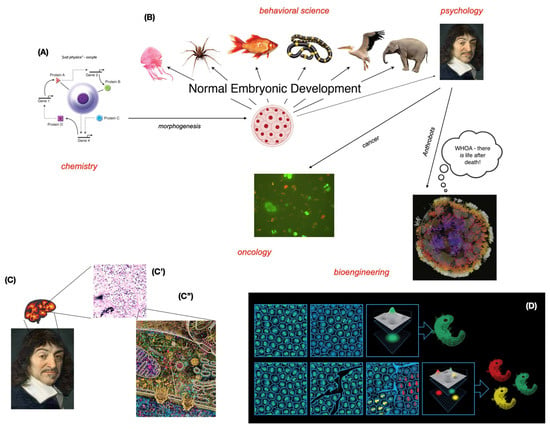




![Bodies and minds self-assemble from single cells as a process of alignment and autopoiesis. (A) Most complex biological forms begin as one cell—a fertilized oocyte, commonly thought to be well-described by the laws of physics and chemistry. (B) A gradual, slow process of developmental morphogenesis results in the final form of the organism, which may have complex structure and a mind which may not believe it is a “machine”. Our transformation from a chemical soup into an active embodied mind is continuous but heterogeneous: (C) while we commonly think of ourselves as a unified intelligence with a “centralized” brain, the fact is that even the pineal gland, of which there is only one in the brain, is made of cells (C′) and those cells in turn are made of myriad other active components (C″)—we are a collective intelligence at all scales. (D) The creation of an “individual” out of an excitable medium such as an embryonic blastoderm with hundreds of thousands of cells is a dynamic process that is not hardwired: scratches made in that blastoderm would result in independent self-organization in each island, resulting in multiple embryos forming. This reveals the potentiality for some non-pre-determined number of minds to arise out of the same substrate. Images in (A,B,D) courtesy of Jeremy Guay of Peregrine Creative, used previously in [29]. Image (B) used with permission from [30]. Image in (C′) courtesy of Jose Calvo, Science Photo Library. Image in (C″) courtesy of Evan Ingersoll and Gaël McGill. Image (D) used with permission from [31].](https://mdpi-res.com/philosophies/philosophies-11-00161/article_deploy/html/images/philosophies-11-00161-g001-550.jpg)


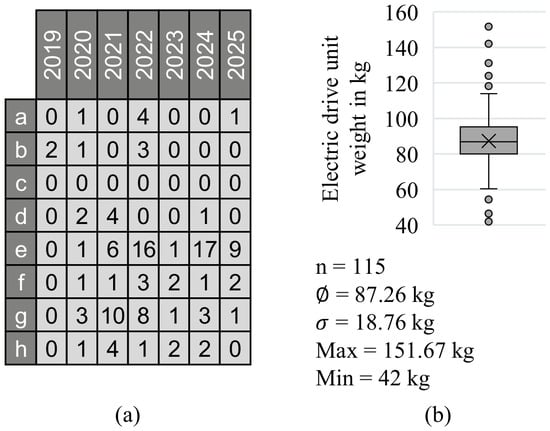
![Overview of the different housing structures according to Drexler et al. [25] by model year (a) and an evaluation of the distribution of the electric drive unit’s weight in kilograms (b).](https://mdpi-res.com/energies/energies-19-05324/article_deploy/html/images/energies-19-05324-g001-550.jpg)


