


Skip Content
You are currently on the new version of our website. Access the old version .

Cells, Volume 15, Issue 1

2026 January-1 - 92 articles

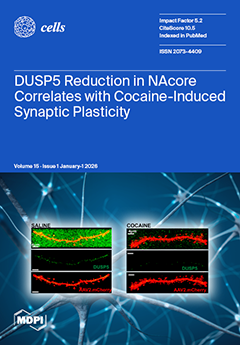
Cover Story: Drug overdose remains a leading cause of preventable death in the United States, underscoring the urgent need to identify the neurobiological mechanisms that drive substance use disorders. Addiction is characterized by persistent changes in brain circuits that govern reward, motivation, and aversion, with the nucleus accumbens core (NAcore) serving as a critical locus for these adaptations. Chronic exposure to drugs of abuse produces long-lasting structural and functional synaptic modifications within the NAcore that promote compulsive drug seeking and relapse. However, the intracellular signaling mechanisms that constrain or exacerbate these maladaptive synaptic changes remain incompletely understood. View this paper
  • Issues are regarded as officially published after their release is announced to the table of contents alert mailing list .
  • You may sign up for email alerts to receive table of contents of newly released issues.
  • PDF is the official format for papers published in both, html and pdf forms. To view the papers in pdf format, click on the "PDF Full-text" link, and use the free Adobe Reader to open them.

Articles (92)

  • Review
  • Open Access
307 Views
13 Pages

5 January 2026

Variants of the MYO5B gene, which encodes the molecular motor protein myosin-Vb, have gained prominence as a causative factor in familial intrahepatic cholestasis (FIC). Understanding the disease mechanism is pivotal for therapy development and clini...

  • Review
  • Open Access
626 Views
27 Pages

5 January 2026

The cornea maintains transparency by preserving immune and (lymph)angiogenic privilege through active suppression of inflammation and vascular invasion, a process centrally regulated by limbal epithelial stem cells (LESCs) located at the corneosclera...

  • Article
  • Open Access
286 Views
32 Pages

Distinct Regulation of the ARF and TAp73 Tumor Suppressor Genes by the Transcription Factor E2F1 Enables Discrimination of Cancer Cells from Normal Growing Cells

  • Yaxuan Zhou,
  • Rinka Nakajima,
  • Mashiro Shirasawa,
  • Mariana Fikriyanti,
  • Ako Watanabe,
  • Caiwei Yang,
  • Ritsuko Iwanaga,
  • Andrew P. Bradford,
  • Kenta Kurayoshi and
  • Kiyoshi Ohtani
  • + 1 author

5 January 2026

Discrimination of cancer cells from normal growing cells is crucial to specifically target cancer cells. The transcription factor E2F1 is the principal target of the tumor suppressor pRB. E2F1 activated by growth stimulation activates cell cycle-rela...

  • Article
  • Open Access
328 Views
26 Pages

The Role of Aldosterone in Vascular Permeability in Diabetes

  • Michal Aleksiejczuk,
  • Natalia Bielicka,
  • Magdalena Bruzgo-Grzybko,
  • Izabela Suwda Kalita,
  • Adam Jan Olichwier,
  • Paulina Mierzejewska,
  • Joanna Stelmaszewska,
  • Janusz Dzieciol,
  • Ewa Chabielska and
  • Anna Gromotowicz-Poplawska

5 January 2026

More than 30% of diabetic patients develop dermatopathies linked to inflammation and increased vascular permeability. Considering the role of the renin–angiotensin–aldosterone system (RAAS) in diabetic complications, this study examined w...

  • Article
  • Open Access
798 Views
21 Pages

Photobiomodulation Activates Coordinated Signaling Networks to Modulate Inflammation, Adaptive Stress, and Tissue Healing via Redox-Mediated NFκB–TGF-β1–ATF-4 Axis

  • Sasikumar Ponnusamy,
  • Mahmud Amin,
  • Amruta Bhat,
  • Sarah Garczynski,
  • Saeed Ur Rahman,
  • Sailee Rasam,
  • Sharaschandra Reddy Govindool,
  • Imran Khan and
  • Praveen Arany

5 January 2026

Photobiomodulation (PBM) therapy has been effectively used to relieve pain and inflammation and promote tissue healing and regeneration in a broad range of ailments. Prior work has focused on intracellular mitochondrial cytochrome c oxidase, while ex...

  • Article
  • Open Access
485 Views
24 Pages

5 January 2026

Aging reduces the tissue regenerative capacity, promotes chronic inflammation, and contributes to neurodegenerative diseases, including age-related macular degeneration (AMD). AMD is a leading cause of vision loss in older adults and manifests as dry...

  • Article
  • Open Access
437 Views
14 Pages

Evidence for Quasi-High-LET Biological Effects in Clinical Proton Beams That Suppress c-NHEJ and Enhance HR and Alt-EJ

  • Emil Mladenov,
  • Mina Pressler,
  • Veronika Mladenova,
  • Aashish Soni,
  • Fanghua Li,
  • Feline Heinzelmann,
  • Johannes Niklas Esser,
  • Razan Hessenow,
  • Eleni Gkika and
  • George Iliakis
  • + 3 authors

4 January 2026

Protons are conventionally regarded as a low-linear energy transfer (low-LET) radiation modality with a relative biological effectiveness (RBE) of 1.1, suggesting direct mechanistic similarity to X-rays in the underpinning biological effects. However...

  • Article
  • Open Access
453 Views
23 Pages

Potential Proteins Associated with Canine Epididymal Sperm Motility

  • Marzena Mogielnicka-Brzozowska,
  • Aleksandra Wiktoria Cichowska-Likszo,
  • Pawel Likszo,
  • Leyland Fraser,
  • Weronika Popielarczyk,
  • Julia Pieklik,
  • Maja Kamińska and
  • Gaia Cecilia Luvoni

4 January 2026

The maturation and motility of epididymal sperm (ES) cells are largely driven by changes in protein expression. This study aimed to analyze the proteomic profile of canine (Canis lupus familiaris) ES across groups characterized by different progressi...

  • Review
  • Open Access
1 Citations
533 Views
34 Pages

MicroRNAs in Prostate Cancer Liquid Biopsies: Early Detection, Prognosis, and Treatment Monitoring

  • Seyyed Mohammad Yaghoubi,
  • Erfan Zare,
  • Sina Jafari Dargahlou,
  • Maryam Jafari,
  • Mahdiye Azimi,
  • Maedeh Khoshnazar,
  • Solmaz Shirjang and
  • Behzad Mansoori

4 January 2026

Prostate cancer (PCa) is a common malignancy in men worldwide, with incidence projected to rise in the coming years. Traditional screening and diagnostic methods, such as prostate-specific antigen (PSA) testing and biopsy, face limitations in specifi...

  • Article
  • Open Access
492 Views
17 Pages

SOX11 Is Regulated by EGFR-STAT3 and Promotes Epithelial–Mesenchymal Transition in Head and Neck Squamous Cell Carcinoma

  • Jiayi Peng,
  • Li Cui,
  • Mian Guo,
  • Yi Liu,
  • Wanqi Jia,
  • Kaori Misuno,
  • Jeremy Barrett,
  • Diana Messadi,
  • Shun-Fa Yang and
  • Shen Hu

4 January 2026

The transcription factor SOX11 is implicated in tumor progression across multiple types of cancers, including head and neck squamous cell carcinoma (HNSCC). However, its mechanistic role in HNSCC remains elusive. In this study, we found that the expr...

of 10

Get Alerted

Add your email address to receive forthcoming issues of this journal.

XFacebookLinkedIn
Cells - ISSN 2073-4409