Human Genome Safe Harbor Sites: A Comprehensive Review of Criteria, Discovery, Features, and Applications
 , , , , , ,
  and
and
Abstract
1. Introduction
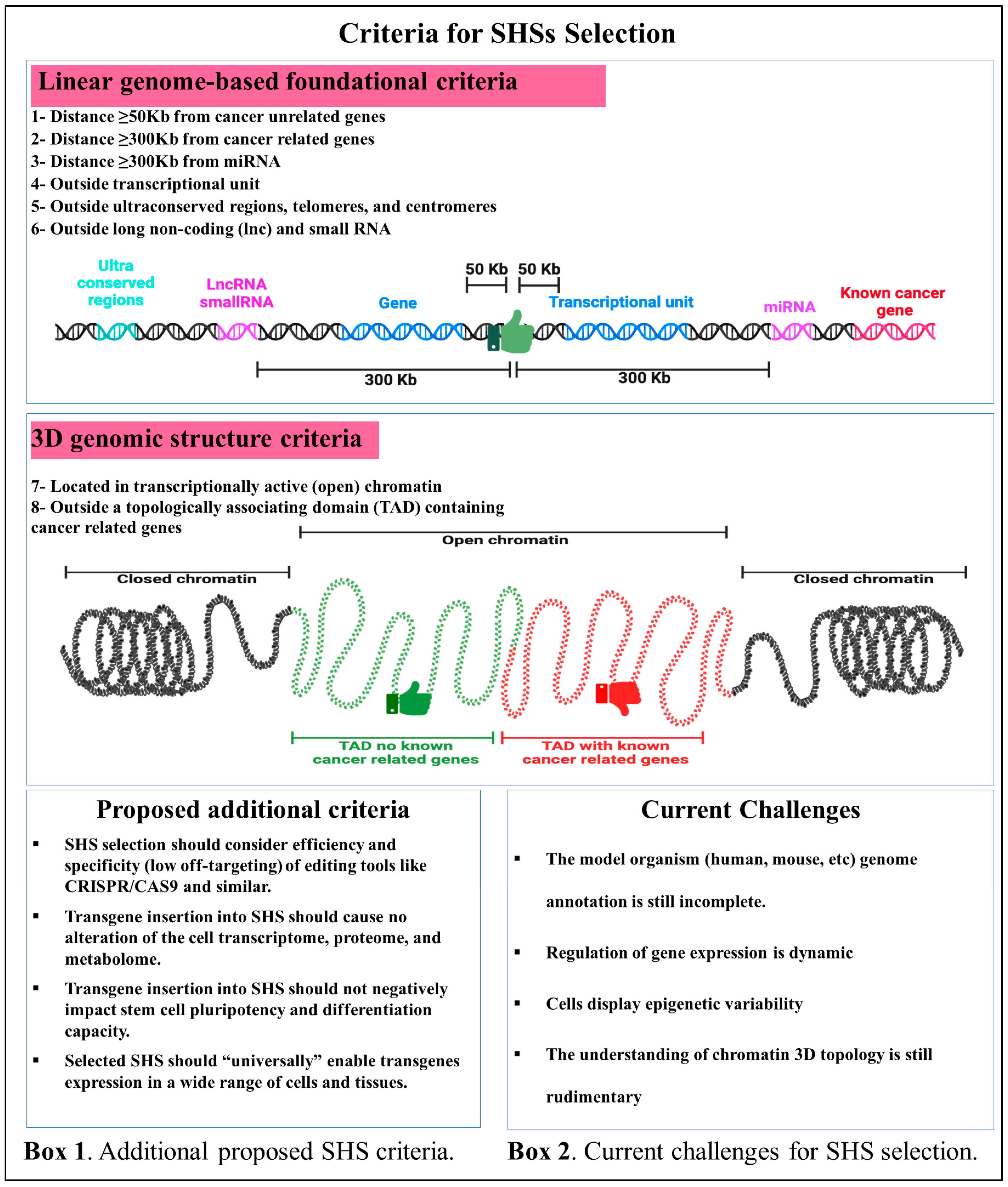
2. Criteria of SHS Selection
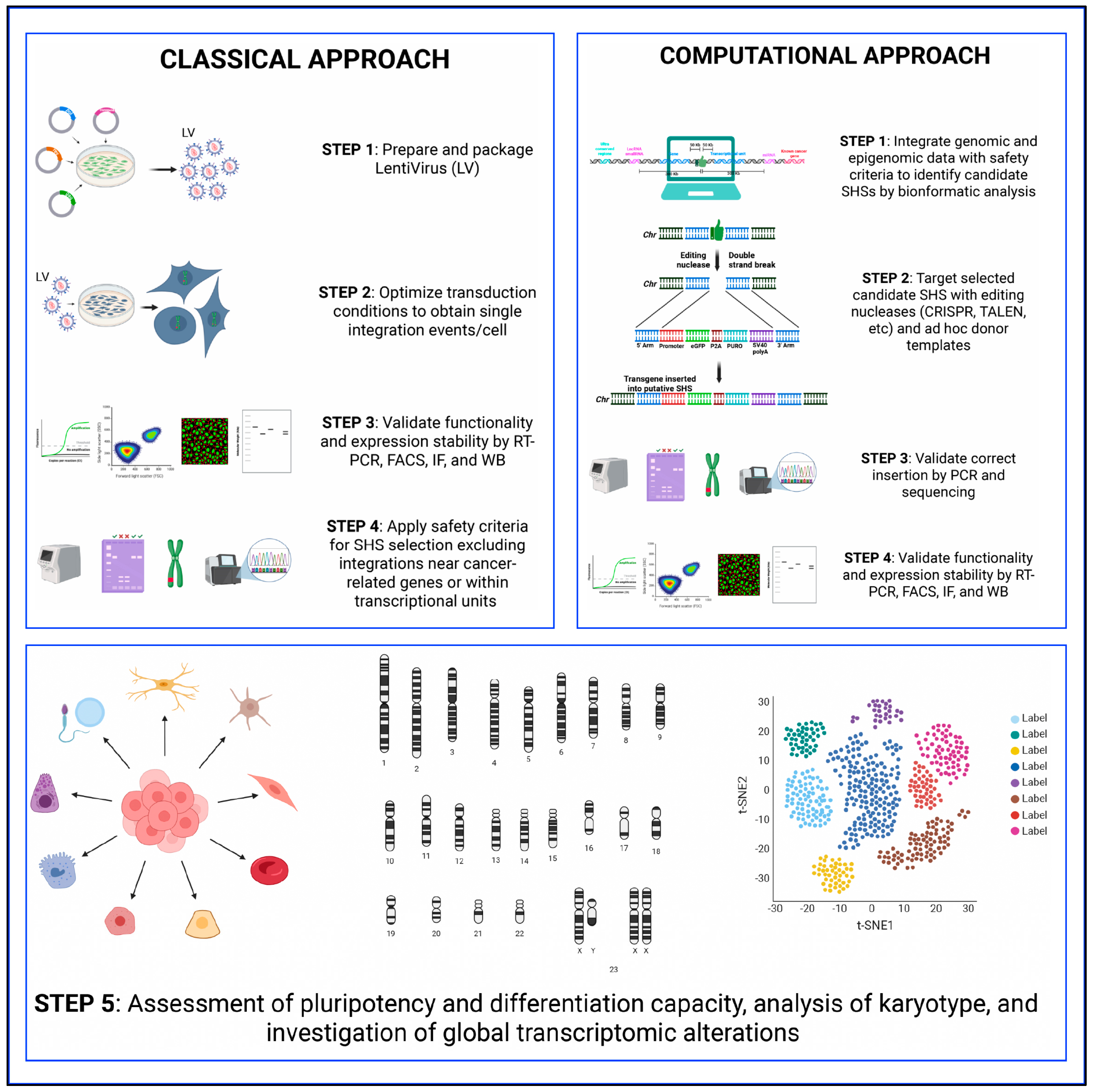
3. Identification and Validation of SHSs
4. Known Genomic Safe Harbors: Features and Limitations
4.1. AAVS1
4.2. hROSA26
4.3. H11 Locus
4.4. CCR5 Locus
4.5. Citrate Lyase Beta-Like (CLYBL)
4.6. SHS231

| SHS Locus | Chrom- osome | Intergenic/ Intragenic | Cell Models | Transgene Expression | Effect on Stem Cells Characteristics | Effect on Transcriptomics | Reported Silencing | Gaps and Limitations | Refs |
|---|---|---|---|---|---|---|---|---|---|
| AAVS1 | 19q13.42 | Intragenic PPP1R12C | Many cellular models, including hESCs | Robust expression | No effect on hESCs’ pluripotency and differentiation capacity | Unknown | Yes | Located within PPP1R12C transcriptional unit and in a gene-dense region | [87] |
| hROSA26 | 3p25.3 | Intragenic THUMPD3 | Many cell models, including hESCs | Robust expression | No effect on hESCs’ pluripotency and differentiation capacity | Unknown | No | Located within THUMPD3 gene transcriptional unit and in a gene-dense region | [27] |
| H11 | 22q12.2 | Intergenic DRG1-H11-EIF4ENIF1 | Mainly in hiPSCs | Robust expression | No effect on hESCs’ pluripotency and differentiation capacity | Unknown | No | Located between two genes whose dysregulation upon targeting is not known | [113,114,115] |
| CCR5 | 3p21.31 | Intragenic CCR5 gene | hESCs, T cells and HEK293T cells | Low expression | No effect on hESCs’ pluripotency and differentiation capacity | Unknown | Yes | Upregulated the flanking genes CCR1 and CCR3, and increased the susceptibility to West Nile virus infection | [122] |
| CLYBL | 13q32.1 | Intragenic CLYBL gene | iPSCs, hESCs, NSC and in Hela and HEK293 cells | Robust expression | No effect on hESCs’ pluripotency and differentiation capacity | Unknown | No | Located within coding gene, and the long-term transgene expression is not known | [104,132] |
| SHS231 | 4q13.1 | Intergenic | Rh5, Rh30, SMS-CTR, and HEK293T | Robust expression | Unknown | Unknown | No | Transgene expression in other cell models, like iPSCs, is not assessed | [139] |
| Rogi1 | 1q31.3 | Intergenic | HEK293T, Jurket, and primary T cells and iPSCs | Robust expression | Unknown | Minimal effect | Yes | The effect on stem cells’ pluripotency, karyotype, and differentiation capacity is not assessed | [51] |
| Rogi2 | 3p24.3 | ||||||||
| Pansio-1 | 1p13.2 | Intergenic | hESCs and iPSCs | Stable expression | No effect on hESCs’ pluripotency and differentiation capacity | Minimal effect | No | The long-term stability and transgene expression in other cell models are not assessed | [69] |
| Olonne-18 | 18q21.31 | Intergenic | |||||||
| Keppel-19 | 19p13.3 | Intergenic | |||||||
| BLD_SHS10 | 3p22.2 | Intronic GOLGA4 | HUDEP2 erythroid progenitors | Stable expression | Unknown | Unknown | No | These sites may be targeted in HSCs to assess the impact on HSC physiology and differentiation capacity into diverse blood cell lineages. | [23] |
| BLD_SHS14 | 6q25.3 | Intronic ARID1B | |||||||
| BLD_SHS15 | 8q24.12 | Intronic/ TAF2 | |||||||
| eSHS6 | 7q36.1 | Pseudogene ZNF767P | T cells | Stable expression | Unknown | Unknown | No | Functionality of this locus in other blood cells and iPSCs warrants further assessment. | [44] |
4.7. Rogi1 and Rogi2
4.8. Pansio-1, Olonne-18, and Keppel-19
4.9. Cell/Tissue Specific SHSs
5. Safe Harbor Sites Applications
5.1. SHSs’ Uses in Basic Research
5.2. SHSs for CAR T Cell-Based Therapy
5.3. Use for Targeted Gene Therapy
5.4. Biotechnology Applications
5.5. Other Applications
6. Conclusions, Challenges, and Future Perspective
Author Contributions
Funding
Data Availability Statement
Acknowledgments
Conflicts of Interest
References
- Naidoo, N.; Pawitan, Y.; Soong, R.; Cooper, D.N.; Ku, C.S. Human genetics and genomics a decade after the release of the draft sequence of the human genome. Hum. Genom. 2011, 5, 577–622. [Google Scholar] [CrossRef]
- Marian, A.J. Sequencing your genome: What does it mean? Methodist DeBakey Cardiovasc. J. 2014, 10, 3–6. [Google Scholar] [CrossRef] [PubMed]
- Comfort, N. Genetics: We are the 98%. Nature 2015, 520, 615–616. [Google Scholar] [CrossRef]
- Fu, X.D. Non-coding RNA: A new frontier in regulatory biology. Natl. Sci. Rev. 2014, 1, 190–204. [Google Scholar] [CrossRef] [PubMed]
- Zhang, P.; Wu, W.; Chen, Q.; Chen, M. Non-coding RNAs and their integrated networks. J. Integr. Bioinform. 2019, 16, 20190027. [Google Scholar] [CrossRef] [PubMed]
- Riethoven, J.J.M. Regulatory regions in DNA: Promoters, enhancers, silencers, and insulators. Methods Mol. Biol. 2010, 674, 33–42. [Google Scholar]
- Jayavelu, N.D.; Jajodia, A.; Mishra, A.; Hawkins, R.D. Candidate silencer elements for the human and mouse genomes. Nat. Commun. 2020, 11, 1061. [Google Scholar] [CrossRef]
- Fan, H.; Chu, J.-Y. A brief review of short tandem repeat mutation. Genom. Proteom. Bioinform. 2007, 5, 7–14. [Google Scholar] [CrossRef]
- Chehelgerdi, M.; Chehelgerdi, M.; Khorramian-Ghahfarokhi, M.; Shafieizadeh, M.; Mahmoudi, E.; Eskandari, F.; Rashidi, M.; Arshi, A.; Farsani, M.A. Comprehensive review of CRISPR-based gene editing: Mechanisms, challenges, and applications in cancer therapy. Mol. Cancer 2024, 23, 9. [Google Scholar] [CrossRef]
- Milone, M.C.; O’Doherty, U. Clinical use of lentiviral vectors. Leukemia 2018, 32, 1529–1541. [Google Scholar] [CrossRef]
- Bire, S.; Dusserre, Y.; Bigot, Y.; Mermod, N. PiggyBac transposase and transposon derivatives for gene transfer targeting the ribosomal DNA loci of CHO cells. J. Biotechnol. 2021, 341, 103–112. [Google Scholar] [CrossRef]
- Ranzani, M.; Cesana, D.; Bartholomae, C.C.; Sanvito, F.; Pala, M.; Benedicenti, F.; Pierangela Gallina, P.; Sergi, S.L.; Merella, S.; Bulfone, A.; et al. Lentiviral vector-based insertional mutagenesis identifies genes associated with liver cancer. Nat. Methods 2013, 10, 155–161. [Google Scholar] [CrossRef]
- Loeb, K.R.; Hughes, B.T.; Fissel, B.M.; Osteen, N.J.; Knoblaugh, S.E.; Grim, J.E.; Drury, J.L.; Sarver, A.; Dupuy, J.A.; Clurman, E.B. Insertional mutagenesis using the Sleeping Beauty transposon system identifies drivers of erythroleukemia in mice. Sci. Rep. 2019, 9, 5488. [Google Scholar] [CrossRef]
- Hacein-Bey-Abina, S.; Von Kalle, C.; Schmidt, M.; McCormack, M.P.; Wulffraat, N.; Leboulch, P.; Lim, A.; Osborne, C.S.; Pawliuk, R.; Morillon, E.; et al. LMO2-associated clonal T cell proliferation in two patients after gene therapy for SCID-X1. Science 2003, 302, 415–441. [Google Scholar] [CrossRef]
- Groves, I.J.; Drane, E.L.A.; Michalski, M.; Monahan, J.M.; Scarpini, C.G.; Smith, S.P.; Stanley, M.A.; Parish, J.L.; McBride, A.A.; Doorbar, J.; et al. Short- and long-range cis interactions between integrated HPV genomes and cellular chromatin dysregulate host gene expression in early cervical carcinogenesis. PLoS Pathog. 2021, 17, e1009879. [Google Scholar] [CrossRef] [PubMed]
- Cabrera, A.; Edelstein, H.I.; Glykofrydis, F.; Love, K.S.; Palacios, S.; Tycko, J.; Zhang, M.; Lensch, S.; Shields, C.E.; Livingston, M.; et al. The sound of silence: Transgene silencing in mammalian cell engineering. Cell Syst. 2022, 13, 950–973. [Google Scholar] [CrossRef] [PubMed]
- Sakurai, K.; Shimoji, M.; Tahimic, C.G.T.; Aiba, K.; Kawase, E.; Hasegawa, K.; Amagai, Y.; Suemori, H.; Nakatsuji, N. Efficient integration of transgenes into a defined locus in human embryonic stem cells. Nucleic Acids Res. 2010, 38, e96. [Google Scholar] [CrossRef] [PubMed]
- Woo, H.J.; Kim, J.; Kim, S.M.; Kim, D.; Moon, J.Y.; Park, D.; Lee, E.; Choi, S.; Jeong, H.; Yang, K.; et al. Context-dependent genomic locus effects on antibody production in recombinant Chinese hamster ovary cells generated through random integration. Comput. Struct. Biotechnol. J. 2024, 23, 1654–1665. [Google Scholar] [CrossRef]
- Kimura, Y.; Shofuda, T.; Higuchi, Y.; Nagamori, I.; Oda, M.; Nakamori, M.; Onodera, M.; Kanematsu, D.; Yamamoto, A.; Katsuma, A.; et al. Human genomic safe harbors and the suicide gene-based safeguard system for iPSC-based cell therapy. Stem Cells Transl. Med. 2019, 8, 627–638. [Google Scholar] [CrossRef]
- Pavani, G.; Amendola, M. Targeted Gene Delivery: Where to Land. Front. Genome Edit 2021, 2, 609650. [Google Scholar] [CrossRef]
- Papapetrou, E.P.; Schambach, A. Gene Insertion Into Genomic Safe Harbors for Human Gene Therapy. Mol. Ther. 2016, 24, 678–684. [Google Scholar] [CrossRef] [PubMed]
- Chen, X.; Yang, G.; Ji, P.; Liu, G.; Zhang, L. Identification of Site in the UTY Gene as Safe Harbor Locus on the Y Chromosome of Pig. Genes 2024, 15, 1005. [Google Scholar] [CrossRef] [PubMed]
- Shrestha, D.; Bag, A.; Wu, R.; Zhang, Y.; Tang, X.; Qi, Q.; Xing, J.; Cheng, Y. Genomics and epigenetics guided identification of tissue-specific genomic safe harbors. Genome Biol. 2022, 23, 199. [Google Scholar] [CrossRef] [PubMed]
- Kotin, R.M.; Linden, R.M.; Berns, K.I. Characterization of a preferred site on human chromosome 19q for integration of adeno-associated virus DNA by non-homologous recombination. Embo J. 1992, 11, 5071–5078. [Google Scholar] [CrossRef]
- Merling, R.K.; Sweeney, C.L.; Chu, J.; Bodansky, A.; Choi, U.; Priel, D.L.; Kuhns, D.B.; Wang, H.; Vasilevsky, S.; De Ravin, S.; et al. An AAVS1-targeted minigene platform for correction of iPSCs from all five types of chronic granulomatous disease. Mol. Ther. 2015, 23, 147–157. [Google Scholar] [CrossRef]
- Oceguera-Yañez, F.; Kim, S.I.; Matsumoto, T.; Tan, G.W.; Xiang, L.; Hatani, T.; Mochizuki, M.; Bando, T.; Hatta, T.; Fukasawa, M.; et al. Engineering the AAVS1 locus for consistent and scalable transgene expression in human iPSCs and their differentiated derivatives. Methods 2016, 101, 43–55. [Google Scholar] [CrossRef]
- Irion, S.; Luche, H.; Gadue, P.; Fehling, H.J.; Kennedy, M.; Keller, G. Identification and targeting of the ROSA26 locus in human embryonic stem cells. Nat. Biotechnol. 2007, 25, 1477–1482. [Google Scholar] [CrossRef]
- Nyabi, O.; Naessens, M.; Haigh, K.; Gembarska, A.; Goossens, S.; Maetens, M.; De Clercq, S.; Drogat, B.; Haenebalcke, L.; Bartunkova, S.; et al. Efficient mouse transgenesis using Gateway-compatible ROSA26 locus targeting vectors and F1 hybrid ES cells. Nucleic Acids Res. 2009, 37, e55. [Google Scholar] [CrossRef]
- Wang, C.; Fang, S.; Chen, Y.; Tang, N.; Jiao, G.; Hu, Y.; Li, J.; Shan, Q.; Wang, X.; Feng, G.; et al. High-efficiency targeted transgene integration via primed micro-homologues. Cell Discov. 2023, 9, 69. [Google Scholar] [CrossRef]
- Knipping, F.; Osborn, M.J.; Petri, K.; Tolar, J.; Glimm, H.; von Kalle, C.; Pereira, L.; Deyell, R.J.; Wagner, J.E.; Woodard, K.; et al. Genome-wide specificity of highly efficient TALENs and CRISPR/Cas9 for T cell receptor modification. Mol. Ther. Methods Clin. Dev. 2017, 4, 213–224. [Google Scholar] [CrossRef]
- Li, Y.S.; Meng, R.R.; Chen, X.; Shang, C.L.; Li, H.B.; Zhang, T.J.; Long, H.Y.; Li, H.Q.; Wang, Y.J.; Wang, F.C.; et al. Generation of H11-albumin-rtTA transgenic mice: A tool for inducible gene expression in the liver. G3 2019, 9, 591–599. [Google Scholar] [CrossRef]
- Landau, D.J.; Brooks, E.D.; Perez-Pinera, P.; Amarasekara, H.; Mefferd, A.; Li, S.; Kaestner, K.H.; Porteus, M.H.; Wilson, M.H.; Yant, S.R.; et al. In vivo zinc finger nuclease-mediated targeted integration of a glucose-6-phosphatase transgene promotes survival in mice with glycogen storage disease type IA. Mol. Ther. 2016, 24, 697–706. [Google Scholar] [CrossRef]
- Pantazis, C.B.; Yang, A.; Lara, E.; McDonough, J.A.; Blauwendraat, C.; Peng, L.; Tang, J.; Liao, Z.; Sun, N.; Gros-Laux, I.; et al. A reference human induced pluripotent stem cell line for large-scale collaborative studies. Cell Stem Cell 2022, 29, 1685–1702. [Google Scholar] [CrossRef] [PubMed]
- Cerneckis, J.; Cai, H.; Shi, Y. Induced pluripotent stem cells (iPSCs): Molecular mechanisms of induction and applications. Signal Transduct. Target. Ther. 2024, 9, 112. [Google Scholar] [CrossRef] [PubMed]
- Deng, Y.; Ding, X.; Wu, Q.; Cai, Y.; Jin, J.; Xu, Q.; Zhang, S.; Li, H.; Chen, Y.; Wang, J.; et al. Construction of a stable expression HEK293T engineered cell line adapted to high-density suspension culture. Biochem. Eng. J. 2024, 207, 109334. [Google Scholar] [CrossRef]
- Aboul-Soud, M.A.M.; Alzahrani, A.J.; Mahmoud, A. Induced pluripotent stem cells (iPSCs)-roles in regenerative therapies, disease modelling and drug screening. Cells 2021, 10, 2319. [Google Scholar] [CrossRef]
- Lienert, F.; Lohmueller, J.J.; Garg, A.; Silver, P.A. Synthetic biology in mammalian cells: Next generation research tools and therapeutics. Nat. Rev. Mol. Cell Biol. 2014, 15, 95–107. [Google Scholar] [CrossRef] [PubMed]
- Cantos, C.; Francisco, P.; Trijatmiko, K.R.; Slamet-Loedin, I.; Chadha-Mohanty, P.K. Identification of “safe harbor” loci in indica rice genome by harnessing the property of zinc-finger nucleases to induce DNA damage and repair. Front. Plant Sci. 2014, 26, 302. [Google Scholar]
- Carroll, D. Genome Engineering with Targetable Nucleases. Annu. Rev. Biochem. 2014, 83, 409–439. [Google Scholar] [CrossRef]
- Wu, X.; Scott, D.A.; Kriz, A.J.; Chiu, A.C.; Hsu, P.D.; Dadon, D.B.; Cheng, A.W.; Trevino, A.E.; Konermann, S.; Chen, S.; et al. Genome-wide binding of the CRISPR endonuclease Cas9 in mammalian cells. Nat. Biotechnol. 2014, 32, 670–676. [Google Scholar] [CrossRef]
- Zerbino, D.R.; Frankish, A.; Flicek, P. Progress, Challenges, and Surprises in Annotating the Human Genome. Annu. Rev. Genom. Hum. Genet. 2020, 21, 55–79. [Google Scholar] [CrossRef]
- Stuart, T.; Satija, R. Integrative single-cell analysis. Nat. Rev. Gen. 2019, 20, 257–272. [Google Scholar] [CrossRef] [PubMed]
- Quezada-Ramírez, M.A.; Loncar, S.; Campbell, M.A.; Parsi, K.M.; Gifford, R.J.; Kotin, R.M. Development of evolutionarily conserved viral integration sites as safe harbors for human gene therapy. iScience 2025, 28, 113910. [Google Scholar] [CrossRef] [PubMed]
- Odak, A.; Yuan, H.; Feucht, J.; Cantu, V.A.; Mansilla-Soto, J.; Kogel, F.; Eyquem, J.; Everett, J.; Bushman, F.D.; Leslie, C.S.; et al. Novel extragenic genomic safe harbors for precise therapeutic T-cell engineering. Blood 2023, 141, 2698–2712. [Google Scholar] [CrossRef]
- Papapetrou, E.P.; Lee, G.; Malani, N.; Setty, M.; Riviere, I.; Tirunagari, L.M.; Kadota, K.; Roth, S.L.; Giardina, P.; Viale, A.; et al. Genomic safe harbors permit high β-globin transgene expression in thalassemia induced pluripotent stem cells. Nat. Biotechnol. 2011, 29, 73–78. [Google Scholar] [CrossRef]
- Sadelain, M.; Papapetrou, E.P.; Bushman, F.D. Safe harbours for the integration of new DNA in the human genome. Nat. Rev. Cancer 2011, 12, 51–58. [Google Scholar] [CrossRef]
- Gilbertson, S.E.; Walter, H.C.; Gardner, K.; Wren, S.N.; Vahedi, G.; Weinmann, A.S. Topologically associating domains are disrupted by evolutionary genome rearrangements forming species-specific enhancer connections in mice and humans. Cell Rep. 2022, 39, 110769. [Google Scholar] [CrossRef]
- Lupiáñez, D.G.; Kraft, K.; Heinrich, V.; Krawitz, P.; Brancati, F.; Klopocki, E.; Horn, D.; Kayserili, H.; Opitz, J.M.; Laxova, R.; et al. Disruptions of topological chromatin domains cause pathogenic rewiring of gene-enhancer interactions. Cell 2015, 161, 1012–1025. [Google Scholar] [CrossRef]
- Miele, A.; Dekker, J. Long-range chromosomal interactions and gene regulation. Mol. Biosyst. 2008, 4, 1046–1057. [Google Scholar] [CrossRef]
- Tsagakis, I.; Douka, K.; Birds, I.; Aspden, J.L. Long non-coding RNAs in development and disease: Conservation to mechanisms. J. Pathol. 2020, 250, 480–495. [Google Scholar] [CrossRef] [PubMed]
- Aznauryan, E.; Yermanos, A.; Kinzina, E.; Devaux, A.; Kapetanovic, E.; Milanova, D.; Church, G.M.; Reddy, S.T. Discovery and validation of human genomic safe harbor sites for gene and cell therapies. Cell Rep. Methods 2022, 2, 100154. [Google Scholar] [CrossRef]
- Ciabrelli, F.; Cavalli, G. Chromatin-driven behavior of topologically associating domains. J. Mol. Biol. 2015, 427, 608–625. [Google Scholar] [CrossRef] [PubMed]
- Barral, A.; Déjardin, J. The chromatin signatures of enhancers and their dynamic regulation. Nucleus 2023, 14, 2160551. [Google Scholar] [CrossRef]
- Bressan, R.B.; Dewari, P.S.; Kalantzaki, M.; Gangoso, E.; Matjusaitis, M.; Garcia-Diaz, C.; Blin, C.; Grant, V.; Bulstrode, H.; Gogolok, S.; et al. Efficient CRISPR/Cas9-assisted gene targeting enables rapid and precise genetic manipulation of mammalian neural stem cells. Development 2017, 144, 635–648. [Google Scholar] [CrossRef] [PubMed]
- Schjeide, B.M.M.; Püschel, G.P. Determining on-target, off-target, and copy number status of transgenic events after CRISPR/Cas9-targeted AAVS1 safe-harbor modification of iPSCs using double-control quantitative copy number PCR. Curr. Protoc. 2023, 3, e635. [Google Scholar] [CrossRef] [PubMed]
- Li, H.; Yang, Y.; Hong, W.; Huang, M.; Wu, M.; Zhao, X. Applications of genome editing technology in the targeted therapy of human diseases: Mechanisms, advances and prospects. Signal Transduct Target Ther. 2020, 5, 1. [Google Scholar] [CrossRef]
- Hermantara, R.; Richmond, L.; Taqi, A.F.; Chilaka, S.; Jeantet, V.; Guerrini, I.; West, K.; West, A. Improving CRISPR–Cas9-directed faithful transgene integration outcomes by reducing unwanted random DNA integration. J. Biomed. Sci. 2024, 31, 32. [Google Scholar] [CrossRef] [PubMed]
- Guo, C.; Ma, X.; Gao, F.; Guo, Y. Off-target effects in CRISPR/Cas9 gene editing. Front. Bioeng. Biotechnol. 2023, 11. [Google Scholar] [CrossRef]
- Mazan-Mamczarz, K.; Ha, J.; De, S.; Sen, P. Single-Cell Analysis of the Transcriptome and Epigenome. Methods Mol. Biol. 2022, 2399, 21–60. [Google Scholar]
- Mudge, J.M.; Carbonell-Sala, S.; Diekhans, M.; Martinez, J.G.; Hunt, T.; Jungreis, I.; Loveland, J.E.; Arnan, C.; Barnes, I.; Bennett, R.; et al. GENCODE 2025: Reference gene annotation for human and mouse. Nucleic Acids Res. 2024, 53, D966–D975. [Google Scholar] [CrossRef]
- Guigó, R. Genome annotation: From human genetics to biodiversity genomics. Cell Genom. 2023, 3, 100375. [Google Scholar] [CrossRef]
- Knowles, D.A.; Davis, J.R.; Edgington, H.; Raj, A.; Favé, M.J.; Zhu, X.; Potash, J.B.; Weissman, M.M.; Shi, J.; Levinson, D.F.; et al. Allele-specific expression reveals interactions between genetic variation and environment. Nat. Methods 2017, 14, 699–702. [Google Scholar] [CrossRef] [PubMed]
- Heinz, S.; Romanoski, C.E.; Benner, C.; Glass, C.K. The selection and function of cell type-specific enhancers. Nat. Rev. Mol. Cell Biol. 2015, 16, 144–154. [Google Scholar] [CrossRef]
- Breton, C.V.; Landon, R.; Kahn, L.G.; Enlow, M.B.; Peterson, A.K.; Bastain, T.; Braun, J.; Comstock, S.S.; Duarte, C.S.; Hipwell, A. Exploring the evidence for epigenetic regulation of environmental influences on child health across generations. Commun. Biol. 2021, 4, 769. [Google Scholar] [CrossRef]
- Capp, J.P. Interplay between genetic, epigenetic, and gene expression variability: Considering complexity in evolvability. Evol. Appl. 2021, 14, 893–901. [Google Scholar] [CrossRef] [PubMed]
- Chen, B.; Ren, C.; Ouyang, Z.; Xu, J.; Xu, K.; Li, Y.; Guo, H.; Bai, X.; Tian, M.; Xu, X.; et al. Stratifying TAD boundaries pinpoints focal genomic regions of regulation, damage, and repair. Brief. Bioinform. 2024, 25, bbae306. [Google Scholar] [CrossRef] [PubMed]
- Rajderkar, S.; Barozzi, I.; Zhu, Y.; Hu, R.; Zhang, Y.; Li, B.; Alcaina Caro, A.; Fukuda-Yuzawa, Y.; Kelman, G.; Akeza, A.; et al. Topologically associating domain boundaries are required for normal genome function. Commun. Biol. 2023, 6, 435. [Google Scholar] [CrossRef]
- Boob, A.G.; Zhu, Z.; Intasian, P.; Jain, M.; Petrov, V.A.; Lane, S.T.; Tan, S.-I.; Xun, G.; Zhao, H. CRISPR-COPIES: An in silico platform for discovery of neutral integration sites for CRISPR/Cas-facilitated gene integration. Nucleic Acids Res. 2024, 52, e30. [Google Scholar] [CrossRef]
- Autio, M.I.; Motakis, E.; Perrin, A.; Bin Amin, T.; Tiang, Z.; Do, D.V.; Wang, J.; Tan, J.K.M.; Ding, S.S.L.; Tan, W.X.; et al. Computationally defined and in vitro validated putative genomic safe harbour loci for transgene expression in human cells. eLife 2024, 13, e79592. [Google Scholar] [CrossRef]
- Biffi, A.; Bartolomae, C.C.; Cesana, D.; Cartier, N.; Aubourg, P.; Ranzani, M.; Calabria, A.; Canale, S.; Leimer, K.; Lattanzi, A.; et al. Lentiviral vector common integration sites in preclinical models and a clinical trial reflect a benign integration bias and not oncogenic selection. Blood 2011, 117, 5332–5339. [Google Scholar] [CrossRef]
- Monse, H.; Laufs, S.; Kuate, S.; Zeller, W.J.; Fruehauf, S.; Uberla, K. Viral determinants of integration site preferences of simian immunodeficiency virus-based vectors. J. Virol. 2006, 80, 8145–8150. [Google Scholar] [CrossRef][Green Version]
- Poletti, V.; Mavilio, F. Interactions between Retroviruses and the Host Cell Genome. Mol. Ther. Methods Clin. Dev. 2017, 8, 31–41. [Google Scholar] [CrossRef]
- Costa, M.; Dottori, M.; Ng, E.; Hawes, S.M.; Sourris, K.; Jamshidi, P.; Pera, M.F.; Elefanty, A.G.; Stanley, E.G. The hESC line Envy expresses high levels of GFP in all differentiated progeny. Nat. Methods 2005, 2, 259–260. [Google Scholar] [CrossRef]
- Figueroa-Bossi, N.; Balbontín, R.; Bossi, L. Mapping transposon insertion sites by inverse polymerase chain reaction and Sanger sequencing. Cold Spring Harb. Protoc. 2024, 5, 108197. [Google Scholar]
- Kim, H.S.; Lee, H.; Bae, T.; Park, S.-H.; Kim, Y.J.; Lee, S.; Lee, S.; Park, J.H.; Bae, S.; Hur, J.K. CReVIS-Seq: A highly accurate and multiplexable method for genome-wide mapping of lentiviral integration sites. Mol. Ther. Methods Clin. Dev. 2021, 20, 193–204. [Google Scholar] [CrossRef]
- Liu, Y.; Thyagarajan, B.; Lakshmipathy, U.; Xue, H.; Lieu, P.; Fontes, A.; MacArthur, C.C.; Scheyhing, K.; Rao, M.S.; Chesnut, J.D. Generation of platform human embryonic stem cell lines that allow efficient targeting at a predetermined genomic location. Stem Cells Dev. 2009, 18, 1459–1472. [Google Scholar] [CrossRef] [PubMed]
- Ustek, D.; Sirma, S.; Gumus, E.; Arikan, M.; Cakiris, A.; Abaci, N.; Mathew, J.; Emrence, Z.; Azakli, H.; Cosan, F.; et al. A genome-wide analysis of lentivector integration sites using targeted sequence capture and next-generation sequencing technology. Infect. Genet. Evol. 2012, 12, 1349–1354. [Google Scholar] [CrossRef]
- Kelly, J.J.; Saee-Marand, M.; Nyström, N.N.; Evans, M.M.; Chen, Y.; Martinez, F.M.; Hamilton, A.M.; Ronald, J.A. Safe harbor-targeted CRISPR-Cas9 homology-independent targeted integration for multimodality reporter gene-based cell tracking. Sci. Adv. 2021, 7, eabc3791. [Google Scholar] [CrossRef]
- Liao, H.; Wu, J.; VanDusen, N.J.; Li, Y.; Zheng, Y. CRISPR-Cas9-mediated homology-directed repair for precise gene editing. Mol. Ther. Nucleic Acids 2024, 35, 102057. [Google Scholar] [CrossRef] [PubMed]
- Pellenz, S.; Phelps, M.; Tang, W.; Hovde, B.T.; Sinit, R.B.; Fu, W.; Li, H.; Chen, E.; Monnat, R.J. New human chromosomal sites with “safe harbor” potential for targeted transgene insertion. Hum. Gene Ther. 2019, 30, 814–828. [Google Scholar] [CrossRef]
- Chaudhari, N.; Rickard, A.M.; Roy, S.; Dröge, P.; Makhija, H. A non-viral genome editing platform for site-specific insertion of large transgenes. Stem Cell Res. Ther. 2020, 11, 380. [Google Scholar] [CrossRef]
- Samulski, R.J.; Zhu, X.; Xiao, X.; Brook, J.D.; Housman, D.E.; Epstein, N.; Hunter, L.A.; Laughlin, C.A. Targeted integration of adeno-associated virus (AAV) into human chromosome 19. EMBO J. 1991, 10, 3941–3950. [Google Scholar] [CrossRef]
- Kotin, R.M.; Menninger, J.C.; Ward, D.C.; Berns, K.I. Mapping and direct visualization of a region-specific viral DNA integration site on chromosome 19q13–qter. Genomics 1991, 10, 831–834. [Google Scholar] [CrossRef]
- Kotin, R.M.; Siniscalco, M.; Samulski, R.J.; Zhu, X.D.; Hunter, L.; Laughlin, C.A.; McLaughlin, S.; Muzyczka, N.; Berns, K.I. Site-specific integration by adeno-associated virus. Proc. Natl. Acad. Sci. USA 1990, 87, 2211–2215. [Google Scholar] [CrossRef] [PubMed]
- Musayev, F.N.; Zarate-Perez, F.; Bishop, C.; Burgner, J.W., II; Escalante, C.R. Structural insights into the assembly of the adeno-associated virus type 2 Rep68 protein on the integration site AAVS1. J. Biol. Chem. 2015, 290, 27487–27499. [Google Scholar] [CrossRef]
- McCarty, D.M.; Young, S.M.; Samulski, R.J. Integration of adeno-associated virus (AAV) and recombinant AAV vectors. Annu Rev Genet. 2004, 38, 819–845. [Google Scholar] [CrossRef] [PubMed]
- Hong, S.; Lee, J.; Kim, Y.; Kim, E.; Shin, K. AAVS1-targeted, stable expression of ChR2 in human brain organoids for consistent optogenetic control. Bioeng. Transl. Med. 2024, 9, e10690. [Google Scholar] [CrossRef]
- Smith, J.R.; Maguire, S.; Davis, L.A.; Alexander, M.; Yang, F.; Chandran, S.; ffrench-Constant, C.; Pedersen, R.A. Robust, persistent transgene expression in human embryonic stem cells is achieved with AAVS1-targeted integration. Stem Cells 2008, 26, 496–504. [Google Scholar] [CrossRef]
- Hockemeyer, D.; Soldner, F.; Beard, C.; Gao, Q.; Mitalipova, M.; DeKelver, R.C.; Katibah, G.E.; Amora, R.; Boydston, E.A.; Zeitler, B.; et al. Efficient targeting of expressed and silent genes in human ESCs and iPSCs using zinc-finger nucleases. Nat. Biotechnol. 2009, 27, 851–857. [Google Scholar] [CrossRef]
- DeKelver, R.C.; Choi, V.M.; Moehle, E.A.; Paschon, D.E.; Hockemeyer, D.; Meijsing, S.H.; Sancak, Y.; Cui, X.; Steine, E.J.; Miller, J.C.; et al. Functional genomics, proteomics, and regulatory DNA analysis in isogenic settings using zinc finger nuclease-driven transgenesis into a safe harbor locus in the human genome. Genome Res. 2010, 20, 1133–1142. [Google Scholar] [CrossRef]
- Li, S.J.; Luo, Y.; Zhang, L.M.; Yang, W.; Zhang, G.G. Targeted introduction and effective expression of hFIX at the AAVS1 locus in mesenchymal stem cells. Mol. Med. Rep. 2017, 15, 1313–1318. [Google Scholar] [CrossRef]
- Kajimura, Y.; Dong, S.; Tessari, A.; Orlacchio, A.; Thoms, A.; Cufaro, M.C.; Fries, B.; Zhang, L.; Mancini, R.; Amann, J.; et al. An in vivo “turning model” reveals new RanBP9 interactions in lung macrophages. Cell Death Discov. 2025, 11, 171. [Google Scholar] [CrossRef] [PubMed]
- Li, C.; Mishra, A.S.; Gil, S.; Wang, M.; Georgakopoulou, A.; Papayannopoulou, T.; Hawkins, R.D.; Lieber, A. Targeted Integration and High-Level Transgene Expression in AAVS1 Transgenic Mice after In Vivo HSC Transduction with HDAd5/35++ Vectors. Mol. Ther. 2019, 27, 2195–2212. [Google Scholar] [CrossRef]
- Ding, Y.; Wang, L.; Ji, W.; Chen, Z.; Wang, D.; Chen, C.; Li, X.; Zhang, Y.; Liu, J.; Sun, H.; et al. Generation of a human induced pluripotent stem cell line with Cas9 driven by Tet-on operator via AAVS1 safe harbor gene editing. Stem Cell Res. 2020, 49, 102064. [Google Scholar] [CrossRef]
- Zhang, K.; Wan, P.; Wang, L.; Wang, Z.; Tan, F.; Li, J.; Ma, X.; Cen, J.; Yuan, X.; Liu, Y.; et al. Efficient expansion and CRISPR-Cas9-mediated gene correction of patient-derived hepatocytes for treatment of inherited liver diseases. Cell Stem Cell 2024, 31, 1187–1202.e8. [Google Scholar] [CrossRef] [PubMed]
- Nadtochy, J.A.; Medvedev, S.P.; Grigor’eva, E.V.; Pavlova, S.V.; Minina, J.M.; Chechushkov, A.V.; Malakhova, A.A.; Kovalenko, L.V.; Zakian, S.M. Transgenic iPSC lines with genetically encoded MitoTimer to study mitochondrial biogenesis in dopaminergic neurons with tauopathy. Biomedicines 2025, 13, 550. [Google Scholar] [CrossRef]
- Orlacchio, A.; Kajimura, Y.; Rizzotto, L.; Tessari, A.; Soliman, S.H.A.; Visone, R.; Zhang, L.; Fries, B.; Tessarollo, L.; Amann, J.; et al. RANBP9 and RANBP10 cooperate in regulating non-small cell lung cancer proliferation. J. Exp. Clin. Cancer Res. 2025, 44, 259. [Google Scholar] [CrossRef] [PubMed]
- Karbassi, E.; Padgett, R.; Bertero, A.; Reinecke, H.; Klaiman, J.M.; Yang, X.; Hauschka, S.D.; Murry, C.E. Targeted CRISPR activation is functional in engineered human pluripotent stem cells but undergoes silencing after differentiation into cardiomyocytes and endothelium. Cell Mol. Life Sci. 2024, 81, 95. [Google Scholar] [CrossRef]
- Bhagwan, J.R.; Collins, E.; Mosqueira, D.; Bakar, M.; Johnson, B.B.; Thompson, A.; James, G.W.S.; Denning, C. Variable expression and silencing of CRISPR-Cas9 targeted transgenes identifies the AAVS1 locus as not an entirely safe harbour. F1000Res 2019, 8, 1234. [Google Scholar] [CrossRef]
- Klatt, D.; Cheng, E.; Hoffmann, D.; Santilli, G.; Thrasher, A.J.; Brendel, C.; Galla, M.; Kuehle, J.; Schneider, S.; Müller, J.; et al. Differential transgene silencing of myeloid-specific promoters in the AAVS1 safe harbor locus of induced pluripotent stem cell-derived myeloid cells. Hum. Gene Ther. 2020, 31, 199–210. [Google Scholar] [CrossRef]
- Ordovás, L.; Boon, R.; Pistoni, M.; Chen, Y.; Wolfs, E.; Guo, W.; Sambathkumar, R.; Bobis-Wozowicz, S.; Helsen, N.; Vanhove, J.; et al. Efficient recombinase-mediated cassette exchange in hPSCs to study the hepatocyte lineage reveals AAVS1 locus-mediated transgene inhibition. Stem Cell Rep. 2015, 5, 918–931. [Google Scholar] [CrossRef]
- Inderbitzin, A.; Loosli, T.; Kouyos, R.D.; Metzner, K.J. Quantification of transgene expression in GSH AAVS1 with a novel CRISPR/Cas9-based approach reveals high transcriptional variation. Mol. Ther. Methods Clin. Dev. 2022, 26, 107–118. [Google Scholar] [CrossRef]
- Mizutani, T.; Li, R.; Haga, H.; Kawabata, K. Transgene integration into the human AAVS1 locus enhances myosin II-dependent contractile force by reducing expression of myosin binding subunit 85. Biochem. Biophys. Res. Commun. 2015, 465, 270–274. [Google Scholar] [CrossRef][Green Version]
- Cerbini, T.; Funahashi, R.; Luo, Y.; Liu, C.; Park, K.; Rao, M.; Zhang, Y.; Chen, J.; Li, H.; Wang, Q.; et al. Transcription activator-like effector nuclease (TALEN)-mediated CLYBL targeting enables enhanced transgene expression and one-step generation of dual reporter human induced pluripotent stem cell (iPSC) and neural stem cell (NSC) lines. PLoS ONE 2015, 10, e0139844. [Google Scholar] [CrossRef] [PubMed]
- Piovan, C.; Amari, F.; Lovat, F.; Chen, Q.; Coppola, V. Generation of mouse lines conditionally over-expressing microRNA using the Rosa26-Lox-Stop-Lox system. Methods Mol. Biol. 2014, 1215, 203–224. [Google Scholar]
- Kong, Q.; Hai, T.; Ma, J.; Huang, T.; Jiang, D.; Xie, B.; Liu, H.; Zhang, Y.; Li, F.; Wang, X.; et al. Rosa26 locus supports tissue-specific promoter driving transgene expression specifically in pig. PLoS ONE 2014, 9, e102551. [Google Scholar] [CrossRef]
- Yang, W.Q.; Xiong, Q.P.; Ge, J.Y.; Li, H.; Zhu, W.Y.; Nie, Y.; Zhang, L.; Chen, X.; Zhao, Y.; Liu, J.; et al. THUMPD3-TRMT112 is a m2G methyltransferase working on a broad range of tRNA substrates. Nucleic Acids Res. 2021, 49, 11900–11919. [Google Scholar] [CrossRef]
- Bertero, A.; Pawlowski, M.; Ortmann, D.; Snijders, K.; Yiangou, L.; Cardoso de Brito, M.; Garcia, M.; Khadayate, S.; Ng, S.Y.; Kilpinen, H.; et al. Optimized inducible shRNA and CRISPR/Cas9 platforms for in vitro studies of human development using hPSCs. Development 2016, 143, 4405–4418. [Google Scholar] [CrossRef]
- Speicher, A.M.; Korn, L.; Csatári, J.; Gonzalez-Cano, L.; Heming, M.; Thomas, C.; Reinwald, S.; Haenel, F.; Lyu, X.; Mokhtari, Z.; et al. Deterministic programming of human pluripotent stem cells into microglia facilitates studying their role in health and disease. Proc. Natl. Acad. Sci. USA 2022, 119, e2111836119. [Google Scholar] [CrossRef] [PubMed]
- Suzuki, R.; Kanemaki, M.T.; Suzuki, T.; Yoshioka, K. Overexpression of JNK-associated leucine zipper protein induces chromosomal instability through interaction with dynein light intermediate chain 1. Genes Cells 2024, 29, 39–51. [Google Scholar] [CrossRef]
- Shi, H.; Li, L.; Mu, S.; Gou, S.; Liu, X.; Chen, F.; Zhao, Y.; Wang, J.; Huang, W.; Tan, X.; et al. Exonuclease editor promotes precision of gene editing in mammalian cells. BMC Biol. 2024, 22, 119. [Google Scholar] [CrossRef] [PubMed]
- Goshayeshi, L.; Yousefi, T.S.; Dehdilani, N.; Nasiri, M.; Ghahramani Seno, M.M.; Dehghani, H. CRISPR/dCas9-mediated transposition with specificity and efficiency of site-directed genomic insertions. FASEB J. 2021, 35, e21896. [Google Scholar] [CrossRef]
- Zhu, F.; Gamboa, M.; Farruggio, A.P.; Hippenmeyer, S.; Tasic, B.; Schüle, B.; Chen, X.; Wernig, M.; Jaenisch, R.; Hockemeyer, D.; et al. DICE, an efficient system for iterative genomic editing in human pluripotent stem cells. Nucleic Acids Res. 2014, 42, e34. [Google Scholar] [CrossRef] [PubMed]
- Park, C.Y.; Sung, J.J.; Cho, S.R.; Kim, J.; Kim, D.W. Universal correction of blood coagulation factor VIII in patient-derived induced pluripotent stem cells using CRISPR/Cas9. Stem Cell Rep. 2019, 12, 1242–1249. [Google Scholar] [CrossRef]
- Pryzhkova, M.V.; Xu, M.J.; Jordan, P.W. Adaptation of the AID system for stem cell and transgenic mouse research. Stem Cell Res. 2020, 49, 102048. [Google Scholar] [CrossRef]
- Barmania, F.; Pepper, M.S. C-C chemokine receptor type five (CCR5): An emerging target for the control of HIV infection. Appl. Transl. Genom. 2013, 2, 3–16. [Google Scholar] [CrossRef]
- Liu, R.; Paxton, W.A.; Choe, S.; Ceradini, D.; Martin, S.R.; Horuk, R.; MacDonald, M.; Stuhlmann, H.; Koup, R.A.; Landau, N.R.; et al. Homozygous defect in HIV-1 coreceptor accounts for resistance of some multiply-exposed individuals to HIV-1 infection. Cell 1996, 86, 367–377. [Google Scholar] [CrossRef]
- Dragic, T.; Litwin, V.; Allaway, G.P.; Martin, S.R.; Huang, Y.; Nagashima, K.A.; Cayanan, C.; Maddon, P.J.; Koup, R.A.; Moore, J.P.; et al. HIV-1 entry into CD4+ cells is mediated by the chemokine receptor CC-CKR-5. Nature 1996, 381, 667–673. [Google Scholar] [CrossRef]
- Zamarchi, R.; Indraccolo, S.; Minuzzo, S.; Coppola, V.; Gringeri, A.; Santagostino, E.; Masiello, L.; Volpe, A.; Marcello, A.; Rizzi, M.; et al. Frequency of a mutated CCR-5 allele (delta32) among Italian healthy donors and individuals at risk of parenteral HIV infection. AIDS Res. Hum. Retroviruses 1999, 15, 337–344. [Google Scholar] [CrossRef]
- Kang, H.; Minder, P.; Park, M.A.; Mesquitta, W.T.; Torbett, B.E.; Slukvin, I.I. CCR5 disruption in induced pluripotent stem cells using CRISPR/Cas9 provides selective resistance of immune cells to CCR5-tropic HIV-1 virus. Mol. Ther. Nucleic Acids 2015, 4, e42. [Google Scholar] [CrossRef] [PubMed]
- Chen, G.; Jin, H.; Yu, Z.; Liu, Y.; Li, Z.; Navarengom, K.; Zhang, H.; Wang, L.; Li, J.; Zhao, X.; et al. Generation of human induced pluripotent stem cells from individuals with a homozygous CCR5Δ32 mutation. Stem Cell Res. 2019, 38, 101485. [Google Scholar] [CrossRef]
- Lombardo, A.; Genovese, P.; Beausejour, C.M.; Colleoni, S.; Lee, Y.L.; Kim, K.A.; Ando, D.; Urnov, F.D.; Galli, C.; Gregory, P.D.; et al. Gene editing in human stem cells using zinc finger nucleases and integrase-defective lentiviral vector delivery. Nat. Biotechnol. 2007, 25, 1298–1306. [Google Scholar] [CrossRef]
- Rothemejer, F.H.; Lauritsen, N.P.; Juhl, A.K.; Schleimann, M.H.; König, S.; Søgaard, O.S.; Pedersen, L.; Jørgensen, S.; Nielsen, C.; Mikkelsen, S.; et al. Development of HIV-resistant CAR T cells by CRISPR/Cas-mediated CAR integration into the CCR5 locus. Viruses 2023, 15, 202. [Google Scholar] [CrossRef]
- Shin, S.; Kim, S.H.; Shin, S.W.; Grav, L.M.; Pedersen, L.E.; Lee, J.S.; Kim, D.; Lee, H.; Choi, Y.; Park, S.; et al. Comprehensive analysis of genomic safe harbors as target sites for stable expression of the heterologous gene in HEK293 cells. ACS Synth. Biol. 2020, 9, 1263–1269. [Google Scholar] [CrossRef]
- Lombardo, A.; Cesana, D.; Genovese, P.; Di Stefano, B.; Provasi, E.; Colombo, D.F.; Neri, S.; Magnani, Z.; Cathomen, T.; Thrasher, A.J. Site-specific integration and tailoring of cassette design for sustainable gene transfer. Nat. Methods 2011, 8, 861–869. [Google Scholar] [CrossRef]
- Lim, J.K.; Glass, W.G.; McDermott, D.H.; Murphy, P.M. CCR5: No longer a “good for nothing” gene—Chemokine control of West Nile virus infection. Trends Immunol. 2006, 27, 308–312. [Google Scholar] [CrossRef]
- Glass, W.G.; McDermott, D.H.; Lim, J.K.; Lekhong, S.; Yu, S.F.; Frank, W.A.; Pape, J.; Cheshier, R.C.; Murphy, P.M. CCR5 deficiency increases risk of symptomatic West Nile virus infection. J. Exp. Med. 2006, 203, 35–40. [Google Scholar] [CrossRef]
- Thyagarajan, B.; Liu, Y.; Shin, S.; Lakshmipathy, U.; Scheyhing, K.; Xue, H.; Du, Y.; Fu, W.; Noggle, S.; Verfaillie, C.M.; et al. Creation of engineered human embryonic stem cell lines using phiC31 integrase. Stem Cells 2008, 26, 119–126. [Google Scholar] [CrossRef]
- Strittmatter, L.; Li, Y.; Nakatsuka, N.J.; Calvo, S.E.; Grabarek, Z.; Mootha, V.K. CLYBL is a polymorphic human enzyme with malate synthase and β-methylmalate synthase activity. Hum. Mol. Genet. 2014, 23, 2313–2323. [Google Scholar] [CrossRef]
- Shen, H.; Campanello, G.C.; Flicker, D.; Grabarek, Z.; Hu, J.; Luo, C.; Banerjee, R.; Mootha, V.K. The human knockout gene CLYBL connects itaconate to vitamin B12. Cell 2017, 171, 771–782.e11. [Google Scholar] [CrossRef]
- Sivakumar, S.; Wang, Y.; Goetsch, S.C.; Pandit, V.; Wang, L.; Zhao, H.; Sundarrajan, A.; Armendariz, D.; Takeuchi, C.; Nzima, M.; et al. Benchmarking and optimizing Perturb-seq in differentiating human pluripotent stem cells. Stem Cell Rep. 2025, 20, 102713. [Google Scholar] [CrossRef]
- Miellet, S.; St Clair-Glover, M.; Maddock, M.; Dottori, M. Generation of a gene-edited H9 embryonic stem cell line carrying a DOX-inducible NGN2 expression cassette in the CLYBL locus. Stem Cell Res. 2024, 75, 103312. [Google Scholar] [CrossRef]
- Pei, Y.; Sierra, G.; Sivapatham, R.; Swistowski, A.; Rao, M.S.; Zeng, X. A platform for rapid generation of single and multiplexed reporters in human iPSC lines. Sci. Rep. 2015, 5, 9205. [Google Scholar] [CrossRef] [PubMed]
- Dräger, N.M.; Sattler, S.M.; Huang, C.T.L.; Teter, O.M.; Leng, K.; Hashemi, S.H.; Hong, J.; Aviles, G.; Clelland, C.D.; Zhan, L.; et al. A CRISPRi/a platform in human iPSC-derived microglia uncovers regulators of disease states. Nat. Neurosci. 2022, 25, 1149–1162. [Google Scholar] [CrossRef]
- Wang, Q.; Liu, J.; Janssen, J.M.; Gonçalves, M.A.F.V. Precise homology-directed installation of large genomic edits in human cells with cleaving and nicking high-specificity Cas9 variants. Nucleic Acids Res. 2023, 51, 3465–3484. [Google Scholar] [CrossRef]
- Blanch-Asensio, A.; van der Vaart, B.; Vinagre, M.; Groen, E.; Arendzen, C.; Freund, C.; Geijsen, N.; Mummery, C.L.; Davis, R.P. Generation of AAVS1 and CLYBL STRAIGHT-IN v2 acceptor human iPSC lines for integrating DNA payloads. Stem Cell Res. 2023, 66, 102991. [Google Scholar] [CrossRef]
- Ulge, U.Y.; Baker, D.A.; Monnat, R.J., Jr. Comprehensive computational design of mCreI homing endonuclease cleavage specificity for genome engineering. Nucleic Acids Res. 2011, 39, 4330–4339. [Google Scholar] [CrossRef] [PubMed]
- Li, H.; Monnat, R.J., Jr. Homing endonuclease target site specificity defined by sequential enrichment and next-generation sequencing of highly complex target site libraries. In Methods in Molecular Biology; Smith, J., Ed.; Homing Endonucleases; Humana Press: Totowa, NJ, USA, 2014; Volume 968, pp. 123–134. [Google Scholar]
- Pellenz, S.; Monnat, R.J., Jr. Identification and analysis of genomic homing endonuclease target sites. In Methods in Molecular Biology; Smith, J., Ed.; Homing Endonucleases; Humana Press: Totowa, NJ, USA, 2014; Volume 968, pp. 145–158. [Google Scholar]
- Hafez, M.; Hausner, G. Homing endonucleases: DNA scissors on a mission. Genome 2012, 55, 553–569. [Google Scholar] [CrossRef]
- Vlassis, A.; Jensen, T.L.; Mohr, M.; Jedrzejczyk, D.J.; Meng, X.; Kovacs, G.; Kaur, S.; Patel, S.; Li, H.; Zhang, Y.; et al. CRISPR-Cas12a-integrated transgenes in genomic safe harbors retain high expression in human hematopoietic iPSC-derived lineages and primary cells. iScience 2023, 26, 105315. [Google Scholar] [CrossRef] [PubMed]
- Yanagi, T.; Phen, S.F.; Ayala, J.; Aydin, D.E.; Jaramillo, S.; Truong, D.M. Termination sequence between an inducible promoter and ubiquitous chromatin opening element (UCOE) reduces gene expression leakage and silencing. J. Biol. Eng. 2025, 19, 29. [Google Scholar] [CrossRef]
- Yang, Y.; Dashi, A.; Soong, P.L.; Lin, K.H.; Tan, W.L.W.; Pan, B.; Lim, C.Y.; Chen, J.; Lee, H.Y.; Ho, D.K.; et al. Long noncoding RNA VENTHEART is required for ventricular cardiomyocyte specification and function. J. Mol. Cell. Cardiol. 2024, 197, 90–102. [Google Scholar] [CrossRef]
- Sonawane, A.R.; Platig, J.; Fagny, M.; Chen, C.-Y.; Paulson, J.N.; Lopes-Ramos, C.M.; DeMeo, D.L.; Quackenbush, J.; Glass, K.; Kuijjer, M.L.; et al. Understanding Tissue-Specific Gene Regulation. Cell Rep. 2017, 21, 1077–1088. [Google Scholar] [CrossRef]
- Balmas, E.; Sozza, F.; Bottini, S.; Ratto, M.L.; Savorè, G.; Becca, S.; Rimondini, R.; Bellin, M.; Tedesco, F.; Testa, G.; et al. Manipulating and studying gene function in human pluripotent stem cell models. FEBS Lett. 2023, 597, 2250–2287. [Google Scholar] [CrossRef]
- Zhang, F.; Meier, A.B.; Poch, C.M.; Tian, Q.; Engelhardt, S.; Sinnecker, D.; Duffy, J.; Knott, R.; Iffland, L.; Wilson, C. High-throughput optical action potential recordings in hiPSC-derived cardiomyocytes with a genetically encoded voltage indicator in the AAVS1 locus. Front. Cell Dev. Biol. 2022, 10, 849050. [Google Scholar] [CrossRef]
- Dost, A.F.M.; Moye, A.L.; Vedaie, M.; Tran, L.M.; Fung, E.; Heinze, D.; Xu, R.; Snyder, E.L.; Rawls, K.; Li, W. Organoids Model Transcriptional Hallmarks of Oncogenic KRAS Activation in Lung Epithelial Progenitor Cells. Cell Stem Cell 2020, 27, 663–678.e8. [Google Scholar] [CrossRef]
- Kim, H.; Selvaraj, S.; Kiley, J.; Azzag, K.; Garay, B.I.; Perlingeiro, R.C.R. Genomic Safe Harbor Expression of PAX7 for the Generation of Engraftable Myogenic Progenitors. Stem Cell Rep. 2021, 16, 10–19. [Google Scholar] [CrossRef] [PubMed]
- Harley, P.; Kerins, C.; Gatt, A.; Neves, G.; Riccio, F.; Machado, C.B.; Cheesbrough, A.; R’Bibo, L.; Burrone, J.; Lieberam, I. Aberrant axon initial segment plasticity and intrinsic excitability of ALS hiPSC motor neurons. Cell Rep. 2023, 42, 113509. [Google Scholar] [CrossRef]
- Schmid, B.; Holst, B.; Poulsen, U.; Jørring, I.; Clausen, C.; Rasmussen, M.; Sørensen, K.; Nielsen, A.; Petersen, L.; Hansen, T.; et al. Generation of two gene edited iPSC-lines carrying a DOX-inducible NGN2 expression cassette with and without GFP in the AAVS1 locus. Stem Cell Res. 2021, 52, 102240. [Google Scholar] [CrossRef] [PubMed]
- Shan, X.; Cramer, A.L.; Jeong, C.G. Protocol for generating NGN2 iPSC lines and large-scale human neuron production. STAR Protoc. 2025, 6, 27. [Google Scholar] [CrossRef]
- Shan, X.; Zhang, A.; Rezzonico, M.G.; Tsai, M.-C.; Sanchez-Priego, C.; Zhang, Y.; Chen, M.B.; Choi, M.; Andrade López, J.M.; Phu, L.; et al. Fully defined NGN2 neuron protocol reveals diverse signatures of neuronal maturation. Cell Rep. Methods 2024, 4, 100858. [Google Scholar] [CrossRef]
- Gu, J.; Rollo, B.; Sumer, H.; Cromer, B. Targeting the AAVS1 site by CRISPR/Cas9 with an inducible transgene cassette for the neuronal differentiation of human pluripotent stem cells. In Applications of Genome Modulation and Editing; Verma, P.J., Sumer, H., Liu, J., Eds.; Springer: New York, NY, USA, 2022; pp. 99–114. [Google Scholar]
- Castaño, J.; Bueno, C.; Jiménez-Delgado, S.; Roca-Ho, H.; Fraga, M.F.; Fernandez, A.F.; Nakanishi, M.; Torres-Ruiz, R.; Rodríguez-Perales, S.; Menéndez, P. Generation and characterization of a human iPSC cell line expressing inducible Cas9 in the “safe harbor” AAVS1 locus. Stem Cell Res. 2017, 21, 137–140. [Google Scholar] [CrossRef]
- Lundin, A.; Porritt, M.J.; Jaiswal, H.; Seeliger, F.; Johansson, C.; Bidar, A.W.; Badertscher, L.; Wimberger, S.; Davies, E.J.; Hardaker, E.; et al. Development of an ObLiGaRe doxycycline inducible Cas9 system for pre-clinical cancer drug discovery. Nat. Commun. 2020, 11, 4903. [Google Scholar] [CrossRef]
- Bourbon, E.; Ghesquières, H.; Bachy, E. CAR-T cells, from principle to clinical applications. Bull. Cancer 2021, 108, S4–S17. [Google Scholar] [CrossRef]
- Uscanga-Palomeque, A.C.; Chávez-Escamilla, A.K.; Alvizo-Báez, C.A.; Saavedra-Alonso, S.; Terrazas-Armendáriz, L.D.; Tamez-Guerra, R.S.; Rodríguez-Padilla, C.; Alcocer-González, J.M. CAR-T cell therapy: From the shop to cancer therapy. Int. J. Mol. Sci. 2023, 24, 15688. [Google Scholar] [CrossRef]
- Rojas-Quintero, J.; Díaz, M.P.; Palmar, J.; Galan-Freyle, N.J.; Morillo, V.; Escalona, D.; González-Torres, H.J.; Torres, W.; Navarro-Quiroz, E.; Rivera-Porras, D.; et al. CAR T cells in solid tumors: Overcoming obstacles. Int. J. Mol. Sci. 2024, 25, 4170. [Google Scholar] [CrossRef]
- Abou-El-Enein, M. The Fate(s) of CAR T-Cell Therapy: Navigating the Risks of CAR+ T-Cell Malignancy. Blood Cancer Discov. 2024, 5, 249–257. [Google Scholar] [CrossRef]
- Dabiri, H.; Safarzadeh Kozani, P.; Habibi Anbouhi, M.; Mirzaee Godarzee, M.; Haddadi, M.H.; Basiri, M.; Alizadeh, Z.; Ebrahimi, M.; Farahmand, L.; Hosseini, S.; et al. Site-specific transgene integration in chimeric antigen receptor (CAR) T cell therapies. Biomark. Res. 2023, 11, 67. [Google Scholar] [CrossRef]
- Harris, J.D.; Chang, Y.; Syahirah, R.; Lian, X.L.; Deng, Q.; Bao, X.; Li, H.; Zhang, W.; Chen, Y.; Xu, S.; et al. Engineered anti-prostate cancer CAR-neutrophils from human pluripotent stem cells. J. Immunol. Regen. Med. 2023, 20, 1. [Google Scholar] [CrossRef]
- Zhang, J.; Hu, Y.; Yang, J.; Li, W.; Zhang, M.; Wang, Q.; Zhang, L.; Wei, G.; Tian, Y.; Zhao, K.; et al. Non-viral, specifically targeted CAR-T cells achieve high safety and efficacy in B-NHL. Nature 2022, 609, 369–374. [Google Scholar] [CrossRef]
- Chen, W.; Tan, L.; Zhou, Q.; Li, W.; Li, T.; Zhang, C.; Wei, X.; Liu, J.; Huang, Y.; Xu, H.; et al. AAVS1 site-specific integration of the CAR gene into human primary T cells using a linear closed-ended AAV-based DNA vector. J. Gene Med. 2020, 22, e3157. [Google Scholar] [CrossRef]
- Zhang, Y.; Liu, X.; Zhang, J.; Zhang, C. Site-specific integration of CAR gene into Jurkat T cells with a linear close-ended AAV-based DNA vector for CAR-T engineering. Biotechnol. Lett. 2016, 38, 1423–1431. [Google Scholar] [CrossRef]
- Ma, S.; Wang, X.; Hu, Y.; Lv, J.; Liu, C.; Liao, K.; Zhu, X.; Yang, Q.; Chen, H.; Li, F.; et al. Enhancing site-specific DNA integration by a Cas9 nuclease fused with a DNA donor-binding domain. Nucleic Acids Res. 2020, 48, 10590–10601. [Google Scholar] [CrossRef]
- Mo, F.; Duan, S.; Jiang, X.; Yang, X.; Hou, X.; Shi, W.; Cueva Jumbo Juan Carlos; Liu, A.; Yin, S.; Wang, W.; et al. Nanobody-based chimeric antigen receptor T cells designed by CRISPR/Cas9 technology for solid tumor immunotherapy. Signal Transduct. Target. Ther. 2021, 6, 80. [Google Scholar] [CrossRef]
- Zhen, X.; Kim, J.; Kang, J.S.; Choi, B.J.; Park, K.H.; Lee, D.S.; Hong, S.H.; Lee, J.H. Homology-independent targeted insertion-mediated derivation of M1-biased macrophages harbouring Megf10 and CD3ζ from human pluripotent stem cells. EBioMedicine 2024, 109, 105390. [Google Scholar] [CrossRef] [PubMed]
- Zhang, J.; Webster, S.; Duffin, B.; Bernstein, M.N.; Steill, J.; Swanson, S.; Merling, R.; Gonzales, A.; Neumann, C.; Pitt, L.M.; et al. Generation of anti-GD2 CAR macrophages from human pluripotent stem cells for cancer immunotherapies. Stem Cell Rep. 2023, 18, 585–596. [Google Scholar] [CrossRef]
- Hale, M.; Lee, B.; Honaker, Y.; Leung, W.-H.; Grier, A.E.; Jacobs, H.M.; Davila, M.L.; Vera, J.F.; Weber, K.L.; Cooper, L.J.N.; et al. Homology-directed recombination for enhanced engineering of chimeric antigen receptor T cells. Mol. Ther. Methods Clin. Dev. 2017, 4, 192–203. [Google Scholar] [CrossRef]
- Cetin, B.; Erendor, F.; Eksi, Y.E.; Sanlioglu, A.D.; Sanlioglu, S. Gene and cell therapy of human genetic diseases: Recent advances and future directions. J. Cell. Mol. Med. 2024, 28, e70056. [Google Scholar] [CrossRef] [PubMed]
- Bulcha, J.T.; Wang, Y.; Ma, H.; Tai, P.W.L.; Gao, G. Viral vector platforms within the gene therapy landscape. Signal Transduct. Target. Ther. 2021, 6, 53. [Google Scholar] [CrossRef] [PubMed]
- Zhang, Z.; Zhang, S.; Wong, H.T.; Li, D.; Feng, B. Targeted gene insertion: The cutting edge of CRISPR drug development with hemophilia as a highlight. BioDrugs 2024, 38, 369–385. [Google Scholar] [CrossRef] [PubMed]
- Stephens, C.J.; Lauron, E.J.; Kashentseva, E.; Lu, Z.H.; Yokoyama, W.M.; Curiel, D.T. Long-term correction of hemophilia B using adenoviral delivery of CRISPR/Cas9. J. Control Release 2019, 298, 128–141. [Google Scholar] [CrossRef]
- Estève, J.; Blouin, J.M.; Lalanne, M.; Azzi-Martin, L.; Dubus, P.; Bidet, A.; Harambat, J.; Llanas, B.; Moranvillier, I.; Bedel, A.; et al. Targeted gene therapy in human-induced pluripotent stem cells from a patient with primary hyperoxaluria type 1 using CRISPR/Cas9 technology. Biochem. Biophys. Res. Commun. 2019, 517, 677–683. [Google Scholar] [CrossRef]
- Torres, R.; Garcia, A.; Jimenez, M.; Rodriguez, S.; Ramirez, J.C. An integration-defective lentivirus-based resource for site-specific targeting of an edited safe-harbour locus in the human genome. Gene Ther. 2014, 21, 343–352. [Google Scholar] [CrossRef] [PubMed]
- Wang, J.; Exline, C.M.; DeClercq, J.J.; Llewellyn, G.N.; Hayward, S.B.; Li, P.W.; Porteus, M.H.; Gregory, P.D.; Holmes, M.C.; Urnov, F.D.; et al. Homology-driven genome editing in hematopoietic stem and progenitor cells using ZFN mRNA and AAV6 donors. Nat. Biotechnol. 2015, 33, 1256–1263. [Google Scholar] [CrossRef] [PubMed]
- Gomez-Ospina, N.; Scharenberg, S.G.; Mostrel, N.; Bak, R.O.; Mantri, S.; Quadros, R.M.; Gurumurthy, C.B.; Lee, C.; Bao, G.; Suarez, C.J.; et al. Human genome-edited hematopoietic stem cells phenotypically correct Mucopolysaccharidosis type I. Nat. Commun. 2019, 10, 4045. [Google Scholar] [CrossRef] [PubMed]
- De Ravin, S.S.; Reik, A.; Liu, P.-Q.; Li, L.; Wu, X.; Su, L.; Raley, C.; Theobald, N.; Choi, U.; Song, A.H.; et al. Targeted gene addition in human CD34+ hematopoietic cells for correction of X-linked chronic granulomatous disease. Nat. Biotechnol. 2016, 34, 424–429. [Google Scholar] [CrossRef]
- Kim, D.-H.; Choi, S.-H.; Sung, J.J.; Kim, S.; Yi, H.; Park, S.; Park, C.W.; Oh, Y.W.; Lee, J.; Kim, D.S.; et al. Long-term correction of hemophilia A via integration of a functionally enhanced FVIII gene into the AAVS1 locus by nickase in patient-derived iPSCs. Exp. Mol. Med. 2025, 57, 184–192. [Google Scholar] [CrossRef]
- Lyu, C.; Shen, J.; Wang, R.; Gu, H.; Zhang, J.; Xue, F.; Liu, X.; Zhao, W.; Li, Q.; Yang, Y.; et al. Targeted genome engineering in human induced pluripotent stem cells from patients with hemophilia B using the CRISPR-Cas9 system. Stem Cell Res. Ther. 2018, 9, 92. [Google Scholar] [CrossRef] [PubMed]
- Lebozec, K.; Jandrot-Perrus, M.; Avenard, G.; Favre-Bulle, O.; Billiald, P. Quality and cost assessment of a recombinant antibody fragment produced from mammalian, yeast and prokaryotic host cells: A case study prior to pharmaceutical development. New Biotechnol. 2018, 44, 31–40. [Google Scholar] [CrossRef]
- Schütz, A.; Bernhard, F.; Berrow, N.; Buyel, J.F.; Ferreira-da-Silva, F.; Haustraete, J.; van den Heuvel, J.; Hoffmann, J.E.; de Marco, A.; Peleg, Y.; et al. A concise guide to choosing suitable gene expression systems for recombinant protein production. STAR Protoc. 2023, 4, 102572. [Google Scholar] [CrossRef]
- Niazi, S.K.; Magoola, M. Advances in Escherichia coli-based therapeutic protein expression: Mammalian conversion, continuous manufacturing, and cell-free production. Biologics 2023, 3, 380–401. [Google Scholar] [CrossRef]
- Zhang, F.; Frost, A.R.; Blundell, M.P.; Bales, O.; Antoniou, M.N.; Thrasher, A.J. A ubiquitous chromatin opening element (UCOE) confers resistance to DNA methylation–mediated silencing of lentiviral vectors. Mol. Ther. 2010, 18, 1640–1649. [Google Scholar] [CrossRef] [PubMed]
- Abaandou, L.; Quan, D.; Shiloach, J. Affecting HEK293 cell growth and production performance by modifying the expression of specific genes. Cells 2021, 10, 1667. [Google Scholar] [CrossRef]
- Yang, H.; Wang, J.; Zhao, M.; Zhu, J.; Zhang, M.; Wang, Z.; Gao, Y.; Zhu, W.; Lu, H. Feasible development of stable HEK293 clones by CRISPR/Cas9-mediated site-specific integration for biopharmaceuticals production. Biotechnol. Lett. 2019, 41, 941–950. [Google Scholar] [CrossRef]
- Tan, E.; Chin, C.S.H.; Lim, Z.F.S.; Ng, S.K. HEK293 cell line as a platform to produce recombinant proteins and viral vectors. Front. Bioeng. Biotechnol. 2021, 9, 796991. [Google Scholar] [CrossRef]
- Sun, H.; Wang, S.; Lu, M.; Tinberg, C.E.; Alba, B.M. Protein production from HEK293 cell line-derived stable pools with high protein quality and quantity to support discovery research. PLoS ONE 2023, 18, e0285971. [Google Scholar] [CrossRef]
- Leitão, M.d.C.; Cabral, L.S.; Piva, L.C.; Queiroz, P.F.d.S.; Gomes, T.G.; de Andrade, R.V.; Perez, A.L.A.; de Paiva, K.L.R.; Báo, S.N.; Reis, V.C.B.; et al. SHIP identifies genomic safe harbors in eukaryotic organisms using genomic general feature annotation. Sci. Rep. 2025, 15, 7193. [Google Scholar] [CrossRef]
- Yuan, M.; Zhang, J.; Gao, Y.; Yuan, Z.; Zhu, Z.; Wei, Y.; Wu, T.; Han, J.; Zhang, Y. HMEJ-based safe-harbor genome editing enables efficient generation of cattle with increased resistance to tuberculosis. J. Biol. Chem. 2021, 296, 100497. [Google Scholar] [CrossRef] [PubMed]
- Miyata, Y.; Tokumoto, S.; Arai, T.; Shaikhutdinov, N.; Deviatiiarov, R.; Fuse, H.; Gogoleva, N.; Garushyants, S.; Cherkasov, A.; Ryabova, A.; et al. Identification of genomic safe harbors in the anhydrobiotic cell line, Pv11. Genes 2022, 13, 406. [Google Scholar] [CrossRef]
- Butterfield, K.T.; McGrath, P.S.; Han, C.M.; Kogut, I.; Bilousova, G. Generation of an Induced Pluripotent Stem Cell Line with the Constitutive EGFP Reporter. Methods Mol. Biol. 2020, 2155, 11–21. [Google Scholar] [PubMed]
- Stellon, D.; Tran, M.T.N.; Talbot, J.; Chear, S.; Khalid, M.; Pébay, A.; Vickers, J.C.; King, A.E.; Hewitt, A.W.; Cook, A. CRISPR/Cas-Mediated Knock-in of Genetically Encoded Fluorescent Biosensors into the AAVS1 Locus of Human-Induced Pluripotent Stem Cells. Methods Mol. Biol. 2022, 2549, 379–398. [Google Scholar]
- Stellon, D.; Talbot, J.; Hewitt, A.W.; King, A.E.; Cook, A.L. Seeing Neurodegeneration in a New Light Using Genetically Encoded Fluorescent Biosensors and iPSCs. Int. J. Mol. Sci. 2023, 24, 1766. [Google Scholar] [CrossRef] [PubMed]
- Guichardaz, M.; Bottini, S.; Balmas, E.; Bertero, A. Overcoming the Silencing of Doxycycline-Inducible Promoters in hiPSC-derived Cardiomyocytes. Open Res. Eur. 2024, 4, 266. [Google Scholar] [CrossRef] [PubMed]


Disclaimer/Publisher’s Note: The statements, opinions and data contained in all publications are solely those of the individual author(s) and contributor(s) and not of MDPI and/or the editor(s). MDPI and/or the editor(s) disclaim responsibility for any injury to people or property resulting from any ideas, methods, instructions or products referred to in the content. |
© 2026 by the authors. Licensee MDPI, Basel, Switzerland. This article is an open access article distributed under the terms and conditions of the Creative Commons Attribution (CC BY) license.
Share and Cite
Ahmed, A.; Di Molfetta, D.; Iaconisi, G.N.; Caponio, A.; Singh, A.; Bibi, A.; Dolce, V.; Palmieri, L.; Coppola, V.; Fiermonte, G. Human Genome Safe Harbor Sites: A Comprehensive Review of Criteria, Discovery, Features, and Applications. Cells 2026, 15, 81. https://doi.org/10.3390/cells15010081
Ahmed A, Di Molfetta D, Iaconisi GN, Caponio A, Singh A, Bibi A, Dolce V, Palmieri L, Coppola V, Fiermonte G. Human Genome Safe Harbor Sites: A Comprehensive Review of Criteria, Discovery, Features, and Applications. Cells. 2026; 15(1):81. https://doi.org/10.3390/cells15010081
Chicago/Turabian StyleAhmed, Amer, Daria Di Molfetta, Giorgia Natalia Iaconisi, Antonello Caponio, Ansu Singh, Aasia Bibi, Vincenza Dolce, Luigi Palmieri, Vincenzo Coppola, and Giuseppe Fiermonte. 2026. "Human Genome Safe Harbor Sites: A Comprehensive Review of Criteria, Discovery, Features, and Applications" Cells 15, no. 1: 81. https://doi.org/10.3390/cells15010081
APA StyleAhmed, A., Di Molfetta, D., Iaconisi, G. N., Caponio, A., Singh, A., Bibi, A., Dolce, V., Palmieri, L., Coppola, V., & Fiermonte, G. (2026). Human Genome Safe Harbor Sites: A Comprehensive Review of Criteria, Discovery, Features, and Applications. Cells, 15(1), 81. https://doi.org/10.3390/cells15010081