Review

The Oral Microbiota: Implications in Mucosal Health and Systemic Disease—Crosstalk with Gut and Brain


1
Clinical Research Unit, Guna S.p.a., 20132 Milan, Italy
2
Department of Life Sciences, Health and Health Professions, Link Campus University, 00165 Rome, Italy
*
Author to whom correspondence should be addressed.
Cells 2026, 15(1), 82; https://doi.org/10.3390/cells15010082
Submission received: 10 November 2025 / Revised: 22 December 2025 / Accepted: 29 December 2025 / Published: 4 January 2026

Highlights

What are the main findings?
  • Current evidence suggests that oral dysbiosis may influence distant tissues through immune activation, microbial translocation and low-grade systemic inflammation, and is not limited to periodontal pathology.
  • Key oral bacteria, including Porphyromonas gingivalis, Fusobacterium nucleatum, Tannerella forsythia, Treponema denticola, Aggregatibacter actinomycetemcomitans and Filifactor alocis, interact with mucosal surfaces and contribute to inflammatory and metabolic pathways that link the oral cavity to the gut and brain.
What are the implications of the main findings?
  • Maintaining the balance of oral microbiota may help to preserve the integrity of the epithelial barrier and modulate mucosa-associated immune responses, which could have protective effects against systemic inflammatory and degenerative diseases.
  • Understanding the mechanisms underlying oral-gut–brain crosstalk could lead to new opportunities for the early prevention and risk stratification of systemic diseases, as well as the development of targeted therapeutic strategies.

Abstract

During the last ten years, the scientific community has increasingly acquired greater knowledge of the importance of oral microbiota, in general, for the physical condition of humans. Not only oral diseases, related to oral dysbiosis, are examined, but also several systemic inflammatory degenerative diseases induced by this condition. This narrative review aims to shed light on the communication mechanisms between the oral cavity and different mucosal compartments, and to explain how the changes in microorganisms may alter their balance, leading to disease. Many potential pathogenic bacteria can induce oral dysbiosis, among them Porphyromonas gingivalis and Fusobacterium nucleatum are the most explored; however, other bacterial species such as Tannerella forsythia, Treponema denticola, Aggregatibacter actinomycetemcomitans and Filifactor alocis are able to give rise to local and systemic diseases through the release of toxins. The two-way communication system between the gastrointestinal tract and the central nervous system, known as the gut–brain axis, is strongly influenced by the gut microbiota and can ultimately be studied even more broadly and in depth if we consider the influence of the oral microbiota on this axis. Taste receptors’ activity also has a significant role, being able to affect a subject’s food choice by interacting with the microbiota. Qualitative and quantitative alterations in microorganisms existing in the main mucosal compartments may easily lead the host to develop systemic degenerative inflammatory diseases.

1. Introduction

The oral cavity is the most important interface between the human body and the environment. In 1890, Willoughby Dayton Miller recognized the importance of oral cavity health in relation to certain microbial species in his writing, ‘The Microorganisms of the Human Mouth’ [1]. He also recognized that a healthy oral cavity could benefit the entire organism by preventing the onset of numerous systemic diseases [1].
The human oral cavity is colonized by a large number of microorganisms, with more than 1000 species and approximately 20 billion resident microorganisms present [2]. This microbial community, which includes bacteria, fungi, viruses and protozoa, is one of the most important and complex in the human body [3]. Nevertheless, it is possible to distinguish substantial microbial differences at the level of the tongue, tooth surface, subgingival plaque, gingival epithelium, buccal mucosa, saliva, tonsils and the oropharyngeal region [4,5,6,7,8] (Table 1). This difference is due to the presence of various microorganisms, including aerobes, anaerobes, facultative anaerobes and strict anaerobes, which can colonize different niches depending on the substrate’s superficial characteristics, oxygen gradient, nutrient availability and proximity to salivary glands. These microorganisms can also interact with mucosal cells, as well as with other bacteria or fungi [9].
In the oral cavity, the mucosa and hard tissues, made of enamel and dentin, are physiologically coated with a protective film. This film is generated by the absorption of peptides, salivary proteins and macromolecules from crevicular gingival fluid, blood, bacteria, mucosa and the host’s diet. Microorganisms living in the oral cavity bind to the main components of the oral film via specific adhesion molecules, thus creating ecologically and functionally stable communities. Within the resulting biofilm, the microorganisms exhibit precise bio-geographical patterns, establishing syntrophic activities and responding to signal molecules present in the oral environment, thereby promoting microbiota homeostasis [10,11]. The oral microbiota plays a key role in maintaining the health of the oral cavity by facilitating the maintenance of an efficient protective barrier against invading pathogens; nevertheless, it is also of great importance in maintaining systemic health through significant, constant interaction with microorganisms found in mucosal compartments. The quantity of saliva secreted by an adult throughout the day, along with its microbial load, reaches the gastrointestinal tract through swallowing, thereby colonizing the gut ectopically and contributing to the maintenance of stability in the intestinal microbial community and mucosa-associated lymphoid tissue (MALT) [12].

2. Oral Microbiota Homeostasis

The homeostasis of the oral microbiota is regulated by a multifactorial network of host-related, environmental and microbial determinants. One of the key regulatory components is the host immune system, which influences the composition of microbiota via innate and adaptive immune mechanisms. These mechanisms include the secretion of antimicrobial peptides and the production of secretory immunoglobulin A (IgA), as well as establishing immune tolerance at the oral mucosal surface [2,13].
Saliva plays a key role in maintaining the balance of microbes in the mouth. Its flow rate, buffering capacity and biochemical composition all strongly influence microbial adhesion, nutrient availability and biofilm stability. Salivary proteins and peptides, such as mucins, lactoferrin, lysozyme, peroxidases and histatins, play a role in controlling microbes and preventing dysbiosis [14,15]. However, alterations in salivary secretion or composition are associated with an increased risk of microbial imbalance and inflammatory disease in the mouth.
The integrity of the oral epithelial barrier, supported by intercellular junctional complexes, is a critical defence mechanism that limits microbial penetration and excessive immune activation. Disruption to these barrier mechanisms can facilitate inflammatory responses driven by dysbiosis, which may contribute to mucosal damage, including mucositis, as well as inflammation of the periodontal tissue [13,14,16,17,18].
The host’s genetic background affects the composition of the oral microbiota by influencing the integrity of the epithelial barrier [2].
Variation in the genes that regulate immune and inflammatory pathways can affect how individuals respond to microbial challenges. Consequently, there may be variations in the likelihood of developing periodontal disease, even when environmental factors are similar [19,20].
Genes that increase susceptibility to severe periodontitis have been identified. These include SIGLEC5, PLG, ROBO2, ABCA1, PF4 and CTSC. These genes play a role in innate immunity and tissue maintenance and repair and are therefore crucial in regulating periodontal health. This may explain why some people develop the disease despite having normal oral hygiene practices and not smoking, unlike people who do not develop periodontitis [21]. In addition, polymorphisms affecting cytokine regulation and inflammatory signalling can alter host-microbiota interactions, resulting in a less effective host response to maintaining microbial homeostasis [19].
Age-related physiological changes, such as reduced salivary function, immunosenescence and altered mucosal integrity, can also contribute to modifications in the composition of the oral microbiota [14]. Under normal conditions, these factors help to maintain a healthy balance of bacteria in the mouth. However, disruption to one or more of these regulatory mechanisms can therefore destabilize oral microbial homeostasis, promoting the transition from eubiosis to dysbiosis and increasing the risk of inflammatory diseases of the mouth and body [2,7].

3. Imbalance of Oral Microbiota and Disease

Under healthy conditions, the various microbial communities in the mouth are in balance with each other. However, when this fragile balance is destroyed due to an unhealthy lifestyle or environmental factors, such as diet, smoking, alcohol consumption, poor oral hygiene, psychological stress, inflammatory diseases or immunodeficiency, a condition known as dysbiosis can develop, which can lead to disease. Oral cavity dysbiosis leads to an inflammatory process that develops into gingivitis. The colonization of the outer gumline biofilm by pathogenic microorganisms and the inflammation generated at the gumline level, causes alterations to the oral microenvironment. Over time, this leads to clinical signs of periodontal disease. Within the oral cavity, the biofilm produced by layers of peptidoglycan, polysaccharides, fibronectin, albumin, mucin and enzymes can remain in microbial homeostasis or incur pathogenic colonization, as mentioned previously. A considerable number of persistent infectious diseases in the human body are caused by virulent biofilms, particularly in the oral cavity or gut [10]. Restorative and prosthetic materials are also quickly coated with biofilms that may harbour pathogenic microorganisms and induce secondary caries, gingivitis, mucositis and peri-implantitis [22]. Oral cavity dysbiosis is the main cause of periodontal disease, also known as periodontal gum disease. This chronic inflammatory disorder is induced by oral pathogens and leads to disruption of the entire periodontal tissue, including the gingiva, alveolar bone, root cementum and periodontal ligament. Periodontal disease is the sixth most widespread disease in the world, affecting the adult population and resulting in irreversible damage to periodontal tissue [23]. Periodontal disease is considered a risk factor for various chronic extraoral diseases, including cardiovascular diseases, respiratory diseases, diabetes, non-alcoholic steatohepatitis (NASH), obesity, inflammatory bowel disease, rheumatoid arthritis, allergic diseases and Alzheimer’s disease [12,24].
Periodontal pathogens and microorganisms derived from oral biofilms can reach the lower airways, where they are associated with an increased risk of pneumonia, chronic obstructive pulmonary disease (COPD) exacerbations and other respiratory infections [25,26,27]. There is also strong and consistent evidence supporting an association between periodontitis and cardiovascular disease (CVD). Large-scale epidemiological studies, meta-analyses and international consensus reports have shown that people with periodontitis are more likely to develop atherosclerotic CVD, including coronary heart disease and stroke [28,29].
Periodontal pathogens have been linked to various infectious diseases, particularly those affecting the head and neck. Fusobacterium nucleatum, particularly Fusobacterium necrophorum, is the main cause of Lemierre’s syndrome, a rare upper respiratory infection that can lead to life-threatening septic thrombophlebitis of the jugular veins [30].
Fusobacterium nucleatum has been found in a wide range of placental and fetal tissues, including amniotic fluid, fetal membranes, and cord blood. Its presence is associated with chorioamnionitis, preeclampsia, preterm birth, stillbirth, and early-onset neonatal sepsis, which indicates its ability to spread to different placental and fetal compartments [31].
The bacteria Porphyromonas gingivalis and Aggregatibacter actinomycetemcomitans can increase the activity of the enzyme peptidyl-arginine deiminase (PAD), resulting in the formation of citrullinated proteins (citrullination) in joints and other tissues. The presence of these proteins induces the production of antibodies against them and the release of pro-inflammatory cytokines. The key role of PAD in triggering autoimmune diseases such as coeliac disease and rheumatoid arthritis is well established [32].
Finally, oral microbial dysbiosis has been associated with impaired immune tolerance, increased susceptibility to allergies (including allergic rhinitis, asthma, atopic dermatitis and food allergies), and the production of Th2-type inflammatory responses [33,34]. Understanding the relationship between the presence of oral microbes and the development of allergic diseases can provide important information on risk factors for allergies and identify potential therapeutic targets [35].
Periodontal disease may promote the initiation and progression of oral squamous cell carcinoma (OSCC), resulting in significant qualitative and quantitative alterations to the host’s immune response and the bacterial community. Specific periodontal pathogens, such as Porphyromonas gingivalis and Fusobacterium nucleatum, are consistently present in OSCC, whereas other microorganisms in the oral cavity are associated with different cancer types. Prevotella spp. has been linked to head and neck squamous cell carcinoma (HNSCC), oropharyngeal squamous cell carcinoma (OPSCC) and laryngeal squamous cell carcinoma (LSCC) [36].
Aggregatibacter actinomycetemcomitans, Streptococcus anginosus and Tannerella forsythia have been linked to oesophageal and gut cancers, while Capnocytophaga spp. and Veillonella spp. have been associated with lung cancer [37].
NOD-, LRR- and pyrin domain-containing protein 3 (NLRP3) is an intracellular multiprotein complex that forms part of the innate immune system. The importance of local NLRP3 inflammasome activation in periodontal disease is now well established. During the development of periodontitis, an increase in inflammatory M1 macrophages is consistently observed in periodontal tissues [38,39]. Experimental evidence indicates that periodontal pathogens and their components, including the outer membrane vesicles (OMVs) of Porphyromonas gingivalis and Fusobacterium nucleatum, promote NLRP3 inflammasome activation [33,40]. This activation contributes to M1 macrophage polarisation and is associated with enhanced alveolar bone loss [40,41,42]. Porphyromonas gingivalis promotes the activation of the NLRP3 inflammasome via both canonical and non-canonical pathways, thereby inducing the expression of IL-1β and IL-18 in gingival tissues [43,44,45]. Interestingly, Porphyromonas gingivalis can also suppress IL-1β secretion induced by Fusobacterium nucleatum by blocking caspase-1 activation [46], thereby inhibiting inflammasome activation triggered by the same bacterium. Interestingly, Aggregatibacter actinomycetemcomitans activates the NLRP3 inflammasome in human macrophages through its own leukotoxin, promoting IL-1β and IL-18 expression and amplifying the local inflammatory response [47].
Inflammation of the oral cavity caused by these and other microorganisms may lead to intestinal microbiota disorder and destruction of the intestinal epithelial barrier (IEB) through ectopic colonization. This can result in the induction of endotoxemia and a systemic inflammatory response, as well as low-grade chronic inflammation (LGCI) and the onset of degenerative diseases. This shows that the prevalence of specific microorganisms in the oral cavity is closely correlated with specific intestinal illnesses [48]. At the immune level, there is evidence of increased interleukins (IL)-1α/β, tumour necrosis factor (TNF)-α, IL-6, IL-8 and IL-17, as well as increased metalloproteinases (MMPs), particularly MMP9, and prostaglandin E2 (PGE2). The cell-mediated compartment is also activated, with a relevant increase in cytokines such as IL-2, interferon (IFN)-γ, IL-4, IL-5, IL-13 and IL-10 [49]. Recent studies have reported that other bacteria are involved in triggering periodontal disease due to their toxins and virulence factors, which can easily translocate systemically and pass through the blood–brain barrier (BBB). These bacteria are Filifactor alocis and Aggregatibacter actinomycetemcomitans; the latter has already been mentioned as being involved in oesophageal and gut cancers [50]. Well-established data have identified an important pathogenic triad in Porphyromonas gingivalis, Treponema denticola and Tannerella forsythia, which is strongly associated with serious periodontal inflammation and is called ‘the red complex’ [32]. However, due to their pathogenic potential, the most extensively studied microorganisms are Porphyromonas gingivalis and Fusobacterium nucleatum. Table 2 and Table 3 list the main biological alterations and pathologies associated with these microorganisms [12,51,52,53].

4. Porphyromonas gingivalis

Porphyromonas gingivalis is a common oral pathogen and the key etiological agent of chronic periodontitis. As an opportunist of the periodontium, it has the ability to transform a healthy oral microbiota into a dysbiotic one. Studies in recent years have emphasised the pro-inflammatory potential of this pathogen, which can induce the destruction of periodontal tissue by initiating a strong pro-inflammatory response mediated by cytokines such as IL-1β, IL-6, IL-8, IL-17 and IL-18, as well as upregulating the NLRP3 inflammasome [54].
Macrophages are the first cells involved in the inflammatory process through the production of pro-inflammatory cytokines. M1 macrophages are the dominant phenotype in response to Porphyromonas gingivalis infection, whereas M2 macrophages, which have an anti-inflammatory function, are less prevalent. An increase in the M1/M2 ratio, an increase in the release of pro-inflammatory cytokines and the differentiation of monocytes/macrophages into osteoclasts induce the destruction of periodontal tissue [23].
Porphyromonas gingivalis disrupts the immune activation of host cells, thereby enabling systemic inflammation and the onset of multiple chronic diseases. It triggers autoimmune diseases by acting on the enzyme PAD [32]. Porphyromonas gingivalis may also alter mitochondrial function, reducing processes related to oxidative phosphorylation, adenosine triphosphate (ATP) production, and oxygen utilisation, and resulting in increased reactive oxygen species (ROS) [54]. Although an elevated rate of oral cavity tumours is associated with viral infections, about 90% of OSCC cases in the USA are caused by papillomavirus and Epstein–Barr virus infections [55,56]. In vitro experiments have shown that Porphyromonas gingivalis may promote tumour progression by affecting different signalling pathways and stimulating OSCC cell proliferation. This occurs through the upregulation of D1 cyclin expression, a critical regulator of cell proliferation, and the reduction in p53 tumour suppressor levels and activity [57]. In addition, the increased expression of MMPs caused by this pathogen impairs the extracellular matrix and the basal membrane, promoting the invasion and metastatic spread of oral cancer cells [58]. Porphyromonas gingivalis is not only responsible for neoplastic diseases in the mouth, but is also implicated in pancreatic and gastric carcinogenesis through effector molecules and inflammatory mediators that can travel through saliva and blood to distant sites [59]. In periodontal disease, the invasion and long-distance colonization of Porphyromonas gingivalis can lead to systemic inflammation and aggravation of cardiac pathologies, particularly coronary disorders, thereby representing a risk factor for myocardial infarction [60]. The presence of Porphyromonas gingivalis within atherosclerotic plaques provides evidence of direct microbial contribution to vascular pathology [61].

5. Fusobacterium nucleatum

Fusobacterium nucleatum is an obligate anaerobe, a non-spore-forming Gram-negative bacterium belonging to the Fusobacteria phylum [62]. It is an important component of the oral microbiota and is a commensal of the oral cavity and gastrointestinal tract. However, under specific genetic or environmental conditions, or when it is translocated from the oral mucosa to the bloodstream, it can demonstrate its potential as an opportunistic pathogen [63]. Its ability to resist acidic environments enables it to survive the passage through the stomach.
Furthermore, the presence of Fusobacterium adhesin A (FadA) enables it to bind to other bacteria and cells by up-regulating the expression of annexin A1 and inducing Wnt/β-catenin, contributing to its pathogenicity [64].
Fusobacterium nucleatum adheres to the oral biofilm via various adhesion mechanisms, such as radiation-sensitive DNA adhesins (RadD), F. autotransporter protein 2 (Fap2) and F. outer membrane protein A (FapA), thereby facilitating the aggregation of secondary colonies [65].
Due to its high heterogeneity, four different subspecies can now be distinguished: Fusobacterium nucleatum subsp. nucleatum, Fusobacterium nucleatum subsp. polymorphum, Fusobacterium nucleatum subsp. vincentii and Fusobacterium nucleatum subsp. animalis [66].
Fusobacterium nucleatum is the main microorganism found in the periodontal tissue and is the main etiological agent of periodontal disease. It is able to create an immune microenvironment that is suitable for disease progression by reducing the defensive function and superoxide production of neutrophils at an early stage, which is essential for oxidative killing [67]. The upregulation of IL-1β, IL-6 and TNF-α expression through the activation of NF-κB induces macrophage infiltration, osteoclast recruitment and activation, and bone resorption [68,69]. Fusobacterium nucleatum can inhibit the proliferation of gingival fibroblasts by promoting apoptosis and increasing the generation of reactive oxygen species (ROS) and the expression of pro-inflammatory cytokines through the activation of the protein kinase B (PKB/AKT)/MAPK signalling pathway and the NF-κB pathway [70].
In addition, the cooperation between Fusobacterium nucleatum and Porphyromonas gingivalis has been emphasised, whereby they can increase each other’s infective capacity [71]. Fusobacterium nucleatum has been identified as an important microorganism in the pathogenesis of many human tumours, and its role has been extensively studied, particularly in colorectal cancer (CRC), squamous cell carcinoma (SCC), and other cancers, including gastrointestinal and breast cancers. Several mechanisms are involved in tumourigenesis and the metastasis of various cancers, including immune response modulation, virulent factors, oncogenic microRNA, the interaction of intestinal metabolites, DNA damage and epithelial–mesenchymal transition. In addition to anti-tumour activity mediated by T cells and NK cells, Fusobacterium nucleatum may stop this process via binding to TIGIT and CEACAM receptors, thereby increasing immunosuppression [72]. Some interesting studies have demonstrated that elevated levels of Fusobacterium nucleatum within tumours have a prognostic role in predicting poor recurrence-free survival in patients with oesophageal squamous cell carcinoma (ESCC) and a reduced response to antineoplastic therapy [73]. Specific sequences of Fusobacterium nucleatum have been found in significantly higher quantities in CRC tissues compared to adjacent healthy tissues [74] and in CRC patients compared to healthy individuals. The presence of Fusobacterium nucleatum in CRC is always associated with higher levels of pro-inflammatory cytokines and an inflammatory microenvironment, which induce tumour progression [75].

6. Effects of Other Periodontal Pathogens

In addition to Porphyromonas gingivalis and Fusobacterium nucleatum, other important oral pathogens should be considered in order to gain a more complete understanding of periodontal disease.
Aggregatibacter actinomycetemcomitans is a facultative Gram-negative anaerobic bacterium belonging to the Pasteurellaceae family [50]. It can lead to inflammation, destruction and resorption of bone and gum tissue. It produces proteolytic enzymes such as collagenase and releases various toxic factors such as the cytolethal distending toxin (Cdt), which damages host cell DNA, and leukotoxin A (LtxA), which belongs to the large repeats-in-toxins (RTX) family and leads to the death of activated leukocytes [50]. In particular, LtxA is closely associated with the onset and progression of the disease since it can activate the NLRP3 inflammasome in human macrophages and induce citrullinated proteins to interact with neutrophils and give rise to pyroptosis, a pro-inflammatory process linked to the pathogenesis of periodontitis [50,76,77]. These toxic factors are contained in OMVs of Aggregatibacter actinomycetemcomitans [78,79,80]. These vesicles can also contain Peptidoglycan-associated lipoprotein (Pal) [81], the chaperonin GroEL [82], and NOD1- and NOD2-active peptidoglycan [83]. The virulent cargo contained in these vesicles, therefore represents a powerful immune trigger. The presence of Aggregatibacter actinomycetemcomitans in the subgingival plaque is always associated with periodontal disease, or it can constitute an early sign of its onset [50].
Its prevalence varies depending on the geographic origin, age, and periodontal condition of the population under consideration. It appears that conditions caused by Aggregatibacter actinomycetemcomitans may create an anaerobic environment favourable to the colonization of another emerging Gram-positive anaerobic pathogenic bacterium, Filifactor alocis [50].
Among the virulent factors expressed by Filifactor alocis is a moonlight surface protein that binds to and inhibits complement component 3 (C3), which is a key step in the complement activation cascade. There is also an exotoxin from the RTX family called RTX ftxA. Razooqi et al. have emphasised that positivity for the RTX ftxA toxin gene in Filifactor alocis carriers is associated with a greater presence of the bacterium itself and a higher progression of clinical attachment loss [84,85]. This suggests a potential role for the toxin in the pathogenicity expression of this bacterium [84,85]. The protein RTX ftxA, which is expressed by these bacteria, is strictly correlated with the onset and progression of many systemic degenerative diseases. Moreover, it is important to highlight the potential impact of the vesicles released by these pathogens on the central nervous system (CNS), given that they can pass through the bloodstream and cross the blood–brain barrier (BBB). Both Filifactor alocis and Aggregatibacter actinomycetemcomitans have developed defence mechanisms to protect themselves from oxidative damage. The former, particularly the ATCC 35896 strain, codes for an antioxidant enzyme called superoxide reductase FA 796 [86]. The latter activates an oxygen resistance transcription regulator called oxyR, which can modulate catalase expression and consequently transform the hydrogen peroxide produced by neutrophils into water and oxygen. These two oral pathogens can evade the host’s immune response, thereby preventing an efficient inflammatory response from being expressed.
Tannerella forsythia, Treponema denticola and Porphyromonas gingivalis constitute a highly pathogenic triad named ‘the red complex’ by Socranski et al. [87,88]. These Gram-negative bacteria are able to operate in close symbiosis and release numerous virulent factors, including lipopolysaccharides (LPS). They are also able to evade the host immune response. Their presence in the oral cavity is associated with the destruction of hard and soft tissue, as well as severe periodontitis. The ‘red complex’ bacteria can use the sialidase enzyme to cleave sialic acid from the end of the host cell’s membrane glycoproteins [89]. Tannerella forsythia specifically codes for a sialidase, NanH, which plays a crucial role in facilitating bacterial colonization by exhibiting epitopes hidden in sialic acid on epithelial cells [90]. Another characteristic of Tannerella forsythia is its ability to survive within biofilms thanks to its auxotrophy for N-acetylmuramic acid (MurNAc), which is generated by the replacement products of the cell walls of other cohabiting bacteria [91]. The pathogenicity of Tannerella forsythia involves many enzymes, including some proteases such as the cysteine protease PrtH [92], the trypsin-like cysteine protease and the secretory protease KLIKK, which can attach to collagen and elastin [93]. Other enzymes, such as karilysin, can inhibit complement activation [94] or inactivate the human antimicrobial peptide cathelicidin [95,96]. Tannerella forsythia cells are coated with a crystalline array formed by S-layer proteins TfsA and TfsB. The S layer plays a crucial role in interacting with the host [97,98,99], adhering to human gingival epithelial cells, and inhibiting the host immune response [100,101].
The glycosylated antigen BspA on the surface of Tannerella forsythia induces the release of cytokines by macrophages and dendritic cells via the TLR2 receptor [102,103], and it causes the development of foam cells in THP-1 macrophages. This suggests that this bacterium is strongly involved in the development of atherosclerotic vascular damage and myocardial infarction [104]. Furthermore, OMVs originating from Tannerella forsythia can elicit a robust pro-inflammatory response through cytokine release in macrophages and mesenchymal stromal cells of the human periodontal ligament (hPDL-MSCs) [105].
Treponema denticola is an anaerobic bacterium and spirochete that is generally part of the normal microflora present in the biofilm. However, under dysbiotic conditions, it can interact with Porphyromonas gingivalis and Tannerella forsythia, becoming a primary cause of gingival disease [2,87,88]. Treponema denticola also exhibits virulence through proteolytic exotoxins, anaerobic amino acid fermentation, production of toxic metabolites, and the presence of OMVs containing adhesins, toxins, and proteolytic enzymes that can facilitate bacterial invasion of tissues [106,107,108] by destroying tight junctions [109] and modulating the host immune response. The main virulence factors of Treponema denticola are part of the so-called toxin-antitoxin (TA) system [110,111], also known as transposase [112]. The TA system comprises a toxin that inhibits essential cell components and an antitoxin that counteracts its toxic effects. It may therefore influence the biofilm [110,111] and resist environmental influences and the action of drugs [113,114]. Dentilysin is one of the toxic factors of Treponema denticola. It is a protease that operates on the cell surface and is capable of cutting phenylalanyl/alanyl and prolyl/alanyl bonds [115,116,117,118,119]. It can also promote extracellular matrix degradation by activating MMP2 [120] and disrupting the host’s intracellular signalling pathway and damaging tight junctions, thus increasing BBB permeability [109]. Treponema denticola can bind to the regulatory protein of the alternative complement activation pathway named factor H (FH) [121]. Some proteins in this family act as cofactors in the cleavage of complement component C3b, so the protein block leads to downregulation of this factor’s production [122,123] and C3 convertase impairment. Treponema denticola’s complement evasion is further enhanced by FH cleavage due to dentilysin. This leads to local dysregulation of complement activation, severe tissue destruction, and bone resorption [1]. Another mechanism enabling Treponema denticola to evade complement attachment is linked to its neuraminidase enzyme, TDE0471, which can remove sialic acid from serum proteins. This neuraminidase provides Treponema denticola with protection by preventing the deposition of membrane attack complexes on its surface [124].
There is evidence showing that Treponema denticola can destroy the actin cytoskeleton of fibroblasts, epithelial cells, and neutrophils [125,126,127], thereby affecting cellular migration and chemotaxis [128,129]. Cofilin is a small protein essential for regulating the actin cytoskeleton. By binding to F-actin, it depolymerises its filaments to promote renewal and plays a key role in cell motility. However, the binding of cofilin to phosphatidylinositol 4,5 bisphosphate (PIP2) renders cofilin inactive. The major surface protein (MSP) of Treponema denticola interferes with the actin cytoskeleton [130,131] by increasing the production of phosphatase-enhancing PIP2, which leads to cofilin inactivation [125]. These mechanisms also involve the motility of mitochondria, which travel along the actin cytoskeleton [132]. At the central nervous system (CNS) level, mitochondria perform essential functions in maintaining neuronal vitality and supporting synaptic functions. To perform these activities, they need to migrate towards presynaptic sites. Loss of functional performance leads to progressive depletion of synaptic connections. It is well established that mitochondrial dysfunction in neurons is closely correlated with the onset of damage and neuronal degeneration [133,134,135].

7. Taste Receptors and Microbiota

Taste receptors are chemosensory receptors that are expressed in both taste buds and extra-taste tissues. They can identify metabolic products and toxic substances from the oral microbiota and modulate the immune response in the oral cavity, playing a significant role in various physiological and pathological processes [136].
Twenty-five types of receptors called T2R are responsible for recognizing bitter taste [137]. Bitter receptors are sensitive to pH; higher acidity increases the perception threshold of this taste. The expression of bitter receptors has been observed in immune system cells such as monocytes and neutrophils. Various bacterial metabolites can stimulate bitter receptors by activating local calcium flow and inducing the activation of the nitric oxide synthase enzyme, which catalyzes nitric oxide (NO) production. NO is capable of increasing macrophage phagocytic activity and evoking relaxation of the smooth muscles of the airways [138].
The T1R2/T1R3 receptors mediate the perception of sweet tastes [139]. Sweet receptor activation enables intracellular signalling, modulating intestinal hormonal responses and glucose absorption [140,141]. Sweet receptors can also inhibit signals led by bitter receptors, thereby reducing the immune response to microbial metabolites and stimulating T2R receptors.
Umami receptors, which are sensitive to L-glutamate, are linked to taste intensity levels, including sweet, bitter, salty and sour. Umami taste is sensed through the heterodimer T1R1/T1R3 [142]. Our diet is influenced by different taste receptors; individuals with a high sensitivity to sweet tastes tend to reduce their consumption of sweet foods, while a high sensitivity to bitter tastes leads to the avoidance of bitter foods [143]. Therefore, taste receptors influence food choice and regulate general metabolism and internal homeostasis, thereby mediating the transition between health and disease conditions [136]. From a physiological point of view, the sensitivity of taste receptors, which is influenced by polymorphisms in the population, guides individuals’ food choices. The introduction of certain foods modifies the oral microbiota, which consequently affects the gut microbiota. Genetic polymorphisms in human taste receptors contribute to variability in taste perception and dietary preferences among individuals. In particular, variants in sweet taste receptors (TAS1R2/TAS1R3) and bitter receptors (e.g., TAS2R38) have been associated with reduced sensitivity to sweet or bitter compounds. This explains why some individuals exhibit a lower preference for sugary or bitter foods, despite similar environmental and nutritional conditions [144,145].
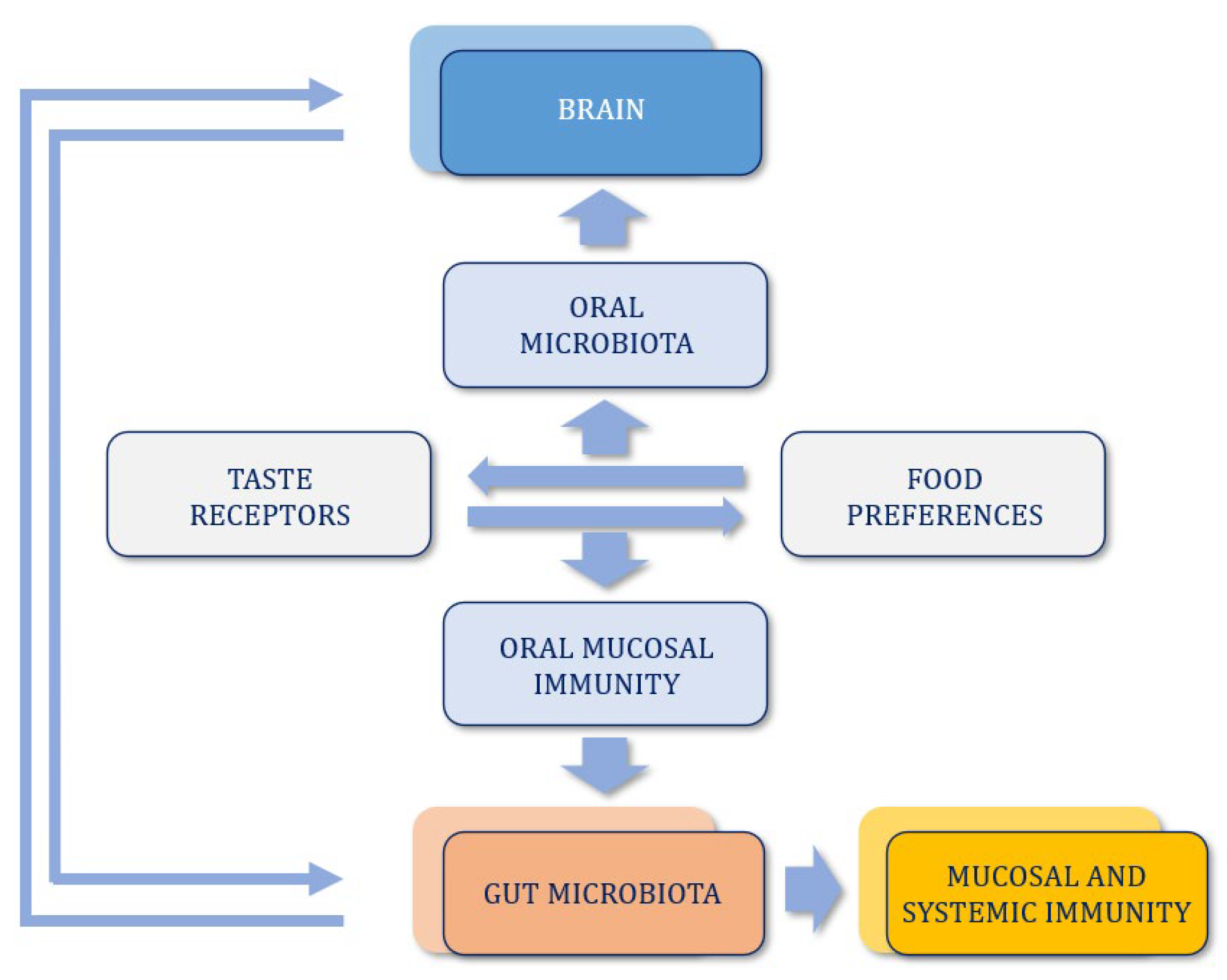
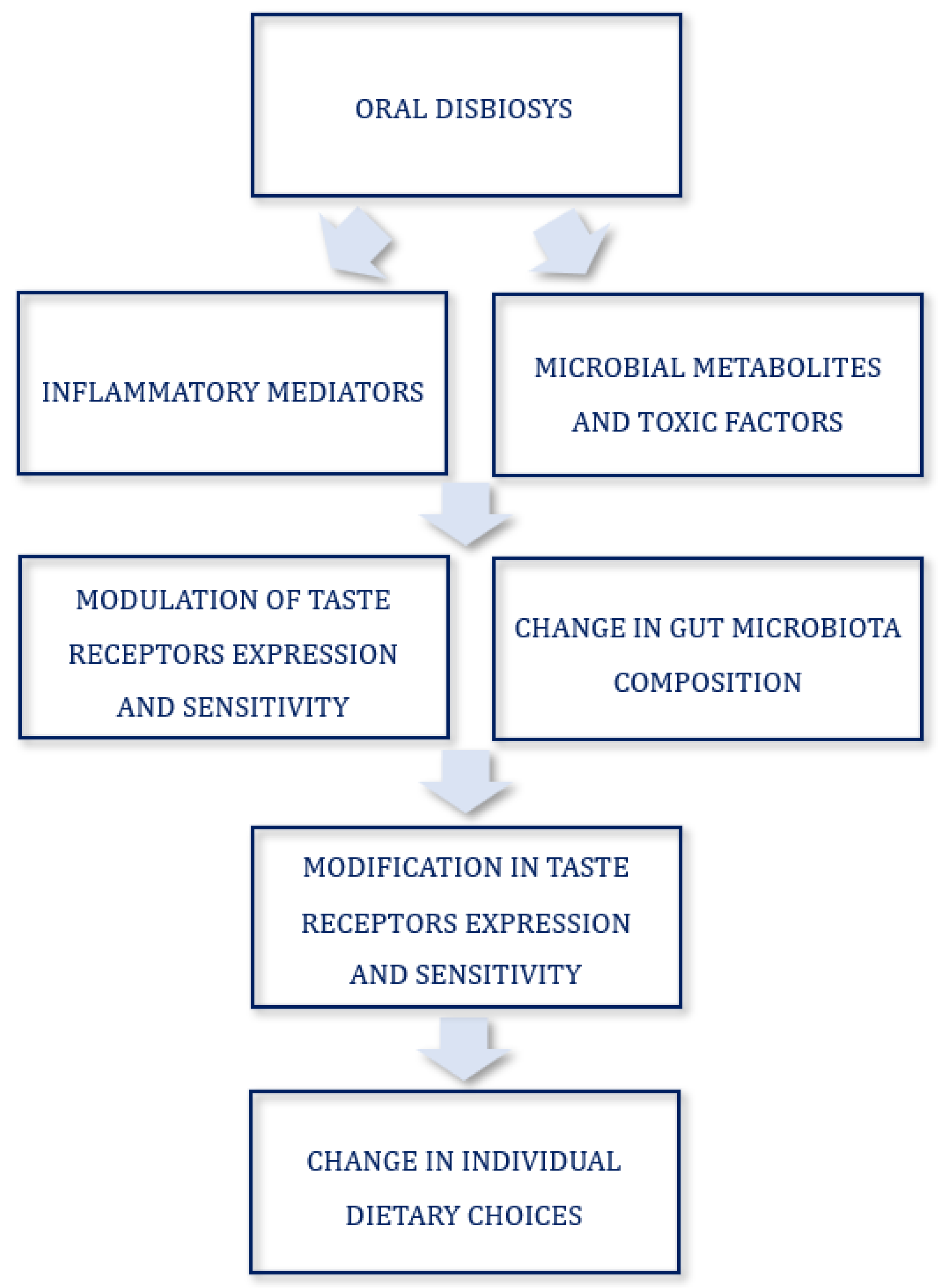
The interaction between oral microbiota and taste receptors is bidirectional, influencing individual dietary preferences. Microbial metabolites, including short-chain fatty acids and other bioactive compounds, can modulate the expression and sensitivity of taste receptors by influencing epithelial signalling pathways [146]. These mechanisms impact the gut microbiota, leading to changes in its composition and function that influence the expression and sensitivity of taste receptors, as well as individual dietary choices (Figure 1). Interestingly, inflammatory mediators such as IL-1β and TNF-α influence the regulation of taste receptors through cytokine-dependent mechanisms, affecting oral epithelial and immune cells [147]. Furthermore, changes in the epithelial microenvironment driven by the microbiota, including shifts in pH and biofilm organisation, impact the accessibility and function of taste receptors [148,149].
As can be seen in Figure 2, the interaction between oral microbiota, taste receptors, oral mucosal immunity and dietary preferences affects the gut microbiota and MALT. This, in turn, affects systemic immunity.

8. Gut Microbiota and Gut–Brain Axis

The gut microbiota indirectly influences the immune response related to MALT. It is composed of a vast number of bacteria (approximately 1015), which are extremely diverse (approximately 70,000 species). Furthermore, microeukaryotes (e.g., fungi, amoebas and flagellates), archaebacteria and viruses interact continuously with each other and can influence the evolutionary trajectory of the host, enabling adaptive processes and the evolution of the psycho-neuro-endocrine-immune (PNEI) system [3].
The composition of the gut microbial population varies according to age, dietary habits, nutritional state, the degree of industrialization of the environment in which a subject lives, and the use of substances that can modify its composition [3].
The gut microbiota performs multiple functions, such as: acting as a barrier against pathogens and pro-inflammatory substances, performing metabolic functions, such as digesting complex polysaccharides and producing short-chain fatty acids (SCFAs), vitamins and amino acids, performing a neuroendocrine function, influencing motility and sensory secretive modes of the gastrointestinal tract, performing a microbial-drug function, affecting the bioavailability, efficacy and toxicity of drugs taken by a subject. It also plays an important role in modulating immune function, which is related to maintaining the mutualistic nature of resident organisms and producing pro-inflammatory and anti-inflammatory molecules [150]. These microorganisms have hormonal receptors and use ‘quorum sensing’, enabling them to perceive and produce self-inducing molecules that regulate growth, motility and bacterial virulence. They also interact with hormonal signals produced by the host organism.
Microbial dysbiosis resulting in increased gut permeability leads to the destruction of immune homeostasis and a local systemic increase in pro-inflammatory molecules. This process leads to the development of systemic inflammation and LGCI, which is characterized by an increase in many pro-inflammatory cytokines, including IL-18, TNF-α, IFN-γ and IL-17, as well as an increase in M1 macrophages. This process induces multiple degenerative metabolic diseases affecting every organ system in the human body [151]. Additionally, the destruction of IEBs can lead to endotoxemia and bacterial translocation, whereby bacterial components, such as LPS, are transported to the submucosa, thus activating the inflammatory process. The gut tract communicates with the central nervous system (CNS) via the vagus nerve and the blood circulation. This bidirectional neuro-humoral communication system represents a veritable axis, the gut–brain axis (GBA), which is of particular importance as it allows signals from the two systems to be integrated and their mutual functions modulated. GBA contributes to maintaining the homeostatic balance of the gastrointestinal apparatus, its local neuroendocrine-immune structure, and central behavioural functions. GBA perturbations may give rise to changes in the structure of these two systems, with consequences for individuals [152]. Under normal conditions, the gut provides an ideal environment for symbiotic and commensal microorganisms to survive. However, mutations in normal intestinal physiology can destabilise this environment, thereby invalidating the functional structural integrity of the gut. This leads to changes in motility, epithelial cells, mucosal secretion and barrier function, resulting in substantial modifications to the associated mucosal microbial ecosystem [153]. Changes in the physiology of the gastrointestinal tract and the central nervous system (CNS) of the host strongly affect gastrointestinal microbiology, leading to qualitative and quantitative modifications of the microorganisms present. Psychological stress can alter the organization of the gut microbiota, as demonstrated in rodents following food and water deprivation [154], maternal separation of rat pups [155] and maternal contact limitations in Macaca rhesus [156]. This results in increased corticosteroid levels, pro-inflammatory cytokines and increased gut permeability [157].
Therefore, stress-induced activation of the hypothalamic–pituitary–adrenal (HPA) axis disturbs ordinary gut physiology, the homeostasis of existing microbiota and the mucosa-associated immune system, resulting in modification of gut physiology and consequent changes to existing bacteria, as well as increased local systemic inflammation.
The structure of the microbiota strongly affects CNS activity: rats dosed with Bifidobacterium infantis for two weeks showed increased levels of tryptophan in the blood, emphasising the communication between certain microorganisms in the gut and the CNS [158].
The introduction of pathogenic microorganisms into the gut tract promptly causes anxious behaviour in an animal model [159], affecting the vagus nerve and activating the nucleus of the solitary tract and the lateral parabrachial nucleus [160]. When mice are infected with Helicobacter pylori, they exhibit altered food-seeking behaviour and modifications in pro-opiomelanocortin levels [161]. Treating healthy mice with Escherichia coli isolated from colitis-affected mice has caused colitis and memory impairment [162].
Mice that are germ-free show a critical reduction in brain-derived neurotrophic factor (BDNF) in the hippocampus compared to specific pathogen-free (SPF) mice [163], which highlights the crucial role of gut microorganisms in developing and maintaining BDNF-induced trophic and neuroplastic activity in the central nervous system.
These data indicate the crucial role of the gut microbiota in developing the host’s behavioural response.
When the NLRP3 inflammasome is activated in response to pathogen- or danger-associated molecular patterns, it leads to the production of pro-inflammatory cytokines such as IL-18 and IL-1β, as well as triggering events such as pyroptosis and apoptosis.
Under physiological conditions, the activation of NLRP3 in epithelial gut cells by resident organisms creates a microenvironment that provides an adequate immune response and controls inflammation to preserve intestinal epithelial barrier (IEB) integrity. However, when dysbiosis occurs, NLRP3 hyperactivation causes a change in local immune responses, increasing the levels of IL-1β, IL-18, IL-17, IL-6 and TNF-α, and inducing IEB damage. Subsequently, as a result of GBA-generated communication, it causes damage to the BBB, increasing kynurenine levels and activating microglia, thereby altering the CNS’s homeostatic immune mechanisms and leading to an increase in neuroinflammation and neurodegeneration [164,165].

9. Oral–Gut–Brain Axis

The oral cavity is home to a variety of microbes, including bacteria, fungi and viruses, which play a key role in maintaining health.
Disruptions to the homeostasis of the oral microbiota can lead to chronic inflammatory diseases of the gums and contribute to the development of systemic diseases such as endocarditis, rheumatoid arthritis, osteoporosis, obesity, diabetes, and psychiatric and neurological disorders. They can also contribute to several degenerative diseases, including CRC and esophageal cancer.
Oral microbiota communities participate in the complex crosstalk generated by the interaction between the microbiota, the gut and the brain (the Microbial–Gut–Brain Axis) [51]. Many species of microorganism are present in specific niches within the host organism; when they leave these niches and settle elsewhere, they can cause illness by altering the existing balance. There is a growing body of evidence supporting the concept of an oral–gut–brain axis as an extension of the traditional gut–brain axis. Both experimental and clinical studies have demonstrated that oral dysbiosis can alter the composition of gut microbes, damage the intestinal barrier’s integrity, and trigger systemic inflammation.
Kitamoto et al. (2020) [164] demonstrated that periodontal inflammation can lead to an increase in Enterobacteriaceae in the mouth, particularly Klebsiella and Enterobacter species. These bacteria are able to colonize the gut under inflammatory conditions. However, this process only occurs when gut colonization resistance is disrupted, enabling orally derived pathobionts to displace resident intestinal strains in a competitive manner. Once established, these bacteria interact with the gut microbiota at the strain level and have adapted their metabolism to thrive in an inflamed intestinal environment. These interactions favour the expansion of Th17-inducing microbial consortia, thereby reshaping immune–microbiota interactions, sustaining mucosal inflammation, and causing epithelial barrier dysfunction. Meanwhile, the ectopic colonization of oral pathobionts exacerbates intestinal inflammation both directly, through the activation of innate inflammatory pathways (IL-1β signalling), and indirectly, by serving as cognate antigens for orally primed effector T cells that migrate to the gut. Oral pathogens and their molecular derivatives, such as lipopolysaccharide (LPS) and extracellular vesicles, can translocate to the gastrointestinal tract and enter the systemic circulation. This can lead to blood–brain barrier (BBB) dysfunction, as well as the activation of microglia and inflammatory processes [166,167,168].
The oral microbiota, or its toxic metabolites such as LPS, can reach the brain directly through the vascular system. Alternatively, they can reach the gut and affect cerebral functions indirectly, generating neurovascular alterations, increased BBB permeability, neuroinflammation and neurodegeneration [169].
The oral microbiota can interact with the central nervous system (CNS) not only through the vagal system, but also via the trigeminal nerve, which is responsible for transmitting signals between the oral cavity and the brain. These signals overlap with those from the vagal nerve through the main sensory nucleus [170]. Neuroinflammation is strongly associated with significant cognitive and neurological decline, as well as multiple psychiatric diseases of the CNS, such as depression, anxiety and bipolar disorder, as well as Parkinson’s disease, multiple sclerosis and Alzheimer’s disease [171]. One of the most relevant oral cavity pathogens is Porphyromonas gingivalis, which can reach the brain via the bloodstream and release a neurotoxic protease called gingipain. This protease is directly involved in generating β-amyloid protein plaques (Aβ) [54]. Experiments on animal models have shown that the oral administration of Porphyromonas gingivalis can lead to gut dysbiosis and cognitive impairment [52]. It has been demonstrated that Porphyromonas gingivalis can promote neuroinflammation and neurodegeneration through the activation of microglia and the stimulation of M1 macrophages, resulting in increased expression of IL-1β, IL-6 and TNF-α. An increase in these molecules at the central level leads to synaptic dysfunction due to Aβ accumulation, which is generated by activation of the NF-κB/cathepsin B pathway; all this is promoted by Porphyromonas gingivalis itself. These processes can lead to dementia and progress to Alzheimer’s disease [172]. Evidence has been found that patients with inflammatory bowel disease (IBD) have poorer oral health and a higher risk of periodontitis than those without IBD [172]. Furthermore, individuals with IBD have a higher incidence of anxiety and depression [173].

10. Conclusions

The oral cavity is home to one of the most important microbial communities in the human body. Consisting of more than 600 bacterial species, this community [173] plays a key role in maintaining oral and overall health. The microenvironment in which this microbial community exists is subject to genetic, environmental and immunological factors that can alter its delicate balance. The resulting dysbiosis creates ideal conditions for periodontal disease to develop. Dysbiosis of the oral cavity is the main cause of periodontal disease, and the chronic inflammatory disorder that develops can lead to the loss of the entire periodontal structure if not treated early.
However, the damage is not limited to the oral cavity; it involves the entire body and becomes a risk factor for chronic extraoral diseases, including cardiovascular disease, respiratory disease, diabetes, non-alcoholic steatohepatitis (NASH), obesity, inflammatory bowel disease, rheumatoid arthritis, allergic disease, Alzheimer’s disease and cancer.
The development and maintenance of periodontal disease involves many bacteria, one of the main culprits being Fusobacterium nucleatum, although the triad formed by Porphyromonas gingivalis, Tannerella forsythia and Treponema denticola is also heavily implicated. More recent studies have also highlighted numerous other oral pathogens, including Aggregatibacter actinomycetemcomitans and Filifactor alocis. These microorganisms have one thing in common: they can produce virulence factors, toxins, proteolytic enzymes, LPS, upregulate the NLRP3 inflammasome, increase the expression of MMPs and create the conditions for persistent inflammation.
Oral microbiota dysbiosis is not limited to the mouth; it also affects the intestine, altering the intestinal microbiota. Numerous experimental and clinical studies have demonstrated that oral dysbiosis can affect the composition of the intestinal microbiota, comprising a vast array of bacteria, archaebacteria, microeukaryotes, and viruses that interact continuously in a state of dynamic equilibrium. Alteration to this balance leads to the destruction of IEB, increased intestinal permeability, destruction of immune homeostasis, local and systemic increases in pro-inflammatory cytokines and development of LGCI.
This has repercussions for taste receptors, influencing the host’s food choices and creating a feedback loop that is difficult to control.
The inflammatory condition that occurs in the intestine also involves the CNS via the GBA and acts as a trigger for a wide range of neuroinflammatory and neurodegenerative diseases.
All this leads to considering the complex crosstalk generated by the interaction between the oral microbiota, intestinal microbiota, intestine and brain as being of crucial importance for an individual’s health.
Interest and research into the oral microbiome and its role in the health of the oral cavity and the individual have increased greatly in recent years, thanks in part to advances in genomic sequencing and metagenomics. This has improved our understanding of the impact of oral microbiota on health, enabling the development of increasingly effective strategies to tackle periodontal disease and prevent and treat systemic diseases such as rheumatoid arthritis, Alzheimer’s and cancer.
However, further studies are needed to explore the role of lesser-known and less characterised oral microorganisms. This will help us to understand their specific ecological functions, how they interact with other species, and how they contribute to maintaining human health. It will also be essential to study the interaction between specific strains of symbiotic bacteria, such as Bifidobacteria and Lactobacilli, and pathogenic microorganisms in the oral cavity. Modulating these interactions could help to achieve a stable equilibrium of microorganisms in different mucosal niches, thereby contributing to an individual’s state of health.

Author Contributions

V.M.: Conceptualization, Writing—original draft, Writing—review & editing, Validation. K.L.: Review & editing, Validation. C.C.: Writing—review & editing, Validation. All authors have read and agreed to the published version of the manuscript.

Funding

The authors declare that no financial support was received for the research and/or publication of this article.

Institutional Review Board Statement

Not applicable.

Informed Consent Statement

Not applicable.

Data Availability Statement

No new data were created or analyzed in this study. Data sharing is not applicable to this article.

Acknowledgments

We would like to thank Simonetta Masieri for her suggestions in developing this review. The authors declare that no Gen AI was used in the creation of this manuscript.

Conflicts of Interest

V.M. and K.L. are employed in GUNA S.p.a. CC declares that the research was conducted in the absence of any commercial or financial relationships that could be construed as a potential conflict of interest.

Abbreviations

The following abbreviations are used in this manuscript:
Amyloid β
ATPAdenosine Triphosphate
BBBBlood–Brain Barrier
BDNFBrain-Derived Neurotrophic Factor
CEACAMCarcinoembryonic Antigen-related Cell Adhesion molecules
CdtCytolethal Distending Toxin
CNSCentral Nervous System
CRCColorectal Cancer
DAMPsDanger-Associated Molecular Patterns
ESCCEsophageal Squamous Cell Carcinoma
FadAFusobacterium adhesin A
FapAFusobacterium outer membrane protein A
Fap2Fusobacterium outer membrane autotransporter protein 2
FHFactor H
GBAGut–Brain Axis
HNSCCHead-Neck Squamous Cell Carcinoma
HPAHypoyhalamus Pituitary Adrenal
IBDInflammatory Bowel Disease
IEBIntestinal Epithelial Barrier
IFNInterferon
ILInterleukin
LGCILow Grade Chronic Inflammation
LPSLipopolisaccharide
LSCCLaryngeal Squamous Cell Carcinoma
LtxALeukotoxin A
MALTMucosa Associated Lymphoid Tissue
MAPKMitogen-Activated Protein Kinase
MPPsMetalloproteinases
MSPMajor Sheath Protein
MurNAcN-Acetyl Muramic Acid
NASHNon-Alcoholic Steatohepatitis
NF-κBNuclear Factor Kappa-Light-Chain Enhancer of Activate B Cells
NKNatural Killer
NLRP3NOD-, LRR- and pyrin domain- containing protein 3
NONitric Oxide
OMVsOuter Membrane Vescicles
OPSCCOropharyngeal Squamous Cell Carcinoma
OSCCOral Squamous Cell Carcinoma
PADPeptidyl-Arginine Deaminase
PAMPsPathogen-Associated Molecular Patterns
PGE2Prostaglandin E2
PIP2Phosphatidylinositol 4,5 bisphosphate
PKB/AKTProtein Kinase B
PNEIPsycho-Neuro-Endocrine-Immunology
RadDRadiation-sensitive DNA Adhesin
ROSReactive Oxygen Species
RTXRepeats in-Toxin
SCFAShort Chain Fatty Acid
SPFSpecific Pathogen Free
ThT helper Lymphocyte
TIGITT Cells Immunoreceptors with Ig and ITIM domains
TLR2Toll Like Receptor 2
TNFTumor Necrosis Factor
TRTaste Receptor
TregT regulatory Lymphocyte

References

  1. Miller, W.D. The Human Mouth as a Focus of Infection. Lancet 1891, 138, 340–342. [Google Scholar] [CrossRef]
  2. Lamont, R.J.; Koo, H.; Hajishengallis, G. The Oral Microbiota: Dynamic Communities and Host Interactions. Nat. Rev. Microbiol. 2018, 16, 745–759. [Google Scholar] [CrossRef] [PubMed]
  3. Lagier, J.C.; Hugon, P.; Khelaifia, S.; Fournier, P.E.; Raoult, D. Human Gut Microbiota: Repertoire and Variations. Front. Cell. Infect. Microbiol. 2012, 2, 136. [Google Scholar] [CrossRef] [PubMed]
  4. Pignatelli, P.; Mura, F.; Falcone, E.; Laghi, L. Microbiota and Oral Cancer as a Complex and Dynamic Microenvironment: A Narrative Review from Etiology to Prognosis. Int. J. Mol. Sci. 2022, 23, 8323. [Google Scholar] [CrossRef]
  5. Haffajee, A.D.; Socransky, S.S. Microbial Complexes in Supragingival Plaque. Oral Microbiol. Immunol. 2008, 23, 196–205. [Google Scholar] [CrossRef]
  6. Segata, N.; Haake, S.K.; Mannon, P.; Lemon, K.P.; Waldron, L.; Gevers, D.; Huttenhower, C.; Izard, J. Composition of the adult digestive tract bacterial microbiome based on seven mouth surfaces, tonsils, throat and stool samples. Genome Biol. 2012, 13, R42. [Google Scholar] [CrossRef]
  7. Zaura, E.; Keijser, B.J.F.; Huse, S.M.; Crielaard, W. Defining the healthy “core microbiome” of oral microbial communities. BMC Microbiol. 2009, 9, 259. [Google Scholar] [CrossRef]
  8. Rai, A.K.; Ghosh, T.S.; Bhute, S.S.; Vaidya, S.; Koylass, M.; Gokul, J.K.; Ballal, S.A.; Tripathi, A.; Ghosh, S.; Sharma, V.K.; et al. The human oral microbiome and its role in health and disease. Adv. Exp. Med. Biol. 2020, 1197, 1–18. [Google Scholar]
  9. Welch, J.L.M.; Rossetti, B.J.; Rieken, C.W.; Dewhirst, F.E.; Borisy, G.G. Oral Microbiome Geography: Micron-Scale Habitat and Niche. Cell Host Microbe 2020, 28, 160–168. [Google Scholar] [CrossRef]
  10. Sterzenbach, T.; Brandt, C.; Batzilla, J. Bioadhesion in the Oral Cavity and Approaches for Biofilm Management by Surface Modifications. Clin. Oral Investig. 2020, 24, 4237–4260. [Google Scholar] [CrossRef]
  11. Baker, J.L.; O’Donnell, L.; Lamont, R.J. The Oral Microbiome: Diversity, Biogeography and Human Health. Nat. Rev. Microbiol. 2024, 22, 89–104. [Google Scholar] [CrossRef] [PubMed]
  12. Peng, X.; Zhou, X.; Zhang, Y. Oral Microbiota in Human Systemic Diseases. Int. J. Oral Sci. 2022, 14, 14. [Google Scholar] [CrossRef] [PubMed]
  13. Marsh, P.D.; Zaura, E. Dental biofilm: Ecological interactions in health and disease. J. Clin. Periodontol. 2017, 44, S12–S22. [Google Scholar] [CrossRef] [PubMed]
  14. Pedersen, A.M.L.; Sørensen, C.E.; Proctor, G.B.; Carpenter, G.H.; Ekström, J. Salivary secretion in health and disease. J. Oral Rehabil. 2019, 46, 730–746. [Google Scholar] [CrossRef]
  15. Bäckström, M. Salivary proteins and peptides in oral host defence. Adv. Dent. Res. 2020, 32, 62–69. [Google Scholar]
  16. Vila, T.; Sultan, A.S.; Montelongo-Jauregui, D.; Jabra-Rizk, M.A. Oral candidiasis: A disease of opportunity. J. Fungi 2019, 5, 15. [Google Scholar] [CrossRef]
  17. Do, T.; Devine, D.A.; Marsh, P.D. Oral biofilms: Molecular analysis, challenges, and future directions. J. Oral Microbiol. 2024, 16, 2323456. [Google Scholar]
  18. Zhou, X.; Li, Y.; Li, M.; Chen, T. Oral epithelial barrier integrity and host–microbiota interactions. Front. Immunol. 2025, 16, 118245. [Google Scholar]
  19. Nibali, L.; Donos, N.; Henderson, B. Periodontal disease susceptibility and genetic polymorphisms. J. Dent. Res. 2017, 96, 251–258. [Google Scholar]
  20. Kinane, D.F.; Stathopoulou, P.G.; Papapanou, P.N. Periodontal diseases. Nat. Rev. Dis. Primers 2017, 3, 17038. [Google Scholar] [CrossRef]
  21. Schaefer, A.S. Genetics of periodontitis: Discovery, biology, and clinical impact. Periodontology 2000, 78, 162–173. [Google Scholar] [CrossRef] [PubMed]
  22. Das, A.; Sharma, S.; Chandra, H. Biofilm Modifiers: The Disparity in Paradigm of Oral Biofilm Ecosystem. Biomed. Pharmacother. 2023, 164, 114966. [Google Scholar] [CrossRef] [PubMed]
  23. Lin, J.; Li, X.; Wang, L.; Zhang, H. Macrophages: A Communication Network Linking Porphyromonas Gingivalis Infection and Associated Systemic Diseases. Front. Immunol. 2022, 13, 952040. [Google Scholar] [CrossRef] [PubMed]
  24. Hernández-Cabanyero, C.; Vonaesch, P. Ectopic Colonization by Oral Bacteria as an Emerging Theme in Health and Disease. FEMS Microbiol. Rev. 2024, 48, fuae012. [Google Scholar] [CrossRef]
  25. Scannapieco, F.A.; Cantos, A. Oral inflammation and respiratory diseases. Respir. Res. 2016, 17, 9. [Google Scholar]
  26. Scannapieco, F.A. The oral–lung axis. Periodontology 2000, 92, 210–222. [Google Scholar]
  27. Pathak, J.L.; Yan, Y.; Zhang, Q.; Wang, L.; Ge, L. The role of oral microbiota in respiratory health and diseases. Respir. Res. 2021, 185, 106475. [Google Scholar]
  28. Carrizales-Sepúlveda, E.F. Periodontal inflammation and cardiovascular risk. Curr. Cardiol. Rev. 2018, 14, 122–136. [Google Scholar]
  29. Sanz, M.; del Castillo, A.M.; Jepsen, S.; Gonzalez-Juanatey, J.R.; D’aiuto, F.; Bouchard, P.; Chapple, I.; Dietrich, T.; Gotsman, I.; Graziani, F.; et al. Periodontitis and cardiovascular diseases: Consensus report. J. Clin. Periodontol. 2019, 47, 268–288. [Google Scholar] [CrossRef]
  30. Han, Y.W. Fusobacterium nucleatum: A multifaceted pathogen. Cell Host Microbe 2015, 17, 4–6. [Google Scholar]
  31. Wang, X.; Buhimschi, C.S.; Temoin, S.; Bhandari, V. Comparative microbial analysis of amniotic fluid and cord blood. PLoS ONE 2013, 8, e56146. [Google Scholar]
  32. Vojdani, A.; Kharrazian, D.; Mukherjee, P. The Role of Exposomes in the Pathophysiology of Autoimmune Diseases II: Pathogens. Pathophysiology 2022, 29, 243–280. [Google Scholar] [CrossRef] [PubMed]
  33. Chen, Y.; Huang, Z.; Tang, Z.; Huang, Y.; Huang, M.; Liu, H.; Ziebolz, D.; Schmalz, G. More than just a periodontal pathogen—The research progress on Fusobacterium nucleatum. Front. Cell. Infect. Microbiol. 2022, 12, 815318. [Google Scholar] [CrossRef] [PubMed]
  34. Zhang, Y. Inflammasome activation and bone loss. J. Periodontol. 2020, 91, 132–144. [Google Scholar]
  35. Moreno, C.M.; Boeree, E.; Tellez Freitas, C.M.; Weber, K.S. Immunomodulatory role of oral microbiota in inflammatory diseases and allergic conditions. Front. Allergy 2023, 4, 1067483. [Google Scholar] [CrossRef]
  36. Chattopadhyay, I.; Roy, S.; Banerjee, R. Role of Oral Microbiome Signatures in Diagnosis and Prognosis of Oral Cancer. Technol. Cancer Res. Treat. 2019, 18, 1533033819867354. [Google Scholar] [CrossRef]
  37. Acharya, S.; Kaur, R.; Sharma, P. Dysbiosis Linking Periodontal Disease and Oral Squamous Cell Carcinoma—A Brief Narrative Review. Heliyon 2024, 10, e32259. [Google Scholar] [CrossRef]
  38. Gonzalez, O.A.; Novak, M.J.; Kirakodu, S.; Stromberg, A.J.; Nagarajan, R.; Huang, C.B.; Chen, K.C.; Orraca, L.; Martinez-Gonzalez, J.; Ebersole, J.L. Differential gene expression profiles reflecting macrophage polarization in aging and periodontitis gingival tissues. Immunol. Investig. 2015, 44, 643–664. [Google Scholar] [CrossRef]
  39. Yu, X.; Wang, Y.; Zhang, Q.; Shi, D.; Han, X.; Feng, X.; Zhu, L.; Xu, Y.; Zhou, X.; Zhang, J.; et al. Macrophage polarization in periodontal disease. J. Dent. Res. 2016, 95, 1301–1308. [Google Scholar]
  40. Champaiboon, C.; Champaiboon, C.; Christensen, S.S.S.J.; Reppe, J.; Vik, O.K.V.J. Porphyromonas gingivalis outer membrane vesicles activate the NLRP3 inflammasome. Cell. Microbiol. 2014, 16, 129–143. [Google Scholar]
  41. Hou, Y.; Zhang, Y.; Liu, S.; Wang, X.; Chen, H.; Li, J. NLRP3 inflammasome in periodontitis. Front. Cell. Infect. Microbiol. 2022, 12, 818241. [Google Scholar]
  42. Yamaguchi, Y.; Kurita-Ochiai, T.; Kobayashi, R.; Suzuki, T.; Ando, T.; Yamamoto, M. Porphyromonas gingivalis and IL-1β induction. Infect. Immun. 2017, 85, e00055-17. [Google Scholar]
  43. Ding, P.; Liu, X.; Hou, Y.; Wang, X.; Zhao, M.; Li, J.; Zhang, Y. Canonical and non-canonical inflammasome activation. J. Immunol. 2020, 204, 307–316. [Google Scholar]
  44. Okano, T.; Oshima, M.; Yamada, S.; Yanagita, M. Periodontal inflammation and cytokine expression. J. Oral Sci. 2018, 60, 161–169. [Google Scholar]
  45. Taxman, D.J.; Champaiboon, C.; Christensen, S.S.S.J.; Reppe, J.; Vik, O.K.V.J. Caspase-1 inhibition by P. gingivalis. PLoS Pathog. 2012, 8, e1002524. [Google Scholar]
  46. Kelk, P.; Johansson, A.; Claesson, R.; Hänström, L.; Kalfas, S. Aggregatibacter actinomycetemcomitans leukotoxin and inflammasome activation. Infect. Immun. 2011, 79, 4589–4600. [Google Scholar]
  47. Kelly, L.; Khan, S. Oral Microbes Are a Signature of Disease in the Gut. Res. Sq. 2023. [Google Scholar] [CrossRef]
  48. Li, Z.; Chen, H.; Zhao, Q. Characterization of the Oral and Esophageal Microbiota in Esophageal Precancerous Lesions and Squamous Cell Carcinoma. Front. Cell. Infect. Microbiol. 2021, 11, 714162. [Google Scholar] [CrossRef]
  49. Ozuna, H.; Martínez-Castañón, G.A.; Niño-Martínez, N.; Patiño-Marín, N.; Loyola-Rodríguez, J.P. Periodontal pathogens and systemic disease. Front. Immunol. 2022, 13, 828195. [Google Scholar]
  50. Bowland, G.B.; Weyrich, L.S. The Oral-Microbiome-Brain Axis and Neuropsychiatric Disorders: An Anthropological Perspective. Front. Psychiatry 2022, 13, 810008. [Google Scholar] [CrossRef]
  51. Lu, J.; Li, Y.; Wang, Y.; Zhang, J. Periodontitis-Related Salivary Microbiota Aggravates Alzheimer’s Disease via Gut-Brain Axis Crosstalk. Gut Microbes 2022, 14, e2126272. [Google Scholar] [CrossRef] [PubMed]
  52. Dominy, S.S.; Lynch, C.; Ermini, F.; Benedyk, M. Porphyromonas Gingivalis in Alzheimer’s Disease Brains: Evidence for Disease Causation and Treatment with Small-Molecule Inhibitors. Sci. Adv. 2019, 5, eaau3333. [Google Scholar] [CrossRef] [PubMed]
  53. Luo, S.; Li, Z.; Chen, H.; Zhang, Y. Mitochondria: An Emerging Unavoidable Link in the Pathogenesis of Periodontitis Caused by Porphyromonas Gingivalis. Int. J. Mol. Sci. 2024, 25, 737. [Google Scholar] [CrossRef] [PubMed]
  54. Tsao, S.W.; Tsang, C.M.; To, K.F. Epstein–Barr Virus Infection and Nasopharyngeal Carcinoma. Philos. Trans. R. Soc. Lond. B Biol. Sci. 2017, 372, 20160270. [Google Scholar] [CrossRef]
  55. Economopoulou, P.; Kotsantis, I.; Psyrri, A. A Special Issue about Head and Neck Cancers: HPV Positive Cancers. Int. J. Mol. Sci. 2020, 21, 3388. [Google Scholar] [CrossRef]
  56. Wang, X.; Li, Y.; Zhou, Y.; Chen, X. Oral Microbiota: The Overlooked Catalyst in Cancer Initiation and Progression. Front. Cell Dev. Biol. 2025, 12, 1479720. [Google Scholar] [CrossRef]
  57. Li, R.; Chen, W.; Zhang, X. Role of Oral Microbiome in Oral Oncogenesis, Tumor Progression, and Metastasis. Mol. Oral Microbiol. 2023, 38, 9–22. [Google Scholar] [CrossRef]
  58. Ahn, J.; Chen, C.; Hayes, R.B. Periodontal Disease, Porphyromonas Gingivalis Serum Antibody Levels and Orodigestive Cancer Mortality. Carcinogenesis 2012, 33, 1055–1058. [Google Scholar] [CrossRef]
  59. Neculae, E.; Popescu, C.; Petrescu, S. The Oral Microbiota in Valvular Heart Disease: Current Knowledge and Future Directions. Life 2023, 13, 182. [Google Scholar] [CrossRef]
  60. Bolstad, A.I.; Jensen, H.B.; Bakken, V. Taxonomy, Biology, and Periodontal Aspects of Fusobacterium Nucleatum. Clin. Microbiol. Rev. 1996, 9, 55–71. [Google Scholar] [CrossRef]
  61. Chiscuzzu, F.; Bianconi, E.; Laghi, L. Current Evidence on the Relation between Microbiota and Oral Cancer—The Role of Fusobacterium Nucleatum—A Narrative Review. Cancers 2025, 17, 171. [Google Scholar] [CrossRef] [PubMed]
  62. Han, Y.W. Fusobacterium Nucleatum: A Commensal-Turned Pathogen. Curr. Opin. Microbiol. 2015, 23, 141–147. [Google Scholar] [CrossRef] [PubMed]
  63. Ye, C.; Wang, J.; Zhang, H.; Li, X. Fusobacterium Nucleatum in Tumors: From Tumorigenesis to Tumor Metastasis and Tumor Resistance. Cancer Biol. Ther. 2024, 25, 2306676. [Google Scholar] [CrossRef] [PubMed]
  64. Kook, J.; Park, S.; Kim, H.; Lee, D. Genome-Based Reclassification of Fusobacterium Nucleatum Subspecies at the Species Level. Curr. Microbiol. 2017, 74, 1137–1147. [Google Scholar] [CrossRef]
  65. Johnson, L.; Han, Y.W.; Kaplan, S. Oral Infection of Mice with Fusobacterium Nucleatum Results in Macrophage Recruitment to the Dental Pulp and Bone Resorption. Biomed. J. 2018, 41, 184–193. [Google Scholar] [CrossRef]
  66. Boyce, B.F.; Xing, L. TNF-Alpha and Pathologic Bone Resorption. Keio J. Med. 2005, 54, 127–131. [Google Scholar] [CrossRef]
  67. Zupan, J.; Grcevic, D.; Kovacic, N. Osteoimmunology and the Influence of Pro-Inflammatory Cytokines on Osteoclasts. Biochem. Med. 2013, 23, 43–63. [Google Scholar] [CrossRef]
  68. Kang, W.; Li, X.; Wang, Y. Fusobacterium Nucleatum Facilitates Apoptosis, ROS Generation, and Inflammatory Cytokine Production by Activating AKT/MAPK and NF-κB Signaling Pathways in Human Gingival Fibroblasts. Oxid. Med. Cell Longev. 2019, 2019, 1681972. [Google Scholar] [CrossRef]
  69. Saito, A.; Yamada, M.; Amano, A. Porphyromonas Gingivalis Entry into Gingival Epithelial Cells Modulated by Fusobacterium Nucleatum Is Dependent on Lipid Rafts. Microb. Pathog. 2012, 53, 234–242. [Google Scholar] [CrossRef]
  70. Gur, C.; Ibrahim, Y.; Isaacson, B. Fusobacterium Nucleatum Suppresses Anti-Tumor Immunity by Activating CEACAM1. Oncoimmunology 2019, 8, e1581531. [Google Scholar] [CrossRef]
  71. Yamamura, K.; Baba, Y.; Nakagawa, S.; Mima, K.; Kurashige, J.; Ueno, S.; Nishioka, Y.; Ishimoto, T.; Iwatsuki, M.; Miyamoto, Y.; et al. Intratumoral Fusobacterium Nucleatum Levels Predict Therapeutic Response to Neoadjuvant Chemotherapy in Esophageal Squamous Cell Carcinoma. Clin. Cancer Res. 2019, 25, 6150–6161. [Google Scholar] [CrossRef]
  72. Castellarin, M.; Warren, R.L.; Freeman, J.D.; Dreolini, L.; Krzywinski, M.; Strauss, J.; Barnes, R.; Watson, P.; Allen-Vercoe, E.; Moore, R.A.; et al. Fusobacterium Nucleatum Infection Is Prevalent in Human Colorectal Carcinoma. Genome Res. 2012, 22, 299–306. [Google Scholar] [CrossRef] [PubMed]
  73. Wu, N.; Yang, X.; Zhang, R.; Li, J.; Xiao, X.; Hu, Y.; Chen, Y.; Yang, L.; Zhou, H.; Tang, W.; et al. Dysbiosis Signature of Fecal Microbiota in Colorectal Cancer Patients. Microb. Ecol. 2013, 66, 462–470. [Google Scholar] [CrossRef] [PubMed]
  74. Kelk, P. Leukotoxin A–induced NLRP3 inflammasome activation in macrophages. J. Leukoc. Biol. 2022, 111, 987–998. [Google Scholar]
  75. Sordi, M.B. Pyroptosis in periodontal inflammation. Front. Immunol. 2021, 12, 658234. [Google Scholar]
  76. Rompikuntal, P.K.; Thay, B.; Hays, E.; Güssmann, C.; Lamont, R.J.; Demuth, D.R.; Jenkinson, H.F. Aggregatibacter actinomycetemcomitans outer membrane vesicles mediate immune activation. Infect. Immun. 2012, 80, 198–207. [Google Scholar]
  77. Kato, S.; Kowashi, Y.; Demuth, D.R. Outer membrane vesicles of Aggregatibacter actinomycetemcomitans. J. Periodontal Res. 2002, 37, 135–142. [Google Scholar]
  78. Demuth, D.R.; James, D.; Kowashi, Y. Characterization of leukotoxin-containing vesicles. Microb. Pathog. 2003, 34, 193–203. [Google Scholar]
  79. Karched, M.; Ihalin, R.; Eneslätt, K.; Eneslätt, K.; Asikainen, S. Peptidoglycan-associated lipoprotein of Aggregatibacter actinomycetemcomitans. Infect. Immun. 2008, 76, 3437–3446. [Google Scholar]
  80. Goulhen, F.; Hafezi, A.; Uitto, V.J. GroEL chaperonin as a virulence factor in periodontal bacteria. Infect. Immun. 1998, 66, 4135–4142. [Google Scholar]
  81. Thay, B.; Damm, A.; Kufer, T.A.; Wiese, A.; Höltje, J.-V.; Bertsche, U. NOD1- and NOD2-active peptidoglycan in periodontal pathogens. Infect. Immun. 2014, 82, 3130–3140. [Google Scholar]
  82. Razooqi, Z.; Wang, Y.; Aruni, A.W.; Roy, F.; Muthiah, A.; Fletcher, H.M. RTX ftxA toxin and Filifactor alocis pathogenicity. J. Periodontal Res. 2024, 59, 123–134. [Google Scholar]
  83. Razooqi, Z.; Wang, Y.; Aruni, A.W.; Roy, F.; Muthiah, A.; Fletcher, H.M. Filifactor alocis and clinical attachment loss progression. Front. Cell. Infect. Microbiol. 2025, 15, 1178456. [Google Scholar]
  84. Mishra, A.; Roy, F.; Aruni, A.W.; Muthiah, A.; Gonzalez, D.J.; Fletcher, H.M. Oxidative stress resistance mechanisms of Filifactor alocis. J. Bacteriol. 2020, 202, e00345-20. [Google Scholar]
  85. Socransky, S.S.; Haffajee, A.D.; Cugini, M.A.; Smith, C.; Kent, R.L. Microbial complexes in subgingival plaque. J. Clin. Periodontol. 1998, 25, 134–144. [Google Scholar] [CrossRef]
  86. Holt, S.C.; Ebersole, J.L. Porphyromonas gingivalis, Tannerella forsythia, and Treponema denticola. Periodontology 2000 2005, 38, 72–122. [Google Scholar] [CrossRef]
  87. Jennings, M.P. Sialidase activity in periodontal pathogens. Microbiology 2022, 168, 001123. [Google Scholar]
  88. Honma, K.; Mishima, E.; Shibata, Y.; Takeuchi, Y.; Uematsu, H.; Shibata, T. NanH sialidase of Tannerella forsythia. Infect. Immun. 2011, 79, 136–146. [Google Scholar] [CrossRef]
  89. Hottmann, I.; Voglauer, R.; Honma, K.; Sharma, A.; Schäffer, C. MurNAc auxotrophy and biofilm survival of Tannerella forsythia. Mol. Oral Microbiol. 2021, 36, 115–125. [Google Scholar]
  90. Hamlet, S.; Pike, R.N.; McGraw, W.T.; Hunter, N.; Bartold, P.M.; Rogers, A.H. PrtH cysteine protease of Tannerella forsythia. Infect. Immun. 2008, 76, 2565–2573. [Google Scholar]
  91. Ksiazek, M.; Mizgalska, D.; Eick, S.; Thøgersen, I.B.; Enghild, J.J. KLIKK proteases in periodontal pathogens. Mol. Oral Microbiol. 2015, 30, 294–306. [Google Scholar]
  92. Jusko, M.; Potempa, J.; Mizgalska, D.; Bielinska, E.; Ksiazek, M.; Enghild, J.J. Karilysin inhibits complement activation. J. Immunol. 2012, 189, 314–322. [Google Scholar]
  93. Koneru, L.; Potempa, J.; Kantyka, T.; Mizgalska, D.; Bielecka, E.; Bachrach, G. Cathelicidin inactivation by periodontal proteases. Infect. Immun. 2017, 85, e00561-16. [Google Scholar]
  94. Koziel, J.; Potempa, J.; Bereswill, S.; Hänsch, G.M. Immune evasion strategies of Tannerella forsythia. Trends Microbiol. 2010, 18, 373–381. [Google Scholar]
  95. Posch, G.; Sekot, G.; Friedrich, V.; Zayni, S.; Messner, P.; Schäffer, C. S-layer proteins of Tannerella forsythia. Mol. Oral Microbiol. 2011, 26, 203–216. [Google Scholar]
  96. Sekot, G.; Posch, G.; Messner, P.; Matejka, M.; Rausch-Fan, X.; Schäffer, C. TfsA and TfsB proteins in host interaction. J. Dent. Res. 2012, 91, 921–926. [Google Scholar]
  97. Ye, X.; Zhang, Y.; Wang, J.; Liu, H.; Chen, F. Tannerella forsythia immune modulation. Front. Immunol. 2024, 15, 1189234. [Google Scholar]
  98. Bloch, S.; Sekot, G.; Posch, G.; Schäffer, C.; Messner, P.; Friedrich, V. S-layer mediated immune evasion. Cell. Microbiol. 2018, 20, e12887. [Google Scholar]
  99. Settem, R.P.; Honma, K.; Nakajima, T.; Pham, T.T.; Sharma, A.; McBride, B.C. Tannerella forsythia–host interaction. Infect. Immun. 2013, 81, 2728–2737. [Google Scholar]
  100. Onishi, S.; Honma, K.; Shibata, Y.; Takeuchi, Y.; Uematsu, H.; Shibata, T. TLR2-mediated BspA signalling. Infect. Immun. 2008, 76, 5819–5827. [Google Scholar]
  101. Sharma, A.; Sojar, H.T.; Glurich, I.; De Nardin, E. BspA-induced cytokine release. J. Biol. Chem. 1998, 273, 20300–20305. [Google Scholar]
  102. Haheim, L.L.; Rønningen, K.S.; Olsen, I.; Ravndal, E.; Bjørnholt, J.V.; Haug, E.S.; Hansen, B.F.; Holm, S.; Skarstein, K.; Schirmer, H.; et al. Atherosclerosis and periodontal pathogens. Atherosclerosis 2020, 297, 1–8. [Google Scholar]
  103. Friedrich, V.; Bloch, S.; Sekot, G.; Posch, G.; Schäffer, C.; Messner, P. OMVs of Tannerella forsythia induce inflammation. Cell. Microbiol. 2020, 22, e13155. [Google Scholar]
  104. Cimasoni, G. The role of Treponema denticola in periodontal disease. J. Periodontal Res. 1987, 22, 453–459. [Google Scholar]
  105. Weinberg, A.; Holt, S.C. Chemical and biological activities of Treponema denticola outer membrane vesicles. Infect. Immun. 1991, 59, 147–154. [Google Scholar]
  106. Kuehn, M.J.; Kesty, N.C. Bacterial outer membrane vesicles and the host–pathogen interaction. Genes Dev. 2005, 19, 2645–2655. [Google Scholar] [CrossRef]
  107. Chi, B.; Qi, M.; Kuramitsu, H.K. Role of dentilysin in Treponema denticola epithelial cell layer penetration. Infect. Immun. 2003, 71, 593–600. [Google Scholar]
  108. Kim, Y.J.; Kim, S.J.; Lee, J.H. Toxin–antitoxin systems in oral spirochetes. J. Bacteriol. 2009, 191, 7071–7079. [Google Scholar]
  109. Makarova, K.S.; Wolf, Y.I.; Koonin, E.V. Comprehensive comparative-genomic analysis of toxin–antitoxin systems and their evolution. Biol. Direct 2009, 4, 19. [Google Scholar] [CrossRef]
  110. Mitchell, A.; Romano, G.H.; Groisman, B.; Yona, A.; Dekel, E.; Kupiec, M.; Dahan, O.; Pilpel, Y. Adaptive prediction of environmental changes by microorganisms. Nature 2010, 460, 220–224. [Google Scholar] [CrossRef]
  111. Lewis, K. Riddle of biofilm resistance. Antimicrob. Agents Chemother. 2001, 45, 999–1007. [Google Scholar] [CrossRef] [PubMed]
  112. Jayraman, A.; Wood, T.K. Bacterial quorum sensing: Signals, circuits, and implications. Annu. Rev. Biomed. Eng. 2008, 10, 145–167. [Google Scholar] [CrossRef] [PubMed]
  113. Uitto, V.J.; Grenier, D.; McBride, B.C. Isolation and characterization of a chymotrypsin-like protease from Treponema denticola. Infect. Immun. 1988, 56, 2717–2722. [Google Scholar] [CrossRef] [PubMed]
  114. Makinen, K.K.; Makinen, P.L. Purification and properties of dentilysin from Treponema denticola. Infect. Immun. 1995, 63, 3472–3477. [Google Scholar]
  115. Ishihara, K.; Kuramitsu, H.K.; Okuda, K. Molecular cloning and expression of a Treponema denticola protease gene. Infect. Immun. 1996, 64, 5178–5186. [Google Scholar] [CrossRef]
  116. Beausejour, D.; Grenier, D.; Mayrand, D. Proteolytic activity of Treponema denticola on extracellular matrix components. Infect. Immun. 1997, 65, 476–481. [Google Scholar]
  117. Grenier, D.; Mayrand, D. Functional characterization of Treponema denticola proteases. J. Bacteriol. 1987, 169, 200–207. [Google Scholar]
  118. Dawson, D.R.; Wang, C.; Danaher, R.J. Dentilysin-mediated activation of matrix metalloproteinase-2. J. Periodontal Res. 1990, 25, 343–349. [Google Scholar]
  119. McDowell, J.V.; Huang, B.; Fenno, J.C.; Marconi, R.T. Analysis of a Treponema denticola factor H binding protein. Infect. Immun. 2007, 75, 507–514. [Google Scholar]
  120. Pangburn, M.K.; Muller-Eberhard, H.J. The alternative pathway of complement. J. Exp. Med. 1977, 146, 257–270. [Google Scholar] [CrossRef]
  121. Ruddy, S.; Austen, K.F. Activation of the alternative complement pathway. J. Immunol. 1969, 102, 533–543. [Google Scholar] [CrossRef] [PubMed]
  122. Kurniyati, K.; Zhang, Y.; Kelly, A.; Yang, Z.; McBride, J.W.; Fenno, J.C. A Treponema denticola neuraminidase promotes complement resistance. Infect. Immun. 2013, 81, 3623–3633. [Google Scholar]
  123. Visser, M.B.; Ellen, R.P. Treponema denticola major surface protein disrupts actin dynamics. Cell. Microbiol. 2011, 13, 123–135. [Google Scholar]
  124. Ellen, R.P.; Galimanas, V.B. Spirochetes at the forefront of periodontal infections. Periodontology 2000 2005, 38, 13–32. [Google Scholar] [CrossRef]
  125. Sela, M.N. Role of Treponema denticola in periodontal diseases. Crit. Rev. Oral Biol. Med. 2001, 12, 399–413. [Google Scholar] [CrossRef]
  126. Amin, M.; Ho, A.C.; Lin, J.Y. Cytoskeletal disruption induced by periodontal pathogens. J. Dent. Res. 2004, 83, 141–145. [Google Scholar]
  127. Puthengady Thomas, B.; Prabhu, S.R. Chemotaxis alterations in periodontal disease. J. Periodontal Res. 2006, 41, 243–249. [Google Scholar]
  128. Wang, Q.; Ko, K.S.; Kapus, A.; McCulloch, C.A. A spirochetal surface protein alters actin dynamics. Mol. Biol. Cell 2002, 13, 402–415. [Google Scholar]
  129. Uitto, V.J.; McBride, B.C. Role of Treponema denticola in actin cytoskeleton modulation. Infect. Immun. 1995, 63, 331–339. [Google Scholar]
  130. Morfini, G.; Pigino, G.; Beffert, U.; Busciglio, J.; Brady, S.T. Fast axonal transport dysfunction in neurodegeneration. Nat. Rev. Neurosci. 2012, 13, 559–573. [Google Scholar]
  131. Beal, M.F. Mitochondrial dysfunction in neurodegenerative diseases. Biochim. Biophys. Acta 2007, 1762, 755–766. [Google Scholar] [CrossRef] [PubMed]
  132. Fukui, H.; Moraes, C.T. Mitochondrial impairment in neurodegeneration. Trends Neurosci. 2009, 32, 160–168. [Google Scholar]
  133. Mattson, M.P.; Gleichmann, M.; Cheng, A. Mitochondria in neuroplasticity and neurological disorders. Neuron 2008, 60, 748–766. [Google Scholar] [CrossRef] [PubMed]
  134. Dong, H.; Liu, J.; Xu, X.; Yu, L.; Xie, H.; Dong, C.; Zhu, H.; Wang, W. Oral Microbiota-Host Interaction Mediated by Taste Receptors. Front. Cell. Infect. Microbiol. 2022, 12, 802504. [Google Scholar] [CrossRef]
  135. Dong, D.; Jones, G.; Zhang, S.; Li, Y.; Wang, X.; Chen, Z. Dynamic Evolution of Bitter Taste Receptor Genes in Vertebrates. BMC Evol. Biol. 2009, 9, 12. [Google Scholar] [CrossRef]
  136. Workman, A.D.; Palmer, J.N.; Adappa, N.D.; Cohen, N.A. The Role of Bitter and Sweet Taste Receptors in Upper Airway Immunity. Curr. Allergy Asthma Rep. 2015, 15, 72. [Google Scholar] [CrossRef]
  137. Li, X.; Staszewski, L.; Xu, H.; Durick, K.; Zoller, M.; Adler, E. Human Receptors for Sweet and Umami Taste. Proc. Natl. Acad. Sci. USA 2002, 99, 4692–4696. [Google Scholar] [CrossRef]
  138. Kojima, I.; Nakagawa, Y.; Fukuda, K.; Yamada, H. The Role of the Sweet Taste Receptor in Enteroendocrine Cells and Pancreatic β-Cells. Diabetes Metab. J. 2011, 35, 451–457. [Google Scholar] [CrossRef]
  139. Kyriazis, G.A.; Li, Y.; Wang, J.; Zhang, X. Sweet Taste Receptor Signaling in Beta Cells Mediates Fructose-Induced Potentiation of Glucose-Stimulated Insulin Secretion. Proc. Natl. Acad. Sci. USA 2012, 109, E524–E532. [Google Scholar] [CrossRef]
  140. Zhao, G.Q.; Zhang, X.; Li, Y.; Wang, J. The Receptors for Mammalian Sweet and Umami Taste. Cell 2003, 115, 255–266. [Google Scholar] [CrossRef]
  141. Basson, M.D.; Smith, R.; Johnson, K.; Lee, C. Association between 6-N-Propylthiouracil (PROP) Bitterness and Colonic Neoplasms. Dig. Dis. Sci. 2005, 50, 483–489. [Google Scholar] [CrossRef] [PubMed]
  142. Mennella, J.A.; Pepino, M.Y.; Reed, D.R. Genetic and environmental determinants of bitter perception and sweet preferences. Pediatrics 2010, 126, e1250–e1258. [Google Scholar] [CrossRef] [PubMed]
  143. Tepper, B.J.; White, E.A.; Koelliker, Y.; Lanzara, C.; d’Adamo, P.; Gasparini, P. Genetic variation in bitter taste receptor TAS2R38 and the perception of bitter taste. Chem. Senses 2008, 33, 611–619. [Google Scholar]
  144. Jaggupilli, A.; Singh, N.; Upadhyaya, J.; Sikarwar, A.S.; Arakawa, M.; Dakshinamurti, S.; Chelikani, P. Analysis of the expression of human bitter taste receptors in extraoral tissues. Mol. Cell. Biochem. 2019, 454, 137–147. [Google Scholar] [CrossRef]
  145. Lee, R.J.; Cohen, N.A. Taste receptors in innate immunity. Cell. Mol. Life Sci. 2015, 72, 217–236. [Google Scholar] [CrossRef]
  146. Carey, R.M.; Lee, R.J. Taste receptors in the gastrointestinal tract. Curr. Opin. Endocrinol. Diabetes Obes. 2017, 24, 18–24. [Google Scholar]
  147. Lee, R.J.; Xiong, G.; Kofonow, J.M.; Chen, B.; Lysenko, A.; Jiang, P.; Abraham, V.; Doghramji, L.; Adappa, N.D.; Palmer, J.N.; et al. T2R38 taste receptor polymorphisms underlie susceptibility to upper respiratory infection. J. Clin. Investig. 2017, 122, 4145–4159. [Google Scholar] [CrossRef]
  148. Adak, A.; Khan, M.R.; Sharma, P.; Gupta, A.; Das, R. An Insight into Gut Microbiota and Its Functionalities. Cell. Mol. Life Sci. 2019, 76, 473–493. [Google Scholar] [CrossRef]
  149. Belizário, J.E.; Faintuch, J.; Garay-Malpartida, M.; de Carvalho, F.A.; Rocha, V.; Justino, T.; Dias-Neto, E.; Mota, J.F. Gut Microbiome Dysbiosis and Immunometabolism: New Frontiers for Treatment of Metabolic Diseases. Mediat. Inflamm. 2018, 2018, 2037838. [Google Scholar] [CrossRef]
  150. Vantrappen, G.; Janssens, J.; Peeters, M.; Hiele, M.; De Roo, M. The Interdigestive Motor Complex of Normal Subjects and Patients with Bacterial Overgrowth of the Small Intestine. J. Clin. Investig. 1977, 59, 1158–1168. [Google Scholar] [CrossRef]
  151. Falk, P.G.; Hooper, L.V.; Midtvedt, T.; Gordon, J.I. Creating and Maintaining the Gastrointestinal Ecosystem: What We Know and Need to Know from Gnotobiology. Microbiol. Mol. Biol. Rev. 1998, 62, 1157–1170. [Google Scholar] [CrossRef] [PubMed]
  152. Tannock, G.W.; Savage, D.C. Influences of Dietary and Environmental Stress on Microbial Populations in the Murine Gastrointestinal Tract. Infect. Immun. 1974, 9, 591–598. [Google Scholar] [CrossRef] [PubMed]
  153. Gareau, M.G.; Sherman, P.M.; Walker, W.A. Probiotic Treatment of Rat Pups Normalises Corticosterone Release and Ameliorates Colonic Dysfunction Induced by Maternal Separation. Gut 2007, 56, 1522–1528. [Google Scholar] [CrossRef] [PubMed]
  154. Bailey, M.T.; Coe, C.L. Maternal Separation Disrupts the Integrity of the Intestinal Microflora in Infant Rhesus Monkeys. Dev. Psychobiol. 1999, 35, 146–155. [Google Scholar] [CrossRef]
  155. O’Mahony, S.M.; Clarke, G.; Borre, Y.; Dinan, T.G.; Cryan, J.F. Early Life Stress Alters Behavior, Immunity, and Microbiota in Rats: Implications for Irritable Bowel Syndrome and Psychiatric Illnesses. Biol. Psychiatry 2009, 65, 263–267. [Google Scholar] [CrossRef]
  156. Desbonnet, L.; Garrett, L.; Clarke, G.; Bienenstock, J.; Dinan, T.G. The Probiotic Bifidobacterium Infantis: An Assessment of Potential Antidepressant Properties in the Rat. J. Psychiatr. Res. 2008, 43, 164–174. [Google Scholar] [CrossRef]
  157. Goehler, L.E.; Park, S.; Opitz, N.; Lyte, M.; Gaykema, R.P. Infection-Induced Viscerosensory Signals from the Gut Enhance Anxiety: Implications for Psychoneuroimmunology. Brain Behav. Immun. 2007, 21, 721–726. [Google Scholar] [CrossRef]
  158. Wang, X.; Li, Y.; Zhang, H.; Xu, Q.; Chen, Y. Evidences for Vagus Nerve in Maintenance of Immune Balance and Transmission of Immune Information from Gut to Brain in STM-Infected Rats. World J. Gastroenterol. 2002, 8, 540–545. [Google Scholar] [CrossRef]
  159. Bercik, P.; Verdu, E.F.; Foster, J.A.; Macri, J.; Potter, M.; Huang, X.; Malinowski, P.; Jackson, W.; Blennerhassett, P.A.; Collins, S.M. Immune-Mediated Neural Dysfunction in a Murine Model of Chronic Helicobacter Pylori Infection. Gastroenterology 2002, 123, 1205–1215. [Google Scholar] [CrossRef]
  160. Jang, S.E.; Lee, J.E.; Lee, H.J.; Han, M.J.; Kim, D.H. Gastrointestinal Inflammation by Gut Microbiota Disturbance Induces Memory Impairment in Mice. Mucosal Immunol. 2018, 11, 369–379. [Google Scholar] [CrossRef]
  161. Sudo, N.; Chida, Y.; Aiba, Y.; Sonoda, J.; Oyama, N.; Yu, X.N.; Kubo, C.; Koga, Y. Postnatal Microbial Colonization Programs the Hypothalamic-Pituitary-Adrenal System for Stress Response in Mice. J. Physiol. 2004, 558, 263–275. [Google Scholar] [CrossRef]
  162. Pellegrini, C.; Antonioli, L.; Colucci, R.; Di Paola, R.; Fornai, M.; Blandizzi, C. Microbiota-Gut-Brain Axis in Health and Disease: Is NLRP3 Inflammasome at the Crossroads of Microbiota-Gut-Brain Communications? Prog. Neurobiol. 2020, 191, 101806. [Google Scholar] [CrossRef]
  163. Chang, L.; Adeyemo, M.; Karunanayake, C.; Swain, J.R.; Qian, W.; Bercik, P. Brain–Gut–Microbiota Axis in Depression: A Historical Overview and Future Directions. Brain Res. Bull. 2022, 182, 44–56. [Google Scholar] [CrossRef] [PubMed]
  164. Kitamoto, S.; Nagao-Kitamoto, H.; Jiao, Y.; Gillilland, M.G.; Hayashi, A.; Imai, J.; Sugihara, K.; Miyoshi, M.; Brazil, J.C.; Kuffa, P.; et al. Oral–gut axis and inflammatory disease. Cell 2020, 182, 447–462. [Google Scholar] [CrossRef] [PubMed]
  165. Atarashi, K.; Tanoue, T.; Ando, M.; Kamada, N.; Nagamori, T.; Narushima, S.; Suda, W.; Imanishi, Y.; Hase, K.; Ohno, H.; et al. Th17 cell induction by microbiota. Cell 2017, 163, 367–380. [Google Scholar] [CrossRef] [PubMed]
  166. Peng, Y.; Zhang, L.; Wang, X.; Liu, Y.; Chen, J.; Li, H.; Zhao, Y.; Sun, Q.; Zhou, Y.; Xu, H.; et al. Oral microbiota–driven neuroinflammation. Front. Immunol. 2022, 13, 906738. [Google Scholar]
  167. Bulgart, H.R.; Gosalbez, A.; Lee, C.; Foster, J.A.; Walker, W.A.; McVey, D.M. Microbial Involvement in Alzheimer Disease Development and Progression. Mol. Neurodegener. 2020, 15, 42. [Google Scholar] [CrossRef]
  168. Goellner, E.; Rocha, C.E. Anatomy of Trigeminal Neuromodulation Targets: From Periphery to the Brain. Prog. Neurol. Surg. 2020, 35, 18–34. [Google Scholar]
  169. Karr, J.E.; Areshenkoff, C.N.; Garcia-Barrera, M.A.; Logan, A.R.; Burke, S.L.; Hogervorst, E.; Allard, E.S. When Does Cognitive Decline Begin? A Systematic Review of Change Point Studies on Accelerated Decline in Cognitive and Neurological Outcomes Preceding Mild Cognitive Impairment, Dementia, and Death. Psychol. Aging 2018, 33, 195–218. [Google Scholar] [CrossRef]
  170. Nie, R.; Zhang, Y.; Li, X.; Zhou, H.; Chen, J.; Wang, L. Porphyromonas Gingivalis Infection Induces Amyloid-β Accumulation in Monocytes/Macrophages. J. Alzheimers Dis. 2019, 72, 479–494. [Google Scholar] [CrossRef]
  171. Papageorgiou, S.N.; König, J.; Schmalz, G.; Scully, C.; Huber, S.; Flemmig, T.F. Inflammatory Bowel Disease and Oral Health: Systematic Review and a Meta-Analysis. J. Clin. Periodontol. 2017, 44, 382–393. [Google Scholar] [CrossRef]
  172. Bernstein, C.N.; Fried, M.; Krugliak, P.; Cohen, A.; Eliakim, R.; Fedail, S.; Bitton, A.; Shanahan, F.; Ghosh, S.; Vael, C.; et al. Increased Burden of Psychiatric Disorders in Inflammatory Bowel Disease. Inflamm. Bowel Dis. 2019, 25, 360–368. [Google Scholar] [CrossRef]
  173. Dewhirst, F.E.; Chen, T.; Izard, J.; Paster, B.J.; Tanner, A.C.R.; Yu, W.-H.; Lakshmanan, A.; Wade, W.G. The human oral microbiome. J. Bacteriol. 2010, 192, 5002–5017. [Google Scholar] [CrossRef]
Figure 1. Oral dysbiosis leads to a change in the oral microenvironment due to the release of microbial metabolites and toxins, as well as the presence of inflammatory mediators. This results in a modulation of the expression and sensitivity of taste receptors, as well as a change in the intestinal microbiota, which has further repercussions on taste receptors and ultimately on individual dietary choices.
Cells 15 00082 g001
Figure 2. The figure illustrates the complex relationship between oral microbiota and oral mucosal immunity. This arrangement has a strong influence on an individual’s food preferences through taste receptors. It also illustrates how intestinal microbiota are highly sensitive to changes in an individual’s dietary choices, and how modifications in the microbiota can produce changes in the mucosal immune system, and consequently in systemic immunity. At a central level, these changes are perceived and lead to strong conditioning of the psychoneuroendocrine-immunological structure. This new condition is then perceived at the intestinal level, particularly by the microbiota and mucosal immune system. This creates an important two-way communication axis: the Gut–Brain Axis.
Cells 15 00082 g002
Table 1. The presence of various species and kinds of microorganisms in the different compartments of the oral cavity. The authors created this table using data from Pignatelli et al. [4], Segata et al. [6] Zaura et al. [7] and Adesh Kumar Rai et al. [8].
SiteMicrobial GenusSpecies
TongueStreptococcusaustralis, parasanguinis,
salivarius
Veillonelladispar, parvula
Fusobacteriumperiodonticum
Prevotellanancelensis
Atropobiumparvulum
Granulicatellaadiacens, hemolysans
Tooth surface,
subgingival plaque
and gingival epithelium
Parviromonasmicros
Streptococcusgordonii, intermedius,
mitis, oralis, sanguinis
Actinomycesisraelii, naeslundii,
odontolyticus
Capnocytophagagingivalis, sputigena,
ochracea
Eikenellacorrodens
Neisseriamucosa
Veillonellaparvula
Campylobactergracilis, rectus, showae
Selenomonasnoxia
Prevotellaintermedia, nigrescens,
melaninogenica
Fusobacterium nucleatumspp. nucleatum,
spp. polymorphum
spp. vincentii
spp. periodonticum
Eubacteriumnodatum
Porphyromonasgingivalis, CW034
Tannerellaforsythia
Treponemadenticola, socranskii
Aggregatibacteractinomycemcomitans
Filifactoralocis
Corynebacteriumdurum
Granulicatellahemolysans
Gemellamorbillorum
Bergeyella602d02
Buccal MucosaStreptococcusmitis
Rothiamucilaginosa
Actinomycesodontolitycus
Neisseriasubflava
SalivaAggregatibacteractinomycemcomitans, segnis
Neisseriasubflava, bacilliformis
Veillonelladispar, parvula
Prevotellamelaninogenica, pallens,
nanceiensis, nigrescens
Rothiadentocariosa, mucilaginosa
Streptococcusanginosus
Porphyromonasendodontalis
Fusobacteriumsp.
Capnocytophagaochracea
Treponemaamylovorum
Peptostreptococcusanaerobius
Tonsil and oropharyngeal
region
Streptococcusanginosus, mutans,
pneumoniae, pyogenes,
viridans
Prevotella-
Haemophylusinfluenza, parainfluenzae
Neisseria-
Table 2. Activities associated with Porphyromonas gingivalis.
MicrobialActivity
Porphyromonas gingivalisupregulation of NLRP3 inflammasome
increase in pro-inflammatory cytokines
anti-inflammatory cytokines inhibition
increase in expression of MMPs
triggering of autoimmune disease by PAD enzyme
NASH induction
increase of triglycerides in hepatic tissue
hepatic cirrhosis induction
insulin-resistance induction
apoptosis inhibition (inhibition Caspase-3; increase Bcl-2)
alteration of mitochondrial oxidative phosphorylation
OSCC induction and progression
production of β-indolic compounds in the gut
neurotoxicity (tau protein damage and β-amyloid protein production)
Table 3. Activities associated with Fusobacterium nucleatum.
MicrobialActivity
Fusobacterium nucleatumintestinal inflammation induction
NF-κB activation
increase in pro-inflammatory cytokines
increase in immunosuppression
increase in ROS
inhibition of gengival fibroblast proliferation
production of β-indolic compounds in the gut
CRC, SCC, ESCC induction and progression of breast cancer induction
Disclaimer/Publisher’s Note: The statements, opinions and data contained in all publications are solely those of the individual author(s) and contributor(s) and not of MDPI and/or the editor(s). MDPI and/or the editor(s) disclaim responsibility for any injury to people or property resulting from any ideas, methods, instructions or products referred to in the content.