Skip to Content

Toxins, Volume 12, Issue 1

2020 January - 60 articles

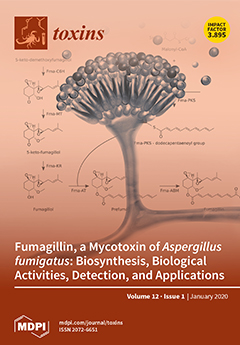
Cover Story: Fumagillin is a mycotoxin produced by the pathogenic filamentous fungus Aspergillus fumigatus, which is important because of its role in the fungal infection process. This review offers a complete overview of all the information currently related to this mycotoxin and its applications, notably in oncology, as an anti-tumor molecule, in the treatment of infectious diseases like HIV or in the treatment of different parasitosis, like microsporidiosis, with a special focus on beekeeping. View this paper.
  • Issues are regarded as officially published after their release is announced to the table of contents alert mailing list .
  • You may sign up for email alerts to receive table of contents of newly released issues.
  • PDF is the official format for papers published in both, html and pdf forms. To view the papers in pdf format, click on the "PDF Full-text" link, and use the free Adobe Reader to open them.

Articles (60)

  • Article
  • Open Access
14 Citations
5,604 Views
11 Pages

A Structural Study on the Listeria Monocytogenes Internalin A—Human E-cadherin Interaction: A Molecular Tool to Investigate the Effects of Missense Mutations

  • Luca Dellafiora,
  • Virginia Filipello,
  • Chiara Dall’Asta,
  • Guido Finazzi,
  • Gianni Galaverna and
  • Marina Nadia Losio

20 January 2020

Listeria monocytogenes is a widespread foodborne pathogen of high concern and internalin A is an important virulence factor that mediates cell invasion upon the interaction with the host protein E-cadherin. Nonsense mutations of internalin A are know...

  • Article
  • Open Access
6 Citations
4,021 Views
13 Pages

Gas Chromatography–Mass Spectrometry Profiling of Volatile Compounds Reveals Metabolic Changes in a Non-Aflatoxigenic Aspergillus flavus Induced by 5-Azacytidine

  • Fengqin Song,
  • Qingru Geng,
  • Xuewei Wang,
  • Xiaoqing Gao,
  • Xiaona He,
  • Wei Zhao,
  • Huahui Lan,
  • Jun Tian,
  • Kunlong Yang and
  • Shihua Wang

19 January 2020

Aspergillus flavus is one of the most opportunistic pathogens invading many important oilseed crops and foodstuffs with such toxic secondary metabolites as aflatoxin (AF) and Cyclopiazonic acid. We previously used the DNA methylation inhibitor 5-azac...

  • Review
  • Open Access
57 Citations
7,440 Views
12 Pages

19 January 2020

The protein-bound uremic toxins, indoxyl sulfate (IS) and p-cresyl sulfate (PCS), are considered to be harmful vascular toxins. Arterial media calcification, or the deposition of calcium phosphate crystals in the arteries, contributes significantly t...

  • Article
  • Open Access
41 Citations
6,909 Views
10 Pages

Patulin Mycotoxin in Mango and Orange Fruits, Juices, Pulps, and Jams Marketed in Pakistan

  • Shabbir Hussain,
  • Muhammad Rafique Asi,
  • Mazhar Iqbal,
  • Nisha Khalid,
  • Syed Wajih-ul-Hassan and
  • Agustín Ariño

16 January 2020

The objective of the study was to explore the incidence of patulin (PAT) mycotoxin in mango and orange fruits and derived products marketed in Pakistan. A total of 274 samples, including 70 mango fruits, 63 mango-based products (juices, pulp, and jam...

  • Article
  • Open Access
24 Citations
7,535 Views
16 Pages

Antivenom Neutralization of Coagulopathic Snake Venom Toxins Assessed by Bioactivity Profiling Using Nanofractionation Analytics

  • Chunfang Xie,
  • Julien Slagboom,
  • Laura-Oana Albulescu,
  • Ben Bruyneel,
  • Kristina B. M. Still,
  • Freek J. Vonk,
  • Govert W. Somsen,
  • Nicholas R. Casewell and
  • Jeroen Kool

16 January 2020

Venomous snakebite is one of the world’s most lethal neglected tropical diseases. Animal-derived antivenoms are the only standardized specific therapies currently available for treating snakebite envenoming, but due to venom variation, often th...

  • Article
  • Open Access
14 Citations
7,217 Views
13 Pages

Venomics and Cellular Toxicity of Thai Pit Vipers (Trimeresurus macrops and T. hageni)

  • Supeecha Kumkate,
  • Lawan Chanhome,
  • Tipparat Thiangtrongjit,
  • Jureeporn Noiphrom,
  • Panithi Laoungboa,
  • Orawan Khow,
  • Taksa Vasaruchapong,
  • Siravit Sitprija,
  • Narongsak Chaiyabutr and
  • Onrapak Reamtong

16 January 2020

The two venomous pit vipers, Trimeresurus macrops and T. hageni, are distributed throughout Thailand, although their abundance varies among different areas. No species-specific antivenom is available for their bite victims, and the only recorded trea...

  • Article
  • Open Access
17 Citations
4,111 Views
14 Pages

16 January 2020

Previous studies by us or others have shown that endoplasmic reticulum (ER) stress was activated by fumonisin 1 (FB1) exposure, which is considered to be a critical event in the FB1-induced toxic effect. However, the detailed mechanisms underlying FB...

  • Article
  • Open Access
12 Citations
5,325 Views
17 Pages

16 January 2020

Aflatoxins (AF) are highly toxic compounds produced by Aspergillus section Flavi. They spoil food crops and present a serious global health hazard to humans and livestock. The aim of this study was to examine the phylogenetic relationships among afla...

  • Review
  • Open Access
38 Citations
5,820 Views
21 Pages

Ciguatera Fish Poisoning: The Risk from an Aotearoa/New Zealand Perspective

  • Lesley L. Rhodes,
  • Kirsty F. Smith,
  • J. Sam Murray,
  • Tomohiro Nishimura and
  • Sarah C. Finch

15 January 2020

Gambierdiscus and Fukuyoa species have been identified in Aotearoa/New Zealand’s coastal waters and G. polynesiensis, a known producer of ciguatoxins, has been isolated from Rangitāhua/Kermadec Islands (a New Zealand territory). The warming of...

  • Article
  • Open Access
26 Citations
4,653 Views
12 Pages

15 January 2020

Dispersive magnetic solid-phase extraction (DMSPE) has received growing attention for sample treatment preconcentration prior to the separation of analytes due to its many advantages. In the present work, the potential of DMSPE for the determination...

  • Article
  • Open Access
28 Citations
6,543 Views
17 Pages

Characterization of Venom Components and Their Phylogenetic Properties in Some Aculeate Bumblebees and Wasps

  • Kyungjae Andrew Yoon,
  • Kyungmun Kim,
  • Woo-Jin Kim,
  • Woo Young Bang,
  • Neung-Ho Ahn,
  • Chang-Hwan Bae,
  • Joo-Hong Yeo and
  • Si Hyeock Lee

14 January 2020

To identify and compare venom components and expression patterns, venom gland-specific transcriptome analyses were conducted for 14 Aculeate bees and wasps. TPM (transcripts per kilobase million) values were normalized using the average transcription...

  • Article
  • Open Access
12 Citations
5,277 Views
18 Pages

Role of Shiga Toxins in Cytotoxicity and Immunomodulatory Effects of Escherichia coli O157:H7 during Host-Bacterial Interactions in vitro

  • Andrea Cecilia Bruballa,
  • Carolina Maiumi Shiromizu,
  • Alan Mauro Bernal,
  • Gonzalo Ezequiel Pineda,
  • Florencia Sabbione,
  • Analia Silvina Trevani,
  • Leticia Verónica Bentancor,
  • María Victoria Ramos,
  • Romina Jimena Fernández-Brando and
  • Marina Sandra Palermo
  • + 1 author

14 January 2020

Enterohemorrhagic Escherichia coli (EHEC) strains are food-borne pathogens that can cause different clinical conditions. Shiga toxin 2a and/or 2c (Stx2)-producing E. coli O157:H7 is the serotype most frequently associated with severe human disease. I...

  • Article
  • Open Access
55 Citations
6,762 Views
13 Pages

Degradation of Aflatoxin B1 by a Sustainable Enzymatic Extract from Spent Mushroom Substrate of Pleurotus eryngii

  • Maria Teresa Branà,
  • Lucrezia Sergio,
  • Miriam Haidukowski,
  • Antonio F. Logrieco and
  • Claudio Altomare

14 January 2020

Ligninolytic enzymes from white-rot fungi, such as laccase (Lac) and Mn-peroxidase (MnP), are able to degrade aflatoxin B1 (AFB1), the most harmful among the known mycotoxins. The high cost of purification of these enzymes has limited their implement...

  • Article
  • Open Access
24 Citations
5,201 Views
14 Pages

Cellular Effects of T-2 Toxin on Primary Hepatic Cell Culture Models of Chickens

  • Máté Mackei,
  • Kata Orbán,
  • Andor Molnár,
  • László Pál,
  • Károly Dublecz,
  • Ferenc Husvéth,
  • Zsuzsanna Neogrády and
  • Gábor Mátis

13 January 2020

Trichothecene mycotoxins such as T-2 toxin cause severe problems for agriculture, as well as for veterinary medicine. As liver is one of the key organs in metabolism, the main aim of our study was to investigate the immunomodulatory and cytotoxic eff...

  • Article
  • Open Access
21 Citations
4,375 Views
12 Pages

11 January 2020

A qualitative study was carried out in south-eastern Costa Rica on the circumstances and consequences of snakebite envenomings. This region has the highest incidence of snakebites and the lowest per capita and per family income in the country. There...

  • Article
  • Open Access
11 Citations
7,513 Views
12 Pages

Development of An Innovative and Quick Method for the Isolation of Clostridium botulinum Strains Involved in Avian Botulism Outbreaks

  • Thibault Le Gratiet,
  • Typhaine Poezevara,
  • Sandra Rouxel,
  • Emmanuelle Houard,
  • Christelle Mazuet,
  • Marianne Chemaly and
  • Caroline Le Maréchal

10 January 2020

Avian botulism is a serious neuroparalytic disease mainly caused by a type C/D botulinum neurotoxin produced by Clostridium botulinum group III, one of the entwined bacterial species from the Clostridium novyi sensu lato genospecies. Its isolation is...

  • Article
  • Open Access
54 Citations
5,959 Views
16 Pages

10 January 2020

T-2 toxin, as a highly toxic mycotoxin to humans and animals, induces oxidative stress and apoptosis in various cells and tissues. Apoptosis and mitochondrial fusion/fission are two tightly interconnected processes that are crucial for maintaining ph...

  • Article
  • Open Access
19 Citations
5,431 Views
18 Pages

New Insights into the Type II Toxins from the Sea Anemone Heteractis crispa

  • Rimma S. Kalina,
  • Steve Peigneur,
  • Elena A. Zelepuga,
  • Pavel S. Dmitrenok,
  • Aleksandra N. Kvetkina,
  • Natalia Y. Kim,
  • Elena V. Leychenko,
  • Jan Tytgat,
  • Emma P. Kozlovskaya and
  • Irina N. Gladkikh
  • + 1 author

10 January 2020

Toxins modulating NaV channels are the most abundant and studied peptide components of sea anemone venom. Three type-II toxins, δ-SHTX-Hcr1f (= RpII), RTX-III, and RTX-VI, were isolated from the sea anemone Heteractis crispa. RTX-VI has been fo...

  • Article
  • Open Access
8 Citations
3,612 Views
18 Pages

9 January 2020

Microcystin-LR (MC-LR) poses a serious threat to human health due to its hepatotoxicity. However, the specific molecular mechanism of miRNAs in MC-LR-induced liver injury has not been determined. The aim of the present study was to determine whether...

  • Article
  • Open Access
28 Citations
7,750 Views
24 Pages

Morphological and Molecular Identification of Microcystin-Producing Cyanobacteria in Nine Shallow Bulgarian Water Bodies

  • Mariana Radkova,
  • Katerina Stefanova,
  • Blagoy Uzunov,
  • Georg Gärtner and
  • Maya Stoyneva-Gärtner

8 January 2020

The paper presents results from the first application of polyphasic approach in studies of field samples from Bulgaria. This approach, which combined the conventional light microscopy (LM) and molecular-genetic methods (based on PCR amplified fragmen...

  • Article
  • Open Access
8 Citations
6,284 Views
13 Pages

Isolation and Characterization of Cylindrospermopsis raciborskii Strains from Finished Drinking Water

  • Carina Menezes,
  • Elisabete Valério,
  • Maria João Botelho and
  • Elsa Dias

8 January 2020

In the summer of 2015, an intense cyanobacterial bloom producing geosmin/2-methylisoborneol (MIB) occurred in the Roxo freshwater reservoir in Alentejo, Portugal. The drinking water supplied from the Roxo water treatment plant (WTP) exhibited an unpl...

  • Article
  • Open Access
27 Citations
5,906 Views
19 Pages

7 January 2020

Ochratoxin A (OTA) is a common mycotoxin contaminant in animal feed. When absorbed from the gastrointestinal tract, OTA has a propensity for pathological effects on animal health and deposition in animal tissues. In this study, the potential of yeast...

  • Article
  • Open Access
12 Citations
5,089 Views
14 Pages

7 January 2020

Listeriolysin O (LLO) is a pore-forming cytolysin that allows Listeria monocytogenes to escape from phagocytic vacuoles and enter the host cell cytosol. LLO is expressed continuously during infection, but it has been a challenge to evaluate the impor...

  • Article
  • Open Access
12 Citations
4,525 Views
20 Pages

6 January 2020

Increased anthropogenic nutrient input has led to eutrophication of lakes and ponds, resulting worldwide in more frequent and severe cyanobacterial blooms. In particular, enhanced availability of phosphorus (P) can promote cyanobacterial mass develop...

  • Article
  • Open Access
22 Citations
5,233 Views
18 Pages

6 January 2020

Aflatoxins are carcinogenic chemical metabolites produced by Aspergillus spp. of the section Flavi. In Kenya, Aspergillus flavus is the most prevalent and has been associated with several acute and chronic aflatoxin outbreaks in the past. In this stu...

  • Review
  • Open Access
279 Citations
18,752 Views
26 Pages

Natural Sources and Bioactivities of 2,4-Di-Tert-Butylphenol and Its Analogs

  • Fuqiang Zhao,
  • Ping Wang,
  • Rima D. Lucardi,
  • Zushang Su and
  • Shiyou Li

6 January 2020

2,4-Di-tert-butylphenol or 2,4-bis(1,1-dimethylethyl)-phenol (2,4-DTBP) is a common toxic secondary metabolite produced by various groups of organisms. The biosources and bioactivities of 2,4-DTBP have been well investigated, but the phenol has not b...

  • Article
  • Open Access
9 Citations
4,499 Views
17 Pages

Epsilon Toxin from Clostridium perfringens Causes Inhibition of Potassium inward Rectifier (Kir) Channels in Oligodendrocytes

  • Jean Louis Bossu,
  • Laetitia Wioland,
  • Frédéric Doussau,
  • Philippe Isope,
  • Michel R. Popoff and
  • Bernard Poulain

6 January 2020

Epsilon toxin (ETX), produced by Clostridium perfringens types B and D, causes serious neurological disorders in animals. ETX can bind to the white matter of the brain and the oligodendrocytes, which are the cells forming the myelin sheath around neu...

  • Review
  • Open Access
38 Citations
9,104 Views
14 Pages

5 January 2020

Botulinum neurotoxins (BoNT) possess an analgesic effect through several mechanisms including an inhibition of acetylcholine release from the neuromuscular junction as well as an inhibition of specific pain transmitters and mediators. Animal studies...

  • Article
  • Open Access
62 Citations
11,543 Views
14 Pages

Occurrence and Characterization of Fungi and Mycotoxins in Contaminated Medicinal Herbs

  • Ling Chen,
  • Weipeng Guo,
  • Yuqing Zheng,
  • Jinzhen Zhou,
  • Tingting Liu,
  • Wei Chen,
  • Daqing Liang,
  • Meiping Zhao,
  • Yudan Zhu and
  • Jumei Zhang
  • + 1 author

3 January 2020

Traditional medicinal herbs are widely used and may be contaminated with mycotoxigenic fungi during cultivation, harvesting, and storage, causing spoilage and mycotoxin production. We evaluated the predominant mycoflora and extent of mycotoxin contam...

  • Meeting Report
  • Open Access
6,011 Views
30 Pages

3 January 2020

This 26th edition of the annual Meeting on Toxinology (RT26) of the SFET (http://sfet.asso.fr/international) was held at the Institut Pasteur of Paris on 4–5 December 2019 [...]

  • Article
  • Open Access
18 Citations
4,398 Views
13 Pages

2 January 2020

Carcinogenic aflatoxins can be inactivated by smectites (e.g., montmorillonite) through adsorption and degradation. Proteins in gastric fluids can reduce smectite’s adsorption capacity for aflatoxins. The objective of this study was to evaluate...

  • Article
  • Open Access
8 Citations
4,208 Views
14 Pages

Large-Scale Comparison of Toxin and Antitoxins in Listeria monocytogenes

  • José Antonio Agüero,
  • Hatice Akarsu,
  • Lisandra Aguilar-Bultet,
  • Anna Oevermann and
  • Laurent Falquet

2 January 2020

Toxin–antitoxin systems (TASs) are widely distributed in prokaryotes and encode pairs of genes involved in many bacterial biological processes and mechanisms, including pathogenesis. The TASs have not been extensively studied in Listeria monocy...

  • Article
  • Open Access
11 Citations
4,592 Views
13 Pages

Revisiting Old Ionophore Lasalocid as a Novel Inhibitor of Multiple Toxins

  • Nassim Mahtal,
  • Yu Wu,
  • Jean-Christophe Cintrat,
  • Julien Barbier,
  • Emmanuel Lemichez and
  • Daniel Gillet

1 January 2020

The ionophore lasalocid is widely used as a veterinary drug against coccidiosis. We found recently that lasalocid protects cells from two unrelated bacterial toxins, the cytotoxic necrotizing factor-1 (CNF1) from Escherichia. coli and diphtheria toxi...

  • Article
  • Open Access
7 Citations
4,262 Views
14 Pages

Calcium-Induced Activity and Folding of a Repeat in Toxin Lipase from Antarctic Pseudomonas fluorescens Strain AMS8

  • Nur Shidaa Mohd Ali,
  • Abu Bakar Salleh,
  • Raja Noor Zaliha Raja Abd Rahman,
  • Thean Chor Leow and
  • Mohd Shukuri Mohamad Ali

1 January 2020

It is hypothesized that the Ca2+ ions were involved in the activity, folding and stabilization of many protein structures. Many of these proteins contain repeat in toxin (RTX) motifs. AMS8 lipase from Antarctic Pseudomonas fluorescens strain AMS8 was...

  • Review
  • Open Access
87 Citations
8,152 Views
21 Pages

1 January 2020

Aflatoxin contamination has been causing great concern worldwide due to the major economic impact on crop production and their toxicological effects to human and animals. Contamination can occur in the field, during transportation, and also in storag...

  • Article
  • Open Access
32 Citations
6,164 Views
16 Pages

Phytotoxic Responses of Soybean (Glycine max L.) to Botryodiplodin, a Toxin Produced by the Charcoal Rot Disease Fungus, Macrophomina phaseolina

  • Hamed K. Abbas,
  • Nacer Bellaloui,
  • Alemah M. Butler,
  • Justin L. Nelson,
  • Mohamed Abou-Karam and
  • W. Thomas Shier

1 January 2020

Toxins have been proposed to facilitate fungal root infection by creating regions of readily-penetrated necrotic tissue when applied externally to intact roots. Isolates of the charcoal rot disease fungus, Macrophomina phaseolina, from soybean plants...

  • Article
  • Open Access
55 Citations
8,206 Views
20 Pages

Suppressing Cyanobacteria with Hydrogen Peroxide Is More Effective at High Light Intensities

  • Tim Piel,
  • Giovanni Sandrini,
  • Emily White,
  • Tianshuo Xu,
  • J. Merijn Schuurmans,
  • Jef Huisman and
  • Petra M. Visser

31 December 2019

Hydrogen peroxide (H2O2) can be used as an emergency method to selectively suppress cyanobacterial blooms in lakes and drinking water reservoirs. However, it is largely unknown how environmental parameters alter the effectiveness of H2O2 treatments....

  • Review
  • Open Access
45 Citations
6,888 Views
23 Pages

Two-Dimensional Layered Nanomaterial-Based Electrochemical Biosensors for Detecting Microbial Toxins

  • Zhuheng Li,
  • Xiaotong Li,
  • Minghong Jian,
  • Girma Selale Geleta and
  • Zhenxin Wang

31 December 2019

Toxin detection is an important issue in numerous fields, such as agriculture/food safety, environmental monitoring, and homeland security. During the past two decades, nanotechnology has been extensively used to develop various biosensors for achiev...

  • Article
  • Open Access
12 Citations
5,587 Views
19 Pages

31 December 2019

The botulinum neurotoxin (BoNT) has been extensively researched over the years in regard to its structure, mode of action, and applications. Nevertheless, the biological roles of four proteins encoded from a number of BoNT gene clusters, i.e., OrfX1-...

  • Article
  • Open Access
71 Citations
6,017 Views
16 Pages

Potential Application of Lactic Acid Bacteria to Reduce Aflatoxin B1 and Fumonisin B1 Occurrence on Corn Kernels and Corn Ears

  • Tiago de Melo Nazareth,
  • Carlos Luz,
  • Raquel Torrijos,
  • Juan Manuel Quiles,
  • Fernando Bittencourt Luciano,
  • Jordi Mañes and
  • Giuseppe Meca

31 December 2019

Fungal spoilage is an important issue for the food industry, leading to food sensory defects, food waste, economic losses and public health concern through the production of mycotoxins. Concomitantly, the search for safer natural products has gained...

  • Article
  • Open Access
29 Citations
5,213 Views
15 Pages

Inflammasome Activation Induced by a Snake Venom Lys49-Phospholipase A2 Homologue

  • Charles Nunes Boeno,
  • Mauro Valentino Paloschi,
  • Jéssica Amaral Lopes,
  • Weverson Luciano Pires,
  • Sulamita da Silva Setúbal,
  • Jaína Rodrigues Evangelista,
  • Andreimar Martins Soares and
  • Juliana Pavan Zuliani

31 December 2019

Background: Snake venom phospholipases A2 (PLA2s) have hemolytic, anticoagulant, myotoxic, oedematogenic, bactericidal, and inflammatory actions. BthTX-I, a Lys49-PLA2 isolated from Bothrops jararacussu venom, is an example of Lys49-PLA2 that present...

  • Article
  • Open Access
20 Citations
4,680 Views
18 Pages

Transcriptome Analysis of Ochratoxin A-Induced Apoptosis in Differentiated Caco-2 Cells

  • Xue Yang,
  • Yanan Gao,
  • Qiaoyan Yan,
  • Xiaoyu Bao,
  • Shengguo Zhao,
  • Jiaqi Wang and
  • Nan Zheng

31 December 2019

Ochratoxin A (OTA), an important mycotoxin that occurs in food and animal feed, has aroused widespread concern in recent years. Previous studies have indicated that OTA causes nephrotoxicity, hepatotoxicity, genotoxicity, immunotoxicity, cytotoxicity...

  • Communication
  • Open Access
18 Citations
5,478 Views
9 Pages

Ephedra sinica Stapf and Gypsum Attenuates Heat-Induced Hypothalamic Inflammation in Mice

  • Wonnam Kim,
  • Wonil Lee,
  • Eugene Huh,
  • Eunjung Choi,
  • Young Pyo Jang,
  • Yun-Kyung Kim,
  • Tae-Hee Lee and
  • Myung Sook Oh

30 December 2019

Ephedra sinica Stapf (EH) exert toxic effects, such as excitability, cardiac arrhythmia, and others. On the contrary, in traditional herbal medicine, EH and gypsum (GF) are used most often to treat symptoms caused by external stressors. The hypothala...

  • Review
  • Open Access
75 Citations
16,902 Views
24 Pages

Public Health Risk Associated with Botulism as Foodborne Zoonoses

  • Christine Rasetti-Escargueil,
  • Emmanuel Lemichez and
  • Michel R. Popoff

30 December 2019

Botulism is a rare but severe neurological disease in man and animals that is caused by botulinum neurotoxins (BoNTs) produced by Clostridium botulinum and atypical strains from other Clostridium and non-Clostridium species. BoNTs are divided into mo...

  • Article
  • Open Access
15 Citations
4,943 Views
14 Pages

Bv8-Like Toxin from the Frog Venom of Amolops jingdongensis Promotes Wound Healing via the Interleukin-1 Signaling Pathway

  • Jiajia Chang,
  • Xiaoqin He,
  • Jingmei Hu,
  • Peter Muiruri Kamau,
  • Ren Lai,
  • Dingqi Rao and
  • Lei Luo

29 December 2019

Prokineticins are highly conserved small peptides family expressed in all vertebrates, which contain a wide spectrum of functions. In this study, a prokineticin homolog (Bv8-AJ) isolated from the venom of frog Amolops jingdongensis was fully characte...

  • Article
  • Open Access
22 Citations
4,960 Views
13 Pages

Extending Metabolomic Studies of Apis mellifera Venom: LC-MS-Based Targeted Analysis of Organic Acids

  • Magdalena Pawlak,
  • Agnieszka Klupczynska,
  • Zenon J Kokot and
  • Jan Matysiak

28 December 2019

Organic acids are important active small molecules present in venoms and toxins, which have not been fully explored yet. The aim of the study was the determination of organic acids in honeybee venom (HBV) samples by using liquid chromatography-tandem...

  • Article
  • Open Access
40 Citations
8,236 Views
17 Pages

Dereplication of Natural Products with Antimicrobial and Anticancer Activity from Brazilian Cyanobacteria

  • Tania Keiko Shishido,
  • Rafael Vicentini Popin,
  • Jouni Jokela,
  • Matti Wahlsten,
  • Marli Fatima Fiore,
  • David P. Fewer,
  • Lars Herfindal and
  • Kaarina Sivonen

24 December 2019

Cyanobacteria are photosynthetic organisms that produce a large diversity of natural products with interesting bioactivities for biotechnological and pharmaceutical applications. Cyanobacterial extracts exhibit toxicity towards other microorganisms a...

  • Article
  • Open Access
23 Citations
3,388 Views
9 Pages

Serum P-Cresyl Sulfate Is a Predictor of Central Arterial Stiffness in Patients on Maintenance Hemodialysis

  • Yu-Hsien Lai,
  • Chih-Hsien Wang,
  • Chiu-Huang Kuo,
  • Yu-Li Lin,
  • Jen-Pi Tsai and
  • Bang-Gee Hsu

21 December 2019

Arterial stiffness (AS) has an important impact on the outcomes of patients on hemodialysis (HD), and p-cresyl sulfate (PC) can mediate the process of vascular damage. We aimed to investigate the relationship between carotid–femoral pulse wave...

of 2

Get Alerted

Add your email address to receive forthcoming issues of this journal.

XFacebookLinkedIn
Toxins - ISSN 2072-6651