


Journal Menu
► ▼ Journal Menu-
- Electronics Home
- Aims & Scope
- Editorial Board
- Reviewer Board
- Topical Advisory Panel
- Instructions for Authors
- Special Issues
- Topics
- Sections & Collections
- Article Processing Charge
- Indexing & Archiving
- Editor’s Choice Articles
- Most Cited & Viewed
- Journal Statistics
- Journal History
- Journal Awards
- Society Collaborations
- Conferences
- Editorial Office
Journal Browser
► ▼ Journal BrowserNeed Help?
Announcements
4 March 2026
MDPI’s 2025 Best Paper Awards—Award-Winning Papers Announced

MDPI is honored to announce the recipients of the 2025 Best Paper Awards, celebrating exceptional research for its scientific merit and broad impact. After a rigorous evaluation process conducted by Academic Editors, this year’s awards showcase papers that stand out for their innovation, relevance, and high-quality presentation.
Out of a highly competitive pool, 396 winning papers have been recognized for their exceptional contributions. We congratulate these authors for pushing the boundaries of their respective disciplines.
At MDPI, we are dedicated to broadening the reach of innovative science. To learn more about the award-winning papers and explore research projects in your field of study, please visit the following links:
- Biology and Life Sciences;
- Business and Economics;
- Chemistry and Materials Sciences;
- Computer Sciences and Mathematics;
- Engineering;
- Environmental and Earth Sciences;
- Medicine and Pharmacology;
- Social Sciences, Arts and Humanities;
- Physical Sciences;
- Public Health and Healthcare.
About MDPI Awards:
To reward the global research community and enhance academic dialogue, MDPI journals regularly host award programs across diverse scientific disciplines. These awards, serving as a source of inspiration and recognition, help raise the influence of talented individuals who have been credited with outstanding achievements and whose work drives the advancement of their fields.
Explore the Best Paper Awards open for participation, please click here.
9 October 2025
Meet Us at the 3rd International Conference on AI Sensors and Transducers, 2–7 August 2026, Jeju, South Korea

Following from our two previous successful editions, we invite you to submit your abstracts and participate in the 3rd International Conference on AI Sensors and Transducers, taking place from 2 to 7 August 2026 in Jeju, South Korea.
Organized by MDPI and the open access journals Sensors, Micromachines, AI Sensors, Micro and Remote Sensing, this in-person conference will once again bring together experts and participating researchers who will share insights and innovations in sensors, sensing technology, transducers and artificial intelligence.
Start preparing your abstracts:
Don’t miss this opportunity to showcase your work to peers and leading experts in AI-enhanced sensing systems and transducers. We will be announcing the session topics at AIS 2026 soon.
Find out more about the instructions for authors: https://sciforum.net/event/AIS2026?section=#instructions.
Find out more about the publication opportunities available for authors: https://sciforum.net/event/AIS2026?section=#Publicationopportunities.
Please feel free to share the information about this conference to your colleagues and students.
We look forward to welcoming you in Jeju!
The organizing committee of the 3rd International Conference on AI Sensors and Transducers (AIS 2026).
17 April 2026
Prof. Dr. Changhwan Shin Appointed Associate Editor of Electronics

Name: Prof. Dr. Changhwan Shin
Affiliation: Faculty of Electrical Engineering, Korea University, Seoul 02841, Korea
Interests: silicon device technology; cache memory; DRAM; NAND; logic technology; 3D device architecture (FinFET, GAAFET, CFET); process integration; design-technology co-optimization; ferroelectric materials
Prof. Dr. Changhwan Shin, PhD, who is a Professor at Korea University and a PhD supervisor, is in the top 2% of scientists in the world. He has published over 200 papers in journals such as IEEE, TED, EDL, TCAD, and many others. He has also been cited more than 5000 times on Google Scholar. He served as the Independent Director for SK Hynix (2017–2023).
The following is an interview with Prof. Dr. Changhwan Shin:
1. Could you briefly introduce your main research areas and achievements?
My research centers on semiconductor devices, specifically CMOS silicon device physics, modeling, and technology. I have devoted my career to understanding the fundamental mechanisms governing metal-oxide-semiconductor field-effect transistors (MOSFETs) and advancing their performance at the nanometer scale. My key contributions include the development of mitigation strategies for short-channel effects in deeply scaled CMOS technologies, physics-based compact models that bridge device physics and circuit simulation, and systematic studies on process-induced random variation such as line-edge roughness (LER), random dopant fluctuation (RDF), and work-function variation (WFV). I have also contributed to process-device co-optimization for advanced technology nodes through close collaboration with industry partners. My work has been published in leading journals including IEEE Transactions on Electron Devices and IEEE Electron Device Letters, and so on. As an Associate Editor for Electronics, I am eager to leverage this expertise to attract and curate high-quality publications in the semiconductor devices domain, strengthening the journal's “Microelectronics” Section and ensuring that important advances in silicon device technology reach the broadest possible audience through open access publishing.
2. In your opinion, which research topics will attract particular attention from the academic community in the coming years?
Several topics in semiconductor devices will command significant attention. First, continued CMOS scaling beyond the 2-nanometer node through gate-all-around (GAA) nanosheet transistors and complementary FET (CFET) architectures presents critical challenges in electrostatics, parasitic management, and process integration. Second, the convergence of CMOS devices with neuromorphic and in-memory computing paradigms is a transformative frontier, as researchers seek to embed intelligence directly into silicon hardware for energy-efficient AI processing. Third, power semiconductor devices are experiencing renewed interest driven by electrification and renewable energy demands, with research bridging silicon-based and wide-bandgap technologies such as SiC and GaN. Fourth, device reliability and variability at advanced nodes remain essential concerns, and the application of machine learning to reliability/variability prediction is a particularly promising emerging trend. Finally, heterogeneous integration and chiplet-based architectures create new research questions at the device and interconnect levels. I believe Electronics is well-positioned to publish impactful work across these topics, and as an Associate Editor, I am committed to soliciting high-quality submissions that address these exciting frontiers in semiconductor device research.
3. What has been the greatest challenge in your professional career, and how did you overcome it?
The greatest challenge has been navigating the increasingly interdisciplinary nature of semiconductor device research while maintaining deep expertise in CMOS silicon technology. Modern device engineering demands fluency not only in semiconductor physics but also in materials science, process technology, and circuit-level constraints. No single researcher can master all these areas independently. I overcame this by adopting a deliberately collaborative research philosophy, actively building partnerships with process engineers, circuit designers, and computational experts across academia and industry. These collaborations taught me to communicate effectively across disciplinary boundaries and to identify problems that are both scientifically rigorous and practically relevant. Another significant challenge was securing funding for fundamental device physics research during periods when the funding landscape favored application-oriented proposals. I learned to frame my research within broader technological narratives, demonstrating how CMOS device improvements directly enable advances in computing, healthcare, and energy efficiency. Finally, mentoring students in semiconductor devices when many were drawn to more visible fields like AI required making courses forward-looking and connecting device-level innovations to their ultimate societal impact. These experiences have made me a more resilient and adaptable researcher, well-prepared for editorial responsibilities.
4. What kind of impact do you hope your research will have? What do you consider to be the key innovations in your work?
I hope my research contributes to sustaining the trajectory of semiconductor technology advancement that underpins the information and AI age. By pushing the limits of CMOS silicon transistors, I aim to help make computing more powerful, energy-efficient, and accessible worldwide. Key innovations in my work include the development of short-channel effect mitigation strategies and physics-based models for nanoscale CMOS devices, which have provided practical design guidelines adopted by both academic and industrial researchers. My contributions to variability physics, particularly understanding LER/RDF/WFV and its interplay with other degradation mechanisms, have advanced the community's ability to enhance yield in critical applications. I have also pioneered TCAD simulation-driven approaches to explore novel device concepts before fabrication, accelerating the R&D cycle and reducing costs. Looking forward, I am excited about integrating machine learning with semiconductor device modeling to develop more efficient predictive tools. As an Associate Editor for Electronics, I hope to attract research demonstrating this synergy between traditional device engineering and emerging computational methods, enriching the journal's portfolio in microelectronics and semiconductor devices.
5. When choosing a journal, what do you value most? And why did you finally choose our journal?
I value several factors when choosing a journal. First is scope alignment: Electronics covers an impressively broad yet coherent range of topics from semiconductor devices and microelectronics to AI applications, ensuring that device-level research reaches not only specialists but also circuit designers and system engineers. Second is peer review quality: Electronics has assembled a distinguished editorial team with deep domain expertise, supported by MDPI's efficient editorial infrastructure that allows Academic Editors to focus on scientific assessment. Third is open access: I firmly believe scientific knowledge should be freely accessible to the global community, and Electronics ensures every article is immediately available worldwide. Fourth is publication speed: the journal's rapid editorial workflow is crucial in fast-moving fields like semiconductor technology, where timely dissemination matters. Finally, I chose Electronics because I see a genuine opportunity to strengthen its coverage in CMOS silicon device research. While the journal already excels in many areas, I believe the semiconductor device physics community can be more actively engaged. As an Associate Editor, I am motivated to bridge this gap by encouraging leading researchers in my field to publish their best work here.
6. Do you have any advice for young researchers?
My advice to young researchers is as follows. First, invest deeply in fundamentals. Mastering semiconductor physics, quantum mechanics, and transport phenomena provides the foundation for analyzing new problems and generating lasting ideas. Second, cultivate breadth while maintaining focus. The most impactful research often emerges at disciplinary intersections, such as semiconductor devices meeting machine learning or neuromorphic computing, so engage broadly but develop deep expertise in a specific area. Third, develop strong communication skills. The ability to write clear, well-structured papers and deliver compelling presentations is essential for publishing in competitive journals and building collaborative relationships. Fourth, embrace collaboration and be generous with your expertise. Science is a collective endeavor, and building a strong professional network early will open doors to new opportunities. Fifth, be patient and persistent. Rejected papers and failed experiments are normal parts of the research process and often lead to unexpected discoveries. Finally, consider publishing in open access journals like Electronics, where your work reaches the widest possible audience. Early-career researchers benefit particularly from the discoverability and accessibility that open access provides, helping build their reputation in the global research community.
7. Do you have any suggestions for how journals and publishers can better support early-career researchers and the academic community?
I have several suggestions for better supporting early-career researchers. First, journals should foster constructive peer review by providing reviewer guidelines that emphasize specific, helpful feedback rather than brief or harsh comments. A well-written review can be as educational as any formal course for a young researcher. Second, publishers can organize training programs such as webinars on scientific writing, workshops on the review process, and networking events connecting junior and senior researchers. MDPI's global reach makes it uniquely positioned for such initiatives. Third, journals should actively include early-career researchers in editorial and review processes, inviting them as guest editors for Special Issues or reviewer board members to provide valuable experience and visibility. Fourth, publishers should explore ways to reduce financial barriers from article processing charges through waivers, discounts, or institutional agreements, ensuring that talented researchers are not prevented from publishing due to funding constraints. Fifth, Special Issues and Topical Collections focusing on emerging interdisciplinary themes, such as the intersection of semiconductor devices with neuromorphic computing or sustainable electronics, can attract diverse contributors and foster collaboration. These efforts collectively help create a more inclusive and supportive academic publishing ecosystem.
8. What are your immediate priorities for the journal in the coming year?
My immediate priorities as Associate Editor focus on strengthening Electronics' presence in semiconductor device research. First, I will actively recruit high-quality submissions by reaching out to leading researchers and groups working on advanced CMOS technologies, emerging transistor architectures, and device reliability. Personally inviting distinguished scholars to contribute feature papers and reviews will help create a positive cycle of high-quality publications. Second, I plan to organize Special Issues on timely topics such as advanced CMOS architectures beyond FinFET, reliability challenges at sub-2-nanometer nodes, and machine learning applications in device modeling. Third, I will maintain rigorous peer review standards by carefully selecting knowledgeable reviewers, providing timely decisions, and offering constructive feedback that adds value for authors. Fourth, I will promote the journal at academic conferences and through professional networks to raise its profile within the semiconductor community. Fifth, I will collaborate closely with the Editor-in-Chief and fellow editors to ensure the journal captures emerging trends and fosters interdisciplinary connections between semiconductor devices and other sections such as AI, power electronics, and communications. Through these efforts, I aim to make Electronics an increasingly prominent destination for impactful semiconductor device research published through open access.
16 April 2026
MDPI’s Newly Launched Journals in the First Quarter of 2026
Our portfolio of journals available for publishing up-to-date research in immediate open access format has been further expanded. In the first quarter of 2026, nine new journals released their inaugural issues and three transferred journals released their first issue as part of MDPI, covering the subjects of clinical medicine, chemistry, computer science & mathematics, engineering, environment & ecology, and social sciences & psychology.
We extend our gratitude to the Editors-in-Chief, Associate Editors, and Editorial Board Members who will shape the future course of these brand-new journals. Each journal is dedicated to upholding strong editorial standards through a thorough peer review process, ensuring impactful open access scholarship.
Please feel free to browse and discover more about the new journals below.
|
New Journals |
Founding Editor(s)-in-Chief |
Journal Topics (Selected) |
|
|
Prof. Dr. Matt Oehlschlaeger, |
AI-based chemical data analysis, prediction, and discovery; AI-enabled chemical reaction prediction, synthesis planning, and retrosynthesis; AI in bioorganic chemistry and chemical biology; digital twins and simulation of chemical processes; AI-powered chemical education and pedagogy | |
|
|
Prof. Dr. Guang Jia, |
occupational hazards and exposure science; occupational health effects and susceptibility; occupational risk assessment and management; occupational health intervention, promotion, and policy | |
|
|
Prof. Dr. Alessandro Miani, |
environmental exposures and health; the built environment and public health; One Health approach; environmental justice and health equity; environmental policies and interventions | |
|
|
Prof. Dr. Miriam H. A. Bopp, |
neuroimaging technology and tool; multimodal neuroimaging integration and analysis; |
|
|
Prof. Dr. Raul A. Urrutia, |
personalized translational and clinical oncology research that contribute to a deeper understanding of cancer diagnoses, prognoses, prevention, and treatment specifically for individual patients | |
|
|
Prof. Dr. Pierre Boulanger, |
AI in disease detection, diagnosis, prediction, and treatment; medical informatics; AI in genomics and precision medicine; AI in drug discovery and development; |
|
|
Prof. Dr. Zhaokui Wang, |
astrodynamics; spacecraft technology; satellite technology; space transportation; space vehicle design, propulsion, and avionics; space energy, power and propulsion | |
|
|
Prof. Dr. Richard J Hauer, |
park design, planning, and evaluation; park and art; park, industrialization, urbanization, and civilization; park and education; park and smart society; park role in SDGs; park services for humans | |
|
|
Prof. Dr. Stacey L. Connaughton, |
conflict resolution; peacebuilding; peacemaking; mediation, reconciliation, and transitional justice; sustaining peace | |


|
Transferred Journals |
Editor(s)-in-Chief |
Journal Topics (Selected) |
|
|
Prof. Dr. Gianluigi Vendemiale, |
physiology and pathology of aging; biogerontology; epidemiology; clinical geriatrics; pharmacology; geriatric nursing | |
|
|
Prof. Dr. Michele Maffia, |
cellular and developmental biology; physiology, pathophysiology and endocrinology; diagnostic tools, therapies and public health | |
|
|
Dr. Warren S. Joseph, |
foot and ankle medicine; podiatric medicine | |


We would like to thank everyone who has supported the development of open access publishing. If you would like to create a new journal, you are welcome to send an application here or contact the New Journal Committee (newjournal-committee@mdpi.com).
16 April 2026
MDPI’s Journal Cluster of Electronic Engineering and Hardware Systems Webinar | Integrated Circuits and Systems for Next-Generation Communication, 16 April 2026

Electronic engineering and hardware systems focus on the design, development, and testing of electronic circuits, devices, and integrated systems, encompassing both hardware and embedded software components. This field spans a wide range of applications, from fundamental electronic elements to advanced, complex systems across industries.
In this webinar, international experts will share insights into the latest developments, challenges, and innovations in electronic engineering and hardware systems. Researchers, engineers, and industry professionals are warmly invited to join this session to explore emerging technologies, practical applications, and future directions in the field.
Date: 16 April 2026 at 10:00 a.m. CEST | 4:00 p.m. CST Asia
Webinar ID: 831 2472 1258
Website: https://sciforum.net/event/Cluster-9
After registering, you will receive a confirmation email containing information on how to join the webinar. Registrations made with academic institutional email addresses will be prioritized.
Unable to attend? Register anyway and we will let you know when the recording is available to watch online.
Register now for free!

Program:
| Speaker/Presentation | Time in CEST | Time in CST Asia |
| MDPI Introduction | 10:00–10:10 a.m. | 4:00–4:10 p.m. |
| Prof. Dr. Sotirios K. Goudos Evolutionary Algorithms for Wireless Communications: State-of-the-art and Challenges | 10:10–10:30 a.m. | 4:10–4:30 p.m. |
| Prof. Dr. Lobna A. Said FPGA-Driven Machine Learning for High-Stakes Prediction in Finance and Environmental Systems | 10:30–10:50 a.m. | 4:30–4:50 p.m. |
| Dr. Nasimuddin An Overview of Reconfigurable Antennas for Future Wireless Systems | 10:50–11:10 a.m. | 4:50–5:10 p.m. |
| Q&A Session | 11:10–11:20 a.m. | 5:10–5:20 p.m. |
| Closing of Webinar | 11:20–11:30 a.m. | 5:20–5:30 p.m. |
Webinar Chair and Speakers:
- Prof. Dr. Sotirios K. Goudos (Chair), Aristotle University of Thessaloniki, Greece;
- Prof. Dr. Lobna A. Said, Nile University, Nigeria;
- Dr. Nasimuddin, A*STAR I2R, Singapore.
16 April 2026
Meet Us at the 2026 China Automation Society Youth Academic Annual Conference, 8–10 May 2026, Changsha, China

MDPI will be participating in the upcoming 2026 China Automation Society Youth Academic Annual Conference.
China Automation Society Youth Academic Annual Conference is a national annual academic conference organized by the China Automation Society and convened by the Youth Committee of the China Automation Society. It has now been successfully held for 40 consecutive years. The 41st Annual Conference will be hosted by Hunan University and is scheduled to take place in Changsha, Hunan, from 8 to 10 May 2026.
It aims to provide a platform for academic exchange among domestic and international scholars and technical professionals in the field of automation, showcasing the latest theoretical and technological achievements. The conference will feature plenary lectures, thematic workshops, parallel sessions and poster presentations as formats for academic exchange.
The following MDPI journals will be represented at the conference:
If you plan to attend the conference, we warmly invite you to visit our booth and speak with our representatives. We look forward to meeting you in person and assisting with any questions or queries that you may have. For more details about the conference, please visit the official website:
https://www.caayac.org.cn/yac2026/.
9 April 2026
Meet Us at the 2026 American Control Conference (ACC 2026), 26–29 May 2026, New Orleans, USA

MDPI will be attending the 2026 American Control Conference (ACC 2026) in New Orleans, USA, which will take place from 26th to 29th May 2026. ACC is the annual conference of the American Automatic Control Council (AACC), the U.S. national member organization of the International Federation for Automatic Control (IFAC). National and international society co-sponsors of ACC include the American Institute of Aeronautics and Astronautics (AIAA), American Institute of Chemical Engineers (AIChE), American Society of Civil Engineers (ASCE), American Society of Mechanical Engineers (ASME), IEEE Control Systems Society (IEEE-CSS), Institute for Operations Research and the Management Sciences (INFORMS), International Society of Automation (ISA), Society for Modeling & Simulation International (SCS), and Society for Industrial & Applied Mathematics (SIAM).
The following open access journals will be represented:
- Automation;
- Drones;
- Electronics;
- Aerospace;
- Applied Sciences;
- Applied System Innovation;
- Eng;
- Processes;
- Vehicles;
- Actuators;
- Modelling;
- Journal of Experimental and Theoretical Analyses — Advanced Methods for Science, Engineering, and Technology;
- Logistics;
- Machines;
- World Electric Vehicle Journal.
If you are attending the conference, please feel free to visit our booth. Our delegates look forward to meeting you in person and answering any questions that you may have. For more information about the conference, please visit the following link: https://acc2026.a2c2.org/.
9 April 2026
Electronics | Highly Cited Papers in 2025 in the “Networks” Section

The “Network” Section, in Electronics (ISSN: 2079-9292), provides full coverage of all topics of interest involved in the networking area. The purpose of this Section is to bring together researchers, engineers, and students from academia and industry to present novel ideas and solid research about the theoretical and practical aspects in the application domains of computer communications and networks.
The primary focus of the Section is on the analysis, modeling, design, simulation, and implementation of computer networks, from wired systems to wireless systems. The Section will also serve to attract research concerning applying networking architectures and scenarios to emerging research topics, such as IoT, smart cities, edge computing, ITS, and unmanned aerial vehicles, among others.
You have free and unlimited access to the full texts of all of the open access articles published in our journal. We welcome you to read our most highly cited papers published in 2025 below:
1. “Redefining 6G Network Slicing: AI-Driven Solutions for Future Use Cases”
by Robert Botez, Daniel Zinca and Virgil Dobrota
Electronics 2025, 14(2), 368; https://doi.org/10.3390/electronics14020368
Available online: https://www.mdpi.com/2079-9292/14/2/368
2. “A Hybrid Federated Learning Framework for Privacy-Preserving Near-Real-Time Intrusion
Detection in IoT Environments”
by Glauco Rampone, Taras Ivaniv and Salvatore Rampone
Electronics 2025, 14(7), 1430; https://doi.org/10.3390/electronics14071430
Available online: https://www.mdpi.com/2079-9292/14/7/1430
3. “Effective ML-Based Android Malware Detection and Categorization”
by Areej Alhogail and Rawan Abdulaziz Alharbi
Electronics 2025, 14(8), 1486; https://doi.org/10.3390/electronics14081486
Available online: https://www.mdpi.com/2079-9292/14/8/1486
4. “Federated Machine Learning to Enable Intrusion Detection Systems in IoT Networks”
by Mark Devine, Saeid Pourroostaei Ardakani, Mohammed Al-Khafajiy and Yvonne James
Electronics 2025, 14(6), 1176; https://doi.org/10.3390/electronics14061176
Available online: https://www.mdpi.com/2079-9292/14/6/1176
5. “Intrusion Detection System Based on Multi-Level Feature Extraction and Inductive Network”
by Junyi Mao, Xiaoyu Yang, Bo Hu, Yizhen Lu and Guangqiang Yin
Electronics 2025, 14(1), 189; https://doi.org/10.3390/electronics14010189
Available online: https://www.mdpi.com/2079-9292/14/1/189
6. “Integrated Low-Cost Water Quality Monitoring System Based on LoRa Network”
by Ioannis Georgantas, Spyridon Mitropoulos, Stylianos Katsoulis, Ioannis Chronis and Ioannis Christakis
Electronics 2025, 14(5), 857; https://doi.org/10.3390/electronics14050857
Available online: https://www.mdpi.com/2079-9292/14/5/857
7. “SAFEL-IoT: Secure Adaptive Federated Learning with Explainability for Anomaly Detection in 6G-Enabled Smart Industry 5.0”
by Mohammed Naif Alatawi
Electronics 2025, 14(11), 2153; https://doi.org/10.3390/electronics14112153
Available online: https://www.mdpi.com/2079-9292/14/11/2153
8. “Cyberthreats and Security Measures in Drone-Assisted Agriculture”
by Kyriaki A. Tychola and Konstantinos Rantos
Electronics 2025, 14(1), 149; https://doi.org/10.3390/electronics14010149
Available online: https://www.mdpi.com/2079-9292/14/1/149
9. “A Privacy-Preserving Authentication Scheme Using PUF and Biometrics for IoT-Enabled Smart Cities”
by Chaeeon Kim, Seunghwan Son and Youngho Park
Electronics 2025, 14(10), 1953; https://doi.org/10.3390/electronics14101953
Available online: https://www.mdpi.com/2079-9292/14/10/1953
10. “A Target Permutation Test for Statistical Significance of Feature Importance in Differentiable
Models”
by Sanad Biswas, Nina Grundlingh, Jonathan Boardman, Joseph White and Linh Le
Electronics 2025, 14(3), 571; https://doi.org/10.3390/electronics14030571
Available online: https://www.mdpi.com/2079-9292/14/3/571
8 April 2026
Recruiting Early Career Editorial Board Members for Electronics

In order to further enhance the international influence of the journal Electronics (ISSN: 2079-9292), promote the academic development of young scientists, and support the Editorial Board with additional expertise, Electronics is inviting interested and eligible early-career researchers to apply for Early Career Editorial Board (ECEB) membership.
Electronics plans to recruit 100 Early Career Editorial Board Members in total. Early Career Editorial Board (ECEB) members will hold the position for two years, with the possibility of renewal for a second term.
Application eligibility:
- Completed their doctorate/PhD degree in the past 10 years (considering exceptions for career interruptions, including medical and family leave);
- Evidence of significant research achievements in the field of electronics;
- Willingness to dedicate their time to the development of the journal with passion and enthusiasm;
- Researchers who are active and engaged in their community (e.g., experienced at presenting at academic conferences or involved in professional organizations).
Benefits of an Early Career Editorial Board Member:
- A certificate of appointment as an Early Career Editorial Board Member;
- The achievements of Early Career Editorial Board Members are publicized on journal media platforms to improve academic visibility;
- An opportunity to be promoted to Editorial Board Member based on contributions;
- The journal will regularly acknowledge those who participated in the peer-review process on the journal website;
- Opportunities to participate in or host annual meetings and online seminars organized by the Editor-in-Chief and Editorial Board Members.
Responsibilities of an Early Career Editorial Board Member:
- Publicizing and promoting the journal at academic conferences and among peers;
- Selecting high-quality articles and preparing bilingual media content for promotion;
- Reviewing at least four manuscripts per year;
- Providing input on any new journal development initiatives;
- Inviting submissions from local and overseas world-leading scientists in members’ respective research fields.
Applications:
Please fill in the application form here.
Please send the application form and your academic resume to electronics@mdpi.com with the subject “Electronics Early Career Editorial Board Application + Name + Institute + Research Expertise”.
Application deadline: 15 December 2026.
Selection process and announcement:
The selection process: Initial screening of application materials → selection by the Editor-in-Chief and Editorial Board Members → email notification → issuing a certificate of appointment.
The selection will be made within one month of the application deadline, and the results will be announced on the journal website.
2 April 2026
2026 Tu Youyou Award—Open for Nominations
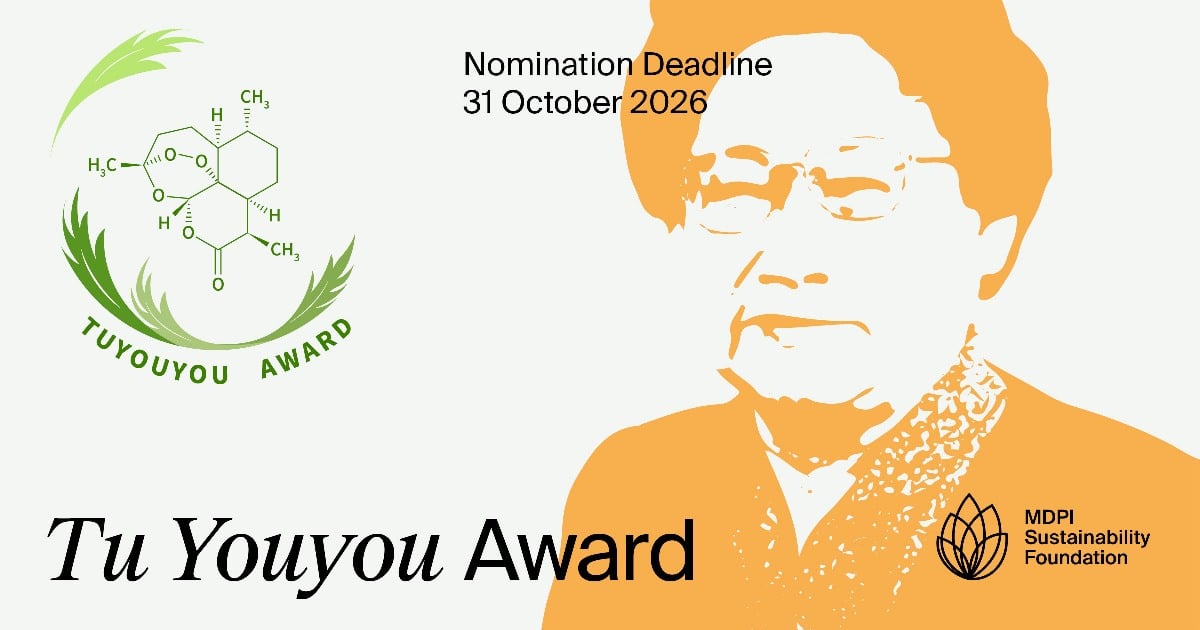
We are delighted to announce that nominations are now open for the 2026 Tu Youyou Award. Named after Nobel Laureate Tu Youyou, whose discovery of artemisinin has saved millions of lives, this award recognizes researchers whose work advances the fields of natural products chemistry and medicinal chemistry, while also contributing to human health.
Prize
– CHF 100,000;
– A medal;
– A certificate.
The monetary prize will be shared equally should there be multiple recipients.
Who May Be Nominated?
– Scientists with outstanding achievements and contributions in the fields of natural products chemistry and medicinal chemistry.
Nominees must be individuals; team or group nominations are not permitted. Nominations are valid only for the current award cycle.
Who May Submit a Nomination?
– The director of the nominee’s host research institution or recognized scientists within the field.
Self-nominations will not be considered.
Nomination Materials
– A biographical sketch;
– A detailed description of the nominee’s contributions;
– 5–10 representative academic publications;
– A list of academic honors, awards, and funded projects;
– A nomination letter signed by two nominators.
How to Submit?
Submit nominations online via the following link: https://tuyouyouprize.org/nomination
Important Dates
– Nomination Deadline: 31 October 2026
– Winner Announcement: March 2027
For further information, please visit the Tu Youyou Award website (https://tuyouyouprize.org/). For any inquiries, please contact the Tu Youyou Award Team at tuyouyouaward@mdpi.com.
