
 Open Access
- Article

26 Pages
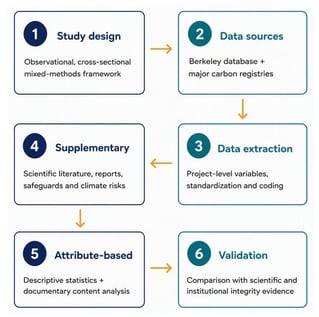
Forest carbon projects have become increasingly relevant for climate mitigation, yet integrated evidence regarding their territorial distribution, governance arrangements, carbon-market performance, and environmental integrity remains limited in Peru. This study provides an integrated assessment of carbon projects implemented between 2010 and 2026 using a mixed-methods approach that combined carbon-registry records, institutional documentation, supplementary project information, and the scientific literature. The analysis evaluated project scope, geographic distribution, governance structures, land tenure, carbon-credit dynamics, co-benefits, and integrity-related risks. The results indicate that Peru’s carbon project portfolio is strongly concentrated in forest-based mitigation pathways, particularly REDD+, ecological restoration, afforestation, and agroforestry initiatives located in the Amazon region. Most projects are implemented in Indigenous territories, private lands, and forest concessions, while private and Indigenous governance arrangements predominate over collaborative or multi-stakeholder models. Patterns of carbon-credit generation and retirement indicate substantial participation in voluntary carbon markets, although market activity is highly concentrated in a small number of large Amazonian REDD+ projects. Furthermore, projects reported biodiversity conservation, ecological restoration, livelihoods, and capacity-building benefits, while concerns related to additionality, leakage, permanence, safeguard implementation, and market transparency persist. Overall, the findings suggest that the long-term effectiveness and credibility of forest carbon projects depend not only on carbon performance but also on governance quality, environmental integrity, territorial rights, transparency, and equitable benefit-sharing mechanisms.
Sustainability
19 October 2026