
Skip to Content
You are currently on the new version of our website. Access the old version .
  • 17 days
    Submission to First Decision
  • 3 days
    Acceptance to Publication

Green

Green is an international, peer-reviewed, open access journal covering fundamental and applied research aimed at understanding and addressing environmental challenges and advancing environmental sustainability, published quarterly online by MDPI.

Get Alerted

Add your email address to receive forthcoming issues of this journal.

All Articles (10)

  • Article
  • Open Access

Sewage sludge is increasingly used as an organic fertilizer in Kenyan peri-urban agriculture, yet concerns persist regarding heavy metal transfer to edible crops and associated health risks. This study evaluated the magnitude of cadmium (Cd), chromium (Cr), and lead (Pb) transfer from sewage sludge-amended soil to kale (Brassica oleracea) leaves and assessed non-carcinogenic health risks to consumers in Nyeri County, Kenya. A Repeated Measures Longitudinal Design was employed with paired soil and kale sampling from 50 plots across wet and dry seasons. Each plot served as its own control, and linear mixed models with random intercepts for plot were used to quantify metal-specific transfer efficiencies. Results showed that soil concentrations significantly exceeded leaf concentrations for all metals in both seasons (p < 0.001). The Linear Mixed Model (LMM) revealed a significant Soil × Metal interaction (χ2 (2) = 14.8, p < 0.001), with estimated soil-to-leaf transfer slopes of 0.183 (Pb), 0.235 (Cr), and 0.271 (Cd). Mean Target Hazard Quotient values were highest for Cr, followed by Cd, and lowest for Pb. Hazard Index values were significantly higher in the dry season (0.00568 ± 0.00422) than in the wet season (0.00383 ± 0.00285; p < 0.001) yet remained substantially below the regulatory threshold of 1.0. These findings indicate negligible non-carcinogenic health risk from the consumption of kale grown on sewage sludge-amended soils under the assessed exposure scenario. However, the elevated transfer efficiency of Cd warrants continued monitoring. This study underscores the need for Kenya to develop national guidelines for the safe agricultural use of sewage sludge, drawing on international benchmarks to ensure consumer safety while supporting sustainable soil amendment practices.

Green

30 October 2026

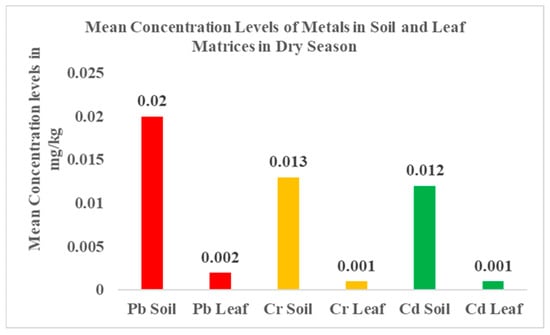
Heavy metal concentrations (mg/kg) between soil and leaf matrices during the dry season.
  • Article
  • Open Access

Can the Mackinac Island Ferry Be Powered by Solar Energy?

  • Siddharth Gopujkar,
  • Robert Waara and
  • Jeremy Worm

Mackinac Island in the state of Michigan, United States of America (USA), is one of the most visited summertime destinations in the country. The island attracts over a million tourists in the short period of 6 months. The only commute to the island is using ferries that travel to the island from Mackinaw City and St. Ignace. In 2022, a study was conducted by the Advanced Power Systems Research Center (APSRC) at Michigan Technological University on the potential benefits of electrification of the ferry from a technical, environmental and economic standpoint. The results from the study concluded that while the retrofitting of the Mackinac Island ferry to an electric ferry was feasible based on components available in the market, electrification would lead to an increase in the CO2 emissions. The economic analysis showed that the electric ferry would result in significant financial losses to any company operating the ferry. The overarching conclusion was that an electric ferry powered by Michigan’s electric grid was not the optimum solution for that time based on both carbon emissions as well as Total Cost of Ownership (TCO). The current work builds on the study completed in 2022 to determine whether an electric ferry powered by local solar energy can help reduce CO2 emissions as compared to the baseline diesel engine-powered ferry. The analysis includes sizing the solar array based on the solar radiation received by Mackinaw City, the CO2 emissions in the manufacture of solar panels based on a lifecycle assessment (LCA) of solar photovoltaics and the addition of battery energy storage as a means of energy storage between ferry trips to determine if the carbon footprint of the electric ferry can be reduced by powering it with energy from solar photovoltaics. Ferry drive cycle data used for this analysis is the same as that collected for the original study, although the appropriate parameters relating to Michigan’s electricity grid and emissions from battery manufacturing have been updated based on technological changes and the addition of different energy sources on the Michigan grid. This work also includes economic considerations for all potential electrification scenarios discussed in this work.

Green

13 October 2026

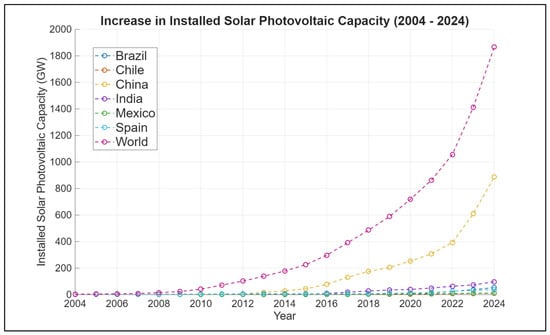
Installed solar photovoltaic capacity from 2004–2024.
  • Article
  • Open Access

Large-scale artificial intelligence systems increasingly disclose energy and carbon metrics, but their freshwater costs remain less consistently measured. This paper introduces the Water Cost of Intelligence (WCI), a per-query metric combining direct water consumed for on-site data-center cooling with indirect water consumed during electricity generation, weighted by local scarcity using Aqueduct 4.0 Baseline Water Stress (BWS) scores. We first reconstruct Google’s disclosed Gemini direct-water figure from Google’s own reported parameters, an internal consistency check on the implementation rather than an independent validation. Expanding the accounting boundary to include electricity-generation water raises the estimate for a median large language model (LLM) prompt by 179% under a uniform national water-intensity value. Parameterizing that intensity by the regional generation mix instead changes the estimate substantially and reverses the regional ordering, depending on whether hydroelectric reservoir evaporation is allocated to generation: the same grid is the least water-intensive of those studied under one convention and the most water-intensive under the other. A region cannot be characterized as water-efficient in terms of electricity without first establishing that convention. Direct-only reporting can be internally accurate yet boundary-incomplete, and regional scarcity can change the interpretation of identical physical water use by an order of magnitude.

Green

1 September 2026

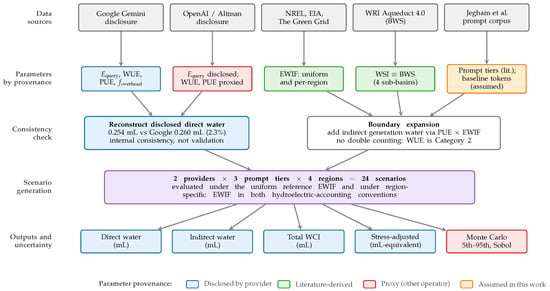
WCI methodological workflow, from data sources through parameter selection, the internal consistency check, and scenario generation to outputs and uncertainty. Parameter boxes are colored by provenance: disclosed by the provider, literature-derived, proxy values borrowed from another operator, or assumed in this work. The color scheme matches the provenance grouping of Table 1 Jegham et al. [14].
  • Review
  • Open Access

Biochar Production: Toward Safe, Effective, and Sustainable Agriculture

  • Omotayo Emmanuel Ojewumi,
  • Gang Chen and
  • Modupe Elizabeth Ojewumi

Biochar, a carbon-rich product resulting from the thermochemical transformation of organic biomass under limited oxygen condition, is currently drawing much worldwide attention due to its multiple applications in carbon sequestration, soil improvement, environmental remediation, and biomass waste management. Initially, the focus of research was primarily on the technical possibilities of biochar production, its economic aspects, and its contribution to climate change mitigation through carbon sequestration and the promotion of sustainable agriculture. Nevertheless, recent research indicates the high complexity and dynamics of biochar interactions with the environment, driven by a combination of factors like feedstock type, process conditions, biochar properties, and other factors. While biochar exhibits multiple beneficial effects, including improving soil structure, enhancing nutrient retention, promoting microbial activities, and remediating contaminants, several environmental risks associated with biochar application have also been identified, namely the formation of polycyclic aromatic hydrocarbons (PAHs), heavy metal contamination, creation of persistent free radicals, changes in soil chemistry, and modification of soil microbial community structure. Such risks are greatly related to production process parameters, treatment methods, and biochar application practices. Moreover, differences in feedstock choice, pyrolysis temperature, reactor design, biochar application rate, and analytical methods used make comparative analysis of results difficult.

Green

5 August 2026

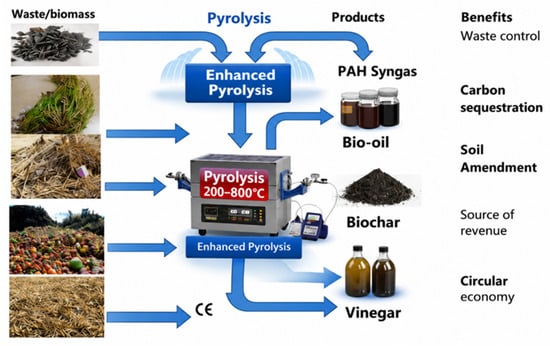
Biochar production processes.

Highly Accessed Articles

News & Conferences

Latest Issues

Open for Submission

Journal Sections

XFacebookLinkedIn
Green - ISSN 3042-9242