



Next Issue
Volume 15, August
Previous Issue
Volume 15, June


Soc. Sci., Volume 15, Issue 7 (July 2026) – 81 articles
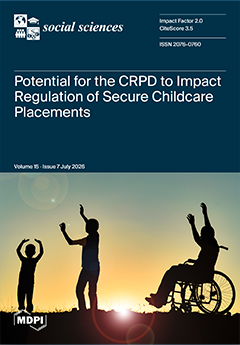
Cover Story (view full-size image): This article explores the potential for the Convention on the Rights of Persons with Disabilities to illustrate the human rights framework that should be put in place to regulate the detention of children on welfare grounds. View this paper
  • Issues are regarded as officially published after their release is announced to the table of contents alert mailing list.
  • You may sign up for e-mail alerts to receive table of contents of newly released issues.
  • PDF is the official format for papers published in both, html and pdf forms. To view the papers in pdf format, click on the "PDF Full-text" link, and use the free Adobe Reader to open them.
Order results
Result details
Section
Select all
Export citation of selected articles as:
18 pages, 328 KB  
Article
De-Privatizing Love: A Transnational Dialogue on the Public Dimension of Love in the Socio-Political Sphere
by Edna Castro, Wonho Jang, Woon-taek Lim, Stefano Tomelleri, Silvia Cataldi, Paulo Henrique Martins and Angelica De Sena
Soc. Sci. 2026, 15(7), 492; https://doi.org/10.3390/socsci15070492 - 22 Jul 2026
Viewed by 512
Abstract
Dominant rationalist and neoliberal frameworks have often privatized love by treating it as an intimate emotion detached from institutions, power, and collective life. This article examines when love becomes publicly consequential as a sociological force. Using an interpretive, cross-cultural, and dialogical approach, it [...] Read more.
Dominant rationalist and neoliberal frameworks have often privatized love by treating it as an intimate emotion detached from institutions, power, and collective life. This article examines when love becomes publicly consequential as a sociological force. Using an interpretive, cross-cultural, and dialogical approach, it brings into conversation three situated sociological traditions developed in Brazil, Italy, and South Korea. Rather than comparing nation-states as fixed units, the article analyses how different sociological traditions interpret shared public problems through distinct moral vocabularies and institutional contexts. Three public grammars of love emerge: struggles over inequality and ecological justice in Brazil; tensions between expertise and democratic mediation in Italy; and questions of social empathy, hyper-competition, and post-growth transformation in South Korea. Love also appears as an ambivalent force that may generate cohesion or conflict, inclusion or exclusion. The article concludes that de-privatizing love broadens sociological understanding of how emotions shape collective life and demonstrates the analytical value of dialogical engagement between sociological traditions for reconstructing the public meanings of love across different socio-political contexts. Full article
10 pages, 240 KB  
Perspective
Artificial Intimacy: Companion Artificial Intelligence and Emerging Risks to Adolescent Mental Health
by Lisa Pescara Kovach
Soc. Sci. 2026, 15(7), 491; https://doi.org/10.3390/socsci15070491 - 22 Jul 2026
Viewed by 829
Abstract
Adolescence is marked by a heightened need for belonging, peer acceptance, and emotional validation, with disruptions linked to loneliness and psychological distress. This perspective integrates belongingness theory with emerging research on companion artificial intelligence (AI), reconceptualizing these systems as relational substitutes that simulate, [...] Read more.
Adolescence is marked by a heightened need for belonging, peer acceptance, and emotional validation, with disruptions linked to loneliness and psychological distress. This perspective integrates belongingness theory with emerging research on companion artificial intelligence (AI), reconceptualizing these systems as relational substitutes that simulate, but do not provide, genuine interpersonal connection. Designed to offer continuous, emotionally responsive interactions, companion AI may be particularly appealing to socially isolated youth. However, these features can foster perceived intimacy, emotional dependence, and misinterpretations of programmed responses as authentic care. Drawing on developmental research and recent case evidence, this manuscript examines how AI-mediated interactions may reinforce social withdrawal, shape expectations of relationships, and contribute to mental health risk. These findings stress the importance of understanding the developmental implications of artificial forms of connection during adolescence and describe potential policies to mitigate the likelihood of negative outcomes. Full article
15 pages, 292 KB  
Article
The Impact of Gender Diversity Policies on Women’s Leadership at the University of Sharjah: Perspectives from Administrative and Academic Staff
by Salha Mohamed Almazrouei and William Charles Frick
Soc. Sci. 2026, 15(7), 490; https://doi.org/10.3390/socsci15070490 - 21 Jul 2026
Viewed by 309
Abstract
Women remain underrepresented in leadership positions in higher education institutions (HEIs) across the Gulf region despite sustained policy efforts to advance gender equity. This study examined how stakeholders perceive the relationship between gender diversity and inclusion policies and women’s leadership advancement at the [...] Read more.
Women remain underrepresented in leadership positions in higher education institutions (HEIs) across the Gulf region despite sustained policy efforts to advance gender equity. This study examined how stakeholders perceive the relationship between gender diversity and inclusion policies and women’s leadership advancement at the University of Sharjah, UAE. Specifically, it investigated the association between perceived policy adequacy and leadership opportunities, explored how policies supported or hindered progression, and identified persistent barriers. A concurrent mixed-method cross-sectional design was employed. The study population comprised academic and administrative staff at the University of Sharjah, from whom 40 survey participants (29 women, 72.5%; 11 men, 27.5%) were invited, with all 40 completing the form, and eight were purposively selected for qualitative interviews (seven women and one man, spanning administrative, faculty, and leadership roles). Quantitative findings revealed a very strong positive correlation between perceived gender diversity policies and women’s leadership (r = 0.95, p < 0.001), with policies explaining 89.8% of the variance in leadership perceptions. However, qualitative data highlighted gaps between formal policy commitments and practice, linked to structural, managerial, and cultural constraints. The study recommends adopting gender-responsive, enforceable policies supported by accountability mechanisms, transparent promotion systems, and targeted leadership development initiatives to achieve sustainable and substantive progress. Full article
(This article belongs to the Section Gender Studies)
19 pages, 361 KB  
Article
Beyond Ideology: Political Behavior and Popularity in TikTok’s Platformized Political Communication Environment
by Tal Laor
Soc. Sci. 2026, 15(7), 489; https://doi.org/10.3390/socsci15070489 - 20 Jul 2026
Viewed by 414
Abstract
Many politicians heavily leverage social media platforms to further their interests and professional goals. TikTok, the widely popular social network established in 2016, has amassed a vast user following, especially among the younger demographic known as Generation Z. This study conceptualizes it as [...] Read more.
Many politicians heavily leverage social media platforms to further their interests and professional goals. TikTok, the widely popular social network established in 2016, has amassed a vast user following, especially among the younger demographic known as Generation Z. This study conceptualizes it as part of a platformized political communication environment that enables direct-to-audience communication beyond traditional journalistic gatekeeping. The current study aims to analyze high-visibility TikTok content produced by active Israeli politicians by scrutinizing the best-performing videos created by politicians representing diverse political ideologies. High-visibility content refers to videos that generated relatively high engagement, exposure, and platform presence, and therefore had greater potential to influence or impact audiences compared with less visible posts. The goal is to characterize and understand the content patterns and visibility dynamics of these successful TikTok videos posted by politicians. The findings suggest that the popularity of TikTok videos posted by politicians is associated with gender, age, and political affiliation. Men, older individuals, and those with right-wing affiliations tend to create content that garners the highest levels of popularity. Moreover, a considerable proportion of the sampled high-visibility videos do not engage directly with political subject matters. This suggests that, among best-performing political TikTok posts, visibility and engagement may sometimes outweigh explicit political or ideological discourse. This implies that politicians feel compelled to participate on the platform, even when their most visible content does not specifically revolve around promoting political messages. Consequently, the findings lend cautious support to the view that platform logic shapes political visibility and communication practices, even in politicians’ use of TikTok. In doing so, this study contributes to understanding how commercial social media platforms such as TikTok shape political visibility, engagement, and direct-to-audience communication. Full article
(This article belongs to the Special Issue Understanding the Influence of Alternative Political Media)
20 pages, 605 KB  
Article
“It Becomes a Catch-22 Situation”: Housing Experiences and Possibilities for LGBTQ+ Aging
by Celeste Pang and Ellie Maclennan
Soc. Sci. 2026, 15(7), 488; https://doi.org/10.3390/socsci15070488 - 20 Jul 2026
Viewed by 294
Abstract
As shelter costs in Canada continue to rise, housing affordability and questions about what housing will be available and accessible in older age are a concern for many marginalized groups, including among LGBTQ+ older adults. This paper shares housing-related findings from a national [...] Read more.
As shelter costs in Canada continue to rise, housing affordability and questions about what housing will be available and accessible in older age are a concern for many marginalized groups, including among LGBTQ+ older adults. This paper shares housing-related findings from a national study on aging and living well among LGBTQ+ older adults across the country, in which we conducted semi-structured interviews with 48 LGBTQ+ older adults between the ages of 64–81. In it, we elaborate four key themes: (1) housing (in)security and cost; (2) housing safety; (3) how to age in place; and (4) mixed perspectives on shared housing models, and discuss systemic and social changes needed to support access to housing that is affordable, accessible, predictable, and safe for LGBTQ+ older adults that will enable them to age in the “right place”. Full article
(This article belongs to the Special Issue Research on LGBTQIA2S+ Aging and Well-Being)
25 pages, 517 KB  
Article
Male Preschool Teachers in a Traditionally Female-Dominated Profession: Evidence from Vietnam
by Hung Sy Ho and Hien Van Pham
Soc. Sci. 2026, 15(7), 487; https://doi.org/10.3390/socsci15070487 - 20 Jul 2026
Viewed by 316
Abstract
Early childhood education (ECE) in Vietnam remains a heavily feminized profession, deeply influenced by traditional gender stereotypes. This study employs an explanatory sequential mixed-methods design, involving a survey of 256 male teachers and 12 in-depth interviews, to examine their career motivations and professional [...] Read more.
Early childhood education (ECE) in Vietnam remains a heavily feminized profession, deeply influenced by traditional gender stereotypes. This study employs an explanatory sequential mixed-methods design, involving a survey of 256 male teachers and 12 in-depth interviews, to examine their career motivations and professional commitment. Regression analysis reveals that gender stereotypes (β = 0.585, p < 0.001) and professional experiences (β = 0.249, p < 0.001) are the primary predictors of commitment. Findings highlight a significant paradox: despite high intrinsic motivation and positive perceptions of institutional equity, long-term commitment remains low due to persistent societal prejudice and “hyper-visibility” pressure. The study concludes that while schools provide a supportive institutional environment, sustainable workforce diversification requires both institutional and societal efforts to address persistent gender stereotypes. The findings suggest that strengthening the recruitment and retention of male preschool teachers depends on promoting inclusive professional cultures, reducing gender-based stigma, and ensuring that professional recognition and career development opportunities are grounded in demonstrated competencies rather than gendered assumptions. These findings contribute to contemporary debates on gender, professional identity, and workforce diversity in early childhood education. Full article
Show Figures

Figure 1

17 pages, 695 KB  
Article
From Academic Stressors to Stress Responses in University Students: A Gender-Stratified Analysis of Coping Pathways
by Cristina Ruiz-Camacho and Margarita Gozalo
Soc. Sci. 2026, 15(7), 486; https://doi.org/10.3390/socsci15070486 - 17 Jul 2026
Viewed by 377
Abstract
Academic stress is a major concern in higher education, but less is known about whether coping strategies mediate the links between specific academic stressors and stress responses in male and female students. This cross-sectional study examined, by gender, whether planning, positive reappraisal, and [...] Read more.
Academic stress is a major concern in higher education, but less is known about whether coping strategies mediate the links between specific academic stressors and stress responses in male and female students. This cross-sectional study examined, by gender, whether planning, positive reappraisal, and support seeking mediated three associations: exams with sleep disturbances, beliefs about performance with negative thoughts, and academic overload with physical exhaustion. Participants were 1014 undergraduates from a Spanish public university (35.5% men, 64.5% women; Mage = 20.56, SD = 3.50), who completed the Academic Stress Questionnaire. Descriptive statistics and Pearson correlations were computed by gender, and three parallel mediation models were tested separately for men and women using PROCESS with 5000 bootstrap samples. Academic stressors were positively associated with their corresponding stress responses in both gender groups, and direct effects remained significant in all models. Indirect effects showed differentiated patterns: positive reappraisal mediated the exams–sleep disturbances and overload–physical exhaustion associations in men, and the beliefs about performance–negative thoughts association in both groups. Support seeking mediated all three associations in women, whereas planning showed no significant indirect effects. These findings support a gender-stratified understanding of academic stress and suggest that interventions should avoid assuming uniform coping pathways, instead strengthening positive reappraisal and social support resources according to the academic demands and stress responses involved. Full article
(This article belongs to the Section Gender Studies)
Show Figures

Figure 1

17 pages, 661 KB  
Perspective
Health Security as Catalyst in Migration Governance: A Practice-Based Case Study Building Trust Through Cross-Border Cooperation in North Africa
by Michela Martini
Soc. Sci. 2026, 15(7), 485; https://doi.org/10.3390/socsci15070485 - 17 Jul 2026
Viewed by 313
Abstract
This paper examines how sequenced cross-border health initiatives may contribute to confidence-building and, ultimately, serve as catalyst toward more coherent cross-border migration-related governance in North Africa. Using a practice-based case study approach, it analyzes a series of regional processes implemented in 2024 and [...] Read more.
This paper examines how sequenced cross-border health initiatives may contribute to confidence-building and, ultimately, serve as catalyst toward more coherent cross-border migration-related governance in North Africa. Using a practice-based case study approach, it analyzes a series of regional processes implemented in 2024 and 2025 by the International Organization for Migration (IOM), in collaboration with the WHO Regional Office for the Eastern Mediterranean (WHO EMRO) and Africa CDC, including two technical workshops in Tunis, a sub-regional simulation exercise in Cairo, and a Mediterranean Forum. The analysis draws on process documentation, institutional outputs, and the authors’ direct involvement in these initiatives to trace how repeated technical engagement supported procedural alignment and the gradual building of confidence for cross-border collaboration. Key outputs included a draft operational plan, a technical white paper, and regional policy recommendations. The paper argues that, in politically sensitive migration settings, cross-border health cooperation—jointly engaging ministries of health, interior, and foreign affairs—can provide an entry point for dialogue, joint problem-solving, and confidence-building across countries and sectors, thereby enhancing collaborative governance. While such collaboration does not directly determine migration policy, it may contribute to health diplomacy efforts that foster a more coherent governance environment capable of supporting safer, more orderly, and better-coordinated migration processes. Although several operational questions remain unresolved and more studies are need it, this paper seeks to open further dialogue and encourage new evidence and reflection on the potential role of health as a catalyst for collaborative governance and confidence-building between countries. Full article
(This article belongs to the Special Issue Health and Migration Challenges for Forced Migrants)
Show Figures

Figure 1

27 pages, 1522 KB  
Article
Integrated Evidence on the Determinants of Perceived Crime Risk and Implications for Preventive Community Safety Policies
by Massimo Arnone, Angelo Leogrande, Carlo Drago, Alberto Costantiello and Fabio Anobile
Soc. Sci. 2026, 15(7), 484; https://doi.org/10.3390/socsci15070484 - 16 Jul 2026
Viewed by 514
Abstract
This paper empirically examines the impact of various variables on Perceived Risk of Crime (PRC) for Italian regions in the period of 2004–2022 using data collected in the framework of the Benessere Equo e Sostenibile (BES, Equitable and Sustainable Well-being) questionnaire conducted by [...] Read more.
This paper empirically examines the impact of various variables on Perceived Risk of Crime (PRC) for Italian regions in the period of 2004–2022 using data collected in the framework of the Benessere Equo e Sostenibile (BES, Equitable and Sustainable Well-being) questionnaire conducted by the Italian National Institute of Statistics (ISTAT). The econometric analysis of the relationship is based on panel regressions (including fixed-, random-, and dynamic-effects estimations). Moreover, weighted least squares regression and machine learning algorithms are used as robustness checks. The results of the empirical estimation reveal the importance of both objective and subjective factors as drivers of PRC. The main positive influences on PRC are provided by pickpocketing cases and fear of crime, while generalized and judicial systems’ trust is negatively related to PRC. Additionally, future pessimism and dissatisfaction with the local environment contribute to higher levels of perceived risk. The analysis of the machine learning model confirms the reliability of the principal outcomes and shows the high accuracy of regularized linear regression as a forecasting tool. The clusters identified through the cluster analysis reflect region-specific differences in crime exposure, institutional trust, well-being, and perceptions of security. In summary, perceived insecurity depends not only on actual crimes but also on the combination of crime exposure, emotions and feelings, institutional trust, and the environment. Therefore, a multidimensional approach should be applied for developing an effective strategy aimed at preventing the risks associated with crimes. Full article
Show Figures

Figure 1

16 pages, 225 KB  
Article
Organizational Barriers to Access in Community Social Services: Fragmentation, Bureaucratization, Congestion and the Role of Triage
by Joaquín Castillo de Mesa, Paula Méndez-Domínguez and Tania Pérez García
Soc. Sci. 2026, 15(7), 483; https://doi.org/10.3390/socsci15070483 - 16 Jul 2026
Viewed by 281
Abstract
Community social services play a crucial role as the main gateway to welfare systems. However, increasing demand, organizational complexity, and limited adaptive capacity have generated growing difficulties in ensuring timely and equitable access to support. This study examines the organizational barriers affecting access [...] Read more.
Community social services play a crucial role as the main gateway to welfare systems. However, increasing demand, organizational complexity, and limited adaptive capacity have generated growing difficulties in ensuring timely and equitable access to support. This study examines the organizational barriers affecting access to community social services and explores the role of triage as an organizational innovation. A qualitative case study was conducted at the Community Social Services Centre of Benalmádena City Council (Spain). Data were collected through focus groups, Customer Journey Mapping exercises, and Design Thinking workshops involving social workers, administrative staff, managers, and external experts, and were analysed using thematic analysis. The findings indicate that access barriers arise from a systemic configuration of organizational dysfunctions rather than from resource scarcity alone. Six interconnected themes were identified: fragmented access pathways, the absence of prioritization mechanisms, demand duplication and appointment absenteeism, organizational bottlenecks related to professional role distribution, fragmented information systems, and the emergence of triage as an organizational innovation. These factors generate cumulative effects that reduce organizational responsiveness and hinder access to services. The study concludes that triage should be understood as part of a broader process of organizational redesign aimed at improving demand management, prioritization, and coordination, highlighting the need for systemic organizational transformation to enhance access to social services. Full article
(This article belongs to the Special Issue Contemporary Community Social Services: Issues and Challenges)
27 pages, 1959 KB  
Article
Do Social Grants Reduce Household Food Insecurity in South Africa: Moderated Mediation Analysis of Income Pathway
by Aemro Tazeze Terefe and Steven Henry Dunga
Soc. Sci. 2026, 15(7), 482; https://doi.org/10.3390/socsci15070482 - 15 Jul 2026
Viewed by 367
Abstract
South Africa has implemented an extensive social grant system to improve the wellbeing of vulnerable households. However, evidence remains limited regarding the pathways through which social grants are associated with household food insecurity and whether these relationships vary across geographical contexts of South [...] Read more.
South Africa has implemented an extensive social grant system to improve the wellbeing of vulnerable households. However, evidence remains limited regarding the pathways through which social grants are associated with household food insecurity and whether these relationships vary across geographical contexts of South Africa. Understanding these mechanisms is essential for designing more effective and spatially targeted social protection policies. This study examined the relationship between social grant receipt and household food insecurity, hypothesizing that household income serves as the principal pathway linking social grants to food insecurity. This study used nationally representative data from the 2024 General Household Survey. A latent food insecurity index was constructed using a two-parameter logistic Item Response Theory model, and a moderated-mediation structural equation model was employed to decompose the association between social grant receipt and food insecurity into direct and indirect components while accounting for geographic heterogeneity. The results indicate that social grants are strongly targeted toward households with higher levels of food insecurity and lower incomes, confirming that grant recipients are among the most vulnerable households in South Africa. Household income was negatively associated with food insecurity and mediated 55.4% of the total association between social grant receipt and household food insecurity. This underscores income as the main transmission pathway. High geographic heterogeneity was observed. The indirect income-mediated association was strongest in commercial farming areas, followed by urban and rural areas administered by local leaders. The direct association was significant in urban and rural areas administered by local leaders. These results show that the effectiveness of income transfers depends on the household’s demographic and socioeconomic conditions. The findings suggest that although social grants play an important role in reducing household vulnerability, cash support alone is insufficient to address household food insecurity among disadvantaged households in South Africa. Therefore, strengthening income support provided through social grants should be complemented by location-specific interventions that expand employment opportunities, improve market access, promote productive asset accumulation, and strengthen local food systems, particularly in rural areas where constraints continue to limit household food security. Full article
Show Figures

Figure 1

14 pages, 337 KB  
Article
More Graduates, Fewer Matches? Examining the Alignment Between Higher Education and Labor Market Needs in Saudi Arabia
by Mohammed Saleh Alkathiri and Ismail Mohammed Ali Alnabrawi
Soc. Sci. 2026, 15(7), 481; https://doi.org/10.3390/socsci15070481 - 15 Jul 2026
Viewed by 431
Abstract
This study examines alignment between higher education graduate output and observed labor market demand in Saudi Arabia using aggregated quantitative data. Drawing on graduate supply data from Saudi universities for the period 2021–2023 and job advertisement data from the first quarter of 2025 [...] Read more.
This study examines alignment between higher education graduate output and observed labor market demand in Saudi Arabia using aggregated quantitative data. Drawing on graduate supply data from Saudi universities for the period 2021–2023 and job advertisement data from the first quarter of 2025 (Q1 2025), the study employs descriptive statistics, Pearson correlation, and exploratory regression analysis to document quantitative surpluses and shortages across fields of study. The findings indicate a positive but not significant association between graduate output and advertised job demand across matched fields of study (r = 0.486, p = 0.155), while also revealing noticeable quantitative imbalances, including oversupply in some non-technical disciplines and shortages in health-, engineering-, and service-related fields. The analysis further highlights sectoral and geographic concentration of job demand, suggesting structural patterns in how labor market opportunities are distributed across regions and sectors. Rather than implying causal relationships, the results provide a descriptive empirical basis to inform discussions on higher education planning, workforce alignment, and curriculum responsiveness within the context of Saudi Arabia’s ongoing education and labor market reforms under Vision 2030. Full article
(This article belongs to the Section Work, Employment and the Labor Market)
Show Figures

Figure 1

17 pages, 296 KB  
Article
Pedagogical-Didactical Self-Efficacy of Future Educators: A Cross-Sectional Survey of Pre-Service STEM Teachers
by Anna Alajbeg
Soc. Sci. 2026, 15(7), 480; https://doi.org/10.3390/socsci15070480 - 15 Jul 2026
Viewed by 312
Abstract
The contemporary educational system places complex demands on educators, emphasizing the importance of pedagogical-didactical competencies and teacher self-efficacy alongside subject-matter expertise. The purpose of this study was to examine how future STEM educators assess their own perceived pedagogical-didactical capabilities for direct teaching and [...] Read more.
The contemporary educational system places complex demands on educators, emphasizing the importance of pedagogical-didactical competencies and teacher self-efficacy alongside subject-matter expertise. The purpose of this study was to examine how future STEM educators assess their own perceived pedagogical-didactical capabilities for direct teaching and classroom management through the construct of teacher self-efficacy, examining variations by gender, student cohort, and academic major. The research was conducted in autumn 2025 using a near-census sample of graduate teaching track students at the Faculty of Science in Split, utilizing the Norwegian Teacher Self-Efficacy Scale. The descriptive and non-parametric results indicate that future teachers express higher baseline scores in the domains of instruction and coping with changes, whereas the lowest self-assessment was recorded regarding the adaptation of teaching to individual student needs. While gender and student cohort demonstrated no statistically significant impact on overall self-efficacy, a significant difference was determined in the domain of maintaining discipline with respect to the study major, with Informatics and Technology students exhibiting the greatest sense of confidence. In conclusion, the findings highlight that while students are well-prepared for content delivery, there remains a critical need to enhance initial teacher education programs by introducing practical tools for managing challenging student behaviors and working within heterogeneous classrooms. Full article
18 pages, 345 KB  
Article
Workforce Shortages, Transnational Mobility and Professional Regulation in Social Work: An Irish Case in Global Perspective
by Mary Elizabeth Kennedy
Soc. Sci. 2026, 15(7), 479; https://doi.org/10.3390/socsci15070479 - 15 Jul 2026
Viewed by 419
Abstract
Global migration and labour market pressures have increased transnational mobility in social work, as practitioners move across borders to meet workforce demand. This paper examines how professional regulation interacts with workforce shortages and transnational mobility, using Ireland as a case study. A regulatory [...] Read more.
Global migration and labour market pressures have increased transnational mobility in social work, as practitioners move across borders to meet workforce demand. This paper examines how professional regulation interacts with workforce shortages and transnational mobility, using Ireland as a case study. A regulatory dilemma arises from the absence of standardised international reference points for comparing social work education, training, roles, and regulation. Where applicants’ qualifications and practice experience do not align with national standards, additional requirements may be imposed, delaying entry into practice. Focusing on applicants from the U.K., U.S., Zimbabwe, and India, identified as principal countries of origin among internationally qualified social workers in Ireland, analysis shows how differences in regulatory structure, education, and role definition shape the assessment of equivalence and extend pathways to registration. The paper determines that this dilemma cannot be resolved by regulators and must be addressed at the level of the profession. It proposes identifying shared core content within existing social work education, using patterns in recognition decisions to inform targeted curriculum development, and creating standardised country profiles describing social work roles to support more consistent interpretation of international experience. Full article
(This article belongs to the Special Issue Preparing Social Workers for Global Practice Challenges)
14 pages, 1575 KB  
Article
Beyond the Cafeteria: The Impact of a Classroom-Based Nutrition Program on Attendance, Academic, and Behavioral Outcomes
by Jenni Putz
Soc. Sci. 2026, 15(7), 478; https://doi.org/10.3390/socsci15070478 - 15 Jul 2026
Viewed by 273
Abstract
This paper evaluates the impact of the Fresh Fruit and Vegetable Program (FFVP), a federal classroom-based nutrition program, on elementary schools in Illinois. Using a staggered difference-in-differences framework that accounts for schools moving in and out of funding status, I examine how classroom-based [...] Read more.
This paper evaluates the impact of the Fresh Fruit and Vegetable Program (FFVP), a federal classroom-based nutrition program, on elementary schools in Illinois. Using a staggered difference-in-differences framework that accounts for schools moving in and out of funding status, I examine how classroom-based school nutrition programs influence school-level behavioral and academic outcomes. I find that FFVP funding increases school attendance rates, but there are no changes to standardized test scores or disciplinary referrals. These findings suggest that fresh food incentives successfully improve school attendance but are limited in their ability to change trajectories in standardized testing or student conduct. Full article
Show Figures

Figure 1

13 pages, 334 KB  
Article
From Short-Video Sustainability Persuasion to Sustainable Tourism Intention: A Route-Sensitive ELM SOR Conceptual Framework
by Xing Wang, Sue Lyn Ong and Nurafiq Inani Man
Soc. Sci. 2026, 15(7), 477; https://doi.org/10.3390/socsci15070477 - 15 Jul 2026
Viewed by 340
Abstract
Despite increasing scholarly attention to short-video platforms as tourism communication tools, the mechanism through which sustainability-oriented persuasive cues shape Sustainable Tourism Intention remains insufficiently theorized. This article integrates the Elaboration Likelihood Model (ELM) and the Stimulus–Organism–Response (SOR) framework to explain how short-video persuasive [...] Read more.
Despite increasing scholarly attention to short-video platforms as tourism communication tools, the mechanism through which sustainability-oriented persuasive cues shape Sustainable Tourism Intention remains insufficiently theorized. This article integrates the Elaboration Likelihood Model (ELM) and the Stimulus–Organism–Response (SOR) framework to explain how short-video persuasive cues may influence Sustainable Tourism Intention through Environmental Attitude. Methodologically, the paper adopts a theory synthesis and conceptual integration approach to connect insights from short-video persuasion, sustainability communication, environmental attitude research, and tourism intention studies. The framework treats short-video sustainability communication as a cue-dense persuasive environment, identifies key cue families, organizes selected cues according to likely central/peripheral processing tendencies, and positions Environmental Attitude as the sustainability-specific organismic evaluative state through which cue exposure translates into intention. It proposes that both central route-oriented and peripheral route-oriented cues may strengthen Environmental Attitude and may thereby shape Sustainable Tourism Intention, although they do so through different processing tendencies. The article concludes that integrating ELM and SOR provides a clearer and more bounded explanation of short-video sustainability persuasion and offers a structured basis for future empirical research. Full article
Show Figures

Figure 1

21 pages, 280 KB  
Article
Secure Childcare and the Convention on the Rights of Persons with Disabilities: Illuminating the Applicable Rights Framework
by Kris Gledhill
Soc. Sci. 2026, 15(7), 476; https://doi.org/10.3390/socsci15070476 - 14 Jul 2026
Viewed by 337
Abstract
Case law illustrates both the complexity of the regimes in England and Wales whereby children may be deprived of their liberty for welfare reasons and the inadequacy of provision to meet complex needs, which has led to a significant use of the power [...] Read more.
Case law illustrates both the complexity of the regimes in England and Wales whereby children may be deprived of their liberty for welfare reasons and the inadequacy of provision to meet complex needs, which has led to a significant use of the power of the High Court to order a Deprivation of Liberty in unsuitable places. Calls have been made for legislative reform and less use of detention. Assuming human rights compliance will be a feature of a new framework, this article examines how the Convention on the Rights of Persons with Disabilities (CRPD), as illuminated by the comments of its expert Treaty Body, the Committee on the Rights of Persons with Disabilities (CRPD Committee), provides useful material as to the contents of a suitable legislative framework. Also outlined is how the CRPD has value under the rights framework most often referenced in the UK, the European Convention on Human Rights (ECHR). Full article
(This article belongs to the Special Issue International Perspectives on Secure Childcare)
29 pages, 663 KB  
Article
Highly Skilled International Professionals in Exploitative Labour Regimes: How Conditional Entry, Legal Dependency, and Intersectional Wage Penalties Shape Migrant Labour Markets
by Ana Nestorovic and Marie-Therese Antoinette Claes
Soc. Sci. 2026, 15(7), 475; https://doi.org/10.3390/socsci15070475 - 14 Jul 2026
Viewed by 314
Abstract
This article examines how institutional arrangements shape exploitative labour conditions among highly skilled international professionals, challenging prevailing assumptions that labour exploitation primarily affects low-skilled or irregular workers. Focusing on international professionals living and working in Vienna, the study addresses a central paradox of [...] Read more.
This article examines how institutional arrangements shape exploitative labour conditions among highly skilled international professionals, challenging prevailing assumptions that labour exploitation primarily affects low-skilled or irregular workers. Focusing on international professionals living and working in Vienna, the study addresses a central paradox of contemporary migration governance: while states and cities actively compete for global talent, they simultaneously reproduce exploitative conditions: legal, organisational, and identity-based constraints that limit labour mobility, weaken bargaining power, and suppress rights mobilisation. The analysis draws on Social Identity Theory, the Skill Paradox, and the concept of Legal consciousness to examine how highly skilled migrants experience labour market entry, wage-setting, and workplace inequality under conditions of legal dependency and institutional regulation. Empirically, the study is based on 42 semi-structured interviews with highly skilled international professionals and 17 expert interviews with representatives of Austrian labour market institutions and non-governmental organisations, complemented by secondary institutional data. Using reflexive thematic analysis, the study identifies three interrelated mechanisms sustaining exploitative conditions: (1) conditional labour market entry through the systematic downgrading of foreign qualifications; (2) legal and institutional dependency that discourages rights awareness and rights mobilisation; and (3) intersectional wage penalties disproportionately affecting women and non-national professionals. The findings demonstrate labour market conditions that exhibit several characteristics associated with labour exploitation. Labour conditions among highly skilled international professionals are not primarily the result of overt coercion or illegality but are structurally produced through migration regimes, credential recognition practices, and uneven access to legal protection. These mechanisms position skilled migrants along a continuum of labour exploitation characterised by restricted mobility, economic compulsion, and suppressed labour market conflict. By conceptualizing what can be reasonably interpreted as exploitative labour arrangements as an institutional outcome rather than an individual failure, the article contributes to debates on skilled migration, labour market inequality, and migration governance, highlighting the need for policy reforms that better align talent attraction strategies with labour rights, legal empowerment, and social justice. Full article
Show Figures

Figure 1

16 pages, 1987 KB  
Communication
Using Systems Thinking to Advance the Prevention of Human Trafficking: Examples and a Call to Action
by Elizabeth Such, Mollie Gordon, Phuong Thanh Nguyen, Lila Pavey, Jenna Hopson, Alys McAlpine, Habiba Aminu and Frances Recknor
Soc. Sci. 2026, 15(7), 474; https://doi.org/10.3390/socsci15070474 - 14 Jul 2026
Viewed by 396
Abstract
Human trafficking is a complex global problem maintained by a web of interacting individual, community, national and international factors. Its complexity is not always robustly addressed in policy, practice and research, with issues commonly approached in silos. This commentary creates the case for [...] Read more.
Human trafficking is a complex global problem maintained by a web of interacting individual, community, national and international factors. Its complexity is not always robustly addressed in policy, practice and research, with issues commonly approached in silos. This commentary creates the case for more intentional application of systems thinking in the counter-trafficking field. We do this by describing some of the origins of a more systemic focus in counter-trafficking work including the emergence of public health approaches, survivor- or lived-experience leadership and developments in the research domain. We then provide three case examples of how a systems lens has been applied in research, in policy and in practice across three countries, the UK, Canada and the US. We conclude with reflections on the promise of and challenges for systems thinking and a call to action for more systems-informed counter-trafficking work. Full article
Show Figures

Figure 1

4 pages, 181 KB  
Editorial
Impacts of Sexual Violence on Relationships: A Reflection on Understanding Trauma and Supporting Survivors
by Buuma Maisha
Soc. Sci. 2026, 15(7), 473; https://doi.org/10.3390/socsci15070473 - 14 Jul 2026
Viewed by 783
Abstract
Sexual violence is one of the most traumatic forms of interpersonal violence [...] Full article
(This article belongs to the Special Issue Impact of Rape and Sexual Violence on the Relationships of Survivors)
18 pages, 570 KB  
Article
Environmental Attitude and Environmental Protection Intention Among Singaporean Generation Z: Does Environmental Connectedness Moderate the Relationship?
by Kar Hoong Chan, Kah Boon Lim, Siew Kim Tan, Tuan Hock Ng, Tze Wei Liew and Vincent Boon Seng Lim
Soc. Sci. 2026, 15(7), 472; https://doi.org/10.3390/socsci15070472 - 13 Jul 2026
Viewed by 381
Abstract
This study examines the moderating role of environmental connectedness in the relationship between environmental attitude and environmental protection intention among Generation Z polytechnic students in Singapore. A cross-sectional survey across five polytechnics yielded 709 valid responses, and partial least squares structural equation modeling [...] Read more.
This study examines the moderating role of environmental connectedness in the relationship between environmental attitude and environmental protection intention among Generation Z polytechnic students in Singapore. A cross-sectional survey across five polytechnics yielded 709 valid responses, and partial least squares structural equation modeling was used to assess both direct and moderating effects. Findings confirm that environmental attitude significantly and positively influences environmental protection intention. However, environmental connectedness did not moderate this relationship, suggesting that in dense urban environments, cognitive attitudes may have a stronger impact than affective ties to nature. This study offers novel insights by extending the Theory of Planned Behaviour to include emotional constructs within an Asian urban setting, highlighting how limited nature exposure may weaken the role of affective factors. While the cross-sectional design and convenience sampling limit causal inference and generalisability, the findings align with national trends, as government agencies and educational institutions have intensified efforts to cultivate environmental awareness through green curricula and co-curricular programmes. These findings indicate that interventions such as curriculum redesign and gamification aimed at shaping environmental attitudes may be more effective than strategies relying solely on emotional engagement with nature, thereby supporting Singapore’s climate goals and fostering responsible urban citizenship. Full article
Show Figures

Figure 1

16 pages, 276 KB  
Article
Fluid Swipes and Solid Care on Dating Apps: Interviews with Midlife Single Parents in Norway
by Plata S. Diesen
Soc. Sci. 2026, 15(7), 471; https://doi.org/10.3390/socsci15070471 - 13 Jul 2026
Viewed by 863
Abstract
This article examines how single parents in Norway approach dating apps as they re-enter romantic life, by asking: How do single parents in midlife approach and anticipate intimacy on dating apps in Norway? The analysis draws on interviews with 10 mothers and 12 [...] Read more.
This article examines how single parents in Norway approach dating apps as they re-enter romantic life, by asking: How do single parents in midlife approach and anticipate intimacy on dating apps in Norway? The analysis draws on interviews with 10 mothers and 12 fathers, aged 32–51, and applies a reflexive thematic analysis. The findings show that entering dating apps was experienced as an affective hurdle, tied to recovery from family breakup and ambivalence about visibility. Dating apps offered a feasible route to intimacy, as offline encounters were otherwise constrained by time scarcity, limited social networks, and social entanglements through overlapping parental and friendship ties. The concept of parental filtering is introduced to describe how participants screened through dating apps for compatibility in custody schedules and parental empathy, using bios and chats as communicative shortcuts. The findings highlight a central paradox of post-separation intimacy: while romantic relationships may be reversible, parenthood is not. Intimate life as a single parent, therefore, requires a particular form of elasticity, as romantic opportunities must continuously adjust to the solid bonds to their children—a commitment that no swipe can dissolve. Full article
(This article belongs to the Special Issue Intimate Relationships in Diverse Social and Cultural Contexts)
23 pages, 1502 KB  
Article
Uncovering Ableism in Large Language Models’ Responses: Hybrid Sentiment and Thematic Analysis Approach for Disability Representation
by Fitri Mutia, Alf Arira Ananta Aysya, Faisal Fahmi and Ragil Tri Atmi
Soc. Sci. 2026, 15(7), 470; https://doi.org/10.3390/socsci15070470 - 11 Jul 2026
Viewed by 337
Abstract
Large language models (LLMs) have become central to how people access and interact with information, yet their potential to reproduce ableist bias remains underexamined, especially in non-English-language settings. This study examines disability representation in LLM-generated outputs across English and Bahasa Indonesia using a [...] Read more.
Large language models (LLMs) have become central to how people access and interact with information, yet their potential to reproduce ableist bias remains underexamined, especially in non-English-language settings. This study examines disability representation in LLM-generated outputs across English and Bahasa Indonesia using a hybrid analytical framework. A total of 360 responses were generated by ChatGPT, Gemini, and Microsoft Copilot through a factorial prompt design varying disability type, socioeconomic class, and language. The proposed analysis combined lexicon-based sentiment analysis, topic modeling, qualitative thematic analysis (three analysts), and consensus-based human ableism scoring. The results show that positive sentiment dominated across both languages but did not reliably indicate non-ableist representation. Ableist classifications were most concentrated in lower socioeconomic class condition, with schizophrenia-related prompts and Gemini-generated outputs showing the highest proportions of ableist classifications across disability types and LLMs, respectively. Theme-level analysis showed that ableism was most prevalent in responses framing disability through sensory overload, mobility barriers, and uneven professional access in negative sentiment outputs, and through life trajectories, aspirations, and participation shaped by socioeconomic access in positive sentiment outputs. Overall, ableist bias appeared intersectionally across socioeconomic class and disability type, with the proposed hybrid framework providing a more sensitive approach for identifying ableist representation in AI-generated text. Full article
(This article belongs to the Section Social Stratification and Inequality)
Show Figures

Figure 1

14 pages, 236 KB  
Article
Breaking the Façade: Exploring the Identity Formation and Navigation of Queer Early-Career Teachers
by Charlotte Feather
Soc. Sci. 2026, 15(7), 469; https://doi.org/10.3390/socsci15070469 - 11 Jul 2026
Viewed by 334
Abstract
There is a growing body of research examining the experiences of lesbian, gay, bisexual, trans, and queer (LGBTQ+) teachers in schools. However, limited empirical attention has been given to those in the early stages of their careers, particularly within the UK context, where [...] Read more.
There is a growing body of research examining the experiences of lesbian, gay, bisexual, trans, and queer (LGBTQ+) teachers in schools. However, limited empirical attention has been given to those in the early stages of their careers, particularly within the UK context, where historical and legislative dynamics continue to shape school cultures. This article addresses this gap by exploring how queer early-career teachers (QECTs) construct and navigate their personal and professional identities within heteronormative and cisnormative school environments. Drawing on a qualitative narrative inquiry with three UK-based QECTs, the study analyses written biographical narratives and semi-structured interviews using reflexive thematic analysis. The findings identify three interconnected processes shaping identity navigation: preventative barriers (including anticipated judgement, self-surveillance, and performative regulation), community as a site of affirmation and restoration, and a negotiated sense of freedom understood as context-dependent agency rather than full disclosure. The study argues that identity formation for QECTs is not a linear progression towards authenticity, but an ongoing negotiation shaped by power, precarity, and relational safety. In doing so, it extends existing research by foregrounding early-career status as a critical factor in queer teacher identity work and contributes a conceptual framing of “negotiated authenticity” within professional contexts. The article concludes by considering implications for professional sustainability, belonging, and inclusive school cultures. Full article
(This article belongs to the Special Issue The Embodiment of LGBTQ+ Inclusive Education)
21 pages, 287 KB  
Article
Multilevel Governance, Digitalisation and Institutional Resilience: Towards a Framework for the Sustainability of Community Social Services
by Javier Pacheco-Mangas, Irene Soledad Estrada-Moreno, Ana Laura López-Carlassare and María de las Olas Palma-García
Soc. Sci. 2026, 15(7), 468; https://doi.org/10.3390/socsci15070468 - 11 Jul 2026
Viewed by 399
Abstract
This article analyses the documentary institutional architecture of community social services in Spain through a comparative study of 15 autonomous communities, with particular attention to the formal conditions of institutional sustainability. Its aim is to examine how multilevel governance, digitalisation and institutional resilience [...] Read more.
This article analyses the documentary institutional architecture of community social services in Spain through a comparative study of 15 autonomous communities, with particular attention to the formal conditions of institutional sustainability. Its aim is to examine how multilevel governance, digitalisation and institutional resilience are articulated in the regional configuration of the system. To this end, a documentary corpus was constructed from three official primary sources: regional social services laws, catalogues or portfolios of benefits and services, and current strategic plans or equivalent instruments. The findings suggest that, at the documentary level, territorial variation is not explained solely by the age of the framework law, but rather by the degree of institutional closure achieved among regulation, the specification of benefits and services, and strategic planning. Autonomous communities with a more complete law–catalogue–plan sequence display more consistent institutional architectures, whereas deficits in any of these links increase documentary and strategic fragmentation. Likewise, digitalisation appears uneven across territories, and its institutional usefulness depends on whether digital tools are integrated into shared information systems and accessible to both professionals and citizens. Institutional resilience is examined through documentary markers such as planning, evaluation, coordination, organisational learning and adaptation mechanisms. The article concludes that, from a documentary institutional perspective, community social services appear more robust when regulation, planning, digital tools and multilevel coordination are articulated in a coherent and stable way. Full article
(This article belongs to the Special Issue Contemporary Community Social Services: Issues and Challenges)
20 pages, 405 KB  
Article
Board Game Experiential Learning for Media and Information Literacy: Teachers’ and Facilitators’ Perspectives in Contemporary Information Environments
by Huey Shyh Tan, Heidi Yeen Ju Tan and Soon Hin Hew
Soc. Sci. 2026, 15(7), 467; https://doi.org/10.3390/socsci15070467 - 10 Jul 2026
Viewed by 322
Abstract
The rapid growth of social media and artificial intelligence (AI) has intensified information disorder, highlighting the need for comprehensive Media and Information Literacy (MIL) education. While game-based approaches are increasingly explored in MIL, research has largely focused on student outcomes, with limited attention [...] Read more.
The rapid growth of social media and artificial intelligence (AI) has intensified information disorder, highlighting the need for comprehensive Media and Information Literacy (MIL) education. While game-based approaches are increasingly explored in MIL, research has largely focused on student outcomes, with limited attention to teachers’ and facilitators’ experiences of implementing non-digital experiential learning interventions, despite the critical role of facilitation and reflection helping learners navigate information environments. This study adopts a qualitative exploratory design to explore teachers’ and facilitators’ perspectives on a board game-based experiential learning intervention for MIL in Malaysian educational settings. Grounded in Kolb’s Experiential Learning Theory and social constructivist principles, the board game was designed to simulate real-world media dynamics, such as information circulation, audience influence, and ethical decision-making. Data were collected through four open-ended teacher feedback forms and one face-to-face semi-structured reflective group interview involving eight facilitators, and analysed using thematic analysis. Four themes emerged: (1) perceived pedagogical value for supporting learner engagement, critical discussion, and applied understanding of MIL concepts; (2) observed experiential and social learning processes characterised by peer interaction, negotiation, and reflection; and (3) implementation challenges related to facilitation demands, time constraints, and balancing competition with learning objectives and (4) recommendations for enhancing implementation. Findings highlight the importance of teacher facilitation and reflective debriefing in transforming gameplay into meaningful MIL learning experiences and reveal key implementation challenges. Full article
Show Figures

Figure 1

17 pages, 313 KB  
Article
Eco-Social Policies and Climate Justice: Social Work and the Integration of Experiential Knowledge in Local Climate Governance
by Adeline Otto, Saskia De Bruyn and Birgit Goris
Soc. Sci. 2026, 15(7), 466; https://doi.org/10.3390/socsci15070466 - 10 Jul 2026
Viewed by 563
Abstract
Climate change risks deepening social inequalities and poses new challenges for social policy. Drawing on climate justice, this article examines how climate impacts and policies are experienced by people living in poverty situations and by social workers, how their knowledge by experience and [...] Read more.
Climate change risks deepening social inequalities and poses new challenges for social policy. Drawing on climate justice, this article examines how climate impacts and policies are experienced by people living in poverty situations and by social workers, how their knowledge by experience and professional practice circulates in local climate policy-making, and how social workers understand their role in promoting climate justice. Based on qualitative interviews with people experiencing poverty, social workers, and local policy officials in three Flemish municipalities, the study shows that vulnerable groups experience climate injustice as a combination of disadvantages, misrecognition, and limited influence over policy agendas. While experiential knowledge is widely acknowledged as valuable, it remains weakly integrated in policy processes and is often channelled indirectly or introduced only after key decisions, reflecting persistent epistemic marginalisation. These patterns can be explained by the interaction of dominant policy framings, unequal power relations, and institutional arrangements that privilege technical expertise. Together, these dynamics highlight both the strategic importance and structural constraints of social work as a mediating actor and point to the need for institutional arrangements that enable earlier, more substantive, and more direct integration of experiential or practice-based knowledge. Full article
17 pages, 445 KB  
Article
Governing Refugee Education Through Pay: Teacher Compensation, Precarity, and Policy Control in Forced Displacement Contexts
by Mary Mendenhall, Kemigisha Richardson, Sarah Etzel, Tiffany Tryon and Whitney Hough
Soc. Sci. 2026, 15(7), 465; https://doi.org/10.3390/socsci15070465 - 10 Jul 2026
Viewed by 318
Abstract
In forced displacement contexts, refugee education is often governed through hybrid arrangements that blend national education systems with humanitarian financing and bordering regimes. While scholarship typically focuses on student enrollment and learning outcomes, less attention has been paid to how education is governed [...] Read more.
In forced displacement contexts, refugee education is often governed through hybrid arrangements that blend national education systems with humanitarian financing and bordering regimes. While scholarship typically focuses on student enrollment and learning outcomes, less attention has been paid to how education is governed through teachers’ work and compensation. This study integrates and compares data from three interrelated research studies, including a multi-country mixed-methods study, a global donor mapping, and a focused case study of South Sudan. Drawing on teacher interviews and focus groups, along with key informant interviews with donors, UN agencies, and stakeholders, we examine how compensation policies affect teachers’ lives. The findings reveal that differentiated systems produce profound inequities. Refugee teachers are largely excluded from national payrolls and are governed through humanitarian “incentive” schemes that normalize precarity and mask long-term state responsibility. We argue that teacher compensation operates as a mechanism of “policying and policing” within the broader architecture of refugee education governance. Full article
Show Figures

Figure 1

24 pages, 802 KB  
Article
Assessing the Impact of Immigration on Peruvian Society: A Quantitative Approach to the Analysis of Economical, Social, Educational and Governmental Indicators (2000–2022)
by Victor Andres Ayma Quirita, Walter Aliaga, Victor Hugo Ayma Quirita and Juan David Cárdenas
Soc. Sci. 2026, 15(7), 464; https://doi.org/10.3390/socsci15070464 - 10 Jul 2026
Viewed by 324
Abstract
In this study, we conduct an exploratory and econometric assessment of the multidimensional impact of recent immigration, predominantly Venezuelan, on Peru (2000–2022). Utilizing 4565 time-series indicators, we apply a two-stage methodology: Pearson correlations to identify baseline exploratory associations, followed by Ordinary Least Squares [...] Read more.
In this study, we conduct an exploratory and econometric assessment of the multidimensional impact of recent immigration, predominantly Venezuelan, on Peru (2000–2022). Utilizing 4565 time-series indicators, we apply a two-stage methodology: Pearson correlations to identify baseline exploratory associations, followed by Ordinary Least Squares (OLS) with temporal controls and First Differences models to isolate genuine structural effects from time-trend artifacts and spurious correlations. Econometric validation refines oversimplified public narratives. Socially, immigration robustly correlates with increased food insecurity, localized detainments, and a reduced youth demographic, while aggregate crime complaints are identified as a time-trend artifact. Economically, migration structurally stimulates income for the poorest 40% and broadens financial inclusion, despite negatively impacting aggregate macroeconomic consumption. Educationally, the influx of skilled migrants robustly drives scientific publications and increases average formal education years, though it introduces challenges like delayed primary school attendance and a negative shift in educational gender parity. Finally, perceived impacts on central government expenditures and consumption tax revenues are econometrically isolated as either time-trend artifacts or spurious correlations rather than direct migratory consequences. This approach separates true structural responses from historical inertia, providing a balanced, quantitative perspective on migration in Peru. Full article
Show Figures

Figure 1

23 pages, 347 KB  
Article
Public Policy Toward the Mother–Worker in Colombia (1960–2025): Recognition Without Emancipation
by Mónica María Cortés Gallego, Alejandro Pérez y Soto Domínguez and Débora Elizabeth Hernández Pérez
Soc. Sci. 2026, 15(7), 463; https://doi.org/10.3390/socsci15070463 - 9 Jul 2026
Viewed by 361
Abstract
Colombian public policy directed at women as mothers and workers between 1960 and 2025 does not constitute a cumulative expansion of rights but a dialectic of recognition that operates against effective emancipation. This article develops a phenomenological reading of that trajectory from Hegel, [...] Read more.
Colombian public policy directed at women as mothers and workers between 1960 and 2025 does not constitute a cumulative expansion of rights but a dialectic of recognition that operates against effective emancipation. This article develops a phenomenological reading of that trajectory from Hegel, Honneth, and Han. Four figures of state consciousness are identified: the tutelary mother (1960–1974), the abstract worker (1974–1991), the differentiated rights-bearing subject (1991–2010), and the administered contradiction (2010–2025). Drawing on legislative reconstruction (12 laws, 11 Constitutional Court rulings), official statistical series (Departamento Administrativo Nacional de Estadística [DANE], Profamilia, International Labour Organization [ILO]), and phenomenological interpretation, the analysis demonstrates that each figure emerges from the negation of the previous one without suppressing it, reproducing the split between Honnethian spheres of recognition as the operative mode of the peripheral capitalist state. The fourth figure is analyzed through Han’s burnout society: the mother–worker who has internalized the demand to reconcile productive and reproductive roles embodies the achievement-subject who self-exploits in the name of freedom. Colombia’s fertility collapse to 1.2 children per woman in 2023 may be read as an indication that the dialectic has reached a demographic threshold. The central thesis holds that state mediation without synthesis is not institutional deficiency but a mode of governance that reveals a structural limit of recognition theory. Full article
(This article belongs to the Section Contemporary Politics and Society)
Previous Issue
Next Issue
Back to TopTop
