


Abstract
Academic stress is a major concern in higher education, but less is known about whether coping strategies mediate the links between specific academic stressors and stress responses in male and female students. This cross-sectional study examined, by gender, whether planning, positive reappraisal, and support seeking mediated three associations: exams with sleep disturbances, beliefs about performance with negative thoughts, and academic overload with physical exhaustion. Participants were 1014 undergraduates from a Spanish public university (35.5% men, 64.5% women; Mage = 20.56, SD = 3.50), who completed the Academic Stress Questionnaire. Descriptive statistics and Pearson correlations were computed by gender, and three parallel mediation models were tested separately for men and women using PROCESS with 5000 bootstrap samples. Academic stressors were positively associated with their corresponding stress responses in both gender groups, and direct effects remained significant in all models. Indirect effects showed differentiated patterns: positive reappraisal mediated the exams–sleep disturbances and overload–physical exhaustion associations in men, and the beliefs about performance–negative thoughts association in both groups. Support seeking mediated all three associations in women, whereas planning showed no significant indirect effects. These findings support a gender-stratified understanding of academic stress and suggest that interventions should avoid assuming uniform coping pathways, instead strengthening positive reappraisal and social support resources according to the academic demands and stress responses involved.
1. Introduction
The psychological well-being of university students has become a growing concern in higher education research. Within this context, academic stress occupies a particularly relevant position, not only because of its prevalence, but also because of its association with academic functioning, well-being, and mental health. Reviews of stress in educational settings have shown that academic pressure is associated with greater emotional distress, lower well-being, and difficulties in academic performance or adjustment (Pascoe et al. 2020). Consistently, data from the World Mental Health International College Student (WMH-ICS) initiative have linked different sources of stress during the university period to mental health problems in this population (Karyotaki et al. 2020). This general framework requires specifying which academic demands are being considered and which stress responses are being examined, given that academic stress does not constitute a unitary or homogeneous phenomenon.
This construct encompasses stressors of different natures, which may be associated with specific stress-related manifestations. Among these, examinations, beliefs about academic performance, and academic overload have been identified as relevant dimensions of the stress experience among university students (Cabanach et al. 2016). Examinations involve evaluative pressure, uncertainty about outcomes, and perceived consequences for students’ academic trajectories; accordingly, test anxiety has been consistently associated with poorer academic and emotional adjustment (von der Embse et al. 2018), while academic stress has been linked to poorer sleep quality and insomnia symptoms (Gardani et al. 2022). Beliefs about academic performance refer to the way students interpret their competence, achievement expectations, and the consequences of performance perceived as insufficient, aspects closely related to perseverative processes such as rumination or repetitive negative thinking (Inostroza et al. 2024; Sheldon et al. 2021). Finally, academic overload reflects the sustained accumulation of tasks and curricular demands, a condition that study demands–resources models identify as an antecedent of student burnout (Bakker and Mostert 2024), in line with meta-analytic evidence linking academic burnout, particularly exhaustion, to poorer academic outcomes (Madigan and Curran 2021).
The transition from academic demands to stress responses, however, cannot be understood as an automatic process. The same stressor may acquire different meanings depending on students’ appraisal of the situation, the resources they perceive as available, and the strategies they mobilize to manage it. At this point, coping becomes particularly relevant, understood as the set of responses students use to deal with academic situations perceived as stressful and to restore balance in the face of such demands (Barraza Macías 2018). From the transactional perspective of stress, coping is conceived as a dynamic process that depends on the appraisal of demands and the resources available to manage them (Lazarus and Folkman 1984). This approach makes it possible to understand coping not as a stable or uniform characteristic, but as a set of cognitive and behavioral efforts that may vary according to the type of stressor, the timing of the situation, and its anticipated consequences (Folkman et al. 1986). Accordingly, the literature has emphasized that coping strategies constitute a multidimensional repertoire whose function depends on the nature of the demand and the outcome under consideration (Folkman and Moskowitz 2004; Skinner et al. 2003).
In the academic context, planning, positive reappraisal, and social support represent three differentiated ways of coping with university demands (González Cabanach et al. 2010). Planning is oriented toward organizing behavior in response to the problem, setting priorities, allocating effort, and anticipating courses of action; it is therefore linked to forms of coping focused on the active management of the demand (Carver et al. 1989). Positive reappraisal involves modifying the meaning attributed to the stressful situation, fostering less threatening or more manageable interpretations of the academic experience (Folkman and Moskowitz 2004). Social support introduces an interpersonal dimension of coping, as it enables students to obtain guidance, emotional validation, or instrumental assistance when facing academic demands, a function consistent with models that emphasize its protective role in stressful situations (Cohen and Wills 1985). Among university students, these strategies have been associated with differential profiles of self-efficacy, psychological well-being, and responses to academic stress, including cognitive, physiological, and behavioral manifestations (Freire et al. 2020; González Cabanach et al. 2018).
Gender constitutes another relevant dimension for understanding academic stress, although its role should be framed with caution, avoiding essentialist interpretations or assumptions that such differences are universal. Available evidence suggests that male and female students may differ in how they perceive academic demands, in the intensity of the distress they report, and in the indicators through which such distress is expressed. Some studies have observed higher levels of academic stress and poorer mental well-being among women compared with men (Barbayannis et al. 2022), as well as gender-differentiated trajectories of depressive symptoms, anxiety, and stress throughout the university period (Gao et al. 2020). Moreover, gender appears to be involved not only in levels of perceived stress, but also in the strength of the association between academic stress and mental health impairment (Rubach et al. 2022). This differentiation is particularly relevant when specific indicators of stress response are considered, such as rumination or repetitive negative thinking (Johnson and Whisman 2013; Nolen-Hoeksema 2012), sleep problems and insomnia (Zhang and Wing 2006; Zeng et al. 2020), and dimensions related to exhaustion or academic burnout (Fiorilli et al. 2022).
However, the relevance of gender in this field is not limited to describing mean differences in stress or distress. From a stress-and-coping perspective, gender may also be involved in the resources that students mobilize to manage academic demands and, therefore, in the mechanisms linking these demands to their consequences. Evidence from university populations has shown gender differences both in levels of perceived stress and in the use of coping strategies, particularly those related to support seeking and the emotional regulation of stressful experiences (Martínez et al. 2019; Graves et al. 2021). Recent studies with first-year university students have also identified gender differences in coping strategies and academic burnout, although these patterns may vary depending on the cultural and academic context (Cabras et al. 2023). Taken together with classic work on gender differences in coping, this evidence suggests that gender may be relevant not only for describing levels of stress, but also for examining how the pathways between academic stressors, coping, and stress responses are articulated (Tamres et al. 2002).
Despite these advances, the available evidence still does not allow the mechanisms through which coping strategies link specific academic stressors to specific stress responses to be delineated with sufficient precision. Recent reviews on coping among university students show a broad but heterogeneous literature in terms of the strategies considered, the theoretical approaches adopted, and the outcomes examined (Waterhouse and Samra 2026). Some studies have integrated motivation, coping, and assessment-related stress into explanatory models of academic adjustment, even incorporating gender-based analyses, although with greater emphasis on outcomes such as performance, affect, satisfaction, or academic intentions than on specific manifestations of the stress response (Bonneville-Roussy et al. 2017; Martínez et al. 2019). Other studies have examined social support as a mediator in the relationship between academic stress and health from a gender perspective (Asensio-Martínez et al. 2023), or have linked coping profiles to psychophysiological responses to academic stress, such as sleep disturbances, exhaustion, and negative thoughts (González Cabanach et al. 2018). However, few studies have integrated, within the same model, the specificity of academic stressors, the differentiation of coping strategies, and the gender-stratified examination of pathways leading to specific stress responses. Thus, it remains unclear how theoretically specified stressor–coping–response pathways are configured within male and female student groups.
On this basis, the selection of the three specific stressor–response pathways was theoretically driven. The examinations–sleep difficulties pathway was considered to reflect an evaluative-arousal route, given the evaluative pressure, anticipatory worry, uncertainty, and heightened arousal associated with assessment situations, which have been linked to test anxiety and sleep problems among students (Bouloukaki et al. 2023; von der Embse et al. 2018). The beliefs about the performance–negative thoughts pathway were conceptualized as a self-evaluative cognitive route because this stressor directly involves students’ appraisals of competence, achievement expectations, and anticipated failure, aspects closely related to rumination and repetitive negative thinking (Inostroza et al. 2024; Sheldon et al. 2021). Finally, the academic overload–physical exhaustion pathway was framed as a cumulative-demand route, in which the sustained accumulation of academic tasks and requirements may be particularly linked to tiredness, exhaustion, and burnout-related processes (Bakker and Mostert 2024; Madigan and Curran 2021). Thus, the models were not intended to test all possible combinations among academic stressors and stress responses, but to examine theoretically specified associations in which coping strategies may operate as mediating mechanisms.
The aim of the present study was to examine, separately for men and women, whether coping strategies—planning, positive reappraisal, and social support—mediated the relationship between specific academic stressors—examinations, beliefs about performance, and academic overload—and distinct stress responses—sleep difficulties, negative thoughts, and physical exhaustion. To this end, three parallel mediation models were tested: the relationship between examinations and sleep difficulties, the relationship between beliefs about performance and negative thoughts, and the relationship between academic overload and physical exhaustion. Based on previous research, academic stressors were expected to be positively associated with their corresponding stress responses, and coping strategies were expected to mediate these associations. Given the gender-stratified focus of the study, these mediation pathways were examined within male and female student groups to identify their configuration in each group.
2. Methodology
2.1. Design and Participants
A The study followed a quantitative, non-experimental, ex post facto, cross-sectional design (Ato et al. 2013).
The target population consisted of students enrolled in official undergraduate degree programs at the University of Extremadura during the 2024/2025 academic year. The inclusion criteria were as follows: (a) being enrolled in an official undergraduate degree program delivered in face-to-face mode at this university; (b) belonging to one of the class groups in which questionnaire administration had been authorized; and (c) voluntarily agreeing to participate by providing informed consent. Participants were recruited through non-probabilistic sampling based on natural clusters, respecting the existing organization of students within their academic groups.
The final sample comprised 1014 undergraduate students aged between 17 and 63 years (M = 20.56; SD = 3.50). Regarding gender, 654 participants were women (64.5%) and 360 were men (35.5%). In terms of academic year, 27.9% were first-year students (n = 283), 28.8% were second-year students (n = 292), 20.0% were third-year students (n = 203), and 23.3% were fourth-year students (n = 236). With respect to field of study, the largest proportion of participants belonged to Social and Legal Sciences (43.0%, n = 436), followed by Health Sciences (22.6%, n = 229), Sciences (17.2%, n = 174), Engineering and Architecture (8.8%, n = 89), and Arts and Humanities (8.5%, n = 86).
2.2. Instruments
To The study variables were assessed using three scales from the Academic Stress Questionnaire (CEA; Cabanach et al. 2008b), developed to examine academic stressors, stress-related responses, and coping strategies among university students. Across all instruments, items were rated on a 5-point Likert-type scale ranging from 1 (never) to 5 (always). Scores for the subscales included in the analyses were computed as the arithmetic mean of the corresponding items; thus, higher scores indicate greater presence, frequency, or use of the dimension assessed.
- -
- Academic stressors. Academic stressors were assessed using the Academic Stressors Scale (E-CEA; Cabanach et al. 2016). The full scale comprises 54 items organized into eight dimensions that assess different sources of stress in the university context. In the present study, three subscales were used, representing conceptually distinct and central academic demands in the university experience: examinations, beliefs about academic performance, and academic overload. The examinations subscale assesses distress associated with evaluative situations; for example, “I feel nervous or uneasy when examination dates are approaching”. The beliefs about academic performance subscale captures concerns related to students’ perceived ability to meet the demands of their degree program; for example, “I feel nervous or uneasy because I do not think I can cope with the demands of the degree I am studying”. The academic overload subscale assesses the perceived excess of tasks, study demands, or lack of time; for example, “I feel nervous or uneasy because of the limited time I have to study the different subjects properly”. In the current sample, internal consistency was adequate for the three subscales: examinations, α = 0.84; beliefs about academic performance, α = 0.86; and academic overload, α = 0.88.
- -
- Academic stress responses. Stress responses were assessed using the Stress Responses Scale of the CEA (R-CEA; Cabanach et al. 2008a). This instrument assesses physiological, cognitive, and behavioral manifestations associated with academic stress through 22 items distributed across five dimensions. In the present study, three subscales were used: sleep difficulties, negative thoughts, and physical exhaustion. The sleep difficulties subscale captures disturbances related to rest; for example, “In recent weeks, I have found it difficult to fall asleep”. The negative thoughts subscale assesses maladaptive cognitive content; for example, “In recent weeks, I have tended to emphasize my failures and devalue my successes”. The physical exhaustion subscale captures feelings of tiredness or lack of energy; for example, “In recent weeks, I have become easily tired”. In the current sample, internal consistency was adequate for sleep difficulties, α = 0.82; negative thoughts, α = 0.85; and physical exhaustion, α = 0.82.
- -
- Academic stress coping strategies. Coping strategies were assessed using the Academic Stress Coping Scale (A-CEA; González Cabanach et al. 2010). The scale comprises 23 items distributed across three dimensions: planning, positive reappraisal, and social support seeking. Planning assesses the deliberate organization of actions to cope with academic demands; for example, “When I face a problematic situation while preparing for examinations, I plan in detail how to study for the exam”. Positive reappraisal captures the tendency to reinterpret the stressful situation by emphasizing its favorable aspects; for example, “When I face a problematic situation, I forget the unpleasant aspects and focus on the positive”. Social support seeking assesses the request for help, guidance, or advice in response to stressful academic situations; for example, “When I face a problematic situation, I ask for advice from a family member or a friend whom I value”. In the present study, the three dimensions of the instrument were used as mediating variables, allowing the examination of organizational, cognitive, and interpersonal coping strategies. In the current sample, internal consistency was adequate for planning, α = 0.84; positive reappraisal, α = 0.85; and social support seeking, α = 0.92.
2.3. Procedure
First, faculties of the University of Extremadura representing different fields of knowledge were identified, and institutional emails were sent to the corresponding centers to provide information about the study aims, questionnaire content, and estimated completion time. Once the relevant authorizations had been obtained, the research team attended several undergraduate classrooms in person, with the approval of the lecturers responsible for each class. Data collection was conducted collectively during regular teaching hours, respecting the natural organization of students within their class groups. The questionnaire was administered through an online form hosted on Google Forms, which students accessed individually via a QR code. The approximate completion time was 20 min. Data collection took place during the second semester of the 2024–2025 academic year, avoiding official examination periods in order to reduce potential biases associated with test anxiety.
Before accessing the questionnaire, participants were informed about the general aims of the study, the voluntary nature of their participation, the confidentiality of the data, and their exclusive use for scientific purposes. It was also explicitly stated that the decision to participate or not participate would have no academic consequences. Informed consent was provided digitally before participants began completing the form. To minimize social desirability bias, students were reminded that there were no right or wrong answers and were asked to respond as honestly as possible. During administration, the researchers remained available in the classroom to answer procedural questions, without intervening in students’ responses.
The form was configured with mandatory response fields, so incomplete questionnaires could not be submitted and no partial responses were generated. After data collection, the database was reviewed to identify potential duplicates, inconsistencies, or out-of-range values. Cases with evident errors were removed using listwise deletion, representing less than 1% of the initial records; therefore, no additional imputation procedures were required. The study was conducted in accordance with the principles of the Declaration of Helsinki and the Code of Ethics of the University of Extremadura.
2.4. Data Analysis
Statistical analyses were performed using IBM SPSS Statistics version 27 and the PROCESS macro extension (Hayes 2022). Descriptive statistics included means, standard deviations, and Pearson correlations among the study variables, computed separately for men and women. Three parallel mediation models were estimated for each gender group using PROCESS Model 4, with age, field of study, and academic year included as covariates. In all models, planning, positive reappraisal, and social support were entered simultaneously as parallel mediators. Model 1 tested the relationship between examinations and sleep difficulties; Model 2 tested the relationship between beliefs about academic performance and negative thoughts; and Model 3 tested the relationship between academic overload and physical exhaustion. Indirect effects were evaluated using 5000 bootstrap samples and 95% percentile bootstrap confidence intervals.
3. Results
3.1. Preliminary Analyses
Table 1 summarizes the descriptive statistics and bivariate correlations among the study variables, computed separately by gender. Women showed higher mean scores on the three academic stressors and the three stress responses. Regarding coping strategies, women showed slightly higher mean scores on planning and support seeking, whereas men scored higher on positive reappraisal. In both groups, academic stressors were positively associated with stress responses; conversely, coping strategies generally showed negative associations with these responses.
Table 1.
Descriptive statistics and correlations (N = 1014).
3.2. Study Models
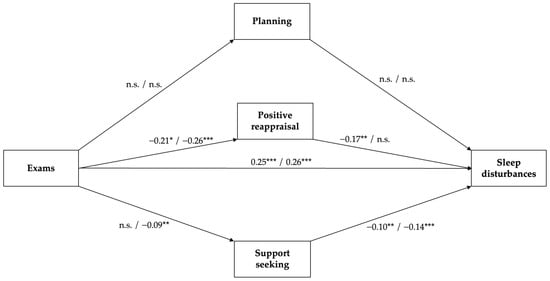
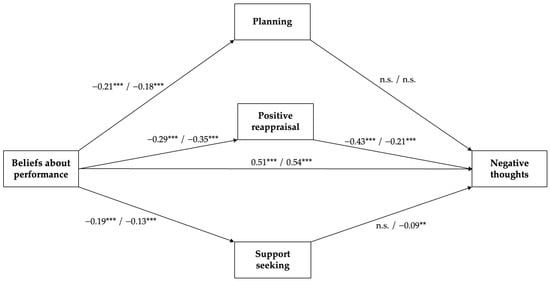
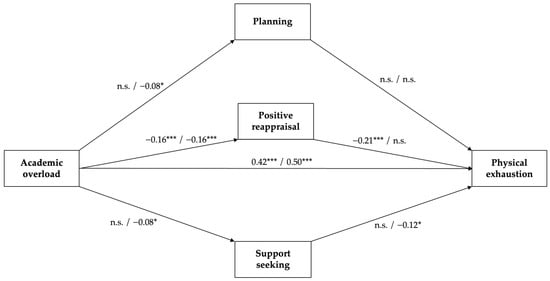
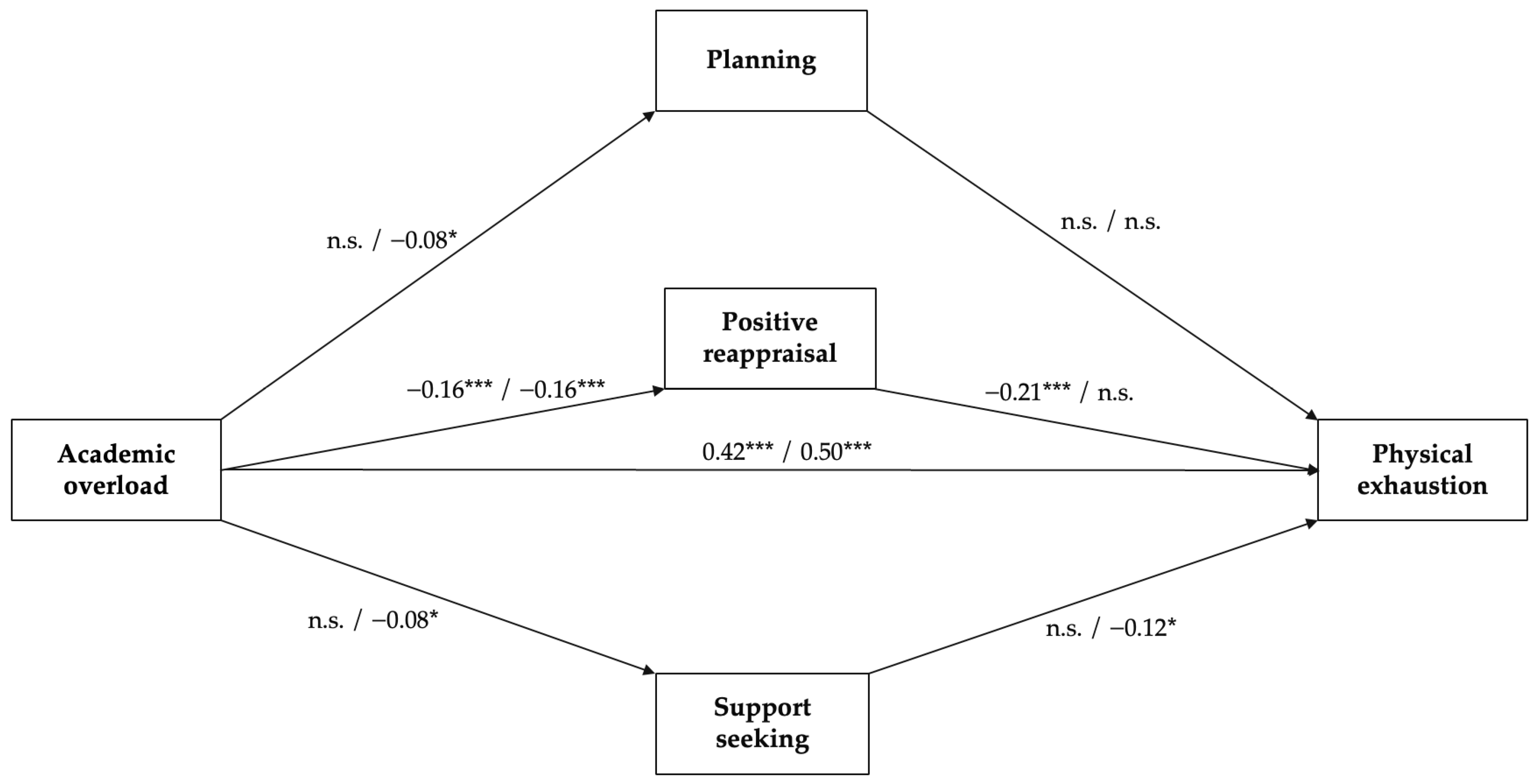
The three parallel mediation models estimated separately by gender are described below. Figure 1, Figure 2 and Figure 3 display the path coefficients, whereas Table 2 summarizes the direct, indirect, and total effects.
Figure 1.
Parallel mediation model between exams and sleep disturbances. Note. Non-standardized regression coefficients are shown for men/women. n.s. = non-significant; * p < 0.05; ** p < 0.01; *** p < 0.001.
Figure 2.
Parallel mediation model between beliefs about performance and negative thoughts. Note. Non-standardized regression coefficients are shown for men/women. n.s. = non-significant; ** p < 0.01; *** p < 0.001.
Figure 3.
Parallel mediation model between academic overload and physical exhaustion. Non-standardized regression coefficients are shown for men/women. n.s. = non-significant; * p < 0.05; *** p < 0.001.
Table 2.
Estimates of the mediation models by gender.
- -
- Model 1. Effect of Exams on Sleep Disturbances Mediated by Planning, Positive Reappraisal, and Support Seeking.
In Model 1 (see Figure 1 and Table 2), the total effect of exams on sleep disturbances was significant in both men, B = 0.285, 95% CI [0.211, 0.359], and women, B = 0.278, 95% CI [0.224, 0.338]. The direct effect also remained significant in both samples, with a very similar magnitude: B = 0.249 in men and B = 0.259 in women. Regarding the indirect pathways, a significant effect through positive reappraisal was observed in men, B = 0.036, 95% CI [0.006, 0.071], whereas in women the significant indirect effect occurred through support seeking, B = 0.010, 95% CI [0.002, 0.022]. Planning did not show a significant mediating role in either group.
- -
- Model 2. Effect of Beliefs about Performance on Negative Thoughts Mediated by Planning, Positive Reappraisal, and Support Seeking.
In Model 2 (see Figure 2 and Table 2), beliefs about performance showed a significant total effect on negative thoughts in both men, B = 0.621, 95% CI [0.545, 0.695], and women, B = 0.609, 95% CI [0.552, 0.664]. The direct effect was also significant in both samples, with estimates of B = 0.512, 95% CI [0.454, 0.571], in men and B = 0.539, 95% CI [0.454, 0.624], in women. Regarding the indirect effects, positive reappraisal acted as a mediator in both groups, although the effect was descriptively larger in men, B = 0.125, 95% CI [0.065, 0.189], than in women, B = 0.074, 95% CI [0.046, 0.107]. In addition, a significant indirect effect through support seeking was observed in the female sample, B = 0.012, 95% CI [0.002, 0.026]. Planning did not show a significant mediating role.
- -
- Model 3. Effect of Academic Overload on Physical Exhaustion Mediated by Planning, Positive Reappraisal, and Support Seeking.
In Model 3 (see Figure 3 and Table 2), academic overload showed a significant total effect on physical exhaustion in both men, B = 0.456, 95% CI [0.381, 0.531], and women, B = 0.518, 95% CI [0.460, 0.576]. The direct effect also remained significant in both samples, although the estimate was higher in women, B = 0.497, 95% CI [0.420, 0.573], than in men, B = 0.419, 95% CI [0.360, 0.477]. Regarding the indirect pathways, a significant effect through positive reappraisal was identified in men, B = 0.035, 95% CI [0.012, 0.065], whereas in women the significant indirect effect occurred through support seeking, B = 0.010, 95% CI [0.003, 0.020]. Planning did not show a significant mediating role in either group.
Finally, Table 2 jointly presents the estimates, significance levels, and bootstrap confidence intervals for the direct, indirect, and total effects of the three models.
Overall, all total effects were significant, showing a consistent association between academic stressors and the stress responses examined. Direct effects remained significant after coping strategies were included, which is consistent with a pattern of partial mediation. The indirect effects showed a gender-differentiated pattern: positive reappraisal showed greater relevance among men, whereas support seeking emerged as a mediating pathway among women; planning did not reach significance as a mediator in any model.
4. Discussion
The present study aimed to examine, separately in men and women, whether three coping strategies—planning, positive reappraisal, and social support—mediate the relationship between specific academic stressors and differentiated stress responses in university students. Specifically, three parallel mediation models were examined: the relationship between examinations and sleep difficulties, between beliefs about performance and negative thoughts, and between academic overload and physical exhaustion. Overall, the results provide partial and nuanced support for the initial expectations of the study.
The three academic stressors were significantly associated with their corresponding stress responses in both men and women, in line with previous studies linking academic stress to different manifestations of stress in university populations (Casuso-Holgado et al. 2019). Coping strategies played a selective mediating role: positive reappraisal and social support showed significant indirect effects in certain models, whereas planning did not reach significance as a mediator. In addition, the persistence of significant direct effects after including coping strategies is consistent with a pattern of partial mediation, in line with previous work on the mediating role of coping in academic stress (Restrepo et al. 2023; Ruiz-Camacho et al. 2025). Finally, mediation patterns showed a gender-differentiated configuration: positive reappraisal showed greater relevance in men, whereas social support emerged as a mediating pathway in women. These patterns are examined in greater detail below.
In the first model, examinations were positively associated with sleep difficulties in both groups. This finding is consistent with literature linking evaluative pressure to increased cognitive and emotional arousal, as well as to impairments in sleep quality among university students (Gardani et al. 2022; von der Embse et al. 2018). More specifically, recent studies focused on examination periods have shown that these stages are associated with poorer sleep quality and higher levels of fatigue in university populations (Bouloukaki et al. 2023). Examinations concentrate uncertainty about outcomes, time pressure, and perceived consequences for students’ academic trajectories, which may foster anticipatory worry and greater difficulty reducing cognitive arousal before sleep (Tousignant et al. 2019). The persistence of the direct effect after introducing coping strategies also indicates that the association between evaluation and sleep is not fully explained by the coping resources considered. This pattern suggests that sleep difficulties linked to evaluation do not depend solely on how students cope with the situation, but also on specific academic conditions, such as the concentration of tests, the accumulation of assignments, or the perceived high-stakes nature of examinations (Pérez-Jorge et al. 2025).
The mediation pattern in the first model also showed relevant differences. In men, positive reappraisal emerged as a significant indirect pathway in the association between examinations and sleep difficulties. This finding may be interpreted as suggesting that greater evaluative pressure is associated with lower activation of positive reinterpretation processes, which in turn is linked to greater sleep difficulties. Positive reappraisal requires cognitively reframing the meaning of the situation, reducing its threatening nature, and restoring a sense of manageability. When this strategy is activated to a lesser extent, the evaluative demand may retain a more threatening meaning and foster cognitive arousal processes that are incompatible with rest (Aldao et al. 2010; Webb et al. 2012). In women, by contrast, the significant indirect effect occurred through social support. This finding is consistent with studies in university populations that have documented gender differences both in test anxiety and in the use of support resources when facing stressful situations (Graves et al. 2021; Núñez-Peña et al. 2016). In this group, the relationship between examinations and sleep difficulties may be partially linked to the mobilization of interpersonal resources. Seeking guidance, accompaniment, or emotional validation may help modulate the evaluative experience; when this resource is not sufficiently activated, the pressure associated with examinations may translate into greater sleep difficulties (Liu et al. 2023).
The second model showed that beliefs about performance were markedly associated with negative thoughts in both men and women. This association is conceptually coherent, given that beliefs about performance involve appraisals of one’s own competence and of the consequences of academic performance, whereas negative thoughts reflect a cognitive response centered on worry, unfavorable self-evaluation, and anticipation of failure. The magnitude of this association suggests that beliefs about one’s own performance constitute a particularly sensitive core of academic stress. The literature has shown that perseverative cognitive processes, such as rumination or repetitive negative thinking, play a relevant role in psychological distress among university students (Brueckmann et al. 2025; Inostroza et al. 2024; Sheldon et al. 2021). The findings of the present study add to this line of research by showing that beliefs about performance are not only directly related to negative thoughts, but that this association is also partially articulated through specific coping resources.
In this second model, positive reappraisal acted as a significant mediator in both groups, with a descriptively larger effect in men. This finding is consistent with its function of reinterpreting the meaning attributed to the stressful experience, particularly when doubts about performance are associated with persistent negative thoughts (Folkman and Moskowitz 2004). Evidence on emotion regulation indicates that cognitive reinterpretation is generally associated with better psychological adjustment, although its effectiveness depends on the context and the type of demand (Aldao et al. 2010; Webb et al. 2012). In women, social support also showed a significant indirect effect, suggesting that the relationship between beliefs about performance and negative thoughts may be articulated not only through cognitive reinterpretation processes, but also through interpersonal resources. This pattern is consistent with university-based studies reporting gender differences in the use of support and meaning-focused or emotion-regulation strategies for managing stressful experiences (Graves et al. 2021; Martínez et al. 2019).
The third model showed that academic overload was significantly associated with physical exhaustion in both men and women. This finding is consistent with study demands–resources models applied to the academic context, according to which the sustained accumulation of study demands may contribute to strain processes, particularly when available resources are perceived as insufficient to meet these demands (Bakker and Mostert 2024). Academic overload represents an accumulative stressor: it does not depend on a single isolated event, but rather on the persistence of tasks, study requirements, assignments, exam preparation, and curricular demands. Its association with physical exhaustion is therefore conceptually coherent. In addition, meta-analytic evidence has linked academic burnout, particularly its exhaustion dimension, to poorer academic outcomes and lower student adjustment (Madigan and Curran 2021). The persistence of the direct effect after including the mediators is consistent with the interpretation that academic overload maintains a relevant association with physical exhaustion, even when the coping strategies examined are taken into account.
The indirect pattern in the third model showed a gender-differentiated profile. In men, positive reappraisal acted as a significant mediating pathway, whereas in women the indirect effect occurred through social support. This pattern is consistent with a possible differentiation in the resources mobilized in response to persistent academic demands. In men, the indirect pathway through positive reappraisal suggests that reinterpreting the meaning attributed to overload may be part of the association between this cumulative demand and physical exhaustion. In women, the role of social support points to a possible interpersonal pathway, in which the accumulation of tasks and demands may be partially managed through guidance, accompaniment, or external validation. This interpretation is consistent with recent studies that have identified gender differences in academic coping and burnout, as well as in the experience and perception of social support, although these patterns may vary depending on the cultural, academic, and relational context (Cabras et al. 2023; Khan et al. 2025).
A cross-cutting finding of interest was the absence of significant mediating effects of planning in the three models. This result should not be interpreted as evidence of a lack of general usefulness of planning, but rather as an indication that, in the specific relationships examined, this strategy did not significantly explain the link between academic stressors and stress responses. Planning is oriented toward organizing behavior, allocating effort, and anticipating courses of action, and may therefore be particularly useful when demands are perceived as controllable. However, its scope may be limited when the stressor is experienced as excessive, uncertain, or difficult to modify through individual action. In contexts of high evaluative pressure, doubts about performance, or sustained overload, better organization of academic work may not be sufficient to modify the emotional, cognitive, or physical response if the demand continues to be perceived as threatening, uncertain, or difficult to manage (Cheng et al. 2014; Folkman and Moskowitz 2004). In addition, recent reviews on coping among university students have highlighted the heterogeneity of the strategies used and of their associations with different indicators of adjustment, reinforcing the need to interpret each strategy according to the stressor and response examined (Waterhouse and Samra 2026).
Taken together, the results suggest a gender-differentiated mediation pattern, although this should be interpreted with caution. It would not be appropriate to derive a dichotomous interpretation according to which men cope “cognitively” and women cope “socially” in a general sense. Rather, the data suggest that, in the models analyzed, positive reappraisal appears as a more consistent indirect pathway in men, whereas social support emerges as a mediating resource in women. This pattern is consistent with previous studies in university populations that have observed greater use of support seeking among women and greater reliance on meaning-focused strategies among men (Graves et al. 2021; Martínez et al. 2019). It also converges with research identifying gender differences in academic stress coping strategies, with differential patterns in positive reappraisal, planning, and social support seeking (González Cabanach et al. 2013). However, these differences should not be interpreted as universal or stable, as they may depend on the academic context, the type of demand, the stress response considered, and the actual opportunities to mobilize personal or interpersonal resources. In this regard, the descriptive differences observed in the study variables reinforce the value of analyzing gender not merely as a variable associated with levels of stress or coping, but as a comparative framework for examining how the pathways between academic stressors, coping strategies, and stress responses are articulated.
From a theoretical perspective, the findings reinforce the value of analyzing academic stress in a differentiated manner, considering the type of stressor, the stress response examined, and the coping strategy involved. The identification of selective mediating patterns suggests that coping strategies do not operate uniformly; rather, their role varies according to the academic demand, the response analyzed, and gender. This interpretation is consistent with transactional and systemic approaches to stress, which emphasize the interaction between environmental demands, subjective appraisal, available resources, and students’ responses (Barraza Macías 2018; Lazarus and Folkman 1984).
At the applied level, the findings suggest that university interventions aimed at coping with academic stress should be designed from a gender-sensitive perspective, not to establish rigid pathways for men and women, but to recognize that coping strategies may be activated differently in response to specific academic demands (Amanvermez et al. 2023). Given that positive reappraisal showed greater relevance as an indirect pathway in men, programs could incorporate brief components focused on emotion regulation, cognitive reinterpretation, and flexible coping, particularly in response to performance-related demands and overload. Likewise, since social support emerged as a mediating resource in women, academic and emotional support networks could be strengthened through peer tutoring, mentoring, and accessible guidance channels. Although planning did not show a significant mediating role, training in this strategy may still be useful as a complementary resource, provided that it is accompanied by academic conditions that make work organization feasible, such as clear deadlines, a balanced distribution of tasks, and teaching coordination. These actions should also help reduce potential barriers to help-seeking and to the expression of distress, avoiding the assumption that all students mobilize the same resources in the same way.
Despite these findings, this study has several limitations. First, its cross-sectional design prevents the establishment of causal relationships or temporal sequences among stressors, coping, and stress responses. Second, the use of self-report measures may have introduced social desirability bias or biases derived from the subjective interpretation of the items. Third, the sample was drawn from a single university and obtained through naturally occurring clusters, which calls for caution when generalizing the results to other institutional contexts. Fourth, although age, field of study, and year of study were included as covariates, the present study did not aim to examine their specific role in the mediation pathways. Finally, estimating the models separately for men and women does not provide a formal test of whether the magnitude of direct or indirect effects differs between gender groups. Future research should employ longitudinal designs, multicenter samples, and multigroup or moderated mediation models to formally test whether the observed indirect effects differ by gender. It would also be advisable to evaluate interventions aimed at developing coping strategies from the early years of university, incorporating a gender-sensitive perspective that addresses possible differences in support seeking, the reinterpretation of academic demands, and the expression of stress responses.
5. Conclusions
The results showed gender-differentiated patterns in the mediation models analyzed. In both men and women, examinations were associated with sleep difficulties, beliefs about performance with negative thoughts, and academic overload with physical exhaustion. However, coping strategies showed a partial and selective mediating role: positive reappraisal emerged as a more consistent indirect pathway in men, whereas social support emerged as a mediating resource in women. Planning did not reach significance as a mediator in any of the models.
These findings suggest that the role of coping in the relationship between academic stressors and stress responses is not homogeneous, but appears to vary according to the type of stressor, the response considered, and gender. At the applied level, the results support the development of gender-sensitive university interventions that strengthen resources such as cognitive reinterpretation and social support, while avoiding the assumption that the same strategies operate equivalently across all students. Future longitudinal and multigroup studies will allow the stability of these patterns to be examined and the equivalence of mediating pathways in men and women to be formally tested.
Author Contributions
Conceptualization, C.R.-C. and M.G.; methodology, C.R.-C. and M.G.; formal analysis, C.R.-C. and M.G.; investigation, C.R.-C.; resources, C.R.-C.; data curation, C.R.-C. and M.G.; writing—original draft preparation, C.R.-C.; writing—review and editing, C.R.-C. and M.G.; supervision, M.G. All authors have read and agreed to the published version of the manuscript.
Funding
This research received no external funding.
Institutional Review Board Statement
The study was conducted in accordance with the Declaration of Helsinki and approved by the Ethics Committee of the University of Extremadura (protocol code 90/2025—17 March 2025).
Informed Consent Statement
Informed consent was obtained from all subjects involved in the study.
Data Availability Statement
The data are available upon request to the corresponding author.
Conflicts of Interest
The authors declare no conflicts of interest.
References
- Aldao, Amelia, Susan Nolen-Hoeksema, and Susanne Schweizer. 2010. Emotion-regulation strategies across psychopathology: A meta-analytic review. Clinical Psychology Review 30: 217–37. [Google Scholar] [CrossRef] [Scilit] [PubMed]
- Amanvermez, Yagmur, Metta Rahmadiana, Eirini Karyotaki, Leonore de Wit, David D. Ebert, Ronald C. Kessler, and Pim Cuijpers. 2023. Stress management interventions for college students: A systematic review and meta-analysis. Clinical Psychology: Science and Practice 30: 423–44. [Google Scholar] [CrossRef] [Scilit]
- Asensio-Martínez, Angela, Alejandra Aguilar-Latorre, Bárbara Masluk, Santiago Gascón-Santos, María Antonia Sánchez-Calavera, and Raquel Sánchez-Recio. 2023. Social support as a mediator in the relationship between technostress or academic stress and health: Analysis by gender among university students. Frontiers in Psychology 14: 1236825. [Google Scholar] [CrossRef] [Scilit] [PubMed]
- Ato, Manuel, Juan J. López-García, and Ana Benavente. 2013. Un sistema de clasificación de los diseños de investigación en psicología. Anales de Psicología 29: 1038–59. [Google Scholar] [CrossRef] [Scilit]
- Bakker, Arnold B., and Karina Mostert. 2024. Study demands–resources theory: Understanding student well-being in higher education. Educational Psychology Review 36: 92. [Google Scholar] [CrossRef] [Scilit]
- Barbayannis, Georgia, Mahindra Bandari, Xiang Zheng, Humberto Baquerizo, Keith W. Pecor, and Xue Ming. 2022. Academic stress and mental well-being in college students: Correlations, affected groups, and COVID-19. Frontiers in Psychology 13: 886344. [Google Scholar] [CrossRef] [Scilit] [PubMed]
- Barraza Macías, Arturo. 2018. Inventario SISCO SV-21: Inventario sistémico cognoscitivista para el estudio del estrés académico. Segunda versión de 21 ítems. Durango: ECORFAN. [Google Scholar]
- Bonneville-Roussy, Arielle, Paul Evans, Jérémie Verner-Filion, Robert J. Vallerand, and Thérèse Bouffard. 2017. Motivation and coping with the stress of assessment: Gender differences in outcomes for university students. Contemporary Educational Psychology 48: 28–42. [Google Scholar] [CrossRef] [Scilit]
- Bouloukaki, Izolde, Ioanna Tsiligianni, Giorgos Stathakis, Michail Fanaridis, Athina Koloi, Ekaterini Bakiri, Maria Moudatsaki, Eleptheria Pouladaki, and Sophia Schiza. 2023. Sleep quality and fatigue during exam periods in university students: Prevalence and associated factors. Healthcare 11: 2389. [Google Scholar] [CrossRef] [Scilit] [PubMed]
- Brueckmann, Malin, Justin Hachenberger, Elke Wild, and Sakari Lemola. 2025. Repetitive negative thinking mediates the relationship between self-esteem and burnout in an ecological momentary assessment study. Communications Psychology 3: 134. [Google Scholar] [CrossRef] [Scilit] [PubMed]
- Cabanach, Ramón G., Antonio Souto-Gestal, and Victoria Franco. 2016. Escala de Estresores Académicos para la evaluación de los estresores académicos en estudiantes universitarios. Revista Iberoamericana de Psicología y Salud 7: 41–50. [Google Scholar] [CrossRef] [Scilit]
- Cabanach, Ramón G., Antonio Valle, Susana Rodríguez, and Isabel Piñeiro. 2008a. Respuesta de estrés en contextos universitarios: Construcción de una escala de medida. Paper presented at the V Congreso Internacional de Psicología y Educación: Los Retos del Futuro, Oviedo, Spain, April 23–25. [Google Scholar]
- Cabanach, Ramón G., Antonio Valle, Susana Rodríguez, and Isabel Piñeiro. 2008b. Variables explicativas del estrés en estudiantes universitarios: Construcción de una escala de medida. Paper presented at the V Congreso Internacional de Psicología y Educación: Los Retos del Futuro, Oviedo, Spain, April 23–25. [Google Scholar]
- Cabras, Cristina, Tatiana Konyukhova, Natalia Lukianova, Marina Mondo, and Cristina Sechi. 2023. Gender and country differences in academic motivation, coping strategies, and academic burnout in a sample of Italian and Russian first-year university students. Heliyon 9: e16617. [Google Scholar] [CrossRef] [Scilit] [PubMed]
- Carver, Charles S., Michael F. Scheier, and Jagdish K. Weintraub. 1989. Assessing coping strategies: A theoretically based approach. Journal of Personality and Social Psychology 56: 267–83. [Google Scholar] [CrossRef] [PubMed]
- Casuso-Holgado, María Jesús, Noelia Moreno-Morales, María Teresa Labajos-Manzanares, and Francisco José Montero-Bancalero. 2019. The association between perceived health symptoms and academic stress in Spanish Higher Education students. European Journal of Education and Psychology 12: 109–23. [Google Scholar] [CrossRef] [Scilit]
- Cheng, Cecilia, Hi-Po Bobo Lau, and Man-Pui Sally Chan. 2014. Coping flexibility and psychological adjustment to stressful life changes: A meta-analytic review. Psychological Bulletin 140: 1582–607. [Google Scholar] [CrossRef] [Scilit] [PubMed]
- Cohen, Sheldon, and Thomas A. Wills. 1985. Stress, social support, and the buffering hypothesis. Psychological Bulletin 98: 310–57. [Google Scholar] [CrossRef]
- Fiorilli, Caterina, Daniela Barni, Claudia Russo, Vanessa Marchetti, Giacomo Angelini, and Luciano Romano. 2022. Students’ burnout at university: The role of gender and worker status. International Journal of Environmental Research and Public Health 19: 11341. [Google Scholar] [CrossRef] [Scilit] [PubMed]
- Folkman, Susan, and Judith T. Moskowitz. 2004. Coping: Pitfalls and promise. Annual Review of Psychology 55: 745–74. [Google Scholar] [CrossRef] [Scilit] [PubMed]
- Folkman, Susan, Richard S. Lazarus, Christine Dunkel-Schetter, Anita DeLongis, and Rand J. Gruen. 1986. Dynamics of a stressful encounter: Cognitive appraisal, coping, and encounter outcomes. Journal of Personality and Social Psychology 50: 992–1003. [Google Scholar] [CrossRef] [PubMed]
- Freire, Carlos, María del Mar Ferradás, Bibiana Regueiro, Susana Rodríguez, Antonio Valle, and José Carlos Núñez. 2020. Coping strategies and self-efficacy in university students: A person-centered approach. Frontiers in Psychology 11: 841. [Google Scholar] [CrossRef] [Scilit] [PubMed]
- Gao, Wenjuan, Siqing Ping, and Xinqiao Liu. 2020. Gender differences in depression, anxiety, and stress among college students: A longitudinal study from China. Journal of Affective Disorders 263: 292–300. [Google Scholar] [CrossRef] [Scilit] [PubMed]
- Gardani, Maria, Daniel R. R. Bradford, Kirsten Russell, Stephanie Allan, Louise Beattie, Jason G. Ellis, and Umair Akram. 2022. A systematic review and meta-analysis of poor sleep, insomnia symptoms and stress in undergraduate students. Sleep Medicine Reviews 61: 101565. [Google Scholar] [CrossRef] [Scilit] [PubMed]
- González Cabanach, Ramón, Antonio Souto-Gestal, Luz González-Doniz, and Victoria Franco Taboada. 2018. Perfiles de afrontamiento y estrés académico en estudiantes universitarios. Revista de Investigación Educativa 36: 421–33. [Google Scholar] [CrossRef] [Scilit]
- González Cabanach, Ramón, Antonio Valle Arias, Susana Rodríguez Martínez, Isabel Piñeiro Aguín, and Carlos Freire Rodríguez. 2010. Escala de afrontamiento del estrés académico (A-CEA). Revista Iberoamericana de Psicología y Salud 1: 51–64. [Google Scholar] [CrossRef] [Scilit]
- González Cabanach, Ramón, Francisca Fariña, Carlos Freire, Patricia González, and María del Mar Ferradás. 2013. Diferencias en el afrontamiento del estrés en estudiantes universitarios hombres y mujeres. European Journal of Education and Psychology 6: 19–32. [Google Scholar] [CrossRef] [Scilit]
- Graves, B. Sue, Michael E. Hall, Carolyn Dias-Karch, Michael H. Haischer, and Christine Apter. 2021. Gender differences in perceived stress and coping among college students. PLoS ONE 16: e0255634. [Google Scholar] [CrossRef] [Scilit] [PubMed]
- Hayes, Andrew F. 2022. Introduction to Mediation, Moderation, and Conditional Process Analysis: A Regression-Based Approach, 3rd ed. New York: The Guilford Press. [Google Scholar]
- Inostroza, Carolina, Claudio Bustos, Vasily Bühring, Lorena González, and Félix Cova. 2024. Stress, repetitive negative thinking, and mental health in Chilean university students: An ecological momentary assessment study. Frontiers in Psychology 15: 1400013. [Google Scholar] [CrossRef] [Scilit] [PubMed]
- Johnson, Daniel P., and Mark A. Whisman. 2013. Gender differences in rumination: A meta-analysis. Personality and Individual Differences 55: 367–74. [Google Scholar] [CrossRef] [Scilit] [PubMed]
- Karyotaki, Eirini, Pim Cuijpers, Yesica Albor, Jordi Alonso, Randy P. Auerbach, Jason Bantjes, Ronny Bruffaerts, David D. Ebert, Penelope Hasking, Glenn Kiekens, and et al. 2020. Sources of stress and their associations with mental disorders among college students: Results of the World Health Organization World Mental Health Surveys International College Student Initiative. Frontiers in Psychology 11: 1759. [Google Scholar] [CrossRef] [Scilit] [PubMed]
- Khan, Aashiq, Irum Zeb, and Shuanghu Fang. 2025. Gender differences in mental health experiences and perceived social support among university students: A qualitative case study. International Journal of Qualitative Studies on Health and Well-Being 20: 2576004. [Google Scholar] [CrossRef] [Scilit] [PubMed]
- Lazarus, Richard S., and Susan Folkman. 1984. Stress, Appraisal, and Coping. New York: Springer Publishing Company. [Google Scholar]
- Liu, Yongli, Junjun Chen, Kun Chen, Jing Liu, and Wei Wang. 2023. The associations between academic stress and depression among college students: A moderated chain mediation model of negative affect, sleep quality, and social support. Acta Psychologica 239: 104014. [Google Scholar] [CrossRef] [Scilit] [PubMed]
- Madigan, Daniel J., and Thomas Curran. 2021. Does burnout affect academic achievement? A meta-analysis of over 100,000 students. Educational Psychology Review 33: 387–405. [Google Scholar] [CrossRef] [Scilit]
- Martínez, Isabel M., Isabella Meneghel, and Jonathan Peñalver. 2019. Does gender affect coping strategies leading to well-being and improved academic performance? Revista de Psicodidáctica (English Edition) 24: 111–19. [Google Scholar] [CrossRef] [Scilit]
- Nolen-Hoeksema, Susan. 2012. Emotion regulation and psychopathology: The role of gender. Annual Review of Clinical Psychology 8: 161–87. [Google Scholar] [CrossRef] [Scilit] [PubMed]
- Núñez-Peña, María Isabel, Macarena Suárez-Pellicioni, and Roser Bono. 2016. Gender differences in test anxiety and their impact on higher education students’ academic achievement. Procedia—Social and Behavioral Sciences 228: 154–60. [Google Scholar] [CrossRef] [Scilit]
- Pascoe, Michaela C., Sarah E. Hetrick, and Alexandra G. Parker. 2020. The impact of stress on students in secondary school and higher education. International Journal of Adolescence and Youth 25: 104–12. [Google Scholar] [CrossRef] [Scilit]
- Pérez-Jorge, David, Majda Boutaba-Alehyan, Ana Isabel González-Contreras, and Itahisa Pérez-Pérez. 2025. Examining the effects of academic stress on student well-being in higher education. Humanities and Social Sciences Communication 12: 449. [Google Scholar] [CrossRef] [Scilit]
- Restrepo, Jorge Emiro, Erika Yohanna Bedoya Cardona, Gina Paula Cuartas Montoya, Mónica de los Milagros Cassaretto, and Yuliana Patty Vilela Alemán. 2023. Academic stress and adaptation to university life: Mediation of cognitive-emotional regulation and social support. Anales de Psicología 39: 62–71. [Google Scholar] [CrossRef] [Scilit]
- Rubach, Charlott, Luise von Keyserlingk, Sandra D. Simpkins, and Jacquelynne S. Eccles. 2022. Does instructional quality impact male and female university students differently? Focusing on academic stress, academic satisfaction, and mental health impairment. Frontiers in Education 7: 820321. [Google Scholar] [CrossRef] [Scilit]
- Ruiz-Camacho, Cristina, Margarita Gozalo, and Inmaculada Sánchez Casado. 2025. The Mediating Role of Active Coping Strategies in the Relationship Between Academic Stressors and Stress Responses Among University Students. Healthcare 13: 1674. [Google Scholar] [CrossRef] [Scilit] [PubMed]
- Sheldon, Elena, Melanie Simmonds-Buckley, Claire Bone, Thomas Mascarenhas, Natalie Chan, Megan Wincott, Hannah Gleeson, Karmen Sow, Daniel Hind, and Michael Barkham. 2021. Prevalence and risk factors for mental health problems in university undergraduate students: A systematic review with meta-analysis. Journal of Affective Disorders 287: 282–92. [Google Scholar] [CrossRef] [Scilit] [PubMed]
- Skinner, Ellen A., Kathleen Edge, Jeffrey Altman, and Hayley Sherwood. 2003. Searching for the structure of coping: A review and critique of category systems for classifying ways of coping. Psychological Bulletin 129: 216–69. [Google Scholar] [CrossRef] [Scilit] [PubMed]
- Tamres, Lisa K., Denise Janicki, and Vicki S. Helgeson. 2002. Sex differences in coping behavior: A meta-analytic review and an examination of relative coping. Personality and Social Psychology Review 6: 2–30. [Google Scholar] [CrossRef] [Scilit] [PubMed]
- Tousignant, Olivia H., Nicholas D. Taylor, Michael K. Suvak, and Gary D. Fireman. 2019. Effects of rumination and worry on sleep. Behavior Therapy 50: 558–70. [Google Scholar] [CrossRef] [Scilit] [PubMed]
- von der Embse, Nathaniel, Dane Jester, Devlina Roy, and James Post. 2018. Test anxiety effects, predictors, and correlates: A 30-year meta-analytic review. Journal of Affective Disorders 227: 483–93. [Google Scholar] [CrossRef] [Scilit] [PubMed]
- Waterhouse, Philippa, and Rajvinder Samra. 2026. University students’ coping strategies to manage stress: A scoping review. Educational Review 78: 127–67. [Google Scholar] [CrossRef] [Scilit]
- Webb, Thomas L., Eleanor Miles, and Paschal Sheeran. 2012. Dealing with feeling: A meta-analysis of the effectiveness of strategies derived from the process model of emotion regulation. Psychological Bulletin 138: 775–808. [Google Scholar] [CrossRef] [Scilit] [PubMed]
- Zeng, Liang-Nan, Qian-Qian Zong, Yuan Yang, Ling Zhang, Yi-Fan Xiang, Chee H. Ng, Li-Gang Chen, and Yu-Tao Xiang. 2020. Gender difference in the prevalence of insomnia: A meta-analysis of observational studies. Frontiers in Psychiatry 11: 577429. [Google Scholar] [CrossRef] [Scilit] [PubMed]
- Zhang, Bin, and Yun-Kwok Wing. 2006. Sex differences in insomnia: A meta-analysis. Sleep 29: 85–93. [Google Scholar] [CrossRef] [Scilit] [PubMed]

Disclaimer/Publisher’s Note: The statements, opinions and data contained in all publications are solely those of the individual author(s) and contributor(s) and not of MDPI and/or the editor(s). MDPI and/or the editor(s) disclaim responsibility for any injury to people or property resulting from any ideas, methods, instructions or products referred to in the content. |
© 2026 by the authors. Licensee MDPI, Basel, Switzerland. This article is an open access article distributed under the terms and conditions of the Creative Commons Attribution (CC BY) license.