


Abstract
Latin America has experienced rapid evangelical growth, yet this expansion has not produced a stable religious cleavage comparable to those observed in Europe or the United States. This article examines Jair Bolsonaro’s relationship with evangelical electoral support in Brazil, asking how an evangelical voter base emerged around him during his seventh campaign for federal deputy and whether this support endured in the presidential election that brought him to office. It argues that Bolsonaro’s evangelical support should be understood not as the product of a unilateral electoral strategy, but as an adaptive alignment with a broader reconfiguration of Brazil’s political and religious environment. Combining quantitative and qualitative evidence, the study analyzes the territorial distribution of evangelicals and Bolsonaro’s legislative vote in Rio de Janeiro, identifies a shift in support in evangelical-rich municipalities beginning in 2014, examines individual-level voting-intention surveys from the 2018 presidential election, and analyzes Bolsonaro’s parliamentary speeches and social media discourse. The findings show that evangelical support developed through discursive repositioning, ties to religious leaders, moral appeals, and opportunities created by party-system crisis and religious brokerage. The article contributes to debates on cleavages, political incorporation, and conservative representation.
1. Introduction
Latin America, regarded as a global Catholic stronghold, has been undergoing significant transformations in religious affiliation and political power, most visibly reflected in the rise of evangelicalism. Evangelicals now account for approximately 15% to 20% of the region’s population (Corporación Latinobarómetro 2020; Johnson and Zurlo 2020), up from 3% seventy years ago (Pew Research Center 2010, 2014). Yet this demographic and political expansion has not produced a stable religious cleavage comparable to those observed in Europe or the United States. In Latin America, religious competition is not clearly tied to ideology: both evangelical and catholic churches have supported right- and left-wing candidates (Smith 2019), and catholic and evangelical voters do not appear to be consistently divided along ideological lines (Boas and Smith 2015). This contrasts with the United States, where religion and ideology are more closely linked (Campbell et al. 2011). With European experiences in which religious conflicts became embedded in party systems (Lijphart 1979, p. 442), Catholic confessional parties emerged (Kalyvas 1998), and religious authority often fused with national identity (Grzymala-Busse 2015; Grzymala-Busse and Slater 2018).
The grassroots bases of political parties in Latin America have been described as “amorphous or eclectic” (Levitsky 2003, p. 22), reflecting the weak consolidation of ideological cleavages in parties of the third democratic wave (Mainwaring 1999; Dix 1989), the disappearance of conservative and liberal parties before the first wave of democratization (Collier and Collier 1991), and their replacement by catch-all parties (Dix 1989). Research on Latin American politics has underscored the importance of examining the varied ties that structure voter–party linkages (clientelistic, personalistic, ideological, or hybrid) (Luna 2014; Luna 2007; Kitschelt and Wilkinson 2007; Kitschelt 2000; Mayhew 1974), as well as the role of non-partisan actors in channeling demands and representing social groups (Luna et al. 2021; Dunning and Stokes 2008).
These works leave unresolved a question: How can religious electoral support emerge and endure in contexts where religious identities are politically flexible, party systems are weakly institutionalized, and religious cleavages have not consolidated into stable partisan alignments? Existing research shows that evangelical churches can act as political intermediaries. It also finds that religious voters may be mobilized around moral issues and that party-system crises create openings for new forms of representation. However, less is known about how these factors combine over time. How do they produce electoral support for a non-confessional conservative leader who does not share the religious identity of the constituency he comes to mobilize? This article addresses that question. It examines how evangelical support developed around Jair Bolsonaro before his presidential campaign and how this support persisted into the 2018 election.
Building on this discussion, this article examines the case of Jair Bolsonaro and evangelical electoral support in Brazil. Bolsonaro’s trajectory raises two central questions: How did an evangelical voter base emerge around him during his seventh campaign for federal deputy? And to what extent did this support endure in the presidential election that brought him to office? Bolsonaro’s support among evangelicals emerged through adaptive discursive repositioning, evangelical brokerage, moral appeals, and the opportunities generated by the crisis of traditional parties. By adaptive discursive repositioning, we refer to the gradual adjustment of Bolsonaro’s public discourse toward themes that were becoming electorally salient among evangelical constituencies, especially the defense of the traditional family, opposition to LGBT and gender-rights agendas, anti-left appeals, and references to Christian values. This repositioning was adaptive because it responded to a broader political–religious environment rather than reflecting a fully pre-planned electoral strategy. By evangelical brokerage, we refer to the mediation performed by religious leaders and evangelical networks that helped connect Bolsonaro to voters with whom he did not share a confessional identity. Although he was not evangelical himself, his connections with key religious elites gave him access to networks of believers (Reich and dos Santos 2013) and enabled him to signal commitment to moral agendas salient to evangelical constituencies.
This article contributes to comparative debates on religious cleavages, voter–party linkages, political intermediation, and conservative representation by examining how a new evangelical voter base emerged around Jair Bolsonaro during his seventh campaign for federal deputy in Brazil and later endured in the presidential election that brought him to office. Specifically, by addressing the question of how religious electoral support emerges and endures in contexts of flexible religious identities and weakly institutionalized party systems, the article advances four interrelated debates: (i) the conditions under which religious cleavages become electorally consequential without crystallizing into confessional parties; (ii) the structure of voter–party linkages in weakly institutionalized systems where non-partisan actors play a central mediating role; (iii) the function of religious intermediaries—pastors, congregations, and evangelical networks—as gatekeepers of electoral alignment; and (iv) the dynamics of conservative representation under conditions of party-system crisis and moral polarization. This support was not simply the result of a pre-existing conservative evangelical electorate, nor of a unilateral electoral strategy by Bolsonaro. Rather, it emerged through the interaction of evangelical expansion, moral politicization, party-system crisis, religious brokerage, and Bolsonaro’s adaptive discursive repositioning.
The Brazilian case is analytically relevant because it captures a typical mechanism through which religious support can emerge in a crisis of representation within party systems, especially during periods of cultural wars. Bolsonaro did not simply inherit a naturally conservative evangelical electorate, nor did he create evangelical politicization ex nihilo. Rather, his trajectory reflects an adaptive response to a broader wave of changes. In this sense, we cannot state that Jair Bolsonaro acted as a strategist, but as a typical case of conservative religious mobilization in which a non-confessional leader adjusted to a changing political-religious environment and benefited from the electoral opportunities it created.
This argument builds on comparative debates about party systems, cleavages, and political representation. The postwar transformation of Western democracies reshaped the social boundaries of established parties through expanded welfare states (Keohane 1984), democratization, and the growing influence of mass media. These shifts altered expectations, values, and citizen–party links, moving political representation beyond the instrumental rationality of industrial societies (Inglehart 1997; Katz and Mair 1995; Kirchheimer 1966). Comparative political sociology has examined how these changes affected party systems, representational bases, and deep-rooted cleavages, including religious divides (Kalyvas 1998; Lijphart 1979). However, these patterns cannot be directly transposed to Latin America, where party politics has been characterized by weak parties (Levitsky et al. 2016), fragmented and loosely institutionalized party systems (Coppedge 1998), and high electoral volatility (Jones and Mainwaring 2003).
Within this setting, the politicization of evangelical identities does not automatically generate stable religious party representation. As Smith (2019) observes, “the rise in evangelical conservatism may be one of the forces driving a small but potentially growing religious gap in partisanship” (Smith 2019, p. 128). This distinction matters because religious identities in Latin America remain flexible and do not necessarily translate into durable partisan alignments. Kalyvas (1998) shows that the actors who drive new social cleavages are not always the same actors who create or lead the parties that represent them. This insight is especially relevant in contexts where religious identities are activated by intermediaries, leaders, and strategies rather than incorporated through stable confessional parties.
Evangelical churches have become increasingly important political actors in Latin America. Once politically marginalized, evangelicals are now a contested electorate (Novaes 2001). Their demographic growth has been accompanied by an increase in evangelical politicians (Pérez Guadalupe and Grundberger 2018; Oro 2003), particularly in legislatures (De Almeida 2017). Dense religious networks can circulate political information and cues within congregations (Trejo 2012), while increased religious participation exposes voters to political sermons and interpretive frames (Smith 2019; McClendon and Riedl 2019). In contexts where participation in traditional political organizations is low, congregations can function as spaces of “congregated voters” (Novaes 2001). Clergy, in turn, may operate as political intermediaries with organizational resources and autonomy, acting as gatekeepers of the evangelical vote (Smith 2019).
The Bolsonaro case fits this broader pattern while also revealing a specific pathway of conservative religious mobilization. Conservative leaders across the Americas have mobilized religious groups during party-system crises and moments of moral polarization, but they have done so through different mechanisms. In the United States, some studies explain evangelical support for Trump as a coalition of interests centered on judicial appointments, abortion, and institutional access (Margolis 2020), while others emphasize the symbolic defense of a national Christian heritage (Baker et al. 2020). In Guatemala, Jimmy Morales relied on his personal evangelical identity (Althoff 2019). In Costa Rica, Fabricio Alvarado’s rise was driven by moral polarization over same-sex marriage (Smith and Boas 2024; León-Carvajal and Pineda-Sancho 2023; Pignataro and Treminio 2019). In Peru, Alberto Fujimori’s 1990 campaign relied heavily on evangelical networks for organizational support; however, these actors were sidelined once he assumed the presidency (López Rodríguez 2008; Gutierrez Sánchez 2000). Bolsonaro, by contrast, illustrates a mechanism based on adaptive discursive repositioning and evangelical brokerage. In this mechanism, a non-confessional conservative leader becomes electorally connected to evangelical voters not by sharing their religious identity or leading a confessional party, but by adjusting his discourse to moral and religious issues already gaining political salience and by relying on religious intermediaries capable of transmitting cues, legitimacy, and access to congregational networks. Initially external to evangelical politics, he became increasingly aligned with a field of religious–moral mobilization that was gaining electoral salience before his presidential campaign.
The Brazilian case highlights the interaction between evangelical expansion, party fragmentation, and electoral institutions. Proportional representation with open lists, large-magnitude districts, and high fragmentation weaken party discipline and voter identification (Ames 2001; Mainwaring 1999). Under these conditions, candidates tend to cultivate personal reputations, build individualized support bases, and mobilize social identities, including religion (Boas 2016; Boas and Smith 2015). These dynamics have facilitated the rise of “pastor-candidates,” who benefit from organizational and symbolic advantages. Yet Bolsonaro’s case is especially puzzling because he became electorally connected to evangelical voters without being evangelical himself. This process became visible in the 2014 legislative elections and continued into the 2018 presidential race. His evangelical appeal was public, visible, and compatible with his broader conservative and anti-Workers’ Party positioning, challenging expectations that segmented electoral strategies require messages to remain hidden from other audiences (Luna 2014).
This experience also differs from theories that emphasize party moderation as the primary path to broader electoral appeal. Rather than moving toward the center, Bolsonaro’s trajectory suggests that base-oriented appeals can become electorally expansive when they resonate with broader moral, partisan, and institutional realignments. His religious–moral positioning did not operate in isolation; it became linked to conservatism, anti-Workers’ Party sentiment, and the crisis of traditional party mediation. In this sense, the case illustrates a broader dilemma in electoral politics: how political actors build focused appeals while also expanding their support bases (Przeworski and Sprague 1986). Bolsonaro’s case shows that such expansion does not necessarily require moderation. It can also occur when specific appeals become aligned with wider political identities and emerging intermediating structures.
Empirically, the article combines quantitative and qualitative evidence to examine this process. First, it analyzes the relationship between the territorial distribution of evangelicals and Bolsonaro’s vote in Rio de Janeiro’s legislative elections. Second, it identifies a shift in support for Bolsonaro in evangelical-rich municipalities beginning in 2014. Third, it examines whether this association persists at the individual level, using voting-intention surveys that capture evangelical support in the 2018 presidential election. Finally, it analyzes Bolsonaro’s discursive positioning in parliamentary speeches and on social media to trace the process of adaptive discursive repositioning, while examining how references to evangelical leaders and moral–religious agendas illuminate the role of evangelical brokerage. By tracing these dynamics, the article contributes to comparative debates on cleavages, political incorporation, and conservative representation, showing how evangelical support for Bolsonaro developed under specific institutional, religious, and party-system conditions.
2. Materials and Methods
This study uses a mixed-methods design, combining quantitative and qualitative approaches and triangulating findings from three sources: (1) aggregated electoral data in a subnational panel dataset, (2) individual-level data from a pre-election vote intention survey, and (3) a corpus of parliamentary speeches and social media messages. Quantitative analysis identifies patterns of evangelical support, while qualitative analysis explores narratives and discourses to contextualize these patterns. Integrating both approaches provides a comprehensive understanding of how Jair Bolsonaro achieved and maintained evangelical support in Brazil amid political changes.
Combining quantitative and qualitative methods enables an integrated analysis of voting patterns. It also allows for an exploratory look at potential political mechanisms. Quantitative analysis identifies the relationship between the electorate’s religious composition and the candidate’s performance over time; this informs the qualitative analysis. The qualitative analysis explores shifts in the candidate’s political communication that might explain this relationship. This stepwise integration, widely used in comparative research, strengthens the validity of empirical inferences (Creswell and Plano Clark 2018; Lieberman 2005).
Data Sources and Data Collection Instruments
- (a)
- Electoral and Sociodemographic Dataset
The municipal panel covers the 92 municipalities of the state of Rio de Janeiro across the five federal legislative elections in which Jair Bolsonaro stood for re-election as a deputy: 1998, 2002, 2006, 2010, and 2014. The dependent variable is the share of valid votes received by Bolsonaro in each municipality-election (prop), computed from electoral records of the Tribunal Superior Eleitoral (TSE). Municipal sociodemographic variables—proportion of evangelical residents, proportion of white residents, proportion of rural residents, and Gini coefficient—were drawn from the Brazilian Demographic Censuses (IBGE) of 1991, 2000, and 2010, and assigned to each election year following the most recent available census: the 1991 Census to the 1998 election, the 2000 Census to the 2002 and 2006 elections, and the 2010 Census to the 2010 and 2014 elections. Municipal GDP per capita was obtained from the IBGE Municipal GDP series, available annually since 1999; no comparable measure exists for 1998, so this control is unavailable for that election. Homicide rates per 100,000 inhabitants were drawn from the Atlas da Violência (IPEA), based on the Sistema de Informações sobre Mortalidade (SIM).
The resulting panel contains 458 municipality-election observations. After listwise deletion of cases with missing values on the religious composition variable—primarily municipalities created between 1991 and the late 1990s that were not registered as independent units in earlier censuses—the analytical sample for the baseline specification (Model 1) comprises 433 observations across 92 municipalities. Specifications including municipal GDP per capita (Models 2–4) drop all 1998 observations and yield an analytical sample of 341 observations across four electoral periods.
- (b)
- Public Opinion Survey
To complement the aggregate analysis and minimize ecological inference risk (King 1997), the study uses data from a pre-election survey conducted between 15 and 21 August 2018, with 1352 respondents. Data were collected via a structured online questionnaire using a Netquest panel certified under ISO 26362:2009, the international standard for access panels in market, opinion, and social research (International Organization for Standardization 2009). The questionnaire covered vote intention, religious identification, political ideology, income, educational attainment, and sociodemographic characteristics.
The analysis measures the dependent variable, voting intention for Jair Bolsonaro, by respondents’ stated electoral choices. The main independent variable, evangelical identification, relies on respondents’ self-identification with an evangelical denomination.
- (c)
- Documentary Corpus for Political Discourse Analysis
To analyze changes in the candidate’s political discourse, a documentary corpus was constructed with three sets: 216 Twitter messages (2010–2014), 299 parliamentary speeches from electoral years, and 74 speeches made two months before and after each participating election.
These materials were collected from official records of the Brazilian Congress and the candidate’s social media archives. The analytical strategy focused on determining whether Jair Bolsonaro’s political discourse matched shifts in his voting patterns in municipalities with the highest proportions of evangelical residents before the 2014 legislative elections, and on regional differences in the evangelical population across municipalities.
Analytical Strategy
- (a)
- Quantitative Analysis with Panel Data
The main quantitative analysis is conducted using linear panel data regressions estimated via ordinary least squares (OLS) with fixed effects for municipalities and electoral years. Fixed-effects models allow for the control of unobserved characteristics of territorial units that remain constant over time, as well as common shocks associated with each election (Wooldridge 2010).
The empirical strategy follows a difference-in-differences (DiD) logic with continuous treatment intensity, in which the proportion of evangelical residents in each municipality captures the degree of exposure to the post-2013 discursive shift (Angrist and Pischke 2009; Wooldridge 2010). To assess this relationship rigorously, the quantitative analysis is developed in three sequential steps. First, the baseline panel regression is estimated with progressively added controls (Table 1), in order to quantify the average association between evangelical share and Bolsonaro’s vote share before and after the shift.
Table 1.
Panel Data Regression Model. Dependent variable: Bolsonaro Vote (%).
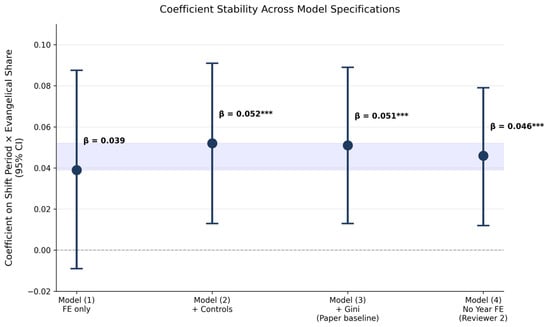
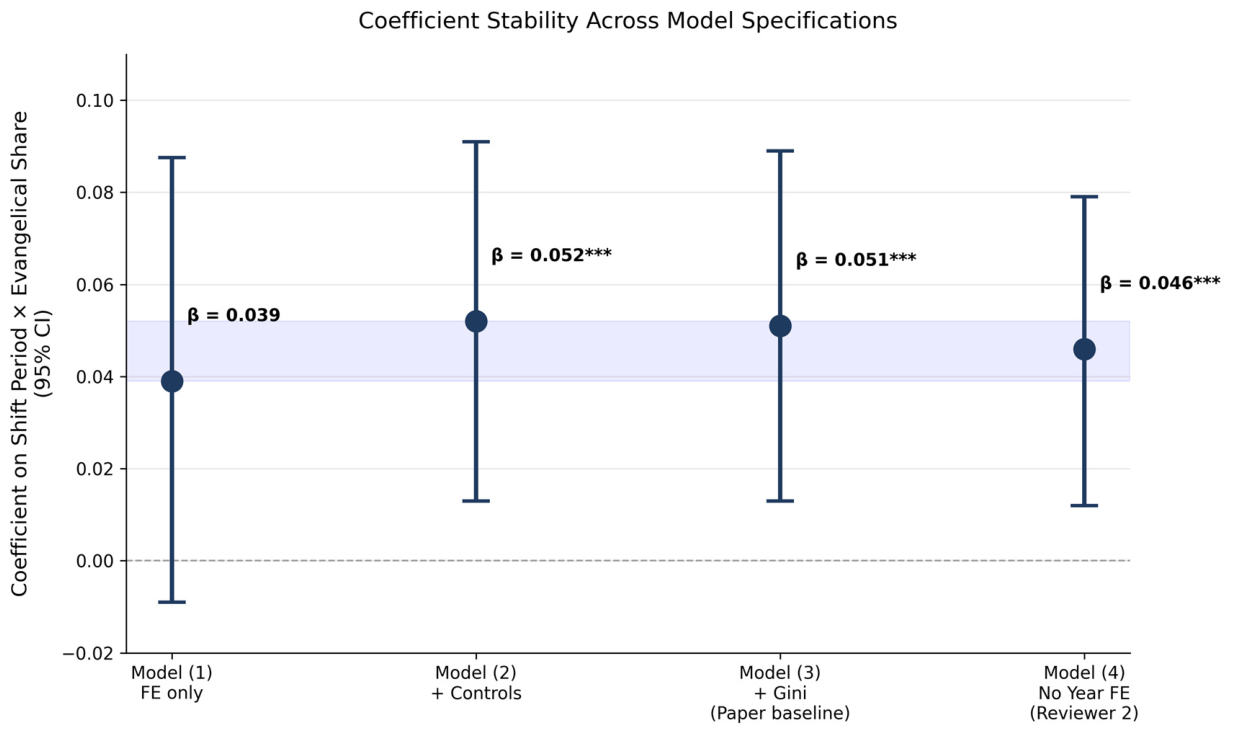
Second, the stability of the central coefficient is examined across alternative specifications (Figure 1), in order to verify that the result is not driven by a particular set of controls or modeling choices.
Figure 1.
Coefficient Stability Across Model Specifications. Coefficient Stability Across Model Specifications. Point estimates and 95% confidence intervals for the Shift Period × Evangelical Share interaction term across the four specifications reported in Table 1. Models (1)–(3) replicate the original specification with progressively added controls and include both municipality and year fixed effects. Model (4), added in response to reviewer comments, drops year fixed effects to allow the Shift Period dummy to be reported as a separate regressor. Significance levels: *** p < 0.01. The shaded band marks the narrow range of point estimates across specifications, illustrating the stability of the main result.
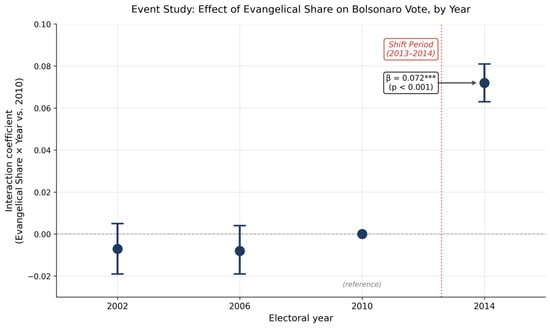
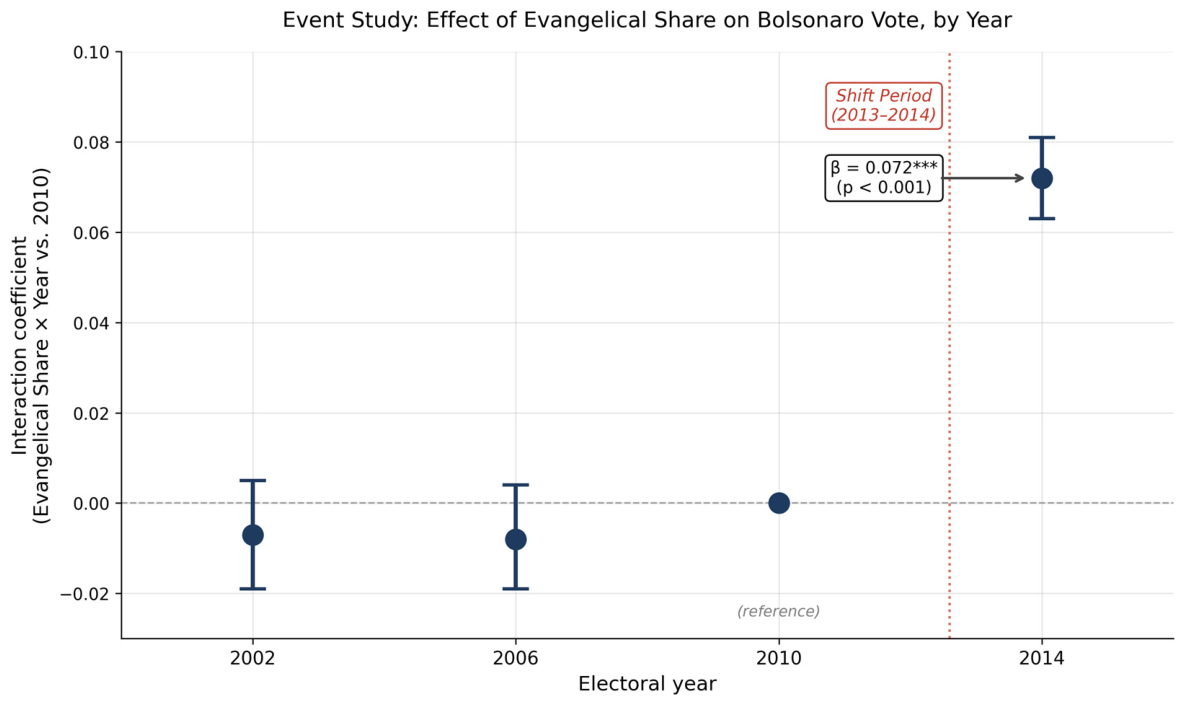
Third, and most importantly, an event study specification is estimated (Figure 2 that allows the coefficient to vary by electoral year, providing a formal test of the parallel-trends assumption that underlies the DiD identification strategy. This sequence (from average estimation, to robustness across specifications, to dynamic testing of the identifying assumption) follows current methodological best practices in applied econometrics (Roth et al. 2023).
Figure 2.
Event Study: Effect of Evangelical Share on Bolsonaro Vote, by Year. Event Study Estimates: Interaction between Evangelical Share and Electoral Year. Point estimates and 95% confidence intervals from the event study specification described in the text. The reference period is 2010 (the last pre-shift election). All estimates include municipality fixed effects and the full set of controls from Model (3) of Table 1. Standard errors are clustered at the municipality level. The 1998 election is excluded from the sample due to the unavailability of municipal GDP data prior to 1999. The vertical dashed line marks the period of the discursive shift (2013–2014). Pre-shift coefficients (2002, 2006) are statistically indistinguishable from zero; the 2014 coefficient is large, positive, and significant (β = 0.072, p < 0.001), consistent with the parallel trends assumption and with the timing of the discursive shift. Significance levels: *** p < 0.01.
The event study specification is particularly important because it addresses a key concern in DiD analyses: the credibility of the parallel-trends assumption. Rather than imposing a single post-treatment interaction term, the event study estimates separate interaction coefficients between evangelical share and each electoral year, using the last pre-shift election (2010) as the reference period. If pre-treatment coefficients are statistically indistinguishable from zero, this constitutes direct empirical evidence that municipalities with high and low evangelical shares were on parallel trajectories before the discursive shift, supporting a causal interpretation of the post-treatment estimate. The methodological choices adopted in this article draw on recent advances in the difference-in-differences literature that emphasize the importance of explicitly testing the identifying assumptions of the design and of using estimators robust to heterogeneous treatment effects (Callaway and Sant’Anna 2021; Goodman-Bacon 2021; Sun and Abraham 2021). Although the setting of this study involves a single treatment timing (2014), which mitigates the concerns about negative weighting raised in this literature for staggered designs, the event study representation is adopted because it provides the most transparent and informative way to assess pre-trends, the timing of the effect, and the precision of the estimates.
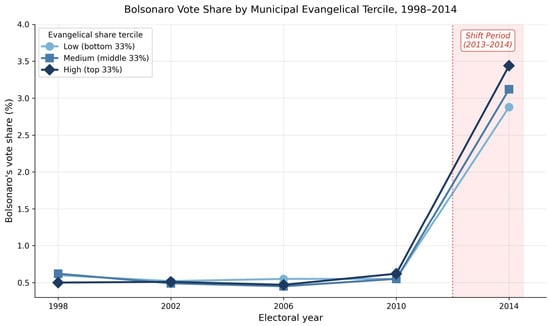
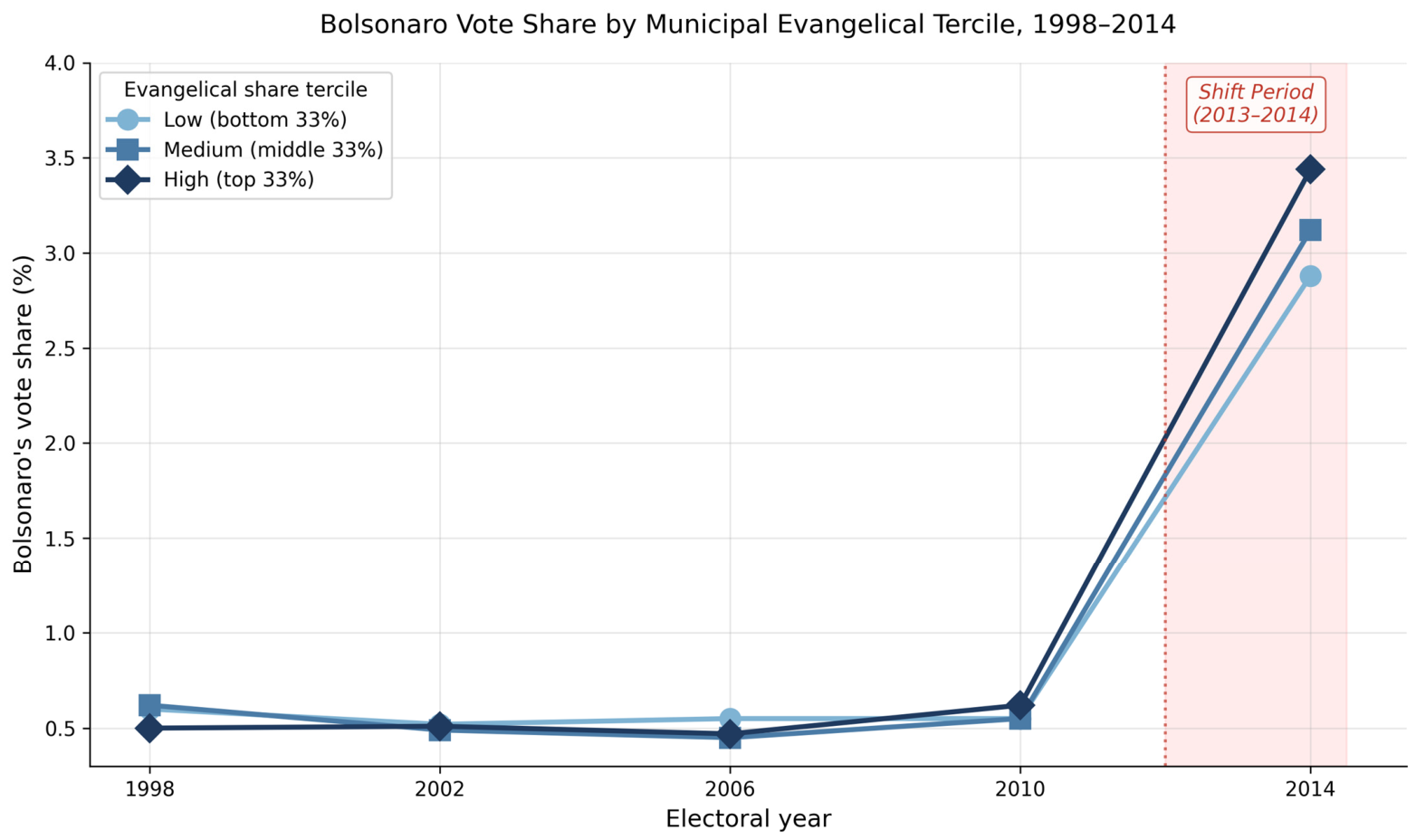
Prior to the formal event study test, the analysis includes a descriptive visualization of the parallel-trends assumption (Figure 3).
Figure 3.
Bolsonaro Vote Share by Municipal Evangelical Tercile, 1998–2014.
For this purpose, municipalities are grouped into three terciles based on their average evangelical share over the 1998–2014 period, and the mean of Bolsonaro’s vote share is plotted by tercile and electoral year. This tercile-based grouping is preferred over alternative cutoffs because it allows for a clear visual contrast across different levels of treatment exposure without imposing arbitrary thresholds, while the time-invariant nature of the classification ensures that the visualization reflects structural differences across municipalities rather than short-term fluctuations.
The estimated OLS model can be expressed as follows:
where Bolsonaro Vote (%) denotes the vote share obtained by Bolsonaro in municipality i in election t between 1998 and 2014. The shift period takes the value 1 for the 2014 election, anchored in identifiable political events between 2013 and 2014—including the 2013 CNJ ruling on same-sex marriage, Marco Feliciano’s presidency of the Human Rights Commission, and the increasing salience of moral–religious framing in the candidate’s discourse documented in Section 3.2. The expectation is that the electoral consequences of this post-shift alignment will be stronger in municipalities with a higher evangelical population share. This is captured by the interaction between the post-shift period and the municipal share of evangelical residents. Additionally, the model includes a set of relevant control variables to improve estimation precision and account for observable municipal-level differences that may also influence Bolsonaro’s vote share.
% BolsonaroVote_it = β0 + β1 Evangelical Share_it + β2 (Shift Period × Evangelical Share_it) + β3 GDP per Capita_it + β4 Gini_it + β5 White Population Share_it + β6 Rural Population Share_it + β7 Homicide Rate_it + β8 Municipality_i + β9 Year_t + u_it
- (b)
- Statistical Analysis Using Survey Data
To assess whether the relationship observed at the aggregate level also holds at the individual level, logistic regression models were estimated using data from the 2018 pre-electoral survey. The dependent variable corresponds to vote intention for Jair Bolsonaro, while the main independent variable identifies whether the respondent self-declares as evangelical. The models include controls for age, gender, income, educational attainment, and ideological self-placement. Results are reported as odds ratios, which indicate how much more or less likely respondents with a given characteristic (e.g., being evangelical) are to express vote intention for the candidate, relative to the reference group (Long and Freese 2014).
- (c)
- Qualitative Analysis of Political Discourse
To identify the political mechanisms underlying the quantitative patterns, a qualitative analysis of the candidate’s political discourse was conducted. Employing a thematic approach (Braun and Clarke 2006), this analysis sought to uncover recurring patterns and monitor their evolution over time. The process involved three stages: first, assembling a documentary corpus from parliamentary speeches and social media; second, applying thematic coding to identify references to religious values, moral agendas, and evangelical leaders; and finally, conducting a longitudinal analysis to observe changes in rhetoric leading up to the 2014 legislative election.
Building on these findings, the analysis shows that, from 2013 onward, the candidate increasingly referred to conservative moral agendas and evangelical leaders. In response to increased support, this trend suggests a discursive realignment that paralleled the candidate’s growing electoral support among evangelicals.
3. Results
This section presents the study’s empirical findings in two stages. First, it analyzes electoral patterns associated with the evangelical vote using panel data from legislative elections in Rio de Janeiro (1998–2014) and survey data from before the 2018 presidential election. Second, it examines the evolution of Jair Bolsonaro’s political discourse through qualitative analysis of his Twitter posts and parliamentary speeches.
By combining these approaches, it becomes possible first to assess whether a relationship exists between the presence of the evangelical electorate and the candidate’s electoral performance, and second to investigate the discursive and political mechanisms that may explain this relationship.
3.1. Quantitative Evidence: Evangelical Vote and Bolsonaro’s Electoral Performance
3.1.1. Results from the Panel Data Model
Table 1 reports four specifications of the panel regression model. Across all three, the interaction Shift Period × Evangelical Share (the central quantity of interest) is positive, of similar magnitude (β = 0.039–0.053), and statistically significant once controls are included (Models 2 and 3, p < 0.01). The coefficient on Evangelical Share alone is consistently small, negative, and not statistically distinguishable from zero, indicating that municipal evangelical share was not associated with Bolsonaro’s vote share in the pre-shift period (1998–2010). Among controls, only the Gini coefficient reaches significance: more unequal municipalities deliver higher vote shares to Bolsonaro post-shift, a finding worth noting for future research on the socioeconomic correlates of the evangelical–conservative alignment in Brazil.
Figure 1 visualizes the central finding of the panel regression analysis. Municipalities are grouped into three terciles based on their average evangelical share over the period, and the mean of Bolsonaro’s vote share is plotted by tercile and electoral year. The pattern displayed in the figure provides strong intuitive support for the central claim of this study. From 1998 through 2010, the three groups of municipalities exhibit nearly parallel trajectories in Bolsonaro’s electoral performance, with mean vote shares remaining low across all terciles and the gap between high- and low-evangelical municipalities remaining stable. This pre-shift parallelism is precisely the pattern that the difference-in-differences identification strategy requires: in the absence of the discursive shift, municipalities with different evangelical compositions would have followed similar trajectories.
The post-shift period reveals a markedly different pattern. In 2014, the trajectories diverge sharply. The vote share in high-evangelical municipalities increases substantially, while low-evangelical municipalities show much more modest gains. This visual divergence, emerging precisely in the year of the discursive shift and not before, corroborates the regression results reported in Table 1 and is consistent with the event study estimates presented in the next section. The figure also clarifies the substantive magnitude of the effect: the gap in mean vote share between the highest and lowest evangelical terciles, which was modest and stable in earlier elections, widens visibly in 2014. For instance, in municipalities at the upper end of the evangelical-share distribution, approximately 40%, Bolsonaro’s 2014 vote share increased by about 2.9 percentage points relative to the pre-shift baseline. The results show that electoral support for the candidate was consistently higher in the period following the change, even when the proportion of evangelicals in the municipalities remained constant. However, we cannot say for certain whether and how Jair Messias Bolsonaro took advantage of this favorable conjuncture.
Coefficient stability across specifications. Figure 2 visualizes the central estimate of the panel analysis, the interaction term Shift Period × Evangelical Share, across the four specifications reported in Table 1, with 95% confidence intervals. The coefficient is remarkably stable: it ranges narrowly from 0.039 in the baseline specification without controls (Model 1) to 0.053 in the fully controlled specification with year fixed effects (Model 2), and to 0.046 in the alternative specification with only municipality fixed effects (Model 4). Three observations are worth highlighting. First, the inclusion of socioeconomic controls (Models 2 and 3) does not attenuate the estimate but, if anything, sharpens its precision: the 95% confidence intervals for these models exclude zero comfortably and the coefficients reach conventional levels of statistical significance (p < 0.01). Second, the exclusion of year fixed effects in Model 4 leaves the interaction coefficient substantively unchanged (β = 0.046 versus 0.051 in Model 3). Third, the consistency of the estimate across alternative modeling choices is itself evidence that the result is not driven by a particular specification or by the inclusion or exclusion of specific controls.
3.1.2. Robustness Checks: Pre-Trend Analysis and Event Study
The difference-in-differences specification reported in Table 1 identifies the causal effect of Bolsonaro’s discursive shift under the assumption that, in the absence of treatment, municipalities with high and low evangelical shares would have followed parallel trajectories in Bolsonaro’s vote. To assess the credibility of this assumption, we estimate an event study specification that replaces the single interaction term Shift Period × Evangelical Share with a separate interaction between Evangelical Share and each electoral year. The reference year is 2010, the last election before the discursive shift, so that all coefficients are interpreted as deviations from the immediate pre-treatment period. The full specification, including all controls from Model (3), is:
where k ∈ {2002, 2006, 2014}, Xit includes the full set of municipal controls (white population share, rural population share, GDP per capita, Gini coefficient, and homicide rate), μi denotes municipality fixed effects, and standard errors are clustered at the municipality level.
% Bolsonaro Vote_it = α + Σ_k β_k (Evangelical Share_i × 1[Year = k]) + X’it γ + μi + ε_it
3.1.3. Individual-Level Evidence: 2018 Pre-Electoral Survey
To assess whether the relationship observed at the aggregate level is also present at the individual level, logistic regression models were estimated using data from a public opinion survey conducted between 15 and 21 August 2018, with 1352 respondents. In this analysis, the dependent variable is voting intention for Jair Bolsonaro, and the main independent variable is a binary indicator for respondents who self-declare as evangelical. The results of the logit model are presented in Table 2.
Table 2.
Logit Model for Vote Preference (Odds Ratios). Dependent variable: Bolsonaro Vote (%).
Across all estimated specifications, the “evangelical” variable exhibits a positive and statistically significant effect on the probability of reporting vote intention for Bolsonaro. In the simplest model, the estimated odds ratio indicates that evangelical respondents are approximately 3.9 times more likely to report vote intention for Bolsonaro compared to non-evangelicals. Even after incorporating controls for age, gender, income, educational attainment, and political ideology, the effect remains statistically significant and substantively meaningful. These results indicate that the association between evangelical identity and electoral support for the candidate observed in the aggregate data is also replicated at the individual level, thereby reinforcing the robustness of the panel analysis findings.
Overall, the quantitative data suggest that Jair Bolsonaro gradually gained the support of the evangelical electorate, particularly in the run-up to the 2014 legislative elections. However, statistical analysis alone does not reveal whether Bolsonaro’s own rhetoric adapted to this shift among the religious electorate. Clarifying this link involves examining if and how Bolsonaro’s public statements began to reflect evangelical values, thereby facilitating the maintenance of this support into the 2018 presidential elections.
3.2. Qualitative Evidence: Evolution of Bolsonaro’s Political Discourse
3.2.1. Analysis of Twitter Messages (2010–2014)
We analyzed 216 tweets from Jair Bolsonaro’s official account (2010–2014) using in vivo coding. We reviewed text, links, and videos. This let us identify key themes in his political narrative and track how his discourse changed over time.
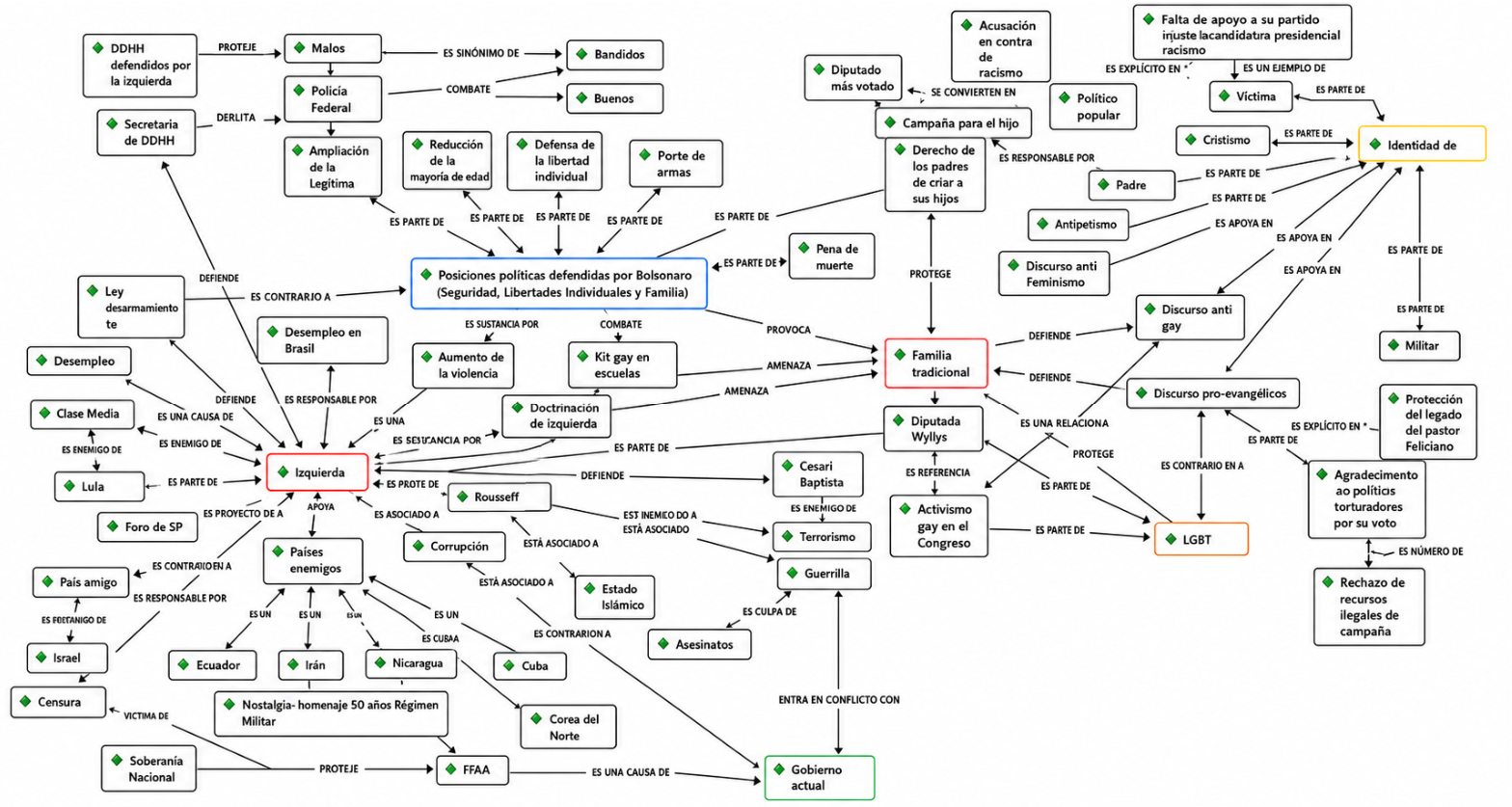
The coding process used the candidate’s language to generate categories and codes, enabling reconstruction of the main discursive frames in his messages. Appendix A (Figure A1, Figure A2, Figure A3 and Figure A4) presents the coding diagrams for each year, illustrating relationships between thematic categories and codes.
Figure A1 (see Appendix A), which visualizes 20 tweets from Bolsonaro’s first year on Twitter (2010), shows that his early discourse centered on three main codes: anti-PT sentiment, nostalgia for the military regime, and corporatist claims about security forces. Within these tweets, the Workers’ Party is frequently targeted, while the military regime is depicted as a period of political order, economic prosperity, and honest officials. The corporatism theme is reflected in messages demanding wage and labor improvements for security forces and military personnel.
Figure A2 (see Appendix A) summarizes messages from 2012 and reflects a simpler discursive structure, given there were fewer posts that year. It also marks the emergence of a new theme: LGBT issues, with Bolsonaro expressing concerns about LGBT rights policies allegedly harming children and clashing with Christian values. Messages related to Carlos Bolsonaro’s electoral campaign also appear, tied to the election context of that year.
Figure A3 (see Appendix A), based on 76 messages from 2013, highlights expanded discursive categories in Bolsonaro’s narrative that year. Six main categories emerge: political positions (especially public security), traditional family, LGBT movement, political left, military government, and Bolsonaro’s identity. The narrative reflects a shift as the candidate systematically defends the traditional family and increasingly criticizes the left and policies supporting sexual diversity. He claims the traditional family faces threats from “ideological indoctrination” in schools, social movements, and public policies linked to the LGBT agenda. He also praises evangelical figures, especially Congressman and pastor Marcos Feliciano, who shares his views on LGBT rights and gender policies.
Figure A4 (see Appendix A), summarizing 114 tweets from 2014, depicts consolidated discursive changes. That year, the defense of positions expanded to include issues such as public security and individual liberties (e.g., parental rights, the right to bear arms). The traditional family category becomes central, frequently linked to criticism of “gay activism,” often represented by Congressman Jean Wyllys. Bolsonaro’s identity also grows more prominent, as he presents himself as an honest politician, a victim of left-wing attacks, a Christian, a family man, and someone close to the evangelical electorate. References to nostalgia for the military government and criticism of the political left persist, with accusations of corruption and alleged ties to guerrilla movements or foreign governments.
The analysis of Bolsonaro’s Twitter messages shows a progressive transformation in his discourse between 2010 and 2014. Initially, his focus was on military identity, and corporatist demands of the armed forces. From 2013, he broadened his scope to moral, religious, and cultural issues—defending the traditional family, criticizing the LGBT agenda, and praising evangelical political leaders. These changes suggest he increasingly adopted themes central to evangelical political debates. Building on these findings, the next section examines Bolsonaro’s parliamentary speeches over a longer time horizon to further contextualize the evolution of his political discourse.
3.2.2. Analysis of Parliamentary Speeches in the Chamber of Deputies (1994–2014)
Given that Jair Bolsonaro only began using Twitter in 2010, the analysis of his parliamentary speeches in the Brazilian Chamber of Deputies was used to examine the evolution of his political discourse over a longer time horizon. In total, 299 speeches delivered during electoral years between 1994 and 2014 were analyzed. The analysis relied on systematic word counts to identify the main themes present in the speeches and to assess whether new topics were incorporated into the candidate’s discourse over time.
Following Gee (2011), the analysis focused primarily on so-called “content words,” especially nouns, as these are particularly useful for identifying dominant themes in discourse. The figures presented display the 50 most frequently used words by Bolsonaro in each electoral year, excluding numbers, verbs, pronouns, prepositions, and other grammatical elements that do not contribute substantive content. Nouns referring to months or parliamentary forms of address were also excluded.
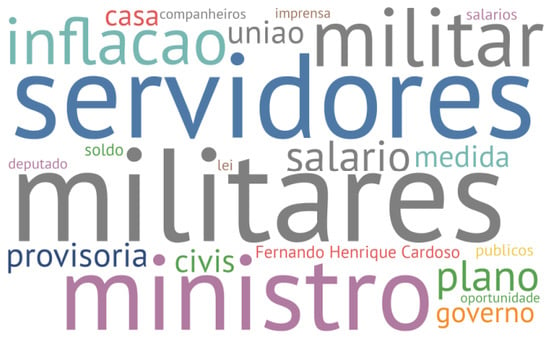
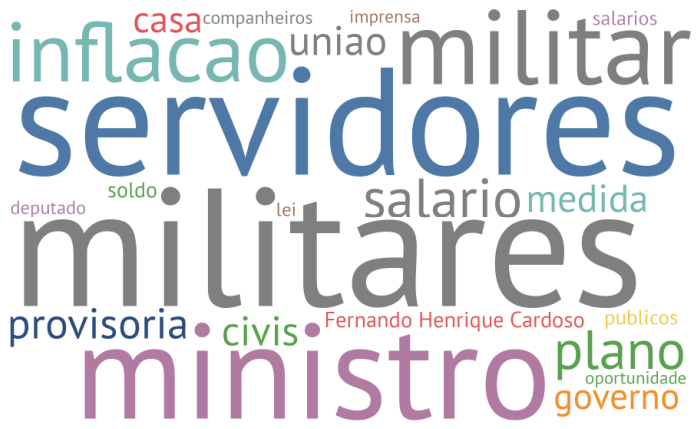
Figure 4, corresponding to speeches delivered in 1994, shows that the most frequently used term is “military,” reflecting the centrality of the armed forces in the candidate’s discourse at the time. The figure is dominated by terms associated with the military sphere, such as praças (lower-ranking military personnel), soldiers, and generals. Terms related to wage demands, such as “salary,” “real,” “remuneration,” and “bonus,” also appear frequently, indicating that a substantial portion of Bolsonaro’s interventions focused on advocating economic improvements for members of the armed forces. In this same figure, the name of then-President Fernando Henrique Cardoso appears frequently, as Bolsonaro directed constant criticism toward him, even going so far as to publicly call for his execution (Folha de S. Paulo 1999).
Figure 4.
Bolsonaro’s Parliamentary Speeches, 19941. Source: Author’s elaboration based on data from the Brazilian Chamber of Deputies.
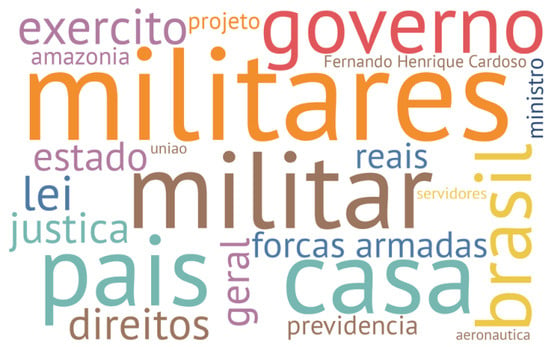
Figure 5, corresponding to 1998, shows substantial continuity with the previous period. The term “military” remains the most frequently cited noun, confirming the persistence of the military axis in the candidate’s discourse. Fernando Henrique Cardoso continues to be the only political figure appearing frequently among the most used words. However, new thematic references begin to emerge at this stage, such as “democracy,” “Amazon,” and “press.” Bolsonaro frames the Amazon as a symbol of national sovereignty, arguing that no foreign country should impose environmental restrictions on Brazil.
Figure 5.
Bolsonaro’s Parliamentary Speeches, 19982. Source: Author’s elaboration based on data from the Brazilian Chamber of Deputies.
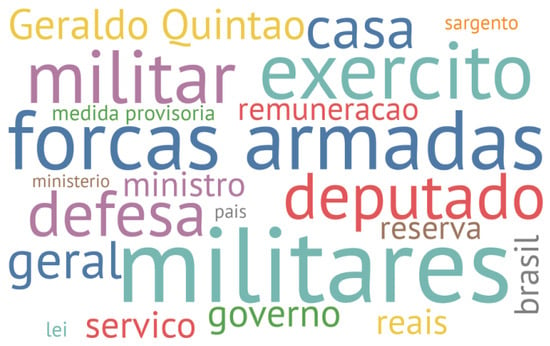
Figure 6, corresponding to 2002, continues to show the predominance of the military sphere in the deputy’s discourse. The terms “military” and “armed forces” remain the most frequent. At this stage, new political figures emerge in the discourse. In addition to Fernando Henrique Cardoso, Bolsonaro also criticizes the then Minister of Defense, Geraldo Quintão, for delaying salary adjustments for military personnel. The name of presidential candidate Ciro Gomes also appears, for whom Bolsonaro publicly expressed sympathy during this period due to his favorable statements toward the armed forces. Finally, the name of Luiz Inácio Lula da Silva, then a presidential candidate, also appears, reflecting the emergence of a more critical discourse toward the Workers’ Party.
Figure 6.
Bolsonaro’s Parliamentary Speeches, 20023. Source: Author’s elaboration based on data from the Brazilian Chamber of Deputies.
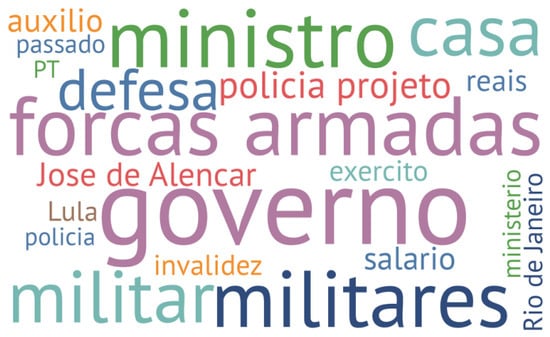
Figure 7, corresponding to 2006, shows some changes in the discourse’s structure, although the military axis remains central. In this figure, the noun “minister” appears as the most frequent term, while “military” and “armed forces” continue to occupy prominent positions. During this period, Bolsonaro criticizes then Minister of Defense José de Alencar, accusing him of harming the military by reducing benefits, and later criticizes Minister Waldir Pires, who assumed the position after Alencar’s departure. Similarly, President Lula and the Workers’ Party (PT) appear among the most frequently mentioned terms, reflecting intensified criticism of the federal government. At the same time, terms such as “salary,” “housing,” and “disability” remain associated with the defense of policies intended to support the welfare of military personnel.
Figure 7.
Bolsonaro’s Parliamentary Speeches, 20064. Source: Author’s elaboration based on data from the Brazilian Chamber of Deputies.
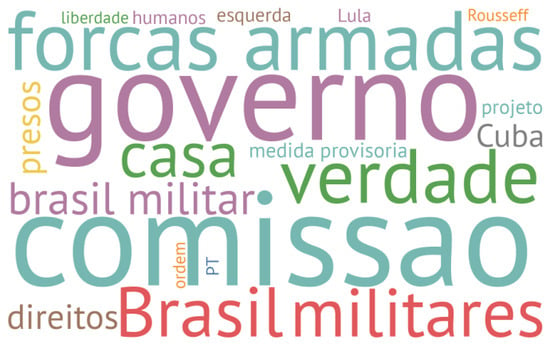
Figure 8, corresponding to 2010, shows greater thematic diversification. In this period, the terms “commission” and “government” appear as the most frequently mentioned. However, when the terms “armed forces,” “military,” and “military personnel” are considered jointly, the military sphere remains the central axis of the deputy’s discourse. At this stage, more frequent references also emerge to political actors associated with the left, such as Cuba, the Workers’ Party (PT), and Lula. In addition, the name of Dilma Rousseff appears, who was then a presidential candidate. During the 2010 campaign, Rousseff faced controversies related to her position on the decriminalization of abortion, which generated an intense circulation of critical messages in religious media, sermons, and social networks (Smith 2019).
Figure 8.
Bolsonaro’s Parliamentary Speeches, 20105. Source: Author’s elaboration based on data from the Brazilian Chamber of Deputies.
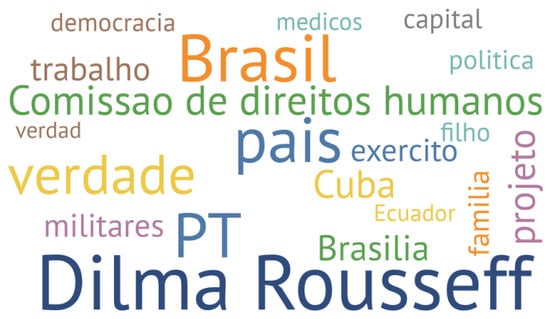
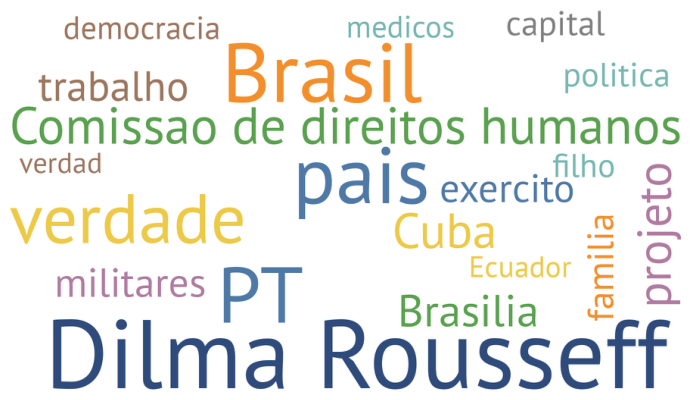
The most significant change is observed in Figure 9, corresponding to 2014, the year of the last legislative election in which Bolsonaro participated prior to his presidential candidacy. In this period, an important transformation in the content of his discourse becomes evident. The most frequent terms shift to “Dilma Rousseff” and “PT,” while “military” drops to the seventh position in frequency. For the first time, explicit references to religion appear, although still relatively limited, with terms such as “God” and “Feliciano,” referring to Congressman and evangelical pastor Marcos Feliciano. At the same time, new words associated with the family emerge, such as “family,” “children,” “father,” and “Eduardo,” in reference to his son. Terms related to public security also appear, such as “crime,” “rapist,” and “criminals,” as well as references to education, employment, and private property.
Figure 9.
Bolsonaro’s Parliamentary Speeches, 20146. Source: Author’s elaboration based on data from the Brazilian Chamber of Deputies.
Finally, to further examine these thematic changes, a subsample of 74 speeches delivered by Bolsonaro in the Chamber of Deputies during the two months before and after each election in which he participated was analyzed. Based on this subsample, references to 14 keywords derived from three thematic axes (homosexuality, family, and religion) were identified. The results of this analysis are presented in Table 3.
Table 3.
Number of Mentions by Jair Bolsonaro in the Chamber of Deputies (1994–2014): Anti-LGBT, Pro-Family, and Pro-Religion Themes (Two Months Before and After Each Election).
The analysis shows that mentions of issues related to the LGBT agenda increased significantly during the 2014 election period. These references appeared in negative contexts within the candidate’s discourse. At the same time, mentions of religious terms such as “Evangelicals,” “God,” and “pastor” also increased during this period. Specifically, for the term “pastor,” Bolsonaro uses it primarily to refer to other evangelical members of Congress. This usage is generally in positive contexts. While these patterns were noted, the analysis does not assess the broader public perception or the intention behind these mentions.
In the analysis of former Congressman Jair Bolsonaro’s tweets, as well as in the tally of the most frequently used words in his Chamber speeches, new themes have emerged in his rhetoric. The central role of military themes during his career as a congressman is evident. It is also notable that word associations representing anti-left and anti-LGBT sentiment gained prominence in his online and verbal statements. There are no explicit references to Bolsonaro identifying as an evangelical. However, there is a closeness to evangelical congressmen, references to his wife’s religion, and a defense of traditional family values and sexual conservatism. According to Smith (2019) and Corrales (2019), these themes resonate with the evangelical public.
Analyses of Twitter and parliamentary speeches reveal a gradual shift in the content of Jair Bolsonaro’s political discourse. Table 4 summarizes this discursive evolution. It highlights the shift from a predominantly corporate-military discourse toward one more focused on cultural conflicts and moral values. These issues occupy a central place on the political agenda of segments of the evangelical electorate.
Table 4.
Political Discursive Evolution.
These findings suggest that Bolsonaro attracted evangelical support through a combination of indirect political intermediation and moral-value alignment with evangelical constituencies. However, although this strategy expanded Bolsonaro’s support among evangelicals, it may also have reinforced political polarization and increased dependence on extra-party religious intermediaries, potentially limiting broader coalition-building dynamics. In weakly institutionalized party systems, reliance on religious brokers may strengthen personalized forms of representation while simultaneously reducing the mediating role traditionally played by political parties.
4. Discussion
This article examined how Jair Bolsonaro attracted and consolidated support among Brazil’s evangelical electorate despite not publicly identifying as evangelical. In doing so, it addressed a broader puzzle in Latin American political studies: how religious identities become electorally relevant in contexts marked by flexible religious cleavages, fragmented party systems, and active non-party actors. Rather than treating evangelical support for Bolsonaro as an automatic consequence of demographic growth or preexisting ideological preferences, the article analyzed how this support was constructed through electoral incentives, moral appeals, religious intermediation, and a crisis of representation among traditional parties.
The findings show that Bolsonaro’s evangelical support was not simply inherited; it was built through a process of political and discursive repositioning. Evidence from Rio de Janeiro’s legislative elections indicates that Bolsonaro adapted his campaign to an electoral environment in which the territorial distribution of evangelicals became increasingly relevant to his performance, especially in 2014. He shifted from a discourse centered primarily on corporatist demands associated with the armed forces to one that incorporated moral and cultural issues resonant with evangelical communities. These included the defense of the traditional family, opposition to agendas linked to sexual diversity, and positive references to evangelical leaders and interests. The analysis of parliamentary speeches and social media shows this discursive realignment and clarifies how changes in campaign messaging contributed to the construction of his evangelical support.
The article contributes to the literature on cleavages and political incorporation by showing that a religious constituency can be electorally activated without a stable confessional party or a candidate who shares the electorate’s religious identity. This finding is particularly relevant for Latin America, where religious competition does not always align clearly with ideology and where churches and clergy often operate as intermediaries between voters and politicians. In Brazil, Bolsonaro’s appeal combined value-based identification with indirect connections to evangelical elites and networks. These mechanisms allowed him to address a religious electorate even in competition with pastor-candidates who possessed organizational and symbolic advantages within evangelical communities.
This interpretation also refines debates on segmented representation and electoral strategy. Bolsonaro’s appeal to evangelicals was visible to the broader electorate and did not depend on concealing specific messages from other audiences. He linked moral agendas (such as opposition to abortion and LGBTQ rights) to broader political identities, including conservatism and anti-Workers’ Party sentiment, within a fragmented party system and a context of personalized electoral competition. The case therefore shows that base-focused discourse can resonate beyond its initial constituency when religious leaders broker political messages, moral themes polarize the electorate, and partisan attachments remain weak.
The argument should be read with its scope conditions in mind. The article analyzes Bolsonaro as a case of conservative religious mobilization during a crisis of party representation. It focuses on Rio de Janeiro’s legislative elections from 1998 to 2014 and on the persistence of evangelical support in the 2018 presidential election. It does not claim that evangelical voters constitute a homogeneous bloc, nor that religious identity directly determines electoral behavior. Rather, it shows that, under specific institutional, religious, and party-system conditions, leaders outside the evangelical field can transform religious affinities and moral demands into electoral coalitions.
This process may have entailed political risks. As Luna (2014) notes, politicians can successfully engage different electoral niches in a hybrid manner only insofar as these strategies remain unknown to the broader public. In Bolsonaro’s case, a visible shift toward evangelical moral agendas could have alienated his traditional military base if that constituency perceived itself as displaced or abandoned. However, this repositioning occurred in a highly polarized context in which evangelical and military constituencies could both be situated within a broader anti-left coalition. This “culture war” context remained intense in 2018, when Jair Messias Bolsonaro was elected president.
Future research should examine whether the mechanisms identified here also appear in other Latin American cases involving non-evangelical candidates. Comparative work could assess whether these mechanisms operate differently when cultural conflicts are less politicized, party systems are more stable, or evangelical actors possess stronger party vehicles. Further research should also investigate when non-evangelical candidates are able to outcompete pastor-candidates, and whether electoral strategies targeting evangelical constituencies shape policy agendas once these candidates reach office.
In sum, the findings show that religious elites and evangelical networks can become politically consequential in weak party systems marked by volatile representation. Bolsonaro’s trajectory demonstrates that evangelical support was not merely the result of structural change or demographic expansion. It was constructed through discursive repositioning, moral signaling, and brokerage by religious actors. By tracing this process, the article contributes to debates on religion and politics, conservative representation, and the role of social identities in electoral competition.
Author Contributions
Conceptualization, B.F.; methodology, B.F. and M.V.; software, M.V.; validation, M.V.; formal analysis, M.V.; investigation, B.F. and M.V.; resources, B.F.; data curation, B.F.; writing—original draft preparation, B.F.; writing—review and editing, B.F. and M.V.; visualization, M.V. and B.F.; supervision, B.F.; project administration, B.F. All authors have read and agreed to the published version of the manuscript.
Funding
This research received no external funding.
Institutional Review Board Statement
This study relies exclusively on publicly available data, including official parliamentary records and publicly accessible social media content. No human subjects were directly involved, and no private or sensitive data were collected. Therefore, according to institutional guidelines, this research does not require formal ethical approval.
Informed Consent Statement
Not applicable.
Data Availability Statement
The original data presented in the study are openly available in: (1) the Open Data Portal of the Superior Electoral Court of the Government of Brazil (Portal de Dados Abertos do Tribunal Superior Eleitoral) at https://www.tse.jus.br/eleicoes/resultados-eleicoes (URL accessed on 9 June 2026); (2) Brazilian Institute of Geography and Statistics Library (Biblioteca do Instituto Brasileiro de Geografia e Estatística, IBGE) at https://www.ibge.gov.br/estatisticas/sociais/populacao/25089-censo-1991-6.html https://www.ibge.gov.br/estatisticas/sociais/populacao/9663-censo-demografico-2000.html and https://www.ibge.gov.br/estatisticas/sociais/trabalho/9662-censo-demografico-2010.html (accessed on 9 June 2026); (3) Atlas of Violence: Institute of Applied Economic Research (Atlas da Violência: Instituto de Pesquisa Econômica Aplicada, IPEA) at https://www.ipea.gov.br/atlasviolencia/publicacoes/49/atlas-da-violencia-2018 (accessed on 9 June 2026); and (4) Chamber of Deputies of Brazil—Speeches Delivered in Plenary (Câmara dos Deputados do Brasil—Discursos Proferidos em Plenário) at https://www.camara.leg.br/internet/sitaqweb/resultadoPesquisaDiscursos.asp?CurrentPage=3&txIndexacao=&BasePesq=plenario&txOrador=JAIR%20BOLSONARO&txPartido=&dtInicio=&dtFim=&txUF=&txSessao=&listaTipoSessao=&listaTipoInterv=&inFalaPres=&listaTipoFala=&listaFaseSessao=&txAparteante=&listaEtapa=&CampoOrdenacao=dtSessao&TipoOrdenacao=DESC&PageSize=50&txTexto=&txSumario=# (accessed on 9 June 2026). Restrictions apply to the availability of the Vote intention survey analyzed in this paper. Data were obtained from a survey commissioned by Daniela Campello (Columbia University) and Francisco Urdinez (PUC Chile), conducted by the firm Netquest (ISO 26362), and are available from the author with the permission of Francisco Urdinez. The dataset of tweets by Jair Bolsonaro analyzed in this article is not publicly available due to the discontinuation and subsequent restriction of access to the original search interface and filtering functionalities of the Twitter platform. Tweets were collected using Twitter’s advanced search tool, applying the query “from:jairbolsonaro since:2010-01-01 until:2014-12-31”. The data were manually retrieved and systematically archived as PDF records. While this approach ensured transparency in the search criteria, it is subject to limitations inherent to platform-based data retrieval, including potential incompleteness and algorithmic prioritization of results. Requests to access the dataset can be directed to bfonseca@uct.cl or through direct access to the archived files at the following link: https://drive.google.com/drive/u/2/folders/1XjXD2UcDr5NFiitrIfYJDDbbfW-MiBop (accessed on 9 June 2026).
Acknowledgments
This manuscript was supported by AI tools exclusively for language editing and translation. All intellectual content, analysis, and interpretations are the sole responsibility of the author.
Conflicts of Interest
The author declares no conflicts of interest.
Appendix A
Figure A1.
Coding of Jair Bolsonaro’s Tweets, 2010. Source: Author’s elaboration based on Twitter data.
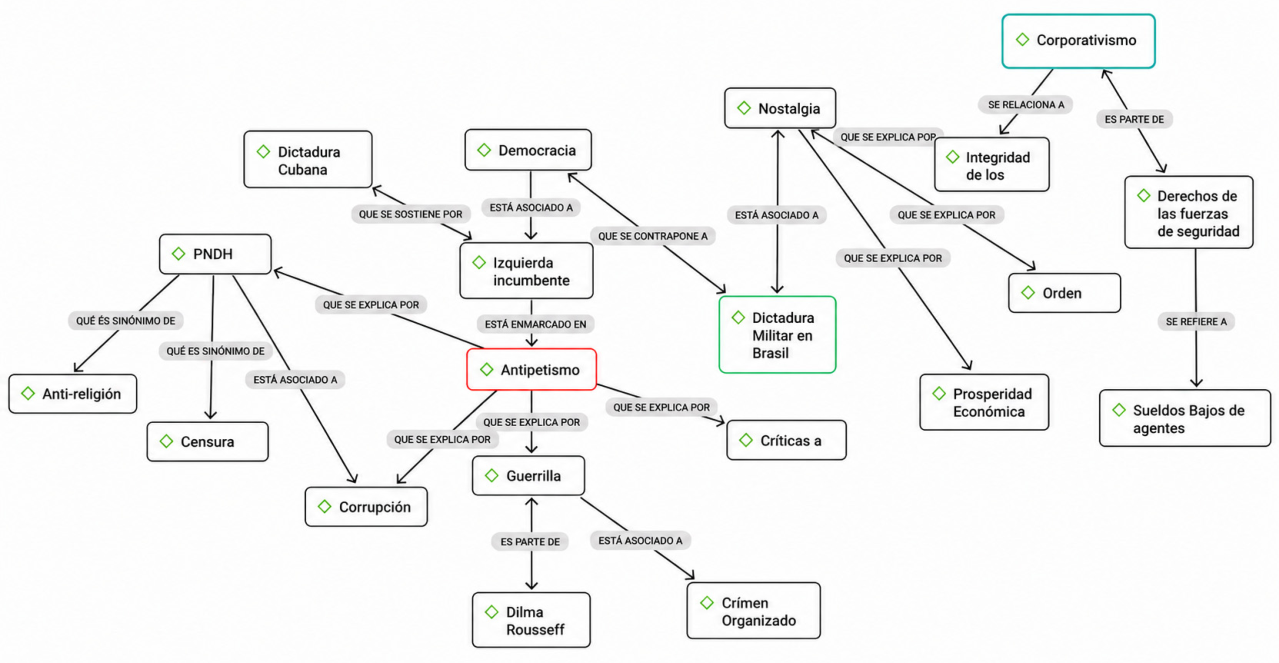
Figure A2.
Coding of Jair Bolsonaro’s Tweets, 2012. Source: Author’s elaboration based on Twitter data.
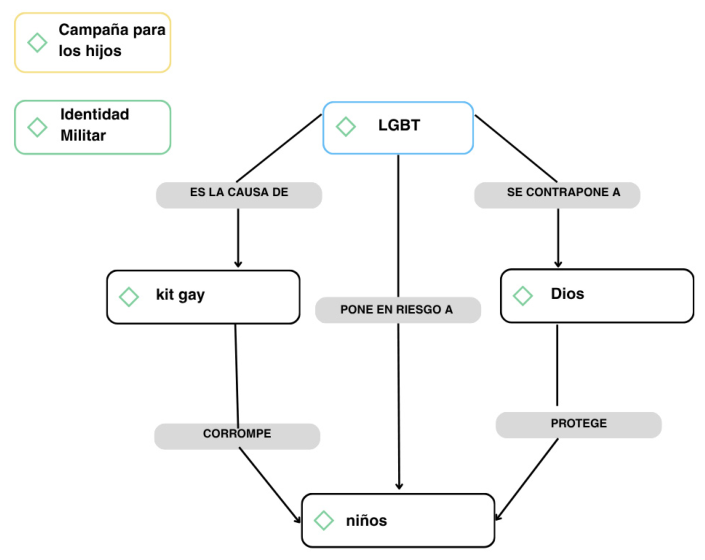
Figure A3.
Coding of Jair Bolsonaro’s Tweets, 2013. Source: Author’s elaboration based on Twitter data.
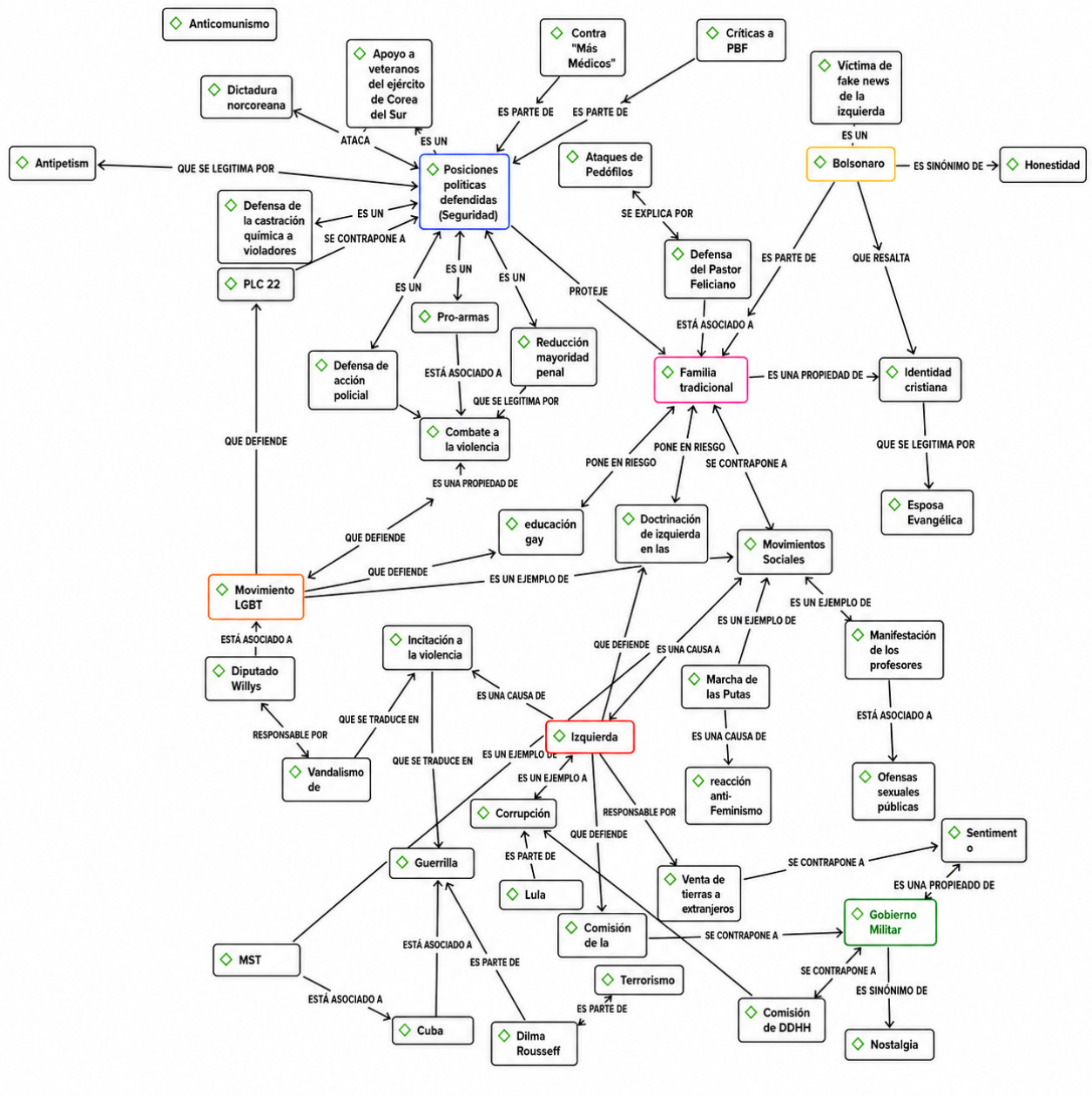
Figure A4.
Coding of Jair Bolsonaro’s Tweets, 2014. Source: Author’s elaboration based on Twitter data.
Notes
| 1 | English translation of keyword groups: militares (military), servidores (public servants), ministro (minister), inflação (inflation), salário (salary), plano (plan). |
| 2 | English translation of keyword groups: militares (military), casa (house), governo (government), país (country), exército (army), lei (law). |
| 3 | English translation of keyword groups: militares (military), forças armadas (armed forces), exército (army), deputado (deputy), defesa (defense), casa (house). |
| 4 | English translation of keyword groups: governo (government), forças armadas (armed forces), ministro (minister), militares (military), defesa (defense), casa (house). |
| 5 | English translation of keyword groups: comissão (committee), governo (government), forças armadas (armed forces), verdade (truth), Brasil (Brazil), direitos (rights). |
| 6 | English translation of keyword groups: Dilma Rousseff, Brasil (Brazil), país (country), verdade (truth), Comissão de Direitos Humanos (Human Rights Committee), Cuba. |
References
- Althoff, Andrea. 2019. Right-Wing Populism and Evangelicalism in Guatemala: The Presidency of Jimmy Morales. International Journal of Latin American Religions 3: 294–324. [Google Scholar] [CrossRef] [Scilit]
- Ames, Barry. 2001. The Deadlock of Democracy in Brazil. Ann Arbor: University of Michigan Press. [Google Scholar] [CrossRef] [Scilit]
- Angrist, Joshua. D., and Jörn-Steffen Pischke. 2009. Mostly Harmless Econometrics: An Empiricist’s Companion. Princeton: Princeton University Press. [Google Scholar]
- Baker, Joseph O., Samuel L. Perry, and Andrew L. Whitehead. 2020. Keep America Christian (and White): Christian Nationalism, Fear of Ethnoracial Outsiders, and Intention to Vote for Donald Trump in the 2020 Presidential Election. Sociology of Religion 81: 272–93. [Google Scholar] [CrossRef] [Scilit]
- Boas, Taylor. 2016. Presidential Campaigns in Latin America: Electoral Strategies and Success Contagion. Cambridge: Cambridge University Press. [Google Scholar]
- Boas, Taylor, and Amy Erica Smith. 2015. Religion and the Latin American voter. In The Latin American Voter. Edited by Ryan E. Carlin, Matthew M. Singer and E. Zechmeister. Ann Arbor: University of Michigan Press, pp. 99–121. [Google Scholar]
- Braun, Virginia, and Victoria Clarke. 2006. Using thematic analysis in psychology. Qualitative Research in Psychology 3: 77–101. [Google Scholar] [CrossRef] [Scilit]
- Callaway, Brantly, and Pedro H. C. Sant’Anna. 2021. Difference-in-Differences with multiple time periods. Journal of Econometrics 225: 200–30. [Google Scholar] [CrossRef] [Scilit]
- Campbell, David E., John C. Green, and Geofrrey C. Layman. 2011. The party faithful: Partisan images, candidate religion, and the electoral impact of party identification. American Journal of Political Science 55: 42–58. [Google Scholar] [CrossRef] [Scilit]
- Collier, Ruth B., and David Collier. 1991. Shaping the Political Arena: Critical Junctures, the Labor Movement, and Regime Dynamics in Latin America. Princeton: Princeton University Press. [Google Scholar]
- Coppedge, Michael. 1998. The dynamic diversity of Latin American party systems. Party Politics 4: 547–68. [Google Scholar] [CrossRef] [Scilit]
- Corporación Latinobarómetro. 2020. Informe Latinobarómetro 2020. Available online: https://www.latinobarometro.org/latinobarometro-2020 (accessed on 9 June 2026).
- Corrales, Javier. 2019. The expansion of LGBT rights in Latin America and the backlash. In The Oxford handbook of global LGBT and sexual diversity politics. Edited by Michale J. Bosia, Sandra M. McEvoy and Momin Rahman. New York: Oxford University Press, pp. 185–200. [Google Scholar] [CrossRef] [Scilit]
- Creswell, John W., and Vicki L. Plano Clark. 2018. Designing and Conducting Mixed Methods Research, 3rd ed. Thousand Oaks: Sage. [Google Scholar]
- De Almeida, Ronaldo. 2017. A onda quebrada: Evangélicos e conservadorismo. Cadernos Pagu 50: e175001. [Google Scholar] [CrossRef] [Scilit]
- Dix, Robert H. 1989. Cleavage Structure and Party Systems in Latin America. Comparative Politics 22: 23–37. [Google Scholar] [CrossRef] [Scilit]
- Dunning, Thad, and Susan C. Stokes. 2008. Clientelism as Persuasion and as Mobilization. PS: Political Science & Politics 41: 635–41. [Google Scholar]
- Folha de S. Paulo. 1999. FHC Pede à Câmara que Puna Bolsonaro: Presidente Afirma que Deputado “passou dos limites” ao Pedir seu Fuzilamento do Presidente e diz Querer um dólar Mais Estável. Available online: https://www1.folha.uol.com.br/fsp/brasil/fc0501200008.htm (accessed on 9 June 2026).
- Gee, James P. 2011. How to do Discourse Analysis: A Toolkit. Oxfordshire: Routledge. [Google Scholar] [CrossRef] [Scilit]
- Goodman-Bacon, Andrew. 2021. Difference-in-differences with variation in treatment timing. Journal of Econometrics 225: 254–77. [Google Scholar] [CrossRef] [Scilit]
- Grzymala-Busse, Anna. 2015. Nations Under God: How Churches Use Moral Authority to Influence Policy. Princeton: Princeton University Press. ISBN 9780691164755. [Google Scholar]
- Grzymala-Busse, Anna, and Dan Slater. 2018. Making godly nations: Church-state pathways in Poland and the Philippines. Comparative Politics 50: 545–64. [Google Scholar] [CrossRef] [Scilit]
- Gutierrez Sánchez, Tomás Jesús. 2000. El “hermano” Fujimori: Evangélicos y poder político en el Perú del ’90. Lima: Archivo Histórico del Protestantismo Latinoamericano. [Google Scholar]
- Inglehart, Ronald. 1997. Modernization and Postmodernization: Cultural, Economic, and Political Change in 43 Societies. Princeton: Princeton University Press. [Google Scholar] [CrossRef] [Scilit]
- International Organization for Standardization. 2009. Access Panels in Market, Opinion and Social Research—Vocabulary and Service Requirements. ISO 26362:2009. Geneva: International Organization for Standardization.
- Johnson, Todd M., and Gina A. Zurlo. 2020. World Christian Database. Leiden: Brill. Available online: https://www.worldchristiandatabase.org (accessed on 9 June 2026).
- Jones, Mark P., and Scott Mainwaring. 2003. The Nationalization of Parties and Party Systems: An Empirical Measure and an Application to the Americas. Party Politics 9: 139–66. [Google Scholar] [CrossRef]
- Kalyvas, Stathis N. 1998. From pulpit to party: Party formation and the Christian democratic phenomenon. Comparative Politics 30: 293–312. [Google Scholar] [CrossRef] [Scilit]
- Katz, Richard S., and Peter Mair. 1995. Changing Models of Party Organization and Party Democracy: The Emergence of the Cartel Party. Party Politics 1: 5–28. [Google Scholar] [CrossRef] [Scilit]
- Keohane, Robert O. 1984. The World Political Economy and the Crisis of Embedded Liberalism. In Order and Conflict in Contemporary Capitalism. Studies in the Political Economy of Western European Nations. Edited by John H. Goldthorpe. Oxford: Oxford University Press. [Google Scholar]
- King, Gary. 1997. A Solution to the Ecological Inference Problem: Reconstructing Individual Behavior from Aggregate Data. Princeton: Princeton University Press. ISBN 9780691012407. [Google Scholar]
- Kirchheimer, Otto. 1966. The Transformation of the Western European Party System. In Political Parties and Political Development. Edited by Joseph LaPalombara and M. Weiner. Princeton, NJ: Princeton University Press. [Google Scholar]
- Kitschelt, Herbert. 2000. Linkages between Citizens and Politicians in Democratic Polities. Comparative Political Studies 33: 845–79. [Google Scholar] [CrossRef] [Scilit]
- Kitschelt, Herbert, and Steven I. Wilkinson, eds. 2007. Patrons, Clients, and Policies: Patterns of Democratic Accountability and Political Competition. Cambridge: Cambridge University Press. [Google Scholar] [CrossRef] [Scilit]
- León-Carvajal, Arantxa, and Andrey Pineda-Sancho. 2023. The Dispute around Same-Sex Marriage in Costa Rica: Arguments and Actions of Conservative Religious Activism (2017–2021). Religions 14: 540. [Google Scholar] [CrossRef] [Scilit]
- Levitsky, Steven. 2003. Transforming Labor-Based Parties in Latin America: Argentine Peronism in Comparative Perspective. Cambridge: Cambridge University Press. [Google Scholar] [CrossRef] [Scilit]
- Levitsky, Steven, James Loxton, Brandon Van Dyck, and Jorge I. Domínguez, eds. 2016. Challenges of Party-Building in Latin America. Cambridge: Cambridge University Press. [Google Scholar] [CrossRef] [Scilit]
- Lieberman, Evan S. 2005. Nested analysis as a mixed-method strategy for comparative research. American Political Science Review 99: 435–52. [Google Scholar] [CrossRef] [Scilit]
- Lijphart, Arend. 1979. Religious vs. Linguistic vs. Class Voting: The “Crucial Experiment” of Comparing Belgium, Canada, South Africa, and Switzerland. American Political Science Review 73: 442–58. [Google Scholar] [CrossRef] [Scilit]
- Long, John Scott, and Jeremy Freese. 2014. Regression Models for Categorical Dependent Variables Using Stata, 3rd ed. College Station: Stata Press. [Google Scholar]
- López Rodríguez, Darío. 2008. Evangelicals and politics in Fujimori’s Peru. In Evangelical Christianity and Democracy in Latin America. Edited by P. Freston. New York: Oxford University Press, pp. 131–62. [Google Scholar] [CrossRef] [Scilit]
- Luna, Juan Pablo. 2007. Representación política en América Latina: El estado de la cuestión y una propuesta de agenda. Política y Gobierno XIV: 391–435. [Google Scholar]
- Luna, Juan Pablo. 2014. Segmented Representation: Political Party Strategies in Unequal Democracies. New York: Oxford UP. [Google Scholar]
- Luna, Juan Pablo, Rafael Piñeiro Rodríguez, Fernando Rosenblatt, and Gabriel Vommaro. 2021. Political Parties, Diminished Subtypes, and Democracy. Party Politics 27: 294–307. [Google Scholar] [CrossRef] [Scilit]
- Mainwaring, Scott. 1999. Rethinking Party Systems in the Third Wave of Democratization: The Case of Brazil. Stanford: Stanford University Press. [Google Scholar]
- Margolis, Michele F. 2020. Who Wants to Make America Great Again? Understanding Evangelical Support for Donald Trump. Politics and Religion 13: 89–118. [Google Scholar] [CrossRef] [Scilit]
- Mayhew, David R. 1974. Congress: The Electoral Connection. New Haven: Yale University Press. [Google Scholar]
- McClendon, Gwyneth H., and Rachel Beatty Riedl. 2019. From Pews to Politics: Religious Sermons and Political Participation in Africa. Cambridge: Cambridge University Press. [Google Scholar] [CrossRef] [Scilit]
- Novaes, Regina R. 2001. A divina política: Notas sobre as relações delicadas entre religião e política. Revista USP 49: 60–81. [Google Scholar] [CrossRef] [Scilit]
- Oro, Ari Pedro. 2003. A Política da Igreja Universal e seus Reflexos no Campo Religioso e Político Brasileiros. Revista Brasileira de Ciências Sociais 18: 53–69. [Google Scholar] [CrossRef] [Scilit]
- Pew Research Center. 2010. U.S. Religious Knowledge Survey. Pew Research Center’s Religion and Public Life Project. Available online: https://www.pewresearch.org/religion/2010/09/28/u-s-religious-knowledge-survey/ (accessed on 9 June 2026).
- Pew Research Center. 2014. Religion in Latin America: Widespread Change in a Historically Catholic Region. Available online: https://www.pewforum.org/2014/11/13/religion-in-latin-america/#history-of-religious-change (accessed on 9 June 2026).
- Pérez Guadalupe, José Luiz P., and Sebastian Grundberger, eds. 2018. Evangélicos y Poder en América Latina. Lima: Instituto de Estudios Social Cristianos; Konrad Adenauer Stiftung. [Google Scholar]
- Pignataro, Adrián, and Ilka Treminio. 2019. Reto económico, valores y religión en las elecciones nacionales de Costa Rica 2018. Revista de Ciencia Política 39: 239–63. [Google Scholar] [CrossRef] [Scilit]
- Przeworski, Adam, and John D. Sprague. 1986. Paper Stones: A History of Electoral Socialism. Chicago: University of Chicago Press. [Google Scholar]
- Reich, Gary, and Pedro dos Santos. 2013. The rise (and frequent fall) of evangelical politicians: Organization, theology, and church politics. Latin American Politics and Society 55: 1–22. [Google Scholar] [CrossRef] [Scilit]
- Roth, Jonathan, Pedro. H. C. Sant’Anna, Alyssa Bilinski, and John Poe. 2023. What’s trending in difference-in-differences? A synthesis of the recent econometrics literature. Journal of Econometrics 235: 2218–44. [Google Scholar] [CrossRef] [Scilit]
- Smith, Amy Erica. 2019. Religion and Brazilian Democracy: Mobilizing the People of God. Cambridge: Cambridge University Press. [Google Scholar] [CrossRef] [Scilit]
- Smith, Amy Erica, and Taylor Boas. 2024. Religion, Sexuality Politics, and the Transformation of Latin American Electorates. British Journal of Political Science 54: 816–35. [Google Scholar] [CrossRef] [Scilit]
- Sun, Liyang, and Sarah Abraham. 2021. Estimating dynamic treatment effects in event studies with heterogeneous treatment effects. Journal of Econometrics 225: 175–99. [Google Scholar] [CrossRef] [Scilit]
- Trejo, Guillermo. 2012. Popular Movements in Autocracies. Cambridge: Cambridge University Press. [Google Scholar]
- Wooldridge, Jeffrey. M. 2010. Econometric Analysis of Cross Section and Panel Data, 2nd ed. Cambridge: MIT Press. [Google Scholar]

Disclaimer/Publisher’s Note: The statements, opinions and data contained in all publications are solely those of the individual author(s) and contributor(s) and not of MDPI and/or the editor(s). MDPI and/or the editor(s) disclaim responsibility for any injury to people or property resulting from any ideas, methods, instructions or products referred to in the content. |
© 2026 by the authors. Licensee MDPI, Basel, Switzerland. This article is an open access article distributed under the terms and conditions of the Creative Commons Attribution (CC BY) license.