


Abstract
The rapid growth of social media and artificial intelligence (AI) has intensified information disorder, highlighting the need for comprehensive Media and Information Literacy (MIL) education. While game-based approaches are increasingly explored in MIL, research has largely focused on student outcomes, with limited attention to teachers’ and facilitators’ experiences of implementing non-digital experiential learning interventions, despite the critical role of facilitation and reflection helping learners navigate information environments. This study adopts a qualitative exploratory design to explore teachers’ and facilitators’ perspectives on a board game-based experiential learning intervention for MIL in Malaysian educational settings. Grounded in Kolb’s Experiential Learning Theory and social constructivist principles, the board game was designed to simulate real-world media dynamics, such as information circulation, audience influence, and ethical decision-making. Data were collected through four open-ended teacher feedback forms and one face-to-face semi-structured reflective group interview involving eight facilitators, and analysed using thematic analysis. Four themes emerged: (1) perceived pedagogical value for supporting learner engagement, critical discussion, and applied understanding of MIL concepts; (2) observed experiential and social learning processes characterised by peer interaction, negotiation, and reflection; and (3) implementation challenges related to facilitation demands, time constraints, and balancing competition with learning objectives and (4) recommendations for enhancing implementation. Findings highlight the importance of teacher facilitation and reflective debriefing in transforming gameplay into meaningful MIL learning experiences and reveal key implementation challenges.
1. Introduction
The fast-paced development of artificial intelligence (AI), algorithmic content distribution, and social media platforms has further fuelled information disorder, including misinformation, disinformation, and attention-driven content ecosystems (Bender 2024). Within such environments, learners are no longer passive consumers of information but are required to critically evaluate content, recognise algorithmic influence (e.g., visibility, targeting, and amplification), and make ethical judgment within complex digital ecosystems (Buckingham 2019). Media and Information Literacy (MIL) has therefore become a key educational priority in preparing learners for information environments, while also contributing to Sustainable Development Goal 4 on quality education by fostering informed, responsible, and participatory citizenship (UNESCO 2015).
In school contexts, however, MIL instruction often remains fragmented and concept-heavy, with limited opportunities for students to engage in dialogue, collaboration, and experiential problem-solving (Zou’bi 2021). In the Malaysian context, MIL is typically integrated across subjects rather than taught as a standalone discipline, which can result in inconsistent emphasis on critical media analysis, ethical reasoning, and participatory competencies needed to address contemporary information disorder (Hashim et al. 2022).
These challenges have been further shaped by post-pandemic educational shifts, which accelerated reliance on digital and hybrid learning environments across Malaysian schools (Thang et al. 2022). Although technology-mediated learning expanded access, it also contributed to reduced peer interaction, passive learning behaviours, and digital fatigue. These issues were not limited to the pandemic period but persist in many classrooms, particularly where digital inequality and limited resources constrain sustained engagement (Keshavarz 2020). This highlights the need for pedagogical approaches that balance technology-rich learning environments with opportunities for active participation, collaboration, and face-to-face interaction (Videnovik et al. 2024).
In response, emerging research highlights the potential of experiential and game-based learning to enhance engagement and critical thinking (Epting and Hodges 2023). However, most studies focus on digital game-based learning and student learning outcomes, with limited attention to low-tech or non-digital alternatives such as board games, particularly in MIL education (Sousa et al. 2024). Within this context, non-digital board games (NDGBL) offer a promising yet underexplored pedagogical approach. As physically interactive and socially mediated learning tools, board games can simulate real-world media dynamics such as information flow, audience influence, algorithmic visibility, and ethical decision-making in simplified but meaningful ways (Cortés et al. 2024). Through structured gameplay and facilitation, learners can reflect on how media systems shape attention, credibility, and information circulation, even without digital technologies (Sousa and Costa 2019).
Despite these potential affordances, research on NDGBL for MIL remains limited, particularly in terms of how teachers and facilitators design, implement, and mediate such learning experiences (Ariya et al. 2025). Existing studies tend to prioritise student engagement and learning outcomes, while overlooking educators’ perspectives on feasibility, facilitation demands, and pedagogical sustainability (Kaimara et al. 2021; Sousa and Costa 2019). This gap is critical, as teachers play a central role in translating experiential game-based activities into meaningful learning through scaffolding, reflection, and classroom adaptation (Jobert and Sanchiz 2025).
While experiential learning and social constructivist theories emphasise guided reflection, collaboration, and the role of the teacher as facilitator, there is limited empirical evidence on how these principles are operationalised in non-digital MIL board game settings, particularly in social media and digital information learning contexts where ethical reasoning and critical media awareness are essential (Arnanteerakul and Asanok 2024).
In response to these gaps, this study developed and examined a non-digital board game-based experiential learning intervention for MIL in Malaysian educational settings. It explores teachers’ and facilitators’ perspectives on how such an intervention supports engagement, reflection, and learning processes, and how it is implemented within real classroom constraints. By foregrounding educators’ experiences, the study positions non-digital board games as a potentially sustainable and context-responsive pedagogical approach for MIL education.
Guided by this objective, the study addresses the following research questions:
- How do teachers and facilitators perceive the pedagogical value of board game experiential learning in supporting MIL instruction?
- What experiential and social learning processes do teachers and facilitators observe during board game implementation?
- What challenges and recommendations do teachers and facilitators identify when implementing non-digital board games for MIL education?
2. Literature Review
2.1. Pedagogical Challenges and Teacher Readiness
Media and Information Literacy (MIL) is widely recognised as a foundational competence for functioning in today’s information environment affected by AI-driven algorithm, misinformation and disinformation. UNESCO has described MIL as a set of competencies that enable individuals to access, evaluate, use, create, and reflect on media and information ethically and effectively (UNESCO 2015). In the AI era, these competencies extend beyond information access to include the ability to recognise algorithm influence, evaluate content credibility, understand audience targeting, and participate responsibly in digital and civic spaces (Bender 2024).
Beyond critical evaluation, MIL has evolved from a predominantly analytical framework toward one grounded in participatory culture. Drawing on Jenkins’ (2006) work, current MIL education emphasises learners’ active roles as creators, collaborators, and reflective participants in media ecosystems. Therefore, effective MIL education requires learning environments that encourage participation, dialogue, and shared meaning-making rather than passive information consumption (Jenkins 2006).
Despite its growing importance, MIL instruction often remains content-focused and transmissive, with limited opportunities for learners to apply critical judgement and ethical reasoning in authentic contexts (Buckingham 2015; Zou’bi 2021). These challenges are particularly evident in technology-mediated learning environments, where reduced interaction and passive learning behaviours may constrain opportunities for discussion and reflection (Chan 2020; Keshavarz 2020). In Malaysia, students have generally adapted to online and digital learning environments but continue to express a preference for face-to-face learning due to greater interaction, motivation, and instructional support (Thang et al. 2022).
From the perspective of teachers and facilitators, these developments present significant pedagogical challenges. Educators are increasingly expected to prepare learners for complex information environments shaped by algorithm and social media while simultaneously fostering engagement, ethical reasoning, and critical thinking (Nascimento et al. 2023; Videnovik et al. 2024). However, studies on MIL integration indicate that teachers often face limitations related to pedagogical confidence, facilitation skills, and access to learning designs that support active and socially grounded learning experiences (Syatriana et al. 2025; Tan and Nagappan 2024).
Research suggests that competencies such as ethical reasoning, critical analysis, and responsible participation are more effectively developed through dialogue, reflection, and applied decision-making rather than through transmissive instructional approaches alone (Cernicova-Buca and Ciurel 2022; Zou’bi 2021). Consequently, the challenge faced within MIL education is not merely one of curriculum content, but of pedagogical design. There is an increasing need for learning approaches that enable learners to experience, negotiate, and reflect upon media-related issues in socially meaningful contexts while supporting teachers in facilitating these processes (Buckingham 2019; Lundberg and Stigmar 2022).
To counter information disorder, researchers have increasingly combined MIL training with game-based interventions, particularly fake news games, to strengthen resilience against misinformation (Micallef et al. 2021; Roozenbeek and van der Linden 2019). While these games can improve awareness and engagement, many focus primarily on misinformation detection rather than deeper MIL competencies such as critical reflection and ethical reasoning (Roozenbeek and van der Linden 2019). Furthermore, most existing interventions are digitally mediated, creating challenges related to accessibility, digital inequality, and opportunities for face-to-face interaction (Fedorov and Levitskaya 2016). Scholars therefore recommend integrating game-based interventions within broader MIL curricula that emphasise collaboration, reflection, and active participation (Lewandowsky and van der Linden 2021).
2.2. Experiential and Social Learning as Innovative MIL Pedagogy
Experiential Learning Theory (ELT), proposed by Kolb (1984), conceptualises learning as a cyclical process comprising Concrete Experience (CE), Reflective Observation (RO), Abstract Conceptualisation (AC), and Active Experimentation (AE). Unlike other knowledge transmission models, ELT views learning as an active and reflective process where learners engage with experience, analyse their actions, construct meaning, and apply insights to new situations (Kolb 1984). These processes align closely with the goals of MIL, which demand that learners critically analyse media messages, reflect on the consequences, and make informed decisions in dynamic information environments.
Various studies in different disciplines have shown that experiential learning increases learner motivation, critical thinking, and knowledge retention, especially when learners are actively involved in decision-making and reflection in game-based learning (Odendaal 2018). In MIL education, experiential approaches are especially relevant because they allow learners to engage directly with media-related issues, evaluate the consequences of information practices, and connect abstract concepts to authentic situations (Zou’bi 2021).
While ELT explains how learning occurs through experience and reflection, Vygotsky’s Social Constructivist Theory (SCT) emphasises the social nature of learning. Concepts such as the Zone of Proximal Development (ZPD) and the More Knowledgeable Other (MKO) highlight the importance of guided interaction, peer collaboration, and facilitation in supporting learners’ meaning-making processes (Vygotsky 1978). Through discussion, negotiation, and shared problem-solving, learners construct understanding collectively and develop higher-order thinking skills that may be difficult to achieve through individual learning alone.
These principles are particularly important in MIL education, where learners must interpret media messages, evaluate information credibility, discuss ethical dilemmas, and understand social influence. Research suggests that competencies such as critical evaluation, ethical reasoning, and reflective judgement are more effectively developed through dialogue and collaborative inquiry than through transmissive instructional approaches (Katanosaka et al. 2024; Tan and Nagappan 2024). However, opportunities for such interaction are often constrained within teacher-centred or technology-mediated learning environments (Keshavarz 2020).
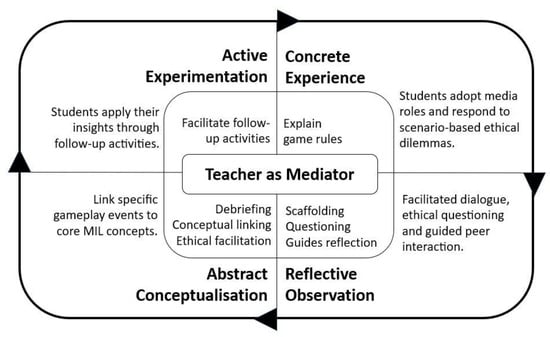
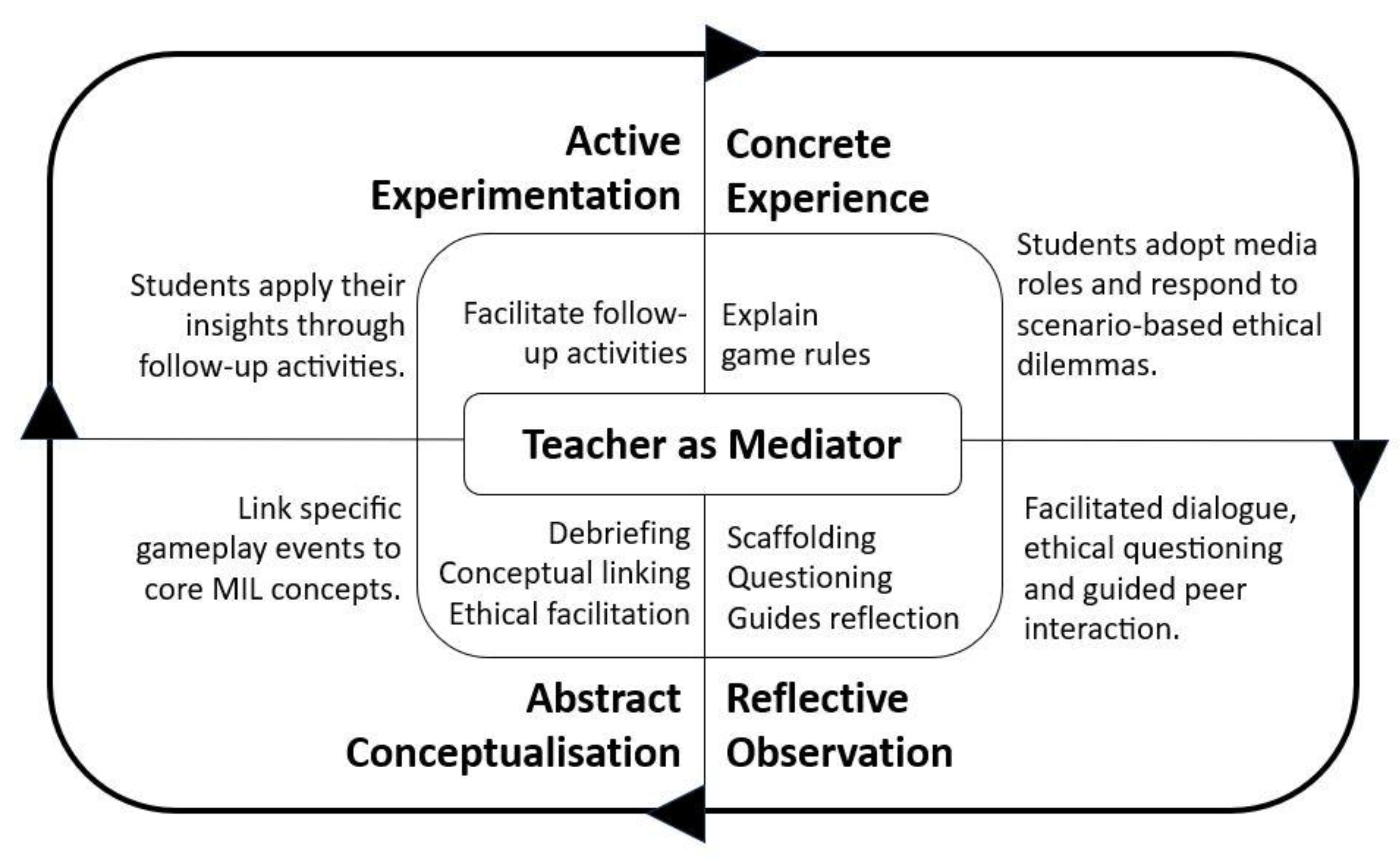
Rather than functioning as separate frameworks, ELT and SCT offer complementary perspectives for MIL education. ELT explains how learning develops through experience, reflection, conceptualisation, and experimentation, while SCT emphasises the role of dialogue, collaboration, and scaffolding in supporting these processes. Guided by these principles, the board game engages learners in media-related scenarios requiring ethical judgement and decision-making, followed by discussion, reflection, and application of new insights. Throughout the process, teachers and facilitators act as More Knowledgeable Others (MKO), supporting learning through questioning, debriefing, and guided interaction within learners’ Zone of Proximal Development (ZPD). Figure 1 illustrates how these theoretical principles were operationalised within the intervention of MIL game-based learning design.
Figure 1.
Operationalisation of Experiential Learning Theory and Social Constructivist Principles within the MIL Board Game Intervention.
Consistent with ELT and SCT principles, board game-based learning environments can provide learners with media-related scenarios that require strategic decision-making and ethical judgement (Concrete Experience). Facilitated debriefing and peer discussions encourage learners to reflect on the consequences of their decisions (Reflective Observation), while connections between gameplay and MIL concepts such as misinformation, audience influence, and media ethics support conceptual understanding (Abstract Conceptualisation). Learners then apply their insights through subsequent gameplay rounds and follow-up learning activities (Active Experimentation). Throughout this process, teachers and facilitators act as MKOs by scaffolding discussion, guiding reflection, and supporting collaborative learning within learners’ ZPD.
By integrating experiential learning with social constructivist principles, the board game creates opportunities for learners to evaluate information, negotiate perspectives, reflect on ethical dilemmas, and collaboratively construct understanding. This integrated framework provides the theoretical foundation for examining how non-digital board game-based learning can support critical, ethical, and socially informed MIL education.
2.3. Non-Digital Board Games as Sustainable Experiential Tools for MIL Instruction
Digital game-based learning (DGBL) has received considerable attention for its ability to enhance engagement, immersion, and interactive learning. However, its implementation often faces challenges related to technology access, infrastructure requirements, cognitive overload, and reduced face-to-face interaction, particularly in under-resourced educational contexts (Ip and Cooperstock 2011; Kaimara et al. 2021). These limitations have prompted increasing interest in non-digital game-based learning (NDGBL) as a more accessible and sustainable alternative.
Non-digital board game offer unique pedagogical affordances that align closely with the goals of MIL (Arnanteerakul and Asanok 2024). Unlike many technology-mediated learning environments, board games naturally encourage dialogue, peer interaction, negotiation, and collaborative problem-solving (Sato and De Haan 2016). Through face-to-face participation, learners are required to justify decisions, evaluate alternative viewpoints, and collectively construct meaning, supporting deeper engagement with complex social and ethical issues (Bayeck 2020). These characteristics also resonate with participatory approaches to MIL education (Jenkins 2006). Current MIL frameworks increasingly emphasise learners not only as consumers of information but also as active participants in media ecosystems who must evaluate content, negotiate perspectives, and make responsible decisions (UNESCO 2013). Board games provide opportunities for learners to assume such participatory roles within structured learning environments. Through role-playing, discussion, and decision-making, learners can experience the consequences of media-related actions while reflecting on issues of credibility, influence, audience engagement, and ethical responsibility (Arnanteerakul and Asanok 2024; Sato and De Haan 2016).
Research on game-based learning consistently demonstrates that collaboration, feedback, and structured reflection contribute to learner engagement, motivation, and critical thinking (Mai et al. 2024; Videnovik et al. 2024). When combined with experiential learning principles, board games can create environments in which learners actively test ideas, receive immediate feedback, and refine their understanding through iterative cycles of action and reflection (Envick 2023). Such learning processes are particularly relevant to MIL, where ethical reasoning and critical evaluation often emerge through discussion and shared inquiry rather than through individual content acquisition alone. However, the educational value of game-based learning depends largely on effective facilitation. Structured guidance, collaborative discussion, and reflective debriefing help learners connect gameplay experiences to broader learning objectives, regardless of their prior gaming experience (Kiili 2006). In MIL education, facilitation is especially important for ensuring that learners move beyond task completion or competitive success towards deeper reflection on media practices, ethical decision-making, and critical understanding of information environments (Zou’bi 2021).
Building on these principles, non-digital board games can also provide learners with opportunities to engage with contemporary media challenges associated with digital information environments (Bender 2024; Buckingham 2019). Through role-playing, scenario-based decision-making, and simulated media interactions, board games can represent issues such as information circulation, audience influence, media bias, algorithmic visibility, and ethical communication in simplified but meaningful ways. Such experiential simulations allow learners to explore the consequences of media-related decisions while developing critical awareness of how information is produced, distributed, and consumed in contemporary society. To support these learning processes, this study employed the Follow Me board game, which was designed to operationalise key MIL competencies through role-playing, collaborative decision-making, and reflective discussion. Table 1 illustrates the alignment between selected MIL competencies and the corresponding gameplay mechanics embedded within the intervention.
Table 1.
Alignment of MIL Competency and board game mechanism.
3. Methodology
This study uses qualitative exploratory research to investigate the pedagogical affordances and challenges of non-digital board game-based experiential learning for MIL. As this study focuses on the perspectives of teachers and facilitators, teaching practices, and observed learning processes rather than student’s learning outcomes, the adoption of qualitative methods is appropriate. This design allows for a thorough investigation of how experiential learning processes are enacted and mediated in authentic classroom settings (Merriam and Tisdell 2016).
The study is guided by Kolb’s Experiential Learning Theory (ELT) and social constructivist principles, which informed the design of the board game intervention and the analytical framework for interpreting participants’ responses.
3.1. Context and Intervention Design
The intervention employed the Follow Me board game, a purpose-designed non-digital serious game developed by ARUS Academy to support MIL learning. The game was designed based on the theoretical framework presented in Figure 1 and aligns with UNESCO MIL learning outcomes, in particular: (1) understanding the role of media and its influence on society, (2) critically evaluating information authenticity, and (3) applying ethical judgement in information sharing and communication.
The game simulates contemporary media ecosystems by requiring players to assume media-related roles such as social media influencers, citizen journalists, podcasters, etc. Each role possesses unique abilities and hidden agendas that influence gameplay decisions. Players compete to attract followers while balancing ethical responsibilities and media influence. Gameplay incorporates several mechanics intended to represent real-world media dynamics. Demographic follower cards simulate audience segmentation and targeting, while event cards introduce media-related scenarios involving misinformation, selective reporting, fact-checking, and ethical dilemmas. Players accumulate followers through strategic decisions, reflecting audience reach and visibility within media environments. Ethical points are awarded or deducted based on decisions made during gameplay, encouraging learners to consider the consequences of information-sharing practices (refer to Table 1).
The board game comprises channel cards, event cards, action cards, secret agenda cards, follower cards, ethics tokens, and influence tokens. The gameplay component typically lasts 60–90 min, depending on the number of players and the pace of discussion. The complete educational intervention was delivered over approximately three hours through a structured experiential learning process based on Kolb’s Experiential Learning Theory. The intervention consisted of three workshop sessions: (1) orientation and trial gameplay (Concrete Experience), (2) full gameplay followed by facilitated reflection and conceptual debriefing (Reflective Observation and Abstract Conceptualisation), and (3) application activities (Active Experimentation) (see Table 2). The sessions progressively guided learners through gameplay, reflection, strategy development, and discussion of real-world media issues. During the intervention, students typically played in groups of five to eight participants, supported by teachers and facilitators who guided discussions, clarified rules, and facilitated reflective debriefing activities. The winning condition requires players to achieve the highest combination of audience influence and strategic success while maintaining ethical credibility, thereby reinforcing the tension between popularity and responsible media practice.
Table 2.
Experiential learning process of the MIL board game intervention.
3.2. Data Collection and Participants
The educational workshops were conducted between October 2023 and March 2024 as part of a media literacy programme. The study involved 12 participants comprising 4 teachers (T1–T4) and 8 facilitators (F1–F8) across five educational settings in Malaysia. Throughout the study, participants were informed of the research purpose before participation, participation was entirely voluntary, and written informed consent was obtained from all participants before any research data were collected. Purposive sampling was employed to recruit participants who were directly involved in implementing, facilitating, or observing the MIL board game intervention (Babbie 2021). In qualitative exploratory research, participant selection prioritises information-rich individuals who can provide meaningful insights into the phenomenon under investigation rather than statistical representativeness (Merriam and Tisdell 2016). Participants were therefore selected based on their direct experience with implementing and facilitating the intervention.
The intervention was conducted across diverse educational contexts, including 4 secondary schools and a tertiary-level institution, representing both urban and geographically dispersed regions of Malaysia. The school-based implementations were conducted within co-curricular, media literacy, or enrichment learning activities involving students from diverse educational and socio-cultural backgrounds. Student group sizes ranged from 26 to 111 participants, which resulted in different facilitation demands and group management requirements (refer to Table 3). Although the educational settings varied in terms of institutional type, class size, and geographical location, the same board game, facilitation materials, and experiential learning structure were used across all sites. Teachers and facilitators followed a common implementation procedure consisting of gameplay, guided reflection, debriefing, and discussion activities based on Kolb’s ELT.
Table 3.
Research sites and participants.
This study focused exclusively on the perspectives of the participating teachers and facilitators. Although students participated in the educational workshops, they were not research participants for this manuscript. Accordingly, no student questionnaires, interview, demographic information, identifiable data, photographs, recordings, or student-generated artefacts were used in the analyses or reported in this paper.
Information regarding participants’ years of teaching experience and prior experience with game-based learning was not systematically collected because these variables were not part of the participant selection criteria. As the four teachers were recruited from four different educational sites, whereas the eight facilitators were recruited from the Kuala Lumpur implementation, differences between teachers and facilitators may also reflect contextual differences in implementation settings. This limitation should be considered when interpreting the findings.
Qualitative data were collected using two complementary sources: open-ended written feedback forms completed by teachers and a semi-structured reflective group interview with facilitators.
Immediately following each board game intervention, one teacher from each participating educational institution completed an open-ended feedback form, resulting in four written responses (T1–T4). Following the final workshop in Kuala Lumpur, all eight facilitators (F1–F8) participated in a face-to-face semi-structure reflective group interview conducted immediately after the intervention at the same institution for around 20–30 min and was conducted by the first author using a common interview guide (Creswell and Poth 2024). The relatively short duration was intentionally adopted to capture participants’ immediate reflections while minimising cognitive fatigue after facilitating the workshop.
The discussion was facilitated by the same researcher using a series of guiding questions aligned with the study’s research questions, encouraging participants to share their experiences of facilitating the board game, challenges encountered during implementation, observations of students’ learning behaviours, and suggestions for improving the intervention. The discussion was audio-recorded with participants’ consent and transcribed verbatim.
Both the written feedback and the reflective group discussion were conducted in Chinese, the participants’ preferred language. Quotations reported in this paper were translated into English using Google Translate, after which the translated excerpts were reviewed and compared with the original Chinese text by the research team to ensure semantic accuracy and consistency.
The feedback prompts and discussion guide were developed based on the study’s research questions and the theoretical framework underpinning the intervention. Specifically, participants were invited to reflect on: (RQ1) the perceived pedagogical value of the MIL board game, (RQ2) observed experiential and social learning processes, and (RQ3) implementation challenges and recommendations for improving the intervention. The instruments were validated by three experts, comprising two MIL practitioners and one academic researcher. The experts evaluated the instruments for content relevance, clarity, wording, and alignment with the research objectives. Based on their feedback, ambiguous questions were refined, wording consistency across language versions was improved, and alignment with the research objectives was strengthened before the instruments were finalised. The complete feedback prompts and interview guide are provided in Appendix A.
The researchers provided orientation and implementation support throughout the workshop but did not evaluate participants’ performance. Participants were informed that the purpose of the study was to understand their implementation experiences and perspectives, and they were encouraged to share both strengths and challenges associated with the intervention. Although researcher involvement in the implementation may have influenced participants’ responses, efforts were made to encourage open and honest reflection by emphasising that there were no right or wrong answers and that both favourable and critical feedback were equally valued. Participation was voluntary, informed consent was obtained, and participant anonymity was maintained with identification codes (e.g., T1–T4; F1–F8).
3.3. Data Analysis
Data were analysed using thematic analysis guided by Braun and Clarke’s six-phase framework (Braun et al. 2019). The analysis adopted a hybrid thematic approach, combining inductive coding with theoretically informed interpretation (Fereday and Muir-Cochrane, 2006). Initial codes were generated inductively from participants’ accounts to capture patterns grounded in the data. During the later stages of analysis, the concepts of MIL, ELT and SCT were used as sensitising concepts to support interpretation of the emerging themes rather than as predetermined coding categories.
The analysis process included the following steps: (1) Familiarisation with interview transcripts and written feedback through repeated reading; (2) generation of initial descriptive codes representing meaningful units of data; (3) grouping related codes into preliminary categories and candidate subthemes based on conceptual similarity; (4) reviewing and refining subthemes and themes against the complete dataset to ensure internal coherence and clear distinctions between themes; (5) defining and naming the final themes; and (6) interpreting the themes in relation to the study’s conceptual framework and research questions.
The first author conducted the primary coding and theme development. The preliminary coding framework, theme definitions, and representative quotations were subsequently reviewed and discussed among the research team to refine the thematic interpretation. Any differences in interpretation were resolved through discussion until agreement was reached regarding the final thematic structure. These discussions aimed to strengthen the credibility and coherence of the analysis rather than establish inter-coder reliability. To enhance trustworthiness, data triangulation was conducted by comparing findings across feedback forms and semi-structured group interview. Credibility was strengthened through iterative theme review and researcher discussion. Dependability was supported through systematic documentation of coding and analytical decisions, while confirmability was enhanced by grounding interpretations in participants’ responses and representative quotations. To preserve anonymity, participants are identified using codes (e.g., T1–T4 for teachers and F1–F8 for facilitators).
4. Results
The thematic analysis identified four interrelated themes that addressed the three research questions: (1) perceived pedagogical value of the MIL board game, (2) observed experiential and social learning processes, (3) implementation challenges, and (4) recommendations for improving implementation (Table 4). These themes were developed from teacher feedback forms and facilitator reflective interview. While both participant groups generally viewed the intervention positively, they emphasised different aspects of the implementation. Teachers primarily reflected on the board game’s educational value and its potential to support MIL learning (T1–T4), whereas facilitators focused more on the learning process, classroom implementation, and practical considerations that influenced student engagement (F1–F8). Divergent perspectives were also identified, particularly regarding the extent to which the board game alone could promote meaningful MIL learning.
Table 4.
Summary of thematic findings and their alignment with the research questions.
4.1. Perceived Pedagogical Value of the MIL Board Game Experiential Learning
Teachers generally perceived the board game as a valuable pedagogical tool for introducing and exploring Media and Information Literacy (MIL) concept. Three teachers (T1, T2 and T4) regarded the board game as a suitable tool for MIL education, highlighting its ability to increase student engagement, support understanding of media concepts, and provide meaningful learning experiences.
Teachers from different sites reported that the game-based format increased students’ interest and engagement with topics that are often perceived as abstract or difficult to teach through conventional instruction. One teacher noted that “learning through game play increases students’ interest in knowing more about MIL” (T1), while another observed that students “enjoy themselves” (T2) during the learning process.
Teachers also perceived that the board game supported students’ understanding of media-related concepts and the role of media in society. As one teacher explained, students became aware that “every media has its own agenda and audience” (T1). Similarly, T4 commented that the board game “can help players better understand the role of media and apply what they understand during the MIL board game.” These observations suggest that educators perceived the board game as helping students relate gameplay to authentic media practices.
Participants further observed that gameplay encouraged critical thinking and ethical decision-making. T1 explained that “students heavily engage in critical thinking because each card is interconnected. Students need to gain followers but must also maintain ethics in the game.” Likewise, T2 regarded the game as “useful” for supporting MIL learning and recognised that it emphasised ethical considerations throughout gameplay. From the facilitators’ perspective, role-based discussion encouraged students to “discuss the best solution in different perspectives based on their role” (F4), suggesting that the board game promoted collaborative decision-making and responsible participation.
However, not all teachers viewed the educational value of the board game in the same way. T3 questioned whether the board game alone was sufficient to develop MIL knowledge, observing that some players focused primarily on gaining followers and maximising game outcomes rather than engaging with the educational content embedded in game. As T3 explained, “these players don’t invest time in reading the content on action cards. Instead, they quickly assess the types of followers to place tokens on and take note of whether they will earn or lose ethical points” Consequently, T3 regarded the intervention as “a useful introduction to media literacy for students,” but considered that it “doesn’t delve deeply into the subject.” This contrasting perspective suggests that, while the board game was generally perceived as a valuable pedagogical tool, its educational value may depend on how learners engage with the instructional content and the extent to which gameplay supports deeper reflection beyond game mechanics.
4.2. Observed Experiential and Social Learning Processes
One teacher (T4) and the facilitators (F2 and F8) described how the board game supported experiential and social learning through collaboration, application of knowledge, and guided facilitation. While T4 reflected on students’ learning experiences during gameplay, the facilitators placed greater emphasis on peer interaction and guided discussion as important components of the learning process.
T4 observed that the board game encouraged students to work collaboratively, explaining that “players need to discuss with other teammates if they are playing in a group.” The teacher further commented that the board game “can help players better understand the role of media and apply what they understand during the MIL board game” and that it “provides meaningful experiences to the players.” These observations suggest that, from the teacher’s perspective, the board game created opportunities for students to apply media-related concepts through collaborative gameplay.
Facilitators similarly highlighted the importance of peer discussion during gameplay. As F2 explained, students were encouraged to “listen other people’s point of view and make decision not only from their own standpoint” (F2), suggesting that collaborative discussion enabled learners to consider different perspectives before making decisions.
Facilitators also emphasised the importance of guided learning throughout the intervention. According to F8, effective implementation required facilitators to support students in “connecting concepts to real-life scenarios and fostering reflective thinking.” Participants reported that opportunities for debriefing, questioning, and discussion helped students relate gameplay experiences to broader media literacy issues and real-world information environments.
4.3. Implementation Challenges and Pedagogical Tensions
Despite the perceived pedagogical value of the intervention, participants identified several challenges affecting implementation.
One challenge concerned the balance between competition and learning objectives. T3 observed that some students prioritised accumulating followers and maximising game outcomes over engaging with the educational content and ethical considerations embedded within the gameplay. As T3 explained, “Players tended to focus on gaining followers and points, often overlooking the ethical choices involved.”
Facilitators primarily highlighted practical implementation issues. F1 noted that limited facilitator support affected classroom management, commenting that “one facilitator overseeing two groups of students is overwhelming.” This observation suggests that large group sizes and limited facilitator-to-student ratios may reduce opportunities for discussion, monitoring, and individual guidance during gameplay.
Additional challenges included differences in students’ prior knowledge and learning pace. As noted by F2, “Some grasp concepts quickly while others become bored or unable to keep up.” Participants also reported occasional confusion regarding game rules and card functions, particularly during initial gameplay sessions (F6 and T1).
Time limitations were another recurring concern. Facilitators observed that students sometimes focused on completing gameplay rather than engaging in deeper reflection. According to F5, “The time is not enough for the students reflect when they are focusing in the game.”
4.4. Recommendations for Enhancing the Learning Design
Participants proposed several recommendations for improving the intervention:
- Facilitator Training: Facilitators emphasised the importance of professional preparation for guiding discussions and reflection. As one stated, “Facilitators require thorough training to effectively guide students in connecting concepts to real-life scenarios and fostering reflective thinking” (F8).
- Extended Reflection Time: Participants recommended extending reflection sessions and providing additional opportunities for discussion. One facilitator suggested that “Reflection time should be extended to allowing students to share the case and relate them to real-life media environment” (F5).
- Rule Simplification: Suggestions included simplifying rules, reducing explanation time, and providing additional instructional materials. For example, “The game’s rules were too complicated for the students, suggested simplify the games rule” (F6).
- Additional Gamification Elements: Participants also suggested incorporating complementary gamification elements and integrating the board game into broader MIL activities. As one stated, “Teachers can enhance the classroom experience by incorporating gamification elements such as providing instructions, awarding points, badges, and leaderboards to encourage desired behaviours. This approach fosters a sense of challenge, competition, and community among students” (F3).
5. Discussion
5.1. Perceived Pedagogical Value from Educators’ Perspectives
The findings suggest that most teachers perceived the board game as a valuable pedagogical tool for supporting MIL instruction. Rather than simply increasing student enjoyment, they observed that gameplay encouraged learners to engage with media-related issues, including audience segmentation, media agendas, information dissemination, and ethical decision-making. These observations support previous studies suggesting that experiential and game-based learning can increase learner engagement while promoting deeper meaning-making processes (Ariya et al. 2025; Kiili 2006; Odendaal 2018).
Teachers also perceived that the board game encouraged students to move beyond passive information consumption by engaging with media-related problems through discussion and decision-making. From their perspective, gameplay provided opportunities for learners to consider how media content is produced, distributed, and interpreted by different audiences. These observations are consistent with contemporary MIL frameworks, which emphasise critical evaluation, ethical reasoning, and responsible participation in increasingly complex information environments (Jenkins 2006; UNESCO 2015). In the context of information disorder, where learners must navigate competing information sources, algorithmic visibility, and audience targeting, such participatory learning experiences may provide meaningful opportunities to explore authentic media-related issues (Bender 2024; Buckingham 2019).
However, the findings also indicate that teachers did not hold identical views regarding the educational role of the board game. While most teachers regarded it as an effective pedagogical tool, one teacher questioned whether gameplay alone was sufficient to promote deeper MIL learning. This participant observed that some students concentrated primarily on gaining followers and maximising game outcomes rather than engaging with the educational content embedded within the action cards, suggesting that the board game functioned more effectively as an introduction to MIL than as a standalone instructional approach. This contrasting perspective highlights that learner engagement with game mechanics does not necessarily translate into meaningful engagement with the intended learning objectives.
Taken together, these findings suggest that educators generally perceived the board game as a promising pedagogical tool for supporting MIL education. At the same time, the differing perspectives indicate that the educational value of the intervention may depend not only on the game design itself but also on the conditions under which learning is facilitated. This issue is explored further through the educators’ descriptions of the learning process in relation to Experiential Learning Theory (ELT) and Social Constructivist Theory (SCT).
5.2. Interpreting Educators’ Perception Through ELT and SCT
While teachers focused primarily on the educational value of the board game, facilitators drew attention to the learning processes occurring during implementation. Their reflections emphasised peer discussion, guided questioning, reflection, and connections between gameplay and real-world media contexts. These educator accounts can be interpreted as broadly consistent with principles of Experiential Learning Theory (Kolb 1984) and Social Constructivist Theory (Vygotsky 1978).
Facilitators described students discussing alternative viewpoints, negotiating decisions, and relating gameplay to authentic media situations. Similarly, one teacher observed that students applied their understanding of media roles during gameplay. These accounts are broadly consistent with experiential learning processes described by ELT, although the present study did not directly assess conceptual change or learners’ progression through each stage of the experiential learning cycle. As the intervention was intentionally designed around Kolb’s experiential learning cycle, these findings are interpreted as educators’ perceptions of learning processes that align with ELT rather than evidence that every learner experienced the complete experiential learning cycle.
The facilitators also highlighted the importance of dialogue and peer interaction throughout gameplay. Students were encouraged to consider different viewpoints and justify their decisions, while facilitators guided them to connect gameplay with real-world media contexts. These practices are consistent with the collaborative learning principles of SCT and reflect the supportive role that educators can play in facilitating knowledge construction through dialogue and shared experiences (Mai et al. 2024; Tan and Nagappan 2024). Rather than positioning facilitators as directly operating within each learner’s Zone of Proximal Development, the findings suggest that participants perceived facilitator guidance as supporting collaborative reflection and meaning making during gameplay.
5.3. Facilitation as a Critical Condition for Meaningful Learning
A key finding reveals the importance of facilitation in supporting meaningful learning. While most teachers regarded the board game as an effective pedagogical tool, one teacher questioned its value as a standalone instructional approach, observing that some students focused primarily on game mechanics rather than the educational content. Facilitators’ reflections provide further insight into this concern by emphasising that meaningful learning depended on guided discussion, questioning, and opportunities for reflection throughout the intervention.
Facilitators described encouraging students to explain their reasoning, consider alternative viewpoints, and relate gameplay experiences to authentic media situations. These practices were perceived as helping students move beyond completing game tasks towards discussing broader MIL concepts such as media agendas, audience perspectives, misinformation, and ethical decision-making. This interpretation is consistent with previous research highlighting the importance of structured facilitation and reflective dialogue in experiential and game-based learning environments (Lundberg and Stigmar 2022; Nascimento et al. 2023).
Consequently, these findings suggest that the educational value of non-digital board game-based learning lies not only in the game design itself but also in how educators facilitate reflection, dialogue, and collaborative meaning-making. Rather than functioning as a standalone instructional tool, the board game appears to be most effective when integrated into broader teaching activities that support learners in connecting gameplay experiences with MIL concepts.
5.4. Competition, Ethics, and Design Implications
An important pedagogical tension identified by participants concerned the relationship between competitive gameplay and ethical learning objectives. Although the follower accumulation and scoring systems successfully motivated participation, teacher observed that some students prioritised winning over ethical reflection.
This tension is particularly relevant to MIL education because contemporary media environments frequently reward visibility, engagement, and popularity rather than accuracy or ethical responsibility (Bender 2024; Tiernan et al. 2023). In this respect, the game mirrors the dynamics of real-world media ecosystems, where audience reach and attention can sometimes take precedence over responsible information practices. Rather than representing solely a limitation of the game design, educators perceived this tension as an opportunity to encourage discussion about the trade-offs between influence, audience engagement, and ethical communication (Buckingham 2019; Cernicova-Buca and Ciurel 2022).
Nevertheless, participants suggested that competitive mechanics can occasionally overshadow deeper learning objectives if not adequately scaffolded. These findings echoe Kiili’s (2006) observation that competitiveness can overwhelm learning objectives if not appropriately scaffolded. Accordingly, participants recommended complementing gameplay with guided discussion and structured reflection to help students critically examine their decisions and relate them to broader MIL concepts.
Future iterations of the board game may therefore benefit from strengthening ethical incentives, increasing the weighting of ethics-related outcomes, or incorporating additional reflection checkpoints throughout gameplay. Such refinements may help ensure that competitive engagement remains aligned with broader MIL learning objectives.
5.5. Contextual Constraints and Implications for Implementation
Findings of this study also highlight several contextual factors that influence implementation, including large class sizes, limited game resources, insufficient facilitator support, and restricted reflection time. These constraints appear to affect learners’ opportunities for discussion, reflection, and conceptual understanding across different stages of Kolb’s experiential learning cycle.
Viewed through the lens of ELT, these implementation constraints may reduce opportunities for experiential learning processes such as collaborative discussion, guided reflection, and application of learning. However, the present study explored educators’ perceptions of the implementation rather than learners’ progression through individual stages of the experiential learning cycle. As such, these observations are best understood as contextual factors that may influence how experiential learning activities are enacted in practice.
These findings resonate with broader concerns regarding post-pandemic education, where teachers continue to balance technology-mediated learning with the need for meaningful face-to-face interaction and sustained learner engagement (Keshavarz 2020; Videnovik et al. 2024). Within this context, non-digital board games may offer a practical complement to technology-rich learning environments by encouraging collaborative problem-solving, dialogue, and shared meaning-making.
Overall, the findings suggest that successful implementation depends not only on the design of the board game but also on adequate facilitator preparation, sufficient opportunities for reflection, and adaptation to local classroom contexts. Rather than functioning as a standalone instructional tool, it is best implemented as part of a broader MIL instructional framework that combines gameplay with guided discussion and reflective learning activities.
6. Conclusions and Implications
This study contributes to research on innovative teaching and learning by exploring teachers’ and facilitators’ perspectives on non-digital board game-based experiential learning for MIL education (Chan 2020; Nascimento et al. 2023; Syatriana et al. 2025). In response to challenges associated with information disorder and evolving post-pandemic learning environments (Bender 2024; Keshavarz 2020; Tiernan et al. 2023), results suggest that teachers and facilitators perceived non-digital board games as a promising pedagogical approach for supporting engagement, discussion, and ethical reflection in MIL education.
In relation to RQ1, teachers and facilitators generally perceived the board game as a valuable pedagogical tool for introducing MIL concepts and for encouraging learner engagement, audience awareness, critical thinking, and ethical reasoning. Regarding RQ2, teachers and facilitators observed experiential and social learning processes such as collaboration, discussion, perspective-taking, and reflective meaning-making during gameplay. For RQ3, teachers and facilitators identified several implementation challenges and recommendations, including the importance of facilitation, reflection time, classroom resources, and balancing competitive gameplay with ethical learning objectives. Participants also proposed several recommendations for implementation, including facilitator training, extended reflection time, rule simplification, and the incorporation of additional gamification elements.
The study extends existing MIL and game-based learning literature by highlighting the role of educators in facilitating experiential learning processes (Arnanteerakul and Asanok 2024; Tan and Nagappan 2024; Zou’bi 2021). Rather than focusing solely on learner engagement, teachers and facilitators evaluated the intervention in terms of feasibility, instructional alignment, and classroom implementation. Their perspectives reinforce experiential and social constructivist views that position educators as designers and mediators of learning through guided discussion, reflection, and scaffolding (Chan 2020; Epting and Hodges 2023).
From a practical standpoint, the findings suggest that board game-based MIL interventions should be integrated into broader instructional frameworks rather than implemented as standalone activities. Participants emphasised the importance of facilitator preparation, structured reflection, and contextual adaptation as implementation conditions that may help foster opportunities for ethical reasoning and critical awareness, rather than superficial engagement (Nascimento et al. 2023; Sousa and Costa 2019).
Several limitations should be acknowledged. First, the study involved a small purposive sample of teachers and facilitators across five educational settings and relied primarily on participants’ perceptions and observations rather than direct measures of student learning outcomes. As a qualitative exploratory study, the findings should therefore be interpreted as contextually grounded insights rather than statistically generalisable evidence.
Second, participant characteristics relevant to facilitation, such as teaching experience, years of service, and prior experience with game-based learning, were not systematically collected. These factors may have influenced participants’ perceptions and facilitation practices. Participant role was partially confounded with research site, as the four teachers represented four different educational settings, whereas all eight facilitators participated in the final workshop conducted in Kuala Lumpur. Consequently, differences between teachers and facilitators may also reflect contextual differences in institutional setting, learner characteristics, class size, or implementation conditions rather than participant role alone.
Third, student perspectives were not examined in this study, and the novelty of the board game intervention may have influenced participants’ perceptions. In addition, although the researchers provided implementation support rather than evaluating participants’ performance, their involvement may have influenced participants’ responses despite efforts to minimise social desirability bias.
Finally, the semi-structured reflective group interview was intentionally brief (20–30 min) to capture participants’ immediate post-intervention reflections while minimising cognitive fatigue. Although this approach was appropriate for the study’s objective of obtaining focused evaluations of the intervention, it may have limited the depth of broader contextual insights.
Overall, the findings suggest that non-digital board game-based experiential learning has pedagogical potential as a low-technology and socially interactive approach for MIL education. However, its educational value appears to depend on effective facilitation, opportunities for reflection, and appropriate classroom conditions. Future research could build on these findings by incorporating student perspectives and employing longitudinal, mixed-methods, or comparative research designs to further examine how board game-based experiential learning supports MIL learning processes and outcomes across diverse educational settings.
Author Contributions
Conceptualisation, H.S.T., H.Y.J.T. and S.H.H.; methodology, H.S.T.; validation, H.Y.J.T. and S.H.H.; formal analysis, H.S.T.; investigation, H.S.T.; data curation, H.S.T.; writing—original draft preparation, H.S.T.; writing—review and editing, H.Y.J.T.; supervision, H.Y.J.T. and S.H.H.; project administration, H.S.T.; funding acquisition, not applicable. All authors have read and agreed to the published version of the manuscript.
Funding
This research received no external funding.
Institutional Review Board Statement
The study was conducted in accordance with the Declaration of Helsinki and approved by the Research Ethics Committee (REC), Research Management Centre (RMC), Multimedia University, Malaysia (Approval No. EA0022024; Ref: RMC/REC/EA/002/2024; approved on 20 March 2024).
Informed Consent Statement
Informed consent was obtained from all 12 adult teachers and facilitators who implemented the MIL board game intervention. Written informed consent has been obtained from the participants to publish this paper.
Data Availability Statement
Due to participant confidentiality and the conditions of ethics approval, the qualitative data, including interview transcripts, teacher feedback forms, coded extracts, and other identifiable research materials, are not publicly available. Additional anonymised materials may be made available by the corresponding author upon reasonable request, subject to institutional ethical requirements and participant confidentiality. All research data were anonymised and handled in accordance with the Malaysian Personal Data Protection Act (PDPA 2010).
Acknowledgments
The authors gratefully acknowledge the support provided by ARUS Academy in facilitating this research. This study did not receive any specific grant from funding agencies in the public, commercial, or not-for-profit sectors.
Conflicts of Interest
The authors declare no conflicts of interest.
Appendix A. Main Interview Questions and Feedback Prompts for Teacher and Facilitator
- Q1. Perceived Pedagogical Value
- What is your opinion of the overall learning experience with the MIL board game?
- In what ways, if any, did the board game support the teaching and learning of Media and Information Literacy (MIL)?
- What aspects of the game were most valuable from an educational perspective?
- Q2. Experiential and Social Learning Processes
- What experiential or social learning processes did you observe during gameplay?
- How did students interact, discuss, negotiate, or reflect during the activity?
- Q3. Challenge and Recommendations
- What challenges or distracting factors affected the learning experience?
- What recommendations do you have for improving the board game or its implementation?
- How could the facilitation process be strengthened?
References
- Ariya, Pakinee, Natchaya Wongwan, Kannikar Intawong, and Kitti Puritat. 2025. Digital literacy through gaming: A comparative study of knowledge acquisition, social presence, and emotional reactions in digital and non-digital board games. Social Sciences & Humanities Open 11: 101387. [Google Scholar] [CrossRef] [Scilit]
- Arnanteerakul, Aree, and Manit Asanok. 2024. Development of Experiential Learning Model using Board Games to Enhance Strategic Thinking for Undergraduate Students. Nanotechnology Perceptions 20: 806–20. [Google Scholar] [CrossRef] [Scilit]
- Babbie, Earl. 2021. The Practice of Social Research, 15th ed. Boston: Cengage. [Google Scholar]
- Bayeck, Rebecca Y. 2020. Board games and learning: Why care in the digital age? In Learning in the Digital Age. Edited by Tutaleni I. Asino. Stillwater: Oklahoma State University Libraries. Available online: https://open.library.okstate.edu/learninginthedigitalage/chapter/board-games-and-learning-why-care-in-the-digital-age/ (accessed on 20 April 2026).
- Bender, Stuart Marshall. 2024. Awareness of Artificial Intelligence as an Essential Digital Literacy: ChatGPT and Gen-AI in the Classroom. Changing English 31: 161–74. [Google Scholar] [CrossRef] [Scilit]
- Braun, Virginia, Victoria Clarke, Gareth Terry, and Nikki Hayfield. 2019. Thematic Analysis. In Handbook of Research Methods in Health Social Sciences. Edited by Pranee Liamputtong. Berlin and Heidelberg: Springer, pp. 843–60. [Google Scholar] [CrossRef] [Scilit]
- Buckingham, David. 2015. Do We Really Need Media Education 2.0? Teaching Media in the Age of Participatory Culture. Berlin and Heidelberg: Springer, pp. 9–21. [Google Scholar] [CrossRef] [Scilit]
- Buckingham, David. 2019. Teaching media in a “post-truth” age: Fake news, media bias and the challenge for media literacy education. Cultura y Educación 31: 213–31. [Google Scholar] [CrossRef] [Scilit]
- Cernicova-Buca, Mariana, and Daniel Ciurel. 2022. Developing resilience to disinformation: A game-based method for future communicators. Sustainability 14: 5438. [Google Scholar] [CrossRef] [Scilit]
- Chan, Cheryl. 2020. The new roles of teachers in 21st century learning. International Journal of Creative Multimedia 1: 137–51. [Google Scholar] [CrossRef] [Scilit]
- Cortés, Niris, José Bakit, Valeria Burgos-Fuster, Angelo Araya-Piñones, Enzo Bonilla, Paulina Veas-García, Mario Jorquera, and Mónica Castillo-Rosales. 2024. Perceptions and reflections about a non-digital game-based learning activity for economic theory. Learning and Instruction 94: 102007. [Google Scholar] [CrossRef] [Scilit]
- Creswell, John W., and Cherly N. Poth. 2024. Qualitative Inquiry and Research Design: Choosing Among Five Approaches, 5th ed. Newcastle upon Tyne: Sage. Available online: https://www.amazon.com/Qualitative-Inquiry-Research-Design-Approaches-dp-1544398395/dp/1544398395/ref=dp_ob_title_bk (accessed on 20 April 2026).
- Envick, Brenda R. 2023. The board game project: An experiential learning exercise to develop conceptual, functional, and visual creativity skills. Global Journal of Business Pedagogy 7: 38. [Google Scholar]
- Epting, Susan, and Amanda Hodges. 2023. The Power of Play: Game Pedagogy and Engaged Learning. Proceedings of the H-Net Teaching Conference 1: 70–76. [Google Scholar] [CrossRef] [Scilit]
- Fedorov, Alexander, and Anastasia Levitskaya. 2016. Modern Media Criticism and Media Literacy Education: The Opinions of Russian University Students. European Journal of Contemporary Education 16: 205–16. [Google Scholar] [CrossRef] [Scilit]
- Fereday, Jennifer, and Eimear Muir-Cochrane. 2006. Demonstrating rigor using thematic analysis: A hybrid approach of inductive and deductive coding and theme development. International Journal of Qualitative Methods 5: 80–92. [Google Scholar] [CrossRef] [Scilit]
- Hashim, Hasrul, Nurul Akqmie Badrul Hisham, and Sabariah Mohamed Salleh. 2022. Modul Pembelajaran Literasi Media & Information Untuk Pelajar-Pelajar Media & Komunikasi di Malaysia. Bangi: Pusat Kajian Media & Komunikasi, Fakulti Sains Sosial & Kemanusiaan, Universiti Kebangsaan Malaysia. Available online: https://www.isis.org.my/2022/05/12/maklumat-palsu-dan-literasi-media-informasi-2/ (accessed on 20 April 2026).
- Ip, Jessica, and Jeremy Cooperstock. 2011. To virtualize or not? The importance of physical and virtual components in augmented reality board games. In International Federation for Information Processing 2011. Edited by J. C. Anacleto, Sidney Fels, Nick Graham, Bill Kapralos, Magy Saif El-Nasr and Kevin Stanley. Berlin and Heidelberg: Springer, vol. 6972, pp. 452–55. [Google Scholar] [CrossRef] [Scilit]
- Jenkins, Henry. 2006. Convergence Culture: Where Old and New Media Collide. New York: New York University Press. [Google Scholar]
- Jobert, Nathalie, and Mylene Sanchiz. 2025. In-service teachers’ perceptions of board games in teaching: Impact of the level of seriousness of the games and teachers’ characteristics. Teaching and Teacher Education 157: 104951. [Google Scholar] [CrossRef] [Scilit]
- Kaimara, Polyxeni, Emmanuel Fokides, Andreas Oikonomou, and Ioannis Deliyannis. 2021. Potential Barriers to the Implementation of Digital Game-Based Learning in the Classroom: Pre-service Teachers’ Views. Technology, Knowledge and Learning 26: 825–44. [Google Scholar] [CrossRef] [Scilit]
- Katanosaka, Toshiki, M. Fahim Ferdous Khan, and Ken Sakamura. 2024. A Cooperative Card Game for Learning Social Media Etiquette. In 16th IIAI International Congress on Advanced Applied Informatics (IIAI-AAI), Takamatsu, Japan, July 6–12. New York: IEEE, pp. 190–95. [Google Scholar] [CrossRef] [Scilit]
- Keshavarz, Mohammad Hossein. 2020. A Proposed Model for Post-Pandemic Higher Education. Budapest International Research and Critics in Linguistics and Education (BirLE) Journal 3: 1384–91. [Google Scholar] [CrossRef] [Scilit]
- Kiili, Kristian. 2006. Evaluations of an Experiential Gaming Model. Human Technology: An Interdisciplinary Journal on Humans in ICT Environments 2: 187–201. [Google Scholar] [CrossRef] [Scilit]
- Kolb, David A. 1984. Experiential Learning: Experience as the Source of Learning and Development. Hoboken: Prentice Hall. [Google Scholar]
- Lewandowsky, Stephan, and Sander van der Linden. 2021. Countering Misinformation and Fake News Through Inoculation and Prebunking. European Review of Social Psychology 32: 348–84. [Google Scholar] [CrossRef] [Scilit]
- Lundberg, Adrian, and Martin Stigmar. 2022. University teachers’ shifting views of successful learning environments in the future. Scandinavian Journal of Educational Research 67: 964–79. [Google Scholar] [CrossRef] [Scilit]
- Mai, Neo, Ismat Zahra, Hew Soon Hin, Neo Tse Kian, Heidi Tan Yeen-Ju, and Elyna Amir Sharji. 2024. Game-Based Learning as an Effective Instructional Strategy for Improving Students’ Critical Thinking and Collaborative Experiences. In 2024 12th International Conference on Information and Education Technology, ICIET 2024, Yamaguchi, Japan, March 18–20. New York: IEEE, pp. 317–21. [Google Scholar] [CrossRef] [Scilit]
- Merriam, Sharan B., and Elizabeth J. Tisdell. 2016. Qualitative Research: A Guide to Design and Implementation, 4th ed. Hoboken: Jossey-Bass. Available online: https://download.e-bookshelf.de/download/0003/7195/84/L-G-0003719584-0007575839.pdf (accessed on 20 April 2026).
- Micallef, Nicholas, Mihai Avram, Filippo Menczer, and Ssmeer Patil. 2021. Fakey: A game intervention to improve news literacy on social media. In Proceedings of the ACM on Human-Computer Interaction, 5(CSCW1). New York: Association for Computing Machinery. [Google Scholar] [CrossRef] [Scilit]
- Nascimento, Isabelle Melo do, Luiz Oliveira da Silva Junior, Wilk Oliveira, Juho Hamari, Pasqueline Dantas, and José Rocha do Amaral Neto. 2023. An Experience Report on Teachers’ Training for Unplugged Gamified Teaching in Brazil. In Proceedings—Frontiers in Education Conference, FIE, College Station, TX, USA, October 18–21. New York: IEEE. [Google Scholar] [CrossRef] [Scilit]
- Odendaal, Danell. 2018. A Framework for Using Experiential Learning Theory to Develop Game-Based Learning. Master’s thesis, Stellenbosch University, Stellenbosch, South Africa. Available online: https://scholar.sun.ac.za (accessed on 20 April 2026).
- Roozenbeek, Jon, and Sander van der Linden. 2019. Fake news game confers psychological resistance against online misinformation. Palgrave Communications 5: 65. [Google Scholar] [CrossRef] [Scilit]
- Sato, Aiko, and Jonathan De Haan. 2016. Applying an experiential learning model to the teaching of gateway strategy board games. International Journal of Instruction 9: 3–16. [Google Scholar] [CrossRef] [Scilit]
- Sousa, Carla, Ana F. Oliveira, Catia Casimiro, Joao Léste, and Havva Yaman. 2024. Exploring the Impact of Game-Based Learning on Young People’s News Literacy and Digital Citizenship. Media & Jornalismo 24: e4510. [Google Scholar] [CrossRef] [Scilit] [PubMed]
- Sousa, Carla, and Conceição Costa. 2019. Game creation to promote Media and Information Literacy (MIL) skills in basic education teachers. Revista Lusofona de Educacao 46: 139–52. [Google Scholar] [CrossRef] [Scilit]
- Syatriana, Eny, Andi Syukri Syamsuri, Eri Jones, and Ratnawati Ratnawati. 2025. Bridging Gaps in Media Literacy: A Global Synthesis of Pre-Service Teacher Competency and Educational Integration. Available online: https://www.researchsquare.com/article/rs-6983381/v1 (accessed on 20 April 2026). [CrossRef] [Scilit]
- Tan, Dongxue, and Rajendran Nagappan. 2024. Pedagogical Strategies in Media Literacy Education and their Alignment with Student-Centered Learning. International Journal of Academic Research in Business and Social Sciences 14: 439–50. [Google Scholar] [CrossRef] [Scilit] [PubMed]
- Thang, Siew Ming, Najihah Mahmud, Nurjanah Mohd Jaafar, Liz Lay Shi Ng, and Noor Baizura Abdul Aziz. 2022. Online learning engagement among Malaysian primary school students during the COVID-19 pandemic. International Journal of Innovation, Creativity and Change 16: 2. [Google Scholar]
- Tiernan, Peter, Eamon Costello, Enda Donlon, Maria Parysz, and Michael Scriney. 2023. Information and Media Literacy in the Age of AI: Options for the Future. Education Sciences 13: 906. [Google Scholar] [CrossRef] [Scilit]
- UNESCO. 2013. Global Media and Information Literacy Assessment Framework: Country Readiness and Competencies. Paris: United Nations Educational, Scientific and Cultural Organization (UNESCO). Available online: https://unesdoc.unesco.org/ark:/48223/pf0000224655 (accessed on 20 April 2026).
- UNESCO. 2015. Media and Information Literacy for the Sustainable Development Goals. Edited by Jagtar Singh, Alton Grizzle, Sin Joo Yee and Sherri Hope Culver. London: International Clearinghouse on Children, Youth and Media. Available online: https://unesdoc.unesco.org/ark:/48223/pf0000234657?posInSet=1&queryId=0a31c9d0-bbb9-4c36-ba43-36fdd7d421fa (accessed on 20 April 2026).
- Videnovik, Maja, Tone Vold, Linda Kionig, Ana Madevska Bogdanova, and Vladimir Trajkovik. 2024. PlayfulPeer Pedagogy: A Framework for Integrating Game-Based Learning and Peer Interaction in Primary Education. In 2024 21st International Conference on Information Technology Based Higher Education and Training, ITHET 2024, Paris, France, November 6–8. New York: IEEE. [Google Scholar] [CrossRef] [Scilit]
- Vygotsky, Lev Semyonovich. 1978. Mind in Society: Development of Higher Psychological Processes. Edited by Michael Cole. Cambridge, MA: Harvard University Press. [Google Scholar]
- Zou’bi, Reem Al. 2021. The impact of Media and Information Literacy on acquiring the critical thinking skill by the educational faculty’s students. Thinking Skills and Creativity 39: 100782. [Google Scholar] [CrossRef] [Scilit]

Disclaimer/Publisher’s Note: The statements, opinions and data contained in all publications are solely those of the individual author(s) and contributor(s) and not of MDPI and/or the editor(s). MDPI and/or the editor(s) disclaim responsibility for any injury to people or property resulting from any ideas, methods, instructions or products referred to in the content. |
© 2026 by the authors. Licensee MDPI, Basel, Switzerland. This article is an open access article distributed under the terms and conditions of the Creative Commons Attribution (CC BY) license.