Article

From Short-Video Sustainability Persuasion to Sustainable Tourism Intention: A Route-Sensitive ELM SOR Conceptual Framework


Faculty of Applied Communication, Multimedia University, Cyberjaya 63100, Malaysia
*
Author to whom correspondence should be addressed.
Soc. Sci. 2026, 15(7), 477; https://doi.org/10.3390/socsci15070477
Submission received: 9 May 2026 / Revised: 9 July 2026 / Accepted: 10 July 2026 / Published: 15 July 2026

Abstract

Despite increasing scholarly attention to short-video platforms as tourism communication tools, the mechanism through which sustainability-oriented persuasive cues shape Sustainable Tourism Intention remains insufficiently theorized. This article integrates the Elaboration Likelihood Model (ELM) and the Stimulus–Organism–Response (SOR) framework to explain how short-video persuasive cues may influence Sustainable Tourism Intention through Environmental Attitude. Methodologically, the paper adopts a theory synthesis and conceptual integration approach to connect insights from short-video persuasion, sustainability communication, environmental attitude research, and tourism intention studies. The framework treats short-video sustainability communication as a cue-dense persuasive environment, identifies key cue families, organizes selected cues according to likely central/peripheral processing tendencies, and positions Environmental Attitude as the sustainability-specific organismic evaluative state through which cue exposure translates into intention. It proposes that both central route-oriented and peripheral route-oriented cues may strengthen Environmental Attitude and may thereby shape Sustainable Tourism Intention, although they do so through different processing tendencies. The article concludes that integrating ELM and SOR provides a clearer and more bounded explanation of short-video sustainability persuasion and offers a structured basis for future empirical research.

1. Introduction

Short-video sustainability persuasion refers to sustainability-oriented tourism communication delivered through short-video platforms, where multiple persuasive cues are embedded within brief and visually rich audiovisual content. In this article, the term short-video platform is used at the category level rather than to denote any single platform. It refers to platform environments in which short-form audiovisual content serves as a primary unit of communication and is commonly encountered through feed-based or algorithmically circulated exposure (Zulli and Zulli 2022). Compared with broader social media environments, short-video platforms are characterized by audiovisual-centered communication, algorithmically mediated exposure, and rapid circulation dynamics (Zhao and Wagner 2022; Zulli and Zulli 2022). This conceptualization is further situated within the growing body of research on TikTok/Douyin and short-video communication as a distinct digital media context (Rejeb et al. 2023). In the tourism domain, such platforms have also been linked to the formation of tourist attitudes and behavioral intention through short-video content features and user experience processes (Liu et al. 2024; Qiu et al. 2024). More broadly, the present framework is grounded in research on sustainability communication in tourism and environmental communication related to pro-environmental attitudes and intentions (Tölkes 2018; He et al. 2023).
Current research into short-video sustainability persuasion has deficiencies in two main areas. First, existing studies are better at documenting whether platform-based tourism content influences tourist attitudes and travel intention than at explaining the cue processing mechanism through which such influence occurs (Wang and Yue 2022; Qiu et al. 2024). Second, previous studies often examine specific message features such as authenticity, credibility, visual appeal, emotional resonance, or social endorsement without integrating them into a coherent framework that explains how distinct cue families are processed through Environmental Attitude as an organismic evaluative state and translated into Sustainable Tourism Intention (Rajput and Gandhi 2025; Hussain et al. 2025; Kim and Pennington-Gray 2025). This lack of integration is consistent with broader evidence that short-video platform research remains conceptually scattered across partially connected lines of inquiry (Rejeb et al. 2023).
This gap matters because sustainable tourism research has repeatedly shown that favorable environmental attitudes do not necessarily translate into sustainable behavior (Juvan and Dolnicar 2014; Passafaro 2020; Viglia and Acuti 2022; Wut et al. 2023). Because the translation of attitudes into actual behavior is shaped by additional situational and contextual factors, the present article focuses on Sustainable Tourism Intention as the more defensible immediate outcome of short-video sustainability persuasion. Without a theorized account of the evaluative process linking persuasive cues to intention in short-video settings, it remains unclear which short-video cues and platform features matter, through what internal mechanism they operate, and what communication strategies might strengthen their contribution to sustainability-oriented travel decisions.
As a model-based conceptual contribution, this article develops a framework for explaining how short-video sustainability persuasion may shape sustainable tourism intention through environmental attitude. To do so, it integrates the Elaboration Likelihood Model (ELM) and the Stimulus–Organism–Response (SOR) framework to explain persuasion processes within short-video platform environments.

2. Methods

2.1. Conceptual Paper Design

This article develops a process-oriented conceptual framework for explaining the mechanism of short-video sustainability persuasion. It is designed as a conceptual paper and adopts a theory synthesis approach, supplemented by conceptual integration. This positioning follows Jaakkola’s (2020) account of theory synthesis articles and is consistent with broader discussions of conceptual contribution and theory building in management and marketing research (Corley and Gioia 2011; MacInnis 2011). Following Cornelissen’s (2017) discussion of process model theorizing, the article seeks to explain how short-video persuasive cues operate as stimuli, how Environmental Attitude functions as an internal evaluative state, and how Sustainable Tourism Intention emerges as the immediate response. A conventional literature review alone is insufficient for the present purpose because the focal problem is not simply to document prior findings, but to explain a mechanism that remains only partially specified across adjacent literatures (Tölkes 2018; Rejeb et al. 2023; Wang and Yue 2022; Shiau et al. 2022).

2.2. Literature Engagement and Theory Integration Procedure

The study followed a problem-driven and selective literature engagement procedure. In line with theory synthesis work, the aim was conceptual sufficiency rather than exhaustive coverage of all adjacent literatures. Literature was therefore selected according to one focal explanatory question: how short-video sustainability cues may shape Sustainable Tourism Intention through Environmental Attitude as an organismic evaluative state.
Three bodies of literature were used. Foundational works were retained to define the core theoretical and construct positions, including ELM, SOR, Environmental Attitude, and Sustainable Tourism Intention (Petty and Cacioppo 1986; Mehrabian and Russell 1974; Dunlap et al. 2000; Ajzen 1991). Recent peer-reviewed studies on short-video tourism communication, environmental communication, social media persuasion, and sustainable tourism intention were then used to contextualize these positions in platform-based sustainability communication. A recent systematic review of environmental communication in short videos was also used as a supplementary mapping source for identifying recurring themes and research gaps (Wang and Ong 2026).
The integration procedure involved four steps. First, concepts were extracted according to their role in the proposed sequence: stimulus, processing route, organismic evaluation, or response, consistent with the need to explicate how selected concepts function in a conceptual analysis (Jaakkola 2020). Second, ELM and SOR were compared in terms of their explanatory strengths and limits when used independently, in line with the need to justify the value added by combining selected theories (Jaakkola 2020; MacInnis 2011). Third, cue differentiation was assigned to ELM and process sequencing to SOR, reflecting the need to clarify the distinct analytical role of each theory (Lukka and Vinnari 2014). Fourth, the integrated logic was translated into route-sensitive cue categories and higher-level propositions so that the chain of argument remained visible and testable (Gilson and Goldberg 2015). The resulting framework is deliberately bounded: it does not seek to include every relevant cue, organismic state, or contextual factor, but to clarify the core cue–attitude–intention mechanism of short-video sustainability persuasion.

3. Theoretical Foundations and Integrated Conceptual Framework

3.1. Short-Video Persuasive Cues as Platform-Based Stimuli

For the purposes of this article, short-video platforms should be understood as platform-based persuasive environments in which multiple message elements operate together within a single short-video post. What matters conceptually is not platform popularity as such, but the co-presence of informational content, source cues, visual form, affective appeal, and social endorsement cues within short-video sustainability communication. This co-presence makes persuasive exposure structurally more composite than in explanations that assume a single, undifferentiated message input. Short-video platforms are shaped by technology affordances and platform logics that influence how users engage with brief, rapidly circulating content (Zhao and Wagner 2022; Zulli and Zulli 2022), a pattern that Qiu et al. (2024) extend to tourism communication in short-video environments.
The relevant stimulus domain is therefore best treated at a middle level of abstraction: more specific than general digital media exposure, but broader than the features of any single platform. In this article, short-video sustainability persuasion refers to a cue environment in which audiences encounter sustainability-related tourism content through combinations of informational, source-related, visual, emotional, and social endorsement cues (Tölkes 2018; Rejeb et al. 2023; Qiu et al. 2024). The point of this section is not to catalogue every possible feature of any single platform, but to specify the kind of persuasive input that the later framework must explain. Recent studies help clarify why the stimulus layer in short-video tourism communication should include informational, visual, and audiovisual formal cues rather than being reduced to message content alone. Zhu et al. (2025) show that informativeness and visual variation jointly shape engagement with pro-environmental tourism videos, while Gan et al. (2023) demonstrate that visual perspective, visual content, and narration appeal influence travel intentions. Zhang et al. (2026) similarly show that motion speed and visual content shape destination attractiveness. Together, these findings support the present framework’s treatment of short-video sustainability persuasion as a cue-dense persuasive environment.

3.2. Theoretical Resources and Core Constructs

As originally formulated by Petty and Cacioppo (1986), ELM provides the cue-processing logic of the framework. It is useful not only for explaining how audiences are likely to process different persuasive cues through central-route or peripheral-route processing tendencies, but also for clarifying the conditions under which audiences are more likely to engage in different levels of elaboration (Bhattacherjee and Sanford 2006; Teng et al. 2014). In classical ELM terms, factors such as motivation to process the message, involvement, cognitive capacity, and perceived message relevance can shape whether individuals rely more on central-route or peripheral-route processing (Petty and Cacioppo 1986; Cheng et al. 2024). In the present framework, these factors are not treated as focal constructs in the baseline model; rather, they are acknowledged as moderator-like boundary conditions that may shape the relative influence of route-sensitive cue effects.
SOR provides the process structure of the framework. By specifying a sequence from stimulus to organism to response, it avoids a direct cue-to-intention explanation and creates a coherent theoretical position for an intervening evaluative state (Mehrabian and Russell 1974). This logic has already been applied in short-video and tourism communication research, where media effects are often transmitted through mediating psychological states before shaping behavioral intention (Chen and Cheng 2023; Bai et al. 2025). In the present framework, SOR links route-differentiated cue exposure to Environmental Attitude and, in turn, to Sustainable Tourism Intention.
Environmental Attitude is retained as the organismic evaluative state because it captures a sustainability-relevant internal orientation that is narrower than diffuse ecological concern yet more proximal to intention than broad environmental orientation (Dunlap et al. 2000; Milfont and Duckitt 2010). It is also responsive to communication-based persuasion, which makes it an appropriate internal bridge between short-video cue exposure and downstream tourism intention (Manca et al. 2020).
Sustainable Tourism Intention is retained as the response construct because it is a more defensible immediate outcome than actual behavior in a communication-based conceptual model. Given the persistent intention–behavior gap in sustainable tourism research, ending the framework with behavior would overstate its explanatory reach (Juvan and Dolnicar 2014; Wut et al. 2023). In the present article, intention therefore functions as the bounded downstream outcome of the cue–attitude mechanism.

3.3. Rationale for Integrating ELM and SOR

Existing explanations of short-video sustainability persuasion remain incomplete because adjacent theories explain different parts of the mechanism without fully accounting for how multimodal persuasive cues are processed into sustainability-oriented evaluation and, in turn, shape Sustainable Tourism Intention in short-video settings. Environmental communication research in tourism has shown that communication interventions can influence pro-environmental intentions and behaviors, but findings are mixed and further explanation is needed regarding what kinds of communication work, how, and why, especially in digital and visual formats (He et al. 2023). Related short-video tourism studies likewise show that platform content, source perceptions, and user experience can shape tourist attitudes and intentions, yet these studies tend to emphasize platform and technology factors or outcome associations rather than a route-sensitive account of persuasion (Liu et al. 2023; Qiu et al. 2024). At the same time, sustainable tourism research continues to document an intention–behavior gap, suggesting that communication-based models should avoid overstating a direct path from persuasive exposure to actual sustainable behavior (Juvan and Dolnicar 2014; Passafaro 2020; Wut et al. 2023).
ELM and SOR each address part of this problem, but neither is sufficient alone. ELM is valuable because it distinguishes central and peripheral processing tendencies and therefore clarifies why informational, source-related, visual, affective, and social endorsement cues may not operate through the same persuasive logic (Petty and Cacioppo 1986; Teng et al. 2014; Cheng et al. 2024). However, ELM is less explicit about the intervening evaluative mechanism through which route-sensitive cue exposure becomes a bounded tourism outcome. SOR contributes that missing process sequence by linking stimulus, organism, and response (Mehrabian and Russell 1974), and this is why it has been increasingly extended in short-video and tourism research (Liu et al. 2023; Zhao and Wagner 2022; Liu et al. 2024). Yet SOR typically treats the stimulus layer as a set of external features or platform conditions and does not sufficiently differentiate the persuasive logic of distinct cue families. Alternative approaches such as the Theory of Planned Behavior, TAM-related models, and narrative transportation theory explain intention formation, platform evaluation, or story-based immersion, respectively, but do not provide a single framework for explaining how heterogeneous short-video persuasive cues are differentially processed and translated into a sustainability-specific evaluative state (Ajzen 1991; Qiu et al. 2024; Huang et al. 2025).
These limits make integration theoretically necessary rather than merely additive. In the present framework, ELM contributes route-sensitive cue processing logic, whereas SOR contributes the sequential mechanism linking stimuli, organismic evaluation, and response. Their integration therefore explains more than either theory can explain alone: it clarifies not only that short-video communication matters, but how heterogeneous persuasive cues are processed through Environmental Attitude as a sustainability-specific organismic evaluative state before shaping Sustainable Tourism Intention. Table 1 summarizes the comparative strengths, limitations, and integrated roles of ELM and SOR in the proposed framework.

3.4. An Integrated ELM SOR Conceptual Framework

Building on the comparative evaluation above, the integrated framework combines ELM’s cue processing logic with SOR’s process structure. ELM differentiates short-video persuasive cues according to likely processing tendencies, whereas SOR positions these cues as stimuli operating through Environmental Attitude toward Sustainable Tourism Intention. The framework therefore specifies a single cue–attitude–intention sequence for short-video sustainability persuasion.
Within this structure, the framework distinguishes between central route-oriented and peripheral route-oriented cues while treating classification as tendency-based rather than absolute. This is because the processing tendency associated with a given cue may vary across audiences depending on factors such as motivation, involvement, cognitive capacity, and perceived message relevance (Petty and Cacioppo 1986; Bhattacherjee and Sanford 2006). Information Quality, Argument Quality, and Environmental Knowledge Delivery are positioned as central route-oriented because they are more closely tied to elaborative evaluation of message substance (DeLone and McLean 2003; Petty and Cacioppo 1986; Kaiser and Fuhrer 2003). Visual Appeal, Emotional Appeal, Source Attractiveness, and Social Endorsement are positioned as peripheral route-oriented because they are more likely to increase heuristic, affective, or socially validated receptivity (Schwarz and Clore 1983; Cyr et al. 2018; McCormack et al. 2021; Qiu et al. 2024). These two cue pathways are expected to differ in how they contribute to Environmental Attitude, with central route-oriented cues working more through substantive evaluation and peripheral route-oriented cues working more through affective and heuristic receptivity.
Source Credibility requires separate treatment. Although often discussed as a peripheral cue in classic ELM work, it may also support more elaborative processing when linked to knowledge-bearing sustainability communication. It is therefore treated here as a mixed cue with a tendency toward central route processing when it enhances the perceived seriousness and informational value of the message.
Environmental Attitude occupies the organismic position because it provides a sustainability-specific evaluative state through which persuasive cue exposure becomes consequential for downstream intention. Sustainable Tourism Intention occupies the response position because it is the most defensible bounded outcome for a communication-based conceptual framework. Table 2 summarizes the route tendencies and conceptual roles of the cue families included in the framework.
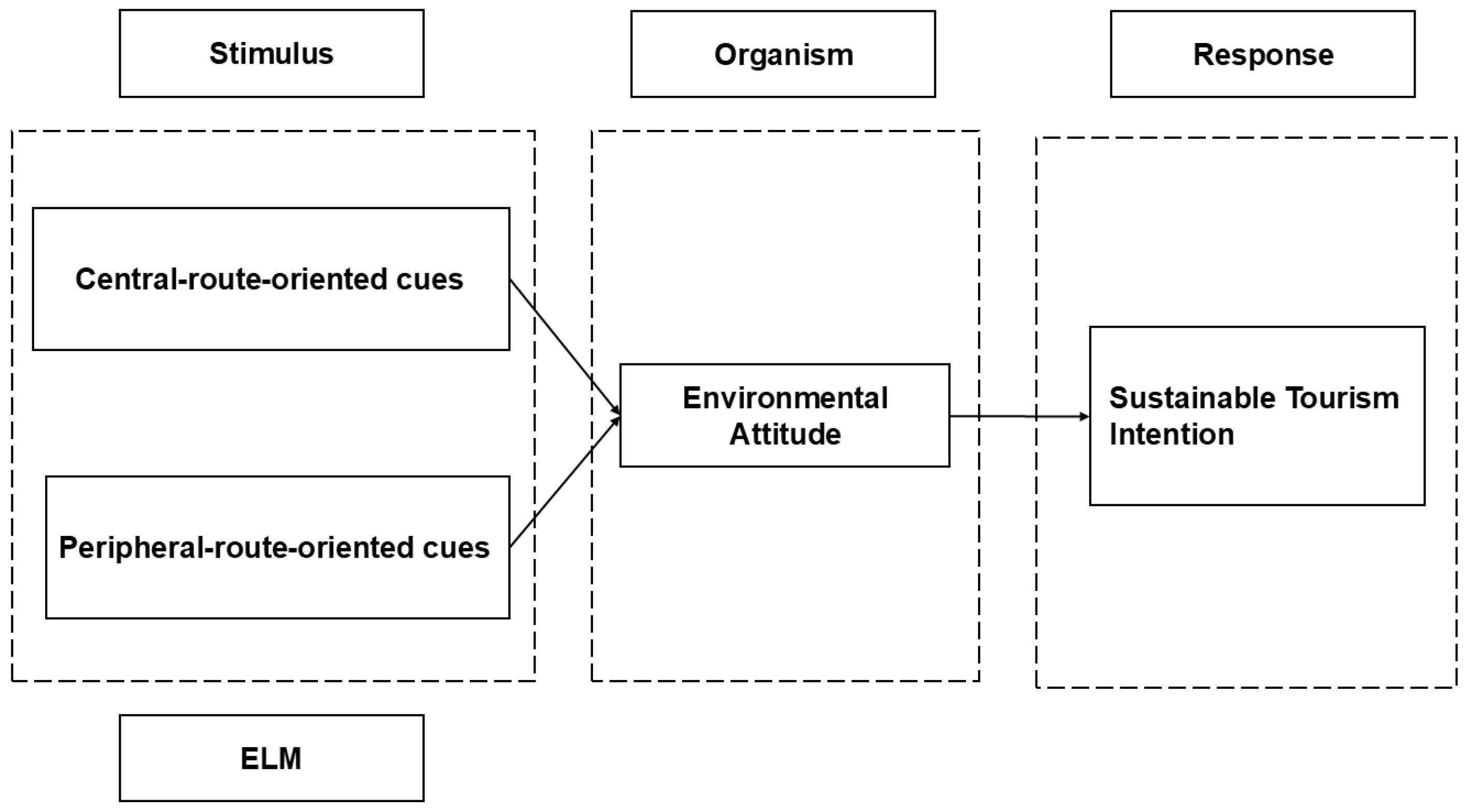
The selected cues are illustrative rather than exhaustive. Other potentially relevant factors, such as algorithmic recommendation, platform interactivity, and flow, are treated here as platform conditions, organismic states, or moderators rather than as focal persuasive cues in the baseline framework (Zhao and Wagner 2022; Shiau et al. 2022; Liu et al. 2024). Table 2 summarizes the cue architecture, Figure 1 visualizes the core cue–attitude–intention sequence, and the propositions formalize the framework’s principal theoretical claims.
Taken together, Table 2 clarifies the route-sensitive organization of the stimulus layer, whereas Figure 1 visualizes the framework’s central explanatory pathway. To preserve conceptual clarity, the figure depicts only the core relationships rather than every possible moderator, ancillary organismic state, or platform-specific contingency.
Taken together, the framework explains short-video sustainability persuasion as a cue–attitude–intention process in which route sensitive persuasive inputs become consequential through an internal evaluative state. Following Nunkoo et al.’s (2023) guidance on proposition formulation in conceptual tourism research, the framework is translated into four propositions focused on cue–attitude effects, the attitude–intention link, and the mediated cue–attitude–intention mechanism, while additional elaboration conditions remain outside the scope of the simplified model presented here.
Proposition 1.
In short-video sustainability persuasion, central route-oriented cues, including information quality, argument quality, and environmental knowledge delivery, may positively influence Environmental Attitude by increasing the perceived diagnosticity and sustainability relevance of the message.
Proposition 2.
In short-video sustainability persuasion, peripheral-route-oriented cues, including visual appeal, emotional appeal, source attractiveness, and social endorsement, may positively influence Environmental Attitude by increasing affective resonance, heuristic receptivity, and perceived social validation.
Proposition 3.
Environmental Attitude may positively influence Sustainable Tourism Intention by translating sustainability-related evaluation into a stated willingness to choose, support, or prefer sustainable tourism practices.
Proposition 4.
In the integrated ELM SOR framework, the effects of central route-oriented and peripheral route-oriented cues on Sustainable Tourism Intention may be mediated by Environmental Attitude, with the central route pathway operating primarily through informational evaluation and the peripheral route pathway operating primarily through affective and heuristic receptivity.

4. Discussion

4.1. Theoretical Contributions

This article makes three theoretical contributions. First, it respecifies ELM SOR integration for sustainability-oriented short-video persuasion. Earlier ELM SOR integration has mainly been developed in e-commerce and general consumer behavior contexts (Shiau et al. 2022), whereas short-video tourism research has more often emphasized platform factors, source perceptions, and user experience than route-sensitive persuasion mechanisms (Liu et al. 2023; Qiu et al. 2024). The present framework extends this literature by showing that sustainability-oriented short-video persuasion requires an explanation of how heterogeneous cues invite evaluation of environmental responsibility and sustainable travel choices rather than merely how platforms or messages influence intention in general (He et al. 2023). This extension is also consistent with recent tourism research showing that pro-environmental persuasion operates through elaboration-related informational and image-based cues rather than through undifferentiated message exposure alone (Cheng et al. 2024).
Second, the article theorizes Environmental Attitude as a sustainability-specific organismic evaluative state. Prior sustainable tourism research has frequently treated attitude as a predictor, outcome, or mediator in broader attitude–intention–behavior relationships (Ibrahim et al. 2021; Chang and Hsiao 2025; Wut et al. 2023), but has less often specified its role within a route-sensitive short-video persuasion mechanism. By positioning Environmental Attitude as the internal evaluative state through which cue exposure becomes consequential for Sustainable Tourism Intention, the framework clarifies why sustainability persuasion should not be modeled as a direct cue-to-intention process. This clarification is important because sustainable tourism research continues to debate the relative role of attitude, intention, and behavior, while broader tourism evidence also shows that pro-environmental behavioral intention is shaped by multiple antecedents rather than by a single attitudinal driver (Wut et al. 2023; Lin et al. 2022).
Third, the article specifies a route-sensitive cue architecture for short-video sustainability persuasion. Existing studies show that short-video tourism outcomes can be shaped by visual presentation, narration appeal, source perceptions, and platform-related evaluations (Gan et al. 2023; Qiu et al. 2024; Huang et al. 2025), yet these inputs are usually examined as separate factors rather than as part of one differentiated persuasive structure. Recent short-video research further suggests that formal visual features such as motion speed and visual content can shape destination evaluation in theoretically distinct ways, reinforcing the need to treat visual cues as analytically meaningful components of the persuasive stimulus layer rather than as mere presentation details (Zhang et al. 2026). The present framework contributes by organizing informational, source-related, visual, emotional, and social endorsement cues into a single mechanism that links route-sensitive stimulus specification with organismic mediation.

4.2. Practical Implications

This framework also offers practical insights for sustainability-oriented tourism communication, although such implications remain secondary to its conceptual contribution. If short-video sustainability persuasion operates through route-sensitive cue combinations rather than through undifferentiated exposure, then communication design should attend to how substantive and impression-oriented elements work together rather than in isolation, a point consistent with tourism short-video studies showing that perceived usefulness, eWOM, and trust-related evaluations shape attitudes toward using short-video platforms for travel planning and destination evaluation (Wang et al. 2022; Qiu et al. 2024).
For destination marketers and sustainability communicators, the framework suggests that content strategy should not treat informational quality, source credibility, visual form, emotional resonance, and social endorsement as interchangeable. Central-route-oriented cues such as detailed sustainability information may be especially useful when communicators seek more substantive environmental evaluation. In practice, such content could include explanations of green certifications, evidence of low-carbon transportation options, facts about ecological conservation efforts, documentation of community benefits, and transparent environmental impact data. These elements invite audience members to process sustainability claims through deliberative evaluation rather than superficial impression formation, consistent with tourism persuasion research showing that informational diagnosticity and elaboration-related message factors can strengthen pro-environmental evaluation and intention (Cheng et al. 2024; Kim and Pennington-Gray 2025).
Peripheral-route-oriented cues such as visual aesthetics, emotional appeal, and social endorsement may be especially useful for increasing receptivity and initial engagement. These cues can attract attention, generate affective resonance, encourage sharing intentions, and enhance social visibility—functions that are particularly valuable in fast-scrolling short-video environments where initial attention is scarce. For example, visually compelling destination imagery, emotionally resonant storytelling, and visible endorsement metrics such as like counts and follower numbers can create entry points that encourage viewers to stay engaged with sustainability-related content long enough for central route messages to have an effect. This implication is consistent with evidence that visual perspective, visual content, and narration appeal can jointly shape travel intention (Gan et al. 2023). It is also consistent with findings that narrative coherence, authenticity, and empathy can strengthen the persuasive effectiveness of short-video endorsers (Huang et al. 2025).
Source credibility warrants particular attention in practice because it operates as a mixed cue in this framework. Unlike source attractiveness, which primarily serves peripheral route functions, source credibility can support both credible endorsement and knowledge-bearing communication. In tourism short-form video contexts, source credibility has been shown to strengthen destination image, telepresence, and visit intention under ELM related conditions (Liao et al. 2024), while influencer credibility can also reinforce destination brand trust and purchase intention (Najar et al. 2024). Practitioners should therefore design influencer collaborations and expert appearances to signal not only appeal and trustworthiness, but also substantive knowledge about environmental responsibility, low-carbon practices, and sustainable tourism standards. When credibility is visibly tied to sustainability expertise, it may enhance both heuristic trust and the perceived seriousness of central route information.

4.3. Limitations and Future Research

The framework is deliberately bounded. It privileges ELM SOR integration over other possible explanatory combinations, retains Environmental Attitude as the focal organismic evaluative state, and ends with Sustainable Tourism Intention rather than actual behavior. These choices increase conceptual clarity, but they also mean that the model does not capture every relevant cue, psychological process, or contextual condition in short-video sustainability persuasion, including platform-level affordances and intervening states that have been treated as influential in adjacent short-video studies (Zhao and Wagner 2022; Liu et al. 2024).
Future research should test whether the proposed cue architecture remains stable across platforms, audience groups, and communication settings, and whether audience-level factors such as prior environmental concern, motivation, involvement, cognitive capacity, and perceived message relevance, or platform conditions such as algorithmic curation, moderate the route-sensitive effects proposed here (Petty and Cacioppo 1986; Zhao and Wagner 2022; Qiu et al. 2024).Future research should also examine whether different cue categories interact with one another, since the present framework focuses primarily on their route-sensitive main effects rather than on possible reinforcing, offsetting, or contingent relationships among cues. Given broader evidence that pro-environmental behavioral intention in tourism is shaped by multiple antecedents (Lin et al. 2022), further work could also incorporate additional organismic states, such as flow or related forms of immersive engagement (Liu et al. 2024), and examine whether Sustainable Tourism Intention translates into observable sustainable tourism behavior in ways that narrow the persistent intention–behavior gap identified in sustainable tourism research (Juvan and Dolnicar 2014; Viglia and Acuti 2022; Wut et al. 2023).

5. Conclusions

By using ELM and SOR as theoretical scaffolding, this article provides a clearer conceptual explanation of how short-video persuasive cues shape Sustainable Tourism Intention through Environmental Attitude in short-video platform contexts. The main contribution lies not in combining the two frameworks per se, but in respecifying their combined logic for sustainability-oriented short-video persuasion. The framework conceptualizes short-video communication as a cue-dense persuasive environment, repositions Environmental Attitude as the organismic evaluative state, and links route-sensitive cue families to Sustainable Tourism Intention through that state. In doing so, it offers a stronger theoretical foundation for future research on short-video sustainability communication and Sustainable Tourism Intention. This perspective also clarifies why short-video sustainability persuasion represents a more specific explanatory context than social media persuasion in general, given its cue-dense, visually driven, and rapidly circulated communication environment. Future research can extend this framework by examining cue interactions, audience-level elaboration conditions, and platform-specific contingencies that may further shape sustainability persuasion processes in short-video environments.

Author Contributions

Conceptualization, X.W., S.L.O. and N.I.M.; methodology, X.W.; software, X.W.; validation, X.W., S.L.O. and N.I.M.; formal analysis, X.W.; investigation, X.W.; resources, X.W.; data curation, X.W.; writing—original draft preparation, X.W.; writing—review and editing, X.W. and S.L.O.; visualization, X.W.; supervision, S.L.O. and N.I.M.; project administration, X.W.; funding acquisition, S.L.O. All authors have read and agreed to the published version of the manuscript.

Funding

This research received no external funding.

Institutional Review Board Statement

Not applicable.

Informed Consent Statement

Not applicable.

Data Availability Statement

No new data were created or analyzed in this study. Data sharing is not applicable to this article.

Acknowledgments

The authors used ChatGPT 5.2 to assist with language polishing, translation support, and formatting refinement during manuscript preparation. The authors take full responsibility for the content of the manuscript.

Conflicts of Interest

The authors declare no conflicts of interest.

References

  1. Ajzen, Icek. 1991. The Theory of Planned Behavior. Organizational Behavior and Human Decision Processes 50: 179–211. [Google Scholar] [CrossRef]
  2. Bai, Wenxi (Bella), Timothy J. Lee, Fan Wu, and Jose Weng Chou Wong. 2025. How Effective Are User-Generated Travel Short Videos in Promoting a Destination Online? Journal of Vacation Marketing 31: 578–95. [Google Scholar] [CrossRef]
  3. Bhattacherjee, Anol, and Clive Sanford. 2006. Influence Processes for Information Technology Acceptance: An Elaboration Likelihood Model. MIS Quarterly 30: 805–25. [Google Scholar] [CrossRef]
  4. Chang, I.-Hsiung, and Yueh-Chih Hsiao. 2025. How Does Environmental Cognition Promote Low-Carbon Travel Intentions? The Mediating Role of Green Perceived Value and the Moderating Role of Electronic Word-of-Mouth. Sustainability 17: 1383. [Google Scholar] [CrossRef]
  5. Chen, Xinyi, and Zhen Cheng. 2023. The Impact of Environment-Friendly Short Videos on Consumers’ Low-Carbon Tourism Behavioral Intention: A Communicative Ecology Theory Perspective. Frontiers in Psychology 14: 1137716. [Google Scholar] [CrossRef] [PubMed]
  6. Cheng, Peng, Wei Wang, and Shu Yang. 2024. Doing the Right Thing: How to Persuade Travelers to Adopt pro-Environmental Behaviors? An Elaboration Likelihood Model Perspective. Journal of Hospitality and Tourism Management 59: 191–209. [Google Scholar] [CrossRef]
  7. Corley, Kevin, and Dennis Gioia. 2011. Building Theory About Theory Building: What Constitutes a Theoretical Contribution? The Academy of Management Review 36: 12–32. [Google Scholar] [CrossRef]
  8. Cornelissen, Joep. 2017. Editor’s Comments: Developing Propositions, a Process Model, or a Typology? Addressing the Challenges of Writing Theory Without a Boilerplate. Academy of Management Review 42: 1–9. [Google Scholar] [CrossRef]
  9. Cyr, Dianne, Milena Head, Eric Lim, and Agnis Stibe. 2018. Using the Elaboration Likelihood Model to Examine Online Persuasion through Website Design. Information & Management 55: 807–21. [Google Scholar] [CrossRef]
  10. DeLone, William H., and Ephraim R. McLean. 2003. The DeLone and McLean Model of Information Systems Success: A Ten-Year Update. Journal of Management Information Systems 19: 9–30. [Google Scholar] [CrossRef]
  11. Dunlap, Riley E., Kent D. Van Liere, Angela G. Mertig, and Robert Emmet Jones. 2000. New Trends in Measuring Environmental Attitudes: Measuring Endorsement of the New Ecological Paradigm: A Revised NEP Scale. Journal of Social Issues 56: 425–42. [Google Scholar] [CrossRef]
  12. Gan, Jianhong, Si Shi, Raffaele Filieri, and Wilson K. S. Leung. 2023. Short Video Marketing and Travel Intentions: The Interplay between Visual Perspective, Visual Content, and Narration Appeal. Tourism Management 99: 104795. [Google Scholar] [CrossRef]
  13. Gilson, Lucy L., and Caren B. Goldberg. 2015. Editors’ comment: So, what is a conceptual paper? Group & Organization Management 40: 127–30. [Google Scholar] [CrossRef]
  14. He, Mu, Clara-Jane Blye, and Elizabeth Halpenny. 2023. Impacts of Environmental Communication on Pro-Environmental Intentions and Behaviours: A Systematic Review on Nature-Based Tourism Context. Journal of Sustainable Tourism 31: 1921–43. [Google Scholar] [CrossRef]
  15. Huang, Jiahui, Dan Huang, and Keyu Huang. 2025. Enhancing Tourist Visit Intentions through Virtual Endorsers’ Short Videos: A Narrative Transportation Theory. Tourism Management Perspectives 58: 101389. [Google Scholar] [CrossRef]
  16. Hussain, Khalil, Marcus L. Stephenson, Elangkovan Narayanan Alagas, Philip Pong Weng Wong, Ahmad Salman, and Ahmed Bostani. 2025. The Contribution of Social Media Influencers to Sustainable Travel Behaviour: The Mediating Role of Inspiration and Involvement in Sustainable Travel Practices. Management & Sustainability: An Arab Review, ahead-of-print. [Google Scholar] [CrossRef]
  17. Ibrahim, Hayati, Manohar Mariapan, Evelyn Lim Ai Lin, and Sheena Bidin. 2021. Wildlife Conservation through Economically Responsible Ecotourist: The Mediator Roles of Attitude between Anticipated Emotion and Intention to Stay in Local Homestays. Sustainability 13: 9273. [Google Scholar] [CrossRef]
  18. Jaakkola, Elina. 2020. Designing Conceptual Articles: Four Approaches. AMS Review 10: 18–26. [Google Scholar] [CrossRef]
  19. Juvan, Eva, and Sara Dolnicar. 2014. The Attitude-Behaviour Gap in Sustainable Tourism. Annals of Tourism Research 48: 76–95. [Google Scholar] [CrossRef]
  20. Kaiser, Florian G., and Urs Fuhrer. 2003. Ecological Behavior’s Dependency on Different Forms of Knowledge. Applied Psychology 52: 598–613. [Google Scholar] [CrossRef]
  21. Kim, Mina, and Lori Pennington-Gray. 2025. Enhancing Pro-Environmental Behaviors in Tourism: Communication Strategies Rooted in Elaboration Factors. Journal of Hospitality and Tourism Management 64: 101317. [Google Scholar] [CrossRef]
  22. Li, Hua, and Eric W. K. See-To. 2023. Source Credibility Plays the Central Route: An Elaboration Likelihood Model Exploration in Social Media Environment with Demographic Profile Analysis. Journal of Electronic Business & Digital Economics 3: 36–60. [Google Scholar] [CrossRef]
  23. Liao, Shan-Shan, Ching-Yuan Lin, and Xing-Zheng Xie. 2024. Effects of Short-Form Video Application Users’ Guanxi on Intention to Visit Rural Tourism Destinations: The Moderating Role of Tourism Fatigue. Journal of Vacation Marketing 30: 451–67. [Google Scholar] [CrossRef]
  24. Lin, Mao-Tang (Brian), Dan Zhu, Claire Liu, and Peter B. Kim. 2022. A Meta-Analysis of Antecedents of pro-Environmental Behavioral Intention of Tourists and Hospitality Consumers. Tourism Management 93: 104566. [Google Scholar] [CrossRef]
  25. Liu, Congying., Mingdi Jiang, and Zulqarnain Arshad Muhammad. 2024. The Impact of TikTok Short Video Factors on Tourists’ Behavioral Intention among Generation Z and Millennials: The Role of Flow Experience. PLoS ONE 19: e0315140. [Google Scholar] [CrossRef] [PubMed]
  26. Liu, Jing, Yujie Wang, and Liyan Chang. 2023. How Do Short Videos Influence Users’ Tourism Intention? A Study of Key Factors. Frontiers in Psychology 13: 1036570. [Google Scholar] [CrossRef] [PubMed]
  27. Lukka, Kari, and Eija Vinnari. 2014. Domain theory and method theory in management accounting research. Accounting, Auditing & Accountability Journal 27: 1308–38. [Google Scholar] [CrossRef]
  28. MacInnis, Deborah J. 2011. A Framework for Conceptual Contributions in Marketing. Journal of Marketing 75: 136–54. [Google Scholar] [CrossRef]
  29. Manca, Silvia, Gianmarco Altoè, P. Wesley Schultz, and Ferdinando Fornara. 2020. The Persuasive Route to Sustainable Mobility: Elaboration Likelihood Model and Emotions Predict Implicit Attitudes. Environment and Behavior 52: 830–60. [Google Scholar] [CrossRef]
  30. McCormack, Clare M., Joshua K. Martin, and Kylie J. H. Williams. 2021. The Full Story: Understanding How Films Affect Environmental Change Through the Lens of Narrative Persuasion. People and Nature 3: 856–71. [Google Scholar] [CrossRef]
  31. Mehrabian, Albert, and James A. Russell. 1974. An Approach to Environmental Psychology. Cambridge: MIT Press. [Google Scholar]
  32. Milfont, Taciano L., and John Duckitt. 2010. The Environmental Attitudes Inventory: A Valid and Reliable Measure to Assess the Structure of Environmental Attitudes. Journal of Environmental Psychology 30: 80–94. [Google Scholar] [CrossRef]
  33. Najar, Ashaq Hussain, Iram Sadia Wani, and Ab Hamid Rather. 2024. Impact of Social Media Influencers Credibility on Destination Brand Trust and Destination Purchase Intention: Extending Meaning Transfer Model? Vikalpa, online first. [CrossRef]
  34. Nunkoo, Robin, Dogan Gursoy, and Yogesh K. Dwivedi. 2023. Effects of Social Media on Residents’ Attitudes to Tourism: Conceptual Framework and Research Propositions. Journal of Sustainable Tourism 31: 350–66. [Google Scholar] [CrossRef]
  35. Ohanian, Roobina. 1990. Construction and Validation of a Scale to Measure Celebrity Endorsers’ Perceived Expertise, Trustworthiness, and Attractiveness. Journal of Advertising 19: 39–52. [Google Scholar] [CrossRef]
  36. Passafaro, Paola. 2020. Attitudes and Tourists’ Sustainable Behavior: An Overview of the Literature and Discussion of Some Theoretical and Methodological Issues. Journal of Travel Research 59: 579–601. [Google Scholar] [CrossRef]
  37. Petty, Richard E., and John T. Cacioppo. 1986. The Elaboration Likelihood Model of Persuasion. In Advances in Experimental Social Psychology. Edited by Leonard Berkowitz. New York: Academic Press, vol. 19, pp. 123–205. [Google Scholar] [CrossRef]
  38. Qiu, Lu, Xiang Li, and So Hyun Choi. 2024. Exploring the Influence of Short Video Platforms on Tourist Attitudes and Travel Intention: A Social-Technical Perspective. Journal of Destination Marketing & Management 31: 100826. [Google Scholar] [CrossRef]
  39. Rajput, Aditi, and Aradhana Gandhi. 2025. Impact of Social Media Influencer Content on Generation Z Sustainable Tourism Choices. Discover Sustainability 6: 1121. [Google Scholar] [CrossRef]
  40. Rejeb, Abderahman, Karim Rejeb, Andrea Appolloni, and Horst Treiblmaier. 2023. Foundations and Knowledge Clusters in TikTok (Douyin) Research: Evidence from Bibliometric and Topic Modelling Analyses. Multimedia Tools and Applications 83: 32213–43. [Google Scholar] [CrossRef]
  41. Robins, David, and Jason Holmes. 2008. Aesthetics and Credibility in Web Site Design. Information Processing & Management 44: 386–99. [Google Scholar] [CrossRef]
  42. Schwarz, Norbert, and Gerald L. Clore. 1983. Mood, Misattribution, and Judgments of Well-Being: Informative and Directive Functions of Affective States. Journal of Personality and Social Psychology 45: 513–23. [Google Scholar] [CrossRef]
  43. Shiau, Wen-Lung, Mengru Zhou, and Chang Liu. 2022. Understanding the Formation Mechanism of Consumers’ Behavioral Intention on Double 11 Shopping Carnival: Integrating S-O-R and ELM Theories. Frontiers in Psychology 13: 984272. [Google Scholar] [CrossRef] [PubMed]
  44. Teng, Shasha, Kok Wei Khong, and Wei Wei Goh. 2014. Conceptualizing Persuasive Messages Using ELM in Social Media. Journal of Internet Commerce 13: 65–87. [Google Scholar] [CrossRef]
  45. Tölkes, Christina. 2018. Sustainability Communication in Tourism—A Literature Review. Tourism Management Perspectives 27: 10–21. [Google Scholar] [CrossRef]
  46. Viglia, Giampaolo, and Daniele Acuti. 2022. How to Overcome the Intention-Behavior Gap in Sustainable Tourism: Tourism Agenda 2030 Perspective Article. Tourism Review 78: 321–25. [Google Scholar] [CrossRef]
  47. Wang, Cheng, Wenjing Cui, Yating Zhang, and Huawen Shen. 2022. Exploring Short Video Apps Users’ Travel Behavior Intention: Empirical Analysis Based on SVA-TAM Model. Frontiers in Psychology 13: 912177. [Google Scholar] [CrossRef] [PubMed]
  48. Wang, Xiaofeng, and Xiaoguang Yue. 2022. A Study on the Mechanism of the Influence of Short Science Video Features on People’s Environmental Willingness in Social Media-Based on the SOR Model. Frontiers in Environmental Science 10: 990709. [Google Scholar] [CrossRef]
  49. Wang, Xing, and Sue Lyn Ong. 2026. A Systematic Review of the Persuasive Effects of Environmental Communication in Short Videos. Jurnal Komunikasi: Malaysian Journal of Communication 42: 603–20. [Google Scholar] [CrossRef]
  50. Wut, Tai Ming, Daisy Lee, and Stephanie Wing Lee. 2023. Does Attitude or Intention Affect Behavior in Sustainable Tourism? A Review and Research Agenda. Sustainability 15: 14076. [Google Scholar] [CrossRef]
  51. Zhang, Minyi, Xi Li, Qing Xia, Jun (Justin) Li, and Haocheng Huang. 2026. How Do Short Videos Leverage Motion Speed and Visual Content to Bolster Destination Attractiveness? A Construal Level Perspective. Journal of Hospitality and Tourism Management 66: 101417. [Google Scholar] [CrossRef]
  52. Zhao, Hongying, and Christian Wagner. 2022. How TikTok Leads Users to Flow Experience: Investigating the Effects of Technology Affordances with User Experience Level and Video Length as Moderators. Internet Research 33: 820–49. [Google Scholar] [CrossRef]
  53. Zhu, Jingjie, Mingming Cheng, and Ying (Wendy) Wang. 2025. Viewer In-Consumption Engagement in Pro-Environmental Tourism Videos: A Video Analytics Approach. Journal of Travel Research 64: 716–35. [Google Scholar] [CrossRef]
  54. Zulli, Diana, and David James Zulli. 2022. Extending the Internet Meme: Conceptualizing Technological Mimesis and Imitation Publics on the TikTok Platform. New Media & Society 24: 1872–90. [Google Scholar] [CrossRef]
Figure 1. Integrated ELM SOR conceptual model.
Socsci 15 00477 g001
Table 1. Comparative roles of ELM and SOR in the integrated conceptual framework.
TheoryExplanatory StrengthLimitation When Used Alone
ELMDistinguishes likely processing tendencies in persuasive communication, including central route-oriented and peripheral route-oriented tendencies (Petty and Cacioppo 1986; Bhattacherjee and Sanford 2006)Does not fully specify how cue exposure develops into an organismic evaluative state and downstream intention (Shiau et al. 2022; Cheng et al. 2024)
SOROrganizes persuasion as a Stimulus–Organism–Response sequence (Mehrabian and Russell 1974; Chen and Cheng 2023)Does not sufficiently differentiate the persuasive processing logic of distinct cue families in the stimulus layer (Liu et al. 2023; Liu et al. 2024)
Table 2. Cue classification and route tendencies in the integrated framework.
Cue FamilyIllustrative Cue ConstructsRoute Tendency in the ModelConceptual Role in the Model
Informational cuesInformation Quality; Argument Quality; Environmental Knowledge DeliveryCentral-route-oriented (Petty and Cacioppo 1986)Provide substantive sustainability content for elaborative evaluation (DeLone and McLean 2003; Kaiser and Fuhrer 2003)
Source-related cuesSource CredibilityMixed: may support more central-route processing when linked to knowledge-bearing communication (Petty and Cacioppo 1986; Li and See-To 2023)Shape whether sustainability content is received as trustworthy and worth processing (Ohanian 1990; Bhattacherjee and Sanford 2006)
Source related cuesSource AttractivenessPeripheral-route-oriented (Petty and Cacioppo 1986)Increase appeal and heuristic receptivity to the persuasive message (Ohanian 1990)
Visual cuesVisual AppealPeripheral-route-oriented (Petty and Cacioppo 1986)Contribute to aesthetic and heuristic receptivity to the persuasive message (Cyr et al. 2018; Robins and Holmes 2008)
Emotional cuesEmotional AppealPeripheral-route-oriented (Petty and Cacioppo 1986)Contribute to affective receptivity toward sustainability-related communication (Schwarz and Clore 1983; McCormack et al. 2021)
Social cuesSocial EndorsementPeripheral-route-orientedProvide social proof and heuristic validation through engagement signals such as likes, comments, shares, and follower counts (Qiu et al. 2024; Rejeb et al. 2023)
Disclaimer/Publisher’s Note: The statements, opinions and data contained in all publications are solely those of the individual author(s) and contributor(s) and not of MDPI and/or the editor(s). MDPI and/or the editor(s) disclaim responsibility for any injury to people or property resulting from any ideas, methods, instructions or products referred to in the content.