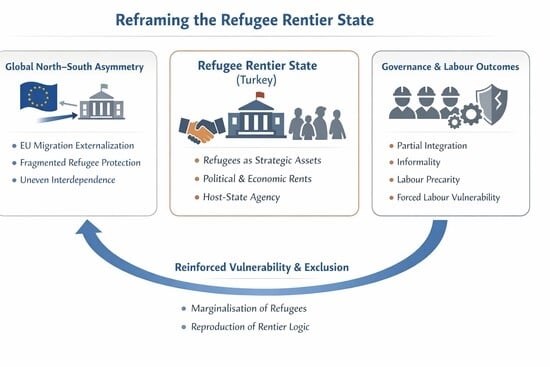
1. Introduction
The growing interest of international relations researchers in migration, and its impact/s on state foreign policy in particular, has not developed in isolation, and has indeed been framed against a growing public concern about its implications for economic prosperity and social cohesion in the Global North. As a result of large-scale population movements, asylum and the established international refugee regime have become increasingly politicised, feeding into, from the 1990s onwards, the effective disintegration of the ‘firewall’ between asylum and migration. In large part as a result, the sustainability of the 1951 Convention, the cornerstone of the post-WW2 international refugee regime (
Goodwin-Gill 2014), is now increasingly questioned and even challenged in the Global North.
In June 2020, the UNHCR reported that refugees, including 6.6 million Syrians, accounted for 26 million of the world’s 79.5 million displaced persons. (
UNHCR 2020). Contrary to the popular legend that castigates hordes of foreign aliens “flocking” to the developed world, it is actually the Global South that has received almost three-quarters (73%) of the “burden” (
Errighi and Griesse 2016, pp. 2–3). The established EU policy of externalisation, and specifically the priority it attaches to controlling and regulating inward population movements within transit countries, implicitly acknowledges this.
EU ‘outsourcing’ of refugee arrangements has direct implications for the displaced, including their integration into labour markets, and obligations long established by international refugee regimes. The ability of ‘partner’ receiving states to manage refugee populations in a way that honours and upholds established international commitments vis-à-vis refugees is also open to question, and here it should be recognised that even in rich and developed countries such as Germany, asylum seekers have experienced a wide number of integration challenges, including obstacles such as language and documentary requirements (
Hamann 2015), poorly designed mandatory integration classes (that made insufficient allowance for personal experience and background) and highly educated professionals effectively being forced into unsuitable jobs (
Nasr 2020). Turkey’s integration efforts, a substantial government commitment notwithstanding, have also been broadly unsuccessful, resulting in minimal integration and social tension between ‘host’/’receiving’ and refugee communities (
Wilder and Hickson 2023). Failed or partial integration exposes refugees to economic marginalisation and exploitation.
While multiple conflicts in the post-Cold War era have drawn attention to these challenges, they have most recently been made visible by the Syrian Civil War, which one observer describes as ‘the greatest human disaster of the twenty-first century’ (
Omer 2025). Both Lebanon and Turkey received far more refugees with far fewer resources, suggesting that in this case the issue was not the absolute number but rather rapid escalation, culminating in a situation where, by September 2013, there were two million Syrian refugees and 4.25 million Internally Displaced Peoples (IDPs) (
Phillips 2016, Introduction). In the period 2011–2014, around 600,000 Syrians sought refuge in Turkey, with many making it clear that they ultimately intended to settle in the EU (
Tolay 2014).
The EU’s asylum arrangements effectively broke down in 2015 (
Ammirati 2015) when the Dublin Regulation effectively became inactive (
Fullerton 2016, p. 130).
1 In 2015 alone, more than 1,800,000 refugees reached European borders, with most arriving in Greece on small, unreliable boats or dinghies (a total still less than half of Turkey’s refugee population and only 0.6 percent of the EU’s total population) (
BBC News 2016;
European Commission 2021). Migrants arriving on the Greek islands of Lesbos, Samos, and Chios (where most migrants were received) were now confronted by a lack of processing capacity and security forces firing tear gas and water cannons (
Recchi et al. 2019, p. 265). As NGOs struggled, with limited resources, to provide shelter, water, emergency supplies, and transportation, states took unilateral action, with Hungary building a barrier along its border with Serbia and Croatia.
Migrants did not follow the first country of entry registration, instead proceeding to countries of preference (usually Germany and Sweden) at a time when Greece was so overwhelmed that migrants were waved through without checks. This is how the (entirely illusory and misleading) concept of a
European refugee crisis took hold and percolated (
Crawley et al. 2016, pp. 41–43).
On 9 September 2015, an emergency relocation proposal was put forward, under which 120,000 refugees in Greece, Hungary, and Italy were supposed to be relocated across Member States with the support of a €1.8 billion Trust Fund, in accordance with a mandatory distribution key (
Bertaud 2015). By the end of the year, Germany had received 1.1 million Syrians (
Dudasova 2016). However, these commitments were increasingly complicated, or even cast into doubt, by a hardening public opinion that made EU leaders and decision-makers less predisposed to political concessions (
Schweitzer et al. 2018, pp. 14–15) and/or challenged the view that asylum seekers were an unwanted economic burden and/or security threat (
Angeloni and Spano 2018, p. 478).
A Pew Research Centre study of the 2014 European elections showed a majority of ‘Right-wing’ voters wanted to limit inward migration, at a time when ‘extreme Right’ parties were the second or third largest parties in several EU legislatures and nativist sentiment was increasingly widespread. Across Europe, populist centre-right parties gained ground at the expense of the centre-left (
Galston 2018).
In Germany, 20,000 gathered in Dresden in 2015 after the AFD won municipal elections to protest immigrants (
Ratković 2017, pp. 48–49). Four years later, the (initially socially conservative, Eurosceptic, and later anti-migrant) party took almost one-third of the vote in the EU Parliament elections (
Kouchehbagh 2019). In 2016, Human Rights Watch (HRW) reported that Hungarian civil militia field guards had beaten and abused asylum seekers (
Human Rights Watch (HRW) 2016). In the UK, UKIP’s notorious “breaking point” campaign poster further fanned the flames in the country’s 2016 EU independence referendum (
Stewart and Mason 2016), and in Greece, members of far-Right groups attacked refugees in Lesbos in 2017, following similar ‘Golden Dawn’ attacks four years earlier (
Baboulias 2018).
These popular pressures combined with other influences to create a situation where humanitarianism and the established refugee regime were effectively secondary or even third-order considerations, with one observer now speaking of ‘policy conversion’ in which ‘factors outside the refugee regime itself are creating change’ (
Mourad and Norman 2020). The original policy, reconfigured and realigned, is now oriented towards ‘new goals, functions, or purposes’ (
Streeck and Thelen 2005). In this context, established protection obligations, including those related to forced labour, were effectively downgraded and subjected to a greater degree of uncertainty.
In the initial stages of the ‘crisis’, the EU’s preference was to use the Syria Humanitarian Response Plan (HRP), created in consultation with the Syrian government, to provide assistance to IDPs. Vis-à-vis refugees in neighbouring countries, its preference was to keep Syrian refugees in ‘border’ countries such as Turkey, Lebanon, and Turkey, and to work through UNHCR (to provide protection and community services, distribution of core relief items, shelter assistance, health-care services, and educational support) (
UNHCR n.d.). This, however, became unsustainable as refugees increasingly congregated in ‘transit country’ camps, creating a backlog and an ever-growing drain on state resources (
Rosen 2021;
Médecins Sans Frontières (MSF) 2022).
2 Pressures continued even after the deal came into effect, with Turkey eventually accommodating the largest Syrian diaspora population of anywhere outside the mother country (
Ineli-Ciger 2017). In 2020, there were more than 3.6 million Syrian refugees in Turkey, (
3RP Turkey 2021), with the Turkish government covering the ‘bulk of the financial costs’ (
3RP Turkey 2021).
From 2013 onwards, the war in Syria became increasingly sectarian, which drove more displacement, further increasing the pressure on neighbouring countries as refugees congregated on Europe’s borders. The situation deteriorated to the point where, in August 2015, Germany unilaterally proposed, on humanitarian grounds, to breach the Schengen Agreement and the Dublin Regulation by allowing 800,000 migrants to cross internal EU borders without valid documents and enter its territory (
Ammirati 2015). Poland and Hungary bitterly contested this, originating a clear divide between ‘old’ (invoking solidarity) and ‘new’ (who refused to accept refugees) Europe that then manifested in rapidly constructed barbed wire fences along reconstructed national borders (
Angeloni and Spano 2018, p. 478). Nativist fears intensified, including in the Visegrad countries, as the Far Right mobilised across Europe.
After permitting this initial influx, despite the pronounced absence of appropriate burden-sharing measures and mechanisms (with the result that Germany and Sweden received most migrants), the EU then shifted to crisis management, agreeing a €3 billion emergency deal with Turkey (
European Commission 2015).
On 18 March 2016, it was followed by an EU–Turkey statement that committed both countries to curb EU-bound irregular migration by returning migrants to Turkey, resettling Syrians across the EU, and expanding EU financial and political assistance to Ankara. However, the EU’s priority was to reduce the numbers entering, with concerns about well-being, including exposure to economic exploitation and coercive working practices, appearing, at best, as a secondary consideration. Criticisms of this “deal”, the latest instalment in a developing European practice of externalisation, tended to focus on the physical well-being of refugees (i.e., the likelihood that they would be exposed to physical harm as a result of their return to a country that was not party to the 1951 Convention), with the result that protection from economic harm was invariably overlooked.
After the European Parliament initially mischaracterised the statement as a European Council–Turkey agreement, it was revealed to be the product of late-2015 European Commission and Council evaluations (undertaken after the EU–Turkey Joint Action Plan announced in November 2015 and internal assessments of the migration crisis (
European Parliament 2016, p. 204). More than a ‘sticking plaster’, it was actually the culmination of a gradual process of policy coordination and securitised migration management within EU institutions across several months. More generally, it was also consistent with a broader practice of externalisation frequently criticised for failing to sufficiently safeguard refugee security and well-being.
On 29 October 2015, it was followed by a joint plan that committed to clamp down on illegal smuggling, force irregular migrants back to Turkey (
Casaglia and Pacciardi 2022), and establish a refugee facility with substantial new resources. These new arrangements included a ‘one-for-one’ policy that instituted an arrangement where, for every Syrian refugee granted the right to remain and settle in the EU, another would ‘return’ to Turkey (
Ott 2020, p. 204). Critics questioned whether this was compatible with established international refugee law and even alleged it was a ‘trade off of human beings’ (
Casaglia and Pacciardi 2022) that potentially discriminated against the safety and well-being of asylum seekers (
Casaglia and Pacciardi 2022, p. 1668). However, such criticisms tended to focus upon legal rights vis-à-vis asylum, rather than the EU’s obligation to protect refugees, including the vulnerable (e.g., women and children), from economic exploitation and forced labour. For the EU, however, it had a broad number of recommendations, including the fact that it made it possible to carry out background checks, in accordance with the Dublin Regulation (
Talani 2021, p. 186). Even after the established European refugee regime broke down, elements therefore effectively persisted, even if only in spirit.
The EU’s “crisis” response inevitably gave rise to objections that it was upholding double standards, a criticism later given further strength by the bloc’s response to Russia’s 2022 invasion of Ukraine. Here, the EU committed itself to ensuring as many refugees as possible were taken in (the exact opposite of the EU position vis-à-vis Syrians), and also to a Temporary Protection Directive and a “10-Point-Plan” that envisaged a ‘reinforced framework’ for adequate funding and put in place national contingency plans to cater for long-term needs.
In subsequent years, the fundamental tension between the weak norm of burden sharing and the strong framework of international refugee law came to characterise, and indeed define, the European management of the ‘crisis’. While the rise in nativist sentiment was clearly important, so were long-established structural deficiencies within the EU itself. The inadequacies of Europe’s crisis response had been shown on numerous occasions, including the 2009 Greek debt crisis and the collapse of the former Yugoslavia in the early- to mid-1990s. Both the CFSP (Common Foreign and Security Policy) and ESDP (European Security and Development Policy) remained more aspirations than concretely embodied policy domains.
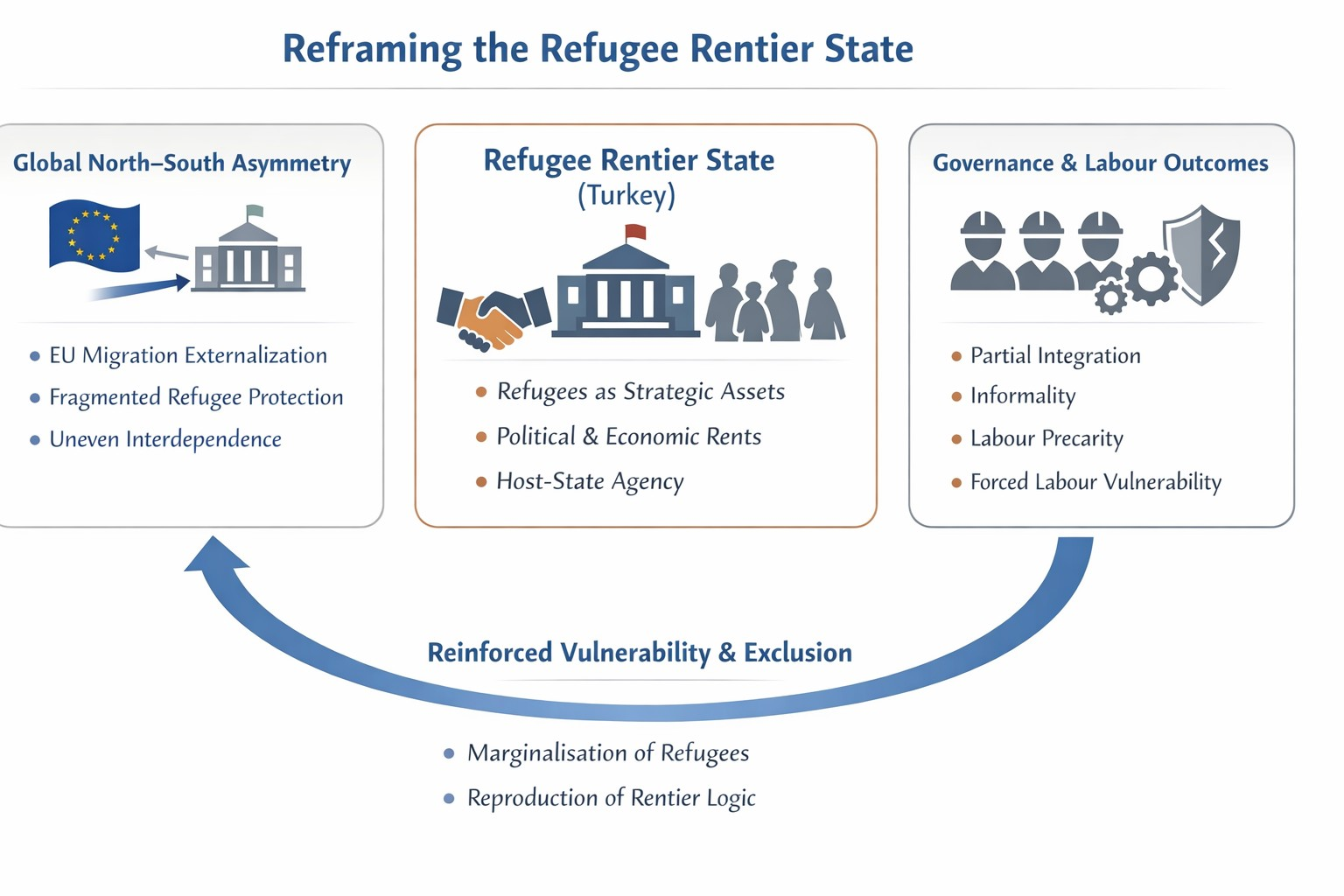
In engaging with these developments in more detail, I primarily seek to contribute insights and perspectives germane to the more general discussion and analysis of the refugee rentier state, and to demonstrate precisely how refugees became central to a state’s bargaining repertoire and EU externalisation. I also contribute to a migration literature that, in my view, has failed to develop an understanding of how rentier policies have become part of the refugee regime (broadly, how states use ‘their position in order to extract revenue from other state or nonstate actors’) (
Tsourapas 2019), and has indeed barely begun to theorise how forced migration impacts state foreign policy decisions. In applying
Tsourapas’s (
2019) definition of ‘refugee rentier state’, I therefore seek to demonstrate how externalisation, securitisation, and rentierism became mutually reinforcing over the course of the ‘crisis’.
In demonstrating how Turkey has manipulated the EU’s security desire to ‘contain’ large-scale population movements and in turn extract both financial and geopolitical/strategic ‘rents’ from the EU, I adapt the work of
Tsourapas (
2019) to show how rent seekers ‘employ their position to extract revenue from other state or nonstate actors’, (
Tsourapas 2019) while also expanding the framing of both rents and rent-seeking behaviour.
Distinguishing ‘rent seekers’ (states seeking to extract revenue) from ‘rent payers’ (state and non-state actors from whom revenue is extracted) within a wider analysis that cuts across domestic and international levels, I demonstrate how Syrian refugees within Turkey, in being integrated into ‘transactions’ on partial and incomplete terms, came to be sources of ‘rent’. While the arrangement worked for rent ‘payers’ and ‘seekers’, it was the refugee population who paid the cost, being exposed to greater marginality, vulnerability and potential exploitation, including forced labour, as a result.
2. Structural Deficiencies in EU Asylum/Migration Policy
As migratory pressure increased in 2015, the EU proposed to expand FRONTEX into a 10,000-member border guard force by 2025, a proposal criticised as unrealistic, which did nothing to reduce the burden on border states (
Kyriakopoulos 2019). Originally established in 2004, with the aim of ensuring ‘operational cooperation’ between EU member states (
Papastavridis 2010). It was now given a more expansive role. However, it did not even begin recruiting until November 2019, when the EU finally adopted the policy. Even before this, in 2016 and 2018, most Member States, citing national sovereignty concerns, refused to allow FRONTEX to operate independently on their borders. The FRONTEX-related policy will not even be completed until 2027.
It continues to attach great importance to its own work, claiming to be engaged in ‘intelligence-driven’ risk analysis’ as part of ‘national security’ operations (
Karamanidou 2015), while celebrating its use of ‘exceptional measures to deal with the threat (
Bossong 2019) However, even after a budget increase to €9.4 billion for the period 2012–2027 (
Bossong 2019) it still fell some distance short of the Commission’s expressed desire for a specific ‘European Border Guards Corps’. Its human rights record also continues to be criticised (
Bossong 2019).
The EU’s ability to absorb large and sudden influxes was also undermined by long-standing weaknesses and deficiencies in the asylum processing and reception systems. The common European asylum system continued to be undermined by four structural weaknesses in the common European asylum system vis-à-vis registration, reception, asylum procedures, and adjudication. This resulted in registration challenges, accommodation difficulties, insufficient service provision, and severe backlogs in the application process. Even before the crisis, asylum seekers lived in emergency shelters and tents without running water (
Oxfam 2019). Even now, there is a lack of infrastructure, legal representatives, interpreters, and trained personnel.
Although inward migration more than tripled in the period 2010–2014, increasing from 204,000 to 615,000, the Eurodac, Dublin lll, reception conditions, and asylum procedures only became operational in mid-July 2015, when 1.23 million asylum seekers had already arrived (
European Commission 2016). There was accordingly something of a lag in the EU policy response to the crisis, with action only occurring after the peak of July 2015 (
Clark 2019). In the first three years of the crisis, as migration inflows increased from 259,400 in 2010 to 431,090 in 2013 (
European Parliament 2015), the EU failed to immediately implement fingerprinting, improve Dublin reception centres, and/or step up European Border and Coast Guard Agency operations.
Little progress has been made towards an alternative to Dublin (the so-called ‘Dublin lV’). Other EU-proposed policies have been delayed or have not come into effect, including the EU Reception Conditions Directive (2003), which sought to establish minimum standards (‘a dignified standard of living and comparable living conditions’) in all Member States (
European Council on Refugees and Exiles (ECRE) 2005, p. 1). The 2013 directive (‘the recast Reception Conditions’ Directive, Directive 2013/33/EU) issued in response to,
inter alia, overcrowding, destitution, and excessive administrative delays (
EU Agency for Fundamental Rights (FRA) 2020, pp. 16–17) that sought to improve standards and put more procedural safeguards in place for asylum seekers across a broad range of areas (EU Directive 2013/33/EU). However, it was only provisionally agreed five years later and has still not come into effect.
An EU Fundamental Rights agency report published in late 2019 drew attention to a large number of problems with the EU asylum system, including a lack of information, difficulties accessing legal help, and long waiting times experienced in seven EU countries.
3 In the Syrian crisis, issues did not just arise within the EU’s system but also on its border, with police in Serbia and North Macedonia refusing to allow asylum seekers to enter (47FRA).
Institutional shortcomings
4 and legal interventions
5 also continued to complicate matters, with the consequence that EU interventions appeared to closely resemble a series of deeply imperfect ad hoc adaptations to changing circumstances (
Beirens 2018). One particularly critical account lamented weak monitoring, lack of policy harmonisation, low solidarity, and an absence of central institution influence (
Wensink et al. 2017), without even mentioning the fact that “solidarity” apparently meant the wealthier EU states, such as Germany, Sweden and Austria, accepting the bulk of refugees (
Ayaz and Wadood 2020).
Developments in asylum and migration policy were also invariably linked to counter-terrorism policy (
Bakkour and Sahtout 2025). A European Commission policy review, conducted as part of the 2014–2015 evaluation of the EU Counter-Terrorism Strategy, found that too many EU and national agencies were involved in the design and implementation of counter-terrorism policy, leading to fragmentation and coordination deficits, and also expressed concerns about counter-terrorism information-sharing arrangements in place, including the lack of a unified database (
European Court of Auditors 2017). A functioning legal regime for the collection, retention, and sharing of data with third parties had still not been developed in 2017. Overlapping competences and unclear mandates were also an ongoing issue (
European Court of Auditors 2017).
By virtue of the securitisation of migration policy, deficiencies within EU security policy, including counterterrorism, impacted the EU’s efforts to develop an effective response. The EU Counter-Terrorism Strategy was adopted in the aftermath of the London bombings in July 2005 (
Council of the European Union 2020b). Despite subsequent developments in the security environment, the strategy was not substantively revised in the twelve years that followed, retaining its original core orientation (
Bures 2007, pp. 45–46). More broadly, critiques that EU counter-terrorism policy has been largely ad hoc and reactive are reinforced by the fact that major terrorist attacks have repeatedly acted as the principal catalysts for the rapid expansion of counter-terrorism measures (
Huysmans 2006, pp. 70–72;
Bures 2007, pp. 43–56).
Exactly the same criticism could be made of the European Security Strategy, which emerged in
response to the Brussels terrorist attacks (
Bures 2007, p. 46) and the appointment of a commissioner with specific responsibility for terrorism (both in 2016) (
Bures 2007, p. 46). The blurring of responsibilities and roles was further compounded by a failure to conduct impact assessments, including on the 2002 directive on combatting terrorism.
This is not, however, merely a question of policy refinement, as politics was also inevitably a factor.
Maldini and Takahashi (
2017, p. 57) re-examined the existing structure and functionality of EU institutions, with a view to establishing whether the refugee crisis attested to a continued structural crisis in the EU. As an alliance of sovereign states, the EU cannot lay claim to classical democratic legitimacy on the model of the political nation, meaning that any consensus, common understanding, and/or common position must be rooted in solidarity, and more specifically, burden sharing that alleviates demands on countries receiving most immigrants. The disconnect between Member States and the relevant EU policy directives highlights an urgent, deeper issue within the EU, namely the need to reform the majority voting system. Compliance with the protection of asylum seekers and refugees was only voluntary, resulting in Member States effectively externalising migration by accepting as few asylum seekers as possible (
Angeloni and Spano 2018, p. 478). Well before this, the EU’s claim to uphold principles of non-discrimination in responding to international emergencies (
Ott 2020) had been drawn into question, including in the Cold War, when states ought to ‘embarrass or discredit adversary nations’ by hosting refugees (
Tsourapas 2019). A continued funding gap (approximately
$700 Million in 2022) (
UNHCR 2022) is at least partially due to politics, while donor (ab)use of UNHCR’s intergovernmental process to advance their priorities (sometimes to the point of effective bribery) and government co-option of the aid process for political purposes (as in the Syrian Civil War) are of course entirely political (
Loescher 2001, chap. 10).
6 3. The Securitisation of EU Asylum/Migration Policy: A Prelude to Externalisation
The (1985) Schengen Agreement ultimately resulted in migration being linked to the protection of Europe’s internal security (
Kasparek 2010) and being discussed vis-à-vis the ‘threats’ of ‘terrorism and transnational crime’ (
Huysmans 2006). This subsequently resulted in asylum and migration being ‘bundled in’ with other established agendas and priorities, through what is known as ‘issue linkage’ (
Betts 2011). One example was the UNHCR, for example, contributing to, rather than resisting, the securitisation of forced migration. This established a two-way interactive process, in which EU member priorities fed into international priorities, which in turn reinforced and oriented EU–Turkey interactions. Aside from its own ‘rent-seeking’, Turkey was therefore predisposed, by virtue of this influence, to orientate towards securitisation and related policy aims and objectives.
Even at this early stage, well in advance of the more far-reaching securitisation that followed, this development was by no means uncontroversial, and indeed both Dutch and German observers expressed discomfort when the proposals were first unveiled (
Hollifield 1991, p. 73). In abolishing internal border controls, this agreement necessarily presupposed a common external border.
Karamanidou (
2015), further developing this point, observes that the Agreement’s liberalisation arrangements (giving rise to “negative” integration, the removal of obstacles to the freedom of movement of people and goods) necessarily implied more control-oriented immigration policies and the securitisation of policies more generally.
Huysmans (
2006, pp. 63–64) echoes this, speaking of how migration was embedded into ‘an internal security framework’ (
Huysmans 2000) after the Agreement. It is by no means insignificant that migration was previously viewed in more positive terms, with some observers suggesting that it was the post-1973 economic downturn that changed this (
van Munster 2009, pp. 1–16). Even before the crisis broke out, Turkey, a ‘frontier state’, was already positioning itself to ‘speak to’ this established European priority. This is, of course, somewhat ironic, as Turkish immigration has been a perennial concern for the EU in the course of accession-related engagements with Turkey.
Such objections persisted in subsequent years, being by no means alleviated by the suggestion that securitisation has contributed to more effective migration policies (
Boswell 2003), including by feeding into closer cooperation between the EU Council, the European Commission, and Member States (
Faist 2006). This resembles, and indeed recalls, the claim that ‘politicisation’, far from an undesired byproduct or outcome, has been integral to the development of the EU refugee regime (
Streeck and Thelen 2005). Securitisation was also important because it established clear opportunities for Turkey to position itself in response, well before the ‘crisis’.
Towards the turn of the millennium, the EU, as part of its developing regional security policy (
Buzan and Wæver 2003), sought to develop a common asylum policy for third-country nationals that would uphold the non-refoulement principle
7 and the 1951 Convention, which, in introducing a series of ‘ever-developing’ universal laws and practices into the international refugee regime, underpinned a broader body of international refugee law that protects refugees from being ‘penalized, expelled, or refouled’ (
Goodwin-Gill 2014). Underpinned by a ‘strong normative and legal framework’ (
Betts 2011, pp. 41–42), it obliges host states to protect refugees on their territory. However, matters become considerably less clear when crucial aspects of asylum are effectively sub-contracted to a third party. Indeed, this creates a horizon of unpredictability and contingency vis-à-vis the upholding of established obligations. Questions of accountability and obligation also proliferate in the absence of an established and consolidated rule-based regime.
From this point of committing to establish a common European refugee regime, the EU committed to uphold the established refugee regime, thereby acknowledging a refugee as somebody who, on the basis of a well-founded fear of persecution (including for reasons of race, religion, nationality, political opinion, or membership of a particular social group), is outside their country of nationality and is, for whatever reason, unwilling to avail themselves of its protection (
European Commission 2021). A third-country national or stateless person who has applied for protection under the Geneva Refugee Convention and Protocol and is awaiting a final decision (
European Commission 2021) was entitled to UN protection by the High Commissioner for Refugees (UNHCR), on terms established by its statute and relevant UNGAR. However, the EU agreement with Turkey was argued by some observers to be incompatible with this and other international law obligations. The EU’s institutionalised hypocrisy vis-à-vis this and other international law commitments created a clear political opportunity for Turkey.
The (1999) Amsterdam Treaty established a five-year transitional period for Common European Asylum System (CEAS) implementation. However, by the time of the crisis, many measures remained outstanding. The two-phase Tampere Programme (1999) was concerned with developing criteria for processing asylum applications. However, amidst large-scale refugee influxes in the initial stages of the ‘crisis’, it effectively broke down. A second phase, under the Hague Programme (2004), committed to establishing a single asylum procedure with common guarantees by the end of 2010. However, in some cases, this obligation did not even arise, as some member states refused to accept refugees in the first instance. The Treaty of Lisbon (2009) changed this, committing to the principle of solidarity, the fair sharing of any financial burdens (
Sokolska 2020, p. 1), and a uniform system of asylum, doing so with the intention of establishing the same status, procedures, and reception conditions in each country. In the ‘crisis’, refugees, however, continued to experience considerable variability in each regard. It also gave the ECJ judicial oversight of asylum decisions, with this court taking on this responsibility from national courts. The EU’s response to the ‘crisis’ was, however, ‘politicised’ in the worst sense (i.e., ad hoc and subject to domestic pressure), rendering the EU’s patchy and deeply imperfect legal regime effectively irrelevant.
In the late 1990s and the first decade of the millennium, such changes were primarily discussed at the level of Europeanisation, inevitably vis-à-vis Eurosceptic concerns about the political implications of the EU’s ever-expanding policy realm. As a result, the extent to which these arrangements met refugee needs and requirements appeared, at best, as a secondary consideration. This was particularly clear in the ‘crisis’, which served to underline the exclusionary rationale and function of borders and border surveillance (
Bakkour 2023, p. 311).
After 11 September 2001, several EU leaders explicitly linked migration to terrorism. After the attacks, the ‘liberalisation of migration’ was increasingly pressurised, as calls for a more restrictive migration policy gathered ground (
Fielding 1993). On September 22, the Justice and Home Affairs Council called for an urgent review of the ‘relationship between safeguarding internal security and complying with international protection obligations’ (
Neal 2009). Externalisation, which created rent-seeking opportunities for Turkey, was an important corollary of this.
The ‘European Agenda on Migration (
European Commission 2015), the most recent encompassing planning document related to migration, put forward a strategy with four pillars: (1) ‘reducing the incentives for irregular migration’; (2) ‘saving lives and securing external borders’; (3) fulfilling ‘Europe’s duty to protect’ through “a strong common asylum policy”; and (4) ‘a new policy on legal migration’. Although the EU supposedly sees each pillar as equally important, particular ones have been privileged in practice. For example, in June 2016, the heads of state and government explicitly prioritised the repatriation of unauthorised migrants, emphasising that ‘cooperation on readmission and return will be a key test of the partnership between the EU and [its] partners’ (
European Council 2016, point 2). In the following December, the Council called on ‘member states to continue and step up their engagement under the Partnership Framework’, while declaring it would ‘keep progress on stemming the flows and improving return rates under close review’ (
European Council 2016, point 2). Even just by referring to these key priorities, Turkey and other external observers could quite clearly see where the EU’s priorities lay and where it was predisposed to allocate attention and resources. Tellingly, there was no reference to the established rights of refugees nor to the obligation to uphold stated commitments, including those related to entry and support arrangements. Indeed, they were seen as expendable in the face of the overarching priority of limiting the influx.
On the basis of these and other developments, the EU was increasingly predisposed to see migration as a security challenge. The securitisation of migration substantially predated the crisis, with the adaptation of migration policy long established and widely recognised as a means through which state elites seek to achieve security (
The Economist Intelligence Unit (EIU) 2021).
Securitisation of EU asylum/migration policy contributed to a development in which refugees, under the remit of the refugee rentier state, became a commodity traded between international states in pursuit of established interests. This process of commodification had clear and potential implications for established legal-juridical rights, with the clear potential to contribute to their deterioration over time.
4. EU Externalisation
If inaction and inconsistencies were all too apparent in these instances, it was nonetheless possible to identify a clearer EU convergence on externalisation, with this appearing as a policy that took root and developed from 2000 onwards, directly implicating ‘Fortress Europe’ in the ‘build-up of migrant and refugee populations’ in other transit countries (
Norman 2020). While it would therefore be fairly easy to characterise EU actions in the crisis as a series of ad hoc improvisations in response to changing circumstances, they were actually framed against the ‘backdrop’ of a long-established policy ‘background’ that influenced their articulation and development.
Cantor et al. define externalisation as ‘the process of shifting functions that are normally undertaken by a state within its own territory so that they take place, in part or in whole, outside its territory’ (
Cantor et al. 2022, p. 120). Jeff Crisp, meanwhile, defines it as ‘measures taken by states in locations beyond their territorial borders to obstruct, deter or otherwise avert the arrival of refugees, asylum seekers, and other migrants who do not have prior authorisation to enter their intended country of destination’ (
Crisp 2019, p. 3). Externalisation therefore entails both the outsourcing of asylum or border control functions traditionally performed by the state and also ‘deflection’ practices (
Xanthopoulou 2024, p. 109), and has a somewhat unclear or even problematic relationship with established refugee law (
Xanthopoulou 2024, p. 110).
Pastore and Roman (
2020, p. 5), in referring to the application of the concept to the African continent, observe:
Indeed, the growing salience of the external dimension in European migration strategies endows Sub-Saharan leaderships with unprecedented opportunities to capitalise on securitised perceptions of migration by positioning themselves as proxy implementers of restrictive migration policies inspired by potential destination states in the EU. This is what we propose to frame theoretically as “threat-based extraversion”.
The externalisation of EU migration governance to third states is a well-established phenomenon often seen as motivated by a desire to shift policy formation out of the remit of both domestic and communitarian constraints. […] This process of externalisation includes a multi-actor approach in which European nation-states have traditionally sought to have third party states solve their migration problems. From the early 2000s onwards, though, the steering of this process has shifted over to the European Commission […]
The EU-Turkey statement has, on this model, been described as an archetypal attempt to manage migration “from afar” (
Moreno-Lax 2017;
European Parliament 2015), being concerned with shifting the practical burdens of protection, reception, and long-term support to a neighbouring third country (
European Commission 2015;
European Council 2016, point 2). The statement instituted a framework in which each party could use
continued Turkish cooperation to elicit further resources or concessions, something that several observers have noted is entirely consistent with the refugee rentier state (
Tsourapas 2019;
Freier et al. 2021).
Externalisation also involved the establishment of a Facility for Refugees in Turkey (FRiT) that would coordinate and accelerate support for refugees and host communities across multiple areas (
European Commission 2015), with support channelled through so-called ‘implementing partners’ (
European Commission 2019). Funding in support of humanitarian assistance and “effective migration cooperation” was dispersed through this mechanism and others.
In accordance with past externalisation practice, the framework was also largely ‘insulated’ and ‘compartmentalised’, enabling migration cooperation to persist even when (already complicated) political relations deteriorated. It was in this context that migration governance became linked to broader diplomatic disputes and incentives, including accession negotiations and the wider political relationship.
Turkey also sought to use the threat of large-scale migration to force European compliance with its carving out of a so-called ‘safe zone’ in northern Syria (
Tsourapas 2019, pp. 79–95). Turkey had long desired to disrupt the possibility of a Kurdish corridor emerging from eastern northern Syria to the Hatay Province coast, seeing this as something that would deal a potentially fatal blow to the very possibility of a Kurdish state while also counteracting PKK activities within Turkey (
Güneş and Lowe 2015, pp. 3–4).
The statement itself entirely confirmed that the EU was seeking to embed migration cooperation in broader mutual commitments (
European Council 2016). After it came into effect, it became closely tied up with visa liberalisation and associated conditions that exposed international cooperation arrangements to increasing pressure—on the Turkish side, this consisted of a perceived EU failure to keep promises, while on the European side it consisted of a perceived Turkish failure to reach benchmarks, which were increasingly voiced after the failed July 2016 coup and subsequent imposition of martial law (
European Parliament 2015). Calls for the freezing or suspension of cooperation, long a part of EU–Turkey relations, were increasingly voiced. However, the EU’s ability to do either was limited by the perceived value of Turkey’s continued cooperation, attesting to an asymmetry entirely characteristic of rentier arrangements. Concerns have also been raised about project delays, sustainability, and the ability to measure outcomes (
European Court of Auditors 2017). European dependency and asymmetry weakened its leverage over ‘partners’, contributing to various transparency- and evaluation-related issues. Critics of externalisation had previously noted this shortcoming, observing how the practice contributed to dependency and promoted coercive bargaining by partner states (
Moreno-Lax 2017).
5. The Turkish Refugee Rentier State
Up until the 1999 Helsinki European Council, Turkey did not have a unified legal and institutional framework for immigration, largely because it was primarily a transit country. After the summit, the EU began to drive important changes in the country’s migration and asylum policy, initiating reforms implemented over the course of the 2000s that were largely an extension of its desire to ‘externalise’ EU border policy to neighbouring third countries (
Aras 2019, p. 48).
Turkey was therefore engaged with European concerns about irregular migration. More than an interested outside observer, it was actively involved in a Europeanisation process through which it sought to align with, and ultimately internalise, European standards and requirements, with the 2001 Turkish National Program committing it to adopt and implement the EU, along with associated admission, readmission, and expulsion. The Asylum and Migration National Action Plan, issued four years later, committed it to implementing deterrent measures intended to prevent illegal immigration. EU progress reports acknowledged the establishment of new checkpoints, appointment of additional sea patrols, and focusing of coast guard resources on illegal migration (
Ozcurumez and Şenses 2011, pp. 240–41).
However, this process was far from straightforward. In instances where EU preferences conflict with domestic priorities, adaptation frequently occurs, especially when national security concerns arise. Second, the discussion of irregular migration is framed against the EU membership application, with Turkey reluctant to make concessions without credible accession assurances.
Ozcurumez and Şenses (
2011), in acknowledging that Europeanisation has been uneven in this area, characterise it as ‘absorption with reservation’ (
Ozcurumez and Şenses 2011, pp. 247–48).
In responding to the ‘crisis’, the Turkish government treated Syrian refugees as non-European refugees, granting a temporary protection status that restricted their ability to access citizenship rights, work in regular employment, and obtain permanent residency status. Turkey’s geographic limitation on its ratification of the 1951 Convention means they are not entitled to claim asylum in the country, a right restricted to refugees from Europe (
Haferlach and Kurban 2017). While the temporary protection regime legislation does establish claimant rights and the responsibility of government officials, it does not establish a basis for Syrian refugees to make long-term plans to settle in Turkey. Indeed, the (2013) ‘Law of Foreigners and International Protection Act’ (LFIP) and (2014) ‘Directive of Regulation on Temporary Protection’ both clearly establish that ‘temporary protection’ entails temporary residency, without guaranteeing long-term residency, citizenship rights, or even the ability to claim refugee status (Republic of Turkey, Temporary Protection Regulation (2014/6883)). The 2013 law also clearly states that ‘temporary protection’ will not culminate in permanent residency after a specified duration of time (
Rygiel et al. 2016, p. 317).
While the Turkish government extensively celebrated its measures put in place to support and sustain refugees, the situation of refugees in the country was nonetheless characterised by sustained uncertainty, not least vis-à-vis the continued goodwill of the Turkish government and general population. In addition to uncertainties arising from Erdoğan’s highly personalised and informal style of governance, refugees were subjected to additional uncertainty because of temporary residence arrangements that limited economic opportunities, further increasing exposure to exploitative employment and labour practices. An additional degree of uncertainty arose from the pronounced absence of entitlements and protections that would, at least in theory, otherwise be provided by refugee status.
Even before the ‘crisis’, Turkey had strong grounds for asserting, and indeed celebrating, its ‘host state’ credentials, as recognised by
Aras and Mencutek (
2015, p. 194), who observe that ‘Turkey has utilised immigration and asylum policy to demonstrate its ‘soft power’ capabilities, to achieve her foreign policy goal of ‘acting as a powerful regional country’ and ‘order establishing actor’ in the Middle East and build a reputation in international society as a pivotal global actor and ‘central state’ which is able to contribute to the solution of humanitarian and political problems’.
Before hosting the largest Syrian diaspora in the world, Turkey had the world’s largest Afghan refugee population (
Dinçer et al. 2013, p. 26), whom it supported with kinship-based immigration policies (most notably the 1934 Law of Settlement, which privileged migrants of Turkish ethnicity, culture, or assumed kinship ties). It also frequently received refugees from the region’s many conflicts (
Gatrell 2013).
Well before the crisis, migration featured prominently in Europe–Turkey relations. From the point of Turkey’s initial (1963) EC membership application (
Bourguignon 1990), it repeatedly resurfaced (
Barysch 2006), including in the UK’s EU 2016 referendum. Accordingly, some of its refugee reception and support arrangements were already aligned with the EU’s (
Akçay and Yilmaz 2012, p. 266), including the 2013 Comprehensive Law on Foreigners and International Protection (LFIP), which eased the migration process by establishing rights and responsibilities at both the local and national levels. Indeed, Turkey sometimes went beyond what Europe was able/willing to offer, including by permitting refugees to live and work in cities (
World Bank 2015). However, such arrangements applied in the pronounced absence of a framework that upheld and enshrined formal obligations vis-à-vis employers, employees, and the state more generally.
Turkey initially reacted to the political crisis and then the civil war in Syria by announcing an ‘open door’ policy, effectively continuing Erdoğan’s ‘Islamic brotherhood’ commitment to provide sanctuary to fellow Muslims fleeing violent conflict (
Aydemir 2023). In the initial stages of the ‘crisis ’, Turkey’s response was influenced by a mixture of humanitarianism, regional ambition, and domestic politics before, from the middle of 2015 onwards, being superseded by external finance and strategic bargaining. In the period 2015–2020 Turkey alternated between reaping the benefits of ‘backscratching’ (financial packages, project-based support, operational coordination) and explicitly threatening the EU. As in the refugee rentier state model, it did so after coming to perceive both rising domestic costs and a strategic advantage in confrontation (
Tsourapas 2019). In return for services rendered, Turkey now sought financial support and political recognition of its role as a key host state and gatekeeper.
Directly taking its lead from the European securitisation of refugee and migration, which framed irregular migration as a threat to security and stability, Turkey positioned itself as an indispensable security provider, with a view to extracting financial transfers, political concessions, and diplomatic leverage from the European Union. This was self-evidently more than ‘mere’ cooperation, with EU–Turkey being embroiled in transactional diplomacy: funding allocations, border control expectations, readmission arrangements, and broader accession-related arrangements, promises and expectations, along with mutual frustrations, grievances, and resentments vis-à-vis Turkey’s EU membership aspirations.
Erdoğan was, however, not content with what he had received and soon began to complain that it was insufficient. Threatening to suspend unless an additional €3 billion was forthcoming, he cited growing numbers of refugees in justification. This was, however, almost extortion and effective blackmail, as Erdoğan further reiterated on 10 February when he threatened to ‘flood Europe with displaced citizens’ (
Barnes 2018). When the European Parliament responded to Turkey’s imposition of martial law (following a failed coup) on 15 July 2016 by proposing sanctions, Erdoğan threatened to open the northern border (
Cetin et al. 2017) On 25 November 2016 Suleyman Soylu, a Turkish minister, did likewise, promising to ‘blow the mind’ of EU member states by sending the ‘15,000 refugees that we don’t send each month’(
Léonard and Kaunert 2022). This, remember, from a ‘negotiating candidate’ and strategic ‘partner’. In this way, Turkey sought to exploit the EU’s political sensitivity to large-scale population movements by adjusting enforcement, readmission, and exit arrangements on its northern border. Turkey exerted influence, or ‘leverage’, by combining ‘migration diplomacy’ with issue linkage and geopolitical pressure (most notably in northern Syria).
The deal ended on 28 February 2020, when Erdoğan, having apparently tired of his country being used as a ‘buffer state’ without sufficient compensation, said he would no longer stop refugees crossing into Europe (
Muftuler-Bac 2020). This in part reflected mounting public and political frustrations, with both the political elite and the general Turkish population increasingly lapsing into anti-Arab rhetoric (
Özden 2013), with the result that Erdoğan’s proposal to grant citizenship to all Syrian ‘refugees’ (who had not even received refugee status) was far from enthusiastically received (
Özerim and Tolay 2021;
Simsek and Akcapar 2018).
Despite this, and signs of growing popular resentment and even hostility, the government remained committed to integrating Syrian refugees into society and the economy. Alongside this, however, it continued to forcibly repatriate refugees, as with many first-hand accounts alleging inhumane treatment and threats that violated international human rights law, including the 1951 Convention (
Human Rights Watch (HRW) 2022).
In a 4 March 2020 statement, the Council of the EU strongly rejected Turkey’s “use of migratory pressure for political purposes”, condemning the situation at the border and calling on Turkey to fully implement the 2016 Joint Statement (
Council of the European Union 2020b). Two days later, a Foreign Affairs Council statement reiterated this, again strongly condemning Turkey’s use of migratory pressure (
Council of the European Union 2020a). On both occasions, the language used was, by the standards of the EU, unusually direct.
The manner in which the deal ended should in no way detract from the important insight that, throughout the ‘crisis’, it had not just served European interests but had indeed developed in response to them, with the refugee rentier state model developing from the established EU priority of externalisation and, more specifically, its underlying desire to stem the ‘diffusion of forced displacement’ into Europe. Subsequent EU–Turkey interactions were accordingly structured and arranged on this basis. Far from breaking with established practice, the deal was instead a continuation of a broader practice of externalisation that sought to ‘outsource’ the ‘management’ and ‘regulation’ of displaced populations to transit countries. In addition, the deal was also rooted within and framed in relation to broader aspects of EU–Turkey relations.
When conceived at the level of international relations (rather than EU–Turkey relations), the refugee rentier model does decisively break with previously established obligations and mutual understandings, giving rise to a situation where refugees and refugee movement are not discussed in terms of protection and protection-related challenges, but rather as extensions of statecraft, becoming conceived and understood as a means through which states can obtain economic and political/strategic benefits. In the worst instances, it gives rise to a situation where refugees are turned into objects, with their movement calculated in terms of immediate benefits.
In this article, forced labour has been discussed as part of broader protection challenges. The bulk of the discussion vis-à-vis externalisation has tended to focus on the EU’s physical protection obligations (i.e., the obligation to protect refugees from direct physical harm), with the result that broader protection responsibilities, including vis-à-vis forced labour, are frequently overlooked. Externalisation, in giving rise to a situation where refugees are confronted by legal precarity, the persistent threat of deportation, and a lack of formal economic opportunities, not only fails to address this protection challenge but is arguably directly implicated in its occurrence.
6. Labour Market Marginalisation and Exclusion in Turkey
While the EU had an established interest and even priority in limiting the refugee influx, it also had an established obligation, under international law, of non-refoulement, not to return refugees to a situation where they could potentially face physical harm. This is aside from the various legal issues related to returning refugees to a country that was not a signatory to the 1951 Convention. Before this, the “deal” was also argued to be incompatible with international law.
However, this is framed in terms of legal-juridical rights related to the physical protection and integrity of the individual. “Harm” could, however, be conceived in a much broader sense, namely in terms of the various forms of exposure, marginality, and vulnerability associated with labour market integration. Incidentally, this aspect has been more broadly overlooked in the extensive discussion and analysis of EU externalisation practice.
Syrian refugees in Turkey were predominantly employed in the informal sector, predominantly in sectors such as construction, manufacturing, and trade, on paid rates of employment that resulted in lower wages. Almost exactly two-thirds of boys aged 15 years were employed in low-skilled and labour-intensive work, in which they were required to work long hours on low pay. Syrian refugee women, in contrast, were far less likely to be employed or enrolled in education. Informal employment on insecure terms gave rise to considerable economic insecurity, with one study claiming that half of refugees changed jobs in the past year (ibid, p. 9). The lack of work permits resulted in excessive working hours, non-compliance with minimum wage legislation, and denial of rights at work, in turn leaving Syrians at increased risk of ‘falling into poverty, social exclusion and marginalization’ (p. 21).
It has been argued that such conditions did not arise from shortcomings within the established temporary protection regime but were instead actively promoted by a state–capital convergence on the exploitation of refugee labour (see
Bélanger and Saraçoğlu 2020). In identifying ‘weak policy enforcement in the realm of labour in general and in the realm of refugee policy concerning Syrian labour in particular’ (ibid, p. 6), they refer to the ‘state’s tolerance of informality’ (p. 7), while speaking of a convergence ‘particularly in the domain of labour relations in which the legal regulations and practices of the state establish a convenient context for the exploitation of Syrian labour’ (p. 15).
Badalič speaks, in slightly different terms, of ‘migration governance’ as a way of integrating migrants ‘into the informal economy, thus providing businesses with a supply of precarious, under-paid labour’ (
Badalič 2023 p. 967). As he notes, this practice (integration of migrants into the informal economy) was already an established feature of the Turkish economy before the “crisis”. Like Bélanger and Saracoglu, he also speaks of a ‘capital-state nexus’ and suggests that Syrian refugee participation in the informal economy was actively desired and promoted by the Turkish government (p. 968).
Thiollet’s account of the Gulf ‘immigration states’ provides insight into how, like in Turkey, migrants are maintained in conditions of ‘precarious non-citizenship’ (
Thiollet 2024, p. 659), in which their terms of employment are, in the absence of effective state oversight and enforcement, subject to the benevolence and accommodation of employers. In the Gulf states, this arrangement is admittedly more institutionalised and formalised, taking the form of the well-established, and indeed notorious,
kafala system of local sponsorship. Nonetheless, the consequences are in effect the same, with migrants obliged to live in ‘grey zones vis-à-vis the states’ (
Thiollet 2024, p. 662). In the words of Thiollet, ‘[r]ecruiters, employers, real estate agents, and other social gate keepers—who may themselves be migrants—enforce a hierarchical and sometimes discriminatory social order’ (p. 669).
7. Conclusions
On the basis of the widespread characterisation of the EU–Turkey “deal”, outside observers could be forgiven for assuming that the arrangement broadly approximated the refugee rentier state model, in which economic ‘rents’ are effectively extorted by the ‘host’ state through what essentially amounted to blackmail. While accepting this representation to some extent, this article has instead emphasised that Turkey did not only seek to obtain immediate economic ‘rents’ but also political/strategic benefits. In this instance (and potentially others), ‘rents’ needed to be conceived more generally.
In reducing the deal to an economic ‘transaction’, observers invariably overlooked and neglected the historical background and broader context, with the result that a partial, incomplete and even simplistic view of the refugee rentier state was presented. The “deal” not only benefited Turkey economically but also helped to achieve long-established EU priorities vis-à-vis the management of external displacement across international borders. In this and other respects, the “deal” was not therefore a “stand-alone” measure but rather a continuation of agendas and priorities inscribed within a long-established EU practice of externalisation. This historical and political ‘context’ is essential to grasping the significance of the “deal” and theorising the refugee rentier state phenomenon more generally in key “transit” countries such as Libya and Tunisia. When engaged on these terms, the implications of the “deal” extend far beyond EU–Turkey relations.
In acknowledging that this ‘deal’ was also very much in the lineage of an established EU practice of externalisation that sought to “outsource” refugee reception and processing responsibilities to ‘transit’ states, this article has sought to demonstrate that, in this case, ‘protection’ should be more broadly conceived to encompass risks and vulnerabilities associated with economic informality and partial labour market integration.
It is therefore important to consider the deal in relation to the established European refugee regime or, to be more precise, its established shortcomings. Commentators invariably did the exact opposite when situating it within the immediate aftermath. Analysts, using an assortment of different terms (‘politicisation’, ‘securitisation’, ‘policy adaptation’, ‘issue linkage’), characterised EU policy as incomplete, broken, or an ad hoc improvisation that operated after policy had broken down.
Future analysis needs to consider the deal not just as part of a developing architecture that seeks to regulate and manage the movement of displaced populations but also as something directly implicated in the reproduction of multiple refugee vulnerabilities and exposures to harm, including forced labour and other exploitative economic practices.