


Abstract
This study examines the moderating role of environmental connectedness in the relationship between environmental attitude and environmental protection intention among Generation Z polytechnic students in Singapore. A cross-sectional survey across five polytechnics yielded 709 valid responses, and partial least squares structural equation modeling was used to assess both direct and moderating effects. Findings confirm that environmental attitude significantly and positively influences environmental protection intention. However, environmental connectedness did not moderate this relationship, suggesting that in dense urban environments, cognitive attitudes may have a stronger impact than affective ties to nature. This study offers novel insights by extending the Theory of Planned Behaviour to include emotional constructs within an Asian urban setting, highlighting how limited nature exposure may weaken the role of affective factors. While the cross-sectional design and convenience sampling limit causal inference and generalisability, the findings align with national trends, as government agencies and educational institutions have intensified efforts to cultivate environmental awareness through green curricula and co-curricular programmes. These findings indicate that interventions such as curriculum redesign and gamification aimed at shaping environmental attitudes may be more effective than strategies relying solely on emotional engagement with nature, thereby supporting Singapore’s climate goals and fostering responsible urban citizenship.
1. Introduction
Rising greenhouse gas concentrations have intensified global warming and the climate risks that accompany it, including sea-level rise, extreme weather, and ecological degradation (United Nations 2023; IPCC 2021). As a low-lying, densely populated island nation, Singapore is especially exposed: roughly 30% of its land lies less than five metres above sea level (Ministry of Sustainability and the Environment [MSE] 2022), and sea levels around the country could rise by up to 1.37 m by 2150 (Shaw 2023). In response, the Singapore Green Plan 2030 sets out commitments to halve emissions by 2030 and reach net-zero by 2050, consistent with the country’s obligations under the Paris Agreement and Sustainable Development Goal 13 (United Nations 2024).
In this study, Generation Z is defined as individuals born between the mid-1990s and the early 2010s. This cohort is central to achieving these long-term goals, given their environmental values, civic awareness, and receptiveness to sustainability messaging (Francis and Hoefel 2018). In Singapore, polytechnic students aged 17 to 22 form a substantial part of this cohort, yet empirical studies on their environmental attitudes and behavioural intentions remain scarce.
A psychological factor of particular relevance is environmental connectedness, defined as the degree of emotional and psychological attachment individuals feel toward the natural environment (Mayer and Frantz 2004). Although connectedness has been linked to stronger intrinsic motivation for environmental protection action, little is known about whether it shapes the relationship between environmental attitude and environmental protection intention among Singapore’s Generation Z.
Accordingly, this study examines the moderating effect of environmental connectedness on the relationship between environmental attitude and environmental protection intention among polytechnic students in Singapore. These findings are intended to provide educators, policymakers, and organisations with insights for strengthening youth engagement in national sustainability goals.
This study is structured as follows: Section 2 presents a review of the literature and the development of hypotheses. Section 3 details the research methodology. Section 4 presents the results, including demographic findings. Section 5 discusses the results, and Section 6 concludes with implications and directions for future research.
2. Literature Review and Hypothesis Development
In recent years, the intensifying impact of environmental degradation has prompted researchers and policymakers to examine the psychological and behavioural drivers of individuals’ willingness to engage in sustainable practices (IPCC 2021; Grilli and Curtis 2021; Concari et al. 2020). This concern is particularly salient in Singapore, where the government has introduced the Singapore Green Plan 2030 as a national framework to guide environmental transformation (United Nations 2024; Ministry of Sustainability and the Environment [MSE] 2022). Understanding the attitudes and behavioural intentions of younger generations is critical in this context, as they will play a key role in shaping long-term sustainability outcomes (Francis and Hoefel 2018). Polytechnic students, who are typically part of Generation Z, represent an especially relevant demographic, given their prospective roles as decision-makers, professionals, and contributors to environmental progress (Francis and Hoefel 2018).
This study examines the role of environmental connectedness in the relationship between environmental attitude and environmental protection intention. Grounded in the Theory of Planned Behaviour, it investigates how an individual’s emotional and cognitive connection to the natural environment may strengthen the influence of environmental attitude on the intention to engage in environmentally responsible behaviour. The following section reviews the relevant theoretical framework and empirical evidence.
2.1. Theory of Planned Behaviour (TPB)
This study focuses on the behavioural intentions of Generation Z polytechnic students in Singapore. Accordingly, the Theory of Planned Behaviour (TPB) is adopted as the primary theoretical framework for examining individuals’ willingness to engage in specific actions (Ajzen 1991). The TPB holds that behavioural intention, the most immediate antecedent of behaviour which is shaped by three determinants: attitude towards the behaviour, subjective norms, and perceived behavioural control (Ajzen 1991). Among these, attitude plays a central role in shaping behavioural intention, and the theory has been extensively applied and adapted in research on environmental protection behaviour (Bellotti et al. 2025; Drescher et al. 2024; Samus et al. 2023; Zhao et al. 2023).
In detail, Bellotti et al. (2025) provides a systematic synthesis of the relationship between connectedness to nature, pro-environmental identity, and environmental attitudes, thereby supporting the conceptual integration of environmental connectedness within the present framework. Drescher et al. (2024) and Zhao et al. (2023) further demonstrate the explanatory relevance of social-psychological and Theory of Planned Behaviour constructs in predicting environmentally responsible intentions and practices across distinct behavioural contexts. Collectively, these studies strengthen the theoretical basis of the present research and justify extending the attitude–intention framework to examine the moderating role of environmental connectedness among Generation Z polytechnic students in Singapore.
Building on this framework, the present study investigates how environmental connectedness moderates the relationship between environmental attitude and environmental protection intention among polytechnic students.
2.2. Environmental Protection Intention
Within the TPB, intention is conceptualised as an individual’s readiness to perform a particular behaviour, serving as the immediate antecedent to action (Ajzen 1991). This readiness arises from a deliberative process in which individuals weigh the potential benefits and drawbacks of engaging in the behaviour. In the present study, environmental protection intention refers to an individual’s willingness to engage in activities aimed at safeguarding the environment, such as reducing waste, conserving energy, and participating in conservation efforts; in this sense, it functions as an indicator of the likelihood of performing the actual behaviour (Chan et al. 2022). For the purposes of this study, environmental protection intention is treated as interchangeable with environmental protection behavioural intention, a construct similarly operationalised within adapted TPB models (Lee et al. 2023; Shanmugavel and Balakrishnan 2023; Gkargkavouzi et al. 2019).
Recent empirical studies reinforce the pivotal role of intention in predicting environmental protection behaviour. Jalaludin (2025) found that, among university students in Indonesia, environmental protection intention significantly predicted actual environmental protection behaviour, underscoring the importance of fostering strong intentions to promote sustainable action. Kotyza et al. (2024) similarly demonstrated that environmental concern and perceived behavioural control were significant predictors of environmental protection intention among university students across several European countries, accounting for a substantial proportion of the variance in such intentions. In the same vein, Phang and Ilham (2023) reported that environmental attitudes, subjective norms, and perceived behavioural control significantly influenced the intention to adopt environmental protection behaviour among university students in Malaysia. Recent evidence from Jordanian households demonstrates the applicability of the Theory of Planned Behaviour across sustainable energy contexts, showing that psychological factors shape intentions to adopt solar energy systems, while environmental concern and eco-literacy strengthen energy-saving intentions and energy poverty constrains their translation into actual behaviour (Jaber et al. 2025a, 2025b). Collectively, these findings highlight the value of understanding and strengthening environmental protection intention, particularly among younger populations such as Generation Z, who are poised to play a crucial role in future environmental stewardship. Identifying the factors that shape these intentions enables the design of interventions that more effectively promote environmental protection behaviour.
In line with the TPB framework, the following section examines the direct relationship between environmental attitude and environmental protection intention, which constitutes the foundational link in the proposed research framework.
2.3. Environmental Attitude and Environmental Protection Intention
In the present study, environmental attitude is conceptualised in evaluative terms as an individual’s positive or negative appraisal of environmental protection behaviour, particularly behaviours intended to protect the environment, consistent with the attitude construct in the Theory of Planned Behaviour (Fishbein and Ajzen 2010; Ajzen and Fishbein 2000). Within this framework, attitude is treated not as a tripartite structure of affect, cognition, and conation, but as a summary evaluation that functions as a proximal antecedent of behavioural intention. The more favourably an individual appraises environmental protection action, the stronger their intention to perform it is expected to be (Fishbein and Ajzen 2010). The centrality of this evaluative attitude–intention link within the Reasoned Action Approach has made the relationship between environmental attitudes and environmental protection behaviour one of the most extensively examined questions in the sustainability literature (Liu and Green 2024; Grilli and Curtis 2021; Concari et al. 2020).
A substantial body of empirical work supports the proposition that favourable environmental attitudes translate into the intention to act environmentally friendly, and ultimately into behaviour. In the waste-management domain, Escario et al. (2020) found that environmental attitudes significantly influenced the adoption of the reduce–reuse–recycle approach, while Minelgaite and Liobikiene (2019) reported that attitudes towards waste generation shaped both reducing and recycling actions, and Balunde et al. (2019) demonstrated that general environmental considerations were positively associated with recycling. The same logic is evident across specific consumption intentions. Rodrigues et al. (2023) applied the TPB directly to second-hand purchase, concluding that attitudes inform the intention and subsequent decision to buy used products, a finding consistent with broader evidence that environmental attitudes positively influence second-hand buying intention.
Nonetheless, the evidence is not uniform. Contrary to the expectation of a robust positive association, Chan et al. (2022) applied partial least squares structural equation modelling to 107 usable responses from managers in Malaysian public listed companies and found that environmental attitude was not significantly related to environmentally friendly intention. Such null findings are not isolated: within the present source domain, Satiene and Liobikiene (2026) reported that general environmental attitudes did not significantly predict several reduction behaviours, and Kautish et al. (2021) similarly found that environmental concern did not directly influence plastic-reduction behaviour, with perceived consumer effectiveness playing the more decisive role. These divergent results indicate that the attitude–intention link is neither uniform nor unconditional, but is contingent on the specificity of the attitude, the population studied, and the contextual conditions under which intention is formed.
Given these inconsistent findings and the limited research examining the relationship between environmental attitude and environmental protection intention in the Southeast Asian context, this study seeks to address the gap by examining whether environmental attitude predicts environmental protection intention among Generation Z polytechnic students in Singapore. Accordingly, the following hypothesis is proposed:
H1.
Environmental attitude positively influences environmental protection intention.
2.4. Environmental Connectedness as the Moderator
Environmental connectedness, often used interchangeably with nature connectedness, refers to an individual’s emotional and cognitive bond with the natural environment (Mayer and Frantz 2004). It reflects a sense of belonging and psychological affiliation with nature, whereby individuals perceive themselves as part of the ecological system, and it captures the reciprocal relationship between humans and the environment. Schultz (2000) characterised nature connectedness as an internalised motivation to protect the environment grounded in one’s relationship with it. Both environmental and nature connectedness rest on common ground: the belief that humans should act to preserve nature because harming the environment is, in effect, harming oneself. Beery and Wolf-Watz (2014) further conceptualised environmental connectedness as a dimension of environmental identity and affiliation with the natural world.
Empirical studies support the significance of this construct in promoting environmental protection behaviour. Mayer and Frantz (2004) validated the connectedness to nature scale across five studies, establishing its reliability and usefulness for measuring this psychological trait; their findings indicate that individuals who feel more connected to nature are more likely to engage in protective environmental actions. This accords with broader evidence that the more strongly individuals perceive themselves as part of nature, the more inclined they are to behave in environmentally responsible ways (Bourdeau 2004; Preiser et al. 2017; Sparks et al. 2014; Flint et al. 2013).
In the present study, environmental connectedness is positioned as a potential moderator of the relationship between environmental attitude and environmental protection intention among polytechnic students in Singapore. Accordingly, the following hypothesis is proposed:
H2.
Environmental connectedness strengthens the relationship between environmental attitude and environmental protection intention.
3. Research Methodology
This study employed partial least squares structural equation modeling (PLS-SEM) to analyze the usable responses. PLS-SEM is particularly suited to the present study because of its capacity to estimate causal–predictive relationships, including moderation effects, within complex structural models (Hair et al. 2021). PLS-SEM accommodates both simple and conditional moderation models, which makes it appropriate for testing the hypothesized interaction in which environmental connectedness moderates the relationship between environmental attitude and environmental protection intention (Hair et al. 2021). The method is also robust when handling relatively small sample sizes, a further consideration given the size of the present sample (Hair et al. 2021).
Following Hair et al. (2022), the measurement and structural models were estimated using SmartPLS 3 and assessed in two stages, beginning with the measurement model and followed by the structural model. At the measurement stage, indicator reliability was examined through the standardised outer loadings; loadings of 0.708 or above were regarded as satisfactory, while items with lower loadings were retained only where their removal did not raise composite reliability or average variance extracted above the recommended thresholds (Hair et al. 2022). Internal consistency reliability was assessed using Cronbach’s Alpha and Composite Reliability (CR), which represent the lower and upper bounds of internal consistency, respectively, with values between 0.70 and 0.95 deemed acceptable. Convergent validity was confirmed where the Average Variance Extracted (AVE) for each construct met or exceeded 0.50. Discriminant validity was assessed using the Heterotrait–Monotrait (HTMT) with values below 0.90 indicating adequate discrimination between constructs (Gold et al. 2001). Following the assessment of the measurement model, the structural model was evaluated. Because non-normally distributed data can inflate or deflate the t-values, bootstrapping was performed to obtain reliable significance estimates. The path coefficients, which represent the hypothesised relationships among the constructs, were then examined. Finally, the model’s predictive accuracy was assessed using the coefficient of determination (R2).
3.1. Research Framework
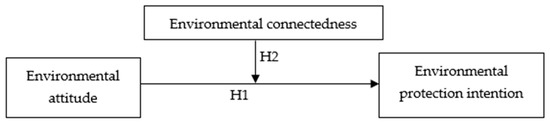
The research framework of this study is presented in Figure 1. The motivational factor, environmental attitude, is adapted from the Theory of Planned Behaviour. To better understand the influence of environmental connectedness, this study incorporates it as a moderator between environmental attitude and environmental protection intention. According to Mayer and Frantz (2004), environmental connectedness significantly affects how individuals form attitudes toward environmental protection. The greater one’s sense of connection to nature, the stronger the motivation to act in ways that preserve the environment. In summary, environmental connectedness is expected to strengthen the link between environmental attitude and environmental protection intention.
Figure 1.
Research Framework.
3.2. Operationalisation of Constructs
The operationalisation of constructs is the research procedure for defining and measuring the constructs of a specific study (Sethi and King 1991). Thus, Table 1 presents the definition of constructs and Table 2 shows the measurement of constructs used. The questionnaire used in this study is presented in Appendix A.
Table 1.
Definition of constructs.
Table 2.
Measurement of constructs used.
3.3. Data Collection Method
This study employed a non-probability sampling approach, specifically the convenience sampling method, to recruit participants from five polytechnics across Singapore. Given the geographical dispersion of the institutions, data were collected through an online self-administered questionnaire. This approach is consistent with prior research that utilised convenience sampling in online survey distribution to capture behavioural and attitudinal data efficiently (Yoder et al. 2024; Key et al. 2023; Sharma et al. 2022). Convenience sampling was deemed appropriate for this study due to its practicality, cost-effectiveness, and alignment with the study’s exploratory objectives (Golzar and Tajik 2022).
To ensure the relevance and authenticity of responses, the structured questionnaire was disseminated via email to the Student Administration Department of Singapore Polytechnic, Ngee Ann Polytechnic, Temasek Polytechnic, Nanyang Polytechnic, and Republic Polytechnic. The department then facilitated the distribution of the questionnaire to their respective student bodies. Data collection was conducted over two months, from March to May 2024, yielding a total of 709 usable responses. The subsequent section details the data analysis procedures conducted using Partial Least Squares Structural Equation Modeling (PLS-SEM).
The required minimum sample size was determined using the inverse square root method (Kock and Hadaya 2018), which estimates the smallest sample needed to detect the minimum path coefficient of interest at a given level of statistical power. For a minimum expected path coefficient of 0.13 at 80% power and a 5% significance level, the method indicates a minimum of approximately 247 responses. In this study, the usable responses are 709, which exceeds this threshold and also satisfies the ten-times rule, under which the sample should be at least ten times the largest number of structural paths directed at any single construct in the model (Hair et al. 2022).
4. Data Analysis
Table 3 shows the demographic analysis of the usable responses collected through the two-month collection period. Among the 709 usable responses, 378 (53%) respondents are female and 331 (47%) respondents are male. The majority of them are from the senior cohort (309, 44%) and aged between 18 and 19 years old (333, 47%), junior (251, 35%), and freshmen (149, 21%). They are collected through different polytechnics via the distribution channel. The usable responses across five different polytechnics are collected, Singapore Polytechnic 165 (23%), Ngee Ann Polytechnic 149 (21%), Temasek Polytechnic 132 (19%), Nanyang Polytechnic 139 (20%) and Republic Polytechnic 124 (17%). Respondents from the School of Business are the majority 247 (35%) and the least responses 31 (4%) from the School of Architecture and Built Environment are the least.
Table 3.
Demographic analysis.
4.1. Measurement Model Assessment
Firstly, a convergent validity analysis is performed, and the findings are tabulated in Table 4. All variables exhibited item loadings ranging from 0.685 to 0.917. The questionnaire items of EA3, EC4, and EC5 are deleted from the model because these items did not meet the required threshold values. After the removal, both the Average Variance Extracted (AVE) and Composite Reliability (CR) metrics exceeded the minimum thresholds of 0.5 and 0.7, respectively. Additionally, the Cronbach’s Alpha values for all variables ranged between 0.676 and 0.906, reflecting that the measurements are reliable.
Table 4.
Convergent validity assessment.
Furthermore, the findings of the discriminant validity assessment showed that all Heterotrait–Monotrait (HTMT) indices are below the critical threshold of 0.90 (Gold et al. 2001), confirming adequate discriminant validity.
The mean scores for Environmental Attitude, Environmental Connectedness, and Environmental Protection Intention were 4.4207, 3.8246, and 4.0206, respectively, while the corresponding standard deviations were 0.6723, 0.7184, and 0.7003. The relatively small standard deviations indicate limited variation in respondents’ responses across the three variables.
4.2. Structural Model Assessment
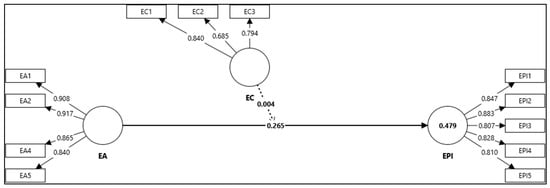
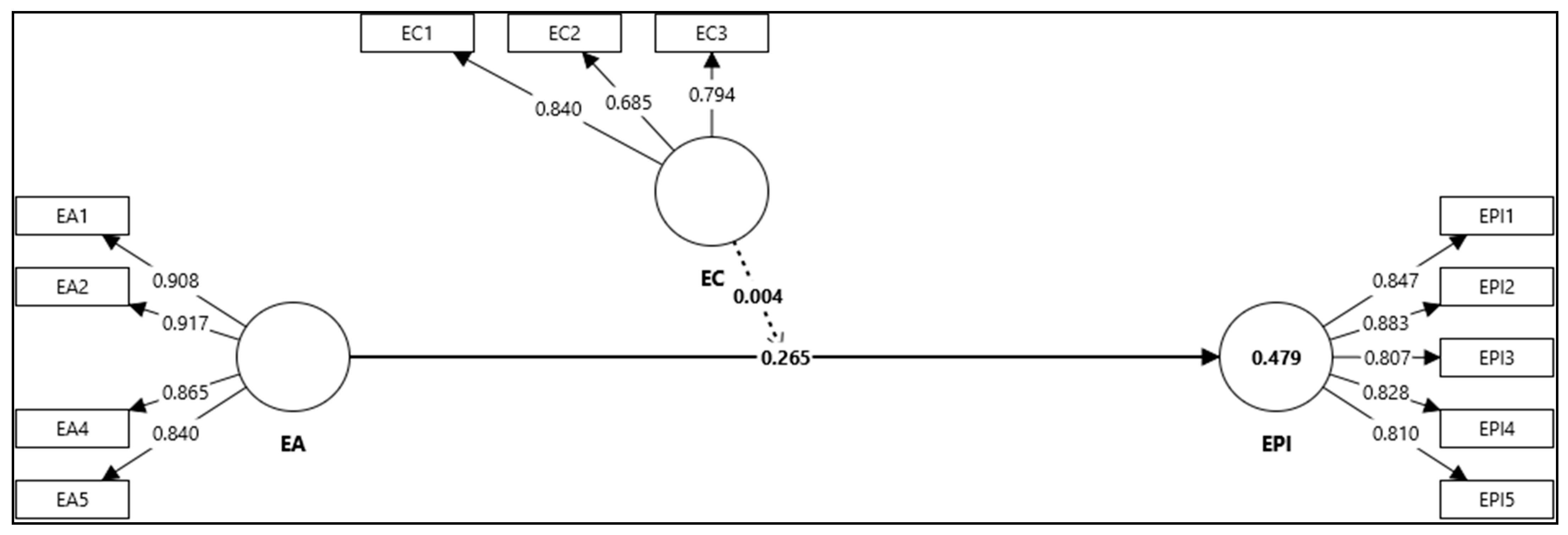
Subsequently, the measurement model is analysed using the SMART_PLS bootstrapping. The structural model with the loading values on the paths between both indicators and constructs is shown in Figure 2. The model has the R2 value of 0.479, indicating that 47.9% of the total variance in environmental protection intention is explained by environmental attitude.
Figure 2.
Model of the study.
Table 5 summarises the findings of hypothesis testing in this study. The findings revealed that H1 is supported at 5% significance level. However, H2 is not supported at 5% significance level.
Table 5.
Hypothesis testing result.
The findings confirm Hypothesis 1, which posits that environmental attitude positively influences environmental protection intention. This is consistent with the Theory of Planned Behaviour and aligns with prior research highlighting attitude as a strong predictor of environmental protection intention (Al Mamun et al. 2024; Ajzen 1991).
In contrast, Hypothesis 2, which suggested that environmental connectedness moderates this relationship, was not supported. Several plausible explanations may account for this outcome. First, the average level of environmental connectedness in urban youth populations may be inherently low due to limited exposure to natural environments. In Singapore’s highly urbanised context, where green spaces are structured and managed rather than wild or immersive, students may perceive nature as peripheral to their daily lives. This spatial disconnect may diminish the psychological salience of environmental connectedness as a moderating factor (Beery and Wolf-Watz 2014; Sparks et al. 2014). In urban environments, exposure to natural spaces may be substituted or complemented by digital nature experiences such as virtual reality parks, nature documentaries, and mobile nature apps. While these do not replace direct interaction, they may influence environmental identity formation and emotional engagement. However, research on their effectiveness remains sparse, especially in Southeast Asia.
These findings are particularly meaningful in the Singaporean context, where the government has long promoted a ‘Clean and Green’ image and incorporated sustainability values into national education. However, the limited impact of environmental connectedness suggests that policymakers and educators should be cautious about assuming a universal psychological response to environmental messaging. Emotional engagement with nature may require more immersive experiences, which are often constrained in dense urban settings. Comparatively, studies in less spatially constrained settings such as Malaysia (Salleh et al. 2025) and Indonesia (Jalaludin 2025) have reported stronger relationships between nature-related psychological factors and environmental protection intention or behaviour. This suggests that geographical context may influence the salience of environmental connectedness as a psychological driver. In contrast, within Singapore’s highly urbanised and structured environment, environmental attitude may serve as a more immediate predictor of environmental protection intention than emotional connectedness to nature.
Second, while environmental connectedness is often theorised to enhance intrinsic motivation for environmental action, its moderating power may require a more stable environmental identity, which typically develops over time. Given the relatively young age of respondents, it is possible that their cognitive attitudes towards environmental issues are not yet reinforced by deeply embedded emotional connections to nature.
Lastly, measurement issues may have played a role. The environmental connectedness construct demonstrated acceptable but comparatively modest internal consistency (CR = 0.709), and two items were removed to achieve threshold values, suggesting that this construct may warrant closer contextual interpretation in the present sample. Although environmental connectedness was operationalised using an established scale, the relatively modest composite reliability and the removal of two items suggest that the scale may not fully capture how urban youth experience connection with nature in highly structured city environments such as Singapore. In contexts where nature is more curated than immersive, conventional indicators of environmental connectedness may show weaker resonance, which could partly explain the non-significant moderating effect observed in this study.
5. Discussion
This study examined whether environmental attitude predicts environmental protection intention among Generation Z polytechnic students in Singapore, and whether environmental connectedness moderates that relationship. Drawing on the Theory of Planned Behaviour (Ajzen 1991) and applying partial least squares structural equation modelling to 709 valid responses across five polytechnics, the analysis produced two principal findings. Environmental attitude exerted a significant positive effect on environmental protection intention (β = 0.266, t = 5.986, p < 0.05), supporting H1, with the structural model accounting for 47.9% of the variance in intention (R2 = 0.479). In contrast, the interaction between environmental attitude and environmental connectedness was negligible and non-significant (β = 0.012, t = 0.130), and H2 was therefore not supported. The following subsections interpret these findings in relation to the Theory of Planned Behaviour and the wider environmental protection literature.
5.1. Environmental Attitude as a Predictor of Environmental Protection Intention
The significant positive effect of environmental attitude on environmental protection intention supports H1 and is consistent with the Theory of Planned Behaviour, in which a favourable evaluation of a behaviour constitutes a proximal antecedent of the intention to perform it (Ajzen 1991). Although the path coefficient was modest in magnitude (β = 0.266), it was estimated with precision (t = 5.986), and the substantial proportion of variance explained by the model (R2 = 0.479) indicates that environmental attitude was meaningfully associated with students’ stated willingness to act protectively. This finding is particularly notable because the attitude–intention link is not uniform across the sustainability literature: within the same domain, several studies report weak or non-significant associations (Chan et al. 2022; Satiene and Liobikiene 2026; Kautish et al. 2021). The clear positive effect observed here therefore extends the evaluative attitude–intention pathway to an under-researched population—Generation Z polytechnic students in a highly urbanised Southeast Asian city-state—and aligns with evidence that environmental attitudes shape environmental protection intention across diverse settings and behaviours (Al Mamun et al. 2024; Phang and Ilham 2023). A plausible explanation for the strength of this relationship is that sustained exposure to environmental education and national sustainability messaging, consistent with Singapore’s long-standing ‘Clean and Green’ agenda, may have consolidated environmental attitudes that translate readily into behavioural intention.
5.2. The Non-Significant Moderating Role of Environmental Connectedness
The most distinctive finding of this study is that environmental connectedness did not moderate the relationship between environmental attitude and environmental protection intention. The interaction term was negligible (β = 0.012) and statistically non-significant (t = 0.130), and H2 was therefore not supported. This outcome is striking given the prominence of nature connectedness in the environmental protection intention literature, where a stronger psychological bond with the natural world is widely held to foster intrinsic motivation for environmental action (Mayer and Frantz 2004; Schultz 2000; Sparks et al. 2014). Several explanations, a number of them rooted in the present context and data, may account for the absence of a moderating effect.
First, the densely urbanised setting of Singapore may limit the salience of nature connectedness as a psychological driver. Where green spaces are structured and managed rather than wild or immersive, students may experience nature as peripheral to daily life, weakening the affective ties that connectedness is theorised to activate (Beery and Wolf-Watz 2014; Sparks et al. 2014). Consistent with this interpretation, studies conducted in less spatially constrained settings, such as Malaysia (Salleh et al. 2025) and Indonesia (Jalaludin 2025), have reported stronger associations between nature-related psychological factors and environmental protection outcomes, suggesting that geographical context conditions the relevance of connectedness.
Second, the moderating influence of environmental connectedness may depend on a relatively stable environmental identity, which typically develops over time. Given the youth of the respondents, their cognitive environmental attitudes may not yet be reinforced by the deeply embedded emotional connection to nature that a moderating effect would require.
Third, and importantly, the null interaction does not imply that environmental connectedness is unimportant; it may instead operate as a direct antecedent of intention rather than as a conditional factor that strengthens the attitude–intention pathway. The substantial variance explained by the model (R2 = 0.479), relative to the modest direct effect of attitude alone (β = 0.266), is consistent with environmental connectedness contributing to intention directly rather than through interaction. Reporting and interpreting the direct path from environmental connectedness to intention would therefore help to clarify the construct’s role within this sample.
Fourth, measurement considerations may have contributed to the result. The environmental connectedness construct exhibited acceptable but comparatively modest internal consistency (CR = 0.709), and two of its items (EC4 and EC5) were removed during validation, narrowing the operational breadth of the construct. The retained items may not fully capture the forms of nature relatedness experienced by urban youth in highly structured city environments such as Singapore, which may have attenuated the construct’s capacity to condition the attitude–intention relationship.
5.3. Theoretical Contribution
Taken together, these findings offer two contributions to the literature on environmental protection behaviour. First, by confirming the attitude–intention pathway central to the Theory of Planned Behaviour within an under-researched Generation Z, polytechnic, and Southeast Asian context, the study reinforces the cross-contextual robustness of the evaluative attitude–intention link, while also adding to the smaller body of work in which this link is not uniform (Chan et al. 2022; Satiene and Liobikiene 2026). Second, by testing environmental connectedness as a moderator and finding no significant interaction, the study identifies a boundary condition for the construct: in a dense urban setting, connectedness does not appear to strengthen the translation of environmental attitudes into intention. This null result is informative rather than merely negative. It cautions against the assumption that nature connectedness uniformly amplifies attitude-driven intention, and points instead to the possibility that, in highly urbanised contexts, cognitive attitudes serve as a more immediate driver of environmental protection intention than affective ties to nature. Future research employing more heterogeneous samples, modelling environmental connectedness as a direct or antecedent variable, and incorporating measures attuned to urban forms of nature relatedness would help to clarify the pathways through which connectedness operates.
6. Implications
The two principal findings of this study are as follows: Hypothesis 1, where environmental attitude significantly predicts environmental protection intention, and Hypothesis 2, where environmental connectedness does not moderate that relationship. This has carried a clear and actionable message for stakeholders: efforts to strengthen the environmental protection intentions of Generation Z are likely to be most effective when they target the direct formation of favourable environmental attitudes, rather than relying on an affective connection to nature as a lever. The following subsections translate this into practical recommendations for policymakers and educators.
Practical and Policy Implications
Because environmental attitude operates as the proximal driver of intention in this sample, national and institutional initiatives should foreground the cultivation of favour-able evaluations of environmental protection behaviour. Singapore already possesses a substantial policy architecture within which such efforts can be situated. The Singapore Green Plan 2030, a whole-of-nation sustainability agenda jointly spearheaded by five ministries, including the Ministry of Education, provides the overarching framework for mobilising youth engagement (Government of Singapore 2021). The present findings offer an evidence-based rationale for directing the attitudinal, rather than the purely experiential, components of these programmes towards the polytechnic cohort.
At the national level, community-oriented funding mechanisms can be oriented towards attitude-shaping outcomes. The SG Eco Fund, a S$50 million grant scheme administered by the Ministry of Sustainability and the Environment to support ground-up environmental projects, enables students to co-create and lead sustainability initiatives that reinforce favourable environmental evaluations through direct participation (Ministry of Sustainability and the Environment [MSE] 2020). The Environment Fund for Institutes of Higher Learning, established under the Green Plan specifically to support youth-driven environmental projects within publicly funded institutes of higher learning, is particularly pertinent, as polytechnics fall squarely within this category and could draw on it to embed attitude-building projects in campus life (Government of Singapore 2021).
At the institutional level, the Ministry of Education’s Eco Stewardship Programme offers a ready vehicle. The programme operationalises sustainability education through the “4Cs”—Curriculum, Campus, Culture and Community—and currently spans the primary to pre-university levels (Ministry of Education [MOE] 2021). Extending its tiered structure into the polytechnic tier would allow attitude-focused content to be delivered through the curriculum, normalised through visible campus practices and culture, and reinforced through community service-learning, with reflective assessment embedded to bridge conceptual understanding and applied behaviour. Consistent with this attitudinal emphasis, gamified learning may further strengthen engagement, as prior work reports a positive association between gamification and attitudinal and behavioural outcomes (Yen et al. 2023; Venturi et al. 2025); digital and game-based platforms could therefore complement curricular efforts to shape environmental attitudes.
Taken together, these recommendations imply a reordering of priorities: in a dense urban setting such as Singapore, interventions that build and consolidate environmental attitudes are likely to yield greater returns for environmental protection intention than those that rely primarily on fostering an affective connection to nature.
7. Conclusions
This study examined whether environmental attitude predicts environmental protection intention among Generation Z polytechnic students in Singapore, and whether environmental connectedness moderates that relationship. Applying partial least squares structural equation modelling to 709 valid responses, it found that environmental attitude significantly and positively predicted environmental protection intention, supporting H1, whereas environmental connectedness did not moderate this relationship, and H2 was therefore not supported (Ajzen 1991; Al Mamun et al. 2024).
The study offers two contributions. Theoretically, it confirms the evaluative attitude–intention pathway of the Theory of Planned Behaviour within an under-researched population, Generation Z who are polytechnic students in a highly urbanised Southeast Asian city-state, Singapore. The findings showed that there was no moderating effect, which means the affective ties to nature do not appear to strengthen the translation of attitudes into intention, and connectedness may instead operate by shaping attitudes directly (Drosinou et al. 2025). Practically, the findings indicate that interventions which build environmental attitudes are likely to be more effective than those relying on emotional connection to nature, consistent with evidence that education programmes can shift environmental attitudes and behaviours in the Singaporean context (Wi and Chang 2019).
Several limitations qualify these conclusions. The cross-sectional design precludes causal inference; the use of self-reported measures may introduce social-desirability bias; the convenience sample limits generalisability beyond the participating polytechnics; and the environmental connectedness scale, although validated, may not fully capture the forms of nature relatedness experienced in spatially structured cities such as Singapore (Beery and Wolf-Watz 2014).
Future research could address these limitations and broaden the model. Longitudinal and mixed-method designs would help to establish directionality and capture the experiential dimensions of environmental engagement, while multi-group analysis across demographic subgroups such as gender, age, discipline, and institution. It may reveal heterogeneity masked in aggregate results (Jaber et al. 2025c). Incorporating the remaining Theory of Planned Behaviour constructs, namely subjective norms and perceived behavioural control, together with additional psychological factors such as empathy and eco-literacy (Sawitri et al. 2015), would yield a more complete account of behavioural intention. Examining digital nature experiences, including virtual reality and mobile applications, may further clarify whether mediated contact with nature can complement direct exposure in shaping environmental protection intention among urban youth (Spangenberger et al. 2024; Brambilla et al. 2024).
As Singapore advances its Green Plan 2030 agenda, understanding how favourable environmental attitudes are formed and how they translate into action among the next generation will remain central to sustaining environmental protection engagement.
Author Contributions
Conceptualization, K.H.C., K.B.L., S.K.T., T.H.N., T.W.L. and V.B.S.L.; methodology, K.H.C., K.B.L., S.K.T., T.H.N. and V.B.S.L.; software, K.H.C., K.B.L., S.K.T., T.H.N. and V.B.S.L.; validation, K.H.C., K.B.L., S.K.T., T.H.N., T.W.L. and V.B.S.L.; formal analysis, K.H.C., K.B.L., S.K.T., T.H.N., T.W.L. and V.B.S.L.; investigation, K.H.C., K.B.L., S.K.T., T.H.N., T.W.L. and V.B.S.L.; resources, K.H.C., T.W.L. and V.B.S.L.; data curation, K.H.C., K.B.L., S.K.T., T.H.N., T.W.L. and V.B.S.L.; writing—original draft preparation, K.H.C., S.K.T., T.H.N., T.W.L. and V.B.S.L.; writing—review and editing, T.W.L.; supervision, T.H.N. and T.W.L.; project administration, K.H.C., S.K.T. and T.W.L.; funding acquisition, T.W.L. All authors have read and agreed to the published version of the manuscript.
Funding
This research and its Article Processing Charge (APC) were funded by Multimedia University (MMU) through the Research Management Centre (RMC).
Institutional Review Board Statement
The study was conducted in accordance with the Declaration of Helsinki, and approved by the Research Ethics Committee, Technology Transfer Office, Multimedia University, Malaysia (protocol code EA0382021, approved on 8 July 2021).
Informed Consent Statement
Informed consent was obtained from all subjects involved in the study.
Data Availability Statement
The original contributions presented in this study are included in the article. Further inquiries can be directed to the corresponding author.
Acknowledgments
The authors gratefully acknowledge the support of the AIX Lab Stats Lab, a joint initiative of the Malaysian Communications and Multimedia Commission (MCMC) and Multimedia University (MMU), Malaysia. During the preparation of this manuscript/study, the author(s) used SmartPLS 3, for data analysis. The authors have reviewed and edited the output and take full responsibility for the content of this publication.
Conflicts of Interest
The authors declare no conflicts of interest.
Appendix A. Questionnaire
The questionnaire was designed with a screening question to restrict participation to polytechnic students and was organised into two parts: Part I measured the three constructs, namely, Environmental Attitude, Environmental Connectedness, and Environmental Protection Intention on a five-level Likert scale, while Part II collected demographic data of the respondents.
- Part I: Measurement of Constructs
- 1.
- Environmental Attitude (EA)EA1. Practicing environmental friendly activities to protect the environment is good.EA2. Practicing environmental friendly activities to protect the environment is beneficial.EA3. Practicing environmental friendly activities to protect the environment is satisfactory.EA4. Practicing environmental friendly activities to protect the environment is valuable.EA5. Practicing environmental friendly activities to protect the environment is a wise move.
- 2.
- Environmental Connectedness (EC)EC1. I often feel a sense of oneness with the environmentEC2. I recognize and appreciate the intelligence of other living organismsEC3. I have a deep understanding of how my actions affect the environment.EC4. When I think of my place on Earth, I consider myself to be a top member of a hierarchy that exists in the environment.EC5. I feel that all inhabitants of Earth, human, and nonhuman, share a common ‘life force’.
- 3.
- Environmental Protection Intention (EPI)EPI1. I intend to practice environmental friendly activities to protect the environment.EPI2. I will try to practice environmental friendly activities to protect the environment.EPI3. I will plan to practice environmental friendly activities to protect the environment.EPI4. I will to practice environmental friendly activities to protect the environment if given a chance.EPI5. I am willing to participate in environmental friendly activities in the future to protect the environment.
- Part II: Screening and Demographics Questions
- Screening question: I am a polytechnic student in Singapore (Yes/No)
- Gender (Male/Female)
- Age (16–17/18–19/20–21/22 and above)
- Cohort. In my present study, which cohort do I belong to? (Freshman/Junior/Senior)
- Polytechnic: I am a student from: [Nanyang Polytechnic (NYP)/Ngee Ann Polytechnic (NP)/Republic Polytechnic (RP)/Singapore Polytechnic (SP)/Temasek Polytechnic (TP)]
- School. I am from: School of Business/School of Engineering/School of Information Technology/Other (free-text)
References
- Ajzen, Icek. 1991. The theory of planned behavior. Organizational Behavior and Human Decision Processes 50: 179–211. [Google Scholar] [CrossRef] [Scilit]
- Ajzen, Icek, and Martin Fishbein. 2000. Attitudes and the attitude-behavior relation: Reasoned and automatic processes. European Review of Social Psychology 11: 1–33. [Google Scholar] [CrossRef] [Scilit]
- Al Mamun, Abdullah, Yue Ma, Mohammad Nurul Hassan Reza, Jawaria Ahmad, Hussain Wan Mohd Hirwani Wan, and Lili Zhai. 2024. Predicting attitude and intention to reduce food waste using the environmental values-beliefs-norms model and the theory of planned behavior. Food Quality and Preference 120: 105247. [Google Scholar] [CrossRef] [Scilit]
- Balunde, Audra, Goda Perlaviciute, and Linda Steg. 2019. The relationship between people’s environmental considerations and pro-environmental behavior in Lithuania. Frontiers in Psychology 10: 2319. [Google Scholar] [CrossRef] [Scilit] [PubMed]
- Beery, Thomas H., and Daniel Wolf-Watz. 2014. Nature to place: Rethinking the environmental connectedness perspective. Journal of Environmental Psychology 40: 198–205. [Google Scholar] [CrossRef] [Scilit]
- Bellotti, Martina, Mirko Duradoni, Maria Fiorenza, and Andrea Guazzini. 2025. Between pro-environmental identity and attitudes: A PRISMA systematic review of the relationship between connectedness to nature and pro-environmental attitudes for sustainability. Sustainability 17: 2140. [Google Scholar] [CrossRef] [Scilit]
- Bourdeau, Ph. 2004. The man-nature relationship and environmental ethics. Journal of Environmental Radioactivity 72: 9–15. [Google Scholar] [CrossRef] [Scilit] [PubMed]
- Brambilla, Elena, Evi Petersen, Karen Stendal, Vibeke Sundling, Tadhg E MacIntyre, and Giovanna Calogiuri. 2024. Effects of immersive virtual nature on nature connectedness: A systematic review and meta-analysis. Digital Health 2022: 20552076221120324. [Google Scholar] [CrossRef] [Scilit] [PubMed]
- Chan, Kar Hoong, Lee Lee Chong, and Tuan Hock Ng. 2022. Integrating extended theory of planned behaviour and norm activation model to examine the effects of environmental practices among Malaysian companies. Journal of Entrepreneurship in Emerging Economies 14: 851–73. [Google Scholar] [CrossRef] [Scilit]
- Concari, Alessandro, Gerjo Kok, and Pim Martens. 2020. A systematic literature review of concepts and factors related to pro-environmental consumer behaviour in relation to waste management through an interdisciplinary approach. Sustainability 12: 4452. [Google Scholar] [CrossRef] [Scilit]
- Drescher, Michael, James Hannay, Robert D. Feick, and Wayne Caldwell. 2024. Social psychological factors drive farmers’ adoption of environmental best management practices. Journal of Environmental Management 350: 119491. [Google Scholar] [CrossRef] [Scilit] [PubMed]
- Drosinou, Marianna, Jussi Palomaki, Markus Jokela, and Micheal Laakasuo. 2025. Everything is connected: Reminders of environmental and social connectedness strengthen environmental attitudes. Journal of Environmental Psychology 102: 102549. [Google Scholar] [CrossRef] [Scilit]
- Escario, Jose-Julian, Carla Rodriguez-Sanchez, and Luis V. Casalo. 2020. The influence of environmental attitudes and perceived effectiveness on recycling, reducing, and reusing packaging materials in Spain. Waste Management 113: 251–60. [Google Scholar] [CrossRef] [Scilit] [PubMed]
- Fishbein, Martin, and Icek Ajzen. 2010. Predicting and Changing Behavior: The Reasoned Action Approach. New York: Psychology Press. [Google Scholar] [CrossRef] [Scilit]
- Flint, Courtney G., Iris Kunze, Andreas Muhar, Yuki Yoshida, and Marianne Penker. 2013. Exploring empirical typologies of human-nature relationships and linkages to the ecosystem services concept. Landscape and Urban Planning 120: 208–17. [Google Scholar] [CrossRef] [Scilit]
- Francis, Tracy, and Fernanda Hoefel. 2018. True Gen’: Generation Z and Its Implications for Companies. Tokyo: McKinsey & Company. Available online: https://www.mckinsey.com/industries/consumer-packaged-goods/our-insights/true-gen-generation-z-and-its-implications-for-companies (accessed on 13 April 2026).
- Gkargkavouzi, Anastasia, George Halkos, and Steriani Matsiori. 2019. Environmental behavior in a private-Sphere context: Integrating theories of planned behavior and value belief norm, self-identity and habit. Resources, Conservation and Recycling 148: 145–56. [Google Scholar] [CrossRef] [Scilit]
- Gold, Andrew H., Arvind Malhotra, and Albert H. Segars. 2001. Knowledge management: An organizational capabilities perspective. Journal of Management Information Systems 18: 185–214. [Google Scholar] [CrossRef] [Scilit]
- Golzar, Jawad, and Omid Tajik. 2022. Convenience sampling. International Journal of Education and Language Studies 1: 72–77. Available online: https://www.scribd.com/document/733455131/IJELS-Volume-1-Issue-2-Pages-72-77 (accessed on 13 January 2026). [CrossRef] [Scilit]
- Government of Singapore. 2021. Singapore Green Plan 2030. Available online: https://www.greenplan.gov.sg/ (accessed on 26 June 2026).
- Grilli, Gianluca, and John Curtis. 2021. Encouraging pro-environmental behaviours: A review of methods and approaches. Renewable and Sustainable Energy Reviews 135: 110039. [Google Scholar] [CrossRef] [Scilit]
- Hair, Joseph F., G. Tomas M. Hult, Christian M. Ringle, and Marko Sarstedt. 2022. A Primer on Partial Least Squares Structural Equation Modeling (PLS-SEM), 3rd ed. Thousand Oaks: Sage. [Google Scholar]
- Hair, Joseph F., G. Tomas M. Hult, Christian M. Ringle, Marko Sarstedt, Nicholas P. Danks, and Soumya Ray. 2021. Partial Least Squares Structural Equation Modeling (PLS-SEM) Using R: A Workbook. Cham: Springer. [Google Scholar] [CrossRef] [Scilit]
- IPCC. 2021. Summary for policymakers. In Climate Change 2021: The Physical Science Basis. Contribution of Working Group I to the Sixth Assessment Report of the Intergovernmental Panel on Climate Change. Edited by Valerie Masson-Delmotte, Panmao Zhai, Anna Pirani, Sarah L. Connors, Clotilde Pean, Yang Chen, Leah Goldfarb, Melissa I. Gomis, J. B. Robin Matthews, Sophie Berger and et al. in press. [Google Scholar]
- Jaber, Mohammad M., Abrar Ghaith, and Mohammad Kashour. 2025a. Exploring Jordanian households’ intentions to adopt solar energy systems using the theory of planned behavior. Discover Sustainability 6: 332. [Google Scholar] [CrossRef] [Scilit]
- Jaber, Mohammad M., Ana Stojilovska, and Hyerim Yoon. 2025b. Assessing the determinants of energy poverty in Jordan based on a novel composite index. Urban Science 9: 263. [Google Scholar] [CrossRef] [Scilit]
- Jaber, Mohammad M., Dhia Qasim, and Abrar Ghaith. 2025c. What drives sustainable energy use? A case study from Jordanian households. Environments 12: 452. [Google Scholar] [CrossRef] [Scilit]
- Jalaludin, Jalaludin. 2025. Pro-environmental behavior among university students: Integrating norm activation and planned behavior models. Ecocycles 11: 94–111. [Google Scholar] [CrossRef] [Scilit]
- Kautish, Pradeep, Rajesh Sharma, Sachin Kumar Mangla, Fauzia Jabeen, and Usama Awan. 2021. Understanding choice behavior towards plastic consumption: An emerging market investigation. Resources, Conservation and Recycling 174: 105828. [Google Scholar] [CrossRef] [Scilit]
- Key, Katherine, Alexandra Wollum, Charon Asetoyer, Maricela Cervantes, Alyssa Lindsey, Raquel Z. Rivera, Janette Robinson Flint, Carmela Zuniga, Jessica Sanchez, and Sarah E. Baum. 2023. Challenges accessing contraceptive care and interest in over-the-counter oral contraceptive pill use among black, indigenous, and people of color: An online cross-sectional survey. Contraception 120: 109950. [Google Scholar] [CrossRef] [Scilit] [PubMed]
- Kock, Ned, and Pierre Hadaya. 2018. Minimum sample size estimation in PLS-SEM: The inverse square root and gamma-exponential methods. Information Systems Journal 28: 227–61. [Google Scholar] [CrossRef] [Scilit]
- Kotyza, Pavel, Inna Cabelkova, Barttomiej Pieranski, Karel Malec, Barbara Borusiak, Lubos Smutka, Sandor Nagy, Aleksandra Gawel, David Bernardo Lopez Lluch, Krisztian Kis, and et al. 2024. The predictive power of environmental concern, perceived behavioral control and social norms in shaping pro-environmental intentions: A multicountry study. Frontiers in Ecology and Evolution 12: 1289139. [Google Scholar] [CrossRef] [Scilit]
- Lee, Seojin Stacey, Yaeri Kim, and Taewoo Roh. 2023. Pro-environmental behavior on electric vehicle use intention: Integrating value-belief-norm theory and theory of planned behavior. Journal of Cleaner Production 418: 138211. [Google Scholar] [CrossRef] [Scilit]
- Liu, Jianjiao, and Raymond James Green. 2024. Children’s pro-environmental behaviour: A systematic review of the literature. Resources, Conservation and Recycling 205: 107524. [Google Scholar] [CrossRef] [Scilit]
- Mayer, F.Stephan, and Cynthia McPherson Frantz. 2004. The connectedness to nature scale: A measure of individuals’ feeling in community with nature. Journal of Environmental Psychology 24: 503–15. [Google Scholar] [CrossRef] [Scilit]
- Minelgaite, Audrone, and Genovaite Liobikiene. 2019. Waste problem in European Union and its influence on waste management behaviours. Science of the Total Environment 667: 86–93. [Google Scholar] [CrossRef] [Scilit] [PubMed]
- Ministry of Education [MOE]. 2021. Learn for Life—Equipping Ourselves for a Changing World: Nurturing Stewards of the Environment. Available online: https://www.moe.gov.sg/news/press-releases/20210304-learn-for-life-equipping-ourselves-for-a-changing-world-nurturing-stewards-of-the-environment (accessed on 26 June 2026).
- Ministry of Sustainability and the Environment [MSE]. 2020. SG Eco Fund. Available online: https://www.mse.gov.sg/take-action/sgecofund/ (accessed on 26 June 2026).
- Ministry of Sustainability and the Environment [MSE]. 2022. Singapore’s Climate Action Plan: Securing Our Future. Available online: https://www.mse.gov.sg/take-action/sgecofund/about/ (accessed on 28 April 2025).
- Phang, Grace, and Zul Ilham. 2023. Theory of planned behavior to understand pro-environmental behavior among Universiti Malaya students. AIMS Environmental Science 10: 691–708. [Google Scholar] [CrossRef] [Scilit]
- Preiser, Rika, Laura M. Pereira, and Reinette Biggs. 2017. Navigating alternative framings of human-environment interactions: Variations on the theme of ‘Finding Nemo’. Anthropocene 20: 83–87. [Google Scholar] [CrossRef] [Scilit]
- Rodrigues, Maria, Joao F. Proenca, and Rita Macedo. 2023. Determinants of the purchase of secondhand products: An approach by the theory of planned behaviour. Sustainability 15: 10912. [Google Scholar] [CrossRef] [Scilit]
- Salleh, Rohani, Shahrina Md Nordin, Wajiha Moughal, Haider Ali Abbasi, Poon Wai Ching, and Nurul Asyiqin Binti Adnan. 2025. The role of social environmental networks in influencing environmental knowledge and environmental awareness towards education for sustainable development in Malaysia and Japan. Higher Education Quarterly 79: e70009. [Google Scholar] [CrossRef] [Scilit]
- Samus, Andreas, Claire Freeman, Katharine J. M. Dickinson, and Yolanda van Heezik. 2023. An examination of the factors influencing engagement in gardening practices that support biodiversity using the theory of planned behavior. Biological Conservation 286: 110252. [Google Scholar] [CrossRef] [Scilit]
- Satiene, Vilija, and Genovaite Liobikiene. 2026. The impact of life satisfaction, environmental attitudes, attitudes towards climate change, clothing, and plastic reduction tools on reduction behaviour in the European Union countries. Journal of Cleaner Production 561: 148439. [Google Scholar] [CrossRef] [Scilit]
- Sawitri, Dian R., H. Hadiyanto, and Sudharto P. Hadi. 2015. Pro-environmental behavior from a social-cognitive theory perspective. Procedia Environmental Sciences 23: 27–33. [Google Scholar] [CrossRef] [Scilit]
- Schultz, P. Wesley. 2000. Empathizing with nature: The effects of perspective taking on concern for environmental issues. Journal of Social Issues 56: 391–406. [Google Scholar] [CrossRef] [Scilit]
- Sethi, Vijay, and William R. King. 1991. Construct measurement in information systems research: An illustration in strategic systems. Decision Sciences 22: 455–72. [Google Scholar] [CrossRef] [Scilit]
- Shanmugavel, Nagarajan, and Janarthanan Balakrishnan. 2023. Influence of pro-environmental behaviour towards behavioural intention of electric vehicles. Technological Forecasting and Social Change 187: 122206. [Google Scholar] [CrossRef] [Scilit]
- Sharma, Sachin Kumar, Shirley Telles, Kumar Gandharva, and Acharya Balkrishna. 2022. Yoga instructors’ reported benefits and disadvantages associated with functioning online: A convenience sampling survey. Complementary Therapies in Clinical Practice 46: 101509. [Google Scholar] [CrossRef] [Scilit] [PubMed]
- Shaw, Timothy. 2023. Commentary: The Urgency of Addressing Rising Sea Levels in Singapore. Available online: https://www.channelnewsasia.com/commentary/singapore-how-high-sea-level-rise-melting-ice-sheet-future-past-3816866 (accessed on 28 June 2024).
- Spangenberger, Pia, Sarah-Christin Freytag, and Sonja M. Geiger. 2024. Embodying nature in immersive virtual reality: Are multisensory stimuli vital to affect nature connectedness and pro-environmental behaviour? Computers & Education 212: 104964. [Google Scholar] [CrossRef] [Scilit]
- Sparks, Paul, Joe Hinds, Susan Curnock, and Louisa Pavey. 2014. Connectedness and its consequences: A study of relationships with the natural environment. Journal of Applied Social Psychology 44: 166–74. [Google Scholar] [CrossRef] [Scilit]
- United Nations. 2023. The-Sustainable-Development-Goals-Report-2023. New York: United Nations. [Google Scholar]
- United Nations. 2024. Goal 13: Take Urgent Action to Combat Climate Change and Its Impacts. Available online: https://sdgs.un.org/goals/goal13 (accessed on 27 June 2024).
- Venturi, Silvia, Katrin Zulauf, Roberta Cuel, and Ralf Wagner. 2025. Trash to treasure: Gamification and informed recycling behavior. Resources, Conservation & Recycling 215: 108108. [Google Scholar] [CrossRef] [Scilit]
- Wi, Andy, and Chew-Hung Chang. 2019. Promoting pro-environmental behaviour in a community in Singapore—From raising awareness to behavioural change. Environmental Education Research 25: 1019–37. [Google Scholar] [CrossRef] [Scilit]
- Yen, Barbara T. H., Corinne Mulley, and Gerardo Meza. 2023. Exploring the attitudes and perceptions influencing user participation in gamification schemes for TDM. Research in Transportation Economics 99: 101300. [Google Scholar] [CrossRef] [Scilit]
- Yoder, Allison D., Gabriela V. Proano, Kathryn Kelley, Yanyan Wu, and Jinan Banna. 2024. Perspectives of food as medicine concept: Report of an online convenience sample survey of registered dietitian nutritionists. Journal of the Academy of Nutrition and Dietetics 124: 257–67. [Google Scholar] [CrossRef] [Scilit] [PubMed]
- Zhao, Ze-Ying, Wen-Bo Li, Peng-Yang Wang, Hong-Yan Tao, Rui Zhou, Jin-Ying Cui, Jian Zhang, Tao Tian, Xu-Zhe Zhao, Yi-Bo Wang, and et al. 2023. Farmers’ participation into the recovery of waste agricultural plastic film: An application of the theory of planned behavior. Waste Management 169: 253–66. [Google Scholar] [CrossRef] [Scilit] [PubMed]

Disclaimer/Publisher’s Note: The statements, opinions and data contained in all publications are solely those of the individual author(s) and contributor(s) and not of MDPI and/or the editor(s). MDPI and/or the editor(s) disclaim responsibility for any injury to people or property resulting from any ideas, methods, instructions or products referred to in the content. |
© 2026 by the authors. Licensee MDPI, Basel, Switzerland. This article is an open access article distributed under the terms and conditions of the Creative Commons Attribution (CC BY) license.