1. Introduction
In forced displacement contexts, refugee education is often governed through hybrid arrangements that blend national education systems with humanitarian financing and bordering regimes that aim to control refugee movements and livelihoods (
Shah 2026). Refugee education provision further relies heavily on fragmented teacher compensation systems spanning government payrolls, humanitarian incentives, and household contributions (
Homonchuk and Lacroix 2025). While current scholarship on refugee education focuses heavily on student access, enrollment, learning, and well-being outcomes, far less attention has been paid to the governance of refugee education through teachers’ work and compensation and its impact on teachers’ lives and livelihoods.
While the challenges wrought by different payment regimes affect teachers across diverse geographical regions, they are acutely felt in Sub-Saharan African contexts, where over 26% of the world’s refugee population resides (
United Nations 2025), and the intersection of migration and education governance hampers the equitable management and support of different profiles of teachers. Many African countries are long-standing hosts of refugees, albeit under varying structural arrangements. In countries like Kenya and Malawi, refugees are geographically segregated in camps, but children have access to host country curricula, language of instruction, and school-leaving exams. The majority of teachers in these settings hail from the refugee community, and they are paid by the United Nations (UN) and non-governmental organizations (NGOs). In Uganda, refugees have a little more freedom of movement, but still reside primarily in refugee settlements allocated across the country. Most teachers working in the settlements are Ugandan, though some refugees who acquired Ugandan teaching qualifications during previous displacements teach in the schools. Both profiles of teachers are paid by the UN and NGOs. In South Sudan, a significant portion of the teaching corps exists outside formal government payrolls, and salary ranges vary widely. This article addresses these complexities by drawing on and comparing qualitative and quantitative data from three distinct, yet interrelated studies on teacher quality, management, and compensation. Specifically, our study asks: How do education governance structures, and specifically the administration of teacher compensation, in refugee education settings affect teachers’ lives and livelihoods?
The central aim of this work is to examine how teacher compensation operates as a primary mechanism through which authority is exercised and boundaries of inclusion and exclusion are drawn across humanitarian, donor, and national structures. In the following section, we conceptualize refugee education governance and how structural management functions as an overarching framework of policying and policing. We then explore how incentive-based pay schemes operate within humanitarian architectures, how administrative policies and practices structure compensation arrangements, and how mechanisms of control and coordination emerge across global and national actors. Next, we analyze how these multi-scalar governance processes interact to produce fragmented compensation systems and varying forms of precarity for refugee teachers. Finally, the discussion section situates these dynamics within broader debates on labor governance, belonging, and professional recognition in forced displacement contexts.
2. Conceptualizing Refugee Education Governance
Refugee education operates through hybrid governance arrangements in which national ministries, humanitarian agencies, donors, and migration frameworks jointly shape how schooling is delivered. Contemporary education scholarship conceptualizes governance as a distributed and multi-actor process rather than solely the formal exercise of authority by national ministries of education. In the shift away from state-centric ideas of policy control, scholars highlight the multi-scalar and networked nature of authority in education systems, demonstrating the interconnectedness across global, national, and local arrangements involving states, multilateral organizations, donors, NGOs, and private actors (
Novelli et al. 2016;
Steiner-Khamsi et al. 2024).
Migration governance scholarship similarly focuses on how authority is distributed across international organizations, host states, donors, and administrative institutions (
Betts and Kainz 2017;
Gordon 2021;
Lori and Schilde 2021). It further acknowledges the bifurcated and fragmented nature of migration governance vs. refugee governance, particularly how migration policy decisions have historically had an economic bent while refugee governance has been conceptualized more through a humanitarian or security lens, leading to differences in rights and protections across the two populations (
Betts and Kainz 2017). Refugee governance is therefore mediated through overlapping legal, bureaucratic, and humanitarian systems that shape access to employment, mobility, and rights (
Betts and Kainz 2017;
Gordon 2021;
Lori and Schilde 2021;
Salehyan and Savun 2024).
Across these perspectives, a common concern is how different governance arrangements allocate responsibility and coordinate action under conditions of complexity and uncertainty, with important implications for accountability, stability, and adaptive capacity (
Duit and Galaz 2008). Both see authority operating through networked arrangements rather than centralized control, while some distinguish between governance as political control, governance as technical capacity to deliver services, and governance beyond government, where multiple actors coordinate across scales to structure provision (
Novelli et al. 2016).
Collectively, this literature establishes two core insights: governance operates through multi-scalar and distributed institutional arrangements, and it is enacted through material practices, particularly the allocation of resources. However, these analyses overwhelmingly assume that teachers are fully incorporated within national systems. They rarely consider how governance operates when teachers themselves occupy legally ambiguous or politically contingent positions within these systems.
This oversight produces what can be understood as a responsibility gap. Multiple actors influence refugee education provision; however, no single actor assumes full responsibility for employment conditions, professional recognition, or long-term workforce integration. While migration governance literature analyzes work authorization and refugee labor market inclusion (
Gordon 2021;
Salehyan and Savun 2024), it rarely intersects with education governance scholarship to examine how these institutional arrangements shape teacher labor within education systems. For this study, we combine these approaches to examine how governance arrangements shape refugee teachers’ employment conditions, with a specific focus on compensation.
Teacher Governance and Compensation in Displacement and Refugee Settings
Turning to teacher governance,
Robertson (
2012,
2016) demonstrates that authority over teachers’ work has shifted from nationally framed development agendas toward transnational regimes of accountability (mirroring the shift mentioned above in education and migration scholarship). At the same time, governance is enacted through everyday administrative practices.
Brandt’s (
2019) study of education governance in the Democratic Republic of Congo argues that “real governance” lies in the logistical techniques used by administrators, including control over salary distribution as one example.
Between transnational regimes and everyday administrative practices, refugee teachers working in displacement settings occupy a structurally precarious position, governed by overlapping and often contradictory humanitarian, national, and migration arrangements. This “bordering regime” regulates inclusion not only at territorial borders but across social and institutional domains, incorporating refugees into labor markets in ways that enable participation while systematically limiting rights and protections. As
Shah (
2026) notes, these regimes subject social worlds to “rules-based dispossession,” forcing refugees into economic arrangements that cast them to the margins.
In refugee education, these dynamics are concretely enacted through the organization of teacher compensation. While refugee teachers are often included as essential education workers, they are frequently excluded from formal teacher status and stable salaries. These employment arrangements—characterized by irregular, time-limited “incentive” payments (
West and Ring 2015;
Richardson et al. 2018)—are not incidental. They are shaped simultaneously by refugee policies regulating work authorization, national authorities governing certification, and humanitarian funding cycles.
Consequently, compensation arrangements function as institutional mechanisms of bordering. Even when qualified in their countries of origin, refugee teachers encounter bureaucratic obstacles to credential recognition, often forcing them into non-formal education programs or roles as classroom assistants rather than fully recognized professionals. In this sense, pay structures and incentive schemes serve as the visible site where overlapping governance regimes converge, translating dispersed authority into material outcomes that define whether an educator is recognized as a professional or a temporary volunteer.
Building on this literature, this study conceptualizes governance as multi-scalar, distributed, and yet boundary-making, which is also enacted through material practices such as teacher compensation. In refugee education, governance operates through the rules, funding arrangements, and administrative practices that allocate responsibility for teachers’ work while defining who is recognized as a teacher and under what conditions. The central argument is that compensation regimes function as governance instruments, translating these arrangements into differentiated forms of professional recognition, protection, and value (
Dryden-Peterson 2016). By centering compensation, this study bridges education governance and refugee governance scholarship to explain how hierarchies within refugee teacher employment are produced and maintained.
We argue that this structural management functions as an overarching framework of policying and policing—operationalized on a daily basis through the dual mechanisms of symbolic control and performative coordination—which ultimately illustrates what
Foucault (
2007) conceptualized as the administrative regulation of a population. By policying, we mean the administrative, semantic, and bureaucratic mechanisms (
Turan 2026) utilized to manage education budgets, bypass national labor laws, and govern the conduct of displaced populations. Conversely, we employ policing through a lens of humanitarian enforcement that relies on boundary-making, professional gatekeeping, and spatial containment (
Brankamp 2019). However, we do not view these policying and policing practices as part of a sinister plot among aid actors. Rather, we conceptualize policying and policing as structural deficits and systemic outcomes of a flawed global humanitarian architecture where well-meaning actors navigate severe funding precarity and host-state regulations (
Hyndman 2000).
To further elaborate on how hybrid governance frameworks translate distributed authority into material inequities, this study adapts and extends two key concepts:
Robertson’s (
2012) conceptualization of symbolic control and
Carvalho and Haybano’s (
2023) notion of performative coordination, which is further informed by
Dhingra (
2022).
Robertson (
2012), drawing on
Bernstein (
1990,
2000), conceptualizes the “field of symbolic control” (hereafter symbolic control) as the domain of agencies and agents who dominated discursive codes to shape social relations and professional classifications. While Robertson traces how global actors enacted control over how to frame “the good teacher,” we extend this concept to the domain of refugee labor. We define symbolic control in refugee education governance as the administrative and semantic classification used by states and humanitarian actors to dictate who is recognized as a professional or not. By controlling the terminology of pay (e.g., “salaries”, “incentives”), governing actors use symbolic control to establish boundaries of belonging that normalize economic precarity. While
Carvalho and Haybano (
2023) and
Dhingra (
2022) define performative coordination primarily as bureaucratic compliance meant to project the appearance of alignment to satisfy donors, we adapt this term to capture its material consequences on labor. We conceptualize performative coordination as the collaborative processes through which myriad actors (e.g., UN agencies, national education authorities, and NGOs) engage in visible alignment, standard-setting, and pay harmonization efforts. While it keeps schools running, it obscures institutional responsibility for the labor rights and protections of refugee teachers.
3. Methodology
The multi-study design used for this article draws on qualitative and quantitative data from three distinct, yet interrelated studies on teacher management and workforce sustainability. We derive insights from these studies to expand the scope of our analysis on how teacher management and workforce sustainability affect refugee teachers and, ultimately, education systems in forced displacement contexts (
DeJaeghere 2024). This comparative approach builds on previous scholarship that analyzes and synthesizes findings across multiple independent studies to offer a more comprehensive analysis of a complex educational issue (see, for example:
Shah and Cardozo (
2016);
Gellman and Bellino (
2019);
Kasper et al. (
2025)).
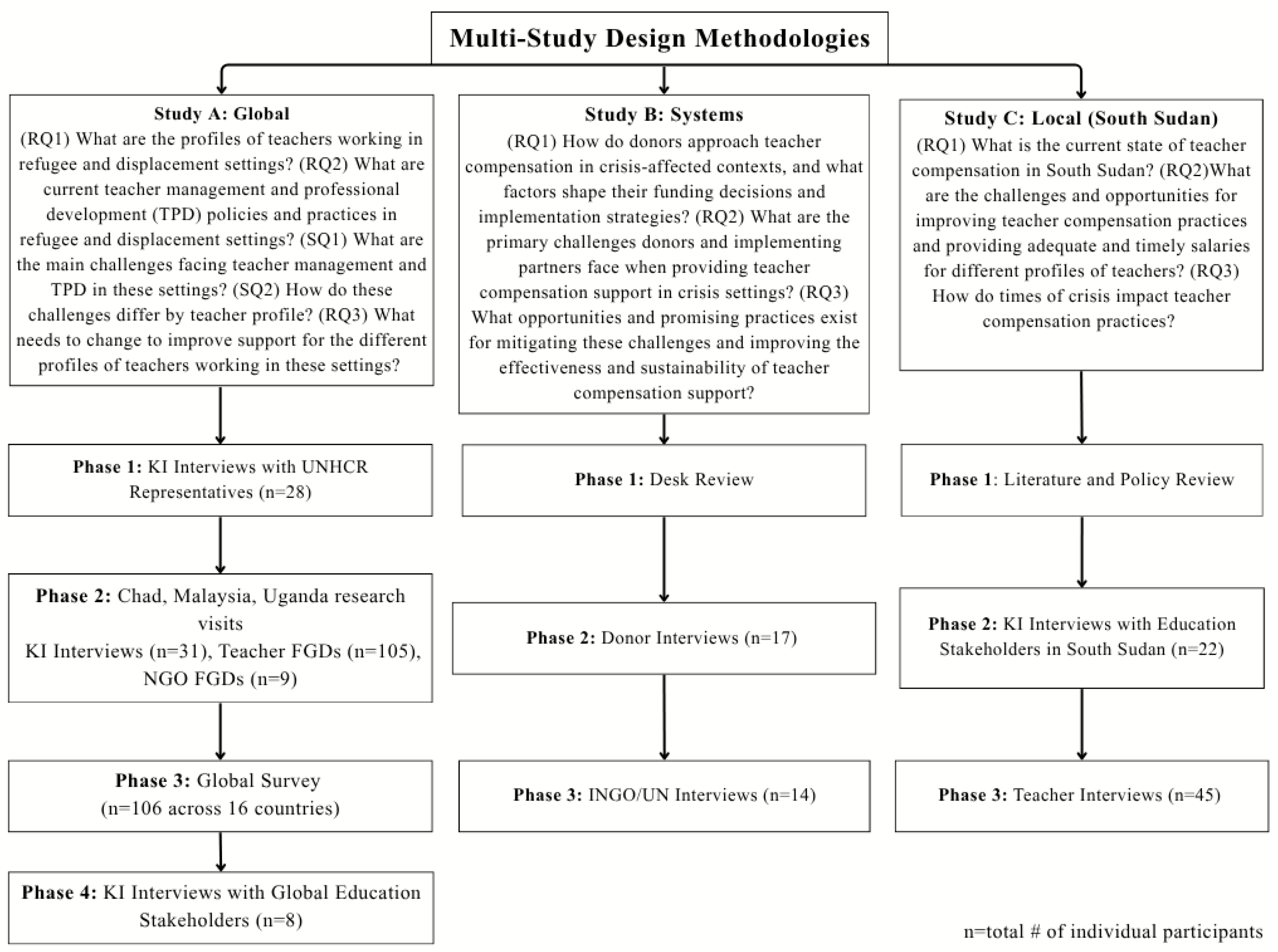
Study A,
Supporting Teachers amidst Displacement: Pathways for Improving Teacher Quality & Workforce Sustainability (
Mendenhall 2024), is a global mixed-methods study that examines teacher development policies and practices in crisis- and conflict-affected settings. It draws on key informant interviews (KIIs) with governmental, NGO, and UN representatives in three refugee-hosting countries (e.g., Chad, Malaysia, and Uganda); teacher and school management committee focus group discussions (FGDs) in the focal countries; a global online survey of local, national, and global education actors; and KI interviews with national and global education stakeholders.
Study B,
Teacher Pay in Crisis: Donor Practices, Challenges, and Opportunities in Emergency and Protracted Settings (
Mendenhall and Etzel 2025), is a global qualitative study that examines how donors approach teacher compensation in emergencies and protracted crises. It included a donor mapping and desk review of donor reporting practices, and KI interviews with donor, NGO, and UN representatives.
Study C,
Teacher Compensation in Crisis Contexts: Problems & Paradoxes for Paying Teachers in South Sudan (
Angong et al. 2025), is a qualitative case study that examines the current state of teacher compensation among primary school teachers in South Sudan, drawing on KI interviews with education stakeholders and teacher interviews across four states (see
Figure 1 for the specific components of each study, including the research questions each study addresses, data collection activities and study samples).
Given the predominance of examples from Sub-Saharan Africa across the three studies, we center those experiences here, focusing on how these different settings specifically impact refugee teachers. We examine the findings from teacher interviews in South Sudan (Study C) alongside findings from FGDs with teachers in Uganda and Chad (Study A). We use findings from the global donor mapping (Study B) to examine teacher compensation policies and practices through a country-level analysis of South Sudan (Study C), among other configurations. By putting these studies in conversation with one another, we ask: How do education governance structures, and specifically the administration of teacher compensation, in refugee education settings affect teachers’ livelihoods, professional recognition, mobility, and rights?
While this study examines diverse teacher profiles—including national civil servant, community, or volunteer teachers—these are employed as a comparative lens to illuminate the unique structural marginalization of refugee teachers within hybrid governance systems.
Comparative Data Analysis
By adopting a multi-study approach, we examine the complexity and processes of teacher pay governance by triangulating qualitative and quantitative data across three studies: global humanitarian policies, institutional donor systems and practices, and local teacher perspectives in South Sudan. Qualitative data analysis across the three studies followed a similar process, including transcriptions, deductive and inductive coding, and thematic memoing.
To apply the multi-study analysis, we first coded each dataset separately using a shared codebook derived from our theoretical framework. Indicative codes included compensation policies, donor practices, hybrid arrangements, fragmented compensation systems, professional recognition, among others. We then conducted cross-study memoing to identify where themes converged or diverged, systematically comparing how global policies (Study A), donor practices (Study B), and teacher experiences (Study C) aligned or contradicted one another. Insights from one study were used to refine coding in the others. This iterative, comparative process allowed us to trace how governance decisions at global and institutional levels materialize in teachers’ everyday experiences.
Quantitative data analysis consisted of descriptive analysis of frequencies and distributions of responses from the online survey. Through this comparative and thematic analytical process, we reanalyzed the data across the three studies using the same deductive coding approach informed by our theoretical framework to examine education actors’ policies and practices on teacher compensation, and to interpret how the governance structures in which they operate shape the everyday lives of teachers working in contexts of forced displacement. Drawing on
Bartlett and Vavrus’ (
2016) comparative case study approach, we engaged in vertical analysis to examine teacher compensation policies across global humanitarian and donor systems (Study A and B), national and institutional compensation arrangements (Study A), and teachers’ lived experiences (Study C). For the horizontal analysis, we compared how teacher compensation policies, processes, and experiences vary across study sites in Sub-Saharan Africa.
Through this multi-study comparative approach, we are able to situate our analysis of the governance of teacher pay and policy discourses in forced displacement contexts beyond individual country cases and nation-state policy frameworks to examine the multi-scalar governance processes that shape and produce fragmented compensation systems and the production of precarity for refugee teachers (
Shah and Cardozo 2016).
We do not intend to produce universally generalizable claims through this multi-study approach (
Shah and Cardozo 2016). Rather, this study examines how teacher compensation is governed across diverse contexts, levels, and teacher profiles to identify patterns, processes, and dynamics that produce hierarchies of belonging that systematically constrain refugee teachers’ access to professional recognition, labor protections, and economic stability.
4. The Governance of Teacher Pay: Fragmented Systems and the Production of Precarity
Across all three studies, we find that teacher compensation in forced displacement contexts is administered through multiple, and at times overlapping, payment systems governed by distinct stakeholder groups. For the purposes of this article, we have organized these compensation arrangements into four categories, a framework derived from the findings of our multi-study design and further informed by the existing literature (
Mendenhall et al. 2018;
Inter-Agency Network for Education in Emergencies (INEE) 2022;
Falk et al. 2024,
2026;
Henderson 2023). These categories are not neutral administrative models. Rather, they are distinct structural configurations of power that operationalize the broader landscape of policying and policing. Specifically, they enact policying through “symbolic control” (
Robertson 2012) to manipulate semantic classifications of pay, and enforce policing through “performative coordination” (
Carvalho and Haybano 2023) to manage the tension between resource scarcity and education provision.
First, the National-Integrated category indicates that payment is governed by national education (and finance) authorities and distributed to formally trained teachers legally entitled to work within the national education system. Symbolic control is maintained through the promise of formal status, standard salaries, and civil service protections. Second, the Humanitarian/Parallel category shows that international stakeholders are the primary authority responsible for overseeing teacher payments (across myriad profiles pending the setting, including national teachers, refugee teachers, etc.). These arrangements typically take place outside of the national system and use donor or other external funds (for example, in refugee camps where education is governed by UNHCR). In this category, UN and NGOs engage in management and performative coordination through standard-setting for “incentive” workers, even as they lack the capacity or institutional mandate to offer formal employment or long-term contractual security. Third, the Hybrid/Co-Governed category encompasses various arrangements where payment responsibilities are jointly overseen by national and international stakeholders such as UN Agencies and INGOs (e.g., teachers are recruited by the government but financed through donor support, or teachers are recruited and paid by international actors, but work in schools supervised by local education officials). Performative coordination serves as a barrier as both actors strive to keep schools running while deflecting accountability for refugee teachers’ poor labor conditions. Finally, the Community-Managed category acknowledges that community actors assume responsibility for paying teachers, often in the absence of a stable government or external funding. In this case, state and humanitarian actors may exert symbolic control by demanding compliance with national curricula and school-leaving exams, while simultaneously abdicating fiscal responsibility for the livelihoods of teachers working in these schools. While analytically distinct, these categories often overlap in practice.
These differentiated mechanisms for paying teachers often emerge in response to resource scarcity or gaps in responsibility for teacher compensation (Studies A, B and C;
Hopper 2024). Yet, they introduce distinct challenges for earning a living and advancing professionally, not to mention the significant inequities and fragmentation that emerge in the process. Once in place, these mechanisms are also difficult to dismantle. Although categories (e.g., Humanitarian/Parallel) can morph into something new (e.g., Hybrid/Co-Governed), it may have a detrimental impact on refugee teachers who may be pushed out entirely when there are no pathways into the formal education system. In what follows, we demonstrate how these differences manifest in the terminology used to describe teacher compensation, different payment amounts for refugee teachers, coordination challenges among education actors, misalignment between accrued professional development and payment structures, and limited to non-existent representation in collective bargaining spaces.
4.1. Policying Terminology for Teacher Pay
The governance of teacher compensation in displacement contexts informs the specific terminology used by governing actors, including terms like salary, incentives, and stipends. The terminology is not merely semantic; it functions as a mechanism to navigate complex legal and operational issues. There are a range of explanations for the widespread use of incentives when talking about teacher compensation, although the reasons may vary by country context. Teachers who are refugees working in Humanitarian/Parallel or Hybrid/Co-Governed settings, and the education actors overseeing teacher management, may face obstacles to acquiring work permits, because refugees may be legally barred from formal employment (Study A, KIIs 2022). The provision of incentives allows refugee teachers to work without violating host country laws that forbid refugees from entering the labor market (Study A, UN KII 2022, Study B, Donor KII 2025). If refugees were granted the right to work, education providers would be obligated to pay minimum wage and social security (Study A, UN KII 2022, Study B, Donor KII 2025), among other benefits, which proves difficult amid budgetary constraints in humanitarian and refugee hosting settings. Regulations further shape the nature of incentives in cases where refugee teacher payment rates are set by national governments, preventing humanitarian stakeholders from paying teachers more if they have the means and will to do so (UN KII 2025). In host countries where refugees face strict legal barriers to formal employment, reclassifying wages as non-binding stipends becomes the only viable legal avenue for aid workers to support teachers’ livelihoods at all. This linguistic shift demonstrates symbolic control in practice where semantic boundaries are altered to bypass rigid labor regulations. As a result, policying terminology operates as a dual instrument, shielding humanitarian agencies from legal and fiscal mandates they lack the capacity to meet, while systematically locking refugee teachers into a state of structural precarity.
In some instances, low incentives are further rationalized due to the provision of humanitarian aid in the form of shelter, healthcare, and food rations within refugee settlements. However, the sustainability and quality of these supplementary services remain inconsistent, and are increasingly dismissed as an inappropriate justification for low teacher pay (Study A, Global Survey 2023). Volunteer or community teachers recruited from the local community in crisis or displacement settings, who may or may not have formal teaching qualifications, are also paid incentives. Beyond right-to-work conditions or financial necessities, donors who fund education in emergencies and displacement settings are also reluctant to pay anything more than incentives. This stems from donors not wanting to be responsible for covering recurrent costs for what they see as the national government’s duties (Studies A, B, and C, Donor KIIs 2022, 2025, 2024), despite efforts to strengthen “responsibility-sharing” for refugee-hosting states among international actors (
United Nations General Assembly 2018).
Notwithstanding these challenges and the reluctance to pay teachers, the use of terms like incentives masks significant inequities, as refugee teachers are expected to fulfill identical professional responsibilities despite the disparity in their formal recognition and pay (Study A, FGDs 2022). The use of incentives further serves to normalize precarity. By labeling compensation as incentives, humanitarian and national actors effectively discipline refugee teacher labor and limit the livelihoods and professional mobility of educators working in these settings. The use of position titles like “incentive teachers” is also an example of symbolic control, whereby semantic boundaries dictate legal and economic value.
4.2. Stratification of Teacher Labor & Compensation Hierarchies
Due to these complex legal and operational constraints, teacher compensation is stratified across teacher profiles. Rather than a unified pay scale for comparable work, teachers are categorized into distinct tiers of remuneration based on their legal status and work authorizations. While local factors complicate direct cross-border comparisons, there are noteworthy patterns.
The gap in monthly compensation for refugee and national teachers reflects the devaluation of refugee labor. In Cameroon, for instance, the $42 monthly incentive for qualified refugee teachers, compared to the $241–300 earned by their national counterparts, signals a significant barrier to wage parity (Study A, Global Survey 2023). We see similar findings in Ethiopia, where the $16 pay rate for refugee unqualified teachers represents a fraction of the $69 government rate (Study A, Global Survey 2023). In Kenya, where national teachers in camps earn less than those on the central government payroll ($153 starting salary compared to $245, respectively), they still significantly outpace refugee teachers ($55), creating a multi-layered inequality within the same site (Study A, Global Survey 2023).
Our study in South Sudan (Study C) captured different compensation figures by teacher profiles and school settings. Teachers on the government payroll, who make up just 30% of the country’s teaching corps, earn between $3 to $58 monthly, pending their civil servant pay grade. In refugee camps in South Sudan, official documentation and teacher-reported data indicated a much wider range between $40–500. Where the incentive figures in the camps were much higher than teachers working in internal displacement settings or on the government payroll, teachers reported vastly different rates for teachers working in the same school. These differences were attributed to qualifications, years of experience, and which NGO was responsible for paying teachers, creating other potential inequities and grievances in a resource-scarce setting.
South Sudan is an anomalous and vexing situation given that national teachers on the government payroll (along with other civil servants) have not been paid for almost three years. While many continue to show up to teach, they do so on a voluntary basis (Study C, Teacher Interviews 2024). Although the incentives paid in the refugee settings in South Sudan are closer to livable wages than the other teacher profiles working in the country, paradoxically when the national government becomes functional again, it may prove difficult to transfer those teachers into the government system where they would receive significantly lower wages (Study C, Donor KII 2024). Many of the refugee teachers working in the refugee camps would never have that opportunity anyway, without plausible professional pathways recognized by the formal education system. The disparate payment amounts for different teacher profiles may also lead to grievances, though teachers (working outside of the camps) reported sharing their funds with other teachers (Study C; Teacher Interviews 2024).
In addition to the teacher profiles described thus far, there is yet another group of educators that merits attention. In displacement settings experiencing overcrowded schools and classrooms, UN agencies and NGOs often hire classroom assistants. These positions are meant to provide support to lead teachers by helping with classroom management and providing translation support for learners, among other tasks. Nevertheless, the classroom assistants we spoke with in Uganda (Study A, FGDs 2022) shared that more often than not they are performing the role of the lead teacher. This positional tiering acts as a clear mechanism of symbolic control, using the low status of “assistant” to mask and financially devalue what is otherwise full-time professional labor. The vast majority of classroom assistants are refugees who purport to have earned their teaching qualifications in their countries of origin, but either cannot produce proof of their qualifications or are still going through the equivalency process in the host country. In some contexts, classroom assistants earn comparable rates to unqualified refugee teachers (already low compared to other teacher profiles) or they earn significantly less (Study A, Global Survey 2023), for performing the same duties as other full-time teachers.
Teachers’ low wages are further aggravated by unpredictable payment schedules, short-term contracts (supported by humanitarian funding), and a lack of other benefits that would typically be granted to civil servant teachers (e.g., tenure, pensions, hardship allowance, among others). Teachers of all profiles hired by UN and NGO actors in refugee camps and settlements may experience these same pay-related challenges. State fragility may lead to these same outcomes for civil servant teachers as we see in the South Sudan example, and community teachers paid by school management committees suffer the same fate. There are also minimal to no safety nets (e.g., long-term retirement/pension benefits) for teachers who have dedicated years and often decades to the teaching profession during their displacement (Study A, FGDs 2022). Ultimately, these inequities are compounded by structural precarity. Short-term humanitarian contracts, letters of engagement in lieu of formal contracts in some contexts (Study A, FGDs 2022), unpredictable payment schedules, and a lack of benefits beyond compensation further erode the professional identity of the workforce, transforming teaching from a career into a survival strategy.
4.3. Systemic Impediments to Pay Harmonization: Fragmented Governance and Funding Precarity
In an effort to mitigate the tensions created by disparate payment systems, education stakeholders have pursued various efforts to harmonize and coordinate compensation practices. Data from all three studies illustrate these efforts across two primary domains: (i) harmonization of compensation amounts within Humanitarian/Parallel or Hybrid/Co-Governed systems; and (ii) coordination between and among humanitarian and national education systems.
Within Humanitarian/Parallel or Hybrid/Co-Governed systems, humanitarian actors attempt to harmonize compensation practices to stabilize teacher payment within settlements and reduce disparities across implementing organizations. In Uganda, for example, UNHCR sought to streamline governance by consolidating teacher payments through two INGOs, Finn Church Aid and Windle International, such that national and refugee teachers were paid a standardized rate through these organizations rather than varying amounts across numerous partners (Study A, UN KII 2022). In South Sudan, the Education Cluster, jointly led by Save the Children and UNICEF, plays a similar role, setting an incentive rate of $40 a month (at the time of our study) for volunteer or community teachers, a rate negotiated with the national government and paid by Cluster partners working in internal displacement settings across the country (Study C, INGO KII 2024). These are promising examples of standardization toward more equitable payment amounts across teacher profiles, but the overall compensation is still quite low. In South Sudan, the agreement also does not account for changes in inflation, a regular occurrence in a volatile environment.
Coordination also occurs across governance models, as humanitarian actors seek to align compensation rates with national education and/or labor policies and teacher management structures. In Ethiopia, UNHCR coordinates with the government’s Refugee and Returnees Service (RRS) to set a standardized pay scale that implementing agencies are required to follow (Study B, Implementing Partner KII 2025). Similarly, in Uganda, efforts have been made to harmonize payment rates of qualified teachers within settlements with the first rung of the national civil service teacher pay scale (Study A; also noted in the
Ministry of Education and Sports (
2023) refugee response plan). Such efforts are motivated not only by considerations of equity across teachers, but also by concerns about the sustainability of compensation arrangements. As one key informant explained, aligning payments with government rates can ease the transition when programs are handed over to local actors, who may otherwise be unable to sustain higher wage levels (Study B, Donor KII 2025).
These standardization efforts can be undermined by other changes in the national education system. In Uganda, the government recently increased salaries for secondary-level science teachers on the government payroll by approximately 300% (
Ministry of Public Service [MoPS] 2025). This move prompted many science teachers working in refugee settlements to leave their positions in hopes of securing civil servant status elsewhere. NGO partners, constrained by pre-determined annual budgets, were unable to coordinate a quick response to this shift (Study A, NGO KII 2022). As the Ugandan government plans to extend these increases to arts and humanities teachers, humanitarian actors face growing pressure regarding salary parity and teacher retention.
Despite well-intentioned efforts, alignment remains difficult to sustain. In Kenya, for instance, monthly payments can still fluctuate between 6000 and 15,000 Shillings depending on the administering NGO (Study B, Implementing Partner KII 2025). One donor acknowledged that challenges stem from partners paying different amounts, noting such discrepancies “creates a lot of confusion” even when technically justifiable (Study B, Donor KII 2025). The absence of salary parity is felt acutely by teachers who experience inconsistent pay rates. For example, a refugee deputy head teacher in South Sudan explained the complexity of determining how much teachers in his school should be paid vs. how much they were earning in practice. Through consultation with UNHCR and various implementing partners, he discovered national teachers were supposed to be paid between $500–750, while refugee incentive teachers should earn $200–280 per month. In practice, teachers across both profiles in his school received significantly less per month from the NGO responsible for their payment: approximately $300 for national teachers and $130–230 for refugee teachers. When challenged, the NGO stated it was their decision what rate to pay teachers. This discrepancy highlights the limits of performative coordination. While standard scales are visibly established at the institutional level to signal alignment, individual operational choices ultimately override these metrics on the ground. These payment inconsistencies and lack of coherent explanations exemplify the detrimental impacts of coordination gaps, illustrating how teachers are simultaneously impacted and disciplined by the payment regimes that govern their livelihoods (Study C, Teacher Interview 2024).
These examples underscore the inherent difficulty of harmonizing across multiple funding streams and parallel systems, particularly as humanitarian stakeholders face structural barriers that further undermine their coordination abilities. Primarily due to the short-term nature of humanitarian aid and donor reticence to cover recurrent salary costs, humanitarian-funded compensation is often pegged to specific project cycles. When a project ends, teachers may face payment gaps or lose their livelihoods, particularly in the absence of clear handovers for payment responsibility (Study B, NGO KII 2025). Furthermore, humanitarian actors often lack the institutional capacity to mirror civil service benefits, such as inflation adjustments, qualification-based scales, or pension contributions (Study B, Donor KII 2025; Study C, INGO KII 2024). These limitations undermine teachers’ professional stability and create a sense of precarity within Humanitarian/Parallel systems, which has been exacerbated by massive global aid cuts and shifts in multilateral policy priorities (Study B, Donor KII 2025). Against these complex structural realities, coordination often functions less as a mechanism to ensure pay parity and more as an effort to manage fragmentation within chronically unstable and underfunded systems.
4.4. Teacher Recognition and the Professionalization Gap
Another significant barrier for refugee teachers is the limited recognition of their professional qualifications within host country systems. Even when teachers arrive with significant expertise, they are frequently excluded from national teacher management and development structures. Many refugee teachers, particularly those serving as classroom assistants, claim to have earned qualifications in their countries of origin but may be unable to provide physical proof or navigate complex equivalency processes (Study A, FGDs 2022). Even when teachers can access formal training within the host country, they may face significant barriers to registration. Classroom assistants are rarely included in professional development opportunities, further frustrating their efforts to acquire recognized teaching credentials and move beyond support roles (Study A, FGDs 2022).
These institutional barriers are often exacerbated by shifting administrative criteria. In Kenya, for example, even when refugee teachers complete courses at national Teacher Training Colleges operating within the camps, the Teachers Service Commission has used slight adjustments in admissions criteria or program duration as a justification to withhold formal recognition of their primary teaching diplomas. Even if these diplomas were recognized, refugees would still remain tethered to incentive status due to broader legal constraints regarding the right to work and the challenges of acquiring work permits. In Chad, refugee teachers who acquired training in Chadian Teacher Training Colleges can technically work in public schools, but to be hired as civil servants paid by the state, they must obtain a Chadian identity card. It is unclear how feasible that is for refugee teachers. These two gatekeeping examples demonstrate how progress in one area can be stymied by regulations in another. These examples also show how governance manifests as administrative practices and their control over professional boundaries. When viewed through our analytical framework, these administrative practices function as mechanisms of policing. By utilizing credentialing criteria, unclear equivalency processes, and shifting registration procedures, the system enforces the boundaries of inclusion and exclusion. This form of policing does not require physical coercion. Bureaucratic hurdles stifle refugee teachers and place them in a perpetual state of volunteerism, effectively restricting their professional and upward economic mobility. While there is optimism that certifications obtained during displacement might be recognized upon repatriation, there are currently no guarantees, though efforts are underway to create a global passport of teacher qualifications, which will be particularly helpful in displacement settings (Study A, UN KII 2022; Study B, Donor Interview 2025;
UNESCO n.d.).
This lack of formal recognition creates a profound disconnect between a teacher’s professional preparation and their financial compensation. In stable education systems, wages are typically commensurate with training and experience, with clear pathways for advancement (
UNESCO 2019). In displacement settings, however, the inability to bridge the gap between “refugee” status and “professional” status means career progression is stalled. In Uganda, refugee teachers expressed a strong interest in participating in formal training opportunities but reported receiving limited guidance and support from education actors to do so. Several classroom assistants shared that they had been told that volunteering in these roles to “fill a gap” would provide a pathway to formal training, but these opportunities have not materialized. As a result, several refugee teachers described feelings of instability and a limited sense of belonging within the profession as factors that lead to higher rates of attrition (Study A, FGDs 2022). Additionally, formally trained teachers find that their wages remain stagnant for years, regardless of their participation in professional development or their actual classroom responsibilities.
Ultimately, these management challenges culminate in a state of perpetual precarity. In many settings, a persistent “crisis logic” also means that despite the protracted nature of displacement, teacher management is still dictated by short-term humanitarian cycles (Study A, UN KII 2022). This results in teachers working on one-year (or shorter) contracts for years on end, leaving them perpetually facing “unknowable futures” professionally (
Dryden-Peterson 2017).
4.5. Collective Bargaining: The Marginalization of Refugee (and Other) Teachers Within Union Structures
All of the African countries covered in these studies have active teacher unions. Yet, findings indicate that these bodies rarely represent the needs and rights of different profiles of teachers, including refugee teachers. Unions are often relegated to the sidelines by parallel governance structures set up by UN and NGO actors, and international actors are unaccustomed to engaging and collaborating with union representatives. This systemic exclusion reveals how performative coordination focuses heavily on visible alignment between institutional aid actors, while actively ignoring structural local mechanisms—like unions—that have the potential to provide protection. These are additional examples where refugee teachers and other vulnerable teacher profiles are excluded from governance mechanisms that should afford them some representation and protection (Study A, Global Survey 2023; Study B, Donor Interview 2025; Study C, KIIs 2024). Teacher unions have a role to play in salary harmonization efforts and equivalency processes, as well as in identifying creative solutions for assessing teachers’ competence in the absence of verifiable teaching certificates.
Teacher responses underscore how a lack of voice can contribute to the instability of the teaching profession. A refugee teacher in Uganda stated, “We don’t have a voice. It makes us really unstable. Most people have left.” Other teachers shared instances where complaining about job conditions had resulted in school transfers or terminations (Study A, FGDs 2022). These retaliatory measures underscore how the policing of refugee labor shifts from soft institutional gatekeeping to overt disciplinary enforcement. The exclusion of different profiles of teachers from traditional union structures leaves them without collective protection. When self-advocacy is met with the threat of termination or forced transfers, the management of teacher payroll functions strictly as a policing technology designed to suppress grievances, maintain operational compliance, and ensure that refugee labor remains a highly flexible, low-cost commodity. Collectively, exclusion from teachers’ unions, low pay, lack of benefits, limited career advancement opportunities, the absence of professional recognition, contribute to decreased motivation and high turnover for the education sector. These barriers to earning livable wages, accessing teacher development opportunities, and advancing their careers are not isolated incidents. They are part of a broader landscape of professional precarity that is present in all of the contexts cited in this study.
5. Discussion and Conclusions
The findings from this multi-study comparative approach show how teacher compensation in refugee-hosting settings serves as a primary governance mechanism that reproduces hierarchies of belonging. Refugee education provision relies on a fragmented compensation system operating across vertical, horizontal, and parallel spaces. Within these hybrid arrangements, UN agencies and NGOs frequently bypass national structures, by design or necessity, to hire refugee, community, or volunteer teachers as incentive workers. These terms are not neutral descriptors; they mask a systemic lack of adequate pay and formal professional recognition.
This hybridity creates a dual workforce of host community and refugee teachers, predominantly managed by UNHCR and partner NGOs in a space that operates parallel to, and yet is influenced by, national governmental standards and regulatory frameworks. This arrangement constitutes a governance regime that manages education through “symbolic control” (
Robertson 2012) and “performative coordination” (
Carvalho and Haybano 2023), among myriad actors. While these stakeholders strive to collaborate to harmonize pay, the resulting systems remain deeply stratified. Differentiated payment mechanisms, while framed as pragmatic responses to resource scarcity, function as a form of policying and policing. On the one hand, education sectors governed by fluctuating humanitarian cycles rather than stable national labor rights create competitive, fragmented labor markets. On the other hand, they police the professional boundaries of the workforce, ensuring that refugee labor remains a flexible, low-cost resource. Notably, these outcomes are not driven by organizational malice. Rather, they reflect the structural limits of an aid architecture that compels well-meaning actors to rely on symbolic control and performative coordination as coping strategies within deeply fragmented spaces.
A key finding of this research is that a teacher’s right to fair and decent compensation, safeguarded by the Joint ILO/UNESCO Committee of Experts on the Application of the Recommendations concerning Teaching Personnel (
ILO/UNESCO 1966), has less to do with their professional contribution to the classroom and more to do with the legal quagmire of displacement policies. In this landscape, compensation serves as a tool for managing teacher mobility and enforcing professional boundaries rather than rewarding merit. This dynamic highlights how host-state regulations and institutional constraints dictate the boundaries of what’s possible for education actors, restricting their capacity to offer equitable labor standards despite operational intentions. The resulting anomalies—where national qualified teachers may be paid significantly more or less than the government scale depending on the specific context—have serious implications for the education sector. These discrepancies influence the ability of schools to attract teachers to hardship positions and contribute to significant attrition when compensation fails to align with the cost of living or professional status. They further erode the professionalization of the teaching corps.
These dynamics highlight a fundamental contradiction in the international aid architecture related to refugee education. Despite the persistent global rhetoric of “responsibility-sharing,” the humanitarian aid architecture remains structurally averse to committing to recurrent expenditures, such as teacher salaries. By systemically channeling teacher pay through short-term incentives rather than a long-term investment in human capital, the international community perpetuates a state of educational fragility. The reliance on short-term humanitarian funding cycles ensures that even as refugees are encouraged to integrate into national systems, refugee teachers in particular do so with a sense of personal and professional precarity.
Ultimately, current compensation models do not just reflect the reality of displacement; they actively produce a secondary class of educators whose professional identity is subordinated to their migration status. Addressing educational equity for refugees requires a paradigm shift away from short-term humanitarian project cycles and toward multi-year, predictable financing instruments. Policies must recognize refugee teachers not as temporary local stopgaps, but as rights-bearing professionals entitled to formal payroll inclusion within national education systems. Moving forward, global “responsibility-sharing” must also move beyond symbolic control and performative coordination that leaves the fiscal burden on low- and middle-income host states. It demands a transnational financial and legal commitment to the individuals who sustain the right to education in the world’s most challenging contexts.