


Abstract
This study examines how Indonesian university students negotiate the meanings of extremism and tolerance across digital and campus environments. Using phenomenology, the research examines the lived experiences of 35 students from Yogyakarta, Jakarta, Semarang, Surabaya, and Bandung to understand how digital platforms, everyday interactions, and symbolic practices mediate their religious identity work. The analysis applies Castells’ concept of communication power and Bourdieu’s notions of habitus and symbolic power to explore how digital platforms shape ideological narratives and emotional framing. Key Findings reveal that extremism is experienced not merely as ideological deviation but as a communicative rupture—manifested through coercive discourse, exclusionary framing, and digitally amplified moral authority—while tolerance emerges as a socially cultivated practice embedded in relational norms, affective positioning, and strategic self-presentation in mediated environments. Social media functions simultaneously as a site of exposure, contestation, and subtle resistance, enabling students to reframe, soften, or oppose dominant narratives through micro-activism and selective curation. This study offers a novel contribution by integrating data-driven phenomenological insights with a theory-driven account of mediated power, demonstrating how symbolic power circulates through digital infrastructures and shapes the cultural politics of religious pluralism among youth in contemporary Indonesia.
1. Introduction
In many parts of the world, concern about youth exposure to online extremism has intensified as social media platforms become central to everyday life, political communication, and identity work. Research on violent extremism in the digital age shows that online environments can facilitate recruitment, amplify polarizing narratives, and normalize antagonistic worldviews, even when only a small minority moves towards violence (Aryaeinejad and Scherer 2024). Global reports highlight how algorithmically curated feeds, recommendation systems, and participatory cultures enable extremist actors to diffuse emotionally charged content, exploit grievances, and reach young audiences across borders at low cost (Alava et al. 2017). At the same time, scholarship stresses that social media do not mechanically “cause” radicalization; instead, they constitute complex communicative environments in which existing beliefs, grievances, and identities are re-articulated through mediated interaction (Archetti 2015).
In Indonesia, the world’s largest Muslim-majority democracy state, youth engagement with religious and political content online has become a central concern for scholars and policymakers. Studies on university students and young adults document phenomena of “pseudo-radicalism,” in which students flirt with or symbolically align themselves with radical ideas without necessarily endorsing violence, as well as broader patterns of socio-religious intolerance and identity politics shaped by online discourse (Suyanto et al. 2022). The latest incident in Jakarta on 7 November 2025, involved the suspected perpetrator of the explosion at SMAN 72 Kelapa Gading, North Jakarta, who carried seven explosives, who was a student at the school and was inspired by extremist figures (Aditya and Carina 2025; Hukmana 2025). Survey-based and policy-oriented research points to social media as both a risk factor and an opportunity: platforms can disseminate intolerant propaganda and conspiracy narratives, yet they can also be used to promote moderation, interfaith dialogue, and civic engagement (Abshari 2025). However, much of this work treats social media primarily as an external influence on attitudes, rather than as a lived, phenomenological space in which young people actively interpret, negotiate, and sometimes resist ideological messages.
Studies report that fundamentalist and radical groups became active in Indonesia’s universities and communities, making religious identity far more salient than before (Hamdi 2023). Consequently, social distance between Muslim and Christian youth has widened, with increasing signs of self-segregation and distrust in daily life (Hasibuan and Alvian 2017). What was once latent differentiation is now more openly expressed, revealing the early stages of an identity-based divide. This local shift mirrors a broader national trend: social scientists have observed that stronger religious identification can correlate with exclusionary attitudes and biases (Leder et al. 2025). For instance, Kanas et al. (2022) found that among students in Indonesia and the Philippines, a high degree of ethno-religious identity often heightens perceptions of out-group threat, which in turn may lead to support for intolerant or even violent actions. Such findings underscore why it is imperative to study how young people’s religious identities are being shaped and how these identities influence their acceptance of others.
In this study, extremism is understood as a process of ideological closure characterized by rigid in-group/out-group boundaries, rejection of pluralism, delegitimization of alternative perspectives, and increasing acceptance of exclusionary practices. This definition draws on contemporary scholarship on ideological extremism and radicalization (Berger 2018; McCauley and Moskalenko 2008; Schmid 2013), while recognizing that extremist orientations do not necessarily imply support for violence. Accordingly, this study focuses on participants’ experiences of exclusionary communication and identity negotiation in digital environments rather than on violent extremism or criminal radicalization.
This article approaches the issue through the lens of mediation, social-mediated communication, and symbolic power. Manuel Castells conceptualizes contemporary societies as “network societies,” in which power struggles are increasingly played out in communication networks that shape what people see, feel, and consider politically possible (Castells 2010). Communication power, in this view, lies in the capacity to shape human minds by constructing meaning within media spaces (Castells 2009). Pierre Bourdieu’s theory of habitus and symbolic power complements this macro perspective by explaining how durable dispositions, embodied histories, and unequal access to symbolic capital structure what is perceived as legitimate, standard, or thinkable within specific social fields (Bourdieu 1991; Costa and Mark 2015). Recent work applies Bourdieu to digital environments, framing social media as a “digital field of power” in which symbolic and digital capital confer authority on certain voices and narratives (Missier 2025).
At the same time, scholarships on digital religion and critical intercultural communication underscores that mediated practices around faith, identity, and difference are embedded in wider cultural norms and power relations. Bajan and Campbell’s (2023) notion of “digital religion” conceptualizes online platforms as hybrid spaces where religious practices, symbols, and authorities are reconfigured in relation to digital media logics. Critical intercultural communication perspectives emphasize how everyday communicative acts—listening, joking, sharing, or remaining silent—reproduce or contest structural inequalities and can foster social justice or exclusion (Sorrells 2013; Sorrells and Sekimoto 2025). Within this body of work, youth are not only potential victims of online manipulation but also agents who creatively appropriate, filter, and repurpose mediated discourses through forms of micro-activism and relational diplomacy (Recuero 2024).
Despite this growing literature, several gaps remain. First, research on youth, religion, and social media in Indonesia has mostly used surveys, content analysis, or policy evaluations that link platform use with attitudes toward radicalism, tolerance, or identity politics (Burhanuddin et al. 2019). While valuable for identifying trends, these approaches often miss how young people actually experience, interpret, and emotionally process extremist and pluralist messages in everyday media use. Second, studies using Castells’ network society and Bourdieu’s symbolic power are rarely combined with phenomenological methods, so the lived textures of social-mediated communication—hesitation, ambivalence, resistance, and digital activism—remain underexplored. Third, global debates often treat youth mainly through security frameworks, with limited attention to how students in non-Western, Muslim-majority contexts practice tolerance and pluralism through culturally grounded communication online and offline.
The authors address these gaps by examining how Indonesian university students in Yogyakarta, Surabaya, Jakarta, Bandung, and Semarang interpret and negotiate religious extremism and tolerance through social-mediated communication, based on phenomenological interviews with 35 students. It analyzes how they encounter religiously charged content, how they feel and respond, and how these experiences connect to campus life and wider socio-political debates, while integrating Castells’ communication power with Bourdieu’s habitus and symbolic power to understand social media as a mediating field of competing narratives, agency, and digital activism.
The study’s novelty is threefold: conceptually, it combines network society theory, habitus/symbolic power, digital religion, and critical intercultural communication; empirically, it offers phenomenological insight into students’ ambivalent experiences (attraction, fatigue, fear, moral responsibility) in three urban contexts; and methodologically, it foregrounds subtle resistance and micro-activism (e.g., selective engagement, counter-framing, moderation practices), shifting the focus from youth as merely “at risk” to youth as communicative agents. Guided by this framework, the article asks: (1) how students experience and interpret social-mediated communication on religious extremism and tolerance across online and campus settings; (2) how digital infrastructures and platform logics mediate the circulation of symbolic power; and (3) how students use communicative and digital-activist strategies, shaped by local cultural norms, to resist, reframe, or support narratives of religious identity and pluralism.
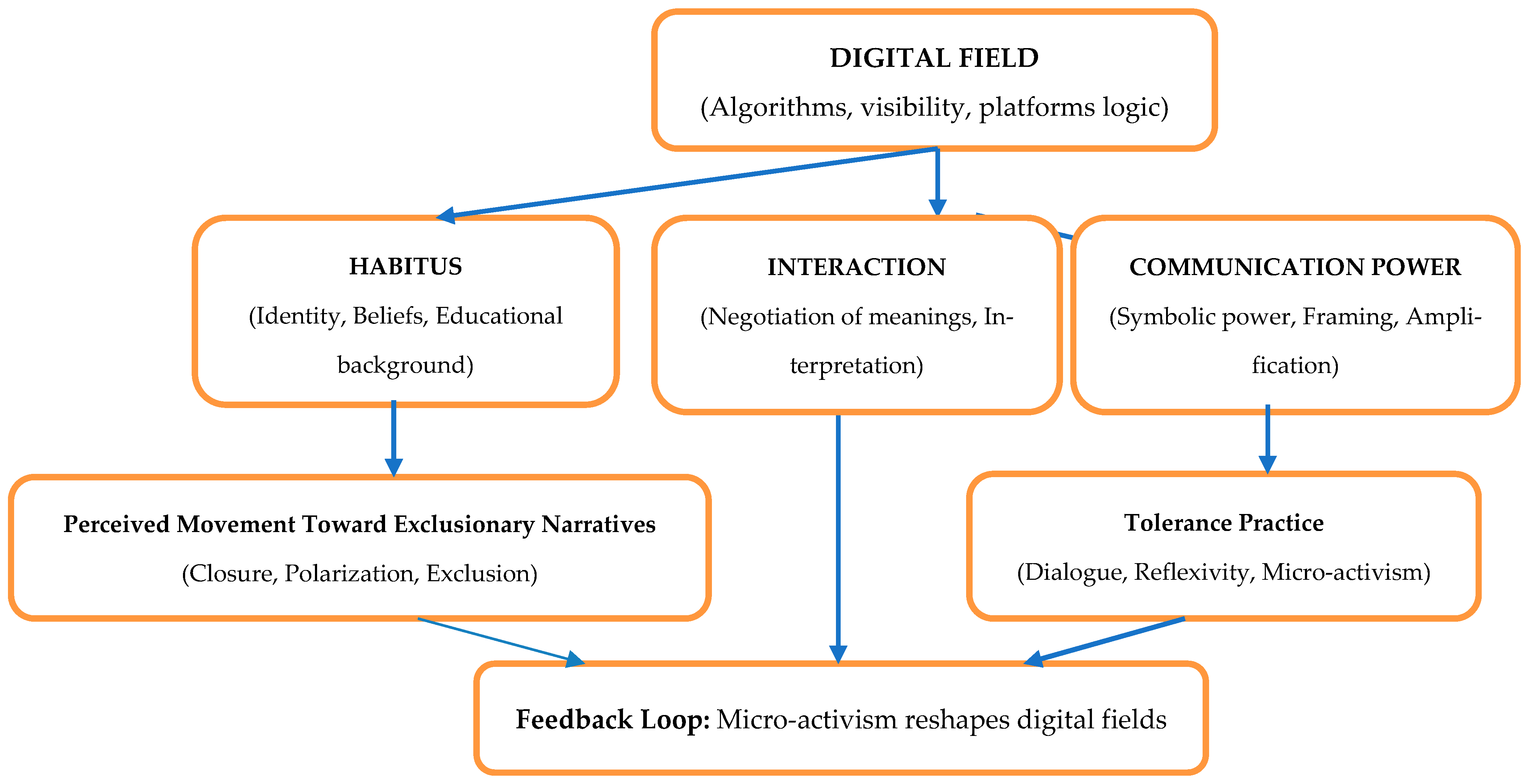
To clarify the theoretical integration, this study proposes a conceptual model that positions social media as a digital field in which communication power and habitus interact dynamically. Within this field, platform architectures (algorithms, visibility, and content circulation) structure communication power by shaping what becomes visible, credible, and emotionally salient. At the same time, students’ habitus—formed through prior socialization, religious identity, and educational experience—guides how they interpret, accept, or resist these mediated messages. The intersection of these elements produces two possible communicative trajectories: (1) perceived movement toward exclusionary narratives, characterized by discursive closure, symbolic exclusion, and emotional polarization, and (2) tolerance practices, expressed through dialogic engagement, reflexivity, and micro-activism. These outcomes are not fixed but continuously negotiated through everyday communicative interactions across online and offline spaces.
In this study, extremism is conceptually understood not merely as support for violence, but as a process of ideological closure characterized by rigid in-group/out-group boundaries, rejection of pluralism, delegitimization of alternative perspectives, and potential justification of exclusionary practices. This definition distinguishes extremist orientation from ordinary religious commitment or strong belief systems. Tolerance is conceptualized as a communicative and social practice involving recognition of difference, willingness to engage across identities, and acceptance of others’ rights to express different religious, cultural, or ideological positions. Therefore, participants’ accounts are analyzed not as primary definitions of extremism and tolerance, but as lived interpretations of how these broader concepts appear, are negotiated, and become meaningful in everyday social-mediated communication.
1.1. Communication Power and the Network Society
Manuel Castells’ theory of the network society is central to understanding how mediated communication structures power in contemporary societies. In his influential article on “communication, power and counter-power,” Castells (2007) argues that political and cultural struggles increasingly unfold within communication networks that shape what becomes visible, sayable, and emotionally resonant in public life. He conceptualizes mass self-communication as a new configuration in which networked individuals produce and circulate messages at scale, yet still within infrastructures governed by powerful institutions and platform owners (Castells 2009). For Castells (2009), communication power does not operate merely through the transmission of information but through the capacity to shape meaning within networked communication spaces. Power emerges through the programming of communication networks that influence visibility, legitimacy, and emotional resonance. However, network societies also enable counter-power, where individuals and communities challenge dominant narratives by producing alternative meanings and communication practices. This perspective is particularly relevant for understanding youth responses to extremist and intolerant narratives because students are not only exposed to mediated power but may also participate in reprogramming communication spaces through selective engagement, critical interpretation, and everyday forms of digital activism. In the network society, media platforms become the primary arena in which values, identities, and power relations are constructed and contested (Fuchs 2009; He et al. 2024).
Empirical work on online extremism builds on this framework by showing how digital networks function as “decision-shaping” environments rather than simple channels of persuasion (Suhaib and Adnan 2020). Systematic reviews of radicalization through social media find that exposure to extremist content—especially for active seekers—is associated with more extreme attitudes and a higher risk of political violence, but always in interplay with offline factors (Akram and Nasar 2023). Studies of violent extremist propaganda highlight how groups exploit the affordances of social media—speed, reach, personalization—to amplify moral outrage, frame in-group identities, and normalize antagonistic worldviews (Conway 2017). Recent work in Studies in Conflict & Terrorism shows how online echo chambers and algorithmic curation intensify ideological entitativity, creating tightly bounded imagined communities in which extremist narratives appear coherent and morally justified (Campion and Colvin 2025).
Within this literature, social media are conceptualized as fields of communicative power, where platform architectures, algorithmic visibility, and user practices jointly shape what young people see, feel, and consider politically possible (Aryaeinejad and Scherer 2024; Petersen and Johansen 2025). For the present study, this perspective is crucial: it suggests that Indonesian students’ experiences of extremism and tolerance are not simply reflections of pre-existing beliefs, but outcomes of ongoing struggles over meaning inside networked communication spaces.
1.2. Symbolic Capital and Symbolic Power in Digital Fields
Pierre Bourdieu’s theory of practice extends this macro focus by explaining how durable dispositions (habitus) and unequal access to symbolic capital structure are recognized as legitimate, usual, or thinkable (Kumar 2025; Costa and Mark 2015). In classic formulations, Bourdieu (1986) describes habitus as embodied history that guides perception and action without conscious deliberation, while symbolic power operates through the capacity to impose categories of perception that appear natural. Building on this, socio-religious studies show how religious habitus is not understood as a determinant of extremism or tolerance, but as a socially formed set of dispositions through which individuals interpret identity, difference, authority, and belonging (Emmelkamp et al. 2020).
Following Bourdieu (1991), symbolic power refers to the ability to shape categories of perception and determine which meanings, identities, and forms of knowledge become recognized as legitimate. In digital religious contexts, symbolic power operates through struggles over whose interpretations gain authority, visibility, and recognition. Therefore, extremist and tolerant orientations are examined in this study as competing symbolic practices rather than fixed characteristics attached to particular religious identities.
Extending Bourdieu’s framework, Verter’s (2003) concept of spiritual capital provides a useful perspective for understanding how religious knowledge, practices, and moral orientations operate as forms of symbolic resources within social fields. Spiritual capital refers not simply to religious affiliation, but to the ways religious meanings and competencies become socially recognized and mobilized within particular contexts.
Recent scholarship explicitly adapts Bourdieu for digital contexts. Ignatow and Robinson (2017) argue that social media constitute digital fields in which forms of digital, cultural, and social capital shape have authority and whose voices are amplified. Edwards (2009) uses Bourdieu’s concepts to show how symbolic power operates in public communication professions, illuminating how discursive practices maintain or challenge dominant social hierarchies. In media theory, Couldry (2003) conceptualizes media institutions as key sites where symbolic power is concentrated and where social realities are constructed, suggesting that media “myths” about society become taken-for-granted reference points in everyday life (Couldry 2003; Cui 2019).
In digital environments, these dynamics are visible in what Recuero (2015) calls symbolic violence and discursive toxicity on social media: interactions where seemingly ordinary humor, memes, or casual comments reproduce inequalities and legitimize exclusion. Studies of gaming and platform cultures further show how symbolic capital—such as technical skill, aesthetic style, or religious knowledge—confers status and influence, shaping which narratives are regarded as credible or authoritative (Oktavianingtyas et al. 2025; Broc et al. 2021).
For this article, Bourdieu’s framework clarifies why some Indonesian students may be more susceptible to exclusivist or extremist narratives—because of a habitus formed in rigid in-group/out-group environments—while others draw on pluralist or dialogic dispositions when encountering similar content. It also helps conceptualize tolerance as a form of symbolic resistance, enacted through subtle communicative practices (e.g., gentle correction, silence, reframing) that challenge dominant scripts without overt confrontation.
This study does not conceptualize religion as an inherently causal driver of extremism. Instead, following Bourdieu’s understanding of habitus, religion is approached as a socially formed system of meanings, dispositions, and symbolic resources. Religious identity may become a medium through which both exclusionary and inclusive narratives are articulated depending on social fields and communicative contexts. Thus, extremist narratives are analyzed not as outcomes of religiosity itself, but as particular interpretations of religious symbols that gain legitimacy through symbolic power, social recognition, and mediated circulation.
While Castells and Bourdieu emerge from different theoretical traditions, this study integrates both perspectives as complementary frameworks for understanding mediated experiences of extremism and tolerance. Castells’ theory of communication power explains how digital networks structure the circulation, visibility, and contestation of ideological narratives. However, network structures alone cannot fully explain why individuals interpret similar messages differently. Bourdieu’s concepts of habitus and symbolic power provide this missing interpretive dimension by explaining how social backgrounds, cultural dispositions, and accumulated symbolic resources shape individuals’ perceptions and responses. Therefore, Castells helps explain the mediated field in which narratives circulate, while Bourdieu explains how actors positioned within that field negotiate meaning, legitimacy, and identity.
2. Materials and Methods
2.1. Research Design
This study employed a qualitative phenomenological approach to explore how Indonesian university students experience, interpret, and negotiate the meanings of extremism and tolerance within digital and campus environments. Phenomenology was selected because the purpose of this research was not to examine a bounded institutional case, but to understand participants’ lived experiences (Lebenswelt) and the meanings they construct through everyday encounters with religious narratives, social media interactions, and intergroup communication. A phenomenological approach allows researchers to examine how individuals perceive, interpret, and give meaning to particular phenomena based on their subjective experiences rather than treating social realities as externally fixed categories (Moustakas 1994; Creswell and Poth 2018).
Following interpretive phenomenological principles, this study positions university students as active meaning-makers who continuously negotiate their identities, beliefs, and social relationships within specific cultural and mediated contexts. In phenomenological inquiry, participants’ narratives are not treated merely as descriptions of events but as reflections of how individuals make sense of experiences that are personally and socially significant (van Manen 2016). Therefore, students’ accounts of extremism and tolerance are analyzed as lived interpretations of how ideological messages, religious identities, digital interactions, and campus cultures are experienced and negotiated in everyday life.
The phenomenological orientation is particularly relevant for studying extremism and tolerance because these concepts are not experienced only as abstract ideological positions but also as embodied and relational experiences involving emotions, identity negotiation, belonging, exclusion, and moral judgment (Putra 2015). Rather than assuming that exposure to certain religious or digital content directly produces extremist attitudes, this study examines how students interpret and respond to such content through their existing social backgrounds, religious experiences, and digital practices. This perspective aligns with phenomenological research that emphasizes the exploration of meaning construction, perception, and human experience within particular social worlds (Smith et al. 2009; Creswell and Poth 2018).
In this study, the phenomenon under investigation is Indonesian university students’ lived experience of encountering and negotiating narratives of extremism and tolerance across online and offline spaces. The focus is therefore not on measuring the prevalence of extremist attitudes or establishing causal relationships between social media exposure and radicalization, but on understanding how students perceive, interpret, resist, or reproduce certain narratives through mediated communication practices.
2.2. Data Collection and Analysis
Data was collected through semi-structured interviews. Limited field observation was conducted solely to provide contextual familiarity and was not included as an analytical data source. The analysis focuses on interview narratives because the study aims to understand participants’ lived experiences and subjective interpretations. The informants in this study were 35 students from several universities in Yogyakarta, Jakarta, Semarang, Surabaya, and Bandung Indonesia. This study employed a purposive sampling strategy, complemented by snowball sampling, to recruit participants who actively engage with social media and are exposed to religious or ideological content. Initial participants were selected based on criteria including active use of digital media, enrollment in university settings, and willingness to reflect on sensitive topics. Subsequent participants were identified through peer referral to capture diverse communicative experiences across networks. This approach ensured the inclusion of participants with varied exposure to extremist and tolerance-related narratives, while maintaining relevance to the research focus.
Religious affiliation was intentionally omitted from participant descriptions to protect participant confidentiality and to avoid reinforcing identity-based categorization in a study addressing sensitive issues of religion, extremism, and tolerance. Rather than comparing perspectives across religious groups, the analysis focuses on participants’ lived communicative experiences and meaning-making processes within digitally mediated environments.
The interview process with informants was conducted from December 2024 to June 2025. Informed consent was obtained verbally from all participants before each interview and answering questions from the researchers, after the study purpose, procedures, potential risks/benefits, confidentiality measures, and the right to withdraw were explained. Verbal consent was used instead of written consent to minimize the collection of personally identifying information and reduce perceived risk. At the request of the informants and to protect their data, the researchers present only the initials of the names of the research informants in Table 1. The data supporting this study’s findings are available from the corresponding author, upon reasonable request.
Table 1.
Research Informants.
Although this study is phenomenologically oriented in its focus on participants’ lived experiences and meaning-making, the interview data were analyzed using reflexive thematic analysis (Braun and Clarke 2006, 2021). Rather than seeking universal or transcendental essences characteristic of descriptive phenomenology, the analysis identified patterns of meaning across participants’ experiential narratives while remaining grounded in their first-person accounts. This approach enabled an interpretation of lived experience without claiming a strict phenomenological analytic procedure.
Interview data were analyzed using reflexive thematic analysis. The process involved six stages: (1) repeated reading of transcripts to achieve familiarity with the data; (2) generation of initial codes related to digital experiences, tolerance practices, symbolic exclusion, and ideological narratives; (3) grouping codes into broader themes; (4) reviewing themes against the complete dataset; (5) refining theme definitions; and (6) interpreting themes through Castells’ communication power and Bourdieu’s symbolic power frameworks. To enhance credibility, researcher triangulation was conducted through collaborative coding discussions among research team members. Interpretations were continuously compared with participants’ narratives to ensure that theoretical explanations remained grounded in empirical data.
3. Results
3.1. Everyday Campus Tolerance and the Subtle Formation of Extremist Attitudes
Across interviews in Yogyakarta, Surabaya, Jakarta, Bandung, and Semarang, students consistently frame tolerance as an active communicative practice rather than passive coexistence. Informants describe tolerance as the ability to accept, respect, and interact across differences in religion, ethnicity, culture, and worldview without coercion. In multiple city clusters, tolerance is repeatedly articulated through phrases such as “saling menghargai” (respect each other) and “tanpa memaksakan” (without forcing), indicating a shared understanding that campus diversity requires reciprocal recognition, not mere proximity. This is especially clear in Bandung, where Na(I24) argues that tolerance is not just “membiarkan perbedaan” (accepting differences) but building “komunikasi yang setara dan terbuka,” (equal and open communication) and in Semarang, where Fh(I31) defines tolerance as creating a “ruang aman” (safe space) for students to express identity and collaborate across differences.
At the same time, informants across all five cities describe extremist attitudes as often formed gradually and subtly, rather than appearing first as overt radical organization or violence. Students repeatedly portrayed extremism as rigid, exclusivist, anti-dialogic, and emotionally reactive. In Yogyakarta, Kr(I1) explicitly links tolerance and extremism as “cukup kuat,” (strong enough) and notes that the problem may begin with students who “maunya bergaul atau diskusi… dengan orang-orang tertentu saja” (only want to socialize or discuss things with certain people). Similar descriptions appear in Surabaya, where Hi(I8) warns that extremism hinders dialogue and encourages exclusivity, and Ra (I10) defines it as a “attitude or way of thinking that tends to be rigid, closed-minded, and resistant to different points of view.” In Jakarta, Sa(I17) similarly states that extremism is “real, but often not immediately apparent,” often entering through ideas and discussions that appear “paling benar” (most correct). These accounts converge on a view of extremism as a communicative and cognitive closure that narrows the space for dialogue before it becomes legible as “radicalism.”
Participants perceived low tolerance as one possible social condition associated with greater openness to exclusionary narratives. However, the findings do not establish a causal pathway from intolerance to extremism. Informants in Jakarta, Bandung, and Semarang are especially explicit about this inverse relationship. Gl(I15) notes that when tolerance is weak, students become “more likely to be caught up in extreme ideologies. Sa(I17) sharpens this relationship by linking low-tolerance environments to “exclusive attitudes, anti-dialogue, or considering other groups to be wrong.” In Bandung, several informants describe low tolerance as a “pintu masuk” (entrance) into extremism, while in Semarang Ms(I29) uses the same phrase—“pintu masuk”—to explain how exclusivity, refusal of discussion, and discrimination enable extremist drift. Across cities, then, extremism is not treated only as ideology, but as a social–communicative process rooted in the erosion of reciprocal engagement.
The interviews also show that barriers to tolerance are often effective and interactional, not always ideological. Students frequently mention discomfort, fear of offending others, stereotypes, and social awkwardness as obstacles to cross-group interaction. In Yogyakarta, Kr(I1) and Em(I7) both describe fear of “salah ucap” (“mispronunciation”) when talking about religion or culture. Jakarta informants echo this pattern through “shyness or fear of saying the wrong thing about religion or culture” (Gl, I15), while Bandung and Semarang informants similarly emphasize “rasa sungkan,” (shyness) stereotypes, and fear of being judged by one’s own group for interacting too openly across identities. These findings are important because they suggest that intolerance can emerge not only through ideological hostility, but also through low-quality interaction and communicative distance, which allow stereotypes and suspicion to persist.
Another highly consistent finding across all five cities is the normalization of intolerance through humor, teasing, and casual speech. Informants repeatedly report a “dark jokes,” or ridicule targeting religion, ethnicity, or belief. In Yogyakarta, Yo(I5) recounts being mocked for his church involvement (“very active in church, as if trying to get into heaven”) and excluded in part through linguistic marginalization in Javanese-dominant peer interactions. In Surabaya, Ga(I14) warns that jokes can “normalizing insults” toward other groups. In Jakarta, Pu(I16) refers to “religious jokes that are actually inappropriate,” while Sa(I17) explicitly labels such humor as a possible “normalization of intolerant attitudes.” Bandung informants similarly identify repeated joking as a pathway into bias and an “entrance” toward more serious intolerance, and Semarang informants even describe explicit religious ridicule as potentially producing “little radicalism.” Across these sites, humor functions as a subtle mechanism of symbolic exclusion, shaping who is respected, mocked, or socially included in everyday campus life.
For example, several participants described memes that frame religious superiority through humor, such as captions implying that members of other religious groups are “less faithful” or “misguided,” often accompanied by exaggerated visual stereotypes. Others referred to short-form video content that selectively edits religious sermons to emphasize exclusivist interpretations, presenting them as universal truths without context. In terms of emotional packaging, participants highlighted posts that use dramatic music, urgent language, and binary framing (e.g., “truth vs. falsehood,” “us vs. them”) to provoke moral outrage. These narratives are often presented as calls for “awakening” or “defending faith,” making them appear morally legitimate while subtly reinforcing exclusionary thinking.
At the level of lived experience, some informants report concrete instances where tolerance is not merely challenged but directly constrained. In Yogyakarta, Vi(I6) describes being asked to delay worship activities in a student organization context, which she interprets as a violation of her religious rights. In other cities, exclusion appears more diffusely through group closure, linguistic dominance, selective association, and anti-dialogic attitudes. This variation is analytically useful: it indicates that students recognize intolerance on a continuum—from subtle symbolic marginalization to clearer restrictions on religious expression—while still understanding these phenomena as related to the broader formation of extremist attitudes.
3.2. Social Media as a Mediating Space for Polarization, Provocation, and Narrative Amplification
Across the five-city interviews (Yogyakarta, Surabaya, Jakarta, Bandung, and Semarang), a highly consistent finding is that students perceive social media—especially Instagram, X, and TikTok—as a high-impact mediating environment in the spread of extremist and intolerant narratives. Informants repeatedly describe platform influence as “big,” “really big,” or “very big,” and explain this in terms of speed of circulation, emotional messaging, algorithmic reinforcement, and weak real-time verification. This pattern appears strongly in Yogyakarta, where Kr(I1) describes social media as “one of the places where intolerant ideas are spread” and warns that students are often exposed to hate speech and “narasi siapa versus siapa” (who versus who narratives) if they are not careful. She also emphasizes that online narratives are often “mostly based on emotion,” which increases vulnerability in a life phase where students are still forming identity. Similar concerns emerge in Surabaya, where Ra(I10) says content spreads “quickly and massively,” and in Semarang, where I29 describes social media as “very influential” because algorithmic systems accelerate provocative narratives and ideological mobilization.
A second strong cross-city pattern is that students describe extremist or intolerant content as often indirect, emotionally packaged, and symbolically framed, rather than openly labeled as radical propaganda. In Yogyakarta, Sa(I3) notes that “many extreme narratives… subtly packaged,” while also spreading without verifications. Em(I7) similarly describes “provocative VT content” and “subtle campaigns” that carry superiority narratives about religion or culture. In Surabaya, Hi(I8) reports invitations with extremist tones that are framed as moral/religious messaging and disguised as a “gerakan kebenaran” (truth movements). In Jakarta, Pu(I16) observes frequent “provocative posts and negative calls to action,” while Sa(I17) describes current online content as “short, emotional, and provocative” and linked to black-and-white ideological campaigns. Bandung data deepen this pattern: De(I23) refers to “potongan ceramah tanpa konteks” (excerpts from lectures without context) and “our versus their naratives,” while Rm(I26) notes that harmful content may look harmless “in the start” before steering users into narrower and more exclusionary positions. Semarang informants echo the same logic through references to provocative posts, identity-based campaigns, and messages that intensify division without openly naming themselves extremist. Together, these accounts show that students often recognize digital extremism first as narrative conditioning and symbolic framing, not direct recruitment.
A third major finding is the emerging student awareness of platform architecture and algorithmic amplification. Across cities, informants describe how repeated exposure, emotional prioritization, and one-sided content loops can harden views and intensify susceptibility. In Yogyakarta, Ek(I2) explicitly notes that social media’s influence is “very strong” because content spreads quickly and “the algorithm sometimes reinforces it,” causing users to become increasingly convinced after repeated exposure. In Surabaya, Hi(I8) and Ga(I14) similarly describe algorithmic reinforcement and filter bubbles; Ga(I14) warns that once users click radical content, they “will be served that continuously,” increasing the risk of being “brainwashed.” In Jakarta, Sa(I17) explicitly states that algorithms can trap users in one viewpoint, especially when content is emotional and provocative. In Bandung, Na(I24) argues that social media can make extremist ideas feel “normal” by reinforcing echo chambers, while Rm(I26) describes algorithms that can “locked-up” users in one-sided information bubbles. Semarang informants I29, I31, and I35 likewise emphasize algorithmic reinforcement, rapid spread, and exposure “without verifications.”
This cross-city pattern indicates an important form of platform literacy: students do not only blame users or content creators, but also identify how platform systems shape visibility, repetition, and persuasive force. Since this study did not analyze platform algorithms or digital trace data, references to algorithms, echo chambers, and filter bubbles represent participants’ perceived experiences of platform dynamics rather than empirically measured algorithmic effects.
Another notable cross-city pattern is the distinction students make between low visibility of overt extremism on campus and high visibility of provocative narratives online. In Yogyakarta, several informants report that they have not directly witnessed extremist organizing on campus, but have observed social media posts containing provocation, exclusivist messaging, or invitations to one-directional discussion groups. Jakarta informants similarly note limited observation of direct extremist cases in campus activities while still describing social media as a major route for ideological spread. This distinction is analytically important because it suggests that students often recognize extremism first as a communicative pattern in digital circulation, emotional framing, repeated narrow narratives, provocative invitations, before it appears as a visible organization, movement, or event in campus life.
The interviews also reveal a hybrid diffusion ecology, in which online narratives interact with offline campus spaces. In Surabaya, informants describe provocative accounts, memes, and social media posts alongside leaflets and invitations on campus that carry harsh tones. In Jakarta, Sa(I17) links online circulation to closed discussions, movement invitations, and black-and-white campaigns. Bandung informants mention “positive-looking” invitations, closed forums, selective mentoring, and exclusive campus activities that later reveal narrow ideological direction. Semarang informants similarly describe a flow between social media posts, demonstrations, pamphlets, closed-group invitations, and campus campaigns that intensify polarization. These accounts indicate that students do not treat social media as an external channel separate from campus life; rather, they describe it as a symbolic and affective arena that shapes how identities, moral judgments, and exclusions are later enacted in offline interaction.
4. Discussion
4.1. Networked Communication Power and the Mediated Production of Extremism–Tolerance Meanings
Participants’ experiences of negotiating religious identity, encountering exclusion, and engaging with diverse viewpoints on social media suggest that contemporary struggles over identity, meaning, and legitimacy are increasingly experienced through communication networks rather than solely through formal institutions, as argued by Castells (2007). Across the five cities, students describe social media not as a neutral channel, but as a high-impact mediating environment where provocative narratives gain traction through speed, emotional packaging, repetition, and algorithmic reinforcement. This aligns closely with the logic of mass self-communication, where users encounter and circulate messages at scale, yet do so inside platform infrastructures whose visibility rules are not fully under their control (Castells 2009). In this sense, the students’ accounts of “short, emotional, and provocative” content, “narasi siapa versus siapa,” and subtly packaged “truth movements” indicate that extremist and intolerant narratives operate as communication power effects: they shape not only opinions, but what becomes emotionally salient, morally urgent, and socially discussable in youth environments.
The findings extend Castells’ framework by demonstrating that communication power in this context is not only macro-political; it is also embedded in everyday campus mediation. Students repeatedly distinguish between low visibility of overt extremism offline and high visibility of provocative narratives online, suggesting that extremism is often first experienced as a communicative pattern (emotional framing, exclusivist messaging, repeated narrow narratives) before it appears as organized action. This aligns with the idea that digital networks are “decision-shaping” environments (Suhaib and Adnan 2020): what students see repeatedly begins to define what seems normal, credible, or worth reacting to. The reported awareness of echo chambers, filter bubbles, and algorithmic loops also supports recent work on platform curation and ideological entitativity (Campion and Colvin 2025), while extending it phenomenologically: students are not merely exposed to network effects, they can describe how repeated exposure feels and how it narrows perspective. In this sense, the findings suggest that platform architectures, user practices, and symbolic framing jointly produce a networked field of polarization (Conway 2017; Aryaeinejad and Scherer 2024; Petersen and Johansen 2025).
However, the findings also foreground counter-power and communicative agency, which is central to Castells’ framework but often underdeveloped in radicalization research. Students’ practices of source-checking, delaying sharing, avoiding provocative accounts, and joining cross-group discussions demonstrate that they are not passive recipients of networked propaganda. Their filtering routines and micro-level tolerance practices function as forms of everyday digital counter-power: modest but meaningful interventions that interrupt circulation, reduce emotional contagion, and re-open dialogic space. Importantly, tolerance in the findings is not merely an attitude but a communicative labor, “equal and open communication,” “safe space,” and “without forcing”—which suggests that pluralism itself is enacted through networked and interpersonal communicative work. Thus, the results refine communication power theory by showing that, in Indonesian campus life, the struggle is not simply between extremist messages and state institutions, but between competing communicative repertoires of closure and openness operating across online–offline networks.
4.2. Symbolic Power, Habitus, and the Everyday Reproduction or Resistance of Exclusion in Digital and Campus Fields
Bourdieu’s framework helps explain why the study’s most important patterns emerge not only in explicit ideological statements, but in ordinary interactional practices—jokes, selective association, social awkwardness, soft exclusion, and anti-dialogic habits. The findings show that extremist drift is often recognized by students as a gradual process of communicative closure: narrowing circles, rigid truth claims, discomfort with difference, and normalized ridicule. This is precisely where symbolic power becomes analytically useful. Rather than operating only through coercion, symbolic power works through categories that come to appear natural—who is “normal,” who is “too different,” whose humor is acceptable, whose religious practice is excessive, and which viewpoints count as legitimate (Bourdieu 1991). The repeated cross-city accounts of “dark jokes,” teasing religion/ethnicity, and casual ridicule demonstrate how symbolic exclusion can be reproduced through seemingly trivial discourse, echoing work on symbolic violence and toxicity in digital environments (Recuero 2015). In this study, humor functions as a low-intensity but socially powerful mechanism of boundary-making, gradually legitimizing bias before it becomes recognizable as explicit intolerance.
The findings also illuminate the role of habitus in shaping students’ susceptibility or resistance. Students who describe extremism as linked to rigidity, anti-dialogue, and exclusivism are effectively identifying a habitus disposition: a patterned way of perceiving and responding to social difference that feels natural to the actor. Conversely, students who emphasize “saling menghargai,” empathy, reflection, and open communication are drawing on a more pluralist, dialogic habitus. This supports the idea that orientations toward “the religious other” are not simply individual preferences but socially formed dispositions (Emmelkamp et al. 2020). The data further suggests that these dispositions are activated differently across digital fields, where symbolic capital—credibility, moral authority, religious fluency, rhetorical style, or platform visibility—shapes which gain legitimacy (Ignatow and Robinson 2017; Couldry 2003; Edwards 2009). Students’ observations about clipped sermons, identity-based campaigns, “our-versus-their” narratives, and polished content “that looks harmless at first” indicate that extremist narratives often succeed not by overt force, but by mobilizing recognizable forms of symbolic capital (religious language, moral urgency, aesthetic polish, emotional certainty) that appear authoritative in youth digital culture.
At the same time, Bourdieu’s perspective also helps clarify why the students’ preventive practices matter theoretically: they are not only behavioral safeguards but forms of symbolic resistance. Gentle correction of jokes, refusing to re-share provocative content, creating inclusive discussion spaces, befriending across groups, and choosing non-reactive language are practices that challenge dominant scripts without always confronting them directly. These actions can be read as attempts to redistribute symbolic legitimacy—reframing what counts as “normal” campus talk, what counts as responsible digital behavior, and what counts as acceptable disagreement. In this sense, tolerance becomes more than a moral ideal; it becomes a practice of contesting symbolic power in both campus and digital fields.
The call for dialogic, educative, and non-repressive campus strategies further reinforces this point: students are effectively asking institutions to build fields in which pluralist dispositions, critical literacy, and inclusive symbolic capital are more durable and socially rewarded than exclusivist or emotionally manipulative ones. The findings show that extremism and tolerance among Indonesian university students are co-produced through networked communication power and symbolic struggles over legitimacy, making both Castells and Bourdieu necessary for understanding the micro–macro dynamics of mediated campus life.
The micro-activism strategies identified in this study—such as gentle peer correction, selective engagement, and reframing—can be systematically integrated into university curricula. For example, communication or civic education courses could incorporate modules on dialogic response strategies, in which students practice responding to provocative content using non-confrontational, reflective approaches. Additionally, classroom-based simulations and digital literacy workshops could train students to identify emotional manipulation, verify sources, and engage in constructive dialogue across differences. Embedding these practices within formal curricula transforms micro-activism from informal coping strategies into structured competencies for democratic communication. As illustrated in Figure 1, extremism and tolerance are not fixed outcomes but emerge from the continuous interaction between platform structures, symbolic power, and students’ habitus, with micro-activism functioning as a critical feedback mechanism.
Figure 1.
Conceptual Model of Digital Field, Habitus and Communication Power.
Although gender was not designed as a primary comparative category in this study, participants’ narratives suggest that experiences of digital interaction and responses to intolerant narratives may also be shaped by gendered social expectations. Female and male students may experience different forms of visibility, vulnerability, and social pressure within digital communication spaces. These differences are not understood as fixed gender characteristics but as outcomes of social positioning, cultural expectations, and unequal symbolic power relations. From a Bourdieusian perspective, gender itself can be understood as part of embodied habitus that influences how individuals navigate social fields, including digital religious and ideological spaces. Future research could further examine how gender intersects with religion, digital participation, and symbolic power in shaping responses toward extremism and tolerance.
5. Conclusions
This study provides evidence that religious extremism and tolerance among Indonesian university students are best understood not as fixed attitudes, but as ongoing communicative processes shaped across campus interaction and digital media environments. Across Yogyakarta, Surabaya, Jakarta, Bandung, and Semarang, students consistently define tolerance as an active practice of respect, dialogue, and non-coercive coexistence, while also recognizing that extremist attitudes often develop gradually through micro-exclusivism, anti-dialogic practices, social discomfort, stereotyping, and normalized ridicule. The findings demonstrate that the early formation of extremist drift is frequently embedded in everyday communication—especially in jokes, selective association, and subtle symbolic exclusion—long before it appears as overt radical organization or violence.
The study also indicates that social media functions as a powerful mediating space in which extremist and intolerant narratives gain traction through emotional framing, symbolic packaging, algorithmic repetition, and rapid circulation. Students’ accounts reveal an increasing awareness of platform logic (e.g., echo chambers, filter bubbles, repeated exposure), and they often distinguish between the low visibility of overt extremism in offline campus life and the high visibility of provocative narratives online. This indicates that many students encounter extremism first as a mediated communicative pattern rather than a formal movement. At the same time, the interviews highlight student agency: source-checking, delaying sharing, avoiding provocative content, gentle peer correction, cross-group interaction, and participation in inclusive dialogue spaces operate as everyday forms of digital resilience and micro-level prevention.
Conceptually, this article contributes by integrating network society theory and symbolic power into a phenomenological account of youth experience, showing how macro-level communication infrastructures and micro-level communicative practices intersect in the cultural politics of campus life. Empirically, it contributes cross-city evidence that Indonesian students in diverse urban contexts share common concerns about emotional provocation, algorithmic amplification, and subtle intolerance, while also developing practical strategies of self-control and inclusion.
In practical terms, the findings suggest that campus prevention should move beyond purely security-oriented or punitive models. Safe reporting mechanisms in Indonesian campus contexts should be designed as confidential, non-punitive, and culturally sensitive systems. These may include anonymous digital reporting platforms managed by university counseling or student affairs units, where students can report exposure to extremist or intolerant content without fear of stigma. Importantly, these systems should be linked to educational interventions rather than solely disciplinary action, such as dialogue-based mediation, counseling support, and peer-led discussion forums. Given the importance of harmony and social cohesion in Indonesian culture, such mechanisms must prioritize restorative approaches that encourage reflection and reintegration rather than exclusion.
This study has several limitations. First, it is based on interviews conducted in five cities and therefore prioritizes depth of experience over statistical generalization. Future research could expand the sample across more regions and campus types, compare public and private universities, and combine interviews with digital ethnography or platform-trace analysis to examine how specific narratives move between online and offline student networks.
Author Contributions
C.N.: Conceptualization, methodology, resources, supervision, project administration, funding acquisition, writing—review and editing. K.B.: Conceptualization, validation, supervision, writing—review and editing, funding acquisition. A.W.: Conceptualization, methodology, formal analysis, investigation, data curation, visualization, writing—original draft preparation, writing—review and editing. M.N.: Methodology, validation, investigation, data curation, writing—review and editing. R.M.U.M.: Validation, writing—review and editing. C.S.B.: Formal analysis, investigation, data curation, visualization. All authors have read and agreed to the published version of the manuscript.
Funding
This research was funded by Telkom University Indonesia, whilst the APC was funded by Multimedia University Malaysia.
Institutional Review Board Statement
The study was conducted in accordance with the principles of the Declaration of Helsinki and approved by the Research Ethics Committee of Telkom University Bandung under Ethical Approval Number 357/LIT06/PPM-LIT/2024, issued in Bandung on 20 September 2024.
Informed Consent Statement
Informed verbal consent was obtained from all participants before interviews. Verbal consent was used to minimize the collection of identifiable information given the sensitive nature of discussions about religion and extremism.
Data Availability Statement
This study demonstrates the importance of maintaining participant confidentiality. Due to privacy and ethical restrictions, interview transcripts and qualitative materials include sensitive information. No publicly accessible dataset was created. Limited data may be available from the corresponding author upon reasonable request and ethical approval.
Acknowledgments
The author gratefully acknowledges the financial support provided by the Directorate of Research and Community Service, Telkom University. The author also extends sincere thanks to all participants in this study, including the students of the Digital Content Broadcasting Program, Telkom University (Class of 2024), who assisted in conducting interviews, as well as all research informants for their valuable time and contributions.
Conflicts of Interest
The authors declare no conflicts of interest.
References
- Abshari, Hana. 2025. Threat Analysis of Social Media Use on the Tendency of College Student Radicalism. Security Intelligence Terrorism Journal 2: 84–94. [Google Scholar] [CrossRef] [Scilit]
- Aditya, N. Ryan, and Jessi Carina. 2025. Densus 88: Terduga Pelaku Ledakan di SMA Peledak, 4 Meledak di Lokasi. Available online: https://www.kompas.com/ (accessed on 11 January 2026).
- Akram, Muhammad, and Asim Nasar. 2023. Systematic Review of Radicalization through Social Media. Ege Academic Review 23: 279–96. [Google Scholar] [CrossRef] [Scilit]
- Alava, Sherapin, Divina Frau-Meigs, and Ghayda Hassan. 2017. Youth and Violent Extremism on Social Media; Mapping the Research. Paris: The United Nations Educational, Scientific and Cultural Organization. [Google Scholar]
- Archetti, Cristina. 2015. Terrorism, Communication and New Media. Perspectives on Terrorism 9: 49–59. [Google Scholar]
- Aryaeinejad, Kateira, and Thomas Leo Scherer. 2024. The Role of The Internet and Social Media On Radicalization (Issue April); Washington, DC: National Institute of Justice.
- Bajan, Adam, and Heidi A. Campbell. 2023. Digital Religion. In The Cambridge Handbook of Cyber Behavior. Edited by Zheng Yan. Cambridge: Cambridge University Press, pp. 791–806. [Google Scholar]
- Berger, John M. 2018. Extremism. Cambridge: MIT Press. [Google Scholar] [CrossRef] [Scilit]
- Bourdieu, Pierre. 1986. The Forms of Capital. In Handbook of Theory and Research for the Sociology of Education. Edited by John Richardson. Westport: Greenwood, pp. 241–58. [Google Scholar]
- Bourdieu, Pierre. 1991. Language and Symbolic Power. Edited and Introduced by John B. Thompson. Cambridge: Polite Press. [Google Scholar]
- Braun, Virginia, and Victoria Clarke. 2006. Using thematic analysis in psychology. Qualitative Research in Psychology 3: 77–101. [Google Scholar] [CrossRef] [Scilit]
- Braun, Virginia, and Victoria Clarke. 2021. One size fits all? What counts as quality practice in (reflexive) thematic analysis? Qualitative Research in Psychology 18: 328–352. [Google Scholar] [CrossRef] [Scilit]
- Broc, Lucie, Elise Brassart, Anne Bragard, Thierry Olive, and Marie-Anne Schelstraete. 2021. Focus on the Narrative Skills of Teenagers with Developmental Language Disorder and High Functioning Autism. Frontiers in Psychology 12: 721283. [Google Scholar] [CrossRef] [Scilit] [PubMed]
- Burhanuddin, Agussalim, Andi Ahmad Yani, Amril Hans, Andi R. Hidayat, and Muhammad Pudail. 2019. Mapping Youth Radicalism and Socio-Religious Intolerance in Social Media. In Proceedings of the 1st Hasanuddin International Conference on Social and Political Sciences. Ghent: EAI. [Google Scholar]
- Campion, Kristy, and Emma Colvin. 2025. Community, More than Conviction: Understanding Radicalisation Factors for Young People in Australia. Studies in Conflict & Terrorism, 1–18. [Google Scholar] [CrossRef] [Scilit]
- Castells, Manuel. 2007. Communication, Power and Counter-power in the Network Society. International Journal of Communication 1: 238–66. [Google Scholar]
- Castells, Manuel. 2009. Communication Power. Oxford: Oxford University Press. [Google Scholar]
- Castells, Manuel. 2010. The Rise of the Network Society: Vol. I, 2nd ed. Oxford: Blackwell Publishing. [Google Scholar]
- Conway, Maura. 2017. Determining the Role of the Internet in Violent Extremism and Terrorism: Six Suggestions for Progressing Research. Studies in Conflict & Terrorism 40: 77–98. [Google Scholar] [CrossRef] [Scilit]
- Costa, Cristina, and Mark Mark. 2015. Bourdieu and the Application of Habitus across the Social Sciences. In Bordieu, Habitus, and Social Research. London: Palgrave Macmillan. [Google Scholar]
- Couldry, Nick. 2003. Media, Symbolic Power and the Limits of Bourdieu’s Field Theory. In Media @LSE Electronic Working Papers, Issue 2. London: London School of Economics and Political Science. Available online: https://researchonline.lse.ac.uk/id/eprint/13451 (accessed on 11 January 2026).
- Creswell, John W., and Cheryl N. Poth. 2018. Qualitative Inquiry and Research Design: Choosing Among Five Approaches, 4th ed. Thousand Oaks: Sage Publications. [Google Scholar]
- Cui, Xi. 2019. Mediatized Rituals: Understanding the Media in the Age of Deep Mediatization. International Journal of Communication 13: 4155–68. [Google Scholar]
- Edwards, Lee. 2009. Symbolic Power and Public Relations Practice: Locating Individual Practitioners in Their Social Context. Journal of Public Relations Research 21: 251–72. [Google Scholar] [CrossRef] [Scilit]
- Emmelkamp, Julie, Jessica J. Asscher, Inge B. Wissink, and Geert Jan J. M. Stams. 2020. Risk factors for (violent) radicalization in juveniles: A multilevel meta-analysis. Aggression and Violent Behavior 55: 101489. [Google Scholar] [CrossRef] [Scilit]
- Fuchs, Christian. 2009. Some Reflections on Manuel Castells’ Book “Communication Power”. TripleC: Communication, Capitalism & Critique 7: 94–108. [Google Scholar] [CrossRef]
- Hamdi, Ahmad Zainul. 2023. The radicalization of contemporary educated Indonesian: A case study of university students in Yogyakarta. Kasetsart Journal of Social Sciences 44: 155–62. [Google Scholar] [CrossRef] [Scilit]
- Hasibuan, Dana, and Rizky Alif Alvian. 2017. The Islamic Fundamentalist’s Politics of Dissents and the Emergence of Urban Citizenship in Yogyakarta. PCD Journal 5: 57–87. [Google Scholar] [CrossRef] [Scilit]
- He, Junyao, Yanliu Lin, Pieter Hooimeijer, and Jochen Monstadt. 2024. Measuring social network influence on power relations in collaborative planning: A case study of Beijing City, China. Cities 148: 104866. [Google Scholar] [CrossRef] [Scilit]
- Hukmana, Siti Yona. 2025. Siswa Pelaku Ledakan di SMAN 72 Jakarta Terinspirasi 6 Tokoh Ekstremisme. Available online: https://www.metrotvnews.com/ (accessed on 11 January 2026).
- Ignatow, Gabe, and Laura Robinson. 2017. Pierre Bourdieu: Theorizing the digital. Information, Communication & Society 20: 950–66. [Google Scholar] [CrossRef] [Scilit]
- Kanas, Agnieszka, Peer Scheepers, and Carl Sterkens. 2022. Ethno-Religious Identification and Support for Interreligious Violence: A Study of Muslim and Christian Students in Indonesia and the Philippines. Politics and Religion 15: 344–73. [Google Scholar] [CrossRef] [Scilit]
- Kumar, Brajesh. 2025. Capital, Habitus and Symbolic Violence: A Bourdieusian Analysis of Mode of Reproductions in Indian Schools. International Journal of Social Science and Human Research 8: 7416–22. [Google Scholar] [CrossRef] [Scilit]
- Leder, Danielle, Wander van der Vaart, and Anja Machielse. 2025. The impact of religious identity on intergroup encounters. Archive for the Psychology of Religion, 1–12. [Google Scholar] [CrossRef] [Scilit]
- McCauley, Clark, and Sophia Moskalenko. 2008. Mechanisms of Political Radicalization: Pathways Toward Terrorism. Terrorism and Political Violence 20: 415–433. [Google Scholar] [CrossRef] [Scilit]
- Missier, Clyde Anieldath. 2025. Grievances and Polarization on Social Media: Perspectives from Religious Young Adults in Conflict-Ridden Amsterdam. Social Sciences 14: 691. [Google Scholar] [CrossRef] [Scilit]
- Moustakas, Clark. 1994. Phenomenological Research Methods. Thousand Oaks: Sage Publications. [Google Scholar]
- Oktavianingtyas, Irmawati, Udi Rusadi, Jamalullail Jamalullail, and Frenki Napitupulu. 2025. The role of symbolic capital and symbolic violence in shaping social hierarchies through digital consumption and production in roblox online game. Bricolage: Jurnal Magister Ilmu Komunikasi 11: 213–23. [Google Scholar] [CrossRef] [Scilit]
- Petersen, Line Nybro, and Mikkel B. Johansen. 2025. Spaces of Hybridized Prefatory Extremism (HYPE) on Social Media. Social Media + Society 11: 1–11. [Google Scholar] [CrossRef] [Scilit]
- Putra, Asaas. 2015. Studi Fenomenologi Ta’aruf sebagai Cara Menentukan Pasangan Hidup pada Partai Keadilan Sejahtera. Jurnal Ilmiah LISKI (Lingkar Studi Komunikasi) 1: 209–23. [Google Scholar] [CrossRef] [Scilit]
- Recuero, Raquel. 2015. Social Media and Symbolic Violence. Social Media + Society 1: 1–3. [Google Scholar] [CrossRef] [Scilit]
- Recuero, Raquel. 2024. The Platformization of Violence Toward a Concept of Discursive Toxicity on Social Media. Social Media + Society 10: 1–9. [Google Scholar] [CrossRef] [Scilit]
- Schmid, Alex. 2013. Radicalisation, De-Radicalisation, Counter-Radicalisation: A Conceptual Discussion and Literature Review. Available online: https://icct.nl/publication/radicalisation-de-radicalisation-counter-radicalisation-conceptual-discussion-and (accessed on 11 January 2026).
- Smith, Jonathan A, Paul Flowers, and Michael Larkin. 2009. Interpretative Phenomenological Analysis: Theory, Method and Research. London: Sage Publications. [Google Scholar]
- Sorrells, Kathryn. 2013. Understanding the Context of Globalization. In Intercultural Communication: Globalization and Social Justice. Thousand Oaks: Sage Publications, Inc., pp. 29–60. [Google Scholar]
- Sorrells, Kathryn, and Sachi Sekimoto. 2025. Intercultural Communication: Globalization and Social Justice. Thousand Oaks: Sage Publications. [Google Scholar]
- Suhaib, Abdul Quddus, and Malik Adnan. 2020. Religious Extremism and Online Radicalization in Pakistan. Islamic Studies 59: 239–54. [Google Scholar] [CrossRef] [Scilit]
- Suyanto, Bagong, Mun’im Sirry, and Rahma Sugihartati. 2022. Pseudo-Radicalism and the De-Radicalization of Educated Youth in Indonesia. Studies in Conflict & Terrorism 45: 153–72. [Google Scholar] [CrossRef] [Scilit]
- van Manen, Max. 2016. Researching Lived Experience: Human Science for an Action Sensitive Pedagogy, 2nd ed. New York: Routledge. [Google Scholar]
- Verter, Bradford. 2003. Spiritual capital: Theorizing religion with Bourdieu against Bourdieu. Sociological Theory 21: 150–74. [Google Scholar] [CrossRef] [Scilit]

Disclaimer/Publisher’s Note: The statements, opinions and data contained in all publications are solely those of the individual author(s) and contributor(s) and not of MDPI and/or the editor(s). MDPI and/or the editor(s) disclaim responsibility for any injury to people or property resulting from any ideas, methods, instructions or products referred to in the content. |
© 2026 by the authors. Licensee MDPI, Basel, Switzerland. This article is an open access article distributed under the terms and conditions of the Creative Commons Attribution (CC BY) license.