


Abstract
This study examines alignment between higher education graduate output and observed labor market demand in Saudi Arabia using aggregated quantitative data. Drawing on graduate supply data from Saudi universities for the period 2021–2023 and job advertisement data from the first quarter of 2025 (Q1 2025), the study employs descriptive statistics, Pearson correlation, and exploratory regression analysis to document quantitative surpluses and shortages across fields of study. The findings indicate a positive but not significant association between graduate output and advertised job demand across matched fields of study (r = 0.486, p = 0.155), while also revealing noticeable quantitative imbalances, including oversupply in some non-technical disciplines and shortages in health-, engineering-, and service-related fields. The analysis further highlights sectoral and geographic concentration of job demand, suggesting structural patterns in how labor market opportunities are distributed across regions and sectors. Rather than implying causal relationships, the results provide a descriptive empirical basis to inform discussions on higher education planning, workforce alignment, and curriculum responsiveness within the context of Saudi Arabia’s ongoing education and labor market reforms under Vision 2030.
1. Introduction
Higher education output and its relation to labor market needs has become one of the most pressing topics for policymakers, educators and researchers around the world, especially in fast-tracked economies. This misalignment between graduates’ acquired competencies and those required by employers may lead to acute labor market inefficiency in a knowledge-based economy, in which innovation and technological development are the most valuable assets. This has contributed to the issues of graduate unemployment and underemployment, as reported by national and international agencies (ILO 2024; OECD 2024). Concerns regarding the alignment between higher education outcomes and labor market needs have become increasingly prominent in the Saudi context. As noted by Alanazi and Benlaria (2023), “there is growing concern that the skills and competencies of graduates are not aligned with the needs of the labour market, leading to high levels of youth unemployment and underemployment” (p. 1).
This issue has taken on even higher significance in Saudi Arabia as part of the national plans under Vision 2030 to diversify the nation and decrease its dependence on the earnings of oil sales through the creation of competitive and knowledge-based workers (Vision 2030 2016). The Human Capability Development Program (HCDP) aims to make the system of higher education responsive to the requirements of the labor market such that graduates can possess the capabilities that they require to succeed in the diversified and modernized economy. Despite these efforts, there have continued to be issues with the matching of academic outputs to industry requirements, thus resulting in skills shortages, especially in the fields of business, humanities, and social sciences. There is also an acute shortage of graduates relative to demand in areas such as health, technology, and technical services.
The objective of the current study is to address these gaps by examining patterns of alignment between higher education graduate output in Saudi universities during the period 2021–2023 and observed labor market demand, with specific reference to job advertisements in Q1 2025. The current study compares graduate supply and advertised job vacancies to identify quantitative surpluses and shortages across fields of study, providing an empirical overview of structural imbalances between educational output and labor market demand. The analysis further considers demographic, geographic, and institutional dimensions to document how graduate output varies by gender, institution type, and region. Ultimately, the study aims to contribute empirical evidence that can inform ongoing policy discussions and strategic planning efforts related to higher education program development and workforce alignment in Saudi Arabia, without implying causality regarding employment outcomes. By analytically integrating graduate supply and labor demand data across fields, gender, and regions, this study provides a research-based interpretation of alignment patterns rather than a descriptive presentation of separate national indicators.
2. Literature Review
2.1. Global Perspectives on Higher Education and Labor Market Alignment
The relevance of higher education to labor needs has been one of the critical issues for policymakers and educators around the world as aligning educational outputs with labor market requirements is essential for sustainable economic growth. It ensures that graduates are equipped with the right competencies and skills to enable them to succeed in the labor market. Global organizations, such as the OECD (2024) and the ILO (2024), contribute to the view that the alignment between higher education production and labor market needs is not a task that can be fully achieved simply by matching the quantity of graduates with available positions. Rather, alignment also requires qualitative correspondence between the skills obtained in higher education and those needed by employers across different industries.
Despite the growth of higher education sectors in various countries worldwide, many graduates possess theoretical knowledge but lack the practical, technical, and soft skills necessary to integrate effectively into the workplace. Several studies identify this phenomenon as a major problem, specifically a skills mismatch (Mohammed and Ozdamli 2024). To address this issue, many studies propose reforms that include competency-based education, enhanced university–industry relationships, and curricula that are responsive to changing labor market demands (Ortiz 2025; Mahardhani et al. 2023). These reforms help close the divide between academic theory and employers’ practical needs, particularly in technology- and innovation-driven sectors.
The alignment challenge in rapidly developing economies, especially within the Gulf Cooperation Council (GCC), is further complicated by the need to diversify beyond oil-dependent industries. These economies must also embrace emerging sectors, such as renewable energy, technology, and healthcare, which require new competencies that must be delivered by higher education institutions (Kikasu et al. 2025). The capacity of educational institutions to respond to these emerging demands by modifying their curricula is therefore critical to graduate employability in the knowledge-based economy.
2.2. Higher Education and Labor Market Dynamics in Saudi Arabia
In Saudi Arabia, the alignment of the labor market demand and higher education degrees has been a central focus of national policy changes, particularly in light of Vision 2030. Vision 2030 aims to establish a more diversified, knowledge-based economy, which requires the development of highly skilled workforce that can support the needs of emerging sectors (Vision 2030 2016). The Human Capability Development Program (HCDP) emphasizes the role of education systems in producing graduates with relevant skills. However, even with substantial investment in the education sector and efforts to diversify academic programs, gaps between the graduate qualifications and labor market requirements remain significant (Eric et al. 2025).
According to Haidar (2025) and Alanazi and Benlaria (2023), the continued growth in graduate numbers across several academic fields has not necessarily corresponded with labor market needs, underscoring the importance of establishing stronger university–industry connections and revising curricula. These structural gaps are further widened by the continued reliance of many universities on traditional teaching approaches and theoretical frameworks that may not adequately prepare graduates for increasingly practical and technical labor market demands.
In Saudi Arabia, although enrollment in higher education has increased substantially, the unemployment rate among graduates remains a persistent challenge, particularly among non-technical disciplines. Researchers such as Tee et al. (2024) have reported that many graduates lack the digital, analytical, and problem-solving skills required in today’s labor markets. The skills gap in sectors such as ICT, health, and engineering indicates the need for curricular reform and that colleges should make changes to their curriculum to ensure that graduates remain abreast of fast-changing labor market requirements.
2.3. Vision 2030 and Competency Gaps in Saudi Graduates
Due to Vision 2030, there is a transformation toward evidence-based educational changes in Saudi Arabia. The Kingdom has increasingly resorted to data-driven approaches to enhance higher education alignment with the needs of the labor market. In the evaluation of educational program effectiveness and the prediction of future trends in the job market, advanced methods of data analytics, such as structural equation modeling (SEM) and topic modeling, are currently being used (Kikasu et al. 2025). With these tools, it is possible to identify a more detailed mechanism of change, in which curriculum design, skill development, and collaboration with industry players can cumulatively affect graduate employability.
Nevertheless, despite these developments, numerous Saudi universities are currently experiencing significant difficulty in fully realizing data-driven reforms. According to Alotaibi and Alshehri (2023), institutional research capacity and the readiness of many faculty members to implement technology-enhanced learning approaches remain key impediments to the wide implementation of the tools. In addition, although Vision 2030 necessitates the application of labor market intelligence to inform educational policy, there has been limited success in its integration into academic planning processes, with only a few universities having managed to apply real-time labor market data to modify their programs.
One of the primary challenges in the area of higher education and labor market in Saudi Arabia is the significant discrepancy between the competencies that students have acquired and the needs of employers. Although the theoretical basis is strong, most graduates are not well equipped to meet the requirements of the labor market, especially with regard to technical skills and digital literacy. Ghouse et al. (2018) argued that graduates, particularly non-technical ones, do not have the required practical skills, including project management, technical writing, and digital literacy, which are increasingly appreciated in the contemporary job market.
Moreover, although the adoption of technology in education has been promoted as a possible means of addressing this skills gap, the lack of infrastructure and faculty willingness to efficiently use digital learning tools remains an issue in many institutions (AlSharif et al. 2025). This technological deficiency makes graduates unprepared to work in industries like ICT, where digital skills are the most crucial. The use of work-integrated learning opportunities like internships and cooperative education programs is also underutilized, which further widens the gap in the issue of academic training and industry needs. According to Kikasu et al. (2025), although a few institutions have undertaken efforts to develop partnerships with industry in attempt to provide opportunities for practical learning, these initiatives are currently not widespread enough to support the need of practical skills development in all fields.
2.4. Gaps in the Literature and the Need for the Present Study
Although there have been many studies on the topic of higher education and labor-market fit in Saudi Arabia, there are several essential gaps in the literature. The majority of current literature has primarily focused on employer perceptions, graduate self-reported preparedness, institution-specific case studies, or analyses limited to particular disciplines or geographic regions. While these studies contribute valuable contextual understanding, their methodological scope often limits the ability to examine broader structural patterns linking graduate supply with labor market demand at the national level. Both Eric et al. (2025) and Tee et al. (2024) reported that graduate unemployment remains particularly evident in non-technical disciplines such as business and the humanities, while demand for technical and digital skills continues to increase. Similarly, Ghouse et al. (2018) argued that the challenge extends beyond technical specialization itself to the insufficient development of digital competencies and transferable skills, including critical thinking and problem-solving abilities. Alotaibi and Alshehri (2023) further noted that many universities continue to face difficulties in effectively integrating digital learning infrastructure despite ongoing technological advancements. Conversely, Kikasu et al. (2025) and AlSharif et al. (2025) suggested that technology-enhanced teaching practices may positively influence graduate employability; however, the implementation of such approaches remains inconsistent across institutions.
When comparing the findings and the assertions of different authors, it can be concluded that there is a broad agreement that the skills mismatches continue to exist in the Saudi labor market; however, this convergence is drawn from studies employing varied data sources and analytical approaches. Consequently, direct comparison across studies remains difficult, particularly in relation to broader national patterns connecting graduate supply with labor market demand across regions, sectors, and academic fields. Recent international studies have similarly emphasized that labor market alignment research frequently relies on perception-based employability indicators rather than integrated labor market intelligence and large-scale workforce analytics (e.g., Jackson and Tomlinson 2020; Suleman 2018). Other studies have also argued that higher education employability research often lacks longitudinal and cross-sectoral analysis capable of capturing structural labor market dynamics at the national level (e.g., Holmes 2013).
In addition, relatively limited attention has been given to examining how regional labor market concentration and sector-specific demand patterns correspond to graduate output across different academic disciplines within the Saudi context. This limitation is particularly relevant given the uneven distribution of employment opportunities across major economic regions and sectors.
Furthermore, although Saudi Vision 2030 has emphasized the importance of data-driven educational reform and stronger alignment between higher education outcomes and workforce needs, empirical studies integrating labor market intelligence into higher education outcome assessment models remain comparatively limited. Existing studies have generally examined employability, digital readiness, curriculum reform, or graduate perceptions separately, rather than through integrated analyses connecting graduate supply patterns with labor market demand indicators using nationally representative datasets.
Accordingly, the present study seeks to extend the existing literature through a structured analysis of graduate supply and labor market demand using nationally representative secondary datasets. Rather than focusing solely on perceptions of employability or institution-level experiences, the study examines alignment patterns across academic fields, geographic regions, and employment sectors to provide a broader empirical basis that may support higher education planning and workforce alignment efforts in Saudi Arabia.
3. Methodology
3.1. Research Design
This study adopts a quantitative descriptive-analytical research design to examine patterns of alignment between higher education graduate output and observed labor market demand in Saudi Arabia. This approach is suitable for systematically collecting, comparing, and analyzing aggregated datasets on graduate supply and job vacancies, allowing for the identification of structural distributions and imbalances across academic disciplines, regions, and sectors. Through descriptive and correlational analysis, the study seeks to document recurring patterns and associations between the number of graduates and the number of advertised job opportunities, without implying predictive or causal relationships. Accordingly, the research design is intended to provide a structured empirical overview of how graduate output and labor market demand co-vary across fields, not to evaluate labor market absorption and/or employment outcomes; the study is guided by analytical research questions rather than formal causal hypotheses.
3.2. Data Collection
The data used in this study were obtained from the Saudi Open Data Portal: https://open.data.gov.sa (accessed on 12 September 2025), a centralized governmental platform that publishes validated datasets from national agencies, including the General Authority for Statistics (GASTAT) and the National Labor Observatory (NLO). The datasets include graduate output data from Saudi public and private higher education institutions for the period 2021–2023, as well as job vacancy data derived from advertised positions in Q1 2025.
Graduate supply data comprise aggregated counts of graduates across fields of study, disaggregated by gender and institution type (public/private), and classified according to national adaptations of the International Standard Classification of Education (ISCED). These data provide a quantitative profile of graduate output across disciplines and institutional categories. Job demand data consist of compiled job vacancy statistics for Q1 2025, covering both public and private sectors and classified by field, industry, and region. These vacancy data are used as an indicator of short-term observed labor market demand relative to graduate supply. Specifically, the datasets were organized in a structured tabular format in which each row represented an observational unit, such as a graduate cohort categorized by field of study, while each column represented a specific variable relevant to the analysis. The graduate supply dataset included the year of graduation (2021–2023), field of study based on the national adaptation of the ISCED classification, education level, gender (male/female), institution type (public/private), and the number of graduates. In parallel, the job demand dataset included the year or quarter of observation (Q1 2025), occupation or job title, industry sector, region, mapped field of study, and the number of job vacancies. Furthermore, a crosswalk mapping structure was developed and applied to align fields of study with their corresponding occupational categories, thereby enabling direct comparison between graduate supply and labor market demand. This mapping process relied on standardized classification systems in addition to manual validation procedures to ensure accuracy and consistency across datasets.
3.3. Data Analysis
The authors conducted data analysis using IBM SPSS Statistics, version 32, and involved multiple analytical techniques to examine patterns of alignment between graduate supply and observed job demand. Descriptive statistics were first used to summarize the distribution of graduates and job vacancies by gender, field of study, sector, and region, providing an overview of structural patterns in graduate production and labor market demand. Pearson’s correlation coefficient was then applied to assess the strength and direction of the statistical association between graduate output and job vacancies across fields of study. In addition, simple linear regression was employed as an exploratory descriptive tool to examine the extent to which variations in graduate numbers co-vary with observed job demand across fields. The R-squared value was reported to indicate the proportion of shared variance between the two variables, rather than to imply predictive or causal effects. For the correlation and exploratory regression analyses, the unit of analysis is the aggregated matched field-level observation, where each observation represents one field of study or mapped occupational field with corresponding counts of graduates and job vacancies. The mapping between graduate fields and job categories was conducted at the broad field level to enable comparability between education sector classifications and labor-market classifications. In cases where direct one to one correspondence was not possible; fields were grouped according to their closest substantive alignment based on field descriptions and occupational relevance. Therefore, the crosswalk should be understood as an analytical harmonization procedure for comparison rather than as an exact equivalence between academic programs and occupations.
To ensure data reliability and measurement consistency, all datasets were obtained from a publicly available government source. The use of standardized and internationally recognized classification frameworks (e.g., ISCED) enhances comparability across datasets and reduces potential classification bias. All data were anonymized and aggregated, and no personally identifiable information was used.
Several methodological limitations should nevertheless be acknowledged. Differences between education-sector and labor-market classification schemes may introduce minor mapping inconsistencies across fields. Job vacancy data capture only advertised positions and therefore exclude employment filled through internal recruitment or informal channels, potentially underestimating total labor demand. Additionally, the temporal gap between graduate output data (2021–2023) and job vacancy data (Q1 2025) reflects a snapshot of short-term market demand and may not fully capture longer-term employment trajectories, particularly in fields with extended training and absorption periods, such as healthcare and engineering. Accordingly, the findings should be interpreted as indicators of alignment between recent graduate supply and observed labor demand, rather than as evidence of employment absorption and/or causal labor market outcomes.
4. Results
4.1. Graduate Supply Patterns (2021–2023)
The 2021–2023 data on graduate supply in Saudi Arabia reveal a clear quantitative distribution of graduates across fields of study. Business, Administration, and Law constitute the largest share of graduate output, reaching 119,854 graduates in 2023, followed by Arts and Humanities (38,970) and Health and Welfare (17,554). Across the observed period, Business, Administration, and Law consistently remain the dominant fields, although graduate numbers fluctuate year to year. In contrast, Health and Welfare exhibits a marked decline in graduate output in 2023 relative to previous years, indicating a contraction in supply during the observed period rather than a confirmed long-term trend.
As illustrated in Table 1, the distribution of graduates by field and year shows persistent concentration in Business, Administration, and Law and Arts and Humanities, while graduate output in Health and Welfare, Engineering, and ICT remains comparatively lower and more variable. These patterns describe the structural composition of graduate supply across fields over the study period, providing a quantitative baseline for subsequent alignment analysis with labor market demand.
Table 1.
Distribution of Graduates by Field and Year (2021–2023).
4.2. Job Demand in 2025
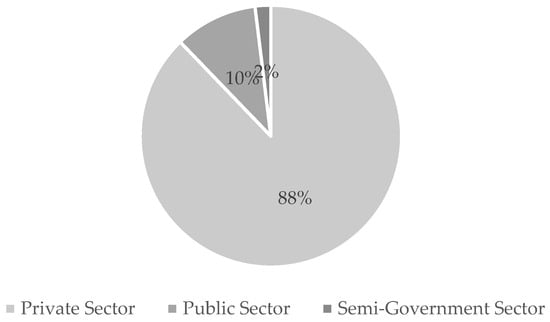
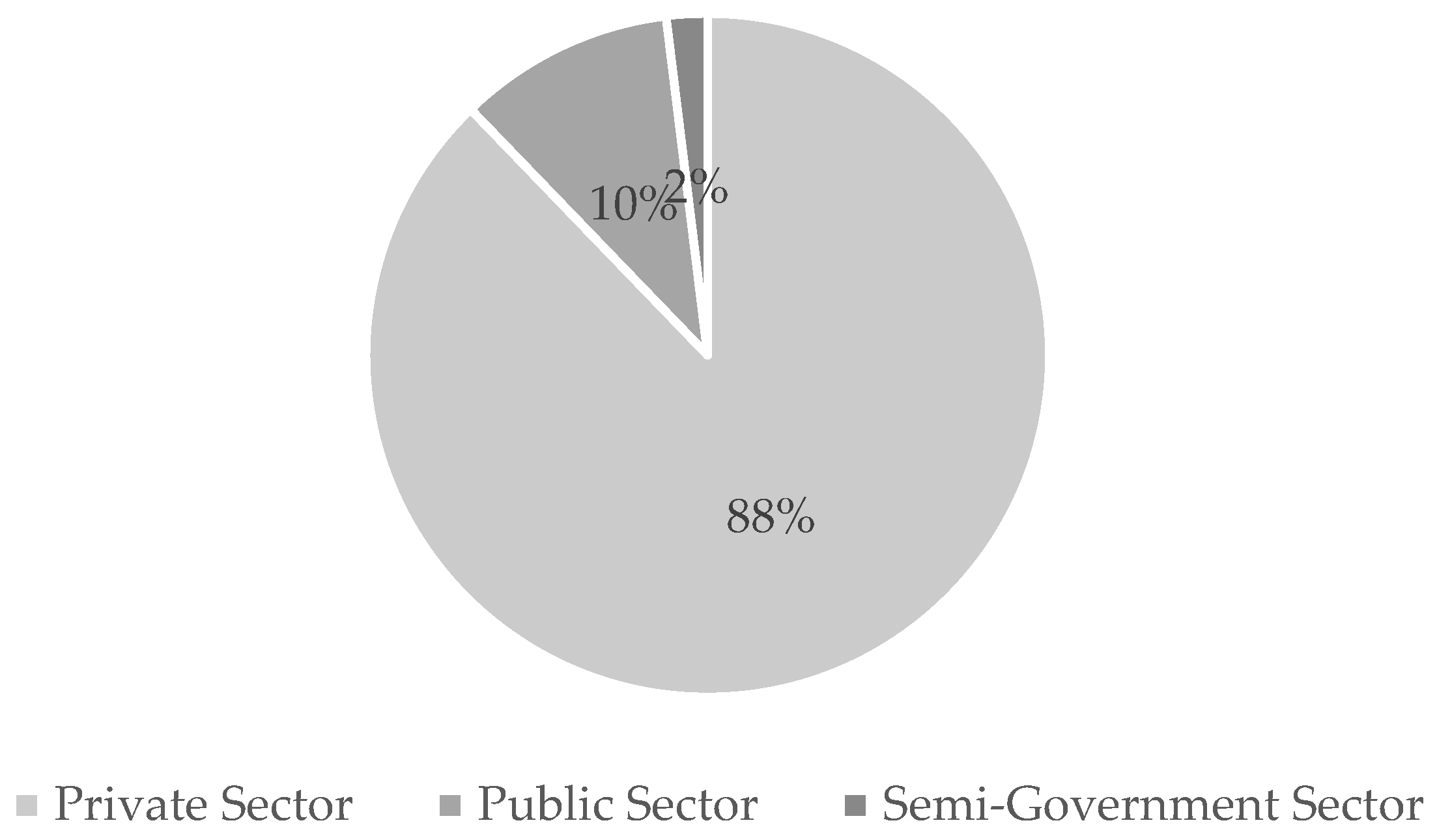
The labor market analysis for Q1 2025 indicates a total of 140,624 advertised vacancies, with the highest shares concentrated in Business, Administration, and Law (18.2%), Health and Welfare (17.4%), and Engineering, Manufacturing, and Construction (17.1%). Together, these sectors account for more than half of all the job opportunities observed. In contrast, Education and ICT represent a comparatively small proportion of total vacancies, accounting for 3.5% and 1.9%, respectively (see Table 2). As illustrated in Figure 1, job demand is predominantly concentrated in the private sector, which accounts for approximately 88% of total vacancies, while the public sector represents around 10% and the semi-government sector remains marginal at approximately 2%. Regionally, employment opportunities are heavily concentrated in Makkah, Riyadh, and the Eastern Province, which together account for more than 70% of all job postings. Figure 1 is constructed using variables that are explicitly defined within the dataset, including sector and region classifications; all values represent direct aggregations of observed job vacancy records without any inferential transformation.
Table 2.
Job Demand by Field in 2025.
Figure 1.
Job Demand by Sector in 2025.
When examined through alignment indicators, specifically jobs per 100 graduates and shortage/surplus differentials, pronounced quantitative imbalances across fields become evident. Fields such as Business, Administration, and Law exhibit a substantial quantitative oversupply, with 119,854 graduates in 2023 compared with 25,633 advertised job vacancies in Q1 2025, resulting in a low ratio of approximately 21 jobs per 100 graduates and a quantitative surplus of 94,221 graduates. In contrast, Services and Health and Welfare display pronounced quantitative shortages, with 180.55 and 139.28 jobs available per 100 graduates, respectively, despite comparatively lower graduate output. These indicators highlight uneven quantitative alignment between graduate production and observed labor market demand across fields, without implying causal or skill-based mismatches.
4.3. Sectoral and Regional Distribution
The sectoral and regional analysis of job demand reveals a high degree of concentration across specific sectors and locations. The private sector accounts for the majority of job demand in most disciplines, particularly in Business, Engineering, and ICT, reflecting their predominantly private-sector orientation. In contrast, demand in Health and Welfare is more evenly distributed between sectors, with approximately 53% of vacancies in the private sector and 44% in the public sector. Across regions, job opportunities are heavily concentrated in Makkah (31.4%), Riyadh (26.3%), and the Eastern Province (13.6%), which together account for more than 70% of total job postings. This spatial concentration reflects the structural role of major urban and economic hubs in shaping labor demand patterns and suggests uneven geographic distribution of employment opportunities across regions. As a result, graduates located outside these hubs may face greater structural barriers to local employment, potentially requiring geographic mobility to access available job opportunities.
4.4. Institutional Shifts in Graduate Production (2021–2023)
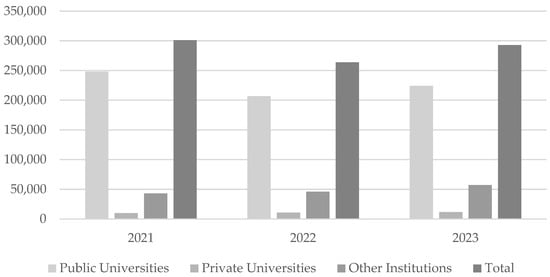
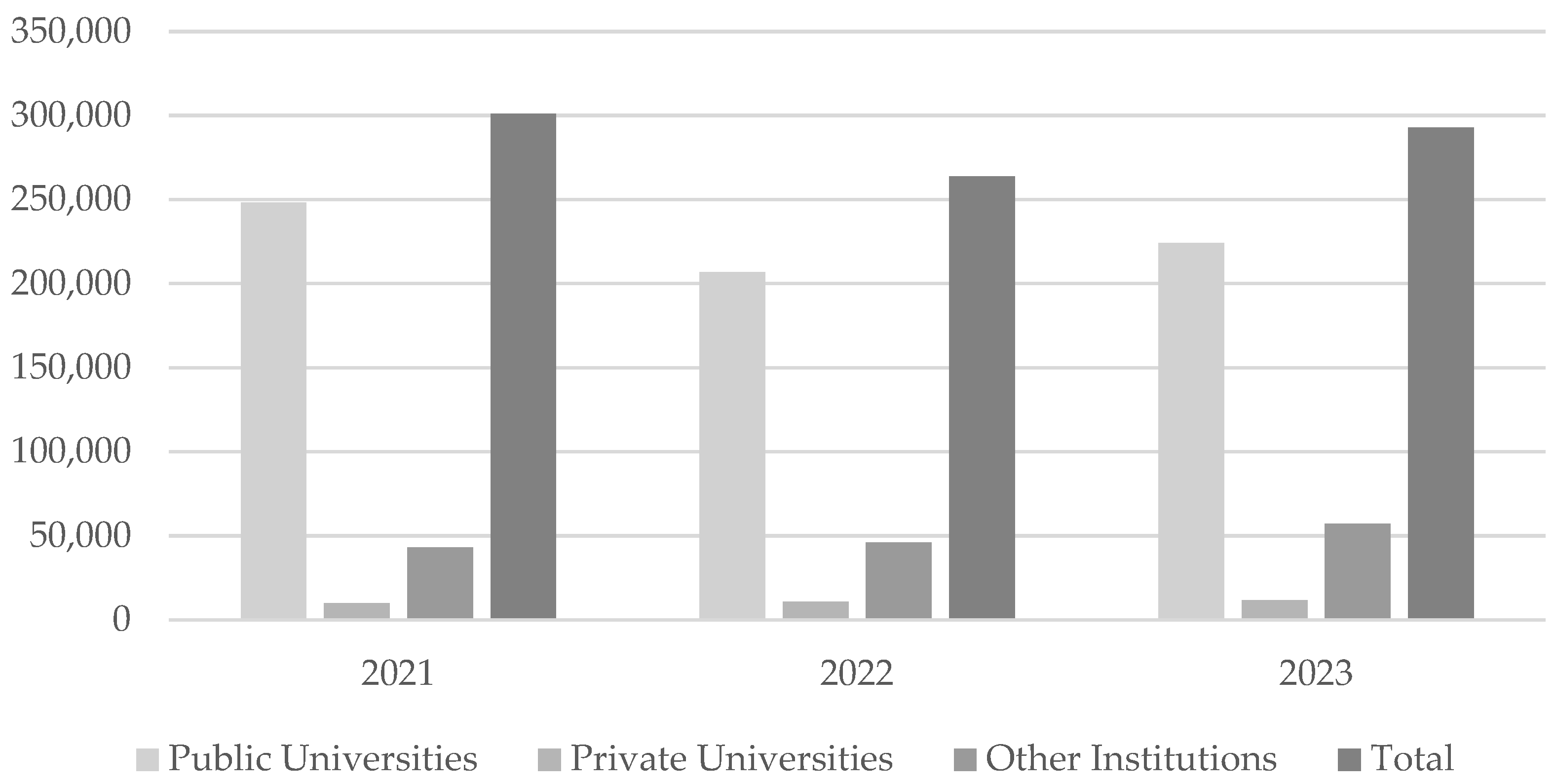
The comparison of institutional graduate output between 2021 and 2023 indicates a decline in the proportion of graduates from public universities, from 82.4% in 2021 to 76.5% in 2023, as calculated from the aggregated institutional counts shown in Figure 2, while the share of private universities remained relatively stable at approximately 4%, with comparatively higher representation in fields such as Health and Business. As illustrated in Figure 2, public universities consistently account for the majority of graduate output across all three years, despite a noticeable contraction in 2022 followed by a partial recovery in 2023. Private universities contribute a smaller but gradually increasing share over the same period, whereas other institutional categories remain marginal. The temporary decline in total graduate numbers in 2022 suggests short-term system-level fluctuations rather than a sustained trend. Overall, these patterns indicate that public universities continue to play a structurally dominant role in graduate production within the higher education system, underscoring their central position in shaping national graduate supply.
Figure 2.
Distribution of Graduates by Institution Type, 2021–2023.
4.5. Graduate–Labor Market Alignment: Indicators and Associations
4.5.1. Correlation Analysis
The analysis examines the association between graduate supply (i.e., the number of graduates in a particular field) and job demand (i.e., the number of job postings in the corresponding field). Pearson’s correlation is employed to assess whether a statistical association exists between the two variables. Table 3 presents graduate numbers for 2023, employment opportunities for 2025, and the ratio of jobs per 100 graduates across fields of study. The results show substantial variation in jobs per 100 graduates across fields. Services recorded the highest ratio, with 180.55 jobs per 100 graduates, followed by Health and Welfare (139.28) and Engineering, Manufacturing, and Construction (112.34). In contrast, Arts and Humanities, Natural Sciences, and Social Sciences recorded very low ratios, indicating pronounced quantitative oversupply relative to observed job demand.
Table 3.
Distribution of Jobs per 100 Graduates and Resulting Shortage/Surplus by Field of Study.
The Pearson correlation coefficient indicated a positive but statistically non-significant association between graduate output and observed job demand across the ten matched fields of study (r = 0.486, p = 0.155). This suggests that fields with larger graduate output tended, to some extent, to have higher observed job demand; however, the association was not statistically significant and should therefore be interpreted cautiously as a descriptive pattern of field-level co-variation rather than as evidence of a robust statistical or causal relationship.
4.5.2. Exploratory Linear Regression Analysis
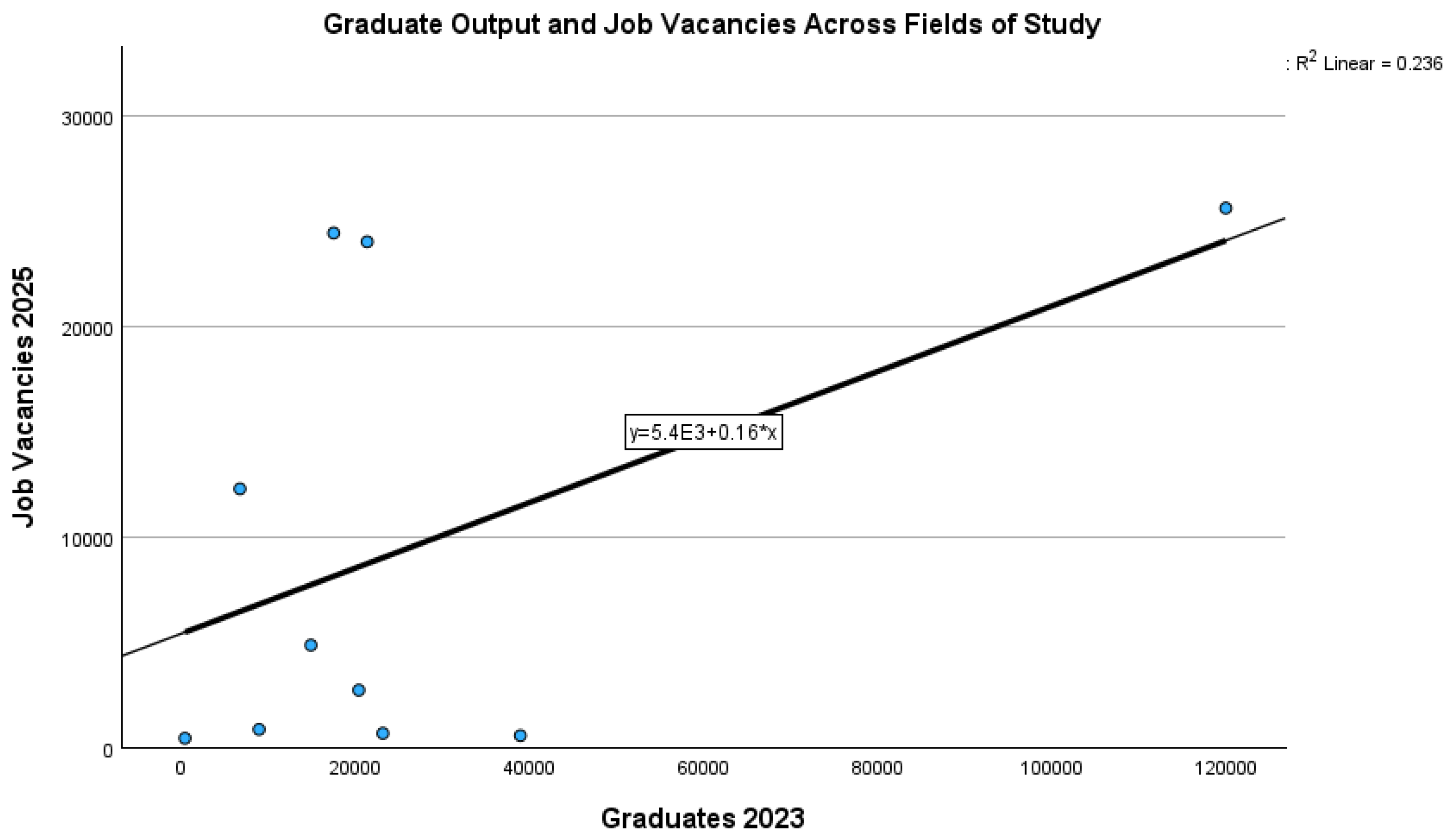
The regression results help in describing the relationship between the number of graduates in 2023 and employment opportunities in 2025. To complement the correlation analysis, a simple linear regression was conducted as an exploratory descriptive tool to summarize the degree of co-variation between graduate output in 2023 and observed job vacancies in Q1 2025 across the ten matched fields of study. The model indicated that graduate output accounted for approximately 23.6% of the variation in observed job vacancies across fields (R2 = 0.236; adjusted R2 = 0.141). However, the regression model was not statistically significant, F(1, 8) = 2.472, p = 0.155.
The coefficient for graduate output was positive (B = 0.156), indicating that fields with higher graduate numbers tended to have higher observed job vacancies. However, this coefficient was not statistically significant (p = 0.155). Accordingly, the regression results should be interpreted as descriptive evidence of broad field-level co-variation rather than as predictive and/or causal evidence. These results reinforce the need to interpret the alignment indicators primarily through field-specific ratios, shortages, and surpluses rather than through regression-based prediction.
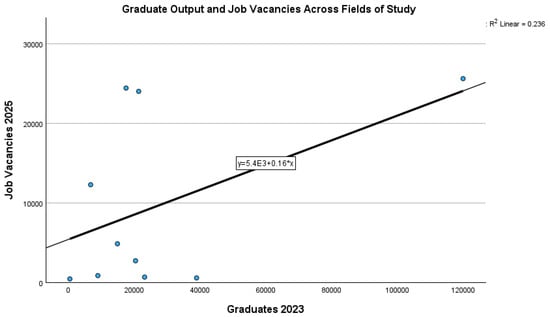
In Figure 3, the scatter plot illustrates the relationship between the number of graduates in 2023 (x-axis) and the number of job vacancies in 2025 (y-axis), with each point representing a field of study. The fitted regression line indicates a positive linear association, showing that fields with larger graduate output also tend to exhibit higher observed job demand. The R2 value (0.236) suggests that a limited proportion of the variation in job vacancies is associated with differences in graduate numbers across fields; however, this association was not statistically significant and should be interpreted as descriptive rather than causal.
Figure 3.
Scatter plot with fitted regression line. Relationship between graduates (2023) and job vacancies (2025) across fields; the fitted line indicates a positive descriptive association.
5. Discussion
The findings of this study document the presence of persistent quantitative imbalances between graduate supply and observed labor market demand in Saudi Arabia. The analysis reveals substantial variation across fields, with pronounced oversupply in some non-technical disciplines and clear shortages in health- and service-related areas. These patterns indicate structural misalignment in the distribution of graduate output relative to advertised job opportunities, rather than uniform demand across fields.
The association between graduate supply and job demand was positive across the ten matched fields of study (r = 0.486, p = 0.155), suggesting that fields producing larger numbers of graduates also tend to exhibit higher observed job demand. However, this relationship should be interpreted as descriptive of structural co-variation rather than as evidence that graduate output directly determines employment opportunities. The exploratory regression analysis further supports this cautious interpretation, showing that graduate output explains only a limited proportion of variation in job vacancies, while most variation remains attributable to other structural factors. This finding is consistent with earlier work emphasizing the limitations of supply-driven education systems in responding to dynamic labor market conditions (Kirschner and Valcke 1994).
Field-level patterns reinforce this interpretation. The pronounced oversupply observed in Business, Administration, and Law (where only 21.39 jobs are available per 100 graduates) is consistent with prior studies reporting excess graduate output in business- and humanities-related disciplines and its association with underemployment (Eric et al. 2025; Ghouse et al. 2018). In contrast, Health and Welfare and Services exhibit markedly higher job-to-graduate ratios (139.28 and 180.55, respectively), reflecting quantitative shortages relative to advertised demand. These contrasts highlight uneven quantitative alignment across disciplines rather than direct evidence of skill-level mismatches. That said, the policy relevance of the findings lies in identifying which fields may require closer monitoring of program capacity, curriculum orientation, and labor market responsiveness.
Overall, the findings underscore the importance of evidence-based approaches to higher education planning and labor market alignment, as emphasized within Saudi Arabia’s Vision 2030 framework (Kikasu et al. 2025). At the same time, the results highlight that graduate quantity alone provides an incomplete picture of employability and labor market dynamics. Sectoral composition, geographic concentration, technological change, and the relevance of educational content likely play substantial roles in shaping observed employment patterns, suggesting that graduate–labor market alignment should be understood as a multidimensional structural issue rather than a purely numerical one. Theoretically, these findings suggest that graduate–labor market alignment cannot be fully explained by human capital supply alone; Instead, the results emphasize that employability is shaped by graduate numbers as well as the distribution of opportunities across sectors, regions, and skill domains. This interpretation is consistent with international literature showing that graduate employability is shaped by the interaction between graduate attributes, institutional contexts, and demand-side labor market conditions, rather than by educational output alone (Holmes 2013; Suleman 2018; Jackson and Tomlinson 2020; Tee et al. 2024; Biagi et al. 2025). The study relies on publicly available, aggregated datasets, which support its replication in other contexts with comparable data structures; however, the findings are inherently shaped by the specific conditions of Saudi Arabia within a defined period of time.
6. Conclusions
The current study provides an empirical analysis of the alignment between higher education graduate output and observed labor market demand in Saudi Arabia. By combining national graduate datasets with recent job vacancy data, the analysis highlights persistent structural imbalances across fields of study, reflecting uneven alignments rather than a uniform relationship between educational output and labor market demand. Consistent with previous research, including Eric et al. (2025), the results reinforce the persistence of misalignment between higher education output and labor market requirements in Saudi Arabia.
Nonetheless, the findings suggest that graduate quantity offers a limited explanation of employability dynamics, reinforcing that labor market absorption is shaped by multiple interacting factors beyond supply. These include sectoral composition, geographic concentration of employment opportunities, and the evolving skill requirements in a transforming economy. As such, graduate–labor market alignment should be considered as a multidimensional structural issue rather than a quantitative or causal relationship. This reinforces the need for future studies to combine national labor market intelligence with graduate outcome tracking, employer data, and program-level curriculum analysis.
Recommendations
Within the context of Saudi Arabia’s Vision 2030 reforms, the study contributes an empirical foundation to contemporary policy discussions on curriculum responsiveness, workforce planning, and the critical role of higher education in supporting labor market needs. Based on the empirical patterns identified in this study, the authors propose a set of policy-relevant recommendations to inform discussions on improving alignment between graduate output and observed labor market demand in Saudi Arabia, in three thematic areas: curriculum orientation, regional alignment, and industry–university collaboration. These recommendations are directly linked to the study’s indicators: field-level jobs-per-graduate ratios, shortage/surplus differentials, and the observed sectoral and regional concentration of vacancies.
- 1.
- Curriculum Orientation and Skills Alignment
The observed quantitative oversupply in fields such as Business, Administration, and Law, alongside shortages in Health and Welfare and Services, suggests the need to reassess curriculum priorities across disciplines. Higher education institutions may consider strengthening the practical, digital, and applied components of curricula in response to evolving sectoral demand, particularly in health-, technology-, and service-related fields. Rather than implying immediate labor market outcomes, such curriculum adjustments could support greater responsiveness of academic programs to observed demand patterns. For example, fields with low jobs-per-graduate ratios may require careful review of program capacity and graduate skill profiles, while fields with high ratios may warrant targeted expansion.
In parallel, the quantitative shortages identified in technically oriented fields highlight the potential role of expanded technical and vocational education and training (TVET) pathways. Enhancing TVET programs, particularly in healthcare, engineering, ICT, and related sectors, may help diversify graduate pathways and better reflect the distribution of advertised labor demand. Work-integrated learning opportunities, including internships and apprenticeships developed through public–private collaboration, could further support alignment between educational provision and workplace requirements.
- 2.
- Regional Planning and Alignment
The concentration of job demand in major economic hubs, specifically Makkah, Riyadh, and the Eastern Province, contrasts with the more geographically dispersed pattern of graduate production. This spatial imbalance suggests the relevance of regionally informed academic planning. Universities may consider aligning selected program offerings with regional economic profiles, while policymakers may explore complementary strategies to support localized employment opportunities in underserved regions. Such approaches could contribute to reducing structural geographic mismatches without presuming labor mobility outcomes. This recommendation follows directly from the finding that job vacancies are concentrated in a limited number of major regions, suggesting that alignment policies should consider not only field of study, but also geographic distribution of opportunities.
- 3.
- Strengthening Industry–University Collaboration
The persistence of quantitative mismatches across fields underscores the importance of sustained engagement between higher education institutions and industry stakeholders. Structured collaboration mechanisms, such as advisory boards, co-designed curricula, and shared labor market intelligence, may help ensure that academic programs remain informed by evolving sectoral needs. In this context, continuous monitoring of job demand through institutions such as the National Labor Observatory (NLO) can provide timely evidence to support strategic planning, while recognizing that advertised vacancies represent short-term indicators rather than long-term employment guarantees. Such collaboration is particularly important as the study shows that graduate numbers alone do not sufficiently explain observed job demand across all fields.
These recommendations are intended to inform evidence-based discussions and strategic decision-making aimed at improving alignment between graduate output and observed labor market demand. By providing a structured empirical basis for such discussions, the study contributes to ongoing efforts to enhance the responsiveness of higher education systems to labor market needs.
Author Contributions
Conceptualization, M.S.A.; methodology, M.S.A. and I.M.A.A.; software, M.S.A. and I.M.A.A.; validation, M.S.A. and I.M.A.A.; formal analysis, M.S.A. and I.M.A.A.; investigation, M.S.A. and I.M.A.A.; resources, M.S.A. and I.M.A.A.; data curation, M.S.A. and I.M.A.A.; writing—original draft preparation, M.S.A. and I.M.A.A.; writing—review and editing, M.S.A. and I.M.A.A.; visualization, M.S.A. and I.M.A.A.; supervision, M.S.A.; project administration, M.S.A. All authors have read and agreed to the published version of the manuscript.
Funding
This research received no external funding.
Institutional Review Board Statement
Not applicable.
Informed Consent Statement
Not applicable.
Data Availability Statement
The data presented in this study are available in Saudi Open Data Portal (https://open.data.gov.sa, accessed on 12 September 2025).
Conflicts of Interest
The authors declare no conflicts of interest.
References
- Alanazi, Adel Saber, and Houcine Benlaria. 2023. Bridging higher education outcomes and labour market needs: A study of Jouf University graduates in the context of Vision 2030. Social Sciences 12: 360. [Google Scholar] [CrossRef] [Scilit]
- Alotaibi, Nayef Shaie, and Awad Hajran Alshehri. 2023. Prospers and Obstacles in Using Artificial Intelligence in Saudi Arabia Higher Education Institutions—The Potential of AI-Based Learning Outcomes. Sustainability 15: 10723. [Google Scholar] [CrossRef] [Scilit]
- AlSharif, Moza, Abdulrahman AlMansoori, and Maitha Alnaqbi. 2025. How Smart Education Technologies Can Prepare Post-Graduate Students to Be Productive and Increase Their Readiness for the Job Market. International Journal of Technology and Systems 10: 38–54. [Google Scholar] [CrossRef] [Scilit]
- Biagi, Federico, Castano Muñoz, and Di Pietro. 2025. Mismatch Between Demand and Supply Among Higher Education Graduates in the EU. Luxembourg: Publications Office of the European Union. [Google Scholar] [CrossRef]
- Eric, Ralainirina Razokiny, Jean Tsitaire Arrive, and Ralaivao Hanginiaina Emynorane. 2025. Impact of the Higher Education Training on the labor Market Demand: Evidence from African Higher Education. International Journal of Educational Research 2: 53–63. [Google Scholar] [CrossRef] [Scilit]
- Ghouse, Suhail M., Monica Chaudhary, and Sumit Garg. 2018. Importance of Non-Technical Skills for Employment Opportunities: A Gap Analysis of Students and Employers Perception Importance of Non-Technical Skills. Paper presented at the 2018 Eleventh International Conference on Contemporary Computing (IC3), Noida, India, August 2–4. [Google Scholar] [CrossRef] [Scilit]
- Haidar, Fahd Taha. 2025. Employability skills of accounting students: What do their CVs tell us? Humanities and Social Sciences Communications 12: 910. [Google Scholar] [CrossRef] [Scilit]
- Holmes, Leonard. 2013. Competing perspectives on graduate employability: Possession, position or process? Studies in Higher Education 38: 538–54. [Google Scholar] [CrossRef] [Scilit]
- ILO. 2024. Global Employment Trends for Youth 2024. Geneva: International Labor Organization. Available online: https://www.ilo.org/publications/major-publications/global-employment-trends-youth-2024 (accessed on 18 November 2025).
- Jackson, Denise, and Michael Tomlinson. 2020. Investigating the relationship between career planning, proactivity and employability perceptions among higher education students in uncertain labour market conditions. Higher Education 80: 435–55. [Google Scholar] [CrossRef] [Scilit]
- Kikasu, Eustache Tanzala, Yunus Goolam Doba, Strinivasan Soondrasan Pillay, and Gustave Mungeni Kankisingi. 2025. Higher Education and Its Contribution to Economies of African Countries: Move Towards Competence-Based and Skills Demand-Driven Standards in Collabouration with Industry. Journal of Education and Learning 14: 21. [Google Scholar] [CrossRef] [Scilit]
- Kirschner, Paul A., and Martin M. A. Valcke. 1994. From supply-driven to demand-driven education: New conceptions and the role of ICT therein. Computers in Human Services 10: 31–53. [Google Scholar] [CrossRef] [Scilit]
- Mahardhani, Ardhana Januar, Bernadetha Nadeak, Ita Musfirowati Hanika, Izlan Sentryo, and Rosmalina Kemala. 2023. A New Approach to Curriculum Development: The Relevance of the Higher Education Curriculum to Industry Needs. International Journal of Educational Research Excellence (IJERE) 2: 501–9. [Google Scholar] [CrossRef] [Scilit]
- Mohammed, Farhad Sadik, and Fezile Ozdamli. 2024. A Systematic Literature Review of Soft Skills in Information Technology Education. Behavioral Sciences 14: 894. [Google Scholar] [CrossRef] [Scilit] [PubMed]
- OECD. 2024. OECD Employment Outlook 2024. Paris: OECD. Available online: https://www.oecd.org/en/publications/oecd-employment-outlook-2024_ac8b3538-en.html (accessed on 18 November 2025).
- Ortiz, Eva Juliana Maya. 2025. An Integrated Competency-Based Framework for Employability and the Sustainability of Higher Education. Sustainability 17: 10340. [Google Scholar] [CrossRef] [Scilit]
- Suleman, Fátima. 2018. The employability skills of higher education graduates: Insights into conceptual frameworks and methodological options. Higher Education 76: 263–78. [Google Scholar] [CrossRef] [Scilit]
- Tee, Poh Kiong, Ling Chai Wong, Morakinyo Dada, Bee Lian Song, and Chee Pung Ng. 2024. Demand for digital skills, skill gaps and graduate employability: Evidence from employers in Malaysia. F1000Research 13: 389. [Google Scholar] [CrossRef] [Scilit] [PubMed]
- Vision 2030. 2016. Saudi Arabia’s Vision 2030; Riyadh: Vision 2030. Available online: https://www.vision2030.gov.sa/media/rc0b5oy1/saudi_vision203.pdf (accessed on 18 November 2025).

Disclaimer/Publisher’s Note: The statements, opinions and data contained in all publications are solely those of the individual author(s) and contributor(s) and not of MDPI and/or the editor(s). MDPI and/or the editor(s) disclaim responsibility for any injury to people or property resulting from any ideas, methods, instructions or products referred to in the content. |
© 2026 by the authors. Licensee MDPI, Basel, Switzerland. This article is an open access article distributed under the terms and conditions of the Creative Commons Attribution (CC BY) license.