


Abstract
Human trafficking is a complex global problem maintained by a web of interacting individual, community, national and international factors. Its complexity is not always robustly addressed in policy, practice and research, with issues commonly approached in silos. This commentary creates the case for more intentional application of systems thinking in the counter-trafficking field. We do this by describing some of the origins of a more systemic focus in counter-trafficking work including the emergence of public health approaches, survivor- or lived-experience leadership and developments in the research domain. We then provide three case examples of how a systems lens has been applied in research, in policy and in practice across three countries, the UK, Canada and the US. We conclude with reflections on the promise of and challenges for systems thinking and a call to action for more systems-informed counter-trafficking work.
1. Introduction
Human trafficking (Allen et al. 2025) is a complex and systemic global issue with profound social and health consequences (Ottisova et al. 2016). It is generated and maintained by interacting phenomena at multiple levels, including international, national, institutional, regional, local, community, family, peer group, and individual. Its estimated global ubiquity and growth indicate its systemic complexity has been hard to address. In 2021, global estimates indicated that approximately 50 million people were living in conditions of modern slavery, an umbrella term that includes various forms of human trafficking (International Labour Organization (ILO), Walk Free and International Organization for Migration 2022). The 2024 Global Report on Trafficking in Persons noted a 25 percent increase in identified cases of human trafficking and a 31 percent increase in identified cases of child trafficking between 2019 and 2022 (United Nations Office on Drugs and Crime 2024). As a complex systems issue, human trafficking is also referred to as a ‘wicked problem’ (Stephens and Thomas 2025). Often fraught socially and politically, its ill-defined and evolving nature, context specificity, and complex interdependencies between and within systems and sub-systems (Stephens and Thomas 2025), render solutions elusive, leading some stakeholders to advocate for ‘systems change’ (Shipman et al. 2025) or a ‘whole systems response’ (McCoig et al. 2022; Cockbain and Tompson 2024) as a necessary alternative to individual programs or siloed policies (Shipman et al. 2025). This requires potentially different approaches to anti-trafficking work and a clearer articulation of our thinking framed within systems.
There is considerable literature on the complexity of human trafficking in its myriad forms (e.g., sex, labor, organ, adult, child), contexts (e.g., domestic, international) and the systems (e.g., policy, practice, legal) within which it generates, operates, is maintained, and disrupted. We know some of the observed behaviors, interests, intentions, and powers of a range of actors in trafficking and anti-trafficking, for example, in policing (Farrell and Pfeffer 2014; Farrell et al. 2019; Allen et al. 2025), NGOs (Limoncelli 2016; Noyori-Corbett and Moxley 2018) and support services (Richie-Zavaleta et al. 2021; Macy and Graham 2012; Recknor et al. 2023). We know less, however, about how these elements of systems interrelate or interact and their implications for policy, practice, and research.
This paper provides an evidence- and practice-based demonstration of how systems thinking can be applied to human trafficking and exploitation, particularly in meeting prevention goals. Systems thinking is a perspective, a language and a set of tools used to address problems as a whole (holistically), recognizing that events or patterns derive from deep social structures (Monat and Gannon 2015). Its emergence can be seen as an extension of several ‘turns’ in the counter-slavery field including towards complexity, survivor empowerment and emergent perspectives such as a public or population health approaches. These trends in the human trafficking field (e.g., Todres 2011; Zimmerman et al. 2011; Clarke et al. 2013; Greenbaum et al. 2018; Such et al. 2020, 2024; Recknor et al. 2022; Weston and Mythen 2023) embrace the concept of interconnected policy systems and practice functioning together to prevent harm, particularly through addressing root causes. The purpose of the application of systems thinking is to achieve systems change or the ‘intentional process designed to alter the status quo by shifting the function or structure of an identified system’.
First, we articulate the origin of our concern for systems thinking in these emergent trends. Second, we illustrate three different examples of our work in local policy, healthcare settings and research where we have, in different ways, applied a systems lens. Finally, we discuss our cautious optimism, highlighting the potential of emerging applications, areas for further development and challenges yet to overcome. We conclude with a call to systems thinking and action to advance counter-trafficking work.
2. The Emergence of Systems Thinking in Counter-Trafficking
Systems-oriented approaches to counter-trafficking in policy, practice and research have several starting points. While a full examination of these is out of the scope of this commentary, we see at least three evolutions in human trafficking theory, method and practice as key contributors: (i) the development and application of public health approaches to human trafficking, (ii) the growth of survivor-oriented and -directed innovation, (iii) the maturation of scientific studies using systems theory and method in the field.
First, public health approaches to human trafficking have begun to take root in research, policy and some areas of practice. Its connection to systems thinking lies in its explicit recognition of human trafficking and exploitation as a complex or ‘wicked problem’, one that is persistent with multiple risk and protective factors interacting across different levels of society. Greenbaum notes consistency around the world in the complex social determinants and drivers of exploitation across individual, relationship, community and societal levels (see Greenbaum 2020 for a fuller outline of these multi-factorial elements of risk). Typically, a public health perspective to human trafficking offers an approach that addresses such issues across ‘whole systems’ locally, nationally and globally (Greenbaum 2020; Such et al. 2020, 2024; Recknor et al. 2022).
The alignment of public health approaches and systems perspectives emerge from its orientation towards populations (rather than individuals), its emphasis on data and evidence, prevention and partnership (Greenbaum 2020; Recknor et al. 2022; Such et al. 2020, 2024). Research on a public health framework to address human trafficking articulates these fundamental elements and their interconnection (Such et al. 2020, 2024).
The framework highlights several systems-level issues. For example, at a national level (and potentially global level, cf. Such et al. 2020), policy and law must be coherent, consistent, coordinated and cooperative across government. The absence of several of the 6 ‘Cs’ of policy (coherent, consistent, coordinated, comprehensive, compliant with the law, cooperative) has been highlighted as one of the barriers to effective prevention (Dean 2020; Murphy et al. 2022; Such et al. 2024). In addition, the engagement of statutory agencies, civil society, businesses, and citizens working together to achieve desired outcomes—a collaborative or partnership orientation—underscores a localized public health approach. Critically, no single agency, service or program can address trafficking alone. Partnerships are needed to offer coordination at and across every level.
Beyond conceptual development, public health approaches to human trafficking have begun to frame policy. The Scottish Government, for example, has structured its human trafficking strategy around a public health approach (Scottish Government 2025) and the 2024 US National Human Trafficking Framework used a public health approach to prevention (US Department of Health and Human Services 2024).
Second, the turn towards systems and complexity-oriented work in counter-trafficking and -exploitation has emerged from the evident leadership of and direction provided by survivors or people with lived experience of trafficking. The past decade has seen a transformative shift in survivor involvement in the creation of policies, research programs and practices in the field. This empowerment, trauma-informed and survivor-centered movement (Azzopardi et al. 2024; Human Trafficking Foundation 2025) has manifested in networks, councils and leaders integrated in many decision-making structures and in service design and delivery. This has moved beyond advocacy towards normalized best practice, albeit with uneven application across geographies and contexts. Importantly, survivor inclusion has leveraged unique knowledge and experience of the complexities of trafficking, vital for the development of effective, systems-focused responses and outcome measurement (Jannesari et al. 2024). In addition, survivor-centered approaches have challenged traditional power hierarchies, embedding in it a systems-critical orientation that surfaces the need for power structures and dynamics to change to deliver successful counter-trafficking action (Shipman et al. 2025).
The final contributing factor to the emergence of systems thinking in counter-trafficking has been the application of systems theory and methods in research in the past decade. To answer the question, ‘How has systems theory and method been applied to human trafficking research?,’ we conducted an abbreviated review of the literature. Five databases were searched (APA PsycInfo, Embase, OVID Medline, ProQuest, and Web of Science), with terms that included systems integration/theory/science/change//model/dynamic/strategy/OR complex system AND human/sex/labor trafficking, domestic servitude/debt bondage/modern slavery/anti-trafficking/enslavement/or sex trade. The search yielded 233 results. Sifts yielded 13 research articles with an explicit focus on systems-oriented research in the human trafficking field.
Briefly reviewed, these emergent studies applied systems-informed theory, method and tools. In terms of theoretical development, Barlow et al. developed a complexity-informed analytical framing for child criminal exploitation, showing interactions between potential victims, a conductive environment and a motivated exploiter (Barlow et al. 2021). Van der Watt and van der Westhuizen considered how complex systems theory could be considered and integrated into the criminal justice response to human trafficking in South Africa, noting how both the criminal justice system nor human trafficking can be compressed or simplified (Van der Watt and van der Westhuizen 2017).
Methodologically, advances have been made in the application of ‘systems science’ methodology, a body of methods designed to generate models, or simplified versions, of reality (Mabry et al. 2010). Examples of methods in this domain include system dynamics modeling, network analysis and agent-based modeling (ABM) (Luke and Stamatakis 2012). McAlpine and colleagues noted both the promise and underutilization of ABM in migration and human trafficking research (McAlpine et al. 2021). Applications of ABM have been used to explore the dynamics of labor exploitation, with guidance developed for researchers on how to apply the tools and techniques of the method (Chesney 2021). Cockbain et al., use social network analysis (SNA) to explore victim and offender networks of internal child sex trafficking in the UK (Cockbain et al. 2011). They identify how SNA can be advanced in the context of situational policing practice, arguing for its greater and more sophisticated use. In addition, Causal Loop Diagramming (a form of systems mapping) has been used as a tool to understanding how systems of harm were generated and reinforced for UK survivors of human trafficking during the COVID-19 pandemic (Such et al. 2026). Kiss et al. used Bayesian network analysis to evaluate an anti-trafficking program for migrant workers in South Asia, producing findings that challenged usual understanding of pathways into trafficking (Kiss et al. 2021). They found that risks of trafficking were mostly determined by migrants’ destination country, how they were recruited and their sector of work rather than their vulnerabilities as individuals. In other words, the approach revealed that the structures and dynamics of migration systems generated opportunities for harm, not just the ‘risk factors’ embodied in the individual (e.g., poor, fe/male, low educated).
Despite these advances, systems thinking in human trafficking research offers only a small number of applications. These are often highly technical, using methods drawn from the more positivist traditions of systems science. Systems thinking, however, offers a long history and range of traditions (Hammond 2005; Systems Thinking Alliance 2024), from ontological positivism to critical methodological pluralism aligned with goals of emancipation. The field of human trafficking research does not, to date, offer this philosophical, theoretical, methodological and applied range.
3. Illustrating the Potential of Systems Thinking Through Examples in Research, Policy and Practice
There are few research, policy and practice illustrations of how systems thinking can be applied to human trafficking and exploitation. To fill this gap, the following examples demonstrate how different systems-informed approaches have been used and how it can deliver additional insight and value to the anti-trafficking domain. We intentionally present our findings in an illustrative rather than comprehensive manner, offering possible new lines of inquiry, methods and practical applications. Our examples are from research in the UK, policy in Canada and practice in the US.
3.1. Understanding Systems of Prevention in Developing Research Agendas: Mapping Experiences of Survivors of Trafficking (Led by ES and HA)
3.1.1. The Project Problem
This project sought to explore the experience of pregnancy, or ‘what happens’ during trafficking and exploitation, as a means of identifying possible opportunities for research on harm prevention and mitigation. We undertook this work as we know that globally, women and girls are disproportionately affected by trafficking and exploitation (Walk Free 2023). Although data are difficult to obtain, one study of trafficking survivors in the UK found that 28 (29%) of 98 women who took part reported one or more pregnancies while trafficked (Bick et al. 2017). There is limited documentation or research analysis on ‘what happens’ when victims become pregnant, although some survivor accounts are available (Prakash et al. 2023a; Collins and Skarparis 2024) as well as some insight on how maternity and reproductive services provide appropriate care (Bick et al. 2017; Borrelli et al. 2023; Prakash et al. 2023b). This project addressed this challenge, applying concepts and tools of critical systems thinking.
3.1.2. Our Approach
We worked with people with lived experience of exploitation to help surface what could or does happen when women living in trafficked and exploited situations become pregnant. We explored hypothetical processes and outcomes through vignettes to protect participants’ right to non-disclosure and psychological safety. Together, survivors articulated the possible processes and outcomes of pregnancy and then uncovered the places within these systems where circumstances and dynamics could be shifted to protect women from further exploitation and harm.
3.1.3. Methods of Exploring Pregnancy During Trafficking
We adopted and adapted Group Model Building (GMB) (Siokou et al. 2014) techniques with survivors of trafficking (n = 7) in a face-to-face setting. This was a facilitated process supported by a survivor research leader, one lead university researcher, and two other university staff members, who engaged in activities and took notes.
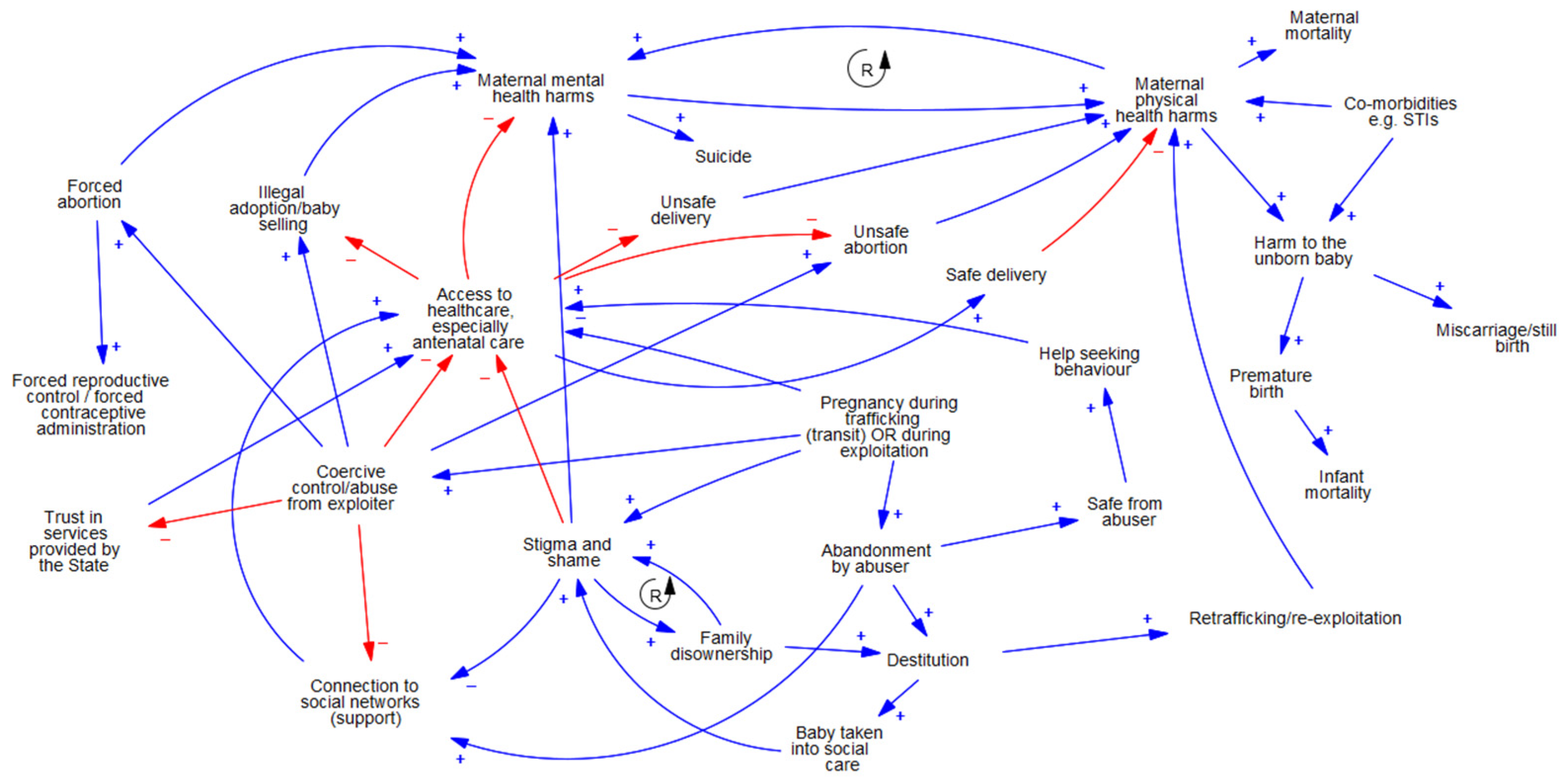
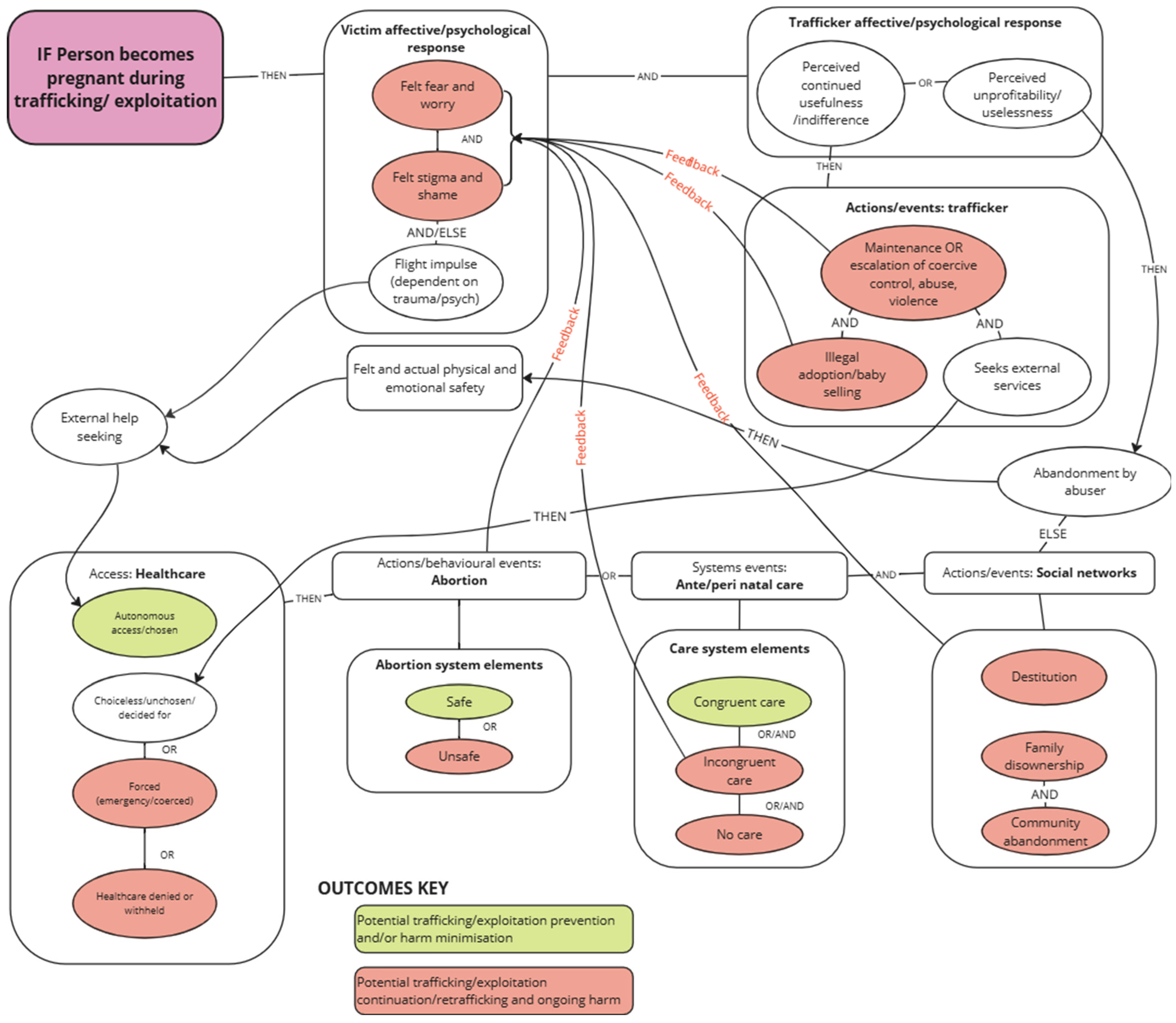
The question of ‘what happens’ was asked in two workshops (3 h in total) where system elements and dynamics were explored, recorded and synthesized in discussion and documentation. Workshop 2 included a validation process and new iterations and reiterations of the model. This led to the creation of a systems-level Causal Loop Diagram (Figure 1) and a more person-centered mapping of what can happen to women who become pregnant during exploitation. This used conditional statements (e.g., IF, THEN statements) to demonstrate how situations could deteriorate or improve for victims (Figure 2).
Figure 1.
An initial Causal Loop Diagram of what can happen when a person becomes pregnant during trafficking. Explanation/key: Blue arrow with + polarity = Increase in factor A leads to increase in B—that is, change in the same direction. Red arrow with—polarity = Increase in variable A leads to decrease in B—that is, change in the opposite direction. R loop—Reinforcing feedback loop (increase in A leads to increase in B leads to increase in A, etc.).
Figure 2.
What can happen at pregnancy using conditional statements, showing the centrality of stigmas.
3.1.4. What This Process Revealed
GMB exercises and analysis provided insight into pregnancy as an event within a system of exploitation. While the process of GMB discussion was lengthy, it was not intended to be exhaustive, surfacing as many of the system elements and dynamics that could inform a future research agenda. In sum it revealed:
- There were few pathways and predictable windows of opportunity for trafficked women to avoid further harm once pregnancy occurred. Survivors referred to the likely ‘choicelessness’ of the situation or their perception that pregnancy and the harm that followed was ‘done to’ them. The systems diagrams demonstrate this finding, showing how many onward scenarios from pregnancy led to further pathways to harm. Healthcare systems could reduce harms but there were many dynamical elements that pushed against autonomous access to high quality care.
- Potential points of intervention existed both within and outside the maternal health system. Although access to maternal healthcare was a potentially pivotal intervention point in secondary/tertiary prevention, other systems were as well (e.g., systems that avoided destitution, including social welfare services, social/peer networks and voluntary sector support).
- Oppressive systems of stigma and shame operated as a central mechanism across levels (individual, family, community, social). Multiple stigmas worked within the pregnancy/exploitation system, including abortion stigma, mental health stigma, pregnancy stigma, and trafficking stigma. These were used as tools of oppression by exploiters and reinforced by structural oppression (e.g., racism, poverty, gender bias).
Critically, this exercise pointed the research team and the survivor consultation group towards a research agenda that addressed multiple forms of stigma in the context of accessing critical maternity care for people living in trafficked situations.
3.2. Using a Systems-Informed Approach to Develop a Strategy and Action Plan to Prevent Commercial Sexual Exploitation of Children (CSEC) in Nova Scotia, Canada (Led by LP and JH)
3.2.1. The Project Problem
Nova Scotia (NS) has the highest provincial rate of human trafficking in Canada, (Ibrahim 2021) including high rates for 12–17 year olds (Statistics Canada 2021). The current project on preventing the Commercial Sexual Exploitation of Children (CSEC) arose from the observation that the needs of children and youth in Nova Scotia were not being met at a systems level. The evidence base showed us that unsupportive living conditions were preventing children and youth from having their mental, physical, social, and developmental needs met (Gagnon 2020). Evidence from Nova Scotia and elsewhere identify a strong relationship between unmet basic needs and CSEC (Pavey et al. 2022; Ijadi-Maghsoodi et al. 2018). Exploitation often arises from the need to fulfill survival requirements, such as access to food, housing, and income, as well as the quest for safety, security, support, emotional connection, attachment, or a sense of belonging within family, community, and society (Gagnon 2020). This strategic project sought to develop an approach that would begin to address these unmet needs by adopting a provincial system-wide approach.
3.2.2. Our Approach and Methods
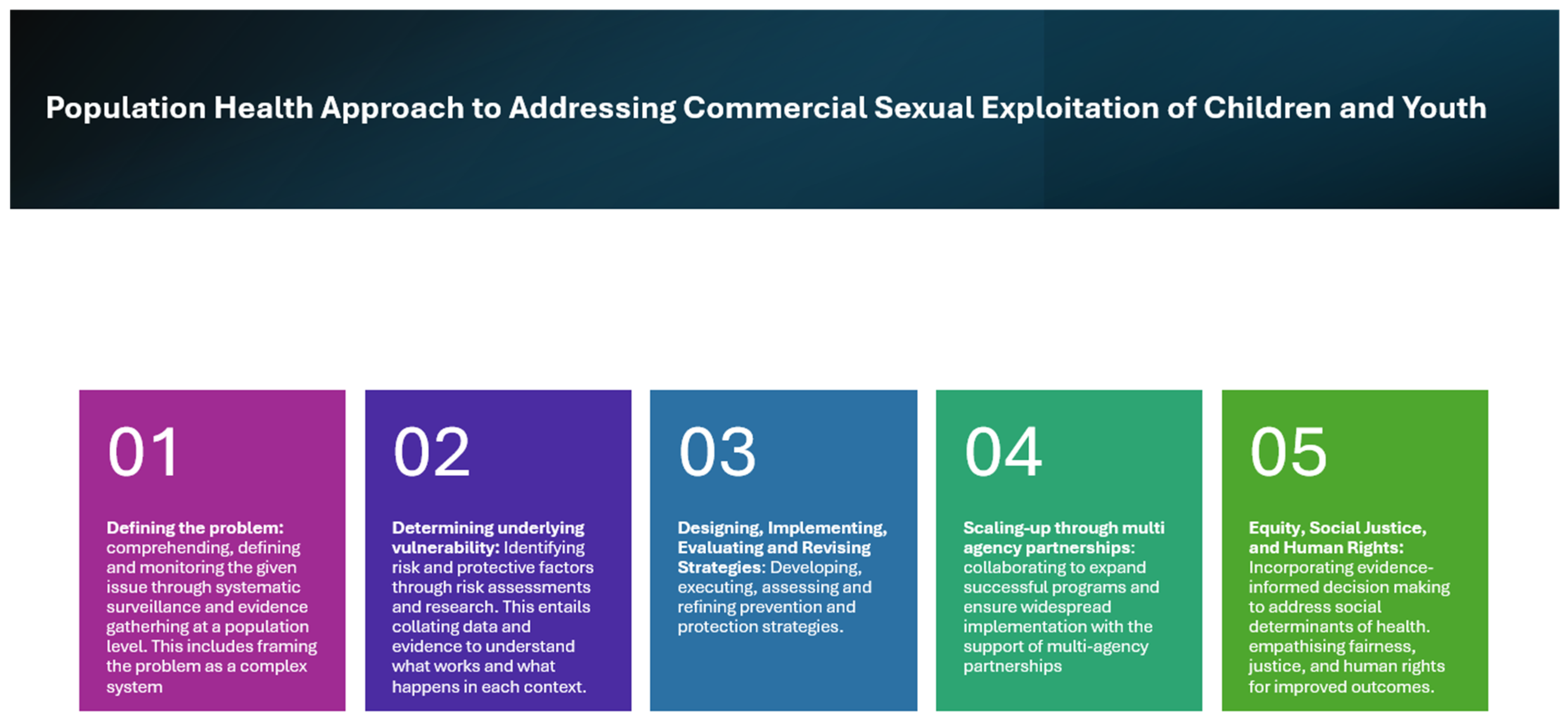
A population health approach offered a framework for a system-wide strategy. Built from the recommendations of prior consultations with people with lived experience of the sex industry and an analysis of risk factors for CSEC in the province (Pavey et al. 2022), our approach was inclusive and comprehensive in outlook. Eighty-five key partners and collaborators across the province and beyond contributed to the strategy; this was a system-wide exercise in itself. We were responsive to the recognized on-going systemic harms experienced by Indigenous people and racial minorities generated through historic processes of colonization. Our methods included a desktop literature review and jurisdictional scan, along with four partner engagement sessions and one-on-one conversations with key informants between September 2023–January 2024. We included action planning in our processes, producing a ‘compendium of actions’ across the institutional system of government and civil society (IWK Health 2024). See Figure 3.
Figure 3.
Our process of developing a population health approach to commercial sexual exploitation of children and youth.
3.2.3. What This Process Revealed
Our whole-system orientation resulted in a proposed menu of actions across nine domains: poverty, housing, violence, online harms, racism and discrimination, substance use, sense of belonging, mental health and education. Each domain contained actions for federal, provincial and First Nations governments, community services, specific federal government departments, municipalities, transportation agencies, academic institutions, healthcare services, non-profit organizations, business associations, private sector actors, law enforcement and the criminal justice sector. We set these out in tabular format for discoverability, disseminating across a wide provincial and national network. We framed it as a ‘collective starting point’ for a system-wide population health approach to addressing CESC in Nova Scotia. We intentionally emphasized the strategy did not target one organization. Rather, the output, like the process, was centered on strengthening community partnerships to build trusting relationships and coordinated action to address the root causes of harm. Our inclusive approach was designed to build a sense of shared ownership of the strategy, an important motivating factor in its mobilization.
One of the challenges of creating a system-wide strategy and action plans was undoubtedly building in mechanisms for feedback to enable us to keep track of systems change. We took on the role of system convenors and invited collaborators to work with us and feedback to us on progress. This, however, proved challenging in the context of limited resources for evaluation and monitoring. Nevertheless, a reconvention of over 50 partners in summer 2025 offered an opportunity for provincial colleagues and community partners to report on progress and to continue to endorse the system-wide, collaborative commitments made. Qualitative feedback from the session included how the approach shifted thinking to understand the importance of the prevention continuum and how through this framework it becomes clear that everyone has a role to play in the prevention of Commercial Sexual Exploitation of Children and Youth. Our experience reinforced the feasibility of co-creating a systems-level consensus about the nature of CSEC and the solutions to it across a large and complex social and geographic landscape. Our documented processes provide a blueprint for others to follow in determining a compendium of actions across a matrix of systems levels (see IWK Health 2024). Learnings from the partners convening identified that to further strengthen the approach to action would include defining a monitoring and evaluation plan with an established agreement for shared governing and accountability. Potential models for monitoring, evaluation and learning would be Ripple Effects Mapping (Nobles et al. 2022) or contribution analysis (Buetti et al. 2025).
3.3. Applying Systems Thinking to the Medical, Psychiatric, and Social Service Needs of Human Trafficking Survivors in Houston, Texas, US (Led by MG and PTN)
3.3.1. The Project Problem
Victims and survivors of human trafficking often describe multiple systemic failures that contribute to their exploitation (Such and Aminu 2024). These include the failure of public support systems to coordinate effectively to meet need. This can result in missed opportunities to prevent harm and in some cases may exacerbate it. The following narrative case illustration is used to highlight what we mean by complex individual cases and how recording patient life histories and structural positioning can inform systems-oriented service design and coordination. The case is used for illustration and is a composite patient experience created by experienced practitioners at Baylor College of Medicine, Houston, TX, USA. After presenting the vignette, we map patient experience and history to a high-level Framework of Patient Complexity (Table 1) (Schaink et al. 2012). This takes into account five core dimensions of complexity: health and social experiences, mental health, demographics, social capital and medical/physical health. We then outline the Baylor College of Medicine Anti-Human Trafficking Program (BCM A-HTP), highlighting how complexities in the vignette are addressed by BCM program intervention. In presenting the vignette, we are alert to the risks of essentializing or stereotyping trafficking victims and survivors. This is not our intention. Rather, the vignette is designed to illustrate how complex circumstances, characteristics and histories present in trafficking patients and how services need to account for a range of intersecting structural and individual factors in treatment and prevention.
Table 1.
Mapping events to a complexity model of patient experience (see Schaink et al. 2012).
3.3.2. A Complex Patient Vignette
The patient is a 19-year-old minoritized woman who presented to an Emergency Center after making a suicide attempt. The patient was born to a mother who was unhoused, abusing substances, and experienced domestic violence during pregnancy. At the time of the delivery, the patient was taken by child protective services due to mother’s inability to care for the patient. Mother was sent to a residential drug rehabilitation program after delivery and the patient was brought into the foster care system where she was constantly moved around to different foster families which were often overcrowded and lacked resources. At the age of 10, the patient became a victim of physical and sexual abuse, perpetrated by an adolescent living in the home with her. After reporting the abuse to her teacher at school, an investigation was not able to confirm the abuse and she remained in the home for several years. The patient struggled psychologically and academically and was not able to see a mental health professional because of transportation limitations and limited access to care in her community. The patient ran away from home as a teenager and was approached by a young man on the street who offered her a place to stay in exchange for sex. After engaging in sex for money on several occasions, she was forced to use drugs and to have sex with other people for money by this young man, with threats of violence toward her if she refused. She engaged in this work until she separated from him at 18. She presented to the Emergency Center about a year later after a suicide attempt.
3.3.3. Building a Whole System Response to Complex Clinical Cases: The Baylor College of Medicine Anti-Human Trafficking Program (BCM A-HTP)
This case highlights the complex challenges facing local health agencies who may only experience clinical encounters at a patient crisis point such as a hospital emergency room. The directors of the BCM A-HTP are senior inpatient hospital psychiatrists and psychologists who treat high-risk and vulnerable patients transferred from their Emergency Center. The BCM A-HTP is intentionally designed as an integrated public healthcare response to human trafficking in a large metropolitan city. It is designed to draw from both community-based and hospital-based services by creating a multidisciplinary medical home for patients through its integrated healthcare system and through established relationships with local social service organizations. Through the program, patients can also access inpatient and outpatient psychiatric services, trauma-informed psychotherapy, group psychotherapy, and substance abuse treatment services. Additionally, acute crisis management is available through the Emergency Center which provides medical, psychiatric, surgical care, and forensic examinations. With such coordinated services in place across the local system, BCM A-HTP is better able to carve out opportunities for the prevention of cases described in the vignette. Importantly, BCM A-HTP trains healthcare professionals, support staff, and community providers on the identification and treatment of survivors of human trafficking, highlighting the complex personal, structural and situational contexts within which patients require support. Overall, the program has increased awareness and victim identification and addressed the medical, psychiatric, and social service needs of hundreds of patients since its creation in 2016 (Chen et al. 2021).
4. Discussion and a Call to Action
Few would oppose the notion that human trafficking is a complex phenomenon that spans social, economic, political and geographic boundaries and systems. Our paper is a contribution to further develop systems thinking in the field by offering examples of how a systems lens has been applied to research, policy and practice problems in three geographies: the UK, Canada and the US.
While the three case studies presented here are in well-resourced Euro-American contexts, systems science and systems change is achievable in resource-constrained contexts as well. For example, a recent systems change review within the anti-slavery sector describes systems change initiatives in Ethiopia focused on strengthening coordination between community groups, local government and survivor-led organizations to address the drivers of domestic servitude, alongside work in Nepal using community-based systems approaches to challenge bonded labor practices and improve local protection systems (Shipman et al. 2025). The feasibility of systems-change research, policy and practice is not dependent on a threshold of resources, but whether the systems-approach or methods have been grounded in local knowledge and priorities and shaped by local resources, institutional capacity, data availability, and community infrastructure. Where the underlying research or intervention challenge is fundamentally systemic in nature, we suggest it is critical to apply a systems-oriented approach, even if the specific methods, scale, or pace of implementation may need to differ across contexts.
We offer this presentation of case studies in the context of a limited number and range of applied examples in human trafficking work. We hope that by surfacing these and our learning from it, we are calling others to action systems thinking. The well-documented need for systems change lies behind our logic for adoption (Shipman et al. 2025).
We anticipate several benefits and challenges ahead for the application of systems thinking in the human trafficking arena. Benefits could include:
- The promotion of collaboration. Systems thinking at policy and practice levels necessitate coordinated, cooperative and collaborative action. The examples from Nova Scotia and Houston, TX, demonstrate operationalization of this truism.
- Surfacing the unsurfaced. Applied systems thinking can surface otherwise hidden yet critical system blockers and enablers. The example of the central role of multiple stigmas in the research development example provided new insight and potential avenues for intervention.
- Moving upstream. Systems thinking encourages those engaged in the human trafficking field to dig deep and explore the foundational structures that encourage exploitation. This focus on the wider determinants of human trafficking creates an environment for foundational action.
- Widening the net. Human trafficking affects the whole of society; a systems lens may encourage the further broadening of traditional anti-trafficking boundaries to make the work ‘everyone’s business’ (UK Independent Anti-Slavery Commissioner 2024).
- Building from other fields. There are existing models of systems-level research, practice and policy from which we can build and grow. The World Health Organisation’s INSPIRE framework on preventing violence against children (WHO 2018), for example, offers helpful, replicable blueprints.
- Methods and practice. Systems thinking opens up new opportunities for developing, exploring and applying new methods and practice, for example using Group Model Building or Agent-Based Modeling for intervention theory development (McAlpine and Birks 2025). This will enrich the field.
While this list is non-exhaustive, it helps make the case of systems thinking in human trafficking research, policy and practice. The challenges are also, however, numerous. Systems thinking requires us to step back and embrace complexity; this can be overwhelming, difficult to communicate and time-consuming to operationalize. It requires transformation of ways of thinking and doing that are deeply engrained into the silos of disciplines, professions, government structures and cultures. Lessons from other systems-level transformation efforts in fields such as public health and healthcare demonstrate both some signs of success (Greenhalgh et al. 2009; Breslin et al. 2024) and failure (Bayat et al. 2023). Systems thinking and application also raise new challenges for evaluation as intervention becomes coordinated and multi-layered. This may promote systems evaluation methods such as realist-informed Ripple Effects Mapping; (Harris et al. 2024) although these are emergent, technical and may not yet be privileged by scientific confidence. Finally, having the orientation towards a more systemic focus for action on human trafficking does not mean we have yet the tools, skills and technologies to optimize its potential, and we should forever be alert to the risk of well-intentioned change causing heightened risks of harm.
5. Conclusions
In conclusion, we call on human trafficking scholars, activists, practitioners and policy makers to embrace systems thinking in their work and be explicit in the way systems theory and methods are used in their work to address the complexity of human trafficking. Through an increased systemic focus on counter-trafficking work including the emergence of public health approaches, survivor- or lived-experience leadership and developments in the research domain, there are opportunities to address a global problem sustained by a web of interacting individual, community, national and international factors. The strengths of a systems-thinking approach to the human trafficking and the prevention of it are in the process of unpacking the dynamic and complex factors contributing to the problem rather than a prescriptive framework or one-size fits all approach. The examples presented here are emergent and contribute to the gradual development of a movement to bring a systems lens closer to the field. This paper is an explicit invitation to continue a conversation about how we can bring better methods, approaches, practices and policies to bear on, what is, a truly complex systems problem.
Author Contributions
Conceptualization, E.S., F.R., M.G., P.T.N., L.P., J.H. and A.M.; methodology, E.S., F.R., M.G., P.T.N., L.P., J.H. and H.A.; formal analysis, E.S., F.R., M.G., P.T.N., L.P., J.H. and H.A.; investigation, E.S., F.R., M.G., P.T.N., L.P., J.H. and H.A.; writing—original draft preparation, E.S., F.R., M.G., P.T.N., L.P., J.H. and A.M.; writing—review and editing, E.S., F.R., M.G., P.T.N., L.P., J.H., H.A. and A.M. All authors have read and agreed to the published version of the manuscript.
Funding
This research received no dedicated external funding. A.M. was funded by a Wellcome Trust Early Career Award (225633/Z/22/Z), E.S. and H.A. were funded by a University of Nottingham Anne McLaren Fellowship, University of Nottingham, UK.
Institutional Review Board Statement
Not applicable. The case example of developing systems thinking for research in the UK included people as advisors with lived expertise. The work was about developing a research agenda and was not, in itself, research.
Informed Consent Statement
Not applicable.
Data Availability Statement
No new data were created for this paper.
Acknowledgments
We would like to acknowledge the support provided by Jordan Greenbaum in the early phases of our discussions. ES would like to acknowledge the support offered by the University of Nottingham Right’s Lab Health and Wellbeing Survivor Research Advisory Group.
Conflicts of Interest
The authors declare no conflicts of interest. The funders had no role in the work described, the writing of the manuscript, or in the decision to publish.
Abbreviations
The following abbreviations are used in this manuscript:
| ABM | Agent-Based Modeling |
| SNA | Social Network Analysis |
| CSEC | Commercial Sexual Exploitation of Children |
| GMB | Group Model Building |
| BCM A-HTP | The Baylor College of Medicine Anti-Human Trafficking Program |
References
- Allen, Kathleen M., Jennifer C. Gibbs, Emily R. Strohacker, and Siyu Liu. 2025. The Influence of Training and Field Experience on Police Knowledge of and Familiarity with Human Trafficking. Policing: An International Journal of Police Strategies & Management 48: 501–17. [Google Scholar] [CrossRef] [Scilit]
- Azzopardi, Corry, Alex Arruda, Atieno Miguna, and Rhonelle Bruder. 2024. Child Sex Trafficking: A Model of Survivor Inclusion and Survivor-Informed Practice. Child Protection and Practice 3: 100074. [Google Scholar] [CrossRef] [Scilit]
- Barlow, Craig, Alicia Kidd, Simon T. Green, and Bethany Darby. 2021. Circles of Analysis: A Systemic Model of Child Criminal Exploitation. Journal of Children’s Services 17: 158–74. [Google Scholar] [CrossRef] [Scilit]
- Bayat, Mahboubeh, Tahereh Kashkalani, Mahmoud Khodadost, Azad Shokri, Hamed Fattahi, Faeze Ghasemi Seproo, Fatemeh Younesi, and Roghayeh Khalilnezhad. 2023. Factors Associated with Failure of Health System Reform: A Systematic Review and Meta-synthesis. Journal of Preventive Medicine and Public Health 56: 128–44. [Google Scholar] [CrossRef] [Scilit] [PubMed] [PubMed Central]
- Bick, Debra, Louise M. Howard, Sian Oram, and Cathy Zimmerman. 2017. Maternity Care for Trafficked Women: Survivor Experiences and Clinicians’ Perspectives in the United Kingdom’s National Health Service. PLoS ONE 12: e0187856. [Google Scholar] [CrossRef] [Scilit]
- Borrelli, Sara, Renuka Ramasamy, Ruth Wong, and Helen Spiby. 2023. Care and Support during Maternity for Mothers Affected by Modern Slavery: A Scoping Review. International Journal of Nursing Studies Advances 5: 100139. [Google Scholar] [CrossRef] [Scilit] [PubMed]
- Breslin, Gavin, Olujoke Fakoya, Wendy Wills, Nigel Lloyd, Charis Bontoft, Amander Wellings, Sian Harding, John Jackson, Katherine Barrett, Adam P. Wagner, and et al. 2024. Whole systems approaches to diet and healthy weight: A scoping review of reviews. PLoS ONE 19: e0292945. [Google Scholar] [CrossRef] [Scilit] [PubMed]
- Buetti, David, Michael Fitzgerald, Cassandra Barber, Patrick R. Labelle, Isabelle Bourgeois, Tim Aubry, Erin Cameron, and Claire E. Kendall. 2025. The Use of Contribution Analysis in Evaluating Health Interventions: A Scoping Review. Evaluation & the Health Professions 48: 363–73. [Google Scholar] [CrossRef] [Scilit] [PubMed]
- Chen, Eugenia Y., Katherine Robichaux, Mollie R. Gordon, John H. Coverdale, Asim A. Shah, Minal Patel Davis, and Phuong Thanh Nguyen. 2021. A Pilot Program’s Healthcare Response to Human Trafficking in Houston, Texas. Journal of Human Trafficking 9: 119–29. [Google Scholar] [CrossRef] [Scilit]
- Chesney, Thomas. 2021. Agent-Based Modelling of Worker Exploitation. Cham: Springer. [Google Scholar] [CrossRef] [Scilit]
- Clarke, Megan, Kurt M. Ribisl, and Desmond Runyan. 2013. A Public Health Approach to Addressing Internet Child Sexual Exploitation. In Understanding and Preventing Online Sexual Exploitation of Children. London: Routledge. [Google Scholar]
- Cockbain, Eleanor, Helen Brayley, and Gloria Laycock. 2011. Exploring Internal Child Sex Trafficking Networks Using Social Network Analysis. Policing 5: 144–57. [Google Scholar] [CrossRef] [Scilit]
- Cockbain, Ella, and Lisa Tompson. 2024. The Role of Helplines in the Anti-Trafficking Space: Examining Contacts to a Major ‘Modern Slavery’ Hotline. Crime, Law and Social Change 82: 463–92. [Google Scholar] [CrossRef] [Scilit]
- Collins, Catherine H., and Katy Skarparis. 2024. The Experiences of Pregnancy and NHS Maternity Care for Women Who Have Been Trafficked: A Qualitative Study. Midwifery 135: 104040. [Google Scholar] [CrossRef] [Scilit] [PubMed]
- Dean, Laura A. 2020. 5: Uneven Implementation of Human Trafficking Policies. In Diffusing Human Trafficking Policy in Eurasia. Bristol: Policy Press. [Google Scholar] [CrossRef] [Scilit]
- Farrell, Amy, and Rebecca Pfeffer. 2014. Policing Human Trafficking: Cultural Blinders and Organizational Barriers. Annals of the American Academy of Political and Social Science 653: 46–64. [Google Scholar] [CrossRef] [Scilit]
- Farrell, Amy, Meredith Dank, Ieke de Vries, Matthew Kafafian, Andrea Hughes, and Sarah Lockwood. 2019. Failing Victims? Challenges of the Police Response to Human Trafficking. Criminology and Public Policy 18: 649–73. [Google Scholar] [CrossRef] [Scilit]
- Gagnon, Charlene. 2020. Safer Spaces White Paper #3 Pathways to Entry. Halifax: YWCA Halifax. Available online: https://www.ywcahalifax.com/wpcontent/uploads/2021/03/White-Paper-3-Pathways-to-Entry.pdf (accessed on 3 February 2026).
- Greenbaum, Jordan. 2020. A Public Health Approach to Global Child Sex Trafficking. Annual Review of Public Health 41: 481–97. [Google Scholar] [CrossRef] [Scilit] [PubMed]
- Greenbaum, V. Jordan, Kanani Titchen, Ingrid Walker-Descartes, Anastasia Feifer, Corey J. Rood, and Hiu-Fai Fong. 2018. Multi-Level Prevention of Human Trafficking: The Role of Health Care Professionals. Preventive Medicine 114: 164–67. [Google Scholar] [CrossRef] [Scilit] [PubMed]
- Greenhalgh, Trisha, Charlotte Humphrey, Jane Hughes, Fraser Macfarlane, Ceri Butler, and Ray Pawson. 2009. How do you modernize a health service? A realist evaluation of whole-scale transformation in London. The Milbank Quarterly 87: 391–416. [Google Scholar] [CrossRef] [Scilit] [PubMed] [PubMed Central]
- Hammond, Debora. 2005. Philosophical and Ethical Foundations of Systems Thinking. tripleC 3: 20–27. Available online: https://www.triple-c.at/index.php/tripleC/article/view/20 (accessed on 3 February 2026).
- Harris, Kevin, James Nobles, Louis Ryan, Christoph Szedlak, Hannah Taylor, Rowena Hawkins, Alice Cline, Elizabeth Smith, and Amelia Hall. 2024. Towards realist-informed ripple effects mapping (RREM): Positioning the approach. BMC Medical Research Methodology 24: 259. [Google Scholar] [CrossRef] [Scilit] [PubMed]
- Human Trafficking Foundation. 2025. The Slavery and Trafficking Survivor Care Standards. London: Human Trafficking Foundation. Available online: https://www.humantraffickingfoundation.org/-trafficking-survivor-care-standards (accessed on 3 February 2026).
- Ibrahim, David. 2021. Trafficking in Persons in Canada, 2019. Juristat. Statistics Canada. Available online: https://www150.statcan.gc.ca/n1/pub/85-005-x/2021001/article/00001-eng.htm (accessed on 3 February 2026).
- Ijadi-Maghsoodi, Roya, Eraka Bath, Mekeila Cook, Lauren Textor, and Elizabeth Barnert. 2018. Commercially Sexually Exploited Youths’ Health Care Experiences, Barriers, and Recommendations: A Qualitative Analysis. Child Abuse and Neglect 76: 334–41. [Google Scholar] [CrossRef] [Scilit] [PubMed]
- International Labour Organization (ILO), Walk Free and International Organization for Migration. 2022. Global Estimates of Modern Slavery Forced Labour and Forced Marriage. Geneva: IOM UN Migration. Available online: https://publications.iom.int/books/global-estimates-modern-slavery-forced-labour-and-forced-marriage (accessed on 3 February 2026).
- IWK Health. 2024. A Population Health Approach to Address Commercial Sexual Exploitation of Children and Youth in Nova Scotia. Halifax: IWK Health. Available online: https://iwkhealth.ca/sites/default/files/2024-06/A%20Population%20Health%20Approach%20to%20Address%20Commercial%20Sexual%20Exploitation%20of%20Children%20and%20Youth%20in%20Nova%20Scotia_3.pdf (accessed on 3 February 2026).
- Jannesari, Sohail, Bee Damara, Rachel Witkin, Cornelius Katona, Queenie Sit, Minh Dang, Jeanet Joseph, Emma Howarth, Olivia Triantafillou, Claire Powell, and et al. 2024. The Modern Slavery Core Outcome Set: A Survivor-Driven Consensus on Priority Outcomes for Recovery, Wellbeing, and Reintegration. Trauma, Violence, and Abuse 25: 2377–89. [Google Scholar] [CrossRef] [Scilit] [PubMed]
- Kiss, Ligia, David Fotheringhame, Joelle Mak, Alys McAlpine, and Cathy Zimmerman. 2021. The Use of Bayesian Networks for Realist Evaluation of Complex Interventions: Evidence for Prevention of Human Trafficking. Journal of Computational Social Science 4: 25–48. [Google Scholar] [CrossRef] [Scilit]
- Limoncelli, Stephanie A. 2016. What in the World Are Anti-Trafficking NGOs Doing? Findings from a Global Study. Journal of Human Trafficking 2: 316–28. [Google Scholar] [CrossRef] [Scilit]
- Luke, Douglas A., and Katherine A. Stamatakis. 2012. Systems Science Methods in Public Health: Dynamics, Networks, and Agents. Annual Review of Public Health 33: 357–76. [Google Scholar] [CrossRef] [Scilit] [PubMed]
- Mabry, Patricia L., Stephen E. Marcus, Pamela I. Clark, Scott J. Leischow, and David M’Endez. 2010. Systems Science: A Revolution in Public Health Policy Research. American Journal of Public Health 100: 1161–63. [Google Scholar] [CrossRef] [Scilit] [PubMed]
- Macy, Rebecca J., and Laurie M. Graham. 2012. Identifying Domestic and International Sex-Trafficking Victims During Human Service Provision. Trauma, Violence, and Abuse 13: 59–76. [Google Scholar] [CrossRef] [Scilit] [PubMed]
- McAlpine, Alys, and Daniel Birks. 2025. Using agent-based modelling for anti-trafficking intervention theory development and evaluation. In Evaluating Anti-Trafficking Interventions. Critical Reflections and Lessons from the Field. Edited by Ella Cockbain, Aiden Sidebottom and Sheldon X. Zhang. London: UCL Press, pp. 91–116. [Google Scholar]
- McAlpine, Alys, Ligia Kiss, Cathy Zimmerman, and Zaid Chalabi. 2021. Agent-Based Modeling for Migration and Modern Slavery Research: A Systematic Review. Journal of Computational Social Science 4: 243–332. [Google Scholar] [CrossRef] [Scilit]
- McCoig, April, Ines Campos-Matos, and Elizabeth Such. 2022. Exploring a Public Health Approach to Modern Slavery: Potential, Problems and Translating Principles into Practice. The Journal of Poverty and Social Justice: Research, Policy, Practice (BRISTOL) 30: 141–50. [Google Scholar] [CrossRef] [Scilit]
- Monat, Jamie P., and Thomas F. Gannon. 2015. What Is Systems Thinking? A Review of Selected Literature Plus Recommendations. American Journal of Systems Science 2015: 11–26. [Google Scholar] [CrossRef]
- Murphy, Carole, Alicia Heys, Craig Barlow, and Sophie Wilkinson. 2022. Identifying Pathways to Support British Victims of Modern Slavery Towards Safety and Recovery: A Scoping Study Identifying Pathways to Support British Victims of Modern Slavery Towards Safety and Recovery: A Scoping Study Research Team. London: St Mary’s University. Available online: https://research.stmarys.ac.uk/id/eprint/6216/1/British-nationals-full-report.pdf (accessed on 3 February 2026).
- Nobles, James, Jessica Wheeler, Kirsty Dunleavy-Harris, Richard Holmes, Alan Inman-Ward, Alexandra Potts, Jennifer Hall, Sabi Redwood, Russell Jago, and Charlie Foster. 2022. Ripple effects mapping: Capturing the wider impacts of systems change efforts in public health. BMC Medical Research Methodology 22: 72. [Google Scholar] [CrossRef] [Scilit] [PubMed]
- Noyori-Corbett, Chie, and David P. Moxley. 2018. Addressing Female Sex Trade Human Trafficking in Japan through NGO Advocacy Networks. International Social Work 61: 954–67. [Google Scholar] [CrossRef] [Scilit]
- Ottisova, Lea, Stacey Hemmings, Louise M. Howard, Cathy Zimmerman, and Sian Oram. 2016. Prevalence and Risk of Violence and the Mental, Physical and Sexual Health Problems Associated with Human Trafficking: An Updated Systematic Review. Epidemiology and Psychiatric Sciences 25: 317–41. [Google Scholar] [CrossRef] [Scilit] [PubMed]
- Pavey, Lila, Jenna Hopson, and Charlene Gagnon. 2022. Hearing Them. Exploring the vulnerability and Risk Factors for commercial Sexual of Children and Youth in Nova Scotia. Halifax: YWCA Halifax. Available online: https://www.ywcahalifax.com/wp-content/uploads/2022/11/Hearing-them-Risks-Prevention.pdf (accessed on 30 June 2026).
- Prakash, Jaya, Bukola Oriola, Traci Kurtzer, and Hanni Stoklosa. 2023a. ‘Praying for Freedom’: A Story of Labor Trafficking During Pregnancy. American Journal of Obstetrics and Gynecology MFM 5: 100873. [Google Scholar] [CrossRef] [Scilit] [PubMed]
- Prakash, Jaya, Tahireh Markert, Paul A. Bain, and Hanni Stoklosa. 2023b. Maternal Health Concerns for Pregnant Labor-Trafficked People: A Scoping Review. Journal of Immigrant and Minority Health 25: 899–905. [Google Scholar] [CrossRef] [Scilit] [PubMed]
- Recknor, Frances, Erica di Ruggiero, and Elsabeth Jensen. 2022. Addressing Human Trafficking as a Public Health Issue. Canadian Journal of Public Health 113: 607–10. [Google Scholar] [CrossRef] [Scilit] [PubMed]
- Recknor, Frances, Robin Mason, Danielle Jacobson, C. Emma Kelly, Frances Montemurro, Rhonelle Bruder, and Janice Du Mont. 2023. Challenges to Supporting Domestically Sex Trafficked Persons: In-Depth Interviews with Service Providers. Journal of Human Trafficking 12: 195–210. [Google Scholar] [CrossRef] [Scilit]
- Richie-Zavaleta, Arduizur Carli, Sarah Baranik, Stephanie Mersch, Janna Ataiants, and Shea M. Rhodes. 2021. From Victimization to Restoration: Multi-Disciplinary Collaborative Approaches to Care and Support Victims and Survivors of Human Trafficking. Journal of Human Trafficking 7: 291–307. [Google Scholar] [CrossRef] [Scilit]
- Schaink, Alexis K., Kerry Kuluski, Renée F. Lyons, Martin Fortin, Alejandro R. Jadad, Ross Upshur, and Walter P. Wodchis. 2012. A Scoping Review and Thematic Classification of Patient Complexity: Offering a Unifying Framework. Journal of Comorbidity 2: 1–9. [Google Scholar] [CrossRef] [Scilit] [PubMed]
- Scottish Government. 2025. Scotland’s Trafficking and Exploitation Strategy. Available online: https://www.gov.scot/publications/scotlands-trafficking-exploitation-strategy-2025/documents/ (accessed on 3 February 2026).
- Shipman, Helen, Yuki Lo, and Alys McAlpine. 2025. Systems Change in Practice. Pathways Towards Eradicating Modern Slavery. New York: The Freedom Fund. [Google Scholar]
- Siokou, Christine, Rebecca Morgan, and Alan Shiell. 2014. Group Model Building: A Participatory Approach to Understanding and Acting on Systems. Public Health Research and Practice 25: e2511404. [Google Scholar] [CrossRef] [Scilit] [PubMed]
- Statistics Canada. 2021. Victims of Police-Reported Violent Crime and Traffic Violations Causing Bodily Harm or Death, by Type of Violation and Age of Victim. Available online: https://www150.statcan.gc.ca/t1/tbl1/en/tv.action?pid=3510004901 (accessed on 12 August 2022).
- Stephens, Anne, and Jill Thomas. 2025. Developing an M&E System for a Wicked Problem. Evaluation Journal of Australasia 25: 127–46. [Google Scholar] [CrossRef] [Scilit]
- Such, Elizabeth, Alison Gardner, Minh Dang, Nicola Wright, Liana Bravo-Balsa, Vicky Brotherton, Hannah Browne, Nancy Esiovwa, Erika Jiménez, Ben Lucas, and et al. 2026. The Risks and Harms Associated with Modern Slavery During the COVID-19 Pandemic in the United Kingdom: A Multi-Method Study. Journal of Human Trafficking 12: 1–21. [Google Scholar] [CrossRef] [Scilit]
- Such, Elizabeth, and Habiba Aminu. 2024. The Prevention of Adult Exploitation and Trafficking. Oxford: Modern Slavery and Human Rights Policy and Evidence Centre. Available online: https://files.modernslaverypec.org/production/assets/downloads/Adult-prevention-synthesis-report1.pdf?dm=1736268028 (accessed on 3 February 2026).
- Such, Elizabeth, Claire Laurent, Ravi Jaipaul, and Sarah Salway. 2020. Modern Slavery and Public Health: A Rapid Evidence Assessment and an Emergent Public Health Approach. Public Health 180: 168–79. [Google Scholar] [CrossRef] [Scilit] [PubMed]
- Such, Elizabeth, Ines Campos-Matos, Kate Hayes, April McCoig, Sara Thornton, and Jonathan Woodward. 2024. A Public Health Approach to Modern Slavery in the United Kingdom: A Codeveloped Framework. Public Health 232: 146–52. [Google Scholar] [CrossRef] [Scilit] [PubMed]
- Systems Thinking Alliance. 2024. Brief History of Systems Thinking. January 8. Available online: https://systemsthinkingalliance.org/brief-history-of-systems-thinking/ (accessed on 3 February 2026).
- Todres, Jonathan. 2011. Moving Upstream: The Merits of a Public Health Law Approach to Human Trafficking. North Carolina Law Review 89: 447–506. [Google Scholar]
- UK Independent Anti-Slavery Commissioner. 2024. Preventing Labour Exploitation: Tackling Modern Slavery Is Everyone’s Business. Available online: https://www.antislaverycommissioner.co.uk/media/nncbfawb/24-08-01-labour-exploitation-brief-final.pdf (accessed on 3 February 2026).
- United Nations Office on Drugs and Crime. 2024. Global Report on Trafficking in Persons 2024. New York: United Nations. [Google Scholar]
- US Department of Health and Human Services. 2024. National Human Trafficking Prevention and Protection Framework. Washington, DC: US Department of Health and Human Services. Available online: https://pact.cfpic.org/wp-content/uploads/2025/12/Research_-HHS-Human-Trafficking-Prevention-Framework_Final_February-2024.pdf (accessed on 3 February 2026).
- Van der Watt, Marcel, and Amanda van der Westhuizen. 2017. (Re)Configuring the Criminal Justice Response to Human Trafficking: A Complex-Systems Perspective. Police Practice and Research 18: 218–29. [Google Scholar] [CrossRef] [Scilit]
- Walk Free. 2023. The Global Slavery Index 2023. Available online: https://walkfree.org/global-slavery-index/ (accessed on 3 February 2026).
- Weston, Samantha, and Gabe Mythen. 2023. Child Sexual Exploitation and the Adoption of Public Health Approaches to Prevention: Critical Reflections on Evolving Processes and Practices. Crime Prevention and Community Safety 25: 227–42. [Google Scholar] [CrossRef] [Scilit]
- World Health Organization (WHO). 2018. INSPIRE Handbook Action for Implementing the Seven Strategies for Ending Violence Against Children. Geneva: World Health Organization. Available online: https://iris.who.int/server/api/core/bitstreams/34385d57-dfcd-4de8-8e4a-f3e06d0b8cbe/content (accessed on 3 February 2026).
- Zimmerman, Cathy, Mazeda Hossain, and Charlotte Watts. 2011. Human Trafficking and Health: A Conceptual Model to Inform Policy, Intervention and Research. Social Science and Medicine 73: 327–35. [Google Scholar] [CrossRef] [Scilit] [PubMed]

Disclaimer/Publisher’s Note: The statements, opinions and data contained in all publications are solely those of the individual author(s) and contributor(s) and not of MDPI and/or the editor(s). MDPI and/or the editor(s) disclaim responsibility for any injury to people or property resulting from any ideas, methods, instructions or products referred to in the content. |
© 2026 by the authors. Licensee MDPI, Basel, Switzerland. This article is an open access article distributed under the terms and conditions of the Creative Commons Attribution (CC BY) license.