
- Article

26 Pages
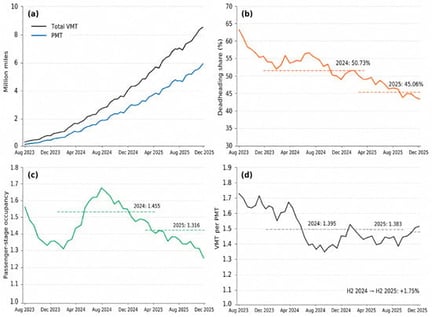
Electric robotaxis have no tailpipe emissions, but the carbon associated with operating the service depends on empty travel, passenger load, vehicle electricity use, and the electricity supply. This study uses 29 months of California commercial robotaxi reporting from August 2023 to December 2025 to examine those factors on a passenger-mile basis. Vehicle-Miles Traveled per Passenger-Mile Traveled (VMT/PMT) is decomposed exactly into deadheading and passenger-stage occupancy and then linked to electricity use and location-based operational carbon dioxide equivalent (CO2e) emissions. Between 2024 and 2025, deadheading fell from 50.73% to 45.06%, while distance-weighted passenger-stage occupancy fell from 1.455 to 1.316. The two changes nearly offset each other, and VMT/PMT declined by only 0.83%. Under a constant-grid scenario using the 2023 California regional grid factor and 0.42 kWh/mile, modeled 2025 carbon intensity was 118.3 g CO2e/PMT. Passenger-miles rose by 269.9% over the same period, and modeled emissions associated with reported passenger-service mileage rose by 266.8%. These are service-attributed accounting estimates rather than a net transportation-emissions effect. The case shows why empty mileage alone is not enough to judge operating efficiency and why emissions intensity should be reported alongside service scale when electric robotaxi services are expanding. The same accounting can help operators and regulators track whether utilization gains keep pace with service growth.
Sustainability
29 September 2026