
Skip to Content
  • 4.1
    Impact Factor
  • 8.9
    CiteScore
  • 17 days
    Submission to First Decision
  • 4 days
    Acceptance to Publication

Sustainability

Sustainability is an international, peer-reviewed, open-access journal on environmental, cultural, economic, and social sustainability of human beings, published semimonthly online by MDPI. The Canadian Urban Transit Research & Innovation Consortium (CUTRIC), International Council for Research and Innovation in Building and Construction (CIB) and Urban Land Institute (ULI) are affiliated with Sustainability and their members receive discounts on the article processing charges.

Get Alerted

Add your email address to receive forthcoming issues of this journal.

All Articles (111,281)

  • Article
  • Open Access

This study examines whether sustainable human resource management (SHRM) is associated with triple bottom line (TBL) performance through circular economy orientation (CEO) and green supply chain integration (GSCI) in manufacturing firms in emerging economies. Drawing on the natural-resource-based view, stakeholder theory, and institutional theory, CEO and GSCI are conceptualized as sequential sustainability capabilities, and strategic environmental orientation (SEO) as a moderator. Survey data were collected from the HR manager and the production/supply-chain line manager of 175 firms in Kenya, Nigeria, Ghana, South Africa, Indonesia, Vietnam, and Bangladesh (350 respondents; effective response rate 45.8%) and analyzed with partial least squares structural equation modeling. In the primary cross-rater model, in which the HR manager reported SHRM and SEO and the line manager reported the other constructs, SHRM was not associated with CEO (β = −0.024) or GSCI (β = 0.049); the indirect, serial indirect, and moderation hypotheses were therefore not supported. CEO was strongly associated with GSCI (β = 0.578), and both CEO (β = 0.270) and GSCI (β = 0.513) were positively associated with perceived TBL performance. When one respondent rated all constructs, associations involving SHRM became substantial, showing that rater source strongly shapes findings in this literature. Because the design is cross-sectional and perceptual, the results are associational, not causal.

Sustainability

18 November 2026

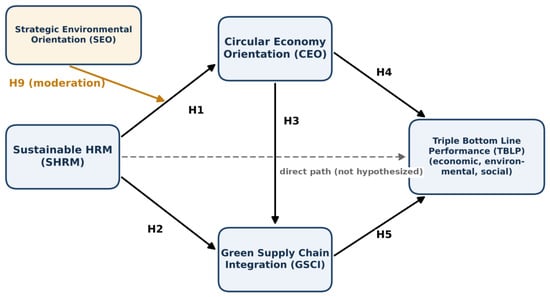
Research model. Dashed line: direct SHRM → TBLP path, estimated but not hypothesized. Indirect effects: H6 = SHRM → CEO → TBLP; H7 = SHRM → GSCI → TBLP; H8 = SHRM → CEO → GSCI → TBLP.
  • Article
  • Open Access

Spatially balanced agricultural development underpins food security and sustainable recovery in war-affected regions. This study examines factors associated with spatial differences in agricultural output across all 24 districts of Chernihiv, Sumy, Kharkiv and Dnipropetrovsk oblasts using GIS and GeoDetector. The database combines published district statistics for 2025 with open satellite, reanalysis, infrastructure and conflict-event data, so that every value is traceable to a public source. Eight factors were assessed with the four GeoDetector modules, selection-adjusted permutation tests with multiplicity adjustment and a regression benchmark. Crop structure—the maize share of the grain area -showed the strongest association with output (q = 0.430; q = 0.610 for crop output, Holm-adjusted p = 0.012), followed by distance to the front line (q = 0.324) and to the Russian border (q = 0.272). Vegetation condition, drought, road density and conflict intensity were weakly associated, and no joint stratification added significantly to its stronger component. Output was spatially clustered (Moran’s I = 0.104, p = 0.016). The results describe cross-sectional associations; they suggest that recovery policies should consider crop specialization and proximity to hostilities when targeting support to districts.

Sustainability

18 November 2026

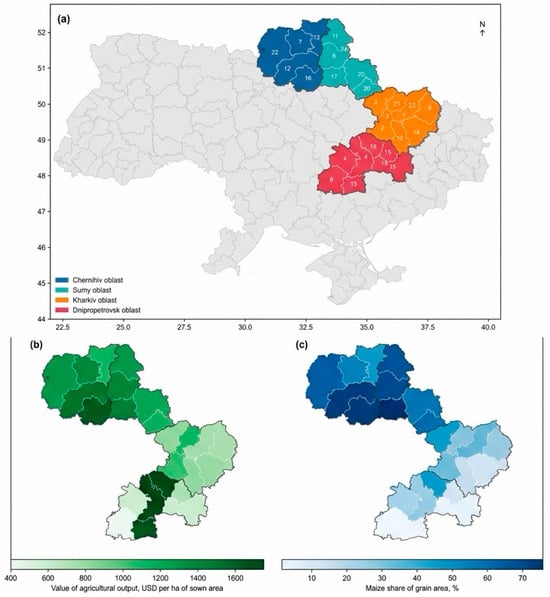
Study area and spatial distribution of the main variables: (a) location of the 24 districts of Chernihiv, Sumy, Kharkiv and Dnipropetrovsk oblasts (district numbers as in Table S1); (b) value of agricultural output per hectare of sown area, USD/ha; (c) maize share of the grain area, %. Source: authors’ elaboration based on OCHA COD-AB administrative boundaries (version 05, 2025) [19] and district tables of the regional statistics offices [15,16,17,18].
  • Article
  • Open Access

This study examines the relationship between environmental, social, and governance (ESG) performance and corporate profitability, with particular attention to whether the association between ESG performance and profitability differs across adverse and non-adverse profitability states. Using an unbalanced ten-year firm-year panel, the analysis employs firm fixed-effects models with year effects and firm-clustered standard errors. The results reveal a positive and statistically significant interaction between overall ESG performance and adverse profitability shock, indicating that the relationship between ESG performance and profitability varies with firms’ financial conditions. At the dimension level, the interactions of environmental and governance performance with profitability shock are also positive and statistically significant, whereas the corresponding interaction for social performance is only significant at 10% level. These findings remain robust to alternative shock thresholds and a leave-one-firm-out shock definition. This study contributes to environmental economics and the corporate sustainability literature by demonstrating that the economic implications of ESG performance are conditional on firms’ financial circumstances and differ across sustainability dimensions. In particular, the environmental findings highlight the importance of accounting for adverse profitability shock when evaluating the relationship between environmental performance and corporate profitability. The results provide a more nuanced understanding of the economic implications of corporate environmental engagement and underscore the importance of considering financial conditions in sustainability-related economic assessments.

Sustainability

18 November 2026

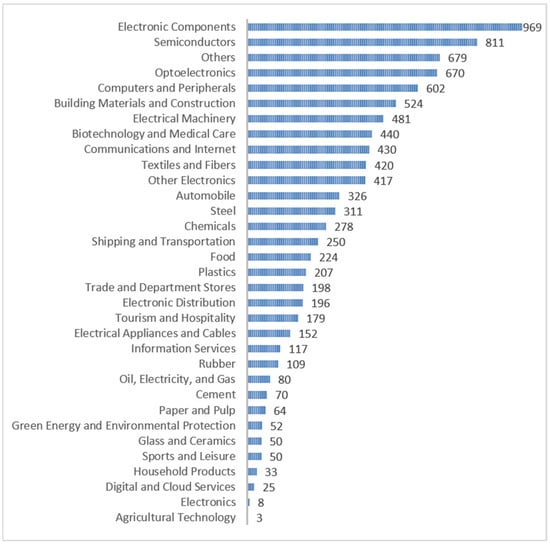
Industry distribution of firms and panel coverage.
  • Article
  • Open Access

Small-diameter round timber from forest thinnings is often directed to short-lived products or energy, although selected pieces may support longer-lived structural uses with limited geometric processing. This study quantified material efficiency, biogenic carbon stock, and mechanical performance for 483 Salzmann pine specimens from Cuenca, Spain: 318 machine-rounded and 165 unrounded. Geometric volume and carbon calculations were combined with descriptive statistics, diameter-class-adjusted models, bootstrap intervals, visual grading, and exploratory screening against EN 338 reference thresholds. Pieces meeting or exceeding C14 represented 76.4% of observed specimen volume and 78.5% of biogenic carbon stock; corresponding count proportions were 65.4% for machine-rounded and 87.3% for unrounded timber. Lot-level EN 384-adjusted mean stiffness limited point-estimate reference levels to C16 and C20, respectively, whereas density and bending strength reached higher thresholds. Unrounded specimens showed a higher screened volume fraction after standardisation by diameter class. Specimens from the same material lot formed two observational processing groups; the allocation procedure could not be verified from the retained project records. The absence of pre-processing measurements prevents estimation of within-piece changes attributable to rounding. Pre-rounding dimensions were unavailable; thus, volume fractions describe post-processing screening, not rounding recovery. The results identify a lightly processed pathway for directing suitable thinning material towards longer-lived uses. Product transfer requires a validated grading system, production control, connection and durability assessment, and product-level environmental and economic evaluation.

Sustainability

18 November 2026

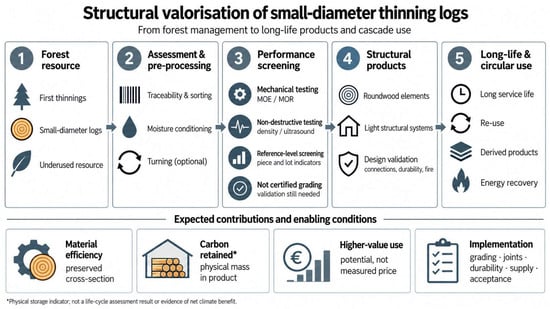
Study framework linking the thinning resource, processing groups, material-efficiency and biogenic carbon indicators, mechanical screening, and potential cascading allocation. The carbon indicator represents biogenic carbon mass in the wood, not a life-cycle assessment result.

Highly Accessed Articles

News & Conferences

Latest Issues

Open for Submission

Journal Sections

XFacebookLinkedIn
Sustainability - ISSN 2071-1050