

You are currently viewing a new version of our website. To view the old version click .

Foods, Volume 8, Issue 7

July 2019 - 52 articles

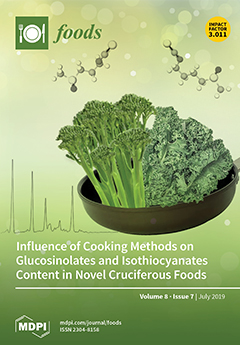
Cover Story: Cruciferous vegetables (Brassicaceae fam.) are of great interest due to their antioxidant and anti-inflammatory activity, related to the presence of glucosinolates (GLS) and their hydrolysis derivatives, the isothiocyanates (ITC). Nevertheless, these compounds are quite unstable under common domestic cooking conditions. In this work, the influence of several cooking practices, on the degradation of GLS and ITC in broccolini and kale, was evaluated. The results revealed that stir-frying and steaming were suitable techniques to preserve GLS and ITC (> 50% retention), while boiling was deleterious for these bioactive compounds (20–40% retention of the uncooked samples). Accordingly, the appropriate cooking method should be considered an important factor to maintain the health-promoting effects in these trending Brassica foods. View this paper
  • Issues are regarded as officially published after their release is announced to the table of contents alert mailing list .
  • You may sign up for email alerts to receive table of contents of newly released issues.
  • PDF is the official format for papers published in both, html and pdf forms. To view the papers in pdf format, click on the "PDF Full-text" link, and use the free Adobe Reader to open them.

Articles (52)

  • Article
  • Open Access
20 Citations
5,282 Views
19 Pages

The Influence of Selected Plant Essential Oils on Morphological and Physiological Characteristics in Pseudomonas Orientalis

  • Katarzyna Leja,
  • Kamila Szudera-Kończal,
  • Ewa Świtała,
  • Wojciech Juzwa,
  • Przemysław Łukasz Kowalczewski and
  • Katarzyna Czaczyk

23 July 2019

The aim of this work was to estimate the antibacterial activity of selected essential oils on Pseudomonas orientalis strains isolated from foods. An attempt was also made to identify the mechanisms of the action of the plant oils. Classical methods o...

  • Article
  • Open Access
5 Citations
5,384 Views
13 Pages

23 July 2019

A low-cost method utilizing rice co-products to concentrate and stabilize blueberry polyphenols was developed that decreased the arsenic (As) content in rice bran. After concentration at 10 g/L, brown rice flour displayed a higher total anthocyanin c...

  • Article
  • Open Access
12 Citations
4,568 Views
17 Pages

Extending the Grazing Period for Bulls, Prior to Finishing on a Concentrate Ration: Composition, Collagen Structure and Organoleptic Characteristics of Beef

  • Gebrehawerya B. Mezgebo,
  • Frank J. Monahan,
  • Mark McGee,
  • Edward G. O’Riordan,
  • Declan Marren,
  • Anne Listrat,
  • Brigitte Picard,
  • R. Ian Richardson and
  • Aidan P. Moloney

23 July 2019

The biochemical and organoleptic characteristics of the longissimus thoracis muscle from suckler bulls (n = 56) finished on a concentrate-based system (C) or raised in a pasture-based system (P) incorporating 99 (P99), 162 (P162) or 231 days (P231) o...

  • Article
  • Open Access
18 Citations
5,657 Views
12 Pages

22 July 2019

The monitoring of food quality and safety requires a suitable analytical method with simultaneous detection in order to control pesticide and herbicide residues. In this study, a novel analytical method, referred to as “dispersive solid–l...

  • Article
  • Open Access
21 Citations
6,533 Views
14 Pages

22 July 2019

This trial aimed to integrate metadata that spread over farm-to-fork continuum of 110 Protected Designation of Origin (PDO)Maine-Anjou cows and combine two statistical approaches that are chemometrics and supervised learning; to identify the potentia...

  • Review
  • Open Access
74 Citations
10,996 Views
16 Pages

22 July 2019

Foodborne pathogens such as Salmonella that survive cleaning and disinfection during poultry processing are a public health concern because pathogens that survive disinfectants have greater potential to exhibit resistance to antibiotics and disinfect...

  • Article
  • Open Access
24 Citations
5,757 Views
15 Pages

Improved Physicochemical and Structural Properties of Blueberries by High Hydrostatic Pressure Processing

  • Maria Paciulli,
  • Ilce Gabriela Medina Meza,
  • Massimiliano Rinaldi,
  • Tommaso Ganino,
  • Alessandro Pugliese,
  • Margherita Rodolfi,
  • Davide Barbanti,
  • Michele Morbarigazzi and
  • Emma Chiavaro

21 July 2019

The use of high pressure on fruits and vegetables is today widely studied as an alternative to the traditional thermal preservation techniques, with the aim of better preserving nutritional and organoleptic properties. The use of high hydrostatic pre...

  • Article
  • Open Access
10 Citations
5,047 Views
9 Pages

Emulsifiers from Partially Composted Olive Waste

  • Aikaterini Koliastasi,
  • Vasiliki Kompothekra,
  • Charilaos Giotis,
  • Antonis K. Moustakas,
  • Efstathia P. Skotti,
  • Argyrios Gerakis,
  • Eleni P. Kalogianni and
  • Christos Ritzoulis

20 July 2019

Partial (one month) composting of solid olive processing waste is shown to produce extractable emulsifiers. Size exclusion chromatography (SEC) and Fourier-transform infra-red spectroscopy (FTIR) show that these consist of polysaccharides and protein...

  • Review
  • Open Access
67 Citations
12,680 Views
20 Pages

19 July 2019

Bread is categorized as having a high amount of rapidly digested starch that may result in a rapid increase in postprandial blood glucose and, therefore, poor health outcomes. This is mostly the result of the complete gelatinization that starch under...

  • Article
  • Open Access
31 Citations
6,670 Views
18 Pages

Effect of Agave Fructans as Carrier on the Encapsulation of Blue Corn Anthocyanins by Spray Drying

  • Miguel Á. Sánchez-Madrigal,
  • Armando Quintero-Ramos,
  • Carlos A. Amaya-Guerra,
  • Carmen O. Meléndez-Pizarro,
  • Sandra L. Castillo-Hernández and
  • Carlos J. Aguilera-González

19 July 2019

Effects of agave fructans as carrier agents on the encapsulation of blue corn anthocyanins using spray-drying were evaluated. Blue corn extract was mixed with 6%, 8%, 10%, and 12% (w/v) of agave fructans in duplicate and dried at 150 °C. The extr...

of 6

Get Alerted

Add your email address to receive forthcoming issues of this journal.

XFacebookLinkedIn
Foods - ISSN 2304-8158