

Inorganics, Volume 14, Issue 1 (January 2026) – 31 articles
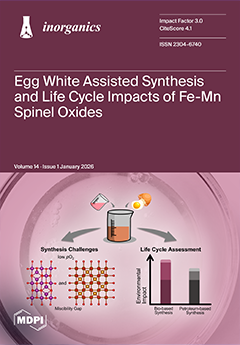
Cover Story (view full-size image):
Egg white (EW) was chosen as a renewable, non-toxic, and potentially sustainable agent for the synthesis of FeMn2O4. However, phase-pure synthesis remains challenging due to (i) the requirement of low oxygen partial pressures, achievable by burning of EW during calcination, to counter rapid Mn3O4 reoxidation and (ii) probable formation of Fe3O4 and Mn3O4 during intermediate steps, leading to multiphase spinel formation caused by a miscibility gap between them. Contrary to widespread expectations, EW may have significant environmental impacts (EIs) in such syntheses, as revealed by life-cycle assessment, which can exceed those of a petroleum-based one. Thus, our results show that the investigated synthesis route is not necessarily more sustainable, and that implementing a quantitative evaluation of EIs at an early stage is essential. View this paper
- Issues are regarded as officially published after their release is announced to the table of contents alert mailing list.
- You may sign up for e-mail alerts to receive table of contents of newly released issues.
- PDF is the official format for papers published in both, html and pdf forms. To view the papers in pdf format, click on the "PDF Full-text" link, and use the free Adobe Reader to open them.
Previous Issue
Next Issue