Article

Cobalt Single-Atom Anchored Tubular Graphyne for Electrocatalytic CO2 Reduction Reaction

1
School of Physics and Electrical Engineering, Anyang Normal University, Anyang 455000, China
2
College of Science, Nanjing Forestry University, Nanjing 210037, China
*
Authors to whom correspondence should be addressed.
Inorganics 2026, 14(1), 7; https://doi.org/10.3390/inorganics14010007
Submission received: 28 November 2025 / Revised: 18 December 2025 / Accepted: 23 December 2025 / Published: 24 December 2025

Abstract

Electrochemical CO2 reduction reaction through utilizing renewable electricity under mild conditions is a promising pathway toward achieving carbon neutrality. In this work, we designed a tubular graphyne functionalized with isolated Co single atom and lowered the activation energy barrier of its rate-determining step to as low as 0.46 eV. The catalytic performance was systematically evaluated through density functional theory calculations. Compared with the planar graphyne functionalized with isolated Co single atom, the tubular one not only significantly improves the utilization efficiency of Co single atoms by exposing them more thoroughly, but also increases the catalytic activity of Co single atom by enhancing electron density of states at the Fermi level, which causes a higher level of activation state for the adsorbed CO2 molecules. Furthermore, it brought about the CO2-to-CH4 reduction reaction pathway, resulting in remarkable catalytic activity and high methane selectivity. Our study demonstrates the efficacy of curvature engineering in enhancing the intrinsic activity of single-atom catalysts, offering a novel strategy for designing advanced carbon cycle catalysts.

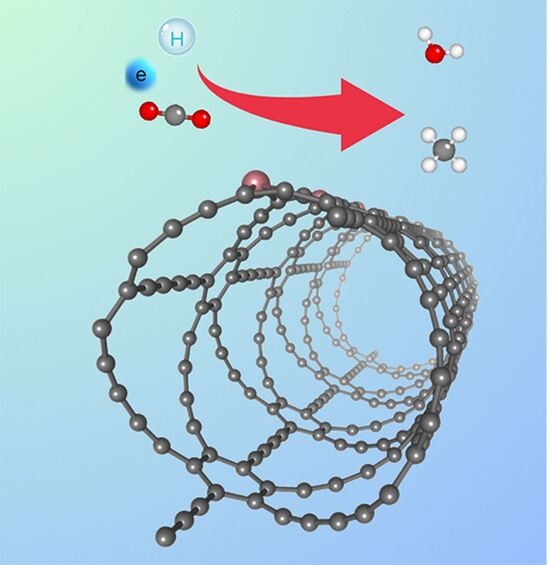
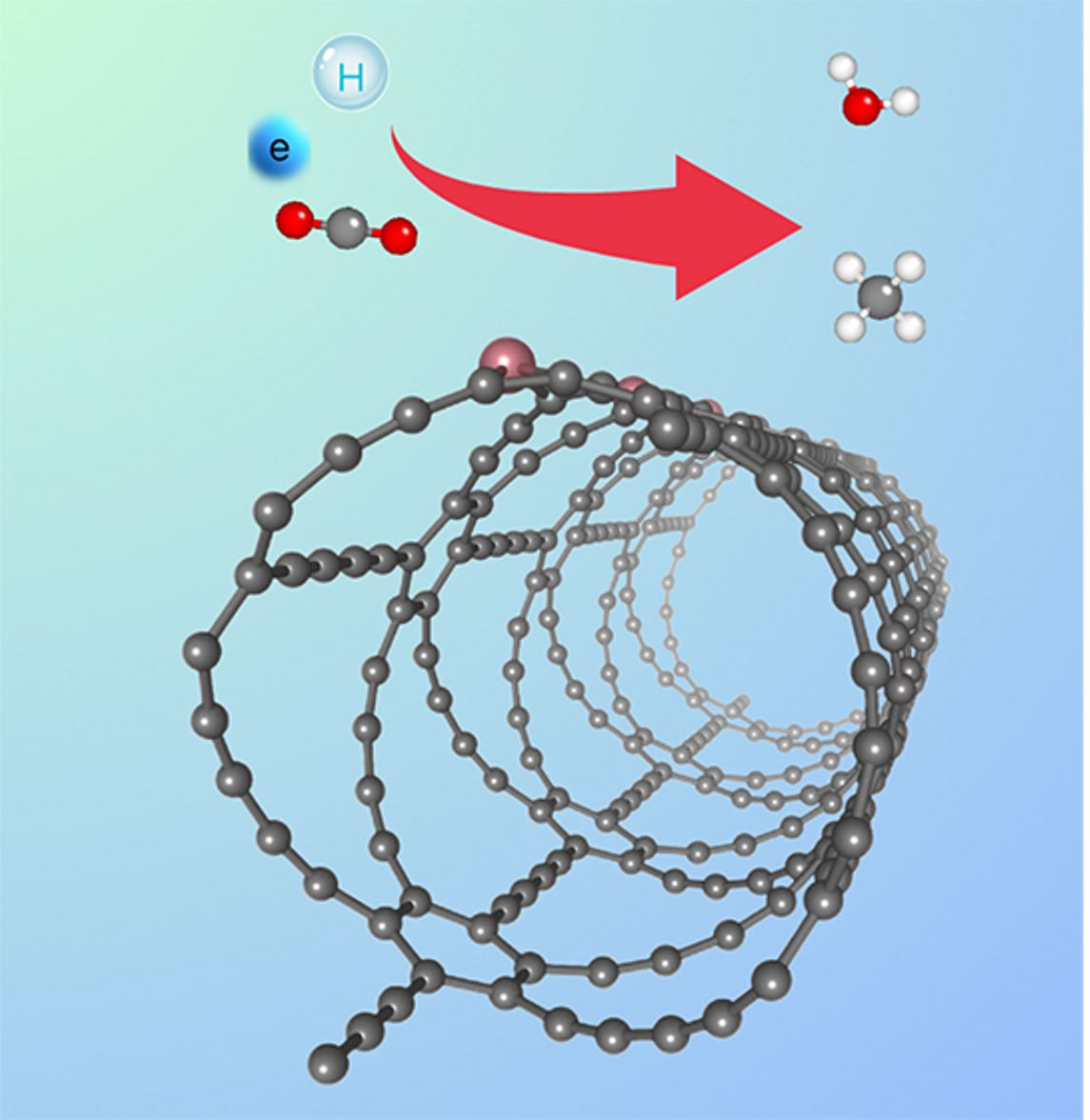
Graphical Abstract

1. Introduction

Carbon capture, utilization, and storage of anthropogenic CO2 present a promising pathway toward achieving carbon neutrality and meeting net-zero emission targets [1]. However, activating CO2 molecules is thermodynamically challenging due to their stable linear C=O bonds. A variety of approaches, including electrochemical [2,3], photochemical [4,5], thermochemical [6,7], and biochemical [8] methods, have been explored to convert CO2 into valuable products. Among these pathways, the electrochemical CO2 reduction reaction (eCO2RR) stands out for its ability to utilize renewable electricity under mild conditions, generating products such as carbon monoxide (CO), methane (CH4), formate (HCOOH), and ethylene (C2H4) [9,10,11,12,13]. Despite considerable progress, the eCO2RR still faces challenges in achieving high selectivity and efficiency for products requiring more than two electrons [14]. This is largely due to complex multi-step proton-coupled electron transfer processes and competition from the hydrogen evolution reaction (HER), which often result in mixed product outputs [15,16].
Over the past decade, significant advances have been made in the design of heterogeneous metal catalysts for eCO2RR. Studies show that catalytic performance and product distribution are highly dependent on the metal used. For example, Ag-based catalysts exhibit high Faradaic efficiency (FE) toward CO [17,18,19], whereas Cu-based catalysts are notable for producing both single-carbon (C1) and multi-carbon (C2+) hydrocarbons and oxygenates [20,21,22,23]. Furthermore, in bimetallic Cu systems, early transition metal dopants tend to enhance hydrocarbon selectivity, while late transition metals favor alcohol production [24]. Nevertheless, key challenges persist, including limited C2+ selectivity, structural instability and aggregation under operating conditions, high overpotentials, and poor atom utilization efficiency [25].
Single-atom catalysts (SACs), which feature isolated metal atoms anchored on solid supports, offer a compelling alternative. SACs exhibit superior activity, selectivity, atom utilization, and tunable electronic properties compared to conventional metal surfaces, making them attractive for various electrocatalytic applications [26]. For instance, M–N4–C sites (M = Fe, Co, Ni, Cu) exhibit high activity in oxygen reduction (ORR), oxygen evolution (OER), and hydrogen evolution (HER) reactions [27]. In M–N4–graphene systems (M = Fe, Co, Ni), Ni sites produce formate, while Fe and Co favor methane [28]. The Al–N–C catalyst was reported achieving up to 98.6% FE for CO at −0.65 V vs. RHE [29]. Beyond the central metal, the coordination environment also plays a critical role. Replacing one N with S in a Bi–N4 SAC (forming BiN3S) reduces the formation energy of COOH* by 0.38 eV, enhancing CO production [30]. Similarly, introducing P into Fe–N–C to form Fe–N/P–C could yield the FE of 98% for CO production [31]. Interestingly, Cu-based SACs are less effective for C1 products, proposing that isolated Cu may act as a promoter rather than an active site [32]. Furthermore, Cr, Mn, Fe, and Co were identified to be more active than Cu for eCO2RR in SAC configurations [33].
In recent years, graphdiyne (GDY) has emerged as a promising carbon allotrope for SAC fabrication. GDY features a unique structure with sp-hybridized carbon atoms forming acetylene linkages between sp2-hybridized benzene rings. Its uniform 18-carbon triangular pores serve as natural macrocyclic ligands that strongly coordinate metal atoms with distinctive electronic interactions, enabling flexible tuning of the coordination environment without requiring additional defects or functional groups [34,35,36]. The electron-withdrawing nature of sp-hybridized carbons and the heterogeneous charge distribution from mixed sp/sp2 hybridization distinguish GDY from conventional carbon materials like graphene or diamond [37]. These properties make GDY an ideal platform for coordination engineering in SAC design.
Recent experimental and theoretical studies have demonstrated the high performance of GDY-based SACs in eCO2RR through tailored coordination environments [38]. For instance, in Cu/GDY SACs, Cu atoms form four Cu–C bonds (2.04–2.07 Å) with alkynyl carbons [39]. Strong hybridization between Cu 3d and C p-π/π* orbitals results in a Cu valence state between 0 and +2. The partially vacant Cu 3d orbitals facilitate strong CO2 adsorption and stabilize the OCHO* intermediate, lowering the energy barrier along the reaction pathway toward CH4 formation (CO2 → CO2* → OCHO* → OCH2* → OHCH3* → CH4). This system achieved the FE of 81% for CH4 and a current density of 243 mA·cm−2 [40]. Modifying the GDY framework with substituents or heteroatoms further tunes catalytic behavior. For example, a Cu SAC was predicted on triphenylene-graphdiyne (Cu@TP-GDY) via DFT, where Cu atoms are stabilized by four Cu–C bonds with strong back-donation (d → π*). This system favors a CO2-to-CO pathway, with the Cu d z 2 and C pz orbital interaction stabilizing the COOH* intermediate [41]. Introducing O or NH groups modulates the Cu charge state and COOH* adsorption energy, thereby tuning the overpotential. Beyond these two kinds of modulation, rolling the two-dimensional (2D) support material into 1D nanotube could also critically influence the electronic structure and catalytic performance of SACs. The curvature of graphene nanotubes can modulate metal–support interactions and local electronic environments, offering a strategy to tailor catalytic properties [42]. Despite this potential, few studies have explored transition metal-doped GDY nanotubes (TM@GDY-NT) for eCO2RR. A comprehensive understanding of their electrocatalytic behavior remains an important and open research challenge. Among other transition metals, Co has attracted considerable attention as an active center in recent years due to its unique characteristics. For example, Lu et al. demonstrated that Co-based single-atom catalysts not only achieve high metal loadings of up to 10.6 wt% while maintaining excellent stability but also exhibit intrinsic magnetism and a tunable spin electronic structure, offering additional avenues for precisely modulating catalytic performance [43]. By constructing non-planar coordination environments or adjusting the spin density of neighboring Co sites, the adsorption energy of oxygen intermediates can be optimized, leading to enhanced efficiency in reactions such as the oxygen evolution reaction. These attributes make cobalt a promising candidate for high-performance SACs. In this study, we firstly constructed a specific GDY nanotube by rolling planar GDY monolayer (GDY-P) and anchored Co single atoms onto this substrate. Then, we investigated if the tubular structure caused modulation on the electronic structure of the Co sites, as well as the CO2 activation and hydrogenation processes by screening the CO2 reduction reaction pathway on the Co@GDY-NT. Therefore, this study employs dimensionality engineering to break the constraints of traditional two-dimensional carbon materials by designing a one-dimensional nanotube architecture. This deliberate transition from a planar to a tubular structure of the active sites thereby enables the precise steering of the product selectivity in the electrocatalytic CO2 reduction reaction.

2. Results and Discussion

2.1. Geometric Structure and Stability of Co@GDY-NT

Graphyne is an excellent substrate for single-atom catalysts (SACs), which comprises three fundamental structural types: α, β and γ [44]. The α, β, and γ nomenclature acts as a “coordinate system” for precisely describing the topology of two-dimensional graphyne structures. Specifically, α denotes the number of carbon atoms in the smallest carbon ring within the structure. The β represents the number of carbon atoms in the next smallest ring that is directly connected to the α ring via a –C≡C– bond. The γ refers to the number of carbon atoms in the third ring, which is directly linked to the β ring at a position adjacent to the connection point between the β and α rings [45]. Among these three structures, γ-graphyne is considered the most stable. This is attributed to its lowest proportion of acetylene linkages (50%) while retaining the stable benzene ring structure [46]. Owing to its unique hybrid orbital structure that enables rapid electron transport, its inherent triangular pores which allow perfect anchoring of metal atoms, and its diverse carbon chemical bonds that strongly couple with metal atoms to effectively modulate their electronic structure.
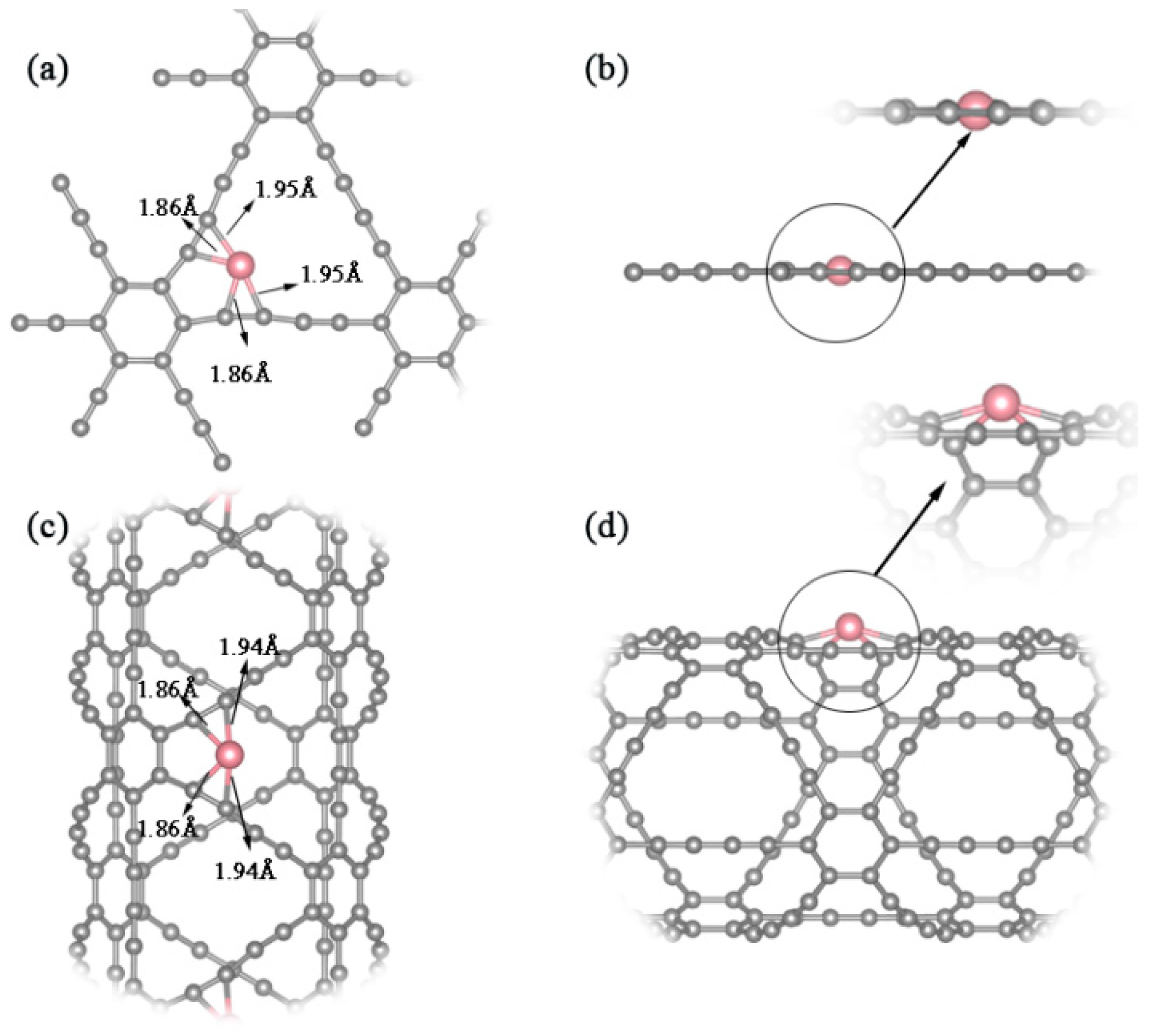
As displayed in Figure 1a, in Co@GDY-P model, the transition metal cobalt single atoms were anchored at the triangular pores of planar graphyne. The distances between Co atom and adjacent carbon atom are measured. It could be seen that the single Co atom resides in the cavity of the s-p linkages of graphyne, with a distance of around 1.86 Å to 1.95 Å between the metal atom and the adjacent carbon atom as shown in Figure 1a. These calculated results are in good agreement with the previous literature [47].
For the Co@GDY-NT model, we constructed a zigzag-type one-dimensional graphyne nanotube model with a chiral index of (1, 1) with a diameter of 10.22 Å. The catalyst possesses a one-dimensional nanotubular structure composed of 72 C atoms and 1 Co atom, with a radius of 5.11 Å, a length of 9.5 Å, and a specific surface area of 304.86 Å2. We opted for the zigzag-type instead of the armchair-type for the reason that, compare with the armchair-type γ-graphyne nanotubes, the zigzag structure has a higher conductivity with smaller band gap, rendering it a better substrate for electrocatalysts [48]. This tubular model was obtained by rolling up a two-dimensional planar γ-graphyne sheet along the corresponding direction, based on the lattice basis vectors illustrated in Figure S1 [49]. Subsequently, we anchored the Co atoms at the same sites as in the planar graphyne. The distances between the Co atoms and adjacent C atoms range from 1.86 to 1.94 Å, which are close to those in the planar structure, as shown in Figure 1c. Planar graphyne was originally constructed by expanding the unit cell using a 2 × 2 × 1 supercell expansion with 18 carbon atoms. A Co atom was then loaded into the triangular pore to form a planar single-atom catalyst. As can be seen from Figure 1b, the anchored Co single atom is embedded within the plane of the graphyne sheet. However, Figure 1d clearly shows that the anchored Co single atom protrudes from the surface of the graphyne nanotube. Compared to the planar catalyst, the anchored Co atom in the tubular catalyst is more fully exposed to the ambient environment. This enhanced exposure is more conducive to the efficient progression of subsequent reactions through adsorbing more reactant gas molecules.
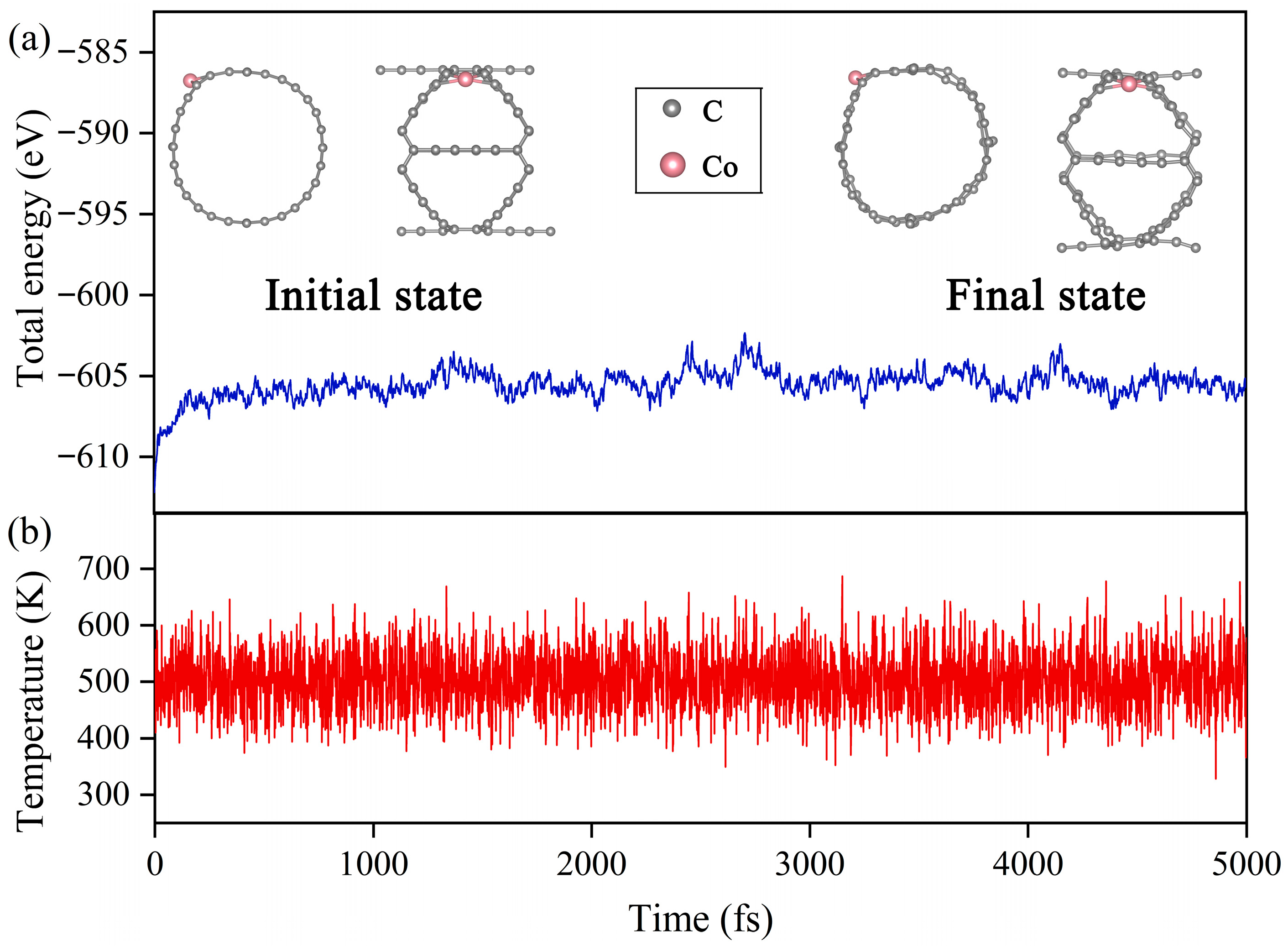
The stability of the Co@GDY-NT system is quantitatively measured with the binding energy of single atom on the graphyne support. According to the equation for the binding energy (displayed in Equation (1)), more negative value of binding energy indicates that the Co single metal atom is attached to the graphyne nanotube more stably. The catalytic performance of electrocatalytic CO2 reduction is co-determined by the geometric structure and stability of the catalyst. The geometric structure governs the nature of active sites and influences the reaction pathway. We calculated the binding energies for both the planar and tubular catalysts. The planar structure exhibits a binding energy of −4.08 eV, while the tubular structure shows a value of −3.93 eV. The negligible difference between these two values indicates that the rolling process into a nanotube has no significant impact on the stability of the catalyst. Furthermore, this result also suggests a strong exothermic process, preliminarily confirming the considerable thermodynamic stability of the SAC. To further investigate the structural stability of Co@GDY-NT at elevated temperatures, we performed ab initio molecular dynamics (AIMD) simulations. The simulations employed a 1 fs time step and were run at 500 K for a total simulation time of 5 ps (the thermal stability assessment does not account for the influence of the electrolyte and potentials). Throughout the simulation shown in Figure 2, the catalyst structure remained intact without any atomic detachment or structural reconstruction, exhibiting only minor deformation. Meanwhile, the total energy of the system fluctuated slightly around the average value and quickly reached equilibrium. This result demonstrates that Co@GDY-NT can maintain its structural integrity even at relatively high temperatures. Considering its excellent energetic and thermal stability collectively, we believe this Co@GDY-NT system potentially possesses considerable application in the field of catalysis. The stability ensures sustained catalytic performance. Catalyst stability is the decisive factor in determining whether a catalyst can transition from the laboratory to practical application. It is not only directly related to the economic viability of production-stable catalysts can significantly reduce costs associated with frequent replacement and system maintenance-but also serves as the core guarantee for the long-term, efficient, safe, and controllable operation of the reaction process.

2.2. The Electronic Structure of Co@GDY-NT

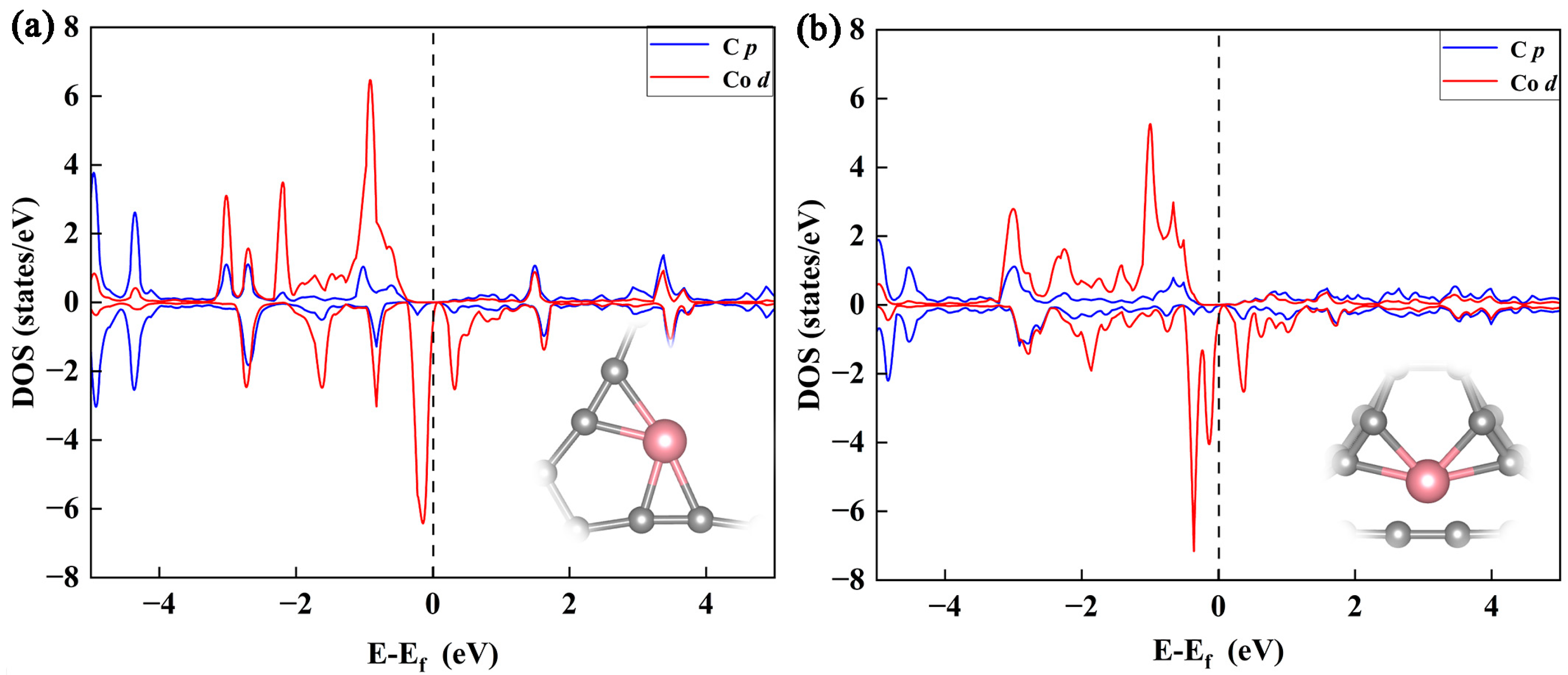
Based on the confirmed geometric structure and stability of the Co@GDY-NT system, we conducted a comparative analysis of its projected density of states (PDOS) and orbital hybridization with the planar catalyst. Integrated analysis of PDOS and magnetic moments reveals that, the transition from the planar structure to the tubular structure alters the properties of the Co atom. As shown in Figure 3b, the most prominent feature is the emergence of distinct split peaks near the Fermi level in the Co-3d orbitals (represented by the red curves) of the tubular structure. This clearly reveals the d-orbital energy level reconstruction induced by the structural transformation, thereby laying the foundation for creating high activity of the Co single atom. The tubular structure maintains a magnetic moment (1.00 μB per Co atom) similar to its planar counterpart. However, in the Co@GDY-NT system, the p-orbital electronic structure of the four C atoms bonded to Co undergoes a critical change that, a significant enhancement in the DOS near the Fermi level directly confirms improved metallicity and conductivity. Meanwhile, the emergence of sharp and localized characteristic peaks around −2 eV signifies the formation of highly localized active sites at specific energy positions. These phenomena collectively demonstrate that, the hopeful catalytic performance of the tubular structure primarily originates from the synergistic effects of d orbital electronic reconstruction of active sites and high conductivity at the Fermi level.

2.3. The CO2 Adsorption on Co@GDY-NT

The adsorption and activation of CO2 is a pivotal step in the catalytic reduction process because it directly creates the possibility for the reaction to proceed. The free-state CO2 molecule possesses a highly symmetric, linear configuration, with its C=O bond energy as high as 750 kJ·mol−1, resulting in remarkable thermodynamic stability of the molecule. Simultaneously, molecular orbital energy level analysis reveals a substantial energy gap of 13.7 eV between the highest occupied molecular orbital (HOMO) and the lowest unoccupied molecular orbitals (LUMO) of CO2 gas molecule. The ultra-high energy gap severely impedes the initial electron injection process and thereby presenting the primary obstacle to its catalytic reduction. Therefore, the core of catalyst design lies in the precise modulation of the electronic and geometric structures of the active sites to overcome the aforementioned energy barriers. At the geometric structure level, constructing asymmetric or confined active sites to disrupt the linear symmetry of the CO2 molecule, forcing it into a bent configuration, could effectively weaken the C=O bonds and reduce the HOMO-LUMO energy gap, achieving efficient CO2 activation.
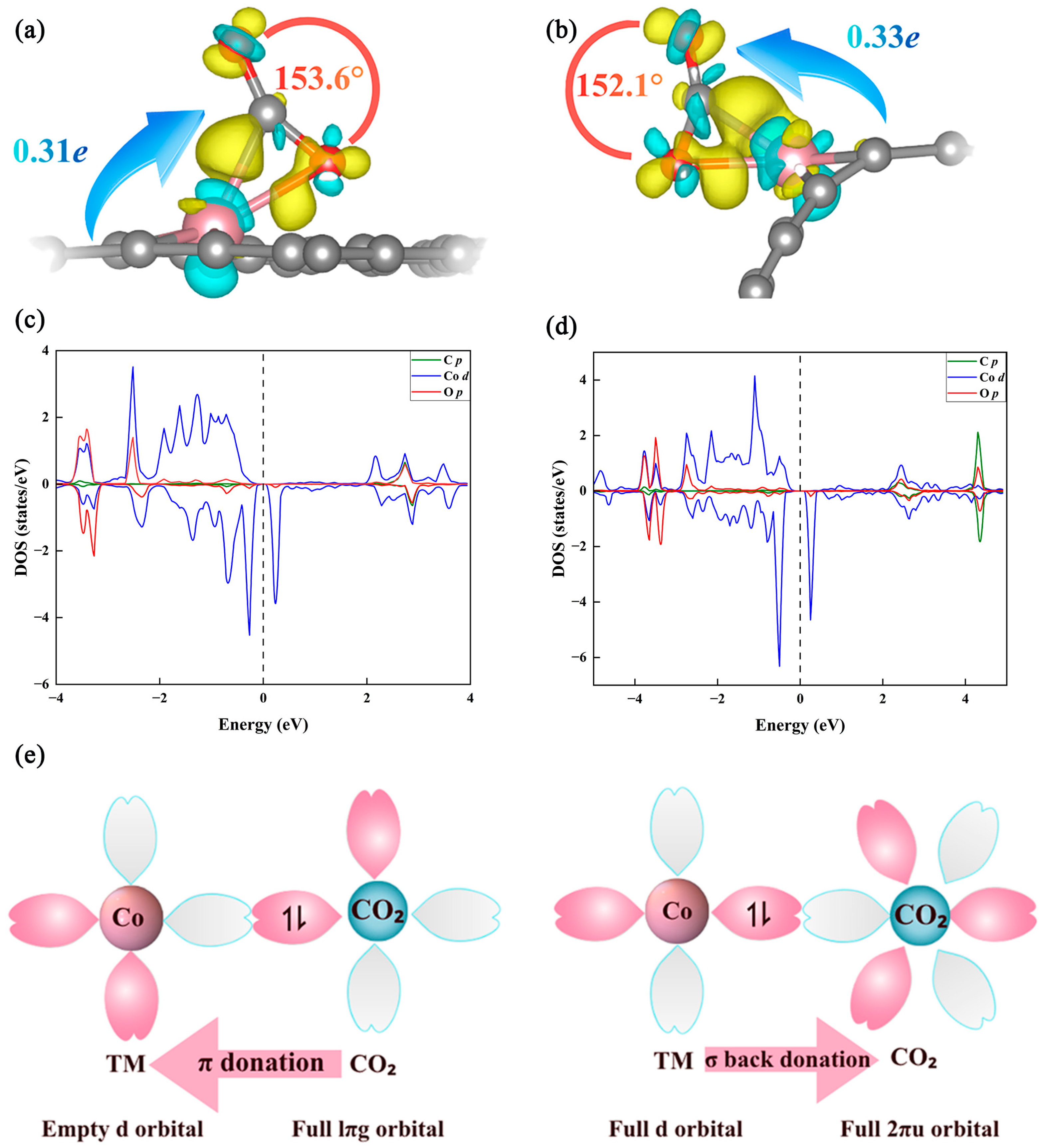
The adsorption of CO2 on the Co@GDY-P and Co@GDY-NT SACs induces profound reconstruction of both geometric and electronic structures of CO2 molecule, signifying the transformation from a thermodynamically stable inert molecule into a highly reactive species. Characterization results clearly demonstrate that the ∠OCO bond angle of adsorbed CO2 bends significantly from 180° in the gas-phase ground state to 153.6° and 152.1° on the Co@GDY-P and Co@GDY-NT SACs, respectively. This critical structural alteration disrupts the inherent linear symmetry of CO2, triggering a downshift in the energy level of its LUMO, thereby achieving optimal energy and symmetry matching with the d orbitals of the catalytic active center. This optimized alignment enables highly efficient interfacial electron transfer, as unequivocally demonstrated by charge density difference analysis, which reveals extensive electron density accumulation (yellow regions) and depletion (cyan regions) at the interface. The Bader charge population analyses further confirm this process, revealing substantial electron acquisition by the adsorbed CO2 from the substrate, with the one on the tubular configuration gaining slightly more electrons (0.33 e) than the one on the planar configuration (0.31 e). These acquired electrons primarily reside in the π* antibonding orbital of CO2, a phenomenon attributable to the synergistic electron donation and back-donation between the metal sites and CO2 (seeing Figure 4e). The elongation of the C=O bond lengths from 1.184 Å to 1.202 Å and 1.249 Å on the Co@GDY-P and Co@GDY-NT SACs, respectively. The C=O bond lengths elongations also provide direct evidences for the weakened C=O bond strength upon CO2 adsorption. In summary, the bond angle bending, interfacial electron transfer, and bond length increase constitute a synergistic activation mechanism that effectively activates the CO2 molecule by reducing the molecular orbital energy gap and weakening the chemical bonds. This activated state not only establishes a thermodynamic foundation for subsequent reduction reactions but also significantly lowers the kinetic energy barrier for the protonation steps, thereby substantially promoting the overall catalytic process.

2.4. The Electrocatalytic CO2 Reduction Reaction Path on Co@GDY-NT

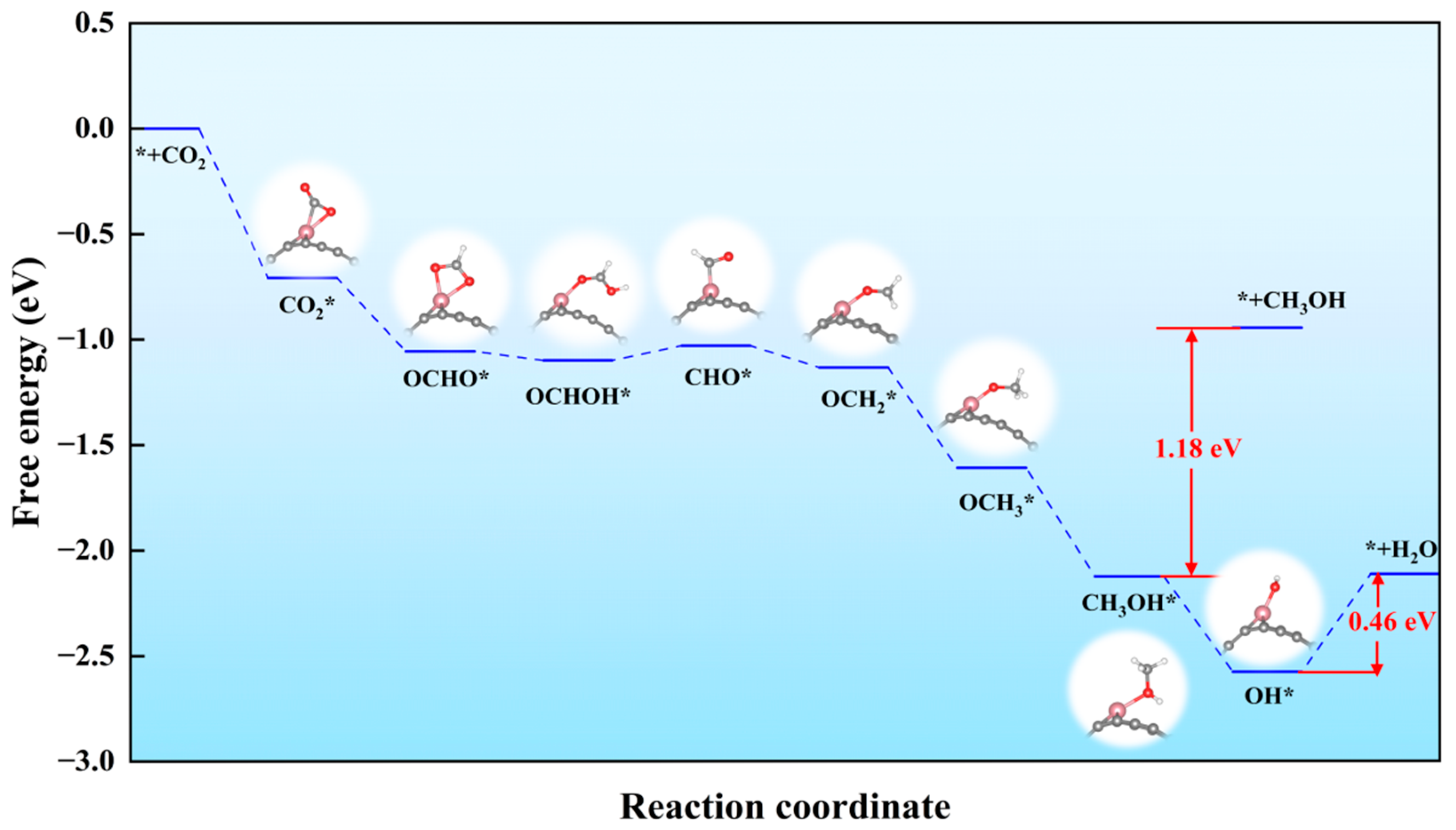
Through the screening research shown in Figure S2, we determined the minimum energy pathway for the CO2 reduction reaction on the Co@GDY-NT catalyst (seeing Figure 5). The minimum energy pathway was identified by evaluating the thermodynamic favorability of all possible protonation steps at each reaction stage. Specifically, at each branching point, the pathway proceeding via the intermediate with the lowest Gibbs free energy change (ΔG) was selected, thereby constructing the overall most thermodynamically favorable reaction network. The CO2 reduction reaction begins with the adsorption of CO2 onto the Co@GDY-NT catalyst surface, forming a CO2* intermediate ( CO 2 ( g )   +   *   →  CO 2 * ). This adsorbed CO2 undergoes a proton-coupled electron transfer (PCET) step, with one hydrogen atom attaching to an O atom ( CO 2 * +   H +   +   e -  →  OCHO * ), producing an OCHO* intermediate. The adjacent oxygen atom then undergoes a second protonation ( OCHO *   +   H +   +   e -  →  OCHOH * ), favorable the OCHOH* intermediate (the adsorbed species resembling formate). The further reduction step involves the adsorbed OCHOH* intermediate on the catalyst surface accepting a proton and an electron, transforming into an adsorbed CHO* intermediate, and releasing a water molecule ( OCHOH *   +   H +   +   e -  →  CHO *   +   H 2 O ). This also marks the first dehydration event in the overall reaction process. Moreover, in this step, the atom bonded to Co changes from an oxygen atom to a carbon atom. During the hydrogenation of the CHO* intermediate to the OCH2* intermediate ( CHO *   +   H +   +   e -  →  OCH 2 * ), the change in the carbon atom’s hybridization from sp2 to sp3 induces a fundamental reorganization of the intermediate’s adsorption mode on the catalyst surface. The atom bonded to the Co atom changes from a carbon atom in the previous step back to an oxygen atom, accomplishing the transition from an Co–C bond to an Co–O bond. This spontaneous switching of the adsorption site is a key microscopic step that ensures the smooth progression of subsequent reactions. The subsequent reduction step involves the addition of a hydrogen atom to the carbon atom of the OCH2 group, leading to the formation of the OCH3* intermediate ( OC H 2 *   +   H + +   e -  →  OCH 3 * ). The following hydrogenation step incorporates a hydrogen atom into the oxygen atom of the OCH3* intermediate, yielding a stable CH3OH* species ( O CH 3 *   +   H +   +   e -  →  CH 3 OH * ). This product is identical to that generated on the Co@GDY-P surface [47]. However, we found that the energy barrier required for the adsorbed CH3OH to desorb as a free CH3OH molecule is as high as 1.18 eV. Therefore, we opted to proceed with further hydrogenation. In this reaction step, the CH3OH* intermediate adsorbed on the catalyst surface undergoes a concerted proton-electron transfer process, inducing homolytic cleavage of its C–O bond. The newly introduced hydrogen atom combines with the –CH3 group, generating CH4 that desorbs from the active site ( CH 3 OH *   +   H +   +   e -   →  OH *   +   CH 4 ). This represents the final product of our current work. Meanwhile, the remaining oxygen atom persists as a surface-bound -OH group at the catalytic site. Through a proton-electron transfer process, a hydrogen atom combines with the adsorbed -OH to form a water molecule ( OH *   +   H +   +   e -  →  H 2 O   +   * ), constituting the second dehydration event in the overall reaction. This step constitutes the rate-determining step for the overall pathway, with a calculated energy barrier of 0.46 eV. This process clears the surface active sites and regenerates the catalytic center, playing a crucial role in maintaining the sustainability of the catalytic cycle. All elementary steps along this pathway exhibit low energy barriers, indicating a thermodynamically favorable process. Based on the Bronsted-Evans-Polanyi (BEP) relation, we identified the optimal reaction pathway [50,51]. The most critical distinction from the planar Co@GDY-P catalyst lies in the product selectivity. The planar Co@GDY-P catalyst favors the formation of CH3OH [47], whereas the curvature modulation in the tubular catalyst reconfigured the adsorption energies of key intermediates, thereby rendering the entire pathway from CO2 to CH4 with a high selectivity. In this study, by altering the geometric structure, we have directed the product formation toward a different outcome. It is noteworthy that the Co@GDY-NT SAC for the electrocatalytic CO2RR exhibits a significantly more favorable limiting potential (−0.46 V) than conventional catalysts, such as Cu (211) (−0.8 V) [52], Co@Cu (−0.87 V) [53], WC (0001) (−1.0 V) [54], Pd-Nb@P↑-In2Se3 (−0.66 V) [55], and Co@MoSSe (−0.63 V) [56]. In summary, Co@GDY-NT is a high-performance catalyst where precise tuning of the support dimensionality enables manipulation of both catalytic efficiency and final products.

2.5. HER vs. CO2RR

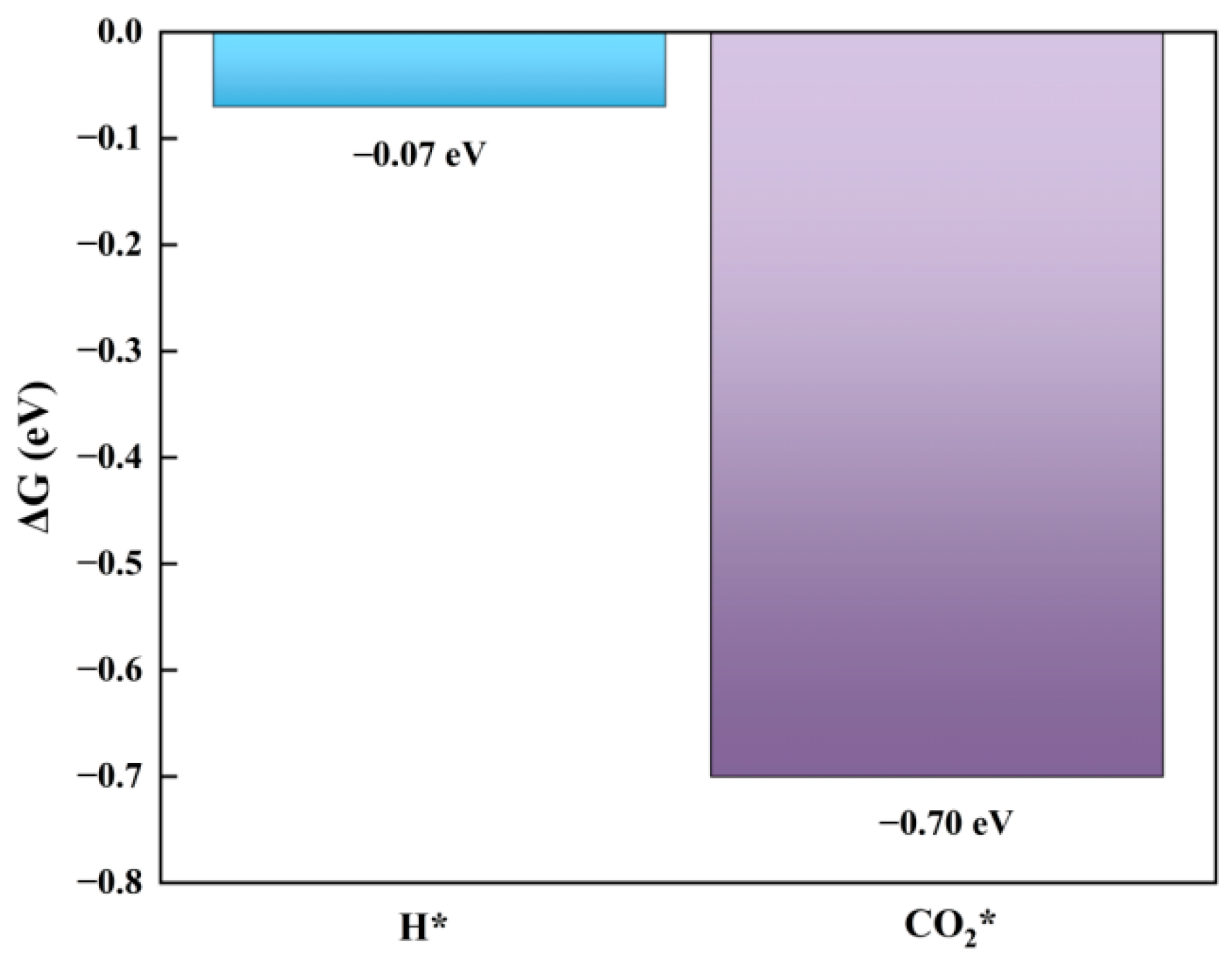
In the design of SAC, an in-depth understanding of the hydrogen evolution reaction (HER) is crucial. This reaction proceeds through sequential proton-electron transfer steps, extracting hydrogen species from the electrolyte to ultimately form H2 molecules. To check if the eCO2RR is more favorable, we calculated the Gibbs free energy changes (ΔG) at the initial steps of eCO2RR ( *   +   CO 2  →  CO 2 * ) and HER ( *   +   H +   +   e  →   H * ). As displayed in Figure 6, on the Co@GDY-NT SAC, the ΔG for the formation of H* is −0.07 eV, while that of CO2* is −0.7 eV. According to the Bronsted-Evans-Polanyi relation, reactions with lower ΔG have smaller reaction barriers and consequently are kinetically more favorable. The calculated ΔG results indicate that, Co@GDY-NT system has a higher selectivity toward the eCO2RR, instead of the HER. Therefore, the active sites are spontaneously and predominantly occupied by CO2 molecules, implying that subsequent hydrogenation proceeds mainly via reactions between the stabilized CO2* intermediate and surface-migrating H species.

3. Models and Methods

In this study, the first-principle calculations were carried out using DS-PAW (Version V2024A; developed by HONG ZHI WEI TECHNOLOGY (SHANGHAI) Co., Ltd., Shanghai, China) soft package based on density functional theory (DFT). The exchange–correlation interactions between electrons were described with the Perdew–Burke–Ernzerhof (PBE) functional under the generalized gradient approximation (GGA), and the Grimme D3 dispersion correction was incorporated to accurately account for van der Waals interactions. Initial structural relaxation was performed on a 1 × 1 × 3 K-point mesh using the conjugate gradient (CG) method until the forces on all atoms converged below 0.03 eV/Å, with a maximum of 500 optimization steps. On the basis of the obtained relaxed structure, a denser 1 × 1 × 5 k-point mesh was employed to perform a self-consistent field (SCF) calculation for obtaining high-accuracy electronic structure properties. The SCF iteration continued until the total energy change was less than 1 × 10⁻⁵ eV, with a maximum of 200 steps. A plane-wave basis set with a cutoff energy of 400 eV was used, and the Brillouin zone integration was performed using the Gamma-centered scheme, with a width of 0.05 eV to improve convergence. Additionally, spin polarization was included, and the crystal symmetry was turned off. To isolate the system from periodic image interactions, a vacuum layer of 14 Å was applied along the C-axis. Subsequently, based on the converged charge density, the electronic band structure along specified high-symmetry paths and the PDOS within an energy range of −25 to 10 eV (relative to the Fermi level) with a resolution of 0.05 eV were calculated for further analysis. The thermodynamic stability of the catalyst was demonstrated using Ab Initio Molecular Dynamics (AIMD), AIMD simulations were performed using VASP with the PBE functional. Calculations were conducted in the NVT ensemble at 500 K using a Nosé–Hoover thermostat. The time step was 1 fs for a total duration of 5 ps.
The binding energy between the Co single atom and graphyne nanotube was calculated using the following formula,
E b   =   E total E sub   E Co
where E t o t a l was the energy of the integrated system, E s u b is the graphyne nanotube, and E C o is the energy of an isolated Co atom. A lower E b corresponds to a more stable catalyst structure.
The adsorption energy of the CO 2 on the graphyne nanotube was obtained from the following formula,
E ads = E total   E sub E CO 2
where E t o t a l was the energy of the adsorption system, E s u b is the energy of the single-atom catalyst, and E C O 2 corresponds to the energy of an isolated CO 2 molecule. A more negative adsorption energy corresponds to a more strongly exothermic process, indicating that the adsorbed structure is thermodynamically more favorable, so possesses higher stability.
The charge density difference (CDD) was computed using the following formula,
Δ ρ = ρ t o t a l ρ s u b ρ C O 2
where ρ t o t a l represents the charge density of the adsorption system, ρ s u b   represents the charge density of the substrate, and ρ C O 2 represents the charge density of the CO 2 molecule. CDD was employed to investigate the interaction mechanism between the adsorbate and the substrate.
The Gibbs free energy is calculated by the following formula,
G = E + E Z P E   -   T S + e U + G p H
where E represents the total energy, E Z P E represents the zero-point energy, and the TS represents entropy. The Gibbs free energy serves to accurately assess the thermodynamic viability of the adsorption process under actual reaction conditions.

4. Conclusions

Based on systematic DFT calculations, this study demonstrates that anchoring Co single atoms on a tubular graphyne support significantly enhances the eCO2RR performance compared to its planar counterpart. The curvature-induced structural transformation in the tubular system leads to a more thorough exposure of Co active sites and a notable reconstruction of the electronic structure, particularly in the Co 3d orbitals near the Fermi level. This electronic reconfiguration enhances metallicity and conductivity, facilitating more efficient electron transfer during catalysis. The tubular geometry also promotes stronger CO2 activation, as evidenced by greater bond angle bending, increased electron transfer, and longer C=O bond lengths. The reaction pathway analysis reveals that Co@GDY-NT preferentially catalyzes the conversion of CO2 to CH4, in contrast to the planar system which favors CH3OH formation. The minimum energy path involves multiple proton-coupled electron transfer steps, with the hydrogenation of OH* to H2O identified as the potential-determining step, exhibiting an energy barrier of 0.46 eV. Moreover, the competition from the hydrogen evolution reaction is effectively suppressed due to the more favorable Gibbs free energy for CO2 adsorption compared to H* formation, ensuring high eCO2RR selectivity. Our work highlights the critical role of curvature engineering in modulating the electronic and geometric properties of single-atom catalysts. By transforming a two-dimensional graphyne sheet into a one-dimensional nanotube, both the intrinsic activity and product selectivity of Co SACs are markedly improved. These findings provide a novel design strategy for developing efficient carbon cycle catalysts through rational dimensionality control of support materials, offering valuable insights for future electrocatalyst development aimed at achieving carbon neutrality.

Supplementary Materials

The following supporting information can be downloaded at: https://www.mdpi.com/article/10.3390/inorganics14010007/s1, Figure S1: The triangular macroporous structure of a graphyne monolayer and its nanotubes. Top view of the graphyne monolayer, showing its anisotropic lattice with the basis vectors a1 and a2. The chiral vector is defined as Ch = ma1 + na2 for constructing the nanotubes. The (n, m) nomenclature is applied here, where Armchair-type nanotubes are represented by (n, 0) and Zigzag-type by (n, n); Figure S2: The search process for the minimum energy reaction pathways of the CO2 reduction reactions on Co@GDY-NT. The red arrows denote disallowed reaction paths, while the green arrows stand for the enabled ones; Table S1: Zero-pint energy correction (EZPE), entropy contribution (TS, T = 298.15 K), total energy (E), and the Gibbs free energy (G) of small molecules; Table S2: Zero-pint energy correction (EZPE), entropy contribution (TS, T = 298.15 K), total energy (E), and the Gibbs free energy (G) of adsorbates along the reaction pathway on Co@GDY-NT, where * represents the adsorption site.

Author Contributions

Conceptualization, D.Z.; Data curation, S.X.; Formal analysis, L.J., X.T., S.X. and C.L.; Funding acquisition, L.J. and C.L.; Investigation, S.X., L.J. and X.T.; Software, S.X.; Supervision, L.J. and D.Z.; Validation, S.X.; Writing—original draft, L.J., X.T., D.Z. and S.X. All authors have read and agreed to the published version of the manuscript.

Funding

We thank the Computational Laboratory for Energy Conversion and Storage for the computational resources. This work is funded by the National Natural Science Foundation of China (Grant Nos. 22573002, 12504256), the Program for Science & Technology Innovation Talents in Universities of Henan Province (Grant No. 24HASTIT013), the Young scientist project of Henan province (Grant No. 225200810103), and the Natural Science Foundation of Henan (Grant No. 252300423365).

Institutional Review Board Statement

Not applicable.

Informed Consent Statement

Not applicable.

Data Availability Statement

The original contributions presented in this study are included in the article/Supplementary Materials. Further inquiries can be directed to the corresponding author.

Conflicts of Interest

The authors declare no conflict of interest.

References

  1. Peter, S.C. Reduction of CO2 to Chemicals and Fuels: A Solution to Global Warming and Energy Crisis. ACS Energy Lett. 2018, 3, 1557–1561. [Google Scholar] [CrossRef]
  2. Mondal, S.; Peter, S.C. A Perspective on Electrochemical Point Source Utilization of CO2 and Other Flue Gas Components to Value Added Chemicals. Adv. Mater. 2024, 36, 2407124. [Google Scholar] [CrossRef]
  3. Ju, L.; Tan, X.; Mao, X.; Gu, Y.; Smith, S.; Du, A.; Chen, Z.; Chen, C.; Kou, L. Controllable CO2 electrocatalytic reduction via ferroelectric switching on single atom anchored In2Se3 monolayer. Nat. Commun. 2021, 12, 5128. [Google Scholar] [CrossRef]
  4. Zhu, X.; Zhou, E.; Tai, X.; Zong, H.; Yi, J.; Yuan, Z.; Zhao, X.; Huang, P.; Xu, H.; Jiang, Z. g-C3N4 S-Scheme Homojunction through Van der Waals Interface Regulation by Intrinsic Polymerization Tailoring for Enhanced Photocatalytic H2 Evolution and CO2 Reduction. Angew. Chem. Int. Ed. 2025, 64, e202425439. [Google Scholar] [CrossRef]
  5. Zhu, X.; Zong, H.; Pérez, C.J.V.; Miao, H.; Sun, W.; Yuan, Z.; Wang, S.; Zeng, G.; Xu, H.; Jiang, Z. Supercharged CO2 photothermal catalytic methanation: High conversion, rate, and selectivity. Angew. Chem. 2023, 135, e202218694. [Google Scholar] [CrossRef]
  6. Goud, D.; Churipard, S.R.; Bagchi, D.; Singh, A.K.; Riyaz, M.; Vinod, C.; Peter, S.C. Strain-enhanced phase transformation of iron oxide for higher alcohol production from CO2. ACS Catal. 2022, 12, 11118–11128. [Google Scholar] [CrossRef]
  7. Roy, S.; Cherevotan, A.; Peter, S.C. Thermochemical CO2 Hydrogenation to Single Carbon Products: Scientific and Technological Challenges. ACS Energy Lett. 2018, 3, 1938–1966. [Google Scholar] [CrossRef]
  8. Gonzales, J.N.; Matson, M.M.; Atsumi, S. Nonphotosynthetic biological CO2 reduction. Biochemistry 2018, 58, 1470–1477. [Google Scholar] [CrossRef]
  9. Jia, S.; Ma, X.; Sun, X.; Han, B. Electrochemical transformation of CO2 to value-added chemicals and fuels. CCS Chem. 2022, 4, 3213–3229. [Google Scholar] [CrossRef]
  10. Shafaat, H.S.; Yang, J.Y. Uniting biological and chemical strategies for selective CO2 reduction. Nat. Catal. 2021, 4, 928–933. [Google Scholar] [CrossRef]
  11. Wei, J.; Yao, R.; Han, Y.; Ge, Q.; Sun, J. Towards the development of the emerging process of CO2 heterogenous hydrogenation into high-value unsaturated heavy hydrocarbons. Chem. Soc. Rev. 2021, 50, 10764–10805. [Google Scholar] [CrossRef]
  12. Yang, F.; Zhu, D.; Xia, C.; Shahid, Z.; Chen, S.; Xia, B.Y. Copper-organic frameworks for electrocatalytic carbon dioxide reduction. Coord. Chem. Rev. 2024, 517, 216021. [Google Scholar] [CrossRef]
  13. Wang, Z.; Zhou, Y.; Qiu, P.; Xia, C.; Fang, W.; Jin, J.; Huang, L.; Deng, P.; Su, Y.; Crespo-Otero, R. Advanced catalyst design and reactor configuration upgrade in electrochemical carbon dioxide conversion. Adv. Mater. 2023, 35, 2303052. [Google Scholar] [CrossRef]
  14. Chang, B.; Pang, H.; Raziq, F.; Wang, S.; Huang, K.-W.; Ye, J.; Zhang, H. Electrochemical reduction of carbon dioxide to multicarbon (C2+) products: Challenges and perspectives. Energy Environ. Sci. 2023, 16, 4714–4758. [Google Scholar] [CrossRef]
  15. Han, J.; Bai, X.; Xu, X.; Bai, X.; Husile, A.; Zhang, S.; Qi, L.; Guan, J. Advances and challenges in the electrochemical reduction of carbon dioxide. Chem. Sci. 2024, 15, 7870–7907. [Google Scholar] [CrossRef] [PubMed]
  16. Yan, Z.; Liu, W.; Liu, X.; Shen, Z.; Li, X.; Cao, D. Recent Progress in Electrocatalytic Conversion of CO2 to Valuable C2 Products. Adv. Mater. Interfaces 2023, 10, 2300186. [Google Scholar] [CrossRef]
  17. Hsieh, Y.-C.; Senanayake, S.D.; Zhang, Y.; Xu, W.; Polyansky, D.E. Effect of Chloride Anions on the Synthesis and Enhanced Catalytic Activity of Silver Nanocoral Electrodes for CO2 Electroreduction. ACS Catal. 2015, 5, 5349–5356. [Google Scholar] [CrossRef]
  18. Sun, D.; Xu, X.; Qin, Y.; Jiang, S.P.; Shao, Z. Rational Design of Ag-Based Catalysts for the Electrochemical CO2 Reduction to CO: A Review. ChemSusChem 2020, 13, 39–58. [Google Scholar] [CrossRef]
  19. Chen, Y.; Li, C.W.; Kanan, M.W. Aqueous CO2 Reduction at Very Low Overpotential on Oxide-Derived Au Nanoparticles. J. Am. Chem. Soc. 2012, 134, 19969–19972. [Google Scholar] [CrossRef]
  20. Bagger, A.; Ju, W.; Varela, A.S.; Strasser, P.; Rossmeisl, J. Electrochemical CO2 reduction: Classifying Cu facets. Acs Catal. 2019, 9, 7894–7899. [Google Scholar] [CrossRef]
  21. Jia, Y.; Li, F.; Fan, K.; Sun, L. Cu-based bimetallic electrocatalysts for CO2 reduction. Adv. Powder Mater. 2022, 1, 100012. [Google Scholar] [CrossRef]
  22. Gao, D.; Sinev, I.; Scholten, F.; Arán-Ais, R.M.; Divins, N.J.; Kvashnina, K.; Timoshenko, J.; Roldan Cuenya, B. Selective CO2 electroreduction to ethylene and multicarbon alcohols via electrolyte-driven nanostructuring. Angew. Chem. 2019, 131, 17203–17209. [Google Scholar]
  23. Yang, K.D.; Ko, W.R.; Lee, J.H.; Kim, S.J.; Lee, H.; Lee, M.H.; Nam, K.T. Morphology-directed selective production of ethylene or ethane from CO2 on a Cu mesopore electrode. Angew. Chem. 2017, 129, 814–818. [Google Scholar] [CrossRef]
  24. Li, Z.; Wang, P.; Lyu, X.; Kondapalli, V.K.R.; Xiang, S.; Jimenez, J.D.; Ma, L.; Ito, T.; Zhang, T.; Raj, J.; et al. Directing CO2 electroreduction pathways for selective C2 product formation using single-site doped copper catalysts. Nat. Chem. Eng. 2024, 1, 159–169. [Google Scholar] [CrossRef]
  25. Su, X.; Wang, C.; Zhao, F.; Wei, T.; Zhao, D.; Zhang, J. Size effects of supported Cu-based catalysts for the electrocatalytic CO2 reduction reaction. J. Mater. Chem. A 2023, 11, 23188–23210. [Google Scholar] [CrossRef]
  26. Chen, C.; Li, J.; Tan, X.; Zhang, Y.; Li, Y.; He, C.; Xu, Z.; Zhang, C.; Chen, C. Harnessing single-atom catalysts for CO2 electroreduction: A review of recent advances. EES Catal. 2024, 2, 71–93. [Google Scholar] [CrossRef]
  27. Xie, L.; Zhou, W.; Qu, Z.; Huang, Y.; Li, L.; Yang, C.; Li, J.; Meng, X.; Sun, F.; Gao, J.; et al. Edge-doped substituents as an emerging atomic-level strategy for enhancing M–N4–C single-atom catalysts in electrocatalysis of the ORR, OER, and HER. Nanoscale Horiz. 2025, 10, 322–335. [Google Scholar] [CrossRef]
  28. Yang, Y.; Li, J.; Zhang, C.; Yang, Z.; Sun, P.; Liu, S.; Cao, Q. Theoretical insights into nitrogen-doped graphene-supported Fe, Co, and Ni as single-atom catalysts for CO2 reduction reaction. J. Phys. Chem. C 2022, 126, 4338–4346. [Google Scholar] [CrossRef]
  29. Ma, Z.; Wang, B.; Yang, X.; Ma, C.; Wang, W.; Chen, C.; Liang, F.; Zhang, N.; Zhang, H.; Chu, Y.; et al. P-block aluminum single-atom catalyst for electrocatalytic CO2 reduction with high intrinsic activity. J. Am. Chem. Soc. 2024, 146, 29140–29149. [Google Scholar] [CrossRef]
  30. Wang, Z.; Wang, C.; Hu, Y.; Yang, S.; Yang, J.; Chen, W.; Zhou, H.; Zhou, F.; Wang, L.; Du, J.; et al. Simultaneous diffusion of cation and anion to access N, S co-coordinated Bi-sites for enhanced CO2 electroreduction. Nano Res. 2021, 14, 2790–2796. [Google Scholar] [CrossRef]
  31. Li, K.; Zhang, S.; Zhang, X.; Liu, S.; Jiang, H.; Jiang, T.; Shen, C.; Yu, Y.; Chen, W. Atomic tuning of single-atom Fe–N–C catalysts with phosphorus for robust electrochemical CO2 reduction. Nano Lett. 2022, 22, 1557–1565. [Google Scholar] [CrossRef]
  32. Zhao, Q.; Crespo-Otero, R.; Di Tommaso, D. The role of copper in enhancing the performance of heteronuclear diatomic catalysts for the electrochemical CO2 conversion to C1 chemicals. J. Energy Chem. 2023, 85, 490–500. [Google Scholar] [CrossRef]
  33. Karmodak, N.; Vijay, S.; Kastlunger, G.; Chan, K. Computational screening of single and di-atom catalysts for electrochemical CO2 reduction. ACS Catal. 2022, 12, 4818–4824. [Google Scholar] [CrossRef] [PubMed]
  34. Lu, T.; Wang, H. Graphdiyne-supported metal electrocatalysts: From nanoparticles and cluster to single atoms. Nano Res. 2022, 15, 9764–9778. [Google Scholar] [CrossRef]
  35. Huang, C.; Li, Y.; Wang, N.; Xue, Y.; Zuo, Z.; Liu, H.; Li, Y. Progress in research into 2D graphdiyne-based materials. Chem. Rev. 2018, 118, 7744–7803. [Google Scholar] [CrossRef] [PubMed]
  36. Fang, Y.; Liu, Y.; Qi, L.; Xue, Y.; Li, Y. 2D graphdiyne: An emerging carbon material. Chem. Soc. Rev. 2022, 51, 2681–2709. [Google Scholar] [CrossRef]
  37. Li, B.; Yu, S.; Zhou, M.; Chen, C.; Lai, C.; Zhang, M.; Lin, H. Graphynes: Ideal supports of single atoms for electrochemical energy conversion. J. Mater. Chem. A 2022, 10, 3905–3932. [Google Scholar] [CrossRef]
  38. Gao, Y.; Cai, Z.; Wu, X.; Lv, Z.; Wu, P.; Cai, C. Graphdiyne-supported single-atom-sized Fe catalysts for the oxygen reduction reaction: DFT predictions and experimental validations. Acs Catal. 2018, 8, 10364–10374. [Google Scholar] [CrossRef]
  39. Shi, G.; Xie, Y.; Du, L.; Fu, X.; Chen, X.; Xie, W.; Lu, T.B.; Yuan, M.; Wang, M. Constructing Cu−C bonds in a graphdiyne-regulated Cu single-atom electrocatalyst for CO2 reduction to CH4. Angew. Chem. 2022, 134, e202203569. [Google Scholar] [CrossRef]
  40. Zhou, X.; Shan, J.; Chen, L.; Xia, B.Y.; Ling, T.; Duan, J.; Jiao, Y.; Zheng, Y.; Qiao, S.-Z. Stabilizing Cu2+ ions by solid solutions to promote CO2 electroreduction to methane. J. Am. Chem. Soc. 2022, 144, 2079–2084. [Google Scholar] [CrossRef]
  41. Shen, H.; Sun, Q. Tuning CO2 Electroreduction of Cu Atoms on Triphenylene-Cored Graphdiyne. J. Phys. Chem. C 2019, 123, 29776–29782. [Google Scholar] [CrossRef]
  42. Li, Y.; Georges, G. Three decades of single-walled carbon nanotubes research: Envisioning the next breakthrough applications. ACS Nano 2023, 17, 19471–19473. [Google Scholar] [CrossRef]
  43. Kumar, P.; Kannimuthu, K.; Zeraati, A.S.; Roy, S.; Wang, X.; Wang, X.; Samanta, S.; Miller, K.A.; Molina, M.; Trivedi, D.; et al. High-Density Cobalt Single-Atom Catalysts for Enhanced Oxygen Evolution Reaction. J. Am. Chem. Soc. 2023, 145, 8052–8063. [Google Scholar] [CrossRef]
  44. James, A.; John, C.; Owais, C.; Myakala, S.N.; Chandra Shekar, S.; Choudhuri, J.R.; Swathi, R.S. Graphynes: Indispensable nanoporous architectures in carbon flatland. RSC Adv. 2018, 8, 22998–23018. [Google Scholar] [CrossRef]
  45. Baughman, R.H.; Eckhardt, H.; Kertesz, M. Structure-property predictions for new planar forms of carbon: Layered phases containing sp2 and sp atoms. J. Chem. Phys. 1987, 87, 6687–6699. [Google Scholar] [CrossRef]
  46. Puigdollers, A.R.; Alonso, G.; Gamallo, P. First-principles study of structural, elastic and electronic properties of α-, β- and γ-graphyne. Carbon 2016, 96, 879–887. [Google Scholar] [CrossRef]
  47. Liu, T.; Wang, G.; Bao, X. Electrochemical CO2 Reduction Reaction on 3d Transition Metal Single-Atom Catalysts Supported on Graphdiyne: A DFT Study. J. Phys. Chem. C 2021, 125, 26013–26020. [Google Scholar] [CrossRef]
  48. Kang, B.; Moon, J.H.; Lee, J.Y. Size dependent electronic band structures of β- and γ-graphyne nanotubes. RSC Adv. 2015, 5, 80118–80121. [Google Scholar] [CrossRef]
  49. Coluci, V.; Galvao, D.; Baughman, R. Theoretical investigation of electromechanical effects for graphyne carbon nanotubes. J. Chem. Phys. 2004, 121, 3228–3237. [Google Scholar] [CrossRef]
  50. Bronsted, J. Acid and Basic Catalysis. Chem. Rev. 1928, 5, 231–338. [Google Scholar] [CrossRef]
  51. Evans, M.; Polanyi, M. Inertia and driving force of chemical reactions. Trans. Faraday Soc. 1938, 34, 11–24. [Google Scholar] [CrossRef]
  52. Back, S.; Kim, H.; Jung, Y. Selective Heterogeneous CO2 Electroreduction to Methanol. ACS Catal. 2015, 5, 965–971. [Google Scholar] [CrossRef]
  53. Zhao, Z.; Lu, G. Cu-Based Single-Atom Catalysts Boost Electroreduction of CO2 to CH3OH: First-Principles Predictions. J. Phys. Chem. C 2019, 123, 4380–4387. [Google Scholar] [CrossRef]
  54. Wannakao, S.; Artrith, N.; Limtrakul, J.; Kolpak, A.M. Engineering Transition-Metal-Coated Tungsten Carbides for Efficient and Selective Electrochemical Reduction of CO2 to Methane. ChemSusChem 2015, 8, 2745–2751. [Google Scholar] [CrossRef]
  55. Ju, L.; Tang, X.; Zhang, Y.; Chen, M.; Liu, S.; Long, C. Insights into Pd-Nb@In2Se3 Electrocatalyst for High-Performance and Selective CO2 Reduction Reaction from DFT. Inorganics 2025, 13, 146. [Google Scholar] [CrossRef]
  56. He, Y.-P.; Wu, S.-Y.; Qin, M.-L.; Lv, C.-W.; Kuang, M.-Q. Density functional theory study of single Iron, Cobalt, Nickel atoms adsorbed on Janus MoSSe nanosheets as electrocatalysts for reduction of CO2 to CH3OH. Int. J. Hydrogen Energy 2025, 169, 151179. [Google Scholar] [CrossRef]
Figure 1. The (a) top and (b) side views of Co@GDY-P model. The (c) top and (d) side views of Co@GDY-NT model. The configuration within the black circle is a local magnified view of the vicinity of the Co single atom active site.
Inorganics 14 00007 g001
Figure 2. The ab initio molecular dynamics simulations of Co@GDY-NT configurations at 500 K, with a time step of 1 fs and a duration of 5 ps, the fluctuations in the (a) total energy and (b) temperature are presented.
Inorganics 14 00007 g002
Figure 3. The PDOS of the d orbitals (marked with red line) from the Co single atom and the p orbitals (marked with blue line) from the four C atoms bonded to the Co single atom are plotted for (a) Co@GDY-P and (b) Co@GDY-NT. The inset configuration is a local view of the Co single-atom active site and its surrounding four C atoms bonded to the Co single atom.
Inorganics 14 00007 g003
Figure 4. The charge differential density maps of CO2 adhered to (a) Co@GDY-P and (b) Co@GDY-NT systems. Yellow and cyan regions represent electron accumulation and depletion. The isosurface level is set to 0.01 e Å−3. (c) The hybridization between the d orbitals of the Co atom and the p orbitals of the C atom bonded to it after CO2 adsorption on the Co@GDY-P substrate. (d) The hybridization between the d orbitals of the Co atom and the p orbitals of the C and O atoms bonded to it after CO2 adsorption on the tubular Co@GDY-NT substrate. (e) Simplified schematic diagrams of CO2 activation on transition metals.
Inorganics 14 00007 g004
Figure 5. The Gibbs free energy diagram for the CO 2 RR to produce CH4 along the minimum energy path on the Co@GDY-NT at 0 V (vs. RHE). Energy-minimized structures of key intermediates are displayed in the insets. The hydrogenation step for the formation of H2O molecule is identified as the potential determining step.
Inorganics 14 00007 g005
Figure 6. The blue and purple bars represent the Gibbs free energy change for the formation of H* and CO2*, respectively.
Inorganics 14 00007 g006
Disclaimer/Publisher’s Note: The statements, opinions and data contained in all publications are solely those of the individual author(s) and contributor(s) and not of MDPI and/or the editor(s). MDPI and/or the editor(s) disclaim responsibility for any injury to people or property resulting from any ideas, methods, instructions or products referred to in the content.