Article

The Influence of Sintering Temperature on the Transport Properties of GdBa2Cu3O7 Superconductor Prepared from Nano-Powders via the Co-Precipitation Method


1
Department of Chemistry, Faculty of Science, Jerash University, Jerash 26150, Jordan
2
Department of Chemical and Materials Engineering, University of Alberta, Donadeo Innovation Centre for Engineering, Edmonton, AB T6G 1H9, Canada
3
Department of Chemistry, Faculty of Science, University of Jordan, Amman 11942, Jordan
4
Faculty of Engineering, the University of Jordan, Amman 11942, Jordan
5
Isra University Innovation Center (IUIC), Isra University, P.O. Box 33, Isra University Office, Amman 11622, Jordan
6
Faculty of Pharmacy, Mutah University, Alkrarak 61710, Jordan
7
Faculty of Pharmacy, Isra University, Amman 11622, Jordan
*
Author to whom correspondence should be addressed.
Inorganics 2026, 14(1), 25; https://doi.org/10.3390/inorganics14010025
Submission received: 22 November 2025 / Revised: 3 January 2026 / Accepted: 5 January 2026 / Published: 7 January 2026
(This article belongs to the Section Inorganic Solid-State Chemistry)

Abstract

This study examines the influence of sintering temperature on the structural and transport properties of GdBa2Cu3O7 (Gd123) superconductors prepared from nano-sized precursors via the co-precipitation method. The metal-oxalate precursor (average particle size < 50 nm) was calcined at 900 °C for 12 h, and then the prepared pellets were sintered under an oxygen atmosphere in the range of 920–950 °C for 15 h. All samples showed metallic properties and a sharp superconducting transition. Critical temperatures TC(R=0) were 94–95 K, with higher sintering temperatures steadily boosting critical current density. X-ray diffraction confirmed orthorhombic Gd123 as the dominant phase, with its phase fraction increasing from 92% to 99.8% as the sintering temperature increased. SEM micrographs showed large, densely packed grains, with higher sintering temperatures promoting improved grain connectivity and reduced porosity. The sample sintered at 950 °C exhibited the most favorable transport performance, attributed to enhanced intergranular coupling and the presence of nanoscale secondary phases acting as effective flux-pinning centers. Overall, these results demonstrate that careful control of sintering temperature can significantly optimize the microstructure and superconducting properties of Gd123 materials, supporting their advancement for practical electrical and magnetic applications.

1. Introduction

The synthesis of REBa2Cu3O7−δ (RE123) ceramic superconductors (RE includes La, Dy, Gd, Sm, Yb, Ho, Nd, and Y) has attracted considerable interest due to their promising electrical and magnetic properties, such as power transmission, magnetic levitation, and energy storage [1,2,3,4,5,6,7,8]. Several synthesis techniques have been used, such as the conventional solid-state reaction (SSR), which achieves a transition temperature (TC) of 92 K [4,5]; pulsed laser deposition (PLD), typically yielding high-quality epitaxial thin films with a TC between 91 and 93 K under optimal oxygenation and substrate conditions [9,10,11]; co-precipitation (COP), which uses nanoscale precursors for better homogeneity and results in a TC of 94 K [12,13,14,15,16,17]; and chemically modified photosensitive methods, where the resulting thin film has a TC of approximately 90 K [18,19]. The SSR method typically uses high-purity oxides and carbonates as precursors, involving multiple grinding steps and extended heat treatments to ensure complete reaction. However, this approach can introduce contamination during processing [20,21,22]. In contrast, the COP method offers advantages by employing nanoscale precursors, reducing the need for prolonged sintering and grinding [23,24,25,26].
Gadolinium-based GdBa2Cu3O7−δ (Gd123), forms an orthorhombic crystal structure when oxygen deficiency is low (δ < 0.6), and its critical temperature (TC) is above 90 K [7]. Secondary phases, such as Gd2BaCuO5 (Gd211), are known to boost transport properties by serving as flux-pinning centers [8].
Research has shown that sintering time influences the superconducting abilities of Gd123, with 15 h at 920 °C being considered optimal [12,13,14,15,16,17]. However, the impact of varying sintering temperatures on the superconducting and transport characteristics of Gd123 produced by COP remains insufficiently explored.
This study aims to produce a Gd123 ceramics superconductor via the coprecipitation method to synthesize fine precursor powder before the calcination and sintering stages. Comprehensive characterizations are carried out using several techniques, including a scanning electron microscope (SEM), thermogravimetric analysis (TGA), X-ray diffraction (XRD), and Direct-Current (DC) system with a cooling facility for electrical measurement within the range of superconductivity.

2. Results and Discussion

2.1. TGA Curve of the Produced Blue Nano-Powder

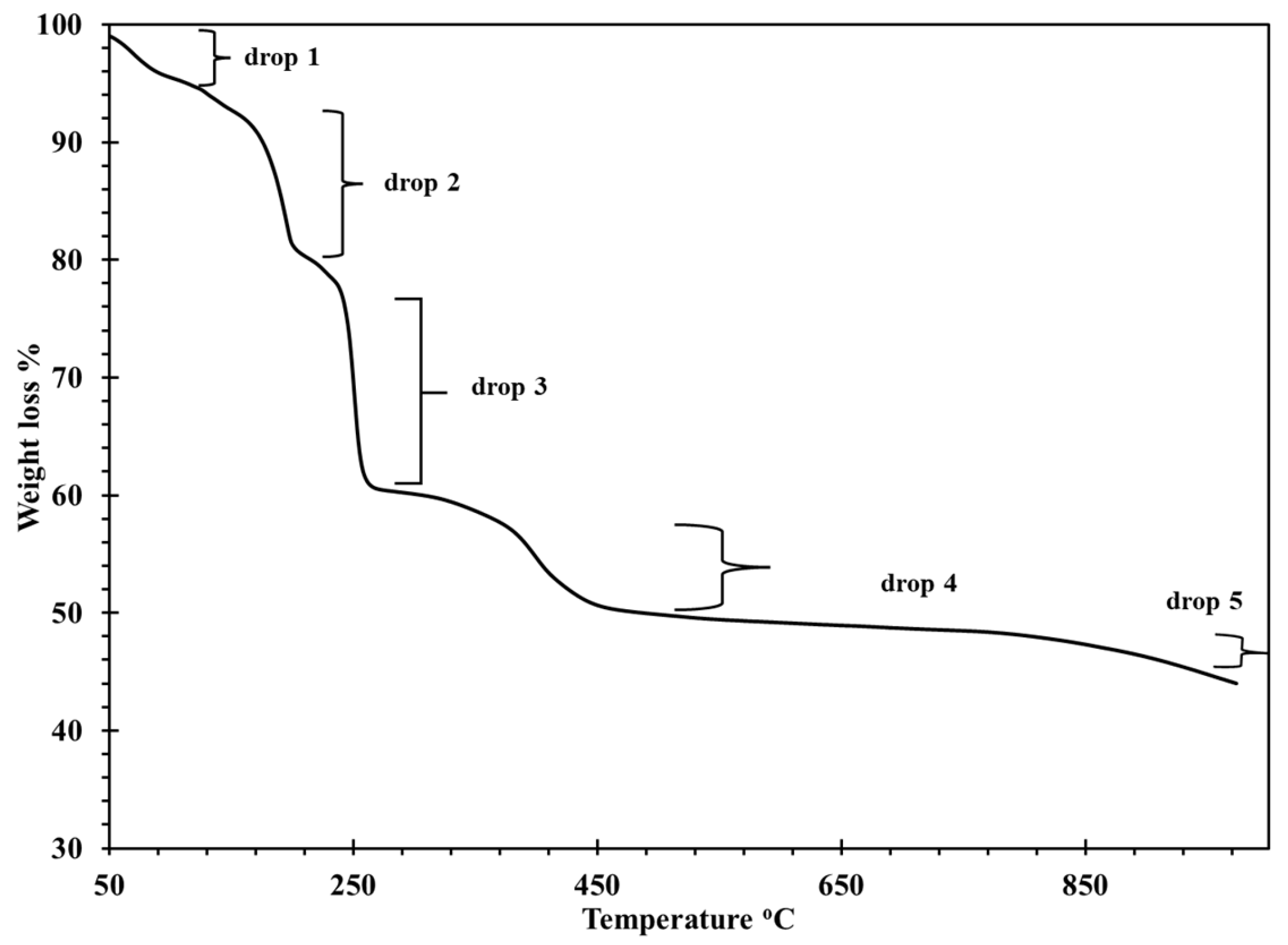
The TGA curve showed five significant weight drops as a function of temperature, as illustrated in Figure 1. The first drop (4.3%) was the moisture loss from the sample, which ended at approximately 125 °C. The second drop, occurring at 125–226 °C, (15%) represented the water loss due to crystallization from the metal oxalate mixtures. The third drop in weight of (20%) at 226–293 °C could be due to the decomposition of CuC2O4, BaC2O4, and Gd2(C2O4)3·6H2O into CuO [27], BaCO3, and Gd2(C2O4)3. The fourth drop (13.1%) at 310–860 °C is associated with the decomposition of Gd2(C2O4)3 to Gd2O3 [27], and the formation of BaCuO2, which agrees with previous reports [26,28]. The final drop shows a complete decomposition and the formation of GdBa2Cu3O7−δ that begins at 860 °C, as indicated in Table 1. Therefore, from the TGA thermogram, it can be concluded that the suitable calcination and sintering temperatures for Gd123 are in the range of 860–950 °C [27,29,30].

2.2. Microstructure of the Produced Powder and Sintered Pellets

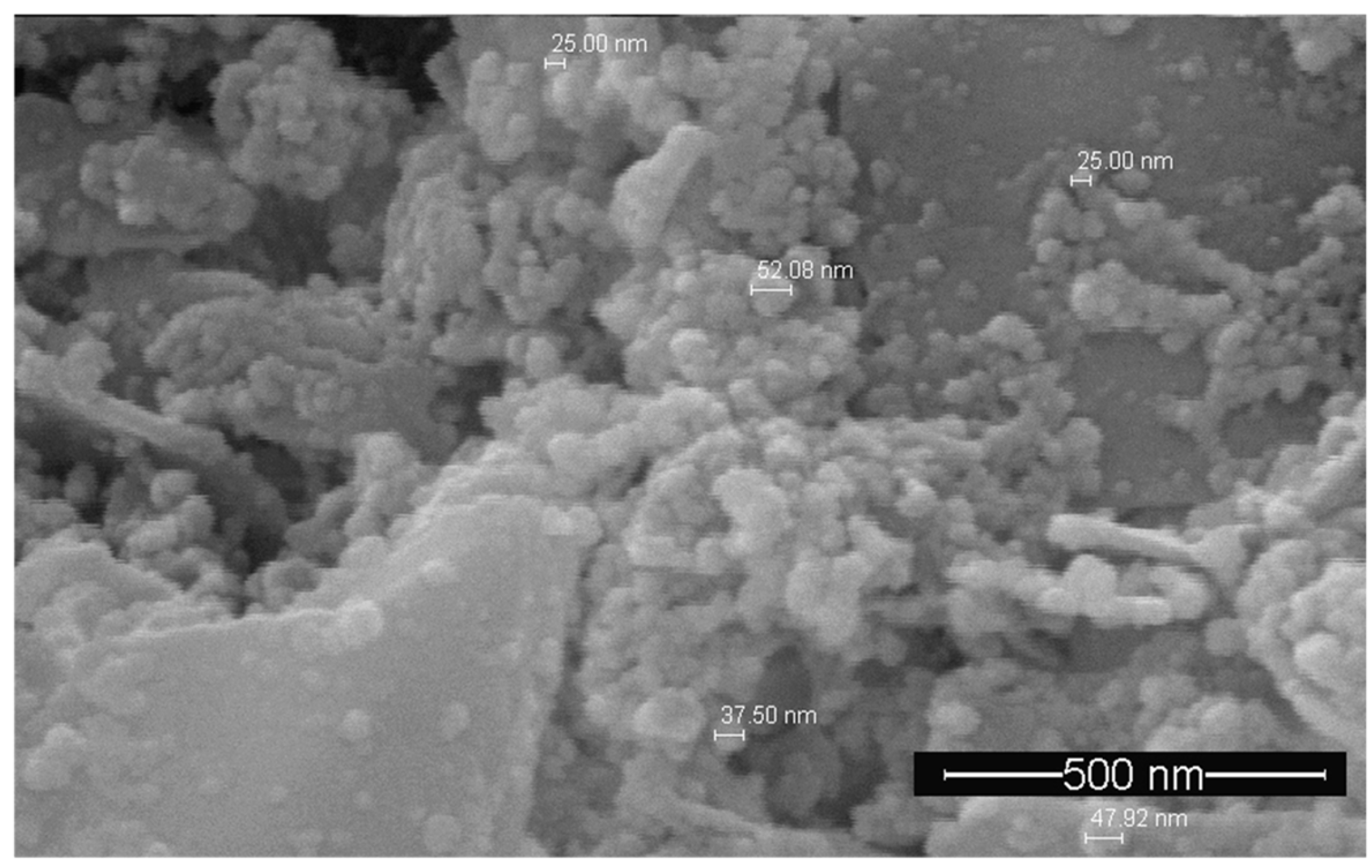
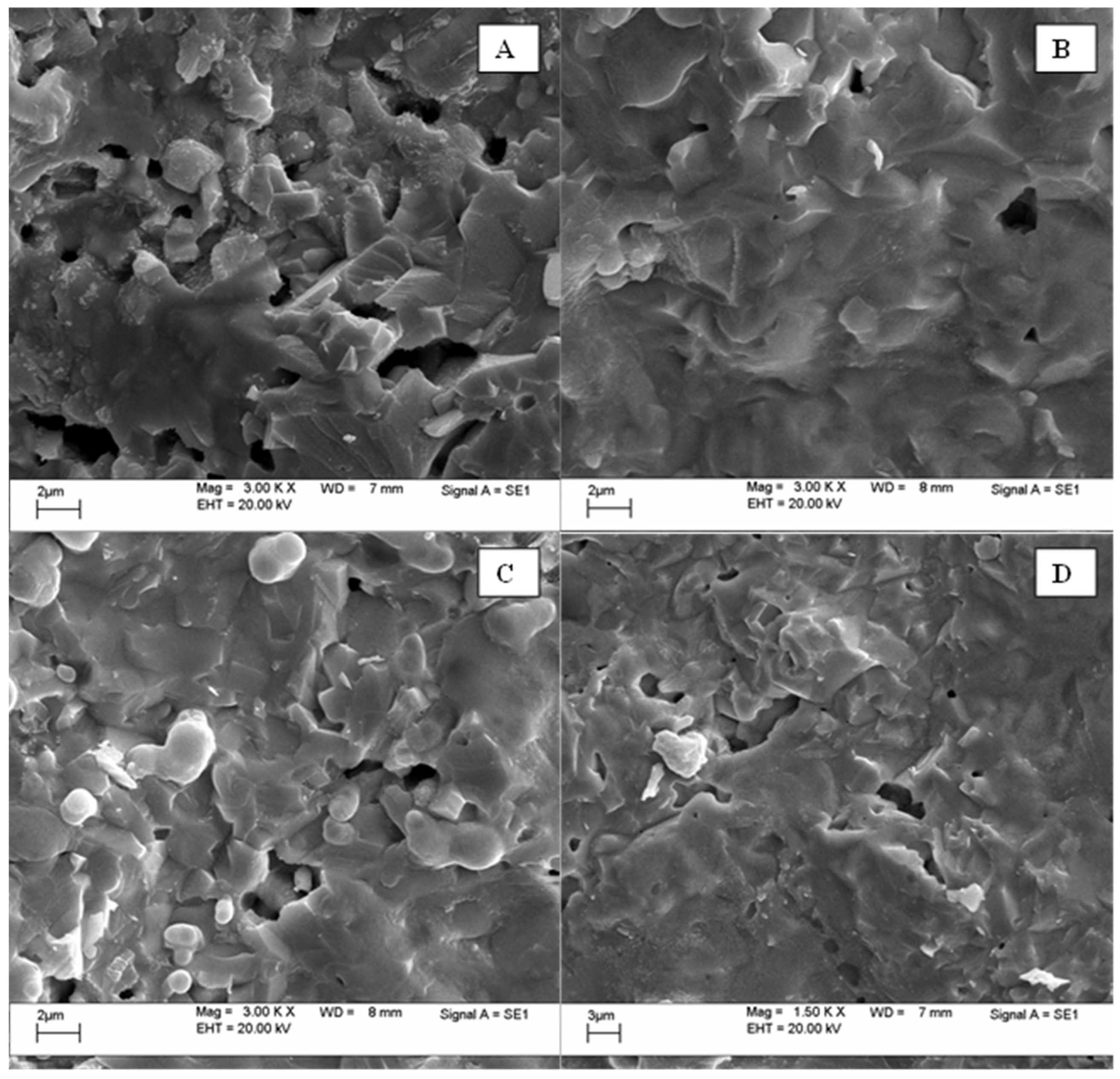
The SEM image of the produced blue powder confirms the precipitation of nanoparticles, as shown in Figure 2. The image reveals the agglomeration state of the nanoscale particles, which is a probable result because of the mutual diffusion between particles during the precipitation process, in the absence of any capping substance. The particle size is within the range of 50 nm or less. All sintered pellets exhibited large, densely packed grains with reduced porosity structures, as demonstrated in Figure 3.
In addition, the grains become closer and more coherent as the sintering temperature increases, thus improving the sintering density as a common result, which is in good agreement with the porosity and relative density measurements recorded in Table 3.

2.3. XRD Results

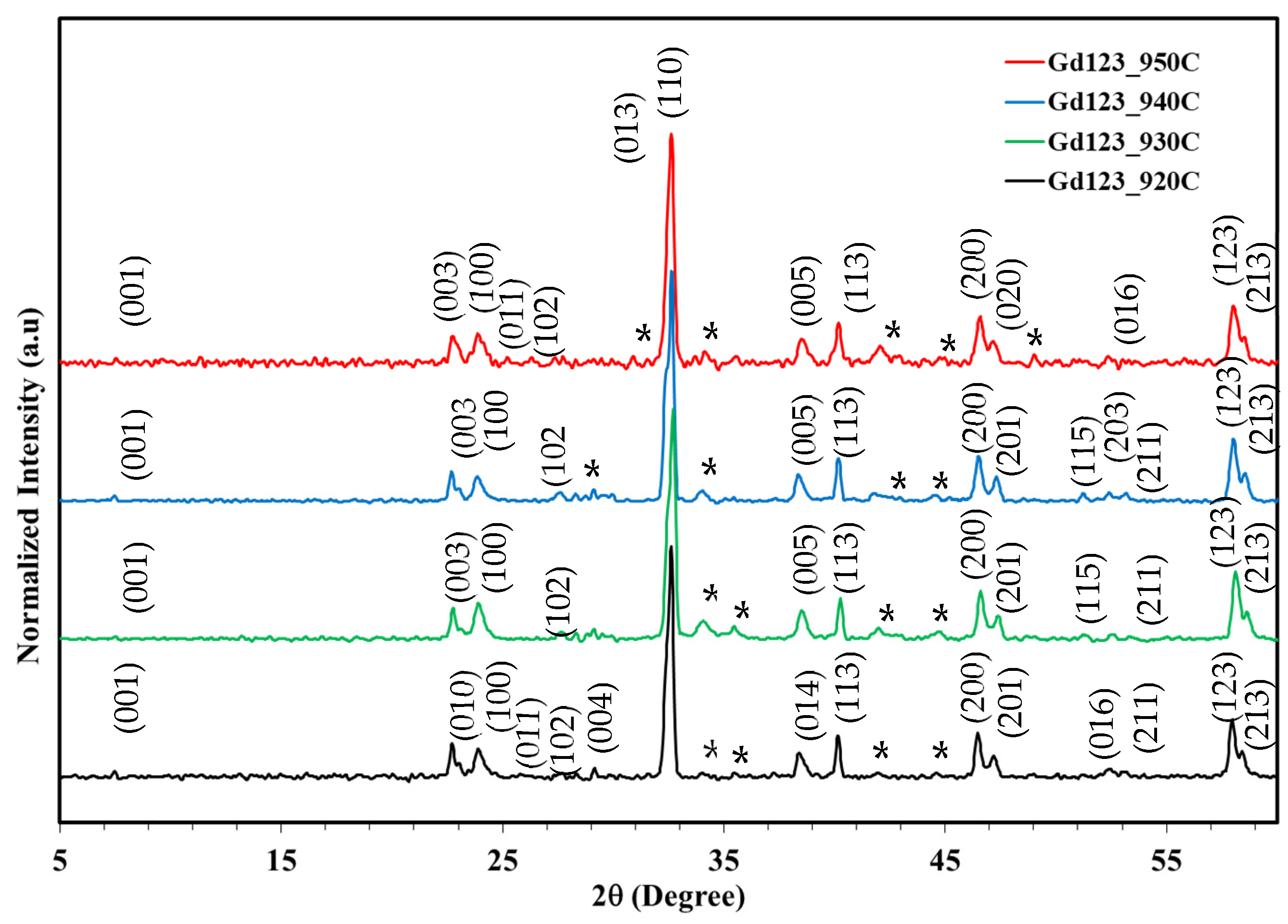
Figure 4 presents XRD patterns for sintered Gd123 at temperatures ranging from 920 °C to 950 °C. The dominant phase of the orthorhombic structure (Gd123) is presented for all samples. This phase was identified and labeled as (h k l) planes and the perovskite structure with the space group of Pmmm, No. 47, Z = 1, α = β = γ = 90°. The phase identification, size calculation, and lattice parameters were calculated Using Highscore Plus software (Version 5.2), the measured lattice parameters for all samples match the standard JCPDS, # 01-089-5733 (International Centre for Diffraction Data, USA, 2015) as shown in Table 2. Few peaks belonging to impurities at 28.42°, 29.27°, 30.08°, 35.68°, 39.99°, 41.87°, 42.54°, and 49.27° were also detected and belonged to the non-superconducting phases, such as BaCuO2 (Gd011) and (Gd211).
Phase contents “Gd123%” for samples sintered at 920 °C, 930 °C, 940 °C, and 950 °C were 96.2%, 99.1%, 98.2%, and 97.8%, respectively. Impurities at 920 °C result from incomplete sintering, while 930–950 °C yields high Gd123 purity.
The Gd123% was calculated using the following Equation (1) [13]:
G d   123 % = Σ I 123 Σ I 123 + Σ I I m p u r i t i e s × 100 %
where I123 and Impurities are the peak intensities of the observed phases for Gd 123 and the impurities.

2.4. Electrical Measurements

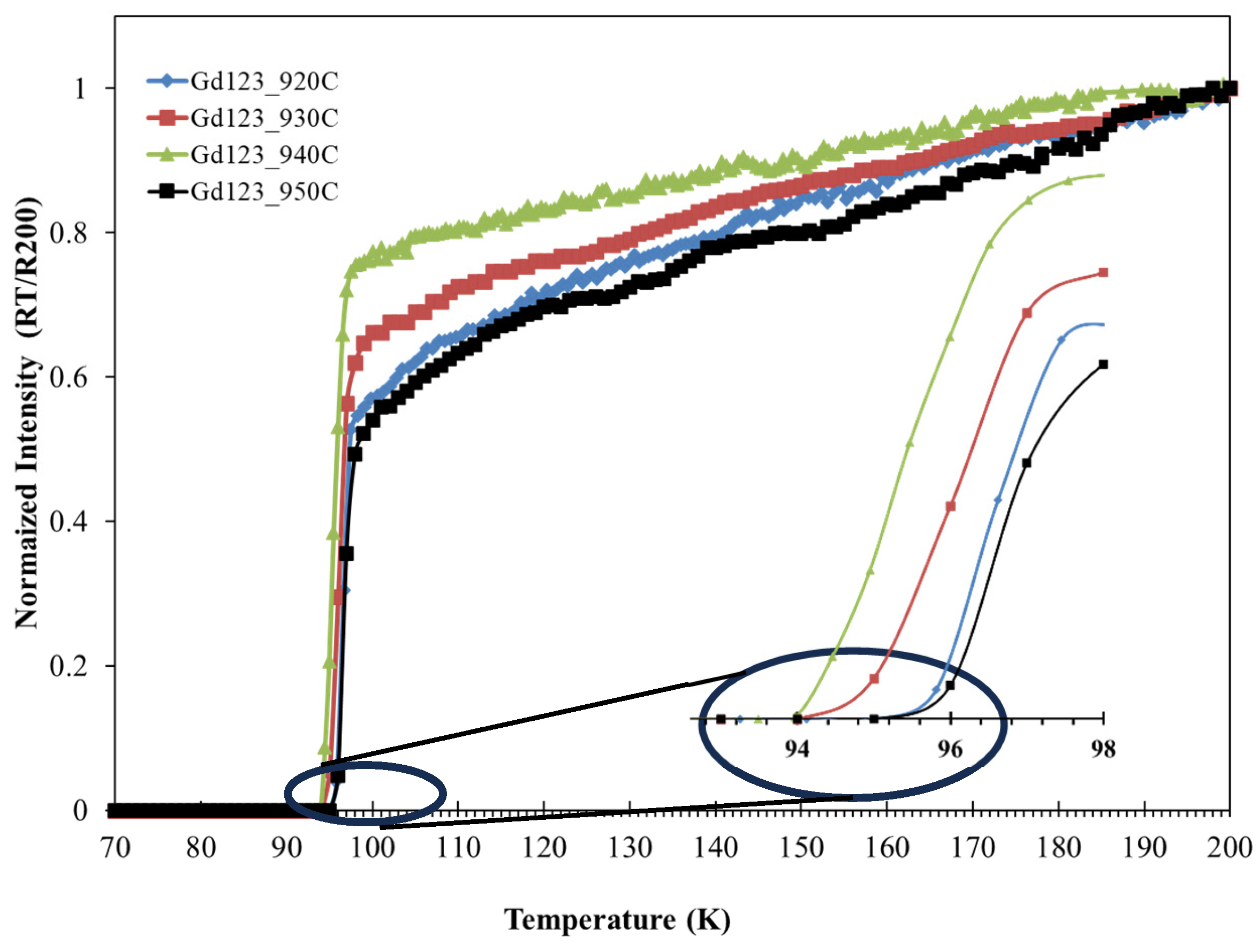
The normalized electrical resistance as a function of temperature, in the absence of a magnetic field, was measured for all sintered samples and showed normal metallic behavior with a single-drop transition feature, as shown in Figure 5. All sintered samples showed a zero-resistance temperature (TC,R=0) of 94–95 K, with no notable changes as the sintering temperature increased.
The transport critical current density, JC, was calculated using Equation (2) [15]:
J C = I C A
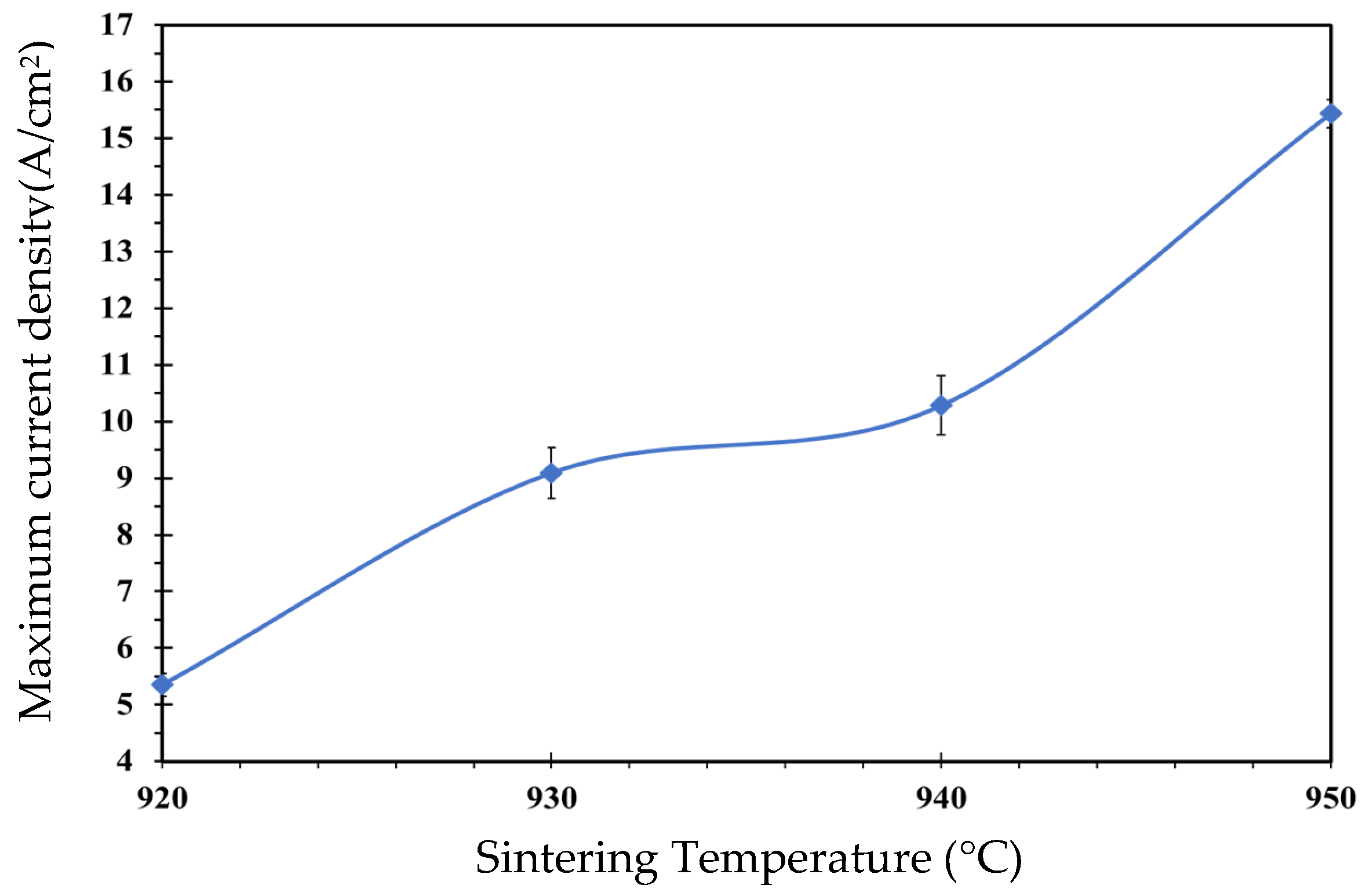
where IC represents the maximum current (A) through the sample’s cross-sectional area (cm2) before superconductivity is lost at 77 K and zero magnetic field. Figure 6 presents JC values of 4.35 ± 0.11, 6.4 ± 0.4, 7.9 ± 0.7, and 12.9 ± 0.9 A/cm2 for samples treated at 920, 930, 940, and 950 °C, respectively.
The JC values presented in Figure 6 and Table 3 increased with higher sintering temperatures, attributed to a reduction in the weak link formation at grain boundaries, thereby facilitating improved current flow. Additionally, the Gd 211 phase acts as a strong pinning center in Gd123 superconductors due to interfacial boundaries and strain fields. These non-superconducting inclusions locally suppress the order parameter, providing favorable sites for vortices, while the lattice mismatch enhances vortex anchoring. A small amount of 211 phase improves transport properties and significantly increases critical current densities and pinning force, as confirmed by XRD data and discussed in references [2,17,18,28,30].

2.5. Relative Density and Porosity

The relative density (Drelative %) and the porosity for all samples were calculated from the actual and theoretical densities using the following Equations (3) and (4):
D R e l a t i v e % = ρ s a m p l e ρ t h e o r i t i c a l × 100 %
P o r o s i t y % = ρ t h e o r i t i c a l ρ s a m p l e ρ s a m p l e × 100 %
where the relative density of sample DRelative is given by the percentage ratio of the density ρsample, obtained for the bulk samples, to theoretical density ρtheoretical obtained from the XRD data (Table 3). Increasing the relative density of ceramics plays a pivotal role in improving their critical current density. This enhancement is primarily attributed to the reduction in insulating cavities within the material, which facilitates better current flow between the grains.
The critical current density ( J c ) in bulk polycrystalline high-temperature superconductors is lower than in thin films or single crystals, mainly due to grain boundaries acting as weak links, poor connectivity from porosity and cracks, and oxygen inhomogeneity. These factors disrupt current flow and reduce superconducting performance. In contrast, thin films and single crystals have excellent connectivity, controlled oxygen content, and aligned current paths; thin films can also incorporate engineered nanostructured pinning centers, while single crystals are free of grain boundaries, resulting in much higher J c values [31].
When comparing this work with other methods, the crystal structure of Gd123 remains similar (a ≈ 3.82 Å, b ≈ 3.88–3.90 Å, c ≈ 11.68 Å); however, the TC(R=0) values vary, as shown in the table below (Table 4).

3. Materials and Methods

3.1. Materials

Gadolinium(III) acetate tetrahydrate {Gd(CH3COO)3· 4H2O}, barium acetate {Ba(CH3COO)2}, and Copper(II) acetate monohydrate {Cu(CH3COO)2· H2O}, were purchased from Sigma Aldrich (USA), supplied with a purity greater than 98%, and used as received. Oxalic acid (C2H2O4·2H2O) was supplied by Thermos Fisher Scientific (USA), isopropanol (C3H8O) were purchased from Loba Chemie (India), and distilled water were used as required.

3.2. Superconductor Powder Synthetization

A clear aqueous solution of a mixture of 6.92 mmol Gd(CH3COO)3· 4H2O, 13.85 mmol Ba(CH3COO)2, and 20.78 mmol Cu(CH3COO)2· H2O was prepared, and then 300 mL of 0.5 M oxalic acid and isopropanol/water mixture (3:2 volume ratio) were added. The addition of isopropanol reduces the overall polarity of the water medium, slowing down nucleation and growth, leading to finer and more uniform particles synthesis. The result was a stable blue suspension product that was separated and dried overnight, gaining a blue powder, as reported in the ref [13].
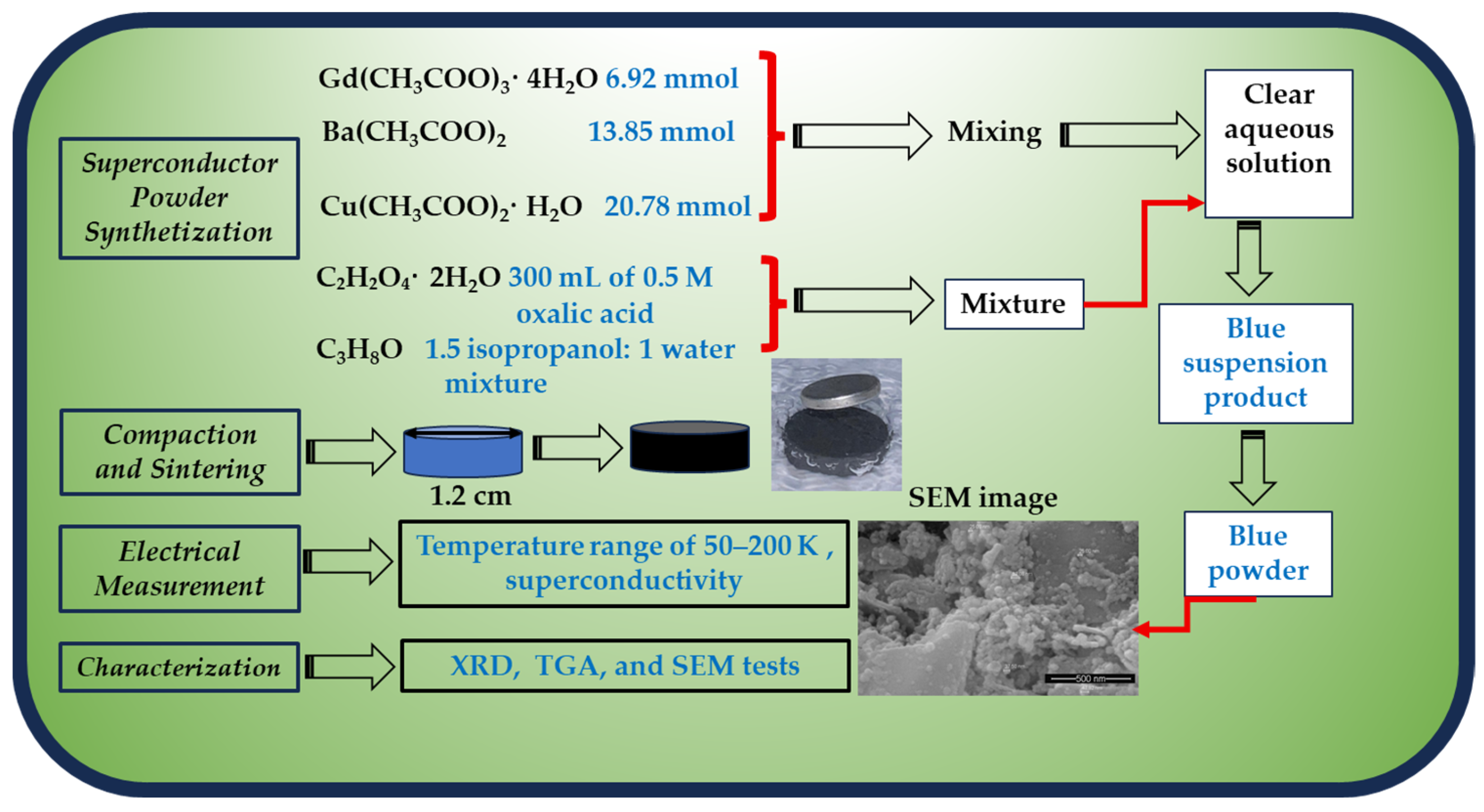
Figure 7 shows the workflow of the research project, which includes the synthesis of the required powders, sintering, electrical measurement, and characterization.

3.3. Compaction and Sintering

The blue powder obtained was heated at 900 °C for 12 h in a muffle furnace (Nabertherm, Lilienthal, Germany), then cooled to room temperature at a rate of 2 °C per minute. After calcination, the powder was ground for 10 min using an agate mortar and pestle, then pressed into pellets about 1.25 cm in diameter with a Carver pressing machine (Carver, MN, USA) at a compaction pressure of 300 MPa. These pellets were sintered at 920, 930, 940, and 950 °C under an oxygen flow of 5 mL/min for 15 h in a tube furnace (Nabertherm, Germany), which is recommended to enhance the formation of the Gd123 superconductor and reduce the oxygen deficiency until room temperature is achieved [14], followed by slow cooling to room temperature at a rate of 1 °C per minute.

3.4. Electrical Resistance Measurement

Electrical resistance measurements for the sintered pellets were conducted over a temperature range of 50–200 K using a standard four-probe method. A direct current (DC) of 30 mA was applied, and the experiments were carried out in a closed-cycle refrigerator system model ARS-EA202A (Pittsburgh, PA, USA).

3.5. Characterization

Some of the sintered pellets were milled, and their powders were examined using X-ray powder diffraction (Malvern Panalytical, Aeris, monochromatic Cu kα1, 1.5406 Å, 0.02 step angle, with 2θ ranging from 4° to 60°, Almelo, The Netherlands) for phase, and lattice parameters’ determination. TGA of the blue powder was conducted using a Netzsch STA 409 PG/PC thermal analyzer (Selb, Bavaria, Germany) from 30 to 1000 °C under nitrogen (50 mL/min) at a rate of 5 °C/min to measure the weight loss as temperature increased. SEM (FEI QUANTA 200, Eindhoven, The Netherlands) and (Hitachi S 3400 N, Tokyo, Japan) were employed for microstructural investigations of the produced blue superconductor powder and sintered pellets.

4. Conclusions

GdBa2Cu3O7−δ superconducting ceramics (Gd123) were synthesized from nanoscale metal–oxalate precursors via co-precipitation, followed by sintering at temperatures ranging from 920 °C to 950 °C. Elevated sintering temperatures resulted in an increase in the orthorhombic Gd123 phase fraction from 96.2% to 99.8%. Electrical measurements demonstrated metallic characteristics, with (Tc, R = 0) consistently observed between 94 and 95 K.
Both XRD and SEM analyses show that raising the sintering temperature improves the critical current density. According to XRD patterns, small amounts of secondary phases are present, which can serve as efficient flux-pinning centers. Meanwhile, SEM images demonstrate that higher temperatures progressively decrease the gaps and voids between superconducting grains. This reduction in insulating cavities strengthens intergranular coupling and increases the material’s relative density, resulting in better current transport efficiency.
Overall, a sintering temperature of 950 °C not only produces the highest Jc but also indicates that large-scale production of high-performance Gd123 tapes or bulk magnets could be feasible.

Author Contributions

Conceptual: A.A.-M. and I.H.; methodology: M.M.A.; software: I.H. and J.R.; validation: Y.A.-D., S.S. and J.R.; formal analysis: W.A.-T. and S.S.; investigation: M.M.A. and A.A.-M.; data curation: I.H.; writing—original draft preparation: I.H.; writing—review and editing: I.S.M. and E.A.; visualization: I.S.M., E.A. and M.H.; supervision, I.H.; project administration: I.H.; funding acquisition: I.H. All authors have read and agreed to the published version of the manuscript.

Funding

This research was funded by the Dean of Scientific Research at the University of Jordan (grant No. 2490).

Institutional Review Board Statement

Not applicable.

Informed Consent Statement

Not applicable.

Data Availability Statement

The original contributions presented in this study are included in the article. Further inquiries can be directed to the corresponding author.

Conflicts of Interest

The authors declare no conflicts of interest.

References

  1. Takao, T.; Kameyama, S.; Doi, T.; Tanoue, N.; Kamijo, H. Increase of Levitation Properties on Magnetic Levitation System Using Magnetic Shielding Effect of GdBCO Bulk Superconductor. IEEE Trans. Appl. Supercond. 2011, 21, 1543–1546. [Google Scholar] [CrossRef]
  2. Jha, A.K.; Matsumoto, K.; Horide, T.; Saini, S.; Ichinose, A.; Mele, P.; Yoshida, Y.; Awaji, S. Evaluation of temperature dependent vortex pinning properties in strongly pinned YBa2Cu3O7−δ thin films with Y2BaCuO5 nanoinclusions. Superconductivity 2024, 9, 100087. [Google Scholar] [CrossRef]
  3. Jha, A.K.; Matsumoto, K.; Horide, T.; Saini, S.; Mele, P.; Ichinose, A.; Yoshida, Y.; Awaji, S. Isotropic enhancement in the critical current density of YBCO thin films incorporating nanoscale Y2BaCuO5 inclusions. J. Appl. Phys. 2017, 122, 093905. [Google Scholar] [CrossRef]
  4. Buchgeister, M.; Herzog, P.; Hosseini, S.M.; Kopitzki, K.; Wagener, D. Oxygen Evolution from ABa2Cu3O7−δ High-Tc Superconductors with A = Yb, Er, Y, Gd, Eu, Sm, Nd, and La. Phys. C 1991, 178, 105–109. [Google Scholar] [CrossRef]
  5. Plackowski, T.; Sułkowski, C.; Włosewicz, D.; Wnuk, J. Effect of the RE3+ Ionic Size on the REBa2Cu3O7−δ Ceramics Oxygenated at 250 Bar. Phys. C 1998, 300, 184–190. [Google Scholar] [CrossRef]
  6. Agarwal, A.G.; Muralidhar, M. Enhancing the superconducting properties of bulk (Sm,Eu,Gd)Ba2Cu3O7−δ: Impact of BaO2 and Ag2O addition via infiltration growth process in air. J. Appl. Phys. 2025, 137, 013906. [Google Scholar] [CrossRef]
  7. Park, Y.; Lee, M.; Ann, H.; Choi, Y.H.; Lee, H.A. Superconducting Joint for GdBa2Cu3O7−δ Coated Conductors. NPG Asia Mater. 2014, 6, e98. [Google Scholar] [CrossRef]
  8. Masi, A.; Freda, R.; Formichetti, A.; Greco, A.; Alimenti, A.; Khan, M.R.; Celentano, G. High Current Measurement of Commercial REBCO Tapes in Liquid Helium: Experimental Challenges and Solutions. Appl. Sci. 2024, 14, 7697. [Google Scholar] [CrossRef]
  9. Chung, J.; Kim, C.J.; Choi, S.M.; Yoo, S.I.; Shin, K.M. TEM Analysis of the Interfacial Defects in the Superconducting GdBa2Cu3O7−δ Tapes Synthesized by IBAD-PLD. Phys. C 2007, 463–465, 722–726. [Google Scholar] [CrossRef]
  10. Keshvani, M.J.; Ravalia, A.; Venkateshwarlu, D.; Ganesan, V.; Kuberkar, D.G. Pinning Centers and Thermally Activated Flux Flow in GdBa2Cu3O7–δ Superconducting Film. J. Supercond. Nov. Magn. 2023, 36, 813–820. [Google Scholar] [CrossRef]
  11. Rosenzweig, S.; Hänisch, J.; Hühne, R.; Holzapfel, B.; Schultz, L. Tc Optimisation of GdBa2Cu3O7 Thin Films Grown by Pulsed Laser Deposition. J. Phys. Conf. Ser. 2010, 234, 012035. [Google Scholar] [CrossRef]
  12. Salama, A.H.; El-Hofy, M.; Rammah, Y.S.; Elkhatib, M. Pinning behaviour of nano nonmagnetic CuO, SnO2 and magnetic Mn3O4 substitutions in YBCO bulk superconductors. InterCeram Int. Ceram. Rev. 2016, 65, 17–24. [Google Scholar] [CrossRef]
  13. Hapipi, N.M.; Shaari, A.H.; Kechik, M.M.A.; Tan, K.B.; Abd-Shukor, R.; Mohd-Suib, N.R.; Chen, S.K. Effect of heat treatment condition on the phase formation of YBa2Cu3O7−δ superconductor. Solid State Phenom. 2017, 268, 305–310. [Google Scholar] [CrossRef]
  14. Hamadneh, I.; Ahmad, A.M.; Wahid, M.H.; Zainal, Z.; Abd-Shukor, R. Effect of Nano-Sized Oxalate Precursor on the Formation of GdBa2Cu3O7−δ Phase via Coprecipitation Method. Mod. Phys. Lett. B 2009, 23, 2063–2068. [Google Scholar] [CrossRef]
  15. Hamadneh, I.; Halim, S.A.; Lee, C.K. Characterization of Bi1.6Pb0.4Sr2Ca2Cu3Oy Ceramic Superconductor Prepared via Coprecipitation Method at Different Sintering Times. J. Mater. Sci. 2006, 41, 5526–5530. [Google Scholar] [CrossRef]
  16. Bolotnikova, A.O.; Nedilko, S.A.; Dzyazko, A.G.; Fesych, I.V. Effect of Phase Composition of Superconductor Y3Ba5Cu8O18+δ on Its Conducting Characteristics. Theor. Exp. Chem. 2017, 52, 342–348. [Google Scholar] [CrossRef]
  17. Hashim, H.; Syuhaida, I.N.; Azman, K.; Azura, C.M.N.; Robaiah, M.; Syamsyir, A.S.; Rosli, M.M. Influence of rare-earth (doped) on low-density Bi1.6Pb0.4Sr2Ca1.9RE0.1Cu3Oδ (RE=Nd, Er) superconductors via co-precipitation method. Mater. Sci. Forum 2016, 846, 574–578. [Google Scholar] [CrossRef]
  18. Jia, J.; Liu, C.; Guo, M.; Han, Y.; Ren, Y.; Liu, D.; Zhao, G. Fabrication of GdBa2Cu3O7−δ Fine Patterns by “Chemically Modified Self-Photosensitive” Photolithography. Ceram. Int. 2021, 47, 27503–27510. [Google Scholar] [CrossRef]
  19. Mimouni, M.; Bayou, S.; Zeroual, S.; Hamadneh, I.; Mahboub, M.S.; Ramdani, S.; Rihia, G.; Ghougali, M.S. Synthesis and Characterization of Bulk Bi-2212 Superconducting Ceramic Using Photopolymerization Reaction-Based Method. J. Supercond. Nov. Magn. 2022, 35, 401–408. [Google Scholar] [CrossRef]
  20. Hamadneh, I.; Abdullah, I.; Halim, S.A.; Abd-Shukor, R. Dynamic Magnetic Properties of Superconductor/Polymer NdBCO/PVC Composites. J. Mater. Sci. Lett. 2002, 21, 1615–1617. [Google Scholar] [CrossRef]
  21. Camargo, C.C.C.; Saavedra Gaona, I.M.; Landínez-Téllez, D.A.; Parra Vargas, C.A.P. Evaluation of the structural, morphological, and magnetic properties of the RE-358, RE-123, RE-Ca0.1 with RE = Gd and Sm superconductors. Phys. C Supercond. Its Appl. 2025, 630, 1354647. [Google Scholar] [CrossRef]
  22. Yahya, A.K.; Hamid, N.A.; Abd-Shukor, R.; Imad, H. Anomalous Elastic Response of HoBa2−xHoxCu3O7−δ Ceramic Superconductors. Ceram. Int. 2004, 30, 1597–1601. [Google Scholar] [CrossRef]
  23. Srour, A.; Malaeb, W.; Marhaba, S.; Awad, R. Thermoelectric power of (Cu0.5Tl0.5)-1223 superconducting phase added with BaSnO3 nanoparticles. J. Phys. Conf. Ser. 2017, 869, 012017. [Google Scholar] [CrossRef]
  24. Hapipi, N.M.; Chen, S.K.; Shaari, A.H.; Kechik, M.M.A.; Tan, K.B.; Lim, K.P. Superconductivity of Y2O3 and BaZrO3 nanoparticles co-added YBa2Cu3O7−δ bulks prepared using co-precipitation method. J. Mater. Sci. Mater. Electron. 2018, 29, 18684–18692. [Google Scholar] [CrossRef]
  25. Wahid, M.H.; Zainal, Z.; Hamadneh, I.; Tan, K.B.; Halim, S.A.; Rosli, A.M.; Alaghbari, E.S.; Nazarudin, M.F.; Kadri, E.F. Phase Formation of REBa2Cu3O7−δ (RE: Y0.5Gd0.5, Y0.5Nd0.5, Nd0.5Gd0.5) Superconductors from Nanopowders Synthesized via Coprecipitation. Ceram. Int. 2012, 38, 1187–1193. [Google Scholar] [CrossRef]
  26. Sibille, R.; Didelot, E.; Mazet, T.; Malaman, B.; François, M. Magnetocaloric Effect in Gadolinium-Oxalate Framework Gd2(C2O4)3(H2O)6(0.6H2O). APL Mater. 2014, 2, 124402. [Google Scholar] [CrossRef]
  27. Liu, B.-L.; Liu, Q.-X.; Li, A.-H.; Tao, R.-J. A novel 2D oxalate- and dissymmetrical oxamidato-bridged heterometallic Cu(II)-Gd(III) complex: Synthesis, crystal structure and magnetic properties. Inorg. Chim. Acta 2012, 392, 1–4. [Google Scholar] [CrossRef]
  28. Maimaiti, N.; Abulaiti, A.; Yang, W. The Effect of Infiltration Temperature on the Microstructure and Magnetic Levitation Force of Single-Domain YBa2Cu3O7−x Bulk Superconductors Grown by a Modified Y+011 IG Method. Nanomaterials 2025, 15, 21. [Google Scholar] [CrossRef]
  29. Sebastian, M.A.P.; Reichart, J.N.; Ratcliff, M.M.; Burke, J.L.; Haugan, T.J.; Tsai, C.; Wang, H. Optimizing Flux Pinning of YBa2Cu3O7−δ (YBCO) Thin Films With Unique Large Nanoparticle Size and High Concentration of Y2BaCuO5 (Y211) Additions. IEEE Trans. Appl. Supercond. 2015, 25, 6601405. [Google Scholar] [CrossRef]
  30. Wu, T.; Yang, W.; Chen, L. The Effect of the Pre-Infiltration Temperature on the Liquid-Phase Infiltration Characteristics and the Magnetic Properties of Single-Domain GdBCO Bulk Superconductors. Crystals 2024, 14, 842. [Google Scholar] [CrossRef]
  31. Ruiz, H.S.; Hänisch, J.; Polichetti, M.; Galluzzi, A.; Gozzelino, L.; Torsello, D.; Milošević Govedarović, S.; Grbovic Novakovic, J.; Dobrovolskiy, O.V.; Lang, W.; et al. Critical current density in advanced superconductors. Prog. Mater. Sci. 2026, 155, 101492. [Google Scholar] [CrossRef]
Figure 1. TGA curve of synthesized nanoscale powder.
Inorganics 14 00025 g001
Figure 2. A SEM image of the blue produced powder.
Inorganics 14 00025 g002
Figure 3. SEM images (SEI) of sintered pellets’ fractured surfaces, (A) the image of the sintered sample at 920 °C, (B) the image of the sintered sample at 930 °C, (C) the image of the sintered sample at 940 °C, and (D) the image of the sintered sample at 950 °C.
Inorganics 14 00025 g003
Figure 4. XRD patterns of Gd123 at different sintering temperatures. (h k l): Gd123, *: impurity phases.
Inorganics 14 00025 g004
Figure 5. Normalized resistance of Gd123 as a function of temperature.
Inorganics 14 00025 g005
Figure 6. Maximum current density (Jc) versus sintering temperature.
Inorganics 14 00025 g006
Figure 7. Schematic of research implementation.
Inorganics 14 00025 g007
Table 1. Different stages of the reaction mechanism during the TGA test.
Weight Losses (Drops) Reaction Mechanism
Drop 1 (4.3%)30–125 °CMoisture loss from the surface of metal oxalate complex
Drop 2 (15.0%)125–226 °CBaC2O4· 0.5H2O ⟶ BaC2O4 + 0.5H2O
CuC2O4· H2O ⟶ CuC2O4 + H2O
Drop 3 (20.0%)226–310 °CGd2(C2O4)3· 6H2O ⟶ Gd2(C2O4)3 + 6H2O
BaC2O4 ⟶ BaCO3 + CO
CuC2O4 ⟶ CuO + CO2 + CO
Drop 4 (12.1%)310–860 °CGd2(C2O4)3 ⟶ Gd2O3 + 3CO2 + 3CO
CuO + BaCO3 ⟶ BaCuO + CO2
Drop 5 (4.0%)Above 860 °C0.5 Gd2O3 + 2 BaCuO2 + CuO + 0.5 O2 ⟶ GdBa2Cu3O7
Table 2. Lattice parameters and unit cell volume for all sintered samples.
Sintering Temp.
(°C)
a (Å)b (Å)c (Å)Volume (Å)3
9203.84921 ± 0.000333.90079 ± 0.0007911.7179 ± 0.0028175.923 ± 0.021
9303.84691 ± 0.000253.90007 ± 0.0003911.7158 ± 0.0011175.799 ± 0.029
9403.84163 ± 0.000163.90276 ± 0.0002111.7157 ± 0.0004175.807 ± 0.021
9503.84311 ± 0.000323.90030 ± 0.0005611.7234 ± 0.0018175.853 ± 0.022
Table 3. Summarized data of TC(R=0) (K), TC-onset (K), Gd123%, relative density, porosity, and the maximum current density (Jc).
Sintering (°C)TC(R=0)TC (onset)Impurities %Relative Density %Jc
(A/cm2)
92095973.880.34.35 ± 0.11
93094970.983.26.4 ± 0.4
94094961.889.97.9 ± 0.7
95095972.295.312.9 ± 0.9
Table 4. Transition temperature (TC(R=0)) by method.
MethodTC(R=0)Reference
Solid-State Reaction (SSR)~92 K[4,5]
Pulsed Laser Deposition (PLD)78–93 K[10,11]
Chemically Modified Photosensitive (CMP)~90 K[18]
Co-precipitation (COP)94–95 KThis work
Disclaimer/Publisher’s Note: The statements, opinions and data contained in all publications are solely those of the individual author(s) and contributor(s) and not of MDPI and/or the editor(s). MDPI and/or the editor(s) disclaim responsibility for any injury to people or property resulting from any ideas, methods, instructions or products referred to in the content.