Article

Egg White Assisted Synthesis of Fe-Mn Spinel Oxides: Effects of Egg White Ratio, Oxygen Partial Pressure, and Life Cycle Impacts


1
Materials and Resources, Institute of Materials Science, Technical University of Darmstadt, 64287 Darmstadt, Germany
2
Material Flow Management and Resource Economy, Institute of IWAR, Technical University of Darmstadt, 64287 Darmstadt, Germany
3
Department of Industrial Engineering, University of Padova, 35131 Padova, Italy
*
Author to whom correspondence should be addressed.
Inorganics 2026, 14(1), 13; https://doi.org/10.3390/inorganics14010013
Submission received: 4 December 2025 / Revised: 23 December 2025 / Accepted: 25 December 2025 / Published: 27 December 2025
(This article belongs to the Section Inorganic Materials)

Abstract

Egg white was chosen as a renewable, non-toxic agent for the synthesis of FeMn2O4 spinel pre-catalysts to avoid the use of critical transition metals such as Ni and Co. However, synthesizing phase-pure FeMn2O4 remains challenging due to (i) the requirement of low oxygen partial pressures to counter rapid reoxidation of Mn3O4 in the presence of iron oxides, which can be achieved by the preferred oxidation of the egg white during the calcination, and (ii) the probable formation of Fe3O4 and Mn3O4 during intermediate steps in the reaction, leading to multiphase spinel formation caused by a miscibility gap between the spinels. In contrast, spinels with Ni, Co, Zn, or Al are phase-pure. Egg white has significant environmental impacts in the synthesis of all spinel manganites, as assessed from a life-cycle perspective, which can exceed those of petroleum-based agents such as ethylenediaminetetraacetic acid (EDTA) in most impact categories. Therefore, our results show that the investigated synthesis route is not more sustainable, and we demonstrate that implementing quantitative evaluation of environmental impacts already at an early stage is essential to determine whether a synthesis is truly sustainable.

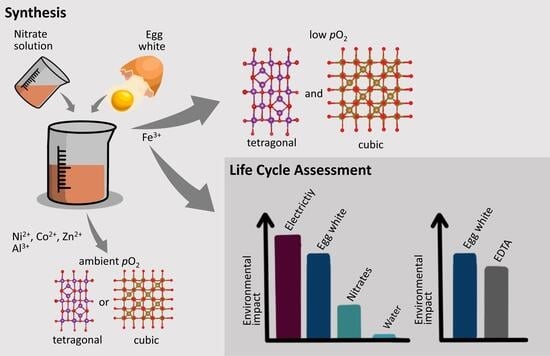
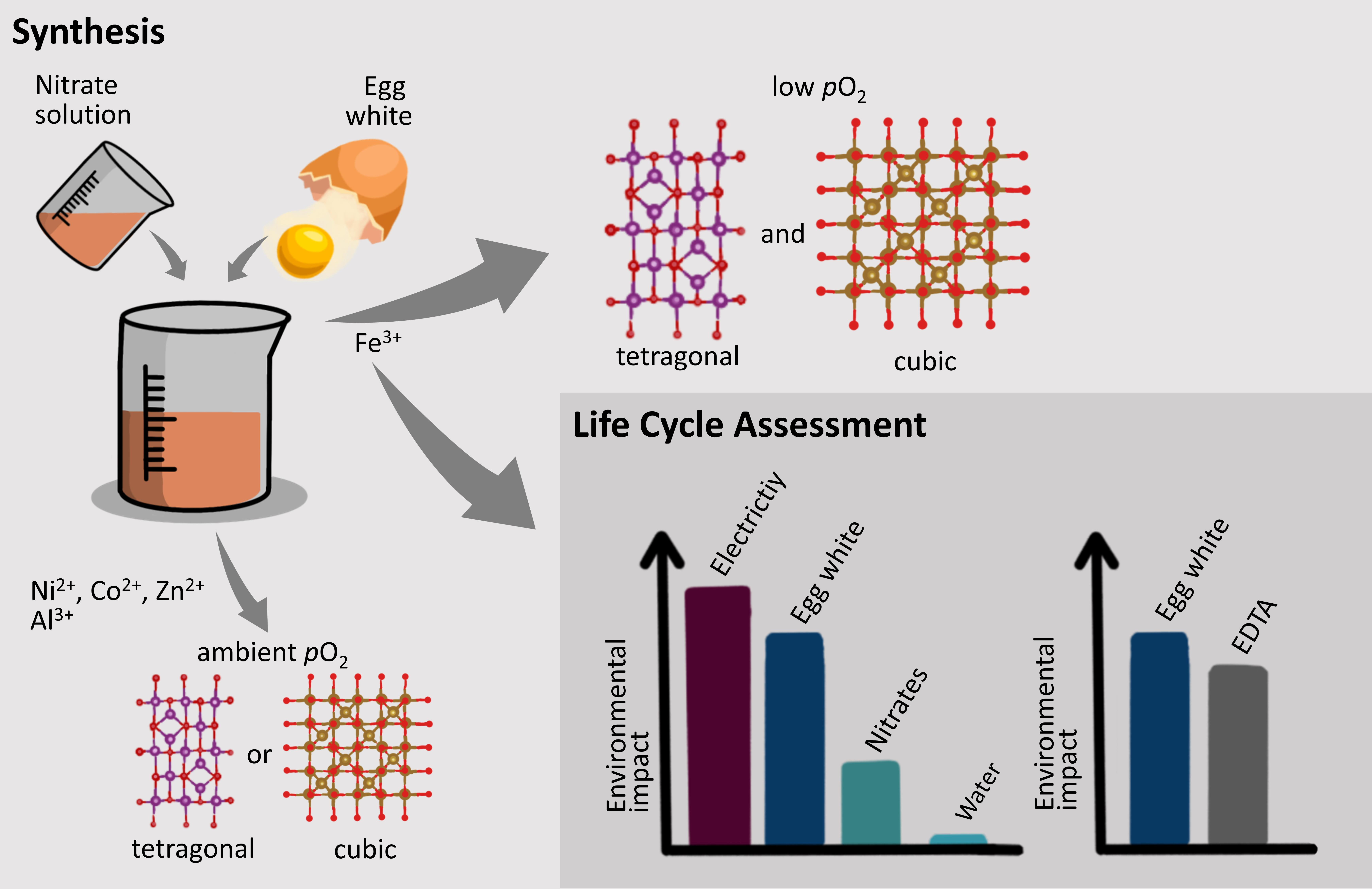
Graphical Abstract

1. Introduction

With recent estimates of around 11 million tons of food waste annually in Germany, food waste has emerged as a significant challenge [1,2]. While research is shifting from the status quo of landfill, anaerobic digestion plants, and biogas installations toward high-value food waste valorization pathways that bring the waste back into a material cycle, this biomass still represents an underexploited reservoir of renewable feedstocks [3,4,5]. To tackle this, several studies have already demonstrated that specific streams in the food waste can directly serve as precursors for valuable products [6], such as the usage of citrus residues for the production of citric acid [7], apple pomace for hemicellulose [8], or coffee grounds and tea leaves as a templating structure for oxide materials [9,10,11]. Among those, another promising waste stream, with over 30 kt being discarded annually in Germany, is eggs [12,13]. The egg white consists predominantly of the proteins ovalbumin, ovotransferrin, and ovomucoid, which together cause the good gelating, chelating, and foaming properties of the egg white [14,15,16,17]. Another advantage of egg white, and especially of ovotransferrin, is its strong affinity for binding Fe3+ ions. At the same time, it can also bind divalent transition-metal ions such as Mn2+, Co2+, and Ni2+, though with lower affinity [18,19]. These properties are the reason why egg white has been recognized as a “green” and “environmentally friendly” agent in sol-gel synthesis, with proven effectiveness in facilitating the production of well-defined materials [20,21,22]. Such bio-based routes seem attractive for substituting for petrochemical-based agents such as ethylenediaminetetraacetic acid (EDTA) [23].
One crystal structure of great interest obtainable by these methods is the spinel structure, particularly spinel oxides, which are used in a variety of applications, including sensors, energy storage, biomarkers, and catalysis [24]. For the latter, catalytic pyrolysis of plastic waste is one technology in which the spinel improves the efficiency of hydrocarbon splitting [25,26]. It offers the advantage of avoiding a clustered distribution of catalyst particles, since upon pyrolysis, the structure decomposes, with the support element oxidizing to form a stable oxide matrix while the active element segregates into finely dispersed nanoparticles on top of it [27,28,29,30]. The spinel structure itself is defined as AB2X4 (with X = oxygen often), where in a normal spinel, the A2+ cations occupy one eighth of the tetrahedral sites, and the B3+ cations occupy half of the octahedral sites. When one eighth of the tetrahedral sites is occupied by B3+ cations instead, and half of the octahedral sites are occupied by both A2+ and B3+ cations, the structure is called inverse. This is described by the inversion degree v, lying between 0 (normal spinel) and 1 (complete inverse spinel) [31]. An overview of the cationic distribution of several spinel structures relevant to this study is given in Table 1.
Catalysts containing nickel, cobalt, and/or iron nanoparticles are already frequently studied for the production of carbon nanomaterials from hydrocarbons [45,46,47,48]. However, since nickel, cobalt, and most of their compounds are classified as carcinogenic, mutagenic, and reprotoxic (CMR) materials [49,50,51,52,53,54], as well as listed as strategic raw materials by the European Union [55], there is a need to develop a catalyst that relies on alternatives such as iron and other abundant elements. Additionally, carbon solubility influences the formation, structure, and length of carbon nanotubes [46,56,57]. For too high solubility, the adhesion to the carbon nanotube wall is too weak, causing detachment, while for too low solubility and thereby strong adhesion, the catalyst will be deactivated [56]. Among iron, cobalt, and nickel, carbon solubility is highest in iron, decreasing from cobalt to nickel (depending on the temperature and form in which the metals are present) [56], likely influencing the reaction behavior. Besides elemental selection, the ratio between the active species (e.g., iron) and the support material (e.g., manganese oxide) is crucial for conversion activity, as it determines the number of active sites. In addition to creating a support material, manganese can also act as a promoter in the reaction [27,58,59]. So far, only MFe2O4 (M = Mn, Co, Ni, Zn, Mg, Co) pre-catalysts have been used for the dehydrogenation of hydrocarbons when focusing on iron [60,61,62,63]. However, there is still the problem of agglomeration into clusters with high (transition) metal loadings, reducing the activity. Therefore, decreasing the amount of iron could lead to increased activity and, consequently, better atomic efficiency of the iron when using FeMn2O4 instead. Hence, this material and its synthesis should be studied further, while also considering the environmental impact caused by the synthesis.
In this work, a systematic investigation was conducted into the use and environmental impacts of egg white as a bio-based material for synthesizing XMn2O4 (X = Fe, Co, Ni, Zn, Al) spinel-type pre-catalysts, with a particular focus on iron-containing compositions. The influence of varying amounts of egg white on the formation of oxide phases is explored, and the role of oxygen partial pressure during calcination is examined. Furthermore, an early-stage screening life cycle assessment (LCA) was performed for the egg white-based synthesis of one iron-containing spinel pre-catalyst, and a comparison with a petrochemical-derived agent was conducted to assess whether egg white as an agent is truly greener and more environmentally friendly.

2. Results and Discussion

2.1. Phase Formation of Iron-Containing Spinel Oxides with Varying Egg-White Content

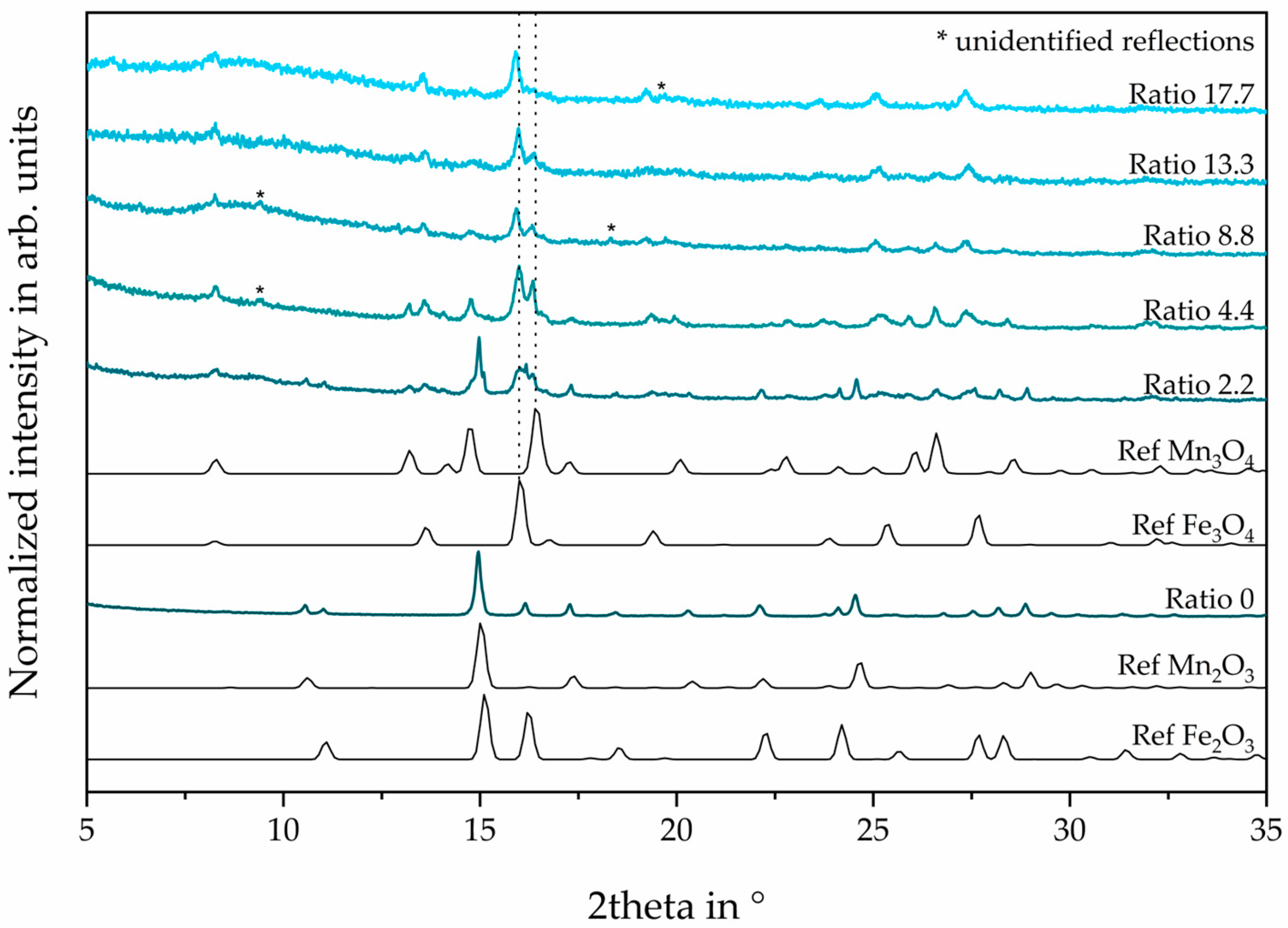
For the evaluation of the XRD results, it should be noted that due to the similarity in ionic radii and electron density between transition metals, particularly iron and manganese, it is not possible to determine the ratio of these elements within the spinel structure using laboratory XRD equipment. It can only be differentiated if the structure is cubic Fe3O4-like (referenced with Ref. Fe3O4 ICSD #9093) or tetragonal Mn3O4-like (referenced with Ref. Mn3O4 ICSD #33327), since substitution with the respective other element does not significantly alter the patterns. This changes at around x = 1.2 FexMn3−xO4 where the structure changes from tetragonal (x < 1.2) to cubic (x ≥ 1.2) [64]. Additionally, there are (Na,K)Cl (space group 225) as well as (K,Na)SO4 (space group 156) salts present in the calcined unwashed samples (see Figure S1). To better see the evolution of the phases, however, only XRD patterns of the washed iron-containing samples with an egg white-to-metal precursor ratio of 0 to 17.7 mL/mmol are collected in Figure 1. Additionally, the reference patterns for Fe2O3 (ICSD #7797), Mn2O3 (ICSD #9091), Fe3O4 (ICSD #9093), and Mn3O4 (ICSD #33327) are shown.
For a better overview, the identified phases are also listed in Table 2. For the spinel phases, the reference patterns were the pure manganese (Mn3O4) or iron (Fe3O4) spinel; however, due to the aforementioned analytical limitations, a certain amount of iron and manganese is likely in the respective other spinel structure, explaining shifts in the 2theta position of the reflections due to varying lattice parameters. Therefore, the phases are listed in the table as FexMn3−xO4 (x < 1.2) corresponding to the tetragonal Mn3O4-like spinel and FexMn3−xO4 (x ≥ 1.2) for the cubic Fe3O4-like spinel [64].
According to XRD data, the solid-state reaction between manganese and iron nitrate does not yield a spinel phase; instead, Mn2O3 and Fe2O3 are formed. In both crystal structures, the cations only exhibit a 3+ valence state, indicating that more reducing conditions are needed for the formation of a spinel structure. The calcination was also performed at low pO2 (p = 100 ppm N2/O2 gas mixture) for this synthesis; however, it failed due to the presence of attached crystal water (see Figures S2–S4).
When adding egg white, cubic and tetragonal spinel phases are emerging alongside the bixbyite and hematite phases. According to Table 1, this requires partial reduction of the manganese to the 2+ valence state. With the egg white naturally acting as a reducing agent and forming a reducing atmosphere when being burnt, it is reasonable to achieve the reduction of manganese and therefore the formation of the spinel phase when increasing the egg white content [21,65]. By further increasing the latter, the spinel phases are stabilized into an even separation (roughly 50:50), and no additional crystal structures are present. At a ratio of 13.3, the separation ratio starts to shift more towards the cubic phase, and this effect is even more pronounced at a ratio of 17.7.
Simultaneously, the signal-to-noise ratio is lower when egg white is added without significant changes in peak broadening, indicating that the powder is becoming less crystalline (lower size of the coherently scattering domains) [66]. This decrease in crystallinity could be attributed to greater dispersion and encapsulation of cations within protein chains [67], thereby increasing the number of nucleation sites and ultimately leading to a more disordered state. For the ratios 4.4, 8.8, and 17.7, there are small reflections that cannot be unambiguously identified due to the too small amount. To determine the impurities and the reasons for the progressive decrease in the tetragonal phase, further investigation will be needed.

2.2. Influence of the Oxygen Partial Pressure on the Phase Formation of Iron-Containing Spinel Oxides

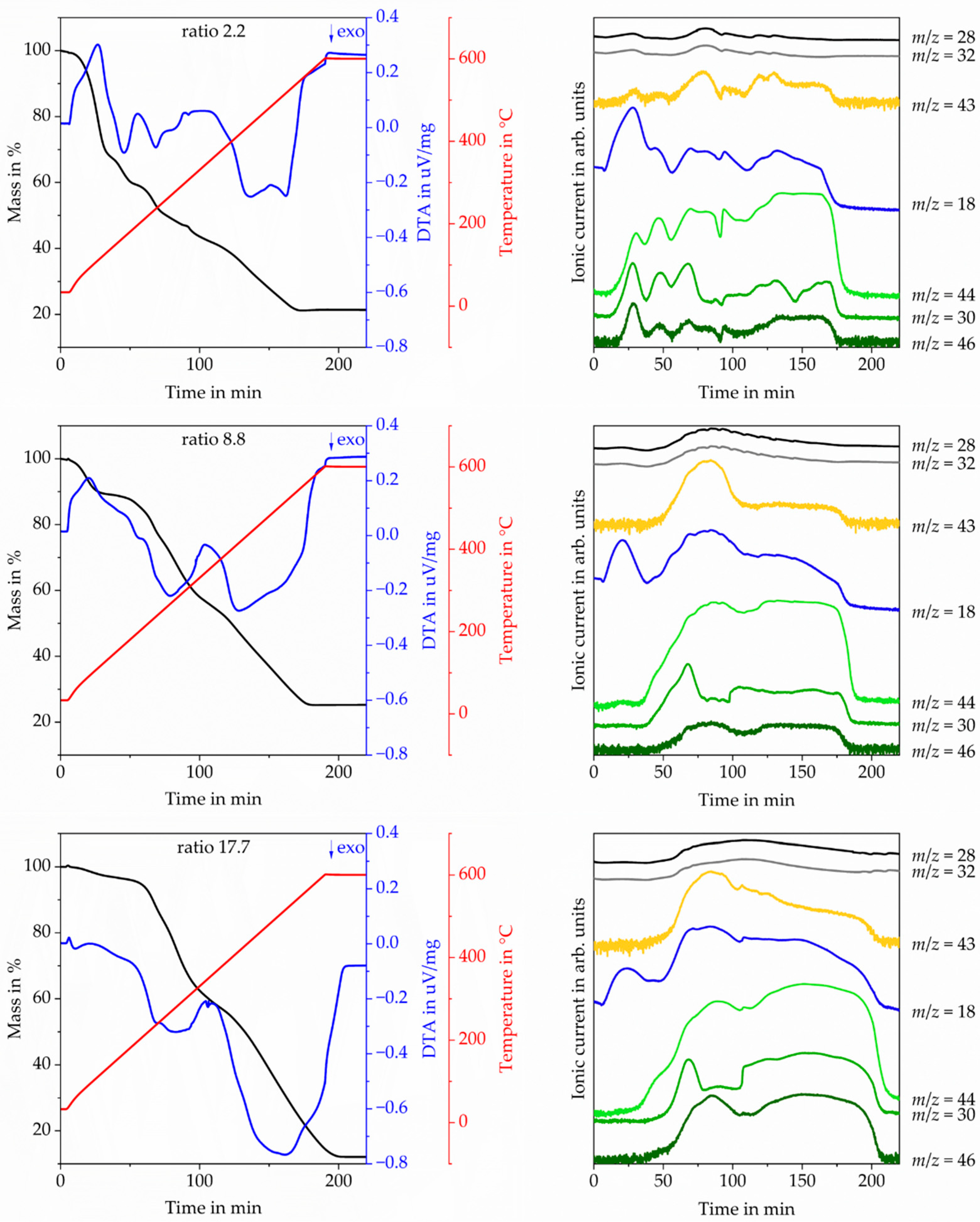
One important phenomenon is the need for a lower oxygen partial pressure for iron-containing spinels. Table 1 states that in FeMn2O4, manganese is in the 2+ oxidation state. Thermodynamically, this would be possible in a pure Mn-O system in air at temperatures above 800 °C < T < 1000 °C [68,69]. However, as different atmospheres change this significantly, with reducing ones lowering it, an analysis of the thermal decomposition pathways is helpful. This change in the atmosphere during the reaction, together with the thermogravimetric analysis, is shown in the TGA-MS plots in Figure 2.
The shape of the signal m/z = 18 (H2O+) in the MS plot shows that for high nitrate concentration, the first peak (t < 50 min) is higher than the following ones (t > 50 min), whereas for low nitrate concentrations, the first peak (t < 50 min) is the smallest. Alongside this, the weight losses are dropping from ~32% (ratio 2.2) to ~3% (ratio 17.7) in that temperature regime, accompanied by a weakening endothermic peak in the DTA curve. This indicates that at low temperatures (up to T = ~110 °C), high nitrate levels likely weaken the binding of water in egg white and provide additional hydrated water from unbound nitrates, promoting early H2O release [70]. For a ratio of 2.2, an additional weight loss step occurs at temperatures between 150 °C < T < 190 °C, with an exothermic peak at T = 168 °C, which is not present in any of the other tested samples. Additionally, a weight loss step with an exothermic peak at 235 °C < T < 240 °C in all three samples can be detected. Those signals most likely arise from the decomposition of excess free nitrates, being lower or absent at higher egg-white ratios, where the egg white proteins (e.g., ovotransferrin) chelate the metal ions and separate them from the nitrates [71,72]. This decomposition of the nitrates would lead to oxidizing conditions due to the presence of nitrogen oxides NOx next to other gaseous oxides, as indicated by the MS signals (m/z = 46 NO2+; m/z = 30 NO+; m/z = 44 CO2+, N2O+; m/z = 18 H2O+—green and blue) in the high-nitrate sample. Further support for this is provided by the XRD pattern (Figure 1) of the high-nitrate sample, which still shows Fe2O3 and Mn2O3, along with the spinel phase. At higher egg white concentrations, the evolution of oxygen-containing gases is delayed. Around 270 °C < T < 280 °C, an exothermic reaction, most likely of the egg white with the evolving oxygen-containing gases, is happening. This reaction becomes increasingly pronounced (see weight loss and DTA signal) relative to the decomposition of Mn-nitrate as the nitrate content decreases. It is also accompanied by the release of hydrocarbon species (MS signal—m/z = 43 C3H7+, CH3CO+—yellow), leading to the formation of a more reducing environment. Lastly, all samples exhibit exothermic reactions with significant weight loss between 400 °C < T < 600 °C, most likely linked to the combustion of unreacted egg white [70]. The accompanying weight loss is higher and takes longer for low nitrate content (20%—ratio 2.2; 30.5%—ratio 8.8; 45%—ratio 17.7), since more egg white remains unreacted, as reflected in prolonged reaction times and the high-temperature MS signals. Due to the manifold different processes, like, e.g., the decomposition of egg white and nitrates, happening simultaneously, an exact assignment of individual reaction steps would be challenging.
To further estimate the actual oxygen partial pressure created by the decomposition of the precursor powder, which leads to the formation of a spinel phase, the calcination was performed in an uncovered crucible at pO2 ≈ 210,000 ppm (air), pO2 ≈ 1000 ppm, pO2 ≈ 100 ppm, and pO2 ≈ 2 ppm (Ar). The formed phases were often of low crystallinity, making a detailed analysis of the XRD patterns (see Figure S4) difficult due to a lack of available reflections. Therefore, the following table lists only the detected phases relevant to the identification of the oxidation states of iron and manganese. The remaining unidentified reflections belong to other phases, such as the salts mentioned above, which are left.
From the information in Table 3, it can be concluded that in air, and at pO2 down to around p = 1000 ppm, the atmosphere remains too oxidizing, leading to the formation of Fe3+- and Mn3+-containing oxides. On the other side, calcination in argon is too reducing, leading to the formation of predominantly M2+-containing oxides (M = Mn, Fe). At a pO2 of p = 100 ppm, no other phase than spinel is detected, meaning the oxygen partial pressure of around p = 10−4 atm is sufficient at T = 600 °C to have both oxidation states of manganese forming. This is in line with the phase diagram of Cheraghi et al., showing a tetragonal Mn3O4 phase at an oxygen partial pressure of p = 10−4 atm and T = 600 °C [69].
Since in literature, when other spinel oxides are synthesized, a low oxygen partial pressure [27,73] is not mentioned, other elements than iron were tested to see if this is a unique feature of this composition. However, for M = Co, Ni, Zn, and Al, a calcination in air in an uncovered crucible is sufficient to result in a single-phase MMn2O4 structure, where for M = Co, Zn, and Al, the structure is tetragonal, and for M = Ni, it is cubic, although the crystallinity is limited for all (see XRD in Figure S5). This is straightforward for Co, Ni, and Zn, as they are predominantly present in a 2+ oxidation state in a spinel structure, as stated in Table 1. Due to their electronic configuration, they also prefer that oxidation state. In contrast, for aluminum- and iron-containing MMn2O4 spinel as noted above, manganese will be the element existing in the 2+ oxidation state [35,74]. Wong et al. [68] have shown that the addition of Fe2O3 to an Mn-oxide can enhance the (re)oxidation kinetics tremendously. In contrast, the addition of Al2O3 does not significantly influence the oxidation kinetics. For iron-containing samples, all potentially formed Mn3O4 will immediately be reoxidized to Mn2O3 due to the presence of Fe2O3 when calcined in air. However, for aluminum-containing samples, this is not the case.

2.3. Miscibility Gap Between Fe3O4 and Mn3O4

There is the occurrence of phase separation into tetragonal and cubic phases for iron-containing spinels, which is absent for the other tested elements. Thermodynamic studies show that the enthalpy of formation of Mn3O4 is higher than that of Fe3O4, meaning that the former tends to form before the iron-spinel [75,76]. Additionally, there is a miscibility gap between the two spinel phases reported, where a separation into a cubic Fe3O4-like [64] and a tetragonal Mn3O4-like phase occurs rather than a mixed single-phase spinel [74,77,78,79,80]. Though the literature reports on the Mn–Fe–O system are not entirely consistent regarding the compositions and temperatures at which a miscibility gap between Fe3O4 and Mn3O4 occurs, they provide valuable insights. Weiland [81] conducted an extensive review of the available literature data, which was then used to optimize the thermodynamic calculations, and also reported a miscibility gap. Those calculations also predicted that a phase separation would happen within the compositional range relevant to this study. Other authors, such as Sahu et al. [82], describe the transition from tetragonal to cubic symmetry in Fe-Mn spinels as continuous, with the Gibbs free energy of mixing always being negative, and therefore do not thermodynamically predict a miscibility gap. Nevertheless, they also show that the enthalpy of mixing between tetragonal Mn3O4 and cubic Fe3O4 becomes positive at high Mn3O4 contents. In contrast, the mixing enthalpy for a mixture of both cubic Mn3O4 and Fe3O4 is negative, indicating an energetic barrier for the mixing [82]. This leads to the hypothesis that during the reaction in the presence of egg white, both Fe3O4 and Mn3O4 form as separate intermediate phases. Furthermore, this hypothesis is supported by the need for a reducing atmosphere, created by the egg white during calcination, which should result in lower oxidation states of manganese and iron. The Fe2+ that is then present will favor the formation of Fe3O4, since according to Table 1, the Fe2+ is only present there and not in FeMn2O4 or MnFe2O4. In both mentioned mixed spinel phases, the 2+ oxidation state is adopted by the manganese, as it results in a preferred 3d5 electronic configuration.
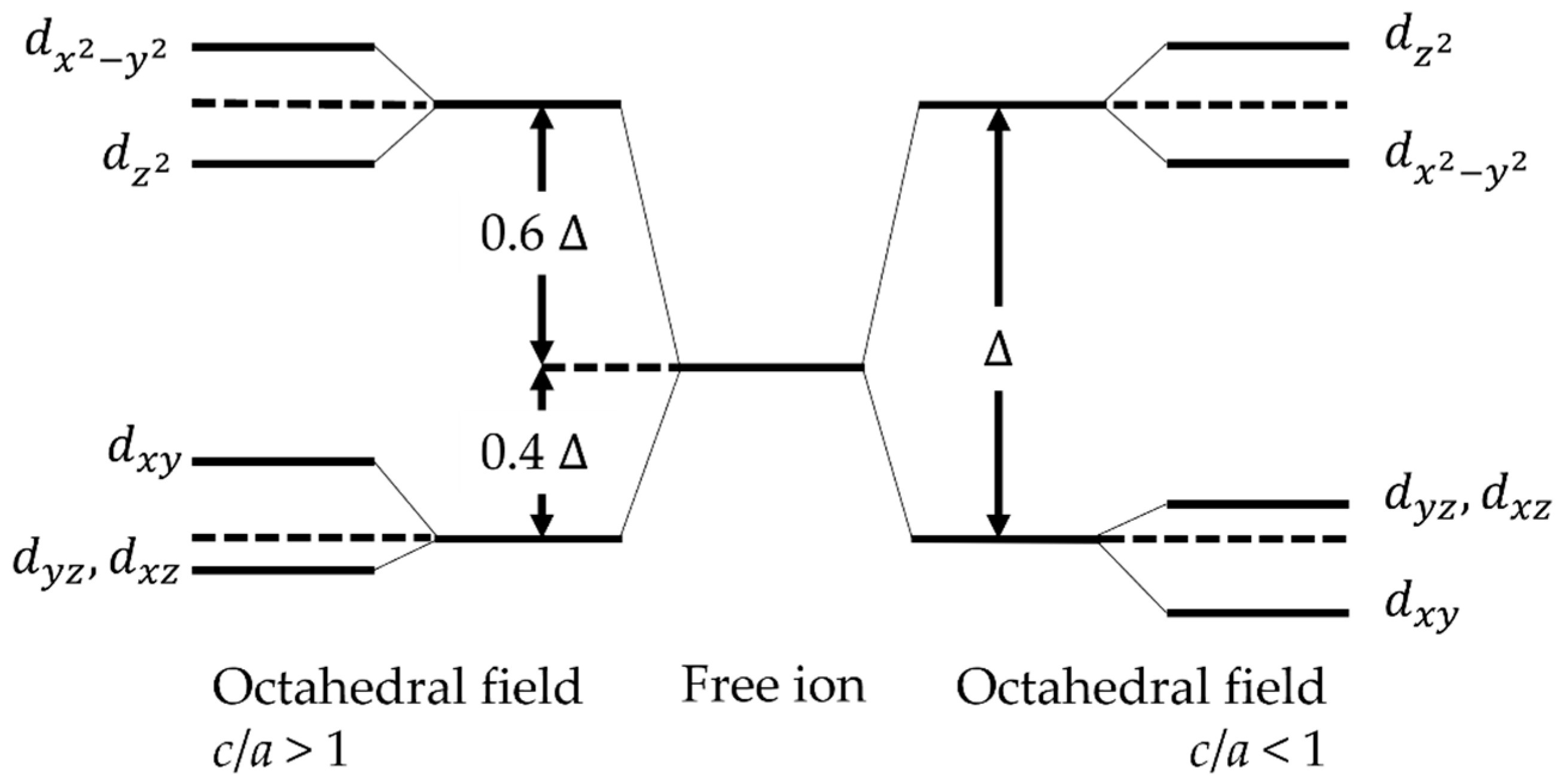
The structural cause of the miscibility gap might be related to the different preferred distortions in the tetragonal phase among the involved cations. In the octahedral configuration, there is an energetic difference between the orbitals depending on whether the tetragonal distortion is leading to compression (c/a < 1) or elongation (c/a > 1) (as seen in Figure 3) [83,84].
The following discussion is based on the fixed presence of Mn3+ with the 3d4 (high-spin, HS) electronic configuration at an octahedral site in the spinel. In this case, 3d2 and 3d7 cations on a tetrahedral site prefer the Jahn–Teller distortion given in an elongated way (c/a > 1), whereas for 3d1 and 3d6, for example, Fe2+, the compressed way (c/a < 1) is preferred. The 3d3, 3d5 (Mn2+, Fe3+), and 3d8 cations behave neutrally in that regard [83]. Those predictions align well with those of Dunitz and Orgel [84] and Goodenough [85], who also state that 3d6 (HS) (Fe2+) is preferred in c/a < 1 configurations when Mn3+ is on the octahedral site [85]. In contrast, phase-pure Mn3O4 prefers c/a > 1 [86]. This makes it less likely for Fe3O4 to mix with the Mn3O4 structure, as long as Fe2+ is present. The situation changes drastically when it is fully oxidized to Fe3+, since this behaves neutrally due to its 3d5 electronic configuration. It has to be mentioned that there is no complete hindrance to forming tetragonally distorted spinel lattices with c/a > 1 when Fe2+ is present, as can be seen by the formation of FeV2O4 and Fe3−xCrxO4 [85]. However, it introduces a small additional energetic barrier when mixing the different spinel structures.
Therefore, overall, the egg white-assisted synthesis of iron-containing samples shows two challenges: (i) the need for a low oxygen partial pressure to overcome fast reoxidation kinetics of Mn3O4 given by the presence of iron oxide [68,69] and (ii) the miscibility gap between Fe3O4 and Mn3O4, leading to the separation into cubic and tetragonal spinel phases instead of a single spinel phase [74,77,79,80,81,82]. After establishing the synthesis conditions, it is also crucial to quantify the associated environmental impacts using LCA.

2.4. Environmental Impact Assessment of an Egg White-Based Synthesis Compared to a Petrochemically Based One

To identify the environmental hotspots of the egg white-assisted synthesis of Fe-Mn spinel oxides, an early-stage attributional screening life cycle assessment was conducted for the synthesis process at laboratory scale.
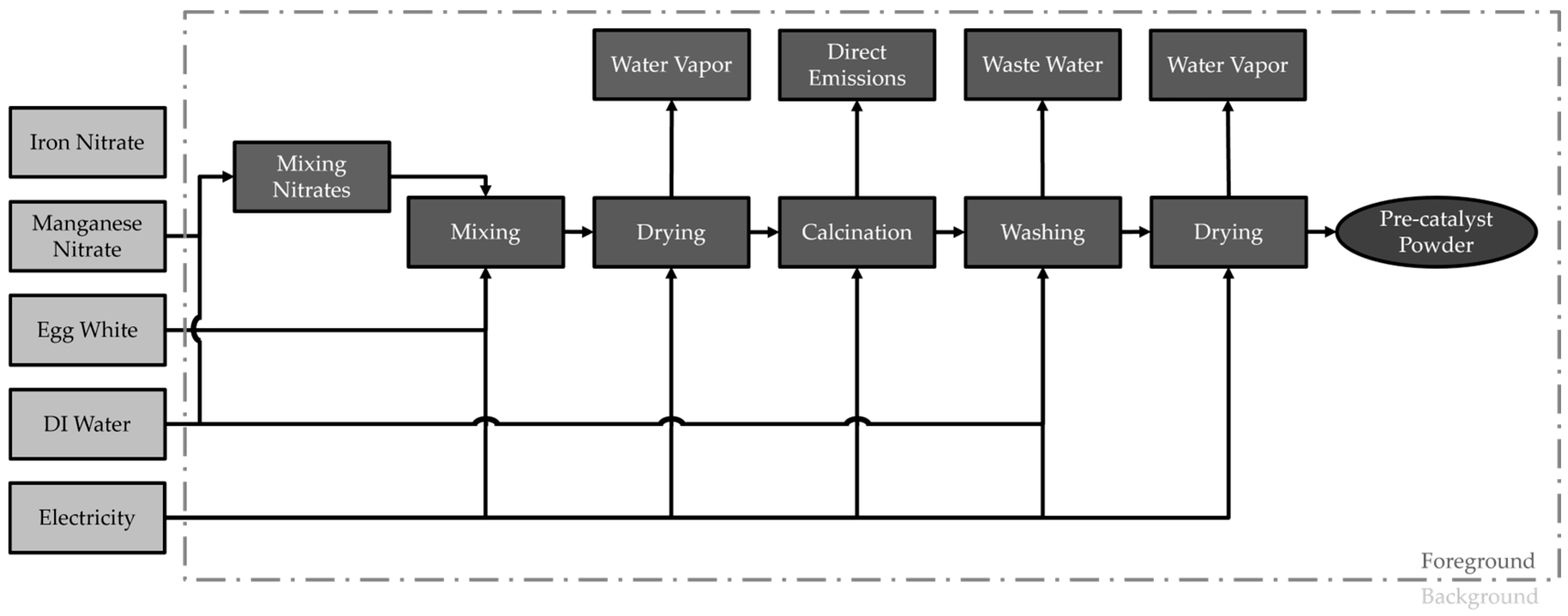
The flowchart in Figure 4 illustrates the processes and flows involved in synthesizing the FexMn3−xO4 spinel-type pre-catalyst powder. In Table S1, the entire inventory is provided, including the used flows, providers, and specific amounts. For the egg white, the process “Egg white, raw, processed in FR|Ambient (average)|Cardboard|at supermarket” was chosen, since the separation process of the egg white from the egg yolk in the Agribalyse database was modeled by a dummy flow, which has no linked emissions and therefore does not add any additional impacts to the resource. Since the separation of egg white and yolk was also performed by hand in the studied synthesis, which did not produce any EIs, the use of this flow is justified. The distribution of the EIs between the fractions of the egg is 60% egg white, 30% egg yolk, and 10% waste (eggshell). Assumed is the production of the egg in France as an average between the different farming types (non-cage, cage, indoor, outdoor, organic).
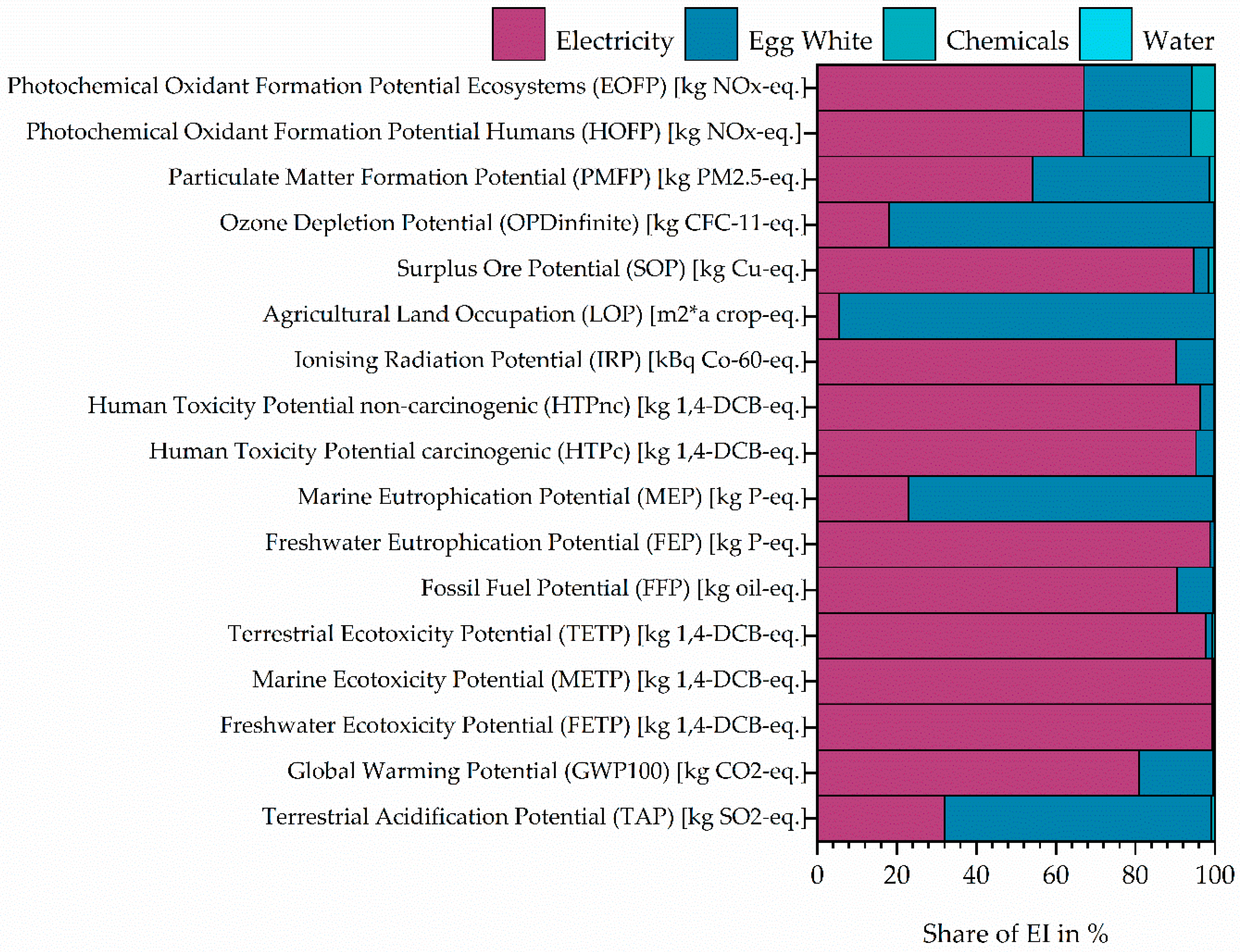
After the calculation, all contributing flows within the synthesis are summarized into four groups, namely “Electricity” (market for electricity in all processes), “Egg White” (Egg white, raw, processed), “Chemicals” (iron nitrate nonahydrate; manganese nitrate tetrahydrate), and “Water” (market for water, deionized; treatment of wastewater), and the impacts are summed up to give an overall value. In Figure 5, the share of each group in the overall impact is provided for 17 of the 18 impact categories (tabulated in Table S2). It should be noted that for the water consumption potential (WCP), the overall calculated shares add up to only 97.7% (see Supplementary Information Table S2). The respective impact contributions of egg white to the WCP are all 0%, indicating an internal error in this data set for this impact category, most likely caused by the merging of the two databases in openLCA. To avoid false claims, the results of this category will therefore not be discussed. For all other categories, the calculations sum to 100%.
The major contributors in all categories are electricity and egg white production. The first can be attributed to the fact that this study is conducted on a lab scale, where electricity consumption is overrepresented due to inefficiencies arising from small batch sizes and non-optimized processes [87]. For egg white, the main contribution is the production of food for chickens. For the chemicals, the impact is relatively low, with a maximum of around 6% in the categories HOFP and EOFP and below 1.6% for all the other categories. While models are available to theoretically upscale lab- or pilot-scale processes to industrial scale, they carry significant uncertainties due to often limited knowledge, of among other things, actual reactor and plant design, required reactant amounts, and achieved product yields [87,88,89]. The scheme proposed by Piccinno et al. [87] suggests linear reactant scale-up and reports that for scaling up from 100 to 10,000 L, the energy values for compensating for heat loss and for stirring both decrease to ~20% of the original value, while the other electricity-requiring steps remain at 90–100%. Under these very rough assumptions and a constant yield, egg white production could hypothetically emerge as the dominant hotspot in this synthesis. However, this scenario is highly uncertain, merely illustrating that the usage of egg white carries a high environmental burden.
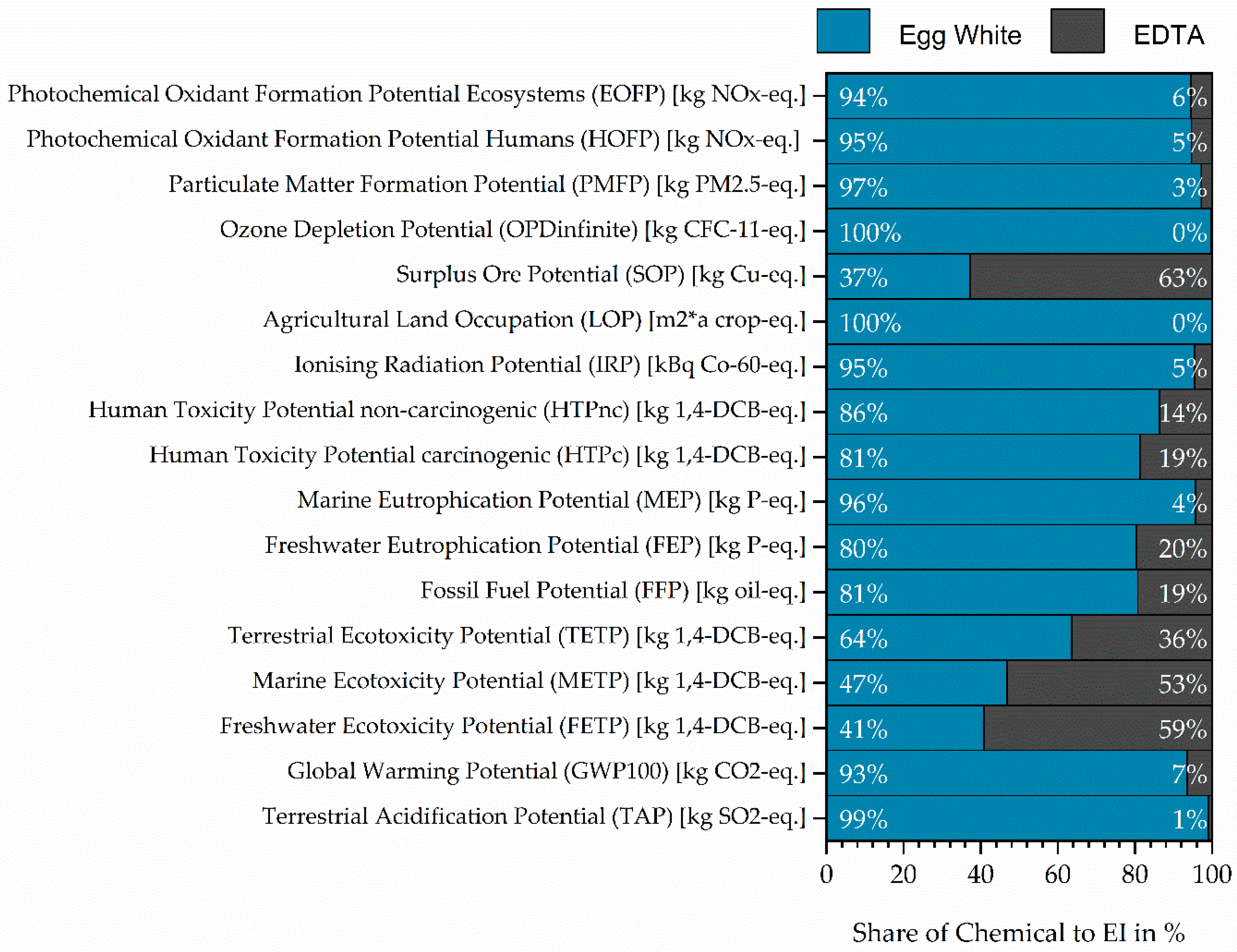
Therefore, it is crucial to check how petroleum-based chemicals would compare in this synthesis. For this, a synthesis where EDTA, a petroleum-based agent, instead of egg white is used as a reference, is conducted [90,91]. Since the synthesis itself was not done in this study, and therefore no first-hand data about electricity consumption, etc., is available, only the production of the agents is compared and not the whole synthesis. This simplification introduces a relevant limitation to this LCA study, as the synthesis with EDTA also requires ammonia to control the pH. Additionally, the calcination steps might differ to obtain a pre-catalyst material with the same performance. This comparison was not intended to produce quantitatively accurate values, but rather to roughly estimate already in this early stage whether egg white has a lower impact than a petroleum-based equivalent, EDTA. In Figure 6, the results for the production of m = 120 g of egg white and m = 5.3 g of EDTA are shown (tabulated values in Table S3). For the same reasons mentioned beforehand, the discussion of the water consumption potential is skipped here.
In this rough estimate of the studied synthesis, it was shown that for most categories (except WCP, SOP, METP, and FETP), egg white has a greater negative environmental impact than its petroleum-based equivalent, EDTA. This contradicts many sources that claim that the synthesis with egg white is “green” and “environmentally friendly” [20,21,22,92,93] and that replacing petroleum-based chemicals with biomass-based ones can help minimize environmental impacts [94]. As this analysis is only an early-stage screening, for a thorough comparison, other factors, such as different heating steps or the addition of ammonia, must also be considered, as they could alter the results. Another limitation is that the comparison of the required amounts is based solely on the literature and has not been experimentally verified. Therefore, a potential reduction in egg white content or an increase in EDTA could change the results. However, even when scaling the results to other ratios between egg white and EDTA, up to a ratio of around 1:0.6 rather than the ratio for this work, assumed to be 1:0.04, more than half of the categories (9 out of the considered 17) have a higher environmental impact for egg white than for EDTA. Only for even higher EDTA amounts would it change to more categories with a higher impact for EDTA than for egg white, but such drastic changes in the required amounts of the reactants are rather unlikely. This clearly shows that not only does the material’s origin need to be studied, but data-based calculations must be implemented as well. For the studied synthesis method, these initial LCA results indicate that substituting petroleum-based materials with egg white is overall less environmentally friendly, particularly in terms of global warming potential.

3. Materials and Methods

3.1. Synthesis

In this work, different metal-containing pre-catalyst materials were synthesized via a soft-chemistry approach using egg white as an agent. Therefore, a stochiometric amount of Mn-nitrate (Mn(NO3)2·4H2O purity: 98%, Thermo Fisher Scientific (Waltham, MA, USA)) and one of the following nitrates (Thermo Fisher Scientific: Fe(NO3)3·9H2O purity: 98.0–101.0%, Zn(NO3)2·6H2O purity: 99%, Co(NO3)2·6H2O purity: 98.0–102.0%, Ni(NO3)2·6H2O purity: 98%; Merck KGaA (Darmstadt, Germany): Al(NO3)2·9H2O) purity: ≥98.5%) were dissolved in 10 mL of deionized (DI) water each according to the values listed in Table 4. In the meantime, egg white was freshly extracted from store-bought hen eggs and slightly beaten on a stirring plate until foamy. After 5 min of stirring the egg white, the nitrate solutions were mixed and added to the egg white, which was continuously stirred. For Fe- and Al-containing materials, the gel forms immediately upon adding the nitrate solution. In contrast, for Co-, Ni-, and Zn-containing samples, the mixture had to undergo a heat treatment at 70 °C < T < 75 °C for t = 5 h in air (for further details, see Supplementary Information). Afterwards, the samples were dried overnight at T = 75 °C. At least m = 1.5 g of the dried iron-containing powders had to be calcined inside a covered alumina cylinder crucible in air for t = 3 h at T = 600 °C. For all the other used elements, calcination in air in an uncovered alumina crucible was performed. This difference was due to empirically observed differences in the behavior of the iron-containing samples compared to those of the other samples. This is explained in Section 2 of this paper. To remove the salts formed during calcination, the dried iron-containing powders were washed 7–10 times in DI water using a centrifuge (3000 rpm, 3 min) and then dried.
For the synthesis with 0% egg white, a solid-state synthesis of the two nitrates was performed. Therefore, a stoichiometric ratio of the powders was mixed in a mortar until a homogeneous powder was obtained and then calcined in air for t = 3 h at T = 600 °C.
In Table 4, the amounts of materials for each synthesis are listed.
Additionally, tests at different oxygen partial pressures, ranging from p = 210,000 ppm (air) to p = 2 ppm (pure Ar), were conducted on an iron-containing sample to estimate the atmosphere created by the combustion of egg white in the covered alumina cylinder during calcination. Calcination in air was performed in a muffle furnace using an uncovered alumina crucible. For the calcinations at p = 1000 ppm and p = 100 ppm, a tube furnace equipped with a Zirox O2 sensor (Zirox SGM5T, Zirox, Greifswald, Germany) at the exhaust side was used. The gas flow used was a mix of pure nitrogen and a mixture of 0.1 vol% O2 in N2, controlled by two separately adjustable mass flow controllers (Red Y Compact, Vögtlin Instruments GmbH, Muttenz, Switzerland) before entering the tube furnace. Due to this build, the oxygen partial pressure was set and equilibrated only at room temperature, with no further adjustments made during the measurement. For the low pO2 measurement at p = 2 ppm, a typical tube furnace connected to pure argon was used.

3.2. Characterization

All derived powders were analyzed for their crystal structure by laboratory X-ray diffraction using a STOE STADI MP (STOE GmbH & Cie, Darmstadt, Germany) in transmission geometry with Mo 1 radiation. For pattern evaluation, the software Match! (version number 4.0 Build 206) (Crystal Impact—Dr. H. Putz & Dr. K. Brandenburg GbR, Bonn, Germany) was used with the reference intensity ratio (RIR) method [95] to obtain quantitative fractions. The values are rounded to reasonable values due to high uncertainty in this method.
Additionally, the dried iron-containing powders with ratios of 2.2, 8.8, and 17.7 were tested using a thermogravimetric analyzer (TG-DTA) coupled with a mass spectrometer (STA 449C Jupiter with QMS Aëolos 403 C mass spectrometer, Netzsch Gerätebau GmbH, Selb, Germany). Therefore, m = 45.25 mg, m = 30.39 mg, and m = 46.06 mg of the samples, respectively, were placed in an alumina crucible fitted with a pierced lid to restrict airflow and heated in air to T = 600 °C at a controlled heating rate of 3 K min−1, with an isothermal step of t = 15 min at T = 600 °C at the end of each measurement.

3.3. Life Cycle Assessment

Life cycle assessment is a tool for evaluating the environmental impacts (EIs) of products or services over their life cycle. This helps to identify environmental hotspots and provides optimization potential, ultimately supporting more sustainable decisions. To quantify the EIs of this synthesis method, an early-stage attributional cradle-to-gate screening life cycle assessment (LCA) was conducted using the software openLCA 2.0.2 (GreenDelta GmbH, Berlin, Germany), with the ecoinvent 3.9.1 database [96] and Agribalyse 3.1.1 [97]. The latter refers to France, but comparable values are also expected in Germany. The final function of the iron-manganese-containing pre-catalyst powder is to be used as a pre-catalyst material for the dehydrogenation of hydrocarbons produced by the pyrolysis of plastic waste; however, at the current state of the study, only the production is investigated, and neither the use phase nor the end-of-life (EOL) phase is considered. This scope was chosen for this study because only the synthesis itself was analyzed, and no statements about its usability or EOL behavior can be made at this time. This leads to a declared unit of producing 1 g of FexMn3−xO4 spinel-type oxide powder via an egg white-based synthesis. The synthesis with an egg white-to-metal precursor ratio of 8.8 mL:mmol was used, as it yielded only spinel phases with good crystallinity and maximized the product yield compared to 4.4 mL:mmol. Included in the study are the estimated direct emissions of CO2, N2, and water during synthesis, as well as emissions associated with the production of the chemicals (including egg white) and electricity. Furthermore, this study is conducted on a lab scale, and no small-scale lab utensils (e.g., paper towels, gloves, or water for washing beakers) or any fabrication of the machinery used are considered. For the calculation of the EIs, the impact assessment method ReCiPe 2016 Midpoint (H) [98] (National Institute for Public Health and the Environment, Radboud University Nijmegen, Leiden University, and Pré Consultants) was chosen.
Additionally, a simple calculation was performed to compare EDTA production with egg white production. For both, the amount required to synthesize 1 g of pre-catalyst powder was used in the LCA, since it was assumed that the resulting pre-catalyst materials would perform similarly. According to the literature, m = 5.3 g of EDTA is required to produce 1 g of pre-catalyst powder [65,66], whereas m = 120 g of egg white is necessary using the synthesis method described in this work.
Since neither iron nitrate nor manganese nitrate is present in the ecoinvent or Agribalyse database, they had to be manually modeled within openLCA, assuming a 100% yield. For this, the following reaction equations are used [99,100,101]:
Fe + 4 HNO3 + 7 H2O → Fe(NO3)3 · 9 H2O + NO
MnO2 + 2 NO2 + 4 H2O → Mn(NO3)2 · 4 H2O
Since no direct process parameters are provided, energy, heat, and factory supply are modeled using proxy values, as described by Hischier et al. [102]. Therefore, the latest available data from the Gendorf Chemiepark for 2021–2023 are used as averaged values for energy and heat usage [102,103].
In the calcination step, the burning of egg white was simplified by assuming that the egg white consists of only ovalbumin (chemical formula: C45H74N10O13, M = 963.14 g/mol, CAS-Nr. 138831-86-4), which is the main protein in egg white [15]. Additionally, a complete combustion of the egg white to CO2, water, and N2 is considered according to the following reaction equation:
C45H74N10O13 + 57 O2 → 45 CO2 + 37 H2O + 5 N2

4. Conclusions

The use of egg white in the synthesis of Fe- and Mn-containing spinel phases shows both opportunities and challenges. While the addition of egg white stabilizes a spinel phase with its reducing properties, phase-pure FeMn2O4 is not easily synthesized. Two main limitations are given: (i) the need for low oxygen partial pressures to counteract the fast reoxidation kinetics of Mn3O4 in the presence of iron oxides and (ii) the intrinsic miscibility gap between Fe3O4 and Mn3O4, which drives the formation of both cubic and tetragonal spinel phases instead of one single phase. In contrast, systems with Ni, Co, Zn, or Al result in phase-pure cubic (Ni) or tetragonal (Co, Zn, Al) spinels without these difficulties.
Additionally, from a life-cycle perspective, egg white significantly contributes to the overall environmental impact of the process, along with high electricity demand. Compared with a petroleum-based agent like EDTA, it makes higher contributions in 14 of the 18 categories. As egg white gains attention as an agent, it is crucial to find a way to make this synthesis as “green” as claimed.

Supplementary Materials

The following supporting information can be downloaded at https://www.mdpi.com/article/10.3390/inorganics14010013/s1, Figure S1: XRD patterns of the unwashed iron-containing samples. Additionally, in black, the reference patterns for (Na,K)SO4 (ICSD #133733) and (Na,K)Cl (ICSD #240593) are shown. Figure S2: pO2 progression (in ppm) during the calcination of the solid-state synthesis sample in dependence on the temperature plotted over time. Figure S3: pO2 progression (in ppm) during the calcination of the egg white-based synthesis sample in dependence on the temperature plotted over time. Figure S4: XRD patterns of the solid-state sample calcined in a pO2 of 100 ppm at T = 600 °C for t = 6 h. Additionally, in black, the reference patterns for Fe2O3 (ICSD #7797) and Mn2O3 (ICSD #9091) are shown. Figure S5: XRD patterns of the samples with Co, Ni, Zn, and Al instead of Fe. Additionally, in black, the reference patterns for CoMn2O4 (ICSD #39197), NiMn2O4 (ICSD #27813), ZnMn2O4 (ICSD #12630), and Mn3O4 (ICSD #33327) are shown. Table S1: Flows, amounts, and provider for the modeled synthesis of 1 g of pre-catalyst powder used in openLCA with the databases ecoinvent 3.9.1. and Agribalyse 3.1.1. Table S2: Exact values as well as percentual share of the groups “Electricity” (market for electricity in all processes), “Egg White” (Egg white, raw, processed), “Chemicals” (iron nitrate nonahydrate; manganese nitrate tetrahydrate), and “Water” (market for water, deionized; treatment of wastewater) for each of the 18 impact categories calculated with ReCiPe 2016 midpoint (H) (National Institute for Public Health and the Environment, Radboud University Nijmegen, Leiden University, and Pré Consultants). Table S3: Calculated (with ReCiPe 2016 midpoint H) impacts for m = 120 g of egg white and m = 5.3 g of EDTA for all 18 impact categories, with the higher values being marked in bold.

Author Contributions

Conceptualization, A.-K.E. and M.W.; methodology, A.-K.E., V.Z., X.L., and M.W.; validation, A.-K.E., V.Z., and M.W.; formal analysis, A.-K.E.; investigation, A.-K.E.; data curation, A.-K.E.; writing—original draft preparation, A.-K.E.; writing—review and editing, A.-K.E., V.Z., X.L., M.W., and A.W.; visualization, A.-K.E.; supervision, M.W. and A.W.; project administration, M.W.; funding acquisition, A.W. All authors have read and agreed to the published version of the manuscript.

Funding

This research was funded by TU Darmstadt with a E+E SEED Fund on the project “Environmental and economic viability of hydrogen production from mixed plastic waste recycling through plasma pyrolysis” with Grant No. EEF11. Additionally, it was funded by “Marie Skłodowska-Curie Postdoctoral Fellowship” with Grant No. 101154421.

Institutional Review Board Statement

Not applicable.

Informed Consent Statement

Not applicable.

Data Availability Statement

The original contributions presented in this study are included in the article/Supplementary Material. Further inquiries can be directed to the corresponding author.

Acknowledgments

The authors would like to thank Arooba Nazneen for the valuable discussion on the modeling of the chemicals and processes included in the life cycle assessment.

Conflicts of Interest

The authors declare no conflicts of interest. The funders had no role in the design of the study; in the collection, analyses, or interpretation of data; in the writing of the manuscript; or in the decision to publish the results.

References

  1. Hermanussen, H.; Loy, J.-P.; Egamberdiev, B. Determinants of Food Waste from Household Food Consumption: A Case Study from Field Survey in Germany. Int. J. Environ. Res. Public Health 2022, 19, 14253. [Google Scholar] [CrossRef]
  2. Statistisches Bundesamt. Ermittlung der Lebensmittelabfälle in Deutschland im Jahr 2020, Erfüllung der Berichtspflicht Gegenüber der EU-Kommission im Jahr 2022 und Ableitung von Handlungsempfehlungen; Statistisches Bundesamt: Wiesbaden, Germany, 2024. [Google Scholar]
  3. Roy, P.; Mohanty, A.K.; Dick, P.; Misra, M. A Review on the Challenges and Choices for Food Waste Valorization: Environmental and Economic Impacts. ACS Environ. Au 2023, 3, 58–75. [Google Scholar] [CrossRef]
  4. Sarker, A.; Ahmmed, R.; Ahsan, S.M.; Rana, J.; Ghosh, M.K.; Nandi, R. A comprehensive review of food waste valorization for the sustainable management of global food waste. Sustain. Food Technol. 2024, 2, 48–69. [Google Scholar] [CrossRef]
  5. Bundesministerium für Umwelt, Klimaschutz, Naturschutz und nukleare Sicherheit (BMUKN). Abfallwirtschaft in Deutschland 2025: Fakten, Daten, Grafiken; BMUKN: Berlin, Germany, 2025.
  6. Lin, C.S.K.; Pfaltzgraff, L.A.; Herrero-Davila, L.; Mubofu, E.B.; Abderrahim, S.; Clark, J.H.; Koutinas, A.A.; Kopsahelis, N.; Stamatelatou, K.; Dickson, F.; et al. Food waste as a valuable resource for the production of chemicals, materials and fuels. Current situation and global perspective. Energy Environ. Sci. 2013, 6, 426. [Google Scholar] [CrossRef]
  7. Torrado, A.M.; Cortés, S.; Salgado, J.M.; Max, B.; Rodríguez, N.; Bibbins, B.P.; Converti, A.; Domínguez, J.M. Citric Acid production from orange peel wastes by solid-state fermentation. Braz. J. Microbiol. 2011, 42, 394–409. [Google Scholar] [CrossRef]
  8. ACS Publications. Hot-Water Hemicellulose Extraction from Fruit Processing Residues. Available online: https://pubs.acs.org/doi/full/10.1021/acsomega.1c06055 (accessed on 24 November 2025).
  9. Klemenz, S.; Stegmüller, A.; Yoon, S.; Felser, C.; Tüysüz, H.; Weidenkaff, A. Holistic View on Materials Development: Water Electrolysis as a Case Study. Angew. Chem. Int. Ed. 2021, 60, 20094–20100. [Google Scholar] [CrossRef]
  10. Yu, M.; Moon, G.; Bill, E.; Tüysüz, H. Optimizing Ni–Fe Oxide Electrocatalysts for Oxygen Evolution Reaction by Using Hard Templating as a Toolbox. ACS Appl. Energy Mater. 2019, 2, 1199–1209. [Google Scholar] [CrossRef]
  11. Yu, M.; Chan, C.K.; Tüysüz, H. Coffee-Waste Templating of Metal Ion-Substituted Cobalt Oxides for the Oxygen Evolution Reaction. ChemSusChem 2018, 11, 605–611. [Google Scholar] [CrossRef]
  12. Caldeira, C.; de Laurentiis, V.; Ghose, A.; Corrado, S.; Sala, S. Grown and thrown: Exploring approaches to estimate food waste in EU countries. Resour. Conserv. Recycl. 2021, 168, 105426. [Google Scholar] [CrossRef] [PubMed]
  13. European Commission. Impact Assessment Report: Directive of the European Parliament and of the Council Amending Directive 2008/98/EC on Waste; European Commission: Brussels, Belgium, 2024. [Google Scholar]
  14. Razi, S.M.; Bagheri, H.; Mohammadian, M.; Mirarab-Razi, V.; Rashidinejad, A. Gelation Properties of Egg White Proteins: A Review. Food Rev. Int. 2024, 40, 2751–2774. [Google Scholar] [CrossRef]
  15. Belitz, H.-D.; Grosch, W.; Schieberle, P. Lehrbuch der Lebensmittelchemie, 6th ed.; Springer: Berlin/Heidelberg, Germany, 2012. [Google Scholar]
  16. Razi, S.M.; Fahim, H.; Amirabadi, S.; Rashidinejad, A. An overview of the functional properties of egg white proteins and their application in the food industry. Food Hydrocoll. 2023, 135, 108183. [Google Scholar] [CrossRef]
  17. Zang, J.; Zhang, Y.; Pan, X.; Peng, D.; Tu, Y.; Chen, J.; Zhang, Q.; Tang, D.; Yin, Z. Advances in the formation mechanism, influencing factors and applications of egg white gels: A review. Trends Food Sci. Technol. 2023, 138, 417–432. [Google Scholar] [CrossRef]
  18. Prasad, S.; Patel, B.; Kumar, P.; Kaufman, J.; Lall, R. Ovotransferrin as a Multifunctional Bioactive Protein: Unlocking Its Potential in Animal Health and Wellness. Vet. Sci. 2025, 12, 514. [Google Scholar] [CrossRef]
  19. Legros, J.; Jan, S.; Bonnassie, S.; Gautier, M.; Croguennec, T.; Pezennec, S.; Cochet, M.-F.; Nau, F.; Andrews, S.C.; Baron, F. The Role of Ovotransferrin in Egg-White Antimicrobial Activity: A Review. Foods 2021, 10, 823. [Google Scholar] [CrossRef] [PubMed]
  20. Sabouri, Z.; Akbari, A.; Hosseini, H.A.; Khatami, M.; Darroudi, M. Egg white-mediated green synthesis of NiO nanoparticles and study of their cytotoxicity and photocatalytic activity. Polyhedron 2020, 178, 114351. [Google Scholar] [CrossRef]
  21. Liu, X.; Li, K.; Wu, C.; Zhou, Y.; Pei, C. Egg white-assisted preparation of inorganic functional materials: A sustainable, eco-friendly, low-cost and multifunctional method. Ceram. Int. 2019, 45, 23869–23889. [Google Scholar] [CrossRef]
  22. Tripathy, S.; Saini, D.S.; Bhattacharya, D. Synthesis and fabrication of MgAl2O4 ceramic foam via a simple, low-cost and eco-friendly method. J. Asian Ceram. Soc. 2016, 4, 149–154. [Google Scholar] [CrossRef]
  23. Danks, A.E.; Hall, S.R.; Schnepp, Z. The evolution of ‘sol–gel’ chemistry as a technique for materials synthesis. Mater. Horiz. 2016, 3, 91–112. [Google Scholar] [CrossRef]
  24. Srikala, D.; Kaushik, S.D.; Verma, M. Overview on Spinel Oxides: Synthesis and Applications in Various Fields. Phys. Solid State 2024, 66, 327–340. (In English) [Google Scholar] [CrossRef]
  25. Al-Salem, S.M.; Antelava, A.; Constantinou, A.; Manos, G.; Dutta, A. A review on thermal and catalytic pyrolysis of plastic solid waste (PSW). J. Environ. Manag. 2017, 197, 177–198. [Google Scholar] [CrossRef]
  26. Biakhmetov, B.; Dostiyarov, A.; Ok, Y.S.; You, S. A review on catalytic pyrolysis of municipal plastic waste. Wiley Interdiscip. Rev. Energy Environ. 2023, 12, e495. [Google Scholar] [CrossRef]
  27. Liu, X.; Xu, D.; Ding, H.; Widenmeyer, M.; Xie, W.; Mellin, M.; Qu, F.; Chen, G.; Zhang, Y.S.; Zhang, Z.; et al. Multi-scale designed CoxMn3–xO4 spinels: Smart pre-catalysts towards high-efficiency pyrolysis-catalysis recycling of waste plastics. Appl. Catal. B Environ. 2023, 324, 122271. [Google Scholar] [CrossRef]
  28. Liu, X.; Xie, W.; Widenmeyer, M.; Ding, H.; Chen, G.; De Carolis, D.M.; Lakus-Wollny, K.; Molina-Luna, L.; Riedel, R.; Weidenkaff, A. Upcycling Waste Plastics into Multi-Walled Carbon Nanotube Composites via NiCo2O4 Catalytic Pyrolysis. Catalysts 2021, 11, 11. [Google Scholar] [CrossRef]
  29. Xu, D.; Shen, C.; Liu, X.; Xie, W.; Ding, H.; Widenmeyer, M.; Mellin, M.; Qu, F.; Rashid, A.; Chen, G.; et al. Efficient transformation of plastic wastes to H2 and electromagnetic nanocarbon absorbents over molecular-level engineered 3D NiCo/MnO. Chem. Eng. J. 2023, 476, 146477. [Google Scholar] [CrossRef]
  30. Mehrabadi, B.A.; Eskandari, S.; Khan, U.; White, R.D.; Regalbuto, J.R. Chapter One—A Review of Preparation Methods for Supported Metal Catalysts. In Advances in Catalysis; Song, C., Ed.; Academic Press: Cambridge, MA, USA, 2017; pp. 1–35. Available online: https://www.sciencedirect.com/science/article/pii/S0360056417300044 (accessed on 4 December 2025).
  31. Sickafus, K.E.; Wills, J.M.; Grimes, N.W. Structure of Spinel. J. Am. Ceram. Soc. 1999, 82, 3279–3292. [Google Scholar] [CrossRef]
  32. Levy, D.; Giustetto, R.; Hoser, A. Structure of magnetite (Fe3O4) above the Curie temperature: A cation ordering study. Phys. Chem. Min. 2012, 39, 169–176. [Google Scholar] [CrossRef]
  33. Grimes, R.W.; Anderson, A.B.; Heuer, A.H. Predictions of cation distributions in AB2O4 spinels from normalized ion energies. J. Am. Chem. Soc. 1989, 111, 1–7. [Google Scholar] [CrossRef]
  34. Dinger, J.; Friedrich, T.; Reimann, T.; Töpfer, J. NiMn2O4 revisited: Temperature-dependent cation distribution from in situ neutron diffraction and thermopower studies. J. Am. Ceram. Soc. 2023, 106, 1834–1847. [Google Scholar] [CrossRef]
  35. Zhang, Q.; Tian, W.; Nepal, R.; Huq, A.; Nagler, S.; DiTusa, J.F.; Jin, R. Polyhedral Distortions and Unusual Magnetic Order in Spinel FeMn2O4. Chem. Mater. A Publ. Am. Chem. Soc. 2023, 35, 2330–2341. [Google Scholar] [CrossRef] [PubMed]
  36. Gabal, M.A.; Ata-Allah, S.S. Concerning the cation distribution in MnFe2O4 synthesized through the thermal decomposition of oxalates. J. Phys. Chem. Solids 2004, 65, 995–1003. [Google Scholar] [CrossRef]
  37. Li, J.; Yuan, H.; Li, G.; Liu, Y.; Leng, J. Cation distribution dependence of magnetic properties of sol–gel prepared MnFe2O4 spinel ferrite nanoparticles. J. Magn. Magn. Mater. 2010, 322, 3396–3400. [Google Scholar] [CrossRef]
  38. Huang, J.-R.; Cheng, C. Cation and magnetic orders in MnFe2O4 from density functional calculations. J. Appl. Phys. 2013, 113, 3. [Google Scholar] [CrossRef]
  39. Rajput, S.; Yadav, M.; Dehury, T.; Yadav, A.K.; Sahoo, P.K.; Rath, C. Coexistence of tetragonal and cubic phase induced complex magnetic behaviour in CoMn2O4 nanoparticles. Nanotechnology 2023, 34, 425702. [Google Scholar] [CrossRef] [PubMed]
  40. Bordeneuve, H.; Tenailleau, C.; Guillemet-Fritsch, S.; Smith, R.; Suard, E.; Rousset, A. Structural variations and cation distributions in Mn3−xCoxO4 (0 ≤ x ≤ 3) dense ceramics using neutron diffraction data. Solid State Sci. 2010, 12, 379–386. [Google Scholar] [CrossRef]
  41. Töpfer, J.; Feltz, A.; Gräf, D.; Hackl, B.; Raupach, L.; Weissbrodt, P. Cation Valencies and Distribution in the Spinels NiMn2O4 and MzNiMn2−zO4 (M = Li, Cu) Studied by XPS. Phys. Stat. Sol. A 1992, 134, 405–415. [Google Scholar] [CrossRef]
  42. Ponce, J.; Rehspringer, J.-L.; Poillerat, G.; Gautier, J. Electrochemical study of nickel–aluminium–manganese spinel NixAl1−xMn2O4. Electrocatalytical properties for the oxygen evolution reaction and oxygen reduction reaction in alkaline media. Electrochim. Acta 2001, 46, 3373–3380. [Google Scholar] [CrossRef]
  43. Ivanova, I.V.; Zaitseva, N.A.; Samigullina, R.F.; Krasnenko, T.I. Solid-state synthesis of ZnMn2O4 spinel: Sequence of phase transformations, thermal stability, localization and charge state of manganese ions in the intermediate and final reaction products. Solid State Sci. 2023, 136, 107110. [Google Scholar] [CrossRef]
  44. Panigrahi, R.; Mallik, B.S. Computational study of spinel ZnM2O4 as a cathode material for Zn-ion batteries. Ionics 2025, 31, 1719–1730. [Google Scholar] [CrossRef]
  45. Narkiewicz, U.; Podsiadły, M.; Jędrzejewski, R.; Pełech, I. Catalytic decomposition of hydrocarbons on cobalt, nickel and iron catalysts to obtain carbon nanomaterials. Appl. Catal. A Gen. 2010, 384, 27–35. [Google Scholar] [CrossRef]
  46. Moisala, A.; Nasibulin, A.G.; Kauppinen, E.I. The role of metal nanoparticles in the catalytic production of single-walled carbon nanotubes—A review. J. Phys. Condens. Matter 2003, 15, S3011–S3035. [Google Scholar] [CrossRef]
  47. Modekwe, H.U.; Daramola, M.O.; Mamo, M.A.; Moothi, K. Recent advancements in the use of plastics as a carbon source for carbon nanotubes synthesis—A review. Heliyon 2024, 10, e24679. [Google Scholar] [CrossRef]
  48. Busto, M.; Dosso, L.A.; Nardi, F.; Badano, J.M.; Vera, C.R. Catalytic and Non-Catalytic Co-Gasification of Biomass and Plastic Wastes for Energy Production. Catalysts 2025, 15, 844. [Google Scholar] [CrossRef]
  49. Pflaumbaum, W.; Steinhausen, M. Liste der Krebserzeugenden, Keimzellmutagenen und Reproduktionstoxischen Stoffe (KMR-Stoffe); Institut für Arbeitsschutz der Deutschen Gesetzlichen Unfallversicherung (IFA): Sankt Augustin, Germany, 2025; p. 012750. [Google Scholar]
  50. American Elements. Safety Data Sheet—(2N) 99% Manganese Cobalt Oxide, Spinel Powder: Mn1.5Co1.5O4—CAS/; American Elements: Los Angeles, CA, USA, 2020; Available online: https://americanelements.com/manganese-cobalt-oxide-spinel-powder (accessed on 28 October 2025).
  51. Sigma-Aldrich. Safety Data Sheet—Cobalt (II) Oxide: CoO—CAS 1307-96-6; Sigma-Aldrich: St. Louis, MO, USA, 2023. Available online: https://www.sigmaaldrich.com/DE/de/product/aldrich/343153 (accessed on 28 October 2025).
  52. Stanford Advanced Materials. Safety Data Sheet—Manganese Iron Oxide: MnFe2O4—CAS 12063-10-4; Stanford Advanced Materials: Santa Ana, CA, USA. Available online: https://www.samaterials.de/searchSds.html (accessed on 28 October 2025).
  53. Sigma-Aldrich. Safety Data Sheet—Cobalt (II,III) Oxide: Co3O4—CAS 1308-06-1; Sigma-Aldrich: St. Louis, MO, USA, 2025. Available online: https://www.sigmaaldrich.com/DE/de/search/1308-06-1?focus=products&page=1&perpage=30&sort=relevance&term=1308-06-1&type=cas_number (accessed on 28 October 2025).
  54. Sigma-Aldrich. Safety Data Sheet—Nickel (II) Oxide: NiO—CAS 1313-99-1; Sigma-Aldrich: St. Louis, MO, USA, 2025. Available online: https://www.sigmaaldrich.com/DE/de/product/aldrich/637130 (accessed on 28 October 2025).
  55. European Commission. Directorate-General for Internal Market, Industry, Entrepreneurship and SMEs. In Study on the Critical Raw Materials for the EU 2023—Final Report; Grohol, M., Veeh, C., Eds.; Publications Office of the European Union: Luxembourg, 2023. [Google Scholar]
  56. Aguiar-Hualde, J.-M.; Magnin, Y.; Amara, H.; Bichara, C. Probing the role of carbon solubility in transition metal catalyzing single-walled carbon nanotubes growth. Carbon 2017, 120, 226–232. [Google Scholar] [CrossRef]
  57. Diarra, M.; Zappelli, A.; Amara, H.; Ducastelle, F.; Bichara, C. Importance of carbon solubility and wetting properties of nickel nanoparticles for single wall nanotube growth. Phys. Rev. Lett. 2012, 109, 185501. [Google Scholar] [CrossRef] [PubMed]
  58. He, S.; Xu, Y.; Zhang, Y.; Bell, S.; Wu, C. Waste plastics recycling for producing high-value carbon nanotubes: Investigation of the influence of Manganese content in Fe-based catalysts. J. Hazard. Mater. 2021, 402, 123726. [Google Scholar] [CrossRef] [PubMed]
  59. Tao, Z.; Yang, Y.; Zhang, C.; Li, T.; Ding, M.; Xiang, H.; Li, Y. Study of Manganese Promoter on a Precipitated Iron-Based Catalyst for Fischer-Tropsch Synthesis. J. Nat. Gas Chem. 2007, 16, 278–285. [Google Scholar] [CrossRef]
  60. Shoukat, B.; Naz, M.Y.; Yaseen, M.; Noreen, S. Microwave-Driven Pyrolysis of Plastic Waste into Carbon Nanotubes and Hydrogen Using Spinel Ferrites. Chem. Eng. Technol. 2024, 47, 1013–1023. [Google Scholar] [CrossRef]
  61. Xu, L.; Wang, L.; Li, Y.; Song, Q.; Tian, Z.; Wang, C.; Zhao, M.; Gao, N. A novel high-entropy spinel ferrites (CoNiCuZnMg)Fe2O4 catalyst for H2 production via steam reforming of derived volatiles from polypropylene and waste cooking oil. Chem. Eng. J. 2024, 488, 150767. [Google Scholar] [CrossRef]
  62. Ma, Y.; Wang, W.; Fu, Y.; Miao, H.; Huang, J.; Han, S.; Chen, Y. A multifunctional SiC@HZSM-5@CoFe2O4 catalyst for synergistic co-pyrolysis of biomass and waste plastics by microwave irradiation. Fuel 2024, 359, 130407. [Google Scholar] [CrossRef]
  63. Xiao, J.; Xu, T.; Shu, Z.; Chen, W.; Liu, D. Iron-based spinel for H2 production and CO2 separation from plastics via chemical looping. Appl. Therm. Eng. 2025, 274, 126633. [Google Scholar] [CrossRef]
  64. Kumawat, S.M.; Dwivedi, G.D.; Chien, Y.H.; Su, P.F.; Huang, Z.H.; Chou, H. Understanding the structural behaviors and abrupt enhancement in magnetic ordering temperature of Fe-substituted Mn3O4. Mater. Res. Bull. 2022, 154, 111928. [Google Scholar] [CrossRef]
  65. Chen, J.; Gu, B.; Royer, R.A.; Burgos, W.D. The roles of natural organic matter in chemical and microbial reduction of ferric iron. Sci. Total Environ. 2003, 307, 167–178. [Google Scholar] [CrossRef]
  66. Holder, C.F.; Schaak, R.E. Tutorial on Powder X-ray Diffraction for Characterizing Nanoscale Materials. ACS Nano 2019, 13, 7359–7365. [Google Scholar] [CrossRef] [PubMed]
  67. Bagheri, S.; Shameli, K.; Hamid, S.B.A. Synthesis and Characterization of Anatase Titanium Dioxide Nanoparticles Using Egg White Solution via Sol-Gel Method. J. Chem. 2013, 2013, 848205. [Google Scholar] [CrossRef]
  68. Wong, P.S.B. Thermochemical Heat Storage for Concentrated Solar Power: Thermochemical System Reactor Design for Thermal Energy Storage. USDOE Office of Energy Efficiency and Renewable Energy (EERE), Renewable Power Office. Solar Energy Technologies Office, General Atomics, San Diego, CA (United States) DOE-GO–18145, 2011. Available online: https://www.osti.gov/biblio/1039304 (accessed on 4 December 2025).
  69. Cheraghi, A.; Yoozbashizadeh, H.; Safarian, J. Gaseous Reduction of Manganese Ores: A Review and Theoretical Insight. Miner. Process. Extr. Metall. Rev. 2020, 41, 198–215. [Google Scholar] [CrossRef]
  70. Kumari, T.S.D.; Kannan, R.; Kumar, T.P. Synthesis of LiMn2O4 from a gelled ovalbumin matrix. Ceram. Int. 2009, 35, 1565–1568. [Google Scholar] [CrossRef]
  71. Wieczorek-Ciurowa, K.; Kozak, A.J. The Thermal Decomposition of Fe(NO3)3·9H2O. J. Therm. Anal. Calorim. 1999, 58, 647–651. (In English) [Google Scholar] [CrossRef]
  72. Gallagher, P.K.; Schrey, F.; Prescott, B. The thermal decomposition of aqueous manganese (II) nitrate solution. Thermochim. Acta 1971, 2, 405–412. [Google Scholar] [CrossRef]
  73. Xing, X.; Li, Z.; Wang, Y.; Tian, Z.; Liu, D.; Cheng, J.; Hao, Z. Synergistic catalytic degradation of benzene and toluene on spinel MMn2O4 (MCo, Ni, Cu) catalysts. J. Environ. Sci. 2025, 154, 238–251. [Google Scholar] [CrossRef]
  74. Wickham, D.G. The chemical composition of spinels in the system Fe3O4 Mn3O4. J. Inorg. Nucl. Chem. 1969, 31, 313–320. [Google Scholar] [CrossRef]
  75. National Institute of Standards and Technology. NIST-JANAF Thermochemical Tables, 4th ed.; American Inst. of Physics: Woodbury, NY, USA, 1998. [Google Scholar]
  76. Kang, Y.-B.; Jung, I.-H. Thermodynamic modeling of oxide phases in the Fe–Mn–O system. J. Phys. Chem. Solids 2016, 98, 237–246. [Google Scholar] [CrossRef]
  77. Brabers, V. Cation migration, cation valencies and the cubic-tetragonal transition in MnxFe3−xO4. J. Phys. Chem. Solids 1971, 32, 2181–2191. [Google Scholar] [CrossRef]
  78. Mason, B. Mineralogical aspects of the system Fe3O4—Mn3O4—ZnMn2O4—ZnFe2O4. Am. Mineral. 1947, 32, 426–441. [Google Scholar]
  79. Holba, P.; Khilla, M.A.; Krupička, S. On the miscibility gap of spinels MnxFe3−xO4+γ. J. Phys. Chem. Solids 1973, 34, 387–395. [Google Scholar] [CrossRef]
  80. Mcmurdie, H.F.; Sullivan, B.M.; Mauer, F.A. High-temperature x-ray study of the system Fe3O4-Mn3O4. J. Res. Natl. Bur. Stand. 1950, 45, 35. [Google Scholar] [CrossRef]
  81. Weiland, R.J. Untersuchungen zur Thermodynamik Oxidischer Lösungsphasen im System Co-Fe-Mn-O. Ph.D. Thesis, Universität Stuttgart, Fakultät Chemie, Stuttgart, Germany, 2002. Available online: https://d-nb.info/96793107X/34 (accessed on 4 December 2025).
  82. Sahu, S.K.; Huang, B.; Lilova, K.; Woodfield, B.F.; Navrotsky, A. Thermodynamics of Fe3O4-Co3O4 and Fe3O4-Mn3O4 spinel solid solutions at the bulk and nanoscale. Phys. Chem. Chem. Phys. 2015, 17, 22286–22295. [Google Scholar] [CrossRef]
  83. O’keeffe, M. Cation valencies and distributions in spinel structures containing manganese. J. Phys. Chem. Solids 1961, 21, 172–178. [Google Scholar] [CrossRef]
  84. Dunitz, J.D.; Orgel, L.E. Electronic properties of transition-metal oxides—I. J. Phys. Chem. Solids 1957, 3, 20–29. [Google Scholar] [CrossRef]
  85. Goodenough, J.B. Jahn-Teller distortions induced by tetrahedral-site Fe2+ ions. J. Phys. Chem. Solids 1964, 25, 151–160. [Google Scholar] [CrossRef]
  86. Goodenough, J.B. On the influence of 3d4 ions on the magnetic and crystallographic properties of magnetic oxides. J. Phys. Radium 1959, 20, 155–159. [Google Scholar] [CrossRef]
  87. Piccinno, F.; Hischier, R.; Seeger, S.; Som, C. From laboratory to industrial scale: A scale-up framework for chemical processes in life cycle assessment studies. J. Clean. Prod. 2016, 135, 1085–1097. [Google Scholar] [CrossRef]
  88. Espinosa, S.A.; Bala, A.; Fullana-I-Palmer, P. Life cycle assessment as a tool for evaluating chemical processes at industrial scale: A review. Green Chem. 2022, 24, 7751–7762. [Google Scholar] [CrossRef]
  89. Erakca, M.; Baumann, M.; Helbig, C.; Weil, M. Systematic review of scale-up methods for prospective life cycle assessment of emerging technologies. J. Clean. Prod. 2024, 451, 142161. [Google Scholar] [CrossRef]
  90. Mazur, Ł.; Koszelow, D.; Zajusz, M.; Łapiński, M.; Bik, M.; Zając, P.; Adamczyk, A.; Rutkowski, P.; Molin, S.; Brylewski, T. Comparison of Cu1.3Mn1.7O4 spinels doped with Ni or Fe and synthesized via wet chemistry and solid-state reaction methods, designed as potential coating materials for metallic interconnects. J. Eur. Ceram. Soc. 2023, 43, 5557–5574. [Google Scholar] [CrossRef]
  91. Kruk, A.; Brylewski, T. Structure and Electrical Properties of Fe-Mn-Co-O Spinel. Acta Phys. Pol. A 2019, 135, 439–443. [Google Scholar] [CrossRef]
  92. Kannaiyan, S.; Easwaramoorthy; Kannan, K.; Andal, V. Green synthesis of Phenothiazinium Schiff base and its nano silver complex using egg white as a catalyst under solvent free condition. Mater. Today Proc. 2022, 55, 267–273. [Google Scholar] [CrossRef]
  93. Tirado-Guizar, A.; Rodriguez-Gattorno, G.; Paraguay-Delgado, F.; Oskam, G.; Pina-Luis, G.E. Eco-friendly synthesis of egg-white capped silver nanoparticles for rapid, selective, and sensitive detection of Hg(II). MRS Commun. 2017, 7, 695–700. (In English) [Google Scholar] [CrossRef]
  94. Mori, R. Replacing all petroleum-based chemical products with natural biomass-based chemical products: A tutorial review. RSC Sustain. 2023, 1, 179–212. [Google Scholar] [CrossRef]
  95. de Wolff, P.M.; Visser, J.W. Absolute Intensities; AIP Publishing: Delft, The Netherlands, 1964. [Google Scholar]
  96. Wernet, G.; Bauer, C.; Steubing, B.; Reinhard, J.; Moreno-Ruiz, E.; Weidema, B. The ecoinvent database version 3 (part I): Overview and methodology. Int. J. Life Cycle Assess. 2016, 21, 1218–1230. [Google Scholar] [CrossRef]
  97. Koch, P.; Salou, T.; Asselin-Balençon; Broekema, R.; Teulon, H.; Gastaldi, G.; Houssier, J.; Moutia, A.; Rousseau, V.; Wermeille, A.; et al. AGRIBALYSE® Versions 3.1 & 3.1.1. Recherche Data Gouv, 2024. Available online: https://doi.org/10.57745/B5DTRR (accessed on 4 December 2025). [CrossRef]
  98. Huijbregts, M.A.J.; Steinmann, Z.J.N.; Elshout, P.M.F.; Stam, G.; Verones, F.; Vieira, M.; Zijp, M.; Hollander, A.; van Zelm, R. ReCiPe2016: A harmonised life cycle impact assessment method at midpoint and endpoint level. Int. J. Life Cycle Assess. 2017, 22, 138–147. (In English) [Google Scholar] [CrossRef]
  99. Wildermuth, E.; Stark, H.; Friedrich, G.; Ebenhöch, F.L.; Kühborth, B.; Silver, J.; Rituper, R. Iron Compounds. In Ullmann’s Encyclopedia of Industrial Chemistry, 6th ed.; Bohnet, M., Ullmann, F., Eds.; Wiley-VCH: Weinheim, Germany, 2003. [Google Scholar] [CrossRef]
  100. Reidies, A.H. Manganese Compounds. In Ullmann’s Encyclopedia of Industrial Chemistry, 6th ed.; Bohnet, M., Ullmann, F., Eds.; Wiley-VCH: Weinheim, Germany, 2003. [Google Scholar] [CrossRef]
  101. Lewchalermwong, C.C. Process for Manufacture of Ferric Nitrate. U.S. Patent 4808393A, 18 September 1987. [Google Scholar]
  102. Hischier, R.; Hellweg, S.; Capello, C.; Primas, A. Establishing Life Cycle Inventories of Chemicals Based on Differing Data Availability (9 pp). Int. J. Life Cycle Assess. 2005, 10, 59–67. (In English) [Google Scholar] [CrossRef]
  103. Chemiepark Gendorf. Umwelterklärung 2025. Burgkirchen a.d. Alz. 2025. Available online: https://gendorf.de/de-DE/Support%20Navigation/Presse/Broschueren (accessed on 4 December 2025).
Figure 1. XRD patterns of all samples calcined at T = 600 °C for t = 3 h and washed afterwards. From bottom to top, the egg white content increases from a ratio of 0 to 17.7, corresponding to the six samples in Table 2. Additionally, in black, the reference patterns for Fe2O3 (ICSD #7797), Mn2O3 (ICSD #9091), Fe3O4 (cubic) (ICSD #9093), and Mn3O4 (tetragonal) (ICSD #33327) are shown.
Inorganics 14 00013 g001
Figure 2. TGA MS graphs for samples with a ratio of 2.2 (top), 8.8 (middle), and 17.7 (bottom). In the TGA graph, black indicates the mass curve (TG), blue the DTA curve, and red the temperature. In the MS graph, green indicates COx and NOx fractions, blue indicates H2O, yellow indicates organic fractions, and black and gray indicate air (carrier gas).
Inorganics 14 00013 g002
Figure 3. Schematic representation of the differences in energy when a Jahn–Teller distortion is present as an elongation (c/a > 1) (left) or compression (c/a < 1) (right). Based on [83].
Inorganics 14 00013 g003
Figure 4. LCA flowchart for the synthesis of Fe-Mn containing pre-catalyst powder depicting the processes involved as the foreground system (dark gray) and the background system (light gray).
Inorganics 14 00013 g004
Figure 5. Percentual share of the groups “Electricity” (market for electricity in all processes), “Egg White” (Egg white, raw, processed), “Chemicals” (iron nitrate nonahydrate; manganese nitrate tetrahydrate), and “Water” (market for water, deionized; treatment of wastewater) for each of the 17 impact categories calculated with ReCiPe 2016 midpoint (H).
Inorganics 14 00013 g005
Figure 6. Calculated (with ReCiPe 2016 midpoint H) impacts for m = 120 g of egg white and m = 5.3 g of ethylenediaminetetraacetic acid (EDTA) for all 17 impact categories.
Inorganics 14 00013 g006
Table 1. Cationic distribution in spinel-type transition metal-manganites. Tetragonal sites are marked by round brackets (), while square brackets mark octahedral sites [].
CompositionCationic DistributionInversion Degree vSource
Fe3O4(Fev3+Fe1−v2+)[Fev2+Fe2−v3+]O41[32,33]
Mn3O4(Mn2+)[Mn3+]O40[34]
FeMn2O4(Mn1−v2+Fev3+)[Fe1−v3+Mn13+Mnv2+]O40–0.1[35]
MnFe2O4(Mn1−v2+Fev3+)[Fe2−v3+Mnv2+]O40.2–1[36,37,38]
CoMn2O4(Co2+)[Mn3+]O40[39,40]
NiMn2O4(Mnv3+Ni1−v2+)[Niv2+Mn2−v3+]O40.7–1[34,41]
AlMn2O4(Mn2+)[Al3+Mn3+]O40[42]
ZnMn2O4(Zn2+)[Mn3+]O40[34,43,44]
Table 2. Iron- and manganese-containing phases identified by X-ray diffraction for samples with different egg white-to-metal precursor ratios calcined at T = 600 °C for t = 3 h in a covered cylindrical crucible and washed afterwards. References used: Fe2O3 (ICSD #7797), Mn2O3 (ICSD #9091), Fe3O4 (ISCD #9093), and Mn3O4 (ICSD #33327).
Egg White-to-Metal Precursor Ratio
(mL/mmol)
Detected PhasesPercentage
(wt%)
0Mn2O370
Fe2O330
2.2Mn2O345
Fe2O315
FexMn3−x O 4   ( x   1.2)25
FexMn3−x O 4   ( x   < 1.2) 15
4.4FexMn3−x O 4   ( x   1.2)50
FexMn3−x O 4   ( x   < 1.2)50
8.8FexMn3−x O 4   ( x   1.2)50
FexMn3−x O 4   ( x   < 1.2)50
13.3FexMn3−x O 4   ( x   1.2)60
FexMn3−x O 4   ( x   < 1.2)40
17.7FexMn3−x O 4   ( x   1.2)70
FexMn3−x O 4   ( x   < 1.2)30
Table 3. Summarized XRD results of the calcination of a Fe-Mn containing powder with the egg white-to-nitrate ratio of 8.8 in different pO2 atmospheres.
pO2 in ppmDetected Phases
210,000Fe2O3, Mn2O3
1000Mn2O3, Mn3O4, Fe3O4
100(Fe,Mn)3O4
2MnO, (Fe,Mn)3O4
Table 4. Used amounts in mL or mmol for the egg white and the nitrates for the different samples.
Intended MaterialEgg White-to-Metal Precursor Ratio
in mL:mmol
Egg White Content
in mL
Mn Content
in mmol
Cation 2 Content
in mmol
FeMn2O40042
2.240126
4.44063
8.84031.5
13.34021
17.7401.50.75
CoMn2O48.84031.5
NiMn2O48.84031.5
AlMn2O48.84031.5
ZnMn2O48.84031.5
Disclaimer/Publisher’s Note: The statements, opinions and data contained in all publications are solely those of the individual author(s) and contributor(s) and not of MDPI and/or the editor(s). MDPI and/or the editor(s) disclaim responsibility for any injury to people or property resulting from any ideas, methods, instructions or products referred to in the content.