
Article

Synthesis of Aluminum-Based MOF and Cellulose-Modified Al-MOF for Enhanced Adsorption of Congo Red Dye

Department of Chemistry, Kocaeli University, Kocaeli 41380, Türkiye
*
Author to whom correspondence should be addressed.
Inorganics 2026, 14(1), 6; https://doi.org/10.3390/inorganics14010006
Submission received: 30 November 2025 / Revised: 19 December 2025 / Accepted: 20 December 2025 / Published: 23 December 2025

Abstract

The synthesis of two novel materials, aluminum-based MOF (Al-MOF) and cellulose-modified MOF (Al-MOF@C), as adsorbents is presented. Al-MOF was synthesized from aluminum sec-butoxide and terephthalic acid in a 1:1 molar ratio using a solvothermal method. Al-MOF@C was synthesized under similar solvothermal conditions by reacting environmentally friendly starting materials such as aluminum sec-butoxide, terephthalic acid, and cellulose in a 1:1:1 molar ratio. The synthesized materials’ structural, morphological, and surface properties were thoroughly characterized using XRD, SEM, EDS, BET (with specific surface areas calculated as 563.9 m2/g for Al-MOF and 487.1 m2/g for Al-MOF@C), and FTIR analyses. Then they were utilized in the water treatment process to remove the highly toxic anionic Congo red (CR) dye. Dye adsorption studies were carried out using UV-Vis spectroscopy. Batch adsorption experiments showed that Al-MOF and Al-MOF@C materials adsorbed CR dye with removal efficiencies of 95.06% and 91.79% in just 4 min, respectively. The equilibrium adsorption isotherm data for Al-MOF and Al-MOF@C were best fitted by the Langmuir model, and the calculated maximum adsorption capacities were 80.64 mg/g and 68.96 mg/g, respectively. The adsorption kinetics exhibited an excellent correlation with the pseudo-second-order model (R2 = 0.9975 for Al-MOF and R2 = 0.9936 for Al-MOF@C). Measurements taken after the adsorption process showed that Al-MOFs synthesized using environmentally friendly chemicals retained their stable chemical structure in aqueous environments and thus did not create secondary pollution in the environment, highlighting the importance of this study. Chemically stable, thermodynamically favorable, and highly reusable Al-MOF adsorbents offer a promising solution for the advanced environmental remediation of hazardous dye contaminants.

1. Introduction

The rapid growth of modern industry is continually increasing water pollution, which poses serious environmental risks. Synthetic dyes are widely used in industries like textiles, cosmetics, plastics manufacturing, and food production [1]. These substances are a major source of contamination because they have high toxicity and carcinogenic potential [2]. Specifically, Congo red (CR), an azo dye, can be easily absorbed through the skin and poses a severe environmental and health hazard as it degrades into highly carcinogenic compounds like benzidine [3]. Owing to its extensive use in textile, paper, and printing industries, CR is considered one of the most persistent pollutants in industrial wastewater. Its complex aromatic structure provides significant chemical stability, while its high solubility in water ensures environmental persistence, making CR dye difficult to remove using some treatment methods [4]. Discharging this wastewater into rivers and streams without proper treatment leads to irreversible damage to aquatic and terrestrial ecosystems [1]. Therefore, the removal of dye pollutants from water is extremely important for environmental protection. To achieve this, various methods are applied, including sedimentation, filtration, chemical treatment, photocatalytic reactions, electrochemical methodology, biological treatment, and adsorption [5]. Among these, adsorption is a highly effective and preferred method due to its low cost, high removal capacity, and practical applicability [6].
For this purpose, numerous studies have been investigated the removal of organic pollutants from aqueous environments using adsorbents derived from natural sources or industrial wastes. Natural or waste-based adsorbents include biochar (e.g., fish scale waste, walnut shell) [7,8], clay minerals (such as bentonite and kaolinite) [9,10], and industrial byproducts such as fly ash [11]. These materials have been widely investigated due to their low cost, environmental compatibility, and easy availability. On the other hand, synthetic adsorbents such as metal oxides (TiO2, Fe3O4, ZnO) [12,13,14], polymer-based composites, and Metal–Organic Frameworks (MOFs) have been developed to achieve higher adsorption capacity, selectivity, and reusability [15]. In this context, the investigation of porous materials with high specific surface area has become an important area of research, and MOFs have attracted significant attention among researchers as a new class of promising materials [16,17,18,19].
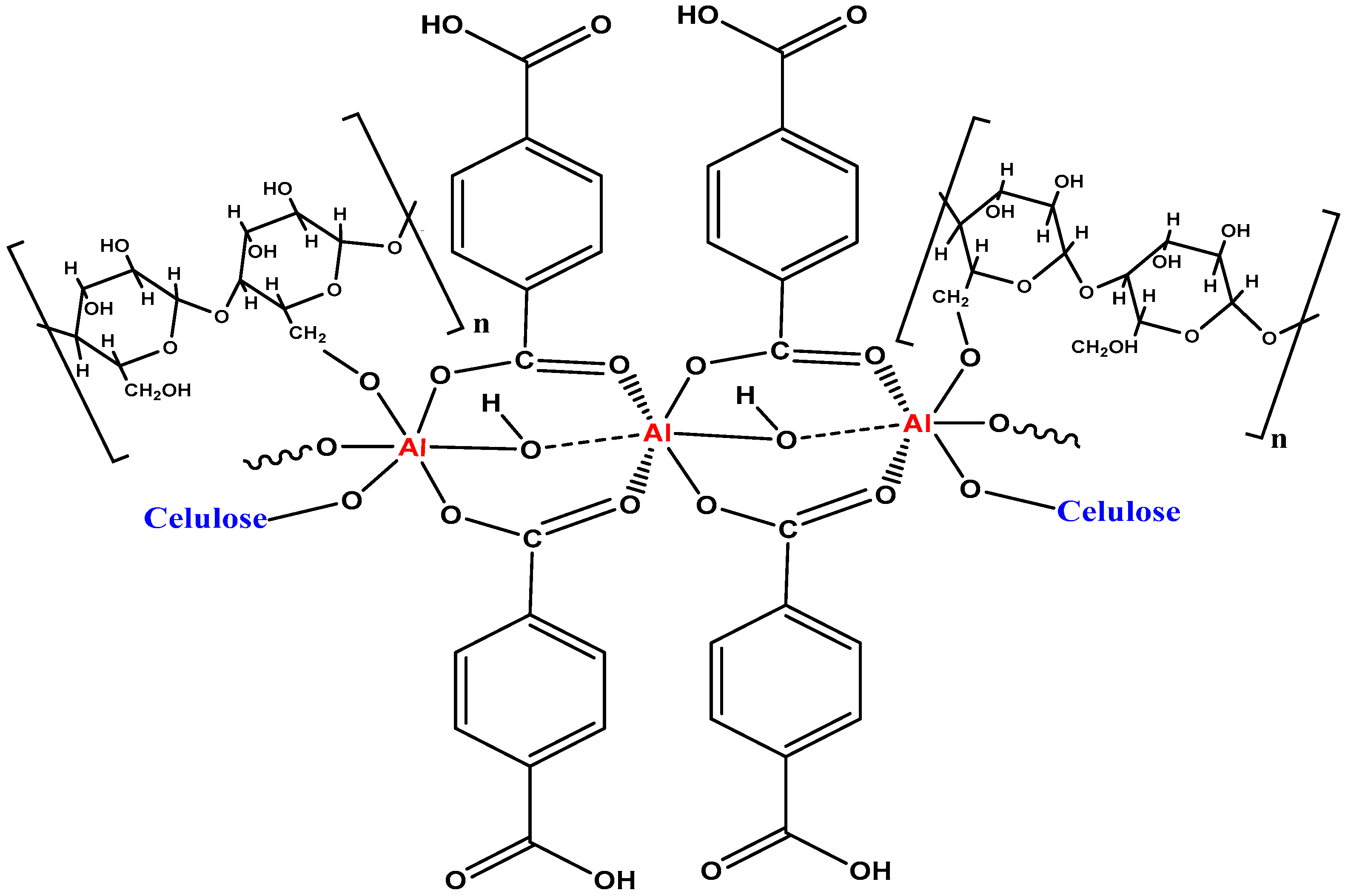
MOFs are porous structures formed by the coordination of metal ions or clusters with organic and inorganic ligands [20]. Their unique framework allows for tunable pore sizes, adjustable surface functionalities, and exceptionally high surface areas [21]. Among various MOF systems, aluminum-based frameworks (Al-MOFs) have gained particular attention due to the low cost, non-toxicity, and high natural abundance of aluminum precursors [22,23]. Furthermore, Al3+ ions form strong coordination bonds with oxygen-containing linkers, which provide remarkable thermal, chemical, and hydrolytic stability to the frameworks [24,25]. These features render Al-MOFs especially suitable for applications in aqueous environments, such as dye adsorption, catalysis, and wastewater treatment [26,27,28]. Well-known examples of Al-based frameworks include MIL-53(Al), NH2-MIL-53(Al), and MIL-101(Al), which exhibit high surface areas, tunable pore architectures, and good recyclability [29,30,31]. Owing to these advantages, the development of novel Al-MOF and Al-MOF-based composite materials represents a promising strategy for achieving efficient and sustainable removal of organic pollutants such as Congo red from wastewater [32,33]. Preparing adsorbents from alcoholate-based starting materials, especially in the preparation of aluminum MOF compounds, is a good solution to prevent a second impurity originating from the adsorbent from being introduced into the environment. For this reason, preparing a MOF adsorbent from aluminum sec-butoxide also constitutes the novelty of this work. Additionally, cellulose, which acts as a biomaterial, reduces the solubility of the MOF compound by coordinating with the central atom in the MOF structure and simultaneously increases its physical/chemical strength, making the MOF structure more durable in aqueous environments [34].
The novelty and primary objective of the research was to successfully synthesize and characterize Al-based MOFs from environmentally friendly chemicals such as aluminum sec-butoxide, terephthalic acid, and cellulose. The adsorption properties of these obtained Al-MOF compounds against CR dye, which has high toxic properties, were investigated. The adsorption isotherm, kinetic, and thermodynamic analyses were comprehensively detailed. The results show that these MOFs are highly efficient in eliminating CR from aqueous solutions.

2. Results and Discussion

2.1. Structural Characterization of Al-MOF and Al-MOF@C

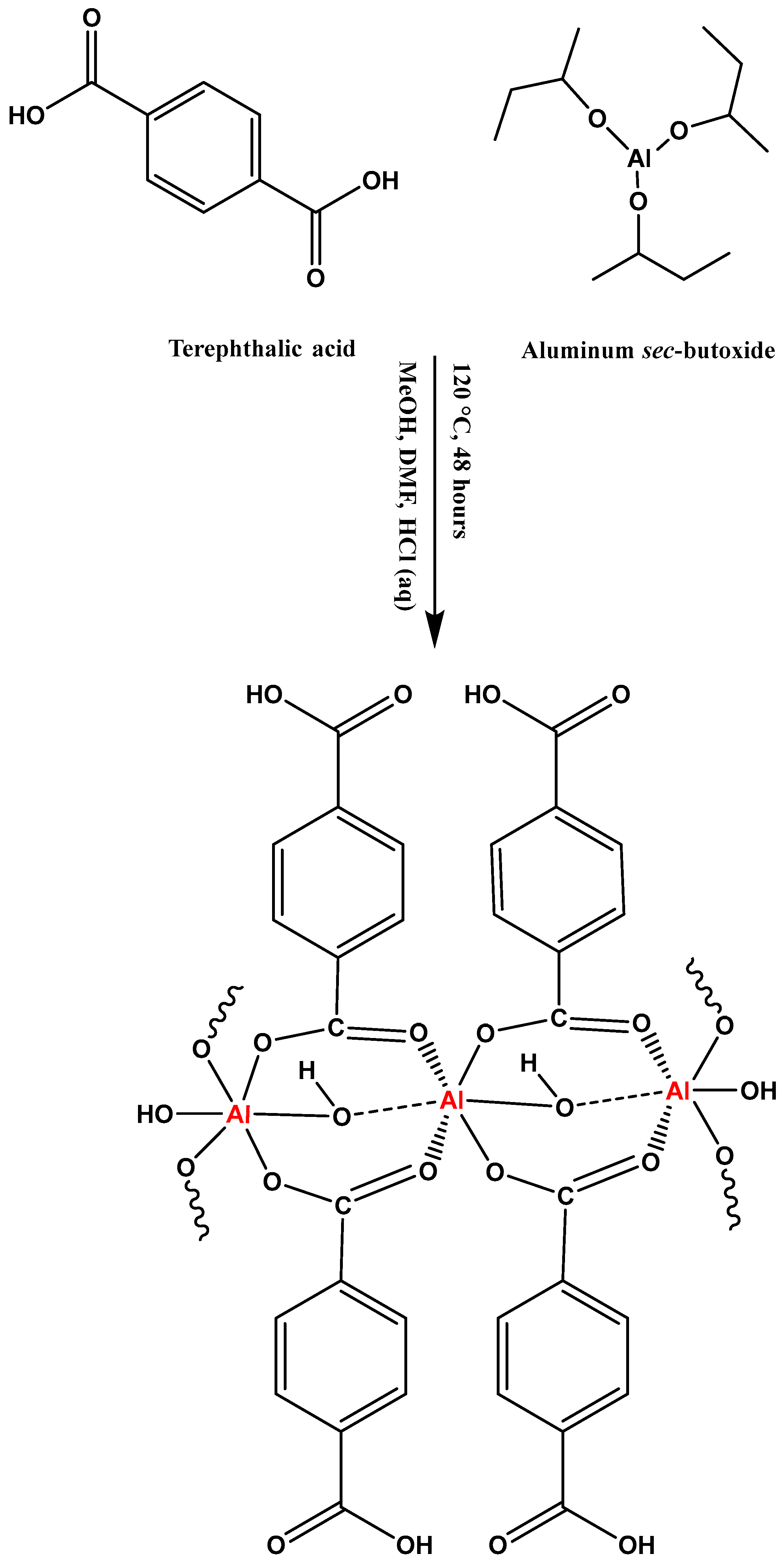
Aluminum sec-butoxide was reacted with terephthalic acid (1,4-benzenedicarboxylic acid) (in a 1:1 molar ratio), resulting in the formation of aluminum–terephthalate compound through coordination between the Al–OR groups and the carboxylate groups of terephthalic acid. The precursor was subsequently hydrolyzed with hydrochloric acid. Following the solvothermal synthesis, Al-MOF containing OH, bridging oxo groups, and terephthalate linker was obtained. In a separate synthesis, aluminum sec-butoxide, terephthalic acid, and cellulose, were mixed simultaneously. The hydroxyl groups of cellulose interacted with aluminum centers, leading to the formation of Al–O–C bonds. After hydrolysis with HCl(aq), the solvothermal synthesis yielded a cellulose-modified Al-MOF@C compound. The synthesized Al-MOF and Al-MOF@C compounds (Scheme 1 and Scheme 2) were characterized using XRD, FTIR, SEM, EDS, BET and BJH analyses.
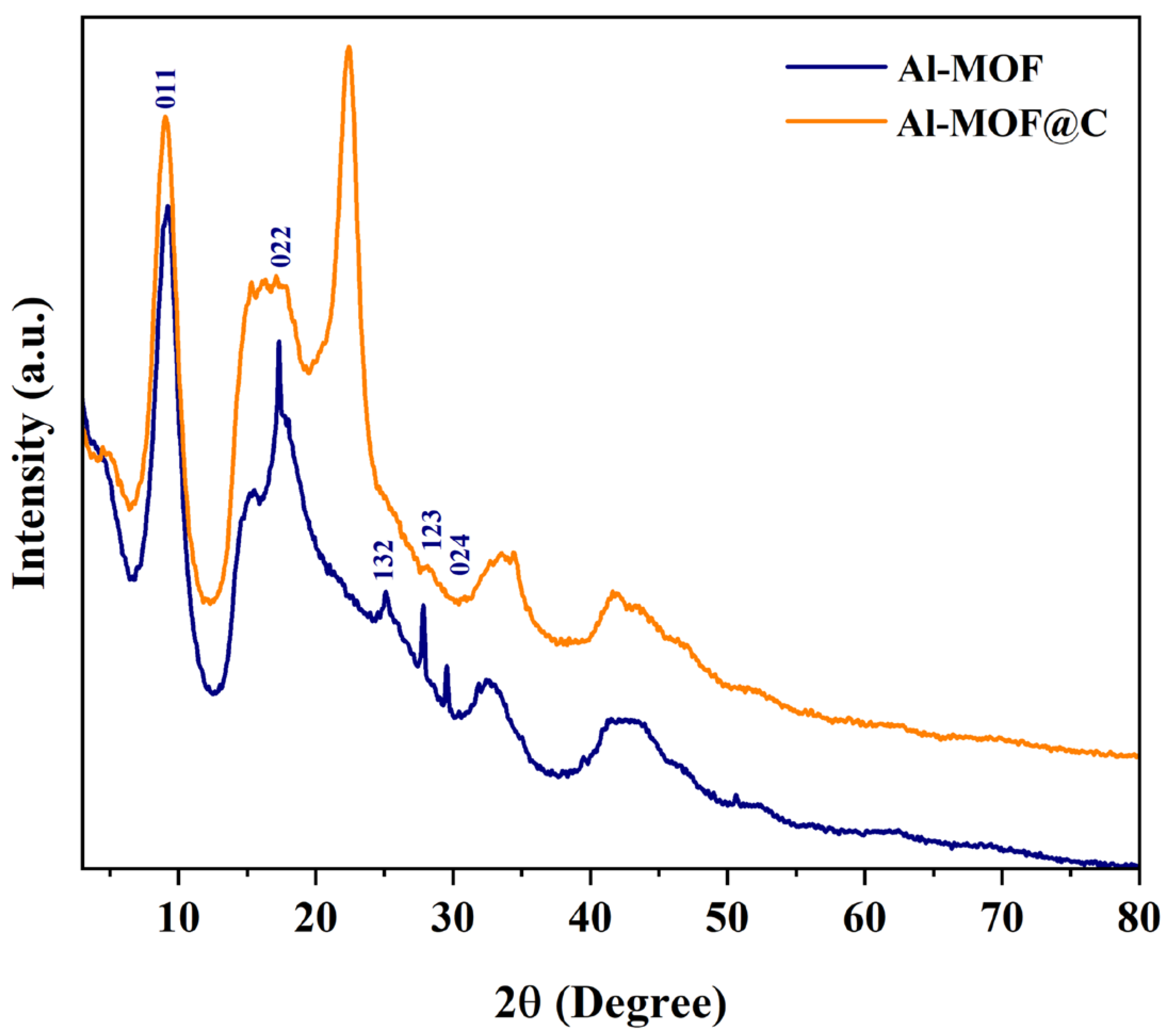
XRD analyses were performed to investigate the crystal structures of the synthesized materials (Figure 1). The characteristic diffraction peaks of Al-MOF were detected at 2θ = 4.77°, 9.16° (011), 14.81° (101), 17.54° (022), 25.05° (132), 27.83° (123), and 29.52° (024). The sharp peaks in the XRD spectrum indicate that the material is highly crystalline, while in addition to these, a certain number of amorphous characteristics are also observed in the peaks at approximately 32.65 and 43.29 degrees in the spectrum. These results are consistent with the peak values observed in MIL-53(Al)-like or aluminum-based MOF structures [35]. MIL-53 crystals exhibit different diffraction patterns under different synthesis conditions and, while compatible with that of MIL-53 (Al) form the Cambridge Crystallographic Data Center (No. CCDC-220475), contain more crystal peaks.
The diffraction peaks of Al-MOF@C were recorded at 2θ = 5.15°, 9.08°, 14.72°, 16.10°, 17.80°, 22.35°, 32.36° (broad peak), and 43.75° (broad peak). Despite the addition of cellulose, the fact that Al-MOF@C retains its crystallinity indicates that the synthesis conditions allow organic (cellulosic) and inorganic (aluminum-based) components to coexist within a well-organized hybrid structure. The characteristic peaks of pristine cellulose in XRD spectra appear at approximately 2θ = 16 and 22° [17]. As expected, after cellulose was bound to Al-MOF, a partial decrease in some peak intensities and slight shifts were observed. This observation indicates the formation of Al-O-C covalent bonds through the interaction of the hydroxyl groups of cellulose with aluminum centers. Furthermore, the emergence of a broad peak at 16.10 and a sharp peak at 22.35° confirms the presence of cellulose moiety [34]. The obtained results show that both synthesized materials exhibit crystalline properties, although the addition of cellulose led to partial amorphization of the structure.
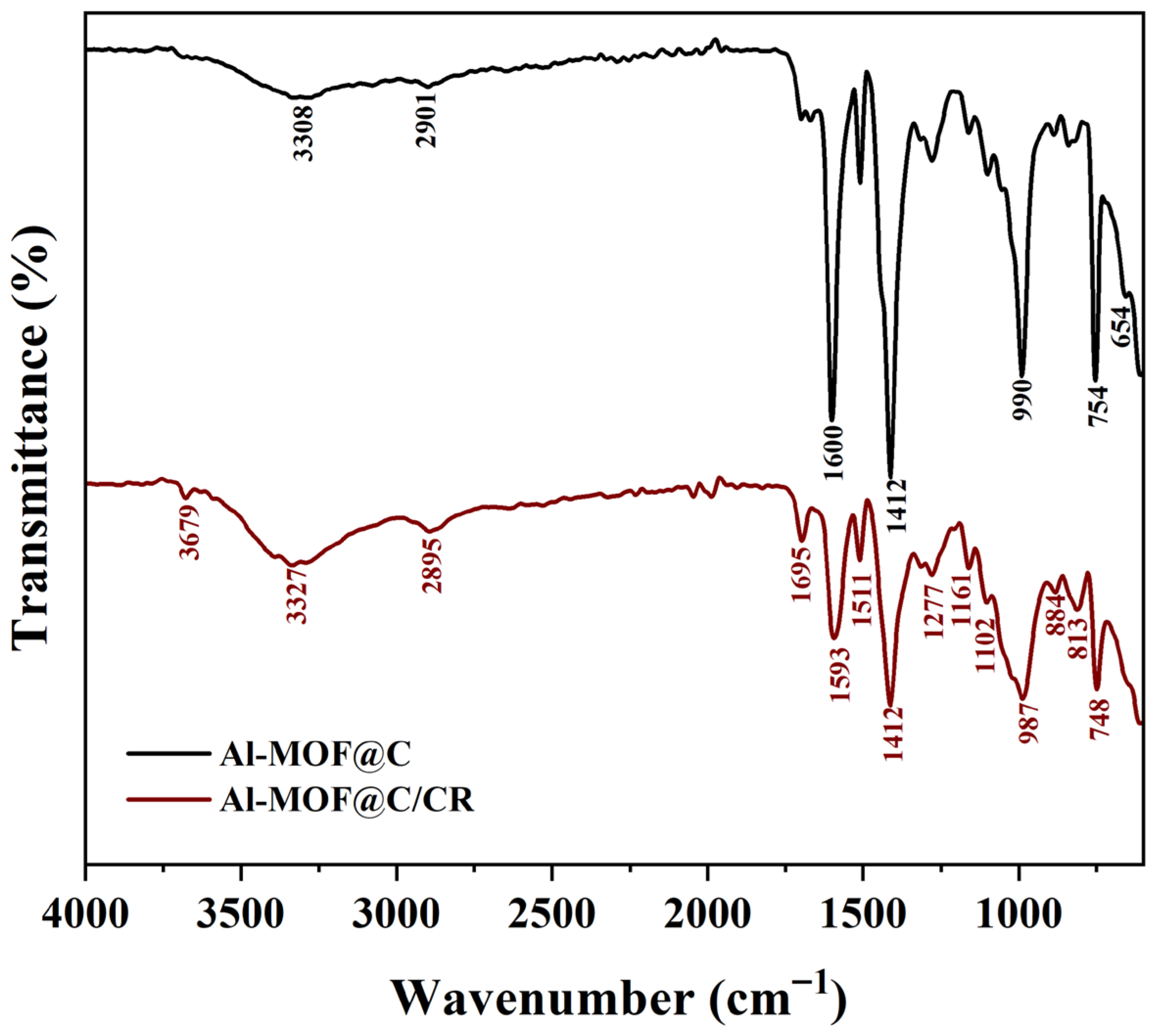
FTIR spectroscopy was employed to identify the structure’s organic and inorganic functional groups and to clarify the MOF structure. Figure 2 shows the FTIR spectra of Al-MOF@C compound before and after CR adsorption. The asymmetric (asym) and symmetric (sym) stretching vibrations of the carboxylate (COO) groups originating from free terephthalic acid were observed at 1670 and 1421 cm−1 (Figure S1), respectively [34,36]. After coordination of terephthalate ligand to Al(OBus)3, the asym and sym stretching vibration of carboxylate (COO) peaks appeared at around 1600 and 1412 cm−1 for both Al-MOF and Al-MOF@C. The small intensity peak at 1697 cm−1 corresponds to the few terminal COOH groups remaining unbound to the aluminum atom of terephthalic acid. The peaks at 1280, 1162, and 991 cm−1 are attributed to C–O–C and C–O stretching vibrations of terephthalate and glycosidic linkages of cellulose ligands [17]. The broad band around 3330 cm−1 corresponds to the O–H stretching vibrations in cellulose units and the adsorbed water molecules within the MOF [37]. Furthermore, a weak band observed around 3670 cm−1 is assigned to the stretching vibration of surface Al–OH species or bridged hydroxyl (Al–OH–Al) groups. The peak at 2895 cm−1 is attributed to the asymmetric stretching vibration of the C-H bond in the cellulose group. After the CR dye bound to the adsorbent surface, a decrease in the adsorbent’s peak intensities and small shifts in its values were observed. For example, the asym and sym stretching vibrations of the carboxylate (COO) groups were observed at 1593 and 1412 cm−1 with small shifts, respectively. The peak corresponding to the C-H bending vibration coincides with the COO peak appearing at 1412 cm−1. The peaks observed at 1570 cm−1 (coinciding with the asym COO peak at 1593 cm−1) and 1511 cm−1 belong to the C=C bonds present in both the phthalate group in Al-MOF@C and the benzene ring of the CR dye. It should be noted that the peak at 1593 cm−1 also belongs to the N=N bond vibration region. The medium-intensity peak appearing in the 748 cm−1 regions before and after adsorption in both spectra also belongs to the aryl-H (C=C-H) out-of-plane band. After the adsorption process, extra peaks belonging to CR dye appear in addition to the adsorbent peaks. For example, the peak that broadens and appears at 1062 cm−1 is attributed to the vibration of the S=O group. In short, the decrease in peak intensities, shifts, and the emergence of new peaks indicate that the NH2, N=N, and SO3 groups of the CR dye are involved in the adsorption process. In addition, the peak observed at around 667 cm−1 is assigned to the Al–O stretching vibration. FTIR spectra of Al-MOF before and after CR adsorption are given in Figure S2.
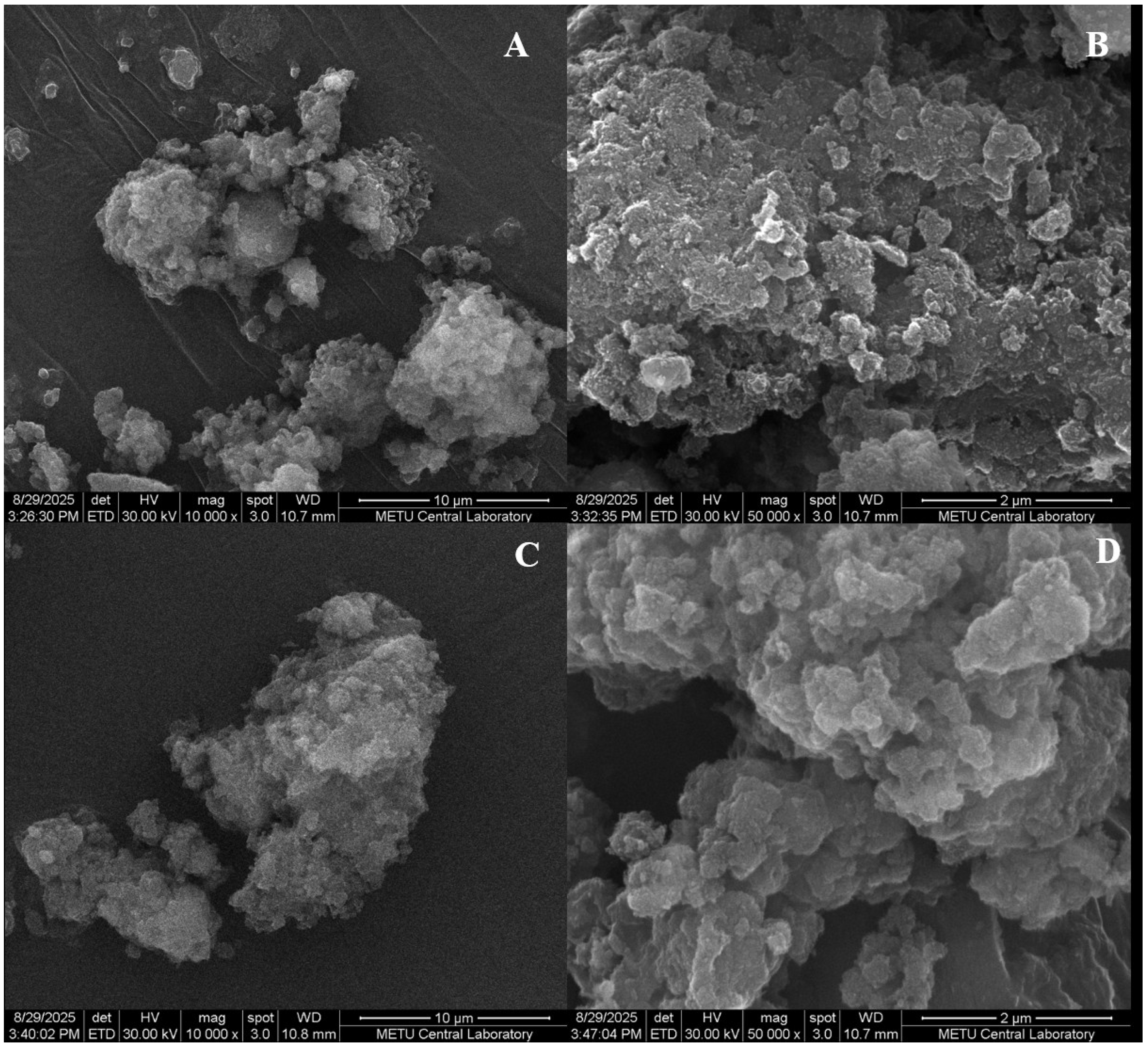
SEM and EDS instruments were employed to analyze the surface properties and chemical content of the newly synthesized materials. Figure 3 shows SEM images of Al-MOF (A, B) and Al-MOF@C (C, D) at various magnifications (10,000×–50,000×). Al-MOF structure is characterized by irregularly stacked, plate-like Al-MOF crystals (average crystal size of ~200 nm) and forms a porous, layered framework with interlocking sheets. These features provide a high surface area and numerous active sites for adsorption. Al-MOF@C also exhibits a rough and porous surface morphology composed of irregularly agglomerated plate-like nanocrystals with sizes ranging from 100 to 400 nm and an average crystal size of ~250 nm (Figure 3C,D). A loose aggregate morphology characterized by visible inter-particle porosity is observed. Upon careful examination of the SEM images of Al-MOF and Al-MOF@C, it is evident that Al-MOF possesses a larger pore volume and pore size. These observations are consistent with the BET results.
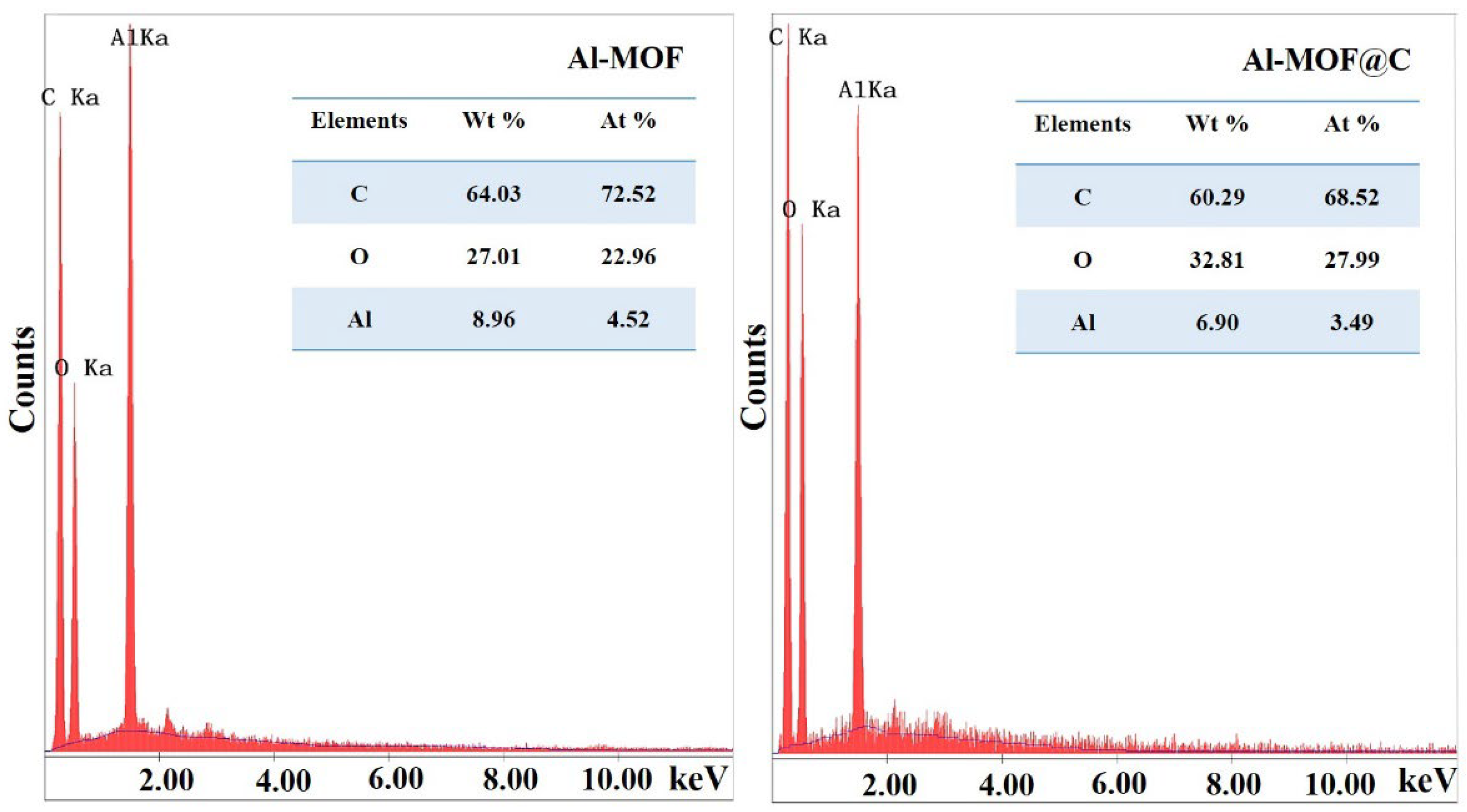
The EDS analyses (Figure 4 (A, B for Al-MOF and C, D for Al-MOF@C)) confirm that both adsorbents consist of carbon, oxygen, and aluminum, consistent with a hybrid organic–inorganic composition. Al-MOF exhibits a higher Al content (8.96 wt%) than Al-MOF@C (6.90 wt% Al), whereas Al-MOF@C shows an increased O content (32.81 wt%). This difference is an expected result because Al-MOF is modified with a cellulose unit, and each cellulose unit contains 5 oxygen atoms, which increases the amount of oxygen in the molecule. Ultimately, these findings highlight the successful synthesis of Al-MOF/cellulose. The balanced distribution of Al, O, and C here indicates strong interactions between the MOF and cellulose components, thereby enhancing stability and improving the availability of hydroxyl groups for adsorption activities.
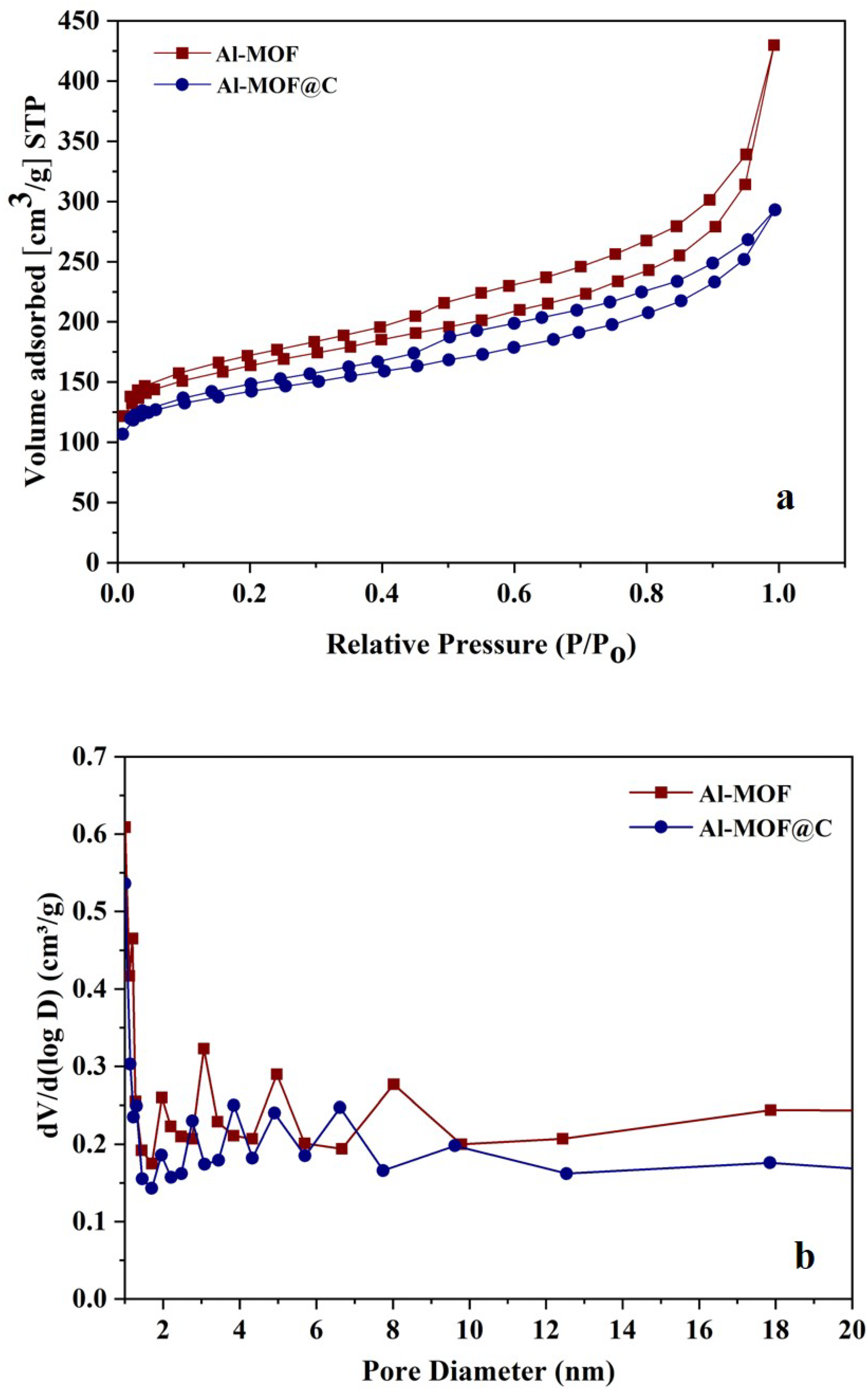
The surface textural properties of Al-MOF and Al-MOF@C, such as surface area, pore volume, and pore size distributions, were determined using nitrogen (N2) adsorption–desorption isotherms (Figure 5). These properties were calculated using models, including BET, DH, and DR, with the detailed results presented in Table 1. The N2 adsorption–desorption isotherms (Figure 5a) of Al-MOF and Al-MOF@C correspond to Type IV isotherms [38]. According to the pore size distribution curve obtained by the BJH method (Figure 5b), both adsorbents possess pores in the range of 2–10 nm, indicating a mesoporous structure. This lower pore distribution in Al-MOF@C can be attributed to a slight reduction in pore volume caused by the addition of cellulose. The surface areas determined by the BET method were 563.9 m2/g for Al-MOF and 487.1 m2/g for Al-MOF@C. The corresponding pore volumes were 0.5970 cm3/g and 0.3890 cm3/g, respectively. The large surface area and advanced porous structure of Al-MOF and Al-MOF@C provide an advantage for numerous adsorption applications.
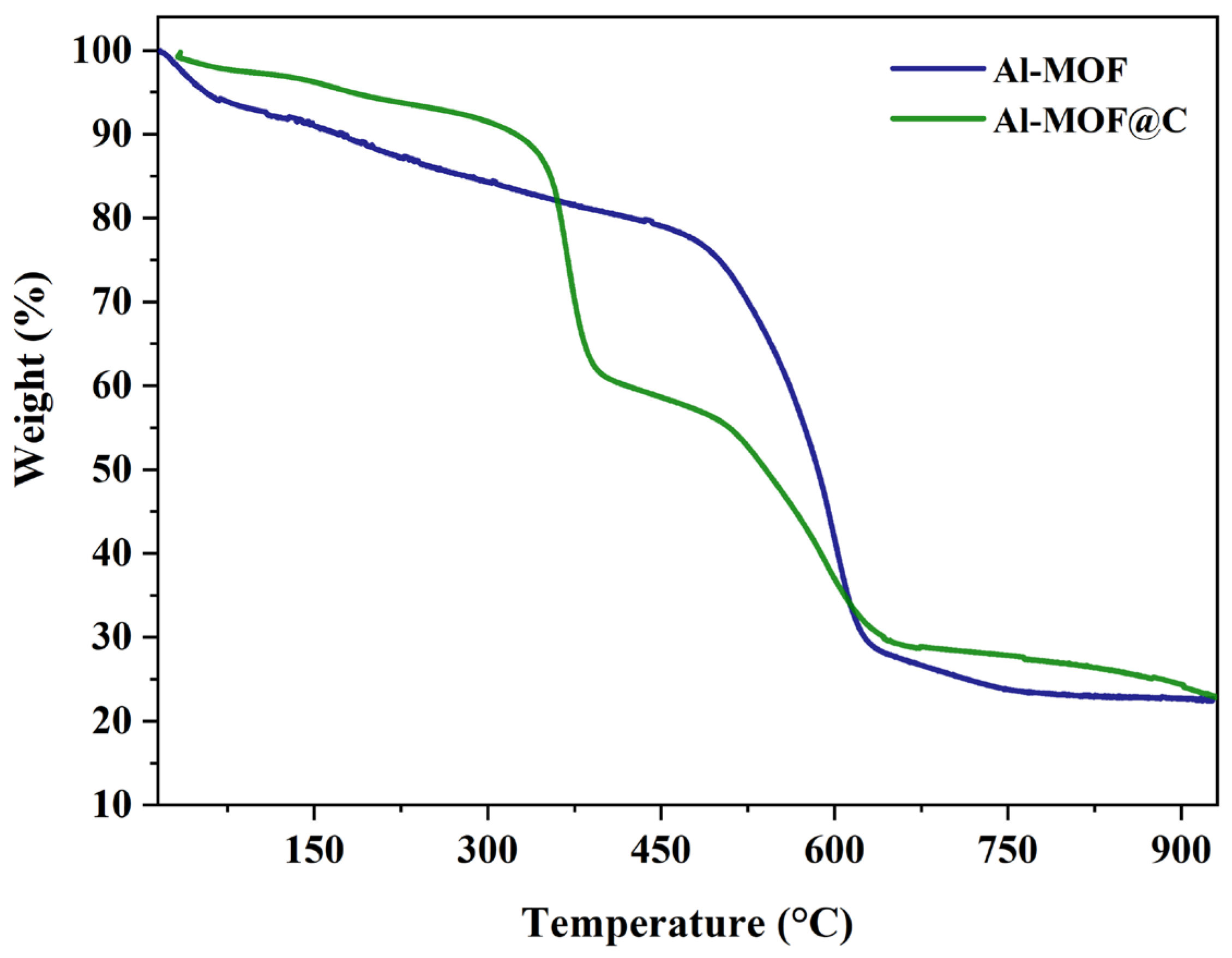
The thermograms of Al-MOF and Al-MOF@C are given in Figure 6. Both adsorbents exhibited a three-step thermal decomposition curve. The first weight loss, observed below approximately 150 °C, corresponds to the removal of physically adsorbed water molecules and volatile solvents. The second major weight loss occurred in the range of 300–500 °C, and this can be attributed to the decomposition of the organic linker (terephthalic acid) and degradation of cellulose [17]. Specifically, Al-MOF@C exhibits approximately 30% mass loss in the 300–375 °C range, which is entirely attributable to the cellulose group. The third stage, observed between 500 and 700 °C, corresponds to the complete decomposition of the organic components, resulting in aluminum oxide as the final residue (22.59% for Al-MOF and 23.06% for Al-MOF@C).

2.2. Adsorption Studies for Removal of Anionic Congo Red (CR) Dye

2.2.1. Study of Point of Zero Charge (PZC)

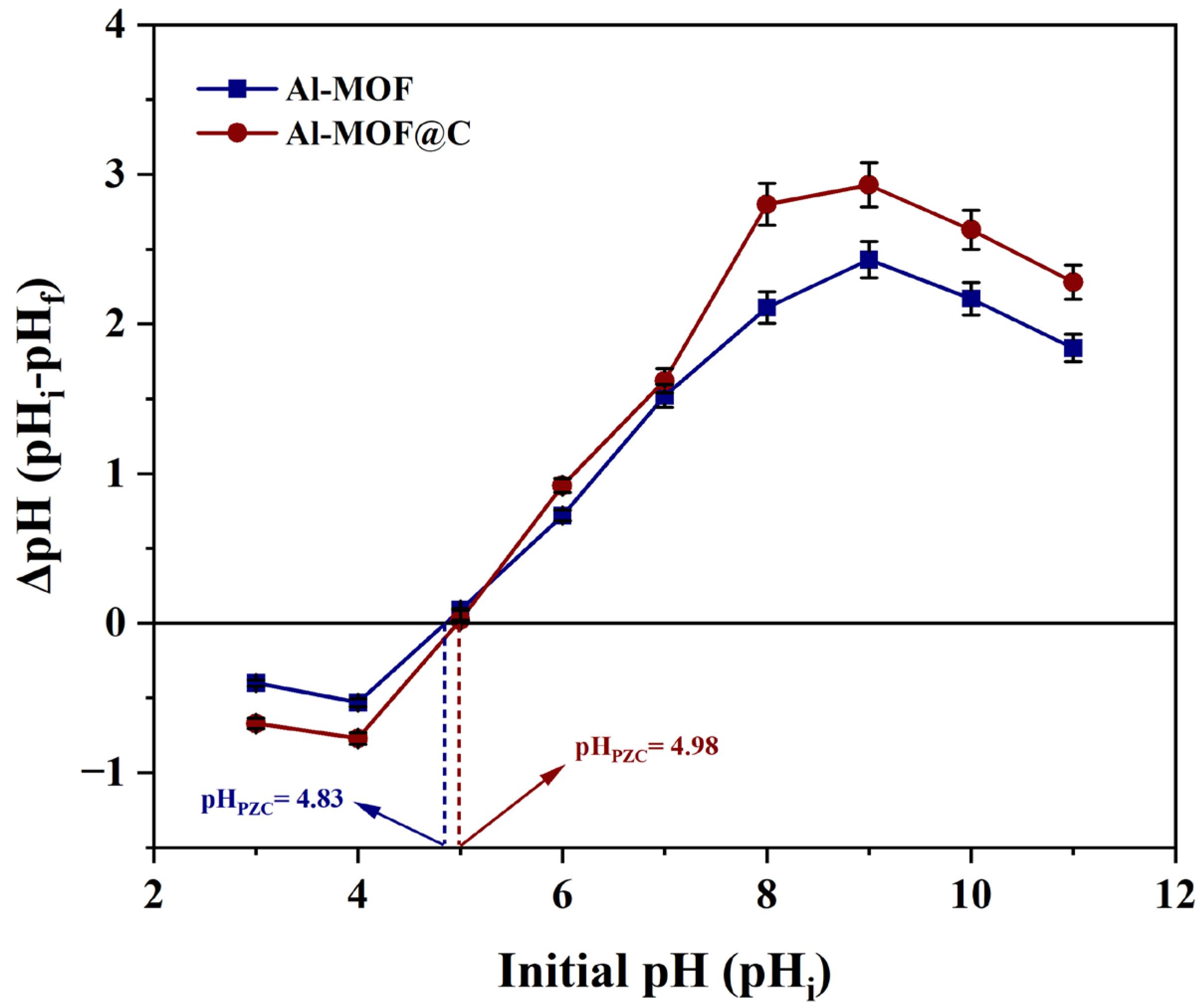
The point of zero charge (PZC) of the Al-MOF and Al-MOF@C adsorbents was determined using a slightly modified pH drift method. Nine 25 mL bottles for each sample were prepared, containing the adsorbent at a concentration of 1.0 g/L. The initial pH values were adjusted between 3.0 and 11.0 using 0.1 M NaOH or 0.1 M HCl solutions. After stirring the suspensions for 1 h with a magnetic stirrer, the initial pH (pHi) of each bottle was recorded. Subsequently, 0.01 M NaCl solution was added to maintain a constant ionic strength and the suspensions were agitated for two days to reach equilibrium. The final pH values (pHf) were then measured [34]. The difference ΔpH (pHi − pHf) was plotted as a function of pHi to determine the PZC of both Al-MOF and Al-MOF@C (Figure 7). The analysis revealed that the point of zero charge (PZC) was 4.83 and 4.98 for adsorbents, respectively. Consequently, these adsorbents exhibit positive surface charges below pH value of approximately 5. Considering the PZC values of these adsorbents and environmental conditions, subsequent stages were conducted under neutral conditions (without the addition of acids or bases).

2.2.2. Effect of Temperature on Adsorption Process

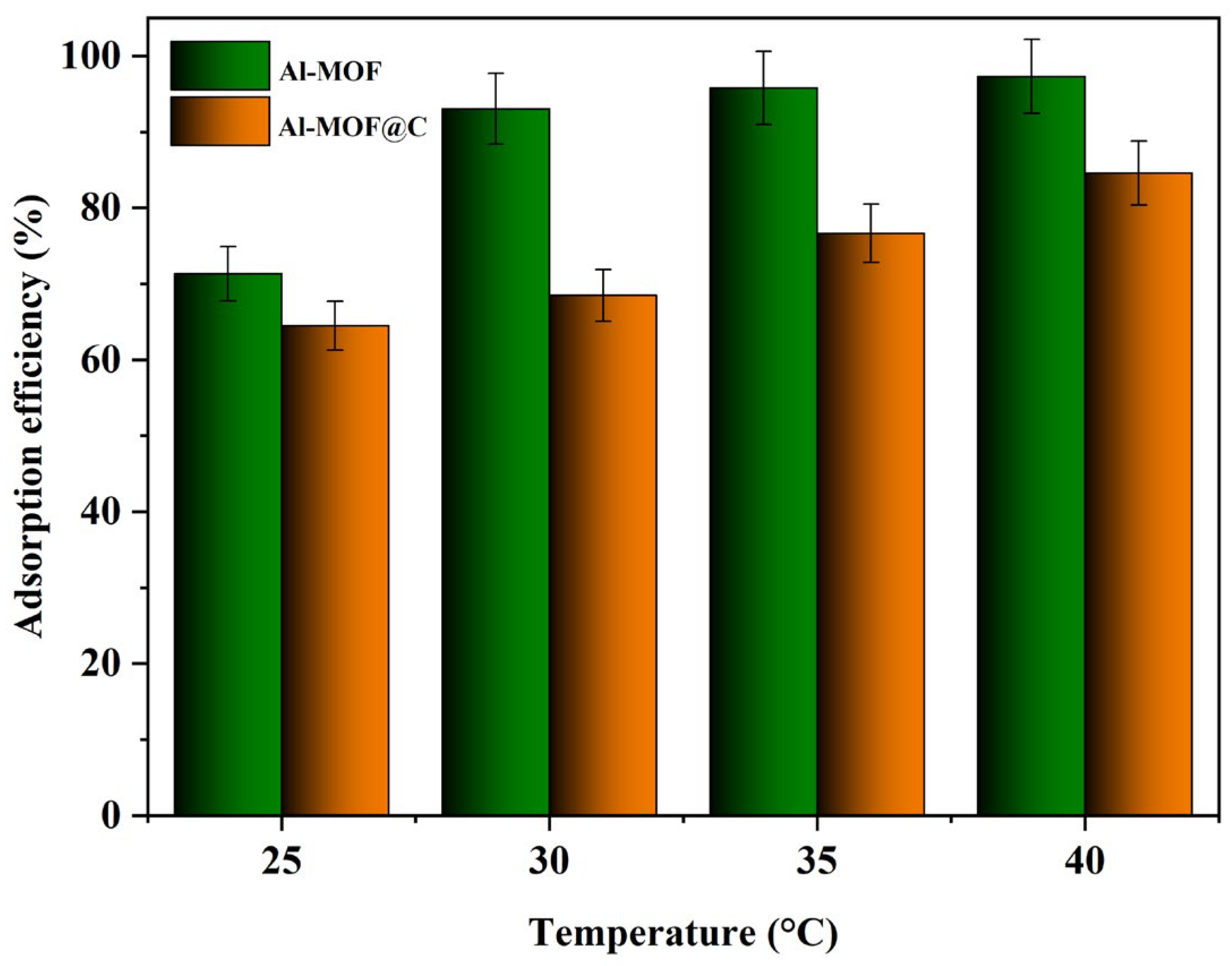
Temperature is a critical parameter in the adsorption process. The effect of this parameter on the adsorption of CR dye was investigated. For this investigation, a dye solution with a concentration of 20 ppm was prepared in distilled water as standard stock solutions. Then, 10 mg of Al-MOF and Al-MOF@C were separately immersed in 20 mL aqueous dye solutions within the temperature range of 25–40 °C for 60 s. The increase in temperature from 25 to 40 °C caused an enhancement of anionic CR adsorption from 71.34% to 97.29% for Al-MOF, and from 64.50% to 84.60% for Al-MOF@C (Figure 8). This rise in adsorption efficiency at high temperatures shows that the adsorption process is endothermic. The increase in performance may be due to an increase in the kinetic energy of CR dye molecules, which enhances their mobility and diffusion to the adsorbent surface. Consequently, the experimental findings revealed that the adsorption of anionic CR dye was strongly related to the temperature [39].

2.2.3. Effect of Adsorbent Dosage on Adsorption Process

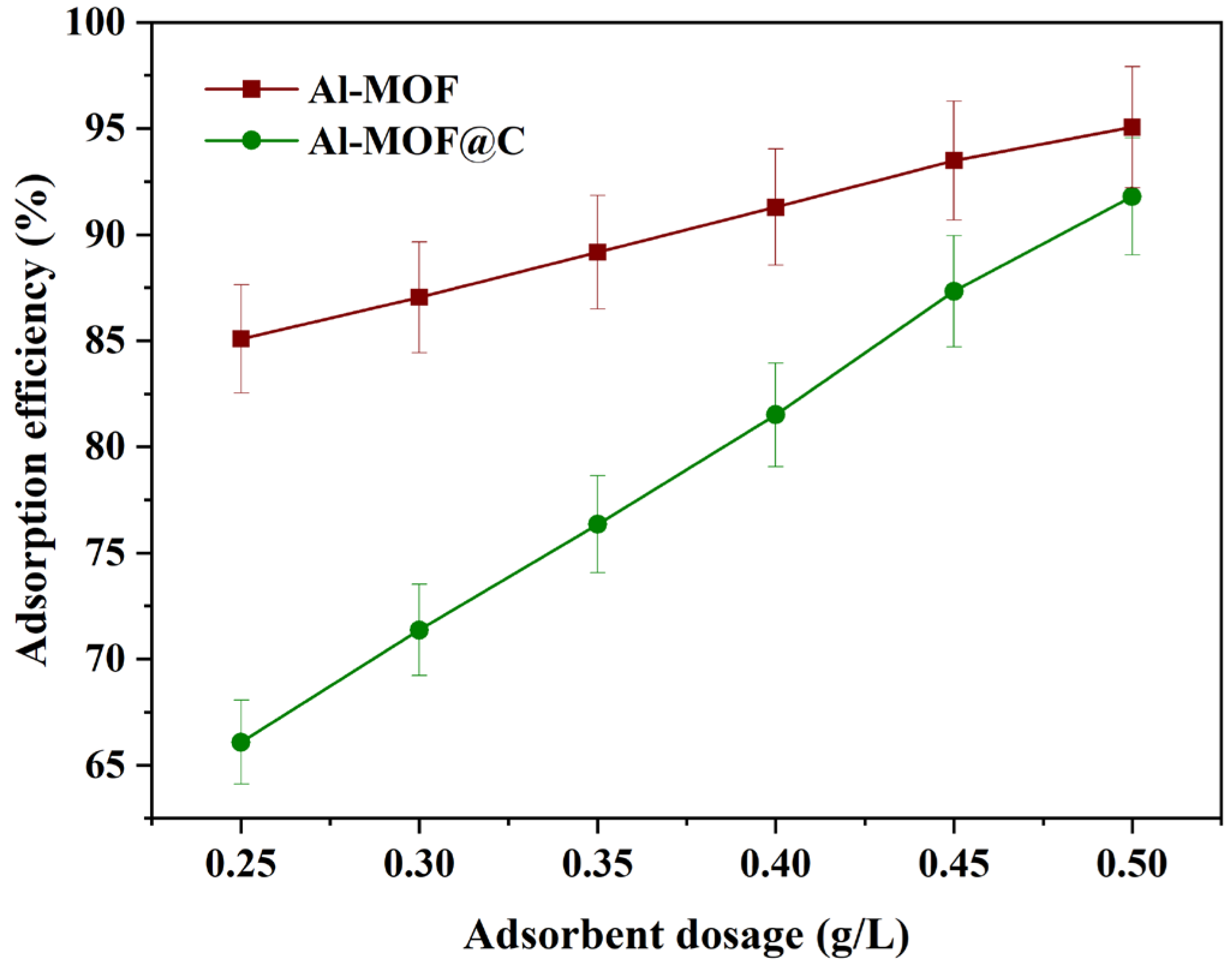
Effect of adsorbent mass on the removal efficiency of CR dye was also studied to determine the optimal dosage. For this, various amounts of adsorbent masses from 5 mg to 10 mg were systematically used, while all other parameters were kept constant: the initial dye concentration was 20 ppm (in a 20 mL solution), at neutral pH, room temperature and a contact time of 240 s. When the adsorbent dosage increased from 5 mg to 10 mg, the adsorption efficiency of Al-MOF enhanced from 85.08% to 95.06%. Similarly, for Al-MOF@C, the efficiency increased noticeably from 66.08% to 91.79% (Figure 9). Adsorption efficiency was directly proportional to the adsorbent mass.

2.2.4. Effect of Time on Adsorption Process

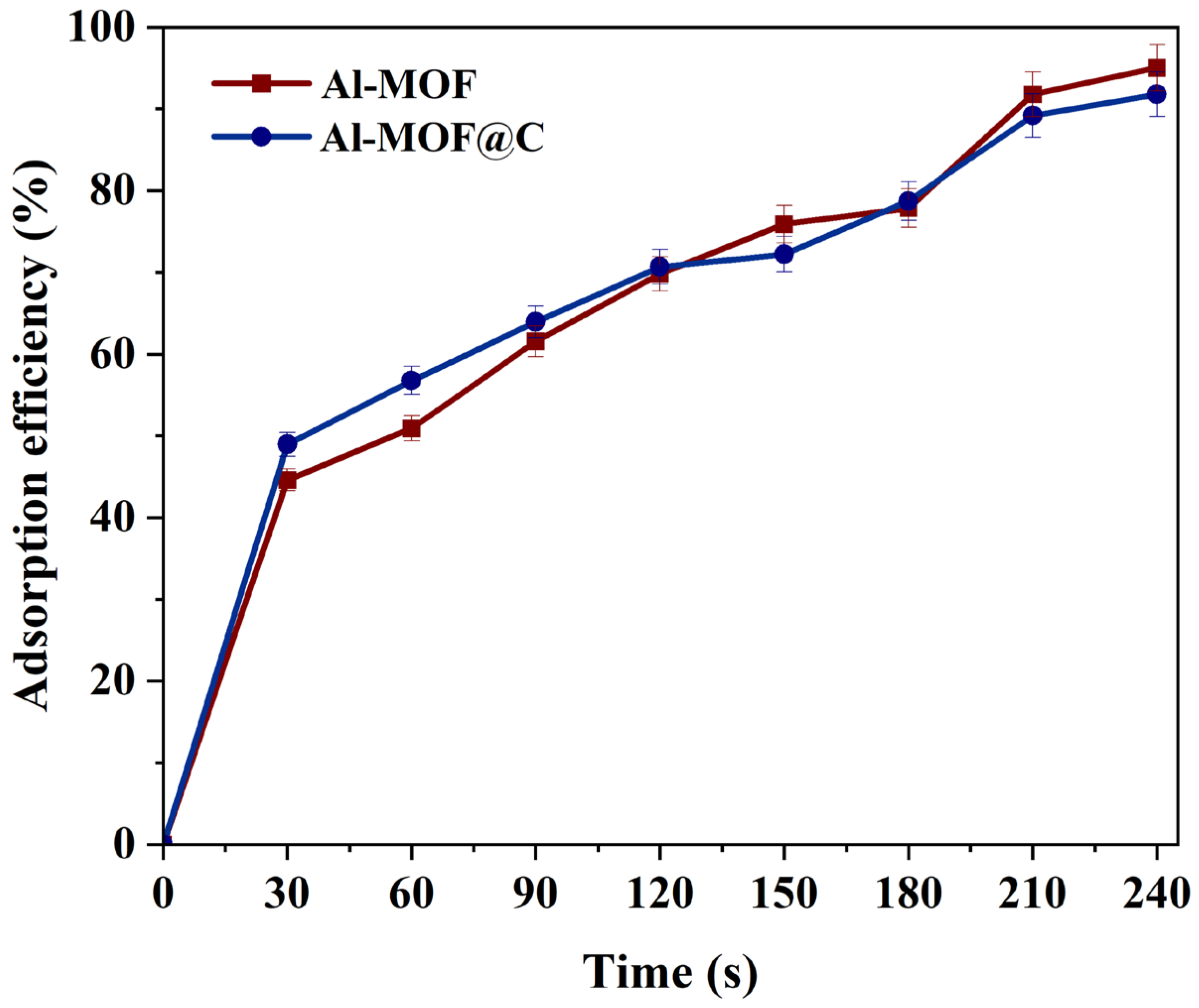
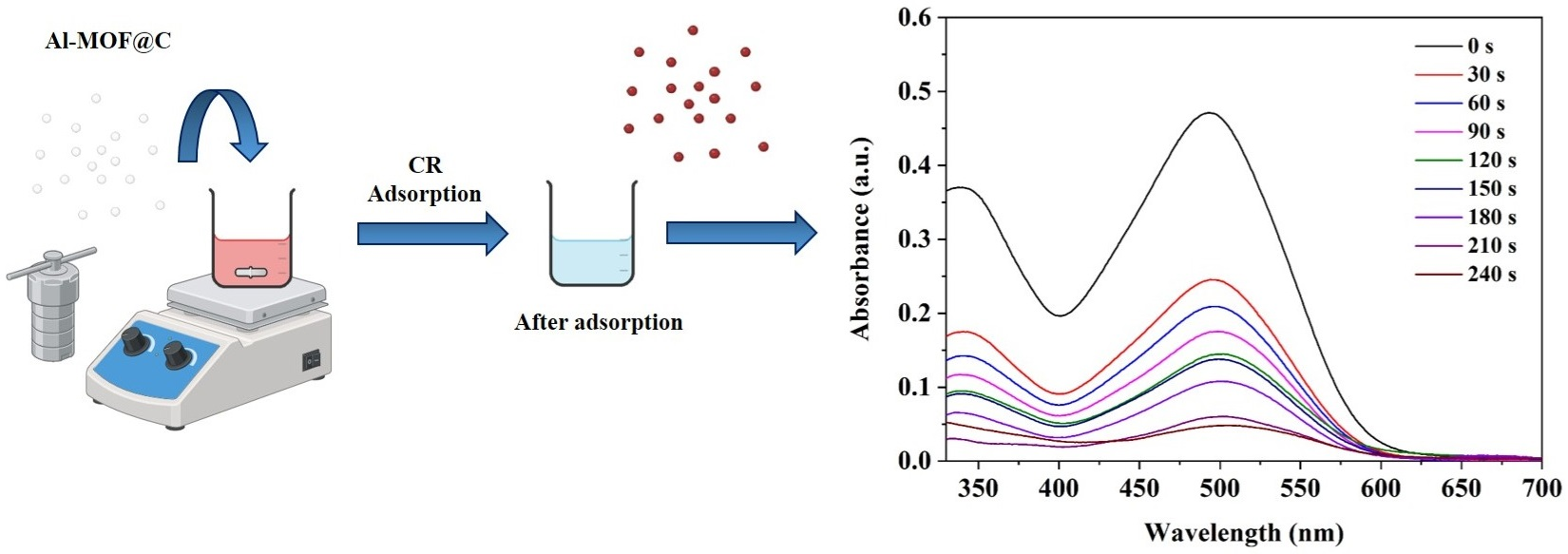
Effect of contact time on the adsorption efficiency of CR dye was investigated while maintaining constant temperature, pH, and adsorbent mass. The Al-MOF and Al-MOF@C adsorbents were shaken with the CR dye solution over various time intervals ranging from 0 to 240 s. The dye adsorption increased rapidly at the initial stage and then gradually approached equilibrium. This behavior can be attributed to the adsorbent’s sites becoming saturated with the dye over time [40]. The plot in Figure 10 obviously shows that equilibrium is reached after 240 s of shaking for CR. At equilibrium, 95.06% of CR was removed from the solution by Al-MOF and 91.79% by Al-MOF@C. The corresponding qe values were determined to be 39.90 mg/g for Al-MOF and 38.53 mg/g for Al-MOF@C, respectively (Figure S3). The findings indicate that Al-MOF and Al-MOF@C possess sample active sites and sufficient pore accessibility for the rapid binding of CR dye. As shown in Figure S3, the adsorption capacity increases rapidly up to 210 s and then increases slowly up to 240 s, reaching its equilibrium value.

2.3. Kinetic Studies on Adsorption Behavior of CR Dye

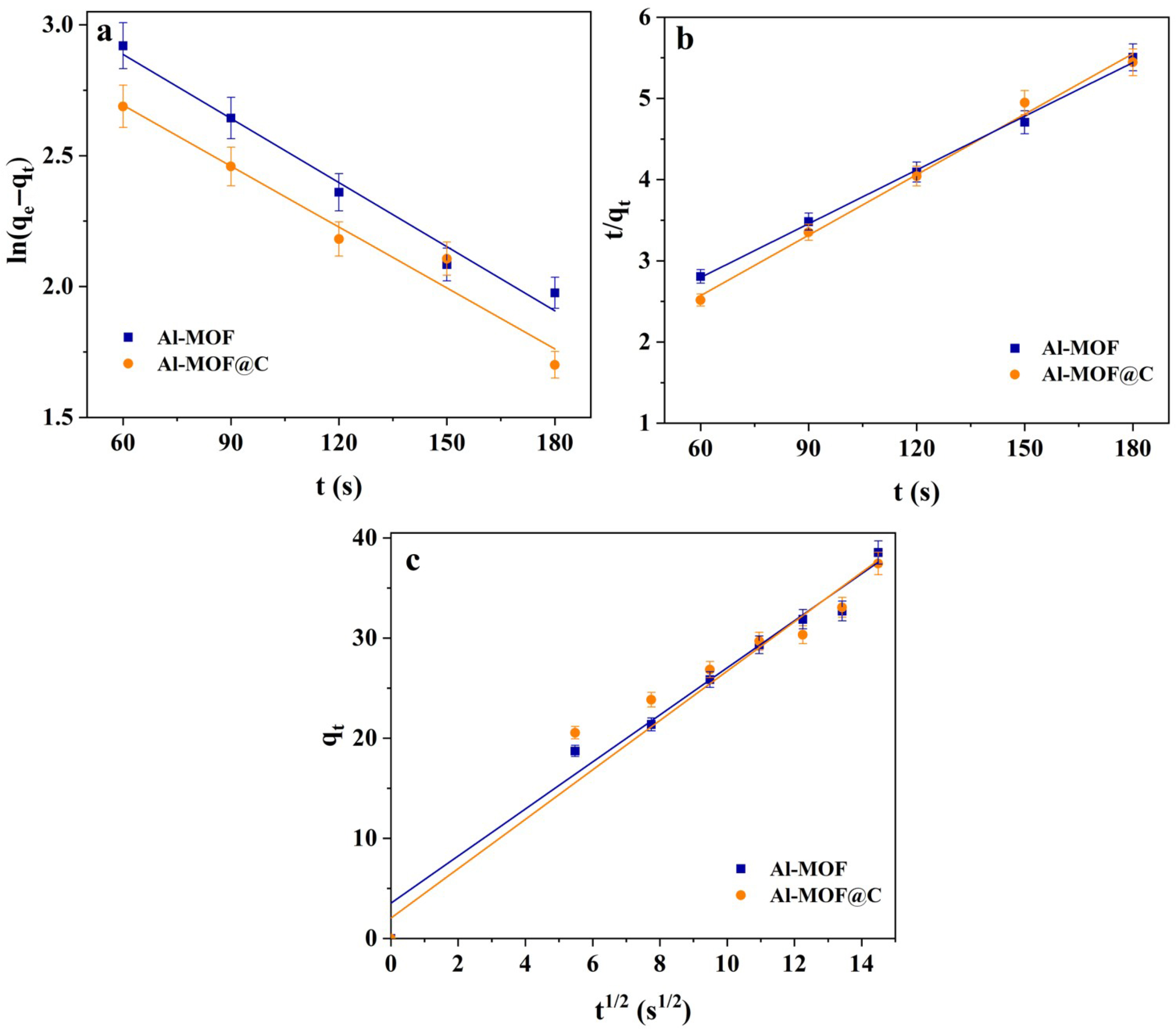
Kinetic experiments were performed to identify time needed for the process to reach equilibrium and mechanism for the adsorption of CR dye on Al-MOF and Al-MOF@C. Hence, kinetic models such as the pseudo-first-order (PFO), pseudo-second-order (PSO) models and intraparticle diffusion (IPD) were created and kinetic parameters were calculated [39,41]. Kinetic data are shown in Figure 11a–c.
The pseudo-first-order kinetic model is expressed as Equation (1):
ln q e   q t = l n q e k 1 × t
The pseudo-second-order kinetic model is expressed as Equation (2):
t q t = 1 k 2 q e 2 + 1 q e × t
The intraparticle diffusion kinetic model is represented by Equation (3):
q t = k i × t 1 / 2 + C
Herein, qe (mg/g) and qt (mg/g) represent the amounts of substance adsorbed at equilibrium and at any given time t (s), respectively. k1 is the rate constant of the PFO (s−1), k2 is the rate constant of the PSO model (g·mg−1·s−1), and ki is the rate constant of the IPD model (mg·g−1·s−1/2). C corresponds to the boundary layer thickness [41].
As shown in Table 2, the calculated first-order rate constants (k1 = 0.0082 and 0.0078 1/s) indicate the adsorption rate in the early stage and emphasize that CR dye molecules rapidly bind to the available active sites on Al-MOF and Al-MOF@C. In this study, the PFO kinetic analysis supports other kinetic models by showing that, despite the initial presence of physical adsorption, chemical adsorption likely became the primary mechanism in the binding of CR dye to Al-MOF and Al-MOF@C, as demonstrated in Figure 11b. The PSO kinetic model suggests that chemical adsorption, dominated by valence forces that favors electron sharing and exchange between the functional groups and surface of the adsorbents and adsorbate CR molecules, is the factor controlling the adsorption process. As seen in Table 2, the PSO kinetic model displayed perfect linearity with very high correlation coefficients (R2 = 0.9975 and 0.9936 for Al-MOF and Al-MOF@C, respectively). This indicates that the removal of CR dye by the Al-MOF and Al-MOF@C adsorbents is primarily attributed to a chemisorption mechanism. In the IPD model, the adsorption process begins with rapid adsorption on the outer surface of the adsorbents and then occurs through gradual diffusion into the internal mesopores of the adsorbents (Figure 11c). The calculated IPD rate constants for Al-MOF and Al-MOF@C adsorbents (k3 = 2.4651 and 2.3484 mg/g·s1/2) indicate that the diffusion of CR dye molecules into the porous structure is relatively fast. This model is important for materials with high porosity, such as MOFs, and contributes to adsorption kinetics [39].

2.4. Isotherm Studies on Adsorption Behavior of CR Dye

To obtain the adsorption isotherms, 10 mg of the adsorbent was added to CR dye solutions of different concentrations at 298.15 K. Adsorption equilibrium was established after 240 s, and the data were analyzed using the Langmuir and Freundlich isotherm models. The mathematical equations corresponding to the Langmuir and Freundlich isotherm models are presented below [37,42]:
The Langmuir model is provided by Equations (4) and (5):
q e = q m a x K L C e 1 +   K L C e
R L = 1 1 + K L C 0
where qe is the adsorption capacity (mg/g) at equilibrium, and qmax is the maximum adsorption capacity (mg/g) referring to complete monolayer occupying of the adsorbent surface by the adsorbate. C0 and Ce are the starting and equilibrium concentrations of CR dye (mg/L), respectively. KL (L/mg) is Langmuir constant related to the affinity of binding sites of the adsorbents and is the measure of adsorption energy. The separation factor (RL), ranging from 0 to 1, is used to evaluate the favorability of the adsorption process.
The Freundlich isotherm model is mathematically expressed by Equation (6):
q e = K f C e 1 n f
where Kf and nf are the Freundlich constants related to adsorption capacity and intensity, respectively. The nf value in the range of 1 to 10 suggests an appropriate adsorption process. A smaller 1/nf means a more heterogeneous surface.
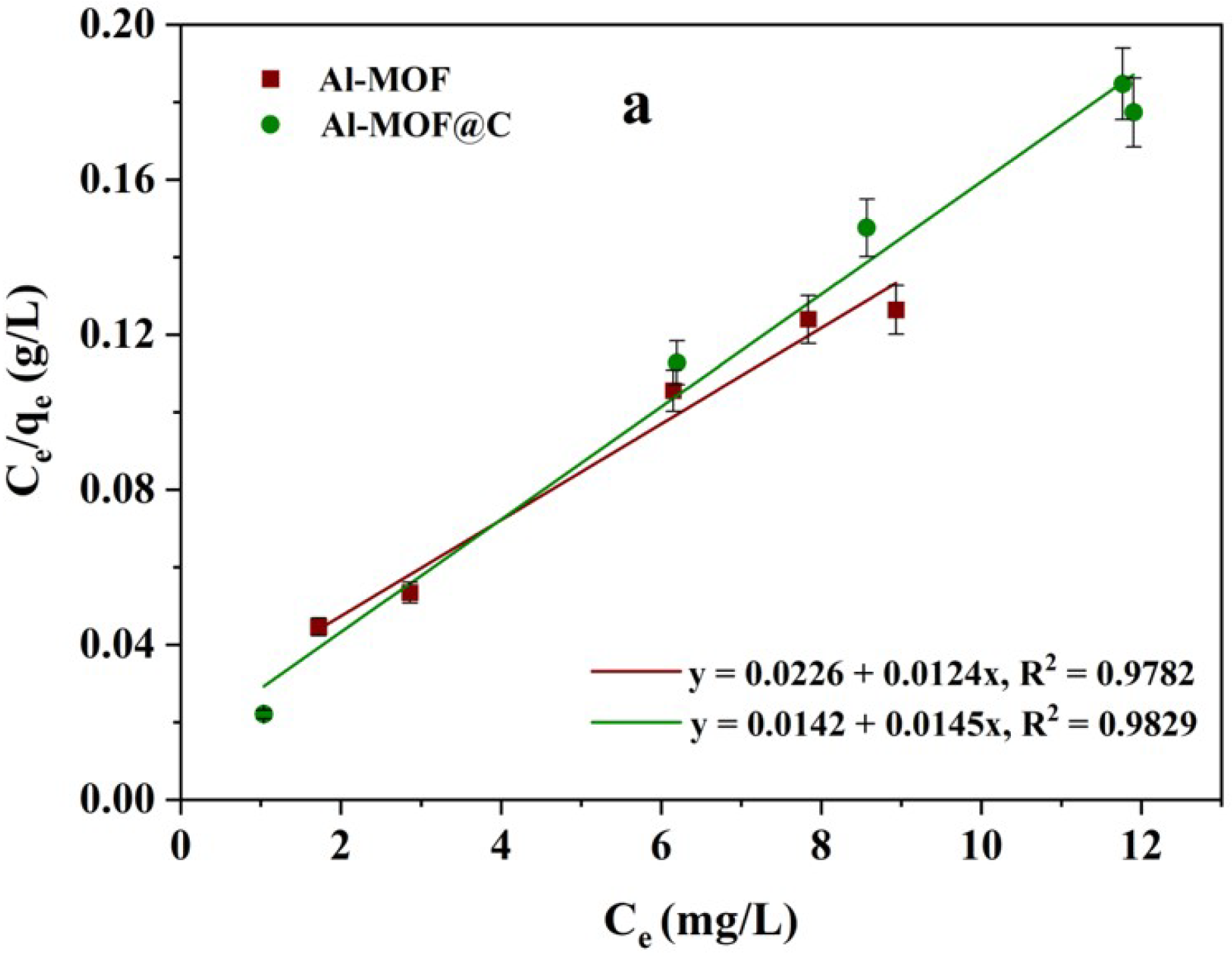
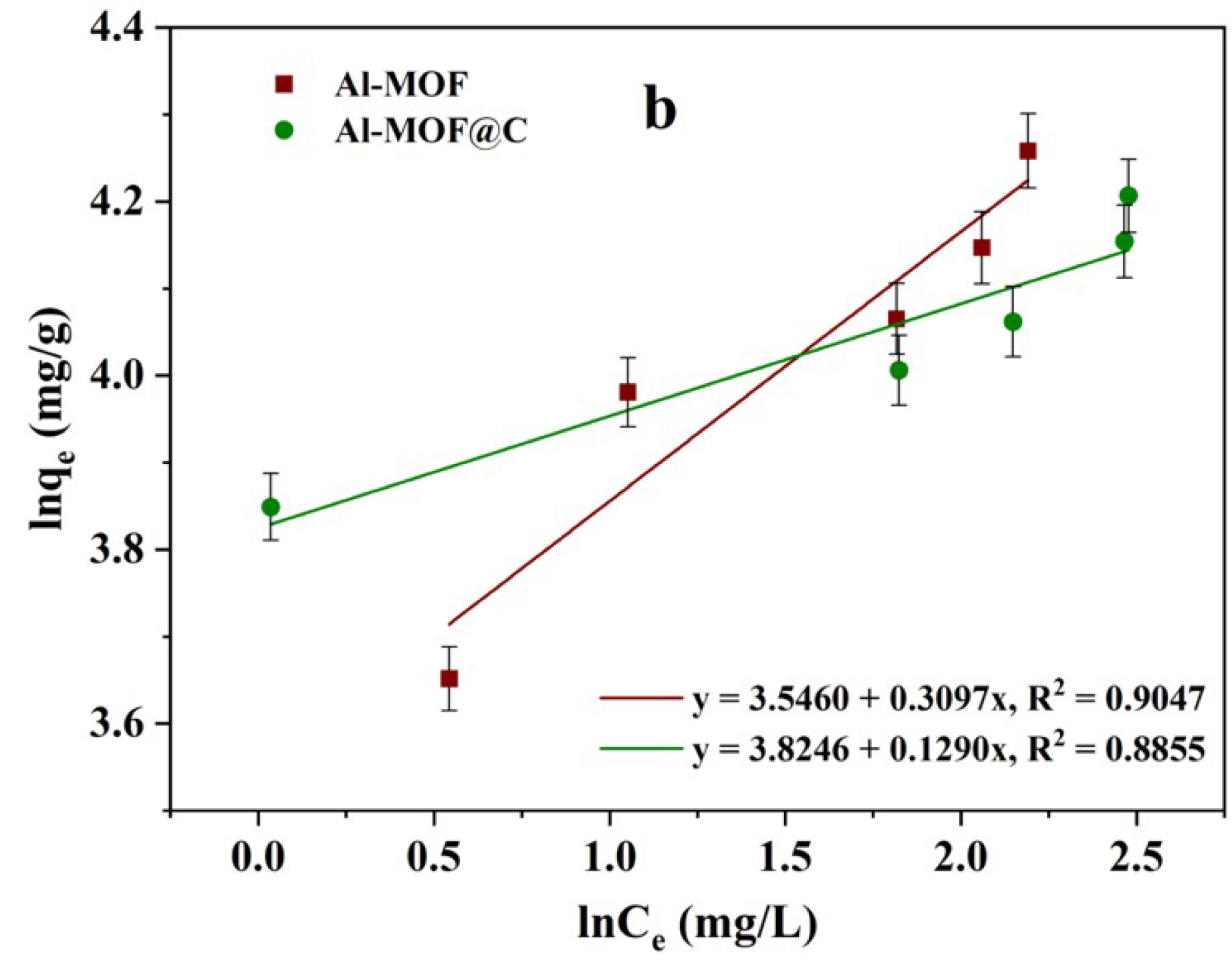
The Langmuir and Freundlich isotherms are shown in Figure 12a,b. A detailed analysis of Table 3 reveals that the Langmuir isotherm exhibits a higher correlation coefficient compared to the Freundlich isotherm. The Langmuir R2 values are 0.9782 and 0.9829 for Al-MOF and Al-MOF@C, respectively. The Langmuir model yielded maximum adsorption capacities of 80.64 mg/g and 68.96 mg/g for Al-MOF and Al-MOF@C, respectively. Langmuir model is favorable because it assumes that the adsorption surface is uniform, has active regions of equal energy, and allows for single-layer adsorption. The measurement results given in Table 3 also confirm this. Additionally, the Langmuir constants (KL = 0.548 and 1.021 L·mg−1) also indicate the strong binding between anionic CR dye molecules and the binding sites present on the MOFs surface. The RL values being below 1.0 (0.08 for Al-MOF and 0.038 for Al-MOF@C) show that the adsorption process is favorable. The Freundlich isotherm model is employed when applying the adsorption process on heterogeneous surfaces with different binding energies. The Freundlich constant (KF = 34.67 and 45.81 (mg/g)(L/mg)(1/nf) has revealed that the MOF compounds have a moderate affinity for CR dye.

2.5. Thermodynamic Study

Adsorption thermodynamics provides significant information about the mechanism, energetic nature, and application conditions of the adsorption process. To characterize these, fundamental thermodynamic parameters, including the adsorption enthalpy change (ΔH°), Gibbs free energy change (ΔG°), and entropy change (ΔS°), were systematically analyzed. The Van’t Hoff (Equation (7)) and Gibbs free energy (Equation (8)) equations were employed to evaluate the thermodynamic properties of the adsorption study [43,44].
l n K c = Δ S o R Δ H o R T
Δ G o = R T l n K c
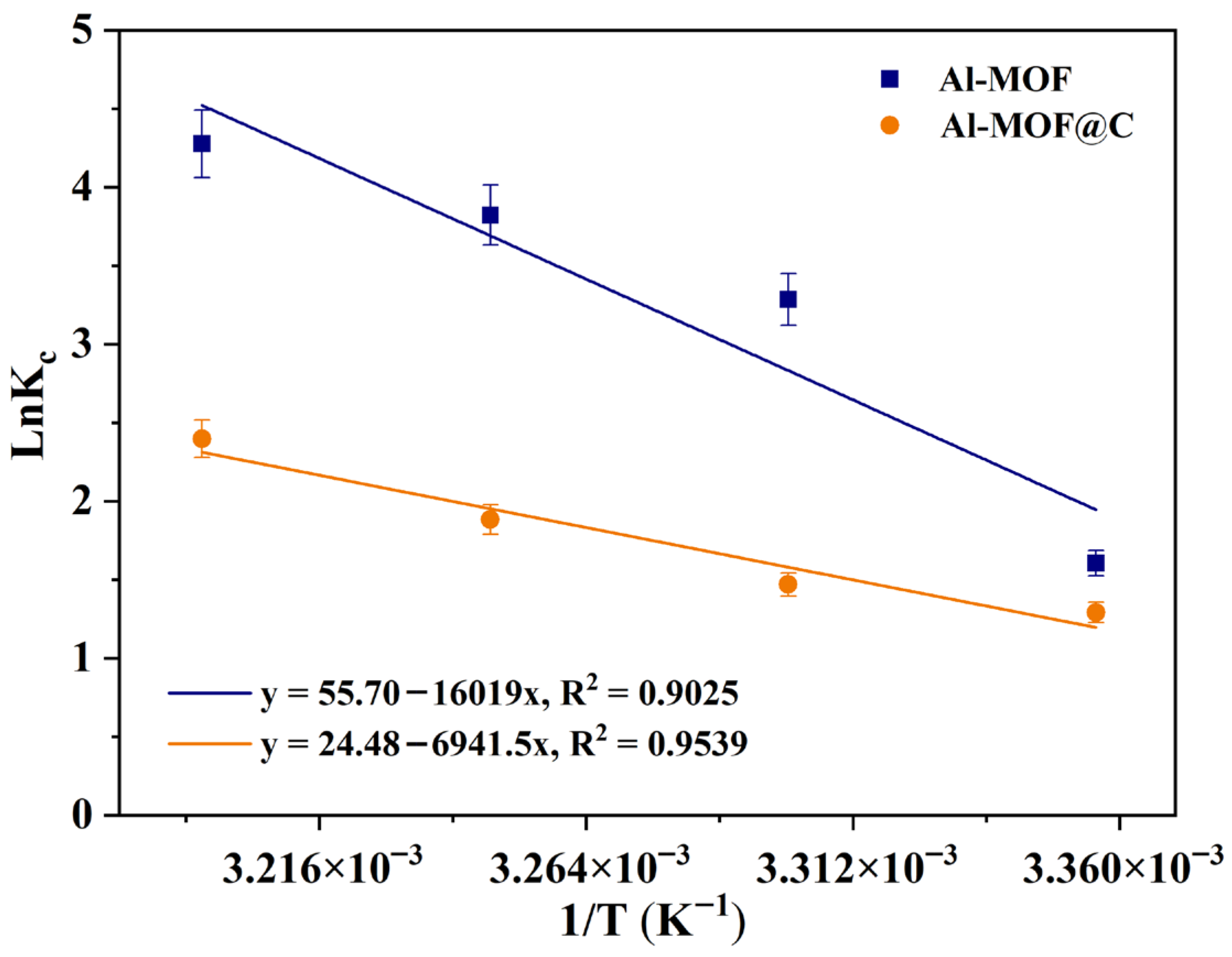
In these equations, R is the gas constant (8.314 J mol−1K−1), T is the temperature (K), and Kc is the thermodynamic equilibrium constant. The linear relationship between ln Kc and 1/T is shown in Figure 13. Accordingly, the values of ΔH° and ΔS° were found from the slope and intercept of the linear plot of ln Kc versus 1/T, respectively. The negative value of (ΔG° < 0) confirms that the adsorption of CR onto Al-MOF and Al-MOF@C occurs spontaneously. The positive enthalpy value (ΔH° > 0) indicates that the adsorption process is endothermic, and the adsorption capacity increases with increasing temperature (Table 4).

2.6. Possible Mechanism for Adsorption of CR onto Al-MOF and Al-MOF@C Adsorbents

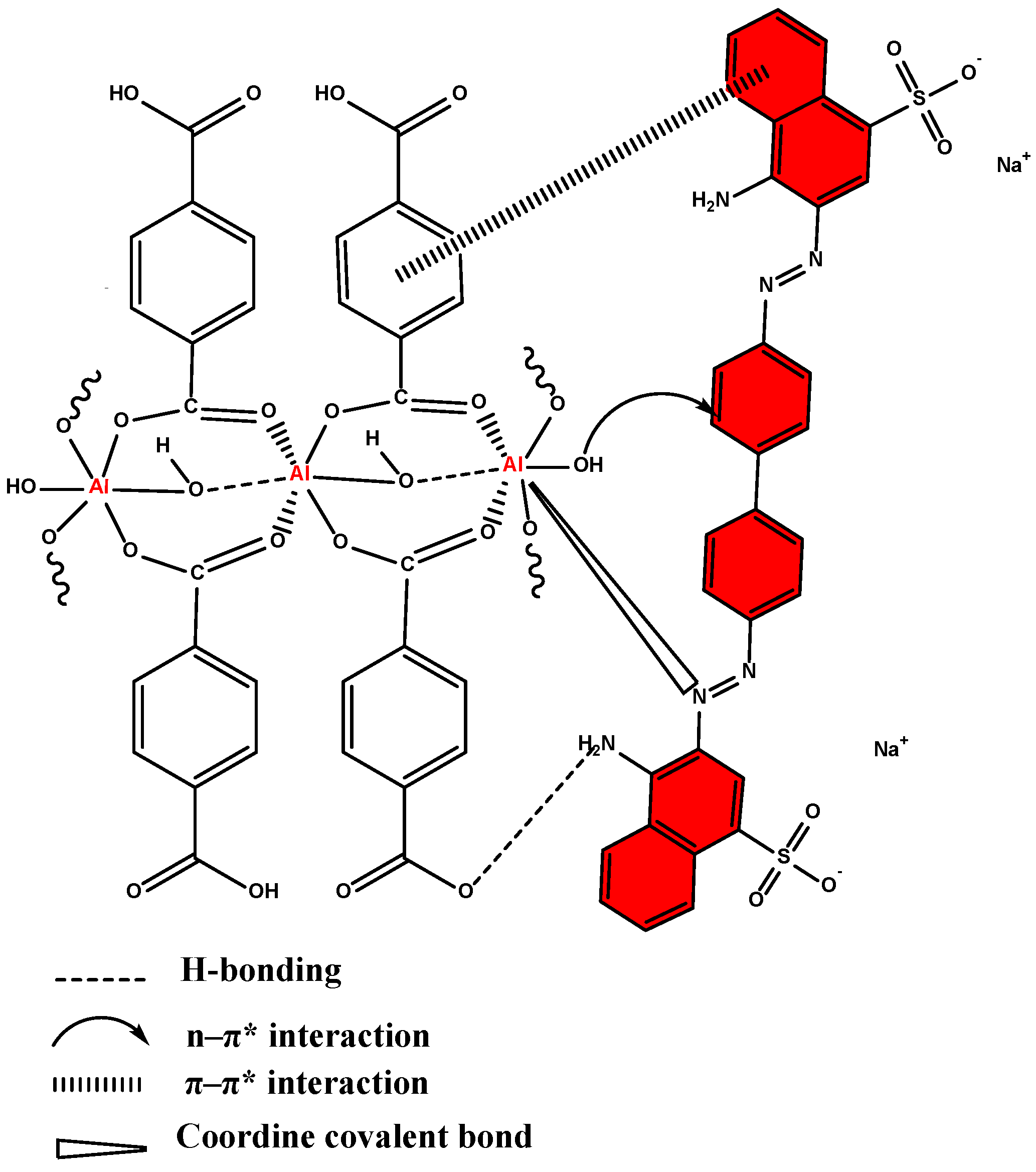
The adsorption of Congo red dye onto adsorbent surfaces can be attributed to electrostatic interaction, hydrogen bond formation, pore filling, n-π*, and π–π stacking. Both adsorbents, Al-MOF and Al-MOF@C, possess hydroxyl (OH) groups (Figure 14). The adsorbent containing the cellulose component is particularly rich in hydroxyl groups. Hydrogen bonds form between these hydroxyl groups and the nitrogen atoms (NH2 and N=N) and SO3 groups of CR molecules, thereby enhancing the adsorption performance of anionic CR dye on the surface. The aromatic rings of the terephthalate ligands in Al-MOF and Al-MOF@C facilitate π–π interactions with the aromatic rings of CR, thereby enhancing the adsorption capacity. n-π* electron transfer is one of the interactions that occurs when unpaired electron pairs on oxygen in Al-OH-Al units or other oxo including groups are transferred to the low-energy empty π*-orbital of the anionic CR dye molecule. Al-MOF’s ability to achieve high adsorption capacity within a short period of 240 s and the emergence of a high ΔH° value (133 kJ/mol, in Table 4) confirm also the presence of coordinate covalent bonds between Al3+ center of MOF and anionic CR dye in addition to interactions mentioned above.
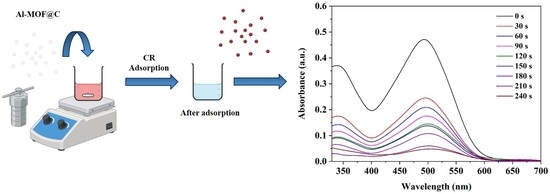
Furthermore, the high surface area and porosity of the synthesized Al-MOF and Al-MOF@C contribute synergistically to the maximum adsorption capacities (80.64 mg/g for Al-MOF and 68.96 mg/g for Al-MOF@C). The adsorption efficiencies of these adsorbents, as shown in the UV–Vis spectra (Figure S4), were determined to be approximately 95.06% and 91.79%, respectively, after a contact time of 240 s. Although the maximum adsorption capacities of Al-MOF and Al-MOF@C adsorbents were close to each other, Al-MOF@C showed a slightly lower adsorption capacity. After adding cellulose, a slight decrease in the surface area and pore size of the Al-MOF compound was observed in both SEM and BET measurements. Consequently, due to the decrease in surface area and pore size, the adsorption capacity of the Al-MOF@C adsorbent towards CR dye was lower. In addition to the decrease in surface area and pore size, the steric hindrance of the cellulose ligand is also thought to be effective. The binding of the cellulose ligand to Al-MOF forms a larger complex molecule and creates a steric hindrance to the CR dye approaching the Al center, which may cause a decrease in adsorption capacity.
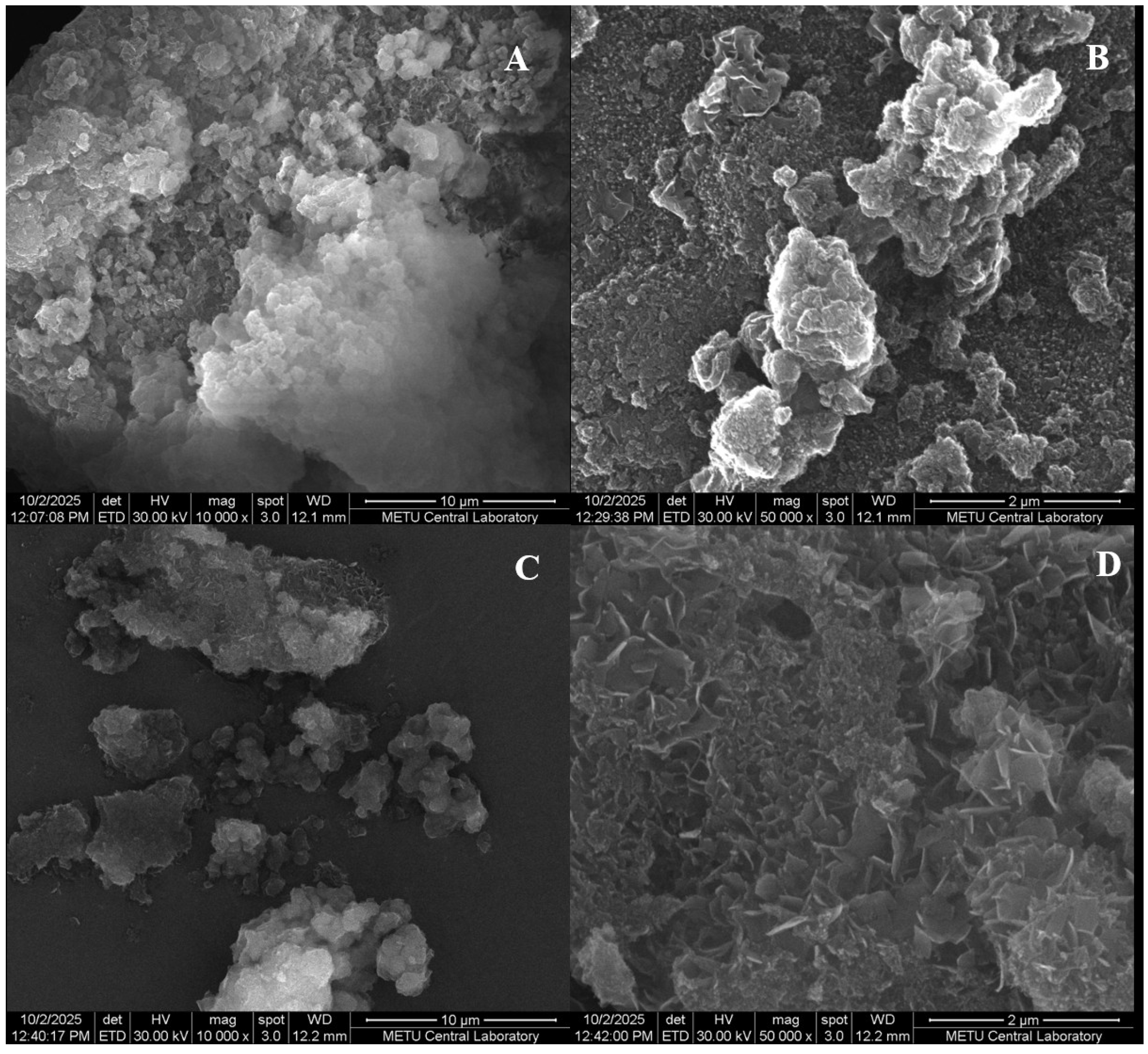
After CR adsorption (Figure 15), a remarkable change in surface morphology is observed. The surface becomes more compact, while the pores are significantly reduced. This change indicates that CR molecules are effectively adsorbed onto the active sites and within the pores of the Al-MOF and Al-MOF@C.
Differences were observed in the peak intensity and peak shifts in the FTIR spectra obtained after adsorption of Congo red dye. These changes are highlighted in Figure 2 and Figure S2.
Adsorption performance of Al-MOF and Al-MOF@C for CR dye is comparable to other adsorbent materials found in the literature, which is presented in Table 5.

2.7. Reusability of Al-MOF and Al-MOF@C

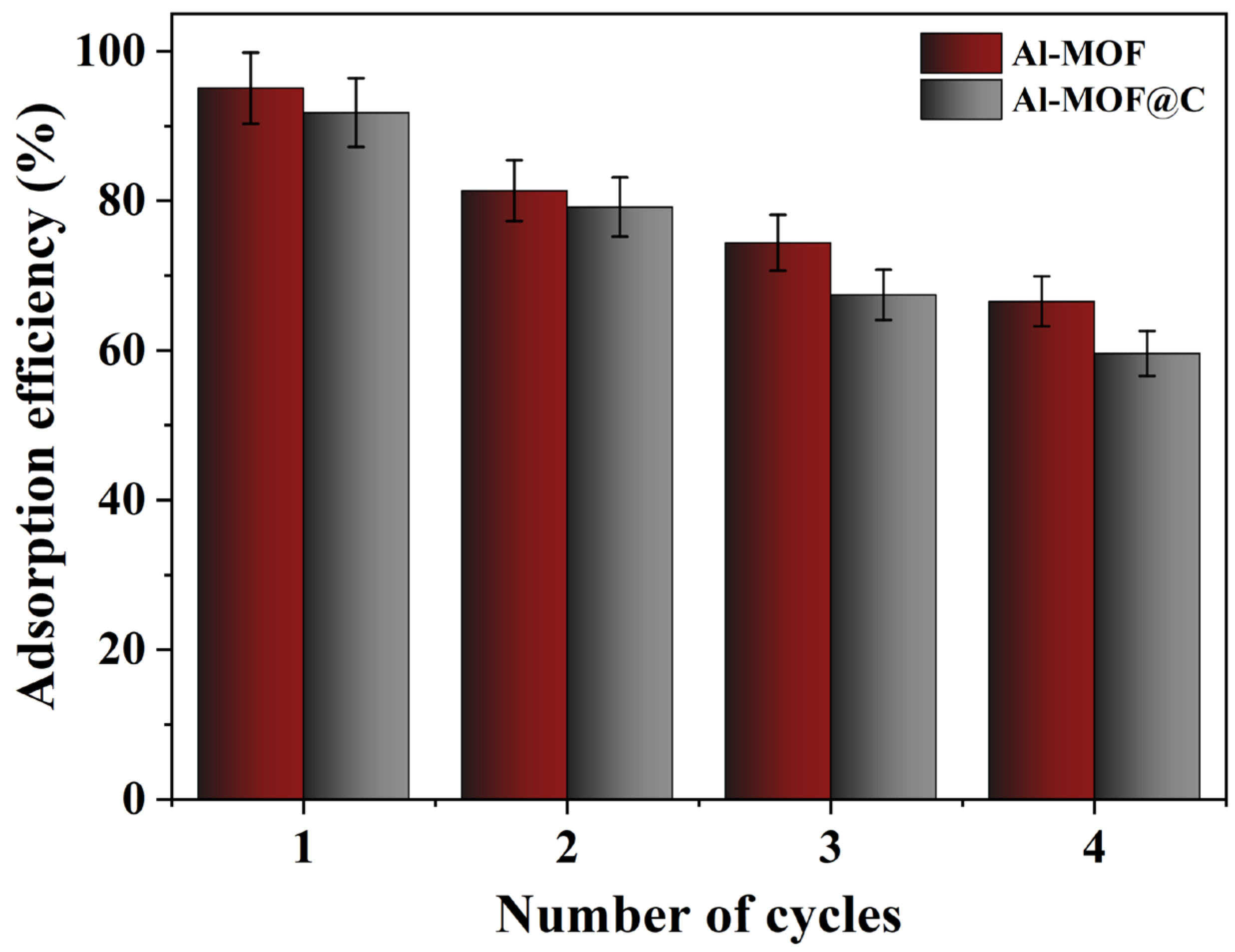
To evaluate the reusability and stability of adsorbents, four adsorption–desorption cycles were performed. For this test, 20 mg of adsorbents were reused in 40 mL of a 20 mg/L CR solution by shaking for 240 s. After each run, the adsorbents were filtered from the solution, washed thoroughly with EtOH and pure water, and then dried in an oven at 120 °C before reusing. The adsorptive efficiency decreased from 91.79% to 59.60% for Al-MOF@C and from 95.06% to 66.56% for Al-MOF over the four cycles. The results of the reusability test are shown in Figure 16.
After each cycle, the adsorbent amount and desorbed CR dye were measured to verify the accuracy of the adsorption efficiency given in Figure 16. On the other hand, the FTIR spectroscopic characterization of the adsorbents obtained after the washing process following the cycles also confirmed that a certain amount of CR dye remained on the adsorbent surface. This confirms that there are strong chemical and physical interactions between the adsorbents and the adsorbate, which causes a certain amount of efficiency loss during reuse. In addition to the above explanation, as expected, a certain amount of material loss during the washing and centrifugation stages also caused a slight decrease in adsorption capacity.
To summarize again, after CR was removed in the fourth cycle, SEM and FTIR measurements of the Al-MOFs confirmed that the structural integrity of the material did not change during the adsorption process and once again demonstrated the stability of Al-MOFs in aqueous environments. After the fourth cycle, an approximate 20–30% loss in adsorption capacity can primarily be attributed to the partial blockage of adsorption sites on Al-MOFs. This loss in adsorption capacity is due to the regeneration of adsorbents rather than stability and is mentioned in many literature studies [57].

3. Materials and Methods

3.1. Materials

Aluminum sec-butoxide (97%, Thermo Scientific, Waltham, MA, USA), terephthalic acid (TPA, 98%, Merck, Hohenbrunn, Germany), methyl alcohol (MeOH, 99.7%, Sigma-Aldrich Chemie GmbH, Taufkirchen, Germany), ethyl alcohol (EtOH, 99.8%, Sigma-Aldrich), N,N-dimethylformamide (DMF, anhydrous, 99.8%, Sigma-Aldrich), hydrochloric acid (HCl, 37%, Sigma-Aldrich), Congo red dye (CR, C32H22N6Na2O6S2, Mw:696.68 g/mol, C.I. 22120, indicator Reag, Ph Eur) and cellulose (C, 100%, microcrystalline cellulose powder, [C6H10O5]n, Merck) were utilized as received.

3.2. Instruments

The IR spectra of Al-MOF and Al-MOF@C were recorded in the range of 4000 to 400 cm−1 using a Bruker Tensor 27 FT–IR spectrometer (Ettlingen, Germany). Powder X-ray diffraction (XRD) patterns were obtained using a Rigaku MiniFlex 300/600 instrument (Tokyo, Japan). The 2θ range was scanned from 3° to 80° with a step size of 0.02°. The surface properties and chemical composition of each synthesized MOF were characterized by using SEM (Quanta 400, FEI, Hillsboro, OR, USA) and EDS before and after CR dye adsorption. SEM images were recorded at different magnifications (100×–50,000×), and EDS spectra were collected from multiple areas of the materials. The thermal stability of the MOFs was evaluated using TGA (Perkin Elmer Pyris 1, PerkinElmer, Waltham, MA, USA) at a heating rate of 10 °C min−1 from 25 °C to 950 °C under N2 atmosphere. The N2 adsorption–desorption analysis was performed using the AUTOSORB-1C/MS instrument (Boynton Beach, FL, USA). Before analysis, the MOF samples were degassed under low vacuum at 393 K for 2 h to remove moisture. The adsorption isotherms were measured within a relative pressure (P/P0) range of approximately 0.01–0.99 under liquid N2 at 77.40 K. The specific surface area was determined by the Brunauer–Emmett–Teller (BET) method. The pore size and pore volume distributions were derived using the BJH, DH, and other applicable models, which are summarized in Table 1. Adsorption experiments were conducted using a UV–Vis spectrophotometer (Agilent Cary 60, Santa Clara, CA, USA).

3.3. Synthesis of Al-MOF and Al-MOF@C

Al-MOF: Aluminum sec-butoxide (Al(OBu)3) (5.92 g, 0.023 mol) was dissolved in 5 mL MeOH and 5 mL DMF in a Teflon vessel (50 mL). Terephthalic acid (3.95 g, 0.023 mol) was added to the vessel, followed by 4 mL DMF. The reaction mixture was stirred using a magnetic stirrer for 3 h. Subsequently, 0.3 M HCl (0.63 g, 0.035 mol) was added dropwise to the reaction medium. After adding it, the stirring continued for an additional 10 min. This solution was placed in a Teflon-lined stainless-steel autoclave, sealed, and then heated at 120 °C for 48 h. After solvothermal treatment, the reaction mixture was cooled to room temperature, and the resulting solid was collected by filtration. The product was washed sequentially with MeOH, DMF, and distilled water, and then dried in a vacuum oven.
Al-MOF@C: Aluminum sec-butoxide (Al(OBu)3) (7.3 g, 0.028 mol) and terephthalic acid (4.86 g, 0.028 mol) were placed into a 250 mL flask, followed by the addition of 10 mL DMF and 65 mL MeOH. Subsequently, cellulose (4.66 g, 0.28 mol) was added. The reaction mixture was refluxed for 3 h. After 3 h of refluxing, the reaction solvents DMF and MeOH and the sec-butanol released as a result of the reaction were removed using a vacuum evaporator. The remaining solid was transferred into a Teflon vessel (50 mL), to which 10 mL DMF, 5 mL MeOH, and 0.3 M HCl (1.55 g, 0.043 mol) were added. Teflon-lined stainless-steel autoclave was sealed and heated at 120 °C for 48 h. After cooling to room temperature, the resulting product was collected by filtration. The obtained solid was washed several times with distilled water and dried in a vacuum oven.

3.4. Adsorption Studies of Congo Red (CR) Dye

The adsorption properties of the Al-MOF and Al-MOF@C against the widely used dye, anionic CR, were investigated in batch experiments. For the specific adsorption measurements (room temperature and normal pH conditions), 10 mg adsorbent was added to 20 mL of aqueous solution containing 20 mg/L of the dye. Subsequently, the mixtures were separated by centrifugation, and the residual concentration of the dye was monitored using UV–Vis spectrophotometry. Meanwhile, the effects of temperature, contact time and adsorbent amount on the adsorption were also investigated. Adsorption isotherm experiments were carried out at 25 °C by adding 10 mg of adsorbent to different CR concentrations (20, 30, 40, 50, and 60 mg/L) and shaking for 240 s until equilibrium was reached. The equilibrium adsorption capacity (qe, mg/g), and percentage of removal efficiency (R%) of the adsorbents were calculated using Equations (9) and (10), respectively.
q e = C o C e V / m
R % = ( ( C o C e ) / C o ) × 100
C0 is the initial CR dye concentration (mg/L) and Ce is the equilibrium concentration (mg/L). V is the volume of solution (Liter, L), m is the mass of adsorbent used (gram, g).

4. Conclusions

In this study, aluminum-terephthalate-based organic–inorganic MOF materials (Al-MOF and Al-MOF@C), both with and without cellulose, were successfully synthesized through an environmentally friendly, cost-effective, and facile approach. The adsorbents obtained were thoroughly characterized by various analytical methods to confirm their structural and morphological features. The adsorption behavior of these materials, with surface areas measured at 563.9 m2/g for Al-MOF and 487.1 m2/g for Al-MOF@C, was systematically investigated toward Congo red dye, revealing remarkable adsorption performance. SEM micrographs further supported the adsorption phenomenon by illustrating the attachment of anionic CR dye molecules onto the adsorbent surfaces. Experimental findings demonstrated that both Al-MOF and Al-MOF@C followed the Langmuir isotherm model and exhibited adsorption kinetics consistent with the pseudo-second-order model. The maximum adsorption capacities were measured to be 80.64 and 68.96 mg/g for Al-MOF and Al-MOF@C, respectively. We can draw the following conclusion from this study. By incorporating Al-MOF into the cellulose molecule, we increased the chemical and mechanical stability and low adsorption capacity of the pure cellulose molecule by at least 5 times. Overall, these results suggest that the synthesized materials are promising, sustainable, and highly efficient adsorbents for the removal of toxic organic CR dye from aqueous environments.

Supplementary Materials

The following supporting information can be downloaded at: https://www.mdpi.com/article/10.3390/inorganics14010006/s1, Figure S1: FTIR spectra of cellulose and terephthalic acid; Figure S2: FTIR spectra of Al-MOF before and after CR adsorption; Figure S3: Effect of time on the adsorption capacity of Al-MOF and Al-MOF@C; Figure S4: UV-Vis absorbance spectra of anionic CR dye solution onto (a) Al-MOF and (b) Al-MOF@C.

Author Contributions

C.D.: Writing—original draft, Visualization, Validation, Methodology, Formal analysis, Data curation. A.K.: Writing–review and editing, Writing—original draft, Validation, Supervision, Resources, Methodology, Investigation, Funding acquisition, Formal analysis, Conceptualization, Project administration, Visualization. All authors have read and agreed to the published version of the manuscript.

Funding

This research was funded by Kocaeli University, grant number FBA-2024-3952.

Institutional Review Board Statement

Not applicable.

Informed Consent Statement

Not applicable.

Data Availability Statement

The original contributions presented in this study are included in the article/Supplementary Materials. Further inquiries can be directed to the corresponding author.

Acknowledgments

We would like to thank both Kocaeli University for financial support (No. FBA-2024-3952) and Middle East Technical University for the XRD, SEM, and BET measurements of the samples.

Conflicts of Interest

The authors declare no conflicts of interest.

References

  1. Shi, Y.; Chang, Q.; Zhang, T.; Song, G.; Sun, Y.; Ding, G. A review on selective dye adsorption by different meanisms. J. Environ. Chem. Eng. 2022, 10, 108639. [Google Scholar] [CrossRef]
  2. Lellis, B.; Fávaro-Polonio, C.Z.; Pamphile, J.A.; Polonio, J.C. Effects of textile dyes on health and the environment and bioremediation potential of living organisms. Biotechnol. Res. Innov. 2019, 3, 275–290. [Google Scholar] [CrossRef]
  3. Zeng, L.X.; Chen, Y.F.; Zhang, Q.Y.; Kang, Y.; Luo, J.W. Adsorption of congo red by cross-linked chitosan resins. Desalin. Water Treat. 2014, 52, 7733–7742. [Google Scholar] [CrossRef]
  4. Chatterjee, S.; Lee, M.W.; Wooa, S.H. Adsorption of congo red by chitosan hydrogel beads impregnated with carbon nanotubes. Bioresour. Technol. 2010, 101, 1800–1806. [Google Scholar] [CrossRef]
  5. Gupta, V.K.; Suhas. Application of low-cost adsorbents for dye removal—A review. J. Environ. Manag. 2009, 90, 2313–2342. [Google Scholar] [CrossRef] [PubMed]
  6. Kayan, G.Ö.; Kayan, A. Polyhedral Oligomeric Silsesquioxane and Polyorganosilicon Hybrid Materials and Their Usage in the Removal of Methylene Blue Dye. J. Inorg. Organomet. Polym. Mater. 2022, 32, 2781–2792. [Google Scholar] [CrossRef]
  7. Ooi, J.; Lee, L.Y.; Hiew, B.Y.Z.; Thangalazhy-Gopakumar, S.; Lim, S.S.; Gan, S. Assessment of fish scales waste as a low cost and eco-friendly adsorbent for removal of an azo dye: Equilibrium, kinetic and thermodynamic studies. Bioresour. Technol. 2017, 245, 656–664. [Google Scholar] [CrossRef]
  8. Rose, P.K.; Kumar, R.; Kumar, R.; Kumar, M.; Sharma, P. Congo red dye adsorption onto cationic amino-modified walnut shell: Characterization, RSM optimization, isotherms, kinetics, and mechanism studies. Groundw. Sustain. Dev. 2023, 21, 100931. [Google Scholar] [CrossRef]
  9. Momina; Mohammad, S.; Suzylawati, I. Study of the adsorption/desorption of MB dye solution using bentonite adsorbent coating. J. Water Process Eng. 2020, 34, 101155. [Google Scholar] [CrossRef]
  10. Aragaw, T.A.; Alene, A.N. A comparative study of acidic, basic, and reactive dyes adsorption from aqueous solution onto kaolin adsorbent: Effect of operating parameters, isotherms, kinetics, and thermodynamics. Emerg. Contam. 2022, 8, 59–74. [Google Scholar] [CrossRef]
  11. Malek, N.N.A.; Jawad, A.H.; Ismail, K.; Razuan, R.; ALOthman, Z.A. Fly ash modified magnetic chitosan-polyvinyl alcohol blend for reactive orange 16 dye removal: Adsorption parametric optimization. Int. J. Biol. Macromol. 2021, 189, 464–476. [Google Scholar] [CrossRef]
  12. Fazal, T.; Razzaq, A.; Javed, F.; Hafeez, A.; Rashid, N.; Amjad, U.S.; Ur Rehman, M.S.; Faisal, A.; Rehman, F. Integrating adsorption and photocatalysis: A cost effective strategy for textile wastewater treatment using hybrid biochar-TiO2 composite. J. Hazard. Mater. 2020, 390, 121623. [Google Scholar] [CrossRef]
  13. Liu, X.; Tian, J.; Li, Y.; Sun, N.; Mi, S.; Xie, Y.; Chen, Z. Enhanced dyes adsorption from wastewater via Fe3O4 nanoparticles functionalized activated carbon. J. Hazard. Mater. 2019, 373, 397–407. [Google Scholar] [CrossRef]
  14. Noreen, S.; Khalid, U.; Ibrahim, S.M.; Javed, T.; Ghani, A.; Naz, S.; Iqbal, M. ZnO, MgO and FeO adsorption efficiencies for direct sky Blue dye: Equilibrium, kinetics and thermodynamics studies. J. Mater. Res. Technol. 2020, 9, 5881–5893. [Google Scholar] [CrossRef]
  15. Haque, E.; Jun, J.W.; Jhung, S.H. Adsorptive removal of methyl orange and methylene blue from aqueous solution with a metal-organic framework material, iron terephthalate (MOF-235). J. Hazard. Mater. 2011, 185, 507–511. [Google Scholar] [CrossRef]
  16. Pendar, A.; Özcan, E.; Yatmaz, H.C.; Zorlu, Y. Multifunctional Anionic Cyclotriphosphazene-Based Metal–Organic Framework Featuring a One-Dimensional Zn(II) Inorganic Building Unit for Selective Chemical Sensing and Efficient Photocatalytic Activity. Cryst. Growth Des. 2025, 25, 6169–6182. [Google Scholar] [CrossRef]
  17. Baig, M.T.; Kayan, A. Advanced biopolymer-based Ti/Si-terephthalate hybrid materials for sustainable and efficient adsorption of the tetracycline antibiotic. Int. J. Biol. Macromol. 2024, 280, 135676. [Google Scholar] [CrossRef]
  18. Gong, W.; Xie, Y.; Pham, T.D.; Shetty, S.; Son, F.A.; Idrees, K.B.; Chen, Z.; Xie, H.; Liu, Y.; Snurr, R.Q.; et al. Creating Optimal Pockets in a Clathrochelate-Based Metal-Organic Framework for Gas Adsorption and Separation: Experimental and Computational Studies. J. Am. Chem. Soc. 2022, 144, 3737–3745. [Google Scholar] [CrossRef]
  19. Davarcı, D.; Erucar, I.; Yücesan, G.; Zorlu, Y. Cationic Metal-Organic Frameworks Synthesized from Cyclotetraphosphazene Linkers with Flexible Tentacles. Cryst. Growth Des. 2022, 22, 7123–7132. [Google Scholar] [CrossRef]
  20. Zhang, W.; Yang, J.M.; Yang, R.N.; Yang, B.C.; Quan, S.; Jiang, X. Effect of free carboxylic acid groups in UiO-66 analogues on the adsorption of dyes from water: Plausible mechanisms for adsorption and gate-opening behavior. J. Mol. Liq. 2019, 283, 160–166. [Google Scholar] [CrossRef]
  21. Farha, O.K.; Eryazici, I.; Jeong, N.C.; Hauser, B.G.; Wilmer, C.E.; Sarjeant, A.A.; Snurr, R.Q.; Nguyen, S.T.; Yazaydin, A.Ö.; Hupp, J.T. Metal-organic framework materials with ultrahigh surface areas: Is the sky the limit. J. Am. Chem. Soc. 2012, 134, 15016–15021. [Google Scholar] [CrossRef]
  22. Kang, Y.; Zhang, B.; Miao, J.; Yu, Y.; Fu, J.; Jia, B.; Li, L. Superparamagnetic Fe3O4@Al-based metal-organic framework nanocomposites with high-performance removal of Congo red. J. Environ. Chem. Eng. 2023, 11, 109754. [Google Scholar] [CrossRef]
  23. Samokhvalov, A. Aluminum metal–organic frameworks for sorption in solution: A review. Coord. Chem. Rev. 2018, 374, 236–253. [Google Scholar] [CrossRef]
  24. Chang, R.; Ma, J.; Wang, J.; Liu, Y.; Guo, X.; Qu, H. Efficient adsorption of dyes using polyethyleneimine-modified NH2-MIL-101(Al) and its sustainable application as a flame retardant for an epoxy resin. ACS Omega 2020, 5, 32286–32294. [Google Scholar] [CrossRef]
  25. Tannert, N.; Ernst, S.J.; Jansen, C.; Bart, H.J.; Henninger, S.K.; Janiak, C. Evaluation of the highly stable metal-organic framework MIL-53(Al)-TDC (TDC = 2,5-thiophenedicarboxylate) as a new and promising adsorbent for heat transformation applications. J. Mater. Chem. A 2018, 6, 17706–17712. [Google Scholar] [CrossRef]
  26. Almahri, A.; El-Metwaly, N.M. Enhancing methyl violet 2B pollutant removal from wastewater using Al-MOF encapsulated with poly (itaconic acid) grafted crosslinked chitosan composite sponge: Synthesis, characterization, DFT calculation, adsorption optimization via Box-Behnken Design. Int. J. Biol. Macromol. 2024, 276, 133909. [Google Scholar] [CrossRef]
  27. Dhakshinamoorthy, A.; Heidenreich, N.; Lenzen, D.; Stock, N. Knoevenagel condensation reaction catalysed by Al-MOFs with CAU-1 and CAU-10-type structures. CrystEngComm 2017, 19, 4187–4193. [Google Scholar] [CrossRef]
  28. Wang, R.; Xu, H.; Zhang, K.; Wei, S.; Deyong, W. High-quality Al@Fe-MOF prepared using Fe-MOF as a micro-reactor to improve adsorption performance for selenite. J. Hazard. Mater. 2019, 364, 272–280. [Google Scholar] [CrossRef]
  29. Imanipoor, J.; Mohammadi, M.; Dinari, M.; Ehsani, M.R. Adsorption and Desorption of Amoxicillin Antibiotic from Water Matrices Using an Effective and Recyclable MIL-53(Al) Metal-Organic Framework Adsorbent. J. Chem. Eng. Data 2021, 66, 389–403. [Google Scholar] [CrossRef]
  30. Guan, Y.; Xia, M.; Wang, X.; Cao, W.; Marchetti, A. Water-based preparation of nano-sized NH2-MIL-53(Al) frameworks for enhanced dye removal. Inorg. Chim. Acta 2019, 484, 180–184. [Google Scholar] [CrossRef]
  31. Haque, E.; Lo, V.; Minett, A.I.; Harris, A.T.; Church, T.L. Dichotomous adsorption behaviour of dyes on an amino-functionalised metal-organic framework, amino-MIL-101(Al). J. Mater. Chem. A 2014, 2, 193–203. [Google Scholar] [CrossRef]
  32. Zhao, S.; Li, Y.; Wang, M.; Chen, B.; Zhang, Y.; Sun, Y.; Chen, K.; Du, Q.; Wang, Y.; Pi, X.; et al. Efficient adsorption of Congo red by micro/nano MIL-88A (Fe, Al, Fe-Al)/chitosan composite sponge: Preparation, characterization, and adsorption mechanism. Int. J. Biol. Macromol. 2023, 239, 124157. [Google Scholar] [CrossRef]
  33. Hegde, V.; Uthappa, U.T.; Arvind Swami, O.R.; Han, S.S.; Jung, H.Y.; Altalhi, T.; Kurkuri, M.D. Sustainable green functional nano aluminium fumarate-MOF decorated on 3D low-cost natural diatoms for the removal of Congo red dye and fabric whitening agent from wastewater: Batch & continuous adsorption process. Mater. Today Commun. 2022, 32, 103887. [Google Scholar] [CrossRef]
  34. Demirci, G.V.; Baig, M.T.; Kayan, A. UiO-66 MOF/Zr-di-terephthalate/cellulose hybrid composite synthesized via sol-gel approach for the efficient removal of methylene blue dye. Int. J. Biol. Macromol. 2024, 283, 137950. [Google Scholar] [CrossRef]
  35. Langseth, E.; Swang, O.; Arstad, B.; Lind, A.; Cavka, J.H.; Jensen, T.L.; Kristensen, T.E.; Moxnes, J.; Unneberg, E.; Heyn, R.H. Synthesis and characterization of Al@MOF materials. Mater. Chem. Phys. 2019, 226, 220–225. [Google Scholar] [CrossRef]
  36. Liu, F.; Cao, J.; Yang, Z.; Xiong, W.; Xu, Z.; Song, P.; Jia, M.; Sun, S.; Zhang, Y.; Zhong, X. Heterogeneous activation of peroxymonosulfate by cobalt-doped MIL-53(Al) for efficient tetracycline degradation in water: Coexistence of radical and non-radical reactions. J. Colloid Interface Sci. 2021, 581, 195–204. [Google Scholar] [CrossRef]
  37. Li, C.; Xiong, Z.; Zhang, J.; Wu, C. The Strengthening Role of the Amino Group in Metal–Organic Framework MIL-53 (Al) for Methylene Blue and Malachite Green Dye Adsorption. J. Chem. Eng. Data 2015, 60, 3414–3422. [Google Scholar] [CrossRef]
  38. Mel’gunov, M.S. Application of the simple Bayesian classifier for the N2 (77 K) adsorption/desorption hysteresis loop recognition. Adsorption 2023, 29, 199–208. [Google Scholar] [CrossRef]
  39. Jin, Y.; Liu, F.; Li, Y.; Du, Q.; Song, F.; Chen, B.; Chen, K.; Zhang, Y.; Wang, M.; Sun, Y.; et al. Efficient adsorption of azo anionic dye Congo Red by micro-nano metal-organic framework MIL-68 (Fe) and MIL-68 (Fe)/chitosan composite sponge: Preparation, characterization and adsorption performance. Int. J. Biol. Macromol. 2023, 252, 126198. [Google Scholar] [CrossRef]
  40. Duyar, C.; Pendar, A.; Zorlu, Y.; Davarcı, D. Selective Adsorption of Anionic Dyes Using New Three-Dimension Ag (I) Coordination Polymer. J. Inorg. Organomet. Polym. Mater. 2025, 35, 8031–8047. [Google Scholar] [CrossRef]
  41. Yin, L.; Li, Y.; Zhang, J.; Wang, X.; Chen, B.; Du, Q.; Pi, X.; Zhang, Y.; Li, Y.; Zhou, H.; et al. Efficient removal of Congo red in water by in-situ immobilization of amino-functionalized UiO-67-NH2 on cellulose aerogel. Int. J. Biol. Macromol. 2025, 328, 147630. [Google Scholar] [CrossRef]
  42. Eltaweil, A.S.; Mamdouh, I.M.; Abd El-Monaem, E.M.; El-Subruiti, G.M. Highly Efficient Removal for Methylene Blue and Cu2+ onto UiO-66 Metal–Organic Framework/Carboxylated Graphene Oxide-Incorporated Sodium Alginate Beads. ACS Omega 2021, 6, 23528–23541. [Google Scholar] [CrossRef] [PubMed]
  43. Radwan, A.; Aziz, A.A.A.; Abdel-aziz, A.M.; Sidqi, M.E.; Sayed, M.A. Harnessing synergistic effect of Al and Zn in novel bimetallic MOF for superior environmental pollutants adsorption. Inorg. Chem. Commun. 2025, 179, 114870. [Google Scholar] [CrossRef]
  44. Alhalafi, M.H. Sustainable biopolymer-supported Ce-MOF/polyethyleneimine-guar gum composite sponge for efficient removal of ketoprofen from water: Design, mechanism, and optimization. Int. J. Biol. Macromol. 2025, 331, 148356. [Google Scholar] [CrossRef]
  45. Wang, C.; Le, Y.; Cheng, B. Fabrication of porous ZrO2 hollow sphere and its adsorption performance to Congo red in water. Ceram. Int. 2014, 40, 10847–10856. [Google Scholar] [CrossRef]
  46. Minh, L.; Thi, N.; Nguyen, T.; Thi, T.; Nguyen, T. Facile synthesis of CoFe2O4@ MIL–53(Al) nanocomposite for fast dye removal: Adsorption models, optimization and recyclability. Environ. Res. 2022, 215, 114269. [Google Scholar] [CrossRef]
  47. Rahimi, R.; Kerdari, H.; Rabbani, M.; Sha, M. Synthesis, characterization and adsorbing properties of hollow Zn-Fe2O4 nanospheres on removal of Congo red from aqueous solution. Desalination 2011, 280, 412–418. [Google Scholar] [CrossRef]
  48. Khalaf, I.H.; Al-Sudani, F.T.; AbdulRazak, A.A.; Aldahri, T.; Rohani, S. Optimization of Congo red dye adsorption from wastewater by a modified commercial zeolite catalyst using response surface modeling approach. Water Sci. Technol. 2021, 83, 1369–1383. [Google Scholar] [CrossRef]
  49. Ahmad, R.; Zaidi, S.; Aslam, A.; Khan, P.; Arish, M.; Khan, A.Y.; Tariq, M.; Chani, S.; Asiri, A.M. Removal of congo red from water by adsorption onto activated carbon derived from waste black cardamom peels and machine learning modeling. Alexandria Eng. J. 2023, 71, 355–369. [Google Scholar] [CrossRef]
  50. Alarifi, I.M.; Al-ghamdi, Y.O.; Darwesh, R.; Omaish, M.; Kashif, M. Properties and application of MoS2 nanopowder: Characterization, Congo red dye adsorption, and optimization. J. Mater. Res. Technol. 2021, 13, 1169–1180. [Google Scholar] [CrossRef]
  51. Wang, Y.; Ren, D.; Ye, J.; Li, Q.; Yang, D.; Wu, D. Highly efficient and targeted adsorption of Congo Red in a novel cationic copper-organic framework with three-dimensional cages. Sep. Purif. Technol. 2024, 329, 125149. [Google Scholar] [CrossRef]
  52. Liu, J.; Wang, N.; Zhang, H.; Baeyens, J. Adsorption of Congo red dye on FexCo3-xO4 nanoparticles. J. Environ. Manag. 2019, 238, 473–483. [Google Scholar] [CrossRef]
  53. Du, Q.; Sun, J.; Li, Y.; Yang, X.; Wang, X.; Wang, Z.; Xia, L. Highly enhanced adsorption of congo red onto graphene oxide/chitosan fibers by wet-chemical etching off silica nanoparticles. Chem. Eng. J. 2014, 245, 99–106. [Google Scholar] [CrossRef]
  54. Rani, K.M.; Palanisamy, P.N.; Kowshalya, V.N.; Tamilvanan, A.; Prabakaran, R.; Kim, S.C. Uncalcined Zn/Al Carbonate LDH and Its Calcined Counterpart for Treating the Wastewater Containing Anionic Congo Red Dye. Energies 2024, 17, 2698. [Google Scholar] [CrossRef]
  55. Azhdari, R.; Mousavi, S.M.; Hashemi, S.A.; Bahrani, S.; Ramakrishna, S. Decorated graphene with aluminum fumarate metal organic framework as a superior non-toxic agent for efficient removal of Congo Red dye from wastewater. J. Environ. Chem. Eng. 2019, 7, 103437. [Google Scholar] [CrossRef]
  56. Essam, R.; Abdel-Hafeez, S.R.; EL-Rabiei, M.M.; Burham, N.; El-Shahat, M.F.; Radwan, A. Harnessing Temperature-Dependent Breathing Behaviour in Aluminium-Based MOF for Enhanced Congo Red Dye Removal. Appl. Organomet. Chem. 2025, 39, e70135. [Google Scholar] [CrossRef]
  57. Liu, P.; Lyu, J.; Bai, P. One-step synthesis of Al-doped UiO-66 nanoparticle for enhanced removal of organic dyes from wastewater. Molecules 2023, 28, 2182. [Google Scholar] [CrossRef] [PubMed]
Scheme 1. The formation reactions of Al-MOF.
Inorganics 14 00006 sch001
Scheme 2. The formation reactions of Al-MOF@C.
Inorganics 14 00006 sch002
Figure 1. X-ray diffraction patterns of Al-MOF and Al-MOF@C.
Inorganics 14 00006 g001
Figure 2. FTIR spectra of Al-MOF@C before and after CR adsorption, (Al-MOF@C/CR: aluminum-metal–organic framework@cellulose/Congo red).
Inorganics 14 00006 g002
Figure 3. SEM images of Al-MOF (A,B) and Al-MOF@C (C,D).
Inorganics 14 00006 g003
Figure 4. EDS spectra of Al-MOF and Al-MOF@C.
Inorganics 14 00006 g004
Figure 5. (a) BET nitrogen adsorption–desorption isotherm graph (b) BJH adsorption pore size distribution graph of Al-MOF and Al-MOF@C.
Inorganics 14 00006 g005
Figure 6. TGA of Al-MOF and Al-MOF@C compounds.
Inorganics 14 00006 g006
Figure 7. Determination of the PZC of Al-MOF and Al-MOF@C.
Inorganics 14 00006 g007
Figure 8. Effect of temperature on the adsorption efficiency (%) of Al-MOF and Al-MOF@C (Initial dye concentration = 20 ppm, adsorbent dosage = 0.5 g/L, solution volume = 20 mL, time = 60 s).
Inorganics 14 00006 g008
Figure 9. Effect of adsorbent dosage on the adsorption efficiency (%) of Al-MOF and Al-MOF@C.
Inorganics 14 00006 g009
Figure 10. Effect of contact time on the adsorption efficiency of Al-MOF and Al-MOF@C.
Inorganics 14 00006 g010
Figure 11. (a) Pseudo-first-order, (b) pseudo-second-order (c) intraparticle diffusion kinetic models for adsorption of CR on Al-MOF and Al-MOF@C adsorbents (T = 298.15 K, adsorbent dosage = 0.5 g/L).
Inorganics 14 00006 g011
Figure 12. Langmuir (a) and Freundlich (b) isotherms for CR adsorption on Al-MOF and Al-MOF@C adsorbents (T = 298.15 K, adsorbent dosage = 0.5 g/L, time = 240 s).
Inorganics 14 00006 g012aInorganics 14 00006 g012b
Figure 13. Van’t Hoff plot for adsorption of CR dye from aqueous solution onto Al-MOF and Al-MOF@C.
Inorganics 14 00006 g013
Figure 14. The mechanism of adsorption between Al-MOF and CR dye.
Inorganics 14 00006 g014
Figure 15. SEM images of Al-MOF (A,B) and Al-MOF@C (C,D) after CR adsorption.
Inorganics 14 00006 g015
Figure 16. Reusability test of Al-MOF and Al-MOF@C in CR adsorption.
Inorganics 14 00006 g016
Table 1. Surface area, pore volume, and pore size of Al-MOF and Al-MOF@C.
Al-MOFAl-MOF@C
Surface Area (SA, m2/g)
Multipoint BET563.9487.1
BJH MC Adsorption SA548.3473.7
BJH MC Desorption SA481.1410.1
DH MC Adsorption SA573.1505.6
DH MC Desorption SA495.4423.3
DR M Micro Pore Area693.0602.9
Pore Volume (PV, cm3/g)
BJH MC Adsorption PV0.59700.3890
BJH MC Desorption PV0.57120.3697
DH MC Adsorption PV0.58430.3848
DH MC Desorption PV0.55790.3628
Pore Size or Diameter (PD, Å)
BJH M Adsorption PD10.0310.01
BJH M Desorption PD10.1410.17
DH M Adsorption PD10.0310.01
DH M Desorption PD10.1410.17
BET: Brunauer–Emmett–Teller; BJH MC: Barrett-Joyner-Halenda Method Cumulative; DH MC: Dollimore-Heal Method Cumulative.
Table 2. Parameters of the pseudo-first-order, pseudo-second-order, and intraparticle kinetic models for CR adsorption on Al-MOF and Al-MOF@C at 298.15 K.
Kinetic ModelParametersAl-MOFAl-MOF@C
Experimental
qe (mg/g)
39.9038.53
Pseudo-first-orderk1(1/s)0.00820.0078
qe(mg/g)29.2423.51
R2 0.98060.9672
Pseudo-second-orderk2(g/mg·min)0.000330.00056
qe(mg/g)45.2440.32
R2 0.99750.9936
Intraparticle diffusionk3(mg/g·s1/2)2.46512.3484
C(mg/g)2.0483.5474
R2 0.97860.9529
Table 3. The results of isotherms for optimum conditions.
Isotherm ModelParametersAl-MOFAl-MOF@C
Langmuir Isothermqm (mg/g)80.6468.96
KL (L/mg)0.5481.021
RL0.0800.038
R20.97820.9829
Freundlich Isothermnf3.227.75
Kf (mg/g)(L/mg)(1/nf)34.6745.81
R20.90470.8855
Table 4. Thermodynamic parameters for adsorption of CR on Al-MOF and Al-MOF@C.
AdsorbentParametersTemperature (K)
298.15303.15308.15313.15
Al-MOFΔG° (kJ/mol)−3.97−8.28−9.79−11.13
ΔS° (kJ/mol K) 0.463
ΔH° (kJ/mol) 133.18
R2 0.9025
Al-MOF@CΔG° (kJ/mol)−3.19−3.70−4.82−6.24
ΔS° (kJ/mol K) 0.203
ΔH° (kJ/mol) 57.71
R2 0.9539
Table 5. Adsorption capacities of different adsorbents for Congo red removal.
AdsorbentAdsorption Capacity (qmax, from Langmuir, mg/g) pHTemp (°C)TimeKinetic ModelIsothermRef
ZrO2 reagent4.8073024 hPSOL[45]
MIL–53(Al) 15.2943030 minET[46]
Hollow ZnFe2O4 nanospheres16.58625120 min-L[47]
CoFe2O417.98630180 minBT[46]
Modified Zeolite A21.1172490 minPSOT[48]
CoFe2O4@MIL–53 (Al)43.7763010 minBT[46]
ZrO2 hollow spheres59.5073024 hPSOL[45]
Black Cardamom Activated Carbon69.93630120 minPSOL[49]
MoS2-NP80.64350180 minPSOL[50]
Cu-MOF119.76725300 sPSOL[51]
FexCo3−xO4 nanoparticles160.30-25240 minPFOL[52]
Graphene oxide/Chitosan Fibers294.123201500 minPFOL[53]
Zn/Al carbonate-LDH526.3263090 minPSOF[54]
DE-Fumarate-Al-MOF181.8272515 minPSOL[33]
Fumarate-Al-MOF/GO132.8082530 minPSOL[55]
Al-MOF from AlCl340.00730200 minPSOL[56]
Al-MOF from AlCl3118.60740200 minPSOL[56]
Al-MOF80.64725240 sPSOLThis work
Al-MOF@C68.96725240 sPSOLThis work
B: Bangham, E: Elovich, L: Langmuir, PFO: Pseudo first order, PSO: Pseudo second order, T: Temkin.
Disclaimer/Publisher’s Note: The statements, opinions and data contained in all publications are solely those of the individual author(s) and contributor(s) and not of MDPI and/or the editor(s). MDPI and/or the editor(s) disclaim responsibility for any injury to people or property resulting from any ideas, methods, instructions or products referred to in the content.