
Article

Pulsed EPR Study of the Interaction Between 23Na+ and Flavin in the Sodium-Pumping NADH:Ubiquinone Oxidoreductase (NQR) from Vibrio cholerae


by
Sergei A. Dikanov
1,* and
Robert B. Gennis
2
1
Department of Veterinary Clinical Medicine, University of Illinois at Urbana-Champaign, Urbana, IL 61801, USA
2
Department of Biochemistry, University of Illinois at Urbana-Champaign, Urbana, IL 61801, USA
*
Author to whom correspondence should be addressed.
Inorganics 2026, 14(1), 31; https://doi.org/10.3390/inorganics14010031
Submission received: 15 December 2025 / Revised: 13 January 2026 / Accepted: 13 January 2026 / Published: 20 January 2026
(This article belongs to the Special Issue Feature Papers in Bioinorganic Chemistry 2026)

Abstract

Sodium-pumping NADH: ubiquinone oxidoreductase (Na+-NQR) is an important component of the aerobic respiratory chain of Vibrio cholerae. It oxidizes NADH, reduces ubiquinone, and uses the free energy of this redox reaction to move sodium across the cell membrane. The enzyme is a membrane complex of six subunits, two 2Fe−2S centers, and four flavins. Both the oxidized and reduced forms of Na+-NQR exhibit EPR signals due to flavin semiquinone radicals. It has been shown that in the oxidized form of the enzyme, the radical is a neutral flavin, while in the NADH-reduced form, the radical is an anionic flavin. Electron Spin Echo Envelope Modulation Spectroscopy (ESEEM) was used to probe the presence of the magnetic nucleus 23Na in the immediate vicinity of the paramagnetic centers. The contribution of the 23Na nucleus was observed only in the ESEEM spectra of the anionic flavin semiquinone previously assigned to FMNNqrB. Analysis shows that the Na+ ion is within ~3–4 Å of the flavin radical. This distance is consistent with two models: (i) complexation of the Na+ ion with the carbonyl group of CO4; or alternatively, (ii) a “cation-π interaction,” between Na+ and the electron-rich π-system of the flavin aromatic rings.

1. Introduction

The Na+-translocating NADH: quinone oxidoreductase is a major entry point for electrons into the aerobic respiratory chain of many marine and pathogenic bacteria [1]. Na+-NQR generates an electrochemical Na+ gradient during aerobic respiration and operates as a primary sodium pump, coupling an electron transfer reaction (from NADH to ubiquinone) to Na+ translocation across the membrane. It is likely that the enzyme pumps one sodium per electron across the membrane [2,3]. The activity of Na+-NQR generates a sodium motive force that can be used to do metabolic work [1].
The structure of the enzyme has been determined both by X-ray crystallography and single-particle cryo-EM analysis [2,4,5,6]. Na+-NQR consists of six subunits (NqrA-F) and contains six redox cofactors: two covalently bound FMNs (FMNNqrB and FMNNqrC), one noncovalently bound FAD (FADNqrF), one riboflavin (RBFNqrB), and two [2Fe-2S] centers ([2Fe-2S]NqrF and [2Fe-2S]NqrD/E). The sequence of electron transfer has been established to be the following: NADH→FADNqrF→[2Fe-2S]NqrF→[2Fe2S]NqrD/E→FMNNqrC→FMNNqrB→RBFNqrB→ubiquinone. The enzyme undergoes large conformational changes during the catalytic structure which are critical for both electron transfer and coupling electron transfer to sodium pumping [5,6].
In the current work, pulsed EPR techniques were used to examine the paramagnetic centers in Na+-NQR in both the air-oxidized and NADH- or dithionite-reduced states. Previous studies characterized a signal from the oxidized enzyme due to a neutral flavin radical assigned to the riboflavin, RBFNqrB. In the NADH- or dithionite-reduced enzyme, there are signals from an anionic flavin assigned to FMNNqrB, and a [2Fe-2S] cluster assigned to [2Fe-2S]NqrF [7,8,9,10,11]. When the enzyme is partially reduced (poised at -260 mV) signals from two anionic flavin radicals are observed, FMNNqrB and FMNNqrC [11,12].
High-resolution EPR techniques such as electron-nuclear double resonance (ENDOR), electron spin echo envelope modulation (ESEEM), and hyperfine sublevel correlation spectroscopy (HYSCORE) are suitable for studying the protein environment and electronic structure of paramagnetic species in flavoproteins through hyperfine interactions with nearby magnetic nuclear spins [13]. The 23Na+ ion has a magnetic nucleus with a natural abundance of 100% and a nuclear spin I = 3/2. ESEEM can provide information about the presence of 23Na+ near paramagnetic species in proteins. It has been previously reported [14] that ESEEM spectra of partially reduced Na+-NQR (poised at -260 mV) show clear evidence of 23Na+ interacting with a flavin radical (see Figure S1). However, the radical was not identified, and no quantitative analysis was performed to reveal information about the relative locations of the radical and 23Na+. The current work is focused on identifying the radical interacting with 23Na+ and analysis of the magnetic interactions. It is concluded that a 23Na+ is located within 3 to 4 Å of FMNNqrB in the NADH-reduced state of Na+-NQR.

2. Results

2.1. Radical in the Reduced Sample

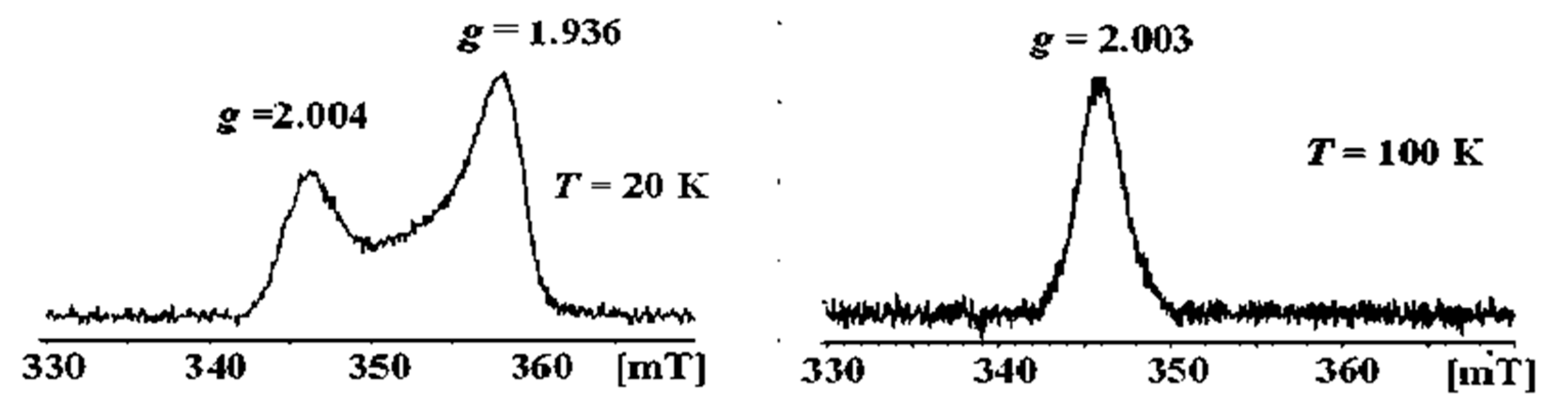
Our continuous and pulsed EPR spectra of reduced Na+-NQR show two signals, as previously reported [15], with relative intensities varying with temperature. The intensity of the broad spectrum from the [2Fe-2S] cluster decreases with increasing temperature (20–100 K) and disappears around 90 K due to the short relaxation time T2 < 10−7 s (Figure 1).
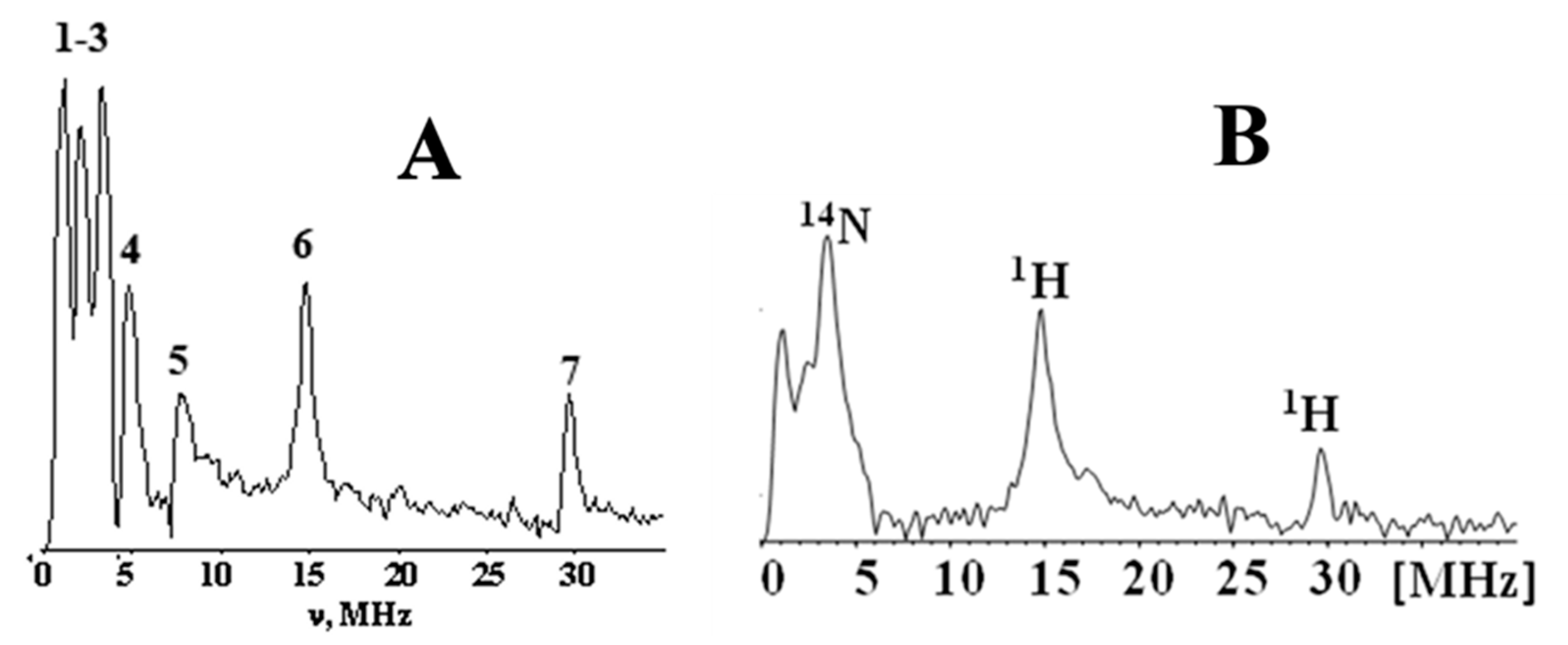
Two- and three-pulse ESEEM spectra obtained on the radical line with g~2 at 100 K (Figure 1, right) show several well-resolved lines at frequencies < 8 MHz and <5 MHz, respectively.
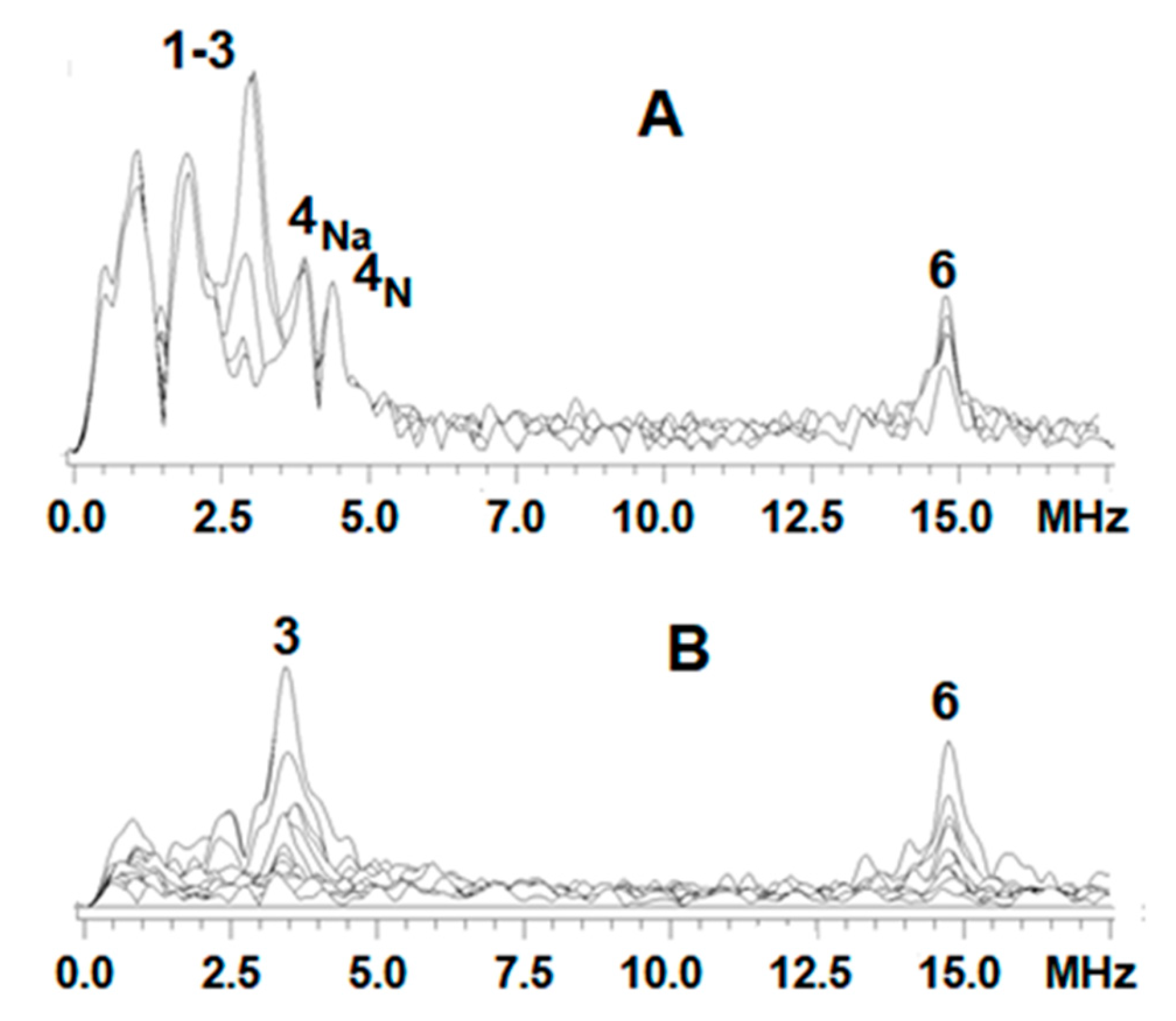
They can be produced by weakly coupled 14N nuclei in the flavin structure and 23Na located near the radical (Figure 2A and Figure 3A). The Zeeman frequency of 23Na nucleus in the applied magnetic field 346 mT is equal to νNa = 3.89 MHz. This suggests that line 5 at frequency ~7.8 MHz, which is not observed in the three-pulse spectrum, is the sum frequency ~ 2νNa = 7.78 MHz of two nuclear frequencies from opposite manifolds of the electron spin of the weakly coupled 23Na nucleus, since the combinationαi ± νβj) frequencies do not contribute to the three-pulse ESEEM spectra [16].
Observation of 2νNa suggests a presence of the νNa line in ESEEM spectra. The line 4Na at 3.93 MHz is purely resolved in the three-pulse spectrum and perfectly corresponds to this assignment (Figure 3A). The other three lines 13 at 1.06, 1.98, and 3.08 MHz, (~0.03 MHz) observed in three-pulse spectrum as well as in two-pulse spectrum in Figure 2A (in contrast with the spectrum in Figure 2B) satisfy well to the condition ν0 + ν = ν+ for three nuclear quadrupole resonance frequencies of 14N nucleus in the zero magnetic field (Equation (S1)) and can be assigned to ν0 = 1.06 MHz, ν = 1.98 MHz, and ν+ = 3.08 MHz.
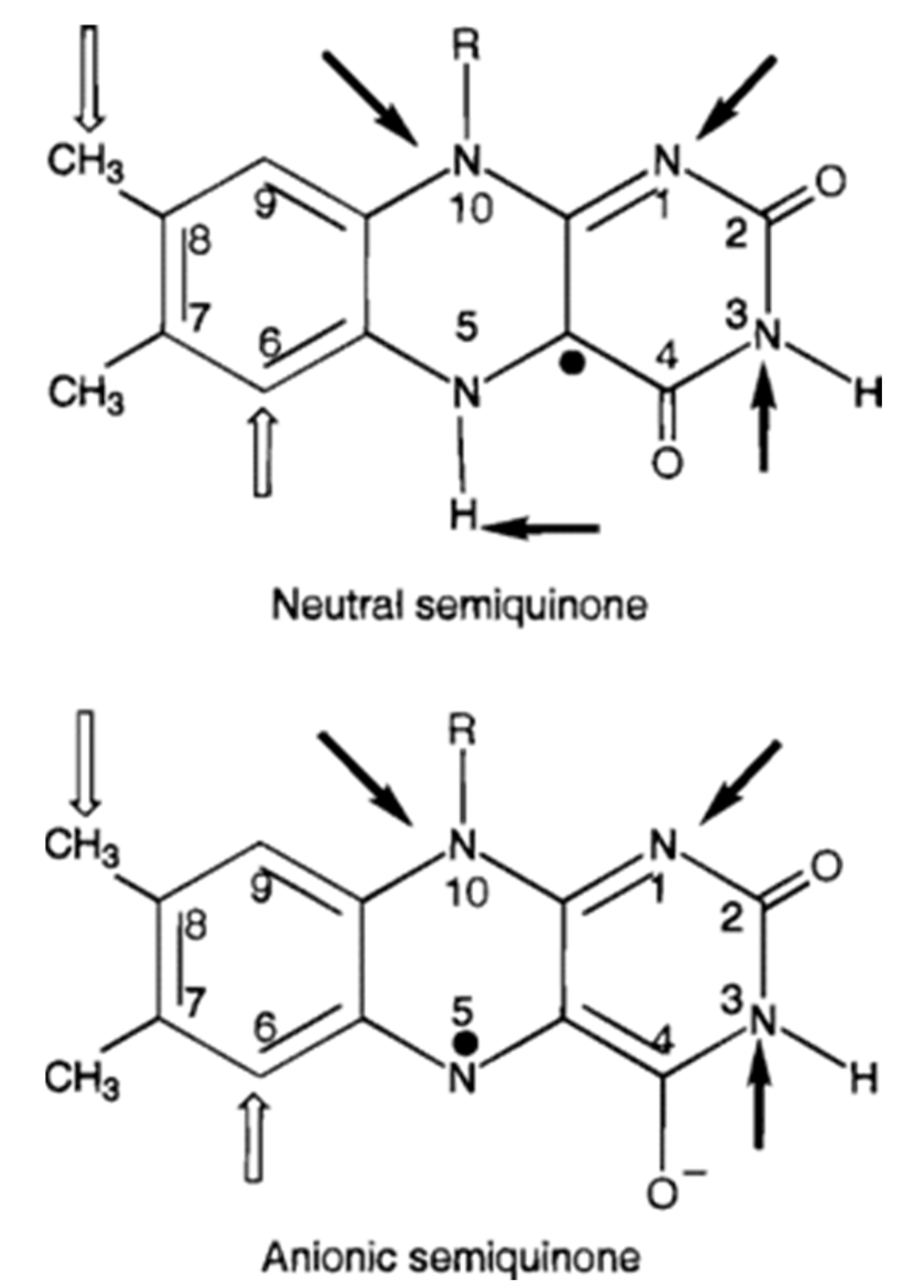
These three frequencies define the quadrupole coupling constant e2Qq/4h = 0.84 MHz and asymmetry parameter η = 0.63. This suggests that the frequency of 4N (4.42 MHz) corresponds to the double-quantum transition (Equation (S2)) from the opposite spin manifold of the 14N with the quadrupole triplet 13 (see Section S1). These assignments allow us to estimate the hyperfine coupling a~1 MHz for this nucleus using Equation (S3). Estimated hyperfine and nuclear quadrupole parameters for weakly coupled 14N are consistent with the values determined from the spectra of the anionic flavin radical (Figure 4) of cholesterol oxidase from Brevibacterium sterolicum [17]. They were assigned to N1 and (or) N3 nitrogen in this radical.
In line with this publication, our HYSCORE spectrum of the anionic flavin radical also shows the cross-features in the (+−) quadrant from the 14N with the couplings |a,T|~10 MHz assigned previously to N10 [17] (Figure S2).

2.2. The Reduced Fe-S Cluster

14N ESEEM and HYSCORE spectra of Fe-S cluster in reduced Na+-NQR are like the spectra from protein nitrogens of the reduced [2Fe-2S](Cys)4 cluster in adrenodoxin (Figure S3) [18]. Adrenodoxin was the first vertebrate ferredoxin for which a high-resolution X-ray structure became available [19]. This similarity excludes the presence of spectral features from 23Na nuclei located near the Fe-S cluster, which would result in a line of observable intensity in the NQR HYSCORE spectrum at the diagonal point (νNa, νNa) with νNa~3.9 MHz. Furthermore, the two-pulse ESEEM spectrum will show the presence of the 2νNa line.

2.3. The Radical in Oxidized Sample

In contrast to the reduced sample, the EPR spectrum of an oxidized NQR displays g = 2.004 line only [8]. The low frequency parts of the two- and three-pulse ESEEM spectra are dominated by the intensive line at ~3.5 MHz with a shoulder at the side of higher frequency (Figure 2 and Figure 3). These spectral features from 14N nuclei are completely consistent with reported spectra of the radical in Anabaena flavodoxin assigned to the neutral flavoprotein semiquinones with protonated N(10) [17]. One can note, however, that the two-pulse spectrum does not contain an observable line near ~8 MHz related to the 2νNa, indicating the lack of 23Na in the immediate environment of the neutral flavin radical in NQR.

3. Discussion

3.1. Evaluation of the Anisotropic Hyperfine Coupling for 23Na+

The observed 23Na+ ESEEM features suggest that the sodium nucleus is involved in a dipole–dipole magnetic interaction with the unpaired electron distributed over the flavin molecule of the anion radical in the reduced Na+ NQR. The spin density of flavin anions and neutral radicals is delocalized in the isoalloxazine ring. It was characterized by hyperfine interactions with magnetic 1H,13C, and 14,15N nuclei using ENDOR and 1D and 2D ESEEM [17,20,21]. Hyperfine couplings for these nuclei in anionic and neutral flavin radicals in the Na+-NQR reported in [20] are shown in Table S2. The results of the spin-distribution analysis for the atoms of the isoalloxazine ring of the anionic radical FMN•− and neutral radical FMNH of flavin mononucleotide (FMN), obtained using DFT calculations (Figure S5) [21], demonstrate the differences between the two radicals.
The largest hyperfine coupling in this anion radicals belongs to N(5) of the central pyrazine ring possessing 14N hyperfine tensor with the principal values (2.3 2.3 57.6) MHz [20]. They define isotropic coupling as a = 20.7 MHz and anisotropic tensor components (−18.4 −18.4 36.8) MHz. These parameters correspond to the spin density of ρS~0.012 or 1.2% on 2s orbital of N(5) and ~25% on the p orbital corresponding to the largest principal value of the 14N anisotropic tensor (parameters used for these estimates are shown in Table S1). The hyperfine tensor characteristics of N(10) are about two times smaller than that of N(5): (1.6 1.6 22.8) MHz, with a=8.6 MHz and (−7.1 −7.1 14.2) MHz indicating more than two times decrease in corresponding s and p spin densities [20].
For anionic flavin radicals, significant spin density is localized also at C(8), C(6), and C(4a) atoms of the isoalloxazine moiety [20]. Based on the values of the 1H and 14N hyperfine constant for protons and nitrogens of the isoalloxazine moiety, obtained in [20], the spin on the anionic flavin radical was approximated as a point dipole located at the center of gravity of its spin density, which is ~4.5 Å from the edges of the isoalloxazine ring with a possible displacement of the center of gravity of the electron spin density from the center of the isoalloxazine ring less than 1 Å [22].
The magnitude of the anisotropic dipole−dipole interaction T between the spin of an unpaired electron and the spin of a coupled nucleus I is determined by the distance, r, between them as 1/r3. In the point dipole approximation, T = gegIβeβI/hr3, where ge, gI, βe, and βI are the respective electronic and nuclear g-factors and magnetons, that gives T = 20.91/r3 (MHz) for 23Na. The dipole–dipole interaction depends on the magnetic field direction and is described by axially symmetric tensor with diagonal principal values (−T, −T, 2T) in the principal axes coordinate system, with z axis directed along r direction.

3.2. Simulations of the 23Na+ Two-Pulse ESEEM

Unfortunately, the available two-pulse 23Na+ ESEEM spectrum does not display the relative intensities of νNa. and 2νNa lines due to the overlap of νNa with νdq line from the nitrogen spectrum. These lines are partially separated in the three-pulse ESEEM spectra where 2νNa is absent. The intensities of νNa and νdq lines in three-pulse spectra at small τ values are approximately equal. Therefore, it can be assumed that these lines make a similar contribution to the corresponding line 4 in the two-pulse ESEEM spectrum of the reduced sample. The same conclusion that the intensities of the νNa and 2νNa lines do not differ significantly can be made by examining previously reported spectra of the reduced NQR with and without Na+ (Figure S1).
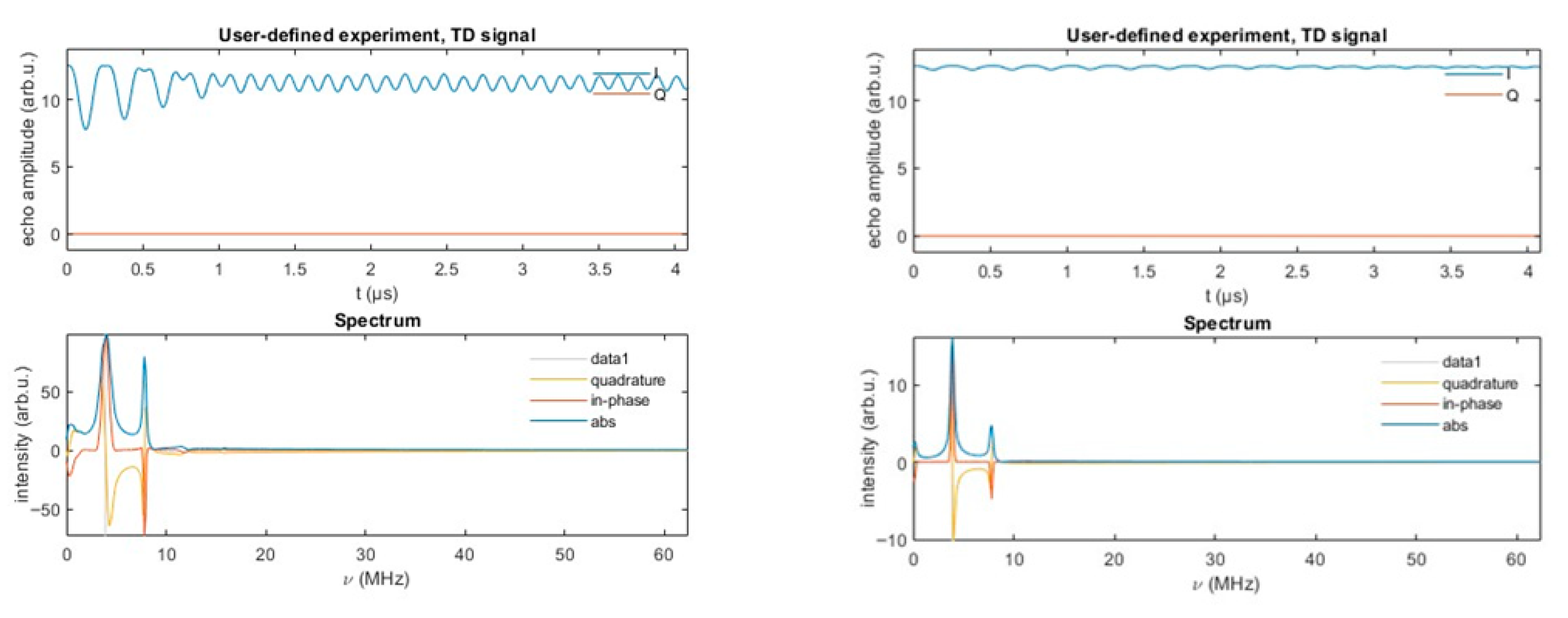
Our simulations of two-pulse 23Na+ ESEEM in time and frequency domains using EasySpin software [23] for different effective distances between electron spin and sodium nucleus, varying in the interval 3–5 Å, are shown in Figure S4. The ratio of peak intensities of the νNa and 2νNa lines in these spectra varies from 0.81 for 3 Å to 0.29 for 5 Å (Figure 5). This result suggests that the preferred effective distance between the electron and the 23Na+ nucleus is ~3–3.5 Å.
We did not include the nuclear quadrupole interaction (nqi) of the 23Na+ nucleus in the modeling because an isolated ion in free space possesses spherical symmetry, which results in a zero electric field gradient (efg) and a zero quadrupole coupling constant. In the combination 2νNa line, no resolved splittings caused by nqi are observed. These splittings should be resolvable at values on the order of a few tenths of a MHz [16]. Their absence indicates that the environment of the 23Na+ located near the flavin anion is not capable of significantly affecting the spherical symmetry of the ion and creating a sufficiently large non-zero efg.

3.3. Studies of the Interactions of Flavins with Alkali Metals

Flavins can interact with alkali metal ions (M+) through direct complexation, primarily with carbonyl groups (CO2, CO4). This interaction changes the flavin’s optical properties, vibrational structures, and energetics, as shown by infrared and visible photodissociation spectroscopy [24]. The strength of the metal–flavin bonds depend on the flavin’s structure and the specific metal ion. Two main isomers of the metal–flavin complex were assigned to M+ bound to CO2 and to CO4, and potentially to N5. For the estimate of the distances between Na+ and the center of the isoalloxazine ring of a flavine, we used the structure shown in Figure S6 [25].
Analysis of the distances between Na+ and the center of gravity of the electron spin density, which is close to the center of the isoalloxazine ring, showed that the estimated ones are ~3.6 Å for Na-O4 and >6 Å for Na-O2. This result indicates that the binding of Na+ with O4 site better satisfied the currently available experimental 23Na+ ESEEM results. However, this conclusion does not exclude the possibility of coordination of Na+ with O2. The coefficient of ESEEM amplitude for weakly coupled nuclei in point dipole approximation is proportional to ~1/r6 [16]. This means that a distant nucleus near O2 will contribute less than 5% of the ESEEM amplitude of the nucleus associated with O4.

3.4. Cation-π Interaction

Another type of structural interaction which can be considered in our case is the interaction of alkali cations with shared π-electrons forming an electron-rich π-system of aromatic rings. This is called a cation-π interaction. Cation–π interactions are non-covalent molecular interactions between the surface of the electron-rich π-system and a neighboring cation (e.g., Na+). The positively charged cation is attracted to the negatively charged π-electron cloud, forming a stabilized structure [26,27].
An analysis of publications devoted to the study of cation-π interactions in proteins allowed us to conduct a quantitative comparison with our ESEEM results characterizing the interaction of 23Na+ with reduced flavin in NQR. Experimental evidence for a cation-π interaction between Na+ and the six-membered indole ring of Trp123 was found in the structure of the hen egg-white lysozyme (2.0 Å resolution) [28]. The geometry of the Na+-π- interaction observed in the protein structure (average distance CAr-Na+ = 4.3 Å; distance between the center of the six-membered ring of the indole and the cation = 4.07 Å) was consistent with the geometries of the crystal structures of small molecules deposited at the Cambridge Structure Database (CSD). Among the selected 44 structures involving Na+-π interactions, the CAr-Na+ distance ranges from 2.83 to 4.95 Å (average distance CAr-Na+ = 3.61 Å).
Evidence that Na+ faces the benzo ring of Trp9 was found in the crystallographic structure of a thermophilic Bacillus stearothermophilus triosephosphate isomerase (H12N/K13G) mutant. The distance between Na+ and the indole ring (4.1–4.3 Å) is consistent with a previous study [28], although it exceeds the average distance observed in the small molecule structures shown above. The cation-π binding site is located near the protein surface. The Phe21 and Glu17 residues close to Trp9 may play an additional role in the stability of sodium–indole interaction. The Na+ is in a position that is occupied by CE and NZ of Lys13 in the wild-type structure [29].
Geobacillus zalihae lipase (T1 lipase) is a thermoalkalophilic lipase that hydrolyzes triglycerides into fatty acids and glycerol. The crystal structure of T1 lipase (1.5 Å resolution) revealed that Na+ in the active site binds to the side chain of Phe16 via cation-π interaction (Figure S7) [30,31]. The average coordination distance between the metal and ring carbons was found to be 3.34 Å, which is much shorter than those observed in the crystal structures of the HEW lysozyme [28] and triosephosphate mutant [29]. The shorter distance is in better coincidence with the experimental values of small molecule crystal structures in CSD. All discussed results show that the position of Na+ relative to the aromatic ring is also influenced by the coordination with fragments of other residues and water molecules. The typical distances between a sodium cation and aromatic ring for available cases of Na+-π interaction in proteins are in the range of 3–4 Å that is consistent with our estimate of the distance between unpaired electron and 23Na+ nucleus in point dipole approximation. This result suggest that this type of interaction should be considered in further experimental and theoretical studies of Na+-NQR.
Pulsed EPR data described in this article can be improved using the uniformly 15N labeled proteins. Labeling the protein with the 15N isotope will allow a pure spectrum to be obtained from 23Na without overlapping with the nitrogen lines. This will result in a more accurate determination of the distance between the radical and the sodium nucleus. The choice between the two models can be made using an orientation-selective Q- or W-band ENDOR experiment. In this case, the orientation-selective spectra collected at different points of the anisotropic EPR line will define the location of the Na nucleus in the coordinate system of the g-tensor principal axes and, accordingly, relative to the plane of the flavin radical.

4. Materials and Methods

4.1. Protein Expression, Purification, and Preparation of EPR Samples

The Na+-NQR protein was kindly provided by Dr. Blanca Barquera (Rennselaer Polytechnic Institute, Troy, NY, USA). Procedures used are described in [8,20]. The procedure used for EPR sample preparation is described in [20]. The enzyme concentration was 150 μM. The air-oxidized enzyme was rapidly frozen in liquid nitrogen. The Na+-NQR was reduced anaerobically by either NADH or dithionite using a vacuum line or glovebox. NADH solutions were rendered air-free by bubbling with nitrogen gas and was added to the enzyme solution to a final concentration of either 200 mM or 10 mM. Dithionite was added to a final concentration of 60 mM in 1 M phosphate buffer, pH 8. The concentration of dithionite used resulted in complete reduction in the anion radical and prevented the formation of a second anion radical, which is observed under mild reducing conditions in the wild-type protein [11]. Results obtained using NADH-reduced and dithionite-reduced enzyme were identical.

4.2. Pulsed EPR Experiments

Pulsed X-band EPR measurements were made using a Bruker ELEXSYS E580 spectrometer with an Oxford CF935 cryostat and Bruker EN 4118X-MD5 resonator at 20–100 K. Several ESEEM experiments with different pulse sequences were employed with appropriate phase cycling schemes to eliminate unwanted features from experimental echo envelopes [16]. Among them are two-pulse and 1D and 2D three- and four-pulse sequences. In the two-pulse electron spin echo (ESE) experiment (π/2-τ–π–τ–echo), the intensity of the echo signal is measured as a function of the time interval τ between two microwave pulses with turning angles π/2 and π to generate an echo envelope that maps the time course of relaxation of the spin system (in ESEEM) or as a function of magnetic field at fixed τ (in field-sweep ESE). In the 1D three-pulse experiment (π/2-τ–π/2-T-π/2-τ-echo), the intensity of the stimulated echo signal after the third pulse is recorded as a function of time, T, at constant time, τ. Three-pulse envelopes recorded at different τ values form a 2D three-pulse data set.
In the 2D four-pulse experiment (π/2-τ–π/2-t1-π-t2-π/2-τ-echo, also called HYSCORE) [32], the intensity of the stimulated echo after the fourth pulse was measured with variation in t2 and t1 while τ remained constant. The length of a π/2 pulse was nominally 16 ns and a π pulse—32 ns. HYSCORE data were collected in the form of 2D time-domain patterns containing 256 × 256 points with a step 16 ns. Spectral processing of three- and four-pulse ESEEM patterns, including subtraction of relaxation decay (fitting by polynomials of 3–6 degree), apodization (Hamming window), zero filling, and fast Fourier transformation (FT), was performed using Bruker WIN-EPR software.
The intensity of the inverted echo after the fourth pulse is measured as a function of t1 and t2 with constant τ. Such a 2D set of echo envelopes gives, after complex Fourier transformation, a 2D spectrum with equal resolution in each direction. The power of this two-dimensional technique lies in the off-diagonal cross-peaks correlating nuclear frequencies from opposite electron spin manifolds. The HYSCORE spectra are sensitive to the relative signs of the correlated frequencies and are usually presented as two quadrants (++) and (+−) of the 2D Fourier transform.

5. Conclusions

The data presented in the current work demonstrate that the reduced form of Na+-NQR has a Na+ ion that is 3 to 4 Å from an anionic flavin radical. The previous observation by Verkhovsky et al. [14] showed an interaction between a Na+ ion and an anionic flavin radical in the partially reduced enzyme (poised at −260 mV). Under these conditions, the signals from both FMNNqerC and FMNNqrB are observed and either could be responsible for the observed Na+ interaction. In the current study, we have examined the fully reduced (NADH- or dithionite-reduced) state of Na+-NQR and confirmed the Na+ interaction. Based on earlier studies, only the anionic flavin radical due to FMNNqrB is observed in the NADH-reduced state of the enzyme [7,8,9,10,11]. Therefore, it can be concluded that in the fully reduced Na+-NQR, a Na+ ion is located within 3 to 4 Å of FMNNqrB. Two sodium ions are observed in subunit NqrB in the cryo-EM structures reported by Hau et al. [5]. Neither is close enough to FMNNqrB to explain the interactions observed in the current study.
The most recent models of how electron transfer is coupled to Na+ transport in Na+-NQR differ in the location of the pathway of Na+ across the membrane. In the model proposed by Kishikawa et al. [6] and Ishikawa-Fukada et al. [2], the Na+ pathway through the protein is located within the heterodimeric unit of subunits NqrD and NqrE. In contrast, in the model proposed by Hau et al. [3,5], the pathway passes through NqrB. Taken at face value, our data would appear to favor the Na+ transport through NqrB. However, we cannot say that the observed Na+ is one which would be transported during catalysis or whether it might be playing another role. Further research is required for clarification.

Supplementary Materials

The following supporting information can be downloaded at: https://www.mdpi.com/article/10.3390/inorganics14010031/s1, Figure S1: Two-pulse echo decay traces of flavin radicals in the sodium (red line) and sodium-free (blue line) Na+-NQR samples and corresponding ESEEM spectra; Figure S2: HYSCORE spectrum of the flavin radical in the dithionite reduced Na+-NQR; Figure S3: 14N HYSCORE spectra of the reduced [2Fe-2S] cluster in the NQR and adrenodoxin; Figure S4: Simulated two-pulse 23Na ESEEM in the time and frequency domains; Figure S5. Mulliken spin population analysis; Figure S6: Absolute distances (in pm) of Na+LF in its S0 state; Figure S7: Crystal structure of the Geobacillus zalihae T1 lipase (PDB code: 2DSN); Table S1: Atomic magnetic hyperfine constants; Table S2.  Hyperfine coupling matrices and g-matrices for the neutral and anionic flavin radicals; Section S1: introduction in 14N ESEEM and HYSCORE. References [33,34,35] are cited in the Supplementary Materials.

Author Contributions

Conceptualization, S.A.D. and R.B.G.; methodology, S.A.D. and R.B.G.; validation, S.A.D. and R.B.G.; resources, S.A.D. and R.B.G.; writing—original draft preparation, S.A.D.; writing—review and editing, S.A.D. and R.B.G.; project administration, S.A.D. and R.B.G.; funding acquisition, S.A.D. and R.B.G. All authors have read and agreed to the published version of the manuscript.

Funding

This work was supported by Grants GM62954 (S.A.D.) and HL16011 (R.B.G.) from the National Institute of Health, and National Center for Research Resources/NIH Grant S10-RR15878 for instrumentation.

Institutional Review Board Statement

Not applicable.

Informed Consent Statement

Not applicable.

Data Availability Statement

All data and information recorded or analyzed throughout this study are included in this paper.

Acknowledgments

The authors are grateful to Blanca Barquera for the provided Na+-NQR protein and useful discussions.

Conflicts of Interest

The authors declare no conflicts of interest.

References

  1. Steuber, J.; Fritz, G. The Na+-translocating NADH:quinone oxidoreductase (Na+-NQR): Physiological role, structure and function of a redox-driven, molecular machine. Biochim. Biophys. Acta 2024, 1865, 149485. [Google Scholar] [CrossRef]
  2. Ishikawa-Fukuda, M.; Seki, T.; Kishikawa, J.I.; Masuya, T.; Okazaki, K.I.; Kato, T.; Barquera, B.; Miyoshi, H.; Murai, M. The Na+-pumping mechanism driven by redox reactions in the NADH-quinone oxidoreductase from Vibrio cholerae relies on dynamic conformational changes. bioRxiv 2025. [Google Scholar] [CrossRef]
  3. Buckel, W.; Ermler, U.; Vonck, J.; Fritz, G.; Steuber, J. The RNF/NQR redox pumps: A versatile system for energy transduction in bacteria and archaea. Appl. Microbiol. Biotechnol. 2025, 109, 148. [Google Scholar] [CrossRef]
  4. Steuber, J.; Vohl, G.; Casutt, M.S.; Vorburger, T.; Diederichs, K.; Fritz, G. Structure of the V. cholerae Na+-pumping NADH:quinone oxidoreductase. Nature 2014, 516, 62–67. [Google Scholar] [CrossRef] [PubMed]
  5. Hau, J.L.; Kaltwasser, S.; Muras, V.; Casutt, M.S.; Vohl, G.; Claussen, B.; Steffen, W.; Leitner, A.; Bill, E.; Cutsail, G.E., III; et al. Conformational coupling of redox-driven Na+-translocation in Vibrio cholerae NADH:quinone oxidoreductase. Nat. Struct. Mol. Biol. 2023, 30, 1686–1694. [Google Scholar] [CrossRef] [PubMed]
  6. Kishikawa, J.-I.; Ishikawa, M.; Masuya, T.; Murai, M.; Kitazumi, Y.; Butler, N.L.; Kato, T.; Barquera, B.; Miyoshi, H. Cryo-EM structures of Na+-pumping NADH-ubiquinone oxidoreductase from Vibrio cholerae. Nat. Commun. 2022, 13, 4082. [Google Scholar] [CrossRef]
  7. Juárez, O.; Nilges, M.J.; Gillespie, P.; Cotton, J.; Barquera, B. Riboflavin is an active redox cofactor in the Na+-pumping NADH: Quinone oxidoreductase (Na+-NQR) from Vibrio cholerae. J. Biol. Chem. 2008, 283, 33162–33167. [Google Scholar] [CrossRef]
  8. Barquera, B.; Hellwig, P.; Zhou, W.; Morgan, J.E.; Häse, C.C.; Gosink, K.K.; Nilges, M.J.; Bruesehoff, P.J.; Roth, A.; Roy, C.; et al. Purification and Characterization of the Recombinant Na+-Translocating NADH: Quinone Oxidoreductase from Vibrio cholera. Biochemistry 2002, 41, 3781–3789. [Google Scholar] [CrossRef]
  9. Bogachev, A.V.; Bertsova, Y.V.; Ruuge, E.K.; Wikström, M.; Verkhovsky, M.I. Kinetics of the Spectral Changes During Reductin of the Na+-moltive NADH: Quinone Oxidoreductase from Vibrio harveyi. Biochim. Biophys. Acta 2002, 1556, 113–120. [Google Scholar] [CrossRef]
  10. Bogachev, A.V.; Bertsova, Y.V.; Barquera, B.; Verkhovsky, M.I. Sodium-Dependent Steps in the Redox Reactions of the Na+-Motive NADH:Quinone Oxidoreductase from Vibrio harveyi. Biochemistry 2001, 40, 7318–7323. [Google Scholar] [CrossRef]
  11. Barquera, B.; Ramirez-Silva, L.; Morgan, J.E.; Nilges, M.J. A new flavin radical signal in the Na+-pumping NADH: Quinone oxidoreductase from Vibrio cholerae. J. Biol. Chem. 2006, 281, 36482–36491. [Google Scholar] [CrossRef]
  12. Bogachev, A.V.; Bloch, D.A.; Bertsova, Y.V.; Verkhovsky, M.I. Redox properties of the prosthetic groups of Na+-translocating NADH:quinone oxidoreductase. 2. Study of the enzyme by optical spectroscopy. Biochemistry 2009, 48, 6299–6304. [Google Scholar] [CrossRef] [PubMed]
  13. Medina, M.; Cammack, R. ENDOR and Related EMR Methods Applied to Flavoprotein Radicals. Appl. Magn. Reson. 2007, 31, 457–470. [Google Scholar] [CrossRef]
  14. Verkhovsky, M.I.; Bogachev, A.V.; Pivtsov, A.V.; Bertsova, Y.V.; Fedin, M.V.; Bloch, D.A.; Kulik, L.V. Sodium-Dependent Movement of Covalently Bound FMN Residue(s) in Na+-Translocating NADH: Quinone Oxidoreductase. Biochemistry 2012, 51, 5414–5421. [Google Scholar] [CrossRef] [PubMed]
  15. Bogachev, A.V.; Kulik, L.V.; Bloch, D.A.; Bertsova, Y.V.; Fadeeva, M.; Verkhovsky, M.I. Redox Properties of the Prosthetic Groups of Na+-Translocating NADH: Quinone Oxidoreductase. 1. Electron Paramagnetic Resonance Study of the Enzyme. Biochemistry 2009, 48, 6291–6298. [Google Scholar] [CrossRef]
  16. Dikanov, S.A.; Tsvetkov, Y.D. Electron Spin Echo Envelope Modulation (ESEEM) Spectroscopy; CRC Press: Boca Raton, FL, USA, 1992; 412p. [Google Scholar]
  17. Martínez, J.I.; Alonso, P.J.; Gómez-Moreno, C.; Medina, M. One- and Two-Dimensional ESEEM Spectroscopy of Flavoproteins. Biochemistry 1997, 36, 15526–15537. [Google Scholar] [CrossRef]
  18. Dikanov, S.A.; Samoilova, R.I.; Kappl, R.; Crofts, A.R.; Hüttermann, J. The reduced [2Fe-2S] clusters in adrenodoxin and Arthrospira platensis ferredoxin share spin density with protein nitrogens, probed using 2D ESEEM. Phys. Chem. Chem. Phys. 2009, 11, 6807–6819. [Google Scholar] [CrossRef]
  19. Müller, A.; Müller, J.J.; Muller, Y.A.; Uhlmann, H.; Bernhardt, R.; Heinemann, U. New aspects of electron transfer revealed by the crystal structure of a truncated bovine adrenodoxin, Adx(4–108). Structure 1998, 6, 269–280. [Google Scholar] [CrossRef]
  20. Barquera, B.; Morgan, J.; Lukoyanov, D.; Scholes, C.P.; Gennis, R.B.; Nilges, M.J. X- and W-Band EPR and Q-Band ENDOR Studies of the Flavin Radical in the Na+-Translocating NADH: Quinone Oxidoreductase from Vibrio cholerae. J. Am. Chem. Soc. 2003, 125, 265–275. [Google Scholar] [CrossRef]
  21. Pompe, N.; Illarionov, B.; Fischer, M.; Bacher, A.; Weber, S. Completing the Picture: Determination of 13C Hyperfine Coupling Constants of Flavin Semiquinone Radicals by Photo chemically Induced Dynamic Nuclear Polarization Spectroscopy. J. Phys. Chem. Lett. 2022, 13, 5160–5167. [Google Scholar] [CrossRef]
  22. Kulik, L.V.; Pivtsov, A.V.; Bogachev, A.V. Pulse EPR, ENDOR, and ELDOR Study of Anionic Flavin Radicals in Na+-Translocating NADH: Quinone Oxidoreductase. Appl. Magn. Reson. 2010, 37, 353–361. [Google Scholar] [CrossRef]
  23. Stoll, S.; Schweiger, A. EasySpin, a comprehensive software package for spectral simulation and analysis in EPR. J. Magn. Reson. 2006, 178, 42–55. [Google Scholar] [CrossRef] [PubMed]
  24. Müller, D.; Dopfer, O. Interaction of alkali ions with flavins: Infrared and optical spectra of metal–riboflavin complexes. J. Phys. Chem. A 2021, 125, 3146–3158. [Google Scholar] [CrossRef] [PubMed]
  25. Müller, D.; Nieto, P.; Miyazaki, M.; Dopfer, O. Effect of alkali ions on optical properties of flavins: Vibronic spectra of cryogenic M+ lumiflavin complexes (M=Li-Cs). Faraday Discuss. 2019, 217, 256–275. [Google Scholar] [CrossRef]
  26. Mahadevi, A.S.; Sastry, G.N. Cation−π interaction: Its role and relevance in chemistry, biology, and material science. Chem. Rev. 2013, 113, 2100–2138. [Google Scholar] [CrossRef]
  27. Dougherty, D.A. The cation−π interaction in chemistry and biology. Chem. Rev. 2025, 125, 2793–2808. [Google Scholar] [CrossRef]
  28. Wouters, J. Cation-π (Na+-Trp) interactions in the crystal structure of tetragonal lysozyme. Protein Sci. 1998, 7, 2472–2475. [Google Scholar] [CrossRef]
  29. Wouters, J.; Maes, D. Identification of a potential metal cation-π binding site in the structure of a thermophilic Bacillus stearothermophilus triosephosphate isomerase mutant. Acta Cryst. 2000, D56, 1201–1203. [Google Scholar]
  30. Matsumura, H.; Yamamoto, T.; Leow, T.C.; Mori, T.; Salleh, A.B.; Basri, M.; Inoue, T.; Kai, Y.; Rahman, R.N. Novel cation-π interaction revealed by crystal structure of thermoalkalophilic lipase. Proteins 2008, 70, 592–598. [Google Scholar] [CrossRef]
  31. Hagiwara, Y.; Matsumura, H.; Tateno, M. Functional roles of a structural element involving Na+-π interactions in the catalytic site of T1 lipase revealed by molecular dynamics simulations. J. Am. Chem. Soc. 2009, 131, 16697–16705. [Google Scholar] [CrossRef]
  32. Höfer, P.; Grupp, A.; Nebenführ, H.; Mehring, M. Hyperfine Sublevel Correlation (HYSCORE) spectroscopy: A 2D ESR investigation of the squaric acid radical. Chem. Phys. Lett. 1986, 132, 279–282. [Google Scholar] [CrossRef]
  33. Dikanov, S.A.; Tsvetkov, Y.D.; Bowman, M.K.; Astashkin, A.V. Parameters of quadrupole coupling of 14N nuclei of chlorophyll a cations determined by electron spin echo method. Chem. Phys. Lett. 1982, 90, 149–153. [Google Scholar] [CrossRef]
  34. Fitzpatrick, J.A.J.; Manby, F.R.; Western, C.M. The interpretation of molecular magnetic hyperfine interactions. J. Chem. Phys. 2005, 122, 084312. [Google Scholar] [CrossRef]
  35. Morton, J.R.; Preston, K.F. Atomic parameters for paramagnetic resonance data. J. Magn. Reson. 1978, 30, 577–582. [Google Scholar] [CrossRef]
Figure 1. Two-pulse field-sweep ESE spectra of the dithionite-reduced Na+-NQR at temperature 20 (left) and 100 K (right), (left) MW frequency of 9.7034 GHz, positions of maxima 346 mT (g = 2.004) and 358 mT (g = 1.936), time τ = 200 ns, T = 20 K; (right) 9.700 GHz, 346 mT (g = 2.003), time τ = 200 ns, T = 100 K.
Inorganics 14 00031 g001
Figure 2. (A) The modulus FT two-pulse ESEEM spectrum of the flavin radical in the dithionite reduced Na+-NQR at temperature 100 K, MW frequency of 9.700 GHz, magnetic field 346 mT (g = 2.003). (B) The modulus FT two-pulse ESEEM spectrum of the flavin radical in the oxidized Na+-NQR at temperature 20 K, MW frequency of 9.695 GHz, magnetic field 345.8 mT (g = 2.003).
Inorganics 14 00031 g002
Figure 3. (A) Stacked plots of three-pulse ESEEM spectra of the SQ at the flavin radical in the dithionite reduced Na+-NQR. The spectra show modulus Fourier transforms along the time T (between second and third microwave pulses) axis (512 points with a 16 ns step) at different times τ. The initial time τ (between first and second pulses) is 100 ns in the first trace and was increased by 16 ns in successive traces. The microwave frequency was 9.700 GHz, and the magnetic field was 346 mT. (B) Stacked plots of three-pulse ESEEM spectra of the flavin radical in the oxidized Na+-NQR at temperature 20 K, MW frequency was 9.695 GHz, magnetic field 345.8 mT (g = 2.003).
Inorganics 14 00031 g003
Figure 4. Structures of the neutral and anionic flavin semiquinone states. Arrows indicate positions of the isoalloxazine ring which interaction parameters with the unpaired spin have been studied either by ENDOR (white arrows) or 2D HYSCORE (black arrows) techniques in flavoprotein semiquinones. “Adapted with permission from ref. [17]. Copyright 1997 American Chemical Society”.
Inorganics 14 00031 g004
Figure 5. Two-pulse 23Na+ ESEEM in the time and frequency domains simulated in the point dipole approximation for distances of 3 Å (left) and 5 Å (right) between an unpaired electron and 23Na+ nucleus. All simulated data for distances from 3 to 5 Å with a step 0.5 Å are presented in Figure S4.
Inorganics 14 00031 g005
Disclaimer/Publisher’s Note: The statements, opinions and data contained in all publications are solely those of the individual author(s) and contributor(s) and not of MDPI and/or the editor(s). MDPI and/or the editor(s) disclaim responsibility for any injury to people or property resulting from any ideas, methods, instructions or products referred to in the content.