
Article

Reactions of Benzylsilicon Pyridine-2-olate BnSi(pyO)3 and Selected Electrophiles—PhCHO, CuCl, and AgOTos

1
Institut für Anorganische Chemie, TU Bergakademie Freiberg, D-09596 Freiberg, Germany
2
Institut für Analytische Chemie, TU Bergakademie Freiberg, D-09596 Freiberg, Germany
*
Author to whom correspondence should be addressed.
Inorganics 2026, 14(1), 20; https://doi.org/10.3390/inorganics14010020 (registering DOI)
Submission received: 7 December 2025 / Revised: 20 December 2025 / Accepted: 24 December 2025 / Published: 1 January 2026

Abstract

In dynamic equilibria, benzylsilicon pyridine-2-olate (BnSi(pyO)3, L) and benzaldehyde react with addition of the Si(pyO) moieties to the PhHC=O carbonyl group and formation of compounds BnSi(–O–C(H,Ph)–N(2-pyridone))x(pyO)3−x (L, L’’, and L’’’, for x = 1, 2, 3, respectively). Addition of CuCl to a solution containing L, L, L’’, and L’’’ results in the formation of BnSi(pyO)3CuCl (LCuCl), shifting the equilibrium towards L with liberation of benzaldehyde. In THF as a solvent, the reaction of L in the presence of excess CuCl affords the complex LCuClCuCl. Upon dissolving in chloroform, it transforms into LCuCl with precipitation of CuCl. The solid state structure of LCuClCuCl features both the monomeric complex with CuClCuCl pattern and a dimer thereof with CuClCu(Cl)2CuClCu pattern and a central Cu2Cl2 four-membered ring. This dimer of LCuClCuCl is the first crystallographically characterized representative of this Cu(I)-only Cu4Cl4 motif. The reaction of LCuCl and silver tosylate (AgOTos) in THF affords LCuOTos with precipitation of AgCl, whereas LAgOTos was obtained from L and AgOTos. In the crystal structure, LAgOTos features tetracoordinate Ag(I) in a distorted tetrahedral AgN3O coordination sphere and a short Ag···Si trans-annular contact (3.3245(7) Å). 109Ag NMR spectroscopy indicates a change in the coordination in solution, with δ 109Ag = +551 and +419 ppm in the solid and in CDCl3 solution, respectively. In combination, 29Si NMR spectroscopy indicates changes in the Si coordination sphere, with δ 29Si = −74.2 and −66.5 ppm in the solid and in CDCl3 solution, respectively. Conversion of LAgOTos with tetraethylammonium chloride results in the precipitation of AgCl with release of L.

1. Introduction

Silicon compounds with penta- or hexacoordinate Si atom have attracted researchers’ interest for many decades [1,2,3,4,5]. More than merely seeing the silicon atom’s higher coordination number as nothing but a scientific curiosity, the exploration of substitution reactions at Si (usually along associative mechanisms [6]) and molecular dynamics associated therewith (e.g., Berry pseudorotation [7] about the pentacoordinate central atom) are closely bound to Si hypercoordination. Other aspects include the exploration of Si–C bond activation associated with the enhanced Si coordination number [8], and theoretical and experimental investigations, which address the general understanding of bonding situations about hypercoordinate Si atoms [9,10,11]. Moreover, transition metal atoms in the Si coordination sphere may also enhance the Si coordination number in the sense of a “simple Lewis base”, i.e., as a lone pair donor toward Si [12,13,14,15,16,17], and they may support Si–X (e.g., X = H) bond activation through agostic interactions, eventually leading to oxidative addition reactions as entrance into catalytic cycles [18,19]. In some cases, Si-hypercoordination itself provides sufficient activation for Si–C bond cleavage and hydrocarbyl transfer to an electrophilic reagent, such as allyl shift from Si to an Si-coordinated aldehyde [20,21], imine [22], quinoline derivative [23], or diazo group [24]. Ring opening of a silacyclobutane upon Si-hexacoordination is another example [25], and Si–H bond cleavage and H transfer to an adjacent electrophile [26,27] as well as a related Si–CN rearrangement may occur in a similar manner [28]. Even metal-free base-supported aryl transfer reactions with an aryl silane were reported [29], and UV irradiation may also initiate Si–C bond cleavage and alkyl, alkenyl, or aryl transfer to an Si-coordinated electrophile [30,31]. Various other reactions may, sometimes in addition to Si-hypercoordination, require the action of an electron rich d-element catalyst. Examples are d10-metal catalyzed cross-coupling reactions [32,33,34], allyl transfer reactions [35], and alkylation reactions [36,37]. Among the d10-metal catalysts used, Cu(I) compounds are very prominent in different roles such as redox-active species in radical mechanisms [33] and soft electrophiles for the formation of hydrocarbyl cuprates(I) as reactive intermediates [36].
In the context of our investigations of hetero-dinuclear complexes, we already reported Cu(I) and Cu(II) complexes of the types RSi(pyO)3CuCl and RSi(pyO)4CuCl (R = different hydrocarbyl groups), respectively, in which silicon and copper are held in close proximity by pyridine-2-olate as a buttressing moiety [38,39]. For these complexes, crystallographic analyses confirmed Si-Cu distances that are markedly shorter than the sum of the van der Waals radii, and computational analyses confirmed weak donation of electron density from Cu(I) toward Si in the complexes of the type RSi(pyO)3CuCl. As these compounds combine Si-hypercoordination and spatial proximity of Cu(I) and Si as well as the presence of an Si–C bond, the current study aimed to explore the reactions of this system when exposed to selected electrophiles (Scheme 1). In the role of an organic electrophile, benzaldehyde was chosen as a representative carbonyl compound. As Si-bound allyl groups may easily undergo rearrangement reactions upon Si-hypercoordination, even in the absence of metal catalysts, the benzylsilicon compound BnSi(pyO)3 (L) was chosen as the silane component of our study.

2. Results and Discussion

2.1. Reaction of Benzyltris(2-pyridyloxy)silane (Ligand L) and Benzaldehyde

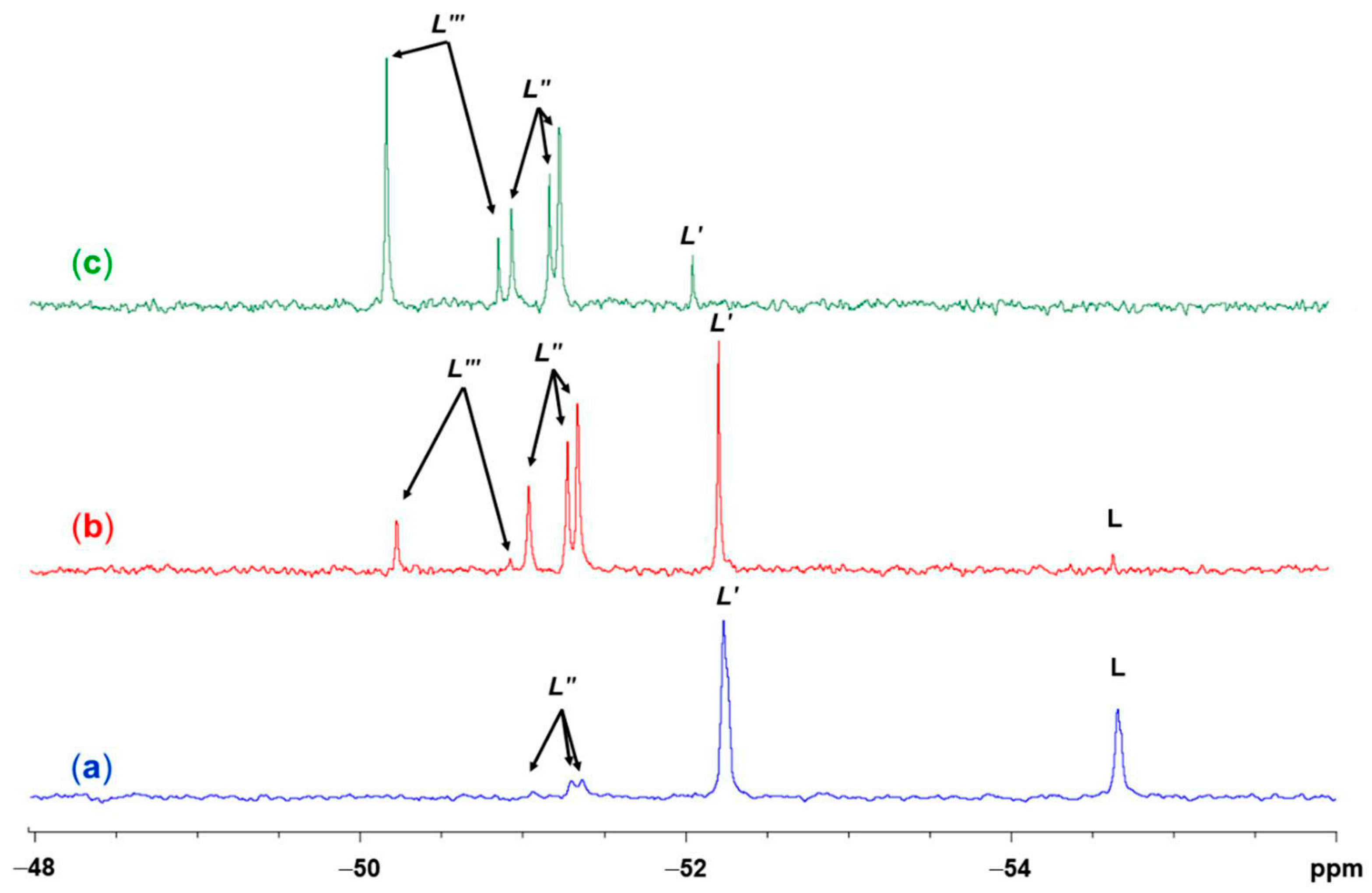
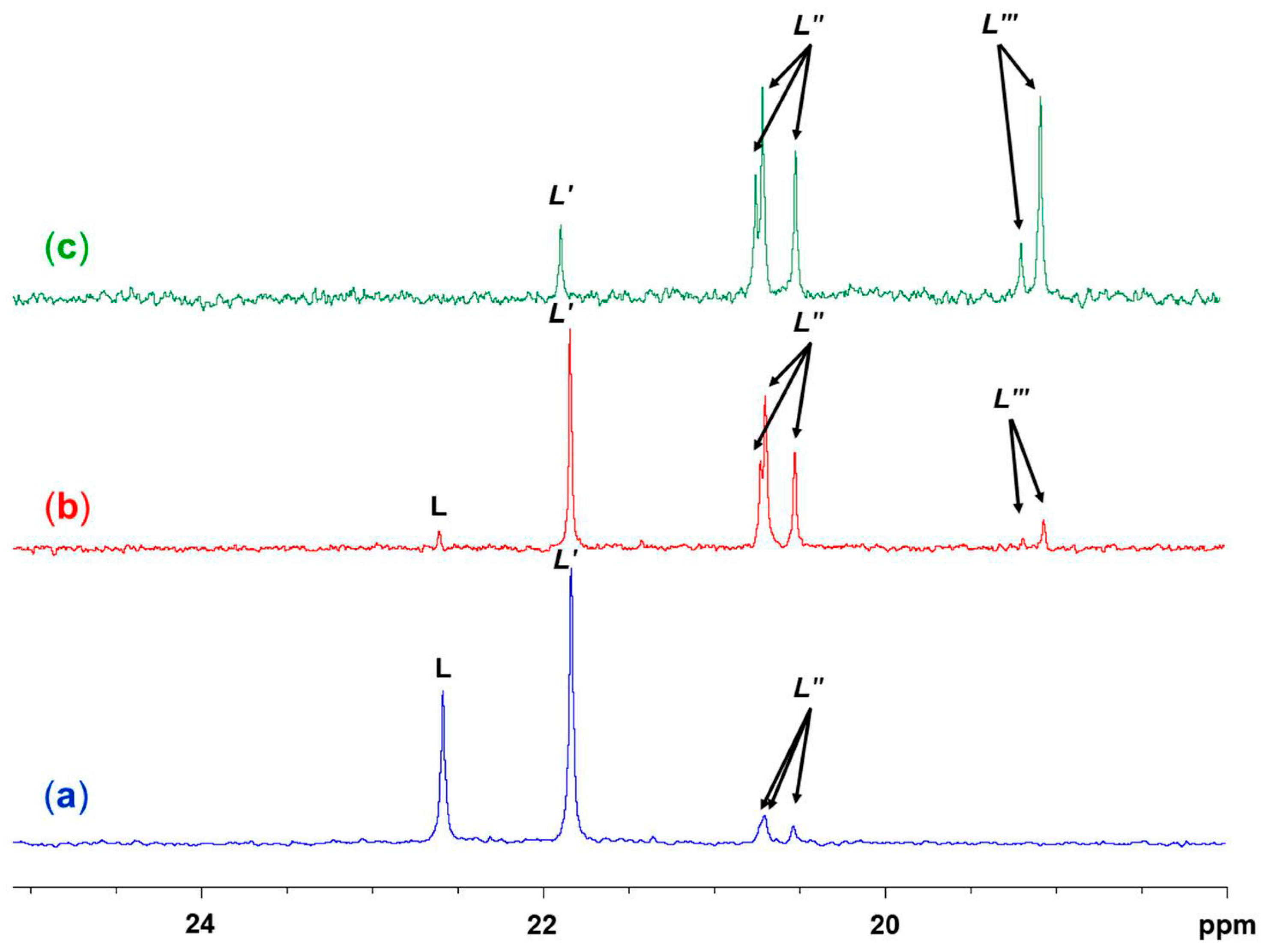
At the beginning of this study, Si–C activation via Si-hypercoordination in the absence of any d-metal component was probed. As a set of NMR scale experiments, three samples of silane L (ca. 1 mmol of silane L, dissolved in 2 mL of CDCl3, for details see Supplementary Materials Figures S1–S10) were mixed with benzaldehyde in molar ratio L:PhCHO = 1:1, 1:3, and 1:10. From the resultant clear solutions, 1H, 13C, and 29Si NMR spectra were recorded. The latter (Figure 1) clearly indicate the formation of new silicon compounds. Whereas the presence of some starting material L is reflected by a 29Si NMR signal at −54.8 (cf. −54.7 reported for a CDCl3 solution of this compound [39]), the systematic development of six new signals in the range between −50 and −53 ppm pointed at the formation of new compounds with BnSi(OR)3 motif (R = variable substituent). With increasing benzaldehyde concentration, the systematic mutual gain vs. loss of signal intensities is speaking for the formation of three principle groups of compounds. The same pattern is reflected by the benzylic CH2 13C NMR signals (Figure 2). In the corresponding 13C NMR spectra (cf. Figure S7), the emerging of new signals in the range between 76 and 79 ppm indicates the formation of compounds with sp3 hybridized C atoms that carry electron withdrawing substituents. Moreover, upon dilution with CDCl3, the signals at higher field (including the signal of the starting material L) gain intensity at the expense of intensity of the signals at lower field, thus pointing at the reversal of the reactions in dynamic equilibria. 29Si NMR spectra recorded from solutions of L and benzaldehyde (molar ratio 1:3, same concentrations) in other solvents (acetonitrile-d3, THF-d8, toluene-d8) convey essentially the same picture of the shift range, number, and relative intensities of the signals of the new products (cf. Figures S13 and S14).
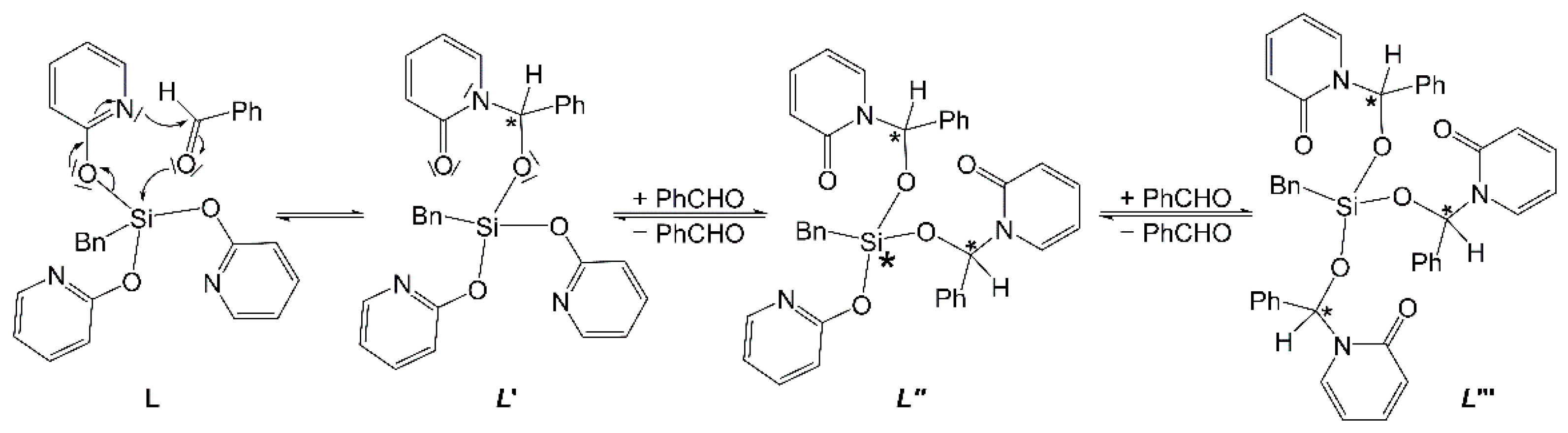
These NMR spectroscopic observations point at addition reactions of benzaldehyde and the Si-bound 2-pyridyloxy groups with formation of the groups L, L’’, and L’’’ of stereoisomers of products of addition of one, two, and three equivalents of benzaldehyde, respectively (Scheme 2). The number of (groups of) diastereomers (1, 1, 3, 2 for L, L, L’’, L’’’, respectively) equals the number of 29Si NMR signals and 13C(CH2) NMR signals per “group” in the corresponding sets of spectra. Moreover, 1H-15N HMBC NMR spectra underline the formation of groups with N-alkylated pyridine N atoms. The spectrum of the starting material L (Figure S11) exhibits a 15N signal at δ 279.3 ppm and particularly pronounced correlation with position H5 of the pyridine-2-olate group. A spectrum of a solution of L and benzaldehyde in 1:3 molar ratio (Figure S12) exhibits signals in the same range (276–280 ppm), speaking for the presence of compounds with pyO groups in the product mixture, and a broad set of signals in the range 191–194 ppm, which exhibit correlations with a group of 1H signals that can be assigned to H5 positions of the new moieties formed. Such an upfield shift in pyridine N atoms’ 15N NMR signals is typical upon N-functionalization (e.g., protonation [40] or N-alkylation [41]).
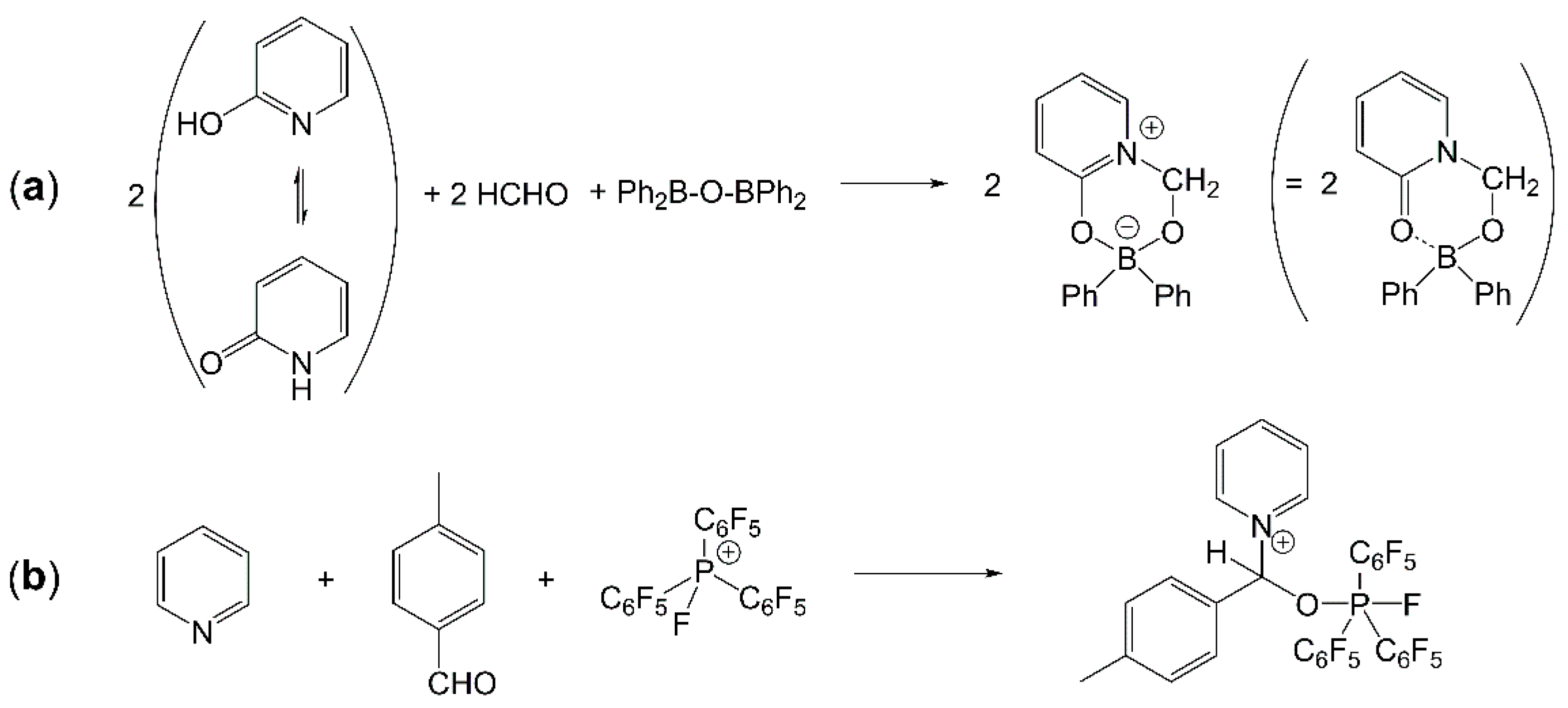
With respect to the molecular structures of silicon pyridine-2-olates, which generally feature Si–O bound 2-pyridyloxy groups with dangling pyridine N atoms [42,43], the pyridine N atoms of compound L represent rather soft Lewis bases. They are suitable to attack the aldehyde’s carbonyl C atom, and the α-heteromethanolate formed (a rather hard Lewis base) can be stabilized by the available hard Lewis acid, i.e., by forming a new O–Si bond. This principle of Lewis acid supported addition of a pyridine and an aldehyde has precedents in the literature. Scheme 3 shows two examples, the first of which (Scheme 3a) involves a 2-pyridyloxy moiety [44]. Even though the authors have drawn a zwitterionic form of the product, its structure can be related to those of the silicon compounds shown in Scheme 2, i.e., an N-alkylated 2-pyridone derivative. The crystal structure of this product reveals a shorter (1.470(4) Å, CH2O–B) and a longer (1.574(4) Å, CO–B) B–O bond, and we interpret this as a result of contributions of the 2-pyridone form to the resonance structures (contributions of an O···B dative bond). The second example (Scheme 3b) illustrates this principle for a simple pyridine [45]. Anders et al. reported various further examples, including BF3 and SbCl5 as Lewis acids, and their studies involved the O-silylated compound [(Py)(p-Tol)HC-O-SiMe3] [O3SCF3] [46].

2.2. Reaction of Benzyltris(2-pyridyloxy)silane (L), Benzaldehyde and CuCl

To explore whether compounds L, L’’, or L’’’ can be used for complexation of CuCl or Cu-supported benzyl transfer to the carbonyl C atom of benzaldehyde, a solution of L (0.44 mmol) and benzaldehyde (0.46 mmol) in CDCl3 (0.7 mL) was prepared, followed by the addition of CuCl (0.44 mmol) and, upon its dissolution, recording of 1H, 13C, and 29Si NMR spectra (cf. Figures S15 and S16). They indicated the formation of LCuCl, while benzaldehyde (previously in equilibrium with, in particular, L and L’’, cf. Figure 1a) coexisted in solution, and there was no sign of the formation of other Si-complexes with BnSiO3 or SiO4 coordination spheres. As excess CuCl remains insoluble in CDCl3 (vide infra), repetition of this experiment with additional CuCl was carried out in THF-d8. The only slightly shifted 29Si NMR signal (δ 29Si −72.1 for LCuCl in CDCl3 [39], −71.1 observed with the THF-d8 solution of this experiment), the general retention of the overall 1H and 13C NMR signal patterns comparable to those of LCuCl and benzaldehyde, and the absence of new signals indicative of an OC(Ph,H,CH2Ph) moiety showed that the Si-bound benzyl did not undergo a transfer reaction under these conditions (cf. Figures S17 and S18). Nonetheless, an additional experiment answered the question as to why two equivalents of CuCl could be dissolved in a THF solution of L.
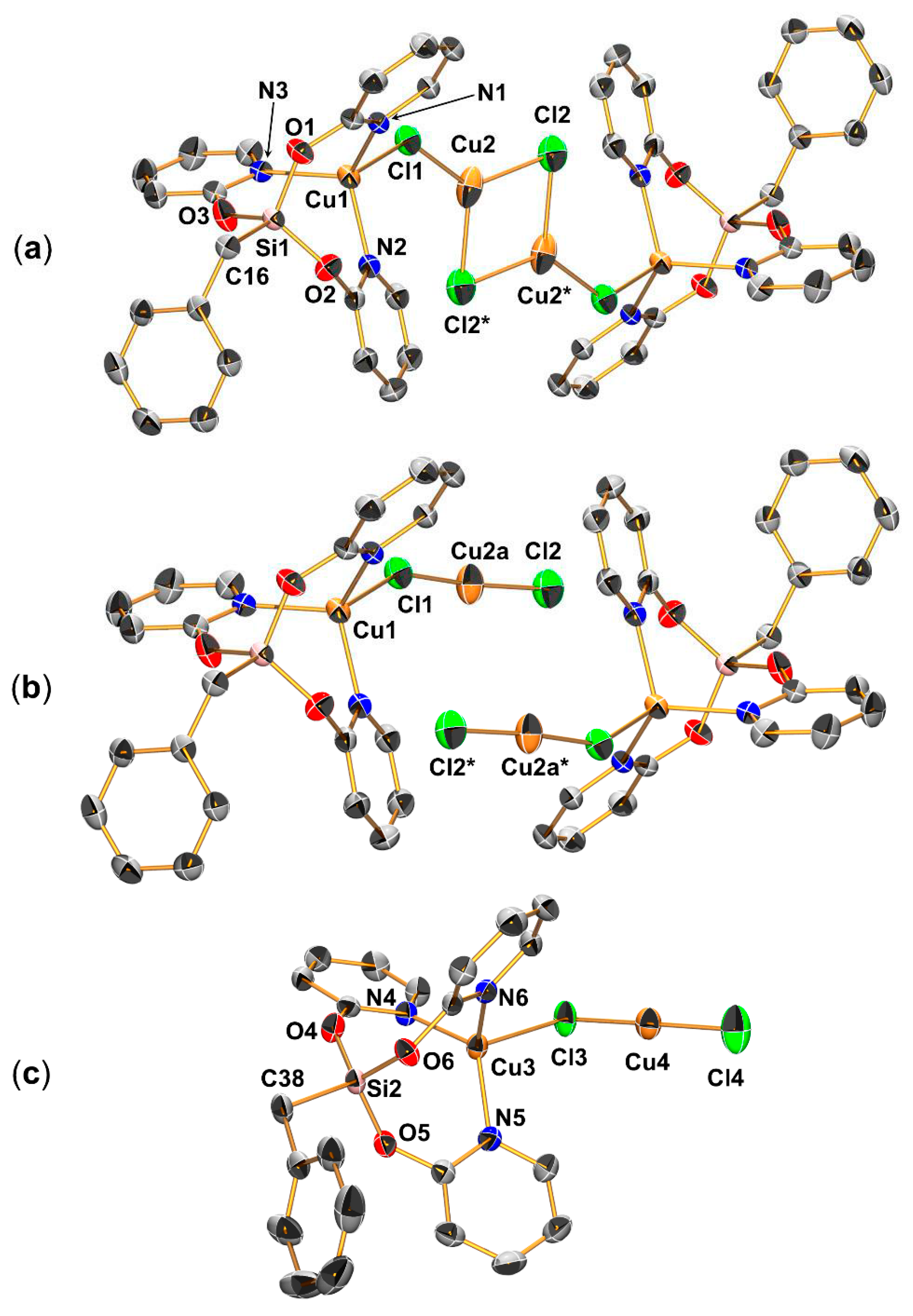
When treated with excess CuCl in THF as a solvent, L proved capable of dissolving up to two equivalents of copper(I) chloride, and greater excess remained practically insoluble. From such a solution, the product LCuClCuCl crystallized (Figure 3, Table A1). The crystallographic asymmetric unit features two independent molecules of LCuClCuCl, one of which resembles one half of a dimer with an inversion symmetric CuClCu(Cl)2CuClCu moiety in its predominant site occupancy, whereas the other one is a simple monomer with a chain-like CuClCuCl moiety (Figure 3a and Figure 3c, respectively). In both cases, the additional CuCl equivalent is formally bound to the Cl atom of the motif of the previously reported complex LCuCl with only marginal indication of Cl abstraction therefrom. Whereas in LCuCl [39] the Cu–Cl bond length is 2.334(1) Å, in LCuClCuCl the corresponding bond lengths Cu1–Cl1 (2.455(1) Å) and Cu3–Cl3 (2.437(1) Å) are ca. 0.1 Å longer. Interestingly, lengthening of the Cu–Cl bond is accompanied by significant shortening of the Si···Cu trans-annular distance (3.227(1) Å in LCuCl [39], Si1–Cu1 3.138(1) Å, and Si2–Cu3 3.130(1) Å in LCuClCuCl). Both effects, the Cu–Cl bond lengthening and the closer Si···Cu approach, result from a predominant formal shift of the Cu atom into the Si(pyO)3Cu cage, which is indicated by the pronounced widening of the N-Cu-N angles (in LCuClCuCl Σ(NCuN) = 343.7 deg and 343.5 deg for molecules 1 and 2, respectively, vs. 336.2 deg in LCuCl [39]) and less widening of the sum of O-Si-O angles (in LCuClCuCl Σ(OSiO) = 337.4 deg and 335.3 deg for molecules 1 and 2, respectively, vs. 332.7 deg in LCuCl [39]). The pronounced change in the out-of-plane(N3) location of the Cu atom (0.591(2) Å in LCuCl vs. 0.477(1) and 0.481(1) Å in LCuClCuCl) vs. the less pronounced change in the out-of-plane(O3) location of the Si atom (0.504(2) Å in LCuCl vs. 0.455(1) and 0.477(1) Å in LCuClCuCl) conveys the same picture.
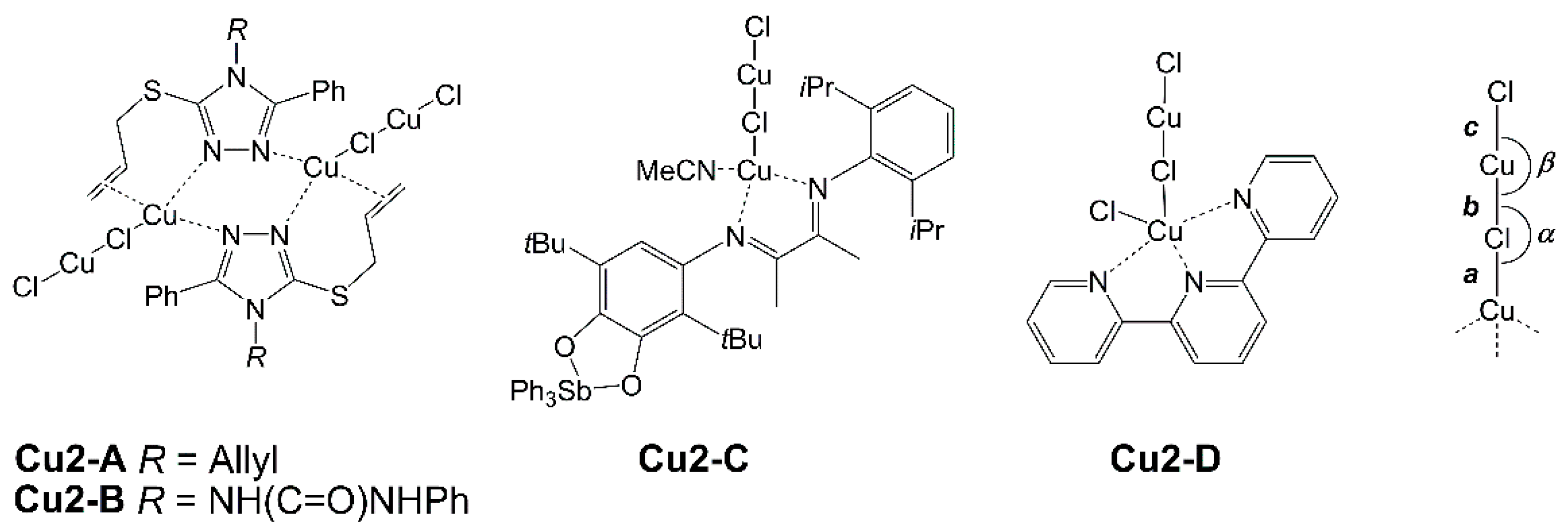
The Cu-Cl-Cu-Cl motif shown in Figure 3b,c has literature precedence of some other crystallographically characterized Cu(I) complexes: Cu2-A [47], Cu2-B [48], and Cu2-C [49] (Figure 4). Moreover, complexes with a related CuIIClCuICl motif were reported, e.g., compound Cu2-D [50]. Table 1 lists the bond lengths and angles (indicated as a, b, c, α, β in Figure 4, right) of these compounds for comparison with the related features of monomeric LCuClCuCl (Figure 3c).
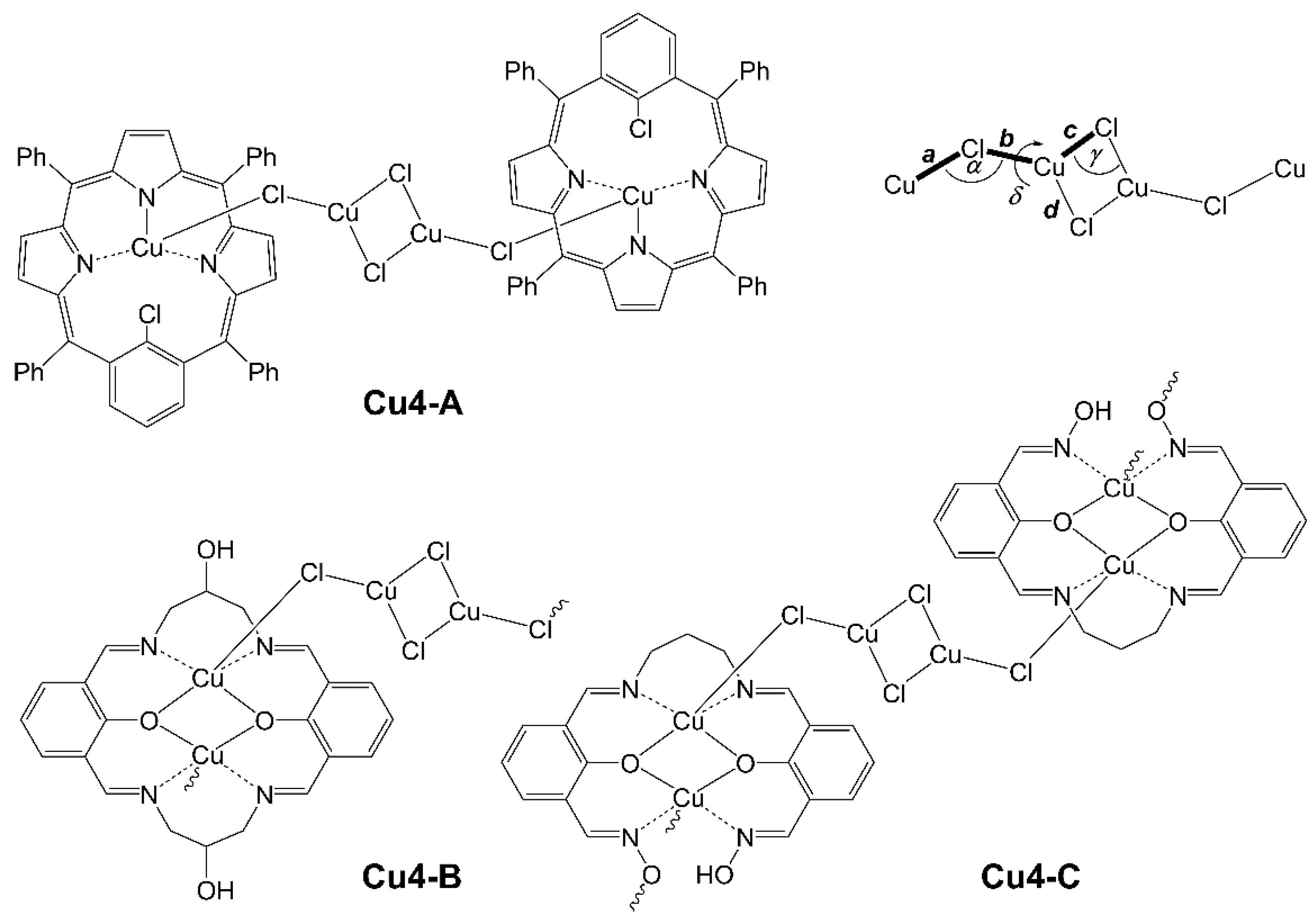
Compound Cu2-C, which also features a N3Cu-Cl-Cu-Cl motif, exhibits very similar bond lengths a, b, c as the monomer of LCuClCuCl. In contrast, the N2(alkene)Cu-Cl-Cu-Cl motifs of Cu2-A and -B exhibit markedly longer Cu–Cl bonds a (by 0.2 and 0.1 Å, respectively). In CuIIClCuICl complex Cu2-D, this distance is even longer, by 0.4 Å, and it can be interpreted as a weak end-on coordination of a linear [CuCl2] anion in apical position of an otherwise square-planar CuIIN3Cl coordination sphere. Regardless of the strength of binding of the formal anion moiety [CuCl2] to Cu(I) or Cu(II) via bond a at angle α, its bond lengths b and c are very similar for all compounds listed in Table 1, and the angle β is close to linearity in most cases. The deviation of the latter in case of Cu2-B could be a result of a disorder associated with the relevant Cu site. This disorder is related to the disorder encountered with compound LCuClCuCl as shown in Figure 3a,b, where a pair of molecules of a monomeric form with rather linear terminal ClCuCl moieties and a dimeric form with ClCu(Cl)2CuCl bridging moiety are found on the same site. Whereas in the case of LCuClCuCl, site occupancy is dominated by the dimer (ca. 89%), in the case of Cu2-B [48] it represents the minor part (ca. 21%). Nonetheless, it represents the only crystallographically characterized precedence of a Cu(I)-only CuClCu(Cl)2CuClCu motif. Further examples were reported for mixed-valence complexes with CuIIClCuI(Cl)2CuIClCuII pattern, i.e., Cu4-A [51], Cu4-B [52], and Cu4-C [53] (Figure 5). For comparison, Table 2 lists the bond lengths and selected angles of this motif for compounds LCuClCuCl (the part shown in Figure 3a), Cu2-C (disorder part of minor occupancy), Cu4-A, Cu4-B, and Cu4-C.
Whereas in the crystal structure of LCuClCuCl for molecular site 1 (cf. Figure 3a,b) the dimer clearly dominates the disorder, the related arrangement in the structure of compound Cu2-B [48] is less favorable, concluded from the minor occupancy of this part in the structural disorder. The Cl···Cl separations of the central Cu2Cl2 moiety (3.61 Å in LCuClCuCl vs. 3.80 Å in Cu2-C) provide an answer as to why the positioning of copper atom Cu2 in a bridging position is less favorable in the latter and results in a Cu2Cl2 motif with a short Cu–Cl bond (2.14 Å) and a markedly longer Cu···Cl contact (2.71 Å). In contrast, in LCuClCuCl and in the mixed-valence copper complexes Cu4-A, -B, -C, the lengths of the Cu–Cl bonds in the central four-membered cycle are similar to one another (in Cu4-A) or deviate to a minor extent (by up to 0.26 Å in Cu4-C). Interestingly, in the bond length patterns of the Cu-Cl-Cu(Cl)2Cu-Cl-Cu moiety, compounds LCuClCuCl and mixed-valence CuIICuI-complex Cu4-A exhibit the greatest similarity, irrespective of the different oxidation number of the terminal Cu atoms. One common feature of all complexes listed in Table 2 is the similarly sharp Cu-Cl-Cu angle γ of the four-membered cycle, which spans the range 75.1–79.4 deg. The Cu-Cl-Cu bond angle α at the two-coordinate Cl atom and the torsion angle δ, however, span very broad ranges. They represent very flexible features of the Cu-Cl-Cu(Cl)2Cu-Cl-Cu motif that can adopt to optimize packing interactions for crystallization.

2.3. Syntheses and Molecular Structures of the Tosylates LCuOTos and LAgOTos

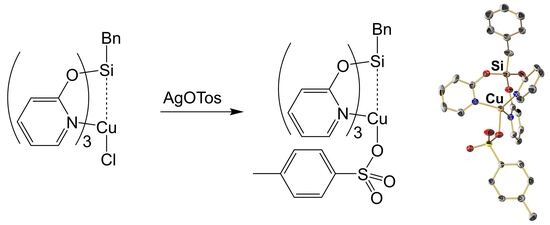
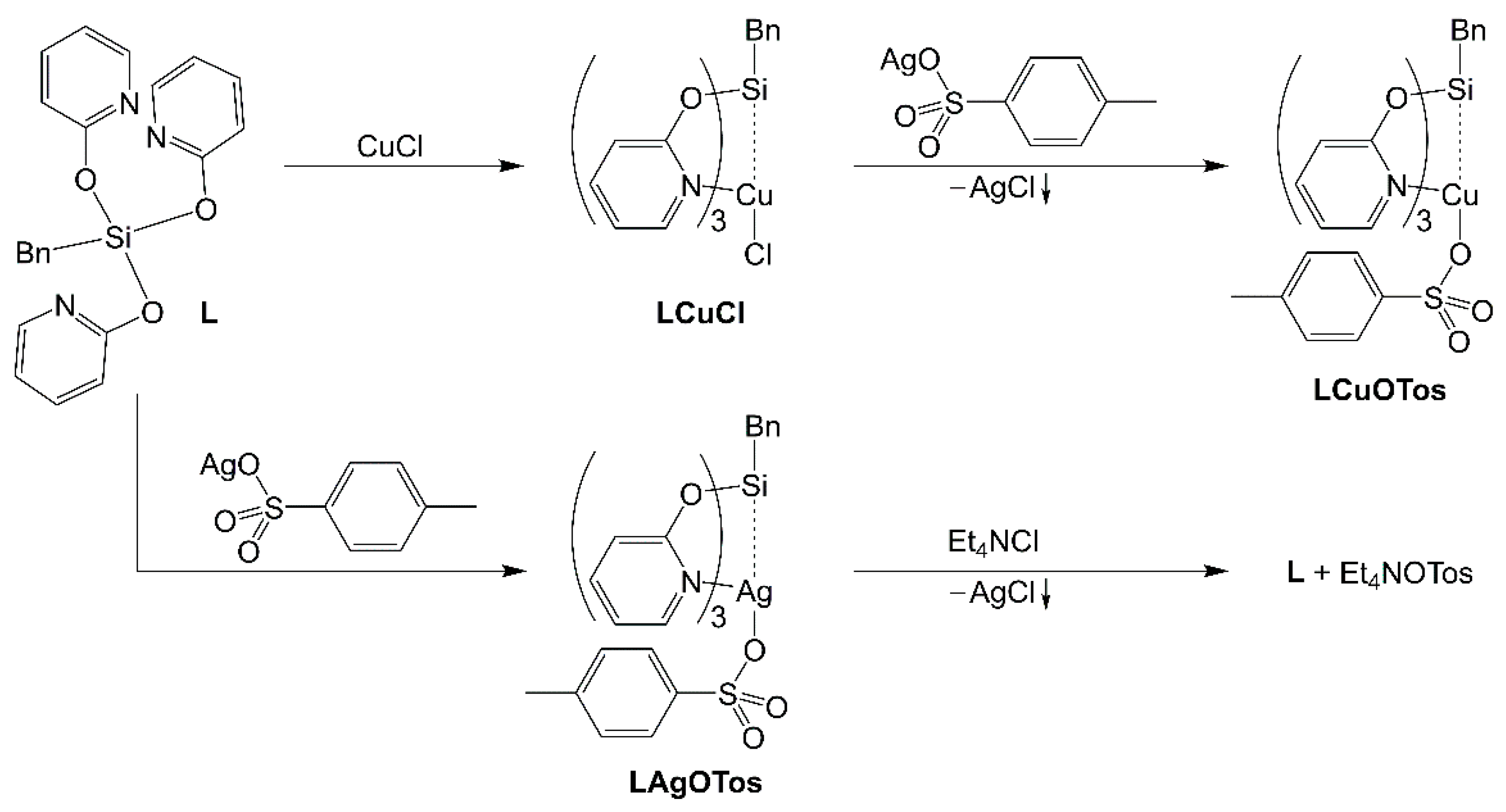
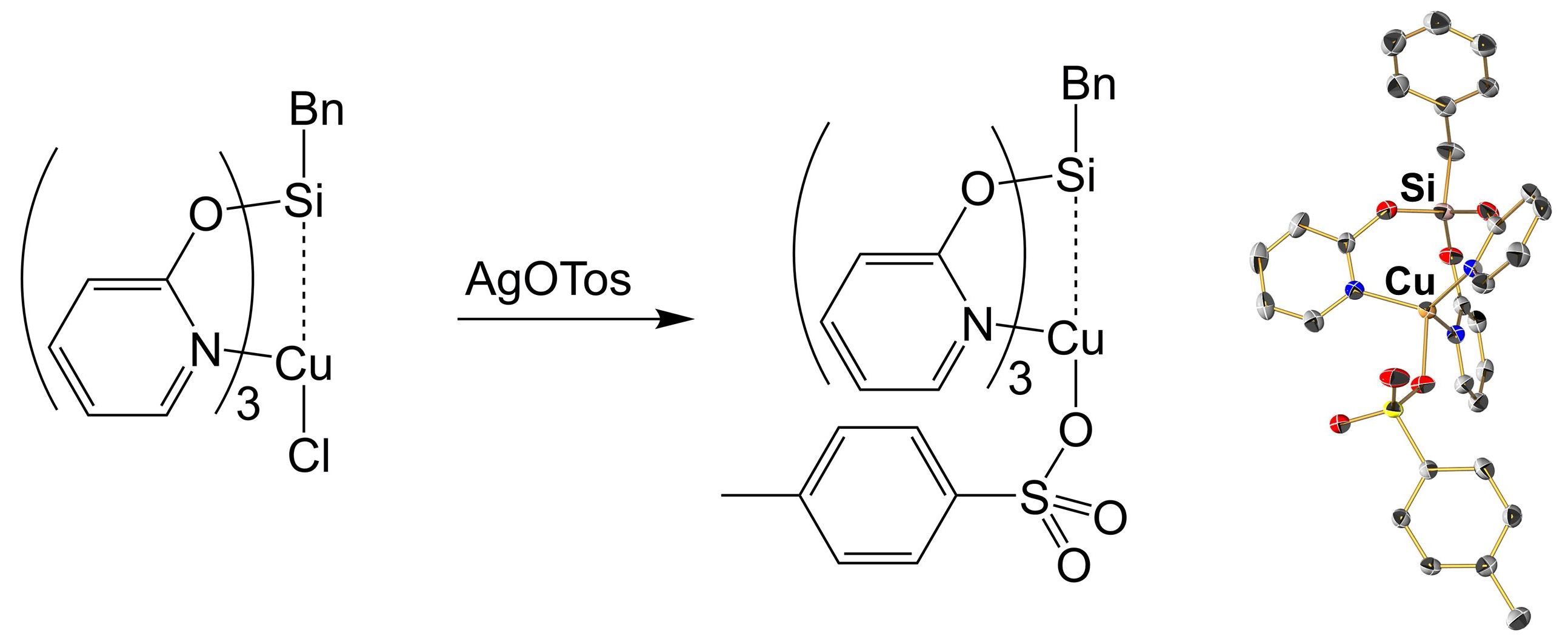
As the addition of a second equivalent of CuCl to LCuCl (i.e., the formation of LCuClCuCl) points at a potential way of Si–C activation (Cu–Cl bond lengthening, closer approach of Cu trans to the Si–C bond), the next experiment aimed at replacing chloride by a hard anion X with formation of a more ionic Cu–X bond. For this purpose, LCuCl was treated with one equivalent of silver p-toluenesulfonate (AgOTos) in THF for replacing Cl by OTos with formation of LCuOTos and AgCl (Scheme 4). In this context, we also probed the accessibility of the corresponding silver complex LAgOTos and its conversion into the corresponding chloro complex “LAgCl”. Whereas the tosylato complexes LMOTos (M = Cu, Ag) were accessible along the routes shown in Scheme 4, treatment of a CDCl3 solution of LAgOTos with one equivalent of tetraethylammonium chloride led to the precipitation of AgCl with liberation of silane L, as confirmed via NMR spectroscopy of the resultant solution. The latter experiment shows that the coexistence of L and AgCl is thermodynamically more favorable than the formation of a complex “LAgCl” under these conditions and that the initial complexation of the Ag atom in LAgOTos does not pose a sufficient kinetic barrier to prevent the release of AgCl under these conditions.
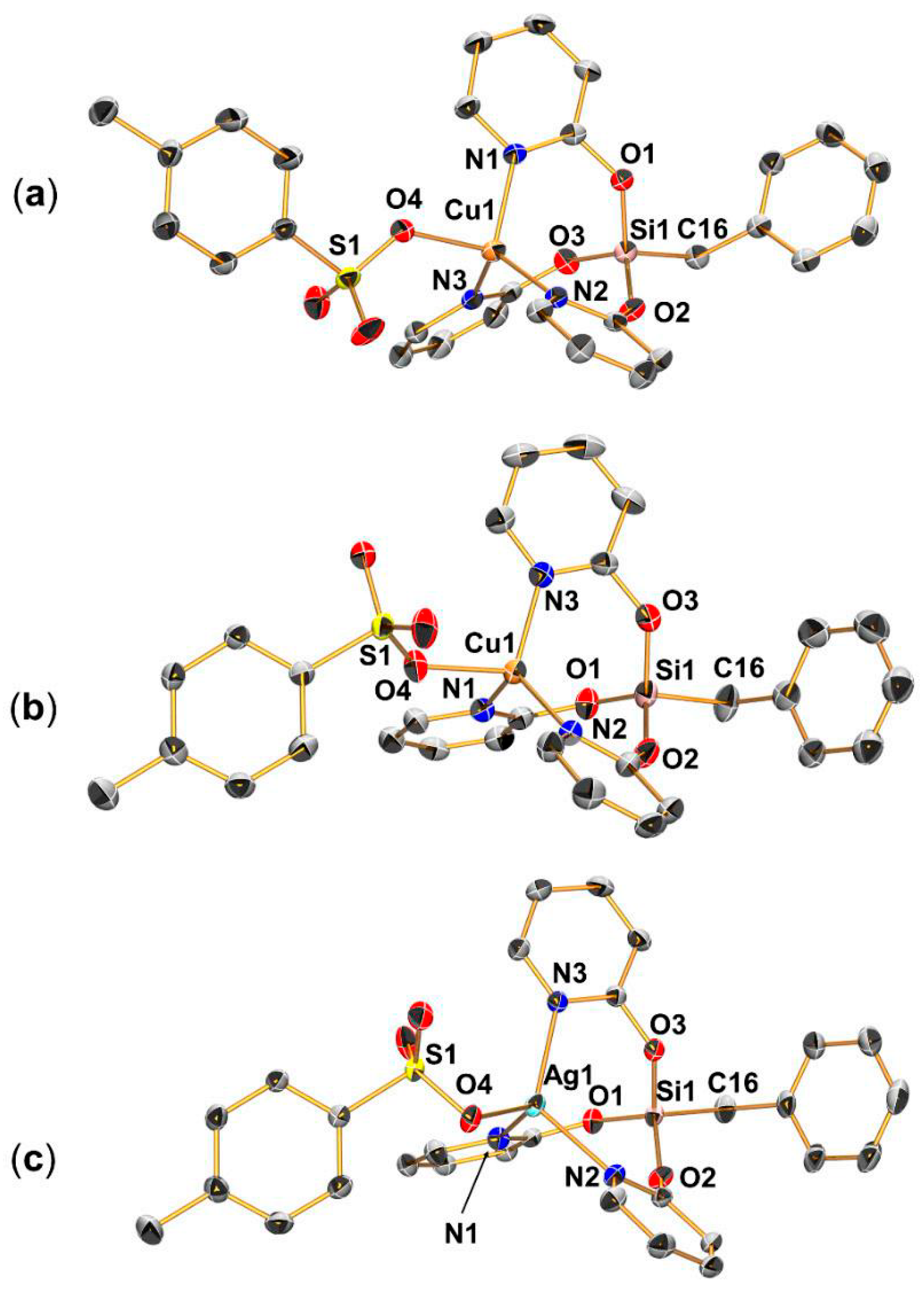
The new products LCuOTos and LAgOTos crystallized from THF solution upon slow addition of pentane (diffusion via gas phase). Whereas the silver complex LAgOTos crystallized within few days, the first crystallization experiment of LCuOTos afforded an oily product, which eventually crystallized over the course of some weeks and afforded crystals of two different modifications of LCuOTos in combination with a few crystals of the decomposition product [Cu(HpyO)6](OTos)2 (cf. Appendix A and Table A1) that had formed in the interim. Compounds LCuOTos and LAgOTos were characterized by single-crystal X-ray diffraction analyses, which confirmed the expected molecular structures (Figure 6, Table A2).
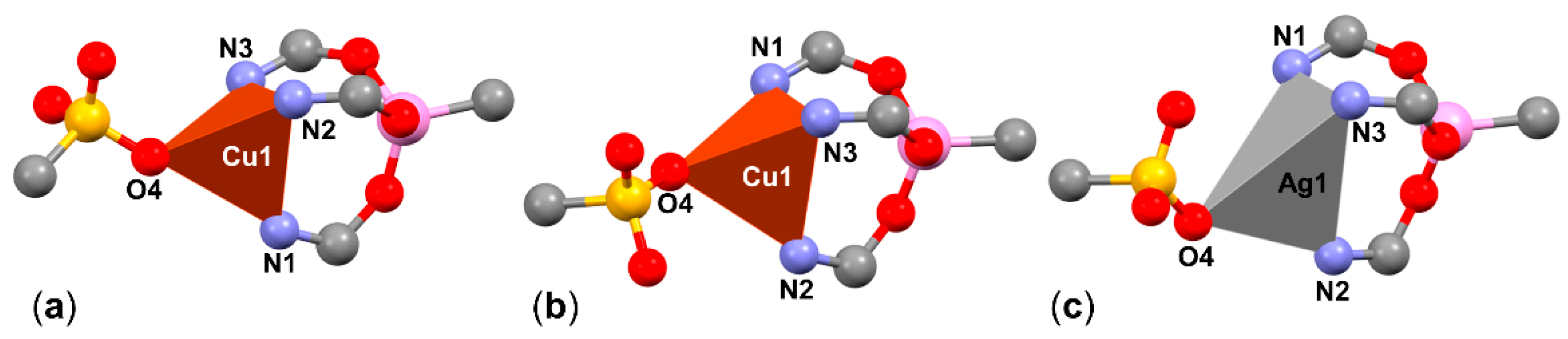
From compound LCuOTos, we obtained a major crystalline product, which consisted of multi-crystalline lumps, and the batch contained a single crystal in an isolated position. X-ray diffraction analyses confirmed that they belong to two different modifications of this compound. Whereas the modification represented by the isolated single crystal (modification 1, Figure 6a) has a slightly greater unit cell volume (by 0.8%) and exhibits some disorder of the tosylate group, the bulk product (modification 2, Figure 6b) formed small multi-crystals of poor diffraction power, which suffer from effects of stacking faults, but they exhibit a more compact unit cell and no disorder (cf. Table A2). In principle, the molecular shapes resemble the motif of LCuCl, i.e., silane L binding to Cu in a tripodal tridentate fashion, in combination with the Cu-bound anion (in this case tosylate) furnishing an almost tetrahedral Cu coordination sphere (cf. Figure 7a,b). The distortion of the latter is mainly determined by the formal approach of Cu toward the Si atom, which results in Cu···Si distances of 3.1177(9) and 3.0781(15) Å in modifications 1 and 2, respectively, associated with a widening of the three N-Cu-N angles (Σ(NCuN) = 343.4 and 345.9 deg, respectively). The out-of-plane(N3) location of the Cu atom (0.484(2) Å in modification 1 and 0.438(3) Å in modification 2) and the out-of-plane(O3) location of the Si atom (0.471(2) Å in modification 1 and 0.450(3) in modification 2) again point at the formal motion of the Cu atom toward the Si(pyO)3 cage as the predominant contribution to the shortening of the Si-Cu distance.
In the corresponding silver complex LAgOTos, the d10-metal coordination sphere is more distorted (Figure 7c). It exhibits two particularly small angles on opposing edges (O4-Ag1-N2 and N1-Ag1-N3), indicating a stretching of the tetrahedron in this direction. Moreover, the sum of N-Ag-N angles (327.9 deg) is markedly smaller than the corresponding values in the aforementioned copper complexes, which points at a displacement of the Ag atom out of this tripodal base. In fact, the out-of-plane(O3) location of the Si atom in LAgOTos (0.495(2) Å) is similar to the corresponding value in LCuCl 0.504(2) Å), but the out-of-plane(N3) location of the Ag atom (0.757(1) Å) is more pronounced than the corresponding displacement of the Cu atom in LCuCl (0.591(2) Å) and thus the cause of the slightly longer M-Si distance in LAgOTos (3.3245(7) Å). Even though this distance is ca. 0.25 Å longer than the Cu-Si distance in LCuOTos modification 2, it corresponds to a similarly close M-Si-approach with respect to the sum of the van der Waals radii (88% for LCuOTos modification 2, 87% for LAgOTos) [54].
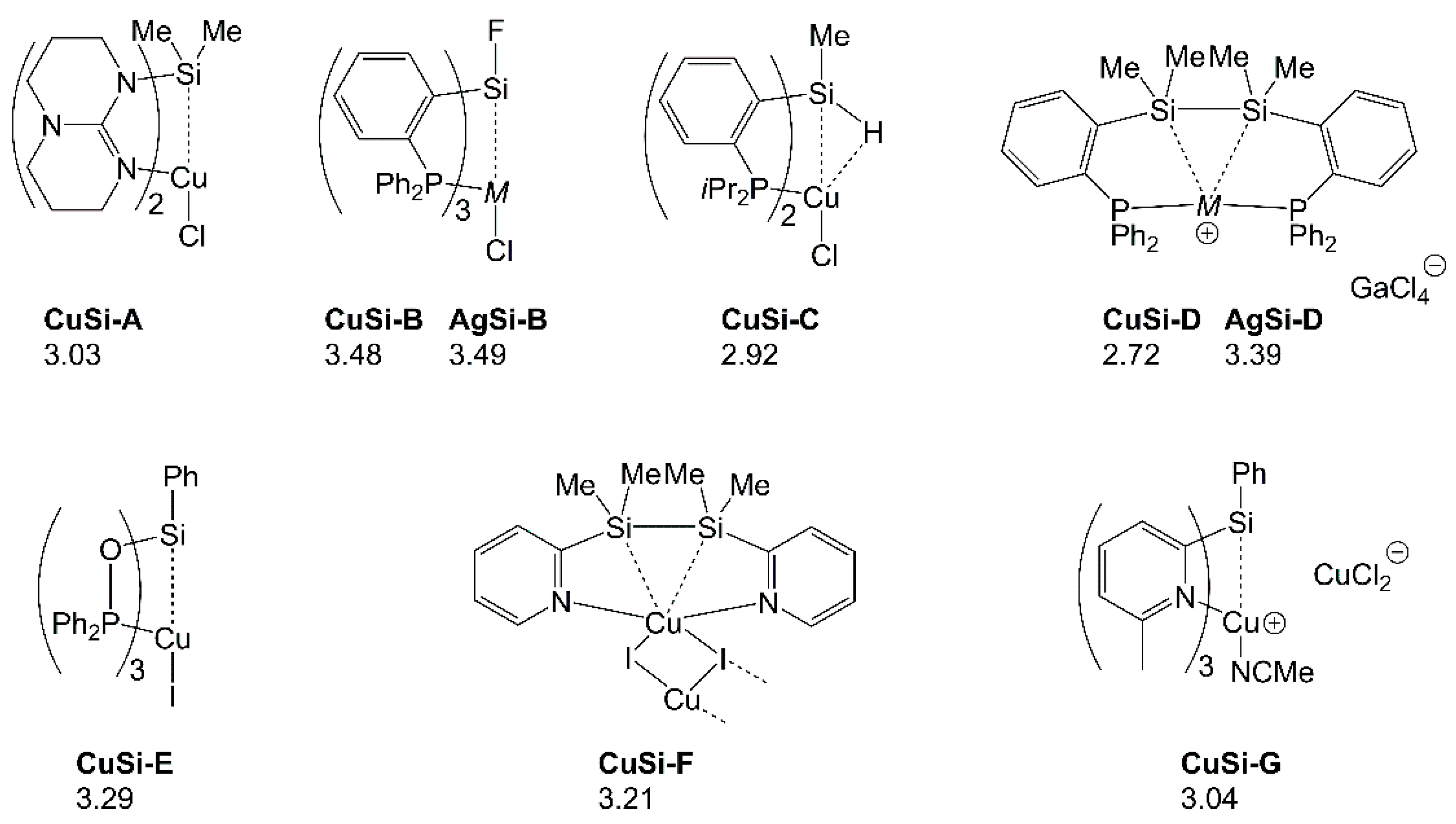
The polarization of the Cu–Cl bond of LCuCl by additional CuCl (in LCuClCuCl) or its substitution by a more polar Cu–OTos bond cause average shortening of the Cu–N bonds (ΣCu–N = 6.16, 6.06 (both CuN3 sites), 6.08, and 6.04 Å in LCuCl, LCuClCuCl, LCuOTos modification 1, and modification 2, respectively). The Si–O bond lengths, however, change only marginally (ΣSi–O = 4.89; 4.86 and 4.88; 4.88, 4.87, and 4.86 Å in LCuCl, LCuClCuCl, LCuOTos modification 1, modification 2, and LAgOTos, respectively). Thus, from the perspective of bond lengths and other molecular metric parameters, the Si coordination spheres of the herein reported complexes are hardly influenced by the changes in the group 11 metal or its coordination sphere. Of note, the Cu-Si and Ag-Si distances observed with the herein reported compounds are among the shortest contacts encountered with such compounds that feature three-atomic bridges between Si and the coinage metal atom. Examples of other crystallographically characterized compounds with short M···Si contacts (M = Cu, Ag) are shown in Figure 8. A shorter contact was observed with CuSi-A [55], whereas in phosphane bridged complexes CuSi-B [56] and AgSi-B [56] the corresponding atom separations are longer. We attribute the markedly short Cu···Si contact in CuSi-A to the combination of the rather rigid Cu-N-bound ligand and the low Cu-coordination number. Introduction of an additional mono-atomic bridge (like a bridging H atom, in CuSi-C [57]) or the use of di-atomic bridges (like in CuSi-D [58], AgSi-D [58] and CuSi-E [59]) forces the metal atom closer to the Si atom. In complexes with di-atomic bridges, rather rigid Cu-N-bound bridging ligands may also support shorter Cu···Si contacts, e.g., in CuSi-F [60] and CuSi-G [61]. Among the examples shown in Figure 8, compound CuSi-D [58] is particularly noteworthy as it exhibits a surprisingly short Cu-Si distance, which is the result of a special bonding interaction, i.e., electron pair donation from the Si–Si σ-bond toward the Cu+ cation.

2.4. NMR Spectroscopic Characterization of LCuClCuCl, LCuOTos, and LAgOTos

In their 1H and 13C NMR spectra, the compounds LCuClCuCl (in THF-d8), LCuOTos (in CDCl3), and LAgOTos (in CDCl3) produce the expected sets of signals (cf. Figures S19, S20, S22–S24, S26–S28, respectively, in the Supplementary Materials), which are consistent with the patterns observed for LCuCl and related complexes of the type RSi(pyO)3CuCl [39], i.e., the spectra exhibit one set of 1H and 13C signals for the three chemically equivalent pyO moieties and the set of signals for the Si-bound benzyl group. In addition, the expected signals of the tosylate group in LMOTos (M = Cu,Ag) are present. Noteworthy for the 1H and 13C spectra is the observation that only in the case of LAgOTos the signals associated with the pyO groups are markedly broadened in a way comparable to the broadening observed with the corresponding signals of LCuCl and related complexes of the type RSi(pyO)3CuCl [39].
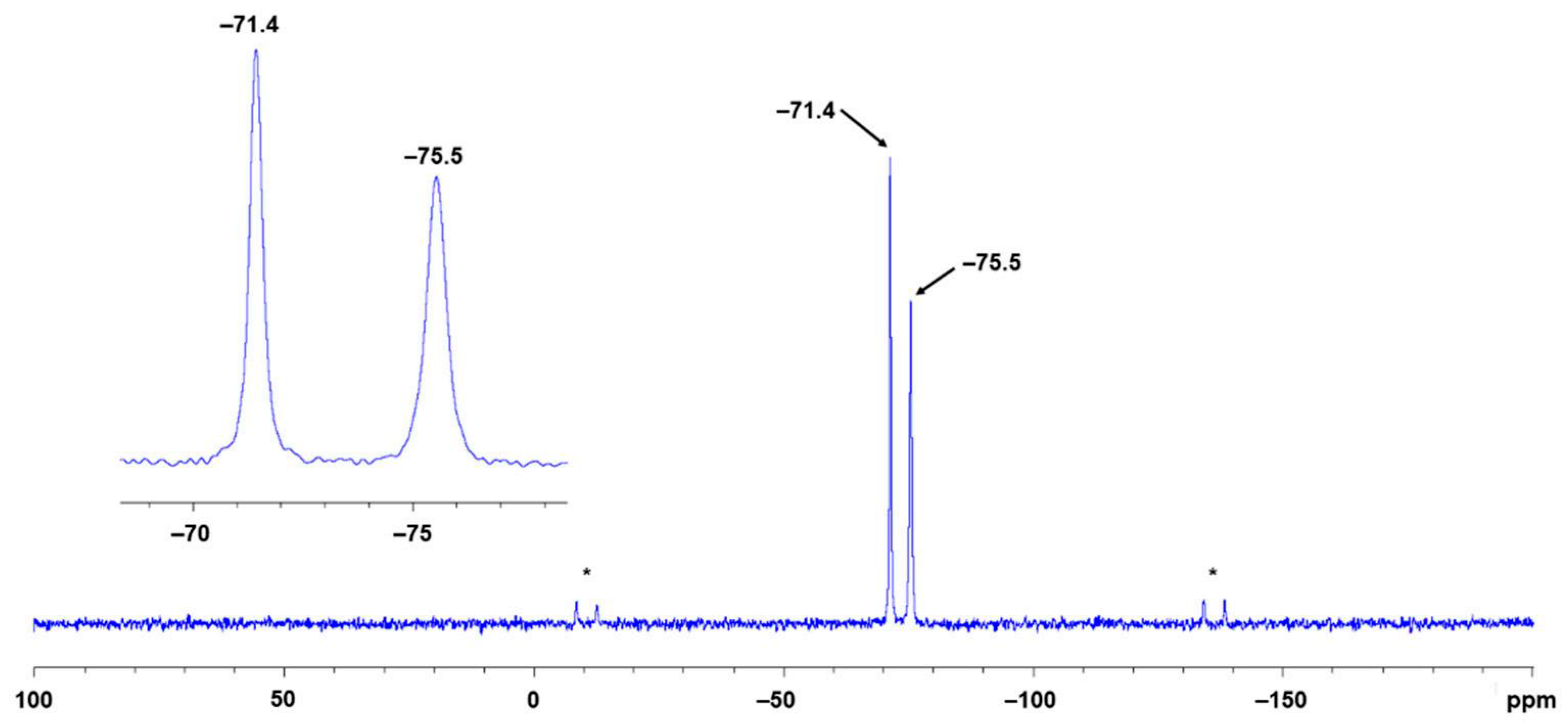
Within the series of the herein reported compounds, all of which basically feature a BnSi(O-py)3···M (M = Cu, Ag) coordination sphere, 29Si NMR spectroscopy is a helpful tool to elucidate the effects of the metal M in the Si coordination sphere in the individual complexes. In our previous study [39], we already reported for L and LCuCl that the presence of Cu in the Si coordination sphere causes an upfield shift in the 29Si NMR signal of the ligand L (δ = −54.7 ppm in CDCl3) to δ = −72.1 and −67.6 ppm for LCuCl in CDCl3 and in the solid state, respectively. A computational analysis of 29Si NMR shifts for a related ligand (PhSi(pyO)3) and its LiCl complex (PhSi(pyO)3LiCl) indicated that the mere coordination of the pyO nitrogen atoms to a cation (Li+) may cause such a marked upfield shift Δδ of −18 ppm. This determines the view point of the following interpretation. Comparison of some molecular features derived from crystal structure analyses of LCuCl, LCuClCuCl, and LCuOTos (vide supra) has revealed some shortening of the Cu···Si separations along this series, a formal approach of Cu toward Si, and an average shortening of the Cu–N bond lengths in combination with the development of a more polar bond (lengthening of the Cu–Cl bond or replacing it by a Cu–O bond) trans to Cu···Si. The latter should lower the Cu atom’s capability of acting as a lone pair donor toward Si. Nonetheless, similar or enhanced upfield shifts in the 29Si NMR signals are also observed for LCuClCuCl (δiso = −71.4 and −75.5 ppm in the solid state, cf. Figure 9, and −71.1 ppm in THF-d8 solution) and LCuOTos modification 2 (δiso = −75.5 ppm in the solid state, δ = −74.4 ppm in CDCl3 solution). Thus, we interpret the structural effects on the 29Si NMR shifts in these compounds predominantly as the results of enhanced coordination of the pyO nitrogen atoms to the more positively polarized Cu atoms rather than the effects of enhanced Cu⟶Si lone pair donation. In addition to the more upfield shifted signals relative to that of LCuCl in the solid state, the 29Si CP/MAS spectrum of LCuClCuCl bears another noteworthy feature. The two signals of the two crystallographically independent Si sites exhibit the same intensity (by integration) but different line width (cf. inset in Figure 9). As one of the two molecular sites is affected by a disorder (cf. Figure 3a,b), we assign this signal to the Si site labeled Si1 and the enhanced width of the signal to slightly different Si1 coordination spheres arising from the different disorder positions.
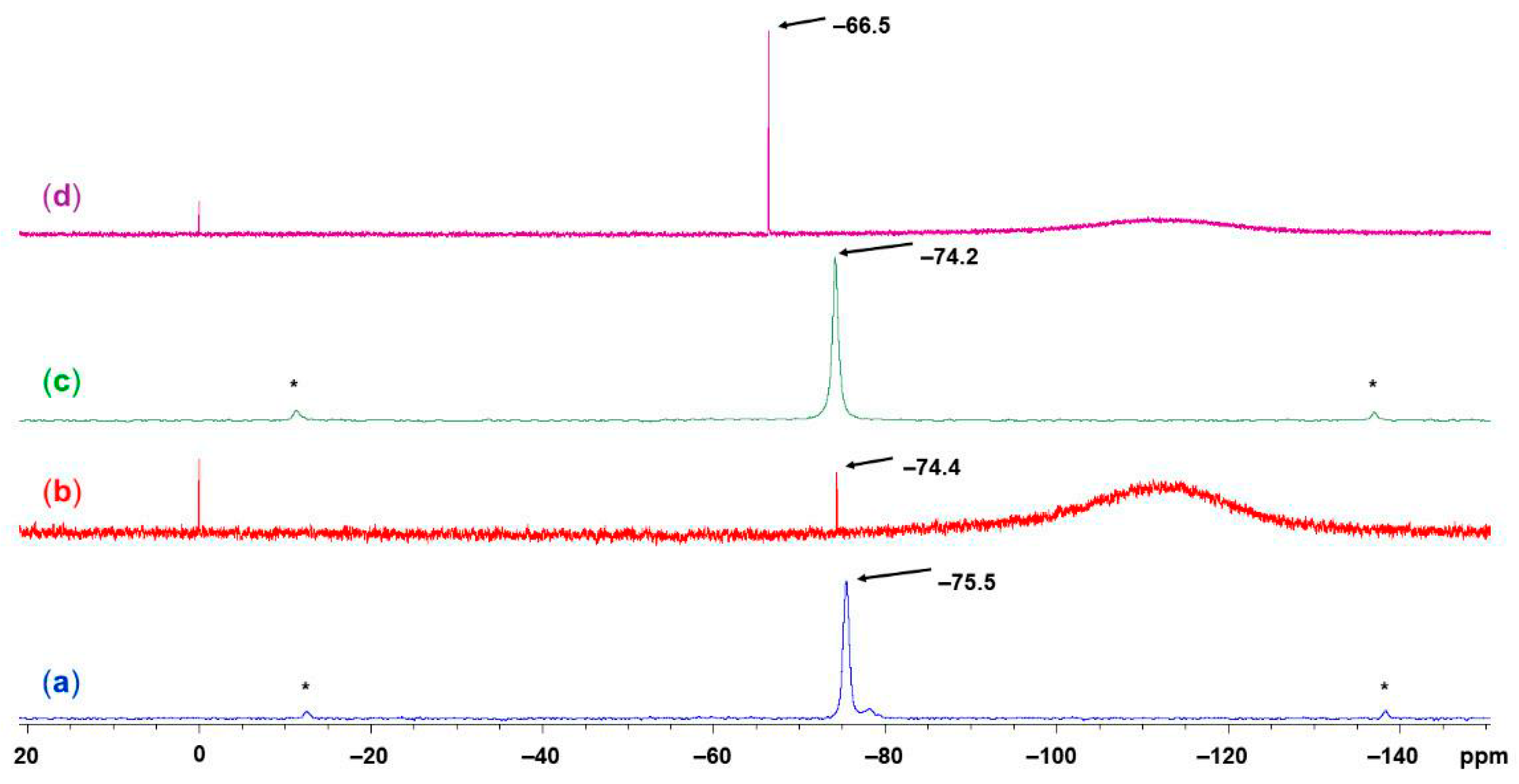
In contrast to LCuOTos, which exhibits similar 29Si chemical shifts in the solid state and in CDCl3 solution (Figure 10a,b), the corresponding silver complex LAgOTos is more responsive to this change in state (Figure 10c,d). In the 29Si CP/MAS NMR spectrum, it gives rise to a signal at δiso = −74.2 ppm, quite similar to its Cu-analog. In CDCl3 solution, however, the signal emerges at δ = −66.5 ppm. In terms of the interpretation of the other 29Si NMR shifts, this downfield shift would point at weaker N–Ag coordination in solution, perhaps accompanied by an enhanced average Ag···Si separation. NMR data of other nuclei of LAgOTos (e.g., the aforementioned signal broadening observed in 1H and 13C spectra, and the 109Ag NMR data, vide infra) add support to this picture.
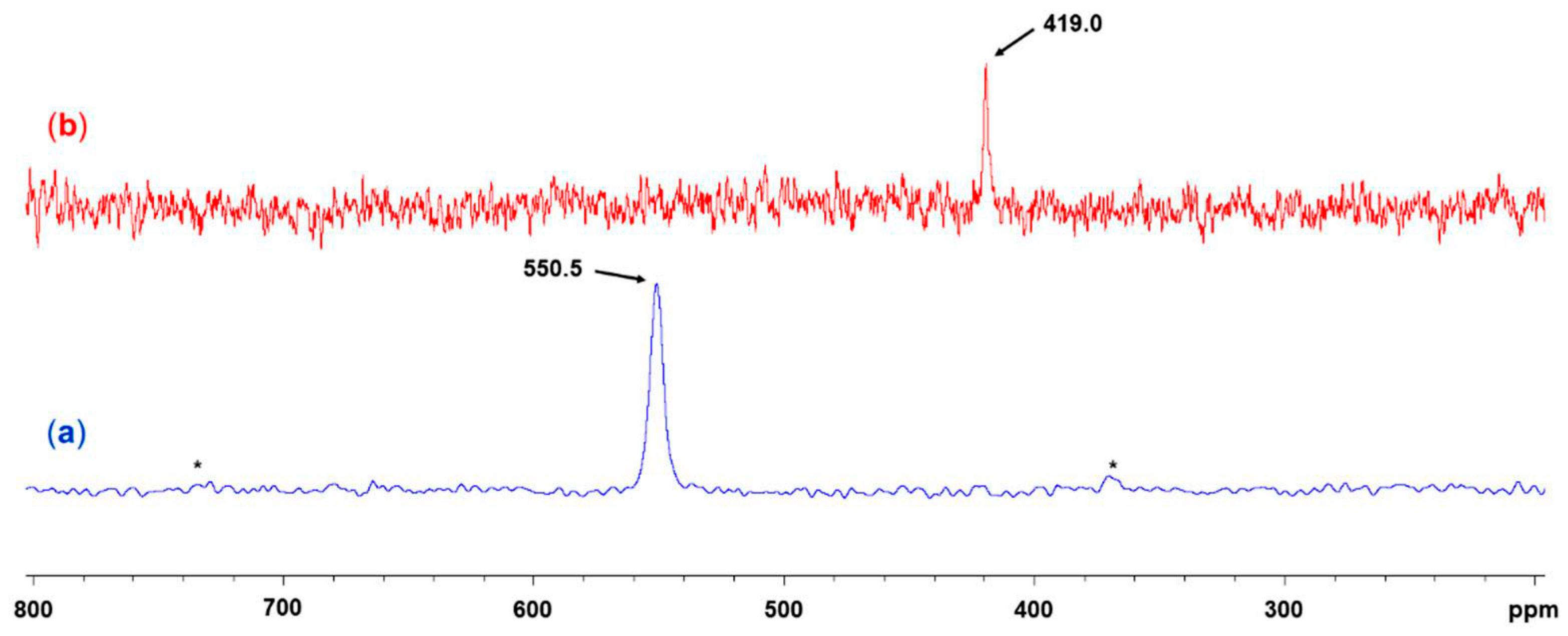
109Ag NMR spectroscopy is a useful tool to gain information about the bonding situation of this metal in various compounds, because the spin ½ nucleus basically allows for acquisition of spectra, which in case of their light coinage metal (63Cu) congeners are hampered by the features of the quadrupolar nucleus. Thus, for example, compounds such as silver halides were studied 109Ag NMR spectroscopically in the solid state some decades ago [62], and in very recent investigations of silver(I) complexes of N-heterocyclic carbenes, 109Ag NMR spectroscopy was shown to be a useful probe for interactions with (and Brønsted acidities of) various surfaces [63]. For compound LAgOTos, the 109Ag NMR spectra (Figure 11), recorded from the solid and the CDCl3 solution, provide some information about changes in the Ag coordination sphere upon dissolving. The 109Ag NMR signal of solid LAgOTos (δiso = 551 ppm) is, in principle, well in accordance with tetracoordinate silver(I). This shift falls in the shift range of compounds such as silver sulfite (δiso = 466.1 and 409.5 ppm for the two crystallographically independent Ag sites, which feature AgO4 and AgSO3 coordination spheres) or tetramethylammonium dichloroargentate(I), which features chains of AgCl4 tetrahedra (δiso = 649.5 ppm) [64]. Moreover, the absence of larger spinning side bands in the CP/MAS spectrum recorded at υrot = 6 kHz (corresponding to a distance of ±185 ppm from the isotropic shift signal) is speaking for a rather narrow span of the chemical shift tensor, also in accordance with the rather tetrahedral coordination sphere observed in the crystal structure of LAgOTos. In CDCl3 solution, the 109Ag NMR signal is shifted to higher field (δ = 419 ppm). Even though this chemical shift is still representative of tetracoordinate Ag, the noticeable shift difference to the solid state (a Δδ of −132 ppm) is speaking for changes in the coordination sphere. The observations of solid- vs. solution-state 29Si and 109Ag NMR spectroscopy, in combination with the findings of 1H and 13C NMR spectra of CDCl3 solutions of LAgOTos (broad signals associated with the atoms of the pyO moieties, cf. Figures S26–S28 in the Supplementary Materials), point at partial release of N–Ag coordination in solution, Ag-coordinated and dangling pyO arms of L being in exchange. In principle, Ag-O coordination by additional tosylate O atoms may be a reason for the retention of the Ag coordination number (An example of O2Ag chelating coordination of tosylate within an AgN2O2 coordination sphere with two pyridine N atoms has been reported by Zhang et al. [65]).

3. Materials and Methods

3.1. General Considerations

BnSi(pyO)3 (L), CuCl, and LCuCl were available from previous studies [39]. AgOTos (Fluka, Memmingen, Germany, >96%) was used as received without further purification. Benzaldehyde (Sigma-Aldrich, Steinheim, Germany) was distilled under argon atmosphere and stored in a Schlenk flask under dry argon prior to use. THF (VWR, Darmstadt, Germany, 99.7%) was stored over Na-wire. CDCl3 (Armar Chemicals, Döttingen, Switzerland, 99.8%), CHCl3 (Honeywell, Offenbach am Main, Germany, >99.5%), THF-d8 (Deutero, Kastellaun, Germany, 99.8%), acetonitrile-d3 (Deutero, Kastellaun, Germany, 99.8%), toluene-d8 (Armar Isotopes, Leipzig, Germany, 99.5%), and n-pentane (VWR, Darmstadt, Germany, 99.8%) were stored over activated molecular sieves (3 Å) for at least 7 days and used without further purification. All reactions were carried out under argon atmosphere utilizing standard Schlenk techniques. For syringe filtration, PTFE syringe filters of 15 mm diameter and 0.2 μm pore size (Roth, Karlsruhe, Germany) were used.
Solution NMR spectra (1H, 13C, 15N, 29Si) were recorded on a Bruker Nanobay 400 MHz spectrometer. 1H, 13C, and 29Si chemical shifts are reported relative to SiMe4 (0 ppm) as internal reference, 15N chemical shifts are reported relative to ammonia. The solution state 109Ag NMR measurement was carried out on a Bruker Biospin 500 MHz AV III instrument using a 5 mm BBFO probe (SF(109Ag) = 23.27 MHz). 109Ag chemical shifts are referenced to saturated AgNO3 in D2O (0 ppm) [66]. 29Si CP/MAS NMR spectra were recorded on a Bruker Avance 400 WB spectrometer using 4 mm zirconia (ZrO2) rotors and an MAS frequency of υrot = 5 kHz. The 29Si chemical shift is reported relative to SiMe4 (0 ppm) and was referenced externally for 29Si to octakistrimethylsiloxyoctasilsesquioxane Q8M8 (most upfield signal of Q4 groups at δiso = −109 ppm). The 109Ag CP/MAS NMR spectrum was measured at a Bruker Biospin 700 MHz Avance NEO instrument equipped with 3.2 mm low gamma DVT CP/MAS probe (SF(109Ag) = 32.59 MHz). A thin walled ZrO2 rotor was used, the applied contact time was 30 ms at a spinning speed of υrot = 6 kHz. The cross-polarization conditions were optimized using silver acetate and verified with silver tosylate [67,68].
For single-crystal X-ray diffraction analyses, crystals were selected under an inert oil and mounted on a glass capillary (which was coated with silicone grease). Diffraction data were collected on a Stoe IPDS-2/2T diffractometer (STOE, Darmstadt, Germany) using Mo Kα-radiation. Data integration and absorption correction were performed with the STOE software XArea (version 2.3) and XShape (version 2.25), respectively. The structures were solved by direct methods using SHELXT [69] and refined with the full-matrix least-squares methods of F2 against all reflections with SHELXL-2019/3 [70,71,72]. All non-hydrogen atoms were anisotropically refined, hydrogen atoms were isotropically refined in idealized position (riding model). For details of data collection and refinement see Appendix B, Table A1 and Table A2. Graphics of molecular structures were generated with ORTEP-3 [73,74], POV-Ray 3.7 [75], and MERCURY [76]. CCDC 2512147 (LCuClCuCl), 2512148 (LCuOTos mod1), 2512149 ([Cu(HpyO)6](OTos)2), 2512150 (LCuOTos mod2), and 2512151 (LAgOTos) contain the supplementary crystal data for this article. These data can be obtained free of charge from the Cambridge Crystallographic Data Centre via https://www.ccdc.cam.ac.uk/structures/ (accessed on 30 November 2025).

3.2. Syntheses and Characterization

  • Compound LCuClCuCl
A Schlenk flask was charged with magnetic stirring bar, compound L (0.473 g, 1.18 mmol), and CuCl (0.293 g, 2.96 mmol), evacuated and set under argon atmosphere. After adding THF (3 mL), the mixture was stirred at room temperature for 1 h. The solution was separated from the remaining solid material via syringe with a syringe filter. As storage of the product solution at 5 °C for 3 d and at −24 °C for another 3 d did not afford any solid product, the solution was connected to a second Schlenk flask containing n-pentane (2 mL) for slow diffusion via gas phase. Crystals of the product, compound LCuClCuCl, formed within 24 h. Thereafter, the supernatant was removed by decantation, and the crystals were dried in vacuum. Yield: 0.402 g (0.67 mmol, 57%). 1H NMR (THF-d8): δ (ppm) 8.87 (d 4.2 Hz, 3H, H6), 7.79 (m, 3H, H4), 7.44 (d 7.4 Hz, 2H Ph-o), 7.31 (m, 2H, Ph-m), 7.15 (t 7.5 Hz, 1H Ph-p), 7.10 (m, 3H, H5), 6.95 (d 8.2 Hz, 3H, H3), 2.83 (s, 2H, CH2); 13C{1H} NMR (THF-d8): δ (ppm) 158.7 (C2), 149.2 (C6), 141.9 (C4), 136.1 (Ph-i), 130.0, 129.4 (Ph-o/m), 126.3 (Ph-p), 120.9 (C5), 115.5 (C3), 22.0 (CH2); 29Si{1H} NMR (THF-d8): δ (ppm) −71.1; (CP/MAS): δiso (ppm) −71.4, −75.5.
  • Compound LCuOTos
Compound LCuCl (0.335 g, 0.67 mmol) was filled into a Schlenk flask with magnetic stirring bar under dry argon atmosphere. Upon addition of solid AgOTos (0.163 g, 0.67 mmol), the Schlenk flask was evacuated and set under argon atmosphere again, whereupon chloroform (1 mL) was added, and the mixture was stirred for 5 min at room temperature. During that time, the crystals of the starting materials dissolved, and a fine white precipitate formed. Thereafter, the solution was separated from the fine solid material via syringe with a syringe filter and transferred into another Schlenk tube, which was then charged with a seed crystal from an earlier batch (positioned slightly above the level of the solution) before it was connected to another Schlenk flask containing n-pentane (2 mL) for slow diffusion via gas phase. Crystals of the product, compound LCuOTos, formed within 72 h at room temperature. Thereafter, the supernatant was removed by decantation, and the crystals were washed two times with a mixture of CHCl3 and n-pentane (2 × 0.2 mL of CHCl3:n-pentane 2:1) and dried in vacuum. Yield: 0.092 g (0.15 mmol, 22%). 1H NMR (CDCl3): δ (ppm) 8.89 (d 4.2 Hz, 3H, H6), 8.35 (br., 2H, tosylate-o), 7.66 (m, 3H, H4), 7.2–7.4 (mm, 7H, Ph and tosylate-m), 7.04 (m, 3H, H5), 6.79 (d 8.1 Hz, 3H, H3), 2.72 (s, 2H, CH2), 2.43 (s, 3H, CH3); 13C{1H} NMR (CDCl3): δ (ppm) 157.3 (C2), 149.0 (C6), 141.6, 140.7 (tosylate), 140.0 (C4), 135.4 (Ph-i), 129.1 (tosylate CH), 128.9, 128.7 (Ph-o/m), 127.0 (tosylate CH), 125.7 (Ph-p), 120.1 (C5), 113.9 (C3), 22.1, 21.3 (CH2, CH3); 29Si{1H} NMR (CDCl3): δ (ppm) −74.4; (CP/MAS): δiso (ppm) −75.5.
  • Compound LAgOTos
Compound L (0.431 g, 1.07 mmol) was filled into a Schlenk flask with magnetic stirring bar under dry argon atmosphere, and solid AgOTos (0.301 g, 1.08 mmol) was added, whereupon the flask was evacuated and set under argon atmosphere again. After adding THF (2 mL), the mixture was stirred for 1 h at room temperature to afford an almost clear solution. The solution was separated from the turbidity via syringe with a syringe filter and transferred into a new Schlenk flask, which was then connected to another Schlenk flask containing n-pentane (2 mL) for slow diffusion via gas phase. The crystalline solid product, compound LAgOTos, formed within 24 h at room temperature. Thereafter, the supernatant was removed via decantation, and the crystals were washed with a mixture of THF and n-pentane (2 × 1.5 mL of THF–n-pentane 2:1) and dried in vacuum. Yield: 0.605 g (0.89 mmol, 83%). 1H NMR (CDCl3): δ (ppm) 8.36 (br., 3H, H6), 7.92 (d 8.1 Hz, 2H, tosylate-o), 7.63 (m, 3H, H4), 7.10–7.30 (mm, 7H, Ph and tosylate-m), 6.96 (br., 3H, H5), 6.72 (d 8.3 Hz, 3H, H3), 2.80 (s, 2H, CH2), 2.33 (s, 3H, CH3); 13C{1H} NMR (CDCl3): δ (ppm) 158.6 (C2), 149.1 (C6), 142.6 (tosylate), 141.1 (C4), 139.6 (tosylate), 134.4 (Ph-i), 128.8, 128.7 (2×) (Ph-o/m, tosylate CH), 126.2 (tosylate CH), 125.8 (Ph-p), 119.8 (C5), 114.3 (C3), 21.7, 21.3 (CH2, CH3); 29Si{1H} NMR (CDCl3): δ (ppm) −66.5; (CP/MAS): δiso (ppm) −74.2; 109Ag{1H} NMR (CDCl3): δ (ppm) 419.0; (CP/MAS): δiso (ppm) 550.5.

4. Conclusions

Under the conditions applied (moderately polar solvents such as chloroform and THF, room temperature), the Si–C bond of benzylsilane BnSi(pyO)3 (L) resists cleavage and transfer to an electrophile (benzaldehyde), both in the absence and presence of CuCl. Instead, in the former case, in a dynamic equilibrium the aldehyde group undergoes addition of the Si-bound pyridine-2-olate with binding of the pyridine N-atom to the carbonyl C atom and formation of an Si–O bond to the alcoholate thus formed. In the latter case, the formation of complexes such as LCuCl (in chloroform) and LCuClCuCl (in THF and in the presence of excess CuCl) is preferred. Also, replacing chloride by tosylate (formation of complex LCuOTos upon treating LCuCl with AgOTos) did not lead to Si–C cleavage in the presence of benzaldehyde. Nonetheless, in LCuClCuCl and LCuOTos the Cu atoms are closer to Si than in the parent complex LCuCl, which may indicate at a potential way of activating the trans-disposed Si–C bond. In contrast to the copper(I) complexes, silver(I) is a less favored electrophile in the tripodal ligand L. LAgOTos was obtained from the reaction of L and AgOTos, but treatment with chloride (Et4NCl) caused precipitation of AgCl with liberation of L. Moreover, solution NMR spectroscopic investigations of LCuOTos and LAgOTos showed that the latter is more prone to changing the metal coordination sphere in solution. In the solid complexes LCuOTos and LAgOTos, however, Cu(I) and Ag(I) approach the Si atom in a similar manner, i.e., establishing contacts which are markedly shorter than the sum of the van der Waals radii (88% and 87%, respectively). In addition to yielding a new complex with very short nonbonding Si···Ag contact, the structural features of LAgOTos motivate us to include silver(I) complexes in future studies of Si–C bond activation.

Supplementary Materials

The following supporting information can be downloaded at https://www.mdpi.com/article/10.3390/inorganics14010020/s1, a document containing details of the NMR spectroscopic characterization of mixtures and compounds reported in this paper. Table S1: Starting materials used for preparing the mixtures analyzed NMR spectroscopically (cf. Figures S1–S18); Figure S1: 1H NMR spectra of solutions of BnSi(pyO)3 and benzaldehyde in different molar ratio in CDCl3. In the spectrum from the mixture with the highest benzaldehyde content, the benzaldehyde related signals are cut off to enhance the visibility of the other signals; Figure S2: Aryl section of the 1H NMR spectra of solutions of BnSi(pyO)3 and benzaldehyde in different molar ratio in CDCl3. In the spectrum from the mixture with the highest benzaldehyde content, the benzaldehyde related signals are cut off to enhance the visibility of the other signals; Figure S3: Benzyl CH2 section of the 1H NMR spectra of solutions of BnSi(pyO)3 and benzaldehyde in different molar ratio in CDCl3; Figure S4: 13C{1H} NMR spectrum of a solution of BnSi(pyO)3 (L) and benzaldehyde in molar ratio 1:1 in CDCl3 as well as spectra of the starting materials as a reference; Figure S5: 13C{1H} NMR spectrum of a solution of BnSi(pyO)3 (L) and benzaldehyde in molar ratio 1:3 in CDCl3 as well as spectra of the starting materials as a reference; Figure S6: 13C{1H} NMR spectrum of a solution of BnSi(pyO)3 (L) and benzaldehyde in molar ratio 1:10 in CDCl3 as well as spectra of the starting materials as a reference; Figure S7: CDCl3 section of the 13C{1H} NMR spectra of solutions of BnSi(pyO)3 and benzaldehyde in different molar ratio in CDCl3. The peaks of the CDCl3 signal are asterisked (*). The spectra are referenced to SiMe4 at 0 ppm, the downfield shift in the CDCl3 signal with increasing benzaldehyde concentration is the response of this signal to the change in solvent properties; Figure S8: 29Si{1H} NMR spectrum of a solution of BnSi(pyO)3 (L) and benzaldehyde in molar ratio 1:1 in CDCl3 with the signal of SiMe4 as a reference at 0 ppm; Figure S9: 29Si{1H} NMR spectrum of a solution of BnSi(pyO)3 (L) and benzaldehyde in molar ratio 1:3 in CDCl3 with the signal of SiMe4 as a reference at 0 ppm; Figure S10: 29Si{1H} NMR spectrum of a solution of BnSi(pyO)3 (L) and benzaldehyde in molar ratio 1:10 in CDCl3 with the signal of SiMe4 as a reference at 0 ppm; Figure S11: 1H-15N HMBC NMR spectrum of a solution of BnSi(pyO)3 (L) in CDCl3. The correlation peaks are assigned to 15N-1H(H6) and 15N-1H(H5), as indicated by the red arrows; Figure S12: 1H-15N HMBC NMR spectrum of a solution of BnSi(pyO)3 (L) and benzaldehyde in molar ratio 1:3 in CDCl3. The correlation peaks are assigned to 15N-1H(H5), as indicated by the red and green arrows for the pyridine and N-alkylpyridone N atoms, respectively; Figure S13: 29Si{1H} NMR spectra of solutions of BnSi(pyO)3 and benzaldehyde in molar ratio 1:3 in different solvents; Figure S14: Magnified section of the 29Si{1H} NMR spectra of solutions of BnSi(pyO)3 and benzaldehyde in molar ratio 1:3 in different solvents; Figure S15: Benzyl CH2 section of the 1H NMR spectra of a solution of BnSi(pyO)3 (L) and benzaldehyde in molar ratio 1:1 in CDCl3 followed by addition of CuCl as well as spectra of LCuCl in CDCl3 and of a solution of BnSi(pyO)3 (L) and benzaldehyde in molar ratio 1:1 in CDCl3; Figure S16: 29Si{1H} NMR spectra of a solution of BnSi(pyO)3 (L) and benzaldehyde in molar ratio 1:1 in CDCl3 followed by addition of CuCl as well as spectra of LCuCl in CDCl3 and of a solution of BnSi(pyO)3 (L) and benzaldehyde in molar ratio 1:1 in CDCl3; Figure S17: 13C{1H} NMR spectra of a solution of BnSi(pyO)3 (L), two equivalents of CuCl and benzaldehyde in THF-d8 as well as reference spectra of benzaldehyde in CDCl3 and of LCuClCuCl in THF-d8; Figure S18: Aryl section of the 13C{1H} NMR spectra of a solution of BnSi(pyO)3 (L), two equivalents of CuCl and benzaldehyde in THF-d8 as well as reference spectra of benzaldehyde in CDCl3 and of LCuClCuCl in THF-d8; Figure S19: 1H NMR spectrum of a solution of LCuClCuCl in THF-d8 with an inset of the magnified section of the aryl proton signals. The small asterisked (*) signals are assigned to the hydrolysis product 2-pyridone; Figure S20: 13C{1H} NMR spectrum of a solution of LCuClCuCl in THF-d8; Figure S21: 29Si{1H} NMR spectrum of a solution of LCuClCuCl in THF-d8; Figure S22: 1H NMR spectrum of a solution of LCuOTos in CDCl3 with an inset of the magnified section of the aryl proton signals. The integral values of the signals associated with the tosylate group, indicated with asterisks (*), exhibit higher intensity than expected. We attribute this higher intensity to the presence of small amounts of a hydrolysis product (perhaps 2-pyridone*HOTos), which adds to the tosylate signals’ intensities through rapid exchange equilibria; Figure S23: 13C{1H} NMR spectrum of a solution of LCuOTos in CDCl3; Figure S24: Magnified section of the 13C{1H} NMR spectrum of a solution of LCuOTos in CDCl3; Figure S25: 29Si{1H} NMR spectrum of a solution of LCuOTos in CDCl3; Figure S26: 1H NMR spectrum of a solution of LAgOTos in CDCl3 with an inset of the magnified section of the aryl proton signals; Figure S27: 13C{1H} NMR spectrum of a solution of LAgOTos in CDCl3; Figure S28: Magnified section of the 13C{1H} NMR spectrum of a solution of LAgOTos in CDCl3; Figure S29: 29Si{1H} NMR spectrum of a solution of LAgOTos in CDCl3; Figure S30: 109Ag{1H} NMR spectrum of a solution of LAgOTos in CDCl3; Figure S31: 109Ag CP/MAS NMR spectrum of LAgOTos recorded at υrot = 6 kHz.

Author Contributions

Conceptualization, J.W.; investigation, S.M., E.B. and J.W.; writing—original draft preparation, J.W. and S.M.; writing—review and editing, S.M., E.B. and J.W.; visualization, J.W.; supervision, J.W. All authors have read and agreed to the published version of the manuscript.

Funding

This research received no external funding.

Data Availability Statement

CCDC 2512147 (LCuClCuCl), 2512148 (LCuOTos mod1), 2512149 ([Cu(HpyO)6](OTos)2), 2512150 (LCuOTos mod2), and 2512151 (LAgOTos) contain the supplementary crystal data for this article. These data can be obtained free of charge from the Cambridge Crystallographic Data Centre via https://www.ccdc.cam.ac.uk/structures/ (accessed on 30 November 2025).

Acknowledgments

The authors are grateful to Beate Kutzner (TU Bergakademie Freiberg, Institut für Anorganische Chemie) for NMR spectroscopy service.

Conflicts of Interest

The authors declare no conflicts of interest.

Appendix A

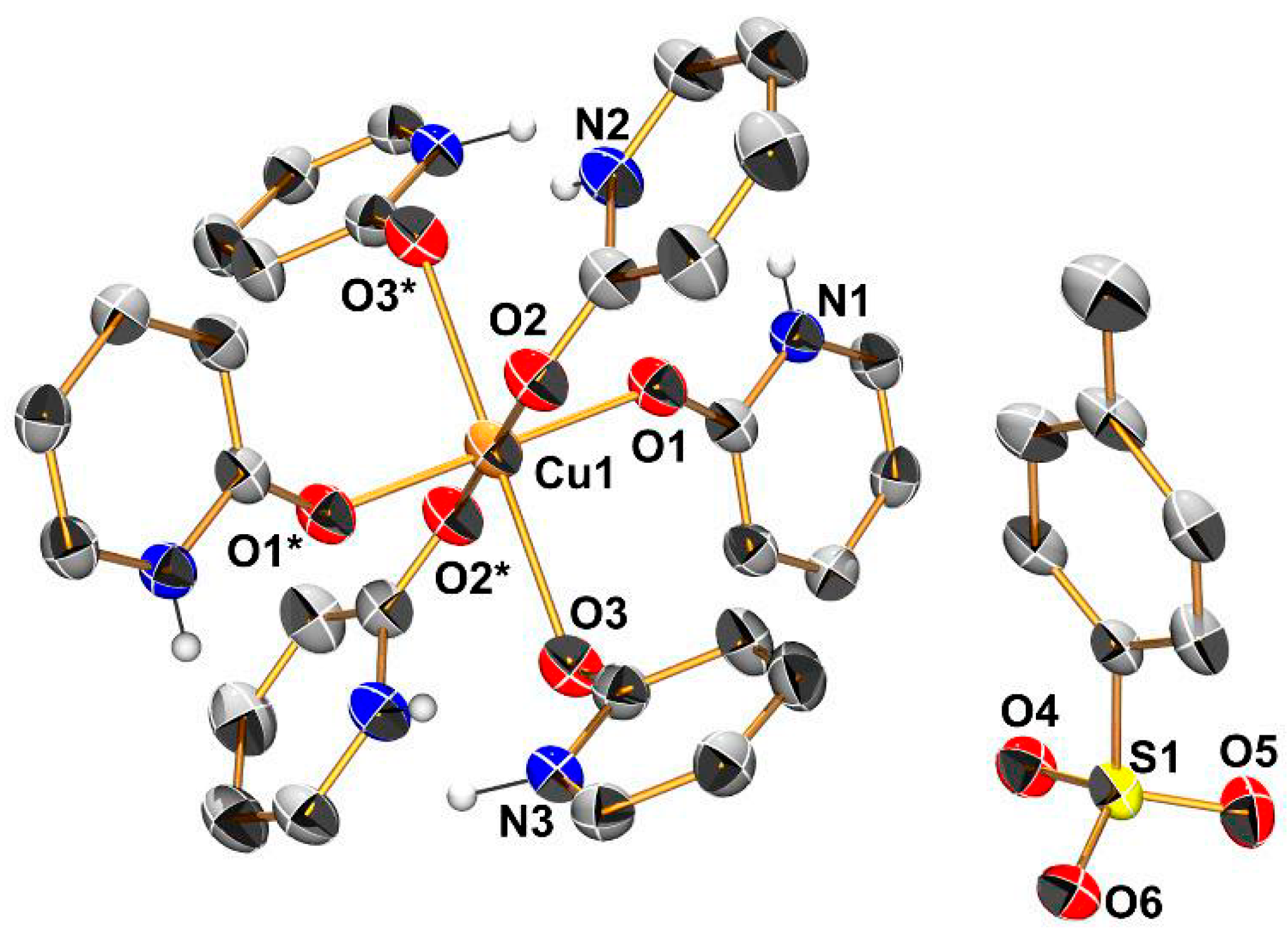
In our previous studies of Cu(I) complexes of the type RE(pyO)3CuCl (R = various hydrocarbyl groups; E = Si, Ge) we found that access of small amounts of air to solutions of RE(pyO)3CuCl results in the formation of the corresponding Cu(II) complexes of the type RE(pyO)4CuCl as decomposition products [38,39,77]. Moreover, with deliberate dosage of dry air, this route can be used to access these dark blue Cu(II) complexes in a preparative manner [39]. In the current study, we encountered a new decomposition product, which formed over the course of crystallization experiments and eventually formed some colorless crystals. The complex [Cu(HpyO)6](OTos)2 (Figure A1, Table A1) features the protio form of the ligand (2-pyridone) and a Cu(II) central atom as products of hydrolysis and oxidation, respectively. Hence, the combined access of both oxygen and moisture can be held responsible for its formation. Even though we cannot exclude the formation of such a byproduct in the reactions that yielded RE(pyO)4CuCl [38,39,77], the presence of the tosylate anion eventually led to the crystallization of such a salt that bears the [Cu(HpyO)6]2+ cation.
Figure A1. Molecular structure of [Cu(HpyO)6](OTos)2 with displacement ellipsoids at the 30% probability level and labels of selected non-hydrogen atoms. For clarity, C-bound H atoms are not depicted. The asymmetric unit consists of one tosylate anion and ½ [Cu(HpyO)6]2+ cation. The Cu site of the latter is located on a center of inversion. The symmetry indicator * at some atom labels refers to the inversion (−x + 1, −y + 1, −z + 1). Selected bond lengths (Å) and angles (deg): Cu1–O1 1.936(3), Cu1–O2 1.965(3), Cu1–O3 2.441(3), O1-Cu1-O2 88.82(11), O1-Cu1-O3 95.90(11), O2-Cu1-O3 91.31(11).
Inorganics 14 00020 g0a1
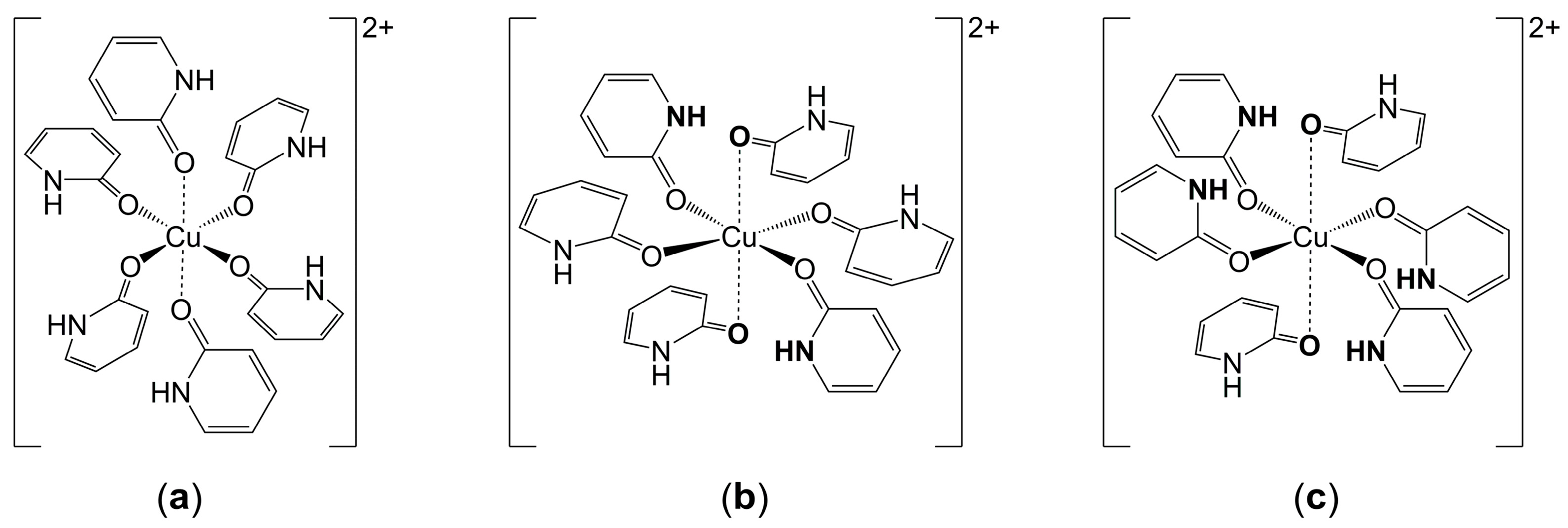
Two crystal structures of salts with the cation [Cu(HpyO)6]2+ were reported in 1975 (the perchlorate thereof [78]) and in 1993 (a chloride salt that features co-crystallized [Cu(OOC-CF3)2(HOOC-CF3)2(HpyO)] [79]). In these and in the herein reported [Cu(HpyO)6](OTos)2, the [Cu(HpyO)6]2+ cation features an inversion symmetric Jahn–Teller-distorted (stretched) octahedral CuO6 coordination sphere. Interestingly, the structures of the three salts demonstrate the wide variability of this distortion for essentially the same cation. In the chloride- and trifluoroacetate-containing salt [79], the Cu–O separations are 2.00, 2.05, and 2.29 Å. This stretching of the longer axis, accompanied by some shortening of the two shorter Cu–O bonds, is more pronounced in the herein reported tosylate with Cu–O separations of 1.94, 1.97, and 2.44 Å, and it is even more pronounced in the perchlorate salt [78] with corresponding distances of 1.92, 1.95, and 2.55 Å. In the same order of salts, the number of intramolecular N–H···O hydrogen bonds between each of the axial 2-pyridone O atoms and NH groups of equatorial 2-pyridone ligands increases from 0 via 1 to 2 (Figure A2).
Figure A2. Schematic representation of the different configurations of the cation [Cu(HpyO)6]2+ as they were encountered in the crystal structures of (a) a co-crystal of the chloride with another Cu(II) complex [79], (b) the herein reported tosylate and (c) the perchlorate [78]. The vertical dotted Cu·····O bonds represent the long axial bonds in the stretched octahedral CuO6 coordination spheres, and the bold style NH and O sites in (b,c) represent the two and four sites, respectively, of intramolecular N-H···O hydrogen bonding. The crystallographic data of the compounds cited for (a,c) can be accessed from the Cambridge Structural Database (CSD) using the respective CSD Refcode (LEFGIM for (a), PYDOCU for (c)) via https://www.ccdc.cam.ac.uk/structures/ (accessed on 3 December 2025 for availability check).
Inorganics 14 00020 g0a2

Appendix B

Table A1. Crystallographic data from data collection and refinement for LCuClCuCl and [Cu(HpyO)6](OTos)2.
ParameterLCuClCuCl[Cu(HpyO)6](OTos)2
FormulaC22H19Cl2Cu2N3O3SiC44H44CuN6O12S2
Mr599.47976.51
T(K)180(2)180(2)
λ(Å)0.710730.71073
Crystal systemtriclinicmonoclinic
Space group P 1 ¯ P21/c
a(Å)9.8896(3)9.5568(4)
b(Å)14.2302(4)23.8922(13)
c(Å)17.4646(4)9.8426(4)
α(°)89.113(2)90
β(°)88.283(2)93.669(3)
γ(°)76.202(2)90
V3)2385.72(11)2242.78(18)
Z42
ρcalc(g·cm−1)1.671.45
μMoKα (mm−1)2.10.7
F(000)12081014
θmax(°), Rint26.0, 0.034825.0, 0.0922
Completeness99.9%99.9%
Reflns collected35,77227,835
Reflns unique93853951
Restraints1210
Parameters605332
GoF1.0271.028
R1, wR2 [I > 2σ(I)]0.0277, 0.06570.0493, 0.1209
R1, wR2 (all data)0.0367, 0.06890.0777, 0.1321
Largest peak/hole (e·Å−3)0.37, −0.350.34, −0.32
Table A2. Crystallographic data from data collection and refinement for LCuOTos modification 1, LCuOTos modification 2, and LAgOTos.
ParameterLCuOTos Mod1 1LCuOTos Mod2 1LAgOTos
FormulaC29H26CuN3O6SSiC29H26CuN3O6SSiC29H26AgN3O6SSi
Mr636.22636.22680.55
T(K)180(2)180(2)180(2)
λ(Å)0.710730.710730.71073
Crystal systemmonoclinicmonoclinicmonoclinic
Space groupP21/nP21/nP21/n
a(Å)10.6762(5)10.4695(6)10.6128(2)
b(Å)9.1920(5)28.7746(14)28.4084(4)
c(Å)28.9364(18)10.5738(7)10.6043(2)
β(°)91.449(5)117.852(4)116.952(2)
V3)2838.8(3)2816.4(3)2849.87(10)
Z444
ρcalc(g·cm−1)1.491.501.59
μMoKα (mm−1)0.90.90.9
F(000)131213121384
θmax(°), Rint26.0, 0.090725.0, 0.079328.0, 0.0354
Completeness99.9%99.8%100%
Reflns collected25,59219,17868,380
Reflns unique558549586858
Restraints45013
Parameters400371394
GoF0.9951.0271.064
R1, wR2 [I > 2σ(I)]0.0410, 0.09800.0615, 0.15770.0225, 0.0579
R1, wR2 (all data)0.0813, 0.10830.1004, 0.17770.0263, 0.0594
Largest peak/hole (e·Å−3)0.46, −0.441.80, −0.41 20.42, −0.36
1 The crystals were obtained from an initial synthesis batch, which was treated as outlined in the synthesis part (product solution connected to a Schlenk tube with n-pentane), and it took some weeks for spontaneous crystallization to commence. One well-shaped isolated crystal formed in an isolated position in the upper parts of the solution, and several multi-crystalline lumps formed in various parts of the product container. The former was used for the first attempt of single-crystal X-ray diffraction analysis, and it proved to be one modification of the target product (LCuOTos mod1). From the latter, small pieces were extracted, some of which were single-crystalline, and their single-crystal X-ray diffraction analysis confirmed their identity as another modification of the target product (LCuOTos mod2). As the latter did not suffer any obvious disorders, has a higher density, and formed multiple seed crystals, we interpret modification 2 as the more stable modification. 2 The high residual electron density peaks are, most likely, the result of a high density of stacking faults in the crystal. The crystal growth (multi-crystalline lumps), streaking in the diffraction pattern, and the arrangement of residual electron density peaks in “ghost molecules”-like manner are in support of problems related to faulty crystal growth. The rather small size and the quite uniform dimensions of the crystal (0.20 × 0.19 × 0.17 mm3) rule out absorption problems as the major cause. (A test refinement of the S, Cu, Si sites and their “ghost molecules” counterparts with a site occupancy variable indicated a total “site occupancy” of 6% for the latter).

References

  1. Singh, G.; Kaur, G.; Singh, J. Progressions in hyper–coordinate silicon complexes. Inorg. Chem. Commun. 2018, 88, 11–20. [Google Scholar] [CrossRef]
  2. Lemière, G.; Millanvois, A.; Ollivier, C.; Fensterbank, L. A Parisian Vision of the Chemistry of Hypercoordinated Silicon Derivatives. Chem. Rec. 2021, 21, 1119–1129. [Google Scholar] [CrossRef]
  3. Wagler, J.; Böhme, U.; Kroke, E. Higher-Coordinated Molecular Silicon Compounds. In Functional Molecular Silicon Compounds I-Regular Oxidation States; Scheschkewitz, D., Ed.; Springer: Berlin/Heidelberg, Germany, 2013; Volume 115, pp. 29–105. [Google Scholar] [CrossRef]
  4. Chuit, C.; Corriu, R.J.P.; Reye, C.; Young, J.C. Reactivity of Penta- and Hexacoordinate Silicon Compounds and Their Role as Reaction Intermediates. Chem. Rev. 1993, 93, 1371–1448. [Google Scholar] [CrossRef]
  5. Peloquin, D.M.; Schmedake, T.A. Recent advances in hexacoordinate silicon with pyridine-containing ligands: Chemistry and emerging applications. Coord. Chem. Rev. 2016, 323, 107–119. [Google Scholar] [CrossRef]
  6. Bassindale, A.R.; Glynn, S.J.; Taylor, P.G. Chapter 9: Reaction Mechanisms of Nucleophilic Attack at Silicon. In The Chemistry of Organic Silicon Compounds; Rappoport, Z., Apeloig, Y., Eds.; John Wiley & Sons: Hoboken, NJ, USA, 1998; Volume 2, pp. 495–511. [Google Scholar] [CrossRef]
  7. Berry, R.S. Correlation of Rates of Intramolecular Tunneling Processes, with Application to Some Group V Compounds. J. Chem. Phys. 1960, 32, 933–938. [Google Scholar] [CrossRef]
  8. Sivaramakrishna, A.; Pete, S.; Mhaskar, C.M.; Ramann, H.; Ramanaiah, D.V.; Arbaaz, M.; Niyaz, M.; Janardan, S.; Suman, P. Role of hypercoordinated silicon(IV) complexes in activation of carbon–silicon bonds: An overview on utility in synthetic chemistry. Coord. Chem. Rev. 2023, 485, 215140. [Google Scholar] [CrossRef]
  9. Kocher, N.; Henn, J.; Gostevskii, B.; Kost, D.; Kalikhman, I.; Engels, B.; Stalke, D. Si–E (E = N, O, F) Bonding in a Hexacoordinated Silicon Complex: New Facts from Experimental and Theoretical Charge Density Studies. J. Am. Chem. Soc. 2004, 126, 5563–5568. [Google Scholar] [CrossRef]
  10. Korlyukov, A.A.; Lyssenko, K.A.; Antipin, M.Y.; Kirin, V.N.; Chernyshev, E.A.; Knyazev, S.P. Experimental and Theoretical Study of the Transannular Intramolecular Interaction and Cage Effect in the Atrane Framework of Boratrane and 1-Methylsilatrane. Inorg. Chem. 2002, 41, 5043–5051. [Google Scholar] [CrossRef] [PubMed]
  11. Fester, G.W.; Wagler, J.; Brendler, E.; Böhme, U.; Roewer, G.; Kroke, E. Octahedral Adducts of Dichlorosilane with Substituted Pyridines: Synthesis, Reactivity and a Comparison of Their Structures and 29Si NMR Chemical Shifts. Chem.-Eur. J. 2008, 14, 3164–3176. [Google Scholar] [CrossRef] [PubMed]
  12. Grobe, J.; Wehmschulte, R.; Krebs, B.; Läge, M. Alternativ-Liganden. XXXII Neue Tetraphosphan-Nickelkomplexe mit Tripod-Liganden des Typs XM’(OCH2PMe2)n(CH2CH2PR2)3-n (M’ = Si, Ge; n = 0–3). Z. Anorg. Allg. Chem. 1995, 621, 583–596. [Google Scholar] [CrossRef]
  13. Grobe, J.; Lütke-Brochtrup, K.; Krebs, B.; Läge, M.; Niemeyer, H.-H.; Würthwein, E.-U. Alternativ-Liganden XXXVIII. Neue Versuche zur Synthese von Pd(0)- und Pt(0)-Komplexen des Tripod-Phosphanliganden FSi(CH2CH2PMe2)3. Z. Naturforschung 2007, 62, 55–65. [Google Scholar] [CrossRef]
  14. Gualco, P.; Lin, T.-P.; Sircoglou, M.; Mercy, M.; Ladeira, S.; Bouhadir, G.; Pérez, L.M.; Amgoune, A.; Maron, L.; Gabbaï, F.P.; et al. Gold–Silane and Gold–Stannane Complexes: Saturated Molecules as σ-Acceptor Ligands. Angew. Chem. Int. Ed. 2009, 48, 9892–9895. [Google Scholar] [CrossRef]
  15. Wagler, J.; Brendler, E. Metallasilatranes: Palladium(II) and Platinum(II) as Lone-Pair Donors to Silicon(IV). Angew. Chem. Int. Ed. 2010, 49, 624–627. [Google Scholar] [CrossRef]
  16. Truflandier, L.A.; Brendler, E.; Wagler, J.; Autschbach, J. 29Si DFT/NMR Observation of Spin–Orbit Effect in Metallasilatrane Sheds Some Light on the Strength of the Metal→Silicon Interaction. Angew. Chem. Int. Ed. 2011, 50, 255–259. [Google Scholar] [CrossRef]
  17. Wahlicht, S.; Brendler, E.; Heine, T.; Zhechkov, L.; Wagler, J. 7-Azaindol-1-yl(organo)silanes and Their PdCl2 Complexes: Pd-Capped Tetrahedral Silicon Coordination Spheres and Paddlewheels with a Pd-Si Axis. Organometallics 2014, 33, 2479–2488. [Google Scholar] [CrossRef]
  18. Lipke, M.C.; Liberman-Martin, A.L.; Tilley, T.D. Electrophilic Activation of Silicon–Hydrogen Bonds in Catalytic Hydrosilations. Angew. Chem. Int. Ed. 2017, 56, 2260–2294. [Google Scholar] [CrossRef]
  19. Nikonov, G.I. Recent Advances in Nonclassical Interligand Si…H Interactions. Adv. Organomet. Chem. 2005, 53, 217–309. [Google Scholar] [CrossRef]
  20. Sato, K.; Kira, M.; Sakurai, H. Allylation of α-Hydroxy Ketones with Allyltrifluorosilanes and Allyltrialkoxysilanes in the Presence of Triethylamine. Stereochemical Regulation Involving Chelated Bicyclic Transition States. J. Am. Chem. Soc. 1989, 111, 6429–6431. [Google Scholar] [CrossRef]
  21. Kira, M.; Zhang, L.C.; Kabuto, C.; Sakurai, H. Synthesis and Reactions of Neutral Hypercoordinate Allylsilicon Compounds Having a Tropolonato Ligand. Organometallics 1996, 15, 5335–5341. [Google Scholar] [CrossRef]
  22. Wagler, J.; Roewer, G. Syntheses of Allyl- and 3-Silylpropyl-substituted Salen-like Tetradentate Ligands via Hypercoordinate Silicon Complexes. Z. Naturforschung B 2006, 61, 1406–1412. [Google Scholar] [CrossRef]
  23. Wächtler, E.; Kämpfe, A.; Krupinski, K.; Gerlach, D.; Kroke, E.; Brendler, E.; Wagler, J. New Insights into Hexacoordinated Silicon Complexes with 8-Oxyquinolinato Ligands: 1,3-Shift of Si-Bound Hydrocarbyl Substituents and the Influence of Si-Bound Halides on the 8-Oxyquinolinate Coordination Features. Z. Naturforschung B 2014, 69, 1402–1418. [Google Scholar] [CrossRef]
  24. Kano, N.; Yamamura, M.; Kawashima, T. Reactivity Control of an Allylsilane Bearing a 2-(Phenylazo)phenyl Group by Photoswitching of the Coordination Number of Silicon. J. Am. Chem. Soc. 2004, 126, 6250–6251. [Google Scholar] [CrossRef] [PubMed]
  25. Gostevskii, B.; Kalikhman, I.; Tessier, C.A.; Panzner, M.J.; Youngs, W.J.; Kost, D. Hexacoordinate Complexes of Silacyclobutane: Spontaneous Ring Opening and Rearrangement. Organometallics 2005, 24, 5786–5788. [Google Scholar] [CrossRef]
  26. Fester, G.W.; Eckstein, J.; Gerlach, D.; Wagler, J.; Brendler, E.; Kroke, E. Reactions of Hydridochlorosilanes with 2,2′-Bipyridine and 1,10-Phenanthroline: Complexation versus Dismutation and Metal-Catalyst-Free 1,4-Hydrosilylation. Inorg. Chem. 2010, 49, 2667–2673. [Google Scholar] [CrossRef]
  27. Lippe, K.; Gerlach, D.; Kroke, E.; Wagler, J. Hypercoordinate Organosilicon Complexes of an ONN′O′ Chelating Ligand: Regio- and Diastereoselectivity of Rearrangement Reactions in Si-Salphen Systems. Organometallics 2009, 28, 621–629. [Google Scholar] [CrossRef]
  28. Kalikhman, I.; Gostevskii, B.; Kertsnus, E.; Botoshansky, M.; Tessier, C.A.; Youngs, W.J.; Deuerlein, S.; Stalke, D.; Kost, D. Competitive Molecular Rearrangements in Hexacoordinate Cyano-Silicon Dichelates. Organometallics 2007, 26, 2652–2658. [Google Scholar] [CrossRef]
  29. Suzawa, K.; Ueno, M.; Wheatley, A.E.H.; Kondo, Y. Phosphazene Base Promoted Functionalization of Aryltrimethylsilanes. Chem. Commun. 2006, 42, 4850–4852. [Google Scholar] [CrossRef]
  30. Wagler, J.; Roewer, G.; Gerlach, D. Photo Driven Si C Bond Cleavage in Hexacoordinate Silicon Complexes. Z. Anorg. Allg. Chem. 2009, 635, 1279–1287. [Google Scholar] [CrossRef]
  31. Brendler, E.; Wächtler, E.; Wagler, J. Hypercoordinate Silacycloalkanes: Step-by-Step Tuning of N→Si Interactions. Organometallics 2009, 28, 5459–5465. [Google Scholar] [CrossRef]
  32. Minami, Y.; Hiyama, T. Designing Cross-Coupling Reactions using Aryl(trialkyl)silanes. Chem. Eur. J. 2019, 25, 391–399. [Google Scholar] [CrossRef] [PubMed]
  33. Mi, C.; Zhang, B.-B.; Zhang, G.; Peng, A.; Wang, Z.-X.; Shi, Q.; Huang, H. An Efficient C−Si/C−H Cross-Coupling Reaction Enabled by a Radical Pathway. Chem. Eur. J. 2024, 30, e202303857. [Google Scholar] [CrossRef]
  34. Hatanaka, Y.; Hiyama, T. Cross-Coupling of Organosilanes with Organic Halides Mediated by Palladium Catalyst and Tris(diethylamino)sulfonium Difluorotrimethylsilicate. J. Org. Chem. 1988, 53, 918–920. [Google Scholar] [CrossRef]
  35. Kamei, T.; Fujita, K.; Itami, K.; Yoshida, J. Copper-Catalyzed Allylation of Carbonyl Derivatives Using Allyl(2-pyridyl)silanes. Org. Lett. 2005, 7, 4725–4728. [Google Scholar] [CrossRef] [PubMed]
  36. Tsubouchi, A.; Muramatsu, D.; Takeda, T. Copper(I)-Catalyzed Alkylation of Aryl- and Alkenylsilanes Activated by Intramolecular Coordination of an Alkoxide. Angew. Chem. Int. Ed. 2013, 125, 12719–12722. [Google Scholar] [CrossRef] [PubMed]
  37. Takeda, T.; Matsumura, R.; Wasa, H.; Tsubouchi, A. Copper(I)-Promoted Alkylation of Alkenylbenzyldimethylsilanes. Asian J. Org. Chem. 2014, 3, 838–841. [Google Scholar] [CrossRef]
  38. Ehrlich, L.; Gericke, R.; Brendler, E.; Wagler, J. (2-Pyridyloxy)silanes as Ligands in Transition Metal Coordination Chemistry. Inorganics 2018, 6, 119. [Google Scholar] [CrossRef]
  39. Seidel, A.; Gericke, R.; Brendler, E.; Wagler, J. Copper Complexes of Silicon Pyridine-2-olates RSi(pyO)3 (R = Me, Ph, Bn, Allyl) and Ph2Si(pyO)2. Inorganics 2023, 11, 2. [Google Scholar] [CrossRef]
  40. Jiang, W.; Lumata, L.; Chen, W.; Zhang, S.; Kovacs, Z.; Sherry, A.D.; Khemtong, C. Hyperpolarized 15N-pyridine Derivatives as pH-Sensitive MRI Agents. Sci. Rep. 2015, 5, 9104. [Google Scholar] [CrossRef]
  41. Sheenhy, K.J.; Bateman, L.M.; Flosbach, N.T.; Breugst, M.; Byrne, P.A. Identification of N- or O-Alkylation of Aromatic Nitrogen Heterocycles and N-Oxides Using 1H–15N HMBC NMR Spectroscopy. Eur. J. Org. Chem. 2020, 22, 3270–3281. [Google Scholar] [CrossRef]
  42. Seidel, A.; Weigel, M.; Ehrlich, L.; Gericke, R.; Brendler, E.; Wagler, J. Molecular Structures of the Silicon Pyridine-2-(thi)olates Me3Si(pyX), Me2Si(pyX)2 and Ph2Si(pyX)2 (py = 2-Pyridyl, X = O, S), and Their Intra- and Intermolecular Ligand Exchange in Solution. Crystals 2022, 12, 1054. [Google Scholar] [CrossRef]
  43. Kuß, S.; Brendler, E.; Wagler, J. Molecular Structures of the Pyridine-2-olates PhE(pyO)3 (E = Si, Ge, Sn) – [4+3]-Coordination at Si, Ge vs. Heptacoordination at Sn. Crystals 2022, 12, 1802. [Google Scholar] [CrossRef]
  44. Kliegel, W.; Motzkus, H.-W.; Nanninga, D.; Rettig, S.J.; Trotter, J. Structural studies of organoboron compounds XXIII: Preparation and crystal and molecular structures of 2,2-diphenyl-l,3-dioxa-4a-azonia-2-borata-1,2,3,4-tetrahydronaphthalene and 4,4-diphenyl-3-oxa-l-aza-4a-azonia-4-borata-l,2,3,4-tetrahydronaphthalene. Can. J. Chem. 1986, 64, 507–513. [Google Scholar] [CrossRef]
  45. Guo, C.-X.; Schwedtmann, K.; Fidelius, J.; Hennersdorf, F.; Dickschat, A.; Bauzá, A.; Weigand, J.J. Bifunctional Fluorophosphonium Triflates as Intramolecular Frustrated Lewis Pairs: Reversible CO2 Sequestration and Binding of Carbonyls, Nitriles and Acetylenes. Chem. Eur. J. 2021, 27, 13709–13714. [Google Scholar] [CrossRef] [PubMed]
  46. Anders, E.; Markus, F.; Meske, H.; Tropsch, J.; Maas, G. Anomer kontrollierte Substitutionsreaktionen mit verschiedenen N-Alkylpyridiniumverbindungen. Chem. Ber. 1987, 120, 735–745. [Google Scholar] [CrossRef]
  47. Hordiichuk, O.R.; Kinzhybalo, V.V.; Goreshnik, E.A.; Slyvka, Y.I.; Krawczyk, M.S.; Mys’kiv, M.G. Influence of apical ligands on Cu–(C=C) interaction in Copper(I) halides (Cl, Br, I) π-complexes with an 1,2,4-triazole allyl-derivative: Syntheses, crystal structures and NMR spectroscopy. J. Organomet. Chem. 2017, 838, 1–8. [Google Scholar] [CrossRef]
  48. Slyvka, Y.; Fed’ko, A.; Goreshnik, E.; Kordan, V.; Mys’kiv, M. A new hybrid inorganic-organic coordination copper(I) chloride π,σ-compound [Cu4(C18H17N5OS)2Cl4]·2H2O·2C3H7OH based on N-phenyl-N’-{3-allylsulfanyl-4-amino-5-phenyl-4H-1,2,4-triazol-4-yl}urea: Synthesis and structure characterization. Chem. Met. Alloys 2021, 14, 43–47. [Google Scholar] [CrossRef]
  49. Poddel’sky, A.I.; Smolyaninov, I.V.; Druzhkov, N.O.; Fukin, G.K. Heterometallic antimony(V)-zinc and antimony(V)-copper complexes comprising catecholate and diazadiene as redox active centers. J. Organomet. Chem. 2021, 952, 121994. [Google Scholar] [CrossRef]
  50. Zhang, G.; Liu, E.; Yang, C.; Li, L.; Golen, J.A.; Rheingold, A.L. Copper(II) Complexes of 2,2′:6′,2″-Terpyridine Derivatives for Catalytic Aerobic Alcohol Oxidations–Observation of Mixed-Valence CuICuII Assembles. Eur. J. Inorg. Chem. 2015, 2015, 939–947. [Google Scholar] [CrossRef]
  51. Hung, C.-H.; Chang, F.-C.; Lin, C.-Y.; Rachlewicz, K.; Stȩpień, M.; Latos-Grażyński, L.; Lee, G.-H.; Peng, S.-M. Iron and Copper Complexes of Tetraphenyl-m-benziporphyrin: Reactivity of the Internal C-H Bond. Inorg. Chem. 2004, 43, 4118–4120. [Google Scholar] [CrossRef] [PubMed]
  52. Tandon, S.S.; Thompson, L.K.; Bridson, J.N.; McKee, V.; Downard, A.J. Dinuclear copper(II) and polymeric tetranuclear copper(II) and copper(II)-copper(I) complexes of macrocyclic ligands capable of forming endogenous alkoxide and phenoxide bridges. Structural, magnetic, and electrochemical studies. Inorg. Chem. 1992, 31, 4635–4642. [Google Scholar] [CrossRef]
  53. Rybak-Akimova, E.; Busch, D.H.; Kahol, P.K.; Pinto, N.; Alcock, N.W.; Clase, H.J. Dicopper Complexes with a Dissymmetric Dicompartmental Schiff Base−Oxime Ligand:  Synthesis, Structure, and Magnetic Interactions. Inorg. Chem. 1997, 36, 510–520. [Google Scholar] [CrossRef]
  54. Bondi, A. van der Waals Volumes and Radii. J. Phys. Chem. 1964, 68, 441–451. [Google Scholar] [CrossRef]
  55. Oakley, S.H.; Coles, M.P.; Hitchcock, P.B. Poly(guanidyl)silanes as a new class of chelating, N-based ligand. Dalton Trans. 2004, 33, 1113–1114. [Google Scholar] [CrossRef]
  56. Kameo, H.; Kawamoto, T.; Bourissou, D.; Sakaki, S.; Nakazawa, H. Evaluation of the σ-Donation from Group 11 Metals (Cu, Ag, Au) to Silane, Germane, and Stannane Based on the Experimental/Theoretical Systematic Approach. Organometallics 2015, 34, 1440–1448. [Google Scholar] [CrossRef]
  57. Kim, Y.-E.; Kim, J.; Park, J.W.; Park, K.; Lee, Y. σ-Complexation as a strategy for designing copper-based light emitters. Chem. Commun. 2017, 53, 2858–2861. [Google Scholar] [CrossRef]
  58. Gualco, P.; Amgoune, A.; Miqueu, K.; Ladeira, S.; Bourissou, D. A Crystalline σ Complex of Copper. J. Am. Chem. Soc. 2011, 133, 4257–4259. [Google Scholar] [CrossRef] [PubMed]
  59. Aloisi, A.; Berthet, J.-C.; Genre, C.; Thuéry, P.; Cantat, T. Complexes of the tripodal phosphine ligands PhSi(XPPh2)3 (X = CH2, O): Synthesis, structure and catalytic activity in the hydroboration of CO2. Dalton Trans. 2016, 45, 14774–14788. [Google Scholar] [CrossRef] [PubMed]
  60. Zhao, Y.; Nakae, T.; Takea, S.; Hattori, M.; Saito, D.; Kato, M.; Ohmasa, Y.; Sato, S.; Yamamuro, O.; Galica, T.; et al. Reversible Transition between Discrete and 1D Infinite Architectures: A Temperature-Responsive Cu(I) Complex with a Flexible Disilane-Bridged Bis(pyridine) Ligand. Chem. Eur. J. 2023, 29, e202204022. [Google Scholar] [CrossRef]
  61. Plajer, A.J.; Colebatch, A.L.; Enders, M.; García-Romero, Á.; Bond, A.D.; García-Rodríguez, R.; Wright, D.S. The coordination chemistry of the neutral tris-2-pyridyl silicon ligand [PhSi(6-Me-2-py)3]. Dalton Trans. 2018, 47, 7036–7043. [Google Scholar] [CrossRef] [PubMed]
  62. Becker, K.D.; von Goldammer, E. NMR Chemical Shifts in the Silver Halides. Chem. Phys. 1980, 48, 193–201. [Google Scholar] [CrossRef]
  63. Hansen, C.; Docherty, S.R.; Cao, W.; Yakimov, A.V.; Copéret, C. 109Ag NMR chemical shift as a descriptor for Brønsted acidity from molecules to materials. Chem. Sci. 2024, 15, 3028–3032. [Google Scholar] [CrossRef]
  64. Penner, G.H.; Li, W. Silver-109 NMR Spectroscopy of Inorganic Solids. Inorg. Chem. 2004, 43, 5588–5597. [Google Scholar] [CrossRef]
  65. Zhang, X.-L.; Tang, G.-M.; Wang, Y.-T. A set of Ag-based metal coordination polymers with sulfonate group: Syntheses, crystal structures and luminescent behaviors. Polyhedron 2018, 148, 55–69. [Google Scholar] [CrossRef]
  66. Harris, R.K.; Becker, E.D.; Cabral de Menezes, S.M.; Goodfellow, R.; Granger, P. NMR nomenclature. Nuclear spin properties and conventions for chemical shifts (IUPAC Recommendations 2001). Pure Appl. Chem. 2001, 73, 1795–1818. [Google Scholar] [CrossRef]
  67. Merwin, L.H.; Sebald, A. The first examples of 109Ag CP MAS spectroscopy. J. Magn. Reson. 1992, 97, 628–631. [Google Scholar] [CrossRef]
  68. Sebald, A. MAS and CP/MAS of Less Common Spin-1/2 Nuclei. In Solid State NMR II: Inorganic Matter; Diehl, P., Fluck, E., Günther, H., Kosfeld, R., Seelig, J., Eds.; book series: NMR Basic Principles and Progress; Blümich, B., Ed. Springer: Berlin/Heidelberg, Germany, 1994; Volume 31, pp. 91–131. [Google Scholar] [CrossRef]
  69. Sheldrick, G.M. SHELXT—Integrated space-group and crystal-structure determination. Acta Crystallogr. A 2015, 71, 3–8. [Google Scholar] [CrossRef]
  70. Sheldrick, G.M. Program for the Refinement of Crystal Structures; SHELXL-2019/3; University of Göttingen: Göttingen, Germany, 2019. [Google Scholar]
  71. Sheldrick, G. A short history of SHELX. Acta Crystallogr. A 2007, 64, 112–122. [Google Scholar] [CrossRef] [PubMed]
  72. Sheldrick, G. Crystal structure refinement with SHELXL. Acta Crystallogr. C 2015, 71, 3–8. [Google Scholar] [CrossRef]
  73. Farrugia, L.J. ORTEP-3 for windows—A version of ORTEP-III with a graphical user interface (GUI). J. Appl. Crystallogr. 1997, 30, 565. [Google Scholar] [CrossRef]
  74. Farrugia, L.J. WinGX and ORTEP for Windows: An update. J. Appl. Crystallogr. 2012, 45, 849–854. [Google Scholar] [CrossRef]
  75. POV-RAY (Version 3.7), Trademark of Persistence of Vision Raytracer Pty. Ltd., Williamstown, Victoria (Australia). Copyright Hallam Oaks Pty. Ltd., 1994–2004. Available online: http://www.povray.org/download/ (accessed on 28 June 2021).
  76. Macrae, C.F.; Sovago, I.; Cottrell, S.J.; Galek, P.T.A.; McCabe, P.; Pidcock, E.; Platings, M.; Shields, G.P.; Stevens, J.S.; Towler, M.; et al. Mercury 4.0: From visualization to analysis, design and prediction. J. Appl. Cryst. 2020, 53, 226–235. [Google Scholar] [CrossRef] [PubMed]
  77. Wagler, J.; Gericke, R. Ge–Cu-Complexes Ph(pyO)Ge(μ2-pyO)2CuCl and PhGe(μ2-pyO)4CuCl—Representatives of Cu(I)→Ge(IV) and Cu(II)→Ge(IV) Dative Bond Systems. Molecules 2023, 28, 5442. [Google Scholar] [CrossRef]
  78. Taylor, D. The crystal structure of Hexakis(2-pyridone)copper(II) perchlorate. Aust. J. Chem. 1975, 28, 2615–2622. [Google Scholar] [CrossRef]
  79. Breeze, S.R.; Wang, S. Hydrogen-bond-directed assembly of one-dimensional and two-dimensional polymeric copper(II) complexes with trifluoroacetate and hydroxypyridine as ligands: Syntheses and structural investigations. Inorg. Chem. 1993, 32, 5981–5989. [Google Scholar] [CrossRef]
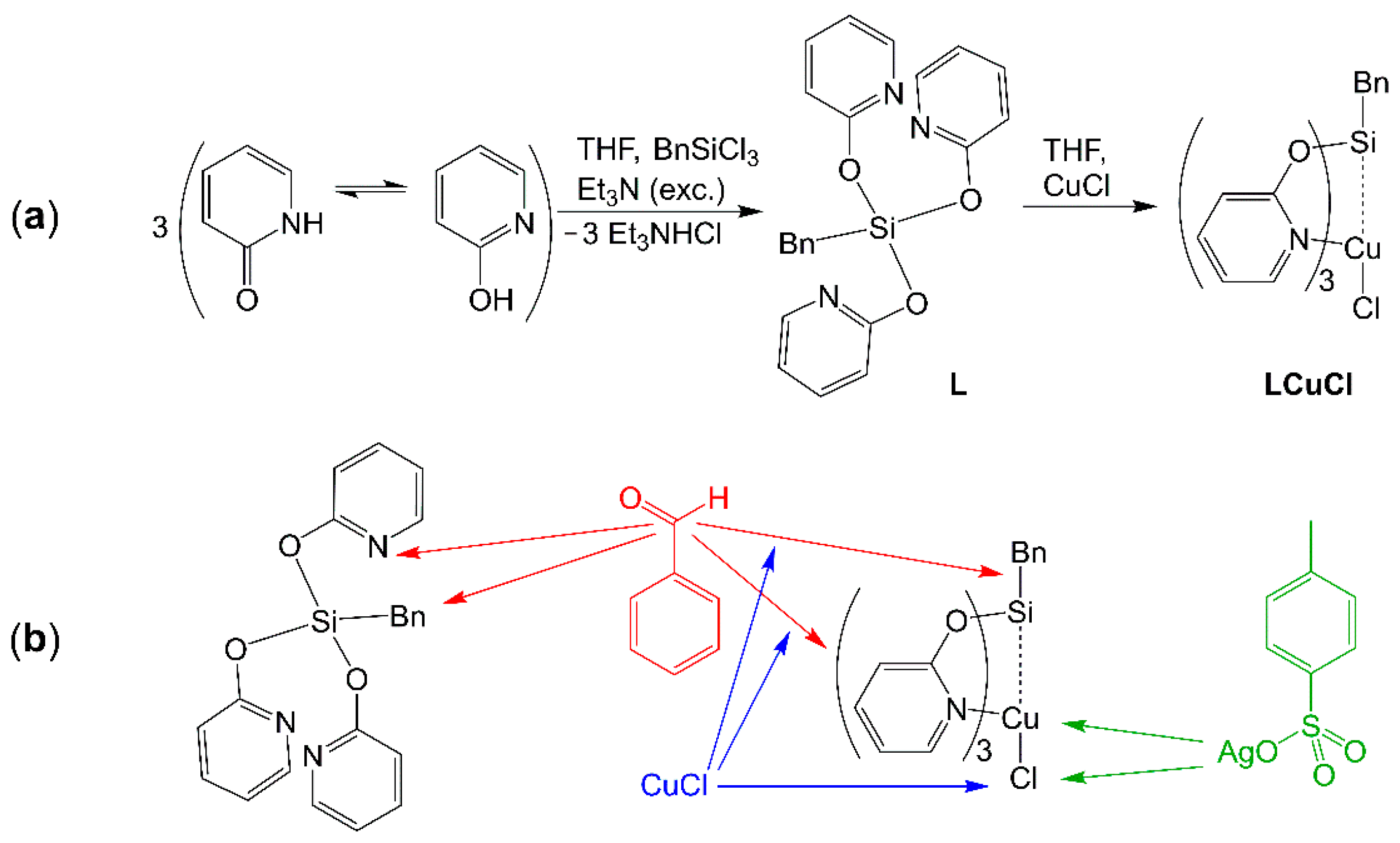
Scheme 1. (a) Synthesis of ligand L and its copper(I) complex LCuCl [39]. (b) Investigation of the interaction of L and LCuCl with the electrophiles PhCHO, CuCl, and AgOTos. The colored arrows point at potential sites of interference of (red) benzaldehyde with L and LCuCl, (blue) additional CuCl with the reaction of benzaldehyde and sites at LCuCl or the Cl atom of LCuCl, and (green) AgOTos with the Cu or Cl atom of LCuCl.
Inorganics 14 00020 sch001
Figure 1. 29Si NMR spectra of CDCl3 solutions of 0.55 M of L after addition of benzaldehyde in molar ratio L:PhCHO of (a) 1:1, (b) 1:3, and (c) 1:10.
Inorganics 14 00020 g001
Figure 2. Section of the 13C NMR spectra of CDCl3 solutions of 0.55 M of L after addition of benzaldehyde in molar ratio L:PhCHO of (a) 1:1, (b) 1:3, and (c) 1:10. This section shows the signals of the Ph-CH2-Si carbon atoms.
Inorganics 14 00020 g002
Scheme 2. Reaction of L and benzaldehyde with formation of stereoisomeric sets of compounds L, L’’, and L’’’. The arrows in the drawing of the reaction of L and PhCHO indicate the formal transformation of some of the lone pairs and bond electron pairs into new bond electron pairs and lone pairs, respectively. The asterisks * indicate stereocenters. L forms a pair of enantiomers (the absolute configuration of the asymmetric C atom * can be R,S); L’’ forms a pair of enantiomers (when ** = RR,SS) and a pair of diastereomers (when ** = RS,SR). In the latter case, the Si atom is pseudo-asymmetric as it carries four different substituents, two of which are mutually enantiomeric. This renders the isomers with the absolute configurations of its asymmetric C atoms ** = RS,SR chemically non-equivalent. L’’’ forms two pairs of enantiomers (*** = RRR,SSS and *** = RRS,SSR).
Inorganics 14 00020 sch002
Scheme 3. Examples of reactions of the type “pyridine + aldehyde + Lewis acid” with (a) a pyridine-2-olate and (b) pyridine itself as the N-nucleophile.
Inorganics 14 00020 sch003
Figure 3. Molecular structures of the two crystallographically independent molecules of LCuClCuCl in the crystal structure of this compound, depicted with thermal displacement ellipsoids at the 50% probability level and labels of selected atoms. (Hydrogen atoms are omitted for clarity). The CuClCuCl moiety of molecule 1 (a,b) is located near a center of inversion. The asterisks * at some labels refer to the corresponding symmetry operation, −x, −y+1, −z+2. This location of molecule 1 gives rise to a disorder of a copper atom over two sites (Cu2/Cu2a), which results in the presence of a pair of molecules 1 as Cu2Cl2-bridged dimer ((a), with site occupancy 0.891(3)) and as adjacent monomers ((b), with site occupancy 0.109(3)). Apart from the disorder sites Cl2/Cl2a, the other atom sites (and their labels) are identical in (a,b). Molecular site 2 (c) is monomeric. Selected bond lengths (Å) and angles (deg) for (a): Si1–O1 1.625(2), Si1–O2 1.619(2), Si1–O3 1.618(2), Si1–C16 1.839(2), Cu1–N1 2.009(2), Cu1–N2 2.025(2), Cu1–N3 2.027(2), Cu1–Cl1 2.4545(6), O1-Si1-O2 111.50(9), O1-Si1-O3 111.87(9), O2-Si1-O3 113.98(9), Cl1-Cu1-N1 102.36(5), Cl1-Cu1-N2 105.21(5), Cl1-Cu1-N3 103.61(5), N1-Cu1-N2 115.85(7), N1-Cu1-N3 120.60(7), N2-Cu1-N3 107.21(7). For (c): Si2–O4 1.626(2), Si2–O5 1.629(2), Si2–O6 1.628(2), Si2–C38 1.832(2), Cu3–N4 2.017(2), Cu3–N5 2.019(2), Cu3–N6 2.053(2), Cu3–Cl3 2.1115(7), O4-Si2-O5 112.63(8), O4-Si2-O6 112.30(8), O5-Si2-O6 110.39(8), Cl3-Cu3-N4 102.89(5), Cl3-Cu3-N5 103.70(5), Cl3-Cu3-N6 104.62(5), N4-Cu3-N5 123.00(7), N4-Cu3-N6 108.14(7), N5-Cu3-N6 112.37(7).
Inorganics 14 00020 g003
Figure 4. Sketches of crystallographically characterized compounds Cu2-A [47], Cu2-B [48], Cu2-C [49], and Cu2-D [50], which feature a Cu-Cl-Cu-Cl motif. A generic sketch of this motif (right) illustrates the positions of the bonds (a, b, c) and angles (α, β) that are listed in Table 1. The crystallographic data of these compounds can be accessed from the Cambridge Structural Database (CSD) using the respective CSD Refcode (GANFAF for Cu2-A, LOBVOR for Cu2-B, EZAMIE for Cu2-C, MUCMEE for Cu2-D) via https://www.ccdc.cam.ac.uk/structures/ (accessed on 3 December 2025 for availability check).
Inorganics 14 00020 g004
Figure 5. Sketches of crystallographically characterized compounds Cu4-A [51], Cu4-B [52], and Cu4-C [53], which feature a Cu-Cl-Cu(Cl)2Cu-Cl-Cu motif. A generic sketch of this motif (top right) illustrates the positions of the bonds (a, b, c, d), bond angles (α, γ), and the torsion angle δ of the a-b-c bond sequence that are listed in Table 2. The crystallographic data of these compounds can be accessed from the Cambridge Structural Database (CSD) using the respective CSD Refcode (SABDEF for Cu4-A, KUTNUI for Cu4-B, RIBXUV for Cu4-C) via https://www.ccdc.cam.ac.uk/structures/ (accessed on 3 December 2025 for availability check).
Inorganics 14 00020 g005
Scheme 4. Syntheses of tosylato complexes LCuOTos and LAgOTos.
Inorganics 14 00020 sch004
Figure 6. Molecular structures of (a) LCuOTos in modification 1, (b) LCuOTos in modification 2, and (c) LAgOTos, depicted with thermal displacement ellipsoids at the 30% probability level and labels of selected atoms (Hydrogen atoms are omitted for clarity). For the disordered parts (in (a) the tosylate group with site occupancies of 0.866(4) and 0.134(4), in (c) the tosylate group with site occupancies of 0.931(4) and 0.069(4) and the benzyl group with site occupancies of 0.70(1) and 0.30(1)), only the part of predominant occupancy is shown. Selected bond lengths (Å) and angles (deg) for (a): Si1–O1 1.629(2), Si1–O2 1.626(2), Si1–O3 1.628(2), Si1–C16 1.828(3), Cu1–N1 2.041(2), Cu1–N2 2.005(2), Cu1–N3 2.034(2), Cu1–O4 2.174(2), O1-Si1-O2 111.60(11), O1-Si1-O3 110.38(11), O2-Si1-O3 113.93(12), O4-Cu1-N1 94.93(11), O4-Cu1-N2 105.38(11), O4-Cu1-N3 110.60(11), N1-Cu1-N2 114.73(10), N1-Cu1-N3 112.18(10), N2-Cu1-N3 116.51(9). For (b): Si1–O1 1.623(4), Si1–O2 1.616(4), Si1–O3 1.633(4), Si1–C16 1.835(5), Cu1–N1 2.044(4), Cu1–N2 1.989(4), Cu1–N3 2.008(4), Cu1–O4 2.138(3), O1-Si1-O2 112.3(2), O1-Si1-O3 113.4(2), O2-Si1-O3 112.1(2), O4-Cu1-N1 98.93(15), O4-Cu1-N2 101.74(15), O4-Cu1-N3 106.86(16), N1-Cu1-N2 119.08(17), N1-Cu1-N3 103.36(16), N2-Cu1-N3 123.47(17). For (c): Si1–O1 1.621(2), Si1–O2 1.615(2), Si1–O3 1.628(2), Si1–C16 1.849(3), Ag1–N1 2.335(2), Ag1–N2 2.281(2), Ag1–N3 2.302(2), Ag1–O4 2.397(2), O1-Si1-O2 110.68(7), O1-Si1-O3 113.24(7), O2-Si1-O3 109.49(7), O4-Ag1-N1 123.31(5), O4-Ag1-N2 89.06(5), O4-Ag1-N3 119.50(5), N1-Ag1-N2 111.98(5), N1-Ag1-N3 92.37(5), N2-Ag1-N3 123.51(5).
Inorganics 14 00020 g006
Figure 7. Polyhedral representations of the M = Cu and Ag coordination spheres in LMOTos (Atom colors of non-labelled atom types are: C grey, S yellow, Si pink). The Cu coordination sphere of LCuOTos (modification 2) is shown from two perspectives, showing the tetrahedral edge of the smallest O-Cu-N angle (O4-Cu1-N1) in (a), and in (b) it is shown from another perspective that is related to that used for the view of the silver complex (c).
Inorganics 14 00020 g007
Figure 8. Selected examples of crystallographically characterized compounds which feature Cu···Si or Ag···Si contacts supported by different bridging ligands: CuSi-A [55], CuSi-B (M = Cu) [56], AgSi-B (M = Ag) [56], CuSi-C [57]), CuSi-D (M = Cu) [58], AgSi-D (M = Ag) [58], CuSi-E [59]), CuSi-F [60], and CuSi-G [61]. The lengths of the shortest Cu···Si or Ag···Si contacts of each compound are listed below the respective compound code (in Å, rounded to two decimal places). The crystallographic data of these compounds can be accessed from the Cambridge Structural Database (CSD) using the respective CSD Refcode (IXIVAM for CuSi-A, WUKCIQ for CuSi-B, WUKCOW for AgSi-B, FAMQUI for CuSi-C, UTOWUW for CuSi-D, UTOXAD for AgSi-D, EQOWUE for CuSi-E, WETVEA for CuSi-F, TIGWUE for CuSi-G) via https://www.ccdc.cam.ac.uk/structures/ (accessed on 3 December 2025 for availability check).
Inorganics 14 00020 g008
Figure 9. 29Si CP/MAS NMR spectrum of LCuClCuCl recorded at υrot = 5 kHz with an inset of the magnified isotropic shift signals of the two crystallographically independent Si sites. The asterisks (*) indicate the positions of spinning side bands.
Inorganics 14 00020 g009
Figure 10. 29Si NMR spectra of LCuOTos and LAgOTos. The asterisks (*) indicate the positions of spinning side bands, and the peak at δ = 0 ppm belongs to the internal standard (SiMe4). (a) 29Si CP/MAS NMR spectrum of LCuOTos (modification 2) recorded at υrot = 5 kHz. The shoulder at the isotropic shift signal may arise from the high density of stacking faults in this crystalline material (cf. Table A2) and the slightly different molecular conformations associated therewith. (b) 29Si NMR spectrum of LCuOTos in CDCl3. (c) 29Si CP/MAS NMR spectrum of LAgOTos recorded at υrot = 5 kHz. (d) 29Si NMR spectrum of LAgOTos in CDCl3.
Inorganics 14 00020 g010
Figure 11. 109Ag NMR spectra of LAgOTos. (a) CP/MAS NMR spectrum recorded at υrot = 6 kHz. The asterisks (*) indicate the positions where the first spinning side bands could be expected. (b) Spectrum recorded from a CDCl3 solution of LAgOTos.
Inorganics 14 00020 g011
Table 1. Selected bond lengths (Å) and angles (deg) of the monomer of LCuClCuCl (as shown in Figure 3c) and complexes Cu2-A [47], Cu2-B [48], Cu2-C [49], and Cu2-D [50]. The assignment of bonds and angles is shown in Figure 4.
LCuClCuClCu2-ACu2-BCu2-CCu2-D
a2.4366(6)2.632.542.432.81
b2.1115(7)2.102.132.112.13
c2.0786(8)2.092.092.102.11
α109.00(3)101.6105.8118.492.5
β177.35(3)175.7160.5177.7176.8
Table 2. Selected bond lengths (Å) and angles (deg) of the dimer of LCuClCuCl (as shown in Figure 3a), the dimeric disorder part in the crystal structure of Cu2-B [46], and the mixed-valence complexes Cu4-A [51], Cu4-B [52], and Cu4-C [53]. The assignment of bonds and angles is shown in Figure 5.
LCuClCuClCu2-BCu4-ACu4-BCu4-C
a2.4545(6)2.542.492.652.65
b2.2080(8)2.222.192.142.15
c2.2739(10)2.712.302.382.47
d2.3691(16)2.142.312.242.21
α131.88(4)98.7110.2111.8108.5
γ77.85(3)77.875.179.079.4
δ148.30(7)111.7137.9164.9164.5
Disclaimer/Publisher’s Note: The statements, opinions and data contained in all publications are solely those of the individual author(s) and contributor(s) and not of MDPI and/or the editor(s). MDPI and/or the editor(s) disclaim responsibility for any injury to people or property resulting from any ideas, methods, instructions or products referred to in the content.