
Article

Unveiling the Phase Formations in the Sr–Zn–Eu3+ Orthophosphate System: Crystallographic Analysis and Photoluminescent Properties

1
Department of Chemistry, Lomonosov Moscow State University, 119991 Moscow, Russia
2
Laboratory of Arctic Mineralogy and Material Sciences, Kola Science Centre, Russian Academy of Sciences, 184209 Apatity, Russia
3
Institute of Nanotechnology of Microelectronics, Russian Academy of Sciences (INM RAS), 115487 Moscow, Russia
4
Vernadsky Institute of Geochemistry and Analytical Chemistry of RAS (GEOKHI RAS), 119991 Moscow, Russia
5
Geological Institute, Kola Science Centre, Russian Academy of Sciences, 184209 Apatity, Russia
*
Author to whom correspondence should be addressed.
Inorganics 2026, 14(1), 15; https://doi.org/10.3390/inorganics14010015
Submission received: 16 November 2025 / Revised: 21 December 2025 / Accepted: 25 December 2025 / Published: 28 December 2025

Abstract

This study investigates phase formation in the Sr–Zn–Eu3+ orthophosphate system, focusing on double- and triple-phosphates. The isomorphisms and phase formation in Sr3–1.5xEu1+x(PO4)3, Sr9–1.5xZn1.5Eux(PO4)7, Sr9.5–1.5xZnEux(PO4)7, Sr3–xZnxEu(PO4)3, and Sr3–xZnx(PO4)2 series were studied using powder X-ray diffraction and Rietveld refinement. A ternary phase diagram was constructed, identifying concentration limits for pure phases and multi-phase regions as well as areas of stabilization of strontiowhitlockite-, palmierite-, eulytite-, and strontiohurlbutite-type phases. The combinatorial complexity of Sr-based phosphates is discussed. The β-Sr3(PO4)2 isostructural to whitlockite was found to exhibit the highest isomorphic capacity for Eu3+ cations, which is advantageous for its application as a red-emitting phosphor. Photoluminescence properties were studied, and analyzed based on structural data. Photoluminescence studies confirmed intense red-emission dominated by the 5D07F2 transition of Eu3+, with the β-Sr3(PO4)2-based phosphor showing the highest emission intensity.

1. Introduction

Interest in new oxide hosts for doping with rare earth elements (REE) is quite high and can be explained by the expansion of areas of application of luminescent materials, for example, in dosimetry, forensics, verification, etc. [1]. Previously, the potential of different strontium phosphate phases doped with REE [2] as photoluminescent (PL) materials has been shown. The reasons for their intense PL properties are due to the volumetric coordination polyhedra formed by Sr2+ ions, which are well-matched with REE ions without concentration quenching effects. The incorporation of ions with small radius (Zn2+, Mg2+, Cu2+, etc.) that significantly differ in size from Sr2+ allows the formation of various crystallographic environments and influences the PL properties of REE ions.
Some double Sr-phosphates doped with ions with a small radius M2+, where M2+ can be Zn2+, Mg2+, Cu2+, etc., are known. Sr2+ ions always form large polyhedra with CN (coordination number) equal to 8 or 9 [3], while M2+ forms the most characteristic coordination polyhedra. The Cu3(PO4)2–Sr3(PO4)2 system is shown to form several Sr–Cu double phosphates [4], where Cu atoms have tetrahedral [5] or octahedral [4] coordination.
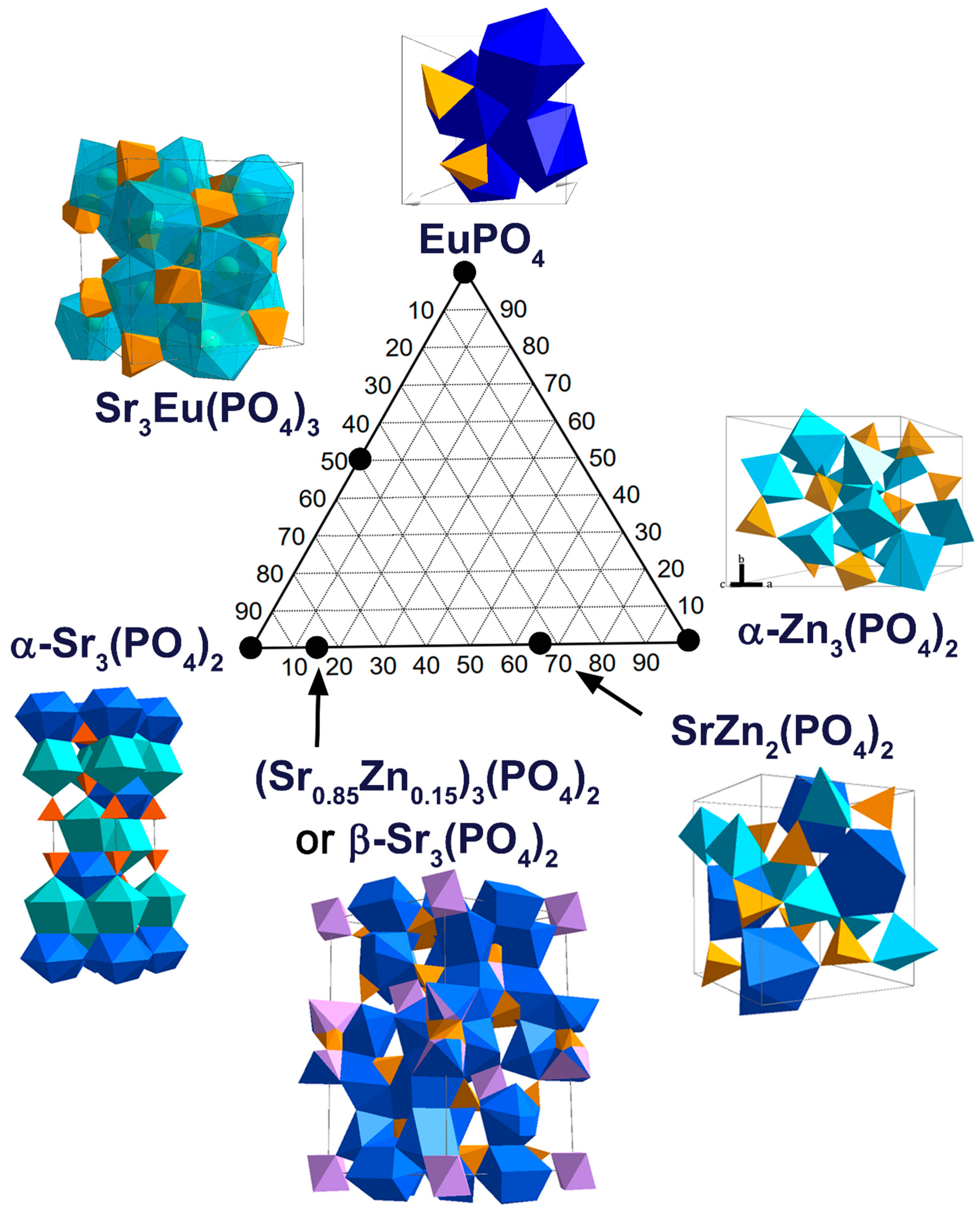
The substitution relations in the Sr2+–Zn2+–Eu3+ orthophosphate system can be presented by the ternary phase diagram (or Roozeboom’s triangle) (Figure 1). The limit points in the Sr2+–Zn2+–Eu3+ system are phosphates with the palmierite Sr3(PO4)2 [6], hopeite Zn3(PO4)2 [7], and monazite EuPO4 [8] structures. The projections of the crystal structures of these compounds are shown in Figure 1.

1.1. Monazite EuPO4

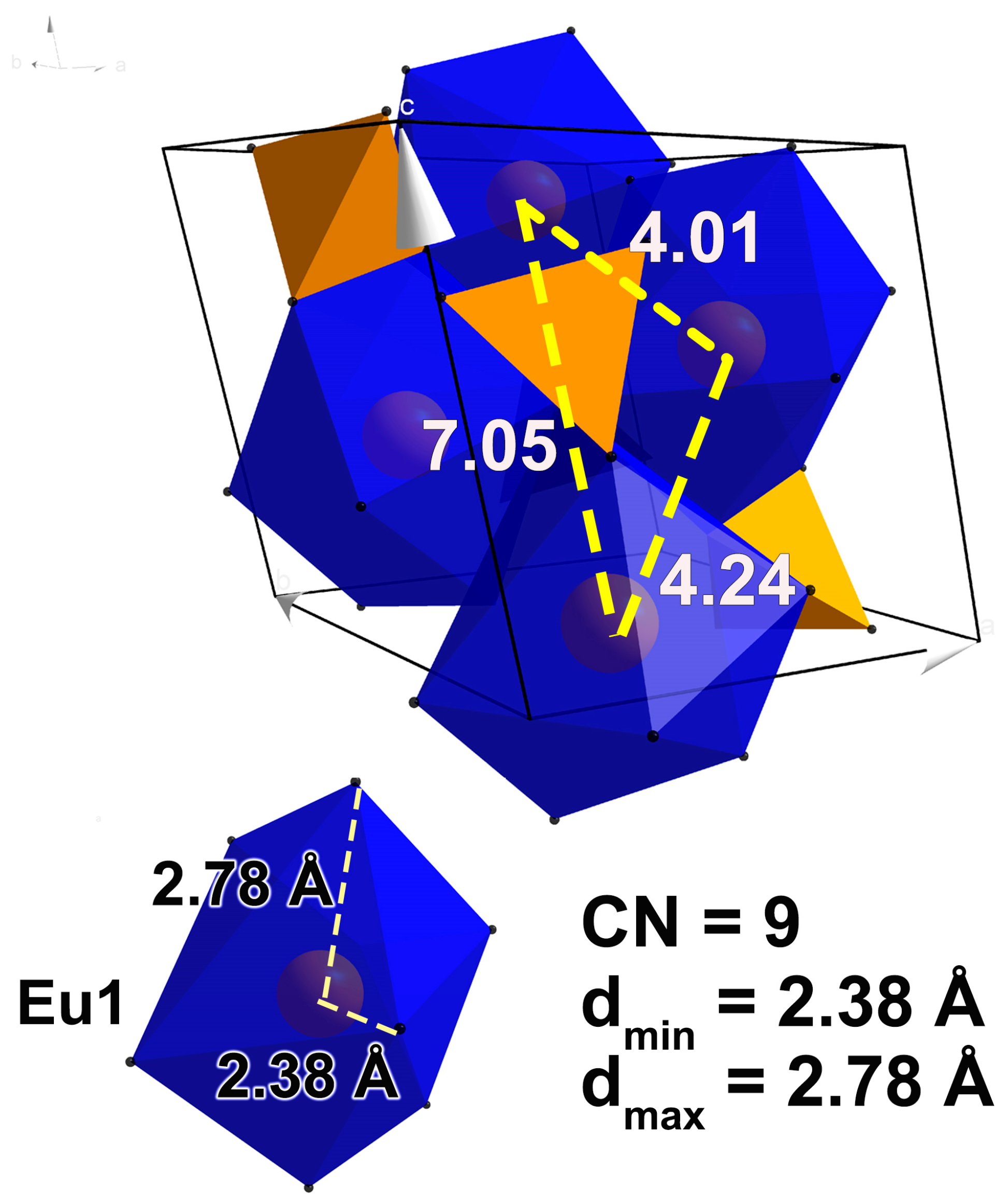
The phosphates with the general formula LnPO4, where Ln is a rare earth element from La to Gd (except Pr), have monazite crystal structure with monoclinic syngony [9] (space group (SG) P21/n). The phosphates with small lanthanides are crystalized in xenotime structure with cubic syngony (SG I41/amd) [10]. So, the EuPO4 (ICSD_201840) forms a monazite crystal structure (SG P21/n), the unit cell parameters are a = 6.639 Å, b = 6.823 Å, c = 6.318 Å, β = 104°, Z = 4. There is a single crystallographic site for the Eu atom with a disordered nine-fold coordination [11,12] (Figure 2), linked by PO4 tetrahedral in 3D framework (Figure 2). The Eu-surrounding structure is characterized by two different Eu-O distances, leading to disordering of polyhedra. The distance Eu–Eu between two polyhedra changes from 4.01 Å to 4.24 Å. EuPO4 shows PL properties associated with Eu3+ emission.

1.2. Hopeite α-Zn3(PO4)2

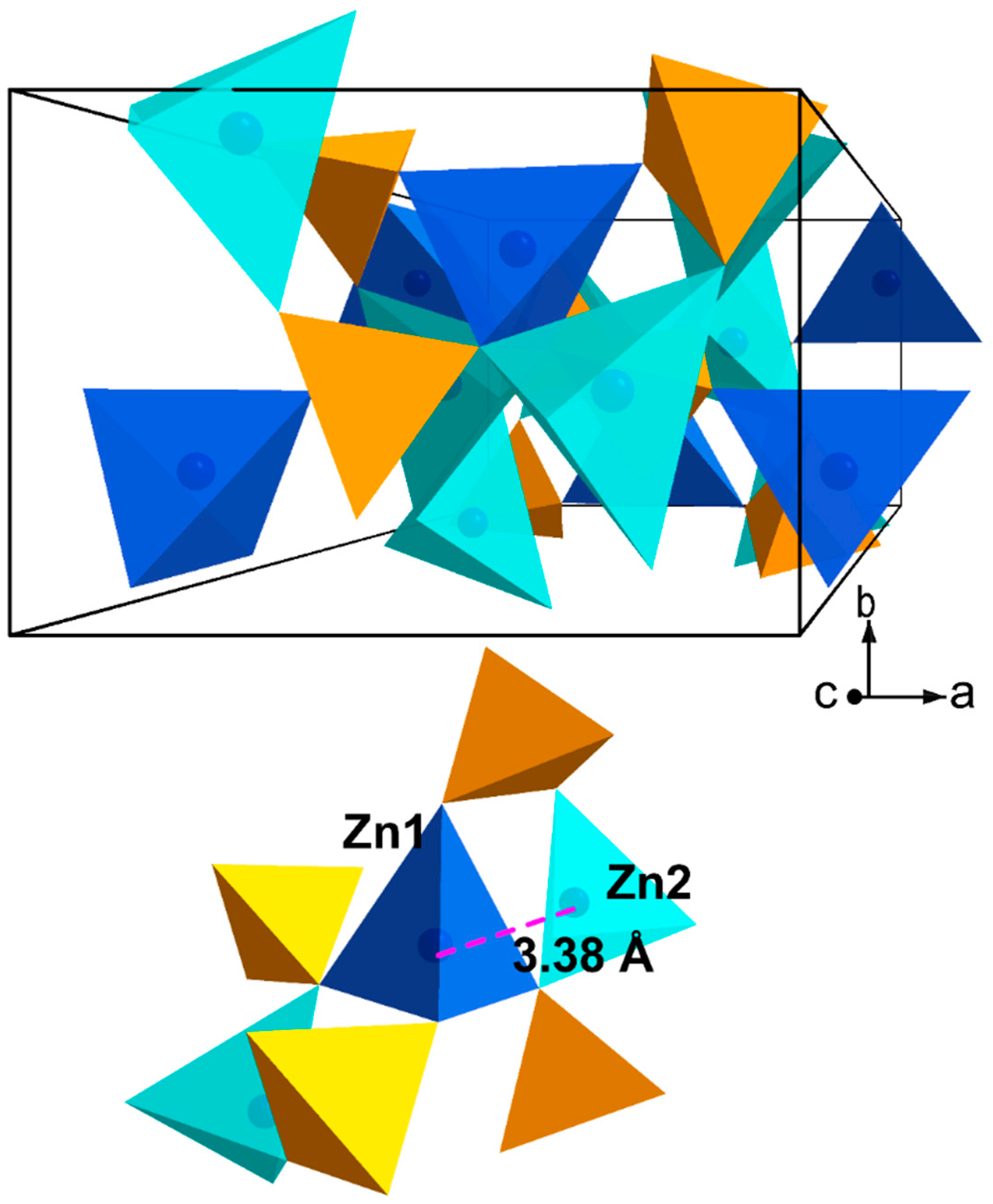
The α-Zn3(PO4)2 (ICSD_27554) is crystallized in SG C2/c [8]. There are two disordered Zn sites, which are connected by PO4 tetrahedra into a 3D framework (Figure 3). The unit cell parameters are a = 8.140 Å, b = 5.630 Å, c = 15.040 Å, β = 105.13°, V = 665.36 Å3, Z = 4. According to the characteristic small ionic radii for Zn2+ ions, the cationic sites have tetrahedral coordination. The distances Zn–O are dmin = 1.929 Å and dmax = 2.031 Å in the Zn1 site, and dmin = 1.864 Å and dmax = 2.017 Å in the Zn2 site. The distance Zn1–Zn2 is 3.38 Å (Figure 3) between Zn in tetrahedra.
For the Zn3(PO4)2–EuPO4 system, there are currently no intermediate individual phases. However, EuPO4 and Zn3(PO4)2 structures themselves have low isomorphic capacity due to the mismatch in the Eu3+ and Zn2+ ions’ sizes and coordination environment. Thus, in [13,14] the doping of Zn3(PO4)2 by Eu3+ ions shows a very low limit of substitution for single-phase formation not exceeding 3 mol%.

1.3. Palmierite α-Sr3(PO4)2

The strontium phosphate (Sr3(PO4)2) can be stabilized in two phases: α- and β-phases, which exhibit structural differences. Low-temperature modification, α-Sr3(PO4)2 (ICSD_150869), is related to the palmierite-type structure–M3(TO4)2 where M = Ba2+, Sr2+, Ca2+, Pb2+, and T = V5+, As5+, P5+ [15] (SG R 3 ¯ m, unit cell parameters a = 5.3901(8) Å, c = 19.785(5) Å, V = 497.81(19) Å3, Z = 3) [16].
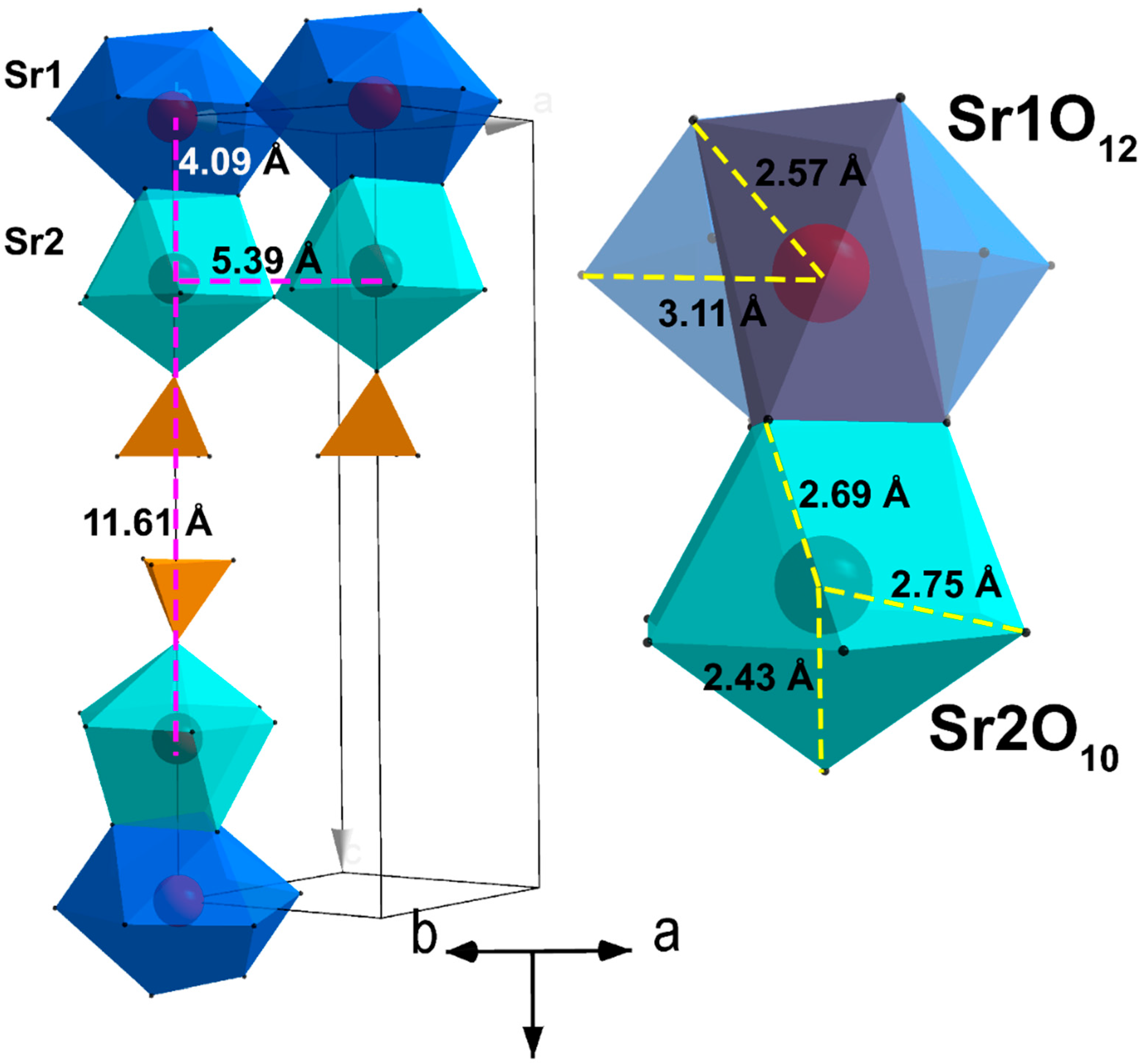
There are two different crystal sites for Sr atoms in the palmierite-type structure (Figure 3) characterized by different CN: Sr1 and Sr2. The Sr1 site shows 12-fold symmetrical coordination with two different Sr–O distances. The first interatomic distance is dSr1–O2 = 2.57 Å, which forms the symmetrical octahedral surrounding of Sr2+ (Figure 4). The second one is dSr1–O1 = 3.11 Å, which forms 12-fold coordination for Sr2+ in the Sr1 site. The Sr2 site has CN = 10, and three different Sr–O distances: dSr2–O2 = 2.75 Å, dSr2–O2 = 2.69 Å, and dSr2–O1 = 2.43 Å (Figure 4).
Phosphorus atoms form PO4 tetrahedra that link cationic sites. The structure can be described as a sequence of polyhedra composed of PO4–Sr2O10–Sr1O12–Sr2O10–PO4 forming the column along the c-axis (Figure 4) [17]. The interatomic distance between the Sr1 and Sr2 sites is 4.09 Å, while the distance between cationic sites in the nearest columns is 5.39 Å (Figure 4).
The α-Sr3(PO4)2 is stable at room temperature, while the high-temperature structure, namely β-Sr3(PO4)2, is significantly different and is isostructural with mineral strontiowhitlockite Sr9Mg(PO4)6(PO3OH) (PDF-2 No 48-1855) [18]. However, the β-Sr3(PO4)2 structure can be stabilized at room temperature by introducing small radius cations, such as Mg2+, Zn2+ [19], Fe2+ [20].

1.4. Strontiowhitlockite β-Sr3(PO4)2

As mentioned above, the incorporation of Zn2+ ions into the palmierite-type α-Sr3(PO4)2 phosphate forms an octahedral coordination that is characteristic of relatively small Zn2+ ions. Consequently, Zn-substituted Sr3(PO4)2 exhibits a strontiowhitlockite structure. The relations between Sr3(PO4)2–Zn3(PO4)2 at different temperatures was studied in [19]. It was shown that at 12–15% mol.% of Zn3(PO4)2 (or 0.35 ≤ x ≤ 0.45 in Sr3–xZnx(PO4)2), solid solutions with the β-Sr3(PO4)2-type structure can be stabilized as a single phase. The described novel phase was (Sr0.85Zn0.15)3(PO4)2 (PDF-2 No 14-207, Z = 21) in [21]. This formula, according to the crystallographic structure, can be represented as Sr8.925Zn1.575(PO4)7 (Z = 6). It should be noted that in the case of the Sr3(PO4)2–Mg3(PO4)2, the range of solid solutions with the β-Sr3(PO4)2-type structure is considerably wider, ranging between 10–35 mol.% of Mg3(PO4)2 [19]. Later, it was shown that the β-Sr3(PO4)2 structure is stable at room temperature in strontiowhitlockite mineral Sr9Mg(PO4)6(PO3OH) [19]. To date, some REE-activated β-Sr3(PO4)2-type phosphors have been investigated: (Sr0.85Zn0.15)3(PO4)2:Eu3+ [21], (Sr0.86Mg0.14)3(PO4)2:Eu2+, Mn2+ [22], Sr8ZnIn(1–m)Lum(PO4)7:Eu2+/Mn2+ [23], Sr8ZnIn0.6Sc0.4(PO4)7:Eu2+/Mn2+ [24].
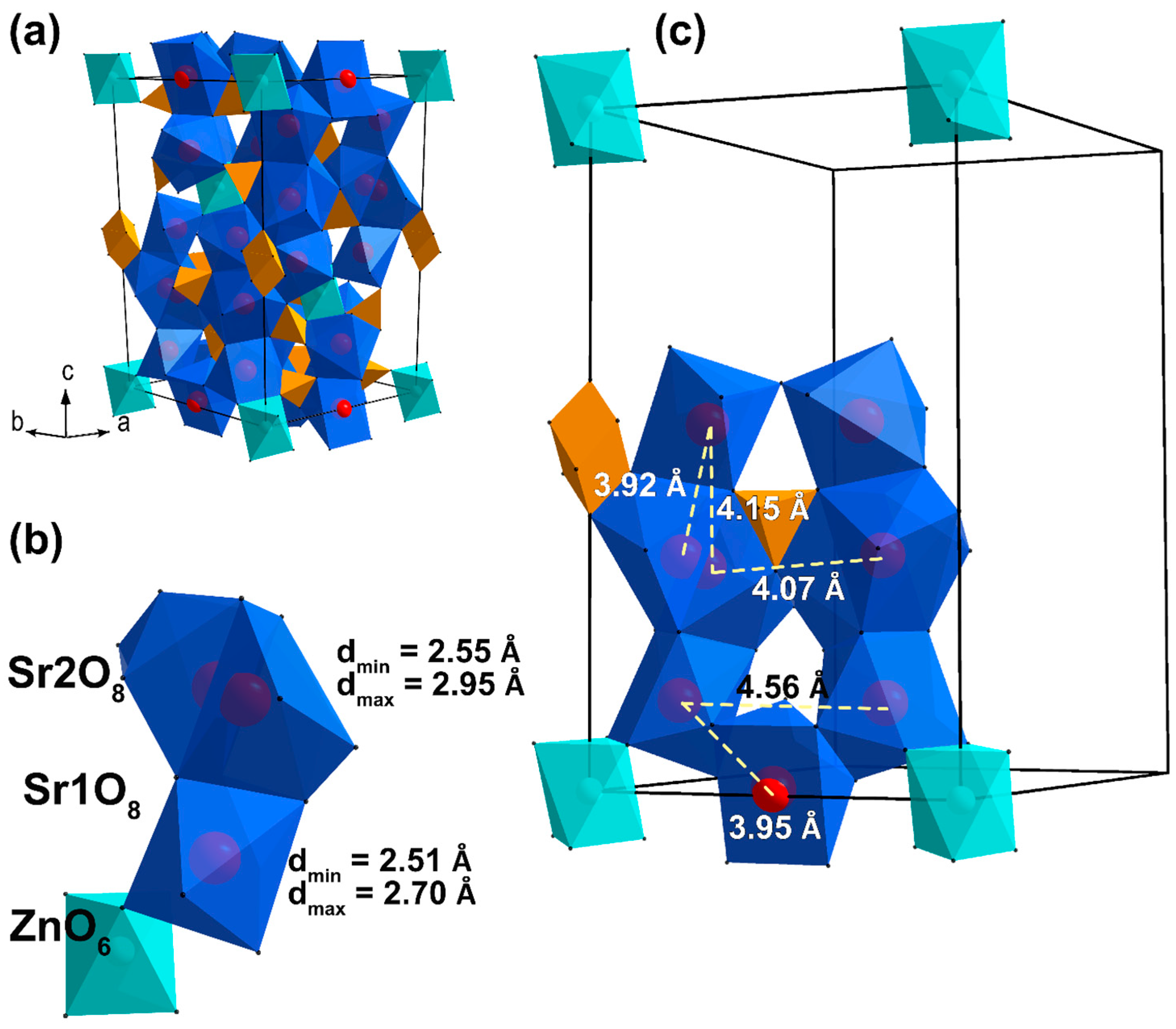
The phosphates (Sr0.85Zn0.15)3(PO4)2 [19] and Sr8ZnEu(PO4)7 (CCDC No 2424984) [2,25] with the β-Sr3(PO4)2-type structure are significantly more complex (Figure 5a) compared to α-Sr3(PO4)2. It is worth noting that the SG of the mineral Sr9Mg(PO4)6(PO3OH) was determined as polar R3c [18], similar to its calcium analogue, whitlockite Ca9Mg(PO4)6(PO3OH) [26,27]. However, later studies on synthetic analogues of strontiowhitlockite using the second harmonic generation method revealed the absence of nonlinear optical activity and confirmed a nonpolar structure corresponding to the SG R 3 ¯ m [25,28]. Due to its extremely low abundance, similar studies on the natural mineral have not been conducted since its discovery.
In contrast to calcium-based whitlockite [29], which can incorporate many ions of different sizes and charges [30], the strontiowhitlockite has limited isomorphic capacity as was shown in [19]. It should be noted that the heterovalent substitutions can also be realized in a β-Sr3(PO4)2 structure according to the substitution scheme 3Sr2+ → 2R3+ + □, where □ is a vacancy, with the formation of Sr9R3+(PO4)7 phosphates, where R3+ is an ion with small radius, such as Sc3+, Ga3+, Cr3+, Fe3+, In3+ [31], Lu3+ [32], or Y3+ [33]. In Sr9R3+(PO4)7, R–La3+ was crystalized in a palmierite structure, as was shown in [34]. However, co-doping 4Sr2+ → 2R3+ + M2+ can lead to the β-Sr3(PO4)2 structure. Structural analysis of the triple phosphate Sr8ZnR(PO4)7 R = Eu [25], R = La [35] revealed two nonequivalent positions of Sr atoms—Sr1 and Sr2 (Figure 5b)—jointly occupied by strontium and europium atoms, while the Zn atoms form octahedral polyhedra located on the 3-fold c axis. The SG was refined as centrosymmetric R 3 ¯ m based on the second harmonic generation tests. The unit cell parameters are a = b =10.607(5) Å, c = 19.658(8) Å, Z = 3. The shortest interatomic distance between the cationic sites is dSr1–Sr2 = 3.92 Å (Figure 5c), while the largest distance of 4.56 Å is observed between Sr1 sites in the nearest columns.

1.5. Eulytite Sr3Eu(PO4)3

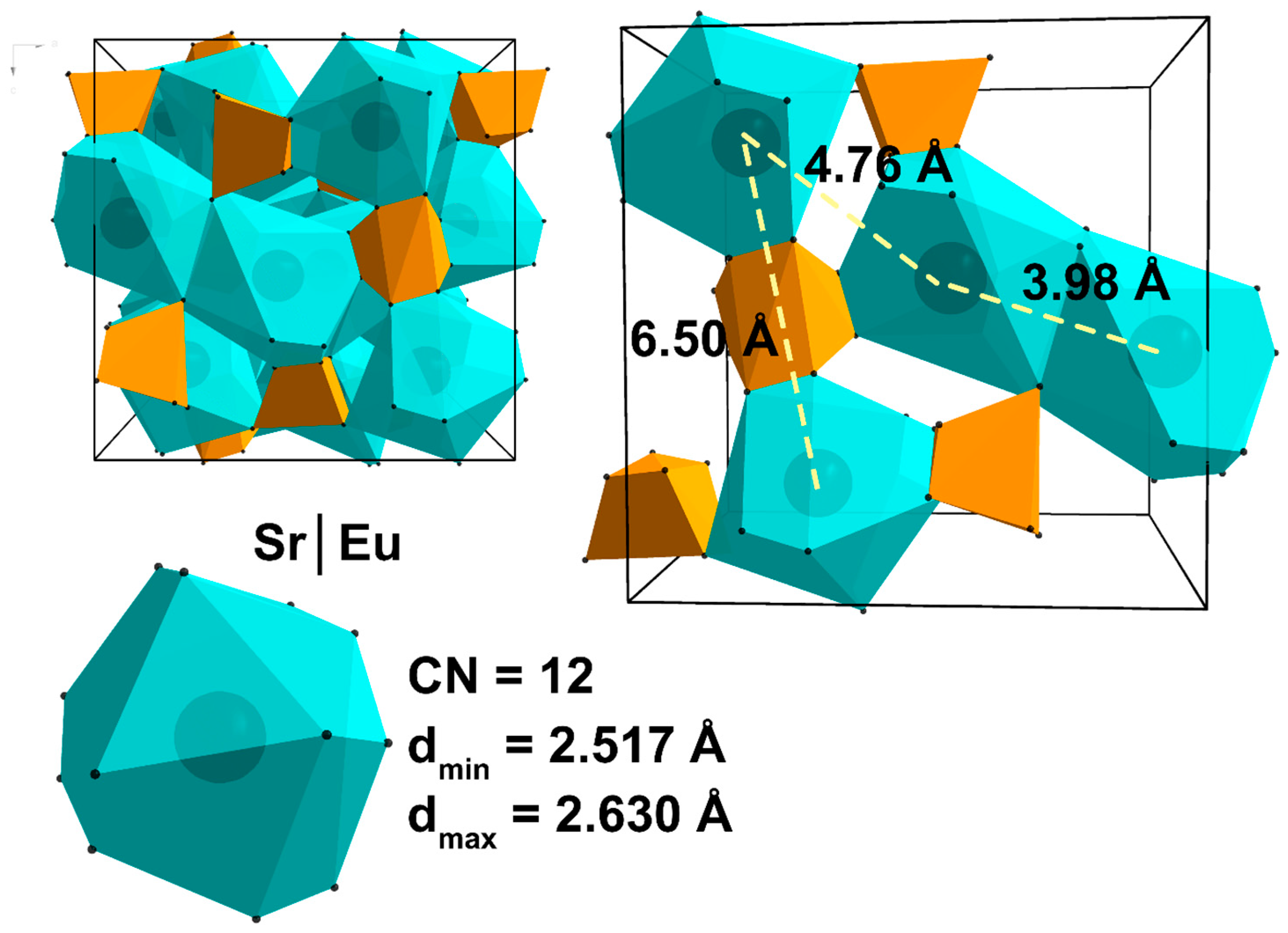
The existence of a single intermediate phase with the eulytite structure Sr3Eu(PO4)3 (ICSD_195181, SG I 4 ¯ 3d, Z = 4) is known in the system Sr3(PO4)2–EuPO4 [36]. The unit cell parameters are a = 10.120(2) Å, V = 1036.5(5) Å3. The structure contains one crystallographic Sr|Eu site (Figure 6), which is jointly occupied by Sr and Eu atoms in a 3:1 ratio. The interatomic distance between the nearest sites is 3.98 Å, and the largest distance in the nearest columns is 6.50 Å (Figure 6). The oxygen environment of these sites is a twelve-vertex polyhedra (Figure 6) with two different Sr|Eu–O distances: 2.517 and 2.630 Å. Two types of PO4 tetrahedra link the structure into a 3D framework (Figure 6). It is worth noting that in the Sr3(PO4)2–CePO4 phosphate series, the formation of the strontiowhitlockite phase was observed at a molar fraction of CePO4 less than 5% and a temperature above 1400 °C [37]. Similar studies have not been carried out for the Sr3(PO4)2–EuPO4 series, but it is known that the impurity of Eu3+ in Sr3(PO4)2 up to 3 mol.% preserves the palmierite-type structure [38].

1.6. Strontiohurlbutite SrZn2(PO4)2

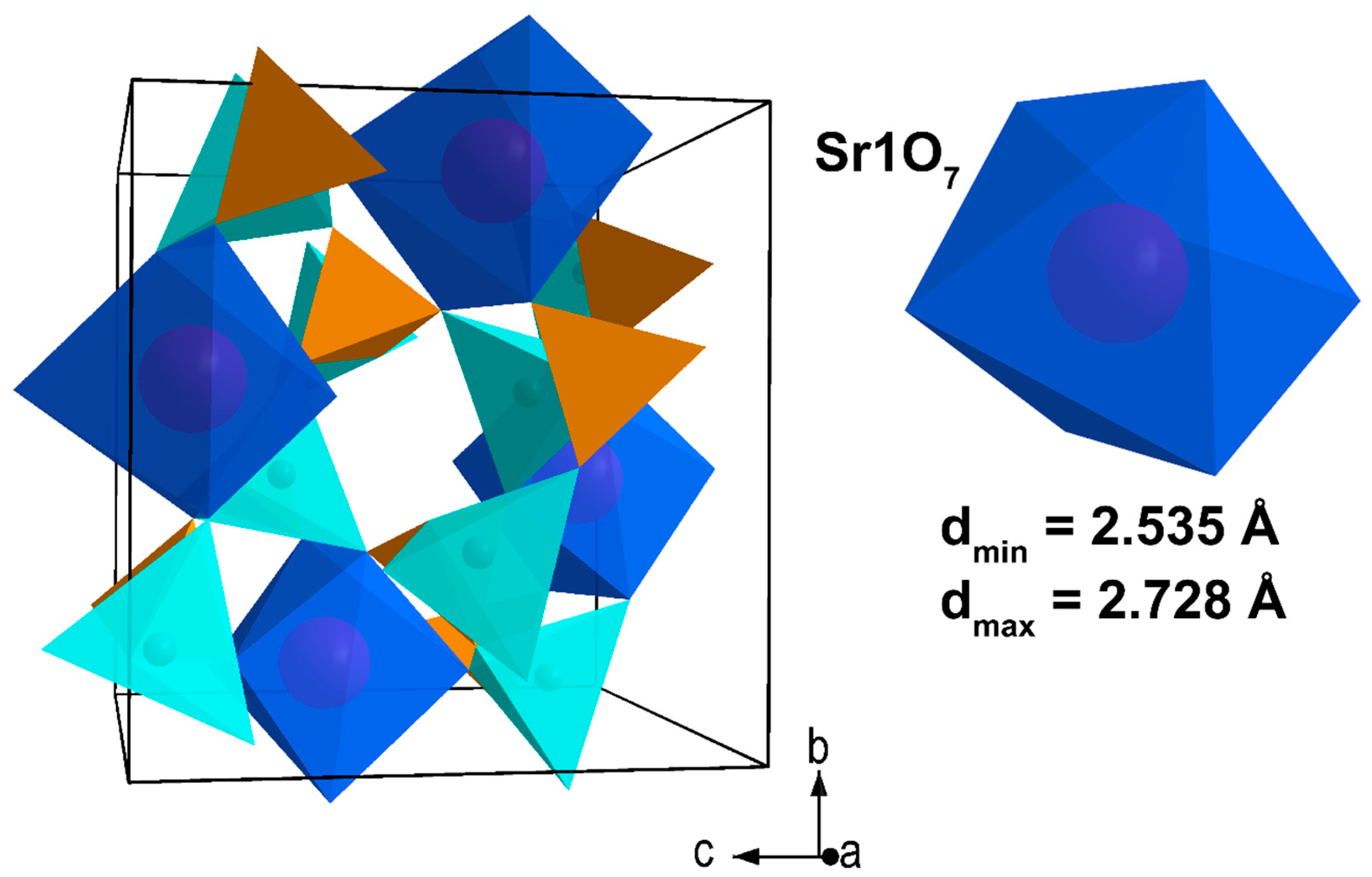
In addition to the strontiowhitlockite phase (Sr0.85Zn0.15)3(PO4)2 [19], isostructural with tricalcium phosphate β-Ca3(PO4)2 [39], one more individual compound is known in the Sr3(PO4)2–Zn3(PO4)2 series (Figure 1). This is the double phosphate SrZn2(PO4)2 with the hurlbutite structure [40]. However, the existence of single-phase intermediate phosphates and their compositional limits has not been established. SrZn2(PO4)2 (ICSD_68881) is isostructural with the mineral hurlbutite CaBe2(PO4)2 [40], and its strontium analogue strontiohurlbutite, which is crystallized in the form SG P21/c. The unit cell parameters are a = 8.323(4) Å, b = 9.510(4) Å, c = 9.032(4) Å, β = 92.3(3)°, V = 714.33(6) Å3, Z = 4. The Sr atoms occupy one crystallographic site, surrounded by a seven-vertex oxygen polyhedron, which represents a slightly distorted monocapped trigonal prism. This is presented with two different Sr–O distances. The Zn atoms form tetrahedra (Figure 7), similar to orthophosphate α-Zn3(PO4)2. The PO4 tetrahedra connect the cationic sites in a 3D framework. The distance Sr–Sr between nearest polyhedra is 5.533 Å, while the second nearest Sr-Sr distance is 6.801 Å. The SrZn2(PO4)2 host can be doped with small amount of Eu3+ and Bi3+ ions not exceeding 3 mol.%, as was shown in [41]. These atoms are located only in Sr sites of the structure. So, the hurlbutite structure is characterized by a low isomorphic capacity.
In summary, all described structures are formed by metal atoms’ coordination polyhedra linked into a 3D framework through PO4 tetrahedra. These connected framework structures offer several advantages for REE ions’ luminescence properties. Such 3D framework prevents defects and oxygen vacancies, while the rigid framework shields luminescence activators from oxidation and thermal degradation. Framework structures of phosphates also allow for easy variation of activator composition and coordination environment. This enables more precise control of emission wavelength, reduces concentration quenching, and increases quantum yield. Therefore, this work aims to discover new phases in the Sr3(PO4)2–Zn3(PO4)2–EuPO4 system and characterize them using powder X-ray diffraction methods and quantitative phase analysis. The structures of new phosphates were refined by the Rietveld method. The PL properties of the synthesized series were studied and compared among the series. The PL properties are discussed based on the crystallographic criteria.

2. Results and Discussion

2.1. Substitution Sr2+ → Zn2+

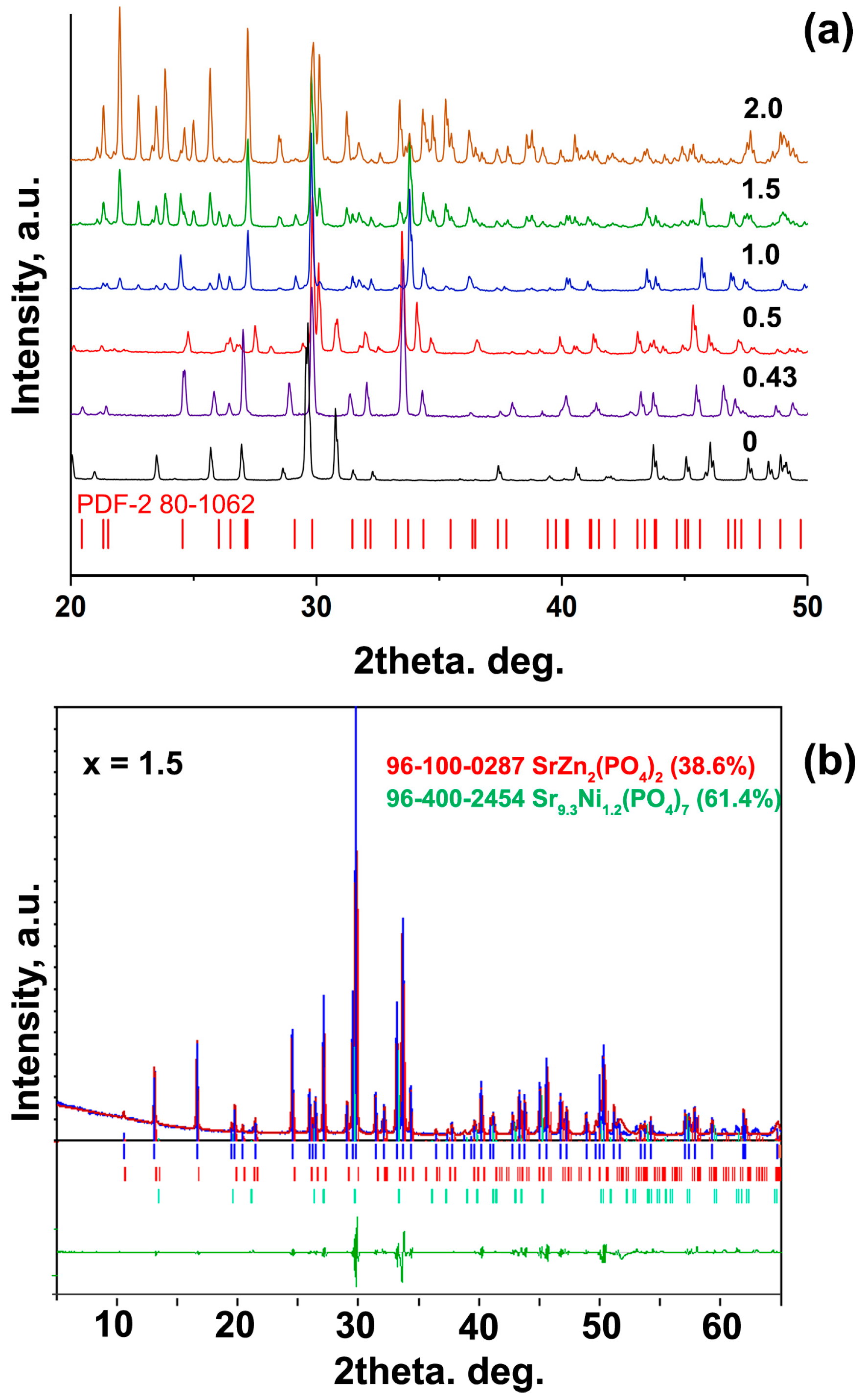
The PXRD patterns for the series of phosphates with Sr2+ → Zn2+ substitution in the Sr3–xZnx(PO4)2 series are presented in Figure 8a. The Zn2+ concentration varied from x = 0 to x = 2 (Table 1). At x = 0, the structure corresponds to palmierite α-Sr3(PO4)2-type phase. The amount x = 0.43, which is equal to the formula Sr9Zn1.5(PO4)7 (Z = 6), is crystallized at β-Sr3(PO4)2 structure as (Sr0.85Zn0.15)3(PO4)2 [19]. The range 0.5 ≤ x ≤ 1.5 demonstrates formation of both the β-Sr3(PO4)2 and the strontiohurlbutite structures. So, Zn2+ stabilizes the β-Sr3(PO4)2 type structure. This phase is mostly found in the range 0.5 < x ≤ 1.5 (Figure 8a). The amount x = 2 was crystalized in the strontiohurlbutite structure SrZn2(PO4)2 [40] (Figure 8b). Deviations from the stoichiometric compositions of Sr3(PO4)2 or SrZn2(PO4)2 results in a two-phase region except for the range 0.35 ≤ x ≤ 0.45, where pure strontiowhitlockite (β-Sr3(PO4)2) is stabilized. Quantitative phase analysis shows that at x = 1.5, the ratio between SrZn2(PO4)2 and β-Sr3(PO4)2 was 38.6/61.4%. At x = 1, the ratio was 23.1/76.9%. For x = 0.5, the ratio of α-Sr3(PO4)2 to β-Sr3(PO4)2 was 90.2/9.8%.

2.1.1. Rietveld Refinement

The crystal structure refinement of Sr9Zn1.5(PO4)7 (Z = 6) or Sr2.57Zn0.43(PO4)2 (Z = 21) was carried out by the Rietveld method using Jana2006 software [42]. The centrosymmetric crystal structure model of the phosphate Sr9Ni1.5(PO4)7 [43] was used as the initial model for further refinement. Pseudo-Voigt functions were used for fitting the reflection profiles. The background was described by a Legendre polynomial function.
At the first step of the refinement, Zn atoms were placed into the M4 and M5 sites (like Ni atoms in the initial Sr9Ni1.5(PO4)7 structure), and the coordinates and atomic displacement parameters (Uiso) were refined. High residual electron density was detected near the Sr1 site. Thus, this position was split into Sr1a and Sr1b sites. Due to the large values of Uiso for the O21 and O24 sites, they were split into two positions. The P–O distances were restricted at 1.54 Å ± 7%.
In the beginning, the Uiso for all O atoms were fixed as the same value and refined together. The same approach was performed for Sr1, Sr3, Zn4, Zn5 and P1, P2 sites. During one of the last cycles of refinement, negative values were obtained, which makes no physical sense. That is why the Uiso value for the above sites was fixed on the final cycle of refinement.
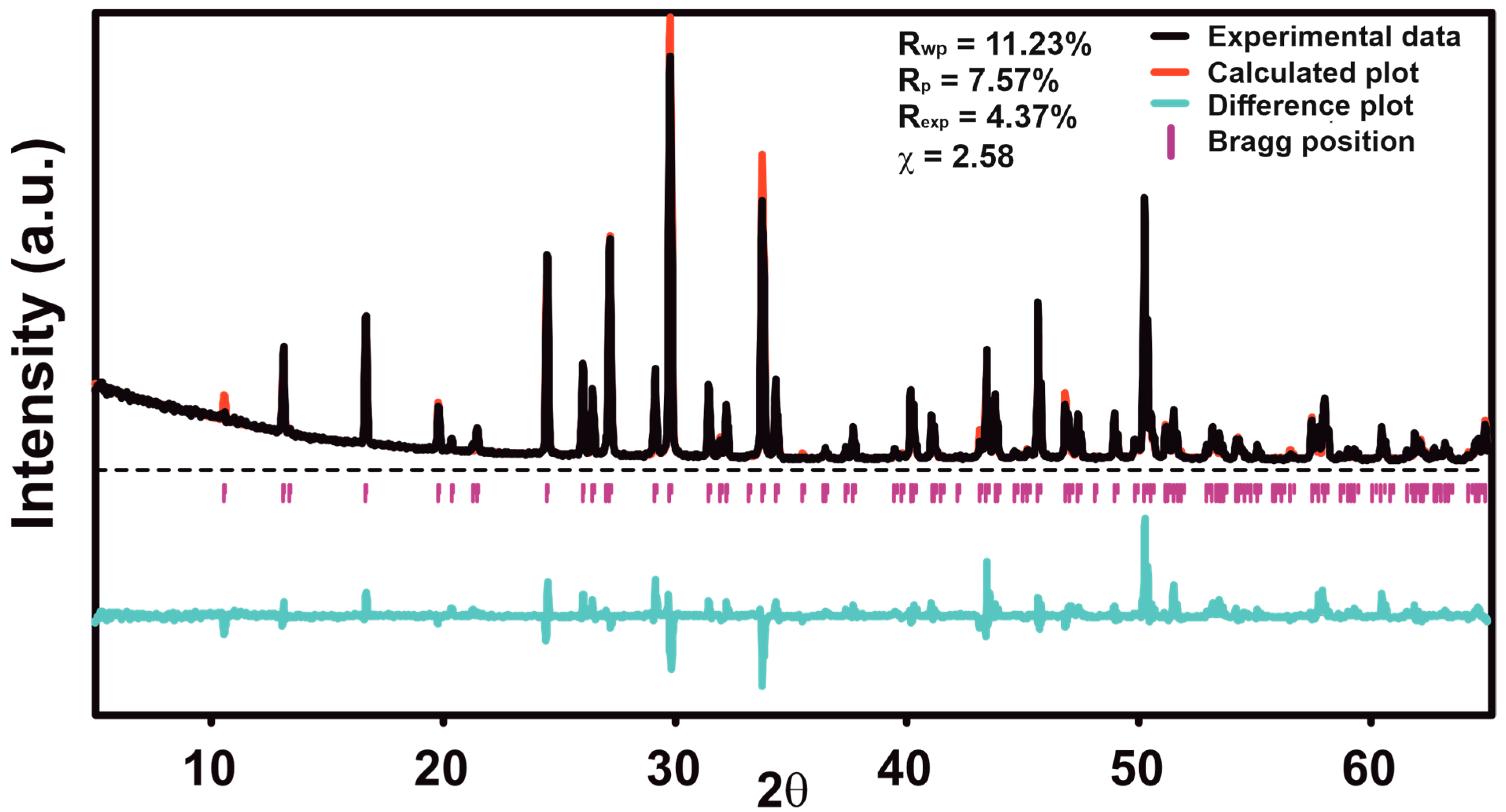
In the final stage, the coordinates of all atoms were refined, as well as the occupancies (ai) of the Sr1a, Sr1b, Sr3a, Sr3b, O21a, O21b, O24a, O24b sites, and Uiso for Zn4, Zn5, P2, and O11 sites. The final results are presented in Table 1 and Figure 9. Table 2 lists the fractional atomic coordinates, site symmetry, occupancy, and isotropic atomic displacement parameters. Table 3 include selected interatomic distances.

2.1.2. Combinatorial Complexity Calculations

The combinatorial complexity I G K K was calculated for some β-Sr3(PO4)2- and β-Ca3(PO4)2-type phosphates to analyze the influence of substitutions on the crystal structure. As a rule, combinatorial complexity of the crystal structure provides a negative contribution to the configurational entropy of a crystalline solid [44]. The value of combinatorial complexity of a crystal structure sensitive to partial occupancies was introduced by Kaußler and Kieslich [45]. I G K K depends on its ordinary Krivovichev complexity [46] I G s t r :
I G K K = I G s t r + I m i x ,
where Imix ≥ 0 is a contribution of mixing to the overall crystal–chemical complexity. As was shown by Krivovichev et al. [47], the overall crystal–chemical complexity ( I G s t r ) should be calculated as follows:
( I G s t r ) = 2 I G s t r I G K K .
The calculated values are given in Table 4. The value of ( I G s t r ) accounts for the influence of chemical substitutions and vacancies on the overall structural complexity and can therefore be considered as a degree of atomic order that takes into account not only structural architecture, but also its chemical nature. The presence of chemical substitutions (including substitutions by vacancies) results in a decrease of the atomic order and thus in a decrease of ( I G s t r ) . Moreover, unlike I G s t r , in some cases it is possible that ( I G s t r ) < 0.

2.1.3. DRS Study

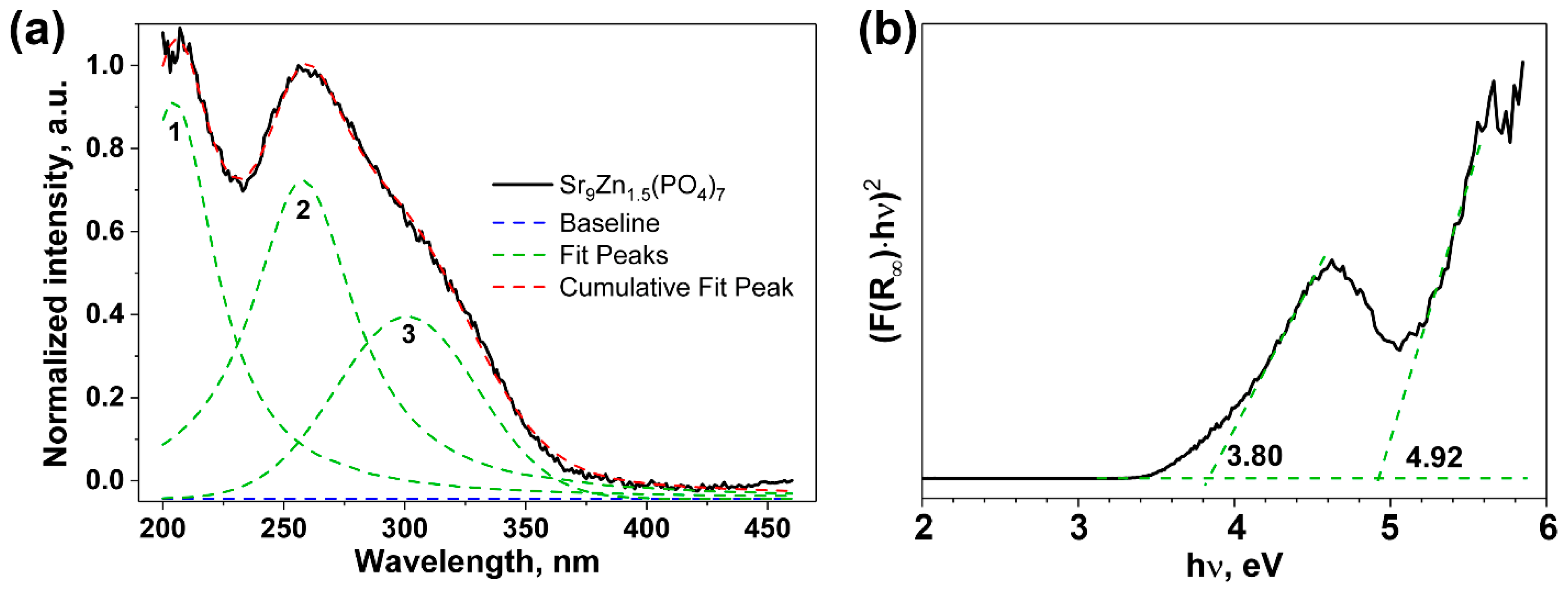
The UV-Vis diffuse reflectance spectra of the synthesized Sr9Zn1.5(PO4)7 phosphate reveal a complex absorption profile, indicative of multiple electronic transitions. For a detailed comparative analysis of the absorption edge, the spectra were examined in the 200–450 nm range and normalized to the maximum intensity within the 250–270 nm interval (Figure 10a).
A notable feature is the pronounced absorption tail extending to 400 nm, indicative of defect states or structural disorder. The spectrum was deconvoluted into three components: two Lorentzian peaks (Peak 1, 2) and one Gaussian (Peak 3), as summarized in Table S1 of the Supporting Information.
Peak 2 represents the fundamental absorption edge, while the Gaussian Peak 3 corresponds to defect-related transitions. The substantial contribution of Peak 3 (22%) confirms significant density of in-gap states. Peak 1 corresponds to a high-energy electronic transition. The optical band gap (Eg) was determined from the DRS data using the Tauc method (Figure 10b). The absorption coefficient was derived from the Kubelka–Munk function, F(R). Empirical analysis revealed that the best linear fit in the Tauc plot was achieved for the direct allowed transition model (exponent n = 2). This indicates that the dominant optical transition in Sr9Zn1.5(PO4)7 is direct, likely induced by the modification of the electronic structure upon zinc doping.
The analysis of the (F(Rhν)2 vs. hν plot revealed two distinct linear regions, allowing for the determination of two optical band gaps: Eg1 = 4.92 eV, Eg2 = 3.80 eV. The presence of two Eg values suggests a complex band structure and the possibility of several direct optical transitions in the material.

2.1.4. Raman Spectroscopy Study

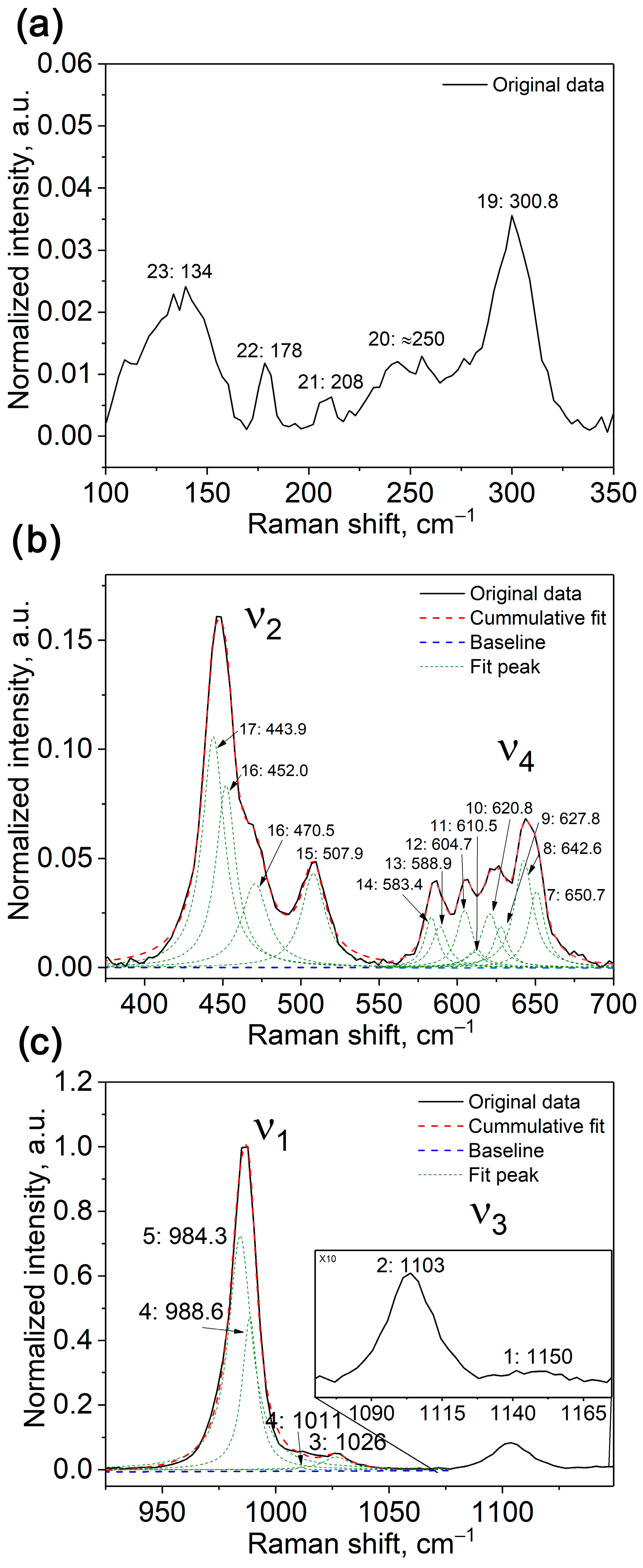
The Raman spectrum of the Sr9Zn1.5(PO4)7 phosphate was analyzed to gain insight into its local structure and the vibrational behavior of phosphate anions. The spectrum exhibits a complex profile characteristic of phosphates with isolated PO4 tetrahedra situated in multiple non-equivalent crystallographic sites. For a detailed analysis, the spectrum was deconvoluted into individual Lorentzian components across three characteristic regions (Figure 11), reflecting the different types of vibrational modes. Lorentzian profiles were used for the fitting of the internal phosphate modes (ν1, ν2, ν4), while the low-intensity bands in the lattice mode region were estimated without fitting.
In Region 1 (100–350 cm−1, Figure 11a), the observed low-intensity bands (peaks 19–23) are attributed to external lattice modes, which involve translational and vibrational motions of the PO4 units coupled with vibrations of the Sr/Zn cationic framework.
Region 2 (350–650 cm−1, Figure 11b) contains the internal bending vibrations of the PO4 tetrahedra. The deconvolution of the ν4 mode (peaks 7–14) revealed multiple components, with the most intense bands at 642.6 cm−1 (peak 8) and 650.7 cm−1 (peak 7). The ν2 mode (peaks 15–18) is characterized by a broad envelope with a maximum at 443.9 cm−1 (peak 17). The significant splitting and broadening observed in this region are direct evidence of the low local symmetry and distortion of the PO4 tetrahedra. This finding is in excellent agreement with the structural disorder and splitting of oxygen positions revealed by the Rietveld refinement.
The high-frequency Region 3 (900–1200 cm−1, Figure 11c) corresponds to the P–O stretching vibrations. The deconvolution of the ν1 mode resolved two dominant components at 988.6 cm−1 (peak 5) and 984.3 cm−1 (peak 6). The ν3 mode is represented by a complex contour, with the main fitted component at 1026.7 cm−1 (peak 3). Additional high-frequency components at 1150 cm−1 (peak 1) and 1103.8 cm−1 (peak 2) were also identified (Figure 11c, black box). The observed splitting of the ν1 and ν3 modes is a characteristic feature of whitlockite-type structures. Similar to β-Ca3(PO4)2 (β-TCP) [48], the presence of multiple components in the ν1 region directly reflects the existence of several non-equivalent PO4 tetrahedra with distinct P–O bond lengths. The broadening of these Raman bands in Sr9Zn1.5(PO4)7, compared to the sharper peaks in well-ordered phosphates like hydroxyapatite [49], indicates a significant structural disorder. This disorder arises from the random distribution of Sr2+, Zn2+, and vacancies over multiple cationic sites, analogous to the half-occupancy of the Ca(4) site in pure β-TCP, which also leads to broad spectral features [50]. The observed peak broadening is therefore a direct spectroscopic signature of the high combinatorial complexity calculated for this compound (Section 2.1.2).
A notable correlation is observed between the full width at half maximum (FWHM) of the ν1 mode components and the overall fit quality (χ2) for Region 3. The broader bands of the ν1 components (peaks 5 and 6), indicative of a greater distribution of P–O bond lengths and angles, correlate with a higher χ2 value for the multi-peak fit. This phenomenon can be understood by considering the extreme sensitivity of the ν1 mode to the local cationic environment. In substituted whitlockites, the nature of the substituting cation significantly influences the ν1 band positions [50]. In our case, the random distribution of Sr/Zn/vacancies creates a continuous range of local environments, leading to inhomogeneous broadening. This broadening, in turn, causes severe overlap of the ν3 components, making their reliable deconvolution more challenging and increasing the χ2 value. Thus, the correlation between FWHM(ν1) and χ2 is not an artifact but a direct spectroscopic consequence of the chemical and positional disorder within the Sr9Zn1.5(PO4)7 structure.
The Raman data thus provide independent confirmation of the structural conclusions drawn from the Rietveld refinement. The observed peak splitting and broadening corroborate the model of a complex crystal structure with distorted phosphate tetrahedra occupying several non-equivalent sites. Furthermore, the Raman spectrum of Sr9Zn1.5(PO4)7 is distinctly different from that of the palmierite-type α-Sr3(PO4)2, which exhibits a simpler spectral profile [51]. The complex and broadened features observed here are unequivocally characteristic of a whitlockite-type structure with a high degree of cationic substitution and disorder [52], firmly supporting the phase identification made by PXRD. The correlation between vibrational peak broadening and the combinatorial structural complexity, as quantified in Section 2.1.2, underscores the profound influence of cationic disorder on the local anion environment in the Sr9Zn1.5(PO4)7 host.

2.2. Substitution Sr2+ → Eu3+

The Sr2+ → Eu3+ substitution revealed severely limited isomorphic capacity in phases with the palmierite structure type (α-Sr3(PO4)2 [6]). As was previously demonstrated in [38], Sr2+ → Eu3+ substitution in Sr3(PO4)2 can be realized up to 0.3 mol.% of Eu3+ ions [53], even when a coupled charge compensation was used. Increasing the Eu3+ concentration in Sr3(PO4)2 results in the formation of an impurity phase with eulytite-type structure [38].
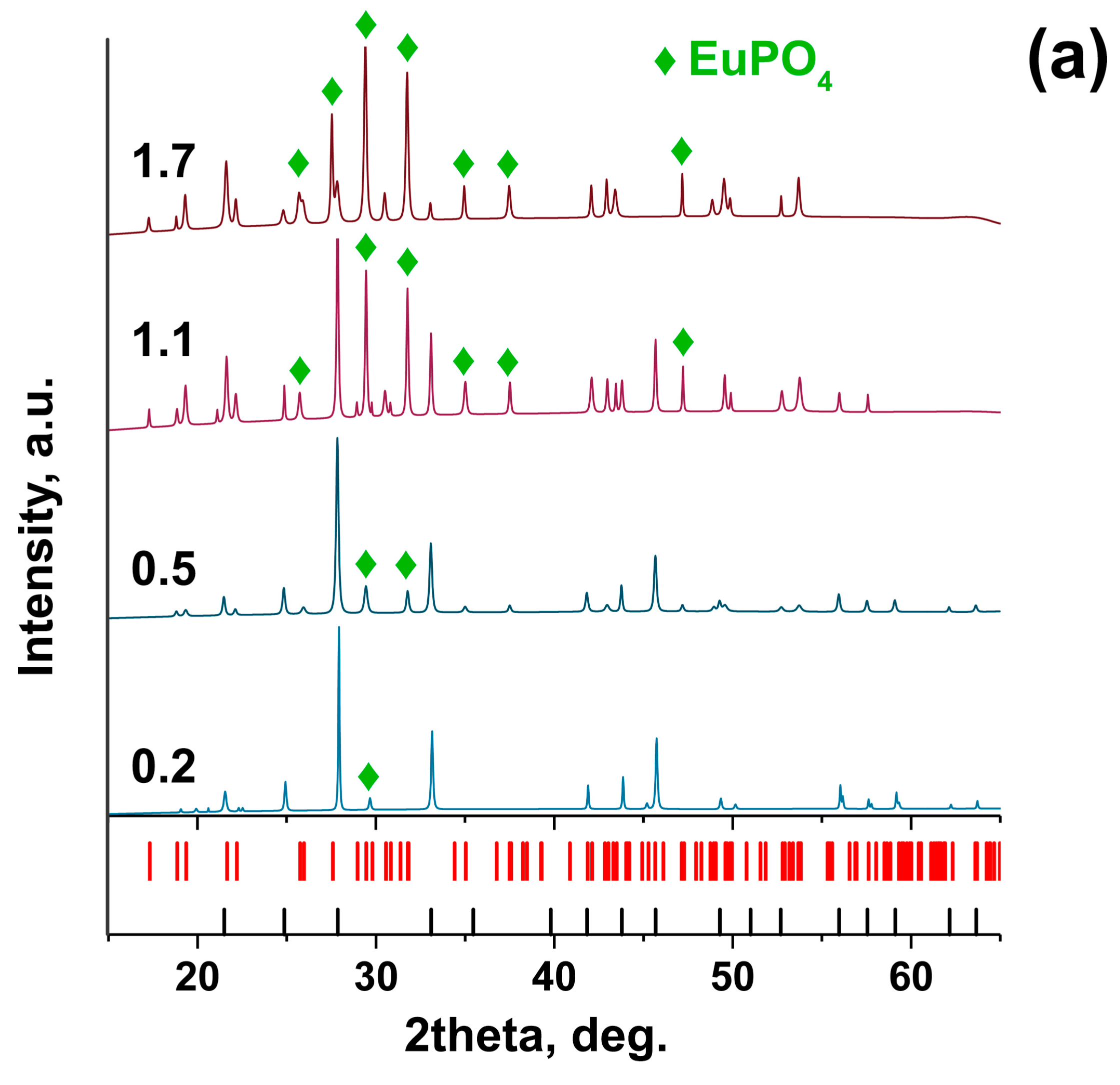
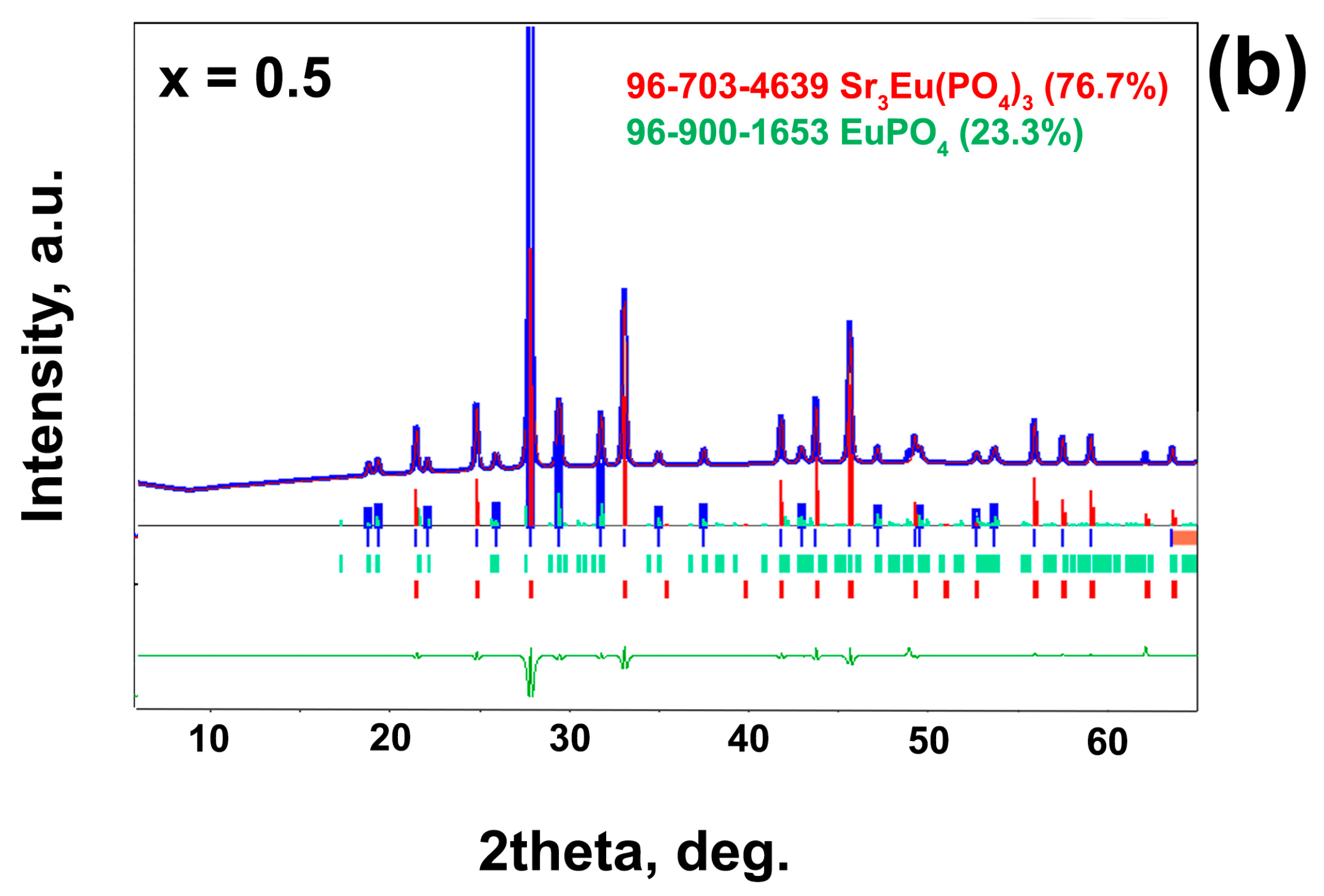
In the phosphate series with eulytite-type structure with general formula Sr3–1.5xEu1+x(PO4)3 where x varies from 0 to 2.0, all intermediate substances are not single-phased, except for the initial solid solution of double phosphate Sr3Eu(PO4)3 (x = 0) (Figure 12a) and the end-member EuPO4 (x = 2). The identified impurity phase for intermediate substances is monazite EuPO4 (Figure 12b), consistent with classical phase diagrams showing a two-phase region between Sr3Eu(PO4)3 and EuPO4. Quantitative phase analysis reveals that as Eu3+ concentration increases, the EuPO4 amount rises from 8% at x = 0.2 to 23% at x = 0.5. At x = 1.7, the monazite phase becomes dominant, reaching 79% at x = 1.7.

2.3. Co-Substitution Sr2+ → Zn2+, Eu3+

2.3.1. Sr9–xZnxEu(PO4)7

The series of Sr9–xZnxEu(PO4)7 phosphates was previously studied by us in [54]. Stabilization of phases in Sr9–xZnxEu(PO4)7 solid solution with the β-Sr3(PO4)2 at room temperature structural type is observed only for the stoichiometric phosphate Sr8ZnEu(PO4)7 [2,54]. This formula corresponds to formation of the octahedral site fully occupied by Zn atoms. This site was named M5, like in the base β-Ca3(PO4)2 structure. The second harmonic test revealed that the Sr8ZnEu(PO4)7 sample has a centrosymmetric structure (SG R 3 ¯ m). Changes in zinc concentration destabilize the structure through incomplete occupation of the octahedral site. This destabilization arises because the large ionic radii of Sr2+ or Eu3+ (Table 5) are incompatible with the octahedral coordination environment. This differs from calcium analogs, where the concentration series Ca9–xZnxEu(PO4)7 exists across the entire range—both the phosphates Ca9Eu(PO4)7 (with calcium cations occupying the M5 position) [55] and Ca8ZnEu(PO4)7 [56] are stable. In contrast, the phosphate Sr9Eu(PO4)7 cannot be stabilized as a single phase, which is explained by the difference in ionic radii (Table 5). Table 5 also summarizes data on radius difference percentage (Dr) [57] in Sr9R3+(PO4)7 phosphates, where R3+–Ga3+, Lu3+, Y3+.

2.3.2. Sr9.5–1.5xZnEux(PO4)7

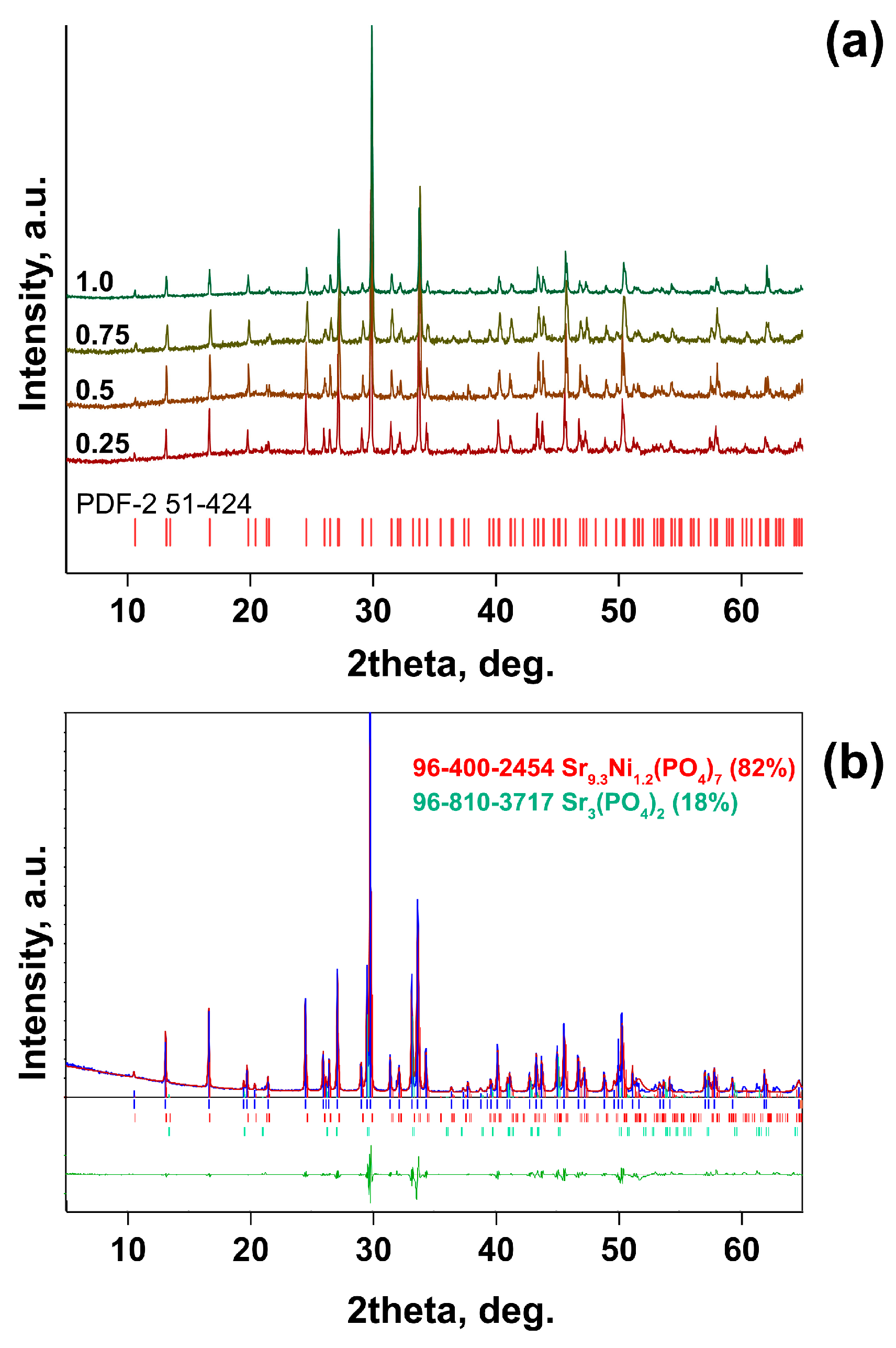
PXRD patterns for the series with heterovalent double substitution Sr2+ → Zn2+, Eu3+ with the general formula Sr9.5–1.5xZnEux(PO4)7 are shown in Figure 13a. At 0.25 ≤ x ≤ 1.0 values the PXRD patterns are identical. All reflections correspond to the phosphate (Sr0.85Zn0.15)3(PO4)2 (PDF-2 No 14-207). However, the composition x = 0 (Sr9.5Zn(PO4)7) is different. A mixture of α- and β-Sr3(PO4)2 was observed (Figure 13b) at amounts of 18 and 82%, respectively.
An amount of Zn2+ ions in the β-Sr3(PO4)2 host less than 15 mol.% leads to instability in this structure. There are crystal–chemical rules for β-Sr3(PO4)2 crystallization: requirements are the formation of an octahedral M5 site (Figure 5) occupied by Zn atoms and the occupation of a position with variable occupancy M4 on the c axis with a strongly distorted octahedral environment. As was mentioned above [19], the β-Sr3(PO4)2 phase remains stable at room temperature only within a narrow range of x from 0.35 to 0.45 in Sr3–xZnx(PO4)2 or Zn2+ content at 12–15 mol.%. In series with heterovalent co-substitution Sr2+ → Zn2+,Eu3+–Sr9–xZnxEu(PO4)7 [54] and Sr9.5–1.5xZnEux(PO4)7, the stabilization of the β-Sr3(PO4)2 phase occurs at a lower Zn2+ concentration of 10 mol.%. This happens because the M4 site axis becomes vacant according to the substitution scheme Sr2+ → Eu3+ + □ (where □ represents a vacancy). Similar behaviors in phase formation were observed in Sr9–xMgxEu(PO4)7, Sr9–xMnxTb(PO4)7 [54], and Sr9–xMnxEu(PO4)7 [60].

2.3.3. Sr9–1.5xZn1.5Eux(PO4)7

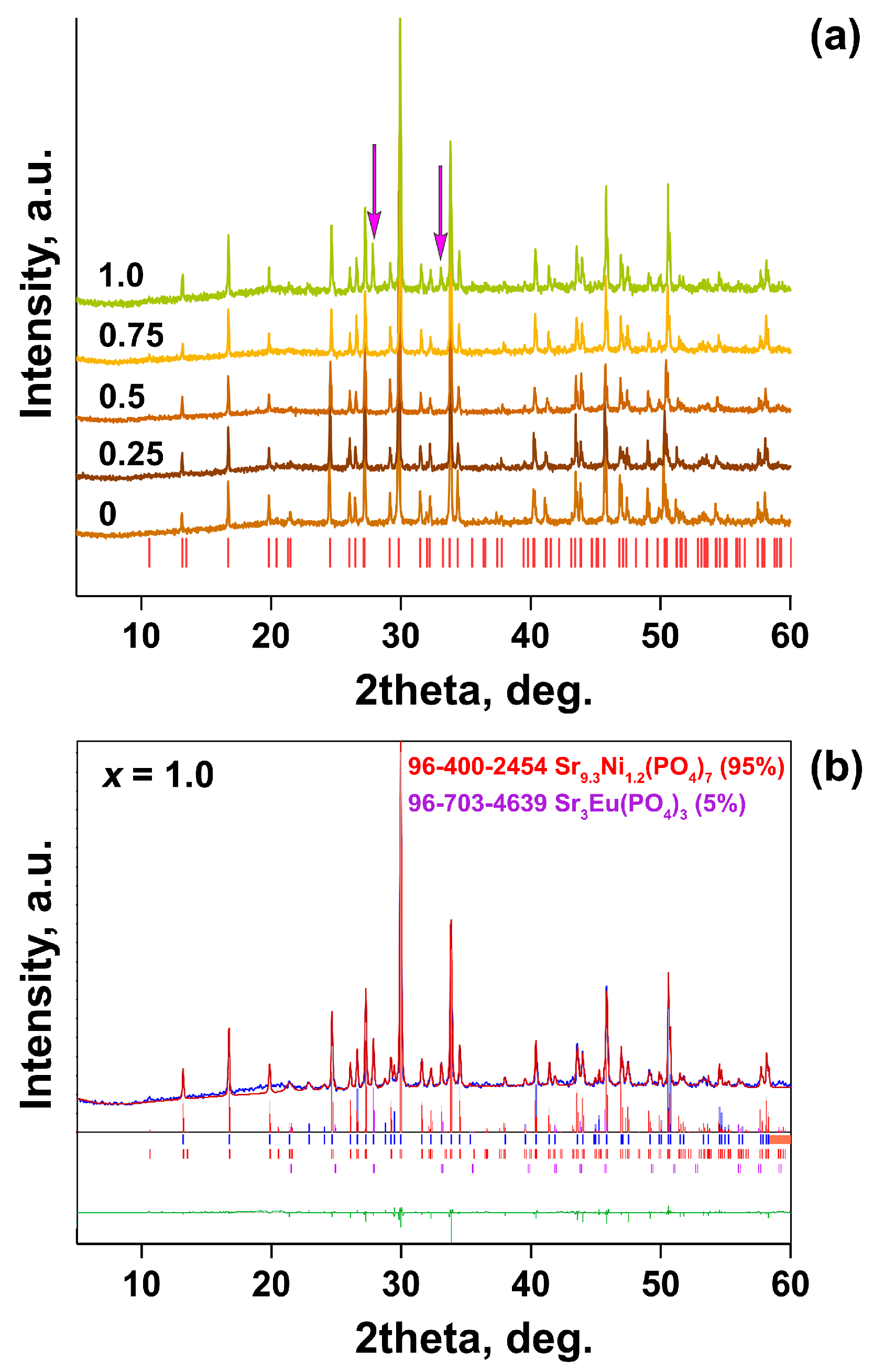
PXRD patterns for another series with heterovalent substitution with the general formula Sr9–1.5xZn1.5Eux(PO4)7 are shown in Figure 14a. Unlike the previous phosphate series Sr9.5–1.5xZnEux(PO4)7, the sample with x = 0—nominal formula Sr9Zn1.5(PO4)7—is single-phased (Figure 9 and Figure 14a). At 0 ≤ x ≤ 0.75, the observed reflections correspond to the β-Sr3(PO4)2 phase, with no reflections from secondary phase impurities. An unbroken series of solid solutions is thus formed. For the sample with x = 1.0—nominal formula Sr7.5Zn1.5Eu(PO4)7—reflections of the eulytite Sr3Eu(PO4)3 phase are observed (Figure 14b). Quantitative phase analysis shows that the main β-Sr3(PO4)2 phase and the impurity Sr3Eu(PO4)3 phase are present in a 95:5 ratio.

2.3.4. Sr3–xZnxEu(PO4)3

A series of Sr3–xZnxEu(PO4)3 (0 ≤ x ≤ 2) phosphates with heterovalent Sr2+ → Zn2+, Eu3+ co-substitution was studied, with eulytite phase Sr3Eu(PO4)3 as the initial structure at x = 0. Contrary to expectations, regions of β-Sr3(PO4)2-type structure stabilization were identified instead of phases based on the eulytite structure. In the composition range 0.25 ≤ x ≤ 0.5, a single phase corresponding to β-Sr3(PO4)2 phase crystallized. Increasing Zn2+ concentration led to the appearance of reflexes on the PXRD patterns corresponding to the monazite phase (x = 1.0 and 2.0). This indicates that zinc ions displace europium ions from structural positions, and the phases of double Sr-Zn phosphates are more thermodynamically stable than Sr-Eu phosphates, as no impurities of the Zn3(PO4)2 phase are observed. The co-substitution Sr2+ → Zn2+, Eu3+ in the phosphates successfully expanded the concentration limits for stabilizing the β-Sr3(PO4)2-type phase.

2.3.5. The SHG Test for Co-Substitution Sr2+ → Zn2+, Eu3+ Phosphates

The structure of β-Sr3(PO4)2-type compounds was calculated using different models with different SG. In [61], the SG R 3 ¯ m was used for the refinement of the base Sr9Mg1.5(PO4)7 and doped Sr9Mg1.5(PO4)7:Ce3+, A+ (A+ = Li+, Na+, K+) structures. In Sr8ZnIn(1−m)Lum(PO4)7:Eu2+/Mn2+ [23], the model with SG I2/a was used related to the Sr9In(PO4)7 initial phosphate. At the same time in [62], the polar R3c SG was used for the Sr9LiY0.667(PO4)7 structure.
The SG for the synthesized β-Sr3(PO4)2-type series was confirmed by SHG measurements. For the Sr9.5–1.5xZnEux(PO4)7 and Sr9–1.5xZn1.5Eux(PO4)7 series, SHG signals were completely absent across the entire single-phase range of x. This indicates that the samples are centrosymmetric, confirming that the SG R 3 ¯ m should be used. In the two-phase sample with nominal formula Sr9.5Zn(PO4)7, the SHG value was approximately zero. The absence of signal in this sample is likely because the second phase is palmierite α-Sr3(PO4)2 (PDF-2 № 80-1614), which also crystallizes in SG R 3 ¯ m. In contrast, the presence of a signal for the sample with formula Sr7.5Zn1.5Eu(PO4)7 may be due to a eulytite-type phase impurity with non-centrosymmetric structure (SG I4 3 ¯ d). The SHG signal in this sample is ~1.0 unit relative to the quartz reference. This small optical nonlinearity value is attributed to the small quantity of impurity, at 5%.

2.4. Eu3+ Doping of the Described Hosts

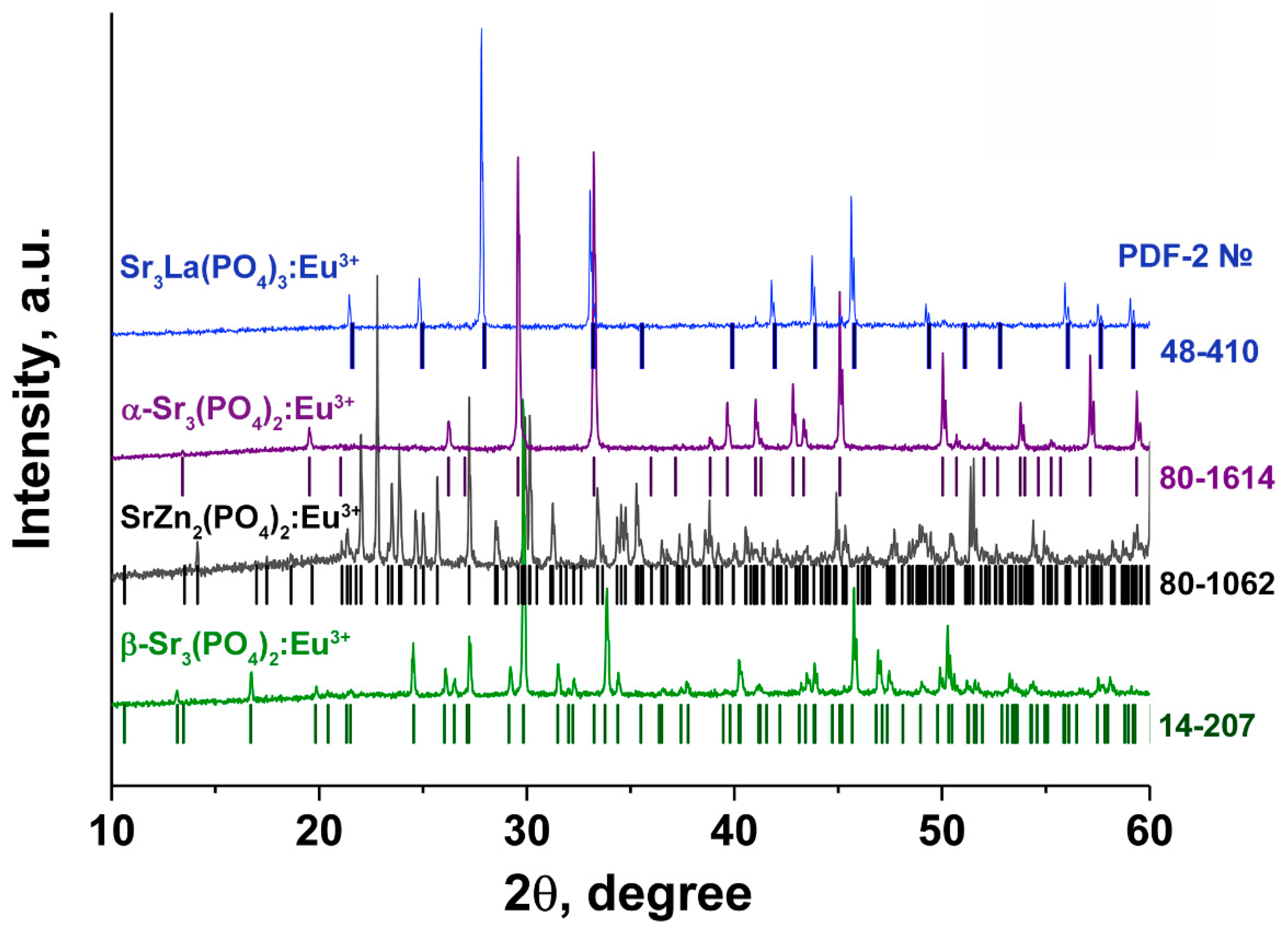
To compare the PL intensity of Eu3+-doped phases in the Sr3(PO4)2–Zn3(PO4)2–EuPO4 system, samples with α-(palmierite)-, β-Sr3(PO4)2 (strontiowhitlockite)-, SrZn2(PO4)2 (strontiohurlbutite)-, and Sr3La(PO4)3 (eulytite)-type structures were doped at 0.3 mol.% of Eu3+ ions. The corresponding formulas were calculated to be Sr2.985Eu0.01(PO4)2, Sr0.985Zn2Eu0.01(PO4)2, Sr2.535Zn0.45Eu0.01(PO4)2 and Sr3La0.99Eu0.01(PO4)3. The PXRD patterns of the synthesized phases are shown in Figure 15. For all samples, the number and position of reflections exactly correspond to the respective structural types: Sr3(PO4)2 (PDF-2 № 80-1614), SrZn2(PO4)2 (PDF-2 № 80-1062), (Sr0.85Zn0.15)3(PO4)2 (PDF-2 № 14-207), and Sr3Eu(PO4)3 (PDF-2 № 48-410). No reflections corresponding to secondary phases or initial reagents were observed (Figure 15). Thus, doping these structures with Eu3+ ions up to 0.3 mol% does not prevent phase formation.

2.5. PL Study

2.5.1. PL Study for Co-Substituted Sr2+ → Zn2+, Eu3+ Phosphates

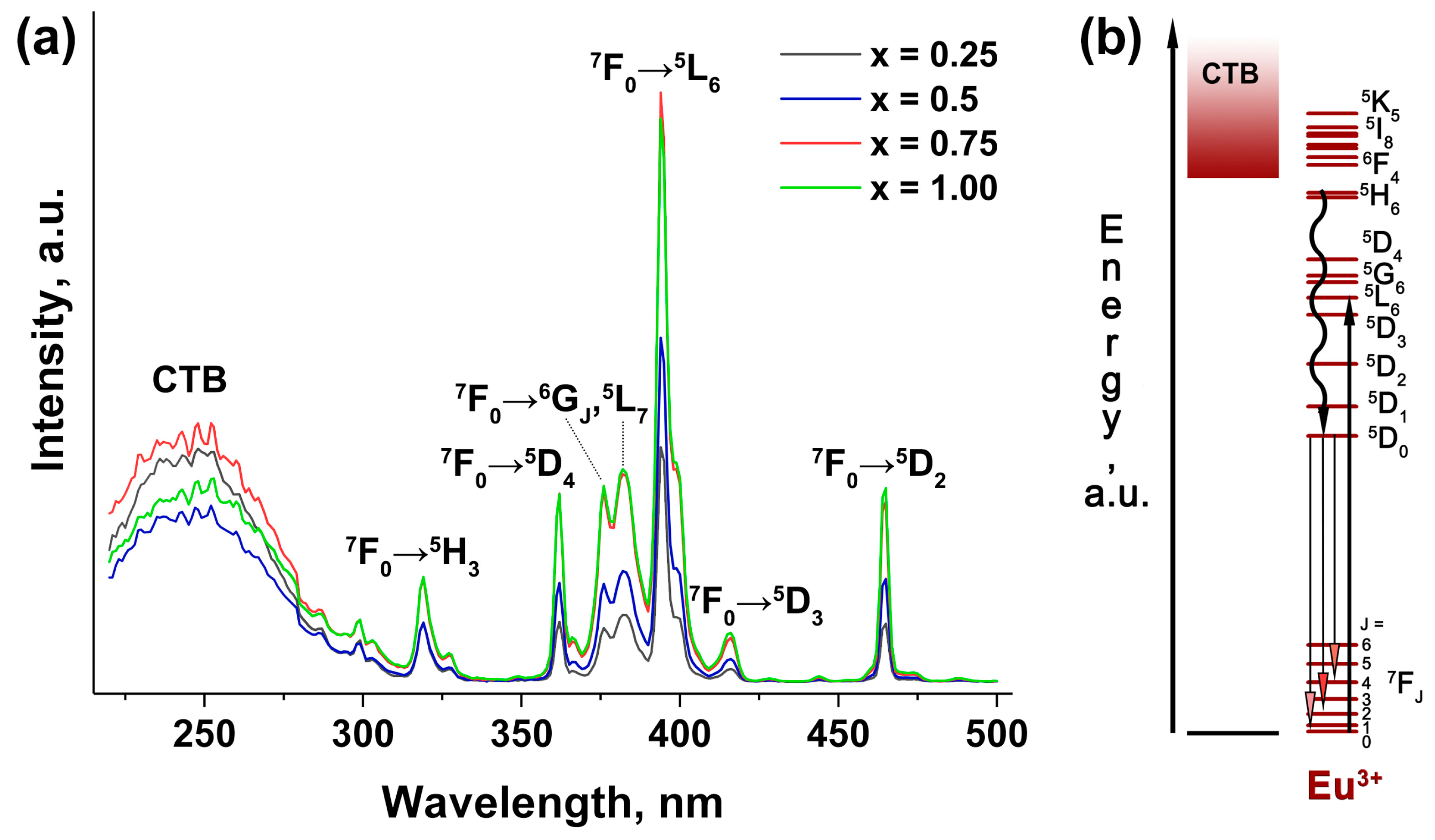
The PLE spectra monitored at λem = 614 nm for the Sr9.5–1.5xZn1.5Eux(PO4)7 series are shown in Figure 16. The number and positions of the observed bands corresponding to the 4f–4f transitions of Eu3+ ions for the samples with x = 0.25–1.0 remained unchanged regardless of the cation ratio in the host. The broad band from 250 to 300 nm can be attributed to the charge-transfer band (CTB), and a series of narrow bands in the 300–500 nm range can be attributed to the intracenter f–f transitions of Eu3+. The CTB corresponds to electrons excited from the 2p delocalized orbital of the O2− ion to the incomplete 4f orbital of the Eu3+ ion [63]. Linear dependence on x is not observed for series. In single-phased samples x = 0.25–0.75, it may be attributed to different occupations of sites by Eu3+ in the strontiowhitlockite host. As was shown in [57], the intensity of CTB depends on the polyhedra DI and bond length for calcium whitlockite, where Eu3+ ions occupy sites in a statistically random manner. The decrease in CTB intensity for x = 1.0 may be due to impurity phases isostructural to Sr3Eu(PO4)3. The bands located at 320, 361, 376, 382, 395, 416, and 465 nm correspond to the 7F05H3, 5D4, 5GJ, 5L7, 5L6, 5D3, and 5D2 transitions of Eu3+ ions. The PLE spectra for Sr9.5–1.5xZnEux(PO4)7 series demonstrate the same behavior and are shown in Figure S2 of the Supporting Information.
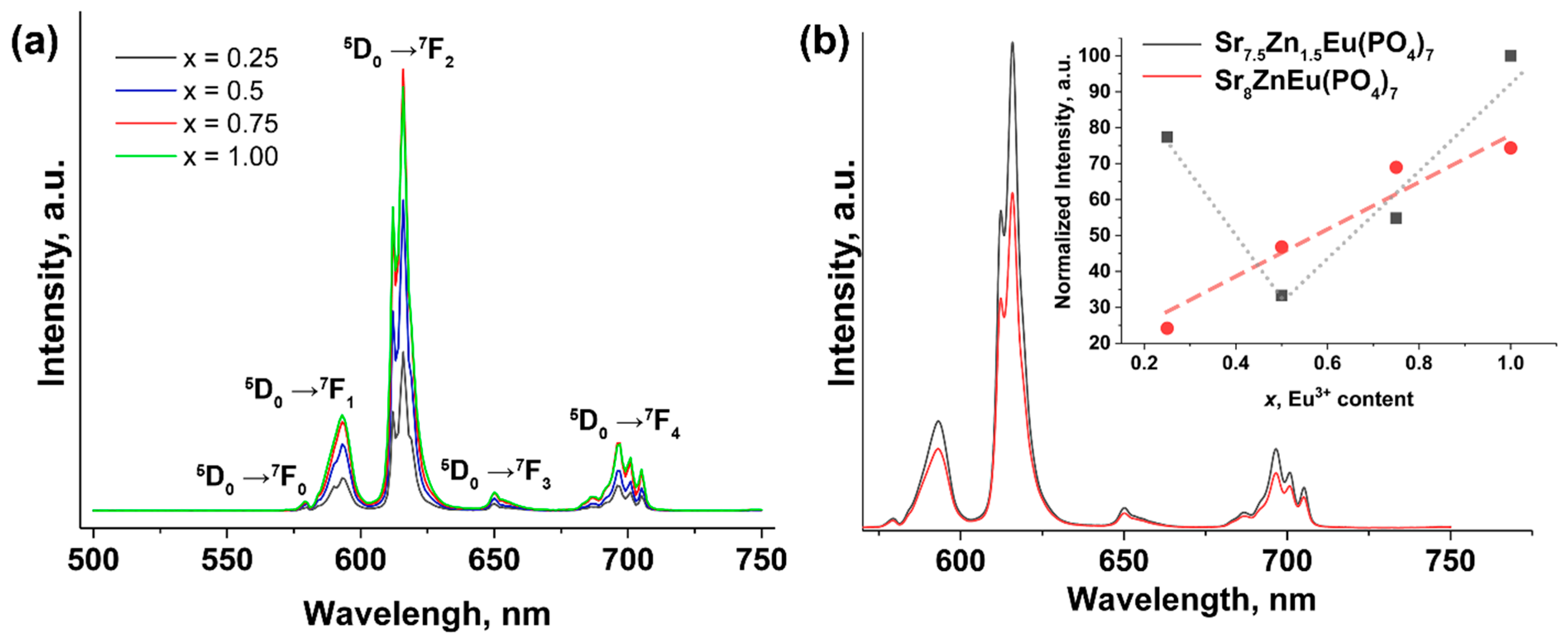
The PL spectra of Sr9–1.5xZn1.5Eux(PO4)7 series at 395 nm excitation are shown in Figure 17a (Figure S3 of the Supporting Information shows the PL spectra for Sr9.5–1.5xZnEux(PO4)7). The characteristic emission bands for Eu3+ ions are observed in the spectra. The narrow lines at 578, 594, 617, 650, and 700 nm correspond to 5D07FJ (J = 0, 1, 2, 3, 4) (Figure 17a). The most intense band is observed at 615 nm attributed to the hypersensitive 5D07F2 electric-dipole transition. This fact indicates the absence of inversion symmetry in the Eu3+ ion surroundings in the Sr9–1.5xZn1.5Eux(PO4)7 samples. The same trend is observed in Sr9.5–1.5xZnEux(PO4)7 series (Figure S3). The intensity of 5D07F2 transition shows a maximum at x = 0.75 in accordance with PLE spectra (Figure 17a). Transitions corresponding to the 4f5d–4f transitions of Eu2+ are not observed in the PL spectra (Figure 17a). The PL spectra confirm the absence of partial self-reduction Eu3+ → Eu2+ in strontiowhitlockite compared to Eu3+-doped palmierite-type Sr3(PO4)2:Eu3+ [38] or Ba3(PO4)2:Eu3+ [16] phosphors. In this research, the samples were obtained in air. Commonly, for Eu2+ stabilization in strontiowhitlockite [64,65,66], thermal treatment in a reducing atmosphere is required. Additionally, in the series Sr9–xMnxEu(PO4)7 [60] the Eu2+ state has been detected; however, in the current orthophosphates no reducing agents are present. Thus, Eu is stabilized at the 3+ state in the strontiowhitlockite structure.
The normalized integral intensity is shown in the inset in Figure 17b. The PL intensity changes non-linearly depending on Eu3+ content in the host, which may indicate its non-uniform distribution in the cationic sublattice. However, the most efficient intensity was observed for samples with the highest Eu3+ concentration, thus, no concentration quenching was observed. The comparison of the samples in the Sr9–1.5xZn1.5Eux(PO4)7 and Sr9.5–1.5xZnEux(PO4)7 series at x = 1 reveals that increased Zn2+ concentration in the sample has a positive effect on the PL properties, as previously was observed in some Ca-based whitlockite-type phosphors [56]. The values of calculated asymmetry ratio R/O, calculated by the equation R/O = I(5D07F2)/I(5D07F1), are listed in Table 6. There are no significant differences in Eu3+ surrounding for Sr9.5–1.5xZnEux(PO4)7, based on R/O data, while some deviations in Eu3+ surrounding are observed for Sr(9–1.5x)Zn1.5Eux(PO4)7. Additionally, all phosphates demonstrate closed values for CIE coordinates (X;Y) (Table 6). Calculated CIE coordinates (X;Y) are located at red region and closed to red standard.

2.5.2. PL Study of Eu3+-Doped Hosts

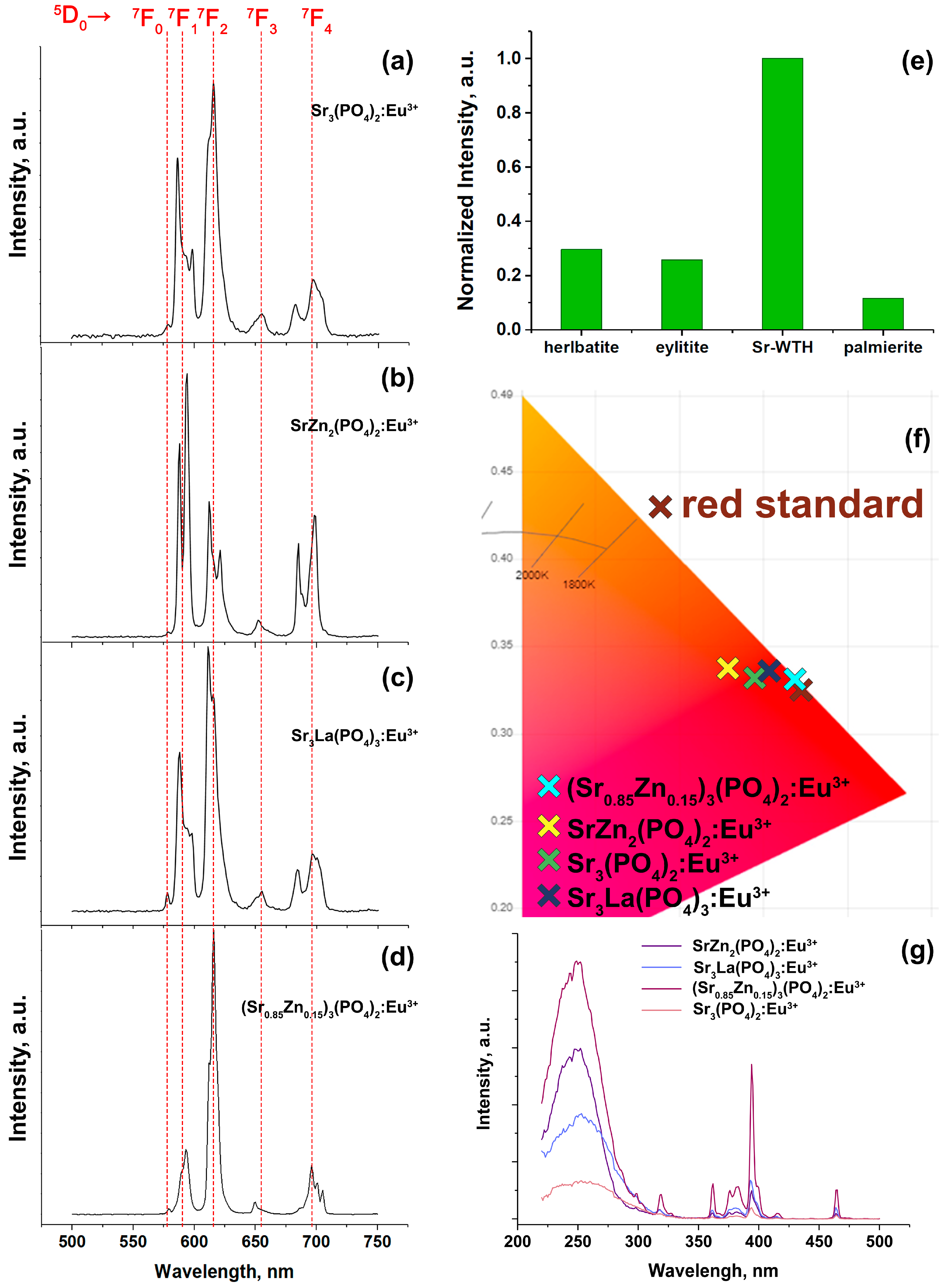
To compare the PL properties of different phases in the Sr3(PO4)2–Zn3(PO4)2–EuPO4 system, the synthesized phases were doped by Eu3+ ions at 0.3 mol.% (Table 7 in Section 3.1. Synthesis). The PL spectra of these phases are shown in Figure 18. All PL spectra were recorded at room temperature using an excitation wavelength of λex = 395 nm. The spectra consist of intracenter 4f–4f transitions of Eu3+ ions and can be attributed to transitions from the 5D0 excited state to terms of the ground state 7FJ (J = 0–4).
The emission spectra of Eu3+ doped phosphate (Figure 18a) consist of narrow transition bands located at 578 nm (5D07F0), 586 nm (5D07F1), 615 nm (5D07F2), 654 nm (5D07F3), and 696 nm (5D07F4). A difference in intensity of transitions is observed for different hosts. The electro-dipole (ED) transition 5D07F2 exceeds the magneto-dipole (MD) transition 5D07F1 (Figure 18a) in α-Sr3(PO4)2:Eu3+, (Sr0.85Zn0.15)3(PO4)2:Eu3+, and Sr3La(PO4)3:Eu3+, while the inverse relationship was detected for SrZn2(PO4)2.
The comparison of the integral intensity of the doped samples measures in the same conditions is shown in Figure 18e. At equal Eu3+ concentration in the host, the most intensive properties were observed for the (Sr0.85Zn0.15)3(PO4)2:Eu3+ sample with the β-Sr3(PO4)2 structure.
The asymmetry ratio (R/O) values are shown in Table 6. The lowest R/O is observed for SrZn2(PO4)2; due to formation of a symmetrical Eu3+ surrounding, the polyhedra are characterized by the C4v point group (Table 6). The α-Sr3(PO4)2 and the Sr3La(PO4)3 hosts are characterized by close values of 1.75 and 1.8, respectively, with domination of ED transition. So, the Eu3+ ions occupy sites with lower symmetry in α-Sr3(PO4)2 and Sr3La(PO4)3 than in SrZn2(PO4)2. This dominance of the ED transition in Eu3+ ions relates to distortion of the local coordination environment within centrosymmetric SG α-Sr3(PO4)2 and the Sr3La(PO4)3 hosts. Moreover, both α-Sr3(PO4)2 (Figure 4) and Sr3La(PO4)3 (Figure 6) are characterized by higher distortion in Eu-O distances compared to SrZn2(PO4)2 (Figure 7). This distortion arises from the charge imbalance introduced by the heterovalent substitution 3Sr2+ → 2Eu3+ + □. This mismatch creates defects in the host and distorts the cationic polyhedra, resulting in the dominance of the hypersensitive 5D07F2 transition. Similar behavior was observed in palmierite-type phosphors [16,67]. Conversely, charge compensation in the host leads to higher intensity of MD transition [38]. Increasing R/O value in the series SrZn2(PO4)2 → Sr3(PO4)2 → Sr3La(PO4)3 is well correlated to a decrease in total integral intensity. The strontiowhitlockite exhibits the largest R/O value and largest integral intensity. The highest distortion of Eu3+ is observed—that is, all Eu3+ polyhedra can be characterized by C1 symmetry—while lattice symmetry is described by SG R 3 ¯ m. In summary, both reduced crystallographic site symmetry of Eu3+ and increased lattice symmetry led to the dominance of the 5D07F2 transition and the increase in total integral intensity. Additionally, the CIE coordinates of strontiowhitlockite are shifted more to the red region than other hosts (Table 6 and Figure 18f). This confirms that strontiowhitlockite is an ideal host for the realization of Eu3+ emissions as red phosphors.
The PLE spectra monitored at λem = 614 nm for various series are shown in Figure 18g. The number and positions of the narrow bands correspond to the 4f–4f transitions of Eu3+ ions. The broad band from 250 to 300 nm can be attributed to the CTB. The intensity of the CTB region is strongly dependent on Eu-O polarity and bond length. As was described in the Section 1, the highest bond length is observed for (Sr0.85Zn0.15)3(PO4)2 in closed oxygen environment, probably leading to the highest intensity in CTB.

2.6. Phase Diagram in the Sr3(PO4)2–Zn3(PO4)2–EuPO4 System

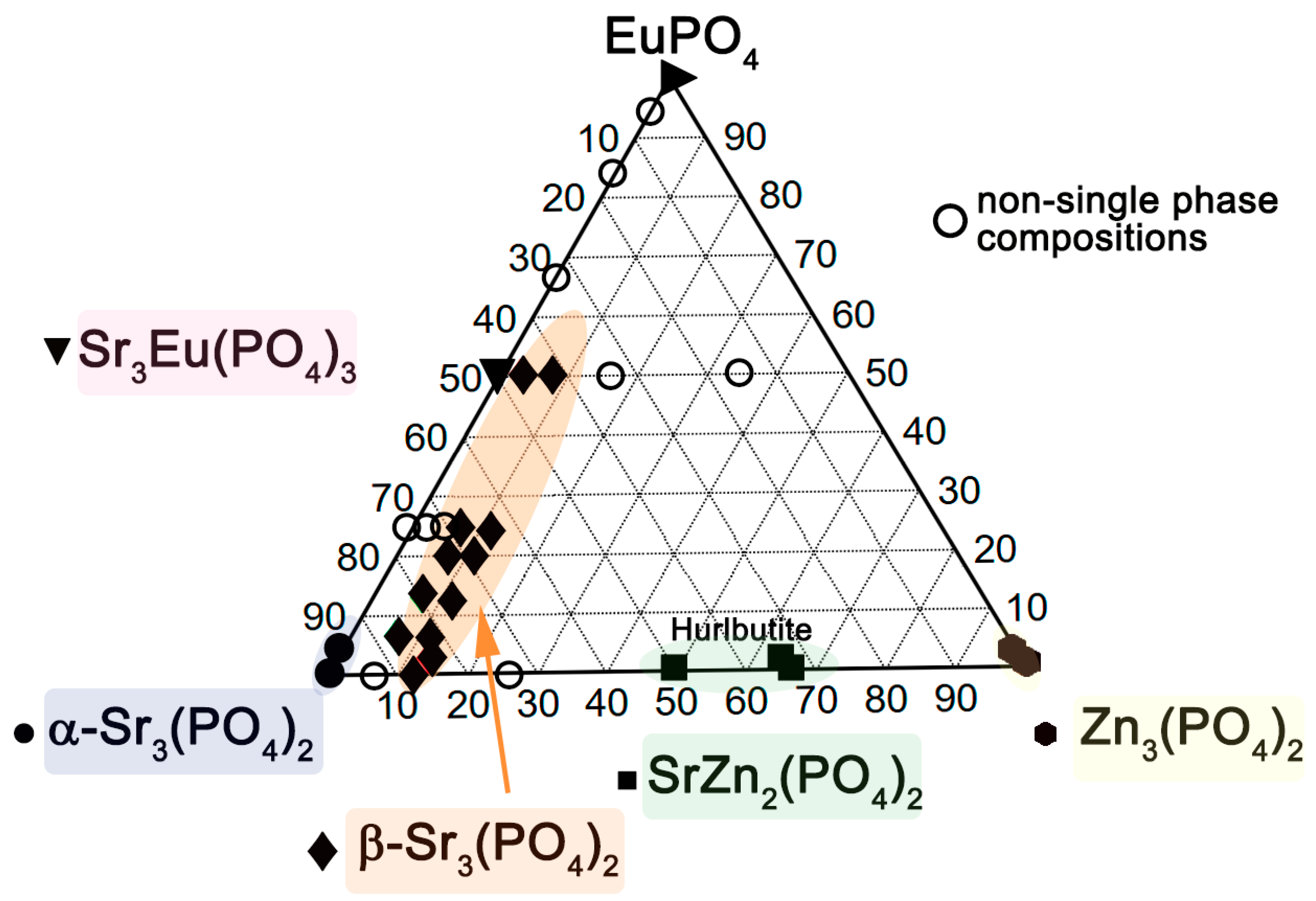
The phase analysis for all synthesized series in the Sr3(PO4)2–Zn3(PO4)2–EuPO4 system can be presented in a ternary plot (Figure 19). The ternary plot allows us to obtain the following results: phases with the eulytite and hurlbutite structures do not have isomorphic capacity, which is apparently due to significant differences in the characteristic coordination environment of the Sr2+ and Zn2+ ions, caused by a significant size mismatch of these ions. Previously [19], it was assumed that the β-Sr3(PO4)2 structure exists in a very limited range of Zn concentrations at room temperature. However, our results demonstrate that the stability region of the β-Sr3(PO4)2 structure is significantly expanded upon heterovalent substitutions that facilitate vacancy formation. Thus, solid solutions with the β-Sr3(PO4)2 structure were obtained in series with Mg2+ [54] and Mn2+ [60], and a combination of Zn2+ and Mn2+ [35].

3. Materials and Methods

3.1. Synthesis

In the present work, a series of phosphates with substitutions Sr2+ → Zn2+, Sr2+ → Eu3+, and co-substitution Sr2+ → Zn2+, Eu3+ along with some individual compositions were synthesized and studied. The data on the objects of research are summarized in Table 7. The phosphates were prepared from stoichiometric amounts of the initial reagents SrCO3 (99.9%), ZnO (99.99%), NH4H2PO4 (99.9%), and Eu2O3 (99.99%) by high-temperature solid-state reactions in muffle furnaces by heating slowly to avoid the rapid release of gaseous substances from the reaction zone and possible losses. The phosphates were heated to 1100 °C for 48 h, with preheating stages and intermediate homogenization of the reaction intermediates. The completeness of the synthesis was judged by the identity of the last two diffraction patterns.
Table 7. The synthesized series of solid solutions in the Sr–Zn–Eu phosphate system.
Substitution TypeGeneral Formula of
the Series
Range of x
Sr2+ → Zn2+Sr3–xZnx(PO4)20 ≤ x ≤ 2.0
Sr2+ → Eu3+Sr3–1.5xEu1+x(PO4)3 0 ≤ x ≤ 2.0
Sr2+ → Zn2+, Eu3+Sr3–xZnxEu(PO4)3 0 ≤ x ≤ 2.0
Sr9–xZnxEu(PO4)7 [54]0 ≤ x ≤ 1.5
Sr9.5–1.5xZnEux(PO4)7 0 ≤ x ≤ 1.0
Sr9–1.5xZn1.5Eux(PO4)7 0 ≤ x ≤ 1.0
Individual compositionsSr0.985Zn2Eu0.01(PO4)2;
Sr2.985Eu0.01(PO4)2;
Sr2.535Zn0.45Eu0.01(PO4)2
Sr3La0.99Eu0.01(PO4)3
x = 0.01

3.2. Methods of Investigation

3.2.1. Powder X-Ray Diffraction (PXRD) Study

Powder X-ray diffraction (PXRD) was performed using a Rigaku SmartLab SE: 3 kW powder diffractometer with sealed X-ray tube, D/teX Ultra 250 silicon strip detector, vertical type θ–2θ geometry, and a HyPix-400 (2D HPAD) detector (Rigaku, Tokyo, Japan). Before conducting the diffraction analysis, the tube was adjusted to a voltage of 40 kV and a current of 15 mA. PXRD data were collected at room temperature in the 2θ range between 5° and 80° with a step interval of 0.02° and cuvette rotation speed of 30 rpm.
PXRD phase identification for the synthesized phases was performed using the Crystallographica Search-March program (version 2.0.3.1) and the Profile Diffraction Data PDF-2 and Cambridge Crystallographic Data Centre (CCDC) databases. The quantitative phase analysis was performed by March! (version 3.15) based on the Profile Diffraction Data PDF-4.
The Rietveld method was applied using the JANA2006 [42] software (version 20/02/2023). Background refinement was performed using a fifteen-order polynomial. Peak profiles were fitted using a modified Pseudo-Voigt function. At the first stage the unit cell parameters were refined by LeBail method. The obtained unit cell parameters were used as starting parameters in the Rietveld method. After the last refinement procedure, good agreement was found between the experimental and calculated patterns.
Illustrations of the crystal structures were created with DIAMOND [68] software (version 4.6.8).

3.2.2. Second Harmonic Generation Study

Second harmonic generation (SHG) was used to determine whether the sample has a center of symmetry. This confirmed the space group selected for structure refinement. The SHG signal was measured using a Q-switched YAG:Nd laser at λω = 1064 nm in reflection mode.

3.2.3. Diffuse Reflectance Spectroscopy

Diffuse reflectance spectroscopy (DRS) was acquired using a Shimadzu UV-2600 Plus spectrophotometer (Shimadzu Corporation, Kyoto, Japan) equipped with an integrating sphere ISR-2600 (Shimadzu Corporation, Kyoto, Japan). The measurements were performed in the 200–1400 nm range with a scanning speed of 200 nm/min, a data interval of 1 nm, and a slit width of 2 nm. The integrating sphere was calibrated prior to measurements using a certified BaSO4 plate as a 100% reflectance standard. Solid dispersion samples were gently ground to a fine powder and packed uniformly into a powder sample holder to ensure a flat surface for analysis.

3.2.4. Raman Spectroscopy

Raman spectra were collected using a Renishaw InVia Qontor confocal Raman microscope (Renishaw plc, Wotton-under-Edge, UK). Measurements were performed using 532 nm laser excitation with a 50× objective. The laser power at the sample surface was maintained at 75 mW to ensure a strong signal while avoiding sample degradation. Spectra were acquired in the extended range of 50–1200 cm−1, covering both lattice modes and internal vibrations of the phosphate groups, using a 1200 lines/mm grating, which provided a spectral resolution of approximately 2 cm−1. For each measurement, 25 accumulations with an exposure time of 10 s per accumulation were recorded to optimize the signal-to-noise ratio. To ensure data reproducibility and account for potential sample heterogeneity, spectra were collected from at least five different spots on the surface of each powdered sample. Wavelength calibration was verified prior to measurements using a silicon standard (520.7 cm−1 band).

3.2.5. Combinatorial Complexity

The combinatorial complexity I G K K was calculated using crystIT ver. 0.2.1 [45] software, whilst the values of ordinary Krivovichev complexity I G s t r were calculated using ToposPro ver. 5.5.4.1 [69]. The cif files for Ca9Zn1.5(PO4)7, Sr8ZnEu(PO4)7 [25], Sr9.3Ni1.2(PO4)7 [43] and as-refined Sr9Zn1.5(PO4)7 were used for calculations.

3.2.6. Photoluminescence Study

A Cary Eclipse (Agilent Technologies) fluorescence spectrometer equipped with a 75 kW xenon light source (pulse length τ = 2 μs, pulse frequency ν = 80 Hz, wavelength resolution 0.5 nm; PMT Hamamatsu R928) was used to record photoluminescence emission (PL), excitation (PLE) spectra, as well as decay curves. All measurements were performed at room temperature and corrected for the sensitivity of the spectrometer.

4. Conclusions

This work comprehensively investigated phase formation in the Sr3(PO4)2–Zn3(PO4)2–EuPO4 phosphate system. A series of novel phosphates were synthesized via solid-state reactions and characterized using X-ray diffraction and quantitative phase analysis. It was demonstrated that continuous solid solutions do not form in the Sr3–xZnx(PO4)2 and Sr3–1.5xEu1–x(PO4)3 series. Instead, new concentration regions for the stabilization of the strontiowhitlockite (β-Sr3(PO4)2) phase were discovered. The stabilization of this phase in double phosphates requires a minimum of 15 mol.% of Zn2+ ions for their complete localization in two crystallographic positions along the c-axis. Conversely, in series with heterovalent co-substitution Sr2+ → (Eu3+, Zn2+), such as Sr3–xZnxEu(PO4)3 and Sr9.5–1.5xZnEux(PO4)7, the formation of vacancies enables the crystallization of solid solutions with the strontiowhitlockite structure at a lower Zn2+ content of 10 mol.%. In these structures, the voluminous crystallographic sites are jointly occupied by Sr and Eu atoms, which creates new opportunities for tailoring the luminescent properties of Eu3+ ions. Photoluminescence studies confirmed that the strontiowhitlockite-based host provides the most efficient red emission, making it a promising candidate for luminescent applications.

Supplementary Materials

The following supporting information can be downloaded at: https://www.mdpi.com/article/10.3390/inorganics14010015/s1. Figure S1: Original DRS spectrum of Sr9.5Zn(PO4)7 and Sr9Zn1.5(PO4)7 strontium phosphates. Figure S2: PLE spectra for Sr9.5–1.5xZnEux(PO4)7 at λem = 614 nm. Figure S3: PL spectra for Sr9.5–1.5xZnEux(PO4)7 at λem = 395 nm. Figure S4: PLE spectra Sr3(PO4)2:Eu3+ (a), SrZn2(PO4)2:Eu3+ (b), Sr3La(PO4)3:Eu3+ (c), (Sr0.85Zn0.15)3(PO4)2:Eu3+ (c) at λem = 614 nm. Table S1: Spectral deconvolution parameters for Sr9Zn1.5(PO4)7.

Author Contributions

Conceptualization, D.V.D., I.V.N., S.M.A. and B.I.L.; methodology, I.V.N., V.V.T., E.V.L., V.E.K. and D.A.B.; software, V.V.T.; validation, D.V.D., S.M.A. and B.I.L.; formal analysis, V.V.T., E.V.L., V.E.K. and D.A.B.; investigation, V.V.T., E.V.L., V.E.K. and D.A.B.; resources, D.V.D.; data curation, D.V.D. and I.V.N.; writing—original draft preparation, I.V.N., V.V.T. and B.I.L.; writing—review and editing, D.V.D. and I.V.N.; visualization, D.V.D., I.V.N., V.V.T., E.V.L. and V.E.K.; supervision, D.V.D., I.V.N., S.M.A. and B.I.L.; project administration, D.V.D.; funding acquisition, D.V.D. All authors have read and agreed to the published version of the manuscript.

Funding

This research was funded by the Russian Science Foundation, grant number 23-73-10007 (https://www.rscf.ru/project/23-73-10007/ (accessed on 20 December 2025)).

Institutional Review Board Statement

Not applicable.

Informed Consent Statement

Not applicable.

Data Availability Statement

The original contributions presented in the study are included in the article, further inquiries can be directed to the corresponding author.

Conflicts of Interest

The authors declare no conflicts of interest.

References

  1. Sehrawat, N.; Devi, P.; Dalal, H.; Solanki, D.; Garg, O.; Kumar, M.; Punia, R.; Garg, S. Solution combustion derived color-tunable Eu3+ doped Ca8ZnBi(VO4)7 nano sample for luminous devices and latent fingerprinting applications. Inorg. Chem. Commun. 2024, 168, 112976. [Google Scholar] [CrossRef]
  2. Deyneko, D.V.; Nikiforov, I.V.; Spassky, D.A.; Berdonosov, P.S.; Dzhevakov, P.B.; Lazoryak, B.I. Sr8MSm1-xEux(PO4)7 phosphors derived by different synthesis routes: Solid state, sol-gel and hydrothermal, the comparison of properties. J. Alloys Compd. 2021, 887, 161340. [Google Scholar] [CrossRef]
  3. Khmiyas, J.; Benhsina, E.; Ouaatta, S.; Assani, A.; Saadi, M.; El Ammari, L. Crystal structure of silver strontium copper orthophosphate, AgSr4Cu4.5(PO4)6. Acta Crystallogr. Sect. E 2020, 76, 186–191. [Google Scholar] [CrossRef]
  4. Belik, A.A.; Malakho, A.P.; Lazoryak, B.I.; Khasanov, S.S. Synthesis and X-ray Powder Diffraction Study of New Phosphates in the Cu3(PO4)2–Sr3(PO4)2 System: Sr1.9Cu4.1(PO4)4, Sr3Cu3(PO4)4, Sr2Cu(PO4)2, and Sr9.1Cu1.4(PO4)7. J. Solid State Chem. 2002, 163, 121–131. [Google Scholar] [CrossRef]
  5. Belik, A.A.; Azuma, M.; Matsuo, A.; Whangbo, M.-H.; Koo, H.-J.; Kikuchi, J.; Kaji, T.; Okubo, S.; Ohta, H.; Kindo, K.; et al. Investigation of the Crystal Structure and the Structural and Magnetic Properties of SrCu2(PO4)2. Inorg. Chem. 2005, 44, 6632–6640. [Google Scholar] [CrossRef]
  6. Zachariasen, W. The crystal structure of the normal orthophosphates of barium and strontium. Acta Crystallogr. 1948, 1, 263–265. [Google Scholar] [CrossRef]
  7. Roderick, J.H.; Jones, J.B. The crystal structure of hopeite. Am. Mineral. 1976, 61, 987–995. [Google Scholar]
  8. Calvo, C. The Crystal Structure of α-Zn3(PO4)2. Can. J. Chem. 1965, 43, 436–445. [Google Scholar] [CrossRef]
  9. Begun, G.M.; Beall, G.W.; Boatner, L.A.; Gregor, W.J. Raman spectra of the rare earth orthophosphates. J. Raman Spectrosc. 1981, 11, 273–278. [Google Scholar] [CrossRef]
  10. Ni, Y.; Hughes, J.M.; Mariano, A.N. Crystal chemistry of the monazite and xenotime structures. Am. Mineral. 1995, 80, 21–26. [Google Scholar] [CrossRef]
  11. Mullica, D.F.; Milligan, W.O.; Grossie, D.A.; Beall, G.W.; Boatner, L.A. Ninefold coordination LaPO4: Pentagonal interpenetrating tetrahedral polyhedron. Inorganica Chim. Acta 1984, 95, 231–236. [Google Scholar] [CrossRef]
  12. Clavier, N.; Podor, R.; Dacheux, N. Crystal chemistry of the monazite structure. J. Eur. Ceram. Soc. 2011, 31, 941–976. [Google Scholar] [CrossRef]
  13. Yan, B.; Xiao, X. Hydrothermal synthesis, controlled microstructure, and photoluminescence of hydrated Zn3(PO4)2: Eu3+ nanorods and nanoparticles. J. Nanoparticle Res. 2009, 11, 2125–2135. [Google Scholar] [CrossRef]
  14. Wang, J.; Su, Q.; Wang, S. A novel red long lasting phosphorescent (LLP) material β-Zn3(PO4)2:Mn2+, Sm3+. Mater. Res. Bull. 2005, 40, 590–598. [Google Scholar] [CrossRef]
  15. Grzechnik, A.; McMillan, P.F. High Pressure Behavior of Sr3(VO4)2 and Ba3(VO4)2. J. Solid State Chem. 1997, 132, 156–162. [Google Scholar] [CrossRef]
  16. Lazoryak, B.I.; Dikhtyar, Y.Y.; Spassky, D.A.; Fedyunin, F.D.; Baryshnikova, O.V.; Pavlova, E.T.; Morozov, V.A.; Deyneko, D.V. Synthesis and photoluminescence properties of Ba3(PO4)2:Eu3+/2+ phosphors. Mater. Res. Bull. 2024, 176, 112799. [Google Scholar] [CrossRef]
  17. Zhai, S.; Liu, A.; Xue, W.; Song, Y. High-pressure Raman spectroscopic studies on orthophosphates Ba3(PO4)2 and Sr3(PO4)2. Solid State Com. 2011, 151, 276–279. [Google Scholar] [CrossRef]
  18. Britvin, S.N.; Pakhomovskii, Y.A.; Bogdanova, A.N.; Skiba, V.I. Strontiowhitlockite, Sr9Mg(PO3OH)(PO4)6, a new mineral species from the Kovdor Deposit, Kola Peninsula, U.S.S.R. Can. Mineral. 1991, 29, 87–93. [Google Scholar]
  19. Sarver, J.F.; Hoffman, M.V.; Hummel, F.A. Phase Equilibria and Tin-Activated Luminescence in Strontium Orthophosphate Systems. J. Electrochem. Soc. 1961, 108, 1103. [Google Scholar] [CrossRef]
  20. Belik, A.A.; Lazoryak, B.I.; Pokholok, K.V.; Terekhina, T.P.; Leonidov, I.A.; Mitberg, E.B.; Karelina, V.V.; Kellerman, D.G. Synthesis and Characterization of New Strontium Iron(II) Phosphates, SrFe2(PO4)2 and Sr9Fe1.5(PO4)7. J. Solid State Chem. 2001, 162, 113–121. [Google Scholar] [CrossRef]
  21. Ren, F.; Chen, D. Synthesis of (Sr0.85Zn0.15)3(PO4)2:Eu3+ by a modified solid-state reaction and its luminescent properties for ultraviolet light emitting diodes. Powder Technol. 2009, 194, 187–191. [Google Scholar] [CrossRef]
  22. Wang, Y.; Zhang, J.; Shi, J.; Jiao, H. Luminescence properties of (Sr0.86Mg0.14)3(PO4)2:Eu2+,Mn2+ phosphors for LEDs application. J. Mater. Sci. Mater. Electron. 2017, 28, 8895–8900. [Google Scholar] [CrossRef]
  23. Guo, H.; Li, R.; Peng, X.; Cui, R.; Deng, C. Multiple applications of Sr8ZnIn(1-m)Lum(PO4)7:Eu2+/Mn2+ through thermal stability adjustment, spectral tuning, and resonance energy transfer. J. Alloys Compd. 2025, 1034, 181312. [Google Scholar] [CrossRef]
  24. Guo, H.; Peng, X.; Zhang, Y.; Li, R.; Yang, L.; Wang, N.; Li, Y.; Cui, R.; Deng, C. A novel single phase multifunctional Sr8ZnIn0.6Sc0.4(PO4)7: Eu2+/Mn2+ phosphor with good thermal stability for optical thermometers, fingerprint detection and WLEDs applications. Ceram. Int. 2025, 51, 53232–53245. [Google Scholar] [CrossRef]
  25. Nikiforov, I.V.; Zhukovskaya, E.S.; Aksenov, S.M.; Shendrik, R.Y.; Pankrushina, E.A.; Deyneko, D.V. Structural Refinement and Optical Properties of Strontiowhitlockite-Based Mixed Phosphate-Vanadates. Inorg. Chem. 2025, 64, 13669–13683. [Google Scholar] [CrossRef] [PubMed]
  26. Frondel, C. Whitlockite: A new calcium phosphate, Ca3(PO4)2. Am. Mineral. 1941, 26, 145–152. [Google Scholar]
  27. Mackay, A.L.; Sinha, D.P. The piezo-electric activity of whitlockite β-Ca3(PO4)2. J. Phys. Chem. Solids 1967, 28, 1337–1338. [Google Scholar] [CrossRef]
  28. Deyneko, D.V.; Lebedev, V.N.; Aksenov, S.M.; Shendrik, R.Y.; Pankratov, V.; Lazoryak, B.I.; Gosteva, A.N.; Barbaro, K.; Rau, J.V. Zn2+, Sr2+, and Sm3+ tri-doped whitlockites: Luminescent materials with improved bioactive and antibacterial properties. Ceram. Int. 2025, 51, 21117–21134. [Google Scholar] [CrossRef]
  29. Gopal, R.; Calvo, C.; Ito, J.; Sabine, W.K. Crystal Structure of Synthetic Mg-Whitlockite, Ca18Mg2H2(PO4)14. Can. J. Chem. 1974, 52, 1155–1164. [Google Scholar] [CrossRef]
  30. Bessière, A.; Benhamou, R.A.; Wallez, G.; Lecointre, A.; Viana, B. Site occupancy and mechanisms of thermally stimulated luminescence in Ca9Ln(PO4)7 (Ln=lanthanide). Acta Mater. 2012, 60, 6641–6649. [Google Scholar] [CrossRef]
  31. Belik, A.A.; Izumi, F.; Ikeda, T.; Okui, M.; Malakho, A.P.; Morozov, V.A.; Lazoryak, B.I. Whitlockite-Related Phosphates Sr9A(PO4)7 (A=Sc, Cr, Fe, Ga, and In): Structure Refinement of Sr9In(PO4)7 with Synchrotron X-Ray Powder Diffraction Data. J. Solid State Chem. 2002, 168, 237–244. [Google Scholar] [CrossRef]
  32. Trofimova, E.S.; Pustovarov, V.A.; Shi, Q. Fast 5d-4f luminescence in Sr9RE(PO4)7 (RE = Sc, Lu) complex phosphates doped with Pr3+ ions. AIP Conf. Proc. 2019, 2174, 020178. [Google Scholar] [CrossRef]
  33. Ding, X.; Li, Z.; Xia, D. New whitlockite-type structure material Sr9Y(PO4)7 and its Eu2+ doped green emission properties under NUV light. J. Lumin. 2020, 221, 117114. [Google Scholar] [CrossRef]
  34. Kim, D.; Seo, Y.W.; Park, S.H.; Choi, B.C.; Kim, J.H.; Jeong, J.H. Theoretical design and characterization of high efficient Sr9Ln(PO4)7: Eu2+ phosphors. Mater. Res. Bull. 2020, 127, 110856. [Google Scholar] [CrossRef]
  35. Nikiforov, I.V.; Titkov, V.V.; Aksenov, S.M.; Lazoryak, B.I.; Baryshnikova, O.V.; Deineko, D.V. Structural Features of Strontiowhitlockite-Based Luminophores. J. Struct. Chem. 2024, 65, 1668–1676. [Google Scholar] [CrossRef]
  36. Ji, H.; Huang, Z.; Xia, Z.; Molokeev, M.S.; Jiang, X.; Lin, Z.; Atuchin, V.V. Comparative investigations of the crystal structure and photoluminescence property of eulytite-type Ba3Eu(PO4)3 and Sr3Eu(PO4)3. Dalton Trans. 2015, 44, 7679–7686. [Google Scholar] [CrossRef]
  37. Matraszek, A. Study of phase relationships in the Sr3(PO4)2–CePO4 system. Phase diagram and thermal characteristics of phases. J. Solid State Chem. 2013, 203, 86–91. [Google Scholar] [CrossRef]
  38. Deyneko, D.V.; Spassky, D.A.; Antropov, A.V.; Ril’, A.I.; Baryshnikova, O.V.; Pavlova, E.T.; Lazoryak, B.I. Anomalous oxidation state of europium in the Sr3(PO4)2-type phosphors doped with alkaline cations. Mater. Res. Bull. 2023, 165, 112296. [Google Scholar] [CrossRef]
  39. Yashima, M.; Sakai, A.; Kamiyama, T.; Hoshikawa, A. Crystal structure analysis of β-tricalcium phosphate Ca3(PO4)2 by neutron powder diffraction. J. Solid State Chem. 2003, 175, 272–277. [Google Scholar] [CrossRef]
  40. Hemon, A.; Courbion, G. The crystal structure of α-SrZn2(PO4)2: A hurlbutite type. J. Solid State Chem. 1990, 85, 164–168. [Google Scholar] [CrossRef]
  41. Xu, Y.; Zhang, K.; Chang, C. Effects of Bi3+ co-doping on structure and luminescence of SrZn2(PO4)2-based phosphor. J. Mater. Sci. Mater. Electron. 2020, 31, 10072–10077. [Google Scholar] [CrossRef]
  42. Petrícek, V.; Dusek, M.; Palatinus, L. Crystallographic Computing System JANA2006: General features. Z. Kristallogr. 2014, 229, 345–352. [Google Scholar] [CrossRef]
  43. Belik, A.A.; Izumi, F.; Ikeda, T.; Morozov, V.A.; Dilanian, R.A.; Torii, S.; Kopnin, E.M.; Lebedev, O.I.; Van Tendeloo, G.; Lazoryak, B.I. Positional and Orientational Disorder in a Solid Solution of Sr9+xNi1.5-x(PO4)7 (x = 0.3). Chem. Mater. 2003, 15, 1399–1400. [Google Scholar] [CrossRef]
  44. Krivovichev, S.V. Structural complexity and configurational entropy of crystals. Acta Crystallogr. Sect. B 2016, 72, 274–276. [Google Scholar] [CrossRef]
  45. Kaussler, C.; Kieslich, G. crystIT: Complexity and configurational entropy of crystal structures via information theory. J. Appl. Crystallogr. 2021, 54, 306–316. [Google Scholar] [CrossRef] [PubMed]
  46. Krivovichev, S.V. Which Inorganic Structures are the Most Complex? Angew. Chem. Int. Ed. 2014, 53, 654–661. [Google Scholar] [CrossRef] [PubMed]
  47. Krivovichev, S.V.; Krivovichev, V.G.; Hazen, R.M.; Aksenov, S.M.; Avdontceva, M.S.; Banaru, A.M.; Gorelova, L.A.; Ismagilova, R.M.; Kornyakov, I.V.; Kuporev, I.V.; et al. Structural and chemical complexity of minerals: An update. Mineral. Mag. 2022, 86, 183–204. [Google Scholar] [CrossRef]
  48. de Aza, P.N.; Santos, C.; Pazo, A.; de Aza, S.; Cuscó, R.; Artús, L. Vibrational Properties of Calcium Phosphate Compounds. 1. Raman Spectrum of β-Tricalcium Phosphate. Chem. Mater. 1997, 9, 912–915. [Google Scholar] [CrossRef]
  49. Anjaneyulu, U.; Pattanayak, D.K.; Vijayalakshmi, U. Snail Shell Derived Natural Hydroxyapatite: Effects on NIH-3T3 Cells for Orthopedic Applications. Mater. Manuf. Process. 2016, 31, 206–216. [Google Scholar] [CrossRef]
  50. Sophie, Q.; Charlotte, M.; Renate, G.; Julien, H.; Philippe, D.; Georg, B.; Jean Michel, B. Raman and Infrared Studies of Substituted β-TCP. Eng. Mater. 2011, 493–494, 225–230. [Google Scholar] [CrossRef]
  51. Fritsch, E.; Balan, E.; Petit, S.; Juillot, F. Vibrational spectroscopic study of three Mg–Ni mineral series in white and greenish clay infillings of the New Caledonian Ni-silicate ores. Eur. J. Mineral. 2021, 33, 743–763. [Google Scholar] [CrossRef]
  52. Batool, S.; Hussain, Z.; Rehman, M.R.; Idrees, M.U. Effect of strontium and iron on the structural integrity and drug delivery of Whitlockite. Open Ceram. 2023, 14, 100347. [Google Scholar] [CrossRef]
  53. Cheng, L.; Zhang, W.; Li, Y.; Dai, S.; Chen, X.; Qiu, K. Synthesis and photoluminescence properties of Sr3(PO4)2:Re3+, Li+ (Re = Eu, Sm) red phosphors for white light-emitting diodes. Ceram. Int. 2017, 43, 11244–11249. [Google Scholar] [CrossRef]
  54. Nikiforov, I.V.; Yashina, K.N.; Zhukovskaya, E.S.; Gutnikov, S.I.; Aksenov, S.M.; Deyneko, D.V. Phase Formation in the System of Triple Phosphates Sr–M2+–Ln3+ (M2+ = Zn2+, Mg2+, Mn2+; Ln3+ = Eu3+, Tb3+). Crystallogr. Rep. 2025, 70, 395–403. [Google Scholar] [CrossRef]
  55. Benhamou, R.A.; Bessière, A.; Wallez, G.; Viana, B.; Elaatmani, M.; Daoud, M.; Zegzouti, A. New insight in the structure–luminescence relationships of Ca9Eu(PO4)7. J. Solid State Chem. 2009, 182, 2319–2325. [Google Scholar] [CrossRef]
  56. Dikhtyar, Y.Y.; Spassky, D.A.; Morozov, V.A.; Deyneko, D.V.; Belik, A.A.; Baryshnikova, O.V.; Nikiforov, I.V.; Lazoryak, B.I. Site occupancy, luminescence and dielectric properties of β-Ca3(PO4)2-type Ca8ZnLn(PO4)7 host materials. J. Alloys Compd. 2022, 908, 164521. [Google Scholar] [CrossRef]
  57. Deyneko, D.V.; Spassky, D.A.; Morozov, V.A.; Aksenov, S.M.; Kubrin, S.P.; Molokeev, M.S.; Lazoryak, B.I. Role of the Eu3+ Distribution on the Properties of β-Ca3(PO4)2 Phosphors: Structural, Luminescent, and 151Eu Mössbauer Spectroscopy Study of Ca9.5–1.5xMgEux(PO4)7. Inorg. Chem. 2021, 60, 3961–3971. [Google Scholar] [CrossRef]
  58. Yang, X.; Li, Q.; Li, X.; Ma, B. Color tunable Dy3+-doped Sr9Ga(PO4)7 phosphors for optical thermometric sensing materials. Opt. Mater. 2020, 107, 110133. [Google Scholar] [CrossRef]
  59. Geng, Y.; Shi, Q.; You, F.; Ivanovskikh, K.V.; Leonidov, I.I.; Huang, P.; Wang, L.; Tian, Y.; Huang, Y.; Cui, C.e. Site occupancy and luminescence of Ce3+ ions in whitlockite-related strontium lutetium phosphate. Mater. Res. Bull. 2019, 116, 106–110. [Google Scholar] [CrossRef]
  60. Nikiforov, I.V.; Spassky, D.A.; Krutyak, N.R.; Shendrik, R.Y.; Zhukovskaya, E.S.; Aksenov, S.M.; Deyneko, D.V. Co-Doping Effect of Mn2+ and Eu3+ on Luminescence in Strontiowhitlockite Phosphors. Molecules 2024, 29, 124. [Google Scholar] [CrossRef]
  61. Li, H.; Meng, W.; Jiao, M.; Sun, W.; Fu, C.; Chen, X.; Luan, J.; Li, Z.; Zhang, H. Long-lasting ultraviolet-A persistent luminescence in Sr9Mg1.5(PO4)7:Ce3+,A+ (A+ = Li+, Na+, K+) phosphors by X-rays rapid charging. Spectrochim. Acta Part A 2026, 346, 126853. [Google Scholar] [CrossRef]
  62. Wei, Y.; Wu, Y.; Li, Q.; Liu, L.; Sun, B.; Yu, J. Tunable emission in Sr9LiY0.667(PO4)7: Eu2+, Mn2+ phosphor via energy transfer for pc-LEDs application. Opt. Mater. 2025, 162, 116850. [Google Scholar] [CrossRef]
  63. Tanner, P.A. Some misconceptions concerning the electronic spectra of tri-positive europium and cerium. Chem. Soc. Rev. 2013, 42, 5090–5101. [Google Scholar] [CrossRef]
  64. Tang, W.; Xue, H. Preparation of Sr8Mg1−mZnmY(PO4)7:Eu2+ solid solutions and their luminescence properties. RSC Adv. 2014, 4, 62230–62236. [Google Scholar] [CrossRef]
  65. Zhou, J.; Chen, M.; Zhang, J.; Shi, C.; Ding, J.; Zhuang, Y.; Wu, Q. Regulating photoluminescence behavior by neighboring-cation-size in Sr8CaX(PO4)7: Eu2+ (X = Al and Ga) phosphors for high color rendering solid-state lighting source. Chem. Eng. J. 2021, 426, 131869. [Google Scholar] [CrossRef]
  66. Ding, X.; Wang, Y. Novel orange light emitting phosphor Sr9(Li, Na, K)Mg(PO4)7: Eu2+ excited by NUV light for white LEDs. Acta Mater. 2016, 120, 281–291. [Google Scholar] [CrossRef]
  67. Szyszka, K.; Nowak, N.; Kowalski, R.M.; Zukrowski, J.; Wiglusz, R.J. Anomalous luminescence properties and cytotoxicity assessment of Sr3(PO4)2 co-doped with Eu2+/3+ ions for luminescence temperature sensing. J. Mater. Chem. C 2022, 10, 9092–9105. [Google Scholar] [CrossRef]
  68. Brandenburg, K. DIAMOND (version 4.6.8); Crystal Impact GbR: Bonn, Germany, 1999. [Google Scholar]
  69. Blatov, V.A.; Shevchenko, A.P.; Proserpio, D.M. Applied Topological Analysis of Crystal Structures with the Program Package ToposPro. Cryst. Growth Des. 2014, 14, 3576–3586. [Google Scholar] [CrossRef]
Figure 1. Roozeboom’s triangle for the Sr3(PO4)2–Zn3(PO4)2–EuPO4 system. Known phases and their crystal structure projections are shown.
Inorganics 14 00015 g001
Figure 2. Projection of the monazite EuPO4 crystal structure and the coordination polyhedra of the Eu1 site.
Inorganics 14 00015 g002
Figure 3. Projection of the hopeite α-Zn3(PO4)2 crystal structure and the coordination polyhedra of the Zn1 and Zn2 sites.
Inorganics 14 00015 g003
Figure 4. Projection of the palmierite α-Sr3(PO4)2 crystal structure and the coordination polyhedra of the Sr1 and Sr2 sites.
Inorganics 14 00015 g004
Figure 5. Projection of the Sr8ZnEu(PO4)7 (β-Sr3(PO4)2-type) crystal structure (a); the coordination polyhedra of the Sr1, Sr2 and Zn sites (b); distances between nearest cationic sites in the structure (c).
Inorganics 14 00015 g005
Figure 6. Projection of the eulytite Sr3Eu(PO4)3 crystal structure and the coordination polyhedra of the Sr|Eu site; the main interatomic distances in the structure.
Inorganics 14 00015 g006
Figure 7. Projection of the strontiohurlbutite SrZn2(PO4)2 crystal structure; the coordination polyhedra of the Sr|Eu site.
Inorganics 14 00015 g007
Figure 8. The PXRD pattern of the Sr3–xZnx(PO4)2 series and PDF-2 card 80-1062 SrZn2(PO4)2 (a); phase analysis for sample with x = 1.5 from the Sr3–xZnx(PO4)2 series and PDF-4 cards 96-100-0287 SrZn2(PO4)2 and 96-400-2454 Sr9.3Ni1.2(PO4)7 (b).
Inorganics 14 00015 g008
Figure 9. Intensity profiles for the powder X-ray Rietveld refinement of Sr9Zn1.5(PO4)7. The observed and calculated profiles are represented in black and red lines, respectively. The difference profile is plotted at the bottom. Vertical bars indicate the positions of the Bragg reflections.
Inorganics 14 00015 g009
Figure 10. Optical characterization of Sr9Zn1.5(PO4)7: (a) experimental DRS spectrum with deconvolution into three components; (b) Tauc plot for direct band gap determination (n = 2).
Inorganics 14 00015 g010
Figure 11. Raman spectrum for Sr9Zn1.5(PO4)7: (a) Region 1 (100–350 cm−1) with estimated band positions, (b) Region 2 (350–700 cm−1) with Lorentzian fit of ν2 and ν4 modes, (c) Region 3 (900–1200 cm−1) with Lorentzian fit of ν1 and estimated band positions of ν3 modes.
Inorganics 14 00015 g011
Figure 12. The PXRD pattern of Sr3–1.5xEu1+x(PO4)3 series and PDF-2 card 48-410 Sr3Eu(PO4)3 (a); phase analysis for sample with x = 1.5 from Sr3–1.5xEu1+x(PO4)3 series and PDF-4 cards 96-703-4639 Sr3Eu(PO4)3 and 96-900-1653 EuPO4 (b).
Inorganics 14 00015 g012aInorganics 14 00015 g012b
Figure 13. The PXRD pattern of Sr9.5–1.5xZnEux(PO4)7 series and PDF-2 card 51-424 (a); phase analysis for sample with x = 0 for Sr9.5–1.5xZnEux(PO4)7 series and PDF-4 cards 96-400-2454 Sr9.3Ni1.2(PO4)7 and 96-810-3717 Sr3(PO4)2 (b).
Inorganics 14 00015 g013
Figure 14. The PXRD patterns for Sr9–1.5xZn1.5Eux(PO4)7 and PDF-2 card for Sr9.3Ni1.2(PO4)7 (№ 51-424), pink arrows show reflexes for 96-703-4639 Sr3Eu(PO4)3 (a); phase analysis for sample with x = 1.0 (Sr7.5Zn1.5Eu(PO4)7) and PDF-4 cards 96-400-2454 Sr9.3Ni1.2(PO4)7 and 96-703-4639 Sr3Eu(PO4)3 (b).
Inorganics 14 00015 g014
Figure 15. The PXRD patterns for Eu3+-doped samples Sr2.985Eu0.01(PO4)2, Sr0.985Zn2Eu0.01(PO4)2, Sr2.535Zn0.45Eu0.01(PO4)2, and Sr3La0.99Eu0.01(PO4)3; PDF-2 cards for α-Sr3(PO4)2 (PDF-2 №80-1614), SrZn2(PO4)2 (PDF-2 №80-1062), (Sr0.85Zn0.15)3(PO4)2 (PDF-2 №14-207), and Sr3Eu(PO4)3 (PDF-2 № 48-410) phases are shown as bars.
Inorganics 14 00015 g015
Figure 16. PLE spectra for Sr9–1.5xZn1.5Eux(PO4)7 at λem = 614 nm (a), and the energy level diagram for the Eu3+ ion (b).
Inorganics 14 00015 g016
Figure 17. The PL spectra for Sr(9–1.5x)Zn1.5Eux(PO4)7 at λex = 395 nm (a); the PL spectra for Sr7.5Zn1.5Eu(PO4)7 and Sr8ZnEu(PO4)7, the inset shows the normalized integral intensity (b).
Inorganics 14 00015 g017
Figure 18. PL spectra of doped phosphates Sr3(PO4)2:Eu3+ (a), SrZn2(PO4)2:Eu3+ (b), Sr3La(PO4)3:Eu3+ (c), (Sr0.85Zn0.15)3(PO4)2:Eu3+ (d) at λex = 395 nm. Normalized integral intensity (e), CIE color coordinates (f), PLE spectra at λem = 614 nm (g) of doped phosphates.
Inorganics 14 00015 g018
Figure 19. Refined ternary plot Sr3(PO4)2–Zn3(PO4)2–EuPO4.
Inorganics 14 00015 g019
Table 1. The main Crystallographic data for Sr9Zn1.5(PO4)7 phosphate.
SampleSr9Zn1.5(PO4)7
SGR 3 ¯ m
Lattice parameters: a, Å10.595(3)
c, Å19.738(6)
Unit cell volume, Å31918.9(1)
Calculated density, g/cm34.0277
Data collection
DiffractometerRIGAKU Ultima III
Radiation/Wavelength (k, Å)CuKα1+α2/1.54186 Å
2θ range (o)5–65
Step scan (2θ)0.02
Refinement
Background function15 Legendre polynoms
R and Rw for Bragg reflections, %9.01/10.42
RP, RwP, Rexp, %7.57/11.23/4.37
Goodness of fit (ChiQ)2.58
Max./min. residual density, e/Å31.68/−1.48
CSD number2,494,889
Table 2. Fractional atomic coordinates, site symmetry, isotropic displacement atomic parameters (Uiso∙100) and site occupation for Sr9Zn1.5(PO4)7 sample from PXRD data.
AtomOccupation, aixyzUiso∙100
Sr1a0.87(1)0.1885(4)−0.1885(4)0.5362(2)0.14
Sr1b0.13(1)0.235(3)−0.235(3)0.5504(15)0.14
Sr3a0.401(3)−0.5208(6)0.5208(6)0.0093(5)0.49
Sr3b0.099(3)0.389(1)0.611(1)−0.017(2)0.49
Zn40.08330.174(6)0.087(3)0.388(3)3
Zn510001.3(4)
P11−2/32/31/60.01
P210.4886(6)−0.4886(6)0.3979(8)2.8(4)
O111−0.542(2)0.811(2)0.138(1)0.1
O21a0.62(5)0.463(2)−0.463(2)0.319(1)0.1
O21b0.38(5)0.454(6)−0.561(7)0.323(2)0.1
O220.87(1)0.5758(8)−0.5758(8)0.407(1)0.1
O24a0.13(1)0.455(6)−0.455(6)0.471(3)0.1
O24b0.87(1)0.1885(4)−0.1885(4)0.5362(2)0.1
Table 3. Selected interatomic distances (Å) in Sr9Zn1.5(PO4)7 from Rietveld Refinement data.
Bonds Distance, ẮBonds Distance, Ắ
Sr1aO21b2.45(4)Sr3bO21a × 22.16(3)
O222.41(1) O22 × 22.58(3)
O112.48(3) O21b × 22.76(9)
O112.55(3)Zn4O111.91(6)
O21a2.53(2) O111.91(6)
O24a2.58(1) O21b1.91(9)
O24b2.79(6) O112.60(5)
Sr3aO222.46(1) O112.60(7)
O222.57(1) O112.84(6)
O21b2.55(5)Zn5O24a × 62.21(2)
O112.93(3)P1O11 × 41.54(3)
O112.93(3)P2O24a1.61(1)
O21b2.85(5) O21b1.62(5)
O21b2.85(5) O22 × 21.70(1)
Table 4. Combinatorial complexity values for some Ca- and Sr-substitutes phosphates with the whitlockite-type structure.
SampleRef.Complexity, bit/atom
I G s t r I G K K Imix ( I G s t r )
Ca9Zn1.5(PO4)7 4.0764.0980.0224.054
Sr9Zn1.5(PO4)7This work3.2674.2030.9362.331
Sr9.3Ni1.2(PO4)7 3.0163.8870.8712.145
Sr8ZnEu(PO4)7 3.0163.4450.4292.588
Table 5. Ionic radius difference percentages (Dr) between host cations and doped R3+ ions.
Doped R3+ IonRadius,
Å/CN
Dr, %
Sr2+
1.26 Å/8
Sr2+
1.18 Å/6
Ca2+
1.12 Å/8
Ca2+
1.00 Å/6
Zn2+
0.74 Å/6
Ga3+ [58]0.62 Å/6 47.53816.2
Lu3+ [59]0.98 Å/8 22.212.5
0.86 Å/6 27.11416.2
Y3+ [33]1.02 Å/8 198.9
0.90 Å/6 23.71021.6
Eu3+
This work
1.07 Å/8 15.14.5
0.95 Å/6 19.55.028
Table 6. Calculated asymmetry ratio R/O, CIE coordinates (X;Y) and decay times (τ) for Eu3+ emission in synthesized Sr-based phosphate hosts.
Sr9–1.5xZn1.5Eux(PO4)7
x0.250.50.751.00
R/O3.683.523.723.44
CIE (X;Y)0.653; 0.3510.649; 0.3480.653; 0.3490.649; 0.350
Sr9.5–1.5xZnEux(PO4)7
x0.250.50.751.00
R/O3.653.513.583.63
CIE (X;Y)0.650; 0.3490.652; 0.3480.651; 0.3490.650; 0.349
Sr3(PO4)2:Eu3+SrZn2(PO4)2:Eu3+Sr3La(PO4)3:Eu3+(Sr0.85Zn0.15)3(PO4)2:Eu3+
crystallographic site symmetryC1 + C3vC4vC3C1
R/O1.750.71.83.8
CIE (X;Y)0.632; 0.3660.623; 0.376 0.638; 0.3610.651; 0.348
Disclaimer/Publisher’s Note: The statements, opinions and data contained in all publications are solely those of the individual author(s) and contributor(s) and not of MDPI and/or the editor(s). MDPI and/or the editor(s) disclaim responsibility for any injury to people or property resulting from any ideas, methods, instructions or products referred to in the content.