Article

Synthesis, Characterization and Anticancer Activities of Zn2+, Ni2+, Co2+, and Cu2+ Complexes of 4-Benzopyranone-2-carboxylic Acid


1
College of Chemistry and Chemical Engineering, Hefei University of Technology, Hefei 230009, China
2
Instruments Center for Physical Science, University of Science and Technology of China, Hefei 230022, China
3
Laboratory of Molecular Design and Drug Discovery, School of Science, China Pharmaceutical University, 639 Longmian Avenue, Nanjing 211198, China
4
College of Chemistry, Central China Normal University, Wuhan 430079, China
*
Authors to whom correspondence should be addressed.
Inorganics 2026, 14(1), 26; https://doi.org/10.3390/inorganics14010026

Submission received: 14 December 2025 / Revised: 8 January 2026 / Accepted: 9 January 2026 / Published: 12 January 2026

Abstract

Coordination complexes play a crucial role in modern research. 4-benzopyranone-2-carboxylic acid is a fascinating class of molecules with numerous applications, including the synthesis of pharmaceuticals and valuable chiral compounds. Antibacterial and tuberculostatic medicines, HIV protease inhibitors, intermediates in organic synthesis, and organic catalysis are only a few of the biological applications of chiral complexes. In this study, the synthesis of four metal complexes, C30H28N2NiO12 [Ni(bzpyr)2(py)2(H2O)2] (I), C30H24CoN2O10 [Co(bzpyr)2(py)2(H2O)2] (II), C20H20O13Zn [Zn(bzpyr)2(H2O)3] (III), and C30H22CuN2O9 [Cu(bzpyr)2(py)2(H2O)] (IV), is reported via direct reactions of 4-benzopyranone-2-carboxylic acid with metal salts and pyridine in anhydrous ethanol. Single-crystal X-ray diffraction analysis revealed that complexes I and II crystallize in the chiral space group P-1, whereas III and IV crystallize in the centrosymmetric space group P21/c. The structures of these complexes were further characterized by infrared spectroscopy, UV-Visible Diffuse Reflectance Spectroscopy, electrospray ionization mass spectrometry (ESI-MS), elemental analysis, nuclear magnetic resonance, electron paramagnetic resonance spectroscopy and single-crystal X-ray diffraction. In addition, the cytotoxic activities of complexes I–IV were evaluated against the human tumor cell lines K562, A549, HepG2, MDA-MB-231, and SW480, and molecular docking studies were conducted on the four complexes.

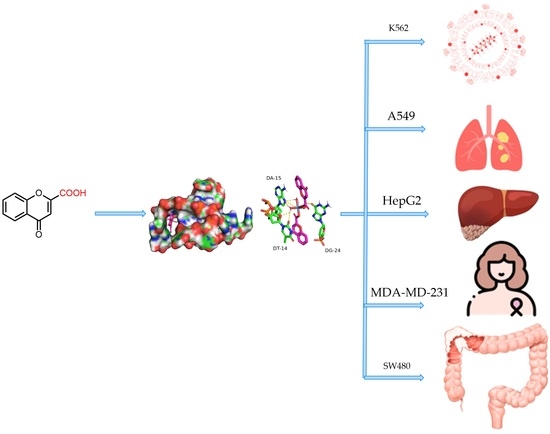
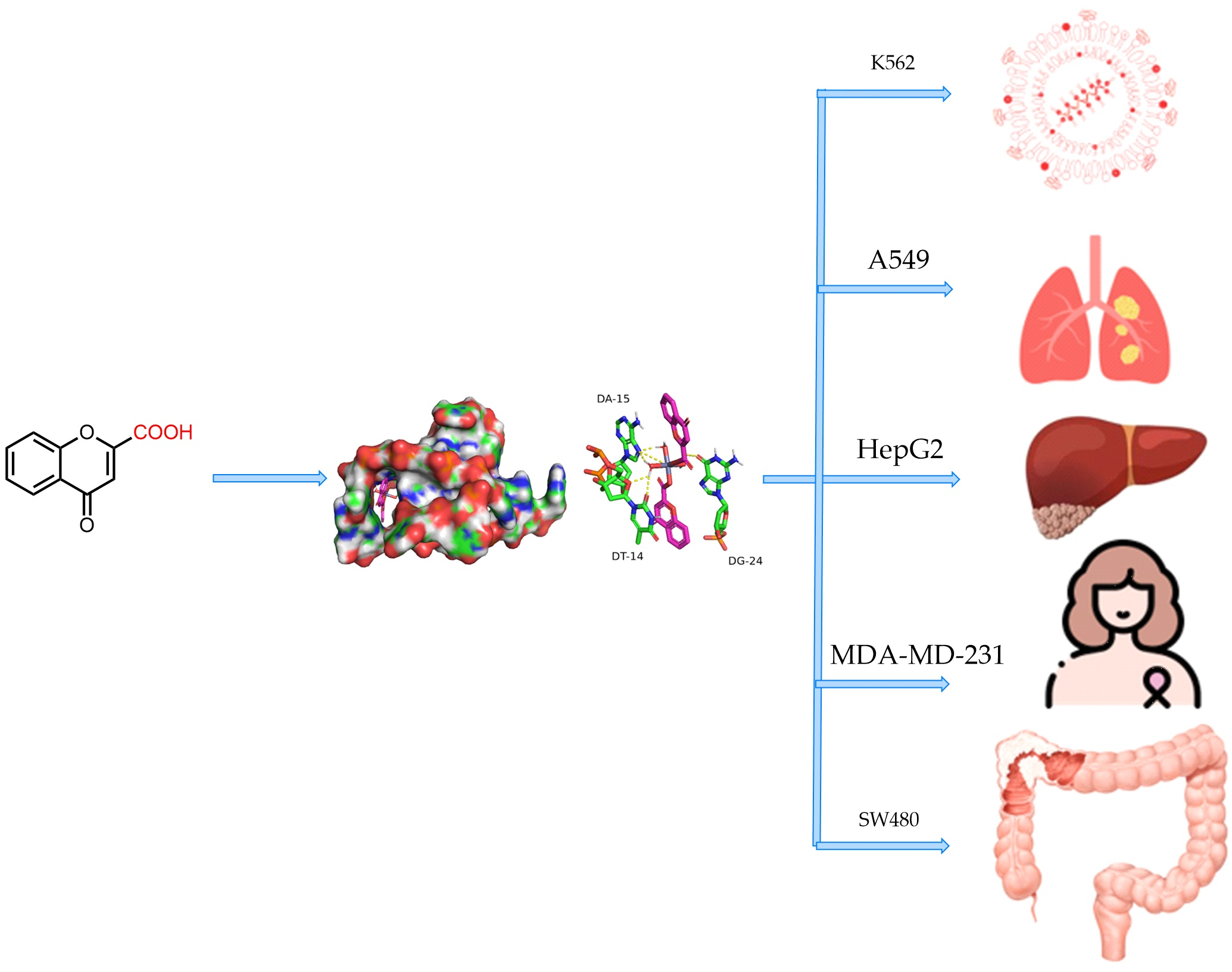
Graphical Abstract

1. Introduction

The global cancer mortality rate is still high and has become a major health challenge [1,2], underscoring the urgent need for novel anticancer drug development. Metal complexes, with their unique electronic structures and diverse coordination modes, hold considerable potential in anticancer drug design [3,4,5,6]. In recent years, drugs represented by platinum complexes have been widely used in clinics, among which the platinum (IV) anti-tumor prodrug developed by researchers has shown excellent application prospects because of its ability to increase stability and reduce toxicity [7,8,9]. In addition, ruthenium (II)/iridium (III) complexes have demonstrated potential in photodynamic therapy [10,11]. However, developing novel metal complexes with enhanced efficacy, higher selectivity, and improved safety remains a core objective in this field. Nano-delivery systems have further advanced the clinical translation of metal complexes by enabling precise drug delivery and controlled release [12,13], while exploring novel metal centers and ligands remains crucial for driving progress in this field.
Notably, the anticancer potential of metal-based complexes derived from human body essential trace transition metals, such as nickel, cobalt, zinc and copper, has attracted widespread attention. Complexes of these metals typically exhibit selective cytotoxicity, multi-target mechanisms of action, and low systemic toxicity, offering promise to overcome key limitations of cisplatin [14,15,16,17,18,19,20]. In constructing such metal complexes, carboxylic acid ligands have emerged as highly promising materials due to their tunable coordination modes, controllable molecular structures, and inherent biological activities (e.g., anti-inflammatory and antioxidant effects) in certain cases [21,22,23,24,25,26]. The synergistic interaction between carboxylic acid ligands and metal centers not only modulates the physicochemical properties of the resulting complexes [27,28], but also enhances anticancer activity through ligand–metal cooperation [29,30,31]. However, 4-benzopyranone-2-carboxylic acid, an organic carboxylic acid primarily used as a pharmaceutical intermediate and optical material, has rarely been employed as a ligand for anticancer metal complexes.
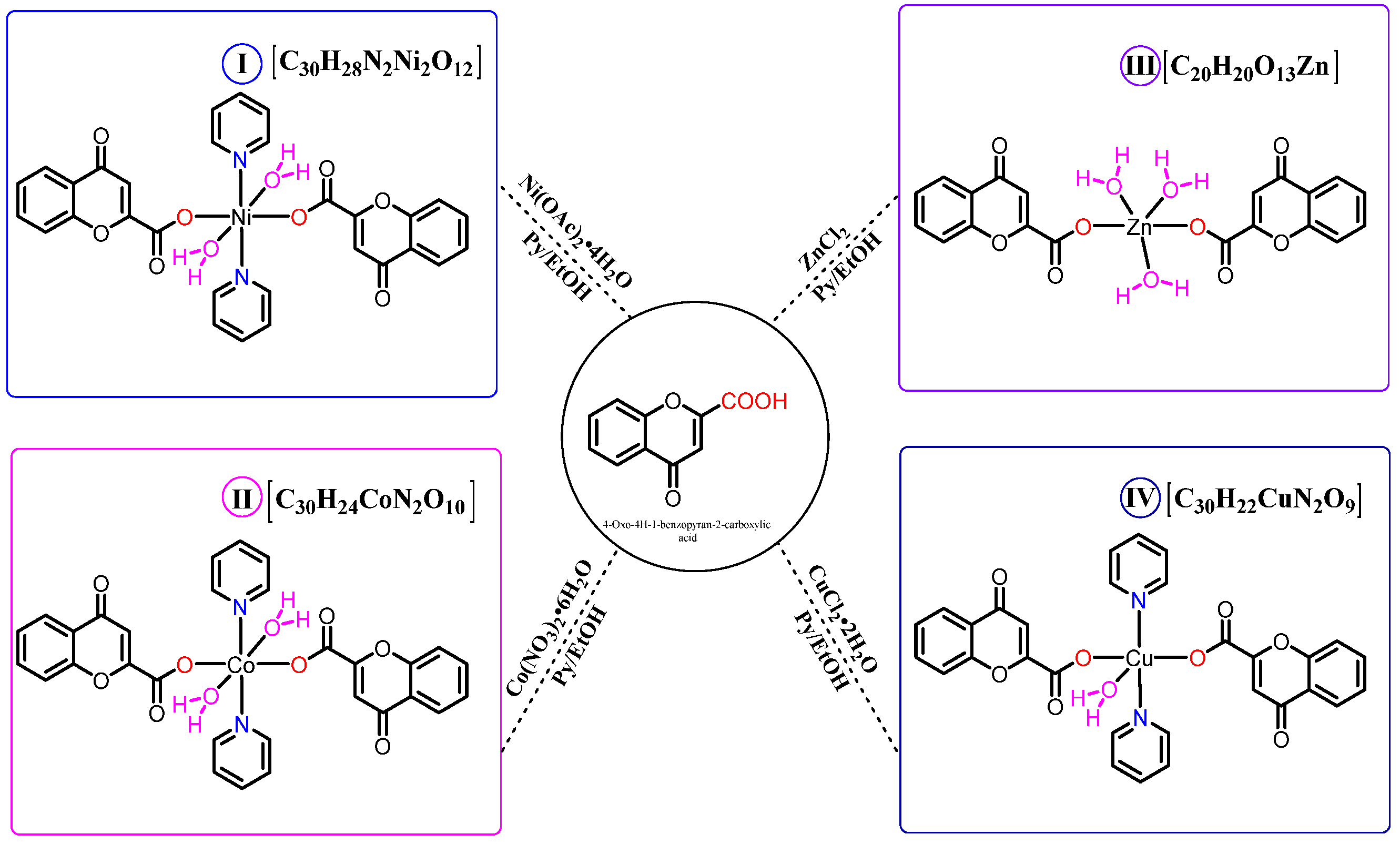
Thus, in this study, a series of new metal complexes of nickel (II), cobalt (II), zinc (II) and copper (II) were successfully prepared by a one-pot method with 4-benzopyranone-2-carboxylic acid as the organic ligand: [C30H28N2NiO12] (I), [C30H24CoN2O10] (II), [C20H20O13Zn] (III), and [C30H22CuN2O9] (IV) (Scheme 1). Their structures were characterized by elemental analysis (EA), UV-vis diffuse reflectance spectrum (UV-vis DRS), infrared spectroscopy (IR), nuclear magnetic resonance (NMR), electron paramagnetic resonance spectroscopy (EPR), electrospray ionization mass spectrometry (ESI-MS) and single-crystal X-ray diffraction (XRD). Cell activity was detected by the MTS method (using 3-(4,5-dimethylthiazol-2-yl)-5-(3-carboxymethoxyphenyl)-2-(4-sulfophenyl)-2H-tetrazolium internal salt (MTS)) [32]. The cytotoxicity of the human leukemia cell line (K562), lung cancer cell line (A549), liver cancer cell line (HepG2), breast cancer cell line (MDA-MB-231) and colon cancer cell line (SW480) was determined. Interestingly, our complexes showed good cytotoxicity in a leukemia cell line (K562) and a liver cancer cell line (HepG2).

2. Results and Discussion

2.1. Synthetic Analysis of Complexes I–IV

The synthetic routes of complexes I–IV are illustrated in Scheme 1. 4-benzopyranone-2-carboxylic acid was selected as the organic carboxylic acid ligand, which exhibits diverse coordination modes and strong coordination affinity with transition metal ions [14]. Pyridine, as a classic N-donor auxiliary ligand, can not only coordinate effectively with transition metal ions, but also fine-tune the coordination geometry and enhance the stability of the complexes [33,34].
The organic carboxylic acid ligand, pyridine and transition metal salt were dissolved in anhydrous ethanol at a molar ratio of 2:1:1. Upon completion of the reaction, the mixture was subjected to hot filtration immediately to remove insoluble impurities. The resulting filtrate was evaporated slowly at room temperature, yielding high-purity single crystals of complexes I–IV that are suitable for subsequent X-ray diffraction characterization.

2.2. Crystal Structure Analysis

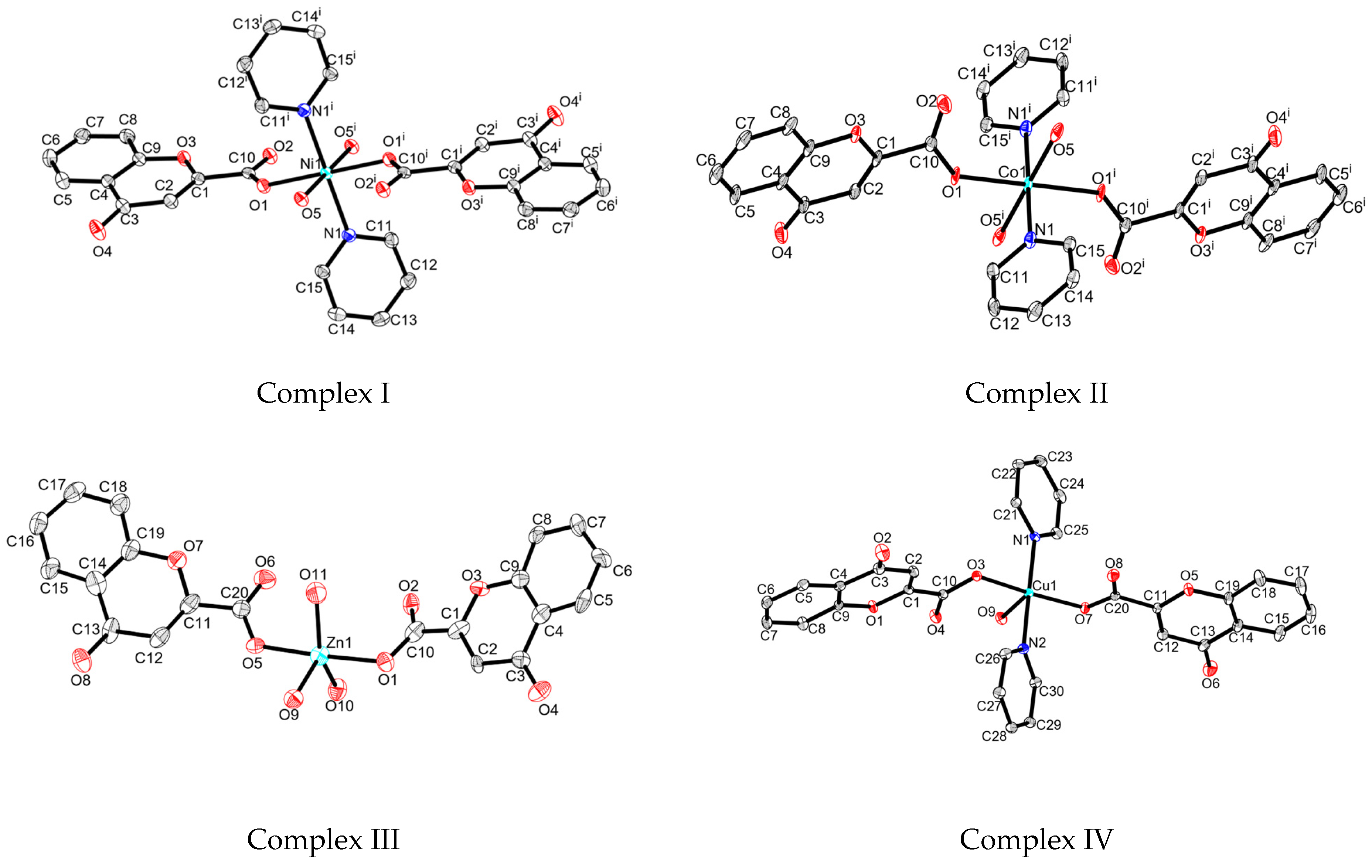
The crystal structures and stereograms of complexes I–IV are shown in Figure 1. The spatial crystal groups of all the complexes are as follows: I: P-1; II: P-1; III: P21/c; IV: P21/c. All four complexes are mononuclear, but their asymmetric unit compositions, coordination geometries, and stability forces differ. The asymmetric structural unit of complex I includes one nickel ion, two 4-benzopyran-2-carboxylic acid molecules, two pyridine molecules, and three water molecules. The asymmetric unit of complex II includes a cobalt ion, two 4-benzopyranone-2-carboxylic acid anions, two pyridine molecules and two water molecules. The asymmetric unit of complex III includes a zinc ion, two 4-benzopyranone-2-carboxylic acid anions and five water molecules. The asymmetric unit structure of complex IV includes a copper ion, two 4-benzopyranone-2-carboxylic acid anions, two pyridine molecules and one water molecule. The asymmetric unit of complex III includes one zinc ion, two 4-benzopyran-2-carboxylic acid molecules, and five water molecules. The asymmetric unit structure of complex IV includes one copper ion, two 4-benzopyran-2-carboxylic acid molecules, two pyridine molecules, and one water molecule.
Complexes I and II are isomorphic with the triclinic system (space group P-1), both adopting sixfold-coordinated slightly distorted octahedral configurations. However, complex I (Ni2+) shows no obvious special distortion except for the common deviation caused by triclinic system stacking, while complex II (Co2+) has subtle differences in bond angles due to ligand property variations. In contrast, complexes III (Zn2+) and IV (Cu2+) belong to the monoclinic system (space group P21/c) with fivefold coordination. The central metal ion Zn1 of complex III exhibits a configuration between triangular bipyramid and square pyramid (τ5 = 0.54) [35,36], while the central metal ion Cu1 of complex III (d9 configuration) undergoes Jahn–Teller distortion, forming a twisted square pyramid configuration (τ5 = 0.16) [35,36,37]. Regarding stability forces, complexes I, III, and IV rely on hydrogen bond networks to stabilize crystal stacking, while complex II mainly depends on π–π packing between aromatic rings. These structural differences are mainly attributed to the type of central metal ions and their electronic configurations [38].
In the crystal structure of complex I, the central metal ion Ni1 adopts a geometry with sixfold coordination, forming a slightly distorted octahedral geometry (Figure 1). The coordination layer consists of two oxygen atoms from water molecules, two nitrogen atoms from pyridine ligands, and two oxygen atoms from 4-benzopyran-2-carboxylic acid. This coordination mode can be described by the sp3d2 hybridization of Ni (II) ions: six hybrid orbitals accommodate lone pair electrons from O and N coordinating atoms. Ni–O (water and carboxylate) and Ni–N (pyridine) bonds are formed through covalent and coordination interactions. A comparison of the above bond lengths with those reported in relevant literature reveals that the Ni–N (pyridine) bond lengths are also consistent with the previously reported range of Ni–N (pyridine) bond lengths (1.950–2.200 Å), and the Ni–O (carboxylate/water) bond lengths in this study fall within the range of M–O bond lengths reported for analogous metal complexes [39,40,41]. The distortion of the ideal octahedral geometry is attributed to the spatial effects of ligands and crystal stacking forces in the triclinic system [42]. Around the Ni1 ion, the cis bond angles are 85.41(4)°, 94.60(4)°, 85.40(4)°, 92.45(4)°, 87.55(4)°, 90.14(4)°, and 89.86(4)°, respectively, all significantly deviating from 90°, further confirming the distortion of the octahedral structure [43], and all the trans bond angles are 180.0° (Table S1), which is consistent with the parameters of similar complexes reported in the literature [14,44]. Crystal stacking is stabilized by a hydrogen bond network: coordinated water molecules (O5-H5A and O5-H5B) form hydrogen bonds with oxygen atoms (O2) in 4-benzopyran-2-carboxylic acid and oxygen atoms (O6) in free water molecules. Free water molecules (O6-H6A and O6-H6B) form additional hydrogen bonds with oxygen atoms (O2, O3, and O4) in the ligands (Figure S1). These hydrogen bond lengths are 1.91 Å, 1.91 Å, 1.97 Å, 2.41 Å and 2.07 Å (Table S2), which collectively increases the stability of the crystal structure [45].
The crystal structure of complex II is isomorphic with respect to that of complex I, but its central metal ion is Co2+. The central metal Co1 also adopts a geometry with sixfold coordination, coordinating with carboxyl oxygen atoms (O1, O1i) from two different 4-benzopyran-2-carboxylic acid ligands, nitrogen atoms (N1, N1i) from two pyridine molecules, and oxygen atoms (O5, O5i) from two water molecules to form a slightly distorted octahedral geometry (Figure 1). The bond length measurement results indicate that the Co1-O1/O1i (ligand carboxyl oxygen) bond length is 2.0292(15) Å, which is significantly shorter than the bond length of Co1-O5/O5i (coordinated water molecule oxygen) [2.1810(19) Å] (Table S1). This difference is due mainly to the different properties of the ligands. The oxygen atom in deprotonated carboxylate salts has a higher electron density and forms stronger coordination bonds with the metal center; as a neutral ligand, the coordination of water molecules is relatively weak [46,47]. The Co1-N1/N1i bond lengths are 2.1450(19) Å and 2.1449(19) Å, respectively, which are consistent with the reported range of Co-N and Co-O bond lengths [48]. The bond angle analysis further revealed subtle distortions in the coordination environment. Although the three trans angles of the O1i-Co1-O1, N1i-Co1-N1, and O5-Co1-O5i bonds are all 180°, satisfying central symmetry, the cis bond angle deviates from the ideal octahedron by 90°. The O-Co1-N bond angle ranges from 89.53(9)° to 90.47(9)°, approaching the ideal value; the deviation in the O-Co1-O bond angle [79.76(7)° to 100.24(7)°] is more significant [49]. Although the coordinating water molecule (O5) is a strong hydrogen bond donor, preliminary analysis suggests that no hydrogen bonds form in the crystal and that the stability of the crystal may depend mainly on other weak interaction forces, such as π–π packing between aromatic rings (Figure S1) [38].
In the crystal of complex III, the central metal ion Zn1 adopts a geometry with fivefold coordination, but its geometric configuration deviates significantly from that of the ideal triangular bipyramid (TBP) (Figure 1). Notably, complex III does not contain pyridine molecules in its asymmetric unit, which is different from complexes I, II, and IV. This might be attributed to the fact that Zn2+ is a transition metal ion with a fully occupied 3d10 electron configuration [50,51]; its fully occupied d-orbitals result in extremely weak covalent interactions with pyridine N atoms, thereby hindering the formation of stable coordination structures [52]. Zn1 coordinates with two oxygen atoms (O1 and O5) from the ligand and three oxygen atoms (O9, O10, and O11) from the water molecule. With Zn1 as the center, the five bond lengths are dZn1-O1 = 2.038(7) Å, dZn1-O5= 2.035(7) Å, dZn1-O9 = 2.048(6) Å, dZn1-O10 = 1.997(7) Å and dZn1-O11 = 2.004(7) Å (Table S1). Notably, the bond between the central metal ion Zn1 and the oxygen atom (O9) in the coordinated water molecule is significantly longer than is its bond with the oxygen atoms (O1, O5) from the ligand source. This may be due to O9 participating in intermolecular interactions as a strong hydrogen bond donor, thereby weakening the strength of the Zn-O9 bond. The bond angle analysis further revealed a highly distorted coordination geometry. Although the axial bond angle of O5-Zn1-O1 is 176.6(3)°, which is close to 180°, the other bond angles of O-Z1-O are within the range of 88.88(3)–14.40(3)°, deviating by 120°. The geometric distortion of Zn1 is quantified by the configuration parameter τ55 = (176.6 − 144.0)/60 = 0.54), indicating that the center of Zn1 is actually between the triangular bipyramid and the square pyramid in terms of its configuration [35,36]. All these structural parameters are consistent with the zinc complex parameters reported in the literature [53,54]. The crystal stacking diagram reveals that there are abundant hydrogen bond structures in complex molecules; water molecules (O-H) can form hydrogen bond structures with various O atoms [55,56,57], and coordinated water molecules (O-H) act as hydrogen bond donors, forming multiple intermolecular interactions with the carboxyl oxygen (O2, O6) and carbonyl oxygen (O4, O8) of ligands in adjacent molecules, as well as with the oxygen atoms (O12, O13) in free water molecules (Figure S1). The hydrogen bond length ranged from 1.79 Å to 2.09 Å (Table S2). These hydrogen bonds work together to expand single molecules into a stable three-dimensional supramolecular network structure, not only solidifying the orientation of coordinated water molecules but also providing a structural basis for the macroscopic stability of the crystal [49].
Complex IV is a mononuclear Cu metal complex, and the central metal Cu1 has a structure with fivefold coordination, coordinating with two oxygen atoms (O3 and O7), two pyridine nitrogen atoms (N1 and N2), and the oxygen atom (O9) of the one water molecule in the ligand (Figure 1). The bond length data (dCu1-O3 = 1.9824(12) Å, dCu1-O7 = 1.9603(12) Å, dCu1-N1 = 2.0061(14) Å, dCu1-N2 = 2.0129(15) Å and dCu1-O9 = 2.3265(13) Å) show that the Cu1-O9 bond is significantly longer than the other Cu-L bonds are (Table S1), which is a typical manifestation of axial Jahn–Teller distortion in Cu(II) d9 systems [37]. Bond angle analysis (N2-Cu1-N1 = 178.69(5)) indicates that the N1 and N2 atoms are in approximately axial positions. The bond angle range for O-Cu1-O is 91.44(5)–168.87(6)°, and the bond angle range for O-Cu1-N is 88.55(5)–91.39(5)° (Table S1). According to the calculation, its configuration parameter τ5 is 0.16, quantitatively indicating that the coordination geometry of the central metal is a twisted square pyramid configuration [35,36]. All the bond length and bond angle parameters are similar to those reported for similar Cu(II) complexes [58,59,60]. In crystal stacking, abundant hydrogen bonding forces are the key to stabilizing supramolecular structures. Coordinated water molecules (O-H) act as hydrogen bond donors, forming strong hydrogen bonds with oxygen atoms (O4, O8) on adjacent ligand carboxyl groups and oxygen atoms (O5) in ether bonds. In addition, the C-H group on the pyridine ring can also act as a weak hydrogen bond donor, interacting with the oxygen atoms (O4, O8) of the carboxyl group in the ligand (Figure S1). Together, these O-H···O and C-H···O hydrogen bonds weave an extended three-dimensional supramolecular network (Table S2). This stable stacking mode constructed through hydrogen bonding has a significant effect on the physical and chemical properties of the complex in the solid state [61].

2.3. Electrospray Ionization Mass Spectrometry

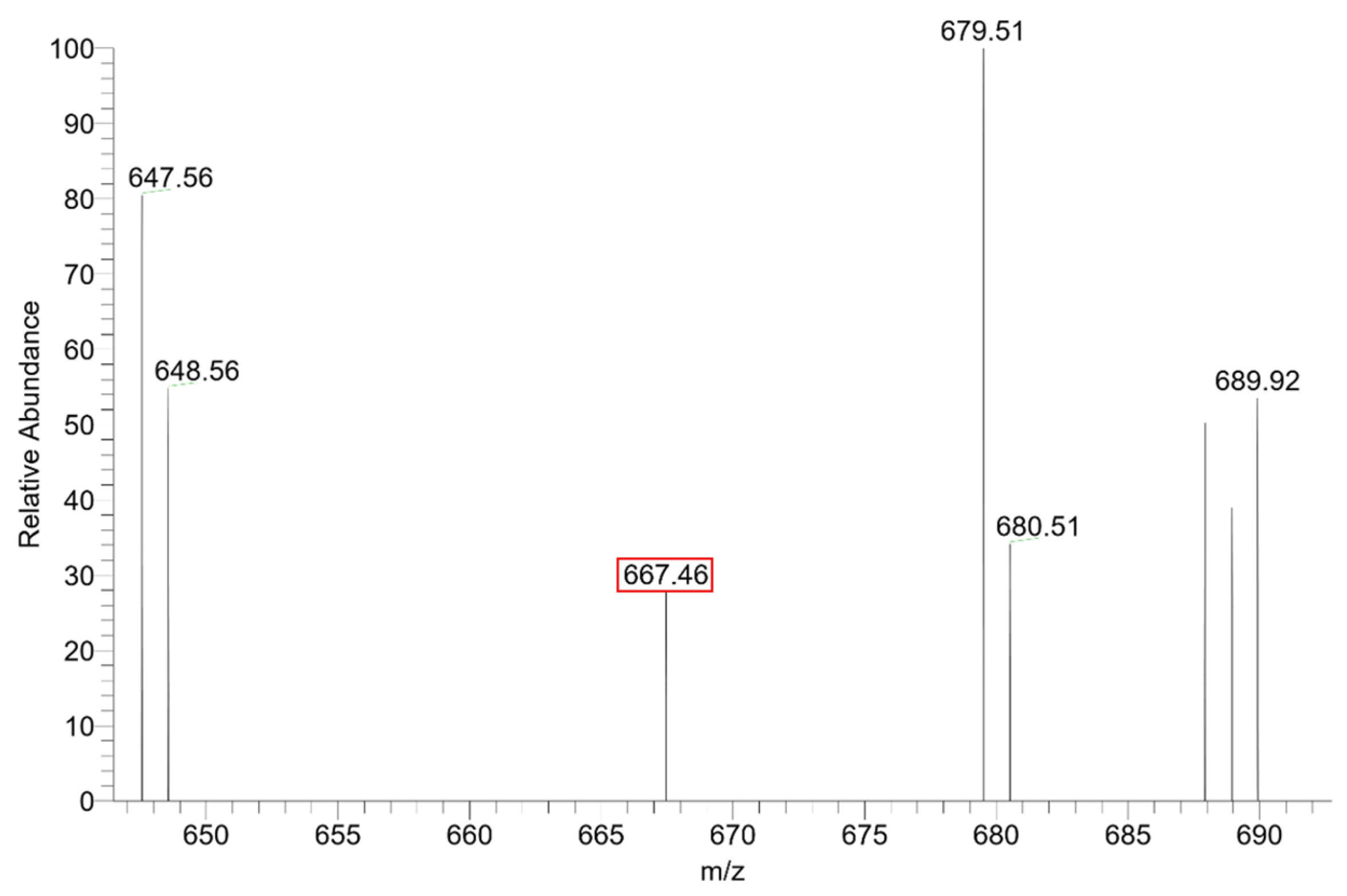
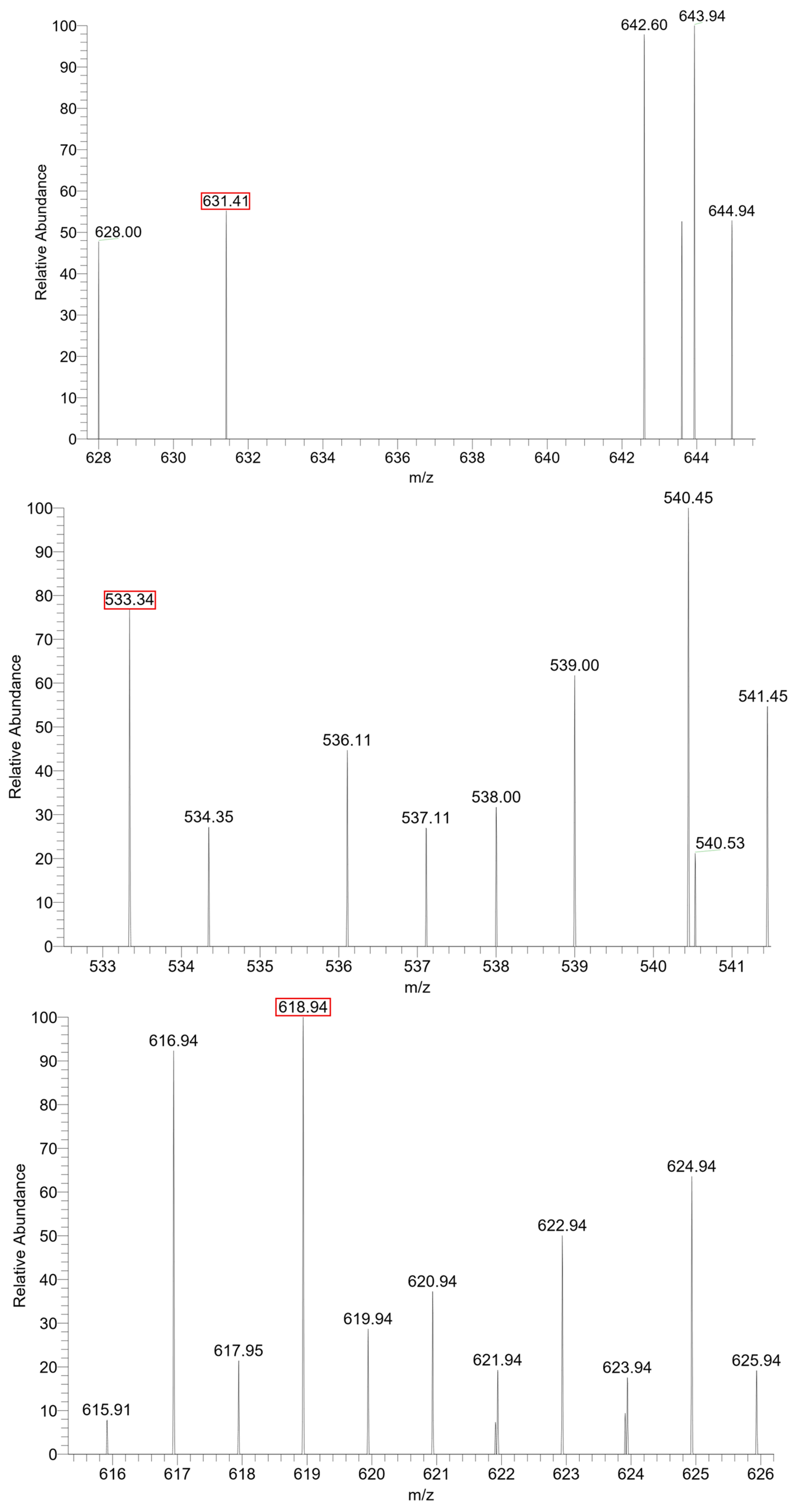
The electrospray ionization mass spectrometry peaks of the complex in absolute ethanol are shown in Figure 2. The molecular formula and calculated and measured mass–charge ratios (m/z) are as follows: I: [C30H28N2NiO12], calculated m/z 667.25, measured m/z 667.46; II: [C30H24CoN2O10], calculated m/z 631.44, measured m/z 631.41; III: [C20H20O13Zn], calculated m/z 533.73, measured m/z 533.34; IV: [C30H22CuN2O9], calculated m/z 618.03, measured m/z 618.94.

2.4. Fourier Transform Infrared Spectrum Analysis

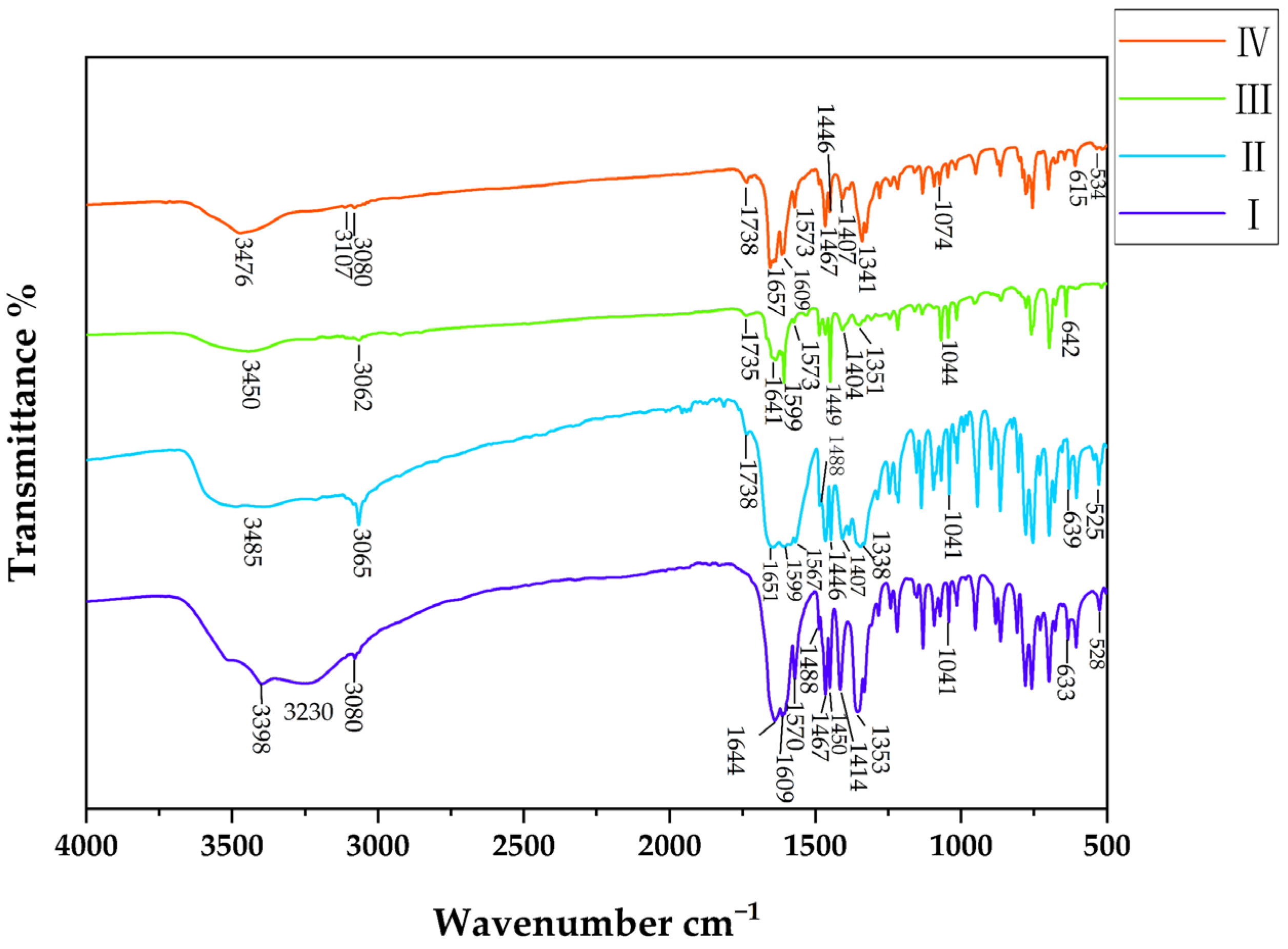
Figure 3 shows the infrared spectral data of this complex in the range of 4000–500 cm−1. The vibration peak attributed to the O-H group is particularly unique, and its absorption peak is clearly affected by the environment. When the O-H group does not form hydrogen bonds, its stretching vibration peak usually presents as an obvious strong absorption peak in the range of 3750–3000 cm−1, and when the O-H group interacts with other groups through hydrogen bonds, a wider peak is observed [62]. Broad peaks of complexes I, II, III and IV are observed in the range of 3485–3230 cm−1, which is due to the bond between coordinated water molecules and metal ions [63]. The C-H stretching vibration range for the benzene ring is 3200–3000 cm−1, and the corresponding peaks can be found in the infrared spectra of the four complexes; 2–3 peaks due to the vibration of the benzene ring skeleton are observed in the 1609–1446 cm−1 region, which indicates the presence of a benzene ring [14]. The infrared peaks characteristic of complexes I, II and IV are observed at 1467 cm−1, 1488 cm−1 and 1446 cm−1, respectively, corresponding to the C=N bond in the pyridine ring [64]. The characteristic absorption band of the C=O stretching vibration can be observed at 1800–1650 cm−1 [65], and all the complexes contain carbonyl groups; thus, the characteristic absorption peak of C=O is observed in Figure 3, in which the absorption peak for complex II is located at approximately 1738 cm−1, that for complex III is located at approximately 1735 cm−1, and that for complex IV is located at approximately 1738 cm−1. However, the absorption peak for complex I is located at approximately 1644 cm−1, which may be attributed to the fact that the participation of coordinated water molecules can affect the stretching vibration of carbonyl through the interaction of hydrogen bonds, making its stretching vibration frequency redshift [66,67]. The peak for complex I at 1570 cm−1 corresponds to the asymmetric stretching of carboxylate groups (-COO) coordinated with metal ions, and the peak at 1414 cm−1 corresponds to symmetric stretching [68]. The difference (Δυ) between asymmetric and symmetric stretching vibrations is less than 200 cm−1, which may be due to the interaction between the carboxylate oxygen, which is not coordinated with metal, and coordinated water molecules through hydrogen bonds, resulting in a “pseudo-bridging” arrangement and indicating that carboxylate groups and metal ions are monodentate coordinated [64,69,70], which is consistent with the results of single-crystal X-ray diffraction. Similarly, the asymmetric stretching peaks of the carboxylate groups of complexes II, III and IV are at 1567 cm−1, 1599 cm−1 and 1573 cm−1, respectively, and the symmetric absorption peaks are at 1407 cm−1, 1404 cm−1, and 1407 cm−1, respectively; moreover, the Δυ values are less than 200 cm−1, which indicates that the carboxylate groups are monodentate coordinated with the metals, which is consistent with the X-ray diffraction results. The absorption peaks for complexes I, II, III and IV can be observed at approximately 1041 cm−1, 1041 cm−1, 1044 cm−1 and 1074 cm−1, respectively, and correspond to =C-O-C in the complexes, indicating that they have ether bonds [14]. The absorption peaks attributed to vibrations of the C-C framework and C=C framework for all the complexes are in the ranges of 1353–1338 cm−1 and 1657–1609 cm−1, respectively [44].
In addition to the above characteristic peaks, the stretching vibration peaks attributed to the metal-O and metal-N bonds of the four complexes appear in the range of 650–500 cm−1. The absorption peak attributed to the Ni-O bond of complex I is located at 633 cm−1, and the absorption peak attributed the Ni-N bond is located at 528 cm−1 [71,72]. The absorption peak attributed to the Co-O bond of complex II is located at 525 cm−1, and the absorption peak attributed to the Co-N bond is located at 639 cm−1 [73,74]. The absorption peak characteristic of the Zn-O bond of complex III is located at 642 cm−1 [14]. The absorption peak characteristic of the Cu-O bond of complex IV is located at 615 cm−1, and the absorption peak attributed to the Cu-N bond is located at 534 cm−1 [62,75]. These absorption peaks confirm the coordination of the metal and ligand [76,77].

2.5. UV-Visible Diffuse Reflectance Spectrum Analysis

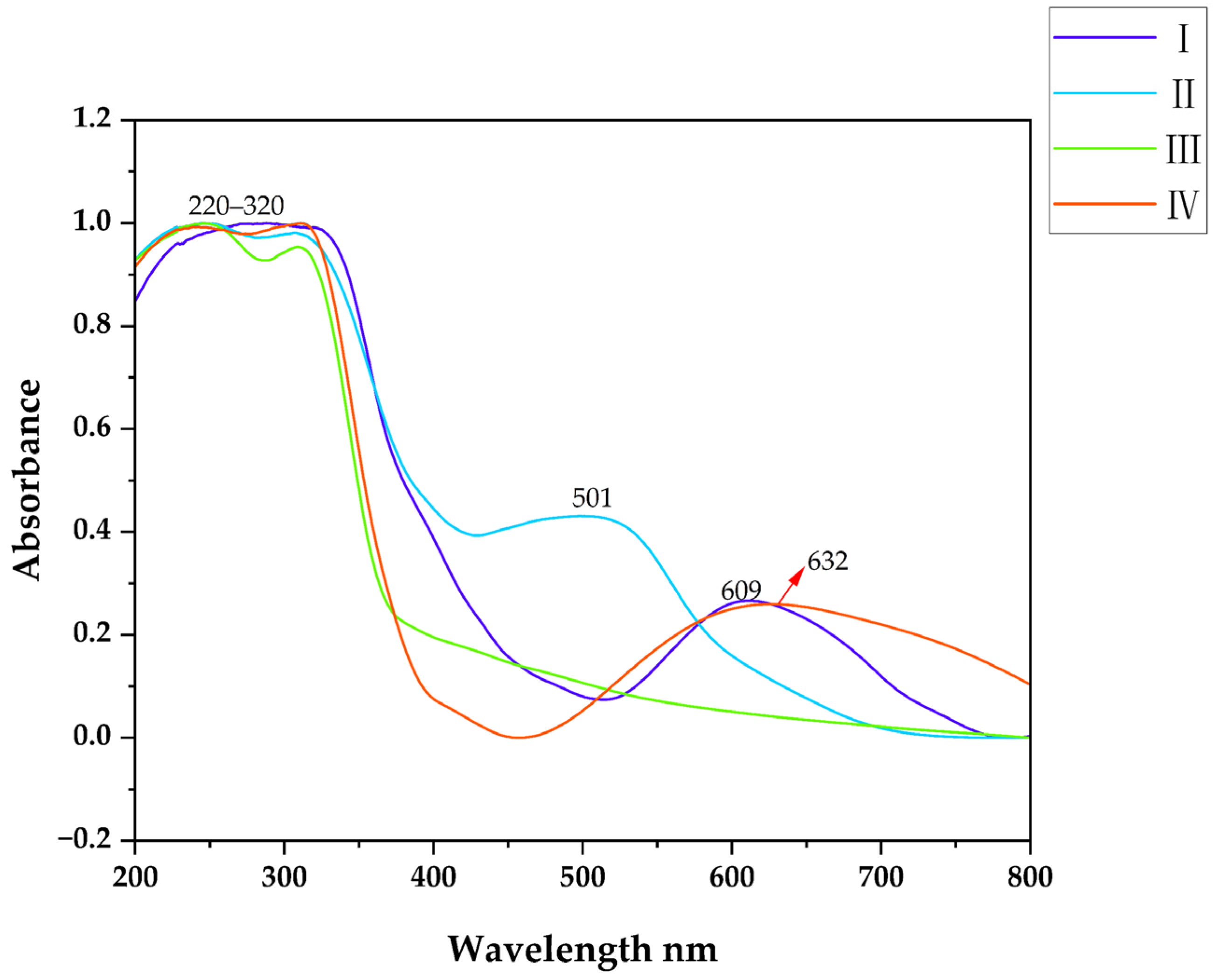
The UV-Visible Diffuse Reflectance Spectrum of the complex in the range of 200–800 nm is shown in Figure 4. Compounds containing double bonds or benzene rings can undergo a π–π* transition, and the wavelength range is generally 210–250 nm. However, with the mutual conjugation of double bonds and the extension of the conjugated system, the maximum absorption wavelength can redshift [78,79,80]. The absorption bands of complexes I, II, III and IV can be observed in the range of 220–270 nm, which may be caused by the π–π* transition of the benzene ring in the complexes and the vibration of the benzene ring skeleton. In addition, the R band can be observed in the range of 270–350 nm because of the n–π* transition of chromophores such as -C=O and -C=N [14,81]. The absorption peak for complex I at 609 nm is due to the d–d* transition of metal ions, which indicates the presence of Ni2+ in the complex, and is equivalent to that of previously reported analogs [82]. The visible light absorption peak for complex II at 501 nm may be caused by the d–d* transition of Co2+ in the complex, which provides strong evidence that the Co complex has an octahedral structure [83]. No ultraviolet absorption was detected in the range of 400–800 nm for complex III because the 3d orbital of Zn2+ in the complex was completely occupied and there were no unpaired electrons; thus, the d–d* transition could not occur, so complex III was colorless [50,51]. The absorption peak for complex IV can be observed at 632 nm, which is caused by the d–d* transition in the presence of Cu2+ in complex IV, and is equivalent to that of previously reported analogs [82].

2.6. NMR Spectrum Analysis

We further characterized complex III by 1H NMR and 13C NMR spectroscopy, with the corresponding spectra shown in Figure S5. In the 1H NMR spectrum, the characteristic resonance peaks of the aromatic protons of the benzene ring appear at 7.56 ppm, 6.41 ppm, and 6.40 ppm [84], while the alkenyl protons of the C=C double bond exhibit a characteristic peak at 6.80 ppm. Concurrently, the signal at 11 ppm was completely absent, indicating coordination through the carboxylic acid oxygen atom [85]. In the 13C NMR spectrum, characteristic resonance peaks at 149.34 ppm, 138.11 ppm, 135.60 ppm, 125.00 ppm, 119.38 ppm, and 113.46 ppm correspond to the carbonyl carbon protons, C=C double bond carbon protons and aromatic carbon protons of the benzene ring, respectively. In summary, the 1H and 13C NMR spectral data fully confirm that the molecular structure of complex 3 is consistent with the results of single-crystal X-ray diffraction analysis.

2.7. Electron Paramagnetic Resonance Spectrum Analysis

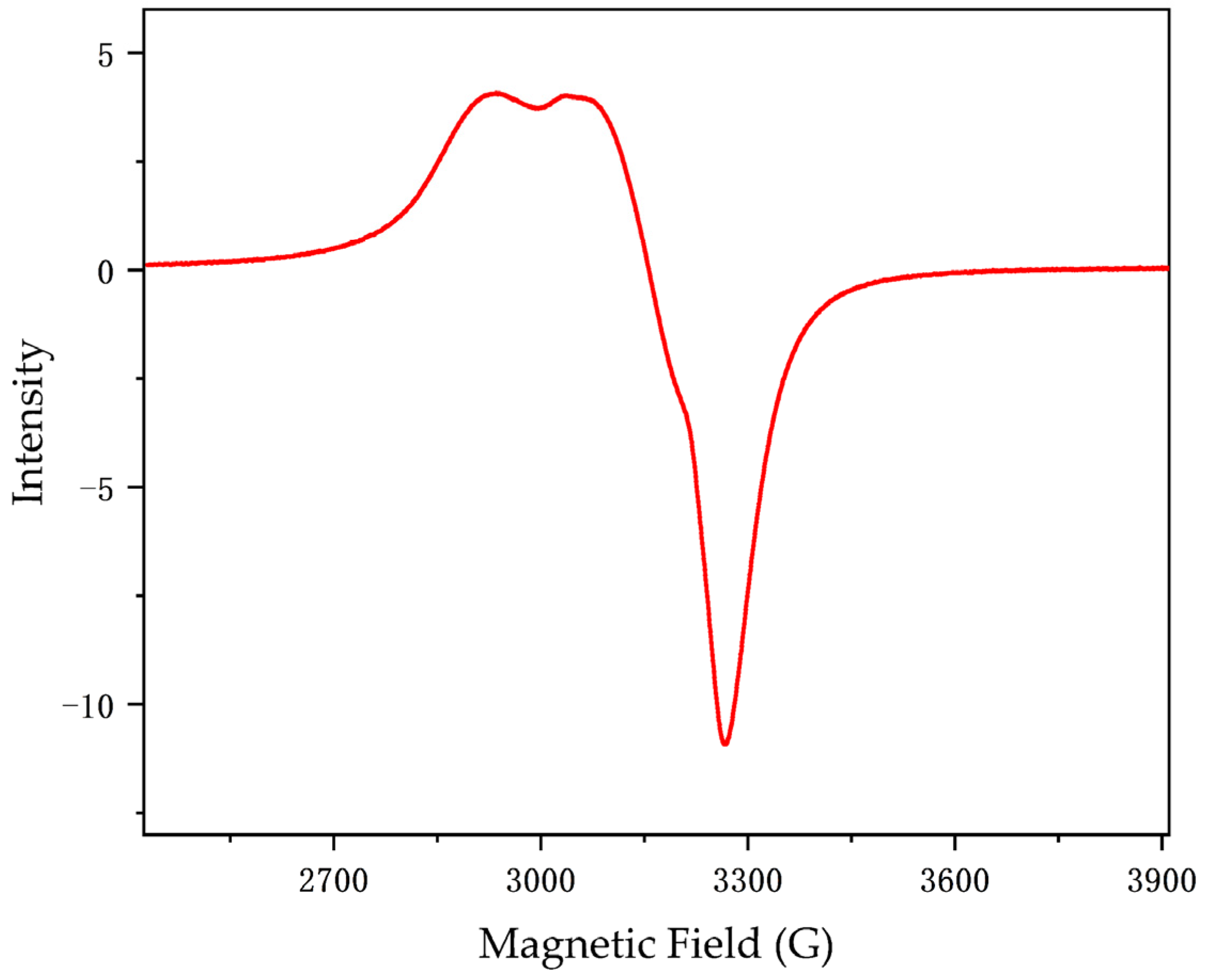
The X-band EPR spectrum of complex IV recorded at 298K exhibits an axial signal with g = 2.06 and g = 2.30 (Figure 5). These g-values are both larger than the free electron g-factor (ge = 2.0023), which is consistent with significant spin–orbit coupling and supports a square-pyramidal coordination geometry for the Cu(II) center [86]. This assignment agrees well with the structure determined by single-crystal X-ray diffraction (τ5 = 0.16). Furthermore, the ge < g < g relationship indicates that the singly occupied molecular orbital (SOMO) is primarily of dx2−y2 character [87,88].

2.8. Cytotoxicity Analysis

The inhibitory effects of complexes I–IV on five human tumor cell lines are shown in Table 1. As shown in Table 1, complexes I, II and III had obvious inhibitory effects on K562 leukemia cells, among which zinc complex III also had good inhibitory effects on A549 lung cancer cells, HepG2 liver cancer cells and SW480 colon cancer cells, while complex IV had good inhibitory effects only on HepG2 liver cancer cells and had low inhibitory effects on the other four cell types. A comparison of the inhibitory effects of the four complexes clearly revealed that the performance of zinc complexes is better than that of nickel, cobalt and copper complexes, which may be attributed to the unique chemical and physical characteristics of zinc ions and their multitarget mechanism [89,90,91]. Additionally, it should be noted that complex III differs from complexes I, II, and IV in the absence of a pyridine ligand. This structural feature may also synergistically modulate its biological activity, thereby further influencing its inhibitory activity against tumor cells [92,93]. These findings provide an important experimental basis for the future study of such anticancer drugs.

2.9. Molecular Docking Study of Complexes I–IV and the G-Quadruplex

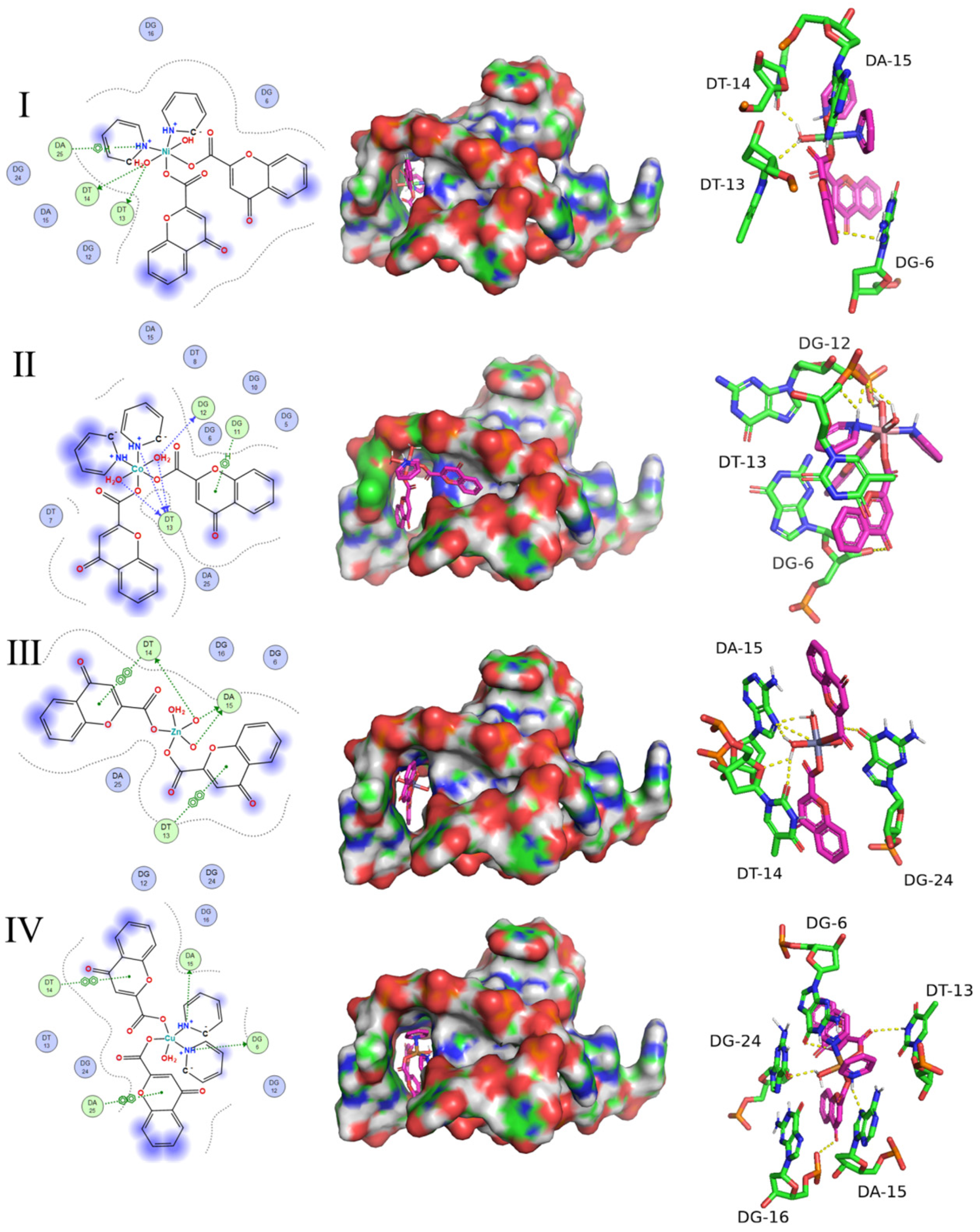
The results of the molecular docking are summarized in Table 2, and the binding modes of the four compounds (complexes I–IV) with the G-quadruplex are depicted in Figure 6. The results of the molecular docking study indicate that all the compounds can fit into the same active pocket of the G-quadruplex and exhibit similar binding modes. They primarily achieve stable binding with the target through the formation of hydrogen bonding interactions with multiple bases of the G-quadruplex, such as DG-6, DT-13, and DA-15.
A molecular docking study revealed that compound I demonstrated the best docking performance among these compounds, with a docking score of −9.2020. It formed hydrogen bonding interactions with the bases at the binding site of the G-quadruplex. Specifically, compound I formed multiple hydrogen bonds with the bases DG-6, DT-13, DT-14, and DA-15 within the binding pocket. Compound IV exhibited a docking score comparable to that of compound I at −9.1687 and formed extensive hydrogen bonding interactions with bases in the G-quadruplex binding pocket, including those of DG-6, DT-13, DA-15, DG-16, and DG-24. Compound III had a relatively lower docking score of -7.7817, forming multiple hydrogen bonds with the bases at the binding site, primarily interacting with DT-14, DA-15, and DG-24. Compound II had the lowest docking score of −6.9703 and displayed interactions within the G-quadruplex binding pocket through the formation of hydrogen bonds with DG-12, DT-13, and DG-6. In conclusion, compound I, which has the highest docking score and stable interactions with the binding site, can interact stably with the G-quadruplex.

3. Experimental Section

3.1. Materials and Methods

4-benzopyranone-2-carboxylic acid, pyridine, Ni(CH3COO)2·4H2O, Co(NO3)2·6H2O, ZnCl2 and CuCl2·2H2O were all purchased from Acros (Thermo Fisher Scientific, Waltham, MA, USA). The infrared spectrum from 4000 to 500 cm−1 was recorded by a Magna IR 750 Fourier transform infrared spectrometer (Thermo Fisher Scientific, Waltham, MA, USA), and the peak value is expressed as cm−1. The UV-vis diffuse reflectance spectrum (UV-vis DRS) in the wavelength range of 200–800 nm was recorded on an Agilent CARY 5000 spectrophotometer from Agilent Technologies equipped with an integrating sphere accessory (Agilent Technologies, Santa Clara, CA, USA), and the peak value was expressed in nm. Electrospray mass spectrometry (ESI-MS) was recorded on a Vanquish Q Exactive Plus (Thermo Fisher Scientific, Dreieich, Germany) liquid chromatography–quadrupole electrostatic field orbital trap mass spectrometer, and ethanol was used for analysis. An Elementar vario EL cube element analyzer (Elementar Analysensysteme GmbH, Langenselbold, Germany) was used for trace analysis of C, H and N. The crystal structure was determined by a Bruker D8 Venture (Oxford Diffraction Limited, Oxfordshire, UK) single-crystal X-ray diffractometer. NMR spectra were acquired using a 500 MHz Bruker Advance III spectrometer (Bruker BioSpin AG, Faellanden, Switzerland). The chemical shifts in the 1H NMR and 13C NMR data are expressed in ppm, with DMSO-d6 as the solvent and δ = 2.5 ppm. Electron paramagnetic resonance (EPR) spectra were recorded on a Bruker E500-10/12 spectrometer (Bruker Biospin GmbH, Ettlingen, Germany) at a microwave frequency of 9.42 GHz.

3.2. Cytotoxicity Assay

In this study, the cytotoxicities of a human leukemia cell line (K562), a lung cancer cell line (A549), a liver cancer cell line (HepG2), a breast cancer cell line (MDA-MB-231) and a colon cancer cell line (SW480) (TCC; Manassas, VA, USA) were determined. Cell activity was detected by the MTS (Promega, Madison, WI, USA) method. Cytotoxicity was determined by using 3-(4,5-dimethylthiazol-2-yl)-5-(3-carboxymethoxyphenyl)-2-(4-sulfophenyl)-2H-tetrazole internal salt (MTS) (Promega, Madison, WI, USA).
The cells were prepared as a cell suspension with 10% fetal bovine serum (DMEM or RMPI640) 12–24 h in advance and inoculated into a 96-well plate at 100 μL per well for culture. The complex was dissolved in DMSO at a preliminary concentration of 100 μM and then added to a 96-well plate so that the final volume of each well was 200 μL, and three wells were used for each treatment. After 48 h of culture at 37 °C, 20 μL of MTS solution was added to each well, and after 2–4 h of incubation, a wavelength of 492 nm was selected; the absorbance of each well was read by a MULTISKAN FC system, and the cell inhibition rate was calculated.

3.3. Synthesis of Complexes I–IV

All the reactions were completed in glassware dried at normal atmospheric pressure, and the reagents were purchased from commercial sources. 4-benzopyrone-2-carboxylic acid was mixed with metal salts such as Ni(CH3COO)2·4H2O, Co(NO3)2·6H2O, ZnCl2 and CuCl2·H2O and dissolved in anhydrous ethanol by ultrasonication, and after a certain reaction time, the product was filtered. The crystal complex was obtained after the filtrate was volatilized and characterized by XRD, FTIR, UV-Vis DRS, EA, NMR, EPR and ESI-MS.

3.3.1. Synthesis of the Ni(II)-4-Benzopyranone-2-carboxylic Acid Complex (I)

4-benzopyranone-2-carboxylic acid (0.38 g, 2 mmol) and Ni(CH3COO)2·4H2O (0.2488 g, 1 mmol) were added to a 100 mL round-bottom flask containing 30 mL of anhydrous ethanol. The mixture was ultrasonicated for 20 min, after which pyridine (1 mL) was added. The reaction was then refluxed at 100 °C with stirring for 22 h. The resulting solution was filtered while it was hot and allowed to evaporate at room temperature. After three days, green crystals suitable for X-ray diffraction were obtained in 94.3% yield. The melting point was determined to be 101–103 °C. FTIR results (KBr, v, cm−1): 3398 (-O-H); 3230 (-O-H); 3080; 1644 (-C=O); 1609 (-C=C); 1570 (-COO); 1488; 1467 (-C=N); 1450; 1414 (-COO); 1353 (-C-C); 1041 (=C-O-C); 633 (-Ni-O); 528 (-Ni-N). ESI-MS (anhydrous ethanol): m/z [C30H28N2NiO12]+ calculated 667.25, found 667.46. Elemental analysis for C30H28N2NiO12: calcd. (%) N, 4.20; C, 54.00; H, 4.23. Found (%) N, 4.26; C, 53.24; H, 4.28. The slight deviation in the elemental analysis values is attributed to the partial loss of solvent molecules during heating.

3.3.2. Synthesis of the Cobalt-4-benzopyranone-2-carboxylic Acid Complex (II)

4-benzopyranone-2-carboxylic acid (0.38 g, 2 mmol) and Co(NO3)2·6H2O (0.2910 g, 1 mmol) were added to a 100 mL round-bottom flask containing 30 mL of anhydrous ethanol. The mixture was ultrasonicated for 20 min, followed by the addition of pyridine (1 mL). The reaction mixture was refluxed at 90 °C with stirring for 24 h. The resulting solution was filtered while it was hot and allowed to evaporate at room temperature. After six days, red crystals were obtained in 79.5% yield. The melting point was determined to range from 151 to 153 °C. FTIR results (KBr, v, cm−1): 3485 (-O-H); 3065; 1738 (-C=O); 1651 (-C=C); 1599; 1567 (-COO); 1488 (-C=N); 1446; 1407 (-COO); 1338 (-C-C); 1041 (=C-O-C); 639 (-Co-N); 525 (-Co-O). ESI-MS (anhydrous ethanol): m/z [C30H24CoN2O10]+ calculated 631.44, found 631.41. Elemental analysis for C30H24CoN2O10: calcd. (%) N, 4.44; C, 57.06; H, 3.83. Found (%) N, 5.08; C, 54.56; H, 3.84. The slight deviation in the elemental analysis values is attributed to the partial loss of solvent molecules during heating.

3.3.3. Synthesis of the Zinc-4-benzopyranone-2-carboxylic Acid Complex (III)

4-benzopyranone-2-carboxylic acid (0.38 g, 2 mmol) and ZnCl2 (0.1363 g, 1 mmol) were added to a 100 mL round-bottom flask containing 30 mL of anhydrous ethanol. The mixture was ultrasonicated for 20 min, followed by the addition of pyridine (1 mL). The reaction mixture was refluxed at 80 °C with stirring for 22 h. The resulting solution was filtered while it was hot and allowed to evaporate at room temperature. After one day, colorless, transparent, needle-shaped crystals were obtained in 30.3% yield. The melting point was determined to be 172 °C. FTIR results (KBr, v, cm−1): 3450 (-O-H); 3062; 1735 (-C=O); 1641 (-C=C); 1599 (-COO); 1573; 1449; 1404 (-COO); 1351 (-C-C); 1044 (=C-O-C); 642 (-Zn-O). ESI-MS (anhydrous ethanol): m/z [C20H20O13Zn]+ calculated 533.73, found 533.34. Elemental analysis for C20H20O13Zn: calcd. (%) C, 45.00; H, 3.77. Found (%) C, 44.63; H, 3.42.

3.3.4. Synthesis of the Copper-4-benzopyranone-2-carboxylic Acid Complex (IV)

4-benzopyranone-2-carboxylic acid (0.38 g, 2 mmol) and CuCl2·2H2O (0.1704 g, 1 mmol) were added to a 100 mL round-bottom flask containing 30 mL of anhydrous ethanol. The mixture was ultrasonicated for 20 min, followed by the addition of pyridine (1 mL). The reaction mixture was refluxed at 93 °C with stirring for 30 h. The resulting solution was filtered while it was hot and left to evaporate at room temperature. After three days, deep blue crystals were obtained in 51.8% yield. The melting point was 93 °C. FTIR results (KBr, v, cm−1): 3476 (-O-H); 3107; 3080; 1738 (-C=O); 1657 (-C=C); 1609; 1573 (-COO); 1467; 1446 (-C=N); 1407 (-COO); 1341 (-C-C); 1074 (=C-O-C); 615 (-Cu-O); 534 (-Cu-N). ESI-MS (anhydrous ethanol): m/z [C30H22CuN2O9]+ calculated 618.03, found 618.94. Elemental analysis for C30H22CuN2O9: calcd. (%) C, 58.30; H, 3.59; N, 4.53. Found (%) C, 58.78; H, 3.87; N, 4.58.

3.4. X-Ray Structure

A Bruker D8 Venture diffractometer (GaKα radiation source, wavelength λ = 1.34139) equipped with a graphite monochromator was used in the experiments, and the diffraction data were collected at room temperature. Structural analysis was completed by the programs of SHEXT [94] and SHEXT-2018/3 [14], in which nonhydrogen atoms adopt an anisotropic refinement model and hydrogen atoms are subjected to constrained isotropic treatment. Visualization of molecular structure was realized by MERCURY (MERCURY 4.2.0/2019) [95], and all crystallographic calculations and graphic processing were completed on OLEX2 (OLEX2-1.5) [96]. The crystal data and correction parameters of the complexes are summarized in Table 2; the hydrogen bond data are given in Table S2; and the selected bond lengths and bond angles are listed in Table S1.

3.5. Molecular Docking of Complexes I–IV

Molecular docking studies were conducted using the molecular operating environment (MOE) software (MOE 2024.06) package from the Chemical Computing Group [97]. The structures of small molecules were simply optimized through the minimize function, and the optimized ligands were subsequently imported into a newly created database. The crystal structure of human telomeric G-quadruplex (PDB ID: 5Z8F) was loaded into MOE software. Protein preparation was carried out using the structure preparation function. After structural correction, the structure was protonated. The ligand binding pocket in the crystal structure was defined as the binding site. The processed ligand molecules were placed in the site using the triangle matcher method and ranked with the affinity dG scoring function. The 30 best poses were retained and further optimized by the induced fit method, followed by rescoring with the GBVI/WSA dG scoring function. The stick-and-ball models and surface models of the G-quadruplex-ligand interactions were generated using PyMOL software (PyMOL 3.0.3/2024) [98].

4. Conclusions

In this study, four new complexes, namely [C30H28N2NiO12] (I), [C30H24CoN2O10] (II), [C20H20O13Zn] (III) and [C30H22CuN2O9] (IV), were designed and synthesized successfully by a one-pot method, and the structures of the complexes were characterized by single-crystal X-ray diffraction, EA, FTIR, ESI-MS, NMR, EPR and UV-Vis DRS. Crystals I–IV are all mononuclear complexes. According to single-crystal X-ray diffraction, complexes I and II are in the hexa-coordination mode, and complexes III and IV are in the penta-coordination mode. Afterwards, the antitumor effect of the complex was evaluated. Complexes I and II have obvious inhibitory effects on human leukemia K562 cells, and complex III has good inhibitory effects on human leukemia K562 cells, lung cancer A549 cells, liver cancer HepG2 cells and colon cancer SW480 cells. The properties of central ions have a certain influence on anticancer activity. Molecular docking studies were conducted on the complex, revealing that complex I had the highest docking score and stable interaction with the binding site and could interact stably with G-quadruplexes. At present, only the inhibitory activity of the complexes on five kinds of human tumor cells has been evaluated, so follow-up work will focus on the study of broad-spectrum activity and structural optimization, which will provide a more sufficient basis for the development of new metal antitumor drugs.

Supplementary Materials

The following supporting information can be downloaded at https://www.mdpi.com/article/10.3390/inorganics14010026/s1, Table S1: All crystal data and correction parameters for Complexes I–IV, obtained from single-crystal X-ray diffraction analysis and subsequent structural refinement; Table S2: The hydrogen bond parameters of the target complexes were summarized in detail, including the bond lengths (Å) and bond angles (°) for Complexes I–IV; Table S3: The key bond lengths (Å) and bond angles (°) of Complexes I–IV, derived from single-crystal X-ray diffraction analysis; Figure S1: The crystal packing of complexes I–IV, showing the formation of the three-dimensional network by hydrogen bonding interactions. Figure S2: The full-range electrospray ionization mass spectrometry spectra was recorded in anhydrous ethanol to characterize the molecular weight of the complexes I–IV; Figure S3: IR spectra of all the complex IIV in the ranges of 4000–500 cm–1, showing individual infrared absorption spectrum of each complex; Figure S4: UV spectra of all complexes I–IV in the range of 200–800 nm show a separate UV absorption spectrum for each complex; Figure S5: NMR spectra (1H and 13C) of complex III, displaying distinct proton and carbon signals consistent with the proposed molecular structure.

Author Contributions

Writing—original draft, methodology, investigation, formal analysis, visualization, Q.K.; writing—review and editing, formal analysis, Q.U.; resources, formal analysis, W.Z.; visualization, resources, formal analysis, X.M.; resources, formal analysis, H.Y.; writing—review and editing, resources, validation, supervision, conceptualization, project administration, funding acquisition, M.L. and Y.Z. All authors have read and agreed to the published version of the manuscript.

Funding

This research received no external funding.

Institutional Review Board Statement

Not applicable.

Informed Consent Statement

Not applicable.

Data Availability Statement

The original contributions presented in this study are included in the article. The crystal structure data of complexes (I)–(IV) have been deposited with the Cambridge Crystallographic Data Center (CCDC), with deposition numbers 2456686-2456689. Further inquiries can be directed to the corresponding authors.

Acknowledgments

This work was supported by the Hefei University of Technology and State Key Laboratory of Photochemistry and Plant Resources in West China.

Conflicts of Interest

The authors declare no conflicts of interest.

References

  1. Siegel, R.L.; Kratzer, T.B.; Giaquinto, A.N.; Sung, H.; Jemal, A. Cancer Statistics, 2025. CA Cancer J. Clin. 2025, 75, 10–45. [Google Scholar] [CrossRef] [PubMed]
  2. Smith, R. Is Cancer Treatment Inevitably Unsustainable? BMJ 2025, 389, r882. [Google Scholar] [CrossRef] [PubMed]
  3. Abdolmaleki, S.; Aliabadi, A.; Khaksar, S. Bridging the gap between theory and treatment: Transition metal complexes as successful candidates in medicine. Coord. Chem. Rev. 2025, 531, 216477. [Google Scholar] [CrossRef]
  4. Bera, A.; Sarkar, T.; Upadhyay, A.; Hussain, A. First-Row Transition Metal Complexes of Naturally Occurring Anticancer Chelators for Cancer Treatment. Coord. Chem. Rev. 2025, 541, 216847. [Google Scholar] [CrossRef]
  5. Bashir, M.; Mantoo, I.A.; Arjmand, F.; Tabassum, S.; Yousuf, I. An Overview of Advancement of Organoruthenium(II) Complexes as Prospective Anticancer Agents. Coord. Chem. Rev. 2023, 487, 215169. [Google Scholar] [CrossRef]
  6. Zhang, Y.-F.; Yin, Y.-K.; Zhang, H.; Han, Y.-F. Metal N-Heterocyclic Carbene Complexes as Potential Metallodrugs in Antitumor Therapy. Coord. Chem. Rev. 2024, 514, 215941. [Google Scholar] [CrossRef]
  7. Paprocka, R.; Wiese-Szadkowska, M.; Janciauskiene, S.; Kosmalski, T.; Kulik, M.; Helmin-Basa, A. Latest Developments in Metal Complexes as Anticancer Agents. Coord. Chem. Rev. 2022, 452, 214307. [Google Scholar] [CrossRef]
  8. Zhang, J.-J.; Xu, Q.-J.; Zhang, Y.; Zhou, Q.; Lv, R.; Chen, Z.; He, W. Recent Advances in Nanocarriers for Clinical Platinum(II) Anticancer Drugs. Coord. Chem. Rev. 2024, 505, 215676. [Google Scholar] [CrossRef]
  9. Zhou, Z.; Shi, P.; Wang, C.; Sun, Y.; Gao, C. Recent Updates in Nanoscale Delivery Systems of Platinum(IV) Antitumor Prodrugs. Coord. Chem. Rev. 2024, 508, 215774. [Google Scholar] [CrossRef]
  10. Li, J.; Chen, T. Transition Metal Complexes as Photosensitizers for Integrated Cancer Theranostic Applications. Coord. Chem. Rev. 2020, 418, 213355. [Google Scholar] [CrossRef]
  11. Gamberi, T.; Hanif, M. Metal-Based Complexes in Cancer Treatment. Biomedicines 2022, 10, 2573. [Google Scholar] [CrossRef]
  12. Abdolmaleki, S.; Aliabadi, A.; Khaksar, S. Riding the Metal Wave: A Review of the Latest Developments in Metal-Based Anticancer Agents. Coord. Chem. Rev. 2024, 501, 215579. [Google Scholar] [CrossRef]
  13. Ye, Z.; Bao, Y.; Chen, Z.; Ye, H.; Feng, Z.; Li, Y.; Zeng, Y.; Pan, Z.; Ouyang, D.; Zhang, K.; et al. Recent Advances in the Metal/Organic Hybrid Nanomaterials for Cancer Theranostics. Coord. Chem. Rev. 2024, 504, 215654. [Google Scholar] [CrossRef]
  14. Zhang, L.; Yin, H.; Zhang, J.-C.; Luo, M.; Meng, X.-G. Synthesis, Crystal Structure and Anticancer Activity of 4-chloro-2-Methoxybenzoic Acid Transition Metal Complexes. J. Mol. Struct. 2024, 1316, 139080. [Google Scholar] [CrossRef]
  15. Hatin Betseba, A.H.; Christabel Shaji, Y.; Brucely, Y.; Sakthipandi, K. Synthesis and Characterization of Nickel-Based MOFs: Enhancing Photocatalysis and Targeted Cancer Drug Delivery. J. Indian Chem. Soc. 2024, 101, 101335. [Google Scholar] [CrossRef]
  16. Khursheed, A.; Khursheed, N.; Rashid, N.; Khanday, W.A.; Hussain, A.; Alajmi, M.F.; Amir, S.; Malik, A.H.; Rather, J.A.; Wani, A.H.; et al. A Glimpse into the Developments, Potential Leads and Future Perspectives of Anticancer Cobalt Complexes. RSC Med. Chem. 2025, 16, 4003–4043. [Google Scholar] [CrossRef]
  17. Gowdhami, B.; Ambika, S.; Karthiyayini, B.; Ramya, V.; Kadalmani, B.; Vimala, R.T.V.; Akbarsha, M.A. Potential Application of Two Cobalt(III) Schiff Base Complexes in Cancer Chemotherapy: Leads from a Study Using Breast and Lung Cancer Cells. Toxicol. In Vitro 2021, 75, 105201. [Google Scholar] [CrossRef]
  18. Porchia, M.; Pellei, M.; Del Bello, F.; Santini, C. Zinc Complexes with Nitrogen Donor Ligands as Anticancer Agents. Molecules 2020, 25, 5814. [Google Scholar] [CrossRef]
  19. Gałczyńska, K.; Drulis-Kawa, Z.; Arabski, M. Antitumor Activity of Pt(II), Ru(III) and Cu(II) Complexes. Molecules 2020, 25, 3492. [Google Scholar] [CrossRef]
  20. Li, X.; Ma, Z.; Wang, H.; Shi, Q.; Xie, Z.; Yu, J. Research Progress of Copper-Based Metal–Organic Frameworks for Cancer Diagnosis and Therapy. Coord. Chem. Rev. 2024, 514, 215943. [Google Scholar] [CrossRef]
  21. Tan, L.-T.; Shen, T.-X.; Jiang, J.-Y.; Zhong, Y.-J.; Lin, F.-Q.; Xue, H.; Yao, Y.-X.; Jiang, X.; Shen, L.; He, X. Bifunctional Tetrazole–Carboxylate Ligand Based Zn(II) Complexes: Synthesis and Their Excellent Potential Anticancer Properties. RSC Adv. 2022, 12, 33808–33815. [Google Scholar] [CrossRef]
  22. Pellei, M.; Bagnarelli, L.; Luciani, L.; Del Bello, F.; Giorgioni, G.; Piergentili, A.; Quaglia, W.; De Franco, M.; Gandin, V.; Marzano, C.; et al. Synthesis and Cytotoxic Activity Evaluation of New Cu(I) Complexes of Bis(Pyrazol-1-Yl) Acetate Ligands Functionalized with an NMDA Receptor Antagonist. Int. J. Mol. Sci. 2020, 21, 2616. [Google Scholar] [CrossRef] [PubMed]
  23. Haiba, N.S.; Khalil, H.H.; Bergas, A.; Abu-Serie, M.M.; Khattab, S.N.; Teleb, M. First-in-Class Star-Shaped Triazine Dendrimers Endowed with MMP-9 Inhibition and VEGF Suppression Capacity: Design, Synthesis, and Anticancer Evaluation. ACS Omega 2022, 7, 21131–21144. [Google Scholar] [CrossRef] [PubMed]
  24. Yücel, N.T.; Asfour, A.A.R.; Evren, A.E.; Yazıcı, C.; Kandemir, Ü.; Özkay, Ü.D.; Can, Ö.D.; Yurttaş, L. Design and Synthesis of Novel Dithiazole Carboxylic Acid Derivatives: In Vivo and in Silico Investigation of Their Anti-Inflammatory and Analgesic Effects. Bioorg. Chem. 2024, 144, 107120. [Google Scholar] [CrossRef] [PubMed]
  25. Akbar, H.S.; Muhammad, N.; Jan, M.S.; Zafar, R.; Ali, S.; Sadia, H.; Alomar, T.S.; AlMasoud, N.; Rauf, A.; Sharma, R. Design, Synthesis, Molecular Docking, and Anti-Inflammatory Potential of Amide Coupling Carboxylate Derivatives. ChemistrySelect 2024, 9, e202303100. [Google Scholar] [CrossRef]
  26. Senhaji, S.; Lamchouri, F.; Akabli, T.; Toufik, H. In Vitro Antioxidant Activities of Five β-Carboline Alkaloids, Molecular Docking, and Dynamic Simulations. Struct. Chem. 2022, 33, 883–895. [Google Scholar] [CrossRef]
  27. Liu, Z.; Sadler, P.J. Organoiridium Complexes: Anticancer Agents and Catalysts. Acc. Chem. Res. 2014, 47, 1174–1185. [Google Scholar] [CrossRef]
  28. Yan, B.; You, X.; Tang, X.; Sun, J.; Xu, Q.; Wang, L.; Guan, Z.-J.; Li, F.; Shen, H. Carboxylate-Protected “Isostructural” Cu20 Nanoclusters as a Model System: Carboxylate Effect on Controlling Catalysis. Chem. Mater. 2024, 36, 1004–1012. [Google Scholar] [CrossRef]
  29. Tan, Y.; Zhang, Z.; Liu, J.; Tan, Y.; Jiang, W. Syntheses, Crystal Structures, and Anticancer Activities of Organotin Carboxylates Based on Alrestatin. J. Mol. Struct. 2025, 1322, 140697. [Google Scholar] [CrossRef]
  30. Tian, W.; Ji, M.; Yang, T.; Zhong, W.; Li, Y.; Yang, M.; Yang, P.; Long, X. Design, Synthesis, Crystal Structure and Anticancer Activity of Organotin(IV)-Rhein Carboxylates. J. Mol. Struct. 2024, 1318, 139341. [Google Scholar] [CrossRef]
  31. Viola; Khan, I.N.; Muhammad, N.; Shaik, M.R.; Ahmad, A.; Tumanov, N.; Wouters, J.; Ilyas, M.; Ibrahim, M. Centrosymmetric Homo- and Heteroleptic Core Paddle-Wheel Copper(II) Carboxylates; Syntheses, Crystal Structures, Antioxidant, Anticancer and Enzyme Inhibition Activity. J. Mol. Struct. 2024, 1313, 138742. [Google Scholar] [CrossRef]
  32. Wang, K.; Wang, L.; Li, H.; Yang, X.; Shang, Z.; Han, Q.; Wang, X.; Meng, Q.; Zhu, M. Synthesis, Crystal Structure, Biological Evaluation and DNA Binding of Three Cu(II) Complexes as Potential Anticancer Agents. J. Mol. Struct. 2025, 1327, 141184. [Google Scholar] [CrossRef]
  33. Ma, H.-Y.; Wang, W.-Q.; Yang, N.; Li, X.-X.; Li, Y.-W.; Shao, X. Structure Modulation in Four New Coordination Polymers by in Situ Ligands Synthesis of Anthracene Derivatives and Various Auxiliary N-Donor Ligands. J. Clust. Sci. 2016, 27, 1293–1306. [Google Scholar] [CrossRef]
  34. Swarbrook, A.M.; Weekes, R.J.; Goodwin, J.W.; Hawes, C.S. Ligand Isomerism Fine-Tunes Structure and Stability in Zinc Complexes of Fused Pyrazolopyridines. Dalton Trans. 2022, 51, 1056–1069. [Google Scholar] [CrossRef] [PubMed]
  35. Addison, A.W.; Rao, T.N.; Reedijk, J.; van Rijn, J.; Verschoor, G.C. Synthesis, Structure, and Spectroscopic Properties of Copper(II) Compounds Containing Nitrogen–Sulphur Donor Ligands; the Crystal and Molecular Structure of Aqua[1,7-Bis(N-Methylbenzimidazol-2′-Yl)-2,6-Dithiaheptane]Copper(II) Perchlorate. J. Chem. Soc. Dalton Trans. 1984, 7, 1349–1356. [Google Scholar] [CrossRef]
  36. Ikpo, N.; Barbon, S.M.; Drover, M.W.; Dawe, L.N.; Kerton, F.M. Aluminum Methyl and Chloro Complexes Bearing Monoanionic Aminephenolate Ligands: Synthesis, Characterization, and Use in Polymerizations. Organometallics 2012, 31, 8145–8158. [Google Scholar] [CrossRef]
  37. Xu, D.; Zhang, C.; Liu, J.; Xu, Y. A Small Jahn-Teller Distortion Around a Cu(II) Atom Crystal Structure of Bis(N,N′-Dimethyl-Formamide)Bis(1,1,1,5,5,5-Hexafluoro-2,4-Pentanedionato)Copper(II). J. Coord. Chem. 2000, 50, 73–78. [Google Scholar] [CrossRef]
  38. Macedi, E.; Rossi, P.; Formica, M.; Giorgi, L.; Lippi, M.; Montis, R.; Paderni, D.; Paoli, P.; Fusi, V. Crystal Structure, Hirshfeld Surface Analysis and Energy Framework Calculations of Different Metal Complexes of a Biphenol-Based Ligand: Role of Solvent and Transition Metal Ion. J. Mol. Struct. 2024, 1299, 137146. [Google Scholar] [CrossRef]
  39. Khatua, M.; Goswami, B.; Samanta, S. Dehydrogenation of Amines in Aryl-Amine Functionalized Pincer-like Nitrogen-Donor Redox Non-Innocent Ligands via Ligand Reduction on a Ni(II) Template. Dalton Trans. 2020, 49, 6816–6831. [Google Scholar] [CrossRef]
  40. Manuel, T.D.; Rohde, J.-U. Reaction of a Redox-Active Ligand Complex of Nickel with Dioxygen Probes Ligand-Radical Character. J. Am. Chem. Soc. 2009, 131, 15582–15583. [Google Scholar] [CrossRef]
  41. Liske, A.; Wallbaum, L.; Hölzel, T.; Föller, J.; Gernert, M.; Hupp, B.; Ganter, C.; Marian, C.M.; Steffen, A. Cu–F Interactions between Cationic Linear N-Heterocyclic Carbene Copper(I) Pyridine Complexes and Their Counterions Greatly Enhance Blue Luminescence Efficiency. Inorg. Chem. 2019, 58, 5433–5445. [Google Scholar] [CrossRef]
  42. Kekeç, S.; Kürkçüoğlu, G.S.; Yeşilel, O.Z.; Şahin, O. 1D Heteronuclear Coordination Polymers of Hexacyanocobaltate(III) with 2-Hydroxymethylpyridine. Polyhedron 2024, 260, 117096. [Google Scholar] [CrossRef]
  43. Dehghani-Firouzabadi, A.A.; Sepehri, S.; Notash, B. Synthesis and Characterization of Metal Complexes of a New Unsymmetrical Tridentate NNS Schiff Base Ligand: X-Ray Crystal Structure Determination of Nickel(II) Complex. J. Chin. Chem. Soc. 2017, 64, 1104–1110. [Google Scholar] [CrossRef]
  44. Umar, Q.; Huang, Y.H.; Nazeer, A.; Yin, H.; Zhang, J.C.; Luo, M.; Meng, X.G. Synthesis, Characterization and Anticancer Activities of Zn2+, Cu2+, Co2+ and Ni2+ Complexes Involving Chiral Amino Alcohols. RSC Adv. 2022, 12, 32119–32128. [Google Scholar] [CrossRef] [PubMed]
  45. Darkebira, F.; Fellah, F.Z.C.; Belkhiri, L.; Roisnel, T.; El Hassasna, S.; Guizouarn, T.; Boucekkine, A.; Pointillart, F. Synthesis, Characterization, Magnetic Properties, and DFT Investigations of Heterobimetallic Nickel–Lanthanide LNiIILnIII (Ln = Ce, Gd, Tb, Dy) Complexes Supported by Schiff Base Ligands. Eur. J. Inorg. Chem. 2025, 28, 2500229. [Google Scholar] [CrossRef]
  46. Deacon, G.B.; Phillips, R.J. Relationships between the Carbon-Oxygen Stretching Frequencies of Carboxylato Complexes and the Type of Carboxylate Coordination. Coord. Chem. Rev. 1980, 33, 227–250. [Google Scholar] [CrossRef]
  47. Pradeep, R.; Naresh, K.; Hussain, T.M.A.; Vikram, L.; Sivasankar, B.N. Crystal and Molecular Structure of Novel Binuclear Ten Coordinated Praseodymium(III) with Octadentateethylenediaminetetraacetate–Synthesis, Characterization and Antioxidant, Antiviral and Anticancer activities. J. Saudi Chem. Soc. 2017, 21, 358–365. [Google Scholar] [CrossRef]
  48. Wei, R.; Liu, Z.; Wei, W.; Liang, C.; Han, G.-C.; Zhan, L. Synthesis, Crystal Structure and Characterization of Two Cobalt(II) Complexes Based on Pyridine Carboxylic Acid Ligands. Z. Für Anorg. Allg. Chem. 2022, 648, e202000418. [Google Scholar] [CrossRef]
  49. Bordbar, M.; Tabatabaee, M.; Alizadeh-Nouqi, M.; Mehri-Lighvan, Z.; Khavasi, H.R.; YeganehFaal, A.; Fallahian, F.; Dolati, M. Synthesis, Characterization, Cytotoxic Activity and DNA-Binding Studies of Cobalt(II) Mixed-Ligand Complex Containing Pyridine-2,6-Dicarboxylate Ion and 2-Aminopyrimidine. J. Iran. Chem. Soc. 2016, 13, 1125–1132. [Google Scholar] [CrossRef]
  50. Kadu, R.; Wani, N.A.; Savani, C.; Aravinda, S.; Rai, R.; Singh, V.K. Synthesis, Crystallographic Characterization and Hirshfeld Surface Analysis of Metal Complexes of Conformationally Constrained β-Amino Acid, 2-(1-Aminocyclohexyl)Acetic Acid with CoII, NiII, CuII and ZnII Ions. J. Mol. Struct. 2021, 1230, 129858. [Google Scholar] [CrossRef]
  51. Tella, A.C.; Shamle, N.J.; Obaleye, J.A.; Whitwood, A.C.; Bourne, S.A.; Ajibade, P.A. Synthesis, Characterization, Crystal Structures and Electrochemical Properties of Heteroleptic Cu(II), Mn(II) and Zn(II) Complexes of Metronidazole with Benzoic Acid Derivatives. J. Mol. Struct. 2020, 1209, 127925. [Google Scholar] [CrossRef]
  52. Kremer, M.; Englert, U. Zn and Ni Complexes of Pyridine-2,6-Dicarboxylates: Crystal Field Stabilization Matters! Acta Crystallogr. Sect. E Crystallogr. Commun. 2019, 75, 903–911. [Google Scholar] [CrossRef] [PubMed]
  53. Rekha Boruah, S.; Bhattacharjee, M.; Dutta Purkayastha, R.N.; Modak, S.; Aktar, T.; Maiti, D.; Sieroń, L.; Maniukiewicz, W.; Gomila, R.M.; Frontera, A. Insights into Synthesis, Crystal Structure, Bioactivity and Computational Studies of Cu(II) and Zn(II) Carboxylates Containing Aminopyridine. ChemistrySelect 2023, 8, e202204937. [Google Scholar] [CrossRef]
  54. Yu, M.; Xuan, F.; Li, J.; Liu, G.-X. Four Zinc(II) Coordination Polymers with Dicarboxylate and Tri(4-Pyridylphenyl)Amine Ligand: Syntheses, Crystal Structures and Physical Properties. J. Mol. Struct. 2020, 1199, 127005. [Google Scholar] [CrossRef]
  55. Zrilić, S.S.; Živković, J.M.; Zarić, S.D. Hydrogen Bonds of a Water Molecule in the Second Coordination Sphere of Amino Acid Metal Complexes: Influence of Amino Acid Coordination. J. Inorg. Biochem. 2023, 242, 112151. [Google Scholar] [CrossRef]
  56. Živković, J.M.; Milovanović, M.R.; Zarić, S.D. Hydrogen Bonds of Coordinated Ethylenediamine and a Water Molecule: Joint Crystallographic and Computational Study of Second Coordination Sphere. Cryst. Growth Des. 2022, 22, 5198–5205. [Google Scholar] [CrossRef]
  57. Melvin, M.K.; Skelton, B.W.; Eggers, P.K.; Raston, C.L. Synthesis, Crystallization and Hirshfeld Surface Analysis of Transition Metal Carboxylate Pentapyridines. CrystEngComm 2021, 24, 57–69. [Google Scholar] [CrossRef]
  58. Iqbal, M.; Ullah, N.; Haleem, M.A.; Ali, S.; Tahir, M.N.; Mahboob-ur-Rehman. Synthesis, Crystal Structure Elucidation, DNA-Binding and Micellization Behavior of Copper(II) Carboxylate Complexes. Results Chem. 2023, 5, 100700. [Google Scholar] [CrossRef]
  59. Masárová, P.; Kuchtanin, V.; Mazúr, M.; Moncol, J. Crystal Structures and Spectroscopic Properties of Copper(II)–Dipicolinate Complexes with Benzimidazole Ligands. Transit. Met. Chem. 2018, 43, 507–516. [Google Scholar] [CrossRef]
  60. Wang, X.-L.; Song, G.; Lin, H.-Y.; Wang, X.; Liu, G.-C.; Rong, X. Solvent-Controlled Synthesis of Various Anderson-Type Polyoxometalate-Based Metal–Organic Complexes with Excellent Capacity for the Chromatographic Separation of Dyes. CrystEngComm 2017, 20, 51–62. [Google Scholar] [CrossRef]
  61. Hariprasad, V.M.; Nechipadappu, S.K.; Trivedi, D.R. Cocrystals of Ethenzamide: Study of Structural and Physicochemical Properties. Cryst. Growth Des. 2016, 16, 4473–4481. [Google Scholar] [CrossRef]
  62. Nazeer, A.; Umar, Q.; Yang, Y.; Luo, M. Zn(II), Cu(II), Co(II), and Ni(II) Complexes Bearing Aza-Heterocyclic Ligands: Synthesis, Characterization, and Anticancer Activities. J. Iran. Chem. Soc. 2024, 21, 1599–1609. [Google Scholar] [CrossRef]
  63. Alorini, T.; Daoud, I.; Al-Hakimi, A.N.; Alminderej, F. Synthesis, Characterization, Anticancer Activity, and Molecular Docking Study of Some Metal Complexes with a New Schiff Base Ligand. J. Mol. Struct. 2023, 1276, 134785. [Google Scholar] [CrossRef]
  64. İlkimen, H.; Salün, S.G.; Gülbandılar, A.; Sarı, M. The New Salt of 2-Amino-3-Methylpyridine with Dipicolinic Acid and Its Metal Complexes: Synthesis, Characterization and Antimicrobial Activity Studies. J. Mol. Struct. 2022, 1270, 133961. [Google Scholar] [CrossRef]
  65. Deptuch, A.; Górska, N.; Srebro-Hooper, M.; Hooper, J.; Dziurka, M.; Urbańska, M. Investigation of Infra-Red Spectra of Three Chiral Liquid Crystalline Compounds with Different Fluorosubstitution of Benzene Ring. J. Mol. Struct. 2024, 1315, 138907. [Google Scholar] [CrossRef]
  66. Gacki, M.; Kafarska, K.; Pietrzak, A.; Korona-Glowniak, I.; Wolf, W.M. Synthesis, Characterisation, Crystal Structure and Biological Activity of Metal(II) Complexes with Theophylline. J. Saudi Chem. Soc. 2019, 23, 346–354. [Google Scholar] [CrossRef]
  67. Shaikh, I.; Jadeja, R.N.; Patel, R.; Mevada, V.; Gupta, V.K. 4-Acylhydrazone-5-Pyrazolones and Their Zinc(II) Metal Complexes: Synthesis, Characterization, Crystal Feature and Antimalarial Activity. J. Mol. Struct. 2021, 1232, 130051. [Google Scholar] [CrossRef]
  68. Lim, I.-T.; Park, J.-H.; Choi, K.-Y.; Kim, C.-H.; Choi, Y.-M. Preparation, Characterization and Crystal Structures of Metal(II) Tetraza Macrocyclic Complexes with Organic Co-Ligands. Transit. Met. Chem. 2018, 43, 323–330. [Google Scholar] [CrossRef]
  69. Giri, G.C.; Haldar, S.; Ghosh, A.K.; Chowdhury, P.; Carrella, L.; Ghosh, U.; Bera, M. New Cyclic Tetranuclear Copper(II) Complexes Containing Quadrilateral Cores: Synthesis, Structure, Spectroscopy and Their Interactions with DNA in Aqueous Solution. J. Mol. Struct. 2017, 1142, 175–184. [Google Scholar] [CrossRef]
  70. Nikolić, M.A.; Dražić, B.; Cristóvão, B.; Bartyzel, A.; Miroslaw, B.; Tanasković, S. New Azamacrocyclic Binuclear Cu(II) Aminocarboxylate Complexes: Structural, Magnetic, Spectral and Antiproliferative Studies. J. Mol. Struct. 2022, 1252, 131969. [Google Scholar] [CrossRef]
  71. Ourari, A.; Bougossa, I.; Bouacida, S.; Aggoun, D.; Ruiz-Rosas, R.; Morallon, E.; Merazig, H. Synthesis, Characterization and X-Ray Crystal Structure of Novel Nickel Schiff Base Complexes and Investigation of Their Catalytic Activity in the Electrocatalytic Reduction of Alkyl and Aryl Halides. J. Iran. Chem. Soc. 2017, 14, 703–715. [Google Scholar] [CrossRef]
  72. Ismail, A.H.; Al-Zaidi, B.H.; Abd, A.N.; Habubi, N.F. Synthesis and Characterization of Novel Thin Films Derived from Pyrazole-3-One and Its Metal Complex with Bivalent Nickel Ion to Improve Solar Cell Efficiency. Chem. Pap. 2020, 74, 2069–2078. [Google Scholar] [CrossRef]
  73. Bendre, R.S.; Tadavi, S.K.; Patil, M.M. Synthesis, Crystal Structures and Biological Activities of Transition Metal Complexes of a Salen-Type Ligand. Transit. Met. Chem. 2018, 43, 83–89. [Google Scholar] [CrossRef]
  74. Duan, Y.; Huang, X.-J.; Fu, L.-F.; Chai, L.-Q. Crystallographic, Spectroscopic, Antimicrobial Activity, Molecular Docking, ESP/HSA, TD/DFT Calculations of Cobalt(II) and Copper(II) Complexes Containing Thiazole Ring. J. Mol. Struct. 2025, 1328, 141354. [Google Scholar] [CrossRef]
  75. Bharti, S.; Choudhary, M.; Mohan, B.; Rawat, S.P.; Sharma, S.R.; Ahmad, K. Syntheses, Spectroscopic Characterization, SOD-like Properties and Antibacterial Activities of Dimer Copper(II) and Nickel(II) Complexes Based on Imine Ligands Containing 2-Aminothiophenol Moiety: X-Ray Crystal Structure Determination of Disulfide Schiff Bases. J. Mol. Struct. 2018, 1164, 137–154. [Google Scholar] [CrossRef]
  76. Han, M.-H.; Gan, L.-L.; Liu, G.-H.; Hu, X.-Y.; Yue, Y.-N.; Dong, W.-K. A Comprehensive Study on Two Novel Cyclic Tetranuclear Co(II) and Ni(II) Bis(Salamo)-Based Oligo(N,O-Donor) Complexes. J. Mol. Struct. 2024, 1318, 139287. [Google Scholar] [CrossRef]
  77. Boutobba, Z.; Direm, A.; Sayin, K.; El Bali, B.; Lachkar, M.; Benali-Cherif, N. Crystal Structure, Hirshfeld Surface Analysis and Theoretical Calculations of an Oxalato-Bridged Copper(II) Complex: μ-Oxalato-Bis[(2,2′-Bipyridine) Hydrate Copper(II) Nitrate]. J. Iran. Chem. Soc. 2020, 17, 671–685. [Google Scholar] [CrossRef]
  78. Phillips, K.A.; Stonelake, T.M.; Horton, P.N.; Coles, S.J.; Hallett, A.J.; O’Kell, S.P.; Beames, J.M.; Pope, S.J.A. Dual Visible/NIR Emission from Organometallic Iridium(III) Complexes. J. Organomet. Chem. 2019, 893, 11–20. [Google Scholar] [CrossRef]
  79. Kuzmitsky, V.A.; Volkovich, D.I.; Gladkov, L.L.; Solovyov, K.N. Quantum-Chemical Calculations of the Geometric Structures and Electronic Spectra of Phthalocyanines MgPc and H2Pc and Their β-Octaphenyl Derivatives. J. Appl. Spectrosc. 2018, 85, 829–839. [Google Scholar] [CrossRef]
  80. Fréreux, J.N.; Godard, M.; Dartois, E.; Pino, T. Ultraviolet Electronic Spectroscopy of Heavily Substituted Naphthalene Derivatives—Insights on the Potential Double Aromatic Ring Substructures of Interstellar Bump Carriers. Astron. Astrophys. 2023, 677, A149. [Google Scholar] [CrossRef]
  81. Mahdi, S.H.; Karem, L.K.A. Synthesis, Characterization, Anticancer and Antimicrobial Studies of Metal Nanoparticles Derived from Schiff Base Complexes. Inorg. Chem. Commun. 2024, 165, 112524. [Google Scholar] [CrossRef]
  82. Esfahani, M.H.; Behzad, M.; Dusek, M.; Kucerakova, M. Synthesis and Characterization of a Series of Acylpyrazolone Transition Metal Complexes: Crystal Structures and Catalytic Performance in the Epoxidation of Cyclooctene. Inorganica Chim. Acta 2020, 508, 119637. [Google Scholar] [CrossRef]
  83. Eni, D.B.; Yufanyi, D.M.; Nono, J.H.; Tabong, C.D.; Agwara, M.O. Synthesis, Characterization and Thermal Properties of 1,10-Phenanthroline Mixed-Ligand Complexes of Cobalt(II) and Copper(II): Metal-Mediated Transformations of the Dicyanamide Ion. Chem. Pap. 2020, 74, 3003–3016. [Google Scholar] [CrossRef]
  84. Gaikwad, K.D.; Ubale, P.; Khobragade, R.; Deodware, S.; Dhale, P.; Asabe, M.R.; Ovhal, R.M.; Singh, P.; Vishwanath, P.; Shivamallu, C.; et al. Preparation, Characterization and in Vitro Biological Activities of New Diphenylsulphone Derived Schiff Base Ligands and Their Co(II) Complexes. Molecules 2022, 27, 8576. [Google Scholar] [CrossRef]
  85. De, A.; Ray, H.P.; Jain, P.; Kaur, H.; Singh, N. Synthesis, Characterization, Molecular Docking and DNA Cleavage Study of Transition Metal Complexes of o-Vanillin and Glycine Derived Schiff Base Ligand. J. Mol. Struct. 2020, 1199, 126901. [Google Scholar] [CrossRef]
  86. Santana, F.S.; Briganti, M.; Cassaro, R.A.A.; Totti, F.; Ribeiro, R.R.; Hughes, D.L.; Nunes, G.G.; Reis, D.M. An Oxalate-Bridged Copper(II) Complex Combining Monodentate Benzoate, 2,2′-Bipyridine and Aqua Ligands: Synthesis, Crystal Structure and Investigation of Magnetic Properties. Molecules 2020, 25, 1898. [Google Scholar] [CrossRef]
  87. Hathaway, B.J.; Billing, D.E. The Electronic Properties and Stereochemistry of Mono-Nuclear Complexes of the Copper(II) Ion. Coord. Chem. Rev. 1970, 5, 143–207. [Google Scholar] [CrossRef]
  88. Maślewski, P.; Wyrzykowski, D.; Witwicki, M.; Dołęga, A. Histaminol and Its Complexes with Copper(II)—Studies in Solid State and Solution. Eur. J. Inorg. Chem. 2018, 2018, 1399–1408. [Google Scholar] [CrossRef]
  89. Pellei, M.; Bello, F.D.; Porchia, M.; Santini, C. Zinc Coordination Complexes as Anticancer Agents. Coord. Chem. Rev. 2021, 445, 214088. [Google Scholar] [CrossRef]
  90. Plapp, B.V.; Savarimuthu, B.R.; Ferraro, D.J.; Rubach, J.K.; Brown, E.N.; Ramaswamy, S. Horse Liver Alcohol Dehydrogenase: Zinc Coordination and Catalysis. Biochemistry 2017, 56, 3632–3646. [Google Scholar] [CrossRef]
  91. Chand, P.; Narula, K.; VS, R.; Sharma, S.; Kumari, S.; Mondal, N.; Singh, S.P.; Mishra, P.; Prasad, T. Mechanistic Insights into Cellular and Molecular Targets of Zinc Oxide Quantum Dots (ZnO QDs) in Fungal Pathogen, Candida Albicans: One Drug Multi-Targeted Therapeutic Approach. ACS Infect. Dis. 2024, 10, 1914–1934. [Google Scholar] [CrossRef]
  92. Das, R.; Mohanty, P.; Dash, P.P.; Mishra, S.; Bishoyi, A.K.; Mishra, L.; Prusty, L.; Behera, D.P.; Dubey, D.; Mishra, M.; et al. Unveiling the Interaction, Cytotoxicity and Antibacterial Potential of Pyridine Derivatives: An Experimental and Theoretical Approach with Bovine Serum Albumin. Naunyn-Schmiedeberg’s Arch. Pharmacol. 2025, 398, 4449–4466. [Google Scholar] [CrossRef]
  93. Mo, Q.; Deng, J.; Liu, Y.; Huang, G.; Li, Z.; Yu, P.; Gou, Y.; Yang, F. Mixed-Ligand Cu(II) Hydrazone Complexes Designed to Enhance Anticancer Activity. Eur. J. Med. Chem. 2018, 156, 368–380. [Google Scholar] [CrossRef]
  94. Sheldrick, G.M. SHELXT—Integrated Space-Group and Crystal-Structure Determination. Acta Crystallogr. Sect. Found. Adv. 2015, 71, 3–8. [Google Scholar] [CrossRef]
  95. Sacchi, P.; Lusi, M.; Cruz-Cabeza, A.J.; Nauha, E.; Bernstein, J. Same or Different—That Is the Question: Identification of Crystal Forms from Crystal Structure Data. CrystEngComm 2020, 22, 7170–7185. [Google Scholar] [CrossRef]
  96. Kleemiss, F.; Peyerimhoff, N.; Bodensteiner, M. Refinement of X-Ray and Electron Diffraction Crystal Structures Using Analytical Fourier Transforms of Slater-Type Atomic Wavefunctions in Olex2. J. Appl. Crystallogr. 2024, 57, 161–174. [Google Scholar] [CrossRef]
  97. Vilar, S.; Cozza, G.; Moro, S. Medicinal Chemistry and the Molecular Operating Environment (MOE): Application of QSAR and Molecular Docking to Drug Discovery. Curr. Top. Med. Chem. 2008, 8, 1555–1572. [Google Scholar] [CrossRef]
  98. Yuan, S.; Chan, H.C.S.; Hu, Z. Using PyMOL as a Platform for Computational Drug Design. Wiley Interdiscip. Rev. Comput. Mol. Sci. 2017, 7, e1298. [Google Scholar] [CrossRef]
Scheme 1. Synthesis route for complexes (I)–(IV).
Inorganics 14 00026 sch001
Figure 1. ORTEP diagram of presentation and atom numbering scheme of complexes (I)–(IV), respectively, depicted as 30% thermal ellipsoid probability. To improve clarity, selected hydrogen atoms in the entire molecular structures are omitted; additionally, hydrogen atoms in water molecules and disordered water molecules of complexes I and III are omitted. For complex (I): #1 = −x, −y, −z + 2; for complex (II): #1 = −x, −y, −z + 1.
Inorganics 14 00026 g001
Figure 2. Electrospray ionization mass spectrometry peaks in anhydrous ethanol. The red boxes highlight the peaks corresponding to the molecular mass of the complex.
Inorganics 14 00026 g002aInorganics 14 00026 g002b
Figure 3. Infrared spectra of complexes I–IV in the range of 4000–500 cm−1.
Inorganics 14 00026 g003
Figure 4. UV-visible diffuse reflectance spectra (DRS) of complexes I–IV in the range of 200–800 nm. Note: The measurements were performed on uniformly spread solid powder samples using an integrating sphere accessory; the concentration parameter, a key metric for solution-phase UV-vis spectroscopy, is not applicable to this solid-state test.
Inorganics 14 00026 g004
Figure 5. X-band EPR spectrum for complex X (polycrystalline sample) at 298 K at a microwave frequency of 9.41 GHz.
Inorganics 14 00026 g005
Figure 6. Binding modes of complexes I–IV in the G-quadruplex binding pocket. The yellow bonds indicate the hydrogen bonds between complexes I–IV (pink) and the bases (green). In the interaction diagram, the green dashed line represents the side chain donor and acceptor; The blue dashed line represents the main chain donor and acceptor. The green symbol arena-arena represents the π-π stacking interaction between aromatic rings; Arene-H represents the CH-π interaction between aromatic rings and hydrogen atoms.
Inorganics 14 00026 g006
Table 1. Cell inhibition of different tumor cell lines by complexes I–IV (%).
Complex (100 μM)K562A549HepG2MDA-MB-231SW480
Cell Inhibition (%)
I40.69 ± 2.2212.49 ± 1.514.06 ± 1.5112.27 ± 1.8917.59 ± 1.73
II44.20 ± 2.1211.74 ± 1.755.98 ± 2.776.21 ± 1.5423.42 ± 0.63
III43.58 ± 3.1833.19 ± 0.1431.43 ± 2.529.40 ± 1.4933.73 ± 2.17
IV——6.14 ± 0.5132.65 ± 1.9319.07 ± 2.2312.00 ± 3.19
Dox (10 μM)78.79 ± 1.8273.32 ± 2.1484.59 ± 1.5076.31 ± 0.3264.34 ± 2.74
Taxol (10 μM)56.70 ± 1.6058.94 ± 1.7481.59 ± 0.9673.09 ± 1.4160.72 ± 0.44
Table 2. Docking score values of compounds and G-quadruplexes.
ComplexesDocking Score (kcal/mol)
I−9.2020
II−6.9703
III−7.7817
III−9.1687
Disclaimer/Publisher’s Note: The statements, opinions and data contained in all publications are solely those of the individual author(s) and contributor(s) and not of MDPI and/or the editor(s). MDPI and/or the editor(s) disclaim responsibility for any injury to people or property resulting from any ideas, methods, instructions or products referred to in the content.